Salmon Facts
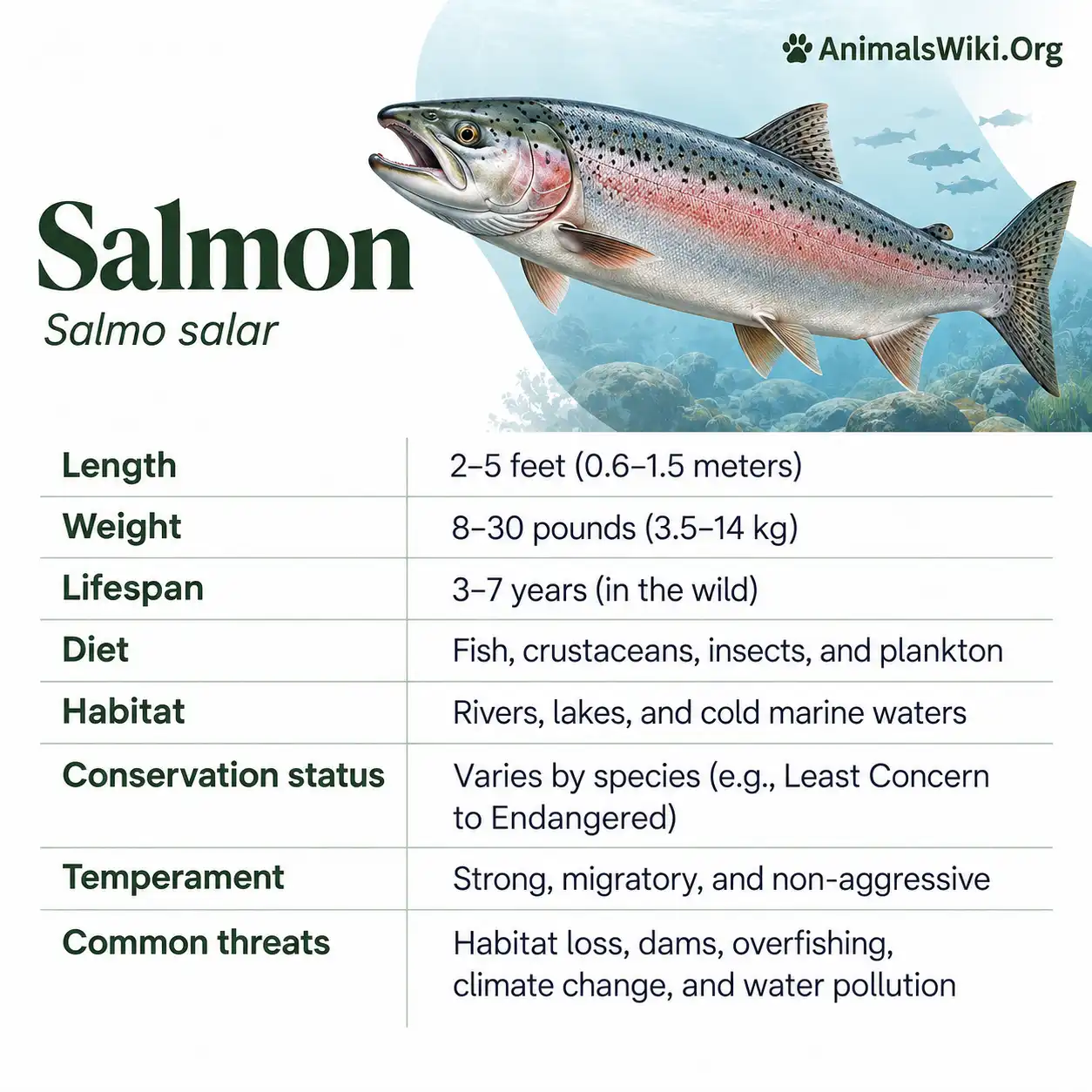
| Feature | Details |
|---|---|
| Common Name | Salmon |
| Scientific Name | Genus Oncorhynchus (Pacific salmon, 7 species); Salmo salar (Atlantic salmon) |
| Family | Salmonidae |
| Order | Salmoniformes |
| First Described | 1758 (Atlantic Salmon, by Carl Linnaeus) |
| Native Habitat | Rivers, streams, and open ocean; anadromous life cycle spans both |
| Geographic Range | North Pacific and North Atlantic river systems and adjacent ocean waters |
| Average Size | 45–150 cm depending on species |
| Average Weight | 1.5–30+ kg depending on species |
| Lifespan | 2–8 years depending on species (most Pacific species die after spawning) |
| Diet | Carnivore — plankton, insects, crustaceans, smaller fish (varies by life stage) |
| Conservation Status | Ranges from Least Concern to Endangered depending on species and population |
| Defining Feature | Anadromous life cycle (born in freshwater, matures at sea, returns to natal river to spawn); extraordinary natal river homing ability; dramatic post-spawning death in most Pacific species |
| Number of Species | 8 primary species (7 Pacific salmon + Atlantic salmon), plus numerous closely related trout and char species |
1. Salmon Species Overview & Classification
In the shallow, gravel-bottomed headwaters of a small Alaskan stream, dozens of kilometers inland from the Pacific Ocean and thousands of kilometers from the open-water feeding grounds where it spent the great majority of its adult life, a battered, deep-red sockeye salmon fights its way upstream against a current that has already carried away most of its remaining strength. Its body, silver and streamlined just weeks earlier, has transformed almost beyond recognition — hooked jaw, humped back, skin scarred and fraying — as it pushes toward the exact gravel bed where it hatched several years before, guided by a navigational sense so precise that scientists still do not fully understand every mechanism behind it. Within days of spawning, this fish will die, its body decomposing directly into the forest floor and river ecosystem that will, in turn, nourish its own future offspring. It is one of the most extraordinary, most physically demanding, and most ecologically consequential life-cycle journeys undertaken by any animal on Earth — and it is simply what a salmon does, every single generation, as a matter of basic biological routine.
The salmon is a group of large, predatory fish belonging to the family Salmonidae, encompassing eight primary species — seven species of Pacific salmon (genus Oncorhynchus) native to the North Pacific basin, and the Atlantic salmon (Salmo salar), native to the North Atlantic — alongside numerous closely related trout and char species that share significant evolutionary and ecological history within the same broader fish family. Salmon are defined above all by their remarkable anadromous life cycle: nearly all salmon are born in freshwater rivers and streams, migrate to the ocean to grow and mature over a period of one to several years, and then undertake an extraordinary, often physically punishing return migration back to freshwater — frequently to the exact same river, and often the very same specific stretch of stream, where they themselves hatched — to spawn a new generation before, in the case of the great majority of Pacific salmon species, dying shortly thereafter.
Salmon occupy a genuinely unique and multifaceted position within both natural ecology and human civilization: they are simultaneously one of the most ecologically important species in the entire North Pacific and North Atlantic coastal ecosystem — a foundational nutrient-transport mechanism connecting ocean and forest ecosystems in a manner few other animals on Earth replicate — and one of the most economically, culturally, and nutritionally significant fish species in human history, supporting Indigenous subsistence traditions extending back thousands of years, a globally significant commercial and recreational fishing industry, and, increasingly, one of the largest and most consequential aquaculture industries in the modern food system. At the same time, wild salmon populations across substantial portions of their historical range — particularly in the American Pacific Northwest and across much of the historical Atlantic salmon range in Europe and eastern North America — have experienced genuinely severe, well-documented declines, making salmon conservation and river restoration among the most closely watched, most politically significant, and most scientifically studied areas of modern fisheries and freshwater ecosystem management.
Species Classification Table
| Classification Level | Details |
|---|---|
| Kingdom | Animalia |
| Phylum | Chordata |
| Class | Actinopterygii (ray-finned fishes) |
| Order | Salmoniformes |
| Family | Salmonidae |
| Genera | Oncorhynchus (Pacific salmon); Salmo (Atlantic salmon) |
| Described By | Carl Linnaeus, 1758 (Atlantic Salmon) |
| Closest Relatives | Trout, char, and whitefish (all family Salmonidae) |
The Eight Primary Salmon Species
| Species | Scientific Name | Range | Notes |
|---|---|---|---|
| Chinook (King) Salmon | Oncorhynchus tshawytscha | North Pacific | Largest Pacific salmon species; can exceed 30 kg |
| Sockeye (Red) Salmon | Oncorhynchus nerka | North Pacific | Dramatic red spawning coloration; heavily lake-dependent life cycle |
| Coho (Silver) Salmon | Oncorhynchus kisutch | North Pacific | Popular sport fish; wide coastal river distribution |
| Pink (Humpback) Salmon | Oncorhynchus gorbuscha | North Pacific | Smallest Pacific salmon; strict 2-year life cycle |
| Chum (Dog) Salmon | Oncorhynchus keta | North Pacific | Widest natural geographic range of Pacific salmon |
| Masu (Cherry) Salmon | Oncorhynchus masou | Western Pacific (Japan, Russia, Korea) | Some populations do not migrate to sea |
| Amago Salmon | Oncorhynchus masou ishikawae | Japan | Often treated as a subspecies of masu salmon |
| Atlantic Salmon | Salmo salar | North Atlantic | Only salmon species that can survive and repeat-spawn multiple times |
The Name “Salmon”
The word “salmon” derives from the Latin “salmo,” with the most widely cited etymological theory connecting the term to the Latin verb “salire,” meaning “to leap” — an entirely fitting reference to the species’ famous, powerful leaping behavior used to ascend waterfalls, rapids, and other obstacles during the upstream spawning migration described extensively throughout this guide.
Did You Know? Salmon possess a navigational homing ability so precise that most individuals return not merely to their natal river system, but frequently to the exact same tributary stream or gravel bed where they themselves hatched years earlier — a feat scientists believe is accomplished substantially through an extraordinarily refined olfactory (smell) memory of the unique chemical signature of their natal stream water, imprinted during the fish’s earliest freshwater life stage and recalled with remarkable precision after years spent in the open ocean, often thousands of kilometers away.
2. Salmon Physical Description & Unique Features
The salmon’s body reflects one of the most physically demanding and physiologically transformative life cycles of any vertebrate animal — a body plan and suite of adaptations built around efficient long-distance ocean swimming, dramatic freshwater physiological transformation, and the extraordinary energetic demands of the upstream spawning migration.
Size and Build
Salmon size varies considerably across the eight primary species:
Chinook Salmon (largest species):
- Length: 60–100 cm typical; exceptional individuals can exceed 1.5 m
- Weight: Typically 4–20 kg; record individuals have exceeded 30 kg (66 lbs)
Pink Salmon (smallest species):
- Length: 45–60 cm
- Weight: Typically 1.5–2.5 kg
Atlantic Salmon:
- Length: 60–100 cm typical
- Weight: Typically 3.5–12 kg, with larger individuals documented, particularly in northern populations
Body shape: A streamlined, laterally compressed (though less dramatically flattened than many other fish groups), torpedo-like body form well suited to efficient sustained ocean swimming, with a distinctly forked tail fin providing strong propulsive power for both routine swimming and the powerful leaping behavior described extensively in the Reproduction section.
The Dramatic Spawning Transformation
Perhaps the single most visually and physiologically remarkable feature of salmon biology is the genuinely dramatic physical transformation many species undergo as they transition from ocean-dwelling adults to spawning freshwater fish:
- Coloration change: Ocean-phase salmon typically display a bright, uniform silver coloration on the flanks and belly, providing effective camouflage in open water (discussed further in the Predators section); upon entering freshwater to spawn, many species undergo a dramatic color shift — sockeye salmon transform to a vivid, almost fluorescent red body with a contrasting green head, one of the most visually striking transformations in any fish species, while other species develop varying combinations of red, olive, black, or mottled patterning depending on species and sex
- Body shape changes (males particularly): Male salmon of several species, particularly Pacific species, develop a pronounced hooked jaw (kype) and, in some species including pink and sockeye salmon, a dramatically humped back, structural changes believed to serve functions in male-male competitive display and combat during the spawning process, discussed further in the Reproduction section
- Skin and tissue deterioration: As the spawning migration and subsequent spawning process itself place extraordinary physiological demands on the fish’s body, described extensively in the Reproduction section, spawning-phase salmon typically show progressive skin deterioration, fraying fins, and overall visible physical decline as the fish’s body essentially begins consuming its own tissue reserves to fuel the migration and reproductive effort
Osmoregulation — A Genuine Physiological Marvel
One of the most scientifically remarkable aspects of salmon biology, largely invisible to casual observation but fundamental to the species’ entire life history, is the animal’s capacity for dramatic osmoregulatory transition between freshwater and saltwater environments:
- Smoltification: Young salmon preparing to migrate from their natal freshwater habitat to the ocean undergo a significant physiological transformation process called smoltification, during which the fish’s gills, kidneys, and broader internal chemistry are substantially reorganized to shift from the freshwater-adapted osmoregulatory mode of early life (in which the fish must actively excrete excess water while retaining salts) to the saltwater-adapted mode required for ocean survival (in which the fish must instead actively excrete excess salt while retaining water) — a genuinely complex, hormonally driven physiological transition representing one of the more significant internal transformations documented in any vertebrate life cycle
- Reverse transition upon return: Salmon returning to freshwater to spawn must undergo a broadly reverse physiological transition, once again reorganizing their osmoregulatory systems to function in freshwater conditions — meaning a single salmon’s life history involves not one but two major osmoregulatory transformations, a genuinely demanding physiological requirement unmatched by the great majority of fish species, which typically remain confined to either freshwater or saltwater throughout their entire lives
The Adipose Fin
Like several other members of the broader Salmonidae family, salmon possess a small, fleshy adipose fin located on the back between the dorsal fin and tail — a feature lacking any known swimming-propulsion function but serving as a useful taxonomic identification marker distinguishing salmonids from many other fish families, and one commonly clipped by fisheries managers as a marking technique to identify hatchery-origin fish, discussed further in the Human Relationships section.
Sensory Adaptations
Extraordinary olfactory capability: As introduced in the Species Overview section, salmon possess a genuinely remarkable sense of smell, believed to be central to the species’ famous natal-stream homing navigation capability, discussed extensively in the Reproduction section
Lateral line system: Like most fish, salmon possess a well-developed lateral line sensory system, detecting water movement and vibration, contributing to both prey detection and broader environmental navigation
Vision adapted to variable light conditions: Salmon possess visual capability adapted to the considerable range of light conditions encountered across their life cycle, from clear, sunlit freshwater streams to the often dim, variable-depth conditions of open ocean habitat.
3. Salmon Habitat & Geographic Range
Salmon occupy one of the most genuinely dual, geographically expansive habitat ranges of any fish group on Earth, spanning freshwater river systems and the open ocean across the entire North Pacific and North Atlantic basins, connected by the extraordinary anadromous migration cycle described throughout this guide.
Preferred Habitat Features
Cool, clean, well-oxygenated freshwater streams (natal/spawning habitat) — the essential freshwater habitat requirement for salmon reproduction, described extensively in the Reproduction section; salmon require gravel-bottomed stream sections with adequate water flow and oxygenation for successful egg incubation, and are notably sensitive to water temperature, sedimentation, and pollution within these critical spawning habitat areas
Unobstructed river connectivity — given the species’ fundamental dependence on migration between ocean and specific natal freshwater spawning sites, described throughout this guide, unobstructed river connectivity — free from impassable dams or other barriers — represents an absolutely critical habitat requirement, discussed extensively in the Conservation section
Productive open ocean feeding grounds — the marine phase of the salmon life cycle depends on access to productive, prey-rich ocean waters, described further in the Diet section, where salmon spend the great majority of their adult growth period before returning to spawn
Estuarine transition zones — the brackish water transition zones where rivers meet the ocean serve a genuinely important habitat function as staging and physiological transition areas during both the outmigration of young salmon (smolts) to the ocean and the return migration of mature adults back toward freshwater spawning grounds
Habitat Types Occupied by Life Stage
| Habitat | Life Stage | Notes |
|---|---|---|
| Gravel-bottomed stream beds | Egg incubation, early juvenile (alevin/fry) | Critical spawning and early development habitat |
| Freshwater rivers and lakes | Juvenile rearing (species-dependent duration) | Varies considerably by species; sockeye particularly lake-dependent |
| Estuaries | Smolt transition, adult return staging | Osmoregulatory transition zone |
| Open ocean (North Pacific/Atlantic) | Adult growth and maturation | Primary feeding and growth period; can span thousands of km |
| Return river migration corridor | Spawning migration | Extraordinary upstream journey, described extensively in Reproduction section |
Geographic Range
Current range by species group:
| Region | Key Countries | Primary Species | Population Status |
|---|---|---|---|
| North Pacific (eastern) | United States (Alaska, Pacific Northwest), Canada | All 7 Pacific salmon species | Variable; Alaska generally robust, Pacific Northwest/California significantly depleted in many watersheds |
| North Pacific (western) | Russia, Japan, Korea | Pacific salmon species, particularly Masu | Variable; Russian Far East populations relatively robust |
| North Atlantic (western) | Eastern Canada, Northeastern United States | Atlantic Salmon | Severely depleted; many historical US populations extirpated |
| North Atlantic (eastern) | Norway, Scotland, Ireland, and broader Europe | Atlantic Salmon | Variable; significant historical decline in many rivers |
The Extraordinary Scale of Salmon Ocean Migration
Depending on species and specific population, salmon ocean migration can involve genuinely vast distances — Pacific salmon populations, particularly certain Chinook and sockeye populations, are documented undertaking ocean migrations spanning thousands of kilometers across the North Pacific basin before returning to their precise natal river system, representing one of the most geographically extensive individual animal migration cycles documented among any vertebrate species, freshwater or marine, covered throughout this broader guide series.
4. Salmon Diet & Feeding Behavior
Salmon diet shifts substantially across the species’ dramatic, multi-stage life cycle, reflecting the considerable differences between the freshwater juvenile environment, the open ocean adult feeding environment, and the largely non-feeding freshwater spawning migration phase.
What Salmon Eat — By Life Stage
Freshwater juvenile stage (fry/parr):
- Aquatic insects and their larvae — the dietary foundation for young salmon during their freshwater rearing period, described extensively in the Reproduction section, including mayfly, caddisfly, and stonefly larvae among numerous other aquatic invertebrate prey
- Zooplankton — particularly significant for species and populations spending an extended juvenile period in freshwater lakes, notably including sockeye salmon populations with strong lake-dependent juvenile rearing habits
Ocean adult stage:
- Zooplankton — a significant dietary component, particularly for smaller salmon species and younger ocean-phase individuals
- Small fish — including herring, sand lance, and various other small forage fish species, representing an increasingly significant dietary component as salmon grow larger during their ocean feeding period
- Squid and other cephalopods — consumed opportunistically by several salmon species during ocean residence
- Crustaceans — including various small crustacean species, contributing to overall dietary breadth during ocean feeding, and notably responsible for the characteristic pink-to-red flesh coloration many salmon species display, derived from carotenoid pigments obtained through crustacean-rich prey consumption
Spawning migration phase:
- Minimal to no feeding: As detailed extensively in the Reproduction section, the great majority of Pacific salmon species cease feeding entirely upon re-entering freshwater to begin their spawning migration, relying instead on substantial fat and energy reserves accumulated during the preceding ocean feeding period to fuel the entire remaining migration and spawning process — one of the most physiologically demanding examples of sustained fasting documented among any vertebrate species
The Carotenoid-Derived Flesh Coloration
As referenced above, the characteristic pink-to-deep-red flesh coloration associated with salmon — and specifically prized within both wild-caught and farmed salmon culinary and commercial contexts, discussed further in the Human Relationships section — derives directly from carotenoid pigments, particularly astaxanthin, obtained through the fish’s ocean-phase diet of crustaceans and other carotenoid-rich prey; this dietary connection is directly relevant to modern salmon aquaculture practice, since farmed salmon, lacking access to the same wild ocean prey base, require deliberate dietary carotenoid supplementation to achieve the characteristic flesh coloration consumers expect and associate with the species.
Feeding Behavior Patterns
Opportunistic ocean foraging: During the extended ocean feeding phase, salmon behave as genuinely active, opportunistic predators, foraging across considerable depth ranges and geographic distances in pursuit of the varied prey base described above, building the substantial fat and energy reserves that will ultimately fuel the demanding freshwater spawning migration
Growth rate and feeding intensity: The ocean feeding period represents the primary growth phase of the salmon life cycle, during which individual fish can achieve dramatic size increases — a young salmon smolt entering the ocean at a modest juvenile size may return to spawn one to several years later at many times its original body weight, reflecting the genuinely substantial feeding intensity and prey availability characteristic of productive North Pacific and North Atlantic marine ecosystems.
5. Salmon Reproduction & Life Cycle
Salmon reproductive biology, centered on the species’ extraordinary anadromous migration cycle, represents one of the most physically demanding, scientifically fascinating, and ecologically significant reproductive strategies found in any vertebrate animal on Earth.
The Anadromous Life Cycle — A Complete Overview
The salmon life cycle unfolds across several genuinely distinct stages, each representing a significant physiological and ecological transition:
| Stage | Timing/Duration | Description |
|---|---|---|
| Egg | Weeks to months (species/temperature dependent) | Incubation within gravel nest (redd) |
| Alevin | Weeks following hatching | Remains in gravel; nourished by attached yolk sac |
| Fry | Following yolk sac absorption | Emerges from gravel; begins independent feeding |
| Parr | Months to years (species-dependent) | Freshwater juvenile growth stage; develops camouflage markings |
| Smolt | Transition period | Undergoes smoltification (described in Physical Description section); migrates to estuary/ocean |
| Ocean adult | 1–7 years (species-dependent) | Primary growth and maturation period at sea |
| Spawning migration adult | Weeks to months | Return migration to natal freshwater spawning grounds |
| Post-spawning | Days to weeks | Death (most Pacific species) or potential repeat spawning (Atlantic salmon) |
Natal River Homing — One of Nature’s Great Navigational Mysteries
As introduced extensively in the Species Overview section, the salmon’s capacity to navigate back to its precise natal river system — and frequently to the specific tributary stream or even the exact gravel bed where it originally hatched — after spending one to several years, and often thousands of kilometers, in open ocean habitat represents one of the most scientifically remarkable and, in certain specific mechanistic respects, still incompletely understood navigational feats in the animal kingdom:
- Olfactory imprinting: The leading scientific explanation for salmon natal-river homing centers on olfactory (smell) imprinting — young salmon are believed to memorize the unique chemical signature of their natal stream water during their early freshwater life stage, an imprinted memory subsequently recalled with remarkable precision when the mature adult salmon re-enters coastal and river waters years later, using this remembered scent signature to navigate progressively closer to the precise natal spawning location
- Broader navigational mechanisms: Beyond olfactory imprinting specifically, researchers believe salmon likely also utilize additional navigational cues during the broader open-ocean portion of the return migration, potentially including geomagnetic field sensing (a navigational mechanism increasingly documented across numerous long-distance migratory animal species) to achieve the initial broad-scale ocean navigation back toward the general coastal region of their natal river system, before olfactory imprinting takes over for the more precise final-stage river and tributary navigation
- Genuine scientific significance: Salmon homing behavior remains an active area of ongoing scientific research interest, given both its inherent biological fascination and its direct practical relevance to fisheries management, hatchery program design, and conservation strategy, discussed further in the Human Relationships and Conservation sections
The Spawning Process
- Nest (redd) construction: Female salmon construct a nest, called a redd, in suitable gravel substrate by using powerful tail movements to excavate a depression, into which eggs are subsequently deposited
- Egg deposition and fertilization: As the female deposits eggs into the redd, one or more males simultaneously release milt (sperm) over the eggs, achieving external fertilization; a single female salmon may lay several thousand eggs across the spawning process, reflecting a broader reproductive strategy of producing substantial offspring numbers to offset the very significant egg, alevin, and juvenile mortality rates the species experiences
- Redd covering: Following egg deposition and fertilization, the female typically covers the redd with additional gravel, using further tail movements, providing the developing eggs with a degree of physical protection from both predation and physical disturbance
- Male competition: As referenced in the Physical Description section, male salmon frequently engage in genuinely vigorous competitive behavior — including direct physical combat using the hooked jaw (kype) structure many species develop — to establish access to spawning females, a competitive process that can result in significant physical injury among competing males
Semelparity — The Dramatic Post-Spawning Death of Most Pacific Salmon
One of the single most scientifically and popularly striking features of salmon biology is the phenomenon of semelparity — reproducing only once in a lifetime, followed by death — characteristic of the great majority of Pacific salmon species:
- The physiological mechanism: Following the extraordinarily demanding combination of an extended fasting period during the spawning migration (described in the Diet section) and the substantial physical exertion of both the upstream migration itself and the spawning process, most Pacific salmon experience a cascade of physiological deterioration — including immune system collapse, tissue breakdown, and organ failure — resulting in death typically within days to a few weeks following spawning
- The ecological significance of post-spawning death: As detailed extensively in the Ecosystem Role section, the death and subsequent decomposition of spawned-out salmon represents one of the most ecologically significant nutrient-transport phenomena in the entire North Pacific coastal ecosystem, transferring substantial marine-derived nutrients directly into freshwater and forest ecosystems
- Atlantic salmon’s notable exception: The Atlantic salmon stands as a genuine and scientifically significant exception to this broader pattern — while Atlantic salmon spawning is also extremely physically demanding and many individuals do die following the process, a meaningful proportion of Atlantic salmon, referred to as “kelts” following spawning, are capable of surviving, returning to the ocean to recover and feed, and subsequently undertaking repeat spawning migrations in subsequent years, a genuine iteroparous (multiple-reproduction) reproductive strategy distinguishing the species from its semelparous Pacific relatives
Salmon Lifespan
- Pacific salmon species: Typically 2–7 years total lifespan, varying considerably by species — pink salmon follow a notably strict, essentially invariable 2-year life cycle, while Chinook salmon populations can range from 2 to as long as 7–8 years, reflecting the considerable life-history variation across the seven Pacific salmon species
- Atlantic salmon: Similarly variable, typically 3–8 years, with the meaningful possibility of extended lifespan among the repeat-spawning “kelt” individuals described above.
6. Social Behavior & Communication
Salmon social behavior varies considerably across the species’ dramatically different life-cycle stages, ranging from relatively solitary ocean-phase feeding behavior to the genuinely dense, highly coordinated aggregation behavior characteristic of the upstream spawning migration and spawning process itself.
Schooling During Juvenile and Ocean Phases
Young salmon during the freshwater juvenile rearing period, and adult salmon during portions of the ocean feeding phase, frequently exhibit schooling behavior, broadly consistent with the schooling patterns documented across numerous other fish species covered elsewhere in this broader guide series, providing collective predator-vigilance benefit and potentially improved foraging efficiency through group coordination.
The Spawning Migration — Mass Coordinated Movement
The upstream spawning migration itself represents one of the most visually dramatic and ecologically significant examples of mass coordinated animal movement documented in the natural world:
- Run timing and synchronization: Salmon populations, or “runs,” typically show meaningful synchronization in their return migration timing, with the great majority of a given population’s spawning-bound adults entering their natal river system within a relatively concentrated seasonal window — a synchronization believed to reflect both genetically influenced timing cues and environmental factors including water temperature and flow conditions
- Density and scale: Certain major salmon runs, particularly in Alaska and the Russian Far East, involve genuinely staggering numbers of returning fish — some of the largest documented sockeye salmon runs have involved tens of millions of individual fish moving through a single river system within a concentrated seasonal window, representing one of the most numerically massive coordinated wildlife movements documented anywhere on Earth
Territorial Behavior on the Spawning Grounds
While salmon are not generally considered a persistently territorial species across most of their life cycle, genuine territorial and competitive behavior does emerge specifically within the spawning grounds context, described extensively in the Reproduction section, particularly among competing males seeking access to spawning females, and to a lesser extent among females competing for the most favorable redd construction sites within limited suitable spawning habitat.
Communication
Salmon communication relies substantially on the chemical/olfactory signaling described extensively in the Reproduction section (particularly relevant to the natal-river homing navigation process), visual cues (including the dramatic breeding coloration and body shape changes described in the Physical Description section, which likely play a role in mate selection and male-male competitive assessment), and, to a lesser and less thoroughly documented extent, other sensory channels including the lateral-line water-vibration detection system common across fish more broadly — salmon are not generally understood to possess the more elaborate vocal communication systems documented in various other animal groups covered throughout this broader guide series, reflecting the broader general pattern of limited vocal communication among most fish species.
7. Predators & Defense Mechanisms
Salmon face substantial and genuinely significant predation pressure across every major stage of their extraordinary life cycle, from vulnerable freshwater eggs and juveniles through the considerable ocean-phase predation risk and, ultimately, the acute vulnerability of the concentrated, exhausted spawning migration itself.
Natural Predators — By Life Stage
Freshwater egg and juvenile stage:
- Other fish species — including various trout and sculpin species, significant predators of salmon eggs and small juvenile fish within freshwater rearing habitat
- Aquatic insects — including larger predatory insect larvae, documented predators of the smallest salmon fry
- Birds — including herons, mergansers, and kingfishers, significant predators of juvenile salmon in freshwater streams
Ocean adult stage:
- Marine mammals — including seals, sea lions, and, significantly, orcas (killer whales), which represent a genuinely important predator of adult salmon across substantial portions of the North Pacific range, with certain orca populations, notably the endangered Southern Resident orca population of the Pacific Northwest, showing a documented, significant dietary dependence specifically on Chinook salmon
- Sharks — various shark species prey on adult salmon within ocean habitat
Spawning migration and spawning grounds:
- Bears — one of the most famous and visually iconic salmon predation relationships in the natural world; brown bears (grizzlies) and black bears across the Pacific Northwest and Alaska rely substantially on concentrated salmon spawning runs as a critical seasonal food resource, discussed extensively in the Ecosystem Role and Famous Salmon Runs sections, with individual bears capable of catching and consuming remarkable numbers of salmon during peak run periods
- Bald eagles — significant predators and scavengers of both live spawning salmon and, notably, post-spawning salmon carcasses, with major salmon spawning rivers historically supporting some of the largest documented seasonal bald eagle concentrations in North America
- Wolves and other terrestrial predators — documented opportunistic predators of spawning salmon in various regions where wolf and salmon spawning-run ranges overlap
Defense Strategies
Schooling as juvenile/ocean-phase defense: As described in the Social Behavior section, schooling behavior during the freshwater juvenile and portions of the ocean adult phase provides meaningful collective predator-vigilance and predator-confusion benefit consistent with schooling defense mechanisms documented broadly across numerous other fish species
Camouflage: Ocean-phase salmon’s characteristic bright silver coloration, described extensively in the Physical Description section, provides effective camouflage against the reflective, light-scattering conditions of open ocean water, reducing visual detectability to predators approaching from various angles
Swimming speed and agility: Salmon possess considerable swimming speed and agility, providing an important evasive escape mechanism against many predators, particularly relevant during the ocean feeding phase
Numerical overwhelm during spawning migration: Given the genuinely massive scale of many salmon spawning runs, described extensively in the Social Behavior section, the sheer numerical abundance of migrating and spawning fish during peak run periods likely provides a meaningful degree of population-level predator-satiation protection — even with substantial individual predation losses to bears, eagles, and other predators during the concentrated spawning period, the overall population-level reproductive success is generally sufficient to sustain the species given the extraordinary total number of spawning individuals and eggs produced.
8. Relationship with Humans
Indigenous Cultural and Subsistence Significance
Salmon hold among the deepest, most sustained, and most culturally foundational relationships with Indigenous peoples of any animal covered throughout this broader guide series, particularly across the Pacific Northwest of North America:
Foundational subsistence and cultural role: For Indigenous peoples of the Pacific Northwest coast — including numerous distinct nations across present-day Alaska, British Columbia, Washington, and Oregon — salmon has served as an absolutely central subsistence food source, cultural touchstone, and spiritual figure for thousands of years, with salmon fishing, preservation techniques (including traditional smoking and drying methods), and associated ceremonial practice representing a foundational element of traditional Pacific Northwest Indigenous life and cultural identity that continues today
The “First Salmon Ceremony”: Numerous Pacific Northwest Indigenous nations maintain traditional First Salmon Ceremonies, observed at the beginning of each season’s salmon spawning run, involving ceremonial recognition and respect for the returning salmon — reflecting a deep, sustained cultural and spiritual tradition of gratitude and reciprocal respect for the species that continues to be actively practiced by many communities today
Treaty rights and modern legal significance: Indigenous salmon fishing rights, established through historical treaties between various Pacific Northwest nations and the United States and Canadian governments, remain a genuinely significant and, in various ongoing legal and political contexts, actively contested area of modern Indigenous rights law and natural resource policy, particularly in the context of the significant salmon population declines and dam-related habitat impacts discussed extensively in the Conservation section
Commercial and Recreational Fishing
Salmon represent one of the most economically significant fish species in modern commercial and recreational fisheries across the North Pacific and North Atlantic regions:
- Commercial fisheries — Alaska specifically maintains one of the largest and most carefully, sustainably managed commercial salmon fisheries in the world, representing a genuinely significant regional economic sector and widely cited as a comparative model of effective, science-based sustainable fisheries management relative to the more severely depleted salmon fisheries historically documented across much of the Pacific Northwest United States and North Atlantic
- Recreational fishing — salmon fishing represents a genuinely significant recreational and sport-fishing tradition across much of the species’ range, supporting substantial regional tourism economies, particularly in Alaska, the Pacific Northwest, and various North Atlantic salmon fishing destinations in Scotland, Norway, and eastern Canada
Salmon Aquaculture — A Transformative Modern Industry
Beyond wild-caught fisheries, salmon aquaculture (fish farming) has grown into one of the largest and most economically significant aquaculture industries in the entire modern global food system:
- Scale and significance: Farmed salmon — predominantly Atlantic salmon raised in net-pen aquaculture operations across Norway, Chile, Scotland, Canada, and other significant producing regions — now represents the majority of total global salmon consumption by volume, a genuinely significant transformation of the broader salmon food-supply landscape relative to historical reliance on wild-caught fisheries alone
- Environmental considerations: Salmon aquaculture has generated significant, ongoing environmental and scientific discussion regarding various potential impacts, including concerns regarding sea lice transmission to wild salmon populations in areas of aquaculture-wild population proximity, the ecological consequences of occasional farmed-salmon escape events, and the broader environmental footprint of the industry’s substantial feed and waste management requirements — an active, ongoing area of fisheries science, environmental policy, and industry practice evolution
Hatchery Programs
Extensive salmon hatchery programs, operated across much of the species’ range by government fisheries agencies, Indigenous nations, and various conservation organizations, represent a significant and, in various contexts, genuinely contested modern fisheries management tool — used both to supplement wild population numbers in support of commercial and recreational fishing opportunity, and, increasingly, as a specific conservation intervention aimed at supporting the recovery of severely depleted wild salmon populations discussed extensively in the Conservation section, though hatchery program design and broader genetic and ecological interaction with wild population dynamics remains an area of considerable ongoing scientific and management debate.
9. Salmon Conservation Status & Threats
Conservation Status Overview
Salmon conservation status varies dramatically across the eight primary species and, critically, across the numerous distinct regional populations within each species — reflecting genuinely divergent regional histories of habitat impact, fisheries management, and dam construction:
| Population Context | General Status |
|---|---|
| Alaska Pacific salmon populations | Generally robust; considered a global model of sustainable management |
| Pacific Northwest US (Washington, Oregon, California, Idaho) populations | Severely depleted; numerous populations formally listed as Threatened or Endangered under the US Endangered Species Act |
| Russian Far East populations | Generally more robust than Pacific Northwest US, though data and monitoring less comprehensive |
| Atlantic salmon (North America) | Severely depleted; historical range across the northeastern US now largely extirpated |
| Atlantic salmon (Europe) | Significant historical decline across much of range, with considerable regional variation |
The Pacific Northwest Salmon Crisis — A Defining Modern Conservation Story
The dramatic decline of wild salmon populations across the Pacific Northwest United States, particularly within the vast Columbia and Snake River basin, represents one of the most significant, closely studied, and politically consequential fisheries conservation crises in North American environmental history:
- Historical abundance versus modern decline: Historical estimates suggest the Columbia River basin once supported salmon and steelhead runs numbering in the many millions of fish annually; modern populations across numerous specific runs and species within this same river system have declined by well over 90% from these historical baseline levels, with several distinct populations formally listed as Threatened or Endangered
- Dam construction as the primary historical driver: The construction of numerous major hydroelectric dams across the Columbia and Snake River system during the 20th century is widely identified by fisheries scientists as the single most significant historical driver of this decline, given salmon’s absolute dependence on unobstructed river connectivity for both the juvenile downstream migration to the ocean and the adult upstream spawning migration described extensively throughout this guide — while many Columbia and Snake River dams incorporate fish passage infrastructure (including fish ladders), this infrastructure provides only partial mitigation of the substantial cumulative mortality and migration delay these barriers impose across a river system with numerous sequential dam structures
- The ongoing Snake River dam removal debate: The question of whether to remove several specific major dams on the lower Snake River, a tributary of the Columbia, specifically to support salmon population recovery represents one of the most significant, sustained, and politically contested environmental policy debates in the contemporary Pacific Northwest, involving complex tradeoffs between salmon conservation, regional hydroelectric power generation, agricultural irrigation and barge transportation interests, and Indigenous treaty rights, and remains an active, unresolved area of regional environmental policy discussion as of this writing
Current Threats
1. Dam Construction and River Fragmentation
As detailed extensively above, dams and other river infrastructure that obstruct or impede salmon migration represent the single most significant, sustained historical and ongoing threat to salmon populations across substantial portions of their range, particularly severe within the Pacific Northwest United States.
2. Habitat Degradation
Beyond dam-related connectivity impacts specifically, broader freshwater habitat degradation — including sedimentation, water temperature increases (from both climate change and reduced riparian forest cover), agricultural and urban runoff pollution, and stream channelization — significantly affects salmon spawning and juvenile rearing habitat quality across much of the species’ range.
3. Overfishing (Historical and Ongoing Regional Concern)
While modern commercial salmon fisheries in well-managed regions such as Alaska generally operate under genuinely sustainable, science-based harvest management frameworks, historical overfishing significantly contributed to salmon population decline across various portions of the species’ range, and inadequately regulated or monitored fishing pressure remains an ongoing concern in certain specific regional and international contexts.
4. Climate Change
Ocean warming and broader climate change impacts represent a significant and, in several respects, increasingly severe modern threat consideration, affecting salmon through multiple pathways including altered ocean prey availability and productivity, increased freshwater stream temperatures that can exceed physiological tolerance thresholds during critical migration and spawning periods, and altered precipitation and snowpack patterns affecting river flow timing and volume.
5. Aquaculture-Related Impacts
As referenced in the Human Relationships section, potential sea lice transmission from net-pen salmon aquaculture operations to wild salmon populations, along with the ecological consequences of occasional farmed-salmon escape events (including potential genetic and disease interaction with wild populations), represent ongoing, actively studied conservation concerns in regions where aquaculture and wild salmon populations occur in close proximity.
6. Predation Pressure Interactions
In certain specific, closely studied cases — including notably the documented relationship between declining Chinook salmon populations and the endangered Southern Resident orca population described in the Predators section — predator-prey population dynamics have become directly, significantly entangled with broader salmon conservation policy, given the orca population’s substantial dietary dependence on already-depleted Chinook salmon stocks, illustrating the broader cascading ecological consequences of salmon population decline extending well beyond the salmon populations themselves.
10. Famous Salmon Runs Around the World
Bristol Bay, Alaska — The World’s Largest Sockeye Run
Bristol Bay, Alaska, hosts what is widely regarded as the largest sockeye salmon run remaining on Earth, with annual returns frequently exceeding 50 million fish in strong years, representing one of the most significant, ecologically and economically consequential wild salmon fisheries anywhere in the world, and a run that has become a significant focal point of ongoing conservation advocacy given proposed large-scale mining development within the watershed that conservation organizations argue could pose substantial risk to this globally significant salmon habitat.
Brooks Falls, Katmai National Park — The Iconic Bear-Salmon Encounter
Brooks Falls within Alaska’s Katmai National Park has become one of the most internationally recognized and widely photographed locations for observing the famous predator-prey relationship between brown bears and spawning salmon described extensively in the Predators section, with dramatic footage and photography of bears catching leaping sockeye salmon directly at the falls representing some of the most iconic and widely circulated wildlife imagery associated with the species, and the park’s live “Bear Cam” webcam coverage of the falls has developed a substantial international viewing following during peak salmon run season.
The Columbia River — A Historic and Contested Legacy
As detailed extensively in the Conservation section, the Columbia River basin’s historical salmon abundance and subsequent dramatic modern decline represents one of the most significant and closely studied individual river system salmon conservation stories in the world, with the river’s numerous historically massive salmon runs, and their substantial modern reduction, serving as a defining case study in the broader field of dam-related fisheries impact and river restoration policy.
11. Role in Ecosystem & Food Chain
The Salmon as an Extraordinary Marine-to-Terrestrial Nutrient Transport Mechanism
Perhaps no aspect of salmon ecology has received more dedicated scientific research attention in recent decades than the species’ genuinely remarkable role in transporting substantial quantities of marine-derived nutrients into freshwater and terrestrial forest ecosystems — a phenomenon representing one of the most significant and best-documented examples of cross-ecosystem nutrient transfer performed by any animal species on Earth:
- The nutrient transport mechanism: Salmon spend the great majority of their adult growth period feeding within productive ocean ecosystems, accumulating substantial body mass and associated nutrients (including nitrogen and phosphorus derived from marine prey); upon their spawning migration and, critically, their subsequent post-spawning death (described extensively in the Reproduction section for the great majority of Pacific salmon species), this substantial accumulated marine nutrient mass is deposited directly into freshwater river systems and, through predator transport and decomposition, into the surrounding forest ecosystem
- Bears as nutrient distribution agents: Research has specifically documented that bears, described extensively in the Predators section, frequently carry captured salmon considerable distances away from the riverbank into surrounding forest habitat before consuming them, subsequently depositing salmon-derived nutrients (through incomplete consumption, waste, and eventual decomposition) directly into forest soil — research examining nitrogen isotope signatures in riparian forest vegetation near major salmon spawning rivers has documented measurable, substantial salmon-derived nutrient contribution to forest tree growth extending considerable distances from the riverbank itself, a genuinely remarkable and well-documented example of an aquatic species’ ecological influence extending meaningfully into an entirely separate terrestrial ecosystem
- Direct river ecosystem nutrient contribution: Beyond the specific bear-mediated forest transport pathway, the direct decomposition of spawned-out salmon carcasses within river systems themselves provides substantial nutrient input supporting the aquatic insect and invertebrate populations that, in turn, provide critical food resources for the next generation of juvenile salmon — meaning spawned-out adult salmon quite directly and measurably nourish their own future offspring’s freshwater rearing environment, a genuinely elegant and ecologically significant closed-loop nutrient cycle
Salmon as a Foundational Prey Species
As detailed extensively in the Predators section, salmon support a remarkably broad and ecologically significant range of predator species across their life cycle — including bears, eagles, orcas, seals, and numerous other marine and terrestrial predators — representing one of the most genuinely important prey-base species within the entire North Pacific coastal ecosystem, with the documented dietary dependence of the endangered Southern Resident orca population on Chinook salmon specifically illustrating the significant, cascading ecological consequences that salmon population health carries for numerous other species across the broader ecosystem.
Indicator Species Status
Given salmon’s fundamental dependence on healthy, well-connected, appropriately cool and clean freshwater river systems, described extensively throughout this guide, salmon population health and spawning success are widely used by researchers, conservation managers, and, in the Pacific Northwest specifically, tribal fisheries co-managers as a genuinely significant indicator of broader watershed and river ecosystem health, given the species’ particular sensitivity to habitat connectivity, water quality, and temperature conditions relevant to numerous other freshwater species sharing the same river systems.
12. Salmon Discovery & Evolution Timeline
~50–60 million years ago — The broader family Salmonidae, encompassing salmon, trout, char, and whitefish, begins diversifying in the fossil record, part of the broader evolutionary radiation of ray-finned fishes across the Northern Hemisphere’s freshwater and coastal marine ecosystems.
~10–20 million years ago — The specific evolutionary divergence between the Pacific salmon genus Oncorhynchus and the Atlantic salmon/trout genus Salmo becomes established, reflecting the broader geographic separation between North Pacific and North Atlantic salmonid evolutionary lineages that persists today.
Pre-Columbian/pre-historical era — Indigenous peoples across the Pacific Northwest and, separately, across the North Atlantic salmon range establish deep, sustained, foundational cultural, spiritual, and subsistence relationships with salmon, including the First Salmon Ceremony traditions and broader mythological significance described extensively in the Human Relationships and Myths sections.
1758 — Carl Linnaeus formally describes the Atlantic Salmon (Salmo salar) in the 10th edition of Systema Naturae, establishing the foundational modern scientific classification for the species.
19th century — Continued formal Western scientific description and taxonomic documentation of the various Pacific salmon species, alongside the beginning of significant industrial-scale commercial salmon fishing and, notably, early commercial salmon canning operations across the Pacific Northwest and Alaska.
Early-mid 20th century — Major hydroelectric dam construction begins across the Columbia and Snake River basin and numerous other significant North American and European salmon river systems, initiating the substantial, sustained historical decline of numerous salmon populations described extensively in the Conservation section.
1930s–1940s — Continued expansion of major dam infrastructure across the Columbia River system specifically, including construction of the Grand Coulee Dam (1942), which, lacking fish passage infrastructure, permanently blocked salmon access to substantial portions of the upper Columbia River basin.
1970s — Significant early scientific and public policy attention begins focusing specifically on Pacific Northwest salmon population decline, alongside foundational Indigenous treaty rights litigation (including the significant 1974 United States v. Washington “Boldt Decision”) affirming Indigenous treaty fishing rights and co-management authority over Pacific Northwest salmon fisheries.
1990s — Numerous distinct Pacific Northwest salmon populations receive formal listing under the U.S. Endangered Species Act, reflecting mounting scientific documentation of the scale of regional population decline described extensively in the Conservation section.
1990s–2000s — Substantial growth and increasing global significance of the salmon aquaculture industry, particularly across Norway, Chile, Scotland, and Canada, fundamentally transforming the broader global salmon supply landscape described extensively in the Human Relationships section.
2010s — Growing scientific research documentation of the significant marine-to-terrestrial nutrient transport ecological role played by salmon, described extensively in the Ecosystem Role section, alongside continued, increasingly urgent scientific and policy attention to the documented dietary dependence of the endangered Southern Resident orca population on depleted Chinook salmon stocks.
2010s–2020s — Continued, increasingly prominent political and policy debate regarding potential removal of lower Snake River dams specifically to support salmon population recovery, alongside ongoing significant proposed large-scale mining development controversy within the globally significant Bristol Bay, Alaska watershed.
2022–2026 — Ongoing regional policy negotiation and scientific assessment regarding Columbia and Snake River basin salmon recovery strategy, continued growth and evolving environmental practice within the global salmon aquaculture industry, and sustained international conservation and Indigenous rights advocacy attention to salmon population recovery across both the Pacific Northwest and broader North Atlantic salmon range.
13. Salmon Comparison with Similar Species
| Feature | Salmon (Oncorhynchus/Salmo spp.) | Trout (various Salmonidae genera) | Eel (Anguilla spp.) | Sturgeon (Acipenser spp.) |
|---|---|---|---|---|
| Family | Salmonidae | Salmonidae | Anguillidae | Acipenseridae |
| Migration pattern | Anadromous (freshwater→ocean→freshwater) | Varies; many non-migratory | Catadromous (opposite of salmon: ocean→freshwater→ocean) | Varies; some anadromous |
| Reproduction strategy | Semelparous (most species; die after spawning) | Iteroparous (repeat spawning) | Semelparous | Iteroparous; can live decades between spawns |
| Size | 45–150 cm | 20–100 cm (species-dependent) | Up to 1.5 m | Up to several meters |
| Lifespan | 2–8 years | 3–10+ years | Up to 20+ years (freshwater phase) | Decades to over a century |
| Native range | North Pacific/Atlantic | Worldwide (native and widely introduced) | Atlantic basin (multiple species) | Northern Hemisphere rivers |
| Conservation | Varies widely (LC–Endangered) | Varies widely by species | Critically Endangered (several species) | Critically Endangered (most species) |
| Closest relative in this guide | Trout | Salmon | N/A | N/A |
14. Best Places to See Salmon in the Wild
Alaska
- 🇺🇸 Brooks Falls, Katmai National Park — as detailed extensively in the Famous Salmon Runs section, the world’s most iconic location for observing brown bears catching leaping sockeye salmon during peak spawning season
- 🇺🇸 Bristol Bay watershed — home to the world’s largest remaining sockeye salmon run, offering extraordinary viewing opportunities across numerous tributary rivers during peak season
- 🇺🇸 Ship Creek, Anchorage — a genuinely accessible, urban salmon-viewing opportunity within Alaska’s largest city, offering surprisingly convenient wild salmon run observation
Pacific Northwest, United States and Canada
- 🇺🇸 Ballard Locks fish ladder, Seattle, Washington — offers a unique, close-range underwater viewing window allowing direct observation of migrating salmon navigating the fish passage structure
- 🇨🇦 Adams River, British Columbia — hosts one of the most significant sockeye salmon runs in Canada, with a spectacular quadrennial “dominant year” super-run drawing substantial visitor attention
- 🇺🇸 Various Columbia River basin fish ladder viewing facilities — several major Columbia River dams include public viewing infrastructure allowing direct observation of migrating salmon navigating fish passage structures
Europe
- 🇳🇴 Numerous rivers across Norway — significant Atlantic salmon runs supporting a well-established recreational salmon fishing tourism tradition
- 🇬🇧 Rivers across Scotland — historically and currently significant Atlantic salmon fishing and viewing destinations, particularly notable rivers including the Spey and Tay
15. Fun Facts About Salmons
- 🐟 Salmon can navigate back to the exact same gravel bed where they hatched, often after spending years and traveling thousands of kilometers in the open ocean
- 🐟 Salmon undergo not one but two major internal physiological transformations in a single lifetime, switching their entire osmoregulatory system between freshwater and saltwater modes
- 🐟 Most Pacific salmon species stop eating entirely once they re-enter freshwater to spawn, surviving the entire migration and spawning process on stored fat reserves alone
- 🐟 The great majority of Pacific salmon die within days to weeks of spawning — a reproductive strategy called semelparity
- 🐟 Atlantic salmon are a genuine exception among salmon species — some individuals survive spawning and return to spawn again in later years
- 🐟 A single major sockeye salmon run, such as Bristol Bay’s, can involve more than 50 million fish returning to spawn in a single season
- 🐟 The pink-to-red color of salmon flesh comes directly from carotenoid pigments in their ocean diet — farmed salmon require dietary supplementation to achieve the same coloration
- 🐟 Bears that catch salmon often carry them into the surrounding forest, and research shows the resulting nutrients measurably fertilize trees near salmon spawning rivers
- 🐟 Historical Columbia River basin salmon runs once numbered in the many millions of fish annually — modern populations in many tributaries have declined by more than 90%
- 🐟 The English idiom “swimming upstream” comes directly from the salmon’s famous, physically grueling spawning migration
- 🐟 Farmed salmon now make up the majority of all salmon consumed worldwide, representing a major transformation of the global seafood supply
- 🐟 In Norse mythology, the trickster god Loki is said to have transformed into a salmon while attempting to evade capture by the other gods
16. Frequently Asked Questions About Salmons
Q1: How do salmon find their way back to the exact river where they were born?
Salmon navigation back to their precise natal river system is believed to rely substantially on olfactory (smell) imprinting — young salmon memorize the unique chemical signature of their natal stream water during their early freshwater life stage, and recall this imprinted scent memory with remarkable precision as adults, using it to navigate progressively closer to the exact natal spawning location after years spent in the open ocean. Researchers believe salmon likely also use additional navigational cues, potentially including geomagnetic field sensing, for the broader-scale ocean navigation back toward the general coastal region before olfactory imprinting guides the final, more precise river and tributary navigation.
Q2: Why do most salmon die after spawning?
Most Pacific salmon species are semelparous, meaning they reproduce only once in their lifetime and then die, typically within days to a few weeks following spawning. This occurs because the combination of an extended fasting period during the spawning migration (most Pacific salmon stop eating entirely upon entering freshwater) and the substantial physical exertion of both the upstream migration and the spawning process itself triggers a cascade of physiological deterioration — including immune system collapse and organ failure — that the fish’s body cannot survive. The Atlantic salmon is a notable exception: a meaningful proportion of Atlantic salmon survive spawning, return to the ocean to recover, and undertake repeat spawning migrations in later years.
Q3: How do salmon nutrients actually end up in forests?
This is one of the most scientifically significant discoveries in modern salmon ecology. Bears frequently catch salmon and carry them away from the riverbank into the surrounding forest before eating them, and the incomplete consumption, waste, and eventual decomposition of these salmon carcasses deposits substantial marine-derived nutrients directly into the forest soil. Scientific research using nitrogen isotope analysis has documented measurable, substantial contributions of salmon-derived nutrients to tree growth in riparian forests near major spawning rivers, extending a meaningful distance from the riverbank itself — representing one of the clearest documented examples of a fish species’ ecological influence extending significantly into a terrestrial ecosystem.
Q4: Why have Columbia River salmon populations declined so dramatically?
Historical Columbia River basin salmon runs once numbered in the many millions of fish annually; modern populations across numerous specific runs have declined by well over 90% from these historical levels. The primary driver, according to fisheries scientists, is the construction of numerous major hydroelectric dams across the Columbia and Snake River system during the 20th century, which obstruct or significantly impede both the juvenile downstream migration to the ocean and the adult upstream spawning migration salmon absolutely depend on. While many dams include fish passage infrastructure such as fish ladders, this only partially mitigates the cumulative mortality and delay imposed by numerous sequential dam structures along a single river system — a crisis that has made the potential removal of specific lower Snake River dams one of the most significant and contested environmental policy debates in the contemporary Pacific Northwest.
Q5: What’s the difference between wild and farmed salmon?
Wild salmon are caught from natural populations completing their full anadromous life cycle in rivers and oceans, while farmed salmon — predominantly Atlantic salmon — are raised in net-pen aquaculture operations, primarily across Norway, Chile, Scotland, and Canada. Farmed salmon now represent the majority of total global salmon consumption by volume. A notable practical difference involves flesh coloration: wild salmon obtain their characteristic pink-to-red color naturally from carotenoid pigments in their ocean diet of crustaceans and other prey, while farmed salmon require deliberate dietary carotenoid supplementation to achieve comparable coloration, since they lack access to the same wild ocean prey base.
Q6: Why are bears at Brooks Falls in Alaska so famous?
Brooks Falls, within Alaska’s Katmai National Park, has become one of the most internationally recognized wildlife-viewing locations in the world specifically because it offers an extraordinarily reliable, visually dramatic opportunity to observe brown bears catching sockeye salmon directly as the fish leap up the falls during their spawning migration. The park’s live “Bear Cam” webcam coverage during peak salmon run season has developed a substantial international viewing following, and photography and footage from the falls represent some of the most iconic and widely circulated wildlife imagery associated with the predator-prey relationship between bears and spawning salmon described extensively throughout this guide.
Q7: How does salmon population decline affect orcas?
This represents one of the more directly documented and significant cascading ecological consequences of salmon decline covered in modern conservation science. The endangered Southern Resident orca population of the Pacific Northwest shows a well-documented, substantial dietary dependence specifically on Chinook salmon, one of the more significantly depleted salmon species across much of the Pacific Northwest’s historical range. This tight predator-prey dependence means that Chinook salmon population decline directly and measurably threatens Southern Resident orca survival and reproduction, illustrating how salmon conservation policy has become directly and significantly entangled with the conservation of numerous other species across the broader North Pacific ecosystem.
Q8: Do all salmon species behave the same way during migration and spawning?
No — while all salmon share the fundamental anadromous life cycle pattern described extensively throughout this guide, meaningful variation exists across the eight primary species. Pink salmon follow a notably strict, essentially invariable two-year life cycle, while Chinook salmon populations can range from two to as long as seven or eight years. Sockeye salmon show a particularly strong dependence on freshwater lake habitat during their juvenile rearing period compared to several other species. And while the great majority of Pacific salmon species die within weeks of spawning (semelparity), the Atlantic salmon stands as a genuine exception, with some individuals surviving to spawn again in subsequent years (iteroparity) — meaning “salmon behavior” genuinely varies in scientifically significant ways across the group’s eight primary species.