
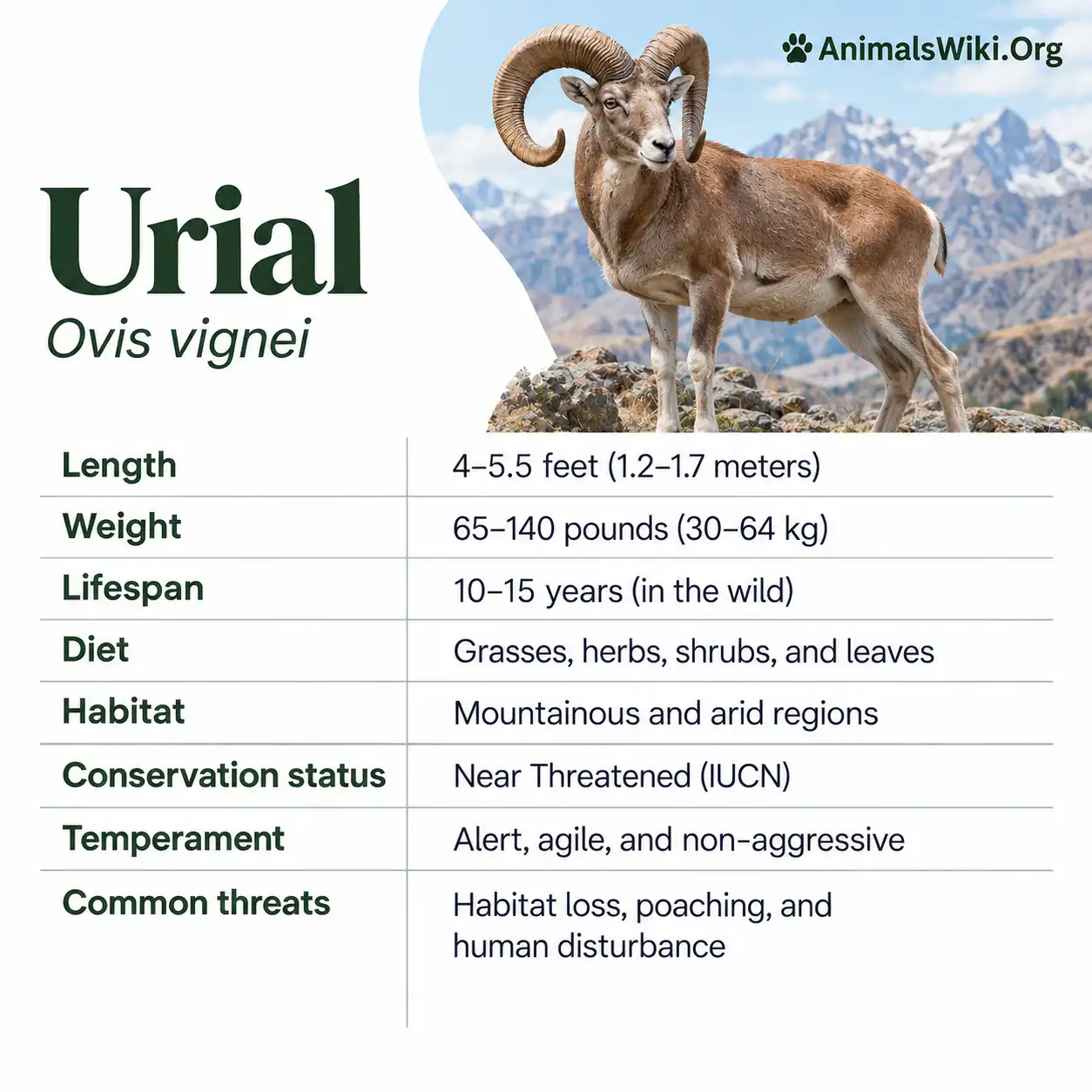
Urial Facts
| Feature | Details |
|---|---|
| Common Name | Urial (also called Shapo or Arkars in some regional traditions) |
| Scientific Name | Ovis vignei |
| Family | Bovidae |
| Order | Artiodactyla |
| First Described | 1841 (by Brian Houghton Hodgson) |
| Native Habitat | Arid and semi-arid mountain slopes, foothills, rocky steppe |
| Geographic Range | Central Asia, Afghanistan, Pakistan, northern India, southern Kazakhstan, Turkmenistan, Iran |
| Average Size | 85–110 cm at the shoulder |
| Average Weight | 35–87 kg (males considerably larger than females) |
| Lifespan | 10–13 years (wild); up to 16 years (captivity) |
| Diet | Herbivore — grasses, forbs, shrubs |
| Conservation Status | Vulnerable (IUCN); some subspecies more critically threatened |
| Defining Feature | Distinctive male neck ruff and bib; heavily ridged, outward-curving horns; among the closest living relatives to domestic sheep; significant hybrid zone overlap with argali |
| Number of Subspecies | Approximately 9 recognized subspecies across its considerable range |
1. Urial Species Overview & Classification
On a sun-scorched hillside somewhere in the rugged borderlands between Pakistan and Afghanistan, where vegetation clings in sparse, hardy patches to slopes of broken rock and bare, wind-scoured earth, a small band of reddish-brown sheep moves with careful, deliberate confidence across terrain that would challenge almost any other large mammal. At the front of the group, a mature ram carries a heavy, deeply ridged pair of horns curving outward and back in a broad, sweeping arc, and beneath his chin and along his throat hangs a striking dark ruff of long hair, a shaggy black-and-white “bib” that gives him an almost regal, bearded appearance entirely distinct from the smooth-coated domestic sheep grazing in valley farmland far below. This is the urial, one of the least publicly known but most scientifically and evolutionarily significant wild sheep species on Earth — an animal whose unassuming public profile belies its genuinely important position at the very root of one of humanity’s oldest and most consequential domestication stories.
The urial (Ovis vignei) is a species of wild sheep native to the arid and semi-arid mountains, foothills, and rocky steppe of Central and South Asia, ranging across portions of Afghanistan, Pakistan, northern India, Kazakhstan, Turkmenistan, Uzbekistan, and Iran. Distinguished by its relatively slender build, distinctive reddish-brown coat, and the striking dark neck ruff and “bib” displayed by mature males, the urial occupies a genuinely fascinating and scientifically significant taxonomic position within the broader wild sheep group: genetic and morphological research has increasingly identified the urial as one of the wild sheep species most closely related to, and potentially most directly ancestral or near-ancestral to, the domestic sheep (Ovis aries) that today numbers in the hundreds of millions worldwide and represents one of humanity’s oldest and most economically significant domesticated animals.
Despite this genuinely profound evolutionary and agricultural significance, the urial remains one of the more obscure and, candidly, publicly under-recognized wild sheep species covered within this broader guide series — overshadowed in general public awareness by more visually dramatic or better-known wild sheep and goat relatives such as the markhor and the various argali subspecies, despite facing genuinely serious conservation pressure across much of its considerable range. The urial’s story encompasses deep evolutionary history intersecting directly with the origins of pastoral agriculture, a taxonomically complex relationship with its close wild sheep relatives that continues to generate active scientific debate, and a modern conservation situation shaped substantially by habitat loss, competition with domestic livestock, and, in various portions of its range, significant historical and ongoing hunting pressure.
Species Classification Table
| Classification Level | Details |
|---|---|
| Kingdom | Animalia |
| Phylum | Chordata |
| Class | Mammalia |
| Order | Artiodactyla |
| Family | Bovidae |
| Subfamily | Caprinae |
| Genus | Ovis |
| Species | Ovis vignei |
| Described By | Brian Houghton Hodgson, 1841 |
| Closest Relatives | Domestic sheep, argali, mouflon (all genus Ovis) |
Notable Urial Subspecies
| Subspecies | Range | Notes |
|---|---|---|
| Punjab Urial (O. v. punjabiensis) | Punjab region, Pakistan | One of the more studied subspecies; significant conservation programs |
| Ladakh Urial (O. v. vignei) | Ladakh region, northern India, Pakistan | Nominate subspecies; high-altitude specialist |
| Afghan Urial (O. v. cycloceros) | Afghanistan, western Pakistan | Widespread but poorly monitored given regional instability |
| Transcaspian Urial (O. v. arkal) | Turkmenistan, Uzbekistan, northern Iran | Significant historical range contraction |
| Bukhara Urial (O. v. bochariensis) | Tajikistan, Uzbekistan | Range-restricted; conservation concern |
| Kopet Dagh Urial / Persian Urial group (O. v. urmiana and related forms) | Iran | Taxonomically complex; sometimes treated as distinct species |
Note: Urial taxonomy remains genuinely unsettled among mammalogists, with ongoing scientific debate regarding whether the urial should be classified as a single species with numerous subspecies, several closely related but distinct species, or, per some taxonomic treatments, a subspecies of the broader mouflon (Ovis orientalis) complex — a genuinely active area of ongoing genetic research.
The Name “Urial”
The word “urial” derives from a regional South Asian vernacular term, generally believed to trace to Punjabi or related regional languages of the animal’s northern Indian and Pakistani range, reflecting the species’ long-standing local recognition and familiarity across the mountain and foothill communities of its core historical range, well predating formal Western scientific classification.
Did You Know? Genetic and archaeological research increasingly suggests the urial — or, more precisely, the broader mouflon-urial species complex to which it belongs — represents one of the wild sheep populations most closely tied to the origin of domestic sheep, one of the very first animals domesticated by humans, with sheep domestication believed to have begun in the Fertile Crescent region of the Near East roughly 10,000–11,000 years ago, placing the urial’s wild relatives at the genuine evolutionary root of an animal that today numbers well over a billion individuals worldwide across global agriculture.
2. Urial Physical Description & Unique Features
The urial’s physical build reflects a genuinely well-adapted wild sheep body plan suited to the arid, often steep and rocky mountain and foothill terrain characteristic of its considerable Central and South Asian range.
Size and Build
- Shoulder height: Typically 85–110 cm (33–43 inches)
- Weight: Males (rams) typically 60–87 kg (132–192 lbs); females (ewes) considerably smaller, typically 35–45 kg (77–99 lbs)
- Sexual dimorphism: Pronounced — males are substantially larger and more heavily built than females, and, as detailed extensively below, display dramatically more developed horns and the distinctive neck ornamentation entirely absent or minimally developed in females
Body proportions: The urial displays a comparatively slender, leggy build relative to some of its bulkier wild sheep relatives, an adaptation broadly consistent with the considerable agility required to navigate the steep, rocky terrain characteristic of much of its native mountain and foothill habitat.
The Horns — A Defining Taxonomic and Display Feature
Male urial horns represent one of the species’ most scientifically and visually significant physical features:
- Shape and structure: Urial horns are heavily ridged and curve outward and backward in a broad, sweeping, somewhat triangular cross-sectional arc — a horn shape and growth pattern that represents one of the key morphological features researchers use to distinguish urial from their close relatives, the argali and mouflon, discussed extensively in the Comparison section
- Size: Mature ram horns can reach lengths of 75–100 cm (30–40 inches) or more along the curve, representing a substantial physical structure relative to the animal’s overall body size
- Female horns: Female urial possess much smaller, less curved horns, typically reaching only a modest fraction of male horn length, a degree of sexual dimorphism in horn development broadly consistent with the pattern documented across numerous other wild sheep and goat species covered elsewhere in broader wildlife guides
The Male Neck Ruff and “Bib” — A Genuinely Striking Ornamental Feature
Perhaps the single most visually distinctive feature of the mature male urial, and one of the species’ most immediately recognizable field identification characteristics, is the dramatic neck ruff and chest “bib”:
- Description: Mature rams develop a substantial growth of long, coarse hair along the throat, neck, and upper chest, typically displaying a striking dark, often black or blackish-brown coloration contrasting against paler surrounding fur, creating a bold, bearded, almost regal visual impression
- Seasonal development: This ruff and bib ornamentation is typically most pronounced during the breeding season (rut), described extensively in the Reproduction section, when it plays a significant role in visual display and male competitive assessment
- Absence in females: Female urial lack this dramatic neck and chest ornamentation, displaying a comparatively plain, unadorned coat consistent with their overall smaller, less visually elaborate physical presentation relative to mature males
Coat and Coloration
General body coloration: Urial typically display a reddish-brown to greyish-brown coat across the back and flanks, with a pale, often whitish underside and rump patch, a countershading pattern broadly consistent with the general camouflage coloration documented across numerous other wild sheep and mountain ungulate species covered throughout this broader guide series
Seasonal coat variation: Urial coats show meaningful seasonal variation, with a thicker, often somewhat greyer winter coat providing enhanced insulation against the considerable seasonal temperature extremes characteristic of much of the species’ Central and South Asian mountain and steppe range, transitioning to a shorter, more reddish-toned summer coat
Legs and Hooves
Urial possess relatively slender but sturdy legs and hard, well-adapted hooves suited to the rocky, often steep terrain characteristic of much of their native habitat, broadly consistent with the general hoof adaptation pattern documented across numerous other mountain-dwelling ungulate species covered throughout this guide series, providing secure footing across loose rock, scree slopes, and similarly challenging substrate.
3. Urial Habitat & Geographic Range
The urial occupies a considerable, if increasingly fragmented, range across the arid and semi-arid mountains, foothills, and rocky steppe of Central and South Asia, showing meaningful ecological distinction from several of its higher-altitude wild sheep relatives in its general preference for somewhat lower-elevation, more arid terrain.
Preferred Habitat Features
Arid and semi-arid mountain slopes and foothills — the core urial habitat type; the species generally favors somewhat lower-elevation terrain than several of its wild sheep relatives, particularly the argali (discussed further in the Comparison section), typically occupying foothill and lower mountain-slope habitat rather than the more extreme high-altitude terrain favored by certain other Central Asian wild sheep populations
Rocky, broken terrain with adequate escape cover — urial show a strong general preference for terrain offering a combination of grazing opportunity and adequately steep, broken, rocky escape terrain, providing critical protection from predators, discussed extensively in the Predators section
Sparse vegetation adapted to arid conditions — reflecting the species’ broader habitat association with arid and semi-arid environments, urial habitat typically features drought-adapted grassland, scrub, and sparse shrub vegetation rather than the more lush grassland or forest habitat favored by many other wild sheep and ungulate species covered throughout this broader guide series
Habitat Types Occupied
| Habitat | Primary Urial Use | Region | Key Features |
|---|---|---|---|
| Arid foothill scrubland | Primary habitat | Pakistan, Afghanistan | Lower elevation; sparse drought-adapted vegetation |
| Rocky steppe | Primary habitat | Central Asia (Turkmenistan, Uzbekistan, Kazakhstan) | Open terrain with rocky refuge features |
| Semi-arid mountain slopes | Primary habitat | Northern India, Pakistan (Ladakh region) | Higher elevation than typical, but still arid-adapted |
| Desert-edge transition zones | Feeding, seasonal habitat | Various range regions | Drought-tolerant grazing |
Geographic Range
Current range by region:
| Region | Key Countries | Population Status |
|---|---|---|
| South Asia | Pakistan, northern India (Ladakh) | Variable; significant regional conservation programs in Pakistan (particularly Punjab urial) |
| Afghanistan | Afghanistan | Poorly monitored given decades of regional conflict and instability |
| Central Asia | Turkmenistan, Uzbekistan, Tajikistan, southern Kazakhstan | Significant historical range contraction |
| Iran | Iran | Variable; some regionally significant remaining populations |
Elevational Distinction from Argali and Other Wild Sheep Relatives
A genuinely notable habitat characteristic distinguishing the urial from several of its closest wild sheep relatives, particularly the argali (discussed extensively in the Comparison section), is the urial’s general preference for comparatively lower elevation, more arid terrain, occupying an ecological niche distinct from the higher-altitude alpine grassland and steppe habitat more typically favored by argali populations across much of Central Asia — though meaningful range overlap and, in certain regions, hybridization between the two species has been documented and studied, a topic of genuine ongoing scientific interest regarding the taxonomic and evolutionary relationship between these closely related wild sheep.
4. Urial Diet & Feeding Behavior
The urial is a genuine herbivorous grazer, well adapted to extracting adequate nutrition from the often sparse, drought-tolerant vegetation characteristic of its arid and semi-arid Central and South Asian range.
What Urial Eat
Grasses — the dietary foundation across most of the urial’s range and season, with the species showing particular reliance on native grass species adapted to the arid, often nutritionally sparse conditions characteristic of much of its habitat
Forbs and herbaceous plants — a significant supplementary dietary component, particularly valuable during periods of seasonal green growth following limited seasonal rainfall
Shrubs and browse — consumed particularly during drier seasons or in more marginal habitat where grass availability is limited, reflecting the species’ broader dietary flexibility necessary to survive the considerable seasonal and annual precipitation variability characteristic of much of its arid range
Feeding Behavior Patterns
Crepuscular feeding activity: Urial feeding activity typically shows peak intensity during the cooler dawn and dusk periods, with reduced activity during the more intense heat of midday, particularly pronounced given the considerable temperature extremes characteristic of much of the species’ arid range
Group foraging: Urial typically forage in social groups, described extensively in the Social Behavior section, benefiting from collective predator vigilance while feeding across generally open, exposed grazing terrain
Water dependency: While urial show meaningful tolerance for the arid conditions characteristic of much of their range, the species nonetheless requires regular access to water, and habitat suitability is meaningfully influenced by the availability of adequate water sources within a practical foraging range, particularly during the driest portions of the year
Competition with Domestic Livestock
A genuinely significant and recurring theme throughout urial ecology, discussed further in the Conservation section, involves the considerable dietary and habitat overlap between urial and domestic livestock — particularly domestic sheep and goats — grazed extensively across much of the urial’s native range by local pastoral communities; this overlap creates both direct forage competition pressure on wild urial populations and, given the close taxonomic relationship between urial and domestic sheep described extensively in the Species Overview section, genuine disease transmission and, in some documented cases, hybridization concern between wild and domestic populations sharing overlapping range.
5. Urial Reproduction & Life Cycle
Urial reproductive biology follows a broadly seasonal pattern typical of many wild sheep species, with breeding timed to coincide with favorable seasonal conditions for subsequent lamb survival and development.
Sexual Maturity
- Females: Typically reach sexual maturity at approximately 1.5–2 years of age
- Males: Generally reach sexual maturity at a broadly similar age, though, consistent with the pattern documented across numerous other polygynous mammal species covered throughout this broader guide series, actual competitive breeding success is typically further delayed until males achieve sufficient body size and horn development to successfully compete with larger, more experienced rival males
The Rut (Breeding Season)
Urial breeding season, or rut, typically occurs during autumn to early winter, timing that positions subsequent lamb births to coincide with the more favorable spring conditions described further below.
Male competitive behavior: During the rut, mature rams engage in genuine competitive behavior for access to receptive females, including direct physical confrontation involving head-to-head clashing using the substantial horns described extensively in the Physical Description section — a competitive pattern broadly consistent with that documented across numerous other wild sheep species, in which horn size and condition serve as both a practical fighting tool and a visual signal of male competitive status potentially influencing the outcome of confrontations without requiring full physical combat in every case
The neck ruff’s display role: As referenced in the Physical Description section, the dramatic male neck ruff and bib ornamentation reaches peak development during the rutting season, playing a significant role in visual display both toward competing males (as a signal of size, condition, and competitive status) and toward potential mates.
Gestation and Birth
- Gestation period: Approximately 150–160 days (roughly 5 months)
- Litter size: Typically a single lamb, though twins occur with some regularity in certain populations, reflecting a degree of reproductive flexibility broadly consistent with that documented across various other wild sheep species
- Birth timing: Typically spring, timed to coincide with the seasonal green vegetation growth that provides critical nutritional support for both the nursing mother and the developing lamb
Lamb Development
Urial lambs, consistent with the broader precocial developmental pattern characteristic of wild sheep and goats more generally, are relatively well developed at birth, capable of standing and moving within a short period following birth, and begin accompanying the mother and broader social group relatively quickly, though remaining closely dependent on maternal nursing and protection through the vulnerable early developmental period.
| Stage | Timing | Development |
|---|---|---|
| Birth | Day 0 | Precocial; standing within hours |
| Early nursing period | Weeks 1–8 | Highly dependent on mother; begins sampling vegetation |
| Weaning | ~4–6 months | Transition to independent grazing |
| Juvenile growth | 6 months–1.5 years | Continued growth; horn development begins in males |
| Sexual maturity | 1.5–2 years | Reproductive capability begins |
| Full adult horn/body development | Several additional years (males particularly) | Continued horn growth throughout much of adult life |
Urial Lifespan
- Wild: Typically 10–13 years, though substantially shortened in many populations by significant predation and, in various regions, hunting pressure, discussed extensively in the Predators and Conservation sections
- Captivity: Up to 16 years documented under protected conditions.
6. Social Behavior & Communication
Urial social structure follows a broadly typical wild sheep pattern, characterized by sex-segregated social groups for much of the year, reorganizing during the breeding season into the more competitive, male-dominance-focused social dynamic described extensively in the Reproduction section.
Sex-Segregated Herds
Outside the breeding season, urial typically organize into sex-segregated social groups:
- Female-led groups: Females, young, and juvenile males typically associate in mixed groups, often led by an experienced adult female whose knowledge of local terrain, water sources, and predator-avoidance routes provides meaningful group navigational and safety benefit
- Male groups (bachelor herds): Adult males, outside the rutting season, frequently associate in separate “bachelor” groups, a social pattern broadly consistent with the sex-segregation documented across numerous other wild sheep and ungulate species covered throughout this broader guide series
Herd Size
Urial herd size varies considerably depending on habitat quality, local population density, and season, ranging from small groups of just a handful of individuals to, in favorable habitat and population conditions, considerably larger aggregations, though generally smaller than some of the larger wild sheep herds documented in certain argali and other Central Asian wild sheep populations occupying more open, higher-elevation steppe terrain.
Territoriality
Urial are not generally considered a strongly territorial species in the sense of maintaining and defending exclusive year-round territory; rather, the species’ social and spatial organization centers substantially on home range use and the seasonal, breeding-focused competitive dynamics described extensively in the Reproduction section.
Communication
Visual signals: Given the considerable role horn size and the male neck ruff/bib ornamentation play in competitive assessment and display, described extensively in the Physical Description and Reproduction sections, visual signaling represents a significant urial communication channel, particularly relevant during the breeding season
Vocalizations: Urial, consistent with the broader pattern documented across numerous wild sheep species, produce a range of vocalizations including alarm calls and various contact and social calls, though the species’ vocal communication system has received considerably less detailed scientific documentation than several of the more extensively studied wild sheep and goat species covered elsewhere in broader wildlife literature, reflecting the urial’s overall comparatively limited research attention relative to certain better-known Caprinae relatives
Scent marking: As with numerous other Bovidae family members covered throughout this broader guide series, scent-based communication likely plays a meaningful role in urial social and territorial communication, though the specific mechanisms and significance remain less thoroughly documented for this species compared to several better-studied relatives.
7. Predators & Defense Mechanisms
Urial face meaningful predation pressure across their considerable Central and South Asian range, from a combination of large cats and canids adapted to the same arid mountain and foothill terrain the urial itself occupies.
Natural Predators
Snow leopards — a significant predator across portions of the urial’s higher-elevation range, particularly relevant in regions of range overlap with this iconic and similarly conservation-significant Central Asian predator species
Wolves — significant predators across much of the urial’s broader range, capable of effective pack-hunting pressure particularly relevant to more open steppe and foothill terrain
Leopards — significant predators across portions of the urial’s South Asian and Central Asian range where the two species’ ranges overlap
Lynx — documented predators, particularly of smaller or more vulnerable urial individuals, across portions of the species’ Central Asian range
Golden eagles — significant predators of urial lambs, particularly during the vulnerable early developmental period described in the Reproduction section
Defense Strategies
Terrain-based escape: As detailed extensively in the Habitat section, urial show strong habitat association with terrain offering adequate rocky, broken escape cover, and the species’ considerable agility across steep, uneven ground represents its primary and most significant defensive strategy, allowing urial to escape into terrain that many predators — particularly wolves, which are generally less well adapted to very steep, broken rocky terrain compared to the urial itself — find considerably more difficult to navigate effectively
Group vigilance: As described extensively in the Social Behavior section, urial social group structure provides meaningful collective predator-detection benefit, with multiple individuals simultaneously alert to potential threats significantly improving overall group predator-detection capability compared to solitary foraging
Alarm signaling: Urial produce alarm vocalizations and, consistent with numerous other wild sheep and ungulate species, likely employ visual alarm signals (including alert posturing) upon detecting potential predator threats, alerting other group members to danger
Speed and agility: Urial possess considerable running speed and agility across their preferred rocky, broken terrain, providing an important active escape mechanism against pursuing predators.
8. Relationship with Humans
Deep Historical Significance — The Domestication Connection
As introduced extensively in the Species Overview section, the urial’s most profound and consequential human relationship centers on its genuine evolutionary connection to the origin of domestic sheep, one of the very earliest and most agriculturally consequential animal domestication events in human history:
- Domestication context: Sheep domestication is believed to have begun in the broader Fertile Crescent region of the Near East approximately 10,000–11,000 years ago, among the earliest livestock domestication events documented anywhere in human history, predating or roughly contemporaneous with several other foundational early agricultural domestication events covered elsewhere throughout this broader guide series
- The urial’s specific role: While the precise wild ancestral lineage of domestic sheep remains an area of genuinely active scientific research and some ongoing debate — with the broader mouflon (a closely related wild sheep species or species complex, depending on taxonomic treatment, occupying a range across the Middle East, Iran, and parts of Central Asia) generally considered the most immediate wild ancestor — the urial’s close taxonomic and genetic relationship to both mouflon and domestic sheep places it firmly within the broader wild sheep lineage directly connected to this foundational domestication event, and genetic research continues to refine scientific understanding of the specific relationships and potential historical hybridization between these closely related wild sheep populations and early domestic sheep lineages
Traditional Hunting and Subsistence Use
Urial have historically been hunted for meat, hide, and horn across substantial portions of their range by local communities, representing a genuine, long-standing traditional subsistence and, in various contexts, cultural practice among numerous mountain and pastoral communities across Central and South Asia.
Trophy Hunting
Urial, particularly mature rams displaying substantial horn development, have historically been, and in certain regulated contexts continue to be, a target species for international trophy hunting, particularly in Pakistan, where several regulated trophy hunting programs — including notably the Torghar Conservation Project in Balochistan province, discussed further in the Conservation section — have been specifically structured around a conservation-hunting model, in which limited, carefully regulated trophy hunting permits generate substantial revenue directed toward broader anti-poaching enforcement and habitat protection efforts benefiting the overall urial population, representing a genuinely significant and, in various conservation policy contexts, actively debated example of the broader “sustainable use” conservation funding model applied to a threatened wild sheep species.
Livestock Competition and Interaction
As detailed extensively in the Diet section, the considerable overlap between urial range and domestic livestock grazing — particularly domestic sheep and goats grazed by local pastoral communities across much of the urial’s native range — represents a genuinely significant and ongoing dimension of human-urial interaction, generating both direct forage competition pressure and, given the close taxonomic relationship between urial and domestic sheep, genuine disease transmission and hybridization concern discussed further in the Conservation section.
Modern Wildlife Tourism and Conservation Awareness
Urial viewing and photography represent a modest but genuinely growing component of wildlife tourism across portions of the species’ range, particularly in regions with established protected areas and conservation programs, including notably several areas within Pakistan, though this tourism remains considerably less developed than that associated with several of the more internationally prominent and publicly recognized wild sheep and goat species covered elsewhere in broader Central Asian wildlife literature.
9. Urial Conservation Status & Threats
IUCN Status
The urial is currently classified as Vulnerable by the IUCN, reflecting genuine, documented population decline across substantial portions of its considerable range, with several specific subspecies and regional populations facing more severe, localized conservation concern than the species’ overall aggregate status designation might suggest.
Current Threats
1. Competition with Domestic Livestock
As detailed extensively in the Diet and Human Relationships sections, direct forage and habitat competition with domestic sheep and goats, grazed extensively across much of the urial’s native range by local pastoral communities, represents one of the most significant and sustained threats facing wild urial populations, particularly acute in regions of high domestic livestock density sharing the same limited arid and semi-arid grazing resources.
2. Habitat Loss and Degradation
Broader habitat loss and degradation — driven by agricultural expansion, infrastructure development, and the cumulative effects of overgrazing pressure from both domestic livestock and, in various regions, expanding human settlement — represents a significant, sustained threat across substantial portions of the urial’s range.
3. Poaching and Unregulated Hunting
Beyond the regulated, conservation-oriented trophy hunting programs described in the Human Relationships section, unregulated and illegal poaching pressure — targeting meat, hide, and particularly trophy-quality horns — represents a genuine and, in various portions of the species’ range, significant ongoing conservation threat, particularly severe in regions lacking effective wildlife law enforcement infrastructure.
4. Regional Political Instability
Given the urial’s range extending across several countries and regions that have experienced substantial and sustained political instability and armed conflict in recent decades — most notably Afghanistan — effective wildlife population monitoring, conservation program implementation, and anti-poaching enforcement has been significantly hampered across meaningful portions of the species’ range, contributing to substantial data gaps and genuine uncertainty regarding actual current population status in several regions.
5. Hybridization and Genetic Concerns
As referenced in the Human Relationships section, documented hybridization between urial and domestic sheep, and, in certain regions, between urial and closely related wild sheep species including argali, described extensively in the Comparison section, represents a genuine and actively studied conservation genetics concern, given the potential for such hybridization to compromise the genetic distinctiveness and, in various interpretations, the long-term evolutionary viability of specific wild urial populations and subspecies.
6. Disease Transmission from Domestic Livestock
Beyond direct competition pressure, disease transmission from domestic sheep and goat populations sharing overlapping range represents a further significant conservation concern, given the close taxonomic relationship and consequent shared disease susceptibility between urial and domestic sheep.
The Torghar Conservation Project — A Notable Conservation Model
As referenced extensively in the Human Relationships section, the Torghar Conservation Project in Balochistan, Pakistan, represents one of the more significant and widely cited conservation success stories directly relevant to urial population management, in which a community-based conservation program structured around limited, carefully regulated trophy hunting revenue has been credited with supporting substantial documented recovery of local urial (and markhor) populations, through funding directed toward local anti-poaching enforcement and community-based conservation incentive structures — a program frequently cited within broader international conservation policy discussion as a notable example of the “sustainable use” conservation funding model applied successfully to a genuinely threatened wild sheep species, though the broader applicability and appropriate scope of this specific conservation-hunting model remains an area of ongoing conservation policy discussion and debate.
10. Famous Urials Around the World
The Torghar Hills Population
While not individually named celebrity animals in the conventional sense, the urial (and markhor) population of the Torghar Hills in Balochistan, Pakistan, described extensively in the Conservation section, deserves recognition as, collectively, one of the more significant and internationally cited individual wild sheep populations in the broader conservation policy literature, given the population’s role as the foundational case study for the influential Torghar Conservation Project conservation-hunting model.
Ladakh’s High-Altitude Urial
The urial populations of the Ladakh region of northern India and Pakistan, occupying some of the highest-elevation habitat documented for the species, have become a subject of particular interest among Central and South Asian wildlife researchers and, increasingly, dedicated wildlife tourism visitors specifically seeking to observe the species within this dramatic high-altitude Himalayan-adjacent landscape.
Research and Zoological Collection Individuals
Various individual urial maintained within accredited zoological collections and dedicated conservation breeding programs worldwide, though considerably less numerous and less publicly prominent than captive populations of many of the more internationally recognized wild sheep and goat species, have contributed meaningfully to broader scientific understanding of urial reproductive biology, genetics, and the species’ complex taxonomic relationship with its close wild sheep relatives.
11. Role in Ecosystem & Food Chain
Urial as a Foundational Prey Species
As detailed extensively in the Predators section, urial represent a genuinely significant prey resource supporting several of Central and South Asia’s most conservation-significant predator species, including notably the snow leopard, itself a species of major international conservation concern and interest — meaning healthy urial populations carry direct, meaningful conservation relevance extending well beyond the urial itself, given the species’ role in supporting the broader predator community across the shared mountain and foothill ecosystems both groups inhabit.
Vegetation Grazing Dynamics
Through their grazing activity across the arid and semi-arid grassland and scrub habitat described extensively in the Habitat and Diet sections, urial contribute to broader vegetation community dynamics within their native range, though this ecological role has received considerably less dedicated research attention than that documented for several other, more extensively studied wild ungulate species covered throughout this broader guide series, reflecting the urial’s overall relatively limited research profile.
Genetic Reservoir Significance for Domestic Sheep
Given the urial’s close evolutionary relationship to domestic sheep described extensively throughout this guide, wild urial populations represent a genuinely significant genetic reservoir of considerable potential relevance to future domestic sheep breeding and genetic diversity research — a form of ecological and agricultural significance somewhat distinct from the more conventional food-web and ecosystem-service roles typically emphasized for other species covered throughout this broader guide series, but nonetheless representing a genuine, scientifically recognized dimension of the species’ broader ecological and agricultural importance.
Indicator Species Considerations
Given urial’s considerable sensitivity to habitat degradation and, particularly, domestic livestock competition pressure described extensively in the Conservation section, urial population health and distribution trends are increasingly used by conservation researchers as a meaningful indicator of broader arid mountain and foothill ecosystem health and grazing pressure sustainability across substantial portions of the species’ Central and South Asian range.
12. Urial Discovery & Evolution Timeline
~2–3 million years ago — The genus Ovis (encompassing all modern wild and domestic sheep species, including the urial, argali, mouflon, and their relatives) becomes established as a distinct evolutionary lineage within the broader Caprinae subfamily, part of the considerable diversification of mountain-adapted Bovidae across Eurasia and North America during this period.
~10,000–11,000 years ago — Sheep domestication begins in the broader Fertile Crescent region of the Near East, among the earliest livestock domestication events in human history, drawing on wild sheep populations — most immediately the mouflon, with the broader urial-mouflon wild sheep complex playing a genuine evolutionary role — that would eventually give rise to the modern domestic sheep found across global agriculture today.
Historical era (regional pastoral communities) — Mountain and pastoral communities across the urial’s considerable Central and South Asian range establish long-standing traditional hunting, subsistence, and cultural relationships with the species, reflected in the regional vernacular naming traditions described in the Species Overview section.
1841 — British naturalist Brian Houghton Hodgson formally describes the urial (Ovis vignei), establishing the modern scientific classification foundation for subsequent taxonomic research on the species.
19th–early 20th century — Continued European colonial-era natural history exploration and documentation of Central and South Asian wild sheep diversity, alongside the beginning of significant international trophy hunting interest in the region’s various wild sheep and goat species, including the urial.
Mid-late 20th century — Growing scientific documentation of urial population decline across substantial portions of its range, driven substantially by the combination of domestic livestock competition, habitat degradation, and unregulated hunting pressure described extensively in the Conservation section.
1980s–1990s — Establishment of the Torghar Conservation Project in Balochistan, Pakistan, pioneering the specific conservation-hunting funding model described extensively in the Conservation section, subsequently credited with supporting significant documented local urial and markhor population recovery.
1990s–2000s — Continued genetic and taxonomic research progressively refines scientific understanding of the complex evolutionary relationships between urial, argali, mouflon, and domestic sheep, an area of ongoing active scientific research and debate.
2000s–2010s — Substantial regional political instability, particularly in Afghanistan, significantly hampers wildlife population monitoring and conservation program implementation across meaningful portions of the urial’s broader range, contributing to significant ongoing data gaps regarding actual current regional population status.
2020 — The urial’s IUCN conservation status assessment is updated, reflecting continued documentation of population decline across substantial portions of the species’ range and reinforcing the Vulnerable classification.
2022–2026 — Continued conservation program implementation across portions of the urial’s Pakistani and broader South and Central Asian range, ongoing genetic research into the species’ complex taxonomic relationships and its evolutionary connection to domestic sheep origins, and continued, if still comparatively limited relative to several better-known regional wild sheep and goat species, international conservation and research attention to the species’ ongoing conservation needs.
13. Urial Comparison with Similar Species
| Feature | Urial (Ovis vignei) | Argali (Ovis ammon) | Mouflon (Ovis gmelini/orientalis) | Markhor (Capra falconeri) |
|---|---|---|---|---|
| Family/Genus | Bovidae/Ovis | Bovidae/Ovis | Bovidae/Ovis | Bovidae/Capra |
| Shoulder height | 85–110 cm | 90–125 cm | 65–90 cm | 65–115 cm |
| Weight | 35–87 kg | 65–185 kg (largest wild sheep) | 25–50 kg | 40–110 kg |
| Range | Central/South Asia | Central Asia, Himalayas, Siberia | Near East, Iran, introduced Europe | Pakistan, Afghanistan, Central Asia |
| Habitat preference | Lower-elevation arid foothills/steppe | Higher-elevation alpine grassland/steppe | Lower-elevation Mediterranean/Near East hills | Steep rocky mountain slopes |
| Horn shape | Outward-curving, heavily ridged arc | Massive, spiraling (largest of all wild sheep) | Smaller, curved | Distinctive corkscrew spiral (goat, not sheep) |
| Male ornamentation | Dark neck ruff/bib | Less pronounced ruff | Minimal ruff | No ruff (different genus) |
| Conservation | Vulnerable | Near Threatened (varies by subspecies) | Vulnerable | Near Threatened |
| Closest relative in this guide | Argali (hybridization documented) | Urial | Urial/domestic sheep ancestor | N/A (different genus) |
14. Best Places to See Urial in the Wild
Pakistan
- 🇵🇰 Torghar Hills, Balochistan — as detailed extensively throughout this guide, home to the population central to the influential Torghar Conservation Project, offering genuine, if logistically demanding, wild urial viewing opportunities within a significant conservation success story context
- 🇵🇰 Kalabagh Game Reserve, Punjab — a significant Punjab urial conservation area with established viewing infrastructure
- 🇵🇰 Various protected areas across Balochistan and Khyber Pakhtunkhwa provinces — supports meaningful remaining urial populations across the country’s considerable mountain and foothill terrain
India
- 🇮🇳 Ladakh region — offers opportunities to observe the high-altitude Ladakh urial subspecies within a dramatic Himalayan-adjacent landscape, typically combined with broader regional wildlife and cultural tourism
Central Asia
- 🇹🇲/🇺🇿 Various protected steppe and mountain areas, Turkmenistan/Uzbekistan — supports remaining Transcaspian and Bukhara urial populations, though with considerably more limited established wildlife tourism infrastructure compared to Pakistan’s more developed conservation-tourism programs
Practical Note for Urial Viewing
Given the species’ considerable remaining habitat overlap with regions experiencing varying degrees of political instability, limited tourism infrastructure, and generally lower international wildlife-tourism profile compared to several better-known Central Asian wild sheep and goat species, urial viewing generally requires more specialized planning, local expertise, and, in several regions, direct coordination with established conservation programs or specialized regional wildlife tour operators compared to more internationally developed wildlife-viewing destinations covered elsewhere throughout this broader guide series.
15. Fun Facts About Urials
- The urial is genuinely, scientifically believed to be among the wild sheep species most closely connected to the origin of domestic sheep — one of humanity’s oldest and most agriculturally significant animal domestications
- Mature male urial develop a dramatic dark neck ruff and chest “bib” entirely absent in females, most pronounced during the autumn-winter breeding season
- Urial horns can reach 75–100 cm or more along the curve in mature rams — a substantial structure relative to the animal’s overall body size
- Domestic sheep today number well over a billion individuals worldwide, tracing their evolutionary origins substantially to the same broader wild sheep lineage the urial belongs to
- Urial taxonomy remains genuinely unsettled among scientists, with ongoing debate about whether it should be classified as one species with several subspecies or multiple distinct species
- The species has been documented hybridizing with argali, its larger, higher-elevation wild sheep relative, in regions where the two species’ ranges overlap
- Pakistan’s Torghar Conservation Project is a widely cited international conservation model in which carefully regulated trophy hunting revenue funds anti-poaching enforcement that has helped local urial populations recover
- Urial generally favor lower-elevation, more arid terrain than several of their higher-altitude wild sheep relatives, including the massive-horned argali
- The urial is classified as Vulnerable by the IUCN, with several specific regional subspecies facing more severe, localized conservation concern
- Unlike domestic sheep, wild urial rely substantially on rocky, broken terrain as their primary defense against predators including wolves and snow leopards
- Significant portions of the urial’s range have historically been difficult to monitor or study due to regional political instability, particularly in Afghanistan
- The word “urial” comes from a regional South Asian vernacular term, reflecting the species’ long-standing local recognition well before formal Western scientific description in 1841
16. Frequently Asked Questions About Urials
Q1: Is the urial related to domestic sheep?
Yes, genuinely and significantly — the urial belongs to the same broader wild sheep lineage (genus Ovis) that gave rise to domestic sheep roughly 10,000–11,000 years ago in the Fertile Crescent region of the Near East, one of the earliest and most agriculturally consequential animal domestication events in human history. While the closely related mouflon is generally considered the most immediate wild ancestor of domestic sheep, the urial’s close taxonomic and genetic relationship to both mouflon and domestic sheep places it firmly within the broader wild sheep lineage connected to this foundational domestication event, and ongoing genetic research continues to refine scientific understanding of the specific relationships between these closely related wild sheep populations.
Q2: What does a urial look like, and how can you identify a male?
Urial are medium-sized wild sheep with a reddish-brown to greyish-brown coat, a pale underside, and, in mature males, heavily ridged horns that curve outward and backward in a broad, sweeping arc, reaching 75–100 cm or more in length. The most distinctive male-specific feature is a dramatic dark neck ruff and chest “bib” — a growth of long, coarse, often blackish hair along the throat and upper chest — that is most pronounced during the autumn-winter breeding season and is entirely absent in females, making it one of the most reliable field identification features distinguishing mature rams from ewes and juveniles.
Q3: Where do urial live, and what kind of habitat do they prefer?
Urial are native to the arid and semi-arid mountains, foothills, and rocky steppe of Central and South Asia, with range extending across Pakistan, Afghanistan, northern India, Kazakhstan, Turkmenistan, Uzbekistan, Tajikistan, and Iran. Compared to several related wild sheep species, notably the argali, urial generally favor somewhat lower-elevation, more arid terrain, typically occupying foothill and lower mountain-slope habitat featuring sparse, drought-adapted vegetation and adequately steep, rocky terrain offering escape cover from predators.
Q4: Is the urial endangered?
The urial is currently classified as Vulnerable by the IUCN, reflecting genuine, documented population decline across substantial portions of its considerable range. Several specific subspecies and regional populations face more severe, localized conservation concern than the species’ overall status designation might suggest, particularly in regions affected by significant habitat competition with domestic livestock, unregulated hunting pressure, and, in areas such as Afghanistan, substantial regional political instability that has significantly hampered effective population monitoring and conservation program implementation.
Q5: What is the Torghar Conservation Project, and why is it significant?
The Torghar Conservation Project, based in the Torghar Hills of Balochistan, Pakistan, is a widely cited and influential community-based conservation program structured around a “sustainable use” model: limited, carefully regulated international trophy hunting permits for urial and markhor generate substantial revenue, which is directed toward local anti-poaching enforcement and community-based conservation incentives. The project is credited with supporting significant documented recovery of local urial and markhor populations and is frequently referenced within broader international conservation policy discussion as a notable example of how regulated, revenue-generating hunting programs can, in specific contexts, support rather than undermine wild population conservation — though the broader appropriate scope and applicability of this specific model remains an area of active conservation policy debate.
Q6: Why does urial taxonomy remain unsettled among scientists?
The urial’s taxonomic classification — including whether it should be treated as a single species with numerous subspecies, several closely related but distinct species, or a subspecies of the broader mouflon complex — remains genuinely debated among mammalogists, reflecting the considerable morphological and genetic variation documented across the species’ roughly nine recognized subspecies spread across a wide and, in places, historically difficult-to-research geographic range. This taxonomic complexity is further complicated by documented hybridization between urial and closely related wild sheep species, including argali, in regions of range overlap, and by the species’ close evolutionary relationship to domestic sheep — an area of genuinely active, ongoing genetic research rather than settled scientific consensus.
Q7: What predators threaten wild urial?
Urial face predation pressure from several of Central and South Asia’s most significant large predators, including snow leopards, wolves, leopards, and lynx, along with golden eagles, which represent a significant threat specifically to vulnerable young lambs. The urial’s primary defense strategy centers on its strong habitat association with steep, broken, rocky terrain that offers effective escape cover — many of the species’ predators, particularly wolves, are considerably less well adapted to navigating very steep, uneven rocky ground compared to the urial itself, making terrain-based escape the species’ most significant defensive advantage, supplemented by collective group vigilance and alarm signaling within its typical social herd structure.
Q8: How is the urial different from the argali and the markhor?
The urial, argali, and markhor are all wild mountain-dwelling members of the goat-antelope subfamily Caprinae found across overlapping portions of Central and South Asia, but they represent genuinely distinct species with important differences. The argali (also genus Ovis, making it the urial’s closer relative of the two) is considerably larger — the largest wild sheep species in the world — with massive, heavily spiraling horns, and generally favors higher-elevation alpine grassland and steppe habitat than the urial. The markhor belongs to an entirely different genus, Capra (true goats rather than sheep), and is immediately distinguishable by its dramatic, tightly spiraling corkscrew-shaped horns, favoring very steep rocky mountain slopes; the markhor also holds distinct cultural significance as the national animal of Pakistan. All three species face varying degrees of conservation concern across their shared and overlapping Central and South Asian mountain range.



