Vulture Facts
| Feature | Details |
|---|---|
| Common Name | Vulture |
| Scientific Name | Old World: various genera in family Accipitridae; New World: family Cathartidae (e.g., Gyps, Aegypius, Cathartes, Vultur) |
| Family | Accipitridae (Old World vultures); Cathartidae (New World vultures) |
| Order | Accipitriformes (Old World); Cathartiformes (New World) |
| First Described | 1758 (Turkey Vulture, by Carl Linnaeus) |
| Native Habitat | Open savanna, grassland, mountains, desert, forest edge |
| Geographic Range | Africa, Europe, Asia, the Americas (absent from Australia and Antarctica) |
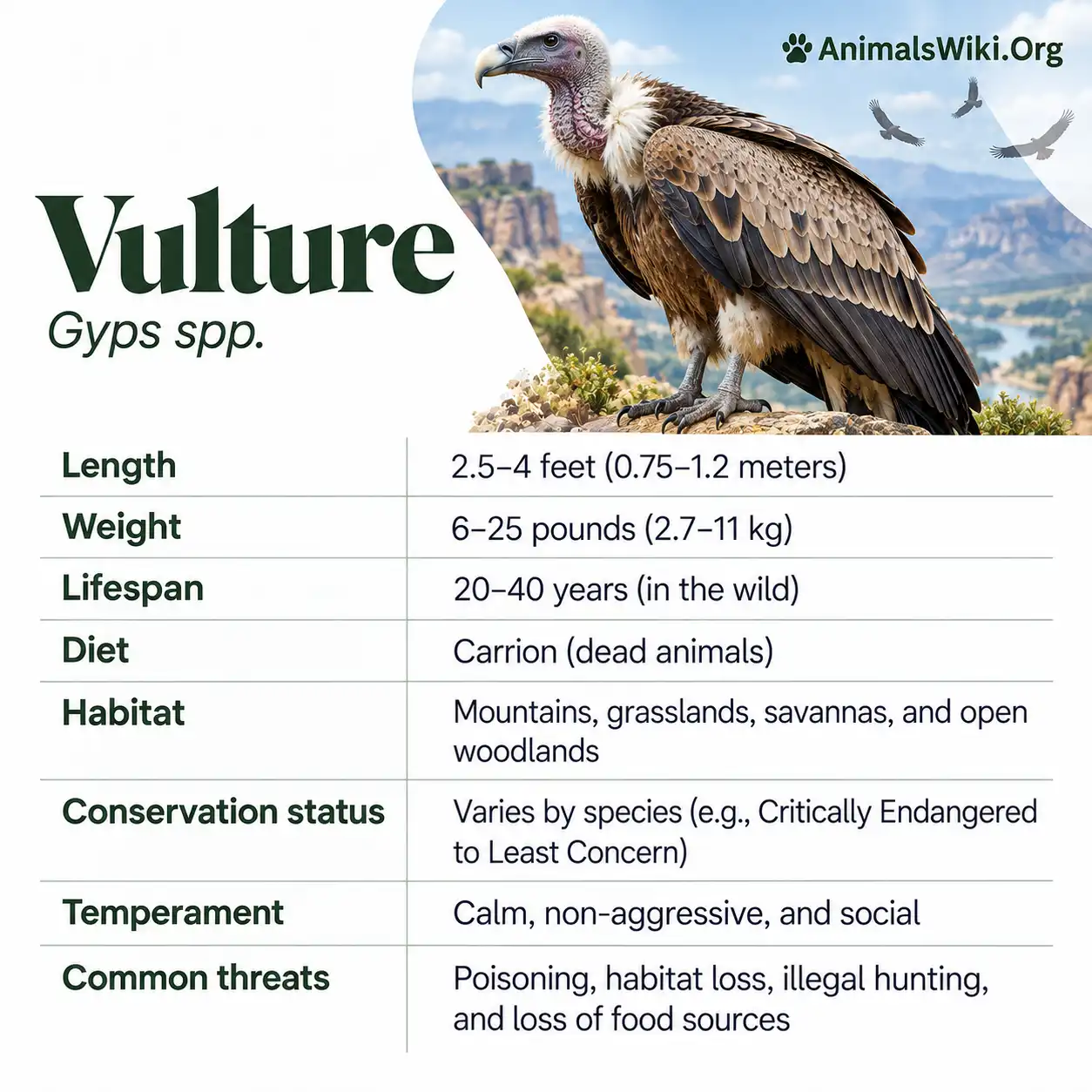
| Average Size | 0.55–1.4 m body length depending on species |
| Average Weight | 0.85–15 kg depending on species |
| Lifespan | 15–30 years (wild); up to 40+ years (captivity) |
| Diet | Scavenger — carrion (dead animal remains) |
| Conservation Status | Ranges from Least Concern to Critically Endangered; several species among the most rapidly declining birds on Earth |
| Defining Feature | Bald head (most species); extraordinarily corrosive stomach acid; soaring flight over vast distances; essential ecological role in disease prevention and carcass removal |
| Number of Species | 23 species worldwide (16 Old World, 7 New World) |
1. Vulture Species Overview & Classification
High above the Serengeti plains, where a lion pride has just abandoned the remains of a wildebeest kill after taking its fill, a shape appears against the sky — then another, and another, until a swirling column of enormous birds spirals downward from an altitude so great that, moments earlier, they had been entirely invisible to observers on the ground. Within minutes of touching down, a scene of frenzied, almost violent activity unfolds around the carcass, as dozens of vultures compete, jostle, and hiss over the remaining meat, their bald, featherless heads plunging deep into the carcass cavity with a practical efficiency that would be almost surgical if it weren’t so visually chaotic. Within an hour or two, what remained of the wildebeest will be reduced to bare bone — a carcass that, left to bacterial decomposition alone, might have taken weeks to break down and could, in that time, have incubated and spread disease across a considerable area, is instead processed, cleaned, and returned to the ecosystem’s nutrient cycle with a speed and thoroughness that few other animals on Earth can match.
The vulture is a group of large birds of prey specialized almost entirely for scavenging — consuming the carcasses of already-dead animals rather than actively hunting live prey — found across Africa, Europe, Asia, and the Americas. Vultures are not, in fact, a single unified evolutionary lineage: the New World vultures (family Cathartidae, including the well-known Turkey Vulture, Black Vulture, and California Condor) and the Old World vultures (a diverse group within the broader hawk and eagle family Accipitridae, including species such as the Griffon Vulture, White-Backed Vulture, and Lappet-Faced Vulture) represent two genetically distinct lineages that evolved their remarkably similar scavenging body plan, bald head, and soaring flight adaptations largely independently — one of the more striking and scientifically significant examples of convergent evolution documented anywhere in the bird world, discussed extensively throughout this guide.
Vultures occupy a position of profound, if frequently underappreciated, ecological importance: they are, without meaningful exaggeration, one of the most indispensable sanitation services provided by any wild animal group on Earth, capable of processing carrion with a speed, thoroughness, and disease-neutralizing digestive capability that no other scavenger — mammalian or avian — can consistently replicate at comparable scale. At the same time, vultures carry one of the most deeply unfair reputational burdens of any bird group covered throughout this broader guide series, widely maligned in popular culture as symbols of death, decay, and ill omen despite performing a genuinely essential public and ecological health service; and in one of the most dramatic and alarming modern wildlife conservation crises of the past several decades, multiple vulture species — particularly across South Asia and, increasingly, across Africa — have suffered population collapses of such catastrophic speed and scale that vulture conservation has become one of the most urgent and closely studied areas of modern global bird conservation.
Species Classification Table
| Classification Level | Details |
|---|---|
| Kingdom | Animalia |
| Phylum | Chordata |
| Class | Aves |
| Orders | Accipitriformes (Old World vultures); Cathartiformes (New World vultures) |
| Families | Accipitridae (Old World); Cathartidae (New World) |
| Described By | Carl Linnaeus, 1758 (Turkey Vulture) |
| Evolutionary Note | Old World and New World vultures are not closely related; their similarity reflects convergent evolution |
Notable Vulture Species
| Species | Scientific Name | Lineage | Range | Notes |
|---|---|---|---|---|
| Turkey Vulture | Cathartes aura | New World | Americas (widest range of any NW vulture) | Exceptional sense of smell, unusual among birds |
| California Condor | Gymnogyps californianus | New World | Western United States, Baja California | One of the rarest birds on Earth; major reintroduction success |
| Black Vulture | Coragyps atratus | New World | Americas | Highly social; relies on sight rather than smell |
| Griffon Vulture | Gyps fulvus | Old World | Europe, North Africa, Asia | Widespread; significant reintroduction successes in Europe |
| White-Backed Vulture | Gyps africanus | Old World | Sub-Saharan Africa | Once Africa’s most numerous vulture; now Critically Endangered |
| Lappet-Faced Vulture | Torgos tracheliotos | Old World | Africa, Middle East | Largest African vulture; dominant at carcasses |
| Bearded Vulture (Lammergeier) | Gypaetus barbatus | Old World | Mountains of Europe, Africa, Asia | Uniquely feeds substantially on bone marrow |
| Egyptian Vulture | Neophron percnopterus | Old World | Africa, Europe, Asia | One of few documented tool-using birds |
The Name “Vulture”
The English word “vulture” derives from the Latin “vulturus,” itself connected to the Latin verb “vellere,” meaning “to pluck” or “to tear” — a direct reference to the bird’s characteristic feeding behavior of tearing flesh from a carcass, an etymology reflecting the animal’s defining ecological role well before formal modern scientific classification.
🦅 Did You Know? A vulture’s digestive system is so extraordinarily acidic — among the most corrosive stomach environments documented in any vertebrate animal — that it can safely neutralize anthrax, botulism, cholera, and rabies pathogens present in decaying carcasses, effectively sterilizing dangerous bacteria and viruses that would otherwise persist in the environment and pose a genuine disease transmission risk to other wildlife, livestock, and humans. This remarkable digestive capability is a central reason vultures are increasingly recognized by public health researchers as playing a genuinely significant, if historically underappreciated, role in disease prevention.
2. Vulture Physical Description & Unique Features
The vulture’s body reflects one of the most specialized and, in several respects, genuinely elegant anatomical adaptations for a scavenging lifestyle found in any bird group — from the famous bald head to a soaring flight capability that allows the bird to cover enormous search distances with minimal energy expenditure.
Size and Build
Vulture size varies considerably across the 23 recognized species:
Lappet-Faced Vulture and California Condor (among the largest species):
- Body length: Up to 1.0–1.4 m
- Weight: 6.5–15 kg depending on species and individual
- Wingspan: Up to 2.5–3.1 m — among the largest wingspans of any flying bird in the world
Egyptian Vulture (among the smaller species):
- Body length: 0.55–0.65 m
- Weight: Approximately 1.6–2.2 kg
Sexual dimorphism: Generally modest across most vulture species, though females in several species are somewhat larger than males, a pattern broadly consistent with the female-larger tendency documented across numerous other raptor groups more generally.
The Bald Head — Function Over Fashion
Perhaps the single most immediately recognizable and, historically, most maligned physical feature of the great majority of vulture species is the bald, featherless head and, in several species, upper neck:
- Hygiene function: The leading and most scientifically supported explanation for vulture head baldness centers on hygiene: given the considerable time vultures spend with their heads deeply immersed inside open carcasses during feeding, feathers in this location would rapidly become matted and heavily contaminated with blood, tissue, and bacteria, creating a significant infection and parasite risk; bare skin, by contrast, can be more easily cleaned (including through direct sun exposure, which helps kill bacteria) and does not retain contaminated material in the same problematic way feathers would
- Thermoregulatory function: The bald head may also serve a meaningful thermoregulatory role, with some researchers suggesting the exposed skin assists in heat dissipation, broadly comparable in general principle to the thermoregulatory bill function documented in toucans, discussed elsewhere in this broader guide series
- Species variation: Not all vulture species display this bald-head feature to the same degree — several species, including the Egyptian Vulture and the Bearded Vulture, retain more substantial head feathering, reflecting somewhat different feeding behavior and ecological niche specialization within the broader vulture group, discussed further in the Diet section
Extraordinary Soaring Flight Capability
Vultures possess some of the most efficient, energy-economical flight capability of any large bird, a genuinely essential adaptation given the considerable search distances required to reliably locate unpredictably distributed carrion across vast landscapes:
- Broad, long wings: Vulture wings are notably broad and long relative to body size, providing exceptional lift and gliding efficiency, allowing the birds to remain aloft for extended periods with minimal active flapping effort
- Thermal soaring: Vultures are masters of thermal soaring — riding rising columns of warm air (thermals) to gain substantial altitude with minimal energy expenditure, then gliding for considerable distances while gradually losing altitude before catching another thermal to regain height, a flight strategy allowing vultures to cover enormous daily search distances — in some species, several hundred kilometers — while expending remarkably little metabolic energy
- High-altitude flight records: Certain vulture species, notably the Rüppell’s Griffon Vulture of Africa, have been documented flying at genuinely extreme altitudes, with one confirmed and widely cited record involving a collision with a commercial aircraft at an altitude of approximately 11,300 meters (37,000 feet) — among the highest confirmed flight altitudes documented for any bird species in the world, reflecting a remarkable physiological tolerance for the extreme cold and oxygen-poor conditions present at such altitude
Feet and Talons — A Genuine Departure from Typical Raptor Anatomy
Unlike many other birds of prey, which rely on powerful, sharply taloned feet to actively capture and kill live prey, vulture feet are comparatively weaker and less adapted for grasping or killing, reflecting the group’s fundamentally scavenging, rather than actively predatory, ecological role — vulture feet function more for walking and standing at carcass sites than for the prey-capture function central to most other raptor groups, a genuinely significant anatomical distinction directly connected to the vulture’s specialized dietary ecology.
The Beak — Adapted for Tearing, Not Killing
Vulture beaks are typically strong, hooked, and well adapted for tearing flesh from a carcass, though, consistent with the reduced foot/talon adaptation described above, the beak’s primary function centers on flesh-processing rather than prey-killing; several species show meaningful beak-shape variation connected to specific feeding-niche specialization at carcass sites, discussed extensively in the Diet section — birds with particularly large, powerful beaks, such as the Lappet-Faced Vulture, are typically able to tear open tougher hide and access deeper tissue that smaller-beaked species cannot easily process.
Extraordinary Sense of Smell (New World Vultures Specifically)
Among the most scientifically notable physical adaptations documented within the vulture group is the exceptional sense of smell possessed by several New World vulture species, particularly the Turkey Vulture — a genuinely unusual sensory capability among birds more broadly, the majority of which rely predominantly on vision rather than smell for foraging; Turkey Vultures can detect the scent of decaying carrion from remarkable distances and, notably, even beneath forest canopy cover where visual carcass detection would be impossible, a capability directly connected to the species’ comparatively large olfactory bulb (the brain structure processing smell information) relative to most other bird species — a discovery with genuine practical application, discussed further in the Human Relationships section, in the natural gas industry’s historical use of Turkey Vulture behavior to help detect pipeline leaks.
3. Vulture Habitat & Geographic Range
Vultures occupy a considerable range of open and semi-open habitat types across Africa, Europe, Asia, and the Americas, generally favoring landscapes offering good visibility for carcass detection and adequate thermal conditions to support the efficient soaring flight described extensively in the Physical Description section.
Preferred Habitat Features
Open savanna and grassland — the core habitat type for numerous African and, historically, South Asian vulture species, offering excellent visibility for detecting carcasses across considerable distances, both through the bird’s own direct observation and through visual cues from other vultures and scavenging species already congregating at a carcass site
Mountainous and cliff terrain — several vulture species, notably the Bearded Vulture and various griffon vulture species, show strong habitat association with mountainous terrain, both for foraging over open alpine and subalpine grazing land and for nesting on inaccessible cliff ledges, discussed further in the Reproduction section
Desert and semi-arid landscape — several vulture species, including the Egyptian Vulture across portions of its range, show meaningful tolerance for arid and semi-arid conditions, reflecting the group’s overall considerable habitat flexibility
Forest and forest edge (select New World species) — the Turkey Vulture in particular shows notable habitat flexibility extending into forested landscapes, aided by its exceptional olfactory carcass-detection capability described extensively in the Physical Description section, which allows effective foraging even where dense canopy cover would prevent the visual carcass detection method relied upon by most other vulture species
Proximity to livestock grazing land and, in various regional contexts, human settlement — numerous vulture species, particularly across Africa and historically across South Asia, show significant habitat association with livestock grazing landscapes, reflecting the important historical role livestock carcasses have played as a food resource, discussed extensively in the Diet and Conservation sections
Habitat Types Occupied
| Habitat | Primary Vulture Use | Species Examples | Key Features |
|---|---|---|---|
| African savanna | Primary habitat | White-Backed Vulture, Lappet-Faced Vulture | Abundant wildlife/livestock carrion |
| Mountainous terrain | Nesting, foraging | Bearded Vulture, Griffon Vulture | Cliff nesting sites; alpine grazing |
| South Asian agricultural/rural landscape | Historical primary habitat | Various Gyps species | Historically abundant livestock carrion (now severely disrupted) |
| North American open country/forest edge | Primary habitat | Turkey Vulture, Black Vulture | Broad habitat tolerance |
| Desert/semi-arid | Foraging, secondary habitat | Egyptian Vulture | Considerable heat/aridity tolerance |
Geographic Range
Current range by region:
| Region | Key Countries | Primary Species | Population Status |
|---|---|---|---|
| Sub-Saharan Africa | Wide distribution | White-Backed, Lappet-Faced, Hooded, Cape Vultures, and others | Severe, accelerating decline across multiple species |
| South Asia | India, Pakistan, Nepal, Bangladesh | Gyps species (White-Rumped, Indian, Slender-Billed) | Catastrophic historical collapse; partial recovery underway |
| Europe | Spain, France, Balkans, and broader range | Griffon Vulture, Bearded Vulture, Egyptian Vulture | Significant reintroduction and recovery successes in several regions |
| North America | United States, Mexico, Canada (Turkey Vulture range extends widely) | Turkey Vulture, Black Vulture, California Condor | Turkey/Black Vulture generally stable/expanding; California Condor Critically Endangered with active recovery program |
| South America | Wide distribution | Various Cathartidae species, Andean Condor | Variable by species and region |
The Historical Abundance of South Asian Vultures — Context for a Modern Catastrophe
As detailed extensively in the Conservation section, South Asia — particularly India — historically supported some of the largest vulture populations documented anywhere in the world, with certain Gyps species numbering in the tens of millions of individuals as recently as the early 1990s, a population scale and density that made the region’s subsequent, catastrophically rapid vulture population collapse (discussed extensively in the Conservation section) one of the most dramatic and consequential wildlife population crashes documented in modern conservation history.
4. Vultures Diet & Feeding Behavior
The vulture is defined, above nearly every other characteristic covered throughout this guide, by its role as an obligate scavenger — an animal that subsists almost entirely on carrion (the remains of already-dead animals) rather than actively hunting and killing live prey, a genuinely specialized ecological niche among birds of prey more broadly.
What Vultures Eat
Carrion (dead animal remains) — the overwhelming, near-exclusive dietary foundation across the great majority of vulture species; vultures consume the remains of a considerable range of dead animals, from small mammals and birds to the carcasses of the largest terrestrial mammals, including elephants and, particularly across livestock-grazing landscapes, domestic cattle and other livestock
Bone (specifically the Bearded Vulture) — the Bearded Vulture (Lammergeier) displays a genuinely unique dietary specialization among the entire vulture group, deriving the substantial majority of its diet from bone and bone marrow rather than soft tissue, a specialized ecological niche discussed further below
Occasional live prey (limited, species-dependent) — while the great majority of vultures are essentially obligate scavengers, several species have been documented occasionally taking small live prey — including insects, small reptiles, and, in some cases, weakened or vulnerable small mammals — representing a modest departure from strict obligate scavenging, though this remains a minor component of overall diet across most vulture species
Vegetable matter (limited) — certain vulture species, including some Egyptian Vulture populations, have been documented consuming small quantities of plant material and, notably, various vulture species have been observed consuming animal feces, both apparently opportunistic supplementary feeding behaviors of comparatively modest overall dietary significance
The Extraordinary Bone-Feeding Specialization of the Bearded Vulture
The Bearded Vulture, native to mountainous terrain across Europe, Africa, and Asia, represents one of the most genuinely unusual dietary specializations documented in any bird species on Earth:
- Bone as primary diet: Unlike the great majority of vulture species, which focus primarily on soft tissue, the Bearded Vulture derives an estimated 70–90% of its diet from bone and bone marrow, a genuinely unique ecological niche among vultures and, more broadly, among birds in general
- The “ossuary” behavior: To access the nutritious marrow contained within larger bones too substantial to swallow whole, Bearded Vultures engage in a remarkable behavior: carrying bones to considerable height and deliberately dropping them onto rocky outcrops (sometimes called “ossuaries,” used repeatedly across successive feeding events) to shatter them into smaller, swallowable fragments — a genuinely sophisticated tool-use-adjacent behavior representing one of the more scientifically documented examples of object manipulation in bird feeding ecology
- Digestive adaptation: The Bearded Vulture’s digestive system is specifically adapted to process bone material, with genuinely extreme stomach acidity even relative to the already remarkable acidity documented across vultures more broadly, allowing efficient extraction of nutritional value from this unusual, calcium-and-marrow-rich food source
The Extraordinary Digestive System — A Genuine Biological Marvel
As introduced extensively in the Species Overview section, the vulture digestive system represents one of the most scientifically remarkable adaptations in the entire bird world:
- Extreme stomach acidity: Vulture stomach acid is estimated to have a pH as low as 1 to 2 — among the most corrosive digestive environments documented in any vertebrate animal, roughly comparable to or exceeding battery acid in acidity, and considerably more acidic than the digestive systems of most mammalian carnivores
- Pathogen neutralization: As detailed in the Species Overview section, this extreme acidity allows vultures to safely consume and effectively neutralize a considerable range of dangerous pathogens present in decaying carcasses — including anthrax, botulinum toxin, cholera bacteria, and rabies virus — that would pose serious or fatal illness risk to most other animals, including humans, consuming similarly contaminated material
- Genuine public health significance: This remarkable digestive pathogen-neutralization capability underlies much of the vulture’s broader ecological and public health significance, discussed extensively in the Ecosystem Role section, effectively functioning as a natural biological sterilization mechanism that prevents the spread of disease-causing organisms that would otherwise persist and potentially spread through the environment via less thorough or less biologically capable scavengers
Carcass Detection — Sight Versus Smell
As detailed extensively in the Physical Description section, vulture species show a genuinely interesting division in their primary carcass-detection sensory strategy:
- Visual detection (majority of species): Most vulture species, including the great majority of Old World species and several New World species such as the Black Vulture, rely predominantly on exceptional eyesight to locate carcasses, both through direct visual detection from considerable soaring altitude and through observation of other vultures, other scavenging bird species, or ground predators already congregating at or descending toward a carcass site — a form of indirect, socially-mediated carcass detection discussed further in the Social Behavior section
- Olfactory detection (Turkey Vulture specifically): As detailed extensively in the Physical Description section, the Turkey Vulture possesses a genuinely exceptional sense of smell among birds, allowing direct scent-based carcass detection even beneath dense forest canopy where visual detection would be impossible — a capability sufficiently unusual and well documented that other scavenging species, including Black Vultures, have been documented following Turkey Vultures to newly discovered carcasses specifically to exploit this superior olfactory detection capability, a genuinely interesting example of interspecific information exploitation within the broader scavenger community
The Carcass Feeding Sequence — Ecological Niche Partitioning
At a substantial carcass, particularly in Africa where multiple vulture species along with other scavengers frequently converge simultaneously, a genuinely structured feeding sequence typically emerges, reflecting niche partitioning based on beak size, strength, and feeding specialization:
- Large, powerful-beaked species first: Species with particularly large, strong beaks, such as the Lappet-Faced Vulture, are typically able to tear open tough hide and access the carcass interior first, effectively opening the carcass for subsequent access by other species
- Medium-sized species: Various Gyps species and similar medium-sized vultures typically follow, consuming the bulk of available soft tissue, often with heads and necks deeply immersed within the carcass cavity — the specific feeding behavior directly connected to the bald-head adaptation described extensively in the Physical Description section
- Smaller species and scraps: Smaller vulture species and other scavengers, including various corvids and, in Africa, marabou storks, typically follow, consuming remaining scraps and smaller tissue fragments
5. Vulture Reproduction & Life Cycle
Vulture reproductive biology reflects a broadly slow, K-selected life-history strategy — extended parental investment, delayed sexual maturity, and typically very low reproductive output — a pattern with direct and significant conservation implications given the population recovery challenges this reproductive strategy creates, discussed extensively in the Conservation section.
Sexual Maturity
Vultures reach sexual maturity notably late relative to many other bird species covered throughout this broader guide series, typically at 4–7 years of age depending on species, with the California Condor in particular not typically breeding successfully until 6–8 years or later — an extended maturation timeline broadly consistent with the species’ considerable body size and long overall lifespan.
Pair Bonding
Vultures generally form long-term, often lifelong monogamous pair bonds, a pattern documented across numerous vulture species and broadly consistent with the extended pair-bond patterns documented among several other large, long-lived bird species covered elsewhere throughout this broader guide series; pairs typically return to and reuse the same nest site across multiple successive breeding seasons.
Nesting
Nest site selection varies considerably by species and lineage:
- Cliff-nesting species: Numerous Old World vulture species, including various griffon vultures and the Bearded Vulture, nest on inaccessible cliff ledges, a nest site selection strategy providing significant protection from ground-based predators
- Tree-nesting species: Several African vulture species, including the White-Backed and Lappet-Faced Vultures, construct substantial stick nests within large trees
- Ground/cave nesting (New World species): Several New World vulture species, including the Turkey Vulture and Black Vulture, nest with minimal nest construction, often within caves, hollow logs, or similarly sheltered ground-level or low-elevation sites rather than constructing elaborate external nests
Egg-Laying and Incubation
- Clutch size: Typically one egg, occasionally two depending on species — among the smallest clutch sizes of any bird group covered throughout this broader guide series, directly reflecting the vulture’s overall slow reproductive strategy
- Incubation period: Typically 50–60 days, considerably extended relative to most bird species, with incubation duties generally shared between both parents in the great majority of vulture species
Chick Development
| Stage | Timing | Development |
|---|---|---|
| Hatching | Day 0 | Altricial; covered in white down; entirely dependent |
| Early nestling period | Weeks 1–8 | Slow growth; fed regurgitated food by both parents |
| Feather development | Months 2–4 | Progressive development of juvenile flight feathers |
| Fledging | ~3–5 months (species-dependent) | First flight from nest |
| Post-fledging dependency | Additional months | Continued parental feeding and flight/foraging skill development |
| Independence | ~6 months to over 1 year | Full independence from parents |
| Sexual maturity | 4–8 years (species-dependent) | Reproductive capability begins |
Exceptionally slow reproductive output: Reflecting the combination of a single-egg clutch, an extended incubation period, and a notably prolonged fledgling dependency period, vultures produce offspring at one of the slowest rates of any bird group covered throughout this broader guide series — most species successfully raise, at best, a single offspring per breeding attempt, and many pairs do not breed successfully every single year, a reproductive constraint carrying profound and direct conservation implications given the population recovery challenges this slow reproductive rate creates when vulture populations experience significant additional mortality pressure, discussed extensively in the Conservation section.
Vulture Lifespan
- Wild: Typically 15–30 years, varying considerably by species, reflecting the group’s overall long-lived life-history strategy broadly consistent with the extended reproductive maturation timeline described above
- Captivity: Vultures are documented among the longer-lived birds in managed care, with some individuals, particularly Andean Condors, documented living 40 years or more.
6. Social Behavior & Communication
Vulture social behavior centers substantially on the considerable aggregation behavior documented at carcass sites, alongside meaningful roosting and, in several species, nesting colony social structure, representing a genuinely more socially complex pattern than the vulture’s frequently isolated, solitary popular cultural image might suggest.
Carcass Aggregation — Information Sharing Through Observation
One of the most scientifically interesting aspects of vulture social behavior involves the mechanism by which numerous vultures — often representing multiple species — converge on a single carcass, frequently within a remarkably short period following an animal’s death, even in landscapes where individual vultures may initially be widely dispersed and searching independently:
- The “information center” hypothesis: Researchers have proposed that vultures effectively function as a distributed information network, in which the visible behavior of any single individual vulture beginning to descend toward a detected carcass is itself observed by other vultures soaring at considerable distance, who in turn begin descending toward the same location, creating a rapidly expanding, cascading aggregation effect — a genuinely elegant example of indirect social information transfer that allows the broader vulture population across a considerable landscape area to collectively and efficiently locate scattered, unpredictably distributed carrion resources far more effectively than any individual bird searching entirely independently could achieve
Feeding Aggregation Behavior and Competition
As detailed extensively in the Diet section, carcass feeding sites frequently involve considerable, sometimes genuinely intense competitive interaction among the numerous vultures (and other scavenger species) converging on a single, limited food resource, including vocal hissing and grunting displays, aggressive posturing, and direct physical jostling for feeding position — competitive behavior that, while visually striking and often characterized in popular depictions as chaotic or violent, generally resolves without serious injury given the species’ comparatively modest talon and foot adaptation described in the Physical Description section.
Roosting Behavior
Vultures frequently roost communally, often in substantial numbers, at favored roost sites — typically large trees, cliff faces, or, in several regions, artificial structures such as radio towers or transmission pylons — a communal roosting pattern believed to provide meaningful social benefit, potentially including information-sharing regarding recent carcass locations relevant to subsequent foraging, alongside possible thermoregulatory and predator-vigilance benefits broadly comparable to communal roosting patterns documented across numerous other bird species covered throughout this broader guide series.
Territoriality
Vultures are not generally considered a strongly territorial species in the sense of maintaining and defending exclusive foraging territory, given the fundamentally unpredictable, scattered distribution of their carrion food resource across considerable landscape areas; territorial behavior, where it occurs, is generally most pronounced specifically around active nest sites rather than broader foraging range.
Communication
Vocalizations: Vultures generally possess a comparatively limited vocal repertoire relative to many other bird groups covered throughout this broader guide series, given the group’s underdeveloped syrinx (the avian vocal organ) — most vulture vocalizations consist of relatively simple hisses, grunts, and croaking sounds, used predominantly in the competitive feeding-site contexts described above and in close-range nest-defense and pair-bonding interactions, rather than the more elaborate territorial or courtship song documented across numerous other bird groups
Visual signals: Given the considerable role visual detection of other vultures’ behavior plays in the aggregation dynamics described above, visual signaling — including body posture, wing position, and the general visible behavior of descending or circling flight — represents arguably the single most functionally significant vulture communication channel, operating at a genuinely impressive scale across considerable landscape distances given the group’s exceptional soaring altitude and eyesight.
7. Predators & Defense Mechanisms
Adult vultures, owing to their considerable size (particularly the larger species), effective flight-based escape capability, and generally limited direct value as prey given their scavenging rather than fresh-kill dietary focus, face relatively modest direct predation pressure across much of their range compared to many smaller bird species covered throughout this broader guide series, though eggs, nestlings, and, in certain contexts, adults remain vulnerable to a meaningful range of threats.
Natural Predators
Eagles — significant predators of vulture eggs and nestlings, and occasionally adults, particularly relevant given considerable habitat and range overlap between vultures and various large eagle species across Africa, Europe, and Asia
Corvids (crows and ravens) — significant nest predators of vulture eggs, particularly at more accessible nest sites
Genets, mongooses, and various mid-sized mammalian predators — documented nest predators of vulture eggs and, in some cases, nestlings across various portions of the group’s African and Eurasian range
Leopards and large cats — occasional predators of vultures encountered on the ground at carcass sites or at more accessible nest locations, though the species’ considerable size and flight capability generally limit direct predation exposure
Defense Strategies
Flight as primary escape mechanism: Given the exceptional soaring flight capability described extensively in the Physical Description section, rapid flight represents the vulture’s most significant and consistently employed defense against ground-based threats, allowing the bird to escape to considerable altitude and distance well beyond the practical reach of most terrestrial predators
Nest site inaccessibility: As detailed extensively in the Reproduction section, the considerable proportion of vulture species that nest on inaccessible cliff ledges or high in substantial trees benefit significantly from the passive defensive protection this nest site selection strategy provides against numerous ground-based nest predators
Projectile vomiting: Vultures, when genuinely threatened, particularly at the nest or when cornered on the ground, are documented employing a genuinely distinctive defensive strategy: regurgitating stomach contents — given the substantial volume and, notably, the extreme acidity of vulture stomach contents described extensively in the Diet section, this defensive vomiting can serve both as a distraction (lightening the bird’s body weight to facilitate rapid escape flight) and as a genuinely unpleasant, potentially caustic deterrent directly targeted at an approaching threat
Group vigilance at communal sites: As detailed extensively in the Social Behavior section, the considerable aggregation behavior documented at both carcass feeding sites and communal roost locations provides meaningful collective vigilance benefit, with the presence of numerous individuals simultaneously alert to potential threats improving overall group predator-detection capability.
8. Relationship with Humans
Ancient Cultural and Religious Significance
Vultures hold a genuinely deep, complex, and, notably, far more historically positive cultural and religious significance across numerous ancient civilizations than the bird’s more recent, predominantly negative popular Western cultural reputation might suggest:
Ancient Egypt — Nekhbet: The vulture-headed goddess Nekhbet held genuine and significant status within ancient Egyptian religious tradition, associated with protection, motherhood, and Upper Egypt specifically, appearing extensively across Egyptian religious art, royal iconography, and hieroglyphic symbolism — a considerably more esteemed and protective religious association than the vulture’s modern popular reputation generally reflects
Parsi/Zoroastrian sky burial tradition: Within the Zoroastrian religious tradition practiced by the Parsi community, particularly in India, vultures have historically played a genuinely central and religiously significant role in the traditional funerary practice of “sky burial” or “dakhma” (Tower of Silence) excarnation, in which deceased bodies are deliberately exposed to vultures for consumption, reflecting Zoroastrian religious principles regarding the purity of earth, fire, and water and the consequent inappropriateness of traditional burial or cremation — a funerary tradition directly and severely disrupted by the catastrophic South Asian vulture population collapse described extensively in the Conservation section, representing one of the more poignant and, in various ongoing discussions, genuinely urgent cultural consequences of the region’s vulture conservation crisis
Tibetan Buddhist sky burial: A broadly comparable, though religiously and culturally distinct, traditional practice of sky burial involving vulture consumption of human remains has also historically been practiced within certain Tibetan Buddhist funerary traditions, reflecting particular Buddhist religious principles regarding impermanence and the appropriate disposition of the physical body following death
Ancient Andean cultural significance (Andean Condor): The Andean Condor, while taxonomically a New World vulture, holds particularly deep and continuing cultural, spiritual, and national significance across numerous South American Andean cultures, historically and in various contemporary contexts associated with power, the sky, and connection between the earthly and spiritual realms, and formally recognized as the national bird of several South American countries including Peru, Bolivia, Colombia, Chile, Ecuador, and Argentina
The Modern Western “Symbol of Death” Reputation
In sharp and genuinely notable contrast to the considerably more positive and even sacred cultural and religious associations described above, vultures have developed a predominantly negative popular cultural reputation across much of the modern Western world, frequently deployed as a visual and symbolic shorthand for death, decay, opportunistic exploitation of misfortune, and general ill omen — a popular cultural characterization discussed extensively in the Pop Culture section that stands in genuine tension with both the species’ considerably more positive historical religious significance in other cultural traditions and, more fundamentally, the vulture’s genuinely essential and beneficial ecological function described extensively throughout this guide.
Practical Modern Applications
Pipeline leak detection: As referenced in the Physical Description section, the Turkey Vulture’s exceptional sense of smell has historically been employed by the natural gas industry as a practical leak-detection tool — a chemical compound called mercaptan, which produces an odor chemically similar to that of decaying carrion, is deliberately added to otherwise odorless natural gas specifically because it attracts circling Turkey Vultures to leak locations, allowing utility company personnel to visually identify potential pipeline leak sites by observing vulture aggregation patterns from the air or ground — a genuinely practical, if somewhat unusual, real-world application of vulture sensory biology
Forensic science research: Vulture feeding behavior and carcass-processing patterns have become a subject of genuine interest within forensic science research, given the species’ documented effects on the rate and pattern of carcass decomposition, relevant to forensic investigations involving human remains exposed to vulture scavenging activity in various regional contexts
The Veterinary Drug Crisis — A Direct Human-Caused Catastrophe
As detailed extensively in the Conservation section, the catastrophic South Asian vulture population collapse of the 1990s and 2000s was directly and specifically caused by a widespread veterinary pharmaceutical practice — the routine use of the anti-inflammatory drug diclofenac in livestock — representing one of the most direct, scientifically well-documented, and consequential examples of an unintended human pharmaceutical practice causing catastrophic wildlife population collapse documented in modern conservation history, discussed extensively below.
9. Vulture Conservation Status & Threats
IUCN Status by Species
Vulture conservation status spans one of the widest ranges of any bird group covered throughout this broader guide series, from genuinely secure, stable populations to several species now ranked among the most rapidly declining bird species on the entire planet:
| Species | IUCN Status |
|---|---|
| Turkey Vulture | Least Concern |
| Black Vulture (New World) | Least Concern |
| California Condor | Critically Endangered |
| Griffon Vulture | Least Concern |
| White-Backed Vulture | Critically Endangered |
| White-Rumped Vulture | Critically Endangered |
| Indian Vulture | Critically Endangered |
| Slender-Billed Vulture | Critically Endangered |
| Hooded Vulture | Critically Endangered |
| Cape Vulture | Vulnerable |
| Egyptian Vulture | Endangered |
| Bearded Vulture | Near Threatened |
| Andean Condor | Vulnerable |
The South Asian Vulture Crisis — One of the Most Catastrophic Bird Population Collapses in Modern History
The collapse of South Asian Gyps vulture populations, beginning in the 1990s, represents genuinely one of the most rapid, severe, and thoroughly documented wildlife population crashes recorded anywhere in modern conservation history:
- Scale of the collapse: Populations of the White-Rumped, Indian, and Slender-Billed Vultures across India and neighboring South Asian countries declined by an estimated more than 95–99% across just a decade and a half, from historical populations numbering in the tens of millions of individuals to remnant populations numbering in only the thousands to low tens of thousands — a decline of a speed and magnitude with few genuine parallels among any bird species anywhere in the world
- The diclofenac cause: Scientific investigation ultimately identified the specific cause: diclofenac, a common, inexpensive anti-inflammatory veterinary drug widely administered to livestock across the region, proved to be genuinely, acutely toxic to vultures consuming the carcasses of treated animals, causing rapid and fatal kidney failure even at residual drug concentrations present in carcass tissue — meaning that as diclofenac use in livestock became increasingly widespread across the region during the 1990s, vultures feeding on the carcasses of treated animals (a very substantial proportion of the species’ traditional food resource, given the group’s close historical habitat and dietary association with livestock-grazing landscapes described extensively in the Habitat section) were being systematically, if entirely unintentionally, poisoned on a truly massive scale
- Cultural and public health consequences: As detailed extensively in the Human Relationships section, this population collapse directly and severely disrupted the traditional Parsi Zoroastrian sky burial funerary practice, while also generating genuine, documented public health concern regarding the loss of the vulture’s essential carcass-disposal and disease-neutralization ecosystem service, described extensively in the Ecosystem Role section, with some research linking the vulture population collapse to measurable increases in feral dog populations (which expanded to partially fill the newly available carrion-scavenging niche) and associated concerns regarding rabies transmission risk
Current Threats
1. Veterinary and Agricultural Drug Toxicity
As detailed extensively above, diclofenac and several chemically related veterinary anti-inflammatory drugs remain a significant, ongoing threat to South Asian and, increasingly, African vulture populations, despite formal diclofenac bans implemented across India, Nepal, Pakistan, and Bangladesh beginning in 2006 — bans that have supported meaningful, if still incomplete, population stabilization and modest recovery in several affected species, discussed further below, though continued illegal or unregulated diclofenac use, alongside the emergence of several other vulture-toxic veterinary drugs, remains an active, ongoing conservation concern.
2. Deliberate and Incidental Poisoning (Africa Particularly)
Across Africa, vultures increasingly face significant mortality from deliberate poisoning, including poison specifically targeted at vultures by poachers seeking to prevent the birds’ circling aggregation behavior from alerting park rangers to illegal wildlife kills, alongside broader incidental poisoning from poison baits set by farmers targeting livestock predators such as lions and hyenas, which vultures subsequently consume when scavenging the poisoned carcasses — a genuinely significant and, in various regional contexts, rapidly worsening modern African vulture conservation threat.
3. Habitat Loss and Reduced Carrion Availability
Broader habitat loss and land-use change, alongside declining wild ungulate populations across significant portions of Africa (reducing natural carrion availability) and changing livestock management practices (including more thorough, hygienic livestock carcass disposal practices that reduce the traditional carrion resource vultures have historically relied upon), represent significant, sustained threats across substantial portions of the group’s range.
4. Collision with Power Infrastructure
Given vultures’ considerable size and extensive flight range, collision with power lines and wind turbines represents a genuine, documented mortality source across various portions of the group’s range, an increasingly significant consideration given expanding renewable energy infrastructure development across several regions of significant vulture habitat overlap.
5. Lead Poisoning (California Condor Specifically)
The California Condor, discussed extensively in the Famous Vultures section, faces a particularly severe and specific threat from lead poisoning, resulting from the species’ consumption of animal carcasses containing lead ammunition fragments from hunting activity — a threat that has required, and continues to require, genuinely intensive ongoing management intervention, including regular veterinary blood-lead testing and treatment of wild condors, as part of the species’ broader recovery program described extensively below.
The California Condor Recovery Program — A Genuine Conservation Triumph Amid Ongoing Challenge
The California Condor, discussed extensively throughout this guide, represents one of the most dramatic and closely watched individual species conservation recovery efforts in North American wildlife history:
- Near-total extinction: By 1982, the entire wild California Condor population had declined to just 22 individuals, and by 1987, the decision was made to capture every single remaining wild condor in an unprecedented emergency conservation intervention, bringing the species to complete extinction in the wild for a period, with the entire global population maintained exclusively in captive breeding programs
- Reintroduction and ongoing recovery: Beginning in 1992, captive-bred California Condors have been progressively reintroduced to portions of the species’ historical range across California, Arizona, Utah, and Baja California, Mexico, and the total population — wild and captive combined — has grown to several hundred individuals, representing a genuinely significant conservation recovery achievement, though the wild population remains critically dependent on ongoing, intensive management intervention, particularly regarding the lead poisoning threat described above, and the species remains classified as Critically Endangered.
Signs of Recovery in South Asia
Following the 2006 diclofenac ban described extensively above, several affected South Asian Gyps vulture populations have shown documented, if still modest and geographically uneven, population stabilization and, in certain specific regional populations, genuine recovery, representing a cautiously encouraging, if still genuinely fragile and incomplete, conservation success story directly attributable to coordinated regional policy intervention.
10. Famous Vultures Around the World
“AC-4” and the Founding Population of the California Condor Recovery Program
While not a single celebrity individual in the conventional popular sense, the specific founding population of California Condors captured for the emergency captive breeding program described extensively in the Conservation section — including a notable male individual designated AC-4, who proved to be an exceptionally prolific breeder and genetic contributor within the early captive breeding program — deserves recognition as, collectively, among the most consequential individual animals in the history of North American endangered species conservation, given their direct role in preventing the species’ complete, permanent extinction.
Highlander — A Reintroduced Condor’s Extraordinary Longevity
Various individually tracked, tagged California Condors within the ongoing reintroduction program have achieved considerable recognition within condor conservation and birding communities, with certain long-lived, successfully breeding reintroduced individuals becoming genuinely significant symbols of the broader recovery program’s success, closely tracked and celebrated by conservation researchers and the dedicated condor-watching public alike.
The Cape Vultures of the Magaliesberg — A Notable African Conservation Site
While not individually named celebrity animals, the significant breeding colony of Cape Vultures at the Magaliesberg mountain range in South Africa represents one of the more internationally recognized and closely studied individual vulture populations in Africa, serving as a significant focal point for both scientific research and dedicated vulture conservation ecotourism.
11. Role in Ecosystem & Food Chain
Vultures as Nature’s Essential Sanitation Service
As introduced extensively throughout this guide, the vulture’s role as an efficient, thorough, and genuinely essential carcass-processing and disease-neutralization service represents, without significant exaggeration, one of the most ecologically and, increasingly recognized, publicly consequential ecosystem services provided by any wild animal group covered throughout this broader guide series:
- Rapid carcass processing: A substantial group of vultures can reduce a large mammal carcass to bare bone within a matter of hours — a processing speed dramatically exceeding that achievable through bacterial decomposition alone, which left unaddressed could allow a carcass to persist in a decaying, disease-vector-attracting state for days or weeks
- Disease prevention: As detailed extensively in the Diet section, the vulture’s extraordinarily acidic digestive system effectively neutralizes numerous dangerous pathogens present in carcasses, functioning as a genuine natural biological sterilization mechanism that prevents these pathogens from persisting in the environment or being transmitted to other wildlife, livestock, or, in various documented contexts, humans
- Documented public health consequences of vulture decline: As referenced extensively in the Conservation section, the catastrophic South Asian vulture population collapse has been directly linked by researchers to measurable public health consequences, including documented increases in feral dog populations partially filling the vacated carrion-scavenging ecological niche, with associated concern regarding increased rabies transmission risk to humans — a genuinely striking, well-documented real-world illustration of the tangible, direct human public health consequences that can follow from the loss of an essential wildlife ecosystem service
Nutrient Cycling
Beyond disease prevention specifically, vulture-mediated rapid carcass processing contributes to more efficient nutrient cycling within the ecosystems they inhabit, returning nutrients contained within carcasses to the broader ecosystem considerably more rapidly than would occur through decomposition processes alone.
Vultures and the Broader Scavenger Guild
Vultures interact, sometimes competitively and sometimes in a more complementary fashion, with numerous other scavenging species sharing their ecosystems, including hyenas, jackals (discussed elsewhere throughout this broader guide series), various corvid species, and, in Africa specifically, marabou storks — together forming a broader scavenger guild whose collective activity is essential to efficient, ecosystem-level carcass processing, with vultures typically playing the single most significant role within this broader guild given their exceptional search efficiency, feeding speed, and digestive pathogen-neutralization capability.
Indicator Species Status
Given vultures’ considerable sensitivity to environmental contaminants (including the diclofenac and lead poisoning threats described extensively in the Conservation section) and their position at the top of the scavenging food web, vulture population health and trends are increasingly used by researchers and conservation managers as a meaningful, if often alarming, indicator of broader ecosystem contamination and environmental health, given the species’ documented vulnerability to bioaccumulated toxins present in the carcasses of animals throughout the broader food web they scavenge upon.
12. Vultures Discovery & Evolution Timeline
~50–65 million years ago — Early ancestral lineages within both the eventual Old World vulture group (within the broader hawk and eagle family Accipitridae) and the entirely separate New World vulture lineage (family Cathartidae) begin diversifying within their respective evolutionary trees, representing two genuinely independent evolutionary origins for the broader “vulture” ecological niche and body plan.
~20–30 million years ago — Fossil and molecular evidence suggests the specific convergent evolutionary adaptations shared across both vulture lineages — including the bald head, soaring flight specialization, and extreme digestive acidity — become progressively established as independent, parallel evolutionary responses to the shared ecological pressures of an obligate scavenging lifestyle, representing one of the more scientifically significant documented examples of convergent evolution in the entire bird world.
Ancient Egypt (thousands of years ago) — The vulture-headed goddess Nekhbet becomes firmly established within ancient Egyptian religious tradition, reflecting one of the earliest and most positively regarded documented human religious relationships with the species.
Ancient Zoroastrian tradition (historical period) — Traditional sky burial practices involving vulture consumption of human remains become established within Zoroastrian religious tradition, a practice that would continue, particularly among the Parsi community of India, into the modern era.
1758 — Carl Linnaeus formally describes the Turkey Vulture in the 10th edition of Systema Naturae, establishing the foundational modern scientific classification for one of the family’s most widely distributed New World species.
19th–early 20th century — Continued formal Western scientific description and taxonomic documentation of the considerable vulture diversity across Africa, Europe, Asia, and the Americas.
1982 — The wild California Condor population declines to just 22 individuals, prompting the emergency conservation intervention described extensively in the Conservation section.
1987 — The last wild California Condor is captured, bringing the species to complete extinction in the wild for a period, with the entire global population maintained exclusively through captive breeding.
1992 — Reintroduction of captive-bred California Condors to the wild begins, launching what would become one of the most significant and closely watched individual species recovery programs in North American conservation history.
1990s — The catastrophic South Asian Gyps vulture population collapse begins, though the specific diclofenac cause would not be scientifically identified and confirmed until the early 2000s, described extensively throughout the Conservation section.
2004 — Scientific research definitively identifies diclofenac as the cause of the South Asian vulture population collapse, a landmark finding directly enabling the subsequent regulatory response.
2006 — India, Nepal, and Pakistan formally ban veterinary diclofenac use, followed shortly by Bangladesh, marking a significant, coordinated regional policy response to the vulture crisis.
2010s — Growing scientific documentation of an escalating, parallel vulture poisoning crisis across Africa, driven substantially by poacher-targeted and incidental livestock-predator poison baiting, alongside continued, gradual signs of population stabilization and modest recovery among several South Asian Gyps vulture populations following the 2006 diclofenac ban.
2015 — India formally restricts the human-formulation, high-dose diclofenac products most directly implicated in illegal veterinary use, representing a further significant regulatory tightening in response to continued vulture poisoning documentation.
2022–2026 — Continued California Condor reintroduction and lead-poisoning management efforts across the species’ expanding range, ongoing African vulture poisoning crisis response and anti-poaching-linked poison mitigation efforts, and continued gradual, geographically uneven population recovery monitoring across the South Asian Gyps vulture species most severely affected by the historical diclofenac crisis.
13. Comparison with Similar Species
| Feature | Old World Vulture (Accipitridae) | New World Vulture (Cathartidae) | Marabou Stork (Leptoptilos crumenifer) | Golden Eagle (Aquila chrysaetos) |
|---|---|---|---|---|
| Order/Family | Accipitriformes/Accipitridae | Cathartiformes/Cathartidae | Ciconiiformes/Ciconiidae | Accipitriformes/Accipitridae |
| Range | Africa, Europe, Asia | Americas | Africa | Northern Hemisphere |
| Primary sense for foraging | Vision | Vision (most species) or smell (Turkey Vulture) | Vision | Vision |
| Diet | Obligate scavenger (carrion) | Obligate scavenger (carrion) | Scavenger/opportunistic predator | Active predator (live prey) |
| Foot/talon strength | Comparatively weak (non-grasping) | Comparatively weak (non-grasping) | Weak (wading bird) | Extremely powerful (prey-killing) |
| Head feathering | Typically bald | Typically bald | Bald | Fully feathered |
| Social structure | Aggregates at carcasses; some colonial nesting | Aggregates at carcasses; some communal roosting | Often found alongside vultures | Largely solitary/pairs |
| Conservation | Varies widely (LC–Critically Endangered) | Varies widely (LC–Critically Endangered) | Least Concern | Least Concern |
| Closest relative in this guide | New World Vulture (convergent evolution) | Old World Vulture (convergent evolution) | N/A (different order entirely) | Old World Vulture (shared Accipitridae family) |
14. Best Places to See Vultures in the Wild
Africa
- 🇰🇪/🇹🇿 Maasai Mara and Serengeti ecosystem, Kenya/Tanzania — reliable, often dramatic sightings of multiple vulture species converging at kills, particularly during the annual wildebeest migration
- 🇿🇦 Magaliesberg mountain range, South Africa — as detailed in the Famous Vultures section, a significant, internationally recognized Cape Vulture breeding colony offering dedicated vulture-viewing infrastructure
- 🇳🇦 Namibia’s protected areas — supports significant populations of several African vulture species amid classic savanna and desert-edge habitat
South Asia
- 🇮🇳 Various vulture conservation and breeding centers, India — several dedicated Gyps vulture conservation breeding centers, established directly in response to the diclofenac crisis described extensively in the Conservation section, offer viewing and education opportunities alongside their primary conservation breeding function
- 🇳🇵 Vulture-safe zones, Nepal — Nepal has established several dedicated “vulture-safe zones” with diclofenac-free livestock management, offering some of the more reliable remaining South Asian Gyps vulture viewing opportunities
Europe
- 🇪🇸 Various national parks and protected areas, Spain — home to Europe’s most substantial Griffon Vulture population, alongside significant Bearded Vulture and Egyptian Vulture populations, particularly across the Pyrenees region
North America
- 🇺🇸 Grand Canyon National Park and various California/Arizona release sites — offer opportunities to observe reintroduced California Condors as part of the species’ ongoing recovery program described extensively in the Conservation section
- 🇺🇸 Widespread across much of the continental United States — Turkey Vultures and Black Vultures are broadly common and readily observable across much of North America, requiring no specialized wilderness travel
15. Fun Facts About Vultures
- 🦅 A vulture’s stomach acid is so corrosive it can neutralize anthrax, botulism, cholera, and rabies pathogens present in decayed carcasses
- 🦅 Old World and New World vultures are not closely related — their similar appearance and lifestyle represent a striking case of convergent evolution between two separate bird lineages
- 🦅 A Rüppell’s Griffon Vulture was confirmed colliding with an aircraft at an altitude of approximately 11,300 meters (37,000 feet) — among the highest confirmed flight altitudes recorded for any bird
- 🦅 The Bearded Vulture gets an estimated 70–90% of its diet from bone and marrow, deliberately dropping large bones onto rocks to shatter them into edible fragments
- 🦅 South Asian vulture populations declined by more than 95–99% in roughly 15 years due to a single veterinary drug, diclofenac, being widely used in livestock
- 🦅 By 1987, the entire wild population of the California Condor had been captured, bringing the species to complete extinction in the wild for a period
- 🦅 The ancient Egyptian goddess Nekhbet, depicted as a vulture, was one of the most revered protective deities in the Egyptian pantheon
- 🦅 The natural gas industry historically used a chemical additive, mercaptan, specifically because its carrion-like smell attracts Turkey Vultures to pipeline leak sites
- 🦅 Vultures defend themselves by vomiting, both to lighten their body for a faster escape and to deter a threatening predator with the caustic contents
- 🦅 The Andean Condor, a New World vulture, is the national bird of multiple South American countries, including Peru, Bolivia, Colombia, and Ecuador
- 🦅 Traditional Zoroastrian Parsi sky burial funerary practices, which rely directly on vultures, have been severely disrupted by the South Asian vulture population collapse
- 🦅 A vulture’s bald head isn’t a design flaw — it’s a genuine hygiene adaptation that keeps feathers from becoming matted with blood and bacteria during deep carcass feeding
18. Frequently Asked Questions About Vultures
Q1: Why do vultures have bald heads?
The leading scientific explanation centers on hygiene. Given the considerable time vultures spend with their heads deeply immersed inside open carcasses while feeding, feathers in this location would rapidly become matted with blood, tissue, and bacteria, creating a significant infection and parasite risk. Bare skin, by contrast, can be more easily kept clean, including through direct sun exposure, which helps kill bacteria on the exposed skin surface. The bald head may also serve a secondary thermoregulatory function, helping the bird dissipate excess body heat.
Q2: Are Old World and New World vultures the same kind of bird?
No — despite their strikingly similar appearance, lifestyle, and general body plan, Old World vultures (found across Africa, Europe, and Asia, part of the broader hawk and eagle family Accipitridae) and New World vultures (found across the Americas, family Cathartidae) are not closely related. Genetic and evolutionary research has established that these two groups evolved their shared scavenging adaptations — including the bald head, soaring flight capability, and extremely acidic digestive system — largely independently, representing one of the most striking documented examples of convergent evolution in the entire bird world.
Q3: What caused the catastrophic South Asian vulture population collapse?
Scientific investigation identified diclofenac, a common, inexpensive anti-inflammatory veterinary drug widely administered to livestock across South Asia during the 1990s, as the direct cause. Diclofenac proved to be acutely toxic to vultures, causing rapid, fatal kidney failure in birds that consumed the carcasses of treated animals — a very substantial proportion of the species’ traditional food resource, given vultures’ close historical dietary association with livestock carrion. This single pharmaceutical practice caused a population decline of more than 95–99% across several Gyps vulture species within roughly a decade and a half, one of the most severe and rapid wildlife population collapses documented anywhere in modern conservation history. India, Nepal, and Pakistan formally banned veterinary diclofenac use in 2006.
Q4: How did the California Condor come back from complete extinction in the wild?
By 1982, the wild California Condor population had declined to just 22 individuals. In 1987, in an unprecedented emergency conservation intervention, every remaining wild condor was captured, bringing the species to complete extinction in the wild for a period, with the entire global population maintained exclusively through captive breeding programs. Beginning in 1992, captive-bred condors were progressively reintroduced to portions of the species’ historical range across California, Arizona, Utah, and Baja California, Mexico. The total population has since grown to several hundred individuals, representing a genuinely significant conservation achievement, though the species remains Critically Endangered and the wild population continues to require intensive ongoing management, particularly regarding the serious threat of lead poisoning from ammunition fragments in scavenged carcasses.
Q5: Why is vulture stomach acid so extreme, and what does it protect against?
Vulture stomach acid has an estimated pH as low as 1 to 2 — among the most corrosive digestive environments documented in any vertebrate animal. This extreme acidity allows vultures to safely consume and effectively neutralize a wide range of dangerous pathogens commonly present in decaying carcasses, including anthrax, botulinum toxin, cholera bacteria, and rabies virus, which would pose serious or fatal illness risk to most other animals consuming similarly contaminated material. This remarkable digestive capability underlies much of the vulture’s broader ecological and public health significance, effectively functioning as a natural biological sterilization mechanism that prevents disease-causing pathogens from persisting in the environment.
Q6: Do vultures kill live animals, or only eat things that are already dead?
The great majority of vulture species are essentially obligate scavengers, relying almost entirely on carrion (already-dead animal remains) rather than actively hunting and killing live prey — a distinction reflected directly in vulture foot and talon anatomy, which is notably weaker and less adapted for grasping and killing compared to actively predatory birds of prey such as eagles and hawks. That said, several vulture species have been documented occasionally taking small live prey, including insects, small reptiles, and weakened small mammals, representing a modest departure from strict obligate scavenging, though this remains a minor component of overall diet across the great majority of vulture species.
Q7: How do dozens of vultures find a single carcass so quickly?
Researchers believe vultures function as a kind of distributed information network. Because vultures soar at considerable altitude across large areas while searching for food, the visible behavior of any single individual vulture beginning to descend toward a detected carcass is itself observed by other vultures soaring at a distance, who then begin descending toward the same location — creating a rapidly expanding, cascading aggregation effect. This “information center” dynamic allows the broader vulture population across a considerable landscape to collectively and efficiently locate scattered, unpredictable carrion resources far more effectively than any individual bird searching entirely alone could achieve. The Turkey Vulture is a notable exception, relying substantially on an exceptional sense of smell to locate carcasses directly, even beneath forest canopy.
Q8: Are vultures actually beneficial, given their negative popular reputation?
Genuinely and substantially, yes. Despite a predominantly negative popular cultural reputation across much of the Western world — where vultures are frequently used as a symbol of death and opportunism — vultures provide one of the most essential and, until relatively recently, historically underappreciated ecosystem services of any wild animal group. Their rapid, thorough carcass-processing capability and their genuinely remarkable pathogen-neutralizing digestive system prevent disease spread and support efficient nutrient cycling across the ecosystems they inhabit. The real-world public health consequences of losing this service have been directly documented in South Asia, where the vulture population collapse has been linked by researchers to increased feral dog populations and associated rabies transmission concerns — a striking illustration of just how genuinely valuable, rather than merely tolerable, vultures actually are to the ecosystems and, ultimately, the human communities they share.