Wasp Facts
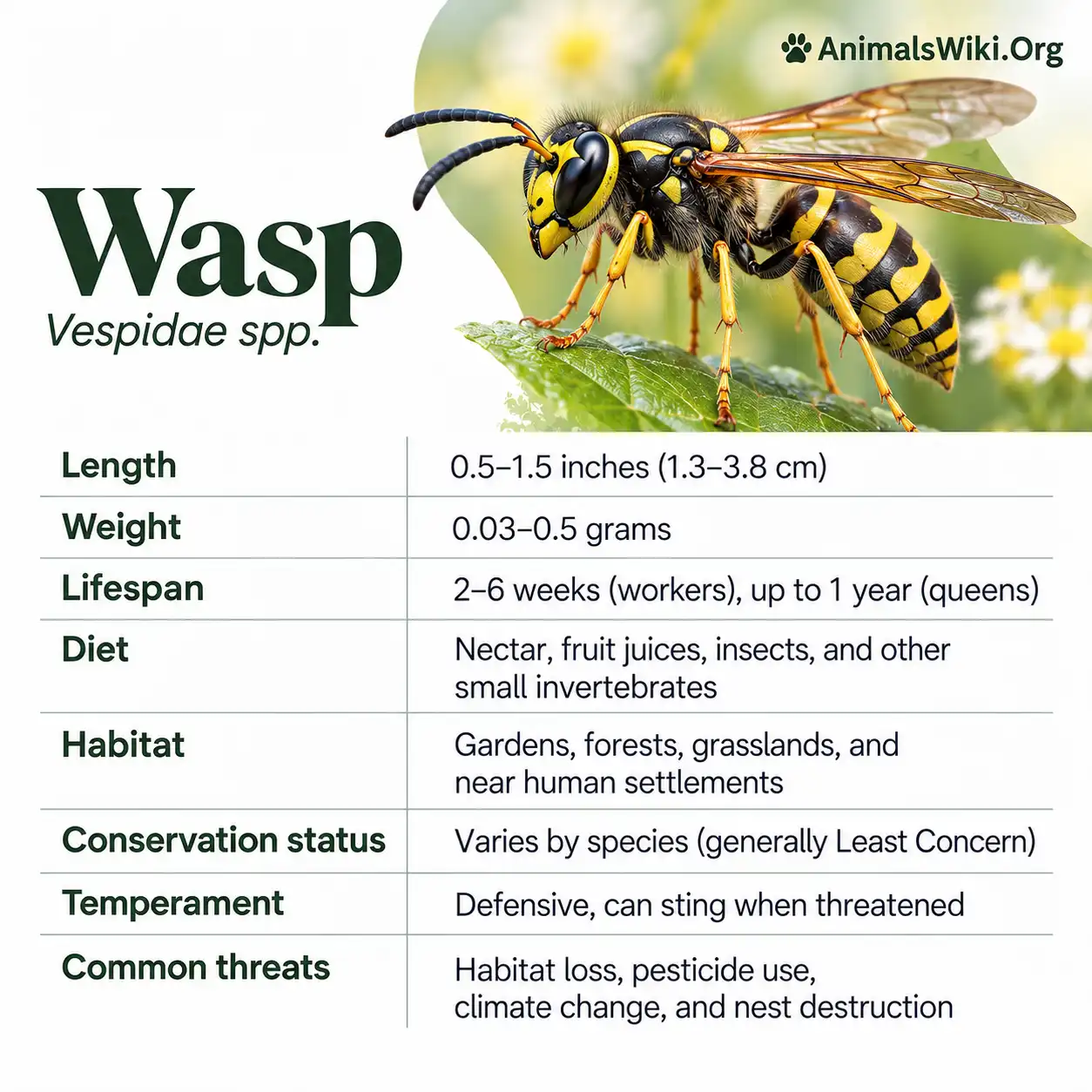
| Feature | Details |
|---|---|
| Common Name | Wasp |
| Scientific Name | Order Hymenoptera, suborder Apocrita (excluding bees and ants); over 100,000 described species |
| Family | Vespidae (social wasps), Sphecidae, Crabronidae, Ichneumonidae, and numerous others |
| Order | Hymenoptera |
| First Described | 1758 (European Hornet, by Carl Linnaeus) |
| Native Habitat | Nearly every terrestrial habitat worldwide except polar regions |
| Geographic Range | Global (all continents except Antarctica) |
| Average Size | 0.1 mm (parasitic fairyflies) to 5+ cm (Asian giant hornet) |
| Average Weight | Negligible (mg) to a few grams for the largest species |
| Lifespan | Workers: weeks to months; queens: up to 1 year (social species); solitary species vary widely |
| Diet | Predominantly carnivorous/predatory (adults also feed on nectar and sugars) |
| Conservation Status | Varies; most common species Least Concern, several specialist pollinator wasps declining |
| Defining Feature | Narrow “wasp waist” (petiole); smooth stinger capable of repeated use in most social species; overwhelming majority of species are solitary and non-aggressive; essential pest control and pollination role |
| Number of Species | Over 100,000 described species; vastly outnumbering bees and ants combined |
1. Wasp Species Overview & Classification
In the quiet corner of a summer vegetable garden, a small, iridescent insect barely a centimeter long lands with delicate precision on the underside of a tomato leaf, its slender, almost impossibly narrow waist catching a flash of afternoon sunlight as it walks with quick, exploratory steps across the leaf surface. It is searching — methodically, patiently — for a very specific target: a caterpillar, one that has been quietly devouring the gardener’s tomato plants for days. When it finds one, the wasp will deliver a swift, precise sting, not to kill outright, but to paralyze, before laying a single egg on or within the caterpillar’s body — the beginning of a process that will, over the following days, see the wasp’s own larva slowly consume its still-living host from within, ultimately emerging as a new adult wasp that will, in turn, hunt down more caterpillars, more aphids, more agricultural pests, continuing a cycle of natural pest control that has been operating largely unnoticed and almost entirely unappreciated in gardens, farms, and forests around the world for tens of millions of years. This single, quiet insect — never once approaching a picnic table, never once threatening a human being — represents the overwhelming statistical reality of what a “wasp” actually is: not the aggressive, sting-happy nuisance of popular summer complaint, but one of the most abundant, most ecologically indispensable, and most unfairly maligned groups of animals on the entire planet.
The wasp is not a single species but an almost unimaginably vast and diverse assemblage of insects within the order Hymenoptera — the same broad taxonomic order that includes bees and ants, both of which, in a genuinely significant evolutionary sense, actually evolved from within the wasp lineage rather than the reverse. With well over 100,000 formally described species, and scientific estimates suggesting the true total number of wasp species worldwide may exceed several hundred thousand or even over a million once undescribed species are accounted for, wasps represent one of the single most numerically dominant and taxonomically diverse animal groups covered anywhere throughout this broader guide series — vastly outnumbering not only bees and ants combined, but the total number of species documented across the entire vertebrate animal kingdom multiple times over.
Wasps occupy a position of profound ecological importance that stands in genuinely striking, almost paradoxical contrast to their overwhelmingly negative popular reputation: the vast, overwhelming majority of wasp species are solitary, entirely non-aggressive toward humans, and function as extraordinarily effective natural predators and parasites of agricultural pests, playing a genuinely essential — and, in modern integrated pest management and organic agriculture, increasingly deliberately cultivated — role in controlling insect populations that would otherwise devastate crops and natural vegetation across the world. The considerably smaller minority of social wasp species — including the yellowjackets and hornets responsible for the great majority of human sting encounters and, consequently, the entire group’s dominant negative popular reputation — represent only a small fraction of the wasp world’s genuine diversity, yet have come to define public perception of an entire order containing well over one hundred thousand species, the overwhelming majority of which most people will never even notice, let alone be stung by, across an entire lifetime.
Species Classification Table
| Classification Level | Details |
|---|---|
| Kingdom | Animalia |
| Phylum | Arthropoda |
| Class | Insecta |
| Order | Hymenoptera |
| Suborder | Apocrita (wasps, along with bees and ants, which evolved from within this group) |
| Major Families | Vespidae, Sphecidae, Crabronidae, Ichneumonidae, Braconidae, Chalcididae, and dozens more |
| Described By | Carl Linnaeus, 1758 (European Hornet) |
| Common Names | Wasp (English); Guêpe (French); Avispa (Spanish) |
Major Wasp Groups
| Group | Example Species | Social Structure | Notes |
|---|---|---|---|
| Yellowjackets | Vespula spp. | Highly social (eusocial) | Most common source of human sting encounters in North America |
| Paper wasps | Polistes spp. | Social (eusocial, smaller colonies) | Build distinctive open, umbrella-shaped nests |
| Hornets | Vespa spp. | Highly social (eusocial) | Includes the Asian giant hornet, the largest social wasp species |
| Parasitoid wasps | Ichneumonidae, Braconidae, Chalcididae families | Solitary | Vastly the most numerous wasp group; essential agricultural pest control |
| Digger/hunting wasps | Sphecidae, Crabronidae families | Solitary | Provision nests with paralyzed prey for larvae |
| Fig wasps | Agaonidae family | Solitary | Obligate, highly specialized pollinators of fig trees |
| Gall wasps | Cynipidae family | Solitary | Induce plant galls; larvae develop inside plant tissue |
The Name “Wasp”
The English word “wasp” derives from the Old English “wæps” or “wæsp,” tracing further back through Proto-Germanic roots to an ancient Proto-Indo-European root generally believed to be connected to weaving or interlacing — potentially a reference to the distinctive woven, paper-like texture of many social wasp nests, discussed extensively in the Reproduction and Social Behavior sections, though this specific etymological connection remains a subject of some linguistic discussion among historical linguists.
🐝 Did You Know? Of the more than 100,000 described wasp species worldwide, only a genuinely small fraction — likely well under 1,000 species, representing a tiny minority of the order’s total diversity — are the social wasps (yellowjackets, hornets, and paper wasps) responsible for essentially all human sting encounters. The overwhelming majority of wasp species are solitary, non-aggressive, and entirely focused on hunting or parasitizing other insects — meaning that when most people picture “a wasp,” they are picturing a genuinely tiny, statistically unrepresentative sliver of one of the most diverse animal orders on Earth.
2. Wasp Physical Description & Unique Features
The wasp body plan, while showing considerable variation across the group’s extraordinary diversity, is united by several genuinely distinctive anatomical features that define the broader Hymenoptera order and, in several specific respects, distinguish wasps from their close bee and ant relatives.
Size and Build
Wasp size spans an almost unimaginably vast range across the group’s more than 100,000 described species:
- Smallest species: Certain parasitoid wasps within the family Mymaridae (fairyflies) rank among the smallest insects on Earth, with some species measuring under 0.2 millimeters in body length — genuinely approaching the theoretical lower size limit for functional multicellular insect anatomy, including a fully formed nervous system, wings, and reproductive organs
- Largest species: The Asian giant hornet (Vespa mandarinia), the largest social wasp species, can reach body lengths of over 5 cm (2 inches), with a wingspan approaching 7.5 cm, representing one of the largest wasp species by overall body size, though several solitary spider-hunting wasp species, including various tarantula hawk wasps, can achieve comparable or even greater overall length
The “Wasp Waist” — A Defining Anatomical Feature
Perhaps the single most immediately recognizable anatomical feature associated with wasps — and one directly reflected in the common English idiom “wasp waist,” used to describe an extremely narrow human waistline — is the distinctive constriction between the thorax (mid-body segment) and abdomen (rear body segment), technically termed the petiole:
- Structural function: This narrow waist connection, while visually striking and popularly associated specifically with wasps, is in fact a broader anatomical feature of the entire Apocrita suborder (encompassing wasps, bees, and ants collectively), believed to provide enhanced abdominal flexibility, a genuinely significant functional advantage for the precise, targeted stinger deployment central to the hunting and defensive behavior of numerous wasp species, discussed extensively in the Diet and Predators sections
- Variation across species: The degree of waist constriction varies considerably across the wasp order’s extraordinary diversity, with certain groups displaying a more dramatically pronounced, threadlike waist than others
Wings of Wasp
The great majority of adult wasps possess two pairs of membranous wings, with the smaller hindwing typically connected to the larger forewing via a row of small hooks (a structural connection shared broadly across the Hymenoptera order), allowing the two wing pairs to function together as a single effective flight surface during active flight.
The Stinger — A Genuinely Remarkable Modified Anatomical Structure
The wasp stinger, present in females only (a detail discussed further below), represents one of the group’s most scientifically interesting and, for obvious reasons, most publicly significant anatomical features:
- Evolutionary origin: The wasp stinger is, in a genuinely fascinating evolutionary sense, a modified ovipositor — the egg-laying structure found in the great majority of insect groups — that has, across the evolutionary history of the Aculeata (the “stinging” lineage within Apocrita, encompassing social and many solitary wasps, along with bees and ants), been repurposed from its original reproductive function toward an additional or, in many species, primary defensive and/or prey-subduing function
- Smooth versus barbed stingers: Unlike the honeybee, whose barbed stinger typically becomes lodged in mammalian skin and is torn from the bee’s body during a sting (resulting in the bee’s death, a well-documented and widely known feature of honeybee biology), the great majority of social wasp species possess a comparatively smooth stinger, allowing the insect to withdraw it cleanly after stinging and, consequently, to sting repeatedly without suffering the fatal self-injury a honeybee experiences — a genuinely significant biological distinction directly relevant to why wasp encounters can, in certain circumstances, involve multiple stings from a single individual insect
- Only females sting: Because the stinger derives evolutionarily from the female reproductive ovipositor structure, male wasps entirely lack the capacity to sting — a fact with genuine practical relevance, since it means every wasp sting a person receives, across the entire order, comes exclusively from a female individual
Mandibles and Feeding Structures
Wasps possess well-developed mandibles (jaw structures) adapted variously across the group’s considerable dietary diversity, discussed extensively in the Diet section, for capturing and subduing prey, chewing wood pulp for nest construction (in social species, discussed extensively in the Reproduction section), and, in numerous species, feeding on nectar and other sugar sources.
Coloration and Warning Patterns
Numerous wasp species, particularly the social species responsible for the great majority of human encounters, display bold black-and-yellow or black-and-white banding patterns — a classic example of aposematic (warning) coloration, discussed extensively in the Predators section, signaling the insect’s stinging defensive capability to potential predators; notably, several entirely harmless, non-stinging insect species, including numerous hoverfly species, have independently evolved strikingly similar black-and-yellow banding patterns specifically to exploit this same predator-deterrent visual signal through Batesian mimicry (a defensive strategy in which a harmless species evolves to resemble a genuinely dangerous or unpalatable one), a genuinely significant and well-documented example of evolutionary mimicry directly connected to the wasp’s broader defensive reputation.
3. Wasp Natural Habitat & Geographic Range
Wasps occupy an almost unparalleled range of terrestrial habitat types across every continent on Earth except Antarctica, reflecting the group’s extraordinary taxonomic diversity and the correspondingly vast range of specific ecological niches occupied by different wasp lineages.
Preferred Habitat Features
Availability of prey or host species — for the overwhelming majority of wasp species, which are predatory or parasitic (discussed extensively in the Diet section), habitat suitability is fundamentally determined by the presence of appropriate prey insects or, for parasitoid species specifically, appropriate host organisms
Suitable nesting substrate — social wasp species require access to appropriate nesting materials and locations, discussed extensively in the Reproduction section, including wood fiber sources (for the paper-nest-building species) and sheltered nest sites such as tree cavities, underground burrows, or structural voids within human buildings
Flowering plants (nectar resource) — while the great majority of wasp species are predatory or parasitic in their larval feeding requirements, described extensively in the Diet section, adult wasps of numerous species rely significantly on nectar and other sugar sources for their own direct adult nutritional needs, making habitat containing adequate flowering plant diversity a significant factor in wasp habitat suitability and broader population health
Soil conditions (ground-nesting species) — numerous solitary and several social wasp species, including several yellowjacket species, nest underground, requiring suitable soil conditions supporting burrow excavation and structural stability
Habitat Types Occupied
| Habitat | Primary Wasp Use | Species Examples | Key Features |
|---|---|---|---|
| Temperate forest and woodland | Nesting, foraging | Numerous social and solitary species | Wood fiber for paper nests; diverse prey |
| Agricultural land and gardens | Foraging, biological pest control | Numerous parasitoid species | Abundant agricultural pest prey/hosts |
| Tropical rainforest | Primary habitat for the greatest species diversity | Enormous diversity of parasitoid and social species | Highest global wasp biodiversity concentration |
| Grassland and meadow | Foraging, ground nesting | Various digger wasp and yellowjacket species | Suitable soil for underground nesting |
| Urban and suburban environments | Adapted nesting habitat | Various social wasp species | Structural cavities; abundant food waste access |
| Desert and arid habitat | Specialized habitat | Various specialized solitary species | Adapted to extreme heat and water scarcity |
Geographic Range
Wasps are found across every continent on Earth except Antarctica, with species diversity showing a pronounced concentration toward tropical and subtropical regions, broadly consistent with the general global biodiversity gradient documented across numerous other insect and broader animal groups — tropical rainforest ecosystems in particular are believed to host a truly vast, and still substantially undocumented, proportion of the world’s total wasp species diversity, particularly among the parasitoid wasp groups, where scientific estimates suggest a very substantial proportion of total global species diversity remains formally undescribed by science.
The Staggering Scale of Undescribed Wasp Diversity
One of the more scientifically striking aspects of wasp biogeography and taxonomy involves the sheer scale of still-undescribed species diversity believed to exist, particularly among the parasitoid wasp groups: some entomological researchers have suggested that the true total number of wasp species worldwide, once all currently undescribed tropical parasitoid species are eventually formally documented, could substantially exceed one million — a scale of undocumented biodiversity that would place wasps among the single most numerically dominant animal groups on the entire planet, considerably exceeding the combined total species diversity of all vertebrate animal groups covered collectively throughout this broader guide series.
4. Wasps Diet & Feeding Behavior
Wasp diet varies considerably across the group’s extraordinary taxonomic diversity, though the overwhelming majority of wasp species share a fundamentally predatory or parasitic feeding ecology during their larval developmental stage — a defining ecological characteristic setting wasps apart from their close bee relatives, whose larvae are predominantly herbivorous, feeding on pollen and nectar provisions.
What Wasps Eat — By Category and Life Stage
Larval diet — predominantly predatory/parasitic:
- Parasitoid wasps (representing the vast majority of total wasp species diversity, described extensively in the Species Overview section) lay eggs on or within a host insect — commonly caterpillars, aphids, beetle larvae, or other arthropods — with the resulting wasp larva subsequently consuming the host from within or attached externally, typically resulting in the host’s eventual death; this parasitoid feeding strategy represents one of the most numerically significant predatory relationships in the entire insect world, given the sheer diversity and abundance of parasitoid wasp species
- Solitary hunting/digger wasps capture and paralyze prey — commonly spiders, caterpillars, or other insects, with specific prey preference varying considerably by species — and provision an individual nest cell with one or several paralyzed prey items, upon which the wasp’s larva subsequently feeds directly
- Social wasp larvae (yellowjackets, hornets, and paper wasps) are typically fed a diet of masticated (chewed) insect prey, gathered and processed by adult worker wasps, described extensively in the Social Behavior section
Adult diet — predominantly nectar and sugars, supplemented by prey:
- Nectar and other sugar sources represent the primary direct nutritional resource for adult wasps of numerous species, including the great majority of social wasps, providing the immediate energy required for flight and general activity
- Prey insects — while adult wasps of predatory and parasitoid species typically do not themselves consume the prey or host insects they capture or parasitize (this food resource being directed toward the developing larvae instead, as described above), adult wasps frequently consume a portion of captured prey directly, and social wasp workers commonly consume small amounts of prey-derived protein alongside their primary nectar-based diet
- Fruit and various sugary substances — numerous wasp species, particularly several social species during the late summer and autumn period described further below, show significant dietary interest in ripe or overripe fruit, fermenting sugary substances, and various human food and beverage sources, a behavior directly connected to the considerable human-wasp conflict discussed extensively in the Human Relationships section
The Late-Summer Behavioral Shift — Why Wasps Seem More “Aggressive” in August and September
A genuinely significant and scientifically well-documented aspect of social wasp feeding behavior directly relevant to common human perception and complaint involves a pronounced seasonal dietary and behavioral shift occurring in late summer:
- Colony life-cycle context: As detailed extensively in the Reproduction section, social wasp colonies follow an annual life cycle in which the colony’s primary reproductive effort — producing new queens and males — occurs during late summer; once this reproductive effort is substantially complete, and as the colony’s population of larvae requiring protein-rich prey provisioning declines toward the end of the season, worker wasps that previously spent the great majority of their foraging effort hunting insect prey for larval provisioning increasingly shift their foraging attention toward direct sugar-source foraging for their own nutritional needs
- Increased human food/beverage interest: This late-season dietary shift substantially explains the commonly observed increase in wasp interest in human food, sugary beverages, and outdoor dining and picnic settings during the late summer and early autumn period — behavior widely, if somewhat inaccurately, characterized in general popular perception as heightened wasp “aggression,” when it more accurately reflects a predictable, biologically driven seasonal shift in foraging priority rather than any change in the insects’ underlying temperament or genuine aggressiveness
The Fig Wasp — An Extraordinary Case of Coevolved Mutualism
Among the wasp order’s most scientifically remarkable dietary and ecological specializations is the relationship between fig wasps (family Agaonidae) and fig trees, representing one of the most tightly coevolved, obligate mutualistic relationships documented anywhere in the natural world:
- Obligate pollination relationship: The great majority of fig tree species depend entirely on a specific, often single, corresponding fig wasp species for pollination, with the relationship structured such that the female fig wasp enters a developing fig fruit (technically an inverted inflorescence structure) through an extremely narrow opening — a process that typically strips off her wings and antennae in the process, meaning she will never leave the fig she has entered — pollinating the fig’s internal flowers in the process of laying her own eggs within specialized gall structures inside the fig, with her offspring subsequently developing, mating, and, in the case of the winged females, departing to repeat the cycle at a new fig, while wingless males typically never leave the fig in which they were born, mating with emerging females before dying without ever seeing the outside world
- Genuine ecological significance: This tightly coevolved, obligate mutualistic relationship underlies the successful reproduction of an enormous number of fig tree species worldwide, which themselves represent a genuinely disproportionately significant food resource for numerous vertebrate frugivore species across tropical ecosystems worldwide, discussed extensively in the Ecosystem Role section, making the comparatively tiny, rarely noticed fig wasp one of the more ecologically consequential individual species relationships documented anywhere in this broader guide series relative to its minimal physical size and near-total lack of general public awareness.
5. Wasp Reproduction & Life Cycle
Wasp reproductive biology varies dramatically across the order’s extraordinary taxonomic diversity, ranging from the comparatively simple, individually focused reproductive strategy of solitary wasp species to the genuinely complex, highly organized annual colony cycle characteristic of social species.
Solitary Wasp Reproduction — The Majority Pattern
Given that solitary wasps represent the overwhelming majority of total wasp species diversity, described extensively throughout this guide, the solitary reproductive pattern is, in a genuine statistical sense, the “typical” wasp reproductive strategy, despite receiving considerably less general public attention than social wasp colony biology:
- Individual nest provisioning: A solitary female wasp — parasitoid or hunting/digger species alike — typically constructs or locates an individual nest cell (which may be excavated in soil, constructed from mud, utilize a pre-existing cavity, or, in parasitoid species, simply be the host organism’s own body), provisions it with either a paralyzed prey item (hunting wasps) or lays her egg directly on or within a host organism (parasitoid wasps), and, in the great majority of solitary species, provides no further parental care beyond this initial provisioning act, with the developing larva left to complete its development entirely independently
- No overlapping generations or colony structure: Unlike social species, solitary wasps do not form colonies, do not produce a distinct worker caste, and each female is fully reproductively capable and independently responsible for her own reproductive effort — a fundamentally different reproductive and social structure from the more publicly familiar social wasp colony pattern described extensively below
Social Wasp Reproduction — The Annual Colony Cycle
The considerably smaller minority of social (eusocial) wasp species — including yellowjackets, hornets, and paper wasps — follow a genuinely complex, highly organized annual colony life cycle, broadly comparable in general structure to the annual colony cycle documented in bumblebees, though with several genuinely distinctive features:
| Stage | Timing | Description |
|---|---|---|
| Queen overwintering | Winter | Solitary mated queen survives winter in sheltered refuge |
| Nest founding | Early spring | Queen alone constructs initial small nest and lays first eggs |
| First worker generation | Spring | Queen personally forages and feeds first larvae; workers emerge |
| Colony growth | Summer | Workers take over foraging/nest-building; queen focuses on egg-laying |
| Peak colony size | Late summer | Colony reaches maximum size (varies dramatically by species) |
| Reproductive production | Late summer/early autumn | Colony produces new queens and males |
| Mating flights | Autumn | New queens and males leave nest to mate |
| Colony collapse | Autumn/winter | Original queen, workers, and old nest die; only newly mated queens survive |
Annual colony mortality — a critical distinction from many social insects: Unlike honeybee colonies, which can persist for multiple years with the same colony structure, the great majority of social wasp colonies are strictly annual, with the entire colony — including the original founding queen, all workers, and the physical nest structure itself — dying at the end of each season, with only the newly produced, freshly mated young queens surviving through winter dormancy to found entirely new colonies the following spring, a genuinely significant biological distinction from the honeybee’s considerably different, colony-persistent life history.
Nest construction — the “paper wasp” material innovation: Social wasps, particularly paper wasps, yellowjackets, and hornets, construct their nests from a genuinely remarkable material: wood pulp mixed with saliva, chewed and processed by worker wasps into a paper-like material that is then constructed into the characteristic layered, hexagonal-celled nest structure — a nest-building innovation that, notably, considerably predates human paper manufacturing by tens of millions of years, and one that some historical accounts suggest may have directly inspired early human paper-making techniques, discussed further in the Human Relationships section.
Colony Size Variation
Social wasp colony size varies considerably across species: paper wasp colonies are typically comparatively modest, often numbering only a few dozen to a few hundred individuals at peak size, while yellowjacket and hornet colonies can grow substantially larger, with certain yellowjacket species (particularly some ground-nesting species in favorable climate conditions) documented reaching colony populations numbering in the several thousands to, in rare exceptional cases, tens of thousands of individuals — a scale of colony growth considerably exceeding the typical annual life-cycle pattern and generally associated with unusually favorable climate conditions allowing colony growth to continue for an extended period beyond the typical single-season cycle.
Wasp Lifespan
- Solitary wasp adults: Typically quite short, often only several weeks to a few months, reflecting the species’ individually focused, non-colonial reproductive strategy
- Social wasp workers: Typically live only a few weeks to a couple of months, reflecting the considerable physical demands of active foraging and colony maintenance duties
- Social wasp queens: Considerably longer-lived than workers, with founding queens typically surviving through the entire single-season colony cycle described above, and newly produced queens surviving through winter dormancy to found the subsequent season’s colony — meaning individual queen lifespan can approach a full year, though this represents an unusually long lifespan relative to the broader wasp order.
6. Social Behavior & Communication
Wasp social behavior spans one of the most dramatic ranges of social complexity documented across the entire animal kingdom — from the entirely solitary, individually independent lifestyle of the overwhelming majority of wasp species to the genuinely sophisticated, highly organized eusocial colony structure of the comparatively small minority of social species.
The Solitary Majority — A Fundamentally Independent Lifestyle
As emphasized extensively throughout this guide, the overwhelming majority of the wasp order’s more than 100,000 described species are solitary, with each female wasp operating entirely independently — constructing her own nest or locating her own host, provisioning offspring without assistance from other wasps, and displaying no meaningful colonial social structure whatsoever; this solitary lifestyle represents the genuine taxonomic and numerical “default” wasp social pattern, despite receiving considerably less general public attention than the comparatively rare social wasp colony structure described extensively below.
The Social (Eusocial) Minority — Genuine Colonial Complexity
The considerably smaller minority of social wasp species display genuine eusociality — a form of social organization characterized by cooperative brood care, overlapping generations within a single colony, and a division of labor into reproductive and non-reproductive (worker) castes, broadly comparable in general structural principle to the eusocial organization documented in honeybees and various ant species:
- Caste structure: Social wasp colonies typically consist of a single founding queen (the colony’s primary, and often sole, reproductive female), numerous sterile female workers (responsible for foraging, nest construction and maintenance, larval care, and colony defense), and, produced specifically during the late-season reproductive period described in the Reproduction section, new queens and males
- Division of labor: Worker wasps display meaningful task specialization within the colony, including foragers (collecting prey and nectar), nest-builders (processing wood pulp into paper nest material), nurses (feeding and caring for developing larvae), and guards (defending the nest against intruders and predators) — a division of labor that can shift for individual workers across their comparatively short lifespan, broadly comparable to the age-based task specialization (“temporal polyethism”) documented across numerous other eusocial insect species
Communication
Chemical/pheromone communication: As with numerous other eusocial insect groups, chemical pheromone signaling represents a significant communication channel within social wasp colonies, used in contexts including nest-mate recognition (allowing workers to distinguish colony members from potential intruders), alarm signaling (discussed extensively in the Predators section, given the genuinely significant role alarm pheromones play in triggering coordinated colony defensive response), and various other social coordination functions
Alarm pheromone release and colony defense: One of the most practically significant aspects of social wasp communication, directly relevant to human sting encounters discussed extensively in the Human Relationships section, involves the release of alarm pheromones by a threatened or injured worker wasp, which rapidly recruits additional nearby workers to a coordinated defensive response — a genuinely significant biological mechanism directly explaining why disturbing a single wasp near an active nest can, in certain circumstances, trigger a considerably more substantial multi-wasp defensive response, as additional colony members are chemically recruited to the perceived threat
Tactile and visual communication: Direct physical contact (including antennal contact) and visual cues play meaningful roles in various social wasp colony interactions, including food-sharing (trophallaxis, the direct mouth-to-mouth transfer of food between colony members) and various dominance and social hierarchy interactions documented particularly within paper wasp colonies, where research has identified genuine dominance hierarchies among co-founding females in certain species, adding a further layer of social complexity to the broader eusocial colony structure.
Documented Cognitive Sophistication in Paper Wasps
Beyond the broader eusocial colony structure described above, several paper wasp species have become subjects of genuine, significant scientific research interest regarding individual facial recognition capability — research has documented that certain paper wasp species can visually distinguish between individual nestmates based on subtle variations in facial markings, a genuinely sophisticated individual-recognition cognitive capability that had, until relatively recently, been considered unusual or unexpected in an insect with the comparatively modest brain size characteristic of the wasp order, representing one of the more scientifically striking recent discoveries regarding insect cognitive capability documented within this broader animal group.
7. Predators & Defense Mechanisms
Wasps, despite their formidable popular reputation as a stinging threat, themselves face meaningful predation pressure from a considerable range of predators specifically adapted to overcome or avoid the group’s genuinely significant chemical and physical defensive capabilities.
Natural Predators
Birds — numerous bird species, including various flycatchers, shrikes, and, notably, specialized “bee-eater” bird species found across Africa, Europe, and Asia, prey significantly on wasps, having evolved specific behavioral techniques (including deliberately rubbing captured wasps against a branch to remove or disable the stinger before consumption) to safely process stinging prey
Other wasps and predatory insects — various larger, predatory wasp species, along with certain robber fly species and praying mantises, prey on smaller wasp species, and social wasp colonies themselves frequently face predation and, notably, nest raiding from other wasp species, including documented instances of yellowjacket colonies raiding and consuming the brood of rival, weaker colonies
Spiders — various spider species, particularly certain orb-weaving species, capture wasps in webs, though social wasp species’ genuine stinging capability means such predation events carry meaningful risk to the predator as well
Mammalian predators — several mammal species, including certain skunk species and, notably, honey badgers (discussed elsewhere throughout this broader guide series in the context of bee-nest raiding), display documented tolerance for and active predation of stinging insect nests, including wasp colonies, reflecting specific physiological or behavioral adaptations that reduce the practical deterrent effectiveness of wasp stings against these particular predator species
Parasitoid wasps preying on other wasps — in a genuinely interesting ecological twist, certain parasitoid wasp species specifically target other wasp species as hosts, meaning the broader wasp order includes documented predator-prey relationships occurring entirely within the group itself
Defense Strategies
The stinger as primary defense: As detailed extensively in the Physical Description section, the wasp stinger — capable of repeated use in the great majority of social species, given the smooth rather than barbed stinger structure — represents the group’s single most significant and well-known defensive mechanism, delivering a venom cocktail causing genuine pain and, in some individuals, more severe allergic reaction, discussed extensively in the Human Relationships section
Aposematic warning coloration: As detailed extensively in the Physical Description section, the bold black-and-yellow banding pattern displayed by numerous wasp species serves as a genuine visual warning signal to potential predators, and the considerable evolutionary investment other, entirely harmless insect species have made in mimicking this same warning pattern (Batesian mimicry) represents strong evolutionary evidence for the genuine effectiveness of this defensive coloration strategy
Coordinated colony defense (social species): As detailed extensively in the Social Behavior section, social wasp colonies benefit from a genuinely significant collective defensive capability, with alarm pheromone signaling allowing rapid recruitment of multiple defending workers in response to a perceived threat, a coordinated group defensive response considerably exceeding what any solitary wasp species could achieve individually
Nest concealment and defensibility: Numerous wasp species, both solitary and social, construct or select nest sites offering meaningful passive defensive protection, including underground burrows, concealed cavities, and, in several social species, nests constructed with a protective outer paper envelope layer specifically enclosing and shielding the more vulnerable internal comb structure from direct predator access
Venom potency variation: Wasp venom composition and potency vary considerably across species, with certain species — including several tarantula hawk wasp species, whose sting is widely regarded among entomologists as among the most subjectively painful insect stings documented anywhere in the world, despite causing comparatively limited lasting physical damage — representing a genuinely significant defensive deterrent investment relative to the group’s overall modest physical size.
8. Relationship with Humans
Ancient Cultural and Practical Recognition
Wasps have held varied, and in several respects genuinely more nuanced and even positive, cultural and practical significance across numerous historical human societies than the group’s dominant modern negative popular reputation might suggest:
Ancient Egyptian symbolism: The wasp, alongside the bee, held meaningful symbolic significance in various ancient Egyptian contexts, and certain wasp-adjacent symbolism appears within broader ancient Egyptian royal and religious iconographic tradition
Traditional entomophagy (insect consumption): In various traditional culinary practices, particularly across parts of Japan and other regions of East and Southeast Asia, wasp larvae and pupae have historically been, and in certain communities continue to be, consumed as a traditional food source — a practice reflecting genuine, longstanding recognition of the nutritional value contained within wasp brood, distinct from the considerably more negative general Western cultural attitude toward the insects overall
Traditional agricultural pest-control awareness: Various traditional farming communities across numerous cultures have historically recognized, at least at an intuitive practical level, the beneficial pest-control services provided by wasps within agricultural settings, a form of traditional ecological knowledge increasingly validated and formalized by modern agricultural science, discussed further below
The Modern “Nuisance Pest” Reputation
As detailed extensively throughout this guide, wasps have developed a predominantly negative modern popular cultural reputation, driven substantially by the disproportionate visibility and public encounter frequency of the comparatively small minority of social wasp species — particularly yellowjackets — responsible for the great majority of human sting encounters, especially during the late-summer behavioral shift toward sugar-source foraging described extensively in the Diet section, when wasp interest in outdoor human food and beverage settings peaks considerably.
Wasp Stings — Medical Considerations
Typical sting reaction: For the great majority of people, a wasp sting produces localized pain, swelling, and redness that generally resolves within a period of hours to a few days without requiring specific medical treatment beyond basic symptomatic care
Allergic reaction risk: A meaningful minority of the human population experiences genuine, potentially serious allergic reactions to wasp venom, ranging from more pronounced localized swelling to, in a smaller proportion of severely allergic individuals, life-threatening anaphylaxis requiring emergency medical treatment — a genuine and important medical consideration underlying much of the broader public caution and, in various contexts, fear response wasps generate
Multiple sting risk: As detailed extensively in the Physical Description and Social Behavior sections, the combination of the social wasp’s smooth, reusable stinger and the alarm-pheromone-triggered coordinated colony defense response means that disturbing an active social wasp nest carries genuine risk of multiple stings from multiple individual wasps within a short period, a risk profile considerably different from and, in aggregate sting-count terms, potentially more medically significant than a single honeybee sting encounter
The Genuinely Essential Agricultural Pest Control Role
As introduced extensively in the Species Overview section and detailed further in the Ecosystem Role section, the overwhelming majority of wasp species — the solitary parasitoid and hunting wasps that receive vastly less public attention than their small minority of social relatives — provide a genuinely essential, and increasingly deliberately cultivated, natural pest control service within modern agriculture:
- Biological pest control programs: Numerous modern agricultural pest management programs, particularly within organic and integrated pest management (IPM) farming systems, deliberately cultivate, release, or otherwise support populations of specific parasitoid wasp species specifically targeted at particular agricultural pest insects, representing a genuine, scientifically validated, and increasingly economically significant application of the wasp’s natural predatory and parasitic ecology toward practical agricultural benefit
- Economic significance: The aggregate economic value of natural, wasp-mediated agricultural pest control across global agriculture — while difficult to precisely quantify given the diffuse, largely unmanaged nature of the great majority of this ecosystem service — is generally recognized by agricultural economists and entomologists as genuinely substantial, representing a significant, if historically underappreciated, contribution to global food production and agricultural pest management
Wasp Nest Removal and Pest Control Industry
Given the genuine sting risk and, in various contexts, allergic reaction concern associated with social wasp colonies nesting in close proximity to human structures and activity, professional wasp nest removal represents a significant, ongoing component of the broader pest control services industry across much of the world, reflecting the practical, day-to-day dimension of human-wasp conflict management.
9. Wasp Conservation Status & Threats
Conservation Status Overview
Given the extraordinary taxonomic scale of the wasp order — well over 100,000 described species, with potentially several times that number remaining undescribed — comprehensive, species-by-species conservation status assessment across the entire order remains genuinely incomplete, with the great majority of wasp species, particularly among the vast parasitoid wasp groups, never having been formally assessed for conservation status at all; the general, broadly common social wasp species most familiar to the public (yellowjackets, common paper wasps, and various hornet species) are generally considered Least Concern and, in several cases, genuinely abundant and, in certain introduced regions, actively invasive, discussed further below, while numerous more specialized, habitat-restricted, or narrowly host-specific parasitoid and pollinator wasp species face genuine, if considerably less publicly recognized, conservation concern.
Current Threats
1. Habitat Loss and Agricultural Intensification
As with numerous other insect groups covered elsewhere throughout broader wildlife literature, habitat loss and the broader intensification of modern agricultural land use — including reduced wildflower and hedgerow habitat providing essential adult nectar resources, described extensively in the Habitat section — represents a significant, sustained threat to numerous specialized wasp species, particularly those with more narrow habitat or host-species requirements than the broadly generalist social species.
2. Pesticide Use
Broad-spectrum insecticide application across agricultural and, increasingly, residential landscapes poses a genuine, significant threat to beneficial wasp populations, including the very parasitoid wasp species that would otherwise provide natural pest control service, described extensively in the Human Relationships section — a genuinely significant and, in various integrated pest management contexts, actively studied ecological irony, in which indiscriminate pesticide use aimed at controlling agricultural pests can simultaneously eliminate the natural predatory wasp populations that would otherwise help suppress those same pest populations through entirely natural means.
3. Climate Change
Shifting temperature and precipitation patterns associated with broader climate change represent a longer-term threat consideration relevant to numerous wasp species, particularly those with specialized host-species relationships (as in the case of parasitoid species) or specific climatic tolerance requirements, given the potential for climate-driven disruption to the precise phenological (seasonal timing) synchronization between many wasp species and their specific host or prey organisms.
4. Introduced/Invasive Wasp Species
In something of a genuine conservation paradox relative to the broader threats facing native wasp diversity, several wasp species have themselves become significant invasive species in various introduced regions, with documented negative ecological impacts on native insect and, in various contexts, broader ecosystem biodiversity — most notably the German and common wasp (Vespula germanica and Vespula vulgaris), which have become significant invasive pest species across New Zealand and various other introduced regions, and the Asian hornet (Vespa velutina), which has emerged as a significant, actively managed invasive species concern across substantial portions of Europe in recent years, given documented predation pressure on native honeybee populations.
5. General Public Persecution and Nest Destruction
Beyond the more systemic threats described above, the wasp order’s overwhelmingly negative general public reputation, described extensively throughout this guide, contributes to widespread, largely indiscriminate nest destruction and general lethal control efforts targeting wasps broadly — including, in many cases, entirely harmless solitary species mistakenly identified as dangerous social wasps — representing a genuine, if difficult to precisely quantify, conservation and ecological pest-control-service pressure stemming substantially from the group’s disproportionately negative public perception relative to its actual behavior and ecological significance.
A Genuinely Underappreciated Conservation Priority
It is worth explicitly noting, in the context of the considerably more publicly prominent bee conservation movement (itself a genuinely important and well-justified conservation priority, covered separately elsewhere in broader wildlife literature), that wasp conservation — despite the group’s comparable or, in several ecological respects, even more significant role in pollination and, distinctly, pest control services — has historically received considerably less public conservation attention and dedicated research funding, a disparity increasingly recognized and actively discussed within the broader entomological and conservation science community as reflecting the group’s persistently negative general public reputation rather than any genuine difference in underlying ecological importance or conservation need.
10. Famous Wasps and Wasp Research Around the World
Charles Darwin and the Ichneumon Wasp
The parasitoid Ichneumon wasp family holds a genuinely significant place in the history of evolutionary biology and, notably, in famous historical philosophical and religious debate: Charles Darwin himself specifically cited the parasitoid wasp’s genuinely brutal larval feeding strategy — involving a developing wasp larva slowly consuming a still-living host caterpillar from within — in his own private correspondence as a source of genuine personal difficulty in reconciling the natural world’s evident cruelty with traditional religious conceptions of a benevolent divine creator, making the ichneumon wasp one of the more historically and philosophically significant individual insect groups referenced within the broader history of evolutionary biology and natural theology debate.
The Discovery of Paper Wasp Facial Recognition
As detailed extensively in the Social Behavior section, the specific research documenting individual facial recognition capability in certain paper wasp species — conducted substantially by researchers including biologist Elizabeth Tibbetts — represents a genuinely significant and widely cited body of modern insect cognition research, substantially reshaping broader scientific understanding of the cognitive sophistication achievable within the comparatively modest neural architecture characteristic of insects more generally.
The Asian Giant Hornet (“Murder Hornet”) Media Phenomenon
The Asian giant hornet (Vespa mandarinia), the largest social wasp species in the world, achieved genuine, substantial international media attention beginning in 2019–2020, when the species was first documented in North America (Washington State and British Columbia), with sensationalized media coverage popularizing the nickname “murder hornet” — a media phenomenon that, while reflecting genuine underlying scientific and agricultural concern regarding the species’ documented capacity to devastate honeybee colonies (a significant predatory behavior discussed further in the Ecosystem Role section), substantially overstated the direct danger the species poses to humans specifically, representing a notable and widely discussed case study in modern sensationalized wildlife media coverage.
11. Role in Ecosystem & Food Chain
Wasps as Essential Natural Pest Control Agents
As detailed extensively throughout this guide, and particularly in the Diet and Human Relationships sections, the overwhelming majority of wasp species — the vast diversity of solitary parasitoid and hunting wasps largely invisible to general public awareness — provide a genuinely essential ecological pest control service, regulating populations of numerous herbivorous insect species, including a considerable range of significant agricultural pest species, across virtually every terrestrial ecosystem on Earth; without this natural predation and parasitism pressure, herbivorous insect populations across the world’s forests, grasslands, and agricultural landscapes would very likely reach considerably higher, more ecologically and agriculturally disruptive population densities.
Wasps as Pollinators
While considerably less efficient and less extensively studied as pollinators compared to bees (whose specialized pollen-collecting anatomy and behavior, covered separately elsewhere in broader wildlife literature, represents a considerably more specialized pollination adaptation), numerous wasp species — including the great majority of social species during their adult nectar-foraging activity, described extensively in the Diet section — nonetheless provide meaningful, if generally secondary, pollination service across numerous plant species, with the fig wasp’s genuinely obligate, essential pollination relationship with fig trees, described extensively in the Diet section, representing by far the most scientifically significant and ecologically consequential individual wasp pollination relationship documented anywhere in the natural world.
Wasps as Prey — Supporting the Broader Predator Community
As detailed extensively in the Predators section, wasps themselves support a meaningful range of predator species specifically adapted to overcome their considerable defensive capabilities, including specialized bee-eater birds, various other predatory insects, and, in certain contexts, mammalian predators — representing a further significant trophic link within the broader terrestrial food webs wasps inhabit.
The Fig Wasp’s Disproportionate Ecological Significance
As detailed extensively in the Diet section, the fig wasp’s genuinely obligate pollination relationship with fig trees carries significant broader ecological consequences extending well beyond the specific wasp-fig relationship itself, given the considerable importance of fig fruit as a food resource for numerous vertebrate frugivore species across tropical forest ecosystems worldwide — meaning the successful reproduction of this comparatively tiny, rarely noticed wasp group underlies, to a genuinely significant degree, the broader food security of numerous larger, more publicly recognized tropical forest animal species.
Nutrient Cycling and Broader Ecological Contribution
Beyond their more prominent predatory, parasitic, and pollination roles, wasps contribute to broader ecosystem nutrient cycling through their own natural mortality and, in the case of the numerous prey and host organisms they consume or parasitize, through the broader trophic energy transfer their predatory activity represents within the food webs they inhabit.
12. Wasp Discovery & Evolution Timeline
~240–250 million years ago — The broader order Hymenoptera begins diversifying in the fossil record, representing one of the older and, ultimately, most species-rich insect orders documented in the entire animal kingdom.
~150–200 million years ago — The suborder Apocrita, encompassing wasps along with the subsequently evolved bee and ant lineages, becomes established as a distinct evolutionary branch, characterized by the distinctive “wasp waist” (petiole) anatomical feature described extensively in the Physical Description section.
~100–150 million years ago — Bees and ants each independently evolve from within the broader wasp evolutionary lineage — a genuinely significant evolutionary fact meaning that, in a strict cladistic (evolutionary-relationship) sense, bees and ants are themselves technically classifiable as specialized wasps, having evolved specific dietary and social adaptations (predominantly herbivorous, pollen-based diet in bees; fully wingless, exclusively eusocial ground-dwelling lifestyle in ants) distinguishing them from the broader ancestral wasp condition.
~70–90 million years ago — The specific evolutionary lineage leading to modern fig wasps becomes established, alongside the parallel evolutionary diversification of fig tree species, marking the beginning of the tightly coevolved, obligate mutualistic relationship described extensively in the Diet section.
Ancient era (various historical civilizations) — Numerous ancient and traditional human societies establish varied practical, culinary, and symbolic relationships with wasps, described extensively in the Human Relationships section, including traditional entomophagy practices in various regions of East and Southeast Asia.
1758 — Carl Linnaeus formally describes the European Hornet in the 10th edition of Systema Naturae, among the earliest formal Western scientific descriptions within the broader modern wasp taxonomic framework.
1860 — Charles Darwin writes his frequently cited private letter reflecting on the ichneumon wasp’s parasitic feeding strategy, described extensively in the Pop Culture section, a passage that would become historically significant within the broader history of evolutionary biology and natural theology discussion.
19th–20th century — Continued formal Western scientific description and taxonomic documentation of the wasp order’s extraordinary diversity, alongside growing scientific and agricultural recognition of the genuine pest-control ecological value provided by numerous parasitoid and hunting wasp species.
Mid-20th century — Growing formal development and agricultural implementation of biological pest control programs deliberately utilizing specific parasitoid wasp species for targeted agricultural pest management, representing an increasingly significant and scientifically validated practical application of wasp ecology.
1980s–2000s — Substantial expansion of integrated pest management (IPM) and organic agricultural practices incorporating deliberate parasitoid wasp population support, alongside growing entomological research documentation of the genuine cognitive sophistication and social complexity characteristic of several social wasp species.
2000s–2010s — Growing scientific research, including notably the work of researcher Elizabeth Tibbetts, documenting genuine individual facial recognition capability in paper wasps, described extensively in the Social Behavior and Famous Wasps sections, substantially reshaping broader scientific understanding of insect cognitive capability.
2019–2020 — The Asian giant hornet is first documented in North America, triggering the substantial, internationally significant “murder hornet” media phenomenon described extensively in the Famous Wasps section.
2010s–2020s — Continued expansion of the invasive Asian hornet across Europe, prompting significant active management and public awareness response given the species’ documented predation pressure on native honeybee populations, alongside continued growth in scientific and popular recognition of the broader wasp order’s genuine ecological significance and the persistent gap between this significance and the group’s dominant negative public reputation.
2022–2026 — Ongoing scientific research into wasp cognitive capability, continued expansion of biological pest control agricultural applications utilizing parasitoid wasp species, and continued invasive species management response to Asian hornet spread across Europe and Asian giant hornet monitoring across North America.
13. Wasp Comparison with Similar Species
| Feature | Wasp (Hymenoptera, various families) | Bee (Anthophila) | Ant (Formicidae) | Hoverfly (Syrphidae) |
|---|---|---|---|---|
| Order | Hymenoptera | Hymenoptera | Hymenoptera | Diptera |
| Evolutionary relationship | Ancestral to bees and ants | Evolved from within wasp lineage | Evolved from within wasp lineage | Unrelated; independent evolution |
| Larval diet | Predominantly predatory/parasitic | Predominantly herbivorous (pollen/nectar) | Omnivorous (varies by species) | Herbivorous/detritivorous (larvae); adults nectar-feeding |
| Adult diet | Nectar, sugars, some prey consumption | Nectar and pollen | Omnivorous (varies) | Nectar and pollen |
| Stinger | Present in females; smooth (reusable) in most social species | Present in females; barbed in honeybees (single-use) | Present in some species | None (mimics wasp coloration; harmless) |
| Social structure | Overwhelmingly solitary; minority eusocial | Varies (solitary to eusocial) | Universally eusocial | Solitary |
| Body hair | Sparse | Dense (pollen-collecting adaptation) | Sparse | Sparse |
| Conservation | Varies (most unassessed; common species secure) | Significant documented decline in many species | Varies widely | Least Concern (most species) |
| Closest relative in this guide | Bee, ant (both evolved from wasps) | Wasp | Wasp | N/A (convergent mimicry only) |
14. Best Places to See Wasps in the Wild
General Observation Notes
Given the wasp order’s genuinely global distribution and extraordinary local diversity, described extensively throughout this guide, wasps — and particularly the numerous solitary species that make up the overwhelming majority of the order’s total diversity — can be reliably observed across virtually any temperate or tropical garden, meadow, woodland, or agricultural landscape worldwide, without requiring specialized wildlife-viewing travel of the kind more typically associated with larger, more visually dramatic species covered elsewhere throughout this broader guide series.
Notable Locations for Wasp Diversity and Observation
- 🌍 Tropical rainforest ecosystems worldwide (Amazon basin, Congo basin, Southeast Asian rainforest) — host by far the greatest documented and, particularly among parasitoid species, still substantially undocumented wasp species diversity anywhere on Earth
- 🇬🇧/🇪🇺 Wildflower meadows and traditional agricultural landscapes across Europe — offer excellent opportunities to observe diverse solitary digger and hunting wasp species, alongside common social species, particularly during peak summer flowering periods
- 🇺🇸 National parks and nature reserves across North America — support substantial native wasp diversity, including numerous specialized parasitoid and solitary hunting wasp species alongside the more familiar yellowjacket and paper wasp species
- 🇯🇵 Traditional agricultural and forest landscapes, Japan — home to significant Asian giant hornet populations and various other notable regional wasp species, alongside the traditional entomophagy cultural context described extensively in the Human Relationships section
Practical Observation Guidance
Given the overwhelming statistical reality that the great majority of wasp encounters involve entirely harmless solitary species, described extensively throughout this guide, casual garden and outdoor wasp observation generally carries minimal genuine risk; observers seeking to specifically observe social wasp colony behavior should maintain reasonable distance from active nest sites and avoid direct nest disturbance, given the genuine coordinated colony defense response described extensively in the Social Behavior and Predators sections.
15. Fun Facts About Wasp
- 🐝 There are more than 100,000 described wasp species worldwide — and potentially several hundred thousand more still undescribed by science
- 🐝 Bees and ants both evolved from within the wasp lineage, meaning, in a strict evolutionary sense, they are technically specialized descendants of wasps
- 🐝 Only female wasps can sting — the stinger is an evolutionarily modified egg-laying organ, and males simply don’t have one
- 🐝 Unlike honeybees, most social wasps have a smooth stinger, allowing them to sting repeatedly without dying
- 🐝 Fewer than 1,000 of the more than 100,000 described wasp species are the social species responsible for essentially all human sting encounters
- 🐝 Certain fairyfly wasp species are among the smallest insects on Earth, measuring under 0.2 millimeters long
- 🐝 A female fig wasp typically loses her wings and antennae entering a fig to pollinate and lay her eggs — and will never leave that fig again
- 🐝 Social wasp colonies are almost always strictly annual — the entire colony, including the original queen, dies each year except for newly mated young queens
- 🐝 Paper wasps can recognize individual nestmates by their faces — a genuinely sophisticated cognitive ability that surprised researchers when first documented
- 🐝 Charles Darwin cited the parasitoid ichneumon wasp’s brutal feeding strategy as a genuine source of personal difficulty reconciling nature with the idea of a benevolent creator
- 🐝 Wasps seem more aggressive and food-obsessed in late summer because their colonies stop needing protein for larvae and workers shift entirely toward sugar foraging
- 🐝 The Asian giant hornet, nicknamed the “murder hornet” in sensationalized 2019–2020 media coverage, poses far more danger to honeybee colonies than to humans
18. Frequently Asked Questions Wasps
Q1: Are most wasps actually dangerous or aggressive toward humans?
No — this is one of the most significant gaps between popular perception and genuine biological reality covered anywhere throughout this broader guide series. Of the more than 100,000 described wasp species worldwide, fewer than roughly 1,000 are the social species (yellowjackets, hornets, and paper wasps) responsible for the great majority of human sting encounters. The overwhelming majority of wasp species are entirely solitary, non-aggressive, and focused exclusively on hunting or parasitizing other insects — most people go their entire lives without ever noticing, let alone being stung by, the vast majority of wasp species that actually exist in their local environment.
Q2: Why do wasps seem so much more interested in food and drinks in late summer?
This reflects a genuine, well-documented biological shift in social wasp colony behavior rather than any change in underlying “aggressiveness.” Social wasp colonies follow an annual life cycle in which the colony’s primary reproductive effort — producing new queens and males — occurs during late summer. Once this reproductive push is largely complete and the number of larvae requiring protein-rich prey provisioning declines, worker wasps that previously spent most of their time hunting insect prey shift their foraging attention toward direct sugar-source foraging for their own nutritional needs, which substantially explains the commonly observed increase in wasp interest in human food and sugary beverages during late summer and early autumn.
Q3: Can a wasp sting you more than once?
Yes, in the great majority of social wasp species — and this is a genuine and important distinction from honeybees. Unlike the honeybee, whose barbed stinger becomes lodged in mammalian skin and is torn from the bee’s body during a sting (killing the bee), most social wasps possess a smooth stinger that can be withdrawn cleanly after use, allowing an individual wasp to sting repeatedly without suffering fatal injury. This is also why disturbing an active wasp nest can lead to multiple stings: a threatened worker releases alarm pheromones that rapidly recruit additional nearby workers to a coordinated defensive response.
Q4: Do wasps actually help control garden and agricultural pests?
Genuinely and substantially, yes — this represents the wasp order’s single most significant, if historically underappreciated, ecological contribution. The vast majority of wasp species are parasitoid or predatory hunters that specifically target other insects, including a considerable range of significant agricultural pest species such as caterpillars and aphids, as food for their developing larvae. This natural pest control function is increasingly and deliberately cultivated within modern organic and integrated pest management (IPM) agricultural systems, which specifically release or support populations of particular parasitoid wasp species to control targeted crop pests — a genuine, scientifically validated form of natural agricultural pest management.
Q5: Why do only female wasps sting?
The wasp stinger is, in a genuinely fascinating evolutionary sense, a modified version of the ovipositor — the egg-laying organ found in the great majority of insect groups. Because this structure evolved specifically from a female reproductive organ, male wasps simply lack the corresponding anatomical structure and are entirely incapable of stinging. This means that, across the entire wasp order without exception, every single sting a person receives comes from a female wasp.
Q6: Is the “murder hornet” really as dangerous as media coverage suggested?
The sensationalized 2019–2020 media coverage of the Asian giant hornet’s detection in North America substantially overstated the direct danger the species poses to humans specifically. While Asian giant hornet stings are genuinely more painful and potentially more medically serious than typical wasp stings, given the species’ larger venom delivery capacity, and fatal stings have occurred in rare cases (predominantly involving multiple stings or allergic reactions), the species does not pose a widespread mass-casualty threat to humans in the way the “murder hornet” nickname implied. The genuine underlying scientific and agricultural concern driving serious monitoring efforts centers substantially on the species’ well-documented capacity to devastate honeybee colonies, which it attacks and destroys in a distinctive, highly effective group raiding behavior.
Q7: What happens to a wasp colony in winter?
For the great majority of social wasp species, the entire colony’s life cycle is strictly annual. As autumn progresses, the colony produces new queens and males, which leave the nest to mate. Following mating, the original founding queen, all worker wasps, and the entire physical nest structure typically die as winter approaches — only the newly mated young queens survive, entering a sheltered overwintering dormancy period before emerging the following spring to found an entirely new colony from scratch. This is a genuinely significant biological distinction from honeybee colonies, which can persist with the same colony structure across multiple years.
Q8: Can wasps recognize individual faces?
Remarkably, yes — at least in certain paper wasp species, according to genuine, peer-reviewed scientific research, including notable studies by researcher Elizabeth Tibbetts. Research has documented that certain paper wasp species can visually distinguish between individual nestmates based on subtle variations in facial markings, a genuinely sophisticated individual-recognition cognitive capability that surprised researchers given the comparatively modest brain size and neural architecture characteristic of insects more generally. This discovery has substantially contributed to a broader, ongoing scientific reassessment of the genuine cognitive sophistication achievable within insect nervous systems.