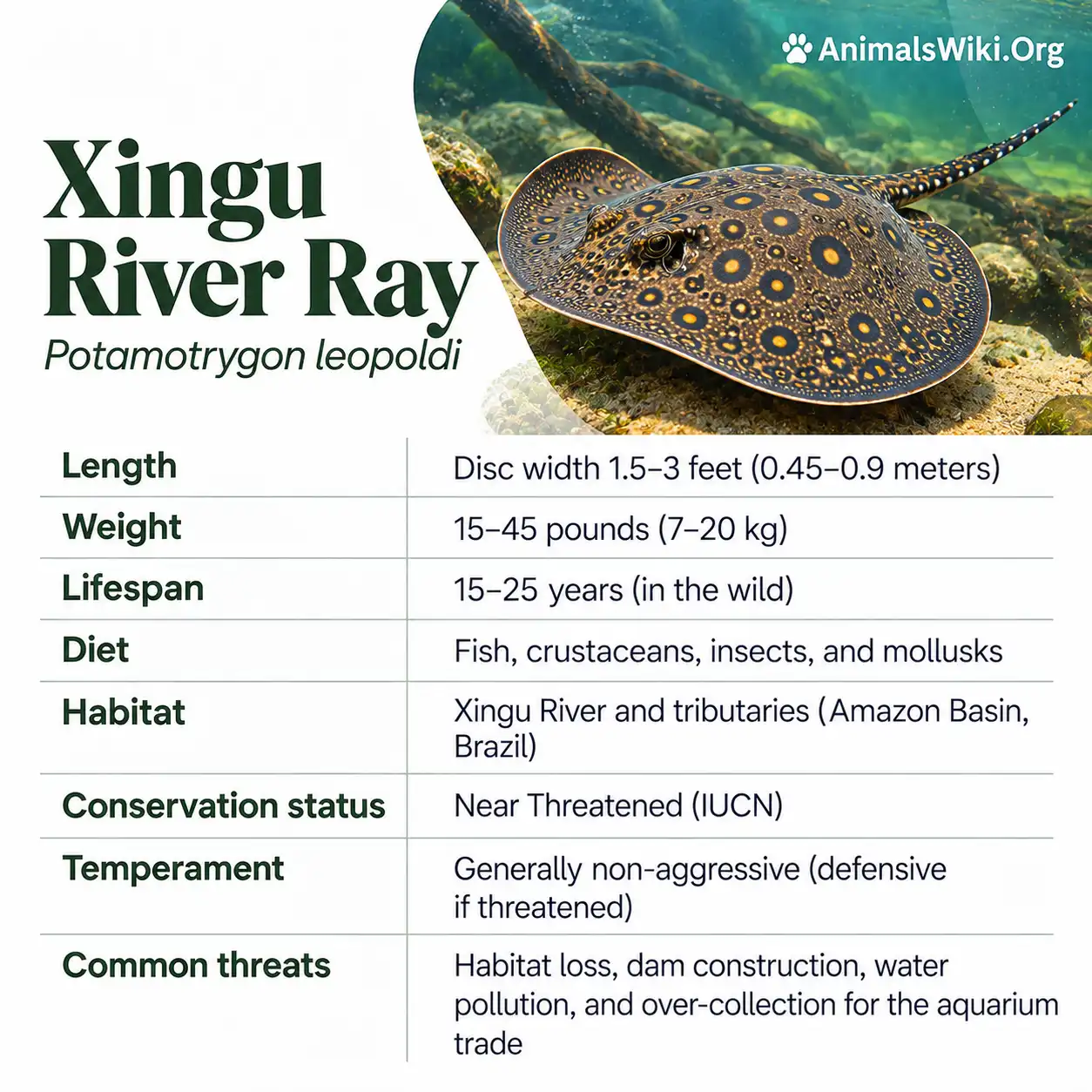
Xingu River Ray Facts
| Feature | Details |
|---|---|
| Common Name | Xingu River Ray (also called Polka-Dot Stingray, White-Blotched River Stingray, or Leopoldi Ray) |
| Scientific Name | Potamotrygon leopoldi |
| Family | Potamotrygonidae |
| Order | Myliobatiformes |
| First Described | 1961 (by Herbert R. Axelrod and Leonard P. Schultz) |
| Native Habitat | Rocky, fast-flowing rapids and clear-water stretches of a single Amazonian river system |
| Geographic Range | Endemic to the Xingu River, Pará state, Brazil (extremely restricted range) |
| Average Size | 30–45 cm disc width (wild); up to 50 cm documented |
| Average Weight | 1–3 kg depending on size and sex |
| Lifespan | 15–20 years (estimated wild); comparable or longer in captivity |
| Diet | Carnivore — small fish, aquatic insects, crustaceans, worms |
| Conservation Status | Data Deficient (IUCN); considered at significant risk by regional researchers due to extremely restricted range |
| Defining Feature | Striking jet-black body covered in bold white or yellow circular spots; venomous tail barb; entirely freshwater, non-migratory lifestyle confined to a single river system |
| Number of Species/Relatives | 1 species; part of the broader South American freshwater stingray family Potamotrygonidae, comprising roughly 35+ species |
1. Xingu River Ray Species Overview & Classification
In the clear, oxygen-rich waters of the lower Xingu River, where the current accelerates through a labyrinth of black basalt rock formations known locally as the Volta Grande (“Big Bend”), a flattened, disc-shaped animal rests half-buried in coarse river sand, almost perfectly still except for the faint, rhythmic pulse of its gill slits. Against the dark, rocky substrate, its jet-black body — patterned with a dense scattering of bold, near-perfectly circular white spots, each one distinct and clean-edged, like a living constellation — should, by most ordinary logic of camouflage, stand out dramatically. Instead, in the dappled, fractured light filtering down through the fast-moving, unusually clear water of this specific stretch of river, the pattern does something remarkable: it breaks up the animal’s outline so effectively that a human diver can pass within arm’s length without ever noticing it. This is the Xingu River Ray — one of the most visually spectacular freshwater fish on Earth, and, in a genuinely striking irony for an animal so vividly patterned that it has become one of the most recognizable and valuable ornamental fish in the entire global aquarium trade, an animal confined for its entire natural existence to a single, geographically tiny stretch of one Amazonian tributary river, found nowhere else on the planet.
The Xingu River Ray (Potamotrygon leopoldi), also widely known by the common names Polka-Dot Stingray or White-Blotched River Stingray, is a species of freshwater stingray belonging to the family Potamotrygonidae — a genuinely remarkable evolutionary lineage of South American freshwater rays that represents one of the very few vertebrate groups within the broader elasmobranch lineage (sharks and rays) to have evolved a fully freshwater, entirely non-marine lifestyle, having lost the physiological capacity to tolerate saltwater entirely over the course of their evolutionary history. Unlike the great majority of ray and stingray species covered in typical marine wildlife literature, which spend all or most of their lives in ocean or estuarine saltwater environments, the Xingu River Ray and its Potamotrygonidae relatives live their entire lives exclusively in freshwater river systems, and the Xingu River Ray specifically has taken this pattern of restricted habitat specialization to an extreme rarely documented among vertebrate animals: it is found naturally nowhere on Earth except a single, well-defined stretch of the Xingu River in the Brazilian state of Pará, making it one of the most genuinely narrow-range endemic vertebrate species covered anywhere throughout this broader guide series.
The Xingu River Ray occupies a position of considerable scientific and, increasingly, conservation significance disproportionate to its comparatively modest physical size and its almost complete absence from general public wildlife awareness: it is among the most highly sought-after and financially valuable ornamental fish species in the entire global freshwater aquarium trade, commanding prices among the highest of any freshwater aquarium fish species in the world, a commercial significance that sits in genuine and increasingly urgent tension with the species’ extraordinarily restricted natural range and the mounting, well-documented environmental pressures — most significantly the controversial Belo Monte hydroelectric dam complex — now bearing down directly on the very specific stretch of river this species depends upon for its entire wild existence.
Species Classification Table
| Classification Level | Details |
|---|---|
| Kingdom | Animalia |
| Phylum | Chordata |
| Class | Chondrichthyes (cartilaginous fish) |
| Order | Myliobatiformes |
| Family | Potamotrygonidae |
| Genus | Potamotrygon |
| Species | Potamotrygon leopoldi |
| Described By | Herbert R. Axelrod and Leonard P. Schultz, 1961 |
| Closest Relatives | Other Potamotrygon freshwater stingray species (~35 species) |
The Xingu River Ray Among Its Freshwater Stingray Relatives
| Species (Selected Relatives) | Scientific Name | Range | Notes |
|---|---|---|---|
| Xingu River Ray | Potamotrygon leopoldi | Xingu River, Brazil (endemic) | The species covered in this guide; extremely restricted range |
| Black River Ray | Potamotrygon henlei | Xingu and Tapajós river basins | Similar coloration; broader range than leopoldi |
| Motoro Stingray | Potamotrygon motoro | Widespread across the Amazon and Orinoco basins | One of the most widely distributed Potamotrygonid species |
| Ocellate River Stingray | Potamotrygon orbignyi | Widespread across South America | Highly variable pattern; common in aquarium trade |
| Porcupine River Stingray | Potamotrygon histrix | Paraná-Paraguay basin | Distinct spiny dorsal ridge |
The Name “Xingu River Ray”
The species’ common English name derives directly and simply from its river of origin — the Xingu River, a major clearwater tributary of the Amazon River flowing through the Brazilian state of Pará — combined with the general common English term “ray,” used broadly across the elasmobranch group. The species’ widely used alternative common name, “polka-dot stingray,” reflects the animal’s most immediately visually striking feature, discussed extensively in the Physical Description section, while its scientific species epithet, leopoldi, honors a personal name associated with the species’ original 1961 formal scientific description.
Did You Know? The Xingu River Ray’s entire known natural global population is confined to a stretch of river measuring only a relatively small number of kilometers along the lower Xingu — meaning this single species, prized and traded internationally by aquarium hobbyists on every inhabited continent, exists nowhere else in the wild anywhere on the planet. Its native range is so geographically restricted that a single, poorly managed large-scale development project within that specific river stretch could, in principle, pose a genuine existential threat to the species’ entire wild population.
2. Xingu River Ray Physical Description & Unique Features
The Xingu River Ray’s body reflects the broader anatomical body plan characteristic of stingrays generally, combined with a suite of specific coloration, sensory, and defensive adaptations that make it one of the most visually and biologically distinctive members of the entire freshwater stingray family.
Size and Build
- Disc width (the standard measurement for ray body size, referring to the flattened, roughly circular main body): Typically 30–45 cm (12–18 inches) in wild adult specimens, with exceptional individuals documented up to approximately 50 cm (20 inches)
- Weight: Typically 1–3 kg (2.2–6.6 lbs), varying with size, sex, and individual body condition
- Body shape: A flattened, roughly circular to oval disc, with the head, gills, and most of the body’s key sensory and feeding structures integrated into this single, disc-shaped primary body form, a body plan shared broadly across the ray and skate group more generally, reflecting a shared evolutionary adaptation for a bottom-dwelling (benthic) lifestyle
Sexual dimorphism: Females are generally somewhat larger than males at full maturity, a pattern documented across numerous other Potamotrygonid freshwater ray species; males additionally develop specialized reproductive structures called claspers — paired, modified pelvic fin extensions used in mating, discussed further in the Reproduction section — providing a reliable visual method for distinguishing mature males from females.
The Signature Coloration — A Genuine Visual Spectacle
The single most defining and commercially significant physical feature of the Xingu River Ray is its genuinely striking coloration pattern:
- Base coloration: A deep, rich black to very dark brown covers the dorsal (upper) surface of the disc
- The spotting pattern: Scattered across this dark base coloration is a dense pattern of bold, well-defined white or, in some individuals, pale yellow circular spots, varying somewhat in size, density, and precise arrangement between individual rays — a degree of individual pattern variation that has, notably, become commercially significant within the aquarium trade, discussed extensively in the Human Relationships section, with certain particularly dense, well-defined, or unusually patterned individuals commanding premium prices among specialist collectors
- Ventral (underside) coloration: The underside of the disc typically displays a considerably paler, more uniform coloration, a pattern of countershading broadly consistent with camouflage strategies documented across numerous other bottom-dwelling and open-water fish species
- Ontogenetic pattern development: Juvenile Xingu River Rays are typically born already displaying a recognizable version of the adult spotting pattern, though pattern density, contrast, and overall visual definition can continue to develop and, in some cases, become somewhat more pronounced as the individual matures
The Tail and Venomous Barb
As with all stingray species, the Xingu River Ray possesses a distinctive, elongated tail equipped with a genuinely significant defensive structure:
- The stinging barb: Located along the tail, typically positioned closer to the base than the tip, is one or more serrated, venom-delivering spines — a specialized modified dermal denticle (a tooth-like scale structure) capable of delivering a painful, venomous wound when the tail is whipped defensively against a threat, discussed extensively in the Predators and Human Relationships sections
- Venom composition: Stingray venom, including that of the Xingu River Ray and its Potamotrygonid relatives, contains a combination of proteins and enzymes causing significant localized pain, tissue damage, and swelling in the event of a sting, though — as detailed further in the Human Relationships section — genuinely serious or life-threatening reactions in humans remain comparatively uncommon relative to the considerable pain the sting itself typically causes
- Barb regeneration: Like several other stingray species, the Xingu River Ray is capable of regenerating a lost or damaged tail barb over time, ensuring the animal is not permanently deprived of this significant defensive capability following barb loss or breakage
Eyes and Sensory Adaptations
Dorsally positioned eyes: Consistent with the broader bottom-dwelling ray body plan, the Xingu River Ray’s eyes are positioned on the top (dorsal) surface of the disc, allowing the animal to maintain visual awareness of its surroundings even while resting partially buried in substrate, described extensively in the Social Behavior section
Spiracles: Immediately behind each eye, the Xingu River Ray possesses a pair of spiracles — specialized respiratory openings allowing the ray to draw water across its gills for respiration even while the mouth and main gill slits (located on the ventral, or underside, surface) remain buried in substrate or otherwise obstructed — a genuinely important adaptation supporting the species’ considerable time spent resting on or partially within the riverbed
Electroreception (ampullae of Lorenzini): Like sharks and other rays, the Xingu River Ray possesses specialized electroreceptor organs called the ampullae of Lorenzini, distributed around the snout and head region, capable of detecting the faint bioelectric fields generated by the muscle activity of nearby prey animals — a genuinely significant sensory adaptation allowing the ray to detect and locate prey items buried in sand or otherwise visually concealed, discussed further in the Diet section
Mouth and dental structure: Positioned on the underside of the disc, the Xingu River Ray’s mouth contains rows of flattened, plate-like teeth well adapted for crushing the shells and exoskeletons of the various invertebrate prey items described extensively in the Diet section.
3. Xingu River Ray Habitat & Geographic Range
The Xingu River Ray occupies one of the most genuinely restricted natural geographic ranges of any vertebrate species covered throughout this broader guide series, found exclusively within a specific, well-defined stretch of a single Amazonian river system.
Preferred Habitat Features
Rocky, fast-flowing rapids and clear water — the Xingu River Ray shows a strong, specific ecological association with the unusually clear, rocky, fast-flowing river conditions characteristic of the Xingu River’s distinctive Volta Grande (“Big Bend”) stretch, a genuinely unusual habitat preference among freshwater stingrays more broadly, many of which favor the slower-moving, more sediment-laden, muddy-bottomed river and floodplain conditions more typical of the broader Amazon basin
Basalt and rocky substrate — the species shows a particular habitat association with the distinctive black basalt rock formations and boulder fields characteristic of this specific stretch of the Xingu River, habitat conditions genuinely unusual within the broader context of Amazonian freshwater ecosystems, which are more typically dominated by sediment, sand, and organic substrate rather than substantial exposed rock formations
Clear water conditions — reflecting the species’ striking coloration pattern, discussed extensively in the Physical Description section, and its apparent function as effective camouflage specifically within dappled, fractured light conditions, the Xingu River Ray’s habitat association with the unusually clear water of this specific river stretch — itself a product of the underlying rocky substrate and distinctive local hydrology — appears directly and specifically connected to the visual function of its coloration pattern
Habitat Types Occupied
| Habitat | Primary Ray Use | Notes |
|---|---|---|
| Fast-flowing rocky rapids | Primary habitat | Distinctive Volta Grande stretch of the Xingu River |
| Clear-water pools and eddies | Resting, feeding | Between and around major rapids and rock formations |
| Sandy substrate patches | Resting, partial burial | Interspersed within the broader rocky habitat matrix |
Geographic Range — An Extraordinarily Restricted Endemic Distribution
The Xingu River Ray is endemic to — meaning found naturally nowhere else on Earth except — a specific stretch of the lower Xingu River, a major clearwater tributary of the Amazon River, within the Brazilian state of Pará. This range is genuinely and remarkably restricted even relative to numerous other narrow-range endemic species covered throughout broader wildlife literature, confined specifically to the river’s distinctive Volta Grande region and immediately adjacent stretches, an area covering a comparatively modest total geographic extent relative to the vast scale of the broader Amazon basin the Xingu River feeds into.
| Region | Country | Population Status |
|---|---|---|
| Volta Grande stretch, lower Xingu River | Brazil (Pará state) | Entire known global wild population; status increasingly uncertain given regional development pressure |
The Genuine Rarity of Such Extreme Vertebrate Endemism
The Xingu River Ray’s degree of geographic range restriction represents a genuinely notable case study within the broader field of conservation biology and biogeography: while narrow-range endemism is documented across numerous invertebrate, plant, and even some smaller vertebrate species worldwide, a species of the Xingu River Ray’s size and ecological prominence — commanding, as detailed extensively in the Human Relationships section, genuine international commercial significance within the aquarium trade — being confined to such an extraordinarily small total geographic range represents a genuinely striking and, from a conservation-vulnerability standpoint, genuinely concerning combination of characteristics, discussed extensively in the Conservation section.
4. Xingu River Ray Diet & Feeding Behavior
The Xingu River Ray is a genuine carnivorous predator, employing a combination of specialized sensory detection and a distinctive bottom-feeding foraging strategy well adapted to locating and capturing prey within its rocky, fast-flowing native river habitat.
What Xingu River Rays Eat
Small fish — a significant dietary component, including various small native Xingu River fish species encountered while foraging along the riverbed
Aquatic insects and their larvae — a substantial dietary component, particularly for smaller or juvenile individuals, reflecting the general dietary pattern documented across numerous other Potamotrygonid freshwater ray species
Crustaceans — including various small native crustacean species inhabiting the rocky substrate and crevices characteristic of the species’ distinctive habitat
Aquatic worms and other benthic invertebrates — consumed opportunistically as encountered during bottom-foraging activity
Feeding Behavior and Sensory Foraging Strategy
Electroreceptive prey detection: As detailed extensively in the Physical Description section, the Xingu River Ray’s ampullae of Lorenzini provide a genuinely significant foraging advantage, allowing the ray to detect the faint bioelectric signals generated by prey animals even when those prey items are buried within sand or otherwise visually concealed from direct observation — a sensory foraging capability of particular value in the ray’s rocky, sediment-patch habitat, where potential prey frequently shelters within crevices or beneath substrate
Bottom-oriented foraging: Consistent with the broader benthic (bottom-dwelling) ray body plan and lifestyle described extensively throughout this guide, the Xingu River Ray forages predominantly by moving along the riverbed, using both direct visual detection and electroreceptive sensing to locate prey, before employing a characteristic “pouncing” or covering technique — descending over a detected prey item and using the body disc to effectively trap it against the substrate before maneuvering the prey toward the mouth, positioned on the ray’s ventral surface
Crushing dental adaptation: As detailed in the Physical Description section, the ray’s flattened, plate-like teeth are specifically adapted for crushing the hard exoskeletons of crustaceans and other armored invertebrate prey, reflecting the genuine dietary significance of these prey categories within the species’ broader foraging ecology
Feeding Activity Patterns
The Xingu River Ray, consistent with the general activity pattern documented across numerous other Potamotrygonid freshwater ray species, shows meaningful crepuscular and nocturnal activity tendencies, with feeding activity often concentrated during lower-light periods, though the species remains capable of active foraging across a range of light conditions given its combination of visual and electroreceptive sensory capability.
5. Xingu River Ray Reproduction & Life Cycle
The Xingu River Ray’s reproductive biology follows the broader pattern characteristic of Potamotrygonid freshwater stingrays, involving internal fertilization and a genuinely distinctive form of live birth (ovoviviparity/aplacental viviparity) rather than the egg-laying reproductive strategy characteristic of numerous other fish groups.
Sexual Maturity
Xingu River Rays typically reach sexual maturity at approximately 2–3 years of age, with maturity generally correlated more closely with achieved body size (disc width) than with precise chronological age, a pattern broadly consistent with numerous other elasmobranch species covered in broader marine and freshwater biology literature.
Mating Behavior
Claspers and internal fertilization: As referenced in the Physical Description section, mature male Xingu River Rays possess paired reproductive structures called claspers — modified extensions of the pelvic fins — used to transfer sperm internally to the female during mating, a reproductive mechanism shared broadly across sharks and rays (the elasmobranch group) and representing a genuinely significant distinction from the external fertilization strategy characteristic of numerous other fish groups, including the great majority of bony fish species
Courtship behavior: Mating in Xingu River Rays and related Potamotrygonid species typically involves the male following and biting at the female’s disc margin during courtship, a behavior pattern documented across numerous ray and stingray species more broadly, prior to the physical positioning required for clasper-mediated internal fertilization.
Gestation and Birth — Live-Bearing Reproduction
- Gestation period: Approximately 3–4 months (varying somewhat by individual and environmental conditions), a comparatively brief gestation period relative to numerous other elasmobranch species
- Reproductive strategy: The Xingu River Ray, consistent with the broader Potamotrygonidae family pattern, is ovoviviparous (also sometimes termed aplacental viviparous) — embryos develop within the mother’s body, initially nourished by yolk reserves and subsequently, in a genuinely distinctive nutritional supplementation mechanism documented across several ray species, by a specialized uterine secretion called “uterine milk” (histotroph), providing additional nutritional support to developing embryos beyond the initial yolk supply before live birth occurs
- Litter size: Typically 2–6 pups per litter, varying by individual female size and condition
- Birth condition: Pups are born as fully formed, miniature versions of the adult ray, already displaying the characteristic black-and-white spotted coloration pattern described extensively in the Physical Description section, and are immediately capable of independent swimming, foraging, and basic self-sufficiency — a genuinely precocial birth condition consistent with the broader elasmobranch reproductive pattern and standing in contrast to the more dependent, gradually developing offspring condition characteristic of numerous other animal groups covered throughout this broader guide series
Pup Development
| Stage | Timing | Development |
|---|---|---|
| Birth | Day 0 | Fully formed miniature adult; immediately independent |
| Early juvenile growth | Months 1–12 | Rapid initial growth; continued pattern development |
| Juvenile/subadult growth | 1–2 years | Continued disc-width growth toward mature size |
| Sexual maturity | 2–3 years | Reproductive capability begins |
No parental care after birth: Consistent with the broader pattern documented across the great majority of elasmobranch species, Xingu River Ray pups receive no parental care whatsoever following birth — the precocial, immediately self-sufficient birth condition described above means young rays are fully capable of independent survival from the moment of birth, without requiring the extended parental investment period characteristic of numerous other vertebrate groups covered throughout this broader guide series.
Lifespan
- Wild: Estimated at approximately 15–20 years, though precise wild longevity data remains somewhat limited given the practical challenges of long-term individual tracking within the species’ remote, difficult-to-access native river habitat
- Captivity: Comparable or potentially somewhat longer lifespans have been documented in well-managed aquarium settings, reflecting the general pattern of extended captive longevity relative to typical wild mortality pressure documented across numerous other species throughout this broader guide series.
6. Social Behavior & Communication
Xingu River Ray social behavior is best characterized as predominantly solitary, consistent with the broader social pattern documented across the majority of stingray species more generally, though the species does display some meaningful behavioral flexibility regarding aggregation under specific circumstances.
Solitary Lifestyle
Adult Xingu River Rays generally forage, rest, and move through their habitat as individual, independently operating animals, without forming the persistent social groups or cooperative behavioral structures documented across numerous other species covered throughout this broader guide series; this solitary pattern is broadly consistent with the general social ecology documented across the great majority of stingray and ray species worldwide.
Resting and Substrate Behavior
As referenced extensively in the Physical Description section, Xingu River Rays spend considerable time resting partially buried in sand or positioned motionless against rocky substrate, a behavior serving both camouflage/predator-avoidance function, discussed extensively in the Predators section, and general energy conservation, with the ray’s dorsally positioned eyes and spiracles (described in the Physical Description section) allowing continued environmental awareness and respiration even during these extended resting periods.
Occasional Aggregation
While predominantly solitary, Xingu River Rays and related Potamotrygonid species have been documented showing a degree of loose aggregation under certain specific circumstances, including around particularly favorable feeding areas or, in captive settings, when multiple individuals are maintained within the same enclosure — aggregation that appears to reflect shared resource attraction rather than any genuine cooperative or persistently bonded social structure.
Territoriality
Xingu River Rays are not generally considered a strongly territorial species in the sense of actively defending an exclusive area against other rays, though individual rays may show a degree of consistent home-range use within their particular stretch of rocky, fast-flowing habitat, reflecting general site fidelity to favorable resting and foraging locations rather than active territorial exclusion of conspecifics.
Limited Communication Documentation
Given the species’ predominantly solitary lifestyle and the general communication limitations characteristic of ray and stingray biology more broadly (which, unlike many bony fish groups, generally lack the swim-bladder-based sound production mechanisms and elaborate visual signaling systems documented across numerous other fish groups covered throughout this broader guide series), Xingu River Ray social communication has received considerably less detailed scientific documentation than several of the more extensively studied social species covered elsewhere throughout this broader guide series — a research gap broadly reflecting the species’ overall comparatively limited scientific study relative to its considerable commercial significance, discussed extensively in the Human Relationships section.
7. Predators & Defense Mechanisms
The Xingu River Ray, protected substantially by its genuine venomous defensive capability and effective camouflage, faces meaningful but not overwhelming predation pressure within its native Amazonian river habitat.
Natural Predators
Large predatory fish — various large native Xingu River fish species, including certain large catfish species documented within the broader Amazon basin, represent potential predators, particularly of smaller or juvenile rays
Caimans — various caiman species inhabiting the broader Xingu River system represent potential predators of Xingu River Rays, particularly individuals encountered in shallower water
River otters and other semi-aquatic mammalian predators — the giant otter, covered extensively elsewhere throughout this broader guide series, and other semi-aquatic mammalian predators inhabiting the Amazon basin represent potential predators of freshwater rays, though the specific documented predation relationship between giant otters and Xingu River Rays specifically remains less thoroughly researched than several other components of the species’ basic ecology
Defense Strategies
The venomous tail barb — the primary active defense: As detailed extensively in the Physical Description section, the Xingu River Ray’s serrated, venom-delivering tail barb represents the species’ single most significant active defensive mechanism, capable of delivering a genuinely painful, venomous wound to a threatening predator (or, as discussed extensively in the Human Relationships section, an unwary human) when the tail is whipped defensively in response to a perceived threat, particularly when the ray is stepped on or otherwise directly, physically disturbed
Camouflage: As detailed extensively in the Physical Description and Habitat sections, the ray’s distinctive black-and-white spotted coloration pattern appears to function as genuinely effective camouflage specifically within the dappled, fractured light conditions characteristic of its clear-water, rocky native habitat, providing a significant passive defensive advantage against visually hunting predators
Substrate burial: As detailed extensively in the Social Behavior section, the ray’s habit of resting partially buried in sand or positioned motionless against rocky substrate provides further meaningful camouflage and concealment benefit, reducing overall predator detection risk during the ray’s considerable resting periods
Burst swimming capability: While not generally considered a particularly fast or sustained swimmer compared to many active-pursuit predatory fish, Xingu River Rays are capable of effective burst swimming and rapid substrate repositioning when directly threatened, providing a meaningful active escape mechanism to supplement the species’ primary camouflage and venomous-barb defensive strategies.
8. Relationship with Humans
Traditional Indigenous and Local Community Relationships
Local Indigenous and traditional riverine communities along the Xingu River have maintained a long-standing practical awareness of and relationship with the Xingu River Ray, reflecting genuine, longstanding local ecological knowledge of the species’ habitat, behavior, and the practical safety considerations associated with the animal’s venomous defensive capability, discussed further below — a body of traditional local ecological knowledge that predates and exists independently of the species’ more recent rise to international scientific and commercial prominence.
The International Aquarium Trade — A Defining Modern Relationship
Since its formal scientific description in 1961, the Xingu River Ray has become one of the most commercially significant and highly valued species within the entire global freshwater aquarium trade, a defining modern relationship with humans that stands in genuine and increasingly significant tension with the species’ extraordinarily restricted natural range:
- Premium commercial value: Given the species’ striking visual appearance, described extensively in the Physical Description section, and its genuine rarity and restricted natural distribution, Xingu River Rays consistently command some of the highest prices of any freshwater aquarium fish species in the world, with particularly well-patterned or unusually marked individuals reaching prices considerably exceeding those of the great majority of other ornamental freshwater fish species available in the international aquarium trade
- Captive breeding development: Reflecting both genuine conservation concern regarding continued wild collection pressure and the straightforward commercial economics of supplying sustained international demand, dedicated captive breeding programs for the Xingu River Ray have developed considerably in recent decades, both within Brazil (where export regulations have historically restricted or, at various points, prohibited direct wild collection and export specifically to protect the species’ extraordinarily vulnerable wild population) and among specialist aquarium breeders internationally, with captive-bred Xingu River Rays now representing a significant, and increasingly dominant, proportion of the animals available through the legitimate international aquarium trade
- Selective breeding for pattern variation: Within the dedicated aquarium breeding community, selective breeding efforts have, in various contexts, focused specifically on producing individuals with particularly dense, well-defined, or otherwise commercially desirable spot patterns, representing a genuine, if specialized, form of ornamental animal breeding paralleling similar selective breeding practices documented across numerous other commercially significant ornamental species
Sting Injuries and Safety Considerations
Given the Xingu River Ray’s genuine venomous defensive capability, described extensively in the Physical Description and Predators sections, both wild encounters (relevant to local fishing and river-use communities) and captive aquarium keeping carry genuine, well-documented sting injury risk:
- Sting symptoms and severity: A Xingu River Ray sting typically causes significant, acute localized pain, swelling, and potential tissue damage at the wound site, broadly consistent with the general symptom profile documented across numerous other stingray species; while genuinely serious systemic reactions remain comparatively uncommon, the acute pain and localized tissue damage associated with a sting represents a genuine and significant safety consideration for both wild river users and aquarium keepers maintaining the species in captivity
- Aquarium keeping precautions: Specialist aquarium keepers maintaining Xingu River Rays in captivity, given the species’ considerable commercial value and specific husbandry requirements, generally develop specific handling protocols and equipment specifically designed to minimize sting risk during necessary tank maintenance and health-monitoring activities
Scientific and Conservation Research Significance
Beyond its considerable ornamental commercial significance, the Xingu River Ray holds genuine scientific interest as a case study in extreme vertebrate endemism and, increasingly, as a significant indicator species and conservation focal point directly relevant to the broader environmental and social controversy surrounding large-scale hydroelectric development within its extraordinarily restricted native range, discussed extensively in the Conservation section.
9. Xingu River Ray Conservation Status & Threats
IUCN Status
The Xingu River Ray is currently classified as Data Deficient by the IUCN — a formal conservation status designation indicating that, at the time of the most recent assessment, available scientific data regarding the species’ population size, trend, and specific threat exposure was considered insufficient to support a more definitive conservation status classification (such as Least Concern, Vulnerable, or Endangered); however, numerous regional researchers, conservation organizations, and ichthyologists specifically studying the Xingu River system have expressed genuine, significant concern regarding the species’ conservation status, given the extraordinarily restricted natural range combined with the substantial, well-documented environmental disruption now affecting the species’ specific native habitat, discussed extensively below.
The Belo Monte Dam — A Direct, Existential Threat to a Single-River Endemic Species
The single most significant, well-documented, and actively controversial threat facing the Xingu River Ray involves the Belo Monte hydroelectric dam complex, constructed on the Xingu River specifically within and immediately adjacent to the Volta Grande stretch of river that constitutes the species’ entire known natural habitat:
- Project scale and impact: The Belo Monte dam complex, one of the largest hydroelectric infrastructure projects in Brazil and among the largest in the world, involves substantial diversion of the Xingu River’s natural water flow specifically through and around the Volta Grande stretch, fundamentally altering the natural hydrology, water flow rate, and seasonal flooding pattern of precisely the river stretch the Xingu River Ray’s entire wild population depends upon
- Direct habitat alteration: Given the Xingu River Ray’s specific, well-documented ecological association with the fast-flowing, rocky, clear-water conditions of the Volta Grande, described extensively in the Habitat section, the dam-related alteration of natural river flow through this specific stretch represents a genuinely direct and significant threat to the fundamental habitat conditions the species requires for survival — reduced water flow, altered seasonal flooding patterns, and broader hydrological disruption within this restricted habitat zone carry the potential for substantial, direct negative impact on the species’ entire wild population, given the complete absence of any alternative habitat area the species could naturally relocate to
- Broader environmental and social controversy: The Belo Monte dam project has generated substantial, sustained international environmental and human rights controversy extending well beyond its specific implications for the Xingu River Ray, including significant documented impacts on local Indigenous communities dependent on the Xingu River’s traditional flow patterns and fisheries, and broader concern regarding the project’s overall environmental impact assessment and mitigation adequacy — making the Xingu River Ray’s conservation situation a genuinely significant and closely watched case study within the broader body of international discussion regarding large-scale hydroelectric development impact on narrow-range endemic freshwater species
Current Threats
1. Hydroelectric Dam Development and Flow Alteration
As detailed extensively above, the Belo Monte dam complex’s direct alteration of natural water flow through the Volta Grande represents, without meaningful competition, the single most significant and directly documented threat facing the Xingu River Ray’s entire wild population, given the species’ complete habitat and range restriction to this specific, now substantially hydrologically altered river stretch.
2. Overcollection for the Aquarium Trade
While captive breeding programs, described extensively in the Human Relationships section, have meaningfully reduced pressure for direct wild collection in recent decades, historical and, in various less well-regulated contexts, ongoing wild collection pressure for the international aquarium trade represents a genuine, additional conservation concern given the species’ extraordinarily restricted natural population base and correspondingly limited capacity to sustain significant additional removal pressure without meaningful population-level impact.
3. Broader Water Quality and Pollution Concerns
Mining activity and broader development pressure within the wider Xingu River basin raise genuine additional concern regarding water quality degradation potentially affecting the specific, unusually clear-water habitat conditions the species depends upon, compounding the more direct and immediate hydrological threat posed by the Belo Monte dam complex specifically.
4. Extreme Vulnerability Inherent to Narrow-Range Endemism
Beyond any single specific threat, the Xingu River Ray’s fundamental conservation vulnerability is significantly amplified by its extraordinarily restricted natural range itself, described extensively in the Habitat section — a species confined to such a genuinely small total geographic area carries inherently elevated extinction risk relative to more widely distributed species, given the complete absence of alternative habitat areas or population refugia that could buffer against any single significant, geographically concentrated threat event or process.
The Need for Formal Conservation Status Reassessment
Given the genuinely significant, well-documented direct habitat threat posed by the Belo Monte dam complex specifically, numerous researchers and conservation organizations focused on the Xingu River system have called for a more urgent, updated formal conservation status assessment for the Xingu River Ray, moving beyond the current Data Deficient classification toward a more definitive status determination reflecting the genuine, documented severity of the direct habitat threat the species currently faces — representing an active, ongoing area of conservation science and policy advocacy specifically relevant to this species.
10. Famous Xingu River Rays Around the World
Record-Setting Aquarium Trade Specimens
While not individually named celebrity animals in the conventional sense applied to larger, more publicly prominent species covered elsewhere throughout this broader guide series, certain particularly exceptional, densely and distinctively patterned individual Xingu River Rays have achieved genuine notoriety and significant commercial recognition within the specialized international freshwater aquarium hobbyist and breeder community, with photographs and detailed pattern documentation of especially prized individuals circulating extensively within dedicated stingray-keeping forums, publications, and breeder marketing materials.
The Volta Grande Research Population
While not individually named, the wild Xingu River Ray population inhabiting the Volta Grande stretch of the Xingu River deserves recognition as, collectively, one of the more significant individual wild fish populations currently at the center of active international conservation science and environmental policy attention, given the population’s direct and well-documented entanglement with the broader Belo Monte dam controversy described extensively in the Conservation section — representing a genuinely consequential wild population whose ongoing fate is being closely monitored by regional ichthyologists, environmental researchers, and conservation advocacy organizations.
Pioneer Captive Breeding Program Specimens
The specific founding breeding stock individuals utilized in the earliest successful captive breeding programs for the Xingu River Ray, both within Brazil and among international specialist aquarium breeders, deserve recognition for their significant, if largely unpublicized, contribution to establishing the now-substantial captive breeding infrastructure that has meaningfully reduced ongoing wild collection pressure on the species’ extraordinarily vulnerable natural population.
11. Role in Ecosystem & Food Chain
The Xingu River Ray as a Predator Within a Genuinely Unusual Amazonian Habitat Niche
As detailed extensively in the Diet section, the Xingu River Ray functions as a significant predator of small fish, aquatic insects, crustaceans, and other invertebrates within its specific rocky, fast-flowing native habitat — contributing to natural population regulation of these various prey categories within the genuinely distinctive Volta Grande ecological zone, a habitat type that, given its unusual rocky, clear-water characteristics relative to the broader, more typically sediment-dominated Amazon basin, likely supports a somewhat ecologically distinct invertebrate and small-fish community compared to more typical Amazonian river and floodplain habitat.
Indicator Species Status for a Uniquely Threatened Habitat Zone
Given the Xingu River Ray’s extraordinarily specific habitat association with the Volta Grande’s distinctive rocky, fast-flowing, clear-water conditions, described extensively throughout this guide, the species’ population health and distribution represent a genuinely significant indicator of the broader ecological condition of this specific, now substantially hydrologically altered habitat zone — meaning the ray’s conservation trajectory carries direct relevance not only to the species itself, but to the broader ecological community and habitat integrity of this genuinely unique stretch of Amazonian river more generally, a habitat type that, given its restricted extent and distinctive character, likely supports numerous other specialized, potentially similarly range-restricted species whose conservation status may be less thoroughly documented than that of the more commercially prominent and consequently better-studied Xingu River Ray.
Xingu River Rays as Prey
As detailed extensively in the Predators section, Xingu River Rays support various predator species within their native ecosystem, including large predatory fish and caimans, representing a meaningful trophic link within the broader Xingu River food web, connecting the invertebrate and small-fish prey base the ray itself consumes to the larger predator community sharing the same restricted habitat zone.
12. Xingu River Ray Discovery & Evolution Timeline
~100 million years ago — The broader order Myliobatiformes (stingrays and their relatives) begins diversifying within the fossil record, part of the broader evolutionary radiation of rays and skates within the elasmobranch lineage.
~20–30 million years ago — The family Potamotrygonidae — the South American freshwater stingray lineage that would eventually include the Xingu River Ray — becomes established through a genuinely significant evolutionary transition from marine to entirely freshwater habitat, believed to have occurred through the ancestral colonization of South American river systems by marine stingray ancestors during a period when the geological and hydrological configuration of the region differed considerably from its modern form, with the resulting freshwater lineage subsequently losing the physiological capacity to tolerate saltwater entirely — a genuinely significant and evolutionarily consequential habitat transition among the broader elasmobranch group.
Pre-Columbian era — Indigenous peoples along the Xingu River establish long-standing traditional practical knowledge of and relationship with the species, reflecting the genuine, longstanding local ecological familiarity described extensively in the Human Relationships section.
1961 — American aquarium industry figure and publisher Herbert R. Axelrod, alongside ichthyologist Leonard P. Schultz, formally describe Potamotrygon leopoldi — the Xingu River Ray — establishing the species’ modern scientific classification, a description directly connected to and reflecting the early aquarium-trade commercial interest in the species that would substantially define much of its subsequent human relationship history.
1970s–1990s — Growing international aquarium trade demand for the Xingu River Ray drives increasing wild collection pressure, alongside growing scientific documentation of the species’ genuinely restricted natural range and distinctive habitat association with the Xingu River’s Volta Grande stretch.
Late 20th–early 21st century — Brazilian export regulations, alongside broader growing international conservation awareness regarding the species’ extreme range restriction, prompt increasing formalization of captive breeding infrastructure both within Brazil and among international specialist aquarium breeders, gradually reducing the proportion of internationally traded specimens sourced through direct wild collection.
2011 — Construction begins on the Belo Monte hydroelectric dam complex, initiating the substantial, ongoing hydrological alteration of the Volta Grande stretch of the Xingu River that constitutes the Xingu River Ray’s entire known wild habitat, described extensively in the Conservation section.
2010s — The Belo Monte dam project generates substantial, sustained international environmental and human rights controversy, with the Xingu River Ray increasingly cited within broader environmental impact discussion and documentation as a specific, illustrative example of the project’s potential ecological consequences for narrow-range endemic freshwater species.
2019 — Brazilian regulatory authorities implement operational changes to the Belo Monte dam’s water flow management, following sustained advocacy and legal challenge regarding the project’s environmental and social impact, representing a partial, contested regulatory response to some of the broader concerns raised regarding the project’s hydrological impact on the Volta Grande.
2020s — Continued scientific and conservation advocacy attention to the Xingu River Ray’s conservation status, alongside ongoing monitoring of the Belo Monte dam’s hydrological impact on the Volta Grande ecosystem and continued growth of international captive breeding infrastructure for the species.
2022–2026 — Ongoing conservation science and environmental policy attention to the Xingu River Ray’s status amid continued Belo Monte dam operation, continued advocacy for formal conservation status reassessment beyond the current Data Deficient classification, and continued significant international aquarium trade demand for the species, increasingly met through established captive breeding programs.
13. Xingu River Ray Comparison with Similar Species
| Feature | Xingu River Ray (Potamotrygon leopoldi) | Motoro Stingray (Potamotrygon motoro) | Ocellate River Stingray (Potamotrygon orbignyi) | Southern Stingray (Hypanus americanus, marine) |
|---|---|---|---|---|
| Family | Potamotrygonidae | Potamotrygonidae | Potamotrygonidae | Dasyatidae |
| Habitat | Freshwater only; single river | Freshwater only; widespread Amazon/Orinoco | Freshwater only; widespread South America | Marine/estuarine |
| Range | Endemic to Xingu River (extremely restricted) | Widespread across multiple river basins | Widespread across multiple river basins | Western Atlantic coastal waters |
| Disc width | 30–45 cm | 35–50 cm | 25–40 cm | Up to 1.5 m |
| Coloration | Black with bold white/yellow circular spots | Variable; often brown/tan with dark-ringed spots | Highly variable; ocellated spot patterns | Grey-brown, less patterned |
| Conservation | Data Deficient (significant regional concern) | Least Concern (wide range provides buffer) | Least Concern | Least Concern |
| Aquarium trade significance | Extremely high value; among the most prized | High value; common in trade | Common; moderate value | Not typically kept (marine, large) |
| Closest relative in this guide | Other Potamotrygon species | Xingu River Ray | Xingu River Ray | N/A (different family) |
14. Best Places to See Xingu River Rays
Brazil (Wild Habitat)
- 🇧🇷 Volta Grande do Xingu, Pará state — the species’ entire known natural wild range; visiting this specific, remote stretch of the Xingu River generally requires specialized local guiding, given both the area’s logistical remoteness and the genuine complexity and sensitivity of the region given the ongoing Belo Monte dam controversy described extensively in the Conservation section
- 🇧🇷 Altamira region, Pará — the nearest significant population center to the Volta Grande, serving as a practical staging point for any specialized wildlife research or observation access to the species’ native habitat
Public Aquariums and Specialist Facilities
- 🌍 Major public aquariums worldwide with dedicated South American freshwater fish exhibits — a growing number of major public aquarium institutions maintain Xingu River Rays within dedicated Amazonian or South American freshwater fish exhibits, offering the most practically accessible viewing opportunity for the great majority of interested visitors worldwide, given the species’ extreme wild range restriction and habitat remoteness
- 🌍 Specialist aquarium hobbyist events and expos — dedicated freshwater stingray and specialist aquarium hobbyist conventions and expos, held periodically across various countries with significant aquarium-hobbyist communities, frequently feature Xingu River Ray display and breeder showcase opportunities
A Genuine Practical Reality — Captive Viewing as the Primary Accessible Option
Given the species’ extraordinarily restricted, remote, and logistically complex wild habitat access, described extensively throughout this guide, the practical reality for the great majority of people genuinely interested in observing a Xingu River Ray directly is that captive viewing — through public aquariums or, for dedicated hobbyists, private aquarium keeping — represents the considerably more accessible and realistic viewing option relative to the genuinely difficult proposition of visiting the species’ remote, restricted, and environmentally sensitive natural wild habitat.
15. Fun Facts About Xingu River Rays
- The Xingu River Ray’s entire known wild population is confined to a single, relatively short stretch of one river in Brazil — found naturally nowhere else on Earth
- Despite this extreme rarity in the wild, it is one of the most valuable and sought-after freshwater aquarium fish species in the entire world
- Freshwater stingrays like the Xingu River Ray belong to a lineage that lost the ability to tolerate saltwater entirely over millions of years of evolution
- The species’ bold black-and-white spotted pattern appears to function as effective camouflage specifically in the dappled light of its unusually clear, rocky native river habitat
- Unlike most fish, stingrays like the Xingu River Ray give birth to fully independent, live young rather than laying eggs
- Developing embryos are nourished partway through gestation by a specialized maternal secretion called “uterine milk”
- The species can detect prey hidden in sand using electroreception — sensing the tiny electrical fields generated by other animals’ muscles
- The controversial Belo Monte hydroelectric dam was built directly within the species’ entire known native range, posing a genuinely direct existential habitat threat
- A Xingu River Ray can regenerate its venomous tail barb if it is lost or damaged
- The species is officially classified as Data Deficient by the IUCN, even though regional researchers consider it to be at significant, mounting risk
- Its scientific name, Potamotrygon leopoldi, dates back to its 1961 formal scientific description
- Within the specialized freshwater stingray aquarium hobbyist community, it is often considered one of the single most prestigious and desirable species a collector can own
18. Frequently Asked Questions About Xingu River Rays
Q1: Why is the Xingu River Ray found in only one river?
The Xingu River Ray belongs to a lineage of South American freshwater stingrays (family Potamotrygonidae) that evolved entirely within freshwater river systems, having lost the physiological ability to tolerate saltwater over millions of years. Within this broader freshwater family, the Xingu River Ray specifically evolved a strong ecological specialization for the unusually clear, rocky, fast-flowing river conditions found in a specific stretch of the lower Xingu River called the Volta Grande — habitat conditions genuinely unusual within the broader Amazon basin, which is more typically characterized by slower-moving, sediment-rich water. This tight habitat specialization, combined with the species’ evolutionary history, has resulted in one of the most extreme cases of narrow-range vertebrate endemism documented anywhere in the world.
Q2: Is the Xingu River Ray dangerous to humans?
The species possesses a genuine venomous tail barb capable of delivering a significantly painful, venomous wound if the ray is stepped on, handled carelessly, or otherwise directly threatened — a real safety consideration for both local river communities and aquarium keepers. However, Xingu River Rays are not aggressive toward humans and do not actively attack; virtually all documented stings occur when a person accidentally steps on or directly disturbs a ray, triggering its defensive tail-whip response, rather than through any unprovoked attack. Serious, life-threatening reactions remain comparatively uncommon relative to the significant acute pain the sting itself typically causes.
Q3: Why is the Xingu River Ray so valuable in the aquarium trade?
The species commands some of the highest prices of any freshwater aquarium fish species in the world due to a combination of factors: its genuinely striking, bold black-and-white spotted appearance; its extreme natural rarity and restricted wild range, which historically limited supply; and strong, sustained demand among specialist freshwater stingray hobbyists who consider it among the most prestigious species available in the hobby. Particularly well-patterned or unusually marked individuals can command especially premium prices among dedicated collectors and breeders.
Q4: What is the Belo Monte dam, and why does it threaten this species?
The Belo Monte hydroelectric dam complex is one of the largest infrastructure projects in Brazil, constructed directly on the Xingu River within and immediately adjacent to the Volta Grande — the exact, extremely restricted stretch of river that constitutes the Xingu River Ray’s entire known wild habitat. The dam substantially diverts and alters the river’s natural water flow through this stretch, fundamentally changing the hydrology the species has evolved to depend upon. Because the Xingu River Ray has no alternative habitat anywhere else in the world, this direct habitat alteration represents one of the most serious, well-documented, and immediate threats facing any single vertebrate species covered in wildlife literature — a genuinely direct case of a single infrastructure project posing potential existential risk to an entire species’ wild population.
Q5: How does a stingray like the Xingu River Ray give birth?
Unlike most fish, the Xingu River Ray does not lay eggs. It is ovoviviparous (also called aplacental viviparous), meaning fertilized embryos develop inside the mother’s body and are born live as fully independent, miniature versions of the adult, typically in litters of 2–6 pups after a gestation period of roughly 3–4 months. During gestation, developing embryos are nourished first by yolk reserves and later by a specialized maternal uterine secretion sometimes called “uterine milk,” which provides additional nutrition before birth. Pups receive no parental care after birth and are immediately capable of independent swimming and foraging.
Q6: Is the Xingu River Ray officially endangered?
Currently, the IUCN classifies the species as Data Deficient, a technical designation meaning there isn’t yet enough formally compiled scientific data to support a more definitive status ranking such as Vulnerable or Endangered. However, numerous regional researchers and conservation organizations focused specifically on the Xingu River system consider the species to be at significant and mounting risk in practice, given the combination of its extraordinarily restricted natural range and the substantial, well-documented hydrological disruption to that exact habitat area caused by the Belo Monte dam. There is active, ongoing advocacy calling for a more urgent, updated formal conservation status assessment.
Q7: How does the Xingu River Ray find food?
The species uses a combination of direct vision and a specialized sensory system called electroreception, involving organs called the ampullae of Lorenzini located around its snout. These organs can detect the extremely faint electrical fields generated by the muscle activity of nearby prey animals, allowing the ray to locate small fish, insects, crustaceans, and worms even when they’re hidden in sand or rock crevices along the riverbed. Once prey is detected, the ray uses a “pouncing” technique, descending over the prey item and trapping it against the substrate before maneuvering it toward its mouth on the underside of its body.
Q8: Can you buy a Xingu River Ray as a pet, and is that ethical?
Yes, Xingu River Rays are available through the specialist freshwater aquarium trade, though they require very specific, demanding husbandry conditions and represent a significant financial and care commitment appropriate only for experienced specialist aquarists. Given the species’ extreme wild rarity and habitat vulnerability, the ethical and conservation-conscious approach is to source only captive-bred specimens from reputable breeders, rather than any wild-collected individuals — captive breeding programs, both in Brazil and internationally, have grown substantially in recent decades and now supply a significant and increasing proportion of the animals available through the legitimate trade, meaningfully reducing pressure on the species’ extraordinarily restricted and increasingly threatened wild population.