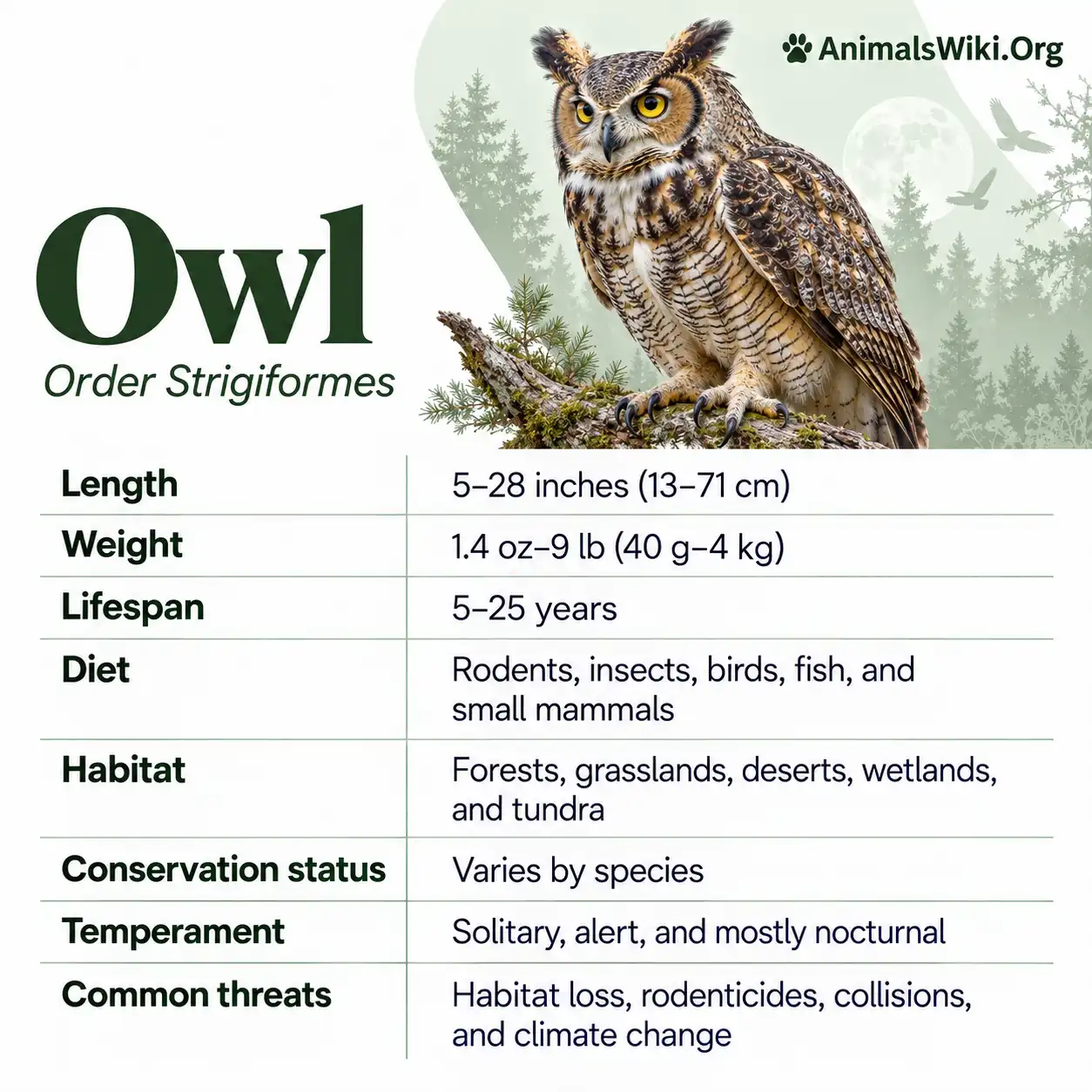
Owls are among the world’s most recognizable birds of prey. Famous for their large forward-facing eyes, powerful talons, hooked beaks, extraordinary hearing, flexible necks, and remarkably quiet flight, owls have evolved into highly specialized predators capable of hunting in darkness.
Owls belong to the order Strigiformes, which contains more than 200 living species. They occur on every continent except Antarctica and inhabit an extraordinary range of environments, including forests, grasslands, deserts, mountains, wetlands, farmland, tundra, and even towns and cities.
Although owls are commonly described as nocturnal birds, not every owl hunts exclusively at night. Some species are active during twilight, while others—including the snowy owl—may regularly hunt during daylight.
Owls feed primarily on other animals. Depending on species and body size, their prey can include mice, rats, voles, insects, rabbits, birds, reptiles, amphibians, and fish. Large owls can capture surprisingly substantial prey.
Their hunting success comes from an impressive combination of adaptations. Forward-facing eyes provide excellent depth perception. Specialized ears can locate animals hidden beneath vegetation or snow. Broad wings and uniquely structured feathers reduce flight noise, helping many species approach prey without being detected.
Owls are also surrounded by myths. Contrary to popular belief, an owl cannot rotate its head completely around. It can, however, turn its head approximately 270 degrees, compensating for eyes that are largely fixed in their sockets.
This comprehensive guide explores owl facts, species, classification, habitat, diet, size, lifespan, night vision, hearing, silent flight, hunting, talons, feathers, reproduction, eggs, owlets, behavior, adaptations, predators, owl pellets, conservation, and differences between owls and other birds of prey.
Owl Facts
| Feature | Information |
|---|---|
| Common Name | Owl |
| Animal Type | Bird |
| Kingdom | Animalia |
| Phylum | Chordata |
| Class | Aves |
| Order | Strigiformes |
| Main Families | Strigidae and Tytonidae |
| Number of Species | More than 200 |
| Distribution | Worldwide except Antarctica |
| Habitat | Forests, grasslands, deserts, wetlands, tundra, farmland and urban areas |
| Diet | Carnivore |
| Main Foods | Rodents, insects, birds and other animals |
| Hunting Style | Stealth, hearing and visual detection |
| Activity | Mostly nocturnal or crepuscular; some species diurnal |
| Famous Feature | Large forward-facing eyes |
| Head Rotation | Up to roughly 270° |
| Reproduction | Egg-laying |
| Young | Owlet |
| Flight | Usually exceptionally quiet |
| Main Weapons | Talons and hooked beak |
| Major Threats | Habitat loss, poisoning, collisions, persecution and environmental change |
What Is an Owl?
An owl is a predatory bird belonging to the order Strigiformes.
Most owls possess:
- Large heads
- Forward-facing eyes
- Hooked beaks
- Powerful feet
- Sharp talons
- Broad wings
- Soft feathers
- Excellent hearing
These characteristics make them highly effective hunters.
However, owl species differ dramatically in appearance and ecology.
Some are tiny insect hunters.
Others are powerful predators capable of capturing rabbits and other relatively large animals.
Scientific Classification of Owls
| Classification | Name |
|---|---|
| Kingdom | Animalia |
| Phylum | Chordata |
| Class | Aves |
| Order | Strigiformes |
Living owls are generally divided into two major families:
Strigidae
The true owls.
This family contains most living owl species.
Examples include:
- Great horned owl
- Snowy owl
- Eurasian eagle-owl
- Burrowing owl
- Tawny owl
- Screech owls
Tytonidae
The barn owls and bay owls.
The familiar barn owl belongs to this family.
Barn owls are particularly recognizable by their heart-shaped facial discs.
How Many Species of Owls Are There?
There are more than 200 recognized living owl species.
The precise number can change as scientists:
- Study genetics
- Discover new populations
- Split species
- Combine species
- Revise taxonomy
Owls range from tiny species weighing only a few dozen grams to huge eagle-owls with wingspans approaching two meters.
Where Do Owls Live?
Owls have an enormous global distribution.
They occur naturally on every continent except Antarctica.
Habitats include:
- Tropical rainforest
- Temperate forest
- Boreal forest
- Grassland
- Savanna
- Desert
- Mountain
- Tundra
- Wetland
- Farmland
- Orchards
- Villages
- Cities
Different owl species are adapted to dramatically different environments.
Owl Habitat
An owl’s habitat must generally provide:
- Suitable prey
- Roosting sites
- Nesting opportunities
- Protection
- Hunting areas
Forest owls may depend on tree cavities.
Grassland species may nest directly on the ground.
Burrowing owls use underground burrows.
Barn owls frequently use buildings, barns, cliffs, and cavities.
Habitat requirements therefore vary enormously.
What Do Owls Eat?
Owls are carnivores.
Their diet depends on species, body size, habitat, and available prey.
Common foods include:
- Mice
- Rats
- Voles
- Shrews
- Rabbits
- Hares
- Insects
- Birds
- Snakes
- Lizards
- Frogs
- Fish
Small owls may specialize heavily in insects.
Large species can overpower much larger vertebrate prey.
Do Owls Eat Mice?
Yes.
Rodents are among the most important prey for many owl species.
Owls can help regulate populations of:
- Mice
- Rats
- Voles
- Other small mammals
A breeding pair raising hungry owlets may capture large numbers of rodents.
This makes owls valuable natural predators in agricultural ecosystems.
Do Owls Eat Snakes?
Some do.
Larger owls may capture:
- Snakes
- Lizards
- Frogs
- Other reptiles and amphibians
The importance of these prey differs according to habitat and species.
Owls generally take whatever suitable prey is locally abundant and manageable.
Do Owls Eat Other Birds?
Yes.
Some owls regularly hunt birds.
Potential avian prey can include:
- Songbirds
- Pigeons
- Ducks
- Other small or medium-sized birds
Large owl species may occasionally prey on smaller owls.
Predator-prey relationships among birds of prey can therefore be surprisingly complex.
How Do Owls Hunt?
A typical owl hunt involves several stages.
- The owl listens and watches from a perch.
- It detects potential prey.
- It launches quietly.
- It approaches with minimal wing noise.
- Its legs extend forward.
- Sharp talons seize the prey.
- The beak helps tear food when necessary.
Some species hunt from perches.
Others fly low across open landscapes while listening for prey.
Why Do Owls Hunt at Night?
Nighttime hunting can provide several advantages.
It can:
- Reduce competition with daytime predators
- Provide access to nocturnal prey
- Help owls use their exceptional low-light vision
- Take advantage of specialized hearing
However, not every owl is nocturnal.
Some species hunt during twilight or daylight.
Are All Owls Nocturnal?
No.
Owls can be:
- Nocturnal
- Crepuscular
- Diurnal
The snowy owl, for example, may hunt during daylight, especially during Arctic summers when sunlight can last almost continuously.
Burrowing owls may also be active during daylight.
Calling every owl strictly nocturnal is therefore inaccurate.
Owl Eyes
An owl’s eyes are exceptionally large relative to its skull.
Large eyes help collect available light.
Unlike the nearly spherical eyes of humans, owl eyes are more tube-shaped.
This provides excellent visual performance but restricts eye movement.
As a result, owls move their heads rather than shifting their eyes dramatically from side to side.
Can Owls See in Complete Darkness?
No.
Owls require at least some light to see.
Their eyes are highly effective in dim conditions, but vision cannot function in the total absence of light.
When darkness is extremely deep, hearing becomes particularly important.
Some owls can locate prey almost entirely through sound.
Do Owls Have Night Vision?
Yes.
Owls possess excellent low-light vision.
Their large eyes contain numerous light-sensitive cells.
This allows many species to detect movement under illumination levels that would make hunting difficult for humans.
However, owl vision is only one component of their hunting system.
Hearing can be equally important.
Can Owls See During the Day?
Yes.
Owls are not blinded by daylight.
Nocturnal species may prefer lower-light conditions, but their eyes remain functional during daytime.
Several owl species routinely hunt under daylight.
Why Do Owls Have Forward-Facing Eyes?
Forward-facing eyes create substantial overlap between the visual fields of the two eyes.
This produces strong binocular vision.
Binocular vision helps estimate:
- Distance
- Depth
- Prey position
Accurate depth perception is extremely important when an owl is attempting to seize a small moving animal with its talons.
Owl Hearing
Owls possess exceptionally sensitive hearing.
In some species, the ear openings are positioned asymmetrically.
One ear may sit slightly higher than the other.
This allows sounds to reach each ear at subtly different times and intensities.
The brain analyzes these differences to estimate a sound’s position.
Why Do Some Owls Have Uneven Ears?
Asymmetrical ear placement improves sound localization.
It helps an owl determine both:
- Horizontal direction
- Vertical position
This is especially useful when prey is:
- Hidden in grass
- Beneath leaves
- Under snow
- Active in darkness
Certain species can attack prey they cannot directly see.
What Is an Owl’s Facial Disc?
The circular or heart-shaped arrangement of feathers around an owl’s face is called a facial disc.
It functions somewhat like a satellite dish.
The feathers help direct sound toward the ears.
This improves the owl’s ability to locate prey.
The facial disc is especially prominent in barn owls.
Why Can Owls Fly Silently?
Owls possess specialized wing and feather structures that reduce noise.
Important features include:
Serrated Leading Edges
Comb-like structures break up turbulent airflow.
Soft Feather Surfaces
Velvety feather textures help dampen sound.
Fringed Trailing Edges
These reduce aerodynamic noise.
Broad Wings
Large wing surfaces allow relatively slow flight.
Together, these adaptations make many owls extraordinarily quiet in flight.
Is Owl Flight Completely Silent?
Not literally.
Any object moving through air creates some sound.
However, owl flight can be exceptionally quiet compared with that of many other birds.
This provides two major advantages:
- Prey has less warning.
- The owl can continue listening while flying.
Silent flight therefore supports both stealth and hearing.
How Fast Can an Owl Fly?
Flight speed differs between species and situations.
Many owls fly at moderate speeds while hunting.
They rely more on:
- Quiet approach
- Maneuverability
- Surprise
- Accurate prey detection
Some larger species can fly rapidly when traveling or attacking.
Owls are generally not specialized for extreme speed like falcons.
Owl Talons
An owl’s primary weapons are its talons.
These sharp claws are used to seize and restrain prey.
The feet contain powerful muscles and tendons.
Owls can exert substantial gripping force relative to their body size.
Large species can capture prey considerably heavier than the animals taken by small owls.
Owl Beak
Owls possess hooked beaks.
The beak helps:
- Tear flesh
- Remove feathers
- Break food into manageable pieces
Much of the beak is partly hidden by facial feathers, so it often appears smaller than it actually is.
Talons generally perform the initial capture, while the beak helps process food.
What Are Owl Pellets?
Owls often swallow small prey largely whole.
Digestible material is processed, while indigestible parts accumulate in the stomach.
These can include:
- Bones
- Fur
- Feathers
- Teeth
- Insect exoskeletons
The material is compressed into a mass called an owl pellet and later regurgitated.
Why Do Owls Cough Up Pellets?
Pellet production allows an owl to remove materials that cannot be efficiently digested.
Scientists can dissect owl pellets to determine what the birds have been eating.
A pellet containing rodent skulls, teeth, and bones can provide valuable information about local prey species.
Can Owls Turn Their Heads All the Way Around?
No.
An owl cannot rotate its head a full 360 degrees.
Many species can rotate the head approximately 270 degrees.
That is still extraordinary compared with humans.
Why Can Owls Turn Their Heads So Far?
Owls have several anatomical adaptations that allow extensive neck movement.
They possess 14 cervical vertebrae, compared with seven in humans.
Their circulatory anatomy also helps maintain blood flow during extreme head rotation.
This flexibility compensates for the limited movement of their eyes.
Do Owls Have Long Necks?
Yes—longer than they appear.
The neck is usually hidden beneath feathers.
An owl’s rounded silhouette can therefore make the head appear directly attached to the body.
When the bird stretches or turns, the flexibility of its neck becomes much more obvious.
Owl Feathers
Owl feathers provide:
- Insulation
- Flight
- Camouflage
- Noise reduction
- Protection
Many forest owls have brown, gray, white, or reddish patterns that resemble:
- Bark
- Leaves
- Shadows
- Lichen
A motionless owl can therefore be extremely difficult to notice during daylight.
Owl Camouflage
Camouflage is particularly important while roosting.
An owl sleeping against a tree trunk can become almost invisible.
Some species elongate their bodies and narrow their eyes when threatened, making themselves resemble broken branches.
This reduces detection by predators and potential prey.
Do Owls Have Ear Tufts?
Some species have feather tufts on top of the head.
Examples include:
- Great horned owl
- Long-eared owl
- Eurasian eagle-owl
Despite their appearance, these structures are not ears.
Their exact functions may include:
- Visual signaling
- Camouflage
- Breaking up the head’s outline
The real ear openings are located on the sides of the head.
Why Are Owls Called Horned Owls?
Species such as the great horned owl appear to have horns because of prominent feather tufts.
These are sometimes called plumicorns.
They are feathers, not horns.
They are also not the owl’s actual ears.
Owl Size
Owls vary enormously in size.
The smallest species are only around the size of a sparrow.
The largest species can have wingspans approaching 2 meters (6.5 feet).
Body size influences:
- Prey selection
- Habitat use
- Flight style
- Nesting
- Competition
What Is the Smallest Owl?
The elf owl (Micrathene whitneyi) is one of the world’s smallest owls.
It weighs only around 40 grams and is roughly 13–14 centimeters long.
Elf owls primarily feed on insects and other small animals.
They occur in parts of the southwestern United States and Mexico.
What Is the Largest Owl?
Defining the “largest” owl depends on whether size is measured by:
- Weight
- Body length
- Wingspan
The Blakiston’s fish owl is among the heaviest living owls and has an enormous wingspan.
Large eagle-owls, including the Eurasian eagle-owl, are also among the world’s biggest owl species.
Great Horned Owl
The great horned owl (Bubo virginianus) is one of the most powerful and recognizable owls of the Americas.
It has:
- Large ear tufts
- Yellow eyes
- Broad wings
- Strong talons
Its diet is exceptionally diverse and can include mammals, birds, reptiles, and other animals.
Barn Owl
The barn owl (Tyto alba) is one of the world’s most recognizable owls.
Its heart-shaped facial disc helps direct sound toward the ears.
Barn owls specialize heavily in hunting small mammals.
They often inhabit:
- Farmland
- Grassland
- Barns
- Old buildings
- Tree cavities
Their pale coloration and eerie calls have contributed to many myths and legends.
Snowy Owl
The snowy owl (Bubo scandiacus) is adapted to Arctic environments.
It has thick plumage covering much of the body, including the legs and feet.
Males often become whiter with age, while females usually retain more dark markings.
Unlike many owls, snowy owls regularly hunt during daylight.
Burrowing Owl
The burrowing owl (Athene cunicularia) differs dramatically from the stereotypical forest owl.
It lives in open landscapes and nests underground.
It frequently uses burrows created by other animals.
Burrowing owls have unusually long-looking legs and are often active during daylight.
Eagle-Owls
Eagle-owls are among the largest and most powerful owls.
The Eurasian eagle-owl can capture a wide variety of prey.
Large eagle-owls possess:
- Massive talons
- Broad wings
- Powerful bodies
- Prominent ear tufts
They occupy forests, rocky landscapes, mountains, and other habitats.
Fish Owls
Fish owls specialize partly in aquatic prey.
They hunt near:
- Rivers
- Streams
- Lakes
Their diet can include fish, amphibians, and other aquatic animals.
Blakiston’s fish owl is particularly famous for its enormous size and dependence on healthy riverine forests.
Owl Reproduction
Owls reproduce by laying eggs.
Many species do not construct elaborate nests.
They may use:
- Tree cavities
- Abandoned nests
- Cliff ledges
- Burrows
- Buildings
- Ground depressions
The female commonly performs most incubation, while the male provides food.
Parental roles differ somewhat among species.
Owl Eggs
Owl eggs are generally:
- White
- Rounded
- Relatively plain
Clutch size varies.
Species experiencing highly variable rodent populations may lay more eggs during years when prey is abundant.
Food availability can therefore strongly influence reproductive success.
Baby Owls
Baby owls are called owlets.
Newly hatched owlets are generally:
- Covered in down
- Vulnerable
- Dependent on parents
- Unable to hunt
Parents supply food until the young develop the physical and behavioral skills necessary for independence.
How Do Owlets Learn to Fly?
Young owls gradually strengthen their wings and flight muscles.
They may:
- Move around the nest.
- Climb nearby branches.
- Flap their wings.
- Make short jumps.
- Attempt short flights.
- Improve maneuverability.
The stage when young birds leave the nest is called fledging.
Parents may continue feeding them after fledging.
What Is Branching?
Young owls sometimes leave the nest before they can fly confidently.
They climb and move along nearby branches.
This stage is known as branching.
A young owl found on the ground is therefore not necessarily abandoned.
Its parents may still be nearby and caring for it.
How Long Do Owls Live?
Owl lifespan varies dramatically by species.
Small species may live only several years in the wild.
Larger owls can survive 10–20 years or more, with some individuals living substantially longer.
Survival depends on:
- Species
- Food availability
- Predators
- Disease
- Collisions
- Habitat
- Human activity
Captive individuals can sometimes live longer than wild birds.
Are Owls Solitary?
Many owls spend substantial amounts of time alone or as breeding pairs.
Territorial species may actively exclude other owls.
However, behavior differs among species.
Some owls occasionally gather in communal roosts, particularly outside the breeding season.
How Do Owls Communicate?
Owls communicate through:
- Hoots
- Screeches
- Whistles
- Trills
- Hisses
- Bill snapping
- Body postures
Not every owl hoots.
Barn owls, for example, are famous for harsh screeching calls rather than the stereotypical deep “hoo-hoo.”
Why Do Owls Hoot?
Hooting can serve several functions.
It may:
- Advertise territory
- Attract mates
- Maintain pair bonds
- Communicate location
- Warn rivals
Each species has characteristic vocalizations.
Experienced birders can often identify owls by sound without seeing them.
Why Do Owls Screech?
Some species naturally produce screeches rather than hoots.
Calls can be used for:
- Courtship
- Territorial defense
- Begging
- Alarm
- Contact between family members
An eerie nighttime scream may therefore be a completely normal owl vocalization.
Owl Adaptations
Owls possess an impressive combination of predatory adaptations.
Large Eyes
Improve low-light vision.
Forward-Facing Vision
Provides strong depth perception.
Sensitive Hearing
Detects hidden prey.
Asymmetrical Ears
Improve three-dimensional sound localization in some species.
Facial Disc
Channels sound toward the ears.
Silent Flight
Reduces warning to prey.
Powerful Talons
Capture and restrain animals.
Hooked Beak
Tears food.
Flexible Neck
Compensates for relatively fixed eyes.
Camouflage
Conceals resting birds.
Broad Wings
Allow controlled, relatively slow flight.
Together, these adaptations make owls extraordinarily effective predators.
Owl Predators
Adult large owls have relatively few predators.
However, smaller owls can be killed by:
- Larger owls
- Eagles
- Hawks
- Mammalian predators
Eggs and owlets may be threatened by:
- Snakes
- Raccoons
- Martens
- Foxes
- Other birds
Predation risk varies by habitat and geographic region.
Do Owls Eat Other Owls?
Yes.
Large owl species can sometimes prey on smaller owls.
For example, powerful eagle-owls and great horned owls may kill smaller raptors.
Competition can also cause owls to avoid areas occupied by larger species.
Owl vs. Eagle
| Feature | Owl | Eagle |
|---|---|---|
| Order | Strigiformes | Accipitriformes |
| Typical Activity | Often nocturnal | Mostly diurnal |
| Eyes | Forward-facing | More side-oriented but strong binocular vision |
| Flight | Often exceptionally quiet | Powerful soaring/flapping |
| Hearing | Extremely important | Vision usually dominant |
| Main Weapons | Talons | Talons |
| Beak | Hooked | Hooked |
Both are formidable birds of prey, but they evolved different hunting specializations.
Owl vs. Hawk
Hawks are generally daytime hunters relying heavily on exceptional vision.
Many owls specialize in low-light hunting and rely strongly on hearing.
Both possess:
- Sharp talons
- Hooked beaks
- Excellent vision
- Carnivorous diets
However, they belong to different evolutionary groups.
Owl vs. Falcon
Falcons are famous for speed.
The peregrine falcon can reach extraordinary velocities during dives.
Owls generally prioritize:
- Stealth
- Silent flight
- Hearing
- Low-light hunting
The comparison demonstrates two very different solutions to aerial predation.
Owl vs. Eagle-Owl
An eagle-owl is not a cross between an eagle and an owl.
Eagle-owls are simply very large owl species, primarily within the genus Bubo.
They are called eagle-owls because of their impressive size and predatory power.
Owl vs. Nightjar
Owls and nightjars are both frequently active at night but are unrelated groups.
Owls have strong talons and hunt vertebrates or insects.
Nightjars primarily catch flying insects using wide mouths.
Their superficial similarities result from adaptation to nocturnal lifestyles.
Are Owls Dangerous to Humans?
Owls generally avoid people.
However, they possess extremely sharp talons and can cause injuries if:
- Threatened
- Trapped
- Handled
- Defending a nest
Large owls should always be treated as wild predators and observed from a respectful distance.
Serious attacks on humans are uncommon.
Can Owls Be Pets?
Owls are wild birds of prey rather than domesticated pets.
They require specialized:
- Diets
- Housing
- Veterinary care
- Flight space
- Environmental enrichment
They also produce pellets, droppings, feathers, and predatory behaviors unsuitable for ordinary households.
In many jurisdictions, keeping native owls without appropriate permits is illegal.
Are Owls Smart?
Owls have long symbolized wisdom, but human concepts of intelligence should not be applied too simplistically to animals.
Owls possess cognitive abilities suited to their ecological needs.
They can:
- Navigate territories
- Recognize locations
- Locate prey
- Learn hunting strategies
- Respond to environmental cues
However, the popular image of the owl as universally “the smartest bird” is cultural rather than a scientific ranking.
Why Are Owls Associated With Wisdom?
The association is ancient.
In Greek tradition, the owl became associated with Athena, the goddess connected with wisdom.
Owls’ large forward-facing eyes and quiet behavior may also contribute to their thoughtful-looking appearance.
Different cultures interpret owls very differently.
They can symbolize:
- Wisdom
- Protection
- Mystery
- Night
- Death
- Spirituality
These meanings are cultural rather than biological.
Are Owls Endangered?
There is no single conservation status for all owls.
Some species remain widespread and abundant.
Others are:
- Vulnerable
- Endangered
- Critically endangered
- Restricted to tiny geographic ranges
Each species must therefore be assessed individually.
Threats to Owls
Habitat Loss
Forest clearing and development can remove nesting and hunting areas.
Rodenticides
Poison used to kill rodents can indirectly poison owls that eat contaminated prey.
Vehicle Collisions
Owls hunting near roads can be struck by vehicles.
Power Infrastructure
Collisions and electrocution can affect some populations.
Illegal Killing
Owls are persecuted in certain regions because of myths or wildlife trade.
Climate Change
Changing temperatures, rainfall, snow cover, and prey distribution can alter habitat.
Loss of Nest Sites
Removal of old trees and buildings can reduce available cavities.
Owls and Rodent Control
Owls can provide natural pest-control services.
Barn owls are especially valuable in agricultural areas because rodents can form a large proportion of their diet.
Providing safe nesting habitat can sometimes encourage natural owl populations.
However, heavy use of rodenticides can undermine this benefit by poisoning the predators that consume affected rodents.
Why Are Owls Important?
Owls are important predators within many ecosystems.
They help regulate populations of:
- Rodents
- Insects
- Small birds
- Other animals
They also serve as prey or competitors within larger food webs.
Because many species depend on healthy habitats and prey populations, changes in owl abundance can provide useful ecological information.
40 Interesting Owl Facts
- Owls are birds.
- They belong to the order Strigiformes.
- There are more than 200 living owl species.
- Owls live on every continent except Antarctica.
- Most owls are carnivores.
- Many owls hunt rodents.
- Not all owls are nocturnal.
- Snowy owls frequently hunt during daylight.
- Owls have forward-facing eyes.
- Their eyes are relatively fixed in their sockets.
- Owls move their heads to redirect their gaze.
- They cannot rotate their heads 360 degrees.
- They can turn their heads roughly 270 degrees.
- Owls have 14 neck vertebrae.
- Many owls possess excellent low-light vision.
- They cannot see in absolute darkness.
- Owl hearing can be extraordinarily sensitive.
- Some species have asymmetrical ears.
- Facial discs help direct sound.
- Many owls fly exceptionally quietly.
- Specialized feathers reduce flight noise.
- Owls capture prey primarily with their talons.
- They possess hooked beaks.
- Owls generally swallow small prey largely whole.
- They regurgitate pellets.
- Owl pellets can contain bones and fur.
- Some owls have feather ear tufts.
- Those tufts are not actual ears.
- Baby owls are called owlets.
- Owls lay eggs.
- Some species nest in tree cavities.
- Burrowing owls live underground.
- Barn owls often use human structures.
- Some owls hunt fish.
- Large owls can prey on smaller owls.
- Owls are not closely related to hawks or eagles despite similar predatory lifestyles.
- Owls can provide natural rodent control.
- Rodenticides can poison owls indirectly.
- Habitat destruction threatens many species.
- Owls are important predators in ecosystems worldwide.
Did You Know?
An owl can hunt prey that it cannot see.
In species with exceptionally specialized hearing, sounds from a mouse moving beneath grass, leaves, or even snow reach each ear at slightly different times and intensities.
The owl’s brain processes these differences to calculate the prey’s location.
Its facial disc helps collect and direct sound, while asymmetrically positioned ears can improve three-dimensional localization.
Once the prey’s position is identified, the owl can launch almost silently and extend its talons at precisely the right moment.
This combination of hearing, silent flight, and spatial processing makes some owls among nature’s most specialized acoustic hunters.
Frequently Asked Questions About Owls
What is an owl?
An owl is a predatory bird belonging to the order Strigiformes.
Are owls birds?
Yes. Owls are birds of prey.
How many owl species are there?
There are more than 200 recognized living species.
Where do owls live?
Owls occur on every continent except Antarctica.
What is an owl’s habitat?
Depending on species, owls inhabit forests, grasslands, deserts, wetlands, mountains, tundra, farmland, and urban environments.
What do owls eat?
Owls eat rodents, insects, birds, reptiles, amphibians, fish, and other animals.
Do owls eat mice?
Yes. Mice and other rodents are important prey for many species.
Do owls eat rats?
Many medium and large owl species can capture rats.
Do owls eat snakes?
Some owl species eat snakes and other reptiles.
Do owls eat other birds?
Yes. Some owls regularly prey on birds.
Do owls eat other owls?
Large owls can occasionally prey on smaller owl species.
Are owls nocturnal?
Many are, but some are crepuscular or diurnal.
Can owls see in the dark?
They see exceptionally well in low light but cannot see in the complete absence of light.
Can owls see during the day?
Yes.
Why are owl eyes so large?
Large eyes collect more available light and provide excellent visual sensitivity.
Can owls move their eyes?
Their tube-shaped eyes have very limited movement compared with human eyes.
Can an owl turn its head 360 degrees?
No.
How far can an owl turn its head?
Approximately 270 degrees.
Why can owls turn their heads so far?
Their neck anatomy and specialized circulatory system allow exceptional rotation.
How many neck bones does an owl have?
Owls have 14 cervical vertebrae.
Do owls have ears?
Yes. Their ear openings are hidden beneath feathers.
Are owl ear tufts ears?
No. They are feathers.
Why do owls have uneven ears?
In some species, asymmetrical ears improve the ability to locate sounds in three dimensions.
Why do owls fly silently?
Specialized wing and feather structures reduce aerodynamic noise.
Is owl flight completely silent?
No flight is literally silent, but many owls are exceptionally quiet.
How fast can an owl fly?
Speed varies by species. Owls generally rely more on stealth and maneuverability than extreme speed.
What are owl pellets?
Pellets are compact masses of indigestible prey material such as bones and fur that owls regurgitate.
Do owls have teeth?
No. Owls have hooked beaks rather than teeth.
What is a baby owl called?
A baby owl is called an owlet.
Do owls lay eggs?
Yes.
Where do owls build nests?
They may use tree cavities, abandoned nests, cliffs, burrows, buildings, or the ground depending on species.
What is the largest owl?
Blakiston’s fish owl is among the world’s largest and heaviest owls, while several eagle-owls also reach enormous sizes.
What is the smallest owl?
The elf owl is among the smallest owl species.
How long do owls live?
Lifespan varies greatly. Large species can live 10–20 years or longer in the wild.
Are owls smarter than other birds?
Owls have specialized cognitive abilities, but the cultural association between owls and wisdom does not scientifically establish them as the smartest birds.
Why do owls hoot?
Hooting can advertise territory, attract mates, maintain pair bonds, and communicate with other owls.
Why do owls screech?
Some species naturally communicate with screeches, whistles, trills, and other sounds rather than classic hoots.
Are owls dangerous?
Owls generally avoid people, but their talons can cause injuries if they are threatened or defending nests.
Can owls be pets?
Owls are wild birds with specialized dietary, behavioral, housing, and welfare requirements and are legally protected in many places.
What animals eat owls?
Larger birds of prey, other owls, and some mammalian predators can kill owls, particularly smaller species and young birds.
Are owls endangered?
Some owl species are threatened while others remain widespread. Conservation status must be evaluated species by species.
Why are owls important?
Owls regulate prey populations, particularly rodents, and form important components of food webs.
Conclusion
Owls are among the most specialized aerial predators on Earth.
More than 200 species have adapted to environments ranging from Arctic tundra and tropical rainforest to deserts, grasslands, farms, mountains, and cities.
Their hunting abilities are based on an extraordinary combination of senses and anatomy.
Large forward-facing eyes provide strong depth perception and excellent performance in dim light. Highly sensitive ears can reveal prey hidden beneath leaves or vegetation. In some species, asymmetrical ear placement makes sound localization even more precise.
Their wings add another remarkable advantage.
Specialized feathers reduce aerodynamic noise, allowing an owl to approach prey while producing remarkably little sound. Powerful feet then extend forward, and sharp talons deliver the decisive strike.
Yet owls are far more diverse than the familiar image of a bird hooting from a tree at midnight.
Snowy owls hunt across bright Arctic landscapes. Burrowing owls live underground in open grasslands. Barn owls use buildings and agricultural environments. Fish owls patrol rivers, while enormous eagle-owls can capture surprisingly large prey.
Owls also perform valuable ecological roles.
By hunting rodents, insects, and other animals, they help regulate prey populations and contribute to balanced food webs. In agricultural landscapes, rodent-eating owls can provide a natural form of pest control.
However, owls face growing pressures from habitat destruction, poisoning, road collisions, infrastructure, persecution, and environmental change.
Protecting them requires maintaining nesting sites, healthy prey populations, safe hunting habitat, and connected ecosystems.
From the tiny elf owl to enormous fish owls and eagle-owls, these remarkable birds demonstrate how vision, hearing, camouflage, silent flight, and predatory precision can combine to create some of the most effective nighttime hunters in the animal kingdom.