Mola mola , The Giant Ocean Sunfish of the Open Sea
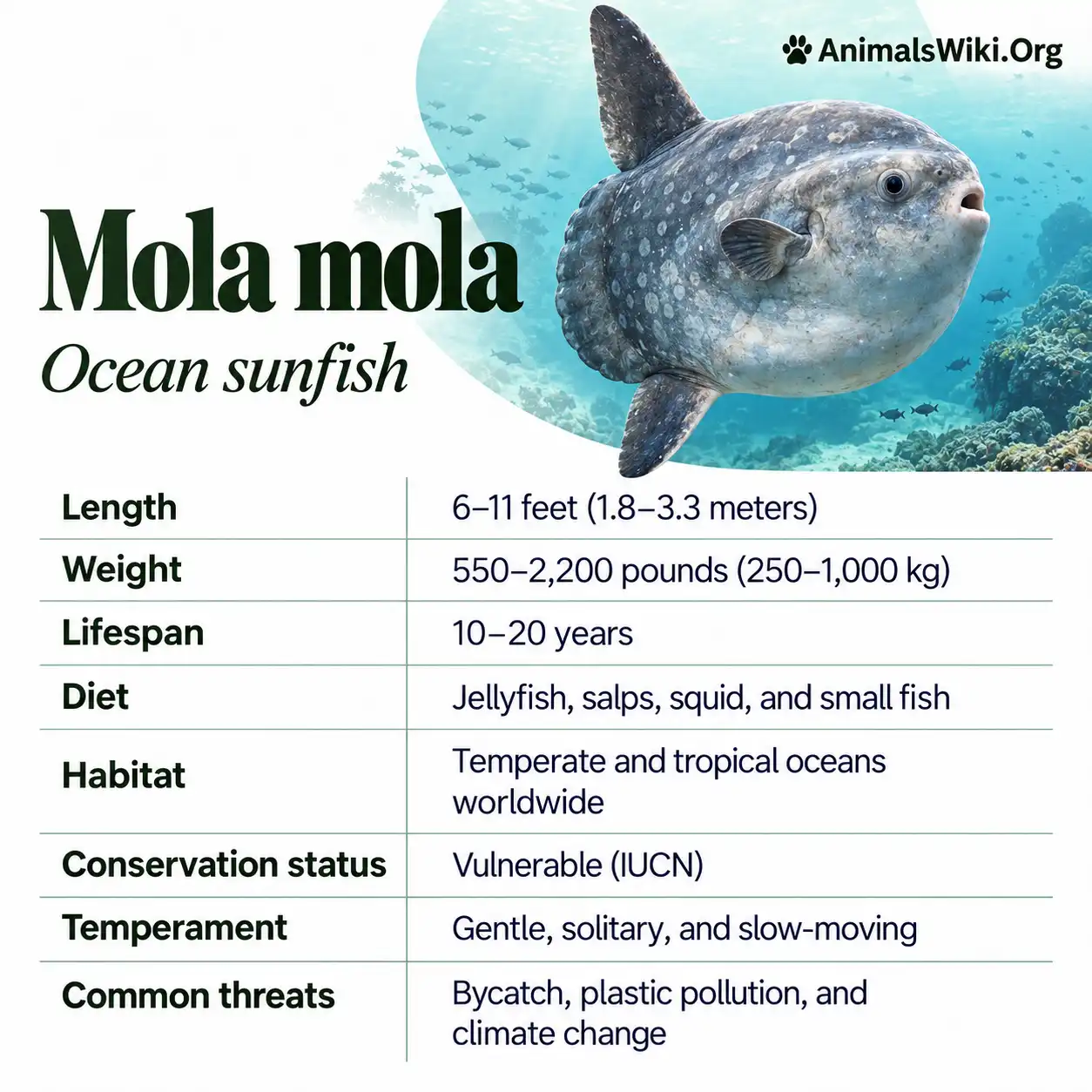
The Mola mola, better known as the Ocean Sunfish, looks almost impossible.
A giant fish.
A flattened body.
Enormous dorsal and anal fins.
Tiny pectoral fins.
No conventional-looking tail.
And a body that can weigh:
more than a ton.
Its scientific name is:
Mola mola.
The Ocean Sunfish belongs to the family:
Molidae.
It is one of several living species commonly known as:
ocean sunfishes.
This distinction matters.
The term “Mola mola” refers specifically to:
Mola mola.
It should not automatically be used for every giant sunfish.
Other members of the group include species such as:
- Mola alexandrini — Giant/Bump-head Sunfish
- Mola tecta — Hoodwinker Sunfish
- Masturus lanceolatus — Sharptail Mola
- Ranzania laevis — Slender Sunfish
For many years, Mola mola was routinely described as the:
heaviest bony fish in the world.
Modern records require a more careful statement.
Mola mola is unquestionably one of the world’s:
heaviest living bony fishes.
However, exceptionally large Mola alexandrini can exceed the largest securely documented Mola mola, making the giant sunfish a major contender for—or holder of—the extreme weight record among bony fishes.
That does not make Mola mola any less:
extraordinary.
Large Ocean Sunfish can reach approximately:
3 meters or more in total vertical fin-to-fin height
and can weigh well over:
1,000 kg.
Exceptional individuals can become substantially:
heavier.
But size is only the beginning.
The Ocean Sunfish has one of the strangest body plans among:
fishes.
Its body appears as if the back half of an ordinary fish has been:
removed.
Instead of a conventional caudal fin, or tail fin, it possesses a rounded structure called the:
clavus.
The clavus acts somewhat like a:
rudder.
Propulsion comes primarily from synchronized movement of the enormous:
dorsal and anal fins.
The Ocean Sunfish therefore does not swim like a:
tuna.
It does not generate most of its propulsion by sweeping a large tail from side to:
side.
Instead, its tall dorsal and anal fins move rhythmically, creating a swimming style that can look almost like a bird:
flapping its wings.
For years, this bizarre appearance contributed to the idea that Mola mola was a slow, helpless animal simply drifting wherever ocean currents carried:
it.
Research has shown otherwise.
Ocean Sunfish are active:
swimmers.
They can move horizontally across large distances and vertically through hundreds of meters of:
water.
They frequently dive into deeper, colder layers and later return toward the warmer:
surface.
Why?
Partly because the Ocean Sunfish is an active:
predator.
The old stereotype says Mola mola eats almost nothing except:
jellyfish.
Jellyfish and other gelatinous organisms are indeed important prey.
But the diet is much:
broader.
Ocean Sunfish can consume:
- Jellyfish
- Salps
- Siphonophores
- Ctenophores
- Squid
- Crustaceans
- Small fish
- Fish larvae
- Other marine invertebrates
Their enormous size is therefore supported by a diverse marine:
diet.
Another famous behavior occurs near the:
surface.
An Ocean Sunfish may lie almost horizontally, exposing one side of its enormous body to:
sunlight.
This behavior helped inspire the English name:
Sunfish.
But “sunbathing” is not necessarily simple relaxation.
Returning to warmer surface water may help the fish regain body heat after deep dives into:
cold water.
The surface also provides access to:
cleaning organisms.
Mola mola can carry many external:
parasites.
Cleaner fish may remove some parasites underwater.
At the surface, seabirds have also been observed picking parasites from the skin.
The Sunfish therefore becomes a remarkable meeting point between:
ocean and sky.
A huge fish floats near the surface.
A seabird lands or approaches.
And instead of becoming prey, the fish may receive a kind of:
cleaning service.
The reproductive biology of Mola mola is equally extraordinary.
Females can produce enormous numbers of:
eggs.
A frequently cited estimate suggests that a large female may carry around:
300 million eggs.
This is often described as one of the highest potential egg counts known among:
vertebrates.
Yet the adult begins life at an astonishingly small:
size.
Sunfish larvae look dramatically different from:
adults.
They can possess spines and a body shape that makes them look more like tiny relatives of:
pufferfish.
As they grow, their proportions change radically.
A microscopic or millimeter-scale larva can eventually become an animal weighing:
hundreds of kilograms.
Few vertebrates demonstrate a more dramatic transformation in:
scale.
Despite their immense size, Ocean Sunfish are generally not considered dangerous to:
humans.
They are not aggressive predators of:
people.
However, their sheer mass creates risks when they are accidentally struck by:
boats
or when a large individual leaps from the water near a:
vessel.
Ocean Sunfish themselves face numerous threats.
They can become accidentally caught in:
fishing gear.
They may ingest:
plastic debris
mistaken for gelatinous prey.
They can be injured by:
boats.
And changes to ocean ecosystems can affect the prey and habitats on which they:
depend.
This comprehensive guide explores Mola mola facts, Ocean Sunfish scientific name, classification, appearance, size, weight, height, clavus, fins, swimming, speed, habitat, distribution, depth, diet, jellyfish, diving, sunbathing, parasites, cleaning behavior, reproduction, eggs, babies, larvae, growth, lifespan, predators, adaptations, Mola mola vs Mola alexandrini, Mola mola vs Hoodwinker Sunfish, Mola mola vs Pufferfish, danger to humans, conservation and why the Ocean Sunfish is one of the strangest giant fishes in the sea.
Mola Mola Facts
| Feature | Information |
|---|---|
| Common Name | Ocean Sunfish |
| Scientific Name | Mola mola |
| Other Name | Common Mola |
| Animal Type | Fish |
| Fish Type | Bony fish |
| Order | Tetraodontiformes |
| Family | Molidae |
| Genus | Mola |
| Habitat | Open ocean & coastal waters |
| Distribution | Temperate & tropical oceans |
| Body Shape | Deep, laterally compressed |
| Length | Commonly up to ~1.8 m; very large individuals exceed this |
| Fin-to-Fin Height | Can approach or exceed ~3 m |
| Weight | Large adults can exceed 1,000 kg |
| Tail | Clavus instead of conventional caudal fin |
| Diet | Gelatinous prey, fish, squid, crustaceans & other animals |
| Activity | Active swimmer & diver |
| Famous Behavior | Surface basking |
| Reproduction | Egg-laying |
| Potential Egg Number | Up to hundreds of millions |
| Temperament | Generally non-aggressive toward humans |
What Is a Mola Mola?
Mola mola is a gigantic marine bony fish commonly known as the:
Ocean Sunfish.
It belongs to the family:
Molidae.
Is Mola Mola the Same as Ocean Sunfish?
Yes.
The species Mola mola is commonly called the:
Ocean Sunfish
or:
Common Mola.
However, “ocean sunfish” can sometimes be used more broadly for members of the family Molidae, so scientific naming provides greater precision.
Scientific Classification of Mola Mola
| Classification | Name |
|---|---|
| Kingdom | Animalia |
| Phylum | Chordata |
| Class | Actinopterygii |
| Order | Tetraodontiformes |
| Family | Molidae |
| Genus | Mola |
| Species | Mola mola |
What Does Mola Mean?
The name Mola comes from Latin for a:
millstone.
The fish’s rounded, flattened body reminded early observers of a large:
millstone.
Because both the genus and species names are mola, the scientific name becomes:
Mola mola.
Why Is It Called an Ocean Sunfish?
The English name is associated with its habit of appearing near the ocean:
surface.
The fish may lie on its side near the surface, seemingly:
basking in sunlight.
Is Mola Mola a Real Fish?
Yes.
Despite its bizarre appearance, Mola mola is a genuine:
bony fish.
It belongs to the same broad ray-finned fish lineage as most familiar fishes.
Is Mola Mola a Shark?
No.
Sharks have skeletons composed primarily of:
cartilage.
Mola mola is a:
bony fish.
Is Mola Mola a Whale?
No.
Whales are:
mammals.
Mola mola is a:
fish.
Is Mola Mola a Pufferfish?
No.
But it is related to:
pufferfishes.
Both belong to the order:
Tetraodontiformes.
Other members of this unusual order include:
- Triggerfishes
- Filefishes
- Boxfishes
- Porcupinefishes
- Puffers
What Does Mola Mola Look Like?
The Ocean Sunfish has an unmistakable:
appearance.
It possesses:
- Enormous flattened body
- Small mouth
- Large eye
- Tiny pectoral fins
- Huge dorsal fin
- Huge anal fin
- Thick rough skin
- Rounded clavus
- No ordinary-looking tail
From the side, the fish appears almost:
circular.
Why Does Mola Mola Look Like Half a Fish?
Its unusual appearance results from extreme evolutionary modification of the rear portion of its:
body.
During development, the conventional tail region changes dramatically.
Instead of developing a typical caudal fin, the adult forms the:
clavus.
Does Mola Mola Have a Tail?
Not a conventional fish:
tail.
It possesses a structure called the:
clavus.
What Is the Clavus?
The clavus is the rounded structure at the rear of the:
Sunfish.
It is formed from modified fin structures and helps with:
steering.
How Does Mola Mola Swim Without a Normal Tail?
The main propulsion comes from the large:
dorsal and anal fins.
These fins move in coordinated side-to-side motions.
The clavus assists with:
steering and stability.
Is Mola Mola a Bad Swimmer?
No.
This is a common:
misconception.
Ocean Sunfish are active swimmers capable of:
- Long-distance movement
- Deep diving
- Vertical migration
- Navigating currents
Their swimming method simply looks unusual compared with that of tail-propelled fishes.
How Big Is a Mola Mola?
Mola mola is one of the largest:
bony fishes.
Typical adults are much smaller than record-sized individuals, but very large animals can reach several meters in overall:
dimensions.
How Long Is Mola Mola?
Many adults are around:
1–2 meters long.
Exceptional individuals can exceed:
2.5–3 meters
in certain measurements.
Exact maximum dimensions vary among reports and must be distinguished carefully from fin-to-fin height.
How Tall Is Mola Mola?
Because the dorsal and anal fins extend far above and below the body, a large Ocean Sunfish can measure around:
3 meters or more vertically from fin tip to fin tip.
This can make the fish appear almost as tall as it is:
long.
How Much Does Mola Mola Weigh?
Large adults can weigh:
hundreds of kilograms.
Exceptionally large individuals can exceed:
1,000 kg.
Historically reported maximum weights approach or exceed roughly:
2 tonnes, although species identification in old giant-sunfish records can complicate comparisons.
Is Mola Mola the Heaviest Bony Fish?
It was long widely described as the world’s:
heaviest bony fish.
However, the Giant Sunfish:
Mola alexandrini
has produced exceptionally large verified individuals and is now recognized as capable of surpassing Mola mola in maximum documented:
weight.
Therefore the safest description is:
Mola mola is one of the heaviest living bony fishes.
What Is the Largest Bony Fish?
By maximum documented mass, the title is now strongly associated with the:
Giant Sunfish (Mola alexandrini).
Mola mola remains among the largest and heaviest.
What Color Is Mola Mola?
Color varies.
Individuals may appear:
- Silvery
- Gray
- Brownish gray
- Dark gray
- Almost black
Some possess:
mottled patterns.
The coloration can sometimes change noticeably.
Does Mola Mola Have Scales?
Its skin does not resemble the obvious overlapping scales of many:
fishes.
Instead, the body is covered in extremely thick, rough:
skin
with modified scale structures.
How Thick Is Mola Mola Skin?
The skin can be remarkably:
thick.
In large individuals it may measure several centimeters in some areas.
This tough covering provides physical:
protection.
Does Mola Mola Have Bones?
Yes.
It is a:
bony fish.
However, its skeleton has several unusual features and is relatively reduced compared with many more conventionally shaped fishes.
Where Does Mola Mola Live?
Ocean Sunfish occur widely across:
temperate and tropical oceans.
They inhabit parts of:
- Atlantic Ocean
- Pacific Ocean
- Indian Ocean
- Mediterranean Sea
Is Mola Mola Found Worldwide?
It has a broad:
global distribution.
However, distribution patterns can be complicated because multiple sunfish species were historically confused with one another.
Does Mola Mola Live in Warm Water?
Yes, but it also occupies:
temperate seas.
It can encounter very cold water during:
deep dives.
Does Mola Mola Live in the Deep Sea?
It is not exclusively a deep-sea:
fish.
Ocean Sunfish move between surface waters and considerable:
depths.
How Deep Can Mola Mola Dive?
Tracking studies have shown Ocean Sunfish descending hundreds of meters.
Dives beyond:
500 meters
are possible, with depth varying among individuals and locations.
Why Does Mola Mola Dive Deep?
Deep dives may allow the fish to search for:
food.
Gelatinous organisms, squid and other prey can occur at different depths throughout the:
day.
Why Does Mola Mola Return to the Surface?
Possible reasons include:
- Warming after cold dives
- Parasite removal
- Access to cleaning organisms
- Travel
- Feeding opportunities
Does Mola Mola Sunbathe?
Ocean Sunfish are famous for lying near the:
surface.
This is often described as:
sunbathing or basking.
The behavior may help the fish regain heat after spending time in colder:
deep water.
Does Mola Mola Lie on Its Side?
Yes.
Individuals can float near the surface with one side of the body facing:
upward.
This unusual posture contributed to early assumptions that they were sick or:
dying.
Often, the fish is perfectly:
healthy.
What Does Mola Mola Eat?
Ocean Sunfish are:
carnivorous.
Their diet can include:
- Jellyfish
- Salps
- Ctenophores
- Siphonophores
- Squid
- Small fish
- Fish larvae
- Crustaceans
- Other marine invertebrates
Does Mola Mola Only Eat Jellyfish?
No.
This is one of the most persistent misconceptions about:
Ocean Sunfish.
Gelatinous prey can be important, but modern dietary evidence indicates a much more diverse:
diet.
Does Mola Mola Eat Jellyfish?
Yes.
Jellyfish and other gelatinous organisms are consumed.
How Can Mola Mola Grow Huge Eating Jellyfish?
This question is partly based on the false assumption that it eats:
only jellyfish.
Its diet includes more energy-rich animals as well.
Large body size is supported by:
- Continuous feeding
- Diverse prey
- Long growth periods
- Efficient exploitation of marine resources
Does Mola Mola Eat Squid?
Yes.
Cephalopods can form part of its:
diet.
Does Mola Mola Eat Fish?
Yes.
Small fish and fish larvae may be:
consumed.
Does Mola Mola Eat Crustaceans?
Yes.
Crustaceans can form part of the diet.
How Does Mola Mola Eat?
The mouth is relatively:
small.
Its teeth are fused into a beak-like:
structure.
It can suck and manipulate small prey into the mouth.
Does Mola Mola Have Teeth?
Yes, but they are not arranged like the separate teeth of a:
shark.
They are fused into structures characteristic of its tetraodontiform:
relatives.
Can Mola Mola Close Its Mouth?
The mouth is relatively small and has unusual fused dental anatomy.
Descriptions claiming Ocean Sunfish are completely incapable of closing their mouths are generally:
oversimplified.
Does Mola Mola Have a Stomach?
The digestive anatomy of Molids is unusual compared with that of many:
fishes.
They possess a relatively simplified digestive system suited to their varied marine:
diet.
How Does Mola Mola Find Food?
It uses:
- Vision
- Active swimming
- Vertical movement
- Exploration of productive water layers
The fish may track prey across different depths during:
the day.
Is Mola Mola Fast?
Ocean Sunfish are not built for extreme sustained speed like:
tuna or billfish.
But they are considerably more capable swimmers than their awkward appearance suggests.
Can Mola Mola Jump?
Yes.
Ocean Sunfish have been observed:
breaching
or jumping clear of the water.
Why Does Mola Mola Jump Out of the Water?
Possible explanations include:
- Parasite removal
- Disturbance
- Escape responses
- Other behavioral reasons
The exact motivation may differ between:
events.
Can Mola Mola Swim Against Currents?
Yes.
Tracking research demonstrates that they are not merely passive:
drifters.
They can actively control their movement.
Does Mola Mola Migrate?
Ocean Sunfish can make substantial:
seasonal movements.
These may follow:
- Temperature
- Ocean productivity
- Prey concentrations
Migration patterns vary by:
region.
Is Mola Mola Solitary?
It is commonly encountered:
alone.
However, several individuals can gather in productive feeding or cleaning:
areas.
Do Mola Mola Sleep?
Like other fishes, they have periods of reduced:
activity.
However, describing this exactly like mammalian sleep can be misleading.
Why Does Mola Mola Need Cleaning?
Ocean Sunfish can carry many:
parasites.
Numerous parasite species have been documented from molids.
What Parasites Live on Mola Mola?
Parasites can include various:
- Copepods
- Flatworms
- Roundworms
- Other ectoparasites and internal parasites
The exact parasite community differs geographically.
How Does Mola Mola Remove Parasites?
It can visit:
cleaning stations.
Cleaner fishes remove parasites from its skin.
The Ocean Sunfish may adopt specific body positions to facilitate:
cleaning.
Do Birds Clean Mola Mola?
Yes.
At the surface, seabirds have been observed picking organisms from Ocean Sunfish:
skin.
This creates a fascinating interaction between marine fish and:
birds.
Why Does Mola Mola Have So Many Parasites?
Its:
- Large body
- Thick skin
- Wide-ranging movements
- Long lifespan
provide numerous opportunities for parasites to colonize:
it.
How Does Mola Mola Reproduce?
Mola mola reproduces:
sexually.
Females release eggs into the water, where fertilization occurs:
externally.
How Many Eggs Does Mola Mola Lay?
A famous estimate suggests a large female may contain approximately:
300 million eggs.
This is one of the largest potential egg counts recorded for a:
vertebrate.
Does Mola Mola Really Lay 300 Million Eggs?
The figure comes from estimates of ovarian egg production in a large:
female.
It should not be interpreted as every female releasing exactly 300 million viable eggs in a single event.
The broader point remains remarkable:
Mola mola can produce:
enormous numbers of eggs.
Why Does Mola Mola Produce So Many Eggs?
Survival from egg to giant adult is:
extremely low.
Huge egg production increases the probability that at least some offspring survive through:
- Egg stage
- Larval stage
- Juvenile stage
- Predation
- Environmental hazards
What Does a Baby Mola Mola Look Like?
Baby Ocean Sunfish look almost nothing like:
adults.
Larvae are tiny and can possess:
spines.
Their appearance resembles some of their pufferfish-like:
relatives.
Do Baby Mola Mola Have Spikes?
Yes.
Early developmental stages can possess prominent:
spines.
These structures are lost or transformed as the fish matures.
How Small Is a Baby Mola Mola?
Newly hatched larvae are only:
millimeters long.
The contrast with an adult weighing hundreds of kilograms is extraordinary.
How Fast Does Mola Mola Grow?
Sunfish undergo one of the most dramatic size increases known among:
vertebrates.
Growth observations from managed individuals indicate that juveniles can grow remarkably:
quickly.
However, exact wild growth rates remain incompletely understood.
How Much Bigger Does Mola Mola Become From Baby to Adult?
The increase in mass can be:
tens of millions of times.
The precise ratio depends on the larval and adult weights being compared.
How Long Does Mola Mola Live?
The exact lifespan of wild Mola mola remains:
uncertain.
They likely require many years to reach maximum size.
Estimates sometimes suggest lifespans of several decades, but precise wild longevity is not firmly:
established.
Mola Mola Adaptations
Enormous Dorsal and Anal Fins
Provide the primary propulsion.
Clavus
Replaces the conventional tail fin and assists with steering.
Deep Flattened Body
Creates the characteristic Sunfish profile.
Thick Skin
Offers protection against injury and parasites.
Huge Adult Size
Reduces vulnerability to many predators.
Vertical Diving
Allows access to prey at different depths.
Surface Basking
May help restore body temperature after deep dives.
High Egg Production
Compensates for extremely high mortality during early life.
Broad Diet
Allows exploitation of multiple marine food sources.
What Eats Mola Mola?
Large adults have relatively few:
predators.
Known or potential predators include:
- Orcas
- Large sharks
- Sea lions
Juveniles face many more potential predators.
Do Sharks Eat Mola Mola?
Yes.
Large sharks can attack Ocean:
Sunfish.
Do Orcas Eat Mola Mola?
Yes.
Orcas have been observed preying on:
sunfishes.
Do Sea Lions Eat Mola Mola?
Sea lions have been observed attacking:
sunfish.
Some attacks may involve feeding, while others can appear unusually rough or exploratory.
Can Mola Mola Defend Itself?
It lacks the obvious weapons of many large marine:
animals.
Its defenses include:
- Huge adult size
- Thick skin
- Deep body
- Swimming ability
Mola Mola vs. Mola Alexandrini
| Feature | Mola mola | Mola alexandrini |
|---|---|---|
| Common Name | Ocean Sunfish | Giant/Bump-head Sunfish |
| Genus | Mola | Mola |
| Body | Rounded | Large, with distinctive head/chin features |
| Size | Enormous | Can become even heavier |
| Record Significance | Historically called heaviest bony fish | Holds extraordinary verified mass records |
| Distribution | Broad temperate/tropical seas | Broad warm/temperate marine range |
Mola Mola vs. Hoodwinker Sunfish
The Hoodwinker Sunfish is:
Mola tecta.
It was scientifically described as a distinct species only relatively:
recently.
It differs from Mola mola in several morphological:
features.
Its discovery demonstrated how much scientists still have to learn about even enormous ocean:
animals.
Mola Mola vs. Pufferfish
| Feature | Mola Mola | Pufferfish |
|---|---|---|
| Order | Tetraodontiformes | Tetraodontiformes |
| Size | Can exceed 1,000 kg | Usually much smaller |
| Inflation | Does not inflate like typical puffers | Many inflate |
| Habitat | Open ocean | Marine/freshwater depending species |
| Shape | Huge flattened disc | Variable, often rounded |
| Relationship | Relative | Relative |
Mola Mola vs. Shark
Mola mola is a:
bony fish.
A shark is a:
cartilaginous fish.
Mola mola primarily uses dorsal and anal fins for propulsion, whereas most sharks rely heavily on movement of the:
tail.
Mola Mola vs. Whale Shark
The Whale Shark is much:
larger.
But it is a:
shark, not a bony fish.
Therefore the Whale Shark does not compete with Mola mola for the title of largest:
bony fish.
Mola Mola vs. Blue Whale
There is no close size comparison.
The Blue Whale can weigh more than:
100 tonnes.
Even enormous Ocean Sunfish are tiny by comparison.
The Blue Whale is also a:
mammal.
Is Mola Mola Useless?
No.
The viral idea that the Ocean Sunfish is an evolutionarily “useless” animal is:
false.
A species incapable of functioning successfully would not have survived and spread across major ocean basins.
Mola mola:
- Swims actively
- Migrates
- Dives deeply
- Hunts prey
- Avoids predators
- Reproduces successfully
- Occupies a widespread marine niche
Its body is unusual—
not:
unsuccessful.
Is Mola Mola Stupid?
There is no scientific basis for describing Mola mola as:
stupid.
Its unusual appearance and surface behavior have generated internet jokes that do not reflect its actual:
biology.
Does Mola Mola Just Drift Around?
No.
Electronic tracking has shown active:
movement.
Ocean Sunfish can swim independently of prevailing currents.
Are Mola Mola Dangerous to Humans?
Generally:
no.
Ocean Sunfish are not aggressive toward:
people.
Do Mola Mola Bite Humans?
They are not known as animals that deliberately attack swimmers or divers.
Their relatively small mouths are adapted for:
prey, not attacking humans.
Can You Swim With Mola Mola?
Divers encounter Ocean Sunfish in several locations around the:
world.
They should be observed respectfully without:
- Touching
- Chasing
- Feeding
- Harassing
Can a Mola Mola Hurt a Boat?
Because an adult can weigh hundreds of kilograms, collisions can be:
dangerous.
A breaching sunfish striking a small vessel could potentially injure people or damage equipment.
Why Do Mola Mola Get Hit by Boats?
They frequently approach the:
surface.
This places them in the same water layer used by:
boats.
Are Mola Mola Endangered?
The conservation situation of Ocean Sunfish is influenced heavily by:
fishing activity and bycatch.
Formal conservation assessments can change, so the latest authoritative assessment should be checked when publishing a current conservation category.
What Threatens Mola Mola?
Important threats include:
- Fishing bycatch
- Entanglement
- Plastic pollution
- Boat strikes
- Direct harvest in some regions
- Changes to marine ecosystems
Why Are Mola Mola Caught in Fishing Nets?
Their large bodies can become entangled or accidentally captured in fisheries targeting:
other species.
Do Mola Mola Eat Plastic Bags?
Plastic debris can resemble:
gelatinous prey.
Ingestion of marine plastic therefore represents a potential:
threat.
Are Mola Mola Important to the Ocean?
Yes.
They participate in marine food webs as both:
predators and prey.
They consume large quantities of marine organisms and themselves support predators and parasite-cleaning:
relationships.
50 Interesting Mola Mola Facts
- Mola mola is commonly called the Ocean Sunfish.
- Its scientific name is Mola mola.
- It is a bony fish.
- It belongs to the family Molidae.
- It belongs to the order Tetraodontiformes.
- Pufferfish are distant relatives.
- Mola mola is one of the world’s heaviest bony fishes.
- Large adults can exceed 1,000 kg.
- Exceptional individuals can become substantially heavier.
- Its body is extremely flattened from side to side.
- It does not possess a conventional fish tail.
- Its rear structure is called the clavus.
- The clavus helps with steering.
- The dorsal fin is enormous.
- The anal fin is also enormous.
- Those two fins provide most propulsion.
- Mola mola is an active swimmer.
- It does not simply drift with currents.
- Ocean Sunfish can dive hundreds of meters.
- They can return to the surface after cold dives.
- They sometimes lie on their sides at the surface.
- This behavior inspired the name Sunfish.
- Mola mola eats jellyfish.
- It does not eat only jellyfish.
- It can eat salps.
- It can eat squid.
- It can eat crustaceans.
- It can eat small fish.
- It can consume fish larvae.
- Its mouth is relatively small.
- Its teeth form beak-like structures.
- Its skin is very thick.
- Ocean Sunfish can carry numerous parasites.
- Cleaner fish remove parasites from them.
- Seabirds can also pick parasites from their skin.
- Mola mola can breach from the water.
- Females can produce enormous numbers of eggs.
- A famous estimate reaches about 300 million eggs.
- Newly hatched Sunfish are tiny.
- Young stages can possess spines.
- Baby Sunfish look very different from adults.
- Their growth from larva to adult is extraordinary.
- Sharks can prey on Ocean Sunfish.
- Orcas can prey on them.
- Sea lions can attack them.
- Humans are not normal prey.
- Ocean Sunfish are generally harmless to divers.
- Bycatch is an important human-related threat.
- Plastic pollution can create risks.
- Mola mola is one of the most distinctive large vertebrates in the world’s oceans.
Did You Know?
One of the world’s heaviest bony fishes begins life as a creature only millimeters long.
Imagine the open:
ocean.
Floating within it is an egg so small that the future animal inside gives almost no indication of what it might:
become.
Eventually—
a larva:
emerges.
It does not look like an adult Ocean:
Sunfish.
It is tiny.
Spiny.
Almost:
unrecognizable.
Nearby predators could consume it with almost no:
effort.
Millions upon millions of other eggs and larvae will never survive.
That is why the female produces eggs on an extraordinary:
scale.
A famous estimate for a large female reaches approximately:
300 million.
Yet only an unimaginably small fraction can become:
adults.
One survivor begins:
growing.
Its body changes.
The juvenile loses the exaggerated spiny appearance of its earliest:
stage.
Its body becomes deeper.
The dorsal fin grows.
The anal fin grows.
The rear of the body develops into the strange:
clavus.
Years pass.
Now the animal is no longer measured in:
millimeters.
It is measured in:
meters.
No longer in fractions of a gram—
but potentially in hundreds of:
kilograms.
The fish swims into:
deep water.
Cold surrounds it.
Gelatinous animals drift through the:
darkness.
Small fish and other prey move nearby.
The Sunfish:
feeds.
Then it begins to:
rise.
Hundreds of meters above lies warmer:
water.
Eventually the giant body reaches the:
surface.
It turns.
One enormous side faces the:
sun.
To an observer, it may look:
helpless.
Perhaps even:
dead.
But it is neither.
Its journey through the water column was:
active.
Its return to the surface was:
purposeful.
A seabird approaches.
The fish remains near the:
surface.
The bird begins picking parasites from its:
skin.
A creature from the sky cleans a giant from:
the ocean.
Eventually the Mola mola turns upright.
Its enormous dorsal and anal fins begin:
moving.
And the fish disappears once again into:
the blue.
An animal that looks unfinished—
but is actually the product of millions of years of successful:
evolution.
Frequently Asked Questions About Mola Mola
What is Mola mola?
Mola mola is a giant marine bony fish commonly called the Ocean Sunfish.
What is the scientific name of the Ocean Sunfish?
Mola mola.
What does Mola mola mean?
Mola comes from the Latin word for millstone, referring to the fish’s rounded body.
Is Mola mola a fish?
Yes.
Is Mola mola a bony fish?
Yes.
Is Mola mola a shark?
No.
Is Mola mola a whale?
No.
Is Mola mola a pufferfish?
No, but it belongs to the same order, Tetraodontiformes.
Why does Mola mola look so weird?
Its body has evolved an extremely shortened rear region and a clavus instead of a conventional tail fin.
Why does Mola mola look like half a fish?
Its unusual rear anatomy makes the body appear truncated.
Does Mola mola have a tail?
It lacks a conventional caudal fin and instead has a clavus.
What is a clavus?
The clavus is the rounded rear structure used partly for steering.
How does Mola mola swim?
It moves its enormous dorsal and anal fins rhythmically for propulsion.
Is Mola mola a bad swimmer?
No.
Does Mola mola just drift?
No. Tracking studies demonstrate active swimming.
How big is Mola mola?
Large adults can measure several meters in overall dimensions.
How long is Mola mola?
Many adults are around 1–2 meters long, while exceptional individuals can become substantially larger.
How tall can Mola mola become?
Large individuals can approach or exceed roughly three meters from dorsal-fin tip to anal-fin tip.
How much does Mola mola weigh?
Large adults can exceed 1,000 kg.
Can Mola mola weigh a ton?
Yes.
Can Mola mola weigh two tons?
Exceptional giant sunfish have approached or exceeded this range, although species identification is important when evaluating records.
Is Mola mola the heaviest bony fish?
It is one of the heaviest, but Mola alexandrini has surpassed it in verified maximum mass records.
What is the world’s heaviest bony fish?
Current extreme verified records favor the Giant Sunfish, Mola alexandrini.
What color is Mola mola?
Usually gray, silvery, brownish or dark gray.
Does Mola mola have scales?
Its skin contains highly modified scale structures rather than obvious overlapping scales.
Does Mola mola have thick skin?
Yes.
Where does Mola mola live?
Across temperate and tropical oceans worldwide.
Does Mola mola live in the Atlantic?
Yes.
Does Mola mola live in the Pacific?
Yes.
Does Mola mola live in the Indian Ocean?
Yes.
Does Mola mola live in the Mediterranean?
Yes.
Is Mola mola a deep-sea fish?
Not exclusively. It moves between the surface and deep water.
How deep can Mola mola dive?
Individuals can descend hundreds of meters, including beyond 500 meters.
Why does Mola mola dive?
Primarily to forage and exploit prey occurring at different depths.
Why does Mola mola come to the surface?
Warming, cleaning and other behavioral needs may contribute.
Does Mola mola sunbathe?
It frequently lies near the surface, behavior often called basking or sunbathing.
Why does Mola mola lie on its side?
It may be warming itself or facilitating parasite removal.
Is a Mola mola lying sideways dead?
Not necessarily. Sideways surface basking can be normal behavior.
What does Mola mola eat?
Jellyfish, salps, siphonophores, squid, crustaceans, small fish and other marine animals.
Does Mola mola only eat jellyfish?
No.
Does Mola mola eat jellyfish?
Yes.
Does Mola mola eat squid?
Yes.
Does Mola mola eat fish?
Yes.
Does Mola mola eat crustaceans?
Yes.
Does Mola mola have teeth?
Yes, but they are fused into beak-like structures.
Why is Mola mola so big if it eats jellyfish?
Its diet is much more diverse than jellyfish alone, and it feeds across several marine food sources.
Does Mola mola have predators?
Yes.
What eats Mola mola?
Large sharks, Orcas and Sea Lions can prey upon it.
Do sharks eat Mola mola?
Yes.
Do Orcas eat Mola mola?
Yes.
Do Sea Lions eat Mola mola?
Yes.
Why does Mola mola have parasites?
Its enormous body and marine lifestyle expose it to numerous parasitic organisms.
How does Mola mola remove parasites?
Cleaner fish and seabirds can remove external parasites.
Do birds land on Mola mola?
Seabirds can approach or perch on surfaced Sunfish while picking parasites.
Can Mola mola jump?
Yes. It can breach from the water.
Why does Mola mola jump?
Parasite removal may be one reason, although motivations can vary.
Does Mola mola migrate?
Yes, substantial seasonal movements occur.
Is Mola mola solitary?
It is often solitary, although individuals can aggregate around feeding or cleaning sites.
How does Mola mola reproduce?
Females release enormous numbers of eggs into the water for external fertilization.
How many eggs can Mola mola produce?
A famous estimate suggests approximately 300 million in a very large female.
Does Mola mola really lay 300 million eggs?
A large female has been estimated to contain around this number, but not every female produces exactly that many.
What does a baby Mola mola look like?
It is tiny and spiny and looks dramatically different from an adult.
Do baby Mola mola have spikes?
Yes, larval stages can possess prominent spines.
How small is a newborn Mola mola?
Larvae are only millimeters long.
How can a tiny Mola mola become so huge?
Sunfish undergo an extraordinary increase in body mass throughout development.
How fast does Mola mola grow?
Juveniles can grow rapidly, although precise wild growth rates remain incompletely known.
How long does Mola mola live?
The exact wild lifespan is uncertain but may extend for decades.
Is Mola mola poisonous?
It is not generally treated as a venomous animal. Food safety and toxin accumulation can vary by tissue, species and jurisdiction, so consumption should not be generalized from its relationship to pufferfish.
Is Mola mola dangerous?
Generally no.
Does Mola mola attack humans?
No.
Does Mola mola bite divers?
It is not known as an aggressive human-biting species.
Can you swim with Mola mola?
Yes, divers encounter them, but the animals should not be touched or harassed.
Can Mola mola hurt boats?
A collision with such a massive fish can potentially cause damage or injury.
Do boats hit Mola mola?
Yes.
Does Mola mola eat plastic?
Marine debris may be accidentally ingested, especially when it resembles gelatinous prey.
What threatens Mola mola?
Bycatch, entanglement, plastic pollution, boat strikes and direct harvest in some regions.
Is Mola mola endangered?
Its conservation status should be checked against the latest authoritative assessment when a current formal category is needed.
What is Mola alexandrini?
It is another giant sunfish species, commonly called the Giant or Bump-head Sunfish.
Is Mola alexandrini bigger than Mola mola?
It can reach greater verified maximum weights.
What is Mola tecta?
Mola tecta is the Hoodwinker Sunfish.
Are all Ocean Sunfish Mola mola?
No. Several distinct molid species exist.
What is the difference between Mola mola and a Whale Shark?
Mola mola is a giant bony fish, while the much larger Whale Shark is a cartilaginous shark.
What is the difference between Mola mola and a pufferfish?
They are relatives within Tetraodontiformes, but Mola mola is an enormous open-ocean specialist and does not inflate like typical pufferfish.
Is Mola mola useless?
No. This internet claim has no scientific basis.
Is Mola mola stupid?
There is no scientific evidence supporting that description.
Why is Mola mola important?
It participates in ocean food webs as a predator, prey species and host within complex cleaning and parasite relationships.
What is the strangest fact about Mola mola?
A fish that can eventually weigh more than 1,000 kilograms begins life as a tiny, spiny larva only millimeters long.
Conclusion
The Mola mola looks like a biological:
mistake.
A fish without a normal:
tail.
A body flattened into an enormous:
disc.
Fins extending above and below like:
wings.
A mouth that seems far too small for an animal capable of weighing more than:
1,000 kilograms.
But the Ocean Sunfish is not an evolutionary:
failure.
It is an evolutionary:
specialist.
Its dorsal and anal fins propel it through:
water.
Its clavus helps:
steer.
Its thick skin protects its enormous:
body.
Its diving ability gives it access to prey hundreds of meters beneath the:
surface.
And when the cold becomes costly, the fish can rise again toward:
warm sunlight.
At the surface, another strange relationship:
begins.
Cleaner fish work below.
Seabirds may work:
above.
Parasites are removed from an animal connecting multiple layers of the marine:
ecosystem.
Then there is its:
beginning.
A giant female may contain hundreds of millions of:
eggs.
From one emerges a creature only millimeters:
long.
Tiny.
Spiny.
Vulnerable.
Nothing about it suggests that one day it could become an animal measured in:
meters and tonnes.
Yet some survive.
They grow.
They dive.
They migrate.
They reproduce.
And eventually another enormous silhouette rises toward the ocean:
surface.
The dorsal fin appears first.
For a moment, someone may mistake it for a:
shark.
Then the giant body turns sideways.
Sunlight falls across:
its skin.
And one of the strangest fishes in the ocean reveals itself.
Not unfinished.
Not useless.
Not helpless.
But an animal uniquely adapted to its own way of surviving:
Mola mola—the Ocean Sunfish.