Water Flea, The Tiny Crustaceans That Help Shape Aquatic Life
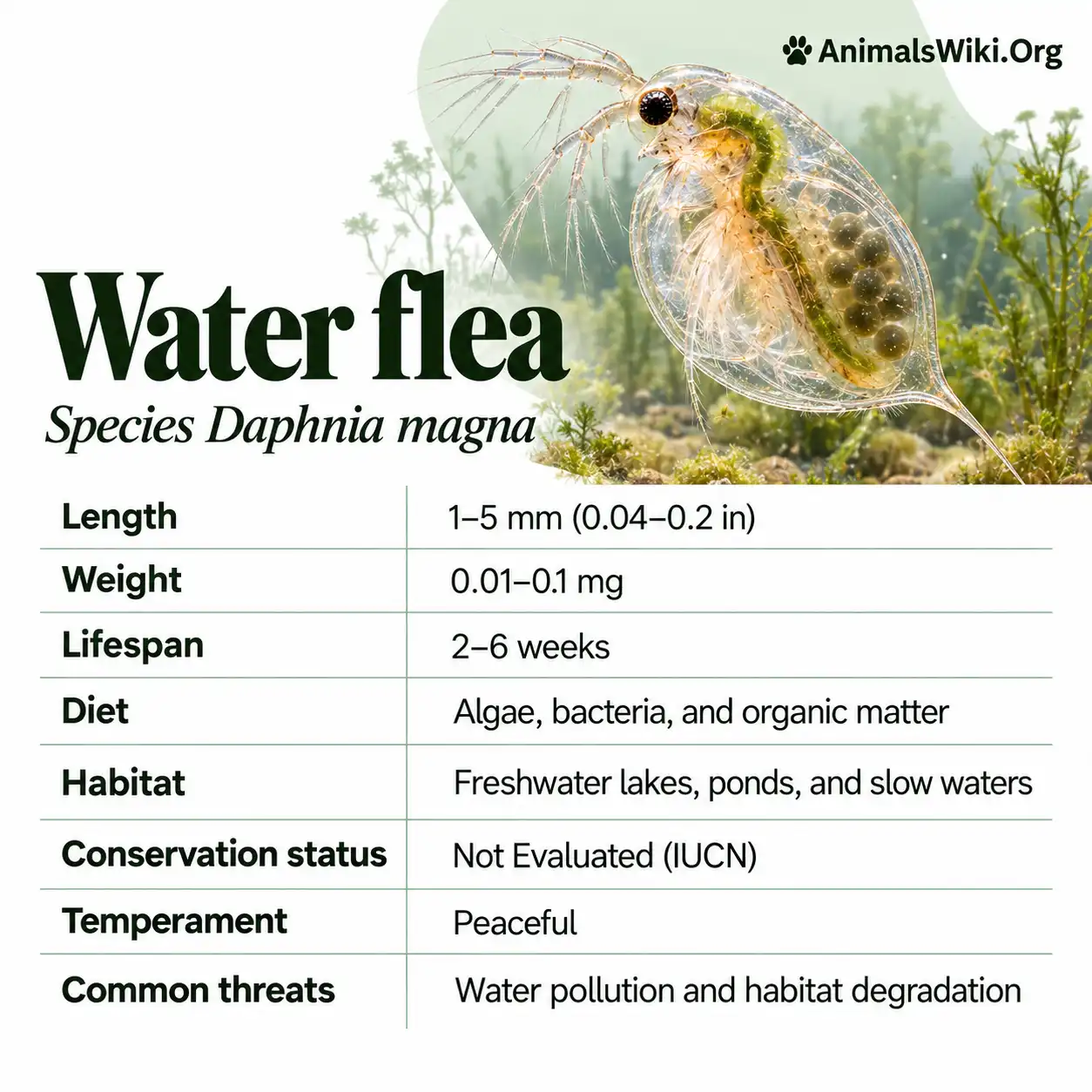
A water flea may look like a drifting speck in a pond, but beneath a microscope it becomes an extraordinary animal. Its swimming antennae beat through the water, its internal organs may be visible through its body covering, and a female may carry developing young in a chamber along her back.
Despite the name, water fleas are not the biting insects found on dogs and cats. They are small aquatic crustaceans. Many belong to a group called Cladocera, and the best-known examples are species of Daphnia.
These animals occupy an important position in aquatic food webs. Many consume microscopic algae and other suspended particles, then become food for fish and larger invertebrates. Their activities connect organisms that capture energy near the base of a food web with animals higher up.
Their biology is equally remarkable. Many Daphnia populations alternate between reproduction without fertilization and sexual reproduction. They can produce resistant resting stages, respond to predator signals, and change their behavior as conditions shift.
However, not every animal called a water flea behaves like Daphnia. Some are predators, and certain species cause ecological problems when introduced beyond their native ranges.
This guide explains what water fleas are, how their bodies work, where they live, what they eat, and why these tiny animals matter to scientists and aquatic ecosystems.
Information checked: October 18, 2026.
Water Flea Facts
| Feature | Information |
|---|---|
| Common name | Water flea |
| Main scientific group associated with the name | Cladocera |
| Familiar genus | Daphnia |
| Animal type | Aquatic crustacean |
| Class | Branchiopoda |
| Typical size | Many familiar forms are millimeter-scale; size varies considerably |
| Main habitat | Ponds, lakes, wetlands, and other aquatic habitats |
| Distribution | Widespread across the world |
| Diet | Suspended particles in many species; other species are predators |
| Movement | Often jerky or hopping, especially in Daphnia |
| Body covering | A carapace surrounds much of the body in Daphnia |
| Reproduction | Often includes parthenogenesis; sexual reproduction also occurs |
| Resistant stage | Resting eggs, commonly protected within an ephippium in Daphnia |
| Predators | Fish and predatory aquatic invertebrates |
| Scientific importance | Ecology, evolution, genetics, physiology, and chemical-effects research |
| Relationship to biting fleas | They are different animals and do not have the same lifestyle |
1. What Is a Water Flea?
A water flea is a small aquatic crustacean, usually a member of Cladocera. The common name covers multiple kinds of animals rather than one species.
Daphnia is the genus most closely associated with the name. Other cladocerans include animals with different body shapes, feeding behaviors, and habitat preferences.
The name “water flea” comes partly from the hopping appearance of their swimming. A Daphnia often moves upward in a short burst, then sinks slightly before the next movement.
This motion may resemble the jumping of a terrestrial flea, but the resemblance is behavioral rather than evidence of a close relationship.
Water fleas are animals, not algae, bacteria, or insect larvae. They have specialized tissues, a digestive system, sensory structures, and appendages.
Many are also zooplankton: animals that live suspended in water and whose larger-scale movement is strongly influenced by water currents.
Being planktonic does not mean being motionless. A water flea can swim actively, adjust its depth, and respond to its surroundings while remaining part of the plankton community.
2. Water Flea Classification
A simplified classification places familiar Daphnia water fleas within the following groups.
| Classification level | Group |
|---|---|
| Kingdom | Animalia |
| Phylum | Arthropoda |
| Class | Branchiopoda |
| Major group | Cladocera |
| Family of Daphnia | Daphniidae |
| Genus | Daphnia |
| Example species | Daphnia magna, Daphnia pulex, and Daphnia galeata |
Scientific classifications can differ in how they assign ranks to the groups between class and family. The important point is the relationship between them, rather than assuming every reference must use identical rank labels.
Cladocerans belong to the wider diversity of crustaceans. They share broad ancestry with larger and more familiar crustaceans, but their small size and distinctive development give them a very different appearance.
A water flea should not be identified to species simply because it resembles a common textbook drawing.
Closely related species can look similar, and hybridization further complicates identification in some Daphnia groups.
Scientists often combine detailed anatomy with genetic evidence when precise identification matters.
3. Different Types of Water Fleas
The common name includes several recognizable examples.
| Example | General characteristics |
|---|---|
| Daphnia magna | A relatively large Daphnia widely used in laboratory research |
| Daphnia pulex | A familiar model for ecology, evolution, and genetics |
| Daphnia galeata | A lake-associated species important in studies of population biology |
| Moina species | Small cladocerans often discussed alongside Daphnia |
| Bosmina species | Small cladocerans with a different outline from familiar Daphnia |
| Spiny water flea | A predatory cladoceran with a conspicuous long tail spine |
These are not interchangeable labels.
A feeding description for Daphnia cannot automatically explain the behavior of a predatory spiny water flea. Likewise, a lifespan measured in one laboratory clone does not establish the lifespan of every cladoceran.
The differences also matter when interpreting environmental information. Finding a native grazing species in a lake is not equivalent to finding an introduced predator.
For general learning, the most useful first step is to separate the broad common name from the particular animal under discussion. Throughout this article, “Daphnia” is used whenever the explanation concerns that genus specifically.
4. Are Water Fleas Related to Fleas on Pets?
Water fleas and the fleas found on pets are different kinds of arthropods.
A dog or cat flea is an insect adapted to a parasitic lifestyle. Daphnia is an aquatic crustacean that obtains food from the water.
The shared word “flea” can therefore be misleading.
Water fleas do not jump onto pets and establish the familiar household flea infestation. Their movement occurs in water, and their anatomy is suited to that environment.
| Feature | Daphnia water flea | Familiar biting flea |
|---|---|---|
| Animal group | Crustacean | Insect |
| Main environment | Aquatic | Associated with terrestrial hosts and their surroundings |
| Typical feeding | Suspended food particles | Blood-feeding in adults |
| Movement | Swimming with antennae | Walking and jumping |
| Household infestation | Not the usual household flea problem | Can infest pets and homes |
This distinction helps explain why a pond containing water fleas does not need to be treated as a source of pet fleas.
The common name describes a resemblance in movement, not the same ecological role. Official aquatic-species guidance also distinguishes water fleas from animals that bite people or pets.
5. How Big Is a Water Flea?
Many familiar water fleas are only a few millimeters long. Smaller forms may be difficult to distinguish without magnification, while larger Daphnia can appear as moving dots to the unaided eye.
Size varies with species, age, sex, food supply, and growing conditions.
The way an animal is measured matters too. Body length may exclude a tail spine, while another measurement includes it.
This is especially important for spiny water fleas, whose long spine contributes substantially to their total length.
An enlarged microscope photograph can create a misleading impression of a large animal. A scale bar provides a more reliable guide than the size of the image on a screen.
Within a population, juveniles and adults may also differ considerably.
A small individual is not necessarily a separate species, and a large female carrying young is not necessarily representative of the average animal.
For an introductory description, “millimeter-scale aquatic crustacean” is more accurate than assigning one fixed length to every water flea.
6. What Does a Daphnia Look Like?
A typical Daphnia has a distinct head and a body enclosed largely within a carapace.
Viewed from the side, its outline may appear rounded or oval, often with a projecting spine toward the rear.
A conspicuous dark compound eye is visible near the front. Large swimming antennae extend from the head.
The body covering is often transparent enough for some internal structures to be observed with suitable magnification and lighting.
This transparency is one reason Daphnia is so familiar in teaching laboratories.
An observer may see the digestive tract, developing offspring, and a beating heart. However, transparency varies with the animal’s condition and the imaging method.
Not every dark patch is an organ, and not every visible structure is easy to identify correctly.
Food in the gut, reproductive material, and changes in pigmentation can alter the appearance.
A useful scientific drawing therefore identifies both the structure and the viewing angle rather than treating a photograph as self-explanatory.
7. Water Flea Anatomy: Small Body, Specialized Parts
Daphnia anatomy demonstrates how much organization can fit into a tiny animal.
Several structures are especially important.
| Structure | Main role |
|---|---|
| Carapace | Encloses and protects much of the body |
| Second antennae | Provide swimming propulsion |
| First antennae | Associated with sensory functions |
| Compound eye | Receives visual information |
| Thoracic appendages | Generate feeding currents and handle food |
| Digestive tract | Processes ingested material |
| Brood chamber | Holds developing offspring during direct reproduction |
| Heart | Circulates body fluid |
These parts work together rather than acting independently.
Swimming changes where the animal encounters food. Feeding currents affect particle capture. Reproduction depends on obtaining enough usable resources.
The arrangement also differs from that of an insect. The carapace is not a set of wings, and the antennae used in swimming are not legs.
Their external covering must be replaced during growth through molting.
Understanding these structures makes observations more meaningful. Instead of seeing a transparent speck, the observer begins to recognize an animal continuously coordinating movement, feeding, circulation, and development.
8. How Does a Water Flea Swim?
Daphnia swim mainly through movements of their enlarged second antennae.
A strong stroke produces a short movement through the water. Between strokes, the animal tends to sink.
Repeated strokes create the familiar hopping pattern associated with the common name.
The animal is not jumping off a solid surface. It is pushing against water with specialized appendages.
At such a small scale, water movement and body shape strongly influence motion. Human intuition about swimming does not always describe what happens to a millimeter-sized crustacean.
The thoracic appendages beneath the carapace are especially important in feeding, while the large antennae provide the most recognizable swimming action.
Swimming can change with environmental conditions. Food patches, light, predators, and water temperature may influence where the animal moves.
A brief microscope observation shows only one moment in that behavioral range.
An individual confined beneath a coverslip, for example, is not experiencing the same space or water conditions as one moving freely in a lake.
9. Where Do Water Fleas Live?
Daphnia occur widely in standing waters, from small temporary pools to large lakes. Some inhabit fresh water, while certain species tolerate brackish conditions.
The broader cladoceran group also contains animals outside this familiar freshwater setting.
Habitat differences matter because a pond and a deep lake offer different opportunities and risks.
A pond may change rapidly in temperature and water level. A lake may contain distinct depth zones with different light, food, and oxygen conditions.
Some cladocerans live close to vegetation or surfaces, while others occupy open water.
Finding “water fleas” in two habitats does not establish that the same species is present in both.
Their broad distribution reflects a diversity of lineages and ecological requirements.
A species that thrives in one water body may fail in another because of unsuitable chemistry, predators, food, or seasonal conditions.
The most informative habitat description therefore identifies both the species and the kind of aquatic environment involved.
10. What Do Water Fleas Eat?
Many familiar Daphnia are suspension feeders, often called filter feeders.
They collect small particles suspended in water rather than hunting large prey.
Their thoracic appendages generate a current. Specialized structures collect particles and transfer suitable material toward the mouth.
Planktonic algae are important food, but Daphnia can also encounter bacteria and other suspended organic material.
Feeding is not identical to passing water through an inert filter. The animal’s size, appendages, particle characteristics, and physiological state influence what is collected and used.
Some material may be difficult to handle or nutritionally poor.
The quantity of food in the water is therefore only one part of the story.
The broader common name also requires caution: predatory water fleas consume other zooplankton rather than following the same feeding pattern as Daphnia.
A statement that “all water fleas eat algae” would be incorrect.
The accurate description is that many familiar forms graze suspended particles, while other cladocerans occupy different feeding roles.
11. Why Food Quality Matters as Much as Food Quantity
A green pond may appear to contain abundant food, but not every suspended organism provides the same nutrition.
Daphnia need appropriate resources for growth, maintenance, and reproduction.
The nutritional value of algae depends partly on their chemical composition, which changes with growing conditions.
Experiments have shown that phosphorus-limited algae can support poorer Daphnia growth than more suitable food.
This is an example of ecological stoichiometry: the importance of balancing elements such as carbon, nitrogen, and phosphorus in living systems.
An animal can encounter plenty of particles while remaining limited by a resource those particles fail to provide.
The same general principle applies to biochemical composition. Food must provide usable material, not merely occupy space in the digestive tract.
This helps explain why a culture can perform poorly even when the water looks richly colored.
It also explains why changes at the base of a food web can affect consumers without an obvious disappearance of all food.
Food quality is a biological property, not something reliably judged by water color alone.
12. Do Water Fleas Make Water Clearer?
Daphnia grazing can reduce the abundance of suspended algae.
When grazing pressure becomes strong, a lake may experience a clear-water phase, during which the water becomes noticeably more transparent.
However, this is an ecological outcome involving the whole community, not a guaranteed service performed by any number of Daphnia.
Algal growth, nutrient inputs, fish predation, grazer abundance, and the kinds of algae present all influence the result.
Some algal forms are less vulnerable to grazing than others.
Research has also shown that responses among cyanobacteria differ, so grazer-based lake management cannot be assumed to control every bloom.
Adding water fleas to a nutrient-rich water body is therefore not equivalent to solving its water-quality problems.
A lake may continue receiving resources that support rapid algal growth, or fish may prevent large grazers from becoming abundant.
The accurate conclusion is that Daphnia can strongly influence water clarity within a functioning food web.
They should not be described as universal living water purifiers.
13. What Eats Water Fleas?
Daphnia are food for many fish and predatory aquatic invertebrates.
This makes them an important connection between microscopic food resources and larger animals.
A fish that cannot efficiently collect individual algal cells may obtain energy by eating animals that have already consumed those cells.
Predation also shapes which Daphnia survive.
A conspicuous large individual may be vulnerable to a visual predator, while another predator may be limited by its ability to capture or handle a particular body shape.
Young and adult water fleas do not necessarily face identical risks.
The predator community can therefore influence body size, behavior, reproduction, and the abundance of different species.
Water fleas are not merely passive units of fish food. Their responses change the conditions experienced by predators and other grazers.
This creates feedback within the food web.
If fish reduce large grazers, algae may experience less grazing. If a predatory invertebrate removes particular prey, competing zooplankton may benefit.
The consequences extend beyond the immediate act of one animal eating another.
14. How Water Fleas Detect Predators
An animal does not need to see a predator directly to receive information about danger.
Daphnia can respond to chemical signals associated with predators.
Such chemicals are often called kairomones when their detection benefits the receiving organism.
Researchers have identified a fish bile compound capable of inducing vertical-migration behavior in Daphnia.
This is more informative than simply saying the animal “smells fear.”
The signal has a chemical identity, occurs at measurable concentrations, and influences a particular response.
Different predators may provide different information, and not every Daphnia genotype responds identically.
The response also depends on context. Avoiding danger can conflict with feeding or remaining in a favorable temperature zone.
Detecting a cue does not guarantee perfect protection.
Instead, the animal adjusts its behavior or development in ways that can change the probability of survival.
This chemical communication is one reason a lake contains much more biological information than a human observer can see.
15. Helmets, Neck Teeth, and Defensive Body Shapes
Some Daphnia develop protective changes in response to predator-related cues.
Depending on the species, these can include neck teeth, crests, longer spines, or changes in body shape.
The structures are not universal, and they are not interchangeable defenses against every predator.
Their effectiveness depends partly on how a predator captures and handles prey.
A shape that makes an animal harder for one predator to swallow may provide less protection against another.
Research has also identified changes in the structure and mechanical properties of the carapace, beyond the obvious outline visible in photographs.
These responses illustrate phenotypic plasticity: the ability of a genotype to produce different characteristics under different conditions.
Plasticity is not the same as an individual instantly redesigning itself through conscious choice.
Developmental timing and previous exposure can matter.
Nor does a dramatic defensive photograph represent the normal appearance of every member of the species.
The valuable lesson is that water flea anatomy can be responsive rather than permanently fixed in one form.
16. Why Do Water Fleas Move Up and Down Each Day?
Many Daphnia populations show diel vertical migration.
“Diel” means occurring over a daily cycle. In a familiar pattern, animals occupy deeper water during daylight and move upward at night.
Moving into darker water can reduce exposure to visually hunting fish.
However, depth also affects temperature and food conditions. Avoiding predators may therefore involve costs.
Experiments have shown that migration into cooler layers can reduce growth and reproduction under the tested conditions.
This is a biological trade-off: an action that improves one aspect of survival may reduce another component of performance.
The pattern is not identical in every lake or species. Food distribution, ultraviolet radiation, oxygen conditions, and predator behavior can modify it.
Some situations even produce a different migration pattern.
A diagram showing all water fleas rising and sinking together should therefore be understood as a simplified model.
The real behavior reflects changing risks and opportunities within the water column.
17. The Daphnia Life Cycle
A typical Daphnia life cycle includes development, repeated growth, reproduction, and sometimes a resistant resting stage.
| Stage | Main events |
|---|---|
| Embryonic development | Offspring develop within eggs |
| Release of young | Directly developing young leave the brood chamber |
| Juvenile growth | Successive molts allow development toward maturity |
| Adult reproduction | Females produce repeated broods under suitable conditions |
| Sexual phase in many populations | Males and sexually reproducing females occur |
| Resting stage | Resistant eggs persist until suitable hatching conditions return |
The cycle differs from an insect’s complete metamorphosis.
Daphnia do not develop into a flying adult after a pupal stage. The released young already resemble the general adult body plan.
The timetable varies with species and environmental conditions.
Temperature, food, and genotype affect how quickly animals grow and begin reproducing.
A textbook diagram is useful for showing the sequence, but its arrows do not represent a fixed number of days.
The main ecological strength of the life cycle is flexibility: rapid population growth can be combined with stages that persist when conditions deteriorate.
18. How Can Water Fleas Reproduce Without Males?
Many Daphnia reproduce through parthenogenesis, in which offspring develop from unfertilized eggs.
Under suitable conditions, females can produce broods without mating.
This permits rapid population increase because an individual does not need to find a partner for each brood.
The offspring are commonly described as clones, although mutation and other sources of biological variation mean “absolutely identical in every possible respect” would be too strong.
Clonal reproduction is especially useful in research. Scientists can compare individuals with closely matched genetic backgrounds under different environments.
A difference between treatments is then easier to interpret than it would be if every animal had an unrelated genotype.
However, reproductive mode varies among lineages.
Some Daphnia alternate between clonal and sexual reproduction, while others have different reproductive patterns.
The term “water flea” alone is not enough to predict the complete process.
The key point is that reproduction without males is a normal part of the biology of many Daphnia, rather than an exceptional event requiring a laboratory.
19. Why Do Some Daphnia Switch to Sexual Reproduction?
Many Daphnia have a life cycle called cyclical parthenogenesis.
Periods of clonal reproduction alternate with sexual reproduction, often associated with producing resistant resting eggs.
Environmental information can influence this transition.
Reported cues include crowding, food limitation, changes in temperature or day length, and other signals. Their importance depends on the population and habitat.
Research on Daphnia galeata, for example, has shown that crowding signals can influence allocation toward future reproduction.
This should not be reduced to a rule that “winter always creates males.”
Different climates, habitats, and lineages do not follow an identical calendar.
Sexual reproduction also changes genetic combinations, while resting stages extend persistence through time.
The transition therefore involves both reproductive genetics and ecological survival.
It is a mistake to describe males as simply appearing because females have become old.
The process is regulated and environmentally responsive, with variation that remains an active subject of research.
20. What Is an Ephippium?
An ephippium is a protective structure associated with resting eggs in Daphnia.
The word is often explained through its saddle-like appearance.
An ephippium is not the same as the brood chamber holding directly developing young.
The brood chamber supports the current brood while the female remains active. The ephippium is released and can become part of a longer-lasting resting-stage reserve.
In a familiar Daphnia pattern, it contains a small number of resting eggs, often two. That number should not be generalized to every cladoceran.
The protective case can sink into sediment or be transported under appropriate circumstances.
Its resistant contents can bridge periods when an active population would struggle to persist.
Calling it a “winter egg” is sometimes convenient but incomplete. Resting stages can also be relevant to drying, food shortages, and other unfavorable conditions.
The broader biological function is to preserve future reproductive potential when immediate growth is a poor option.
21. Resting Eggs and Aquatic Egg Banks
Resting eggs can accumulate in lake or pond sediment, forming an egg bank.
The concept resembles a seed bank in soil. The visible population is supported by a hidden reserve of future individuals.
Some eggs remain viable for decades, and particular studies have documented persistence beyond a century.
These are documented capabilities under particular circumstances, not guarantees that every egg survives equally long.
Burial, temperature, oxygen conditions, physical damage, and other factors affect preservation and viability.
An unhatched egg may be dormant, damaged, or dead. Appearance alone may not establish which.
Egg banks matter because a population can persist even when few active animals are visible.
They also preserve biological history. Sediment layers can contain resting stages produced under earlier environmental conditions.
This makes a pond bottom more than discarded mud.
It can hold both the future of a population and evidence of how that population changed through time.
22. Growth and Molting
Daphnia grow through repeated molts.
Their external covering provides structure and protection, but it must be replaced as the animal increases in size.
A shed covering may remain briefly visible in a culture.
Growth, reproduction, and molting are closely coordinated, so a change affecting one process can influence the others.
A juvenile must obtain enough usable food to develop. An adult divides resources among maintenance, growth, and reproduction.
More food does not automatically produce unlimited growth.
Food quality, temperature, water chemistry, and genetic background affect how resources are used.
The body also changes with developmental stage. A juvenile and an egg-bearing adult differ in more than overall scale.
These differences matter in experiments.
A chemical test using newly released young is not directly equivalent to an observation made on older females.
Good studies control age and developmental stage so that the comparison measures the intended factor rather than an unnoticed difference in the animals themselves.
23. How Long Does a Water Flea Live?
There is no single lifespan for all water fleas.
Even within Daphnia magna, survival differs among genetic lines and temperatures.
Many general accounts describe lives lasting weeks or months, but particular laboratory conditions can produce substantially longer survival.
A recent study following complete Daphnia life histories found wide variation across tested clones and temperatures.
This demonstrates why one lifespan number should not be presented as a biological constant.
It also shows why lifespan alone is not a complete measure of performance.
An animal may live longer while reproducing slowly, whereas another may reproduce earlier under different conditions.
Researchers distinguish survival, reproductive output, developmental rate, and population growth because those measures answer different questions.
The lifespan of an active animal must also be separated from the persistence of a dormant egg.
A resting stage that survives for decades does not mean an adult has been swimming for decades.
24. Why Are Some Water Fleas Red?
Some Daphnia become reddish because of increased hemoglobin.
Hemoglobin is an oxygen-binding protein. Its presence can help explain how particular Daphnia cope with low-oxygen environments.
Research has connected hemoglobin production with environmental oxygen conditions and investigated its physiological benefits.
However, redness is not a simple color chart that reveals every detail of water quality.
Species, individual condition, developmental stage, and other factors can affect appearance.
A red animal is not automatically diseased, and a pale animal is not proof that the water is ideal.
The important distinction is between an observed color and a measured physiological explanation.
Scientists assess oxygen, hemoglobin, and performance rather than relying only on a photograph.
Low-oxygen tolerance also has limits. Producing more hemoglobin does not allow an active water flea to live indefinitely without oxygen.
The adaptation improves performance under particular conditions; it does not remove the animal’s need for respiration.
25. Why Water Flea Numbers Rise and Fall
Water flea populations can change rapidly.
A period of abundant suitable food and favorable temperature may support repeated reproduction. Predation, food depletion, infection, or environmental change can then reduce numbers.
These processes often interact.
For example, a change in algal composition can affect food quality even if the water still looks green. Increased fish activity can remove grazers that would otherwise become abundant.
Population decline does not always mean that one pollutant has entered the water.
Likewise, a rapid increase does not prove that the ecosystem is free from stress.
Ecologists examine several measurements together: species composition, body size, reproductive condition, food, predators, and water chemistry.
The timing of observation is equally important.
A sample collected during a seasonal peak can look very different from one collected several weeks later.
Understanding this variation prevents a single pond-water sample from being treated as a complete diagnosis of ecosystem health.
26. Water Fleas in Environmental Testing
Daphnia are widely used to investigate chemical effects on aquatic animals.
Standardized methods help laboratories compare results obtained under controlled conditions.
One established approach measures short-term immobilization after exposure. Another follows reproductive output over a longer period.
The OECD acute immobilization guideline uses a 48-hour exposure framework. Its Daphnia reproduction guideline uses a 21-day framework.
These tests answer different questions.
An animal may remain alive yet produce fewer offspring. Conversely, a short-term response does not by itself describe every long-term population effect.
Control groups and measurements of water conditions are essential.
Without them, poor performance might result from unsuitable oxygen, temperature, or feeding rather than the tested substance.
Daphnia are valuable test organisms because their biology is well studied and their responses can be measured.
However, no single species represents every aquatic organism.
A result contributes to environmental assessment; it does not replace understanding the full diversity of an ecosystem.
27. Genetics and the Water Flea Genome
Daphnia are important in genetics as well as ecology.
The publication of the Daphnia pulex genome provided a major resource for investigating how genes relate to environmental responses.
The original genome study described extensive gene duplication and examined how gene expression changed under different ecological conditions.
A genome is not simply a list ranking animals by complexity.
Having more predicted genes than another species does not mean an organism is more intelligent or more evolutionarily advanced.
Gene counts also depend on assembly quality and annotation methods, which improve over time.
The scientific value lies in asking specific questions.
Which genes respond to environmental challenges? How do duplicated genes acquire different functions? How does genetic variation influence survival or reproduction?
Daphnia are especially useful because molecular tools can be combined with controlled ecological experiments.
Researchers can connect changes in genes or expression with measurable traits in a small, reproducing aquatic animal.
That connection helps link molecular biology to the conditions experienced in nature.
28. Resurrection Ecology: Learning From Dormant Eggs
Resurrection ecology investigates organisms revived from resting stages preserved in the environment.
For Daphnia, researchers can recover dormant eggs from sediment, hatch viable examples, and establish cultures.
If sediment layers can be dated appropriately, the resulting animals may represent populations from different periods.
Scientists can then compare older and more recent lineages under matched conditions.
This approach helps distinguish inherited differences from the immediate effects of the environment.
For example, populations associated with different historical conditions can be tested under the same temperature or food treatment.
The word “resurrection” does not mean returning a dead animal to life.
The eggs were alive but dormant. The method restarts development in viable resting stages.
Nor can every old sediment sample produce living Daphnia.
Preservation, age, species, and hatching requirements constrain success.
The method is powerful because it gives evolutionary research an unusual opportunity: living material from the biological past can sometimes be compared directly with present-day populations.
29. Parasites and Disease in Water Fleas
Water fleas host parasites, and Daphnia systems are widely used to study infection.
A suspension-feeding animal can encounter infectious material while collecting food.
Research involving Daphnia, the bacterium Pasteuria, and the yeast Metschnikowia has examined how infection affects survival and reproduction.
Different parasites produce different consequences.
Some strongly reduce reproductive output, while others have a larger effect on survival.
The result also depends on the host’s genetic background, environmental conditions, and the particular parasite involved.
This makes Daphnia useful for studying how hosts and parasites evolve together.
It would be inaccurate to treat every cloudy, reddish, or unusually shaped animal as infected without examination.
It would also be inaccurate to assume that a parasite studied in Daphnia automatically poses the same risk to humans.
The ecological question concerns how infection changes host populations and food webs.
A reduction in grazing caused by disease, for example, can have effects extending beyond the infected animal itself.
30. Microplastics and Other Suspended Particles
Because Daphnia collect suspended particles, scientists investigate their interactions with microplastics and nanoplastics.
Laboratory experiments have shown that Daphnia can ingest particular plastic particles.
However, ingestion and harm are not identical measurements.
The effects depend on particle size, concentration, food availability, exposure duration, and the endpoint being studied.
One study found reduced feeding under a particular nanoplastic treatment without detecting a reproductive effect in its exposure design.
Other experiments have reported adverse effects under different conditions.
These results should be interpreted together rather than converted into a claim that every plastic particle produces the same outcome.
A laboratory concentration may also differ from conditions in a particular lake.
Careful research separates what the animal encountered, what entered its body, what was retained, and what changed biologically.
The broader relevance is clear: an animal that gathers microscopic food can also encounter nonfood particles.
Understanding that interaction requires measured evidence rather than assuming that transparent water contains no particulate pollution.
31. What Is a Spiny Water Flea?
The spiny water flea, Bythotrephes longimanus, is a predatory cladoceran.
Its appearance and feeding behavior differ from the familiar rounded Daphnia.
It has a conspicuous eye and a long tail spine. The spine contributes to its recognizable outline and can make it difficult for some small fish to consume.
Rather than grazing algae in the same way as Daphnia, it feeds on other zooplankton.
It is native to parts of Europe and Asia but has become established in waters beyond its native range, including North American lakes.
This is why the phrase “water flea” can appear in both educational biology material and invasive-species warnings.
Those discussions concern different ecological circumstances.
A native Daphnia population should not be treated as an invasive threat simply because another cladoceran causes problems elsewhere.
The species identity, location, and history of introduction determine the relevant concern.
32. Why Invasive Water Fleas Matter
An introduced predator can alter the community it enters.
Spiny water fleas can reduce native zooplankton, including Daphnia. That can affect food available to fish and change grazing pressure on algae.
The consequences depend on the lake, but the mechanism shows how a small animal can influence several food-web connections.
Their spines can also accumulate on fishing equipment, creating practical problems for anglers.
Prevention therefore involves more than looking for a visible adult animal.
Water, attached material, and resistant stages can contribute to movement between water bodies.
Responsible practice includes inspecting equipment, removing attached organisms and debris, draining retained water, and following local cleaning and drying guidance.
Specific requirements vary by location.
The biological principle is consistent: moving untreated aquatic material can move organisms that are difficult to detect.
A tiny species does not need to be visually impressive to create a substantial ecological change after introduction.
33. Observing Water Fleas Responsibly
Water fleas can be fascinating subjects for observation because their movement and some internal processes are visible under magnification.
A shallow observation chamber with enough space for movement gives a more informative view than crushing an animal beneath a coverslip.
Useful observations include swimming strokes, feeding movements, the digestive tract, and developing young.
The beating heart can also be visible in suitable Daphnia specimens.
However, observation conditions influence behavior. Bright illumination can warm a sample, confinement changes movement, and prolonged handling can stress the animal.
Recording the viewing conditions makes the observations more useful.
A photograph should include a scale when possible, especially if it will be used in an educational article.
Species identification should remain cautious unless diagnostic features are clear.
Cultured organisms should not be released into natural water bodies. Likewise, water, sediment, plants, and animals should not be casually transferred between ponds.
The goal is to learn from the animal without changing the ecological community from which it came.
34. Common Water Flea Misconceptions
| Misconception | More accurate explanation |
|---|---|
| Water fleas are biting insects. | Familiar water fleas are aquatic crustaceans. |
| Every water flea is Daphnia. | The common name includes several cladoceran groups. |
| All water fleas eat algae. | Some are predators that eat other zooplankton. |
| They cannot swim because they are plankton. | They swim actively while remaining influenced by water movement. |
| All Daphnia reproduce only by cloning. | Many alternate between clonal and sexual reproduction. |
| Every dormant egg hatches immediately when wet. | Hatching depends on the resting stage and environmental cues. |
| A clear pond must be healthy. | Clarity alone does not establish biological or chemical quality. |
| Red Daphnia are always diseased. | Increased hemoglobin can contribute to red coloration. |
| Water fleas remove every kind of pollution. | Grazing particles is not equivalent to complete water treatment. |
| All species are invasive. | Invasive status depends on species, location, and introduction history. |
These distinctions make the group easier to understand. Water fleas are important because of their varied, measurable biology, not because one simple label explains every species.
35. Frequently Asked Questions About Water Fleas
1. What is a water flea in simple words?
A water flea is a small aquatic crustacean, usually a cladoceran. Daphnia is the most familiar example. Many swim with a jerky, hopping movement and feed on microscopic material suspended in water. Others, including spiny water fleas, have different body shapes and predatory feeding habits.
2. Is a water flea an insect?
No. Familiar water fleas belong to crustacean groups rather than insects. Both are arthropods, but their anatomy and evolutionary relationships differ. Daphnia do not have an insect’s typical adult organization, and they do not emerge from water as winged adults.
3. Can water fleas bite people?
The familiar cladocerans discussed here are not the biting fleas associated with pets and homes. They do not establish that kind of infestation on people. A name containing “flea” should not be used to infer blood-feeding behavior or the ability to live on a terrestrial host.
4. Can you see water fleas without a microscope?
Larger individuals may be visible as tiny moving dots. Magnification is generally needed to see their anatomy clearly or make a reliable identification. Being visible does not mean a species can be recognized accurately with the unaided eye, especially among similar-looking forms.
5. Why do they move as though they are jumping?
Daphnia use enlarged swimming antennae to produce short movements through the water. They tend to sink between strokes, creating a hopping appearance. They are not jumping off the pond bottom in the same way that a terrestrial flea pushes away from a surface.
6. What do Daphnia eat?
Daphnia collect small suspended particles. Planktonic algae are important food, but bacteria and other organic material can also contribute. Nutritional quality matters as well as particle abundance. A water sample containing many particles may still provide poor food for growth or reproduction.
7. Do water fleas eat other animals?
Some do. Predatory cladocerans, including spiny water fleas, consume other zooplankton. This differs from the familiar suspension-feeding pattern of Daphnia. It is therefore more accurate to ask about the feeding behavior of a particular species than assign one diet to every water flea.
8. How do water fleas reproduce so quickly?
Many Daphnia females can produce repeated broods through parthenogenesis when conditions are suitable. They do not need to mate before every brood. Population growth still depends on food, temperature, survival, and other conditions; clonal reproduction does not guarantee continuous increase.
9. Are all water fleas female?
No. Many Daphnia populations contain mostly females during periods of clonal reproduction, but males occur in the sexual phase of many life cycles. Reproductive patterns vary among lineages. A sample containing only females does not establish that males never occur in that population.
10. What are water flea resting eggs?
Resting eggs are developmental stages capable of delaying further development through unfavorable conditions. In Daphnia, they are commonly protected within an ephippium. They differ from directly developing offspring carried in the brood chamber and can contribute to a long-lasting reserve in sediment.
11. Can water flea eggs survive drying?
Some resting stages tolerate drying, but resistance varies with species and conditions. This does not mean active adults can survive the same exposure. An animal’s dormant stage and its swimming stage have different physiological properties and should not be treated as interchangeable.
12. How long do water flea eggs remain alive?
Some remain viable for decades, and particular studies document longer persistence. The outcome depends on preservation conditions and the organism involved. It would be inaccurate to guarantee that every egg in a pond remains capable of hatching for the same length of time.
13. Why are Daphnia transparent?
Their relatively transparent tissues and body covering allow light to pass through much of the animal. This makes some internal structures visible under suitable conditions. Transparency is not absolute, and food, pigments, reproductive material, and imaging conditions can alter the appearance.
14. Do water fleas have a heart?
Daphnia have a heart that circulates body fluid. It can be visible in a living specimen under appropriate magnification. Heart rate is influenced by experimental conditions, so an observation should be interpreted alongside temperature, handling, and the animal’s condition rather than treated as a fixed value.
15. Why are some water fleas bright red?
In some Daphnia, increased hemoglobin contributes to a reddish appearance and is associated with responses to low oxygen. Color alone is not a complete diagnosis. Researchers measure environmental conditions and physiology rather than assuming that every red individual has the same history.
16. Can water fleas clean a pond?
Daphnia grazing can reduce suspended algae and influence clarity. However, they do not provide complete treatment for polluted water, and they cannot reliably control every bloom. Nutrients, predators, algal composition, and habitat conditions determine whether strong grazing effects develop.
17. Why do water fleas disappear from a pond?
Predation, food changes, seasonal temperature, infection, drying, or unsuitable water conditions can reduce the active population. Some lineages may persist through resting eggs. A disappearance of visible adults does not identify the cause by itself or prove that every resting stage has been lost.
18. Are water fleas good food for fish?
Many fish consume Daphnia and other zooplankton. However, nutritional value, prey size, and suitability vary. Predatory spiny water fleas are a different case because their long spines can make them difficult for some small fish to handle. Species identity remains important.
19. Why do scientists use Daphnia in experiments?
Their short generations, clonal reproduction, manageable size, and well-studied biology allow controlled comparisons. Researchers use them to investigate environmental effects, evolution, disease, genetics, and physiology. Their usefulness does not mean they represent every aquatic organism equally well.
20. What is the difference between Daphnia and a spiny water flea?
Daphnia commonly graze suspended particles and have the familiar rounded body enclosed by a carapace. The spiny water flea is a predatory cladoceran with a prominent tail spine. Both fall under the broad common name, but their ecological roles differ considerably.
21. Are all water fleas invasive?
No. Many are native components of their local aquatic communities. A species becomes an invasive concern in a particular context involving introduction and ecological effects. The presence of native Daphnia should not be confused with an invasion by a different cladoceran.
22. Why should water fleas matter to someone who never sees them?
They help connect microscopic food resources with fish and other animals. Their grazing can influence algae, their resting eggs preserve populations through time, and their responses help scientists understand environmental change. Small size makes them easy to overlook, but it does not make their ecological role small.