Uaru Cichlid Facts
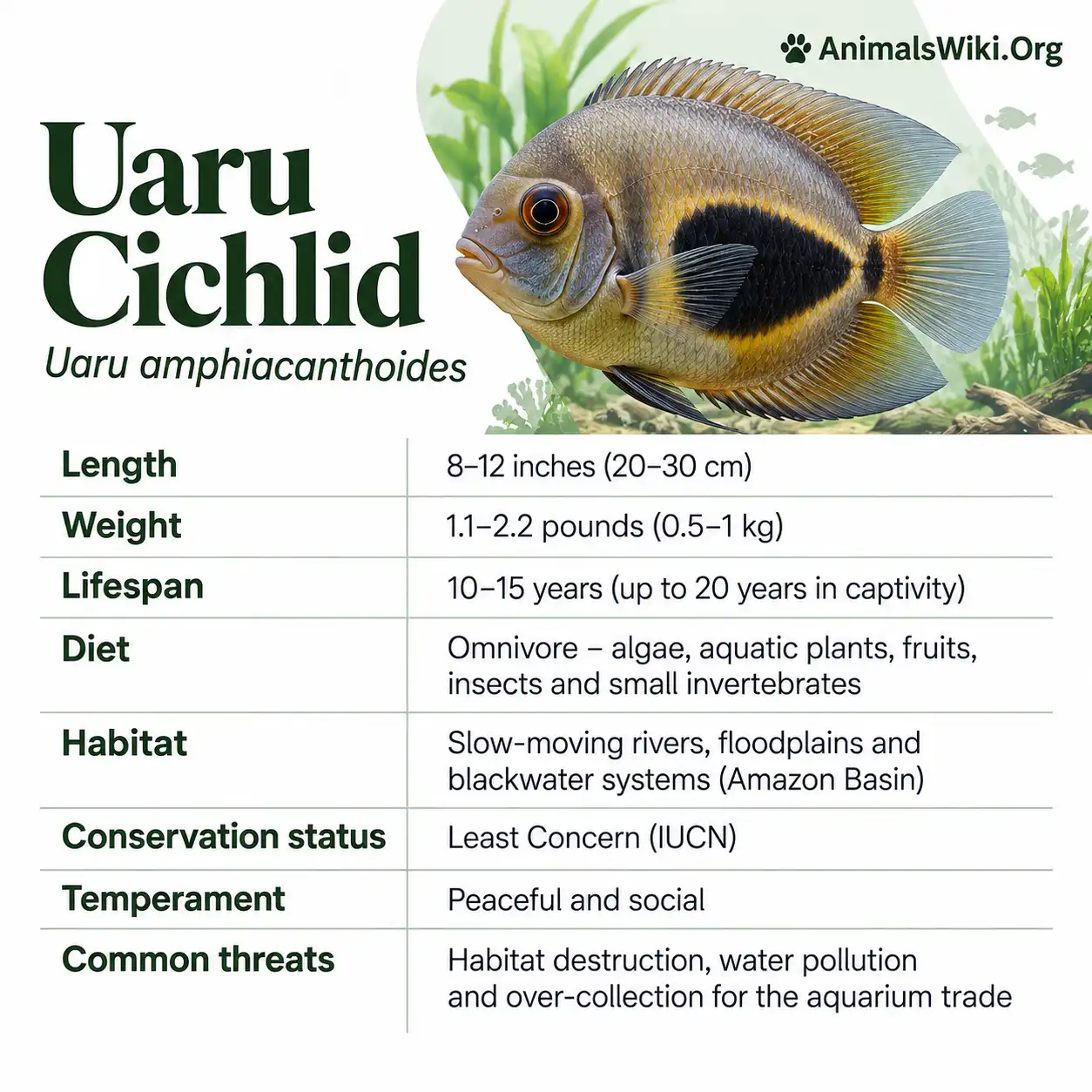
| Feature | Details |
|---|---|
| Common Name | Uaru Cichlid (also: Triangle Cichlid, Waroo, Uaru) |
| Scientific Name | Uaru amphiacanthoides |
| Family | Cichlidae |
| Genus | Uaru |
| First Described | 1840 (by Johann Jakob Heckel) |
| Native Habitat | Blackwater rivers, flooded forests, slow-moving streams of the Amazon Basin |
| Geographic Range | Brazil, Venezuela, Guyana — Amazon and Negro River systems |
| Size | 25–30 cm (10–12 inches) in length |
| Weight | 300–600 grams (estimated) |
| Lifespan | 8–10 years (wild); up to 15 years (captivity) |
| Diet | Omnivore — plant matter, fruits, algae, small invertebrates, detritus |
| Conservation Status | Least Concern (IUCN) |
| Water Type | Soft, acidic blackwater; pH 4.5–6.5 |
| Defining Feature | Distinctive triangular body shape; teardrop marking; exceptional parental care |
1. Uaru Cichlid Species Overview & Classification
In the dim, tannin-stained waters of the Amazon Basin — where the rivers run the color of strong tea and the flooded forests shimmer with life — swims a fish that manages to be simultaneously beautiful, intelligent, devoted, and surprisingly gentle for its size. Meet the Uaru Cichlid (Uaru amphiacanthoides): one of South America’s most fascinating freshwater fish and one of the aquarium hobby’s most rewarding yet underappreciated treasures.
Known variously as the Triangle Cichlid (for its distinctively angular body shape), the Waroo (its indigenous Amazonian name, from which the scientific genus name is derived), and simply “the Uaru” among dedicated cichlid enthusiasts, this fish occupies a special place in both the ecology of the Amazon and the hearts of the aquarists who keep it.
The Uaru Cichlid is not a fish that announces itself with neon colors or dramatic fin extensions. Instead, it earns admiration through a combination of its quietly stunning appearance, its remarkable parental dedication — including the extraordinary behavior of feeding its own fry with mucus secreted from its skin — and a personality and intelligence that cichlid enthusiasts consistently rate among the highest of any freshwater fish.
This is a fish that recognizes its keeper, responds to its name being called, and will beg for food at the glass like a dog at the dinner table. It is, in many ways, more like a pet than a fish — and that is part of what makes the Uaru Cichlid so special.
Species Classification Table
| Classification Level | Details |
|---|---|
| Kingdom | Animalia |
| Phylum | Chordata |
| Class | Actinopterygii (Ray-finned fishes) |
| Order | Cichliformes |
| Family | Cichlidae |
| Subfamily | Heroini |
| Genus | Uaru |
| Species | Uaru amphiacanthoides |
| Second Species | Uaru fernandezyepezi (Papuan Cichlid / Atabapo Uaru) |
| Described By | Johann Jakob Heckel, 1840 |
The genus Uaru contains only two known species: the widely recognized U. amphiacanthoides and the much rarer Uaru fernandezyepezi, discovered from the Atabapo River of Venezuela and described in 1989 by Géry and Stawikowski. When enthusiasts refer to “the Uaru Cichlid” without qualification, they almost always mean U. amphiacanthoides — the focus of this article.
The Cichlidae family is one of the largest and most diverse vertebrate families on Earth, containing over 3,000 described species across Africa, South America, Central America, and parts of Asia. Within this spectacular family, the Uaru Cichlid belongs to the Heroini tribe — a group of neotropical cichlids that includes iconic species like the Discus (Symphysodon spp.) and the Green Terror (Andinoacara rivulatus).
2. Uaru Cichlid Physical Description & Unique Features
The Uaru Cichlid is a fish of geometric distinction — its body shape alone is enough to set it apart from virtually every other cichlid in the Amazon. But look closer, and you discover a fish of remarkable detail and subtle beauty.
Body Shape — The Triangle
The defining physical characteristic of the Uaru Cichlid is its strongly compressed, triangular to ovoid body shape. Unlike the rounded profile of a discus or the elongated form of many other cichlids, the Uaru has a body that rises sharply from the snout to a high dorsal profile, creating a distinctly triangular or wedge-shaped silhouette when viewed from the side. This profile gives rise to the common name “Triangle Cichlid” and makes the fish immediately recognizable even in a tank of mixed species.
Adults reach 25 to 30 centimeters (10 to 12 inches) in total length under good conditions, making them a large cichlid by any standard. Wild specimens may occasionally reach slightly larger sizes in optimal river conditions. The body is laterally compressed — flattened from side to side — giving it the broad, disc-like appearance shared by many of its Amazon relatives.
Coloration — Subtle Mastery
The Uaru Cichlid’s coloration undergoes a dramatic transformation from juvenile to adult — one of the most striking developmental color changes of any cichlid species.
Juvenile coloration: Young Uarus are some of the most spectacularly patterned juvenile cichlids in the hobby. They are covered in an intricate pattern of white or pale blue spots on a dark brown to black base — a high-contrast, eye-catching pattern that is sometimes compared to a “dalmatian” or “starry night” appearance. These spots gradually fade and reorganize as the fish matures.
Adult coloration: Adults are predominantly warm brown to olive-brown, often with an iridescent golden or greenish sheen across the flanks in good lighting. The body may show subtle dark reticulations (net-like patterns) and a generally bronzed, earthy beauty that rewards careful observation. The colors intensify dramatically during breeding condition and periods of stress or excitement.
The Teardrop Marking
The Uaru’s most distinctive and consistent marking is a large, dark teardrop- or comma-shaped blotch located on the mid-flank, just below the lateral line. This marking is present throughout the fish’s life — though its size, intensity, and exact shape vary between individuals. In some specimens, it is a bold, solid black mark; in others, it is more diffuse and bordered. This teardrop is the fish’s trademark and the first thing experienced aquarists look for when identifying the species.
Fins
The dorsal fin is long and continuous, running along most of the fish’s back. The anal fin is similarly extended toward the tail. Both fins are pointed at the rear in adults — a characteristic shared with related large cichlids. The overall fin complement gives the fish an elegant, flowing outline when swimming. Fins are typically darker than the body, often showing subtle blue or green iridescence at the margins.
Eyes
The eyes are relatively large and orange to amber in color — giving the fish an alert, intelligent expression that is entirely consistent with its behavior.
Did You Know? Juvenile Uaru Cichlids look so dramatically different from adults — covered in bright spots on a dark body — that when they were first encountered by scientists and collectors, they were frequently mistaken for entirely different species. The transformation from spotted juvenile to bronzed adult is one of the most dramatic developmental color changes in the cichlid world.
3. Uaru Cichlid Natural Habitat & Geographic Range
The Uaru Cichlid is an exclusively South American species, native to some of the most biologically rich and scientifically important river systems on Earth.
Native Range
Uaru amphiacanthoides is found primarily in the following river systems:
- Rio Negro (Brazil) — the world’s largest blackwater river and a core Uaru habitat; a tributary of the Amazon
- Amazon River mainstem and its tributaries (Brazil)
- Solimões River system (Brazil)
- Rio Branco (Brazil)
- Essequibo River (Guyana)
- Orinoco River tributaries (Venezuela) — particularly in the Atabapo region
The species’ range is centered on the central and western Amazon Basin and extends into the Guiana Shield river systems to the north. It is not found in the Andes foothills systems or the southern Amazon tributaries.
Preferred Habitat
The Uaru Cichlid is strongly associated with blackwater environments — rivers and streams where the water is stained dark brown by tannins and humic acids leached from decomposing leaf litter. These waters are characteristically:
- Extremely soft (very low mineral content)
- Highly acidic (pH typically 4.5–6.5, sometimes even lower in the Rio Negro)
- Warm (26–32°C / 79–90°F)
- Low in dissolved nutrients (blackwaters are often described as “hungry water”)
- Dark and tannin-rich — visibility may be only a few meters
Within these blackwater systems, Uarus are found in a variety of specific microhabitats:
- Flooded forest margins (igapó) — seasonally inundated forests where fish can exploit fallen fruits and leaf litter
- Slow-moving river channels with submerged wood and root tangles
- Backwater lagoons and oxbow lakes with dense aquatic vegetation
- Rocky river sections — particularly near submerged wood and boulders
Habitat Range by Region
| Region | River System | Habitat Type | Notes |
|---|---|---|---|
| Central Amazon, Brazil | Amazon mainstem, Rio Negro | Blackwater rivers, igapó forest | Core distribution range |
| Northwestern Brazil | Rio Negro tributaries | Deep blackwater, flooded forest | Highest population densities |
| Venezuela | Orinoco tributaries, Atabapo | Mixed blackwater/clearwater | Near range of U. fernandezyepezi |
| Guyana | Essequibo River system | Soft, acidic forest rivers | Eastern range extension |
| Brazilian Solimões | Solimões/Upper Amazon | Whitewater margins | Less common; marginal habitat |
Did You Know? The Rio Negro — the world’s largest blackwater river and one of the Amazon’s most important tributaries — is so acidic (pH as low as 3.5 in some sections) and mineral-poor that it actually harbors very few fish-disease pathogens. This extreme water chemistry is one reason that fish like the Uaru Cichlid, which have evolved in these conditions, often develop fungal and bacterial diseases when kept in the more neutral, harder water of typical aquarium systems.
4. Uaru Cichlid Diet & Feeding Behavior
The Uaru Cichlid’s diet is one of the most interesting aspects of its natural history — reflecting the extraordinary seasonal and ecological complexity of the Amazon Basin’s flood-pulse system.
A Primarily Herbivorous Omnivore
The Uaru Cichlid is often described as predominantly herbivorous — a relatively unusual dietary preference among larger cichlids, many of which are primarily carnivorous. In the wild, plant material forms the backbone of its diet, particularly during the dry season when other food sources are limited.
However, the Uaru is a true omnivore in the broadest sense, adapting its diet to whatever is seasonally available in the Amazon’s dramatically fluctuating food landscape.
Wild Diet Components
During the flood season (high water): When the Amazon’s rivers overflow and flood surrounding forests for months at a time, Uaru Cichlids move into the flooded forest — called igapó (blackwater flooded forest) — where they exploit a seasonal bonanza of:
- Fallen fruits from flooded forest trees — a critical high-energy food source
- Seeds of various Amazon plant species
- Submerged leaves and plant matter
- Aquatic invertebrates flushed into the forest from surrounding areas
During the dry season (low water): As waters recede and flooded forests drain, Uarus return to river channels and adapt to a more limited diet:
- Aquatic plants and algae scraped from rocks and wood
- Detritus — decomposing organic matter
- Small invertebrates — insect larvae, small crustaceans
- Biofilm growing on submerged surfaces
Diet Breakdown Table
| Food Type | Estimated % of Diet | Season/Context |
|---|---|---|
| Aquatic plants and algae | 30–40% | Year-round; primary dry-season food |
| Fallen fruits and seeds | 20–30% | Flood season (high water) |
| Submerged leaves and detritus | 15–20% | Year-round |
| Small aquatic invertebrates | 10–15% | Year-round; opportunistic |
| Biofilm and microorganisms | 5–10% | Dry season; scraped from surfaces |
| Organic particles / suspended matter | 5–8% | Passive intake |
Feeding Technique
Uaru Cichlids have a relatively small, terminal mouth (pointing straight forward) that is well-adapted for grazing and picking at plant surfaces rather than the wide gaping strike of a predatory cichlid. They use a combination of:
- Nipping and tearing plant material from surfaces
- Scraping algae and biofilm from rocks and wood with their lips and teeth
- Picking up fallen fruit and manipulating it with the mouth
- Sifting through substrate for invertebrates and organic particles
In an aquarium setting, this herbivorous tendency makes the Uaru somewhat challenging for planted tank enthusiasts — the fish will enthusiastically consume most soft-leaved aquatic plants, and even hardy plants may show damage from persistent nibbling.
“The Uaru is a fascinating example of dietary plasticity in a large cichlid. Its ability to shift between frugivory during flood season and herbivory during dry season reflects the remarkable behavioral flexibility that has allowed cichlids to colonize such a diverse range of niches across South America.” — Dr. Sven Kullander, Ichthyologist, Swedish Museum of Natural History
5. Uaru Cichlid Reproduction & Life Cycle
If the Uaru Cichlid’s feeding behavior is interesting, its reproductive biology is genuinely extraordinary — marking it as one of the most sophisticated and devoted parents in the entire freshwater fish world.
Sexual Maturity
Uaru Cichlids reach sexual maturity at approximately 18–24 months of age, at a body length of roughly 15–18 cm. Like most cichlids, they form monogamous pair bonds — long-term partnerships between a male and female that may persist for the life of both fish under the right conditions.
Males and females are difficult to distinguish externally — a condition biologists call sexual monomorphism. Both sexes reach similar sizes, carry similar coloration, and display similar fin development. Experienced keepers note subtle differences:
- Males tend to be very slightly larger and may develop a modest nuchal hump (fatty forehead bulge) during breeding condition
- Females are marginally more rounded in the belly when gravid
- During spawning, females develop a visible ovipositor (egg-laying tube) that is blunter and wider than the male’s pointed genital papilla
Spawning Behavior
Uaru Cichlids are substrate spawners — they lay eggs on a cleaned, hard surface rather than in a nest or burrow. In the wild, preferred spawning sites include:
- Large, flat rocks
- Submerged logs and smooth wood surfaces
- Cleared patches of riverbed
The pair engages in extended pre-spawning courtship — lasting days or weeks — involving parallel swimming, lip-locking (a form of strength-testing), fin displays, and mutual cleaning of the spawning site. This bonding period is critical — pairs that have not properly bonded may attack each other when confined to an aquarium.
When ready to spawn, the female makes repeated passes over the cleaned surface, depositing a line of eggs with each pass. The male follows closely behind, fertilizing each clutch of eggs as they are laid. A typical clutch contains 300 to 1,000 eggs, pale in color and adhesive, arranged in neat rows on the spawning surface.
Parental Care — The Mucus Feeding Miracle
Here is where the Uaru Cichlid does something truly extraordinary — something that places it among the most remarkable parents in the fish world.
After hatching (typically within 48–72 hours at tropical temperatures), the fry pass through a wriggling larvae stage before becoming free-swimming. In their earliest free-swimming days, the fry do not yet forage independently. Instead, they feed by grazing directly on the mucus coat of their parents’ bodies — a behavior called “mucus feeding” or “glancing.”
Both parents produce a special, nutritionally enriched mucus from their skin during this period — a substance that has been shown to contain proteins, lipids, and other nutrients essential for early fry development. The fry swarm around the parents, repeatedly touching and grazing the parental body surfaces to consume this mucus.
This behavior — biparental mucus feeding — is found in only a handful of cichlid species worldwide, most notably in the closely related Discus (Symphysodon spp.). Its presence in both Discus and Uaru — which are relatively closely related — suggests this extraordinary adaptation may have a shared evolutionary origin in this lineage of Amazon cichlids.
Both parents share the feeding duties, alternating between actively swimming through the fry cloud and resting while the fry graze their flanks.
Fry Development Timeline
| Stage | Duration | Notes |
|---|---|---|
| Egg incubation | 48–72 hours | Parents fan and guard eggs constantly |
| Wriggling larvae (pit phase) | 3–5 days | Parents move fry to cleaned pits; larvae non-mobile |
| Free-swimming fry | From day 5–7 | Begin mucus grazing on parents immediately |
| Mucus feeding period | 2–3 weeks | Gradually transition to independent feeding |
| Independent feeding | From ~week 3 | Begin taking micro-foods; still near parents |
| Parental separation | 6–10 weeks | Parents begin to ignore / occasionally chase fry |
| Sexual maturity | 18–24 months | At approximately 15–18 cm body length |
Lifespan Comparison
| Species | Average Lifespan (Wild) | Average Lifespan (Captivity) |
|---|---|---|
| Uaru Cichlid (U. amphiacanthoides) | 8–10 years | Up to 15 years |
| Discus (Symphysodon discus) | 10–15 years | Up to 15 years |
| Oscar (Astronotus ocellatus) | 10–13 years | Up to 20 years |
| Severum (Heros efasciatus) | 8–10 years | Up to 15 years |
| Altum Angelfish (Pterophyllum altum) | 10–15 years | Up to 15 years |
Did You Know? Uaru Cichlid parents produce a specially enriched mucus from their skin to feed their newborn fry — a behavior shared with the famous Discus cichlid. This extraordinary parental adaptation means that the early survival of Uaru fry depends entirely on direct physical contact with their parents’ bodies during the first weeks of life. Separate the fry from the parents too early, and they will not thrive.
6. Social Behavior & Communication
The Uaru Cichlid’s social intelligence is one of its most celebrated and frequently discussed attributes among aquarists and researchers alike. This is a fish that appears to have a genuine inner life — responsive, curious, emotionally expressive, and socially sophisticated in ways that challenge our assumptions about fish cognition.
Social Structure in the Wild
In their native Amazon habitat, Uaru Cichlids are found in loose social groups outside the breeding season. Juvenile and sub-adult Uarus particularly tend to aggregate in small groups of 5 to 20 or more individuals, foraging together in flooded forest margins and river edges. These groups provide safety in numbers against predators and may also facilitate the learning of foraging behaviors among young fish.
Adult pairs, once formed, tend to be more territorial during breeding season, defending a spawning site and surrounding area from other fish. Outside breeding periods, aggression between adults is generally modest compared to many other large cichlid species.
Intelligence and Personality
The Uaru Cichlid consistently ranks among the most intelligent freshwater fish in the assessment of experienced aquarists and ichthyologists. Documented behaviors include:
- Recognizing individual human faces — Uarus clearly distinguish their regular keepers from strangers, responding differently to familiar and unfamiliar people
- Learning feeding routines — adapting behavior to predictable feeding schedules
- Problem-solving — investigating and manipulating objects in their environment with apparent curiosity
- Emotional expression — showing visible changes in coloration, posture, and behavior in response to stress, excitement, threat, and comfort
Communication
Uaru Cichlids communicate through a rich repertoire of visual and physical signals:
- Color changes — rapid shifts in body coloration (darkening, paling, intensifying the teardrop mark) signal mood, dominance, submission, and breeding readiness
- Fin positioning — erect fins signal confidence and aggression; flattened fins indicate submission or stress
- Body posturing — lateral displays (showing the broadest body profile to a rival) and head-down or head-up postures convey dominance relationships
- Physical contact — lip-locking between paired fish serves both as bonding behavior and strength-testing; gentle body contact between parents and fry maintains the family group
Did You Know? Experienced Uaru keepers report that their fish will swim excitedly to the front of the tank when they hear their keeper’s voice or see them approach — a recognition behavior more commonly associated with mammals and birds than fish. Some keepers describe their Uarus as having individual personalities distinct enough to name and describe in detail.
7. Predators & Defense Mechanisms
The Uaru Cichlid is a medium-to-large fish — large enough that its range of serious predators narrows considerably compared to smaller Amazon species. But the Amazon Basin is full of formidable predators, and the Uaru must navigate them throughout its life.
Natural Predators
Piscivorous (fish-eating) predators of adult and sub-adult Uarus include:
- Arapaima (Arapaima gigas) — the world’s largest scaled freshwater fish, capable of consuming fish up to 30+ cm
- Payara / Vampire Fish (Hydrolycus scomberoides) — a spectacular predatory fish with elongated fang-like teeth
- Large Peacock Bass (Cichla spp.) — the Amazon’s dominant piscivorous cichlid; a major Uaru predator
- Giant Wolf Fish (Hoplias aimara) — a powerful ambush predator of South American rivers
- Large catfish — including several giant Amazonian catfish species
- Caiman (various species) — reptilian predators in shallow water margins
Egg and fry predators include a much wider range of species:
- Smaller fish opportunistically raiding spawning sites
- Invertebrate predators including aquatic insects
Defense Mechanisms
Schooling behavior (juvenile defense): Juvenile Uarus gain safety through numbers — a predator targeting a dense group of similarly sized fish faces the same confusion and dilution effect described in other schooling fish.
Parental defense (breeding pairs): Breeding Uaru pairs are remarkably bold defenders of their eggs and fry. Despite being herbivore-biased omnivores rather than aggressive predators, breeding Uarus will physically challenge fish many times their size in defense of their spawn. Keepers report that breeding pairs will frontally confront and attempt to drive away even much larger fish from their spawning territory — a courage born of parental investment.
Camouflage: The adult Uaru’s brown and bronzed coloration provides reasonable camouflage against the tannin-dark waters and leaf-littered substrates of its natural habitat.
Depth and cover use: Uarus make extensive use of submerged wood, root tangles, and dense vegetation as refugia — retreating to cover when threatened and using the structural complexity of their environment to their advantage.
“What strikes me most about Uaru cichlids in their breeding phase is the complete transformation of their behavioral profile. These generally peaceful, plant-browsing fish become remarkably bold defenders of their offspring. The level of coordinated parental cooperation between the pair is genuinely impressive.” — Dr. Ad Konings, Cichlid Specialist and Author, Cichlids of the Americas
8. Relationship with Humans
Indigenous Relationship — The Origin of the Name
The word “Uaru” (sometimes spelled “Waroo”) comes from indigenous Amazonian languages — specifically from the peoples of the central Amazon Basin and Rio Negro region who have coexisted with these fish for millennia. The name was in local use long before European naturalists arrived and was adopted by science when Johann Jakob Heckel formally described the species in 1840 — one of the relatively rare cases where a fish’s scientific genus name derives directly from an indigenous name rather than from Latin or Greek descriptors.
Indigenous communities of the Rio Negro region have traditionally consumed Uaru Cichlids as a food fish, though their value as food was always secondary to species like Arapaima, Tucunaré (Peacock Bass), and various catfish that were more abundant and more easily caught. The Uaru’s habit of inhabiting flooded forests and blackwater streams made it accessible to indigenous fishermen during the high-water season.
Scientific Discovery
The Uaru Cichlid was first formally described by Johann Jakob Heckel — the Austrian ichthyologist who also described many other Amazonian cichlids including the Discus (Symphysodon discus) — in 1840, based on specimens collected from Brazilian river systems. Heckel’s foundational work on Amazonian cichlids, conducted during a period of intense European scientific exploration of South America, established the scientific framework within which the Uaru has been understood ever since.
The Aquarium Hobby Relationship
The Uaru Cichlid has been present in the international aquarium hobby since the 1960s and 1970s, when expanding trade routes brought a wider variety of South American cichlids to hobbyists in Europe and North America. However, it has always occupied a niche position within the hobby — beloved by dedicated cichlid enthusiasts but never achieving the mainstream popularity of relatives like the Oscar, Severum, or Angelfish.
Several factors contribute to its niche status:
- Specific water requirements (soft, acidic blackwater) that many beginners cannot easily provide
- Large adult size requiring substantial aquarium space (minimum 500 liters recommended for an adult pair)
- Plant destruction — the fish’s herbivorous tendencies make it incompatible with most planted aquarium setups
- Sensitive juveniles that require careful water quality management
For those willing to meet its requirements, however, the Uaru is considered one of the most rewarding cichlids in the hobby — intelligent, interactive, long-lived, and capable of producing spectacular breeding events.
Did You Know? The scientific genus name “Uaru” is one of the few cichlid genus names derived directly from an indigenous Amazonian language rather than Latin or Greek. This naming reflects the fish’s deep cultural connection to the peoples of the Amazon Basin, where it has been known and named long before European science arrived.
9. Uaru Cichlid Conservation Status & Threats
IUCN Status
The Uaru Cichlid (Uaru amphiacanthoides) is currently listed as Least Concern on the IUCN Red List — reflecting its relatively wide distribution across the Amazon Basin and Rio Negro systems and the absence of evidence of dramatic population decline.
However, this “Least Concern” status does not mean the species faces no threats. The Amazon Basin itself is under unprecedented and accelerating pressure, and the specific habitats the Uaru depends upon — blackwater river systems and igapó flooded forests — face targeted threats.
Key Threats
1. Deforestation and Habitat Destruction The Amazon Basin continues to face large-scale deforestation for agriculture (particularly cattle ranching and soy cultivation), infrastructure development, and illegal logging. Deforestation directly threatens the Uaru Cichlid by:
- Destroying igapó flooded forest — the flood-season habitat where Uarus access critical fruit and seed food sources
- Altering watershed hydrology — changing the seasonal flood pulse that drives the Amazon’s ecological rhythms
- Increasing sedimentation in rivers, degrading water quality in blackwater systems
- Fragmenting river catchments, isolating fish populations
2. Gold Mining — Mercury Contamination Illegal gold mining (garimpo) in the Amazon Basin — including in the Rio Negro and its tributaries — is a major and growing threat. Gold mining operations use mercury to separate gold from sediment, releasing this highly toxic heavy metal into river systems. Mercury bioaccumulates through food chains, and even relatively low mercury concentrations in water can cause reproductive failure, developmental abnormalities, and death in sensitive fish species like the Uaru.
3. Dam Construction Large hydroelectric dam projects in the Amazon Basin fragment river systems, block fish migration routes, alter water temperature and chemistry downstream, and destroy upstream habitat through reservoir flooding. Several planned and under-construction dams in the Amazon system potentially threaten Uaru populations in their building footprints.
4. Overfishing for Food and the Ornamental Trade While the Uaru is not a primary target of commercial food fishing, it is caught as bycatch and consumed locally. The ornamental fish trade draws wild-caught specimens from the Rio Negro region, though the scale of wild collection is relatively modest given that captive breeding supplies much of the market demand.
5. Climate Change Altered rainfall patterns and increased drought frequency in the Amazon Basin are changing the seasonal flood cycles that structure Amazonian fish ecology. For a species like the Uaru Cichlid, which depends on flooded forest access during high-water seasons for feeding and possibly breeding, changes to flood pulse timing and intensity could significantly affect population dynamics.
10. Famous Individuals & Notable Records
Individual Uaru Cichlids are not named or tracked in the way that large charismatic megafauna are. However, the species has achieved notable milestones in the aquarium hobby and scientific research.
World’s Oldest Documented Uaru Cichlids
Within the aquarium hobby, several dedicated keepers have documented Uaru Cichlids living beyond 12–14 years in captivity under optimal conditions — approaching or exceeding the species’ estimated maximum lifespan. These long-lived individuals, documented in cichlid hobbyist communities and forums, demonstrate the species’ potential longevity when kept in well-maintained, appropriately large aquariums with suitable water chemistry.
Johann Jakob Heckel’s Type Specimens (1840)
The original type specimens of Uaru amphiacanthoides — the preserved fish from which Heckel made his 1840 formal scientific description — are held at the Natural History Museum in Vienna (Naturhistorisches Museum Wien), Austria. These specimens are among the most historically significant freshwater fish specimens in existence, representing the foundational reference for one of the Amazon’s most distinctive cichlid species.
Cichlid Forum Notable Breeding Achievements
Within the dedicated cichlid hobbyist community — particularly through platforms like Cichlid-Forum.com and The Cichlid Room Companion — several breeders have documented notable achievements including:
- Successful breeding of Uaru fernandezyepezi (the rarer second species) in captivity — an extremely difficult achievement given this species’ even more specific water chemistry requirements
- Documentation of multi-generational captive breeding of U. amphiacanthoides, contributing to the reduction of wild-caught specimen demand
- Detailed video documentation of mucus feeding behavior that has been widely shared as educational material in the aquarium community
11. Role in Ecosystem & Food Chain
The Uaru Cichlid plays a multi-dimensional ecological role in the Amazon Basin — functioning simultaneously as herbivore, frugivore, prey species, and ecosystem engineer, depending on season and context.
Seed Dispersal — The Fish as Gardener
One of the Uaru’s most ecologically significant roles — and one that is often overlooked — is its contribution to seed dispersal in flooded forest ecosystems. During the flood season, when Uarus move into igapó forest and consume fallen fruits and seeds, they function as ichthyochorous seed dispersers — fish that disperse plant seeds through their digestive systems.
Some seeds are swallowed whole and pass intact through the Uaru’s digestive system, being deposited at a different location when the fish defecates. This seed dispersal service may be important for maintaining the plant diversity and regeneration of flooded forest communities — a role analogous to that played by fruit-eating birds and mammals in other forest ecosystems.
Algae and Plant Control
By grazing on algae and aquatic vegetation, Uaru Cichlids help regulate plant growth in their river habitats — preventing any single plant species from dominating shallow water areas and maintaining the habitat diversity that supports other aquatic species.
As Prey
As a medium-to-large fish inhabiting open water and flooded forest margins, the Uaru Cichlid is an important prey species for several of the Amazon’s apex predators, particularly Peacock Bass (Cichla spp.), large catfish, and Arapaima. By serving this role, Uarus help channel plant and fruit energy up the food chain to apex predators.
Nutrient Cycling
Like all fish, Uaru Cichlids contribute to nutrient cycling in their ecosystems through feeding, waste production, and decomposition after death — returning organic matter and minerals to the water column and supporting the productivity of the broader river system.
12. Uaru Cichlid Discovery & Evolution Timeline
~50–60 million years ago — The family Cichlidae first appears in the fossil record, likely originating in Africa before spreading to South America via Gondwana continental connections or long-distance dispersal.
~20–30 million years ago — South American cichlids (subfamily Cichlinae) begin their extraordinary diversification across the continent’s river systems. The Amazon Basin’s complex geological history — including periods of massive lake formation and river capture events — drives rapid speciation.
~10–15 million years ago (estimated) — The lineage leading to the genus Uaru and its relatives (including the Discus and related Heroini cichlids) diverges and begins specializing for blackwater Amazonian environments.
Pre-1840 — The Uaru Cichlid is known to indigenous Amazonian peoples under the name “Uaru” or “Waroo” for thousands of years. European naturalists begin collecting fish specimens from Brazilian river systems during the 18th and early 19th centuries.
1817–1820 — The Austrian scientific expedition to Brazil (Spix and Martius expedition) collects extensive natural history specimens including fish from the Amazon Basin, laying groundwork for subsequent formal descriptions.
1840 — Johann Jakob Heckel formally describes Uaru amphiacanthoides based on specimens from Brazilian rivers — the same year he describes the Discus (Symphysodon discus). Both descriptions appear in his landmark publication on South American fishes.
Late 19th — early 20th century — Occasional specimens of Uaru Cichlid are collected and preserved in European natural history museums. The species remains known primarily from preserved specimens; living biology is unstudied.
1960s–1970s — The Uaru Cichlid enters the international aquarium trade, becoming available to hobbyists in Europe and North America. First captive breeding successes are achieved and documented.
1989 — The second species of Uaru — Uaru fernandezyepezi — is described by Géry and Stawikowski from Venezuela’s Atabapo River, nearly 150 years after the first species was described.
1990s–2000s — Growing cichlid hobby communities in the USA, Germany, and other countries develop deeper understanding of Uaru husbandry and breeding. Documentation of mucus feeding behavior attracts scientific interest in parental care evolution.
2010s–2026 — Uaru Cichlids remain a specialty fish in the aquarium trade. Conservation concerns about the Amazon Basin elevate scientific and hobbyist interest in understanding and documenting wild populations. Captive breeding reduces (but does not eliminate) wild collection pressure.
13. Uaru Cichlid Comparison with Similar Species
| Feature | Uaru Cichlid (U. amphiacanthoides) | Discus (Symphysodon discus) | Severum (Heros efasciatus) |
|---|---|---|---|
| Size | 25–30 cm | 20–25 cm | 20–30 cm |
| Body Shape | Triangular / angular | Round / disc-like | Oval / rounded |
| Color (Adult) | Brown/bronze, teardrop mark | Variable — blue, red, green, brown | Green/gold with dark barring |
| Diet | Primarily herbivorous omnivore | Primarily carnivorous; live/frozen foods | Omnivore — more balanced |
| Water Requirements | Soft acidic blackwater pH 4.5–6.5 | Soft acidic pH 5.5–7.0 | More flexible; pH 6.0–7.5 |
| Mucus Feeding of Fry | Yes — documented | Yes — well-documented | No |
| Difficulty Level | Moderate–Advanced | Advanced | Beginner–Intermediate |
| Minimum Tank Size | 500+ liters (adult pair) | 300+ liters | 200+ liters |
| Lifespan (Captivity) | Up to 15 years | Up to 15 years | Up to 15 years |
| Aggression | Moderate (peaceful except breeding) | Low–Moderate | Moderate |
| Conservation Status | Least Concern | Least Concern | Least Concern |
14. Best Places to See Uaru Cichlids in the Wild
Seeing Uaru Cichlids in their natural habitat is an experience reserved for those willing to venture into the heart of the Amazon — but for the dedicated nature traveler, it is an unforgettable reward.
Wild Locations
- 🇧🇷 Rio Negro, Amazonas State, Brazil — The world’s largest blackwater river and the absolute core of Uaru Cichlid distribution. The Anavilhanas Archipelago — a stunning series of river islands in the lower Rio Negro — is particularly rich in cichlid diversity. Ecotourism operators based in Manaus offer river tours and wildlife watching experiences that include fish observation in blackwater habitats.
- 🇧🇷 Jaú National Park, Amazonas, Brazil — One of the largest protected areas in the Amazon Basin, preserving extensive blackwater river and igapó forest habitat. The Rio Jaú (a blackwater tributary of the Rio Negro) and its surroundings are prime Uaru habitat. The park is accessible via boat from Manaus.
- 🇧🇷 Mamirauá Sustainable Development Reserve, Amazonas, Brazil — A vast floodplain reserve where seasonally flooded forests create ideal igapó habitat. The reserve has well-developed ecotourism infrastructure with local guide services.
- 🇻🇪 Upper Orinoco / Atabapo River, Venezuela — The range of the rarer second species Uaru fernandezyepezi — accessible to intrepid travelers via the Amazonian city of Puerto Ayacucho.
- 🇬🇾 Essequibo River, Guyana — Guyana’s spectacular interior rivers support Uaru populations and are increasingly accessible to ecotourists through established jungle lodge operations.
In Aquariums
- Aquarium of the Americas, New Orleans, USA — Features Amazon River exhibits with South American cichlid species
- Shedd Aquarium, Chicago, USA — Extensive Amazon River ecosystem displays
- Aquazoo Löbbecke Museum, Düsseldorf, Germany — Excellent freshwater fish collections including Amazon cichlids
- Specialist cichlid aquarium shops — Many dedicated cichlid specialty stores in Europe and North America maintain display tanks of Uaru Cichlids
Practical Tip for Wild Observation: The best time to seek Uaru Cichlids in flooded forest habitat is during the Amazon high-water season (approximately January–June) when the fish move into the igapó. During low water (July–December), fish concentrate in river channels and deeper pools, making them harder to observe without snorkeling or diving.
15. Fun facts about Uaru Cichlids
- The name “Uaru” comes directly from an indigenous Amazonian language — the fish was named by the people who lived alongside it long before science arrived.
- Uaru Cichlid fry feed by grazing mucus directly from their parents’ bodies — one of the most extraordinary parental care behaviors in the fish world.
- Juvenile Uarus are covered in bright white spots on black — looking so different from adults that they were historically mistaken for different species.
- The Uaru’s distinctive triangular body shape gives it the common name “Triangle Cichlid” — and makes it unmistakable among Amazon fish.
- These fish can live for up to 15 years in well-maintained captive conditions — longer than many dogs.
- Uaru Cichlids recognize their individual human keepers and respond differently to familiar and unfamiliar people.
- During the flood season, Uarus enter flooded Amazon forests to eat fallen fruits — functioning as seed dispersers for forest plants.
- A breeding pair of Uarus will boldly defend their eggs and fry against fish many times their own size.
- The Uaru’s native habitat — the Rio Negro — can have a pH as low as 3.5 in some sections, making it one of the most acidic river systems on Earth.
- The genus Uaru contains only two species — making it one of the smallest cichlid genera relative to the extraordinary diversity of the family.
16. Frequently Asked Questions About Uaru Cichlids
Q1: What is the Uaru Cichlid, and why is it called the Triangle Cichlid?
The Uaru Cichlid (Uaru amphiacanthoides) is a large freshwater fish native to the blackwater rivers of the Amazon Basin in South America, particularly the Rio Negro and its tributaries. It is called the “Triangle Cichlid” because of its distinctively angular, triangular body shape — the fish’s profile rises sharply from the snout to a high dorsal fin, creating a wedge-like silhouette that immediately distinguishes it from the more rounded profiles of related species like the Discus or Severum.
Q2: How big do Uaru Cichlids get?
Adult Uaru Cichlids typically reach 25 to 30 centimeters (10 to 12 inches) in total length under good conditions. Wild specimens may occasionally grow slightly larger. This makes the Uaru a large cichlid that requires substantial aquarium space — most experienced keepers recommend a minimum of 500 liters (130 gallons) for an adult pair, with larger being strongly preferred. Weight typically falls between 300 and 600 grams.
Q3: What do Uaru Cichlids eat?
Uaru Cichlids are primarily herbivorous omnivores — they eat mostly plant material but are genuinely omnivorous. In the wild, their diet shifts seasonally: during the Amazon flood season, they move into flooded forests to eat fallen fruits and seeds; during the dry season, they rely more heavily on aquatic plants, algae, detritus, and small invertebrates. In captivity, they should be fed a diet rich in plant-based foods including spirulina flakes, blanched vegetables, algae wafers, and high-quality cichlid pellets, supplemented with occasional protein foods like bloodworms or brine shrimp.
Q4: Is the Uaru Cichlid good for a planted aquarium?
Generally, no — the Uaru Cichlid’s strong herbivorous tendencies make it incompatible with most planted aquarium setups. It will readily consume soft-leaved plants and may damage even tougher species through persistent nibbling. The few plants that can sometimes survive with Uarus include very tough, fast-growing species like Java Fern (Microsorum pteropus), Anubias (attached to hardscape), and Vallisneria — though results vary. Most experienced Uaru keepers use natural hardscape (driftwood, smooth rocks, leaf litter) rather than living plants.
Q5: What are the water requirements for keeping Uaru Cichlids?
Uaru Cichlids are demanding in their water chemistry requirements, reflecting their origin in the extreme blackwater environments of the Rio Negro. They thrive in soft, acidic water with:
- pH: 4.5–6.5 (ideally 5.0–6.0)
- Hardness: Very soft — GH 1–8 dGH
- Temperature: 26–32°C (79–90°F)
- Tannins: Addition of driftwood and dried leaf litter (especially Indian Almond Leaves) to replicate blackwater chemistry is strongly recommended
Keeping Uarus in hard, alkaline tap water — common in many cities — leads to poor health, reduced lifespan, breeding failure, and increased disease susceptibility. Water preparation using RO (reverse osmosis) filtration with targeted remineralization is the gold standard for serious Uaru keepers.
Q6: How do Uaru Cichlids breed, and what is the mucus feeding behavior?
Uaru Cichlids are monogamous substrate spawners — a male and female pair bond and lay eggs on a flat, cleaned surface (rock, wood, or substrate). The female deposits 300–1,000 eggs in rows, with the male fertilizing them immediately after. Both parents guard the eggs intensively, fanning them with their fins. After hatching (~48–72 hours), the fry pass through a wriggling larvae stage before becoming free-swimming. For the first 2–3 weeks of free-swimming life, the fry feed by grazing directly on the mucus secreted from their parents’ bodies — a specialized, nutritionally rich substance produced specifically for this purpose. Both parents participate in this mucus feeding, making it one of the most extraordinary parental care behaviors documented in freshwater fish.
Q7: Are Uaru Cichlids aggressive?
Uaru Cichlids are generally considered peaceful to moderately aggressive fish — significantly less aggressive than many other large cichlids of similar size. Outside of breeding periods, they coexist well with similarly sized peaceful fish and even with conspecifics (other Uarus) in groups, provided the tank is large enough. However, during breeding, pairs become strongly territorial and aggressive in defense of their spawning site and fry — capable of challenging fish much larger than themselves. Mixing with aggressive cichlid species is not recommended.
Q8: Is the Uaru Cichlid endangered?
The Uaru Cichlid is currently listed as Least Concern by the IUCN — it is not globally endangered. However, it faces real and growing threats from Amazon deforestation, mercury pollution from illegal gold mining, dam construction, and climate change — all of which are degrading the blackwater river and flooded forest habitats it depends upon. The second species in the genus, Uaru fernandezyepezi, has a much more restricted range and may face greater conservation pressure. Buying captive-bred specimens rather than wild-caught fish, and supporting Amazon conservation organizations, are the most direct actions aquarium hobbyists can take to help.