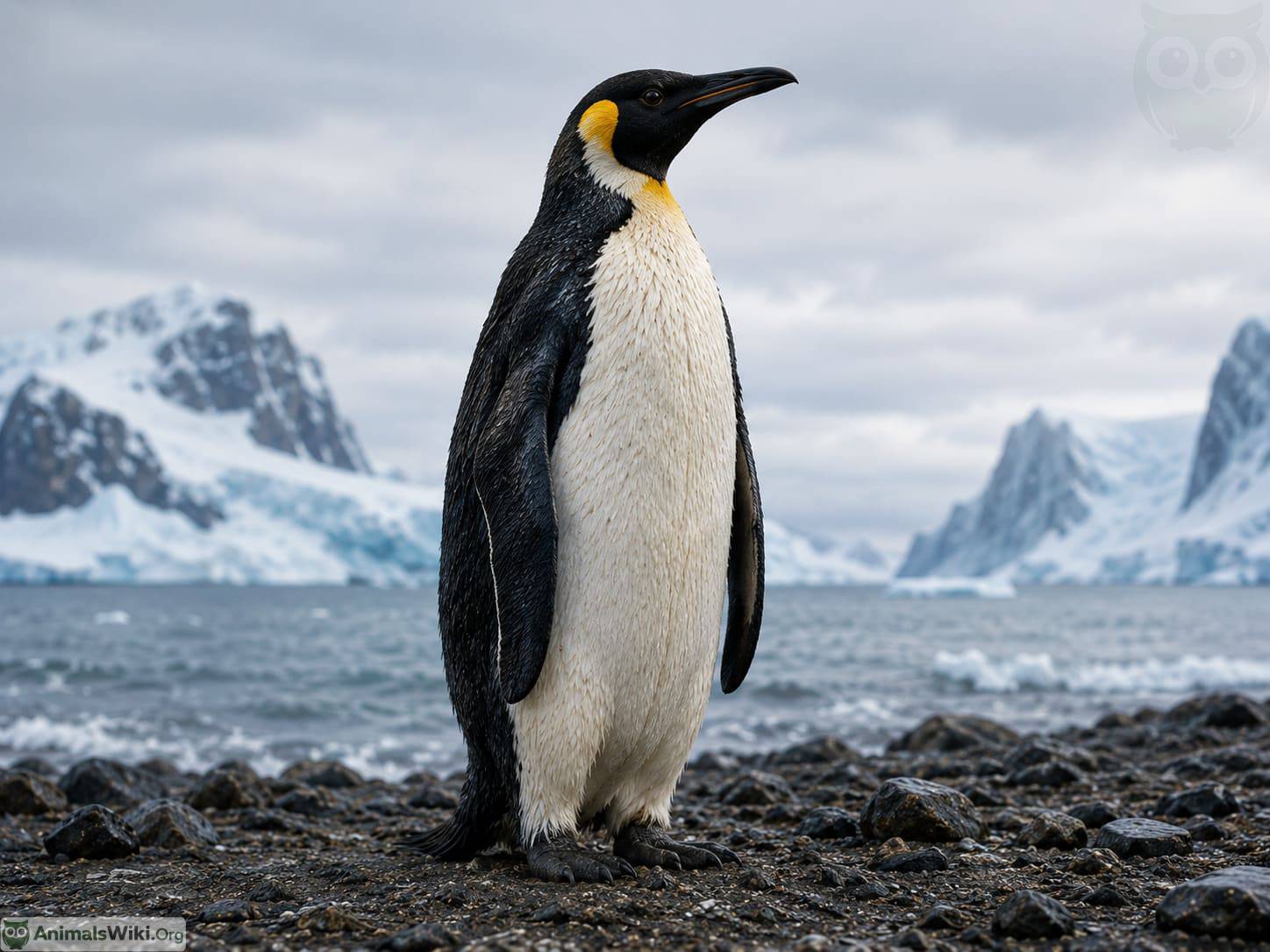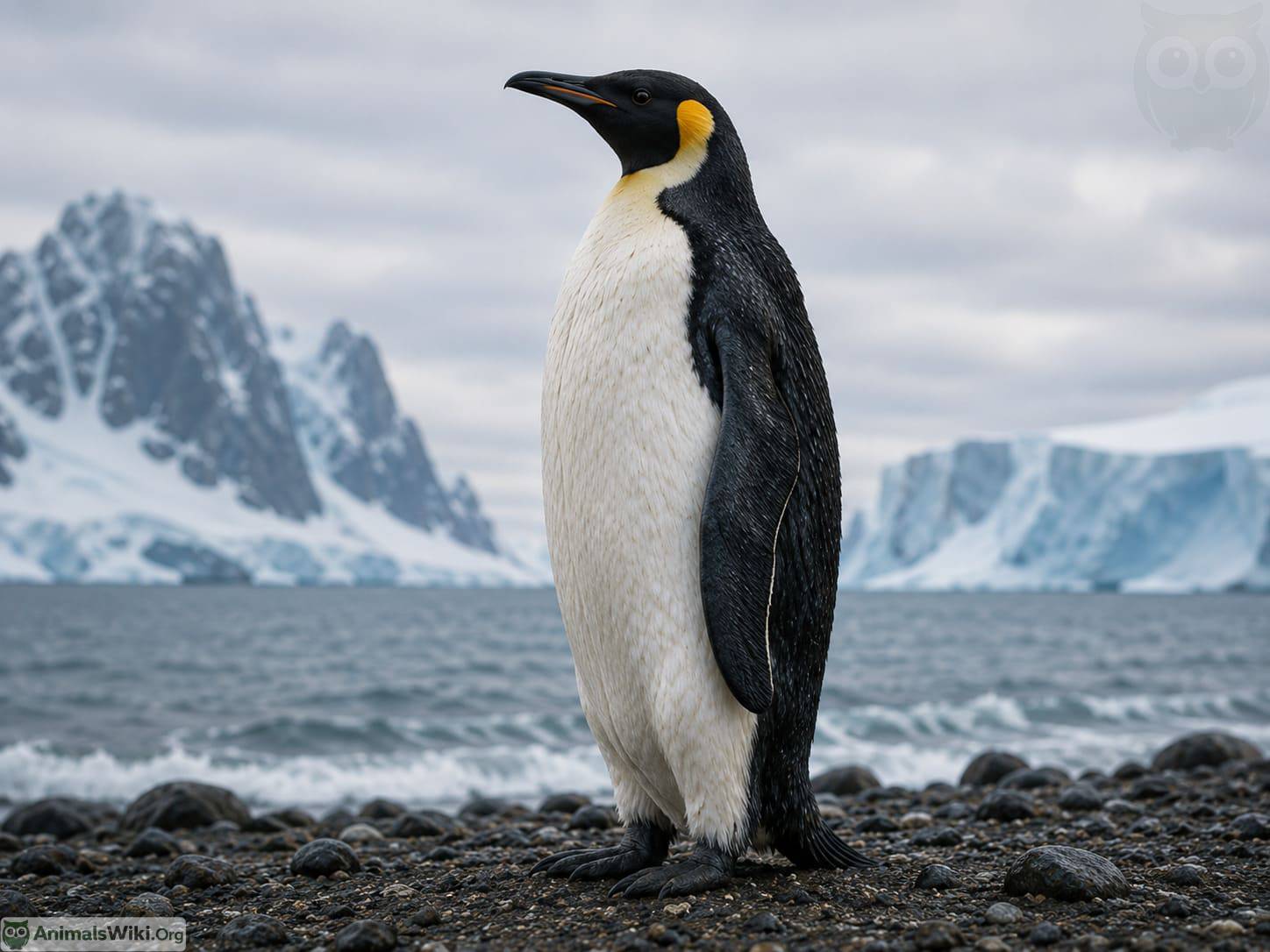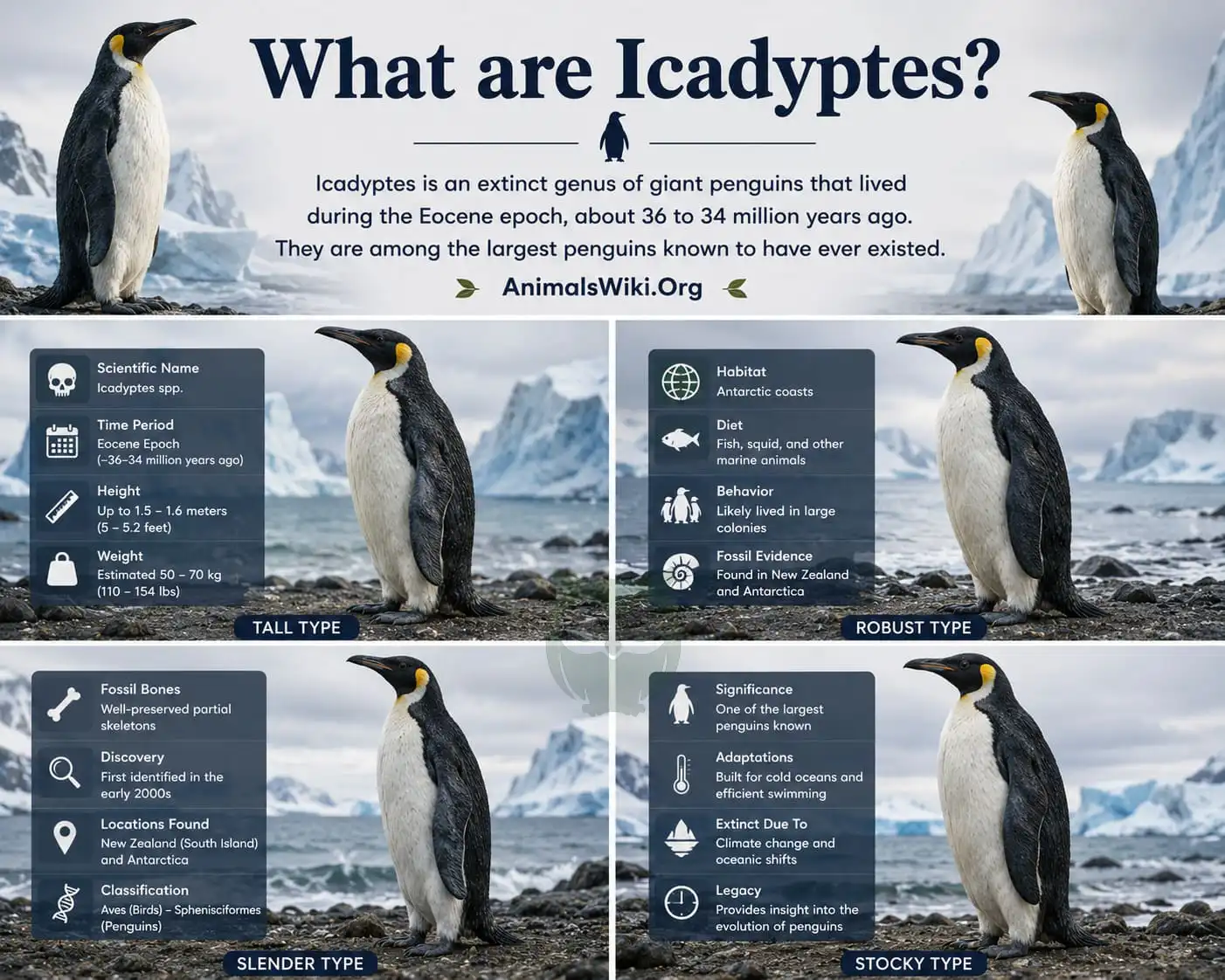
What is Icadyptes?
Icadyptes Facts
| Feature | Details |
|---|---|
| Common Name | Giant Peruvian Penguin / Inkayacu’s Ancestor |
| Scientific Name | Icadyptes salasi |
| Family | †Spheniscidae (Penguins — stem lineage) |
| Order | Sphenisciformes |
| Formally Described | 2007 (by Julia Clarke and colleagues) |
| Existence Period | Late Eocene epoch — approximately 36 million years ago |
| Discovery Location | Atacama Desert, Ica Region, southern Peru |
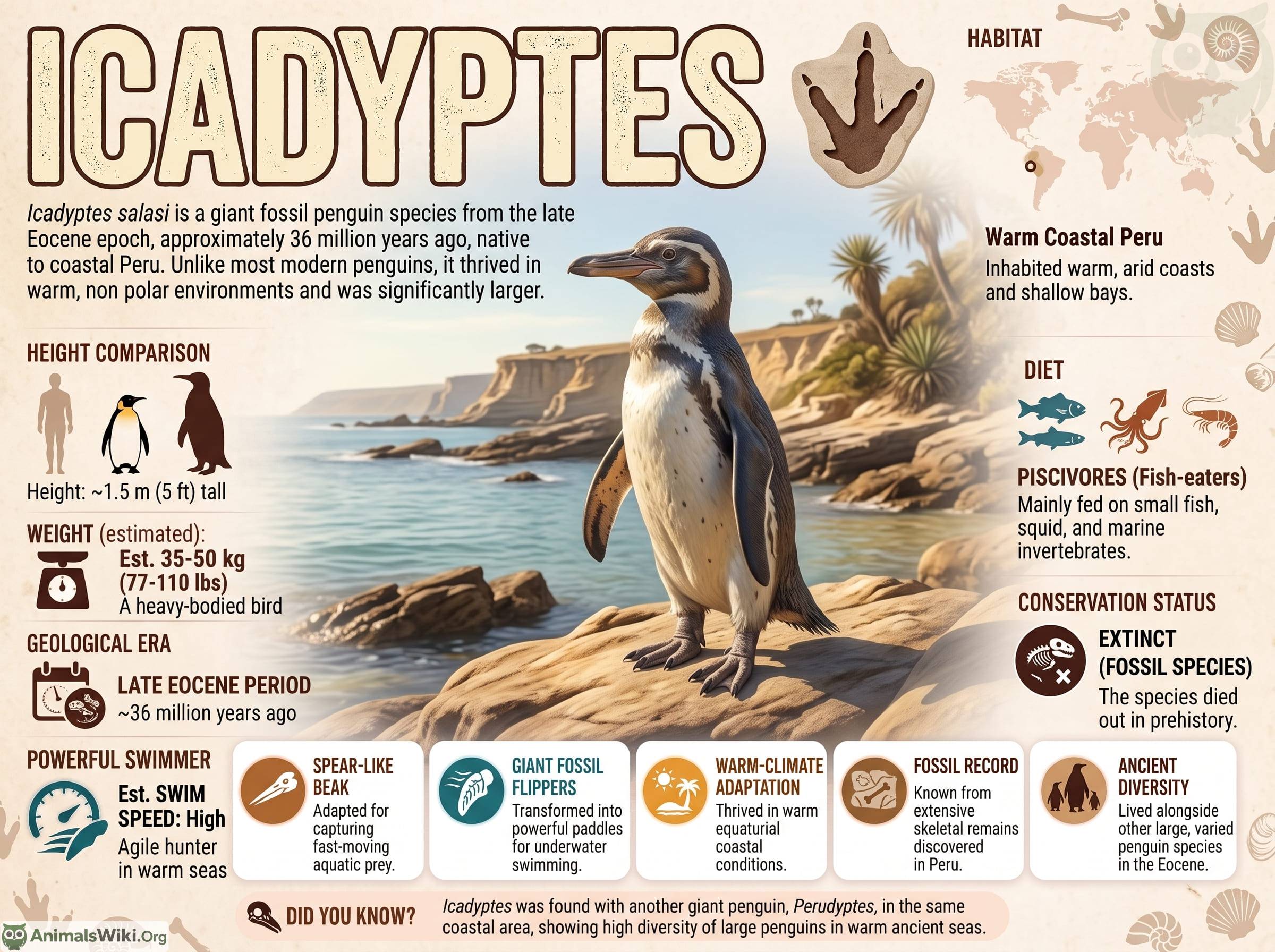
| Estimated Height | Approximately 1.5 meters (4.9 feet) tall |
| Estimated Weight | Approximately 50–60 kg (110–132 lbs) — estimated |
| Diet | Carnivore — fish, cephalopods, marine invertebrates |
| Habitat | Warm tropical and subtropical shallow coastal marine waters |
| Conservation Status | Extinct (†) — approximately 36 million years ago |
| Defining Feature | Enormous elongated spear-like beak; giant body size; lived in warm tropical waters — overturning prior penguin evolution theories |
| Named After | Rodolfo Salas — Peruvian paleontologist at the Natural History Museum of Peru |
1. Species Overview & Paleontological Significance
Thirty-six million years ago, in warm tropical waters along the coast of what is now Peru, a creature swam that would overturn one of the most confidently held assumptions in the history of penguin science. It was enormous — approximately 1.5 meters tall when standing, roughly the height of a modern adult human — with a beak so long, so narrow, and so sharply pointed that it resembled a spear more than the stubby, fish-gripping bills of modern penguins. And it lived in warm, tropical waters at latitudes where no living penguin would be found naturally today.
This was Icadyptes salasi — and its discovery in 2007 changed virtually everything scientists thought they understood about how, where, and when penguins evolved into the animals we recognize today.
The story of Icadyptes begins with the Atacama Desert of southern Peru — one of the driest places on Earth today, where the bones of ancient marine animals are preserved in extraordinary condition by the extreme aridity that has characterized the region for millions of years. It was here that Peruvian paleontologist Rodolfo Salas and his colleagues discovered the fossils that would eventually be described as Icadyptes salasi — named partly in Salas’s honor. And it was from these fossils that the paleoanthropologist Julia Clarke of The University of Texas at Austin, along with an international team, produced the landmark 2007 paper in the Proceedings of the National Academy of Sciences that introduced Icadyptes to the world and reset the scientific understanding of penguin biogeographic history.
The conventional wisdom before 2007 was that penguins had evolved in cold, high-latitude environments (around Antarctica) and only gradually expanded into warmer waters later in their evolutionary history. Icadyptes demolished this narrative entirely. Here was a giant penguin at tropical latitudes — within 10 degrees of the equator — 36 million years ago, at a time when the accepted models predicted that penguins had not yet expanded beyond high-latitude cold waters. The fossil demonstrated that penguins were living in warm tropical environments far earlier than anyone had imagined, and that the modern restriction of penguins to colder waters was a later evolutionary development rather than a primitive condition inherited from their origins.
Icadyptes salasi is not merely a curiosity of prehistoric life — it is a scientifically transformative specimen that has rewritten the evolutionary history of one of the world’s most beloved animal families.
Species Classification Table
| Classification Level | Details |
|---|---|
| Kingdom | Animalia |
| Phylum | Chordata |
| Class | Aves |
| Order | Sphenisciformes |
| Family | †Spheniscidae (stem group) |
| Genus | †Icadyptes |
| Species | †Icadyptes salasi |
| Formally Described | Clarke et al., 2007 |
| Geological Period | Late Eocene |
| Approximate Age | 36 million years ago |
| Type Locality | Otuma Formation, Ica Region, Peru |
Why Icadyptes Matters — The Five Key Revelations
The description of Icadyptes salasi in 2007 overturned or significantly complicated several previously accepted aspects of penguin evolutionary biology:
1. Penguins lived in tropical waters far earlier than thought — the presence of a giant penguin within 10 degrees of the paleo-equator at 36 million years ago demonstrated that penguins colonized warm-water environments during the Eocene, not the later epochs as previously modeled.
2. Giant penguins were ancient — Icadyptes was among the largest penguins ever discovered, demonstrating that gigantism in penguins is not a geologically recent phenomenon but appeared very early in the family’s history.
3. The beak architecture was radically different from modern penguins — the extraordinary elongated, spear-like beak of Icadyptes demonstrated that early penguin feeding strategies were anatomically far more diverse than the modern penguin bill suggests.
4. Penguin biogeographic history is more complex than modeled — the South American/Peruvian location of early giant penguins confirmed that the evolutionary history of penguins involved complex movements across the Southern Ocean rather than simple expansion from Antarctica.
5. Feather coloration is ancient — while not specifically from Icadyptes, a related discovery from the same Peruvian locality (Inkayacu paracasensis, described in 2010) revealed fossilized feather melanosomes, demonstrating that ancient penguin feather coloration can be scientifically reconstructed — a discovery that transformed the field of paleocolor research.
2. Physical Description & Anatomical Features
Icadyptes salasi was a giant by any measure — not merely in comparison to modern penguins but in absolute terms. Reconstructing its appearance from fossil evidence requires careful scientific inference, but the available fossil material provides remarkable insight into the anatomy of this extraordinary ancient bird.
Overall Size and Proportions
Based on the known fossil elements and comparison with the skeletal proportions of related fossil and modern penguins, Icadyptes salasi is estimated to have stood approximately 1.5 meters (4.9 feet) tall — making it roughly comparable in height to the largest known extinct penguins and significantly taller than any living penguin species. The Emperor Penguin (Aptenodytes forsteri), the largest living penguin, stands approximately 1.1–1.3 meters — meaning Icadyptes exceeded it by approximately 15–40 cm.
The body mass is estimated at approximately 50–60 kg — though this estimate carries significant uncertainty as soft tissue reconstruction from skeletal remains always involves considerable extrapolation. The Emperor Penguin’s mass is approximately 22–45 kg — suggesting Icadyptes was a substantially heavier animal.
The Defining Feature — The Extraordinary Beak
The most immediately striking anatomical feature of Icadyptes salasi — and the feature that most powerfully distinguishes it from all modern penguins — is its beak. The beak of Icadyptes is:
Enormously elongated — extending to a length proportionally far greater than any modern penguin’s bill; in relative terms to skull size, one of the longest beaks of any penguin ever recorded in the fossil record
Sharply pointed — tapering to a fine, spear-like tip rather than the more rounded or hooked tip of modern penguin bills
Laterally compressed — flattened from side to side, producing a blade-like cross-section rather than the circular or oval cross-section of modern penguin bills
Long and narrow throughout — unlike modern penguin bills which tend to be robust and designed for gripping slippery fish, the Icadyptes beak was narrow along virtually its entire length — suggesting a spearing rather than gripping feeding strategy
This beak is extraordinary even within the context of extinct penguins — most known fossil species have bills more similar to modern penguins than the remarkable structure of Icadyptes. The closest functional analog in the modern bird world might be the beak of a heron or a darter — birds that use their elongated bills to spear rather than grab prey.
The Skull and Head
The skull of Icadyptes is known from relatively well-preserved fossil material — providing good information about cranial anatomy. Key features include:
Large cranial vault — suggesting a brain of relatively substantial size, consistent with the behavioral complexity expected in a large, socially living marine predator
Large orbit (eye socket) — indicating large eyes relative to skull size; consistent with the pattern in modern penguins, whose large eyes provide excellent underwater visual acuity for prey detection
Robust zygomatic arches — the bone arches flanking the skull are robust, suggesting significant jaw musculature — the power needed to drive the elongated beak through water at speed during prey capture
Elongated nasals — the nasal bones extend along the top of the bill, contributing to its extraordinary length
Flipper Anatomy
The wing-flippers of Icadyptes — the modified forelimbs used for underwater propulsion in all penguins — are known from fossil material and are consistent with the pattern seen in other large fossil and modern penguins:
Flattened and rigid — the bones of penguin flippers are flattened and densely mineralized compared to flying birds; the individual bones are reduced in number and fused in ways that create a rigid, paddle-like structure. This modification for underwater wing-propulsion is the defining anatomical feature of the penguin lineage and was fully developed in Icadyptes.
Large relative to body size — large flippers generate more thrust; in a large animal like Icadyptes, the absolute flipper size was substantial, capable of generating the propulsive force needed for efficient movement through water.
Humerus and radius/ulna — these bones are the primary fossil elements known for Icadyptes wing anatomy; their proportions are consistent with powerful wing-propelled diving locomotion.
Leg and Foot Anatomy
The legs and feet of penguins — used for walking on land and steering underwater — show characteristic modifications in all family members, and Icadyptes was no exception:
Short, robust tarsometatarsus — the characteristic “stubby leg” of penguins is produced by the modification of the tarsometatarsus (the fused ankle-foot bone) into a short, weight-bearing column; this is present in Icadyptes consistent with the typical penguin pattern
Large feet — penguin feet serve as underwater rudders; large feet provide better maneuverability for a large animal moving at speed underwater
Webbed toes — inferred from the skeletal structure; webbing between the toes is universal in penguins and almost certainly present in Icadyptes
Bone Density — The Diving Adaptation
One of the most important anatomical features of all penguins — including Icadyptes — is the exceptional density of their bones. While flying birds have hollow, air-filled bones to minimize weight for flight, penguins have dense, solid bones that provide ballast for diving — counteracting buoyancy and making it energetically easier to remain submerged. The bones of Icadyptes show this characteristic dense mineralization, confirming its adaptation for underwater diving despite its enormous size.
Did You Know? The beak of Icadyptes salasi is so extraordinarily elongated and spear-like that when paleontologists first encountered its proportions in the fossil record, they initially struggled to place it in the correct anatomical context. The beak length relative to skull size is among the most extreme recorded for any penguin — living or extinct — and represents a feeding strategy so different from modern penguins that it required complete reconsideration of early penguin dietary ecology. No living penguin has a beak even remotely resembling the spearing instrument of Icadyptes.
3. Ancient Habitat & Paleogeographic Range
The World of the Late Eocene
To understand Icadyptes salasi, it is essential to understand the world it inhabited — a world profoundly different from the Earth we know today in virtually every relevant aspect: ocean temperature, continental configuration, sea level, and biological community.
The Late Eocene Earth (36 Million Years Ago)
Continental configuration — the continents 36 million years ago were recognizably similar to their modern positions but with significant differences. South America was still largely isolated from North America (the connection via Panama had not yet formed). The Drake Passage between South America and Antarctica was beginning to open, but the Antarctic Circumpolar Current that today isolates Antarctica and drives its extreme cooling had not yet fully developed.
Ocean temperatures — this is the most critical environmental difference for understanding Icadyptes. During the Late Eocene, ocean temperatures were significantly warmer than today across all latitudes. The equatorial ocean where Icadyptes lived had surface water temperatures estimated at approximately 25–28°C (77–82°F) — warm tropical conditions broadly similar to parts of the modern Caribbean or Pacific. There was no permanent polar ice cap; the poles were cool but not frozen.
The Paleo-Pacific coast of Peru — the location where Icadyptes fossils were found (the Ica Region of southern Peru) was, 36 million years ago, a shallow, warm, highly productive marine environment along the western coast of South America. The cold Humboldt Current, which today makes the Peruvian coast one of the most productive (but cold) marine ecosystems on Earth, did not yet exist in its modern form — the waters along this coast were warm and tropical.
Marine productivity — the warm, shallow coastal seas of Eocene Peru were rich in the fish, cephalopods, and marine invertebrates that would have supported a large marine predator like Icadyptes. The excellent fossil preservation in these deposits (which have yielded extraordinary marine fossil assemblages) testifies to the productivity and diversity of the ancient marine community.
Paleogeographic Location
The Otuma Formation of the Ica Region — the geological unit in which Icadyptes was found — was deposited in what paleontological reconstruction shows was approximately 10–15 degrees south of the paleoquator. This places Icadyptes in what would today be called tropical to subtropical latitudes — a habitat completely outside the range of any living wild penguin.
This paleolatitude was one of the most scientifically revolutionary aspects of the Icadyptes discovery. Modern penguins — whose most equatorial representatives are the Galápagos Penguin (Spheniscus mendiculus) and the African Penguin (Spheniscus demersus) — are associated with cool or cold waters even when living at relatively low latitudes. Icadyptes was living in genuinely warm tropical waters, demonstrating that early penguins had no intrinsic physiological barrier to warm-water habitation.
Why Warm Waters? — The Thermoregulation Question
Icadyptes‘s warm-water habitation raises the immediate question of how a penguin — an animal whose modern relatives are strongly associated with cold-water physiology — survived and thrived in tropical conditions.
The answer almost certainly lies in the fact that modern penguins’ cold-water specialization is a derived (recently evolved) condition, not a primitive ancestral one. Early penguins, living in the warmer oceans of the Eocene, would have had different thermoregulatory physiology — potentially without the extreme cold-water adaptations (counter-current heat exchange systems, thick blubber layers, dense plumage trapping air against cold) that characterize the most cold-adapted modern species.
The large body size of Icadyptes would itself have provided thermal inertia — larger bodies cool and heat more slowly than smaller ones, reducing the physiological challenge of temperature regulation in any environment.
Associated Fauna — Who Shared the Ocean with Icadyptes?
The fossil-rich deposits of the Ica Region have yielded an extraordinary picture of the ancient marine community that Icadyptes inhabited:
Large sharks — the warm Eocene seas of Peru were inhabited by large shark species including early relatives of the modern great white shark; fossil shark teeth are among the most common fossils in these deposits and represent a potential predator threat for even large penguins
Early whales — the Late Eocene was a critical period in whale evolution; early archaeocetes (ancient whales) inhabited the same warm Eocene seas as Icadyptes, though the two groups probably occupied different enough ecological niches to coexist without significant direct competition
Marine reptiles (late survivors) — some mosasaur relatives may have persisted into the earliest Eocene in some regions, though by 36 million years ago most large marine reptiles of the Mesozoic had long been extinct
Abundant fish and cephalopods — the diverse bony fish fauna and rich cephalopod community of the Eocene Pacific provided the food base for Icadyptes and the broader marine predator community
Other fossil penguins — the Ica Region deposits have yielded multiple penguin species, suggesting that diverse penguin communities inhabited these ancient waters; Icadyptes was the largest and most spectacular but not the only penguin present
Did You Know? The Atacama Desert of Peru and Chile — where the fossils of Icadyptes and many other ancient marine animals are preserved — is considered the driest non-polar desert on Earth, with some locations receiving essentially no rainfall for decades at a time. This extreme aridity, which has characterized the region for millions of years, creates extraordinary fossil preservation conditions — bones are not dissolved by water or decomposed by soil microorganisms, and can survive in remarkable condition for tens of millions of years. The Ica Region of Peru is consequently one of the world’s richest fossil localities for ancient marine vertebrates, and would be almost nowhere else on Earth preserved in the condition that allowed Icadyptes to be described.
4. Diet & Feeding Behavior
The diet and feeding behavior of Icadyptes salasi must be inferred from its anatomical features — primarily the remarkable beak — combined with knowledge of the ancient marine environment it inhabited and comparison with ecological analogies among living birds. While direct evidence of feeding (such as stomach contents preserved with the fossil) is not available for Icadyptes, the anatomical evidence is highly informative.
The Spearing Beak — Functional Implications
The most powerful dietary inference comes from the extraordinary beak of Icadyptes. Its elongated, narrow, pointed form is functionally analogous to the bills of modern herons, egrets, darters, and gannets — birds that use their bills to spear or strike prey rather than grip and hold it.
This contrasts fundamentally with the bills of modern penguins, which are shorter, more robust, and often have backward-pointing projections on the tongue and palate that help grip slippery prey. Modern penguins are predominantly grip-and-swallow feeders — seizing fish or squid in their bills and swallowing them whole or in large pieces.
Icadyptes appears to have been a strike-and-spear feeder — using its elongated bill to rapidly extend the head and neck, impaling prey rather than gripping it. This feeding strategy is highly effective for capturing:
Large, fast-moving fish — the spearing bill allows a rapid, precise strike that can impale a fish through the body, securing it before it can escape; modern herons use exactly this strategy with considerable success
Squid and cuttlefish — cephalopods are agile, fast-moving prey whose escape response might be defeated by the precision of a spearing strike more effectively than by a pursuit-and-grip strategy
Large crustaceans — the pointed bill could also be used to probe and extract large crustaceans from crevices in reef or rocky substrates
Size and Prey Selection
The large body size of Icadyptes — approximately 1.5 meters tall and estimated at 50–60 kg — has important dietary implications. Large body size requires large caloric intake, which typically means:
Large individual prey items — a large predator that can handle large prey typically selects individual prey items of significant size rather than consuming enormous numbers of small items. Icadyptes was likely pursuing large fish, substantial squid, and other sizable marine prey rather than the small fish and krill that some smaller penguins consume.
Deeper and longer dives — large penguins are capable of diving deeper and for longer than smaller species. The Emperor Penguin, the largest living penguin, regularly dives to 500 meters and can remain submerged for over 20 minutes. Icadyptes, of comparable or greater size, was likely a similarly deep and prolonged diver — accessing prey in the middle and lower water column that was unavailable to smaller, shallower-diving competitors.
Comparison with Related Fossil Penguins
The feeding ecology of Icadyptes can be further illuminated by comparison with other well-studied extinct penguins from the same region. Inkayacu paracasensis — a roughly contemporaneous but distinct giant penguin from the same Peruvian deposits — had a bill intermediate in length between Icadyptes and modern penguins, suggesting a somewhat different feeding strategy. This diversity of bill forms among contemporaneous Peruvian fossil penguins suggests that different species occupied different feeding niches within the ancient marine ecosystem — a pattern of ecological partitioning similar to that seen among modern penguin communities.
Diet Breakdown Table (Inferred)
| Food Type | Estimated % of Diet | Evidence Basis | Notes |
|---|---|---|---|
| Large bony fish | 45–60% | Bill morphology; body size | Primary prey; spearing strategy optimal |
| Cephalopods (squid, cuttlefish) | 20–30% | Bill morphology; Eocene abundance | Highly abundant in warm Eocene seas |
| Large crustaceans | 5–15% | Bill probing capability | Possible secondary prey |
| Other marine invertebrates | 5–10% | Opportunistic inference | Secondary when primary prey scarce |
“The beak of Icadyptes is one of the most extraordinary structures in the entire penguin fossil record. Nothing quite like it exists in any living penguin — it represents a feeding strategy that has been entirely lost from the modern penguin lineage, suggesting that early penguins explored dietary niches that their descendants subsequently abandoned.” — Dr. Julia Clarke, Paleontologist, University of Texas at Austin
5. Locomotion & Swimming Adaptations
All penguins are masters of underwater wing-propelled swimming — a locomotion mode that evolved from the powered flight of their ancestors and was so successful for an aquatic lifestyle that it has been retained and elaborated for approximately 60 million years of penguin evolution. Icadyptes was fully committed to this locomotion strategy, and its large size would have made it a powerful and impressive swimmer.
The Physics of Large Penguin Swimming
The relationship between body size and swimming performance in penguins follows predictable physical principles:
Larger penguins are more hydrodynamically efficient — the drag force a swimming body experiences increases with the square of velocity but scales with surface area, which increases more slowly than volume (and therefore mass) as body size increases. Larger penguins therefore pay proportionally less drag cost per unit of body mass, making large-body swimming more energetically efficient.
Larger penguins generate more thrust — the absolute size of the flippers determines thrust generation; larger flippers move more water per stroke and generate more propulsive force.
Larger penguins dive deeper and longer — greater oxygen stores (both in blood and muscle myoglobin, which both increase with body mass) and lower mass-specific metabolic rates allow larger penguins to extend their dive duration and depth capacity significantly beyond smaller species.
The logical extrapolation of these size-performance relationships from the Emperor Penguin (the largest living species, which dives to 500+ meters and holds its breath for 20+ minutes) to Icadyptes (significantly larger) suggests that Icadyptes was an extraordinarily capable diver by any standard — potentially capable of dives exceeding those of the Emperor Penguin in both depth and duration.
The Transition from Flight to Swimming
Icadyptes lived approximately 36 million years ago — a time when the penguin lineage had already been evolving for at least 25–30 million years (the oldest penguin fossils date to approximately 60–62 million years ago). By the Late Eocene, the transition from flying to wing-propelled diving was complete — the flipper anatomy of Icadyptes is fully committed to underwater propulsion with no residual flight capability.
The bones of the Icadyptes wing-flipper show the characteristic penguin adaptations:
- Flattened humerus — the upper arm bone is flattened into a paddle-like blade
- Dense cortical bone — heavy bones provide ballast for diving
- Limited joint mobility — the elbow and wrist joints have reduced mobility compared to flying birds, producing the rigid flipper structure needed for efficient underwater wing-strokes
- Large muscle attachment surfaces — the coracoid and sternum bones (from which the major flight/flipper muscles originate) are robust, indicating powerful musculature
Walking on Land
All penguins walk upright on land in the characteristic bipedal shuffling gait — constrained by short legs positioned far back on the body (an adaptation for hydrodynamic efficiency underwater that compromises terrestrial locomotion). Icadyptes would have moved on land in this same characteristically waddling fashion.
At 1.5 meters tall, a walking Icadyptes would have been an imposing sight — an upright, human-sized bird moving through the ancient Peruvian coastal environment with the measured, somewhat rolling gait of all penguins. The large body would have made it more energetically costly to move on land than smaller penguins, suggesting that like modern large penguins, Icadyptes probably spent the majority of its time in the water, coming ashore primarily for breeding.
6. Social Behavior & Reproduction — What the Fossils Suggest
Direct evidence of Icadyptes social behavior and reproduction is essentially unavailable from the fossil record — behavior does not fossilize in the way that bones do. However, careful inference from the available evidence and comparison with modern and other extinct penguins allows reasonable hypotheses about how Icadyptes might have lived and reproduced.
Colonial Breeding — A Safe Inference
All modern penguin species breed in colonies — aggregations of breeding pairs ranging from a few dozen animals to hundreds of thousands. Colonial breeding provides significant anti-predator benefits (many eyes watching for predators; confusion and mobbing of approaching predators) and may also facilitate mate finding in species with complex courtship behavior.
The colonial breeding habit of modern penguins is considered deeply ancestral — probably present in the earliest penguin ancestors and maintained throughout the group’s evolutionary history. Icadyptes almost certainly bred colonially on or near the ancient Peruvian coastline, probably on rocky beaches or coastal slopes adjacent to the productive marine waters where it fed.
The rich penguin fossil assemblages of the Ica Region — where multiple penguin individuals and species are represented — are consistent with this inference; the concentration of penguin remains suggests that ancient penguins aggregated in specific coastal areas, as modern penguins do at breeding colonies.
Nesting — Inferences from the Environment
Modern penguin nesting strategies range from elaborate burrow construction in some smaller species to no nest at all in the Emperor Penguin (which incubates its single egg on its feet under a brood pouch). In the warm tropical environment of Eocene Peru, the thermal requirements of incubation would have been radically different from those of polar or subpolar breeding penguins:
- No need for elaborate insulation — the ambient temperature in coastal Peru during the Eocene was warm enough that eggs would not have required the extreme thermal protection needed by Antarctic species
- Possible burrow or scrape nesting — in a warm environment, ground nesting in a shallow scrape or burrow might have been adequate
- Shade-seeking behavior — in a tropical environment, the challenge might have been overheating rather than freezing — Icadyptes might have sought shaded nest sites to prevent egg or chick overheating
Parental Care
All modern penguins practice biparental care — both parents contribute to incubation and chick-rearing, with one parent typically remaining at the nest while the other forages at sea. This pattern is almost certainly ancestral in penguins and was probably practiced by Icadyptes.
The large body size of Icadyptes implies a slow pace of life — larger animals typically take longer to mature, have longer incubation periods, and invest more in individual offspring than smaller animals. Icadyptes chicks were probably large, altricial (helpless at hatching), and required extended parental care before becoming independent — similar to the pattern in modern Emperor and King Penguins.
7. Predators & Survival Challenges
The Predator Community of Eocene Peru
Icadyptes inhabited a world where large marine predators were present and capable of threatening even a large penguin in the water. The key predators of the ancient Peruvian Eocene marine environment include:
Marine Predators
Large sharks — the most significant predator threat for Icadyptes in the water. The Eocene seas of Peru hosted large shark species whose fossil teeth are recovered from the same deposits as Icadyptes fossils. While the Megalodon (Otodus megalodon) — the most famous giant shark — did not appear until the Miocene (approximately 23 million years ago), other large lamnid sharks were present in the Eocene. A large adult Icadyptes would have been a formidable target even for a substantial shark, but juveniles and injured or weakened adults would have been vulnerable.
Mosasaur relatives — by the Late Eocene, 36 million years ago, the great mosasaurs (marine reptiles) of the Mesozoic had been extinct for approximately 30 million years. However, some large marine reptiles persisted into the early Cenozoic in some regions. In the Late Eocene specifically, large marine reptiles were no longer significant ecological players in the open ocean, but crocodilians and sea turtles remained present in coastal and estuarine environments.
Early toothed whales — the Late Eocene was a critical period in cetacean evolution; early archaeocete whales were diversifying rapidly. Some of these early whales were large, predatory animals that might have posed a threat to penguins in the water, though the ecological relationship between early archaeocetes and penguins in Eocene Peru is not well understood.
Terrestrial and Coastal Predators
On land — at the breeding colony and when transitioning between water and shore — Icadyptes faced different threats:
Large terrestrial predators of Eocene South America — South America’s isolation from North America during the Eocene meant its terrestrial predator community was dominated by metatherians (marsupials and relatives) and large flightless predatory birds of the family Phorusrhacidae (the “terror birds”). The terror birds — large, fast, predatory flightless birds — were among South America’s apex terrestrial predators during the Eocene and Oligocene and could potentially have threatened Icadyptes on land.
Aerial predators — large flying birds including early raptors might have posed a threat to Icadyptes eggs and chicks at breeding colonies.
The Defense of Size
The large body size of Icadyptes was itself a significant anti-predator defense on land — a 1.5-meter, 50-kg penguin would have been a daunting target for all but the largest terrestrial predators, and capable of delivering powerful defensive blows with its flippers and beak. Modern large penguins (Emperor and King Penguins) can defend themselves effectively against most threats they encounter, and Icadyptes was likely equally or more formidable.
In the water, the primary defense against sharks and other large predators would have been speed, agility, and vigilance — modern penguins are extremely fast and maneuverable swimmers capable of evading shark attacks in many circumstances, and Icadyptes‘s powerful flippers would have made it a capable escape artist in three-dimensional underwater space.
Did You Know? The same fossil beds of the Ica Region of Peru that yielded Icadyptes salasi have also produced fossils of ancient giant sperm whales, early baleen whale relatives, enormous sharks, and multiple other extinct marine vertebrates — painting an extraordinary picture of the ancient marine ecosystem that Icadyptes inhabited. This remarkable fossil assemblage has made the Peruvian Atacama one of the world’s most scientifically valuable paleontological localities, yielding insights into marine ecosystem evolution across tens of millions of years.
8. Relationship with Human Discovery
The Discovery Story
The fossils that would become Icadyptes salasi were discovered through fieldwork conducted in the Ica Region of southern Peru — specifically in the Otuma Formation, a geological unit of late Eocene age exposed in the extremely arid conditions of the Peruvian Atacama Desert.
The key figure in the discovery was Rodolfo Salas — a Peruvian paleontologist at the Natural History Museum (Museo de Historia Natural) of the Universidad Nacional Mayor de San Marcos in Lima, Peru. Salas had been conducting systematic paleontological surveys of the Ica Region’s extraordinarily rich fossil deposits — an area known to contain exceptional marine fossil assemblages from multiple geological periods.
The Icadyptes fossils were recovered from the same general geological horizon as other extraordinary fossil material — including what would eventually be described as Inkayacu paracasensis (the giant penguin with preserved feather coloration described in 2010). The Ica Region deposits have proven to be one of the most spectacular paleontological discoveries of the past three decades.
The Scientific Description — Clarke et al. 2007
The formal scientific description of Icadyptes salasi was published in 2007 in the Proceedings of the National Academy of Sciences (PNAS) — one of the world’s most prestigious scientific journals — by a team led by Dr. Julia Clarke of The University of Texas at Austin, in collaboration with Rodolfo Salas and international colleagues.
The paper — titled “Paleogene equatorial penguins challenge the proposed relationship between biogeography, diversity, and Cenozoic climate change” — was immediately recognized as a landmark contribution to paleontology and evolutionary biology. Its title reveals its central argument: that the discovery of equatorial (tropical latitude) penguins in the Paleogene (the geological era including the Eocene) fundamentally challenged existing models of penguin biogeographic history and the relationship between climate and penguin diversification.
The Name — Honoring a Peruvian Scientist
The species name “salasi” honors Rodolfo Salas — acknowledging the Peruvian paleontologist’s essential role in the discovery and recovery of the fossils. The genus name “Icadyptes” derives from:
- “Ica” — referring to the Ica Region of Peru where the fossils were found
- “dyptes” — from the Greek δύπτης (dyptēs), meaning “diver” — the same root used in the genus name for modern penguins (Spheniscidae)
The combined name therefore means approximately “Ica diver” — a geographically grounded name that simultaneously honors the locality and describes the animal’s ecological role.
The Impact on Science
The 2007 Icadyptes paper was immediately influential — generating hundreds of citations in subsequent scientific literature and prompting significant re-evaluation of penguin evolutionary models. Key impacts included:
Revised biogeographic models — the paper demonstrated that penguins colonized tropical latitudes during warm Eocene periods and subsequently retreated to cooler waters as global temperatures declined through the Oligocene and Miocene. This model replaced the previous assumption of progressive poleward-to-equatorial expansion.
Renewed interest in Peruvian fossil penguins — the discovery spurred intensive subsequent fieldwork in the Ica Region, leading to the description of multiple additional fossil penguin species over the following decade, including the landmark Inkayacu discovery of 2010.
Broader implications for Eocene biogeography — the demonstration that large penguins inhabited warm tropical waters during the Eocene contributed to broader scientific understanding of how warm Eocene climates facilitated the movement of animal groups across latitude barriers that currently restrict them.
9. Extinction — What Happened to Icadyptes?
The Eocene-Oligocene Transition — A World Cooling
Icadyptes salasi lived during the Late Eocene — a geological period that ended approximately 33.9 million years ago in one of the most dramatic climatic transitions of the Cenozoic era: the Eocene-Oligocene Transition (EOT).
The EOT was characterized by:
Dramatic global cooling — global average temperatures dropped significantly over a period of approximately 300,000 years; polar ice caps began forming; the Antarctic ice sheet developed for the first time in the Cenozoic
Opening of the Drake Passage — the waterway between South America and Antarctica opened sufficiently during this period to allow the full development of the Antarctic Circumpolar Current — a current system that thermally isolated Antarctica and dramatically accelerated its cooling
Ocean cooling — sea surface temperatures dropped significantly across all latitudes; the warm tropical seas that had characterized the Eocene became cooler, particularly at mid and high latitudes
Mass extinction events — the EOT was associated with significant faunal turnover across both marine and terrestrial ecosystems; many Eocene species could not adapt to the rapidly changing conditions and went extinct
The End of Icadyptes
Icadyptes salasi as a species appears to have gone extinct during or shortly after the Eocene-Oligocene Transition — its known fossil record is confined to the Late Eocene, with no representatives in the Oligocene deposits of the same region.
The most likely extinction mechanism involves the loss of the warm tropical marine environment that supported Icadyptes:
Cooling of the Peruvian coastal waters — as global temperatures dropped during the EOT and the Humboldt Current (or its precursor) began to develop along the South American Pacific coast, the warm tropical conditions that had characterized the coastal Peruvian marine environment during the Eocene deteriorated. The prey community that had supported Icadyptes‘s feeding strategy may have shifted significantly.
Ecological disruption — the dramatic faunal turnover of the EOT affected the entire marine food web; the fish, cephalopod, and crustacean communities on which Icadyptes depended would have undergone significant compositional change during this period.
Competitive displacement — as the global climate shifted and new, better cold-adapted marine predators (including more derived penguins better suited to cooler conditions) arose, Icadyptes may have been competitively displaced from the ecological role it had occupied in warmer waters.
The Legacy of Icadyptes — Descendants and Relatives
While Icadyptes itself went extinct, the penguin lineage continued — evolving the cold-water specializations that characterize modern species as global temperatures continued to decline through the Oligocene and Miocene. The story of penguin evolution from warm-water Eocene giants like Icadyptes to the cold-adapted modern species is one of the most instructive examples of how major climate shifts drive fundamental evolutionary change in well-preserved fossil lineages.
The Sphenisciformes as an order survived the EOT and diversified through the Oligocene and Miocene — eventually producing the approximately 18 living species we recognize today. None of them has a beak remotely resembling that of Icadyptes. None of them lives in genuinely tropical waters without the moderating influence of cold currents. And none of them approaches the height of 1.5 meters that made Icadyptes one of the most imposing birds ever to walk the Earth.
10. Famous Fossil Specimens
The Holotype Specimen — MUSM 1052
The primary known fossil material of Icadyptes salasi consists of a remarkably complete skull and associated postcranial elements (bones from the body rather than the head) — designated as the holotype specimen MUSM 1052, housed at the Museo de Historia Natural de la Universidad Nacional Mayor de San Marcos (MUSM) in Lima, Peru.
The holotype is exceptional in its preservation and completeness for a fossil of this age. Key preserved elements include:
- Virtually complete skull and beak — providing the primary anatomical data for the species and its extraordinary bill morphology
- Cervical vertebrae — the neck vertebrae, informing reconstruction of neck length and mobility
- Elements of the forelimb (flipper) — allowing inference of flipper size and function
- Elements of the hindlimb — providing data on leg proportions and locomotion
- Partial tarsometatarsus — the characteristic stubby foot bone of penguins
The completeness of the holotype is particularly fortunate given the typical fragmentary nature of fossil bird material; many fossil bird species are known from only a few isolated bones. The Icadyptes holotype provides a comprehensive anatomical picture that has allowed detailed reconstruction and confident species description.
The Associated Ica Region Penguin Assemblage
Beyond the Icadyptes holotype, the Ica Region deposits have yielded a remarkable assemblage of fossil penguins from approximately the same geological horizon — demonstrating that diverse penguin communities inhabited ancient Peruvian waters simultaneously:
Perudyptes devriesi — a smaller, older penguin from the same region (described from Middle Eocene deposits approximately 42 million years old); helps bracket the temporal range of Peruvian fossil penguin diversity
Inkayacu paracasensis — a giant penguin from Late Eocene deposits of the Ica Region (described in 2010); particularly famous for its preserved feather melanosomes that revealed the coloration of an ancient penguin — reddish-brown and grey rather than the modern black-and-white — for the first time in paleontology
Multiple undescribed specimens — the ongoing fieldwork in the Ica Region continues to yield new penguin material; additional species remain to be formally described
Together, this assemblage represents the most important single locality for understanding the early evolution and diversification of penguins in South America.
Did You Know? The discovery of Inkayacu paracasensis — a roughly contemporaneous giant penguin from the same Peruvian deposits as Icadyptes — included the extraordinary preservation of feather melanosomes (the cellular organelles that determine feather color in modern birds). By comparing the shape of these ancient melanosomes to those of living birds, scientists determined that Inkayacu had reddish-brown and grey feathers rather than the black-and-white of modern penguins — representing the first time the coloration of an ancient penguin had ever been scientifically reconstructed. This discovery transformed the study of fossil feather coloration and suggested that the modern penguin color scheme evolved more recently than previously thought.
11. Role in the Ancient Ecosystem
Apex Marine Predator of the Eocene Peruvian Coast
At approximately 1.5 meters tall and an estimated 50–60 kg, Icadyptes salasi was almost certainly one of the largest avian predators in the ancient Peruvian marine ecosystem — an apex predator operating at the top of the marine food web alongside large sharks and early cetaceans.
Trophic Position and Ecological Function
As a top-level fish predator — Icadyptes consumed large quantities of fish and cephalopods from the productive Eocene coastal waters. At its body size and estimated population density (inferred from the richness of the fossil assemblage), it would have been a significant consumer of mid-water fish populations — potentially influencing fish community structure through selective predation on specific species or size classes.
Energy transfer — Icadyptes transferred energy from lower trophic levels (the fish and cephalopods it consumed) to higher trophic levels (the sharks and other large predators that consumed it). This energy transfer function is ecologically fundamental — large marine predators serve as critical energy conduits linking lower food web productivity to apex predator populations.
Nutrient cycling — like all colonial seabirds, Icadyptes would have moved marine nutrients onto land at its breeding colonies — the guano (excrement) of seabird colonies is extraordinarily rich in nutrients and fertilizes terrestrial environments adjacent to breeding sites. The guano deposits of ancient penguin colonies may have been ecologically significant in the Eocene coastal environment, supporting unique plant communities adapted to high-nutrient conditions.
Competition and Coexistence with Other Penguins
The presence of multiple penguin species in the Ica Region deposits — including the smaller Perudyptes devriesi — raises fascinating questions about ecological coexistence among contemporaneous penguins. Different species likely partitioned the available resources through dietary niche differentiation — different bill shapes targeting different prey types or sizes, different dive depths and durations accessing different depth zones, and potentially different coastal habitats used for breeding.
Icadyptes, with its extraordinarily elongated spearing bill, would have occupied a distinctly different dietary niche from any co-occurring penguin species with more typical shorter bills — the two forms would not have been in direct competition for exactly the same prey, allowing coexistence in the same general area.
12. Icadyptes in Science, Culture & Pop Culture
Scientific Impact — Paradigm Shifting
Icadyptes salasi occupies an unusual position in the scientific literature — a fossil species that is not merely interesting as a new addition to the fossil record but that changed the paradigm within which penguin evolution is understood. Paradigm-shifting fossil discoveries are relatively rare; Icadyptes is genuinely one of them.
The paper describing Icadyptes has been cited over 400 times in subsequent scientific literature — an extraordinary citation count for a descriptive paleontological paper — reflecting its influence across multiple fields including evolutionary biology, biogeography, paleoclimatology, and ornithology.
Media Coverage and Public Awareness
The 2007 description of Icadyptes generated significant international media coverage — with stories appearing in major newspapers and science magazines across North America, Europe, and beyond. The combination of the animal’s dramatic size, its extraordinary beak, its surprising tropical habitat, and the elegance of the scientific story it told (overturning previous assumptions about penguin evolution) made it an unusually accessible and appealing paleontological discovery for non-specialist audiences.
Key media talking points that made Icadyptes an effective science communication story included:
- The counter-intuitive nature of a tropical giant penguin
- The human-scale size of the animal
- The spear-like beak unlike anything in living penguins
- The geographic setting in Peru — a country not typically associated with ancient penguins in public imagination
Peru’s National Paleontological Pride
The discovery of Icadyptes — and the broader recognition of the Ica Region as one of the world’s premier fossil localities — has contributed to Peruvian national pride in the country’s extraordinary natural heritage. The fossils are housed in Peruvian institutions and represent a significant component of Peru’s scientific patrimony.
The naming of the species partly after Rodolfo Salas — a Peruvian scientist — and the use of “Ica” in the genus name reinforces the Peruvian identity of this discovery. Subsequent fossil penguin discoveries from Peru, including Inkayacu paracasensis (whose genus name derives from the Quechua for “water king”), have further deepened this association between Peru and the ancient world of giant penguins.
Connection to the Inkayacu Discovery
Icadyptes is closely associated in public awareness with the 2010 description of Inkayacu paracasensis — the giant penguin with preserved feather color discovered in the same Peruvian deposits. The two discoveries together created a picture of an ancient Peruvian giant penguin fauna that captured global imagination:
- Icadyptes — the spear-beaked giant of 36 million years ago
- Inkayacu — the reddish-brown, grey giant of similar age with an extraordinary fossil preservation story
Together, these two species have made the Late Eocene Peruvian marine environment one of the most publicly recognized ancient ecosystems in modern paleontology.
13. Discovery & Evolutionary Timeline
~65 million years ago — The Cretaceous-Paleogene mass extinction eliminates non-avian dinosaurs and many other animal groups; the bird lineages that will eventually produce penguins are among the survivors.
~62–60 million years ago — The earliest known penguin fossils (Waimanu manneringi from New Zealand) document that the penguin lineage diverged from flying ancestors very early in the Cenozoic; these early penguins were smaller than Icadyptes but already wing-propelled divers.
~58–55 million years ago — Early penguin diversification in the Southern Ocean region; multiple lineages begin diverging; global temperatures are high (the Early Eocene Climatic Optimum represents the warmest period of the Cenozoic).
~50–45 million years ago — Penguin lineages begin exploring lower-latitude waters; the warm Eocene oceans provide no climatic barrier to tropical colonization.
~42 million years ago — Perudyptes devriesi — a smaller fossil penguin — inhabits the coastal waters of what is now Peru; among the earliest documented South American penguins.
~36 million years ago — Icadyptes salasi inhabits warm coastal waters of Eocene Peru at approximately 10–15 degrees south of the paleoequator; one of the largest penguins ever to live; spear-beaked predator of fish and cephalopods.
~36 million years ago — Inkayacu paracasensis (approximately contemporaneous) also inhabits Eocene Peruvian waters; giant reddish-brown and grey feathered penguin.
~33.9 million years ago — Eocene-Oligocene Transition (EOT); dramatic global cooling; Antarctic ice cap formation; cooling of equatorial and subtropical oceans; likely drives the extinction of warm-water adapted giant penguins including Icadyptes.
~28–25 million years ago — Penguin diversification in cooler Oligocene waters; lineages ancestral to modern genera begin to differentiate.
~15–10 million years ago — Modern penguin genera begin to emerge; the Humboldt Current system develops along the South American Pacific coast, creating the cold, productive waters that modern Spheniscid penguins in that region exploit.
~2–1 million years ago — Modern penguin species largely established in their current forms.
1992–2004 — Fieldwork by Rodolfo Salas and colleagues in the Ica Region of Peru recovers the fossil material that will eventually be described as Icadyptes salasi.
2007 — Clarke et al. formally describe Icadyptes salasi in PNAS; the paper immediately recognized as a landmark contribution overturning previous models of penguin biogeographic history.
2010 — Inkayacu paracasensis described from the same Peruvian deposits; preserved feather melanosomes reveal reddish-brown and grey coloration; landmark discovery in paleocolor science.
2010s–2020s — Continued fieldwork in the Ica Region yields additional fossil penguin material; new species continue to be described; the ancient Peruvian fossil penguin fauna revealed as one of the world’s most diverse and scientifically important.
2026 — Icadyptes salasi recognized as one of the scientifically most important extinct penguin species; the Ica Region of Peru continues to be actively excavated for additional fossil material.
14. Comparison with Similar Prehistoric Penguins
| Feature | Icadyptes salasi | Palaeeudyptes klekowskii | Inkayacu paracasensis | Emperor Penguin (living) |
|---|---|---|---|---|
| Age | ~36 Ma (Late Eocene) | ~34–37 Ma (Late Eocene) | ~36 Ma (Late Eocene) | Living |
| Location | Peru (tropical) | Antarctica | Peru (tropical) | Antarctica/Subantarctic |
| Estimated Height | ~1.5 m | ~1.65 m (estimated) | ~1.5 m | 1.1–1.3 m |
| Estimated Weight | ~50–60 kg | ~80–115 kg (estimated) | ~54–60 kg | 22–45 kg |
| Beak | Extremely elongated; spear-like | More typical penguin bill | Intermediate length | Short; robust |
| Feather color | Unknown | Unknown | Reddish-brown and grey | Black and white |
| Habitat | Warm tropical seas | Cold polar seas | Warm tropical seas | Cold polar seas |
| Diet | Fish; spearing strategy | Fish; squid | Fish; squid | Fish; squid; krill |
| Known from | Skull; partial postcranial | Fragmentary bones | Nearly complete skeleton | N/A |
Did You Know? Palaeeudyptes klekowskii — sometimes called the “Colossus Penguin” — from Late Eocene Antarctic deposits is the largest penguin ever recorded, estimated at approximately 1.65 meters tall and potentially 80–115 kg — larger even than Icadyptes. The existence of multiple giant penguin species across different locations (tropical Peru and polar Antarctica) during the same geological period (Late Eocene) suggests that gigantism was a widespread evolutionary trend in early penguins — driven by the advantages of large body size for deep diving, thermal regulation, and competitive dominance — before the Eocene-Oligocene cooling reduced the productivity of warm-water environments that supported such enormous body sizes.
15. Best Places to Learn About Icadyptes
Museums and Institutions
- 🇵🇪 Museo de Historia Natural, Universidad Nacional Mayor de San Marcos, Lima, Peru — houses the holotype specimen MUSM 1052 of Icadyptes salasi; the primary institution associated with the discovery; the natural history museum of Peru’s oldest university and the custodian of Peru’s most important fossil penguin collections
- 🇺🇸 University of Texas at Austin — Jackson School of Geosciences — the institution of lead describer Julia Clarke; active research program on fossil penguins and avian evolution; produces important peer-reviewed research on Icadyptes and related species
- 🇺🇸 Smithsonian National Museum of Natural History, Washington DC — excellent paleontological collections and public exhibits including prehistoric marine ecosystems; educational resources on ancient penguins and Eocene marine life
- 🇺🇸 American Museum of Natural History, New York — world-class paleontological collections and public exhibits; significant resources on Cenozoic marine vertebrate evolution
- 🇨🇱 Museo Nacional de Historia Natural, Santiago, Chile — significant collections of South American Cenozoic marine vertebrates; contextually relevant to Icadyptes
Online Scientific Resources
- PNAS (Proceedings of the National Academy of Sciences) — the original Clarke et al. 2007 paper describing Icadyptes is freely available online; the primary scientific source
- Paleobiology Database (paleobiodb.org) — online database of fossil occurrences including Icadyptes salasi; excellent resource for understanding the fossil context
- ZooKeys and open-access paleontology journals — subsequent research on Peruvian fossil penguins available through open-access publication channels
- Google Scholar — the citation network around the original Icadyptes paper reveals the full scientific impact of the discovery
Field Paleontology — The Ica Region
For the most dedicated enthusiasts, the Ica Region of Peru — where Icadyptes was discovered — can be visited as part of broader Peruvian natural history tourism. The region is accessible from Lima (approximately 300 km south) and is also famous for the Nazca Lines and other archaeological wonders. Fossil collecting in Peru’s protected geological formations requires governmental permits and is conducted through authorized research institutions — but the general landscape where these discoveries were made can be appreciated in the context of broader Peruvian travel.
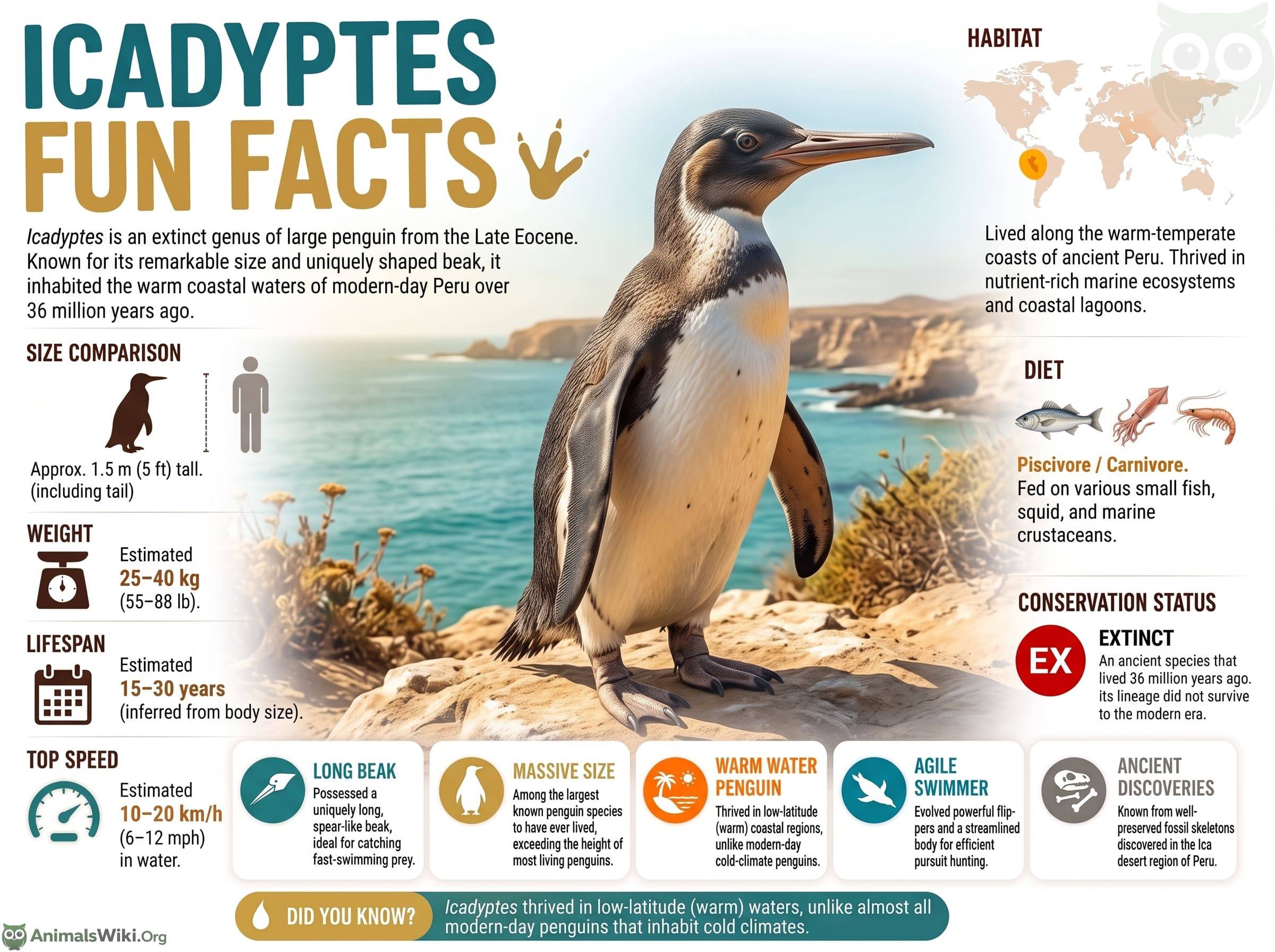
16. Icadyptes Fun Facts for Kids
- 🐧 Icadyptes salasi stood approximately 1.5 meters tall — roughly the height of an average adult human woman
- 🐧 It lived in warm tropical waters within 10 degrees of the ancient equator — where no modern wild penguin lives today
- 🐧 Its beak was so extraordinarily elongated and spear-like that it resembles no living penguin bill — a feeding strategy entirely lost from the modern penguin lineage
- 🐧 Icadyptes existed 36 million years ago — when the dinosaurs had already been extinct for nearly 30 million years
- 🐧 The discovery of Icadyptes in 2007 overturned previous models of penguin biogeographic history that had been accepted for decades
- 🐧 Its name means “Ica diver” — honoring both its Peruvian locality and its ecological role
- 🐧 The species name salasi honors Peruvian paleontologist Rodolfo Salas who discovered the fossils
- 🐧 Icadyptes lived alongside early whales, giant sharks, and other spectacular Eocene marine creatures in the ancient Peruvian sea
- 🐧 Its fossil is housed at Lima’s Natural History Museum — one of Peru’s most important scientific treasures
- 🐧 The Atacama Desert’s extreme aridity preserved Icadyptes fossils in remarkable condition for 36 million years
- 🐧 A roughly contemporaneous giant penguin from the same deposits — Inkayacu — had reddish-brown feathers, not the black-and-white of modern penguins
- 🐧 Icadyptes went extinct during the Eocene-Oligocene Transition — one of Earth’s most dramatic ancient climate change events
17. How You Can Support Paleontological Research
Support These Organizations
- Society of Vertebrate Paleontology (SVP) (vertpaleo.org) — the primary professional organization for vertebrate paleontologists worldwide; supports research, education, and the protection of fossil heritage; student and public memberships available
- Paleontological Research Institution (PRI) (priweb.org) — US institution supporting paleontological research and public education; Museum of the Earth provides excellent public engagement with fossil science
- Natural History Museum, London (nhm.ac.uk) — world-leading paleontological research institution; extensive public programs and online resources; charitable donations support ongoing research
- Museo de Historia Natural, Lima, Peru — supporting Peru’s primary natural history research institution directly supports the custodianship of the Icadyptes holotype and ongoing research on Peruvian fossil penguins
- Paleontological Society (paleosoc.orgpaleosoc.org) — professional paleontological organization; promotes the science of paleontology through research, education, and public outreach
What You Can Do
- Support open-access paleontology publishing — many landmark paleontology papers, including the original Icadyptes description, are freely available online; advocating for open-access scientific publishing ensures that paleontological discoveries reach the widest possible audience
- Visit natural history museums — museum attendance and membership fees directly fund the paleontological research and curation that makes discoveries like Icadyptes possible; supporting natural history museums is the most direct way most people can contribute to paleontological science
- Engage with science communication — the story of Icadyptes is genuinely exciting and accessible; sharing accurate information about ancient penguins and the science of paleontology through social media and personal networks builds public understanding and support for scientific research
- Support fossil protection legislation — important fossil discoveries are threatened by commercial fossil collecting and habitat destruction; supporting legislation that protects significant fossil localities preserves the record of life’s history for future scientific discovery
- Follow and share legitimate paleontological research — following researchers like Julia Clarke on academic platforms and sharing their publications helps ensure that important discoveries reach broad audiences and receive the public attention they deserve
Recommended Books & Resources
- 📖 “Dinosaurs: How They Lived and Evolved” by Darren Naish and Paul Barrett — excellent coverage of the transition from dinosaurs to modern birds including penguins
- 📖 “The Rise and Fall of the Dinosaurs” by Steve Brusatte — excellent context for the Mesozoic-Cenozoic transition and early bird evolution
- 📖 “Ancient Wings: The Story of Ancient Birds” by various paleontological authors — covers ancient bird evolution including stem penguins
- 🌐 PNAS Open Access — the original Clarke et al. 2007 Icadyptes paper freely available online
- 🌐 Penguin Sentinel (penguinsentinel.com) — excellent online resource for both modern penguin conservation and fossil penguin science
18. Frequently Asked Questions About Icadypte
Q1: What was Icadyptes salasi and when did it live?
Icadyptes salasi was a giant extinct penguin that lived approximately 36 million years ago during the Late Eocene epoch in what is now southern Peru. It stood approximately 1.5 meters (4.9 feet) tall — significantly larger than the Emperor Penguin, the largest living penguin — and possessed an extraordinarily elongated, spear-like beak unlike any living penguin species. It inhabited warm tropical coastal waters along the ancient Pacific coast of South America, at a time when global temperatures were significantly warmer than today and the cold currents that now characterize the Peruvian coast did not yet exist.
Q2: Why was the discovery of Icadyptes scientifically important?
The discovery of Icadyptes was scientifically revolutionary for several reasons. Most significantly, it demonstrated that penguins were living in warm tropical environments far earlier than previously believed — overturning models that predicted penguins had evolved in cold Antarctic waters and only gradually expanded to warmer latitudes. The fossil showed that a giant penguin existed at tropical latitudes (within 10 degrees of the paleoequator) 36 million years ago, when previous models suggested penguins should not yet have colonized such warm-water environments. The discovery also revealed an extraordinary beak form entirely unlike modern penguins, demonstrating greater diversity in early penguin feeding strategies than previously appreciated.
Q3: What did Icadyptes eat?
Based primarily on its extraordinary elongated, spear-like beak, Icadyptes is inferred to have been a spearing predator — using its long, narrow bill to strike and impale prey rather than grip it as modern penguins do. Its most likely prey items include large fish and cephalopods (squid and cuttlefish) abundant in the warm, productive Eocene coastal waters of Peru. Its large body size suggests it also pursued large individual prey rather than small fish — diving deep into the ancient ocean to reach mid-water fish populations inaccessible to smaller diving birds.
Q4: Where were Icadyptes fossils found?
The fossils of Icadyptes salasi were discovered in the Otuma Formation of the Ica Region in southern Peru — one of the world’s richest localities for ancient marine vertebrate fossils. The extreme aridity of the Peruvian Atacama Desert has preserved these fossils in remarkable condition for 36 million years. The fossils were discovered by Peruvian paleontologist Rodolfo Salas and colleagues, and the primary holotype specimen is housed at the Museo de Historia Natural of the Universidad Nacional Mayor de San Marcos in Lima, Peru.
Q5: How does Icadyptes compare to the largest living penguin — the Emperor Penguin?
The Emperor Penguin (Aptenodytes forsteri) is the largest living penguin, standing approximately 1.1–1.3 meters tall and weighing 22–45 kg. Icadyptes salasi is estimated to have stood approximately 1.5 meters tall — exceeding the Emperor Penguin by approximately 15–40 cm in height — and weighed an estimated 50–60 kg, making it substantially heavier. The most significant differences beyond size were ecological: the Emperor Penguin lives in polar Antarctic conditions, while Icadyptes inhabited warm tropical seas. The Emperor Penguin has a short, robust bill for gripping fish; Icadyptes had an extraordinarily elongated spearing bill unlike anything in the modern penguin family.
Q6: What caused Icadyptes to go extinct?
Icadyptes almost certainly went extinct during or shortly after the Eocene-Oligocene Transition (EOT) — approximately 33.9 million years ago — one of the most dramatic climate change events of the past 60 million years. The EOT was characterized by significant global cooling, the formation of the Antarctic ice cap, and the development of the Antarctic Circumpolar Current that thermally isolated Antarctica and dramatically altered ocean temperature patterns worldwide. The warm tropical coastal waters of Eocene Peru — the habitat that supported Icadyptes — cooled significantly during this transition, and the prey community that Icadyptes depended on would have changed dramatically. Unable to adapt rapidly enough to the cooling conditions, Icadyptes went extinct along with many other warm-adapted Eocene marine animals.
Q7: How do scientists know what Icadyptes looked like if it lived 36 million years ago?
Scientific reconstruction of Icadyptes combines several complementary approaches. The fossil skeleton provides direct anatomical information about bone sizes, shapes, and proportions — enabling reconstruction of overall body size, limb proportions, and beak morphology with considerable confidence. Comparison with modern penguins allows inference of features not preserved in the fossil (muscle attachment patterns, flipper efficiency, likely locomotion) based on similar structures in living relatives. Paleoecological context — the ancient environment reconstructed from geological and geochemical data — informs inferences about habitat and diet. Phylogenetic analysis — determining the evolutionary relationships of Icadyptes to other fossil and living penguins — helps constrain inferences about behavior and physiology based on what is known about close relatives.
Q8: Are there other giant extinct penguins similar to Icadyptes?
Yes — multiple giant penguin species are known from the fossil record, particularly from Late Eocene deposits across the Southern Hemisphere. The largest known penguin ever discovered is Palaeeudyptes klekowskii from Late Eocene Antarctica — estimated at approximately 1.65 meters tall and potentially 80–115 kg, significantly exceeding even Icadyptes in estimated size. Inkayacu paracasensis — from the same Peruvian deposits as Icadyptes, approximately contemporaneous — was another giant species notable for its preserved reddish-brown and grey feather coloration. The prevalence of giant penguins across multiple Eocene localities suggests that large body size was widespread in early penguins, facilitated by the warm, productive Eocene oceans, before global cooling drove subsequent size reduction in most lineages.
19. Sources Researched
The information in this article was researched and verified using the following authoritative sources:
- Clarke, J.A., Ksepka, D.T., Salas-Gismondi, R., Altamirano, A.J., Shawkey, M.D., D’Alba, L., Vinther, J., DeVries, T.J. and Baby, P. (2007) — “Paleogene equatorial penguins challenge the proposed relationship between biogeography, diversity, and Cenozoic climate change.” Proceedings of the National Academy of Sciences, 104(28), pp.11545–11550. — The foundational primary source
- Wikipedia — Icadyptes, Penguin evolution, Sphenisciformes, Eocene, Otuma Formation
- Paleobiology Database (paleobiodb.org) — Icadyptes salasi occurrence data and taxonomic information
- National Geographic (nationalgeographic.com) — Coverage of the 2007 Icadyptes discovery and related Peruvian fossil penguin discoveries
- Smithsonian Magazine — Coverage of ancient penguin discoveries and their scientific significance
- BBC Science — Coverage of Peruvian fossil penguin discoveries
- Ksepka, D.T. and Clarke, J.A. (2010) — Inkayacu paracasensis description including fossil feather coloration analysis; Science journal
- Jadwiszczak, P. (2009) — Review of fossil penguin diversity and evolutionary history; Polish Polar Research
- Acosta Hospitaleche, C. et al. — Multiple papers on South American fossil penguin systematics and biogeography
- Proceedings of the Royal Society B — Multiple papers on penguin evolutionary biology and biogeography
- Journal of Vertebrate Paleontology — Peer-reviewed research on fossil penguin anatomy and systematics
- Museo de Historia Natural, UNMSM, Lima, Peru (museohn.unmsm.edu.pe) — Institutional custodian of the holotype specimen
- University of Texas at Austin — Jackson School of Geosciences (jsg.utexas.edu) — Julia Clarke’s research group; source of ongoing fossil penguin research
- IUCN Red List (iucnredlist.org) — Modern penguin species conservation context
- New Zealand Journal of Geology and Geophysics — Early penguin evolution context from New Zealand fossil material
20. Icadyptes Images