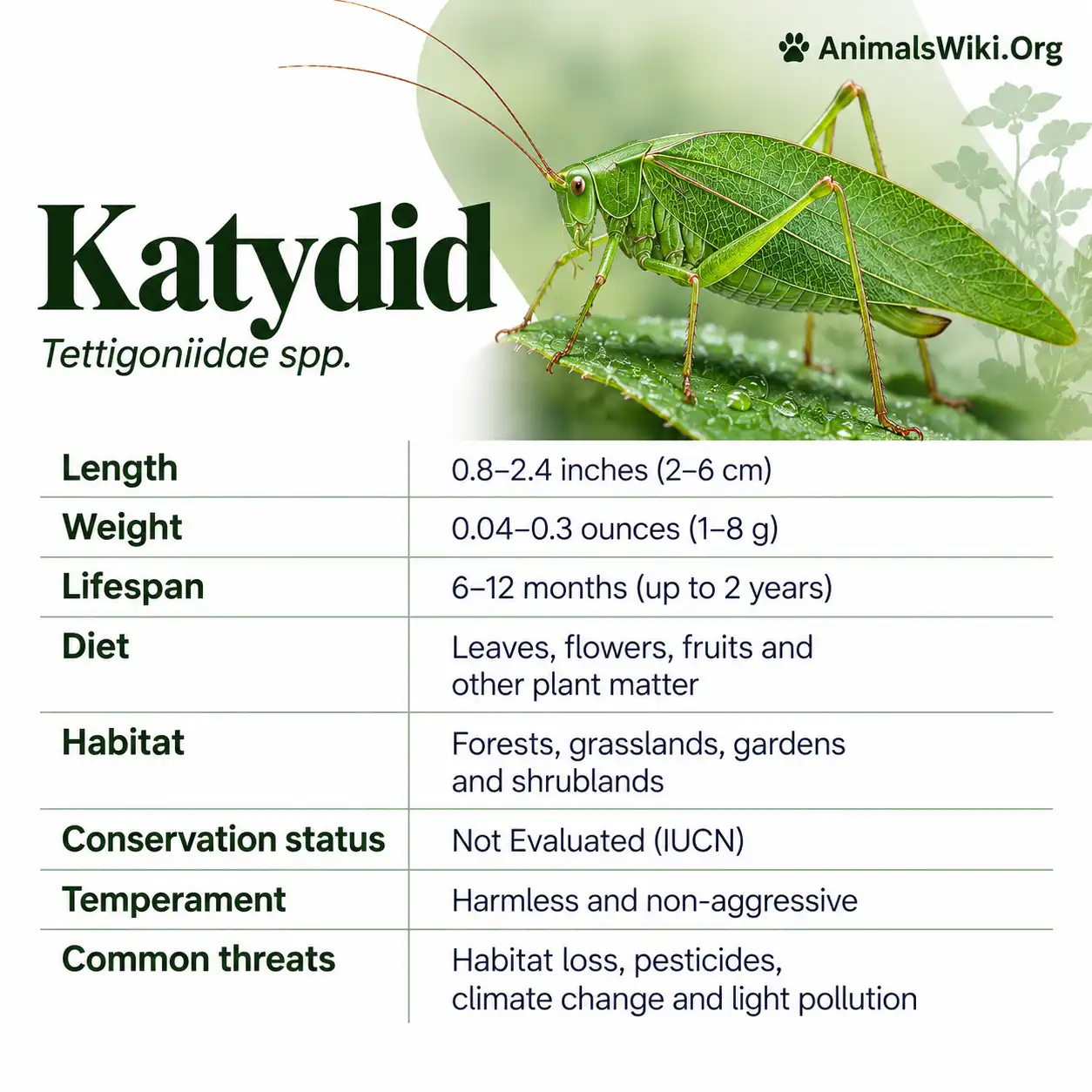
Katydid Facts
| Feature | Details |
|---|---|
| Common Name | Katydid (Great Green Bush-Cricket — focus species) |
| Scientific Name | Tettigonia viridissima (Great Green Bush-Cricket) |
| Family | Tettigoniidae |
| Order | Orthoptera |
| First Described | 1758 (by Carl Linnaeus) |
| Native Habitat | Grasslands, woodland edges, shrubland, gardens across Europe, Asia, and Africa |
| Geographic Range | Europe, North Africa, Middle East, Central and East Asia |
| Average Size | 28–42 mm body length; hindwings extend beyond abdomen |
| Average Weight | 0.9–2.5 grams |
| Lifespan | Approximately 1 year (complete life cycle); adults live 3–6 months |
| Diet | Omnivore — leaves, flowers, insects, invertebrates |
| Conservation Status | Least Concern (IUCN); some species threatened |
| Defining Feature | Extraordinary leaf mimicry; stridulation songs unique to each species; ears on front legs; remarkable camouflage |
| Number of Species | Approximately 8,000 species worldwide |
1. Katydid Species Overview & Classification
On a warm summer evening in virtually any temperate or tropical landscape on Earth, if you stop and listen — truly listen, with the patience that the modern world rarely allows — you will hear them. A rhythmic, pulsing chorus rising from the vegetation around you. A sound so pervasive, so consistent, so fundamental to the acoustic texture of summer nights that most people absorb it as background rather than music. But it is music — extraordinarily sophisticated acoustic communication produced by one of the most diverse and most remarkable insect families on Earth.
The Katydid — known in Britain and much of Europe as the bush-cricket — is the architect of this nocturnal symphony. With approximately 8,000 species distributed across every continent except Antarctica, katydids represent one of the most successful insect radiations in Earth’s history. They have colonized habitats from tropical rainforest canopies to temperate meadows, from desert scrub to Arctic tundra margins, from the ocean’s shoreline to alpine meadows at 4,000 meters elevation. And in virtually every habitat they occupy, they dominate the acoustic landscape of the night in ways that no other insect group can match.
The katydid’s defining characteristics are four in number, and each represents an evolutionary achievement of extraordinary sophistication. First, the sound production — the stridulation of wing-on-wing friction that produces the species-specific songs used for mate attraction, rival recognition, and territory defense. Second, the hearing apparatus — ears located not on the head (as in vertebrates) but on the front legs, just below the “knee” joint, where slit-like tympanic membranes detect the acoustic signals of conspecifics with remarkable precision. Third, the camouflage — particularly in tropical species, the mimicry of leaves so perfect that it includes not just color and shape but the veins, spots, and even the ragged edges of partially eaten leaves. Fourth, the diversity — 8,000 species occupying virtually every available acoustic and ecological niche, from the tiny grass-dwellers of European meadows to the enormous Weta relatives of New Zealand and the spectacular leaf-mimics of South American rainforests.
The Great Green Bush-Cricket (Tettigonia viridissima) — the largest and most widespread katydid of Europe — serves as the focus species for this guide. One of the most acoustically prominent insects of the European summer, its loud, sustained stridulation dominates meadow and grassland soundscapes from June to October across most of continental Europe and into Central Asia. But the guide also explores the extraordinary diversity of the global katydid family — from species that are barely distinguishable from the leaves they rest on to species that fight with spiked forelegs or glow in the dark.
Species Classification Table
| Classification Level | Details |
|---|---|
| Kingdom | Animalia |
| Phylum | Arthropoda |
| Class | Insecta |
| Order | Orthoptera |
| Suborder | Ensifera |
| Family | Tettigoniidae |
| Subfamily | Tettigoniinae |
| Genus | Tettigonia |
| Species | Tettigonia viridissima |
| Described By | Carl Linnaeus, 1758 |
| Total Family Species | ~8,000 species in ~1,000 genera |
Key Katydid Groups and Notable Species
| Group / Species | Common Name | Range | Notable Feature |
|---|---|---|---|
| Tettigonia viridissima | Great Green Bush-Cricket | Europe, Asia | Largest European katydid; very loud song |
| Microcentrum rhombifolium | Greater Anglewing | North America | Perfect leaf mimicry; angular wing shape |
| Pterophylla camellifolia | Common True Katydid | Eastern North America | Namesake “katy-did/katy-didn’t” call |
| Katydid (Stilpnochlora couloniana) | Cuban Katydid | Caribbean | Extremely large tropical species |
| Decticus verrucivorus | Wart-biter Bush-Cricket | Europe | Historically believed to bite warts off |
| Mecopoda elongata | SE Asia | Extraordinary synchronous chorusing | |
| Pseudophyllus titan | Titan Bush-Cricket | SE Asia | Among world’s largest katydid species |
| Acanthacara acuta | Thorn Mimic | South America | Mimics thorns on plant stems |
| Various Mimetica spp. | Dead Leaf Katydids | S America | Perfect dead leaf mimicry |
| Deinacrida spp. | Giant Weta | New Zealand | Up to 70g; world’s heaviest insect |
2. Katydid Physical Description & Unique Features
The katydid body plan is built around the dual imperatives of acoustic communication and camouflage — two evolutionary pressures that have shaped every aspect of its anatomy from the modified wings that produce sound to the leaf-shaped forewings that conceal its body from predators.
Size and Build
The Great Green Bush-Cricket (Tettigonia viridissima) is one of Europe’s largest insects — adults measuring 28–42 mm in body length with hindwings that extend beyond the tip of the abdomen, bringing total length to 50–70 mm in large females. Weight is typically 0.9–2.5 grams — substantial for an insect, though dwarfed by the largest tropical katydid species.
The body shape is characteristic of the family — elongated and laterally compressed (flattened from side to side), with:
- A small, rounded head bearing long, thread-like antennae that in most katydids exceed the body length and in some species reach extraordinary proportions
- A robust thorax housing the powerful flight and jumping muscles
- A long, cylindrical abdomen that in females terminates in the distinctive ovipositor — the egg-laying structure
- Long, powerful hind legs for jumping — the defining locomotion feature of the Orthoptera
- Four wings — the outer pair (tegmina or forewings) modified into tough, leaf-like structures serving for camouflage and sound production; the inner pair (hindwings) clear and membranous, folded beneath the tegmina at rest, used for flight
The Defining Wings — Sound Production and Camouflage Simultaneously
The katydid’s wings represent one of evolution’s most elegant examples of dual-purpose anatomy — the same structures serving two completely different functions simultaneously.
Camouflage function: The forewings (tegmina) of most katydids are colored, shaped, and textured to resemble leaves — the green of living leaves, the brown and tan of dead leaves, or in some species the complex patterns of partially decomposed or fungus-spotted foliage. The venation pattern of the tegmina — the network of veins visible on the wing surface — closely mirrors the vein pattern of real leaves, creating a camouflage so convincing that even experienced entomologists occasionally mistake resting katydids for actual vegetation.
Sound production function: In male katydids (and some females), the base of the left forewing carries a file — a series of microscopic ridges cut into the wing membrane — and the base of the right forewing carries a scraper — a hardened edge that rubs against the file. When the male raises his wings and rubs them together rapidly (stridulation), the scraper catches each ridge of the file in rapid succession, producing a series of sound pulses. The frequency, rate, and pattern of these pulses is precisely tuned by the geometry of the file and scraper — producing the species-specific song that females of the same species recognize and respond to.
This combination — the same wing structure serving as both leaf-camouflage during the day and sound-production apparatus during the night — is a masterwork of evolutionary economy.
The Long Antennae
Katydid antennae are extraordinarily long relative to body size — typically 1.5–3 times the body length in most species, and in some tropical species reaching 6–8 times the body length. These remarkable sensory organs function as:
- Mechanical sensors — detecting air movements and substrate vibrations
- Chemical receptors — bearing numerous olfactory sensilla for detecting food plants, pheromones, and predators
- Tactile probes — exploring the immediate environment in the darkness in which many katydids are active
The long antennae are one of the primary distinguishing features separating katydids (family Tettigoniidae, suborder Ensifera) from grasshoppers (suborder Caelifera) — grasshoppers have short, stubby antennae typically shorter than the body length.
The Ears on the Legs — Tibial Tympanic Organs
Perhaps the most immediately striking anatomical peculiarity of the katydid is the location of its hearing organs — not on the head, as in vertebrates, but on the front legs, just below the “knee” joint (the femoro-tibial joint of the forelegs).
Each foreleg carries a pair of tympanic membranes — thin, oval membranes stretched across a cavity that opens to the outside through one or two narrow slits. The tympanic membranes vibrate in response to sound waves; this vibration is detected by sensory neurons and transmitted via nerve fibers to the central nervous system.
This arrangement — ears on the legs — is not merely a curiosity but a remarkably effective hearing system. The two tympanic organs (one on each foreleg) provide the animal with binaural hearing — the ability to compare sound levels between two spatially separated detectors and thus determine the direction of the sound source. When a female katydid hears a male calling, she can orient toward the sound and locate its source by comparing the signals from her left and right “leg ears” — walking or flying toward the male with directional precision.
The ear’s location on the foreleg is also thought to provide advantages for hearing through substrate — the legs are in direct contact with the vegetation the animal rests on, and substrate-borne vibrations (footsteps of approaching predators, vibrations of singing males) may be detected through the legs as well as through airborne sound.
The Female Ovipositor
Female katydids are immediately distinguished from males by the prominent ovipositor — the egg-laying organ protruding from the tip of the abdomen. In different species, the ovipositor takes dramatically different forms:
- Sword-like (long, straight, blade-like) — in species that lay eggs into plant tissue or soil; the shape allows penetration of tough substrates
- Curved, sickle-shaped — in species that lay eggs into bark crevices or under bark
- Short and inconspicuous — in species that scatter eggs in loose soil or leaf litter
The ovipositor has frequently been mistaken for a stinger by people unfamiliar with katydids — an entirely understandable error given its often impressive size and vaguely threatening appearance. Female katydids do not sting; the ovipositor is purely for egg deposition. Some katydids can bite, however — the mandibles (jaws) of large species are capable of pinching skin and can cause discomfort.
Did You Know? The katydid hears with its legs — tympanic organs located on the front tibiae (just below the “knee”) detect sound waves with remarkable precision. Research using laser Doppler vibrometry (a technique that measures vibration with laser light) has revealed that these tiny leg-ears are extraordinarily sensitive — capable of detecting the calling songs of males at distances of over 100 meters and distinguishing the species-specific temporal patterns of different males’ calls with a precision that allows females to discriminate between individuals.
3. Katydid Habitat & Geographic Range
The Tettigoniidae family has achieved one of the broadest habitat distributions of any insect family — representatives are found on every continent except Antarctica, in habitats ranging from the most productive tropical rainforests to the most extreme desert margins, from sea level to alpine zones above the treeline.
The Great Green Bush-Cricket — European Meadows and Beyond
Tettigonia viridissima occupies an enormous range across the Palearctic region — from the Atlantic coasts of Europe east across the entire Eurasian landmass to Japan and China, and from southern Scandinavia south through the Mediterranean to North Africa and the Middle East. Within this vast range, it occupies:
Tall grassland and meadow — the preferred habitat across most of the range; areas of tall, rank grass (particularly where grasses and forbs are mixed) with sunny, sheltered aspects provide the combination of food, calling perches, and egg-laying sites the species requires
Grassland-shrub ecotones — the boundary between open grassland and shrubby vegetation is particularly favored; the shrubs provide elevated singing perches from which males call, and the grassland provides hunting opportunities
Road verges and railway embankments — across Europe, the rough, unmanaged grassland of road and railway margins provides excellent habitat; the Great Green Bush-Cricket is frequently encountered in these linear habitats
Coastal heathland and dunes — particularly in Britain, where the species reaches the northwestern margin of its range; warm, sheltered dune slacks and coastal grassland support populations
Vineyard margins and agricultural borders — in southern Europe, the warm, well-vegetated margins of agricultural land support good populations
Global Katydid Habitat Diversity
| Region | Habitat Type | Notable Species / Groups | Key Features |
|---|---|---|---|
| European meadows | Tall grassland, grassland-shrub | Tettigonia, Decticus, Platycleis | Relatively simple vegetation; seasonal |
| North American forests | Deciduous woodland, undergrowth | Pterophylla, Microcentrum, Scudderia | Tree-dwelling; leaf mimics |
| South American rainforest | Tropical rainforest canopy | Mimetica, Acanthacara, leaf mimics | Extraordinary diversity; perfect mimics |
| Australian scrub | Eucalyptus woodland, grassland | Caedicia, Hemisaga | High endemism; diverse |
| African savannah | Grassland, bush | Ruspolia, Conocephalus | Economically important pest species |
| Southeast Asian forest | Tropical and subtropical forest | Mecopoda, Pseudophyllus | Giant species; synchronous singers |
| Desert margins | Arid scrub, dry grassland | Ephippiger, Platycleis | Reduced wings; drought-adapted |
| Alpine zones | High-altitude grassland | Various cold-adapted species | Short-season specialists |
Microhabitat Use — Vertical Stratification
Within any given habitat, different katydid species occupy different vertical strata — partitioning the vegetation layers to reduce competition and exploit different food and acoustic resources:
Ground layer (0–20 cm): Typically occupied by smaller, short-winged or wingless katydids that hunt invertebrate prey in leaf litter and low vegetation
Herb layer (20–100 cm): The primary calling stratum for many species; males perch on stems of tall forbs and grasses to project their calls
Shrub layer (1–3 m): Used by larger species for elevated calling perches; also where many tree-feeding species forage
Canopy (3 m+): Occupied by tree-dwelling species in forests; often the most diverse and least well-known katydid community
This vertical stratification means that a single meadow or forest fragment may support 5–15+ katydid species simultaneously, each occupying a slightly different position in the three-dimensional habitat space.
Did You Know? The Weta — the giant orthopteran insects of New Zealand, some of which grow to over 70 grams (making them the heaviest insects in the world) — are members of the katydid family (Tettigoniidae) or its close relatives. These extraordinary animals, which evolved on isolated New Zealand in the absence of native land mammals, fill ecological niches occupied by small mammals elsewhere — including seed dispersal, soil burrowing, and herbivory. The Giant Weta (Deinacrida heteracantha) of Little Barrier Island holds the record for the world’s heaviest insect — a gravid female photographed in 2011 weighed 71 grams (2.5 oz).
4. Katydid Diet & Feeding Behavior
The katydid’s dietary habits are considerably more complex and interesting than most people assume for an insect that is commonly perceived as a simple leaf-eater. While many katydid species do consume substantial quantities of plant material, the family as a whole spans the dietary spectrum from strict herbivores to voracious predators — and even within individual species, diet often shifts opportunistically with the availability of different food resources.
The Herbivore-Carnivore Spectrum
Strictly herbivorous species — primarily consume leaves, flowers, pollen, seeds, and soft plant parts; common in many grassland and meadow species; the pollen consumption of some species is particularly significant as a high-protein food source during the reproductive season
Omnivorous species (including Tettigonia viridissima) — consume both plant material and invertebrate prey; the plant component provides carbohydrates and water; the animal component provides proteins and fats essential for egg production
Primarily predatory species — several katydid groups are predominantly or exclusively carnivorous; these include some of the most spectacular tropical species with powerful, spined forelegs adapted for seizing prey
Kleptoparasitic species — some katydids steal prey from spiders’ webs — a remarkably sophisticated foraging strategy
The Great Green Bush-Cricket’s Diet
Tettigonia viridissima is an opportunistic omnivore with strong carnivorous tendencies — particularly in terms of the protein intake needed for reproduction. Its diet includes:
Invertebrate prey (primary protein source):
- Various grasshopper species — a major prey item; the bush-cricket stalks and seizes grasshoppers with its powerful mandibles
- Caterpillars — consumed readily when encountered
- Aphids and other soft-bodied bugs — grazed from plant surfaces
- Other insects encountered during foraging
Plant material (carbohydrate and water source):
- Grass and forb leaves — consumed particularly by juveniles and during periods of invertebrate scarcity
- Flowers — particularly valuable for pollen protein
- Seeds — nutritionally dense; consumed when available
The Hunting Strategy
The hunting behavior of predatory and omnivorous katydids involves a characteristic stalking approach — the insect moves slowly through vegetation, antennae probing ahead, and strikes prey with a rapid lunge and grasp using the forelegs and mandibles. The mandibles of large katydid species are remarkably powerful — capable of biting through the tough exoskeleton of other large insects and drawing blood from human fingers.
Research using stable isotope analysis of wild-caught katydids has revealed that even species traditionally classified as herbivores often consume considerably more animal protein than their gut contents alone would suggest — the high digestibility of insect prey versus plant material means that animal protein contributes disproportionately to tissue composition relative to its volume in the diet.
Nuptial Feeding — Food as a Reproductive Investment
One of the most extraordinary dietary phenomena in katydids is the spermatophylax — the large, protein-rich food gift that male katydids attach to their spermatophore (sperm package) during mating. The spermatophylax is a gelatinous mass of proteins and nutrients that the female consumes during and after mating — while she is eating the spermatophylax, the sperm transfer from the spermatophore into her reproductive tract proceeds.
The spermatophylax represents a substantial male reproductive investment — in some species, it can constitute up to 25% of the male’s body weight. Research has demonstrated that the nutrients in the spermatophylax are incorporated into the female’s eggs — meaning that the male is literally investing food resources into his own offspring through the medium of the female’s consumption of the gift. This represents one of the most direct examples of paternal nutrient investment in any insect.
Diet Breakdown Table
| Food Type | % of Diet (T. viridissima) | Season | Notes |
|---|---|---|---|
| Invertebrate prey (grasshoppers, caterpillars) | 35–50% | Summer | Primary protein source; essential for reproduction |
| Leaves and forbs | 20–30% | Spring–autumn | Juveniles particularly dependent; water source |
| Flowers and pollen | 15–20% | Early summer | High-protein supplement; essential pre-reproductive |
| Seeds | 5–10% | Late summer | Calorie-dense; late-season diet shift |
| Other invertebrates | 5–10% | Summer | Aphids, small larvae; opportunistic |
“Katydids are the acoustic architects of the insect world. Their songs — each species-specific, precisely structured, and carried across extraordinary distances — represent one of the most sophisticated communication systems in the entire animal kingdom outside of vertebrates. The evening chorus of a summer meadow is not background noise; it is the complex acoustic landscape of an entire community of animals negotiating mating, territory, and survival.” — Dr. Klaus-Gerhard Heller, Acoustic Entomologist, University of Halle
5. Katydid Reproduction & Life Cycle
The katydid’s reproductive biology is organized around the acoustic communication system that is the family’s most celebrated feature — but the details of mate choice, mating behavior, and life cycle reveal layers of biological sophistication that go far beyond the simple production of sound.
Annual Life Cycle — A Single Generation Per Year
Most temperate katydid species, including Tettigonia viridissima, complete one generation per year — a pattern called univoltine reproduction. The life cycle is timed precisely to the seasonal availability of food and the temperatures needed for development:
Egg stage (autumn–spring): Eggs are laid in late summer and autumn into soil or plant tissue; the eggs overwinter in the ground, cold-tolerant and dormant; hatching is triggered by warming spring temperatures
Nymph stages (spring–summer): Newly hatched nymphs pass through 5–7 instars (molting stages) over approximately 2–3 months; at each molt, the nymph grows larger and wing pads become more developed; behavioral repertoire increases progressively with each instar
Adult stage (summer–autumn): Adults emerge in June–July in most of the range; males begin calling shortly after final molt; females mature sexually over the following weeks; mating occurs through summer; egg-laying begins in late summer and continues through autumn; adults die with the first frosts
Male Calling — The Acoustic Advertisement
The calling song of the male katydid is the central event around which the entire reproductive process is organized. In Tettigonia viridissima, the male produces a loud, sustained, high-frequency song (typically 12–16 kHz) by raising his forewings and rubbing them together rapidly. The song is loud enough to be heard by humans at distances of 50–100 meters and by females (whose ears are more sensitive to the relevant frequencies) at considerably greater distances.
The calling song serves multiple functions:
Female attraction — the primary function; females use the song to locate potential mates, moving toward the source of calling
Species identification — the precise temporal pattern of the song (the rate of chirps, the pattern of syllables within chirps, the carrier frequency) is species-specific; females respond to the song of their own species and largely ignore the songs of other species calling simultaneously in the same habitat
Male-male signaling — males reduce calling when they detect a nearby rival’s song; territory-like acoustic spacing prevents males from calling in overlapping areas
Condition advertisement — research has demonstrated that call characteristics (calling rate, bout duration, temporal precision) correlate with male body condition and health — high-quality males call more consistently and at higher rates; females use these features for mate quality assessment
Female Choice — The Active Selector
Female katydids are active choosers — walking or flying toward calling males and selecting among them based on call characteristics. Research on multiple species has demonstrated that females prefer:
Higher calling rates — males calling faster are typically in better condition and have more energy reserves
Greater temporal precision — males with more regular, predictable call timing are preferred in some species
Longer song bouts — males that call for longer periods without pausing demonstrate greater energetic resources
Proximity — in the final stages of mate search, females typically select the nearest calling male that meets minimum quality thresholds — a strategy that balances quality assessment against the predation risk of prolonged exposed movement
Mating and the Spermatophore
When a female approaches a calling male, the mating sequence begins with a period of antennal contact and tactile assessment. Mating in katydids involves the transfer of a spermatophore — a complex packet containing both a sperm ampulla (the actual sperm mass) and the spermatophylax (the nutrient gift described in the diet section).
The spermatophore is attached externally to the female’s genital opening; the female immediately begins consuming the spermatophylax with her mandibles. While she feeds, sperm from the ampulla transfer into her reproductive tract. The entire process takes 30–90 minutes depending on species and spermatophylax size.
Females may mate with multiple males during the breeding season — stored sperm from different males compete for fertilization in a process called sperm competition. Research suggests that females may strategically control which male’s sperm fertilize her eggs based on various factors including spermatophylax quality.
Egg-Laying and Overwintering
After mating, females begin ovipositing — inserting their ovipositor into suitable substrates and depositing eggs. Tettigonia viridissima lays eggs into soil using its long, sword-like ovipositor — pushing it into soft ground and depositing eggs at depths of 1–3 cm. A single female may lay 50–200 eggs during her adult life.
The eggs contain diapause mechanisms — biochemical systems that enforce developmental dormancy through winter regardless of temperature — ensuring that hatching does not occur during warm periods in autumn or winter that might expose nymphs to subsequent cold weather before sufficient food is available.
Katydid Lifespan Comparison
| Insect | Average Lifespan (Adult) | Total Life Cycle |
|---|---|---|
| Great Green Bush-Cricket | 3–6 months | ~12 months (egg to adult death) |
| Common Cricket (Gryllus campestris) | 2–4 months | ~12 months |
| Desert Locust (Schistocerca gregaria) | 3–5 months | 3–5 months (no egg overwintering) |
| Monarch Butterfly | 2–6 weeks (summer); 8 months (migratory) | 2–6 months |
| Praying Mantis | 4–6 months (adult) | ~12 months |
| Giant Weta (Deinacrida spp.) | 1–2 years | 2–3 years (multiple years to mature) |
Did You Know? The male katydid’s spermatophylax — the large protein food gift attached to his sperm package — can represent up to 25% of his total body weight in some species. A human male equivalent would be offering a gift weighing approximately 15–20 kg as part of the mating process. Research has shown that females with access to larger, more nutritious spermatophylaxes produce more eggs and eggs of higher quality — making the male’s food gift a genuine fitness-enhancing paternal investment rather than merely a mechanism to prolong sperm transfer.
6. Social Behavior & Communication
The katydid’s social life is organized almost entirely around acoustic communication — a communication system of extraordinary sophistication that serves functions from mate attraction to predator warning, from territorial spacing to synchronization of group behavior.
The Acoustic Communication System
The katydid’s song is not a simple on/off signal but a structured, information-rich acoustic message organized at multiple temporal levels:
The syllable — the fundamental unit of sound; produced by a single scraper-file contact during wing closure or opening
The chirp — a group of syllables produced during a single wing movement; the number of syllables per chirp is species-specific
The verse — a group of chirps separated by a brief pause; the pattern of verse repetition constitutes the recognizable “song”
The calling bout — a continuous period of singing separated from other bouts by longer pauses; calling bouts can last hours in good conditions
This hierarchical structure means that the song encodes information at multiple timescales simultaneously — species identity in the overall pattern, individual quality in the precise timing, and current motivation in calling rate and bout duration.
Synchronous Calling — The Remarkable Chorus Phenomenon
One of the most spectacular acoustic behaviors in the katydid world is synchronous calling — where males in a group synchronize their calls so that all individuals call at precisely the same moment, then fall silent together.
This phenomenon has been studied most thoroughly in the Southeast Asian species Mecopoda elongata — where groups of males synchronize to produce a remarkable alternating or simultaneous chorus pattern. The synchronization is achieved without any visual contact between males — purely through acoustic feedback; each male adjusts the timing of its own call based on the calls it hears from neighbors.
The adaptive significance of synchrony is debated — competing hypotheses include:
- Female preference for synchrony — females may prefer to approach synchronized male groups
- Acoustic interference avoidance — synchronization prevents males’ calls from overlapping and masking each other
- Predator confusion — synchronized calling makes it difficult for predators to locate individual singers
Female Phonotaxis — Moving Toward Sound
The female’s response to male calling — phonotaxis (movement toward a sound source) — is one of the best-studied behaviors in all of invertebrate biology. Females demonstrate remarkably precise acoustic discrimination:
Species discrimination — females approach only the correct species’ song with high selectivity; playing synthesized songs with subtle modifications to frequency or temporal pattern rapidly reveals the precise acoustic features that trigger female approach versus rejection
Quality discrimination — females discriminate between males of the same species based on call characteristics, preferring males with higher calling rates and more precise timing
Distance assessment — females can estimate the distance to a calling male from sound level differences between their two leg-ears and from the broadening of the temporal pattern at distance
Predator avoidance during phonotaxis — females moving toward males are exposed and vulnerable; research has demonstrated that females interrupt phonotaxis when they detect the calls of bat predators, hiding rather than continuing to approach the male signal
Vibration Communication — The Substrate Channel
Beyond airborne sound, many katydids also communicate through substrate-borne vibration — generating and detecting mechanical waves transmitted through the plant stems and leaves they rest on. This vibrational communication channel is invisible to airborne eavesdroppers (including predators) and can carry signals across the plant without revealing the signaler’s position.
Research using laser vibrometry has documented complex vibrational signals in multiple katydid species that are entirely inaudible to human ears and largely invisible to standard acoustic recording equipment — suggesting that the full complexity of katydid communication has been substantially underestimated.
7. Predators & Defense Mechanisms
The katydid’s predator community is diverse and formidable — spanning bats, birds, spiders, mantids, and parasitic flies. The evolutionary pressure of this predator community has driven the development of the katydid’s most celebrated feature — its extraordinary capacity for disguise — as well as a repertoire of other defensive strategies of remarkable sophistication.
Natural Predators
Bats — the most significant and most studied predator of nocturnal katydids. Insectivorous bats locate katydids through both passive acoustic detection (hearing the males’ calling songs) and active echolocation. The bat-katydid acoustic arms race has driven the evolution of some of the katydid’s most remarkable behavioral adaptations.
Birds — diurnal birds (robins, thrushes, warblers, shrikes) are major predators of katydids that are active or visible during daylight hours; nocturnally active birds including owls take katydids resting in vegetation at night
Parasitoid flies (family Tachinidae) — particularly devastating predators of katydids; female tachinid flies locate calling male katydids using phonotaxis (the same strategy used by female katydids) and deposit larvae onto or near the katydid’s body; larvae burrow into the katydid and consume it from within; one species (Euphasiopteryx ochracea) has been extensively studied as a satellite eavesdropper on katydid calls
Parasitoid wasps — various wasp species parasitize katydid eggs and nymphs
Spiders — both orb-weavers and hunting spiders take significant numbers of katydids
Praying mantids — ambush predators that take katydids resting in vegetation
Amphibians and reptiles — frogs, lizards, and geckos consume katydids encountered during nocturnal activity
Camouflage — The Masterwork of Insect Disguise
The katydid family includes some of the animal kingdom’s most extraordinary camouflage specialists — animals that have evolved disguises so perfect that they are genuinely indistinguishable from their background to any but the most careful examination.
Living leaf mimicry — the most sophisticated form; tropical katydids in families including Mimetica, Cycloptera, and many others have evolved a suite of leaf-mimicking features:
- Overall leaf shape — the wings are shaped like a specific leaf species, complete with petiole-like extension at the base
- Leaf vein mimicry — the wing venation pattern precisely replicates the branching pattern of leaf veins
- Color matching — not just green, but the specific shade of green (or brown, or tan) of particular plant species at particular seasons
- Translucency patterns — some species mimic the look of leaves held up to light, with translucent windows between veins
- Damage mimicry — the most extraordinary feature; some species mimic partially eaten leaves, including the irregular edges, fungal spots, and discoloration of damaged plant tissue
- Midrib shadow — some species have a ridge on the wing that casts a shadow precisely replicating the midrib of a leaf
Dead leaf mimicry — equally extraordinary; brown and tan species that rest on dead leaf litter are essentially invisible against their background; some species add irregular, ragged wing edges that replicate the torn edges of decomposed leaves
Bark and lichen mimicry — some species rest on tree bark and mimic bark texture and lichen patterns with remarkable fidelity
Thorn mimicry — some South American species (Acanthacara and relatives) mimic the thorns of the plants they rest on — adopting a posture that makes them appear to be simply another thorn on the stem
Acoustic Counter-Predator Adaptations
The bat-katydid acoustic arms race has produced some of the most remarkable anti-predator adaptations in the insect world:
Ultrasonic hearing — many katydids can hear the ultrasonic echolocation calls of bats (typically 20–100 kHz) using the same tympanal ears they use for conspecific communication. When a bat’s echolocation is detected, the katydid performs a dive or drop response — immediately ceasing all movement and either dropping from its perch or flying evasively
Reduced calling in bat-dense environments — katydids in bat-dense habitats call less frequently, less loudly, or at lower frequencies than conspecifics in bat-poor environments — a behavioral adjustment that reduces eavesdropping risk at the cost of reduced mate attraction effectiveness
Calling from protected positions — males often call from within dense vegetation where bats cannot maneuver effectively
Frequency matching — some katydids have shifted their calling frequency into ranges less detectable by local bat species
Chemical Defenses
Some katydid species produce defensive secretions — mixtures of compounds that are distasteful or toxic to predators. When handled or attacked, these species can discharge fluid from glands on various parts of the body. The color and conspicuousness of some katydid species (particularly some tropical forms with vivid green, red, or orange markings) suggests aposematism — warning coloration advertising chemical unpalatability.
8. Relationship with Humans
Ancient and Traditional Relationships
Katydids have accompanied human civilization throughout its development — their nocturnal chorus an essential component of the acoustic landscape of human habitation across the world’s temperate and tropical regions.
In China and Japan, katydids (particularly singing species) have been appreciated as musical insects for over 2,000 years. The tradition of keeping singing insects in elaborate cages for their song — a practice documented as far back as the Tang Dynasty (618–907 AD) — has been applied to katydids as well as crickets. Some species were specifically selected for the quality and consistency of their song, breeding programs developed to improve singing performance, and elaborate bamboo and gourd cages crafted for their housing. The practice continues today in parts of China and Japan.
European folk traditions produced numerous katydid references — particularly the Wart-biter Bush-Cricket (Decticus verrucivorus), which was believed in Scandinavian and Central European folk medicine to be capable of biting off warts — the animal’s mandibles placed on a wart until it was induced to bite, and the wart subsequently expected to heal. While obviously without medical validity, this use is documented across multiple European cultures and gave the species its common name.
The Katydid Name — A Distinctively American Story
The name “katydid” itself is one of the most charming etymological stories in entomology. It derives from the two-note call of the Common True Katydid (Pterophylla camellifolia) of eastern North America — a sound that inspired onomatopoeic transcription as “KA-ty-DID” or “KA-ty-DIDN’T” by early American settlers.
The call — produced by alternating males in a group, creating a back-and-forth pattern — was elaborated in American folk imagination into a debate: one male saying “Katy-did!” and the next responding “Katy-didn’t!” The name was formalized in print by the early 19th century and has remained the standard North American common name for the family ever since. It represents one of the few cases where an animal’s name is derived from a folk transcription of the animal’s own vocalization.
Agricultural Importance
Some katydid species are significant agricultural pests in parts of Africa, Asia, and Australia:
Ruspolia differens (the Longhorned Grasshopper or “Nsenene” in Uganda) — massive swarms can devastate crops across East Africa; the species is simultaneously an agricultural pest and an important human food source in Uganda, Rwanda, and neighboring countries — consumed fried or dried in large quantities during seasonal swarm events
Various Australian species — some Caedicia and related species cause damage to grape vines and fruit trees in parts of eastern Australia
Tropical forest species — large predatory katydids in some regions consume significant numbers of beneficial insects including bees and other pollinators
Katydids in Human Food
While not as widely consumed as grasshoppers or crickets, katydids are eaten in several cultures:
Uganda and East Africa — Ruspolia differens (Nsenene) are harvested in enormous quantities during their swarm seasons (November–December and May–June); sold in markets, fried in oil, and consumed as a nutritious high-protein food; the trade represents significant economic activity and the species is embedded in local cultural traditions
Thailand and Southeast Asia — various large katydid species are consumed fried or roasted; sold at street food markets alongside other insects
Mexico — some species are consumed in certain regions as part of broader indigenous insect-eating traditions
Scientific Importance — Bioacoustics and Biomimicry
Katydids have been model organisms for several fields of biological research:
Bioacoustics — the katydid’s relatively accessible and well-characterized song production and detection system has made it one of the primary model systems for studying animal acoustic communication, sound production physics, and hearing mechanisms
Biomimicry — the extraordinary leaf-mimicry of tropical katydids has inspired research in cryptic coloration patterns with applications in military camouflage technology, materials science, and computer pattern recognition
Sexual selection research — the katydid’s well-studied female choice system, spermatophore economics, and nuptial feeding have made it a key model for testing theories of sexual selection and parental investment
Did You Know? In Uganda, the seasonal swarms of the katydid Ruspolia differens — known locally as “Nsenene” — are such a culturally and economically significant event that special streetlights are erected at roadsides to attract the insects during their November and May swarming seasons, and harvesters pay to operate collection stations. The insects are cleaned, fried in their own body fat, and eaten as a nutritious snack food rich in protein and fat. During peak swarm periods, tonnes of Nsenene are harvested and sold per night in Kampala and other Ugandan cities — representing one of the world’s largest and most culturally embedded insect food traditions.
9. Katydid Conservation Status & Threats
IUCN Status
- Great Green Bush-Cricket (Tettigonia viridissima): Least Concern — widespread and generally abundant across its enormous range
- Most common European species: Least Concern — stable or declining moderately
- Several specialist species: Near Threatened to Critically Endangered — particularly UK and European species with restricted habitat requirements
- Wart-biter Bush-Cricket (Decticus verrucivorus): Critically Endangered in the UK — one of Britain’s most endangered insects; restricted to a handful of sites
Key Threatened Species — The UK Example
Britain provides one of the best-documented examples of katydid conservation concern. Of the approximately 30 katydid/bush-cricket species recorded from Britain:
The Wart-biter (Decticus verrucivorus) — formerly widespread across southern England; now restricted to fewer than 10 known sites in England; one of Britain’s rarest and most legally protected insects; classified as Critically Endangered in Britain; requires short, warm, chalk grassland maintained by grazing; has been the subject of expensive and intensive captive breeding and reintroduction programs
The Field Cricket (Gryllus campestris) — not a true katydid but related Orthoptera; reduced to a handful of Sussex sites in Britain; subject to active conservation management
Key Threats
1. Habitat Loss and Agricultural Intensification The primary threat to most threatened katydid species globally is the loss and degradation of suitable habitat:
- Conversion of traditional grassland to intensive agriculture — the plowing of species-rich permanent grassland eliminates the diverse plant communities that support most grassland katydid species
- Agricultural improvement — the application of nitrogen fertilizers to grassland encourages rank grass monocultures at the expense of the diverse forb-rich swards that katydids require
- Loss of hedgerows — hedgerow removal eliminates the sheltered, structurally diverse habitats used by many species
- Scrub encroachment — the cessation of traditional grazing management on calcareous grassland allows scrub to replace the short, warm turf that specialist species require
2. Climate Change Climate change is having complex and often contradictory effects on katydid populations:
Potential benefits: Warming temperatures are allowing some species to expand their ranges northward and to higher elevations; the Great Green Bush-Cricket, for example, has expanded its range in Britain significantly since the 1990s, colonizing areas previously too cold for breeding populations
Potential harms: The disruption of phenological synchrony — the timing of katydid emergence relative to food plant availability — could mismatch prey availability with nymph development stages; extreme weather events (drought, flooding) can cause direct mortality
Range shifts creating conservation problems: As some warm-adapted species expand, they may displace cold-adapted specialist species from their remaining habitats, reducing overall diversity even as the expanding species appears to be “doing well”
3. Pesticide Use The widespread application of insecticides in agricultural and urban environments directly kills katydids and indirectly affects them by eliminating the invertebrate prey and diverse plant communities they depend on. Neonicotinoid insecticides have been documented to affect the neurological function of non-target insects including Orthoptera.
4. Light Pollution Increasing artificial light at night disrupts katydid acoustic communication — males may call less effectively in lit environments (because calling attracts predators whose hunting effectiveness is increased by light), and females’ phonotaxis toward calling males may be disrupted by artificial light cues. The growing body of research on artificial light’s impacts on insect behavior increasingly identifies it as a significant conservation threat.
10. Famous Katydids Around the World
The Wart-Biter — Britain’s Most Famous Endangered Insect
The Wart-biter Bush-Cricket (Decticus verrucivorus) holds a unique position in British conservation — it is among the country’s most endangered insects, it has one of the most memorable common names in British entomology, and it has been the subject of more intensive and more expensive conservation intervention than almost any other British insect.
Once found across southern England, the species is now restricted to fewer than 10 sites — all on the North Downs, South Downs, and one or two other chalk grassland locations. Its requirements are demanding and very specific — short-turf, warm-aspect chalk grassland maintained by sheep or rabbit grazing, with specific temperature micro-climate conditions. The species has been captive-bred at Ryton Organic Gardens and subsequently reintroduced to managed sites, but establishment success has been variable.
The Synchronous Chorus Performers — Mecopoda elongata
The Southeast Asian katydid Mecopoda elongata has become the most studied species in research on synchronous calling in insects. Males synchronize their calls to within milliseconds of each other, producing the remarkable alternating or simultaneous chorus patterns that have fascinated bioacoustics researchers for decades. The mathematical models developed to explain Mecopoda synchrony (based on phase oscillator theory) have been applied to synchronous phenomena in other biological systems including firefly flashing and neural oscillations.
The Leaf Mimics — Mimetica and Relatives
The leaf-mimicking katydids of South America — particularly species of Mimetica, Cycloptera, and related genera — have become iconic images in popular science coverage of animal camouflage. Photographs of these extraordinary insects, indistinguishable from real leaves down to the vein patterns and fungal spots, appear in virtually every popular book on animal camouflage, biology education materials worldwide, and scientific papers on visual deception. They represent arguably the most perfect examples of visual mimicry in the animal kingdom.
The Giant Weta — World’s Heaviest Insect
The Giant Weta (Deinacrida heteracantha) of Little Barrier Island (Hauturu), New Zealand holds the record as the world’s heaviest insect — a gravid female photographed in 2011 by British television presenter Mark Moffett weighed 71 grams (2.5 oz) — approximately the weight of a small sparrow. This remarkable animal, a member of the weta family (Anostostomatidae — closely related to Tettigoniidae), represents the extreme of body size evolution in the katydid lineage, having evolved giant size on an island free of native land mammal predators.
11. Role in Ecosystem & Food Chain
As Prey — Sustaining the Nocturnal Food Web
Katydids are among the most important prey species in the nocturnal insect food web of temperate and tropical environments — their abundance, their nocturnal activity period, and their large body size making them significant prey for bats, owls, and other nocturnal predators.
Bat nutrition — insectivorous bats in many temperate habitats depend substantially on katydids during the summer months; the acoustic conspicuousness of calling males makes them easily detectable prey. Research tracking the diets of European and North American bat species through molecular analysis of fecal DNA has consistently revealed katydids as significant dietary components.
Bird nutrition — during the nesting season, birds provisioning chicks with high-protein invertebrate prey take substantial numbers of katydids; the protein-richness of katydid tissue (particularly female katydids with their developing egg loads) makes them particularly valuable prey.
As Predators — Controlling Invertebrate Populations
Omnivorous and predatory katydids consume significant quantities of invertebrate prey — including pest species. Some katydid species have been investigated as potential biological control agents for agricultural pest insects, though no commercially practical system has been developed.
The predatory function of katydids in ecosystem regulation is difficult to quantify precisely but is likely significant given their biomass in productive grassland and forest habitats.
As Herbivores — Plant Community Dynamics
Herbivorous katydid species consume substantial quantities of plant material during their active season. In some ecosystems, concentrated katydid herbivory can influence plant community composition — preferentially consuming some plant species over others, creating patterns of differential damage that influence competitive outcomes among co-occurring plants.
In agricultural settings, this herbivory becomes economically damaging — some species are significant crop pests. In natural ecosystems, the same herbivory may contribute to plant diversity by reducing the dominance of competitive plant species.
As Acoustic Ecosystem Engineers
Perhaps the most unusual ecological role of katydids — and the one most often overlooked — is their function as acoustic ecosystem engineers. The acoustic environment of a summer night in a temperate meadow or tropical forest is shaped primarily by katydid calls. This acoustic environment is not merely a background to other ecological processes but actively influences the behavior of other species:
Predator behavior — the acoustic signature of calling katydids influences the movement and foraging patterns of bats, owls, and other acoustic predators across landscapes
Plant-insect interactions — research has demonstrated that plants respond to the acoustic vibrations of feeding insects (including katydids) by upregulating defensive chemical production — a phenomenon called acoustic priming or plant bioacoustics
Other insect species — the calls of katydids may influence the behavior of other nocturnal insects that detect them as acoustic cues for habitat assessment or predator presence
12. Katydid Discovery & Evolution Timeline
~320–300 million years ago — The order Orthoptera (grasshoppers, crickets, and katydids) diverges from other insect orders during the Carboniferous period; early orthopterans inhabited the great coal swamp forests of the Paleozoic.
~250 million years ago — The family Tettigoniidae lineage is established; early katydid-like insects are present in the fossil record.
~200 million years ago — Triassic and Jurassic fossil deposits include well-preserved orthopteran material; the basic katydid body plan including wing stridulation organs is established by this period — katydids have been producing sound for at least 200 million years.
~165 million years ago — A remarkable fossil from China’s Middle Jurassic deposits — Archaboilus musicus — provides direct evidence of katydid stridulation mechanisms preserved in fossilized wing structure; analysis by Fernando Montealegre-Z and colleagues (2012) reconstructed the likely song of this ancient katydid using the preserved file geometry — the first reconstruction of a Mesozoic animal’s sound production.
~66 million years ago — Katydids survive the end-Cretaceous mass extinction that eliminated non-avian dinosaurs; like most insects, they pass through this event with relatively little impact compared to vertebrates.
~50 million years ago — Major diversification of modern katydid groups during the Eocene; the expanding forests and grasslands of the Cenozoic provide new habitats and ecological opportunities.
~25 million years ago — Many modern katydid genera established; the co-evolutionary arms race with bat predators intensifies as bat diversity expands through the Miocene.
Pre-colonial era — Katydids recognized and culturally significant in Chinese, Japanese, Native American, and African traditions; singing insects kept in captivity for their songs in China and Japan.
1758 — Carl Linnaeus formally describes Tettigonia viridissima in Systema Naturae — establishing the scientific foundation for katydid taxonomy.
1831 — Oliver Wendell Holmes Sr. publishes “To an Insect” — one of the first dedicated literary treatments of the katydid in American literature.
1854 — Henry David Thoreau writes extensively about katydids in Walden and his journals — among the most influential American natural history writings on the group.
Early 20th century — Systematic surveys of tropical katydid diversity begin revealing the extraordinary leaf-mimicking forms of South American and Southeast Asian forests.
1950s–1970s — Kenneth Roeder’s foundational research on moth hearing and bat-insect acoustic interactions includes katydids as key study subjects — establishing the field of neuroethology as applied to insect acoustics.
1980s–1990s — Research on female phonotaxis and mate choice in katydids produces landmark contributions to sexual selection theory; Darryl Gwynne’s work on nuptial gifts and spermatophore evolution in Orthoptera is particularly influential.
1996 — Discovery and documentation of plant vibrational communication — research showing that plants respond to vibrations of feeding insects, including katydids — begins to reveal a new dimension of plant-insect interaction.
2012 — Fernando Montealegre-Z and colleagues reconstruct the song of a 165-million-year-old katydid (Archaboilus musicus) from its fossilized wings — the first reconstruction of Mesozoic animal sound.
2019–2026 — Molecular phylogenetics revolutionizing understanding of katydid evolutionary relationships; continued discovery of new species particularly from tropical rainforest canopies; growing documentation of acoustic pollution and light pollution effects on katydid communication.
13. Katydid Comparison with Similar Species
| Feature | Great Green Bush-Cricket (T. viridissima) | Common True Katydid (P. camellifolia) | Wart-biter (D. verrucivorus) | Common Field Cricket (G. campestris) |
|---|---|---|---|---|
| Order/Family | Tettigoniidae | Tettigoniidae | Tettigoniidae | Gryllidae (Cricket) |
| Size | 28–42 mm | 40–55 mm | 24–36 mm | 19–23 mm |
| Antennae | Very long (>body length) | Very long | Very long | Moderately long |
| Song | Loud; continuous; 12–16 kHz | Rhythmic; “katy-did” | Loud; ticking clicks | Pure tone; musical |
| Song producer | Males primarily | Males primarily | Males primarily | Males only |
| Ears | Fore tibiae | Fore tibiae | Fore tibiae | Fore tibiae |
| Diet | Omnivore | Herbivore | Omnivore | Omnivore |
| Habitat | Tall grassland, shrubs | Forest and woodland | Short chalk grassland | Short grassland, farmland |
| Wing length | Full-winged | Full-winged | Full-winged | Short-winged male; full female |
| IUCN Status | Least Concern | Least Concern | Critically Endangered (UK) | Declining in N Europe |
14. Best Places to See Katydids in the Wild
Europe — The Great Green Bush-Cricket and Relatives
- 🇬🇧 South Downs National Park, Sussex, England — one of the best locations for multiple rare UK katydid species including the Wart-biter Bush-Cricket (under specific management), Grey Bush-Cricket, and other chalk grassland specialists; the range of the Great Green Bush-Cricket has expanded into this region in recent decades
- 🇩🇪 Rhine Valley meadows, Germany — excellent diverse katydid fauna in traditionally managed river meadow habitats; multiple Tettigonia, Decticus, and Platycleis species audible on warm summer evenings
- 🇫🇷 Languedoc and Provence, southern France — extraordinarily diverse katydid fauna in warm Mediterranean climate; warm summer evenings produce remarkable acoustic diversity
- 🇬🇷 Greek islands and mainland Mediterranean Greece — some of the richest katydid diversity in Europe; multiple Tettigoniidae species easily detected acoustically on summer evenings
North America
- 🇺🇸 Appalachian Mountain forests, Eastern USA — Common True Katydid (Pterophylla camellifolia) in forest settings; the namesake “katy-did” call audible in deciduous forest at night from late July through September
- 🇺🇸 Great Smoky Mountains National Park — exceptional insect diversity including numerous katydid species; the park’s bioacoustics monitoring programs have documented extraordinary acoustic diversity
- 🇺🇸 Eastern deciduous forest (New England to Georgia) — multiple Microcentrum and Scudderia species with excellent leaf mimicry; listen at night in woodland margins in late summer
Tropical Hotspots
- 🇨🇷 Costa Rican cloud forest and rainforest — extraordinary katydid diversity; leaf-mimicking species of multiple genera; Monteverde Cloud Forest Reserve and Tortuguero National Park excellent starting points
- 🇵🇪 Peruvian Amazon, Manu National Park — among the world’s highest katydid diversity; nighttime forest surveys with headlamps reveal extraordinary diversity
- 🇲🇾 Borneo rainforest — exceptional tropical katydid diversity; Cameron Highlands and Danum Valley Conservation Area productive for katydid observation
- 🇳🇿 Hauturu/Little Barrier Island, New Zealand — the ultimate destination for weta (giant katydid relatives); requires special permits for access but provides experiences with the world’s heaviest insects
15. Katydids Fun Facts for Kids
- 🦗 Katydids hear with their legs — tympanic ears on the front tibiae detect sound with remarkable precision
- 🦗 The name “katydid” comes from folk transcription of the Common True Katydid’s two-note call — “katy-did / katy-didn’t” — an acoustic debate invented by American settlers
- 🦗 Some leaf-mimicking katydids replicate not just leaf shape and color but the vein patterns, fungal spots, and ragged edges of partially eaten leaves
- 🦗 The male katydid’s spermatophylax food gift to females can weigh 25% of his total body weight
- 🦗 Katydids have been producing sound with their wings for at least 165 million years — the song of a Jurassic katydid was reconstructed in 2012
- 🦗 The Giant Weta of New Zealand — a katydid relative — is the world’s heaviest insect, with one specimen recorded at 71 grams (heavier than a sparrow)
- 🦗 In Uganda, seasonal swarms of the katydid Ruspolia differens (Nsenene) are harvested by the tonne per night as a nutritious food source
- 🦗 Some katydid females interrupt their approach to calling males when they detect bat echolocation — hiding rather than continuing toward the mate
- 🦗 The Southeast Asian katydid Mecopoda elongata synchronizes its calls with neighbors to within milliseconds — with no visual contact between singers
- 🦗 There are approximately 8,000 described katydid species — but taxonomists estimate the true number may be far higher, with many tropical species still unknown to science
- 🦗 The Wart-biter Bush-Cricket was genuinely used in Scandinavian folk medicine to bite off warts — placed on the skin until it would bite
- 🦗 Katydid songs can carry 100+ meters — and females can locate a calling male’s position to within a few centimeters using their leg ears
16. Frequently Asked Questions About Katydids
Q1: What is a katydid and how is it different from a grasshopper or cricket?
Katydids (family Tettigoniidae), grasshoppers (families Acrididae and relatives), and crickets (family Gryllidae) are all members of the order Orthoptera — the jumping insects — but they are distinct groups with important differences. The most reliable distinguishing feature is antenna length: katydids have very long antennae that typically exceed their body length; grasshoppers have short antennae typically shorter than the body. Crickets have long antennae like katydids but are distinguished by their flattened body form, their song production (males rub the left wing over the right, opposite to katydids), and their typically dark coloration. Katydids also differ from grasshoppers in having ears on their front legs rather than on the abdomen (grasshoppers’ tympanic organs are on the first abdominal segment), and in being primarily nocturnal whereas most grasshoppers are diurnal.
Q2: Why do katydids make sounds?
Katydid sounds serve several functions. The calling song produced by males is primarily a mate advertisement — broadcasting the male’s species identity, location, and condition to females that are searching for mates. Females of the correct species approach calling males using phonotaxis (sound-directed movement). Males also produce rivalry songs when detecting nearby males’ calls — signaling to rivals and potentially establishing acoustic spacing that reduces direct competition. Some species produce alarm calls when disturbed or attacked — loud sounds that may startle predators or attract the predators of the katydid’s predator. The precise function of each song type is often species-specific and is an active area of research.
Q3: Do katydids bite?
Many katydids are capable of biting with their mandibles (jaws), and larger species can inflict a noticeable and occasionally painful pinch. However, katydids are not aggressive and do not bite humans unless handled carelessly or provoked. The ovipositor of the female (the prominent structure at the tip of the abdomen often mistaken for a stinger) is not a stinger and cannot sting — it is purely for egg-laying. If you want to handle a katydid, pick it up gently from behind to avoid triggering the defensive bite response; even large species rarely cause more than momentary discomfort.
Q4: Where do katydids go in winter?
In temperate climates, adult katydids die with the first frosts of autumn — the adult stage does not survive winter in most temperate species. The population overwinters entirely in the egg stage — eggs laid in late summer and autumn into soil or plant tissue remain dormant through winter, cold-hardy and metabolically inactive. Hatching is triggered by warming spring temperatures and increasing day length. In warmer climates (subtropical and tropical), katydids may be active year-round, completing multiple generations per year or maintaining continuously breeding populations.
Q5: How do katydids hear with their legs?
The katydid’s hearing organs (tympanic organs) are located on the front tibiae (lower leg segments) just below the “knee” joint. Each tympanic organ consists of a thin membrane (tympanum) stretched across a fluid-filled cavity that opens to the outside through one or two narrow slits. Sound waves cause the tympanum to vibrate; this vibration is detected by sensory neurons attached to the inner surface and the signal is transmitted through nerve fibers to the central nervous system. The two ears — one on each foreleg — provide binaural hearing that allows the katydid to determine the direction of a sound source by comparing signal levels between the two ears. The sensitivity of these leg-ears at the frequencies of conspecific calls is extraordinary — comparable to the auditory sensitivity of many vertebrates.
Q6: What is the spermatophylax and why is it important?
The spermatophylax is a large, protein-rich food mass that the male katydid attaches to his spermatophore (sperm packet) during mating. When the spermatophore is attached to the female, she immediately begins consuming the spermatophylax with her mandibles. While she eats, sperm transfer from the spermatophore into her reproductive tract occurs. The spermatophylax can represent up to 25% of the male’s body weight in some species — a substantial investment. Research has shown that nutrients from the spermatophylax are incorporated directly into the female’s eggs, meaning that the male is investing food resources into his own offspring. The spermatophylax delays the female from removing the spermatophore prematurely, ensuring complete sperm transfer, but it is also genuinely nutritious and beneficial to female reproductive output.
Q7: Are any katydids dangerous to humans?
No katydid species is dangerous to humans in any meaningful sense. The largest species can produce a painful bite if handled roughly, but no katydids are venomous, none carry diseases transmissible to humans through contact, and none are aggressive toward people. Some species are agricultural pests — damaging crops and sometimes present in sufficiently large numbers to cause economic harm — but this does not make them dangerous to humans directly. The Weta relatives in New Zealand, though intimidating in size, are similarly harmless despite their impressive appearance. Katydids can be handled safely if done gently and carefully.
Q8: How can I attract katydids to my garden?
Attracting katydids to your garden is primarily a matter of creating suitable habitat. Key measures include: allowing an area of grass to grow long without mowing — tall, diverse grassland with flowering forbs is the ideal katydid habitat; planting native wildflowers that provide both pollen (a key food source) and structural diversity; avoiding all pesticide use — katydids are particularly sensitive to insecticides, and the elimination of their invertebrate prey through insecticide use is equally damaging; providing shrubby margins where male katydids can perch and call from elevated positions; and reducing or eliminating artificial lighting near the garden at night, which disrupts calling and phonotaxis behavior. In Britain, the Great Green Bush-Cricket has expanded its range significantly in recent decades and is now colonizing gardens in southern England where suitable habitat exists.