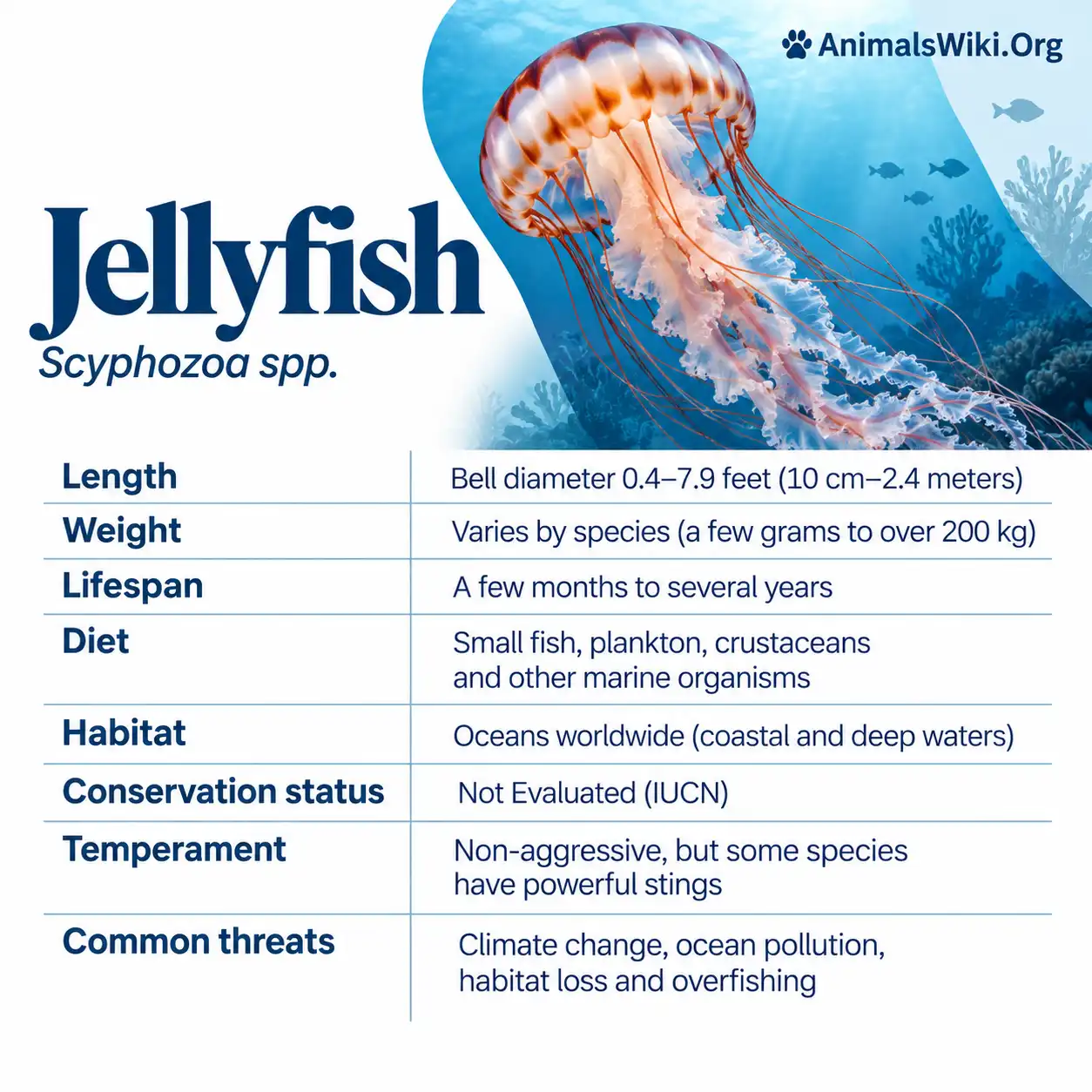
Jellyfish Facts
| Feature | Details |
|---|---|
| Common Name | Jellyfish (Moon Jellyfish — focus species) |
| Scientific Name | Aurelia aurita (Moon Jellyfish) |
| Family | Ulmaridae |
| Order | Semaeostomeae |
| First Described | 1758 (by Carl Linnaeus) |
| Native Habitat | Coastal and open ocean waters worldwide; pelagic and nearshore |
| Geographic Range | Global — found in every ocean from polar to tropical waters |
| Average Size | Bell diameter 25–40 cm (A. aurita); species range from 2 cm to 2 meters |
| Average Weight | 50–500 grams (A. aurita); largest species up to 200 kg |
| Lifespan | 6–18 months (most species); Turritopsis dohrnii potentially immortal |
| Diet | Carnivore — zooplankton, small fish, fish eggs, crustacean larvae |
| Conservation Status | Not Evaluated (most species); Least Concern broadly |
| Defining Feature | No brain, heart, or bones; 95% water; some species biologically immortal; among Earth’s oldest animals |
| Number of Species | Approximately 2,000 described species; estimated 300,000+ total |
1. Jellyfish Species Overview & Classification
There is a moment, familiar to anyone who has swum in the ocean or stood at an aquarium tank, when you first truly look at a jellyfish — not as an obstacle or a hazard or a curiosity, but as a living thing — and feel a particular quality of wonder that very few other animals can produce. The bell pulses. The tentacles trail. The entire animal is translucent, its internal structures visible through its body wall as though lit from within. It has been doing this — exactly this — for over 500 million years. It was here before the dinosaurs. Before the first fish. Before the first land plants. Before the first forests. It watched every major evolutionary innovation in the history of complex animal life from its position in the ocean, drifting, pulsing, feeding, and surviving everything the Earth could produce.
The jellyfish — a name applied loosely to a diverse assemblage of gelatinous marine animals — is simultaneously the most ancient and the most alien of familiar creatures. It has no brain, no heart, no bones, no blood, and no lungs. It is 95% water by composition. It cannot think, plan, learn, or communicate in any sense that we typically apply to animals. Its nervous system is a simple diffuse net distributed throughout its body, without any central processing organ whatsoever.
And yet it is thriving — spectacularly, globally, increasingly — in ways that no other large animal group can claim in the current era of ecological deterioration. While vertebrate populations crash, coral reefs bleach, and fish stocks collapse, jellyfish populations in many ocean regions are booming — taking advantage of warmer, more acidic, more nutrient-polluted oceans in ways that alarm marine ecologists and raise profound questions about the future of ocean ecosystems.
The Moon Jellyfish (Aurelia aurita) is the focus of this guide — the most cosmopolitan, most studied, and most widely recognized jellyfish species in the world. But the jellyfish story extends across approximately 2,000 described species (and an estimated 300,000+ undescribed species) that collectively span body sizes from a few millimeters to nearly 2 meters in bell diameter, occupy habitats from polar seas to tropical lagoons, and include among their number perhaps the most biologically extraordinary animal on Earth — Turritopsis dohrnii, the “immortal jellyfish,” which appears capable of reverting from adult to juvenile form indefinitely, potentially bypassing death entirely.
Species Classification Table
| Classification Level | Details |
|---|---|
| Kingdom | Animalia |
| Phylum | Cnidaria |
| Class | Scyphozoa (true jellyfish — focus) |
| Order | Semaeostomeae |
| Family | Ulmaridae |
| Genus | Aurelia |
| Species | Aurelia aurita — Moon Jellyfish |
| Described By | Carl Linnaeus, 1758 |
| Total Scyphozoan species | ~200 described |
| Total Cnidarian “jellyfish” | ~2,000+ described |
The Jellyfish Diversity Problem — What is a “Jellyfish”?
“Jellyfish” is not a precise taxonomic term — it is applied colloquially to gelatinous, free-swimming marine animals from multiple distinct groups within the phylum Cnidaria and even beyond:
| Group | Class/Phylum | Examples | Notes |
|---|---|---|---|
| True jellyfish | Scyphozoa | Moon jellyfish, Lion’s Mane | The “classic” jellyfish; focus of this article |
| Box jellyfish | Cubozoa | Box jellyfish, Irukandji | Extremely venomous; square bell; true eyes |
| Hydromedusae | Hydrozoa | Portuguese Man O’War, By-the-wind sailor | Man O’War is a colonial organism, not a true jellyfish |
| Comb jellies | Ctenophora | Sea gooseberry, Venus girdle | Not cnidarians; no stinging cells |
| Stalked jellyfish | Staurozoa | Stauromedusae | Attached to substrate; not free-swimming |
Key Species
| Species | Common Name | Notable Feature | Range |
|---|---|---|---|
| Aurelia aurita | Moon Jellyfish | Most common; cosmopolitan | Global |
| Cyanea capillata | Lion’s Mane Jellyfish | Largest jellyfish; tentacles up to 37 m | Cold N. Atlantic, N. Pacific |
| Turritopsis dohrnii | Immortal Jellyfish | Biologically immortal; reverts to polyp | Mediterranean, now global |
| Chironex fleckeri | Box Jellyfish | World’s most venomous animal | Indo-Pacific, N. Australia |
| Chrysaora quinquecirrha | Sea Nettle | Major bloom species; US East Coast | Atlantic, Indo-Pacific |
| Rhizostoma pulmo | Barrel Jellyfish | Largest UK jellyfish; up to 90 cm | NE Atlantic, Mediterranean |
| Nomura’s Jellyfish | Nemopilema nomurai | Up to 2 m diameter; 200 kg | NW Pacific (Japan, China) |
| Physalia physalis | Portuguese Man O’War | Colonial; not a true jellyfish | Tropical and subtropical oceans |
2. Physical Description & Unique Features
The jellyfish body plan is deceptively simple — yet contains within its apparent simplicity some of the most remarkable biological engineering in the animal kingdom. Understanding what a jellyfish actually is, anatomically, reveals why this body plan has proven so extraordinarily durable across half a billion years of evolutionary time.
The Medusa Body Plan
The free-swimming jellyfish form is called the medusa — named after the Greek mythological figure whose snaky “hair” the trailing tentacles presumably recalled to the naturalists who first named it. The medusa body plan consists of:
The bell (umbrella) — the characteristic dome-shaped structure that gives jellyfish their visual identity. In the Moon Jellyfish, the bell reaches 25–40 cm in diameter; in the Lion’s Mane Jellyfish (Cyanea capillata), it can reach 2 meters or more. The bell is composed of a gelatinous material called mesoglea — a non-cellular matrix consisting primarily of water (approximately 95–98%) with embedded protein fibers providing structural support. The outer surface (exumbrella) and inner surface (subumbrella) of the bell are thin layers of epithelial cells.
The manubrium and oral arms — hanging from the center of the bell’s inner surface, the manubrium is a tube-like structure leading to the mouth at its tip. In many jellyfish species, the manubrium is elaborated into distinctive oral arms — frilly, ruffled appendages that help funnel food toward the mouth. In Moon Jellyfish, these oral arms are the four distinctive frilly lobes visible beneath the bell.
Tentacles — extending from the bell margin, tentacles are the primary hunting tools of most jellyfish — bearing thousands of nematocysts (stinging cells) capable of paralysing prey. Tentacle number, length, and arrangement varies enormously by species — from the four simple tentacles of some hydromedusae to the hundreds of long, trailing tentacles of the Lion’s Mane Jellyfish, which can reach lengths of 36–37 meters — making it the longest animal ever recorded.
The gastrovascular cavity — the internal space of the jellyfish serves as both digestive system and circulatory system simultaneously; there is no separate circulatory system. Digested nutrients diffuse from the gastrovascular cavity directly to surrounding tissues.
What Jellyfish Lack — The Biology of Absence
Perhaps more illuminating than listing what jellyfish have is noting what they do not have:
- No brain — the jellyfish has no central nervous system; instead, a diffuse nerve net distributed throughout the body processes sensory information and coordinates movement without any central processing organ
- No heart — no circulatory system; oxygen and nutrients diffuse through the gelatinous mesoglea
- No bones or skeleton — the structural support of the bell comes from the water-filled mesoglea itself (hydrostatic skeleton) and protein fibers
- No blood — no circulatory fluid; the gastrovascular cavity distributes digested nutrients
- No lungs or gills — oxygen exchange occurs by diffusion across the entire body surface
- No kidneys — waste products diffuse out through body surfaces
- No eyes (in most species) — though box jellyfish (Cubozoa) possess surprisingly sophisticated eyes with true lenses and retinas
- No anus — food enters and waste exits through the same opening (the mouth)
The 95% Water Composition
The jellyfish’s water composition is not merely a curiosity — it has profound ecological and evolutionary implications:
Low nutritional value — a jellyfish is approximately 95% water and the remaining 5% includes a high proportion of structural proteins; the caloric content is very low relative to body volume. Animals that eat jellyfish must consume enormous quantities to meet caloric requirements.
Extreme vulnerability to drying — jellyfish stranded on beaches by tides or currents dry out and die within hours; their structural integrity depends entirely on being surrounded by water.
Near-neutral buoyancy — water-dominated tissue is nearly neutrally buoyant in seawater, dramatically reducing the energetic cost of remaining at a given depth; jellyfish can maintain position in the water column with minimal energy expenditure.
Transparency — the water-based tissue is nearly transparent, making jellyfish exceptionally difficult to see in the water — simultaneously an anti-predator camouflage and a predatory advantage.
The Nematocyst — Nature’s Most Complex Cellular Weapon
The nematocyst — the stinging cell of cnidarians — is arguably the most complex single cell structure in biology. Each nematocyst is a microscopic, fluid-filled capsule containing a coiled, hollow thread armed with barbs. When triggered by chemical or mechanical stimulation:
- Internal osmotic pressure inside the capsule increases dramatically
- The capsule lid opens
- The coiled thread everts explosively — turning inside-out as it fires outward
- The thread penetrates the target tissue
- Venom is injected through the hollow thread
The entire discharge process takes approximately 700 nanoseconds — making it one of the fastest biological processes ever recorded. The acceleration involved (approximately 5,400,000 g) is among the highest in the biological world.
A single Moon Jellyfish tentacle may contain thousands of nematocysts; the entire animal may bear millions. Once discharged, a nematocyst cannot be reloaded — it is replaced by a new one generated from specialized cells.
Did You Know? The Lion’s Mane Jellyfish (Cyanea capillata) holds the record for the longest animal ever recorded — a specimen washed ashore in Massachusetts Bay in 1870 had a bell diameter of 2.3 meters (7.5 feet) and tentacles measuring 36.5 meters (120 feet). This surpasses the length of a blue whale (typically 25–30 meters). The tentacles of a large Lion’s Mane are so extensive that a single individual can occupy a volume of water roughly equivalent to a large house.
3. Jellyfish Habitat & Geographic Range
Jellyfish inhabit virtually every marine environment on Earth — from the surface waters of tropical lagoons to the crushing depths of ocean trenches, from polar seas to equatorial waters, from coastal estuaries to the open ocean hundreds of kilometers from land. This extraordinary habitat breadth reflects both the diversity of the jellyfish group as a whole and the remarkable physiological flexibility of individual species.
The Moon Jellyfish — A Cosmopolitan Generalist
Aurelia aurita is one of the most broadly distributed marine animals on Earth — found in coastal and shelf waters across the North and South Atlantic, Pacific, Indian Ocean, and Mediterranean Sea, from approximately 70°N to 70°S latitude. This extraordinary range encompasses water temperatures from near-freezing polar conditions to warm tropical seas exceeding 30°C — a physiological tolerance range unmatched by most large marine animals.
Key habitat preferences of A. aurita include:
- Coastal and shallow water environments — most abundant in bays, harbors, estuaries, and coastal water to depths of approximately 200 meters
- Stratified water columns — tends to aggregate at thermoclines (boundaries between water layers of different temperatures) where prey is concentrated
- Areas with reduced water flow — bays and semi-enclosed coastal areas where currents do not disperse concentrations; moon jellyfish are weak swimmers and cannot maintain position against strong currents
Habitat Range by Ocean Region
| Ocean Region | Key Species | Habitat Preference | Notes |
|---|---|---|---|
| North Atlantic | Moon, Lion’s Mane, Sea Nettle | Coastal, shelf waters | Lion’s Mane reaches largest size in cold N. Atlantic |
| North Pacific | Moon, Nomura’s, Sea Nettle | Coastal, open ocean | Nomura’s blooms cause enormous damage to Japanese fisheries |
| Mediterranean | Moon, Barrel, Mauve Stinger | Coastal, semi-enclosed | Mauve Stinger major bloom species in summer |
| Caribbean | Upside-down Jellyfish, Moon | Shallow coastal, lagoons | Upside-down Cassiopea rests on seafloor |
| Indo-Pacific | Box Jellyfish, Moon | Coastal, shallow | Box jellyfish most dangerous in shallow Australian waters |
| Southern Ocean | Moon, various Medusozoa | Open ocean, coastal | Cold-adapted species poorly known |
| Deep Sea | Multiple deep-sea species | 200–6,000+ meters | Many species undescribed; extremely diverse |
The Oceanic Drift — Passive Transport
One of the most ecologically significant aspects of jellyfish habitat use is their relationship with ocean currents — they are fundamentally at the mercy of water movement for long-distance transport. Unlike fish, which can actively swim against currents, jellyfish are carried by currents across ocean basins — a passivity that contributes to their cosmopolitan distributions but also makes them vulnerable to stranding on beaches when currents carry them against the coast.
This passive transport has significant ecological consequences:
- Bloom formation — currents concentrate jellyfish in specific areas, creating the sudden, enormous aggregations called blooms that can contain millions of individuals per square kilometer
- Predictable occurrence patterns — jellyfish blooms in specific areas often occur at predictable times of year when current patterns reliably aggregate animals
- Invasive potential — jellyfish transported in ship ballast water have established populations in new regions globally; the arrival of the comb jelly Mnemiopsis leidyi in the Black Sea (in ballast water from the US East Coast) in the 1980s caused a catastrophic collapse of the Black Sea fishery — one of the most dramatic examples of marine biological invasion in history
Jellyfish Lake — Palau’s Extraordinary Enclosed Population
One of the world’s most famous jellyfish habitats is Jellyfish Lake (Ongeim’l Tketau) on the island of Eil Malk in Palau, Micronesia — a landlocked marine lake connected to the ocean through tunnels in the surrounding limestone. The lake contains an extraordinary population of Golden Jellyfish (Mastigias papua etpisoni) — a subspecies that has evolved in isolation from the sea over thousands of years and has largely lost its stinging capability (having no predators to defend against).
Every day, millions of jellyfish migrate horizontally across the lake following the sun — they harbor symbiotic algae (zooxanthellae) in their tissues that photosynthesize and provide nutrition, and the migration keeps them in the optimal light conditions for their algal partners. The lake was a popular snorkeling destination until swimming with jellyfish was temporarily closed in 2016 due to a population crash; it has since recovered and reopened to limited visitation.
Did You Know? Some jellyfish have been discovered living at depths exceeding 6,000 meters in ocean trenches — including the Mariana Trench, the deepest point on Earth. A pale-yellow jellyfish (Crossota millsae) was filmed at approximately 3,700 meters by a NOAA remotely operated vehicle in 2016, hovering in the abyss with its tentacles spread in a hunting posture and appearing totally otherworldly. The deep sea harbors a diversity of jellyfish species almost entirely unknown to science — far more species likely exist in the deep ocean than have ever been collected or described.
4. Jellyfish Diet & Feeding Behavior
The jellyfish is a passive predator of remarkable effectiveness — one whose feeding strategy relies not on speed, intelligence, or complex pursuit behavior but on the extraordinary efficiency of its stinging cells and the enormous volume of water it continuously filters through its body. In the Moon Jellyfish and many related species, the entire feeding apparatus is essentially a slow-moving, continuously operating plankton trap.
What Jellyfish Eat
The diet of most jellyfish is centered on zooplankton — the diverse community of small animals that drift in ocean waters — supplemented by fish eggs, fish larvae, and other small soft-bodied prey:
Copepods — tiny crustaceans approximately 1–2 mm in length; among the most abundant multicellular animals on Earth; the primary prey of Moon Jellyfish and many other species
Cladocerans, ostracods, and other small crustaceans — various other microscopic crustacean groups taken routinely
Fish eggs and larvae — particularly important during spawning seasons when these become locally abundant; jellyfish predation on fish larvae and eggs can have significant impacts on fish recruitment
Diatoms and other large phytoplankton — some jellyfish species can filter and consume large phytoplankton cells
Other jellyfish — some jellyfish species are cannibalistic; larger individuals may consume smaller conspecifics; some species prey preferentially on other jellyfish
Small fish — some larger jellyfish species (Lion’s Mane, Nomura’s) can capture and consume small fish; this is relatively rare and prey-size dependent
The Feeding Mechanism — Tentacle Hunting vs. Oral Arm Filtering
Jellyfish use two primary feeding strategies depending on their body plan:
Tentacle-based capture — the dominant strategy in many species; trailing tentacles armed with nematocysts make contact with passing prey; nematocysts fire and paralyze the prey; muscular movements of the tentacles and bell bring prey to the oral arms and mouth. This strategy allows capture of actively swimming prey including copepods, small fish, and fish larvae.
Oral arm mucus trapping — in Moon Jellyfish and related species, the oral arms are covered in mucus secreted by ciliated cells; as the jellyfish swims, water currents created by bell pulsation bring zooplankton into contact with the mucus-covered surfaces; prey sticks to the mucus and is transported by cilia toward the mouth. This strategy works efficiently for smaller, slower prey including copepods and diatoms.
The simultaneous use of both strategies — in Moon Jellyfish, both mechanisms operate simultaneously; the tentacles capture larger prey while the oral arms continuously filter smaller particles from the water.
Feeding Efficiency and Impact
Despite their apparent simplicity, jellyfish are remarkably efficient predators at the population level. A single Moon Jellyfish has been estimated to filter approximately 1,500 liters of seawater per day — a volume that, across a large jellyfish bloom of millions of individuals, can represent an enormous removal of zooplankton from the water column.
The ecological significance of this feeding efficiency becomes alarming during bloom events — when jellyfish populations explode and consume the zooplankton that small fish and fish larvae depend on. In severely bloomed areas, jellyfish can essentially eat out the competition — removing the plankton base that supports fish recruitment and establishing a jellyfish-dominated food web that self-reinforces over time.
Diet Breakdown Table
| Food Type | % of Diet | Method | Notes |
|---|---|---|---|
| Copepods | 40–55% | Tentacle capture; mucus trapping | Most abundant prey; primary target |
| Other zooplankton | 20–30% | Tentacle capture; mucus trapping | Amphipods, cladocerans, ostracods |
| Fish eggs and larvae | 10–20% | Tentacle capture | Seasonal; most important during spawning events |
| Phytoplankton (large cells) | 5–10% | Mucus trapping | Secondary; varies by water conditions |
| Other soft-bodied invertebrates | 2–5% | Tentacle capture | Worm larvae, tunicate larvae |
| Other jellyfish | 1–3% | Tentacle capture | Cannibalism and interspecific predation |
“A jellyfish bloom is one of the ocean’s most misunderstood ecological events. To most people it is a nuisance — closed beaches, fouled fishing nets. To a marine ecologist, it is a symptom of profound ocean change — a signal that the food web has been restructured in ways that may not be reversible on human timescales.” — Dr. Lucas Brotz, Jellyfish Researcher, University of British Columbia
5. Jellyfish Reproduction & Life Cycle
The jellyfish life cycle is one of biology’s most extraordinary — a complex alternation between two completely different body forms (sexual and asexual) that gives the jellyfish group an unusual degree of reproductive flexibility and population resilience. And in one species — Turritopsis dohrnii, the “immortal jellyfish” — the cycle appears to have no endpoint whatsoever.
The Standard Jellyfish Life Cycle — Four Stages
Most true jellyfish (Scyphozoa) pass through four distinct life stages during their development:
Stage 1 — The Planula Larva
Sexual reproduction begins when male jellyfish release sperm into the water; the sperm is drawn into the female’s gastrovascular cavity (or the sperm fertilizes eggs as they are released) producing fertilized eggs. The fertilized egg develops into a tiny, ciliated, free-swimming larva called a planula — approximately 0.1–1 mm long; covered in cilia for locomotion; swimming in the plankton for hours to days before settling.
Stage 2 — The Polyp (Scyphistoma)
The planula settles on a hard substrate — rock, shell, seaweed, or virtually any firm surface — and attaches, transforming into a small, sessile (attached) organism called a scyphistoma or polyp. The polyp is a simple tube-like form, attached at one end, with a ring of tentacles at the other end for capturing food from the water.
The polyp is the long-lived, environmentally resistant phase of the jellyfish life cycle:
- Can survive for years to decades in some species
- Reproduces asexually by budding — producing clones of itself
- Is resistant to adverse conditions including cold, food shortage, and pollution
- Can enter a state of dormancy during unfavorable conditions
Stage 3 — Strobilation (Ephyrae Production)
When environmental conditions improve — typically triggered by changing water temperature, day length, or food availability — the polyp undergoes a remarkable transformation called strobilation. The polyp body begins to segment horizontally, like a stack of coins, with each segment developing into a tiny juvenile jellyfish form called an ephyra.
The top ephyra is released first, then subsequent ones — a single polyp may release dozens of ephyrae over a period of days to weeks, each representing a new individual jellyfish. This is the mechanism by which a single settled polyp can produce a very large number of free-swimming jellyfish — one reason why jellyfish blooms can appear so rapidly after conditions become favorable.
Stage 4 — The Medusa (Adult Jellyfish)
The released ephyra is a tiny (1–3 mm), eight-armed form that gradually grows and develops into the familiar adult medusa form over weeks to months. The adult medusa:
- Grows to full size over weeks to months
- Feeds actively on zooplankton
- Reaches sexual maturity
- Produces eggs or sperm for sexual reproduction
- Typically lives for 6 months to 1 year in most species before dying
The Immortal Jellyfish — Turritopsis dohrnii
The most extraordinary reproductive phenomenon in the entire jellyfish world — possibly in all of biology — is the ability of Turritopsis dohrnii to reverse its life cycle. This tiny jellyfish (bell diameter approximately 4.5 mm) was discovered in the Mediterranean Sea in the 1880s but its remarkable property was not documented until 1996, when Italian researcher Stefano Piraino and colleagues published observations showing that the species, when subjected to environmental stress (starvation, mechanical damage, illness), undergoes transdifferentiation — reverting from its adult medusa form back to the polyp stage, from which it can develop into a new adult medusa.
This process — in which differentiated adult cells transform back into undifferentiated stem-cell-like cells that reorganize into the polyp form — is called transdifferentiation and represents a biological process with no equivalent in vertebrate animals. In principle, a Turritopsis dohrnii individual can undergo this reversal indefinitely — restarting its life cycle from the polyp stage without limit.
The discovery prompted enormous scientific and public interest — and the jellyfish’s popular label as the “immortal jellyfish” — though it is important to note that the species is not truly immortal in practice; individuals regularly die from predation, disease, and environmental accidents, and the reversal process is not 100% reliable under all conditions. The biological reality is nonetheless extraordinary — Turritopsis dohrnii appears to have potentially no inherent biological lifespan limit — a property unique among known multicellular animals.
Did You Know? Turritopsis dohrnii — the “immortal jellyfish” — has become a global invasive species precisely because of its remarkable biology. Carried in ship ballast water from its Mediterranean and northwestern Pacific origins, it has established populations in oceans worldwide. Scientists believe it now inhabits every ocean on Earth — essentially spreading immortality (or at least radical biological longevity) across the globe one ballast water discharge at a time. Its presence in new ecosystems may have ecological consequences that are difficult to predict.
6. Social Behavior & Communication
Jellyfish are among the most socially simple animals on Earth — possessing no brain, no learning capacity, no territorial behavior, no parental care, and no communication system in any meaningful sense. Yet their group-level behavior — the formation of blooms, the daily vertical migrations, the aggregation at thermoclines — produces patterns that resemble social coordination without involving any social cognition whatsoever.
The Bloom — Pseudosocial Aggregation
A jellyfish bloom — a sudden, dramatic increase in local jellyfish density — is not a social behavior in the sense that bees forming a swarm or birds flying in formation is social. Individual jellyfish do not communicate with or coordinate with other jellyfish. Blooms form through independent responses to the same environmental cues — each jellyfish individually responding to temperature, current, light, and food availability in ways that, when aggregated across millions of individuals, produce the visible large-scale pattern.
Nevertheless, blooms are ecologically profoundly significant — some of the world’s largest and most impactful jellyfish blooms contain billions of individuals covering hundreds of square kilometers of ocean surface.
Diel Vertical Migration
Many jellyfish species undergo diel vertical migration — moving upward toward the ocean surface at night and downward during the day. This pattern — driven by light avoidance during the day (which would expose the animal to visual predators) and predator avoidance at depth during darkness — is again not a coordinated social behavior but an individual response to light and predator cues that produces a coherent population-level pattern.
The scale of this migration in some species is remarkable — populations moving hundreds of meters vertically each day, representing one of the ocean’s most significant daily biological events in terms of biomass transport between depth zones.
The Compass Medusa — Evidence of Directional Orientation
Some jellyfish species demonstrate directional orientation — swimming consistently in specific compass directions rather than drifting purely passively. The Compass Jellyfish (Chrysaora hysoscella) and several other species have been observed maintaining consistent orientations relative to the coastline or specific environmental gradients.
The mechanism appears to involve gravity receptors (statocysts) — small sensory organs that detect the direction of gravitational pull and allow the jellyfish to maintain its correct orientation (bell-up, tentacles-down) regardless of currents. These organs may also allow detection of water current direction, enabling some degree of active orientation relative to current flow.
Box Jellyfish — The Exception with True Eyes
The one major exception to the general pattern of jellyfish sensory simplicity is the Cubozoa (box jellyfish) — a distinct cnidarian class whose members possess remarkably sophisticated visual systems. Each box jellyfish has 24 eyes arranged in four clusters around its bell — and crucially, four of these eyes in each cluster are camera-type eyes with true lenses, corneas, and retinas comparable in complexity to vertebrate eyes.
These sophisticated eyes allow box jellyfish to actively navigate their environment — avoiding obstacles, hunting prey visually, and moving toward or away from light with a precision impossible for other jellyfish. They are capable of behaviors that, in an animal without a central brain, remain poorly understood but are clearly far more complex than the simple reflex behaviors of true jellyfish.
7. Predators & Defense Mechanisms
Natural Predators
Despite their stinging capability, jellyfish are an important prey item for numerous marine species — their sheer abundance making them a significant food resource even for predators that consume them reluctantly or inefficiently.
Primary jellyfish predators:
- Ocean Sunfish (Mola mola) — the world’s heaviest bony fish; feeds almost exclusively on jellyfish and salps; a single large Mola mola consumes enormous quantities of jellyfish daily
- Leatherback Sea Turtle (Dermochelys coriacea) — the world’s largest turtle; diet consists almost entirely of jellyfish; the leatherback’s esophagus is lined with backward-pointing spines that help swallow slippery jellyfish
- Loggerhead Sea Turtle — significant jellyfish consumer
- Bluefin and other large tunas — consume jellyfish when abundant
- Swordfish and other billfish — opportunistic jellyfish consumers
- Sunfish — specialized jellyfish feeders
- Seabirds — various seabirds consume jellyfish, particularly in aggregations at the surface
- Whale shark — filters jellyfish blooms along with plankton
- Other jellyfish — some species (e.g., Cyanea, Chrysaora) actively prey on other jellyfish species
Defense Mechanisms
Nematocysts — the primary defense — the jellyfish’s stinging cells are simultaneously hunting weapons and defensive tools. Most jellyfish predators are either immune to the stings (sea turtles, ocean sunfish) or have evolved behavioral strategies to minimize sting exposure (approaching jellyfish from above, consuming the bell rather than tentacles).
Transparency — the near-invisibility of most jellyfish in water provides passive camouflage against visual predators; this is particularly effective in open-ocean environments where there are no background features against which to detect the animal.
Bioluminescence — many deep-sea jellyfish produce bioluminescent flashes when disturbed — the sudden light may startle predators or (in some species) may function as a burglar alarm, attracting the predators of the jellyfish’s predators and thus providing indirect defense. The bioluminescent flash of a disturbed jellyfish in the dark deep ocean is one of the ocean’s most spectacular biological light shows.
Mucus — some jellyfish produce defensive mucus that may deter or disorient predators approaching the tentacles.
The Box Jellyfish Sting — The World’s Most Potent Animal Venom
The Box Jellyfish (Chironex fleckeri) of northern Australian and Indo-Pacific waters is widely described as producing the most potent animal venom on Earth — capable of killing a healthy adult human in as little as 2–5 minutes in severe envenomation cases. The venom:
- Causes immediate, excruciating pain described as one of the most intense experienced by any sting
- Attacks the cardiovascular system — causing cardiac arrhythmia and potentially cardiac arrest
- Causes severe skin necrosis at sting sites
- Contains multiple components including pore-forming proteins, phospholipases, and other toxic molecules
The box jellyfish’s primary venom function is prey capture — the rapid incapacitation of fish that might otherwise thrash and damage the relatively fragile jellyfish during capture. That the same venom is capable of killing humans is incidental; humans are enormously larger than the jellyfish’s intended prey.
8. Relationship with Humans
Ancient Human Encounters
Humans have encountered jellyfish throughout all of recorded history — their presence in coastal waters, their occasional strandings on beaches, and their sometimes-painful stings have been documented across virtually every maritime culture.
Ancient Greece and Rome — jellyfish appear in ancient Mediterranean literature; Aristotle described jellyfish (Acaleph — a term related to the Greek word for nettle, akalephe) in his zoological writings, recognizing their stinging nature and basic biology with remarkable accuracy given the period. The Latin term pulmo marinus (sea lung) — referring to the resemblance of jellyfish to lungs — was used by Pliny the Elder.
Traditional Asian medicine and cuisine — jellyfish have been consumed and used medicinally in China, Japan, and Korea for over 2,000 years. Dried and salted jellyfish (primarily several species of Rhopilema and related genera) is a significant food in Chinese cuisine — served in salads, soups, and as a textural ingredient in various dishes. The preparation involves extensive salting and drying to remove water and modify the texture. Approximately 500,000 tonnes of jellyfish are harvested annually for food globally — primarily in Asia.
Medical and Scientific Importance
Jellyfish have made extraordinary contributions to biological science that extend far beyond their marine ecology:
Green Fluorescent Protein (GFP) — discovered by Osamu Shimomura in the bioluminescent jellyfish Aequorea victoria in the 1960s, GFP has become one of the most important tools in modern biological research. GFP glows green when exposed to blue or ultraviolet light — and when the gene encoding it is inserted into other organisms, it acts as a biological marker, allowing scientists to track specific proteins, cells, or genes in living tissue in real time. GFP and its derivatives are used in virtually every field of modern biology — cancer research, neuroscience, genetics, drug development. The discovery of GFP earned Osamu Shimomura, Martin Chalfie, and Roger Tsien the Nobel Prize in Chemistry in 2008 — making the jellyfish the indirect source of one of the most important scientific tools of the modern era.
Collagen research — jellyfish mesoglea contains unique collagen structures being studied for biomaterials applications including wound dressings, cartilage replacement, and drug delivery systems.
Aging and immortality research — Turritopsis dohrnii‘s transdifferentiation capability has attracted enormous attention from aging researchers; understanding the molecular mechanisms that allow this reversal of cellular differentiation may have implications for understanding and potentially treating age-related diseases in humans.
The Jellyfish Sting Problem — Human Health
Jellyfish stings represent a significant global public health issue — estimated to affect over 150 million people annually worldwide, causing:
- Minor stings — painful but transient; the most common outcome; pain, redness, and urticaria (hive-like reactions) resolving within hours
- Moderate reactions — more extensive skin reactions, nausea, and systemic symptoms requiring medical attention
- Severe anaphylaxis — allergic reactions in sensitized individuals; potentially life-threatening
- Fatalities — primarily from box jellyfish (Chironex fleckeri in Australia; Chironex yamaguchii in the Philippines and Japan; Irukandji syndrome from multiple Cubozoan species)
The number of jellyfish-sting fatalities is difficult to quantify precisely but is estimated at dozens to hundreds annually — with the Philippines and other Indo-Pacific nations bearing the heaviest burden from box jellyfish fatalities.
Did You Know? The Green Fluorescent Protein (GFP) discovered in the jellyfish Aequorea victoria has been described as one of the most important research tools in the history of biology. Since the gene was first cloned in 1992, it has been used in over 100,000 scientific studies and has been inserted into bacteria, yeast, worms, flies, fish, mice, and virtually every other model organism studied by biologists. Without GFP, the pace of advance in cancer biology, neuroscience, genetics, and pharmaceutical development would have been dramatically slower. A jellyfish that nobody had ever heard of outside specialist marine biology circles was, it turned out, harboring one of the most transformative scientific tools of the 20th century.
9. Jellyfish Conservation Status & Threats
The Paradox of Jellyfish Conservation
Jellyfish present a unique conservation paradox — unlike virtually every other major animal group, the global trend for jellyfish is not decline but increase. Many ocean regions are experiencing jellyfish blooms of unprecedented scale and frequency — driven by the same human activities that are devastating other marine species. In this context, the conservation concern is not jellyfish going extinct but jellyfish taking over.
IUCN Status
Most jellyfish species have not been formally assessed by the IUCN — their taxonomy is too poorly understood and their population dynamics too difficult to monitor for standard assessment processes. A few specific species or groups have been assessed:
- Most assessed species: Not Evaluated or Data Deficient
- Some species: Least Concern where assessable
- No species currently listed as Threatened — though this reflects data limitations rather than confirmed stability
The Jellyfish Bloom Crisis
Evidence from long-term ocean monitoring programs suggests that jellyfish are increasing globally:
- Nomura’s Jellyfish blooms in the Sea of Japan have increased dramatically — impacting Japanese fisheries with estimated losses of hundreds of millions of dollars annually; blooms that were historically rare events have become nearly annual occurrences
- Mediterranean Mauve Stinger (Pelagia noctiluca) blooms have increased in frequency and intensity — closing beaches across the western Mediterranean for days to weeks at a time
- Jellyfish blooms in the Black Sea — transformed after the introduction of the comb jelly Mnemiopsis leidyi in the 1980s; the entire ecosystem shifted to a jellyfish-dominated state within years
- North Sea and Baltic Sea — increasing bloom frequency documented through long-term trawl surveys
What is Driving Jellyfish Increases?
1. Ocean warming — jellyfish are broadly tolerant of temperature change and some species benefit directly from warmer waters that extend their growing season, increase metabolic rates, and expand their geographic range. Meanwhile, warming disrupts or eliminates the competitors and predators that previously limited jellyfish populations.
2. Ocean acidification — the acidification of ocean water from carbon dioxide absorption dissolves the calcium carbonate shells and skeletons of jellyfish competitors (mollusks, echinoderms, corals) while leaving jellyfish — which have no calcium carbonate structures — unaffected or even benefiting from altered chemistry.
3. Overfishing — the removal of fish that compete with jellyfish for zooplankton prey and that prey on jellyfish has restructured food webs in favor of jellyfish. When major jellyfish predators (ocean sunfish, sea turtles, tunas) and competitors (small pelagic fish) are depleted by fishing, jellyfish face less pressure and more food.
4. Nutrient pollution (eutrophication) — the runoff of agricultural fertilizers and sewage into coastal waters stimulates phytoplankton blooms that subsequently support zooplankton blooms — providing abundant food for jellyfish while simultaneously reducing oxygen levels (hypoxia) in ways that stress fish but not jellyfish, which can tolerate very low oxygen concentrations.
5. Shipping and ballast water — the global transport of jellyfish and their polyp stages in ship ballast water has introduced jellyfish species to new ecosystems where they face no established predators or competitors, enabling explosive population growth.
10. Famous Jellyfish Around the World
The Immortal Jellyfish — Turritopsis dohrnii
Turritopsis dohrnii — the “immortal jellyfish” — is the world’s most scientifically famous jellyfish and arguably the most biologically remarkable multicellular animal on Earth. First documented in the Mediterranean in the 1880s and formally described scientifically but its immortality property not recognized until Stefano Piraino’s 1996 paper — the species has since attracted global media attention, a devoted scientific following, and enthusiastic popular science coverage. The 1996 paper has been cited hundreds of times; subsequent molecular studies attempting to understand the genetic mechanisms of transdifferentiation continue to generate significant scientific interest.
The Jellyfish Lake Mastigias — Palau
The Golden Jellyfish (Mastigias papua etpisoni) of Jellyfish Lake in Palau achieved global fame through spectacular underwater photography and nature documentary coverage — images of snorkelers surrounded by millions of golden, nearly stingless jellyfish in the clear lake waters became iconic images of marine biology wonder. David Attenborough referenced the lake in multiple BBC productions. The population collapsed in 2016 due to a drought-related temperature spike and associated El Niño conditions — causing global media coverage of the loss — before recovering to approximately 8 million individuals by 2020.
Aequorea victoria — The Nobel Prize Jellyfish
Aequorea victoria — the small, bioluminescent jellyfish of the Pacific Northwest coast of North America — is the source of Green Fluorescent Protein (GFP) and thus the indirect source of one of the most important scientific tools in modern biology. The Nobel Prize in Chemistry 2008 awarded to Shimomura, Chalfie, and Tsien for GFP effectively recognized a discovery made in this specific jellyfish species — making Aequorea victoria probably the most scientifically consequential jellyfish ever studied.
Nomura’s Jellyfish — Japan’s Giant Problem
Nomura’s Jellyfish (Nemopilema nomurai) — growing to 2 meters in bell diameter and weighing up to 200 kg — is the world’s largest jellyfish by mass and the species most associated with dramatic fishery impacts in the modern era. Blooms originating in Chinese coastal waters drift into the Sea of Japan each summer, clogging fishing nets (which sink under the weight of captured jellyfish), contaminating fish catches with toxic mucus, and costing the Japanese fishing industry an estimated ¥30 billion annually during major bloom years. A Japanese fishing trawler famously capsized in 2009 when its crew attempted to haul in a net overloaded with Nomura’s Jellyfish.
11. Role in Ecosystem & Food Chain
As Predators — Zooplankton Regulation
Jellyfish occupy a complex position in marine food webs — simultaneously important predators of zooplankton and fish larvae, significant prey for several specialized predators, and increasingly viewed as potentially disruptive competitors with fish for zooplankton resources.
In productive coastal ecosystems, jellyfish can consume significant fractions of daily zooplankton production — particularly copepod production. During bloom events, jellyfish predation can dramatically reduce zooplankton standing stocks, reducing the food available for planktivorous fish larvae and potentially impacting fish recruitment at the population level.
Jellyfish as a Carbon Pump
One of the most significant and most recently appreciated ecological roles of jellyfish is as a carbon sink — contributing to the biological pump that removes carbon dioxide from the surface ocean and transports it to the deep sea.
When jellyfish die, their largely water-composed bodies sink relatively rapidly (compared to individual plankton cells) and carry organic carbon to the deep ocean — where it may be sequestered for centuries. Research published in recent years has suggested that the global jellyfish contribution to carbon export may be substantial — potentially comparable to or exceeding that of fish feces and other organic particles that constitute the traditional biological pump.
As jellyfish populations increase globally, the magnitude of this carbon export function may be increasing — with potentially significant but poorly understood implications for ocean carbon cycling and climate.
The “Jellyfish Joyride” — Energy Dead End
One of the most important negative aspects of jellyfish in marine food webs is their role as an energy dead end. The extreme water composition of jellyfish tissue (95% water) means that jellyfish are very poor-quality prey — a predator must eat enormous volumes of jellyfish to obtain the same caloric return as a much smaller volume of fish. This means that when jellyfish dominate an ecosystem, the energy transfer efficiency from plankton to higher trophic levels decreases dramatically — less energy reaches species that humans care about (fish, marine mammals) from the same primary production base.
This is the mechanism by which overfished, eutrophied, or warming ocean ecosystems can shift to jellyfish-dominated states that are self-reinforcing and very difficult to reverse — less fish means more jellyfish means less fish prey means fewer fish.
12. Jellyfish Discovery & Evolution Timeline
~700–600 million years ago — Molecular clock estimates suggest that the phylum Cnidaria (the group containing jellyfish) diverged from other animal lineages during the late Precambrian; these are among the earliest animals to evolve.
~580 million years ago — The Ediacaran Period fossils include structures interpreted as possible early medusozoans (the group containing true jellyfish); Ediacaria, Eoandromeda, and related Ediacaran fossils may represent early jellyfish-like organisms though interpretation is contested.
~543–505 million years ago — The Cambrian Explosion — the rapid diversification of animal phyla — includes clear jellyfish-like animals; exquisitely preserved Cambrian fossils from China and other Lagerstätten include unmistakable medusoid forms.
~500 million years ago — Fossil jellyfish preserved in the Cambrian Burgess Shale (British Columbia) represent some of the earliest clearly identifiable jellyfish-like fossils; soft-bodied animals preserved in exceptional detail.
~400 million years ago — Jellyfish-like forms in Devonian fossil deposits indicate the group’s persistence through major extinction events; the basic body plan is already deeply conserved.
~300 million years ago — Fossil medusae from Carboniferous deposits confirm the continued presence of recognizable jellyfish through the Paleozoic; the body plan shows remarkable conservation across hundreds of millions of years.
~200 million years ago — Jellyfish survive the end-Triassic mass extinction event that eliminated approximately 76% of all species — their resilience to extinction events becomes a consistent pattern across their evolutionary history.
~66 million years ago — Jellyfish survive the end-Cretaceous mass extinction that eliminated non-avian dinosaurs and 75% of all species; a pattern of surviving the “Big Five” mass extinctions makes jellyfish one of the most extinction-resistant major animal groups.
~350 BC — Aristotle describes jellyfish in Historia Animalium — among the first scientific descriptions of the group; recognizes their stinging nature and basic biology.
1758 — Carl Linnaeus formally describes Medusa aurita (later Aurelia aurita) in Systema Naturae; provides the scientific framework for jellyfish taxonomy.
1961 — Osamu Shimomura begins studying bioluminescence in Aequorea victoria — work that will eventually lead to the discovery of GFP.
1962 — Shimomura isolates aequorin — the bioluminescent protein of Aequorea victoria — and detects a second protein that fluoresces green when excited by blue light; this is the first isolation of GFP.
1992 — Douglas Prasher clones the GFP gene from Aequorea victoria — enabling its transfer to other organisms.
1994 — Martin Chalfie uses the cloned GFP gene to produce glowing E. coli and C. elegans — the first demonstration of GFP as a biological marker; published in Science.
1996 — Stefano Piraino and colleagues publish the landmark paper documenting Turritopsis dohrnii‘s ability to revert from medusa to polyp stage — the “immortal jellyfish” concept enters scientific literature.
2008 — Nobel Prize in Chemistry awarded to Shimomura, Chalfie, and Tsien for GFP — a jellyfish discovery wins the world’s most prestigious science prize.
2009 — Japanese fishing trawler capsizes under weight of Nomura’s Jellyfish — dramatizes the scale of jellyfish bloom impacts on fisheries.
2010s–2020s — Systematic global monitoring of jellyfish blooms; evidence of increasing bloom frequency and geographic expansion assembled; jellyfish emerge as a focal concern in climate change marine ecology.
2022–2026 — Multiple new deep-sea jellyfish species described annually; molecular phylogenetics revolutionizing understanding of jellyfish evolutionary relationships; Turritopsis molecular mechanisms of transdifferentiation under intensive investigation.
13. Jellyfish Comparison with Similar Species
| Feature | Moon Jellyfish (A. aurita) | Lion’s Mane (C. capillata) | Box Jellyfish (C. fleckeri) | Portuguese Man O’War (P. physalis) |
|---|---|---|---|---|
| Class | Scyphozoa | Scyphozoa | Cubozoa | Hydrozoa (colonial) |
| Bell shape | Round, flat | Round, mane-like | Cubic/square | No true bell; float |
| Bell diameter | 25–40 cm | Up to 2 m+ | Up to 30 cm | N/A (float 10–30 cm) |
| Tentacle length | Few cm | Up to 37 m | Up to 3 m | Up to 50 m |
| Sting severity | Mild to moderate | Moderate to severe | Potentially lethal | Severe; rarely fatal |
| Eyes | None | None | 24 complex eyes | None |
| Habitat | Coastal worldwide | Cold N. Atlantic/Pacific | Shallow Indo-Pacific | Open tropical ocean |
| Diet | Zooplankton; fish eggs | Fish; zooplankton | Fish (primarily) | Fish; crustaceans |
| Special feature | Most cosmopolitan | World’s longest animal | Most venomous animal | Colonial organism |
| Swim ability | Weak; current-dependent | Weak; current-dependent | Strong; can pursue prey | None; wind-dependent |
14. Best Places to See Jellyfish in the Wild
Aquariums — The Most Reliable Experience
- Monterey Bay Aquarium, California, USA — possesses arguably the world’s finest jellyfish exhibit; the “Jellies: Living Art” gallery features dozens of species in stunning circular tanks with dramatic lighting; the aquarium pioneered the husbandry techniques for maintaining jellyfish in captivity and its jellyfish photography has been globally influential
- National Aquarium, Baltimore, Maryland, USA — excellent jellyfish gallery including Moon Jellyfish and other species
- Georgia Aquarium, Atlanta, USA — extensive jellyfish displays
- Osaka Aquarium (Kaiyukan), Japan — spectacular Pacific rim ecosystem display including jellyfish
- Shedd Aquarium, Chicago, USA — excellent jellyfish exhibit
- Aquarium of the Pacific, Long Beach, California — dedicated jellyfish gallery
Wild Encounters — Seasonal and Location-Specific
- 🇵🇼 Jellyfish Lake, Palau, Micronesia — the most famous jellyfish wild experience; snorkeling among millions of nearly stingless Golden Jellyfish; requires Palau Rock Islands entry permit; seasonal closures possible
- 🇦🇺 Northern Australia (November–April) — Box Jellyfish season; significant danger, but also opportunity to see these remarkable animals (safely, with stinger suits); the Cairns area is a major box jellyfish research location
- 🇬🇧 West Cornwall and Southwest England coast (summer) — the world’s largest jellyfish, the Barrel Jellyfish (Rhizostoma pulmo), regularly appears in UK waters in summer; non-stinging; frequently seen from cliffs and shore
- 🇺🇸 Chesapeake Bay, Maryland/Virginia (summer) — Sea Nettle (Chrysaora quinquecirrha) blooms can be spectacular; also Moon Jellyfish in abundance
- 🇯🇵 Sea of Japan coastline — spectacular (if alarming) Nomura’s Jellyfish encounters in late summer bloom seasons; these enormous animals approaching 2 meters in diameter are genuinely awe-inspiring to see in person
- Anywhere in the ocean at night with a light — hanging a light over the side of a boat at anchor in calm water and watching jellyfish attracted to the light is one of the most accessible and most spectacular jellyfish experiences available anywhere in the world
15. Jellyfish Fun Facts for Kids
- 🪼 Jellyfish are 95% water — if left on a beach, they evaporate to almost nothing within hours
- 🪼 Turritopsis dohrnii — the “immortal jellyfish” — appears to have no biological lifespan limit; it can revert from adult to juvenile form indefinitely
- 🪼 The Lion’s Mane Jellyfish is the world’s longest animal — tentacles reaching 37 meters (longer than a blue whale)
- 🪼 Jellyfish have no brain, heart, bones, or blood — yet have survived for over 500 million years through five mass extinctions
- 🪼 The discovery of Green Fluorescent Protein in a jellyfish won the 2008 Nobel Prize in Chemistry — one of the most important biological research tools ever developed came from a jellyfish
- 🪼 A jellyfish nematocyst fires at an acceleration of approximately 5,400,000 g — one of the fastest biological processes ever recorded
- 🪼 Box jellyfish have 24 eyes — including four with true lenses, corneas, and retinas comparable to vertebrate eyes
- 🪼 A single Moon Jellyfish filters approximately 1,500 liters of seawater per day
- 🪼 The Nomura’s Jellyfish grows to 2 meters in diameter and can weigh 200 kg — the world’s heaviest jellyfish
- 🪼 Japan and China consume approximately 500,000 tonnes of jellyfish as food annually
- 🪼 Jellyfish have been found at depths exceeding 6,000 meters in the Mariana Trench
- 🪼 The Box Jellyfish venom is capable of killing a human adult in as little as 2–5 minutes — the most potent animal venom on Earth
16. Frequently Asked Questions About Jellyfish
Q1: Are jellyfish actually fish?
No — jellyfish are not fish at all. Fish are vertebrates — animals with backbones, brains, hearts, and complex organ systems. Jellyfish are invertebrates belonging to the phylum Cnidaria — a completely different branch of the animal kingdom. The name “jellyfish” is a common name applied by tradition rather than taxonomic accuracy. Scientists often prefer the term “jellyfish” or “medusa” for the free-swimming stage and acknowledge that the term is taxonomically imprecise. Some scientists advocate for “sea jelly” as a more accurate common name, though “jellyfish” remains overwhelmingly dominant in public usage.
Q2: Do jellyfish have brains?
No — jellyfish have no brain whatsoever. Their nervous system is a diffuse nerve net — a network of nerve cells distributed throughout the body without any central processing structure. This nerve net can detect stimuli (touch, light, chemicals) and coordinate simple motor responses (bell pulsation, tentacle withdrawal) without any centralized brain or ganglia. The exception is box jellyfish (Cubozoa), which have ring ganglia around the bell that function as a primitive processing center — but even these lack a true brain in the vertebrate sense. Despite this extreme neural simplicity, jellyfish are remarkably successful animals — demonstrating that sophisticated brains are not a prerequisite for survival.
Q3: Is there really an “immortal jellyfish”?
Yes — Turritopsis dohrnii, native to the Mediterranean Sea and now found globally, appears to have no inherent biological lifespan limit. When subjected to physiological stress (starvation, injury, illness, aging), the adult medusa undergoes transdifferentiation — its differentiated cells reverting to an undifferentiated state and reorganizing into a juvenile polyp form, from which the animal can develop into a new adult. This process bypasses the normal death that follows reproduction in most animals and can theoretically repeat indefinitely. In practice, individual Turritopsis regularly die from predation, disease, and other environmental causes — they are not truly deathless in nature. But their cells appear to have no intrinsic aging process that limits lifespan, making them unique among known multicellular animals.
Q4: Why do jellyfish sting and how should you treat a jellyfish sting?
Jellyfish sting using nematocysts — microscopic capsules in their tentacles that fire hollow, venom-filled threads when triggered by mechanical or chemical contact. The sting is not deliberately aggressive — it is an automatic response to contact, used for prey capture. Jellyfish do not target or pursue humans.
For most jellyfish stings: (1) Get out of the water; (2) Do not rub the affected area; (3) Rinse with seawater (not fresh water, which can trigger unfired nematocysts); (4) Remove visible tentacle fragments using a card or stick (not bare fingers); (5) Apply heat — immerse in hot water (40–45°C) for 20 minutes; this is the most evidence-supported treatment for most jellyfish stings. For box jellyfish stings: apply liberal vinegar immediately to neutralize nematocysts, and seek emergency medical treatment immediately — box jellyfish stings can be life-threatening.
Q5: What is causing jellyfish blooms to increase?
Jellyfish blooms are becoming more frequent and more intense globally due to a combination of interacting human impacts on the ocean. Overfishing removes the fish that compete with jellyfish for zooplankton and that prey on jellyfish. Ocean warming extends jellyfish growing seasons and expands their geographic ranges. Ocean acidification damages the calcium carbonate structures of jellyfish competitors (corals, mollusks) while leaving jellyfish unaffected. Nutrient pollution from agricultural runoff stimulates the zooplankton blooms that fuel jellyfish population growth while creating low-oxygen conditions that stress fish but not jellyfish. Shipping transports jellyfish to new oceans in ballast water. Together, these pressures are restructuring ocean food webs in ways that systematically favor jellyfish over fish.
Q6: What did a jellyfish have to do with the Nobel Prize?
The 2008 Nobel Prize in Chemistry was awarded to Osamu Shimomura, Martin Chalfie, and Roger Tsien for the discovery and development of Green Fluorescent Protein (GFP) — a protein originally isolated from the bioluminescent jellyfish Aequorea victoria. Shimomura first isolated GFP from Aequorea in 1962; Prasher cloned the gene encoding it in 1992; Chalfie demonstrated it could be used as a biological marker in living organisms in 1994; Tsien developed colored variants that extended its utility dramatically. GFP is now used as a molecular marker in virtually every field of biology — allowing scientists to track specific proteins, cells, and genes in living organisms in real time. The Nobel Committee described GFP as one of the most important tools in modern bioscience.
Q7: How big can jellyfish get?
Jellyfish vary enormously in size. The smallest species have bells just a few millimeters in diameter. The largest is the Lion’s Mane Jellyfish (Cyanea capillata) — which can have a bell diameter exceeding 2 meters and tentacles reaching 37 meters in length, making it the world’s longest animal by any measure. Nomura’s Jellyfish (Nemopilema nomurai) is the heaviest, with bells up to 2 meters in diameter and weights approaching 200 kg — roughly the size and weight of a large adult black bear. The Moon Jellyfish typically reaches 25–40 cm in bell diameter — the most familiar and most moderate-sized common species.
Q8: Can you eat jellyfish?
Yes — jellyfish have been eaten in China, Japan, and Korea for over 2,000 years, and approximately 500,000 tonnes are harvested for food globally each year. Edible jellyfish (primarily several species of Rhopilema and related genera) are processed by extensive salting and drying to remove water, resulting in a firm, slightly crunchy texture. In Chinese cuisine, jellyfish is typically served cold in salads, seasoned with sesame oil, soy sauce, and vinegar. The taste is mild to neutral — the appeal is primarily textural rather than flavor-based. Nutritionally, jellyfish is very low in calories (primarily water and protein) with some collagen and trace minerals. As jellyfish blooms increase globally, there is growing interest in jellyfish as a sustainable food source in Western countries — though consumer acceptance remains limited.