Quokka Facts
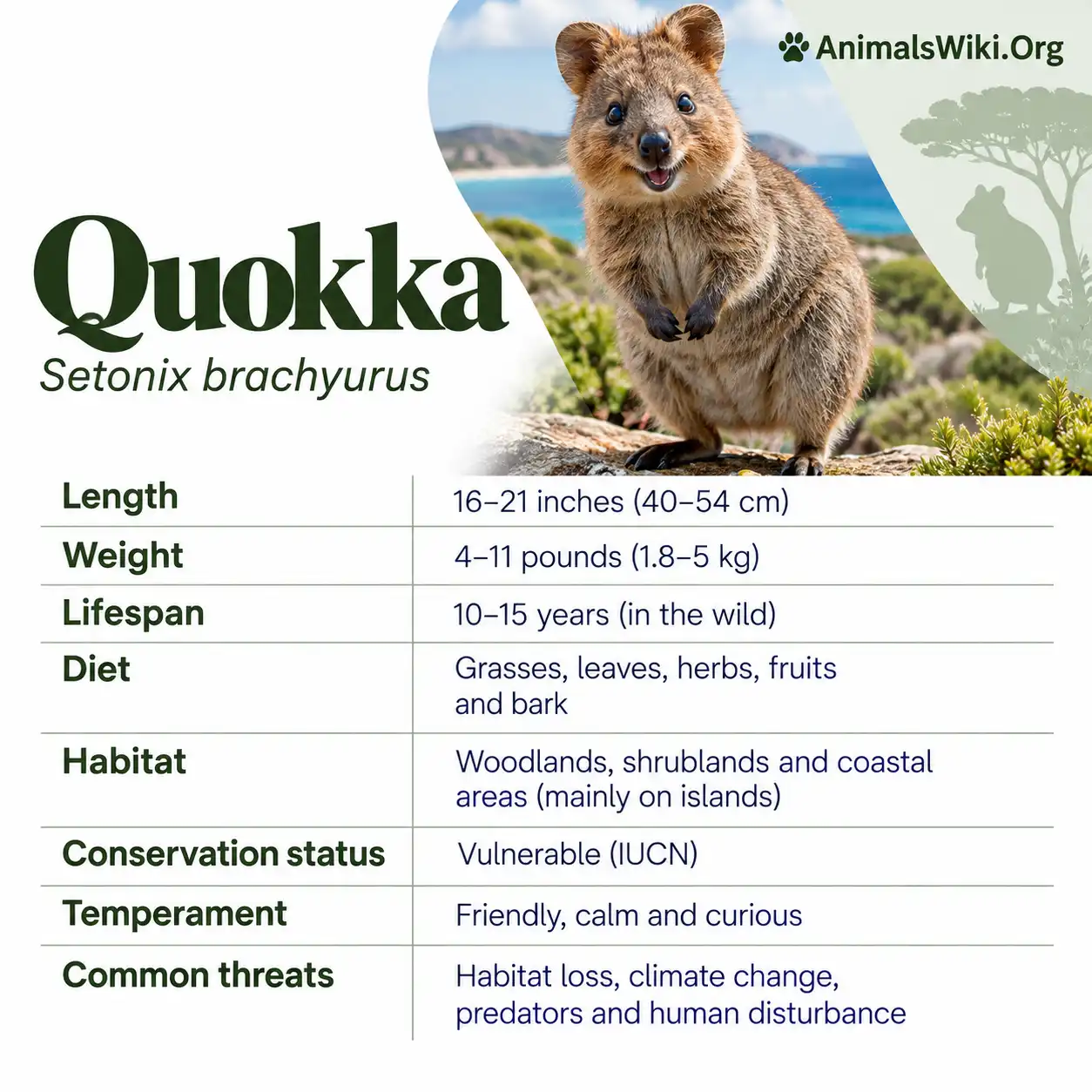
| Feature | Details |
|---|---|
| Common Name | Quokka |
| Scientific Name | Setonix brachyurus |
| Family | Macropodidae (kangaroos and wallabies) |
| Order | Diprotodontia |
| First Described | 1830 (by John Edward Gray) |
| Native Habitat | Dense coastal scrub, woodland, swamps; islands and mainland southwest Western Australia |
| Geographic Range | Rottnest Island, Bald Island, and small mainland populations in southwest Western Australia |
| Average Size | 40–54 cm body length; tail 25–30 cm |
| Average Weight | 2.5–5 kg |
| Lifespan | 10 years (wild); up to 15 years (captivity) |
| Diet | Herbivore — grasses, leaves, stems, seeds, succulents |
| Conservation Status | Vulnerable (IUCN) |
| Defining Feature | Distinctive upturned mouth creating permanent “smile”; world’s most photographed animal for selfies; small marsupial related to wallabies |
| Global Population | Approximately 10,000–14,000 individuals (mostly on Rottnest Island) |
1. Quokka Species Overview & Classification
In the entire animal kingdom — across millions of species spanning every continent and every ocean — there is perhaps no animal that has generated more social media engagement per individual than a small, brown, cat-sized marsupial living on a sun-drenched island off the coast of Western Australia. The Quokka is not the world’s rarest animal. It is not the largest, the fastest, the most venomous, or the most ecologically important. What the quokka is — unmistakably, irresistibly, almost absurdly — is the happiest-looking animal on Earth.
The quokka’s face is arranged by nature into a configuration that, to human eyes, reads unmistakably as a smile. The upturned corners of the mouth, the rounded cheeks, the bright dark eyes — together these features create an expression so universally interpreted as cheerful contentment that the quokka has been dubbed the “world’s happiest animal” by popular media so many times that the epithet has essentially become official. The “quokka selfie” — a photograph taken with a quokka in the foreground, its apparent smile directed at the camera — has become one of the most sought-after wildlife photography experiences on Earth, drawing visitors from every country to Rottnest Island off Perth, Western Australia, where quokkas are remarkably approachable and remarkably photogenic.
But the quokka is considerably more than its Instagram fame suggests. It is a genuinely fascinating marsupial with a remarkable suite of biological adaptations — from its ability to survive on minimal water in a harsh island environment, to its extraordinary capacity to pause the development of an embryo during times of environmental stress, to its complex social dynamics in a confined island habitat. It is also a species in genuine conservation trouble — classified as Vulnerable by the IUCN, with its mainland populations severely reduced by introduced predators and its island stronghold dependent on careful management to prevent habitat degradation.
Understanding the quokka means going beyond the selfie — discovering an animal of real biological depth, genuine conservation urgency, and a relationship with the Australian landscape that stretches back far beyond the invention of the smartphone.
Species Classification Table
| Classification Level | Details |
|---|---|
| Kingdom | Animalia |
| Phylum | Chordata |
| Class | Mammalia |
| Infraclass | Marsupialia |
| Order | Diprotodontia |
| Family | Macropodidae |
| Genus | Setonix |
| Species | Setonix brachyurus |
| Described By | John Edward Gray, 1830 |
| Common Name | Quokka |
| Unique status | The sole member of the genus Setonix |
What Exactly is a Quokka?
The quokka is a marsupial — a mammal that gives birth to very undeveloped young and completes their development in a pouch. More specifically, it belongs to the family Macropodidae — the kangaroos and wallabies — making it a close relative of some of Australia’s most familiar animals. Its relationship to the macropod family is reflected in its body plan: the characteristic hindleg dominance of kangaroos and wallabies is present in a more compact form, and the quokka moves with the same bounding gait as larger macropods.
The quokka occupies its own genus — Setonix — reflecting that despite its macropod ancestry it has evolved sufficiently distinctive characteristics to warrant generic separation from the true wallabies. It is most closely related to the rock wallabies (genus Petrogale) and the pademelons (genus Thylogale), sharing features of body size, facial structure, and habitat preference with these groups.
Did You Know? The quokka’s famous “smile” is not actually an expression of happiness — it is simply the anatomical shape of the quokka’s face, in which the corners of the mouth are naturally upturned and the cheeks are rounded. The quokka cannot change this expression; it “smiles” at all times regardless of its actual emotional state — during feeding, sleeping, fleeing from predators, or any other activity. Whether the quokka experiences anything like happiness in the human sense is an open scientific question, but the specific smile expression is purely a matter of facial geometry rather than emotional communication. That said, quokkas on Rottnest Island appear genuinely comfortable around humans and approach them with curiosity rather than fear — a behavioral characteristic that may reflect genuine positive associations with the reliable food resources that humans sometimes represent.
2. Quokka Physical Description & Unique Features
The quokka is a compact, rounded, endearing animal — its physical form combining the characteristic features of the macropod family with proportions and features that are distinctively its own.
Size and Build
The quokka is a small macropod — significantly smaller than the familiar kangaroos and wallabies that most people associate with the family:
- Body length: 40–54 cm (16–21 inches) — roughly the size of a domestic cat
- Tail length: 25–30 cm (10–12 inches) — relatively shorter and thicker than most macropods; the tail is not used for support during sitting (as in larger kangaroos) but rather functions as a balance aid during movement
- Weight: 2.5–5 kg (5.5–11 lbs) — within the size range of a typical domestic cat but more robustly built
The body is stocky and compact — rounder and less elongated than most wallabies; this rounded body form, combined with the facial configuration, contributes strongly to the quokka’s “cute” appearance that generates such intense human response.
Sexual dimorphism is modest — males are slightly larger and heavier than females but not dramatically so; both sexes are similar in coloration and general appearance.
The Famous Face — The Anatomy of a “Smile”
The quokka’s signature expression deserves careful anatomical description:
Upturned mouth corners — the corners of the quokka’s mouth curve slightly upward, creating the characteristic “smiling” line; this is a fixed anatomical feature of the facial musculature and lip structure, not a voluntarily assumed expression
Rounded cheeks — the quokka’s cheeks are naturally rounded and full, particularly when the animal is well-fed; full cheeks add to the impression of cheerful plumpness
Bright, prominent eyes — dark, rounded eyes set in a relatively flat face create a forward-facing appearance that registers as friendly to human observers accustomed to reading forward-facing eyes as a sign of sociability
Short, rounded snout — shorter and more rounded than most macropods, whose faces are more elongated; the shorter snout brings the face closer to the human “cute” proportions that trigger positive responses
Small rounded ears — shorter and more rounded than the large, pointed ears of larger macropods; more cat-like in proportion
Fur and Coloration
- Overall color: Coarse, brown to grey-brown fur across the body; slightly paler on the underside; individual variation creates a range from warm sandy-brown to darker grey-brown
- Texture: The fur is coarser than it appears in photographs — quokkas are not soft and fluffy to the touch despite looking so in images
- Facial fur pattern: Often slightly paler around the face, which may enhance the appearance of the facial expression
The Hindlimbs and Locomotion
Like all macropods, the quokka has disproportionately developed hindlimbs compared to its forelimbs. The hindlimbs are strong and well-muscled, providing the primary locomotion through bounding hops — the characteristic macropod gait. Unlike larger kangaroos, quokkas also make frequent use of all-fours walking at slow speeds, giving them a somewhat more versatile locomotion style than the obligate bipedal hopping of large red kangaroos.
The quokka’s bounding speed is respectable for its size — it can reach approximately 20 km/h (12 mph) in short bursts, which is sufficient to escape many predators in its natural habitat.
The Pouch
Female quokkas carry a forward-opening pouch on the abdomen — the characteristic marsupial reproductive structure. The pouch contains four teats; typically only one young is raised at a time. The pouch opening faces forward (toward the head), allowing the joey to peer out while the mother moves without being shaken out by the bounding gait.
Did You Know? The quokka was one of the first Australian animals encountered by European explorers — Dutch navigator Willem de Vlamingh encountered quokkas on Rottnest Island in 1696 and initially described them as a kind of “wild cat”. This misidentification led him to name the island “Rottnest” — from the Dutch Rotte nest, meaning “Rat’s Nest” — because he thought the quokkas were some kind of large rats. The island’s unusual name — which it retains to this day — is therefore a direct legacy of the world’s first recorded European quokka sighting.
3. Quokka Habitat & Geographic Range
The quokka is one of the most geographically restricted mammals in the world — a species whose survival depends primarily on a single island off the coast of Western Australia and a small, fragmented set of mainland populations whose collective numbers are declining.
Rottnest Island — The Primary Stronghold
Rottnest Island — known to the Noongar people as Wadjemup — is an A-class nature reserve located approximately 18 km (11 miles) off the coast of Fremantle, Western Australia. The island is approximately 19 km long and 7 km wide at its widest point, with an area of approximately 19 km².
Rottnest Island supports the largest single population of quokkas in the world — estimated at approximately 8,000–12,000 individuals. The island’s quokka population is essentially the species’ primary insurance population — if something catastrophic were to happen to the island’s quokkas, the species would be reduced to a tiny remnant of mainland animals.
The quokka’s success on Rottnest Island is primarily attributable to the absence of introduced predators — foxes and cats (the primary threats to mainland quokka populations) have never been established on the island, allowing quokkas to live without the predation pressure that decimates mainland populations.
Rottnest Island is also a major human tourist destination — approximately 750,000 visitors per year make the ferry crossing from Perth and Fremantle, making Rottnest Island one of Australia’s most visited nature destinations. The primary attraction for many of these visitors is the opportunity to encounter — and photograph — quokkas at close range.
Bald Island
Bald Island — a small, uninhabited island near Albany in southern Western Australia — supports the second-largest quokka island population, estimated at several hundred individuals. Being uninhabited and more remote than Rottnest, the Bald Island population receives less human attention but is ecologically important as a second predator-free island population.
Mainland Western Australia
The mainland quokka population is fragmented into several isolated sub-populations across the Southern Forests and Southwest Coastal Plain of Western Australia:
- Two Peoples Bay Nature Reserve — one of the most significant mainland populations
- Stirling Range National Park — scattered population in heath and scrub
- Southern Forests region — isolated pockets in dense, wet scrub
- Augusta-Margaret River area — small populations in appropriate habitat
Mainland populations collectively number in the low thousands at most — dramatically smaller than the Rottnest Island population — and are in chronic decline due to predation by introduced foxes and cats, habitat fragmentation, and changed fire regimes.
Preferred Habitat
Quokkas show consistent habitat preferences across all populations:
Dense coastal scrub and heath — the primary habitat; thick, low vegetation providing ground-level cover for concealment and thermoregulation; quokkas create and maintain an intricate network of runways through dense scrub — tunnels through vegetation used as travel corridors and escape routes
Riparian vegetation — stream margins and wetland edges with dense sedges, rushes, and shrubs; on the mainland, quokkas are often associated with permanently moist areas where dense vegetation persists through dry summers
Swamp and dampland — moist lowland areas with dense vegetation; important particularly in summer when moisture availability is critical
Forest understory — the dense understory of karri (Eucalyptus diversicolor) and marri (Corymbia calophylla) forest; the wet sclerophyll forest of the southern mainland
What quokkas avoid:
- Open ground without cover — vulnerability to aerial predators
- Very dry, open heath — insufficient moisture and food
- Areas with established fox or cat populations — catastrophically reduced quokka density in such areas
4. Quokka Diet & Feeding Behavior
The quokka is a herbivore with a dietary strategy that reflects the challenging seasonality of its Western Australian habitat — an animal that must manage energy and water budgets carefully through hot, dry summers and is capable of surviving on food sources of remarkably low quality.
What Quokkas Eat
Grasses — the primary dietary component when available; quokkas graze native grasses preferentially, selecting the most nutritious growth stages; on Rottnest Island, the introduced pasture grasses that cover much of the island’s open areas are an important food source
Leaves and foliage — a major dietary component, particularly when grass is dry and unpalatable; quokkas browse the leaves of numerous native shrub species including Rottnest Island tea tree (Melaleuca lanceolata), saltbush (Atriplex spp.), and various other coastal scrub species
Stems and twigs — the structural parts of plants are consumed when more nutritious parts are unavailable; quokkas can process relatively low-quality plant material through their ruminant-like fermentation digestive system
Seeds — consumed when available; represent a high-energy food source that is particularly important in autumn
Succulents — plants with high water content are important dietary components, particularly in summer; on Rottnest Island, various succulent species provide both nutrition and moisture during the dry season
Bark and woody material — consumed occasionally; the quokka’s teeth can process woody material that most small herbivores cannot handle
Fallen fruit — consumed when available; various native fruit species provide important seasonal supplements
The Remarkable Water Economy
One of the quokka’s most important physiological adaptations is its ability to extract sufficient water from its food in all but the most extreme conditions — significantly reducing or eliminating the need to drink standing water. This is particularly important on Rottnest Island where freshwater is very limited (the island has no permanent streams and limited groundwater).
Quokkas achieve this through:
- Efficient kidney function — concentrated urine production minimizing water loss
- Dietary selection of high-water-content plants
- Behavioral thermoregulation — avoiding activity during the hottest parts of the day; sheltering in dense vegetation that provides shade and reduced temperature
- Nasal heat exchange — recovering water from exhaled breath
In very severe drought conditions or extreme heat, however, quokkas can face serious water stress — death from heat and dehydration during heatwave events has been documented on Rottnest Island.
Foraging Behavior
Quokkas are primarily nocturnal and crepuscular foragers — most active at dawn, dusk, and through the night. This timing minimizes exposure to the heat of the day and reduces visibility to aerial predators. On Rottnest Island, where human presence is extensive and the quokkas have largely lost their predator-wariness, feeding behavior is more flexible and quokkas may be active at any time of day.
The foraging technique involves moving slowly through vegetation, selecting plant material by smell and tactile exploration with the forelimbs, and processing food with the continuously growing molars that characterize herbivorous marsupials. Quokkas on Rottnest Island frequently exploit human food offerings — approaching tourists for food — a behavior that has significant welfare implications (see conservation section).
Diet Breakdown Table
| Food Type | % of Annual Diet | Peak Season | Notes |
|---|---|---|---|
| Grasses | 35–50% | Wet season (winter) | Primary food when actively growing |
| Leaves and browse | 25–35% | Year-round; critical in dry season | Major food source when grass dry |
| Stems and fibrous material | 10–15% | Dry season | Low-quality fallback food |
| Seeds | 5–10% | Autumn | High energy; important seasonally |
| Succulents | 5–10% | Summer | Critical water source in dry season |
| Fruit and bark | 2–5% | Seasonal | Opportunistic supplements |
“The quokka’s dietary flexibility and water economy are genuinely impressive for such a small mammal. On Rottnest Island, where summer conditions can be extremely harsh, quokkas manage to maintain body condition through periods of food and water scarcity that would challenge much larger animals. Their ability to cycle between different food types as seasonal availability changes is a key part of what makes them such successful island colonists.” — Dr. Keith Morris, Fauna Survey Group, Department of Biodiversity Conservation and Attractions, Western Australia
5. Quokka Reproduction & Life Cycle
The quokka’s reproductive biology is one of the most biologically sophisticated in the entire marsupial world — featuring the remarkable phenomenon of embryonic diapause, a reproductive timing mechanism that allows quokkas to synchronize breeding with environmental conditions in ways that dramatically improve offspring survival.
Breeding Season
Quokkas on Rottnest Island typically breed between January and March — the end of the austral summer. This timing is counterintuitive at first glance (summer is the harshest season), but it is strategically calculated: joeys born from January–March will emerge from the pouch approximately 5–6 months later in July–August — the beginning of the winter wet season when food and water are most abundant.
Mainland quokkas show more variable breeding timing, partly correlated with the highly variable rainfall patterns of the southwest Australian mainland.
The Reproductive System — Remarkable Multi-Level Flexibility
The quokka’s reproductive system is one of the most flexible and most biologically sophisticated in the Macropodidae family:
Embryonic Diapause (Delayed Implantation): Within days of giving birth to a joey, the female quokka typically mates again. The resulting fertilized egg develops to the blastocyst stage (a ball of approximately 80–100 cells) and then enters diapause — a state of suspended development in which the blastocyst does not implant in the uterine wall and does not continue developing.
The blastocyst remains in diapause as long as the mother has a joey in the pouch — the suckling stimulus from the pouch-young suppresses the hormonal signals needed for implantation. When the pouch joey permanently leaves the pouch (at approximately 6 months), the suppression lifts, the blastocyst resumes development, implants, and a new joey is born approximately 26 days later — without the need for additional mating.
This system effectively means the female maintains a “spare” embryo in waiting — always ready to replace a lost joey with minimal delay. If a pouch joey dies, the blastocyst in diapause immediately resumes development, replacing the lost offspring rapidly. This reproductive flexibility is one of the key adaptations that allows quokka populations to recover rapidly from mortality events.
The sequence in detail:
- Female gives birth to a tiny joey (approximately 1 gram at birth)
- Within days, female mates again
- Fertilized egg develops to blastocyst and enters diapause
- Joey grows in the pouch for approximately 5–6 months
- Joey permanently leaves the pouch — diapause ends
- Blastocyst implants and develops — new joey born 26 days later
- Cycle repeats
Birth and the Pouch
At birth, the quokka joey is extraordinarily undeveloped:
- Weight at birth: Approximately 1 gram (the weight of a paperclip)
- Size at birth: Approximately 1 cm in length — roughly the size of a jellybean
- State at birth: Blind, hairless, with incompletely developed internal organs; only the forelimbs are relatively well developed (needed for the climb to the pouch)
The newborn joey crawls unassisted from the birth canal to the mother’s pouch — a journey of several centimeters accomplished through the grip of its forelimbs on the mother’s fur. This remarkable self-directed journey is accomplished by a creature that is essentially a fetus by most developmental standards.
Once in the pouch, the joey attaches to a teat — and remains permanently attached for the first several weeks of life. Detachment at this stage would be fatal; the joey’s jaw muscles are not yet strong enough to reattach independently.
Development Timeline
| Stage | Timing | Development |
|---|---|---|
| Birth | Day 0 | ~1 gram; ~1 cm; blind; hairless; forelimb-crawls to pouch |
| Permanent teat attachment | Weeks 1–8 | Attached to teat; passive nutrient transfer; organ development |
| First fur | ~Week 10–12 | Fur begins developing; joey becoming more recognizable |
| Eyes open | ~Week 16–20 | Beginning visual awareness |
| First pouch exits | ~Month 5 | Brief excursions from pouch; returns for nursing and security |
| Permanent pouch exit | ~Month 6 | Joey leaves pouch permanently; still nurses from outside |
| Weaning | ~Month 8–10 | Fully independent feeding |
| Independence | ~12 months | No longer associates closely with mother |
| Sexual maturity (females) | ~18–24 months | Can breed in second year |
| Sexual maturity (males) | ~24–36 months | Full reproductive capability |
The “Throwing the Joey” Myth
One of the most discussed — and most misunderstood — aspects of quokka reproduction is a behavior documented in extreme stress situations where a mother quokka, pursued by a predator, may release her joey from her pouch. This behavior is sometimes described in popular media as the mother “throwing her baby at a predator” as a distraction — which is not accurate.
The scientific explanation is more nuanced: in a chase situation, the pouch joey makes sounds that may attract the predator’s attention; releasing the joey may redirect predator focus to the joey while the mother escapes. Whether this constitutes deliberate sacrifice or an instinctive stress response to the weight and sound of the distressed joey is debated. The behavior is rarely observed and is not a regular feature of quokka behavior.
Did You Know? A female quokka can be simultaneously pregnant, nursing a pouch joey, and nursing a recently weaned joey at foot — three developmental stages of offspring being supported at the same time. This extraordinary reproductive multitasking is achieved through the quokka’s ability to produce two different types of milk simultaneously from different teats — a richer, more lipid-heavy milk for the tiny, growing pouch joey and a different composition for the older, weaned joey. This ability to produce compositionally different milks from different mammary glands simultaneously is one of the most remarkable reproductive phenomena in mammalian biology.
6. Social Behavior & Communication
The quokka’s social life is more structured and more interesting than the animal’s reputation as a simple, friendly ball of fur might suggest — organized around a dynamic system of group foraging, established home ranges, and dominance hierarchies that vary between the island and mainland environments.
Social Organization
Quokkas are gregarious — they typically live in loose social groups and engage in collective behavior, particularly during resting periods when groups shelter together in dense vegetation:
Group size — typically 5–25 individuals in most foraging groups; larger aggregations at particularly productive food sources or water points; on Rottnest Island, quokkas often aggregate in groups of dozens around tourist areas where food is sometimes available
Home ranges — individual quokkas maintain home ranges of variable size:
- On Rottnest Island — relatively small home ranges of approximately 0.5–3 hectares; the island’s abundant resources allow small ranges
- On the mainland — larger home ranges reflecting sparser resources; males have larger ranges than females
Dominance hierarchies — within social groups, loose dominance hierarchies determine priority access to food and resting sites; dominant individuals (typically larger males) have priority access; disputes are generally resolved through threat displays rather than physical combat
Thermoregulatory Aggregation
One of the quokka’s most important social behaviors is communal sheltering during the heat of the day — groups of quokkas gather under dense vegetation, in natural hollows, or (on Rottnest Island) in the shade of buildings and vegetation during the hottest hours, sharing body heat in cold conditions and collectively reducing heat load in hot conditions through the shade-seeking aggregation.
This behavior also provides collective predator detection benefits — more eyes and ears watching for approaching threats while the group rests.
Communication
Vocalizations — quokkas communicate through a range of sounds:
- Hissing — the primary threat vocalization; produced when a quokka feels crowded, threatened, or disturbed; most commonly heard on Rottnest Island when tourists approach too closely
- Clicking — social contact sounds used within a group
- Alarm calls — sharp sounds produced when danger is detected; alert other group members
- Joey calls — soft sounds between mother and joey
Scent marking — quokkas mark their home ranges and social territories through scent glands located near the cloaca (the common exit for digestive, urinary, and reproductive tracts); secretions are deposited on vegetation and ground surfaces
Body language — ears flattened back, crouching posture, and tail position all communicate social status and emotional state; these signals are more nuanced than they appear to casual observers
7. Predators & Defense Mechanisms
The quokka’s dramatic population decline on the Australian mainland and its total absence from most of its historical range reflects one fundamental ecological truth: quokkas are highly vulnerable to efficient predators and have limited behavioral defenses against the introduced species that have colonized the Australian mainland since European settlement.
Natural Predators (Historical)
In the pre-European ecosystem, quokkas evolved alongside a suite of native Australian predators to which they had developed behavioral defenses over millions of years:
Quoll species (Dasyurus spp.) — particularly the Western Quoll (Chuditch) (Dasyurus geoffroii); medium-sized marsupial carnivores that were once significant quokka predators in southwest Western Australia; now themselves endangered
Wedge-tailed Eagle (Aquila audax) — Australia’s largest raptor; takes quokkas at the surface
Carpet Python (Morelia spilota) — the primary reptile predator; takes quokkas at ground level and in vegetation
Aboriginal hunting — Indigenous Australians hunted quokkas as a food source across their range for tens of thousands of years; traditional hunting was presumably sustainable at levels that maintained viable populations
Introduced Predators — The Existential Threat
The introduction of European Red Fox (Vulpes vulpes) and Feral Cat (Felis catus) to mainland Western Australia has been catastrophic for quokka populations:
Red Fox — introduced to Australia in the 1860s for fox hunting; spread rapidly across the continent; foxes are extraordinarily efficient small mammal predators with hunting behaviors refined over millions of years in environments where their prey had no evolutionary history of this type of predator; quokka populations in any area where foxes become established essentially collapse within a few years
Feral Cat — cats have been in Australia since early European settlement; highly efficient nocturnal hunters; kill billions of native animals annually across Australia; particularly devastating for quokkas in the dense scrub that characterizes their habitat (cats are superb ambush predators in exactly this vegetation type)
The contrast between the Rottnest Island population (thriving, abundant, with fox-free and largely cat-free conditions) and the mainland population (fragmented, declining, under constant predator pressure) is the most powerful evidence of the impact of introduced predators on quokka populations.
Defense Behaviors
Dense vegetation networks — the quokka’s primary defense against predation is its maintenance of an elaborate network of runways through dense scrub — tunnels in the vegetation through which quokkas can move rapidly in directions that larger predators cannot easily follow; maintaining these runway networks is an important ecological function of the quokka in its habitat
Nocturnality — being active primarily at night and sheltering in dense vegetation during the day reduces exposure to aerial predators and reduces visibility to terrestrial predators in the more open conditions of daylight
Speed — the quokka’s bounding speed of approximately 20 km/h is sufficient to escape many predators in the short bursts needed to reach dense vegetation or other cover
Freezing response — some quokkas adopt a freezing behavior when alarmed — remaining completely motionless in dense vegetation, relying on camouflage rather than flight
8. Relationship with Humans
The Noongar People — Thousands of Years of Coexistence
The quokka’s relationship with humans began long before European exploration — the Noongar people of southwest Western Australia have coexisted with quokkas for at least 40,000 years, the species forming part of the rich cultural and ecological knowledge that Noongar communities developed about the southwest Australian landscape.
For Noongar people, quokkas (known as “quak” in Noongar language — from which the common name “quokka” is derived) were a food source — hunted as part of a sustainable subsistence system that maintained viable quokka populations across the mainland for tens of thousands of years. The traditional hunting methods — which included fire management that created habitat mosaics benefiting quokkas — coexisted with quokka populations in ways that have no parallel in the post-European landscape.
Rottnest Island — Wadjemup in Noongar language — has particular cultural significance for Noongar people. The island was a traditional gathering place and was accessed by canoe during periods of low sea level. The Noongar relationship with Wadjemup is complex and includes both pre-European use and a profound historical trauma — the island was used as an Aboriginal prison and internment camp from the 1830s to 1903, and many Aboriginal people died there in captivity. The island’s name Wadjemup is being increasingly recognized alongside the colonial name Rottnest Island in acknowledgment of its Noongar cultural significance.
European Discovery — The Original “Rat’s Nest” Misidentification
The first recorded European encounter with quokkas was by Dutch navigator Willem de Vlamingh in 1696, when he landed on what is now Rottnest Island and encountered the unfamiliar animals. De Vlamingh described them as some kind of large rat (possibly a wild cat in some accounts) — this misidentification led to the island being named Rottnest (“Rat’s Nest” in Dutch) — a name that has persisted to the present day despite the animals clearly not being rats.
Subsequently, British natural history expeditions documented quokkas more carefully — John Gilbert (companion of naturalist John Gould) collected specimens in the 1840s that contributed to the formal scientific description of the species.
The Quokka Selfie Phenomenon
The modern quokka-human relationship is defined above all by a phenomenon that would have been incomprehensible to Willem de Vlamingh: the quokka selfie. The practice of photographing oneself with a quokka at close range — enabled by the animals’ remarkable tolerance of human presence on Rottnest Island — has become one of the most culturally significant wildlife photography trends of the social media era.
Key facts about the quokka selfie phenomenon:
- The first widely circulated quokka selfie is generally attributed to Campbell Jones in approximately 2012–2013; subsequent social media sharing caused the practice to go viral
- By the mid-2010s, quokka selfies had been photographed with celebrities including Roger Federer, Margot Robbie, Shawn Mendes, Harry Styles, Hugh Jackman, Will Smith, and hundreds of other public figures whose quokka photos generated enormous social media engagement
- Roger Federer’s quokka selfie from 2014 during the Australian Open media tour generated extraordinary international media coverage and is credited with significantly increasing international awareness of quokkas and Rottnest Island tourism
- The hashtag #quokkaselfie has been used hundreds of thousands of times across Instagram, Twitter, and other platforms
- Tourism Western Australia has leveraged the quokka selfie phenomenon in international marketing campaigns — the quokka has become arguably the most effective wildlife tourism marketing image in Australian tourism
- Rottnest Island visitor numbers increased significantly following the rise of quokka selfie culture
The welfare concerns: The popularity of quokka selfies has created genuine animal welfare concerns that have required regulatory responses:
- Some tourists approach quokkas too closely or attempt to touch, hold, or feed them
- Feeding human food to quokkas is illegal on Rottnest Island (and well-intentioned feeding can be harmful — human food is nutritionally inappropriate for quokkas and can cause digestive problems)
- Fines of up to $300 AUD apply to anyone found to be harming, stressing, feeding, or inappropriately interacting with quokkas on Rottnest Island
- The Rottnest Island Authority provides detailed guidelines for responsible quokka interaction
Did You Know? Roger Federer’s 2014 quokka selfie — taken during an Australian Open publicity event at Rottnest Island — is credited by Tourism Western Australia with generating international media coverage worth an estimated AU$7 million — an extraordinary return on investment for a single photograph. The image was shared millions of times on social media and generated news coverage in dozens of countries, introducing the quokka to a global audience that had previously never heard of the species. Tourism researchers have subsequently identified the quokka selfie as one of the most effective spontaneous tourism marketing events in Australian tourism history.
9. Quokka Conservation Status & Threats
IUCN Status
The quokka is classified as Vulnerable on the IUCN Red List — a designation reflecting:
- Restricted and declining range
- Small and fragmented population
- Ongoing threats from introduced predators and habitat loss
- Climate change vulnerability
The total global population is estimated at approximately 10,000–14,000 individuals — with the majority (8,000–12,000) on Rottnest Island and the remainder in small, fragmented mainland populations.
Key Threats
1. Introduced Predators — The Primary Driver of Decline
The Red Fox and Feral Cat have eliminated quokkas from the vast majority of their mainland range — areas that historically supported abundant populations now have no quokkas at all, or tiny, declining remnant groups. The impact of introduced predators on quokka populations is so severe that the species’ survival depends on predator-free islands and a small number of mainland areas where intensive predator control programs are implemented.
Predator control programs — the Department of Biodiversity, Conservation and Attractions (DBCA) in Western Australia operates baiting programs (1080 sodium fluoroacetate — a naturally occurring compound to which native Australian wildlife have evolved resistance) that reduce fox populations in critical quokka habitat areas; these programs are essential for maintaining the few remaining mainland populations but require ongoing effort and funding.
2. Habitat Loss and Degradation
The clearing of native vegetation in southwest Western Australia for agriculture, urban development, and timber production has eliminated vast areas of quokka habitat. The dense, moist coastal scrub and forest understory that quokkas require is one of the most heavily cleared vegetation types in Australian history — the southwest Australian biodiversity hotspot has lost over 50% of its original vegetation cover since European settlement.
Changed fire regimes — Aboriginal land management maintained mosaic burning patterns that created diverse habitat patches benefiting quokkas; European land management has disrupted these patterns, reducing habitat quality for quokkas in many areas.
3. Climate Change
Climate change represents a serious emerging threat to quokka populations — particularly on Rottnest Island:
Increased heatwave frequency and intensity — southwest Western Australia is one of the regions experiencing the most rapid warming in Australia; heatwave events are becoming more frequent and more intense. Quokkas on Rottnest Island face serious heat stress during severe heat events — multiple deaths have been documented during extreme heat conditions, and the island has limited shaded areas and minimal freshwater.
Reduced rainfall — the southwest Australian coastline has experienced a significant decline in annual rainfall since the 1970s — one of the most dramatic rainfall reductions of any Australian region — reducing vegetation productivity and water availability for quokkas.
Sea level rise — long-term sea level rise will reduce the area of Rottnest Island, potentially compressing the quokka population into a smaller space.
4. Inappropriate Tourist Interaction
On Rottnest Island, the enormous tourist interest in quokkas creates welfare risks:
- Tourists offering human food (bread, fruit, chips) — nutritionally harmful
- Physical handling and attempted lifting of quokkas
- Approach during heat stress (when quokkas are already vulnerable)
- Disruption of natural feeding and resting behavior
5. Disease
Quokkas are susceptible to several diseases that could affect populations if introduced:
- Toxoplasmosis — caused by the parasite Toxoplasma gondii, transmitted through feral cat feces; devastating to many Australian marsupials
- Lumpy jaw (actinomycosis) — documented in Rottnest Island quokkas and possibly related to abnormal diets from human food
- Various respiratory diseases
Conservation Success Stories
Several conservation interventions have had measurable positive impacts on quokka populations:
Rottnest Island management — the Rottnest Island Authority’s management of the island as an A-class nature reserve, including feral cat monitoring and control, habitat management, and tourist management programs, has maintained the world’s largest quokka population
Two Peoples Bay Nature Reserve — intensive management at this key mainland site, including predator control, has maintained a small but viable mainland population
Reintroduction programs — quokkas have been reintroduced to several predator-controlled mainland sites; success has been variable but some populations have established successfully
10. Famous Quokkas Around the World
The Roger Federer Quokka — The Original Celebrity Selfie
The quokka photographed with Roger Federer at Rottnest Island in 2014 — during the Swiss tennis champion’s visit to Perth for the Australian Open — is arguably the world’s most famous individual quokka photograph, though the specific animal is unidentified. Federer’s photograph, shared across his social media platforms and picked up by global sports and entertainment media, is credited with transforming the quokka from a regional Australian wildlife curiosity into a global social media phenomenon.
The Celebrity Quokka Roll of Honor
The list of celebrities who have taken quokka selfies and shared them to significant social media engagement is extensive and represents a remarkable cross-section of global celebrity culture: Roger Federer (tennis), Margot Robbie (actress), Shawn Mendes (musician), Harry Styles (musician), Hugh Jackman (actor), Chris Hemsworth (actor), Will Smith (actor), Elton John (musician), and dozens of others. The cumulative social media reach of these celebrity quokka images extends to hundreds of millions of followers worldwide — making the quokka arguably the most celebrity-endorsed wild animal in history.
Rottnest Island’s Most Famous Individual — “Friendliest Quokka”
Various individual quokkas on Rottnest Island have been identified by frequent visitors and conservation staff as particularly bold and photogenic. These individuals — who approach tourists readily, maintain eye contact with cameras, and appear genuinely comfortable with human presence — are informally celebrated as the island’s most photographed animals. None have been formally named (the Rottnest Island Authority discourages naming individual quokkas to prevent the development of celebrity animals that attract concentrated tourist attention), but certain locations on the island (particularly around Geordie Bay and Kingstown Barracks) are known for particularly approachable quokka populations.
Perth Zoo’s Quokka Conservation Champions
Perth Zoo maintains a small quokka population as part of their Western Shield conservation program — focused on the protection and recovery of threatened southwest Australian fauna. Perth Zoo’s quokkas serve educational purposes and have supported research into quokka behavior, nutrition, and reproductive biology that has informed wild population management.
11. Role in Ecosystem & Food Chain
As Herbivores — Vegetation Management
Quokkas play a meaningful role in vegetation dynamics across their habitat — their selective grazing and browsing influences plant community composition in important ways:
Runway maintenance — quokkas maintain networks of tunnels through dense scrub that are ecologically significant; these runways are used not only by quokkas but by other small fauna including reptiles, frogs, and small mammals; the runway network creates habitat structure and connectivity that benefits a range of species
Selective grazing — quokkas preferentially consume certain plant species, potentially reducing the dominance of particularly aggressive plants and maintaining vegetation diversity
Seed dispersal — quokkas consume seeds and disperse them through their dung at distances from parent plants; this contributes to plant community regeneration, particularly for shrub species
As Prey — Supporting Native Predator Populations
In mainland habitats where the historic predator community survives, quokkas support populations of quolls, eagles, and pythons — species that depend on small to medium marsupials as prey. The reduction of quokka populations from the mainland has been one of several factors contributing to the decline of native predator populations, including the Chuditch (Western Quoll) — itself now an endangered species.
As Ecosystem Engineers — Soil and Vegetation
The quokka’s foraging behavior — scratching, digging for roots, and selective consumption of plants — creates soil disturbance that influences decomposition rates, nutrient cycling, and plant recruitment in the dense coastal scrub habitat. This bioturbation function, while difficult to quantify precisely, contributes to the ecological processes that maintain habitat structure over time.
12. Quokka Discovery & Evolution Timeline
~25–30 million years ago — The family Macropodidae (kangaroos and wallabies) diverges from other marsupial lineages in Australia; early macropods are small, forest-dwelling animals.
~15–20 million years ago — The various macropod genera diversify as Australian climate changes and vegetation types shift; ancestors of modern quokkas, wallabies, and kangaroos establish.
~5–7 million years ago — The Setonix lineage (quokka genus) diverges from related macropod genera; early quokka-like animals are established in the developing southwest Australian scrubland environments.
~1–2 million years ago — Setonix brachyurus in essentially its modern form is established; the southwest Australian scrubland and coastal heath provides the specialized habitat this species requires.
~50,000 years ago — First Aboriginal Australians arrive in southwest Western Australia; the long-term sustainable coexistence between Noongar people and quokkas begins. Rottnest Island (Wadjemup) at this time was connected to the mainland (sea levels were lower during the last glacial maximum).
~12,000–7,000 years ago — Rising sea levels following the end of the last ice age separate Rottnest Island from the mainland; quokkas are isolated on the island without the foxes and cats that will later devastate mainland populations. The island population becomes genetically isolated.
~5,000 years ago — Rottnest Island is now fully separated from the mainland; the island quokka population begins the independent evolutionary trajectory that has made them somewhat more tolerant of heat and aridity than mainland animals.
~1650–1700 — European ships begin visiting the Western Australian coast; quokkas on Rottnest Island are among the first Australian fauna encountered by European explorers.
1696 — Willem de Vlamingh lands on Rottnest Island and encounters quokkas — the first recorded European sighting; names the island “Rottnest” (Rat’s Nest) based on his misidentification of the animals.
1801–1803 — French explorer Nicolas Baudin’s expedition surveys the southwestern Australian coast; French naturalists document quokkas with greater accuracy than earlier Dutch encounters.
1826–1830 — John Edward Gray formally describes Setonix brachyurus based on specimens collected from the southwest; the scientific name and generic placement are established.
1840s — John Gilbert (with John Gould’s expedition) documents quokkas on the mainland; notes their abundance in appropriate habitat.
1850s–1900s — European settlement of southwestern Australia accelerates; foxes introduced; quokka range begins contracting dramatically from the mainland.
Early 20th century — Quokkas essentially eliminated from most of their mainland range by fox predation; the island populations become the primary refuge.
1960s — Scientific research on Rottnest Island quokka population ecology begins; the first systematic studies of quokka biology are conducted by Australian university researchers.
1978 — Quokka formally listed under Western Australian Wildlife Conservation Act; legal protections established.
2012–2014 — The quokka selfie phenomenon begins; quokkas achieve global social media celebrity.
2014 — Roger Federer’s quokka selfie generates estimated $7 million AUD in tourism media value for Western Australia; quokka becomes an international tourism icon.
2016 — IUCN Red List assessment maintains quokka as Vulnerable; conservation concerns highlighted internationally.
2020s–2026 — Quokka selfie culture fully established globally; Tourism Western Australia continues quokka-based marketing; climate change creating increasing concern for Rottnest Island population; predator control programs ongoing for mainland populations; research programs studying quokka genetics, nutrition, and climate vulnerability active at multiple universities.
13. Quokka Comparison with Similar Species
| Feature | Quokka (S. brachyurus) | Pademelon (Thylogale stigmatica) | Wallaby (Macropus agilis) | Potoroo (Potorous tridactylus) |
|---|---|---|---|---|
| Size | 40–54 cm; 2.5–5 kg | 29–54 cm; 2.7–9.1 kg | 55–90 cm; 6–25 kg | 34–41 cm; 0.66–1.6 kg |
| Range | SW Western Australia; Rottnest Island | Eastern Australia, New Guinea | Northern Australia | SE Australia |
| Habitat | Dense coastal scrub, heath, swamp | Rainforest edges, dense scrub | Open woodland, grassland | Wet forest, dense undergrowth |
| Diet | Herbivore; grasses, leaves, stems | Herbivore; grasses, leaves, fungi | Herbivore; grasses | Omnivore; fungi, roots, invertebrates |
| Facial expression | “Smiling” — upturned mouth | Neutral | Neutral | Pointed snout; neutral |
| Social behavior | Gregarious; loose groups | Semi-solitary | Mob-forming | Mostly solitary |
| IUCN Status | Vulnerable | Least Concern (mostly) | Least Concern | Near Threatened |
| Famous for | World’s happiest animal; selfies | Forest-dwelling wallaby | Agility; widespread | Truffle-hunting; fungi dispersal |
14. Best Places to See Quokkas in the Wild
Rottnest Island — The Only Place for Guaranteed Encounters
Rottnest Island (Wadjemup) is the unambiguous world capital for quokka encounters — the only place on Earth where you are virtually guaranteed to see quokkas, where they are approachable enough for photography, and where they occur in sufficient density to encounter multiple individuals with minimal effort.
- 🇦🇺 Rottnest Island, Western Australia — accessible by 30-minute ferry from Fremantle (multiple operators) or 25-minute ferry from Perth (Barrack Street Jetty); ferries run multiple times daily year-round; accommodation available on the island for overnight stays; bicycles available for hire (the most popular way to explore); quokkas can be found throughout the island but are most concentrated near Geordie Bay, Kingston Barracks, and the Settlement area; best time to visit: quokkas are present year-round but are most active and visible in the cooler winter months (May–September); summer can be extremely hot and quokkas may be less visible during the heat of the day
- 🇦🇺 Bald Island, Western Australia — uninhabited; accessible only by private boat; provides a more remote quokka encounter away from tourists; not recommended for most visitors without specialized arrangements
Mainland Western Australia — Specialist Destinations
Mainland quokka sightings require significantly more effort and local knowledge:
- 🇦🇺 Two Peoples Bay Nature Reserve, near Albany — one of the best mainland quokka viewing areas; ranger-led walks occasionally encounter quokkas in appropriate dense scrub habitat; not guaranteed
- 🇦🇺 Stirling Range National Park — scattered mainland populations in heath and scrub; very difficult to find without specialist knowledge; hiking the Bluff Knoll trail area offers low-probability encounters
Perth Zoo
- 🇦🇺 Perth Zoo, South Perth — maintains a small quokka exhibit as part of their Australian bushwalk; guaranteed close-up viewing in a naturalistic exhibit; conservation education context makes this a valuable experience supplementary to a Rottnest visit
Practical Tips for Rottnest Island
- Take the morning ferry — early morning is when quokkas are most active
- Hire a bicycle — cycling the island allows you to visit multiple quokka habitat areas
- Never feed the quokkas — it is illegal and harmful; fines apply
- Do not touch, hold, or chase quokkas — approach slowly and let the quokka approach you
- Perfect selfie technique — crouch down to quokka level; hold camera or phone at low angle; wait for the quokka to approach naturally; no zoom required — they will come close
- Bring water and sunscreen — the island can be hot and exposed; your welfare matters too
15. Quokka Fun Facts for Kids
- 🐨 The quokka’s “smile” is not an expression — it is the fixed anatomical shape of its face that it maintains at all times regardless of mood
- 🐨 The island where quokkas live — Rottnest Island — was named “Rat’s Nest” by Dutch explorers who mistook quokkas for rats in 1696
- 🐨 A female quokka can simultaneously support a pouch joey, a recently weaned joey at foot, and a dormant embryo in diapause — three developmental stages at once
- 🐨 Roger Federer’s 2014 quokka selfie generated an estimated AU$7 million in tourism media value for Western Australia
- 🐨 The quokka’s name comes from the Noongar word “quak” — making it one of many Australian animals named from Aboriginal languages
- 🐨 Quokka selfies have been taken with Hugh Jackman, Chris Hemsworth, Harry Styles, Will Smith, Margot Robbie, and hundreds of other celebrities
- 🐨 The quokka produces two types of milk simultaneously from different teats — one for the pouch joey and one for the weaned joey at foot
- 🐨 Quokkas can survive for extended periods without drinking water — extracting moisture from their food
- 🐨 The quokka is classified as Vulnerable — despite its social media fame, it faces genuine extinction risk from predators and climate change
- 🐨 The Rottnest Island quokka population is essentially the species’ last major stronghold — making a single island one of the most important conservation sites for any Australian marsupial
- 🐨 Quokka embryos can remain in suspended animation (diapause) indefinitely until environmental conditions are appropriate for development
- 🐨 The quokka is the sole member of its genus — Setonix brachyurus — making it evolutionarily unique with no close living relatives
16. Frequently Asked Questions About Quokka
Q1: Is the quokka really the “world’s happiest animal”?
The quokka’s designation as the “world’s happiest animal” is a popular media description rather than a scientific assessment. The quokka’s characteristic “smile” is simply the fixed anatomical shape of its face — the corners of its mouth naturally curve upward, creating an expression that humans interpret as a smile regardless of the animal’s actual emotional state. Whether quokkas actually experience happiness in any meaningful sense is an open scientific question. What is true is that quokkas on Rottnest Island are generally very comfortable around humans, approach with apparent curiosity rather than fear, and are easy to observe in a relaxed state — behaviors that may reflect genuine positive conditioning to the presence of people who represent reliable (if ethically problematic) food opportunities. The “happiest animal” designation is charming and has been enormously effective for conservation awareness, but it reflects human anthropomorphism more than quokka emotional life.
Q2: How do I take a quokka selfie responsibly?
The best quokka selfie requires patience, respect, and understanding of the animal’s boundaries: Do crouch or sit down at quokka level; hold your camera or phone low and angle it to include both you and the quokka; wait quietly and let the quokka approach you of its own accord — they often will, particularly in areas of high visitor traffic on Rottnest Island; use your phone’s front camera (selfie mode) to see the composition without pointing the lens directly at the quokka. Don’t chase, corner, or grab the quokka; don’t offer food; don’t touch the quokka; don’t approach a quokka that is sheltering or moving away. The best selfies result from the quokka voluntarily approaching the camera — they are naturally curious and will often come close enough for excellent shots without any coercion. Feeding quokkas to attract them for selfies is illegal on Rottnest Island with fines of up to $300 AUD.
Q3: Are quokkas endangered?
Quokkas are classified as Vulnerable by the IUCN Red List — one step below Endangered on the extinction risk scale. The global population of approximately 10,000–14,000 individuals is concentrated primarily on Rottnest Island, with small, declining mainland populations severely affected by introduced predators (foxes and cats). Despite their abundant presence on Rottnest Island and their enormous social media fame, quokkas face genuine conservation challenges including introduced predators, habitat loss, climate change (particularly heat events on Rottnest Island), and the risks associated with having the majority of the species’ population on a single island. The species does not face imminent extinction but requires active conservation management to prevent further decline.
Q4: Where can I see quokkas?
The best and essentially only place to reliably see wild quokkas is Rottnest Island (Wadjemup) off the coast of Fremantle, Western Australia, Australia. The island is accessible by 30-minute ferry from Fremantle or 25-minute ferry from Perth and is a day trip or overnight destination. Quokkas are present throughout the island year-round, with winter months (May–September) generally better for quokka activity as the animals are less heat-stressed and more visible. Mainland Western Australian populations are very small, fragmented, and extremely difficult to encounter without specialist local knowledge. Perth Zoo also maintains a small captive quokka population visible to visitors.
Q5: What do quokkas eat?
Quokkas are herbivores whose diet varies significantly with season and habitat. The primary foods include grasses (most important when actively growing in winter), leaves and browse from native shrubs (critical in summer when grasses are dry), stems and fibrous plant material (low-quality fallback food during hard times), seeds (high-energy seasonal supplement), and succulents (important water source in summer). On Rottnest Island, introduced grasses covering the island’s open areas form a significant part of the diet. Quokkas should never be given human food — bread, fruit pieces, and other human foods are nutritionally inappropriate and can cause digestive problems and disease.
Q6: Why does Rottnest Island have so many quokkas?
Rottnest Island has the world’s largest quokka population for a single fundamental reason: the island has no established populations of foxes or cats — the two introduced predators that have eliminated quokkas from the vast majority of their mainland range. When Australian sea levels rose at the end of the last ice age approximately 7,000–12,000 years ago, the island was separated from the mainland before foxes and cats were introduced (both arrived with European settlement beginning in the late 1700s). Foxes cannot reach the island naturally, and while feral cats have occasionally been detected on the island, they have not established breeding populations. Without these predators, the quokka population has grown to densities that would be impossible on the mainland.
Q7: Do quokkas really throw their babies at predators?
This question arises from a reported behavior in which female quokkas under predator pursuit have occasionally been observed to release their pouch joey. In popular media, this has been described as the mother “throwing her baby at a predator as a distraction” — a description that is somewhat misleading. The more scientifically accurate explanation is that a distressed joey in the pouch makes sounds and movements that may attract predator attention; releasing the joey may divert predator focus while the mother escapes. Whether this is a deliberate “sacrifice” or an instinctive response to the distressed joey’s movement is uncertain. The behavior is rare, not well-documented with direct observations, and is not a regular feature of quokka behavior — it should not be taken to suggest that quokkas are uncaring mothers, which they clearly are not given the extraordinary investment they make in offspring through the diapause and dual-milk systems.
Q8: What is the connection between the quokka and the name “Rottnest Island”?
The connection is direct and charmingly absurd: Rottnest Island is named after the quokka. When Dutch navigator Willem de Vlamingh landed on the island in 1696, he encountered quokkas — which he had never seen before and had no context for identifying. He described them as some kind of large rat (or in some accounts, wild cat), leading him to name the island “Rottnest” — from the Dutch Rotte nest, meaning “Rat’s Nest” or “Nest of Rats”. The name has persisted for over 325 years despite the complete inaccuracy of the original identification — the “rats” of Rottnest are of course marsupials with no close relationship to rodents, and they are far more charming than the name “Rat’s Nest” implies. The island’s Noongar name, Wadjemup, is increasingly recognized alongside the colonial name in acknowledgment of its Indigenous cultural significance.