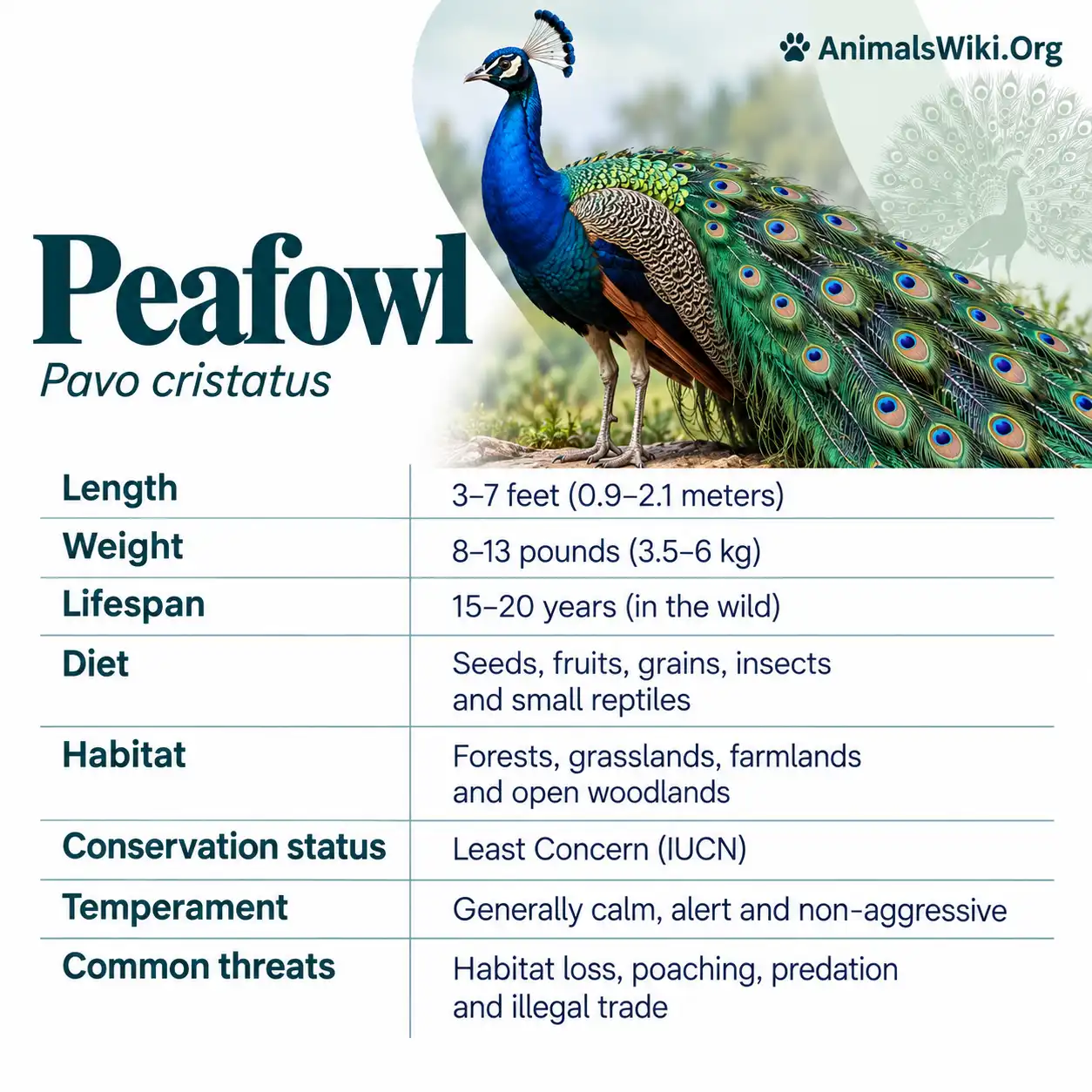
Peafowl Facts
| Feature | Details |
|---|---|
| Common Name | Peafowl (Indian Peafowl — focus species); males = Peacock; females = Peahen; young = Peachick |
| Scientific Name | Pavo cristatus (Indian Peafowl) |
| Family | Phasianidae |
| Order | Galliformes |
| First Described | 1758 (by Carl Linnaeus) |
| Native Habitat | Tropical and subtropical forests, forest edges, grassland, agricultural land |
| Geographic Range | Indian Subcontinent (India, Sri Lanka, Pakistan, Nepal, Bangladesh); introduced worldwide |
| Average Size | Male: 1.8–2.3 m total length (including train); Female: 0.9–1.0 m |
| Average Weight | Male: 4–6 kg; Female: 2.75–4 kg |
| Lifespan | 15–20 years (wild); up to 25 years (captivity) |
| Diet | Omnivore — seeds, insects, small reptiles, berries, plant material |
| Conservation Status | Least Concern (IUCN) |
| Defining Feature | The male’s spectacular iridescent train of up to 200 elongated feathers displayed in a magnificent fan; national bird of India |
| Number of Species | 3 species — Indian Peafowl, Green Peafowl, Congo Peafowl |
1. Peafowl Species Overview & Classification
There are birds that are beautiful. There are birds that are spectacular. And then there is the peacock — an animal that transcends ordinary superlatives and occupies a category essentially its own. Standing in full display, with its train raised and fanned into a shimmering semicircle of iridescent blue, green, and gold — each feather tipped with the hypnotic “eye” pattern that has captivated human imagination for thousands of years — the peacock is simply the most visually extraordinary bird alive. Not the largest. Not the fastest. Not the most endangered. But the most extravagantly, improbably, breathtakingly beautiful.
The Indian Peafowl (Pavo cristatus) — the species from which the familiar garden peacock is drawn — has been a companion of human civilization since at least 4,000 years ago, appearing in the art of ancient India, the menageries of Mesopotamian kings, the gardens of Greek philosophers, the mythology of Hindu religion, the trade routes of Phoenician merchants, and the decorative programs of European Renaissance courts. It is simultaneously the national bird of India, a globally farmed domestic species raised on every inhabited continent, and one of the most immediately recognizable bird silhouettes in the world — the fan-shaped train instantly identified by children who have never seen a live peafowl.
The peacock’s train — technically not a tail but a covert train of modified upper-tail covert feathers that cover the actual short tail — represents the most celebrated example of sexual selection in the entire animal kingdom. When Charles Darwin first developed his theory of sexual selection as a mechanism distinct from natural selection, the peacock’s train was his defining example: a structure so large, so heavy, and so visually conspicuous that it seemingly contradicts the survival-oriented logic of natural selection (it slows the male, increases predation risk, and costs enormous metabolic resources to grow) yet exists because female preference has driven its evolution beyond what natural selection alone would produce.
Yet the peacock’s extraordinary appearance is only one dimension of a genuinely fascinating animal — a bird whose intelligence exceeds what most people expect, whose social organization is more sophisticated than casual observation reveals, whose ecological role as a seed disperser, pest controller, and prey species is ecologically meaningful, and whose conservation situation (particularly for the less-known Green Peafowl) is more urgent than the Indian Peafowl’s abundant captive and feral populations might suggest.
Species Classification Table
| Classification Level | Details |
|---|---|
| Kingdom | Animalia |
| Phylum | Chordata |
| Class | Aves |
| Order | Galliformes |
| Family | Phasianidae (Pheasants, Turkeys, Grouse) |
| Subfamily | Phasianinae |
| Genus | Pavo (Indian and Green Peafowl); Afropavo (Congo Peafowl) |
| Species | Pavo cristatus (Indian Peafowl — focus species) |
| Described By | Carl Linnaeus, 1758 |
| National Bird of | India (since 1963) |
The Three Peafowl Species
| Species | Scientific Name | Range | IUCN Status | Notable Feature |
|---|---|---|---|---|
| Indian Peafowl | Pavo cristatus | Indian Subcontinent | Least Concern | Most familiar; most spectacular train |
| Green Peafowl | Pavo muticus | SE Asia (Java, Myanmar, Vietnam, Thailand) | Endangered | More slender; greener; female also striking |
| Congo Peafowl | Afropavo congensis | Congo Basin, Central Africa | Vulnerable | Discovered only in 1936; very different appearance |
Color Variants — Beyond the Standard Blue
Through centuries of captive breeding and selective breeding programs, several distinct color variants of the Indian Peafowl have been established:
| Variant | Appearance | Notes |
|---|---|---|
| Blue (wild-type) | Iridescent blue neck; green-gold train | The standard form; most common |
| White | Pure white throughout; non-albino | Leucistic mutation; blue eyes retained; extraordinarily striking |
| Black-shouldered (Pied) | Black wing coverts; otherwise normal | First noted as mutation in 1823 |
| Opal | Pale blue-silver coloration | Bred in captivity |
| Purple | Darker, more purple-blue coloration | Captive breeding selection |
| Midnight | Very dark, almost black | Selectively bred |
2. Peafowl Physical Description & Unique Features
The peafowl’s physical form represents one of the most extreme examples of sexual dimorphism in any bird — the male and female are so different in appearance that they could easily be mistaken for different species by an uninformed observer.
The Male — The Peacock
Overall size: The male Indian Peafowl is one of the largest flying birds on Earth — with a total length (body plus train) of 1.8–2.3 meters (6–7.5 feet) and a body weight of 4–6 kg (8.8–13.2 lbs). The body alone (without the train) measures approximately 1.0–1.2 meters.
The iridescent body: The male peacock’s body plumage is a spectacle in itself, independent of the train:
- Head and neck: Intense iridescent cobalt blue — not produced by pigments but by structural coloration (nanostructures in the feather barbs that reflect and refract light to produce the blue color); the precise shade varies with viewing angle — a property called iridescence
- Breast and upper body: Similarly intense blue
- Wing coverts: Predominantly barred black-and-buff with some iridescent blue-green patches
- Crest: An upright fan of specialized feathers with bare blue-green barbs at the tips, forming the characteristic wire-and-disc crest that is the peacock’s most immediately recognizable head feature; the crest is present in both sexes
The Train: The train — commonly and incorrectly called the “tail” — is technically the upper tail coverts (feathers that cover the base of the true tail). Key facts:
- Number of feathers: Typically 150–200 elongated feathers in a full adult train
- Length: Individual train feathers reach 1.0–1.5 meters (3.3–4.9 feet) beyond the body
- Total train spread when fanned: Approximately 2.0–2.3 meters (6.6–7.5 feet) in diameter
- The “eyes”: Each train feather terminates in the famous ocellus (eyespot) — a complex pattern of concentric rings in iridescent blue, green, and bronze that mimics the pattern of an eye; the ocellus structure is produced by precisely organized nanostructures that create different colors from different angles
- Weight: The full train constitutes approximately 60% of the peacock’s total body weight when fully grown — an extraordinary metabolic investment
- Annual replacement: The entire train is shed and regrown annually after the breeding season — growing back over approximately 6 months before the next breeding season
The Structural Color Mystery
The iridescent blues and greens of the peacock’s plumage are not produced by pigments in the conventional sense — there is essentially no blue or green pigment in peacock feathers. Instead, the colors are produced by structural coloration — the physical nanostructure of the feather barbs interferes with light waves, reflecting some wavelengths (blue, green) and absorbing others. This produces colors that:
- Change with viewing angle — the iridescent shimmer that makes peacock feathers so hypnotic
- Are more brilliant than any pigment could produce — the structural mechanism can produce colors of extraordinary saturation
- Do not fade with time — structural colors can persist essentially indefinitely in preserved feathers
The precise nanostructure responsible for peacock iridescence has been extensively studied by physicists and materials scientists — the photonic crystal structure of peacock feathers has inspired research in optical materials, anti-counterfeiting technologies, and structural color displays.
The Female — The Peahen
The peahen is a study in elegant restraint compared to the peacock’s extravagance:
- Body length: Approximately 0.9–1.0 meters (3–3.3 feet) — significantly smaller than the male
- Weight: 2.75–4 kg (6–8.8 lbs)
- Coloration: Predominantly dull brown, grey, and buff — providing excellent camouflage in dry forest and scrubland; the neck shows some iridescent green but much less vivid than the male
- No train: The peahen lacks the elongated train feathers entirely; her tail is short and conventional
- Crest: Present but shorter and less elaborate than the male’s
The peahen’s drab coloration is not a deficiency but an adaptation — she alone incubates the eggs and raises the chicks, and her camouflage is essential for survival during the weeks she spends on the ground nest.
The Eyes — Remarkably Large
Like many galliforms (members of the order Galliformes), peafowl have relatively large eyes positioned on the sides of the head, providing wide visual coverage for predator detection. The golden-yellow iris of the peahen and the iridescent blue-green iris of the peacock are both striking when seen at close range.
Did You Know? The iridescent “eyes” (ocelli) on a peacock’s train feathers are produced not by any blue or green pigment but entirely by physical nanostructures — arrays of microscopic protein rods and air pockets that interfere with incoming light waves to reflect specific colors. This discovery — made through electron microscope analysis of peacock feathers — inspired materials scientists to study peacock feather structure as a model for creating structural colors in manufactured materials. The photonic crystal architecture of a peacock feather is, at the nanoscale, one of the most complex and most precisely engineered structures produced by any living organism.
3. Peafowl Habitat & Geographic Range
The Indian Peafowl is a bird of the South Asian lowlands — adapted to the warm, tropical and subtropical environments of the Indian Subcontinent with a flexibility that allows it to thrive in habitats ranging from dense tropical forest to semi-arid scrubland, and from wild nature reserves to the surroundings of Hindu temples and agricultural villages.
Preferred Habitats
Forest and forest edges — the most natural peafowl habitat; they prefer areas with a combination of open ground for foraging and dense trees for roosting and cover; dry deciduous forest and moist deciduous forest are preferred; pure dense rainforest is generally avoided as the train becomes a physical obstacle in dense vegetation
Scrubland and grassland adjacent to forest — the forest-grassland transition zone is particularly favored; it provides both the open foraging ground the bird needs and the tree cover needed for roosting and predator escape
Agricultural land — peafowl are remarkably comfortable in agricultural landscapes and routinely exploit crop fields, orchards, and village surroundings; this adaptability has made them one of the few large birds to thrive in the heavily modified landscapes of the Indian Subcontinent; they are common around temples, villages, and farms throughout their range
Near water — peafowl prefer habitats with reliable water access; riverine areas and the surroundings of tanks (artificial ponds) in Indian villages are particularly favored
Elevation Range
Primarily a lowland bird — most abundant at elevations below 1,800 meters (5,900 feet); found occasionally up to 2,000 meters in the foothills of the Himalayas and Western Ghats; the Green Peafowl (Pavo muticus) is more associated with lowland forest and river valleys
Geographic Range
Native range (Indian Peafowl):
| Country / Region | Status | Notes |
|---|---|---|
| India | Native; abundant | Most widespread and most numerous; national bird |
| Sri Lanka | Native; abundant | Well-established; important cultural role |
| Pakistan | Native; present in suitable habitat | Less common than in India |
| Nepal | Native; Terai lowlands | Terai-Duar grasslands |
| Bangladesh | Native; declining | Habitat loss reducing populations |
| Bhutan | Occasional visitor | Recorded but not established as resident |
Introduced and feral populations (selected):
| Region | Status | Notes |
|---|---|---|
| United Kingdom | Introduced; feral on some estates | Maintained at stately homes, zoos; feral populations limited |
| United States | Introduced; feral populations | California, Florida, and other states; some feral populations causing conflict |
| Australia | Introduced; feral | Various states; some agricultural conflict |
| New Zealand | Introduced | Limited feral populations |
| Canary Islands (Spain) | Introduced; established | Significant feral populations; ecological concerns |
| South Africa | Introduced | Garden and estate birds; limited feral |
| Mauritius | Introduced; invasive | Significant invasive population causing ecological damage |
Did You Know? The Indian Peafowl has been introduced to every inhabited continent — making it one of the most widely distributed introduced bird species in the world. In some locations, feral peafowl populations have become significant ecological and social concerns — in parts of California and Florida, feral peacocks attracted by suburban gardens and supplementary feeding have established populations of hundreds of birds that damage vegetation, create noise disturbance (the peacock’s call is extraordinarily loud), and generate significant human-wildlife conflict in residential areas. Several US municipalities have engaged in controversial peafowl relocation or population control programs.
4. Peafowl Diet & Feeding Behavior
The peafowl is a dietary generalist of considerable range — an omnivore whose large body size, strong beak, and willingness to consume almost any food encountered makes it a highly effective exploiter of the varied food resources of the South Asian landscape.
What Peafowl Eat
Seeds and grains — the primary dietary component across most of the year; peafowl consume the seeds of grasses, agricultural crops (particularly maize, wheat, and rice at harvest edges), and a wide variety of wild plants; this grain-eating habit makes peafowl significant birds at the human-wildlife interface around farms
Insects and invertebrates — a major and nutritionally important dietary component, particularly important for chicks and breeding adults; peafowl consume:
- Termites — particularly important in the dry season when other food is scarce; peafowl probe termite mounds and exposed galleries
- Grasshoppers and locusts — consumed in large quantities during outbreaks; this predation of agricultural pest insects has significant economic value in farming communities
- Beetles and beetle larvae — found in soil and rotting wood
- Caterpillars — consumed from vegetation
- Earthworms — taken from soft soil after rain
Small reptiles — an important protein source; peafowl actively hunt:
- Small snakes — particularly notable; peafowl are famous in Indian rural tradition for their ability to kill snakes, and there is genuine scientific basis for this — they do consume small snakes opportunistically; however, the folk belief that peafowl are effective at controlling dangerous snake species is exaggerated
- Lizards — various species taken
- Skinks and geckos — taken from crevices and ground cover
Frogs and small amphibians — consumed when encountered
Berries and fruits — consumed seasonally; various wild and cultivated fruits taken from the ground and occasionally from low branches
Flower petals and plant parts — consumed regularly; the petals and young shoots of various plants are eaten, making peafowl occasional nuisances in formal gardens
Small mammals — very occasionally; mice, young rats, and other small mammals may be consumed; rare but documented
Foraging Behavior
Peafowl forage primarily on the ground — using their powerful bill to probe soil, overturn leaf litter, and scratch through ground cover in the manner characteristic of galliforms. The foraging technique involves:
Scratching — using the strong feet to rake back ground litter and expose underlying insects, earthworms, and seeds
Probing — inserting the bill into soft soil to locate earthworms and soil-dwelling insect larvae
Active hunting — chasing and striking at moving prey (insects, lizards, small snakes) with rapid head strikes powered by the long, muscular neck
Gleaning — picking insects and seeds from vegetation surfaces
Aerial hawking — peafowl occasionally pursue and catch flying insects in short aerial sallies
The Farmer’s Friend — Pest Control Services
The peafowl’s appetite for insect pests — particularly locusts, grasshoppers, caterpillars, and termites — makes it a genuinely valuable ally for traditional farming systems across South Asia. Rural communities throughout India have traditionally valued peafowl presence on farmland for this pest control service, which is one reason for the tolerance of peafowl crop raiding that might otherwise lead to persecution.
The snake-hunting reputation of peafowl has similarly enhanced tolerance — even if the birds’ actual impact on snake populations is minimal, the cultural association has protected peafowl from persecution in many areas.
Diet Breakdown Table
| Food Type | % of Annual Diet | Peak Season | Notes |
|---|---|---|---|
| Seeds and grains | 35–45% | Year-round; peak post-harvest | Crop raiding most common at harvest time |
| Insects and invertebrates | 25–35% | Monsoon and post-monsoon | Termites especially important in dry season |
| Berries and fruits | 10–15% | Wet season | Seasonal; varies by habitat |
| Small reptiles | 5–10% | Year-round | Snakes, lizards; active hunting |
| Plant material (leaves, shoots) | 5–10% | Wet season | Fresh vegetation; supplements diet |
| Frogs and small vertebrates | 2–5% | Monsoon | Wet season abundance |
5. Peafowl Reproduction & Life Cycle
The peafowl’s reproductive biology is organized entirely around the male’s spectacular display — one of the most thoroughly studied examples of sexual selection in any bird species — and the female’s discriminating choice among displaying males.
Breeding Season
In India, the primary breeding season follows the pre-monsoon and monsoon period — typically April through September, with peak displaying and mating in April through June when conditions are optimal. In Sri Lanka, breeding may occur somewhat differently timed to local monsoon patterns. In captive and introduced populations worldwide, breeding timing often shifts to reflect local spring conditions.
The Display — One of Nature’s Greatest Performances
The peacock’s courtship display is the most celebrated visual performance in the bird world — a combination of visual, acoustic, and vibrational signaling of extraordinary complexity.
Display components:
Train raising and fanning — the male raises his train feathers to a nearly vertical position and fans them into the magnificent semicircular display; the quill feathers of the actual tail (shorter, brown, and normally concealed beneath the train) are raised to support the train from behind; the entire fan may span 2.0–2.3 meters in diameter
Shivering and rattling — the male vibrates his raised train rapidly, causing the feathers to shake and produce an audible rattling sound that carries significant distance; this train-rattling is a key acoustic component of the display often overlooked in emphasis on the visual spectacle
Rotating — the male rotates within his display location to present the fan at different angles to the female, showing different parts of the train’s surface
Backing toward the female — in a critically important behavioral reversal, males sometimes turn their backs to displaying females to show the reverse of the fan — a pattern of brown and buff quill bases that contrasts completely with the iridescent front surface. Research has suggested this behavioral element may signal different information than the front display.
The infrasound component — research by Suzanne MacDougall-Shackleton and subsequently by Richard Prum and colleagues has demonstrated that peacock train displays generate infrasound — acoustic vibrations at frequencies below human hearing (below 20 Hz) — through the vibration of the train feathers. These low-frequency sound waves can be detected by peahens at distances beyond which visual display is effective, potentially providing a long-range advertisement component to the display that was entirely unsuspected until the research revealed it.
Female Mate Choice — What Are Peahens Looking For?
The question of what peahens actually assess during the peacock’s display has been studied for decades and remains one of the most thoroughly researched and most actively debated questions in behavioral ecology:
Eyespot (ocellus) number and arrangement — multiple studies have demonstrated that peahens show preferences for males with more ocelli; experimental manipulation (removing ocelli from train feathers) reduces male mating success
Train length — longer trains appear to be preferred; longer trains are correlated with older, more experienced males in better body condition
Symmetry — symmetric display (equal eyespot arrangement on both sides of the fan) is preferred over asymmetric display; symmetry is thought to reflect developmental quality and genetic health
Display rate and duration — males that display more actively and for longer durations are preferred; display persistence is correlated with body condition
Genetic quality — evidence from peahen MHC (Major Histocompatibility Complex) choice studies suggests that peahens may use the peacock’s display to assess genetic compatibility — choosing males whose MHC genes complement their own, potentially producing offspring with broader immune system coverage
The consensus from decades of research is that the peacock’s display is a multi-signal advertisement — different components of the display encode different information about male quality, and peahens integrate multiple signals to make complex mate choice decisions.
Mating System — Polygyny with Lek-Like Tendencies
Peafowl are polygynous — males typically mate with multiple females in a season. In wild populations, dominant males may mate with 3–5 females in a season; exceptionally dominant individuals may achieve more.
The mating system shows characteristics of both resource-based polygyny (males defend territories with resources that attract females) and lek-like polygyny (males display in traditional locations and females visit to choose mates based on display quality). In many populations, males aggregate in loose “exploded leks” where multiple displaying males can be compared by visiting females.
Nesting and Incubation
The peahen assumes sole responsibility for nest construction, incubation, and chick-rearing — the male plays no role after mating.
Nest: A simple scrape on the ground lined with leaves, grass, and feathers; typically located in dense vegetation offering concealment; sometimes in crop fields (creating conflict with farmers at harvest)
Clutch size: Typically 3–8 eggs (wild); occasionally up to 12
Egg description: Pale buff to cream-brown; relatively large (approximately the size of a goose egg); laid at 2-day intervals
Incubation period: Approximately 27–30 days — the peahen incubates alone; she sits tight on the nest and may be difficult to flush even when closely approached
Incubation challenges: The peahen’s drab coloration is her primary camouflage during the vulnerable incubation period; she is prey to multiple predators during this time and mortality of incubating peahens is a significant population factor
Chick Development
Peachicks are precocial — active and mobile within hours of hatching:
| Stage | Timing | Development |
|---|---|---|
| Hatching | Day 0 | Fully downy; eyes open; mobile within hours |
| First flight attempt | Day 7–10 | Can make short flights to low branches |
| Joining mother’s foraging route | Week 1–2 | Follows mother throughout; learns food identification |
| First moult | ~3 months | Juvenile plumage replacing natal down |
| Sexual differentiation visible | ~3–6 months | Males showing early coloration differences |
| Subadult male coloration | Year 2 | Striking but train not yet full |
| First train growth (males) | Year 2–3 | Initial train feathers appear |
| Full adult train | Year 4–6 | Maximum train length achieved |
| Sexual maturity (females) | ~1 year | Can breed in second year |
| Competitive maturity (males) | ~5–7 years | Full train and competitive ability |
Did You Know? Research published in 2011 by Dr. Mariko Takahashi and colleagues challenged previous assumptions about peacock display by conducting detailed analysis of peahen behavior during male displays and finding that peahens appeared to largely ignore the display for most of its duration — apparently not watching the train with the attention that researchers had assumed. This finding generated significant scientific controversy and re-examination of how female choice operates in peafowl. Subsequent research confirmed that peahens do make discriminating choices between males but that the timing and mechanisms of information acquisition are more subtle than simple visual assessment of the displayed fan.
6. Social Behavior & Communication
The peafowl’s social system is more sophisticated than the bird’s reputation as a purely decorative species might suggest — combining structured seasonal social groups, complex dominance hierarchies, an extraordinary vocal repertoire, and learned behavioral traditions that suggest a degree of cognitive flexibility.
Social Organization
Non-breeding season: Peafowl typically live in loose mixed-sex groups of 5–25 individuals — these groups provide collective predator detection, shared knowledge of food and water locations, and social engagement that appears important to the birds’ welfare. Males and females associate freely in these groups.
Breeding season: The social structure restructures around male display territories or traditional display locations; females move between male display areas to observe and mate; males compete for prime display sites.
Roosting groups: Peafowl are strongly communal in their roosting behavior — groups of 5–30+ individuals roosting together in tall trees each night; the same roosting trees are used repeatedly over many years. Roosting communally provides safety in numbers (more individuals alert to approaching nocturnal predators) and warmth in colder conditions.
Male bachelor groups: Young males form loose associations — “bachelor flocks” — that may roost and forage together while they develop the displays and competitive capabilities needed for breeding success.
The Remarkable Vocalization — The Call of the Peacock
The peacock’s call is one of the most instantly recognizable bird sounds in the world — a loud, penetrating, multi-syllable scream typically transcribed as “may-AWE” or “KE-OW” that carries over 1 km in still air. This call is used:
- Territorial advertisement — males call repeatedly at dawn and dusk from prominent elevated positions (roof tops, tall trees, fence posts) to advertise their presence to other males and to females
- Alarm calling — the contact call transforms into an insistent alarm series when predators are detected; the alarm call of a peafowl is taken seriously by surrounding wildlife, including deer, sambar, and other animals that use peacock alarm calls as warnings
- Social contact — various softer calls are used between individuals in a group for contact maintenance
- Chick-mother communication — peahens produce soft clucking calls when leading chicks; chicks respond with high-pitched whistling calls when separated from the mother
The low-frequency (infrasound) call: Research has demonstrated that the “hoot” call of the peacock — a low, resonant sound produced during display — contains infrasound components below the threshold of human hearing. These infrasound components travel further than higher-frequency sounds in the forest environment and may allow long-distance communication between individuals that cannot detect each other’s visual displays.
Intelligence and Problem-Solving
Peafowl demonstrate cognitive capabilities that exceed what most people expect from birds:
Spatial memory — peafowl in the wild maintain accurate mental maps of their home range, remembering the locations of food sources, water, roosting sites, and display locations across seasons
Learned traditions — groups of peafowl maintain traditional roosting sites, foraging routes, and display areas that appear to be culturally transmitted between generations; young birds learn these traditions from adults
Predator recognition — peafowl learn to distinguish between different predator species and produce different alarm responses for aerial versus terrestrial predators
Problem-solving in captivity — captive peafowl have demonstrated basic tool-use-adjacent behaviors and can navigate food access puzzles of moderate complexity
7. Predators & Defense Mechanisms
The peafowl occupies a position in the food web of the South Asian forest ecosystem that places it as prey for a significant diversity of predators — ranging from large mammalian carnivores to aerial raptors.
Natural Predators
Large Cats:
- Tiger (Panthera tigris) — the apex predator of the Indian subcontinent; takes peafowl opportunistically
- Leopard (Panthera pardus) — the most important large cat predator of adult peafowl; nocturnal hunting style allows leopards to approach roosting peafowl in trees; documened predation events show leopards climbing trees to reach roosting birds
- Jungle Cat (Felis chaus) and Leopard Cat (Prionailurus bengalensis) — smaller felids that primarily take chicks and juveniles
Dogs and Canids:
- Dhole (Asian Wild Dog) (Cuon alpinus) — pack hunting can overcome adult peafowl
- Golden Jackal (Canis aureus) — significant predator of eggs and chicks; will take adults when opportunity arises
- Feral and domestic dogs — significant mortality source, particularly near villages
Raptors:
- Changeable Hawk-Eagle (Nisaetus cirrhatus) — a significant avian predator of peafowl in forested areas
- Crested Serpent Eagle (Spilornis cheela) — takes chicks
- Owls — large owls (Dusky Eagle Owl, Brown Fish Owl) take roosting peafowl at night
Reptiles:
- Indian Rock Python (Python molurus) — significant predator particularly of chicks and juveniles; adults occasionally taken at roost
Defense Strategies
Tree roosting — peafowl’s most fundamental anti-predator behavior is sleeping in trees rather than on the ground; each evening, the entire group flies to roosting trees and remains elevated throughout the night; this places them beyond the reach of most terrestrial predators; they return to the ground only at first light
Flight — despite their enormous train (in males), peafowl are capable of powerful, rapid flight over short distances; the explosive vertical takeoff characteristic of galliforms allows peafowl to burst upward from the ground when surprised by a predator; the initial burst reaches 16 km/h vertically
The sentinel function — peafowl in groups maintain constant vigilance; any individual detecting a threat produces an immediate alarm call that alerts the entire group; peafowl are among the most reliable alarm callers in the South Asian forest ecosystem and their calls serve as warnings for other species
Alarm and scatter response — when alarmed, a peafowl group scatters explosively in multiple directions, confusing the predator and reducing the probability that any single individual is captured
The train as potential predator deflection — some researchers have proposed that the numerous “eyes” on the peacock’s train may function as intimidation displays against predators — the sudden revelation of dozens of eye-like patterns potentially startling or intimidating a predator considering an attack; evidence for this function is limited but not absent
The Male’s Disadvantage
The male peacock’s train — while extraordinarily beautiful and reproductively successful — genuinely disadvantages the male in predator avoidance relative to females:
- The train is heavy and reduces flying speed and maneuverability
- The train is physically conspicuous, making the male more visible to predators
- Growing the train requires enormous metabolic resources
- Carrying the train imposes mechanical challenges in dense vegetation
These costs are precisely what makes the peacock’s train such a powerful sexual selection signal — a male that survives to grow a full, long, symmetric train despite all these handicaps is genuinely advertising the quality of his genes. The peacock is, in evolutionary terms, the textbook demonstration of the Zahavian Handicap Principle — that costly, honest signals are reliable precisely because they are costly.
8. Relationship with Humans
Ancient South Asian Cultural Relationships
The peafowl has been a companion of human civilization on the Indian Subcontinent for at least 4,000 years — appearing in the earliest texts and art of South Asian civilization and embedded in religious, royal, and folk traditions across all of the subcontinent’s major cultural and religious traditions.
Indus Valley Civilization — peafowl images appear on seals, pottery, and small sculptures from Indus Valley sites dating to approximately 2500–1500 BC — among the earliest documented human representations of the species.
Hindu religious significance — the peafowl is deeply embedded in Hindu iconography and mythology:
- The peacock is the vahana (vehicle) of Kartikeya (Murugan) — the Hindu god of war and victory; Kartikeya is typically depicted riding a peacock or attended by one
- Krishna, one of Hinduism’s most beloved deities, traditionally wears a peacock feather in his crown — one of the most immediately recognized images in Hindu art; the peacock feather in Krishna’s crown is associated with his divine beauty and his role in the story of the Govardhan hill incident where the peacock’s feathers were said to be given in tribute
- Saraswati — goddess of learning and arts — is sometimes depicted with a peacock as her vehicle
- The peacock’s “thousand eyes” on the train are associated with all-seeing divine awareness in some Hindu traditions
Buddhist significance — the peacock is significant in Buddhist tradition; in Buddhist symbolism, the peacock represents the ability to transform poison into nourishment (reflecting the bird’s folk reputation for eating venomous snakes); it is also associated with the bodhisattva Mahamayuri — the Peacock Queen
Mughal India — the Mughal emperors were passionate about peafowl; the most famous physical representation of the Mughal relationship with peafowl is the legendary Peacock Throne — the Takht-e-Tawus — constructed for Emperor Shah Jahan (builder of the Taj Mahal) and completed in 1635. The Peacock Throne was considered the most valuable throne in the world — decorated with diamonds, rubies, emeralds, and pearls in the form of two peacocks flanking the emperor’s seat, with a jeweled canopy above in the form of a peacock with spread tail. The throne was plundered by the Persian conqueror Nadir Shah in 1739 and its subsequent history is unclear.
India’s National Bird — the Indian Peafowl was designated India’s National Bird in 1963 by the Indian government — recognized for its significance to Indian culture, its beauty, and its distribution across the country. The designation provides legal protection under the Indian Wildlife Protection Act; it is an offense to hunt or trap peafowl in India, contributing to the species’ abundance in the country.
The European Fascination — From Alexander to the Renaissance
The peafowl arrived in the Mediterranean world through trade networks associated with Alexander the Great’s Indian campaigns (327–325 BC) — though Greek knowledge of the bird predates Alexander; the philosopher Aristotle described peafowl with considerable biological accuracy in his Historia Animalium.
In ancient Greece and Rome, the peacock was associated with Hera (Juno) — the queen of the gods — and was kept in sacred groves and temple precincts. The myth of Argus Panoptes — the hundred-eyed giant whose eyes Hera transferred to the peacock’s tail after Hermes killed him — explained the origin of the eyespots in Greek mythology.
In medieval Europe, the peacock became a symbol of immortality, resurrection, and incorruptibility — medieval writers believed that peacock flesh did not decay, making the bird a natural symbol for Christ’s resurrection. Peacock was served at royal medieval banquets as the most prestigious possible food — typically re-dressed in its own feathers after cooking for theatrical presentation.
The Renaissance courts of Europe kept peafowl as living symbols of wealth and refinement; Versailles and other European royal gardens featured elaborate peacock collections; the fashion for peacock-feather decoration in interiors and fashion reached peaks in both the medieval period and again during the Art Nouveau movement of the late 19th century.
Commercial Uses Today
- Tourism — in India, peacocks are among the most important wildlife tourism subjects; peacock sightings and displays attract visitors to national parks and temples throughout the country
- Feather trade — peacock feathers (shed naturally after each breeding season) are collected and sold commercially for decoration, fashion, and religious use; India maintains regulated trade in naturally shed feathers; international trade in feathers is regulated under CITES
- Food — peafowl is raised for meat on small scales in some countries; peafowl eggs are consumed
- Ornamental — peafowl are maintained as living ornamental animals at estates, hotels, zoos, and farms worldwide; their spectacular appearance makes them tourist attractions in their own right
Did You Know? The legendary Peacock Throne of the Mughal Emperor Shah Jahan — considered the most valuable throne ever constructed — was valued at approximately 100 million rupees when completed in 1635, equivalent to billions of dollars today. The throne was decorated with diamonds, rubies, emeralds, and pearls arranged in the form of peacocks; when the Persian conqueror Nadir Shah seized it in 1739 during his sack of Delhi, eyewitnesses described it as containing gems worth more than all the other treasures of the Mughal treasury combined. The original throne was lost to history after Nadir Shah’s return to Persia; several later thrones also called “Peacock Throne” were constructed as substitutes but none matched the original’s legendary splendor.
9. Peafowl Conservation Status & Threats
IUCN Status
- Indian Peafowl (Pavo cristatus): Least Concern — abundant across the Indian Subcontinent; large wild population; additionally maintained in captive and feral populations worldwide
- Green Peafowl (Pavo muticus): Endangered — severe population decline from deforestation, hunting, and egg collection across Southeast Asia; estimated fewer than 15,000–30,000 mature individuals remaining; classified as Endangered since 2009
- Congo Peafowl (Afropavo congensis): Vulnerable — restricted range in the Congo Basin; threatened by deforestation and hunting; poorly monitored
The Indian Peafowl — Abundant but Locally Threatened
Despite its Least Concern status, the Indian Peafowl faces specific threats in parts of its range:
Crop depredation conflict — peafowl damage to agricultural crops (particularly grains, groundnuts, and vegetables) creates significant conflict with farming communities; in some areas, illegal poisoning, trapping, and shooting of peafowl occurs in response to crop damage, despite the species’ legal protection in India
Roadkill — the increasing road network across India creates significant peafowl road mortality; the species’ habit of foraging along road margins and its relatively slow road-crossing speed makes it vulnerable
Habitat loss — while the Indian Peafowl has proven remarkably adaptable to modified landscapes, the loss of forest cover reduces habitat quality and prey availability
Feather poaching — despite legal protection and a legal trade in naturally shed feathers, illegal poaching of peafowl for feathers occurs in parts of India
The Green Peafowl Crisis — An Urgent Emergency
The Green Peafowl (Pavo muticus) is the conservation crisis member of the peafowl family — declining rapidly across Southeast Asia from a combination of:
Deforestation — the lowland forest and river valley habitats that Green Peafowl require have been dramatically reduced across their Southeast Asian range; conversion to agriculture, particularly in the Mekong region and Sundaland, has eliminated vast areas of suitable habitat
Hunting — Green Peafowl are hunted for meat, feathers, and traditional medicine across much of their range; in areas without effective wildlife protection, hunting has severely reduced populations
Egg collection — systematic collection of Green Peafowl eggs for food and for sale has reduced reproductive success in many populations
Limited protected area coverage — much of the remaining Green Peafowl range is outside protected areas
10. Famous Peafowl Around the World
The Peacock of Versailles
The Palace of Versailles in France maintained an elaborate peacock collection in its gardens from the reign of Louis XIV (the Sun King) through the 18th century — the peacocks served as living symbols of royal magnificence and were a required feature of the formal French garden aesthetic. The Versailles peacocks were among the most famous ornamental birds in European history and contributed to the fashion for peacock-keeping at aristocratic estates across the continent.
The Peafowl of the London Zoo
Regent’s Park Zoo (ZSL London Zoo) has maintained peacocks as free-ranging animals within the zoo grounds since its founding in 1828 — making these birds among the longest-continuously-maintained animals at any zoological institution. The peacocks are a beloved feature of ZSL and regularly attract visitor attention; the free-ranging birds interact directly with zoo visitors and have appeared in numerous published photographs over nearly two centuries of London Zoo history.
The Peacock Throne — Shah Jahan’s Masterpiece
As described above, the Peacock Throne of Mughal Emperor Shah Jahan (completed 1635) is the most celebrated human artifact directly inspired by peafowl — a throne valued at a sum equivalent to billions of modern dollars, constructed in the form of peacocks with full trains and lost to history after its plunder in 1739.
Krishna’s Peacock Feather — Devotional Art
The single peacock feather worn in Krishna’s crown is one of the most reproduced artistic motifs in the world — appearing in millions of Hindu devotional images, temple decorations, dance costumes, and personal ornaments across India and the global Indian diaspora. The peacock feather worn by Krishna has been reproduced in art so many times that it represents one of the most frequently depicted animal-derived objects in the history of human visual culture.
The Peacock of the Alhambra
The Court of the Lions at the Alhambra palace in Granada, Spain — one of the greatest Islamic architectural achievements in Europe — features twelve white marble lions supporting the famous fountain; historical accounts suggest that the original Alhambra garden also featured living peacocks as part of the palace’s extraordinary aesthetic program. The association of peacocks with the highest expressions of Islamic court culture parallels their role in Mughal and other South Asian court traditions.
11. Role in Ecosystem & Food Chain
As Seed Dispersers
Peafowl consume large quantities of seeds and fruits and disperse them through their droppings at locations distant from the parent plant. Given the distances peafowl travel during daily foraging (regularly 3–10 km), they provide effective long-distance seed dispersal for a range of plant species in the South Asian forest ecosystem. This dispersal service is particularly important for large-seeded plants whose seeds cannot be dispersed by wind or smaller animals.
As Pest Controllers
The peafowl’s consumption of agricultural pest insects — particularly locusts, grasshoppers, caterpillars, and termites — provides quantifiable economic benefit to farming communities across the Indian Subcontinent. Studies in Indian agricultural areas have documented peafowl consuming significant quantities of pest species that would otherwise damage crops, providing a biological pest control service that reduces the need for chemical pesticides in areas with healthy peafowl populations.
As Prey — Supporting South Asian Predator Populations
Peafowl are significant prey for leopards, tigers, jackals, feral dogs, pythons, and large raptors across their range. Their abundance in many areas makes them an important component of the prey base supporting these predator communities. The alarm behavior of peafowl also indirectly benefits many other prey species — the peacock’s loud alarm call is recognized by deer, sambar, and other ungulates as a reliable warning of predator presence.
As Ecosystem Engineers — Soil Disturbance
The peafowl’s powerful scratching and probing behavior during foraging disturbs significant areas of soil and leaf litter — contributing to bioturbation that influences nutrient cycling, seed germination rates (by burying some seeds to appropriate depths), and the composition of soil invertebrate communities.
12. Peafowl Discovery & Evolution Timeline
~30–40 million years ago — The order Galliformes (pheasants, grouse, turkeys, peafowl) diversifies from earlier bird lineages; early phasianids inhabit forest environments across the northern continents.
~20 million years ago — The family Phasianidae (pheasants, including peafowl) is established; early relatives of modern peafowl are present in the Old World fossil record.
~5–10 million years ago — The genus Pavo diverges from related genera within Phasianidae; early peafowl are established across the Asian tropics.
~2–3 million years ago — The Indian Peafowl (Pavo cristatus) and Green Peafowl (Pavo muticus) lineages diverge; their geographic separation reflects the developing barrier of continental Southeast Asia versus South Asia.
~2500–1500 BC — Indus Valley Civilization sites show peafowl imagery; the earliest documented human representation of the species.
~1000 BC — Peafowl appear in Vedic literature and early Sanskrit texts; the association with Kartikeya and other deities is established in Hindu religious culture.
~950 BC — Biblical record (1 Kings 10:22) describes King Solomon importing peacocks from Ophir (possibly India or Sri Lanka) — among the earliest documented long-distance trade in peafowl
~327–325 BC — Alexander the Great’s Indian campaign introduces Greek soldiers to peafowl; live birds brought back to Greece; Aristotle documents peafowl biology.
~280 BC — The first systematic breeding of peafowl in ancient Greece at the island of Samos; peafowl become prestigious luxury animals in Greek culture.
~27 BC–14 AD — Roman Emperor Augustus maintains elaborate peacock collections; Roman banquets feature peacock as luxury food
~500–1500 AD — Peacocks maintained at European royal courts and monasteries as symbols of immortality and royal prestige; peacock feathers used in ecclesiastical and royal regalia
1635 — Shah Jahan’s Peacock Throne completed in Mughal India; the most valuable throne ever constructed
1739 — Peacock Throne plundered by Nadir Shah during the sack of Delhi
1758 — Carl Linnaeus formally describes Pavo cristatus in Systema Naturae
1856 — Charles Darwin uses the peacock’s train as the defining example motivating his concept of sexual selection — writing in a letter to Asa Gray: “The sight of a feather in a peacock’s tail, whenever I gaze at it, makes me sick!” (expressing his discomfort with a structure that seemed to contradict his natural selection theory)
1871 — Darwin publishes “The Descent of Man and Selection in Relation to Sex” — formally developing sexual selection theory with the peacock as the central example
1877 — James McNeill Whistler completes the Peacock Room in London — one of the most celebrated peacock-themed artworks in Western art history
1956 — NBC adopts the peacock as its network logo to advertise color television
1963 — India designates the Indian Peafowl as its national bird
1936 — The Congo Peafowl (Afropavo congensis) is formally described by James Chapin — one of the most extraordinary ornithological discoveries of the 20th century; a large, unknown peafowl species in Central Africa identified from a single feather in museum collections, later confirmed with specimens
2008–2011 — Research reveals that peacock trains generate infrasound during displays; subsequent studies on the nature of peahen mate choice challenge previous assumptions
2014 — Molecular studies formalize the recognition of Green Peafowl subspecies and clarify peafowl phylogenetics
2020 — NBC Universal launches Peacock streaming service — bringing the peafowl name into the streaming age
2026 — Indian Peafowl remains abundant across South Asia; Green Peafowl continues Endangered trajectory with conservation programs active across Southeast Asia; Congo Peafowl remains poorly monitored but subject to growing conservation attention
13. Peafowl Comparison with Similar Species
| Feature | Indian Peafowl (P. cristatus) | Green Peafowl (P. muticus) | Congo Peafowl (A. congensis) | Great Argus (A. argus) |
|---|---|---|---|---|
| Range | Indian Subcontinent | SE Asia (Java, mainland) | Congo Basin, Africa | SE Asia (Borneo, Sumatra, Malay) |
| Male length | 1.8–2.3 m (with train) | 1.8–3.0 m (with train) | ~64 cm | ~160–200 cm (with wings) |
| Male weight | 4–6 kg | 3.8–5 kg | ~1.5 kg | ~2.5 kg |
| Female appearance | Drab brown-grey | Similar to male; striking | Chestnut and black; very different | Brown; less spectacular than male |
| Train/display | Blue-green fan with ocelli | Green-bronze fan with ocelli | No long train | Secondary feathers with ocelli |
| Neck color (male) | Iridescent cobalt blue | Iridescent green-bronze | Metallic blue-green | Rufous brown |
| Crest | Fan of wire-tipped feathers | Long, tightly grouped | Short | None |
| Habitat | Forest edge, agricultural | Lowland forest, river valleys | Dense rainforest | Dense forest |
| IUCN Status | Least Concern | Endangered | Vulnerable | Vulnerable |
| Famous for | Most familiar peafowl; Hindu symbolism | Most spectacular; larger train | Discovered only in 1936 | Enormous wing feather display |
14. Best Places to See Peafowl in the Wild
India — The Heartland of Peafowl
India offers the best wild peafowl viewing in the world — both in spectacular protected natural areas and in the extraordinary experience of peafowl living freely in cultural and religious settings.
- 🇮🇳 Ranthambore National Park, Rajasthan — one of India’s premier tiger reserves; peafowl are extraordinarily abundant and highly habituated to vehicles; male displays are a common sight during morning and evening game drives; April–June (breeding season) produces the most spectacular display behavior
- 🇮🇳 Kanha Tiger Reserve, Madhya Pradesh — excellent peafowl populations in classic Central Indian forest; early morning drives regularly encounter groups of displaying males in forest clearings
- 🇮🇳 Gir National Park, Gujarat — the only wild Asiatic Lion habitat is also excellent peafowl country; the dry deciduous forest here supports large peafowl populations
- 🇮🇳 Bharatpur (Keoladeo National Park), Rajasthan — a UNESCO World Heritage wetland and one of Asia’s greatest birding sites; peafowl are abundant and extremely approachable; excellent for photography
- 🇮🇳 Sariska Tiger Reserve, Rajasthan — known for excellent peafowl density; villages adjacent to the reserve have exceptionally habituated birds approaching temples and farms
- 🇮🇳 Temple towns throughout Rajasthan and Gujarat — perhaps the most extraordinary peafowl viewing experience available; temples at Pushkar, Jodhpur, Jaisalmer and throughout Rajasthan have semi-wild peafowl that live on and around the temple grounds in complete comfort with human presence; seeing peacocks in full display against the backdrop of Rajasthani fort architecture is one of India’s most remarkable wildlife experiences
Sri Lanka
- 🇱🇰 Yala National Park — excellent peafowl viewing combined with leopard, elephant, and sloth bear; peafowl are common and habituated to vehicles throughout the park
- 🇱🇰 Udawalawe National Park — superb peafowl populations in open scrub and forest
For Green Peafowl
- 🇹🇭 Huai Kha Khaeng Wildlife Sanctuary, Thailand — one of the last strongholds for Green Peafowl in mainland Southeast Asia; UNESCO World Heritage Site; requires organized tours
- 🇯🇵 Various Japanese zoos — Green Peafowl is maintained in captivity in Japan and other countries; accredited zoos with conservation programs for this Endangered species offer reliable viewing
15. Peafowl Fun Facts for Kids
- 🦚 The peacock’s train is not a tail — it is modified upper tail covert feathers; the actual tail is short and brown beneath
- 🦚 The iridescent blue-green colors of the peacock’s plumage are produced by physical nanostructures — not pigments
- 🦚 The peacock’s train can contain up to 200 elongated feathers and constitutes approximately 60% of the bird’s total body weight
- 🦚 A peacock display generates infrasound — low-frequency vibrations below human hearing that females may use for long-distance mate assessment
- 🦚 The Indian Peafowl is India’s national bird — designated in 1963
- 🦚 The NBC Peacock logo — first adopted in 1956 — is one of the most recognized corporate logos in American media
- 🦚 The legendary Peacock Throne of Shah Jahan (1635) was considered the most valuable throne ever constructed
- 🦚 Charles Darwin was so troubled by the peacock’s train (which seemed to contradict natural selection) that he wrote it made him “sick to look at it” — until he developed the theory of sexual selection to explain it
- 🦚 Peafowl can live up to 25 years in captivity — among the longer-lived Galliformes
- 🦚 A single peacock’s natural feather sheds can legally be collected and sold in India — the feather trade in naturally shed feathers supports cottage industries across the country
- 🦚 The Congo Peafowl was unknown to Western science until 1936 — discovered from a single feather in a museum collection
- 🦚 Peafowl alarm calls are recognized by deer, sambar, and other wildlife as warnings of predator presence — they function as sentinel species for the entire forest ecosystem
16. Frequently Asked Questions About Peafowl And Peacock
Q1: What is the difference between a peafowl, a peacock, and a peahen?
Peafowl is the correct collective term for the species — used for both sexes and all ages. Peacock specifically refers to the adult male — the bird with the spectacular iridescent blue body and the famous long, eye-spotted train. Peahen refers to the adult female — the smaller, drab brown-grey bird that lacks the long train. Peachick refers to young birds of either sex. Most people use “peacock” as a general term for the species regardless of sex, but technically it is the male-specific term.
Q2: Is the peacock’s tail actually a tail?
No — the famous display structure is not the tail. It is the upper tail covert feathers — specialized elongated feathers that cover the base of the actual tail. The true tail of the peacock is short (approximately 45 cm), brown, and normally completely concealed beneath the much longer and more spectacular coverts. When the peacock raises his “train” in display, you can sometimes see the true brown tail feathers fanned upward to provide structural support for the much longer train coverts above them. The correct term for the display structure is the train or upper tail coverts — not the tail.
Q3: Why do peacocks have such elaborate trains if it makes them more vulnerable to predators?
The peacock’s train exists because female peahens choose to mate with males who have larger, more elaborate trains — a phenomenon explained by Darwin’s theory of sexual selection. Peahens prefer males with longer trains, more numerous eyespots, and greater symmetry — because these characteristics correlate with male genetic quality, health, and body condition. Males that successfully grow and maintain a spectacular train demonstrate (honestly) that they are healthy and genetically fit enough to afford the metabolic cost of the train and to survive despite its predator-attracting conspicuousness. This is the Handicap Principle — the train is trusted as an honest signal of quality precisely because it is so costly. Over millions of generations, peahen preference has driven the evolution of increasingly spectacular trains despite their survival costs.
Q4: What do peafowl eat?
Peafowl are omnivores with a diverse diet. In the wild, they consume: seeds and grains (the primary food source); insects and invertebrates (particularly locusts, grasshoppers, caterpillars, and termites — making them valuable pest controllers); small reptiles including lizards and occasionally small snakes; berries and fruits; leaves and plant parts; and frogs and small mammals opportunistically. In agricultural areas, they frequently raid crop fields for grain — a behavior that creates conflict with farmers. In religious and temple settings across India, peafowl are often fed by devotees, supplementing their diet with grain and other offerings.
Q5: Are peacock feathers bad luck?
The belief that peacock feathers bring bad luck is a Western folk superstition with no basis in fact or in most cultural traditions worldwide. In Hindu culture — the source of the peacock’s longest cultural relationship with humans — peacock feathers are highly auspicious; they are associated with Krishna (one of Hinduism’s most beloved deities), used in religious ceremonies, worn as ornaments, and displayed in homes as good luck charms. The “bad luck” superstition appears to be a specifically European-derived belief, possibly connected to the association of the eyespots with the “evil eye” in some Western folk traditions, or with theatrical superstitions (peacock feathers on stage are considered bad luck in some theatrical traditions). In India, Sri Lanka, and across most of Asia, peacock feathers are symbols of good fortune and divine blessing.
Q6: Can peafowl fly?
Yes — despite their large size and elaborate train, peafowl are capable fliers. They regularly fly to tree branches for roosting (typically ascending to 6–10 meters above ground each evening), and can make rapid vertical takeoffs when startled. Their flight is powerful but not sustained — they can cover several hundred meters in a single flight but are not long-distance fliers. Male peacocks with full trains find flight somewhat more difficult than females due to the train’s weight and aerodynamic drag, but they are nonetheless capable of reaching roosting trees. The train is trailed behind the bird during flight and does not spread into its display fan configuration.
Q7: How long does it take for a peacock to grow its train?
The peacock does not develop its full train immediately — the growth is gradual over several years. Male peachicks show no train at hatching; the first train feathers appear at approximately 2–3 years of age, but the train is not full-length or full-complexity until approximately 5–6 years of age. Young males (2–4 years) have shorter trains with fewer and less perfectly formed eyespots and are generally less successful in competition with older, fully-trained males. After reaching full development at approximately 5–6 years, the male grows and replaces his train annually — shedding the entire train after the breeding season and regrowing it over the following months before the next breeding season begins.
Q8: What is the Congo Peafowl and why is it significant?
The Congo Peafowl (Afropavo congensis) is the third peafowl species and the only member of the peafowl family native to Africa — found in the Congo Basin rainforest of Central Africa (primarily the Democratic Republic of Congo). It is significant for several reasons: it was entirely unknown to Western science until 1936, when American ornithologist James Chapin identified a single puzzling feather in a museum collection as belonging to an unknown large pheasant — subsequently confirmed when specimens were collected; it is the only African pheasant in a family otherwise restricted to Asia; its male is dramatically different from Asian peafowl (lacking the long train and having very different coloration — metallic blue-green on the body with white-streaked head); and it is classified as Vulnerable due to deforestation and hunting across its Congo Basin range.