Rhino Beetle Facts
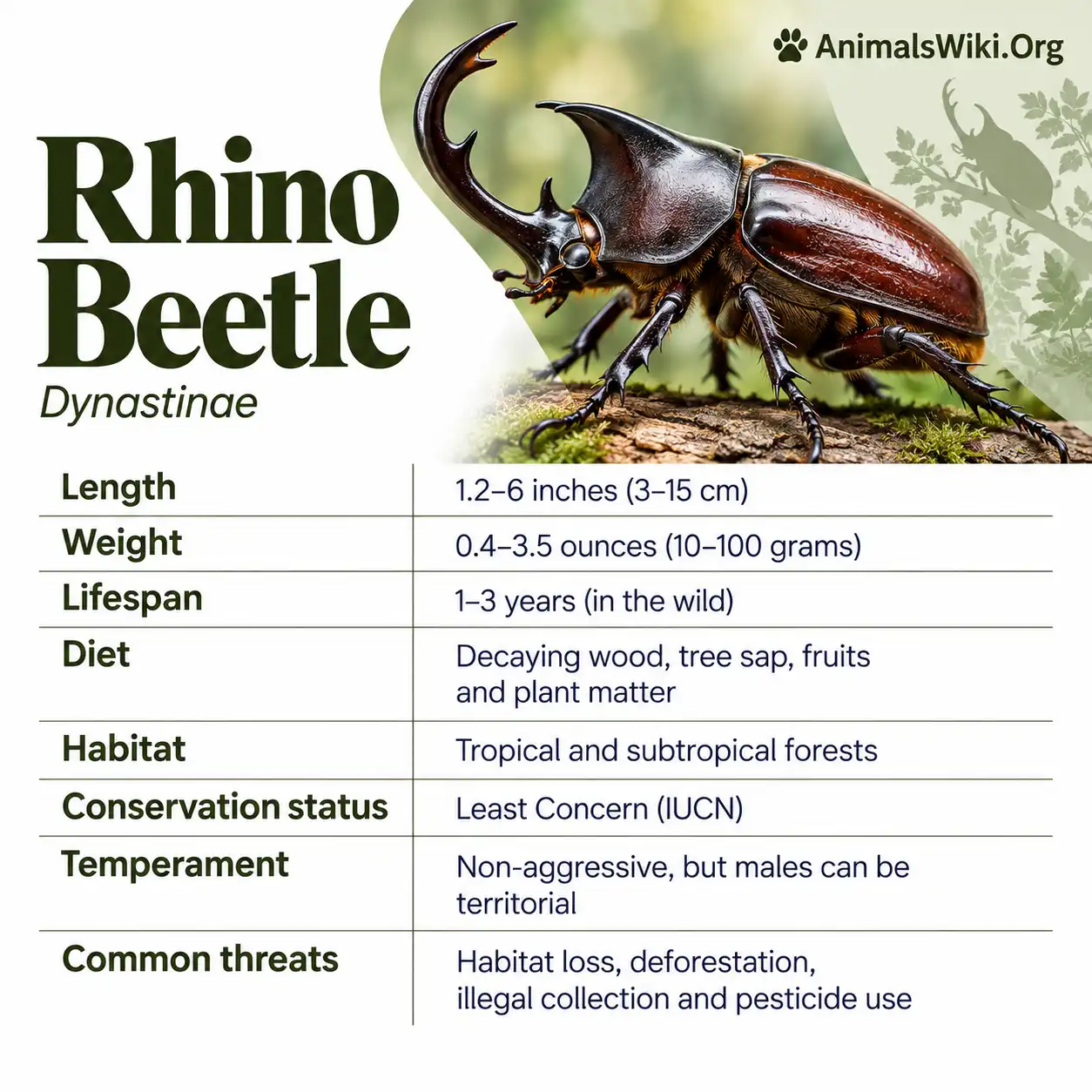
| Feature | Details |
|---|---|
| Common Name | Rhino Beetle / Rhinoceros Beetle (Hercules Beetle — focus species) |
| Scientific Name | Dynastes hercules (Hercules Beetle) |
| Family | Scarabaeidae |
| Order | Coleoptera |
| First Described | 1758 (by Carl Linnaeus) |
| Native Habitat | Tropical and subtropical rainforest; cloud forest; montane forest |
| Geographic Range | Central America, South America, Lesser Antilles (Caribbean islands) |
| Average Size | Males: 50–170 mm total length (including horns); Females: 50–80 mm |
| Average Weight | 15–40 grams (males); 10–20 grams (females) |
| Lifespan | 1–3 years total; adult stage 3–6 months |
| Diet | Larvae: rotting wood; Adults: rotting fruit, tree sap, plant material |
| Conservation Status | Least Concern (IUCN) — most species; some Near Threatened |
| Defining Feature | World’s longest beetle; males bear enormous cephalic and thoracic horns; can carry 850 times their own body weight |
| Number of Species | ~300 species in subfamily Dynastinae worldwide |
1. Rhino Beetle Species Overview & Classification
In the dense rainforests of Central and South America, something moves through the canopy at dusk that defies easy categorization. It is an insect — undeniably — yet it is the size of a human palm. Its body is armored in glossy black, olive-green, or gold. And projecting forward from its head and thorax, curving upward and downward respectively to meet in a pincer-like arrangement, are a pair of horns so enormous, so disproportionate, so magnificently improbable that the creature carrying them seems to belong to a different evolutionary era — as though the Mesozoic had deposited a small, horned dinosaur in the wrong century and the wrong size class.
This is the Hercules Beetle (Dynastes hercules) — the most spectacular member of the rhinoceros beetle family and the holder of one of the most extraordinary records in the biological world: the world’s longest beetle, with horn-to-wingtip measurements reaching 170 mm (6.7 inches) in the largest males. Not the heaviest insect (that distinction goes to the Giant Weta relative or the Goliath Beetle), but the longest — the animal that most dramatically answers the question of how large a beetle can become.
The Hercules Beetle is the flagship species of the subfamily Dynastinae — the rhinoceros beetles — a group of approximately 300 species distributed across tropical and subtropical regions worldwide. The subfamily earns its common name from the elaborate horns borne by males of most species — structures used in male-male combat for access to females and feeding sites in a behavioral ecology that mirrors, at insect scale, the horn-fighting of rhinoceroses, elk, and other large horned vertebrates.
Rhinoceros beetles collectively represent one of the most compelling demonstrations of sexual selection in the insect world — the males’ horns evolving under the dual pressure of female choice and male competition to the extraordinary proportions that characterize the family. They are also among the most frequently cited examples of relative strength in biology — capable of carrying loads many hundreds of times their own body weight — and among the most commercially significant insects in Asia, where several species are kept as pets, raced competitively, and sold for significant sums.
The rhino beetle’s story encompasses evolution, ecology, cultural tradition, conservation concern, and one of the most extraordinary examples of insect engineering anywhere in the natural world.
Species Classification Table
| Classification Level | Details |
|---|---|
| Kingdom | Animalia |
| Phylum | Arthropoda |
| Class | Insecta |
| Order | Coleoptera |
| Family | Scarabaeidae |
| Subfamily | Dynastinae |
| Tribe | Dynastini (focus — large horned species) |
| Genus | Dynastes (focus) |
| Focus Species | Dynastes hercules — Hercules Beetle |
| Described By | Carl Linnaeus, 1758 |
| Total Dynastinae species | ~300 species in ~80 genera |
Key Rhinoceros Beetle Species
| Species | Common Name | Range | Notable Feature |
|---|---|---|---|
| Dynastes hercules | Hercules Beetle | C & S America, Caribbean | World’s longest beetle; up to 170 mm |
| Dynastes neptunus | Neptune Beetle | Colombian/Ecuadorian Andes | Dramatic green-black coloration |
| Dynastes tityus | Eastern Hercules Beetle | Eastern North America | Smaller; greenish-grey; temperate forest |
| Dynastes granti | Western Hercules Beetle | Arizona, New Mexico, Mexico | White-grey coloration; southwestern US |
| Chalcosoma caucasus | Caucasus Beetle | Southeast Asia | Massive; 3 large horns; up to 130 mm |
| Dynastes satanas | Satan Beetle | Bolivia | Rare; extremely large; all-black |
| Megasoma elephas | Elephant Beetle | C & S America | Extremely heavy; densely furred |
| Strategus aloeus | Ox Beetle | Southern North America | 3 thoracic horns; smaller species |
| Xylotrupes gideon | Fighting Beetle | Southeast Asia | Most widely kept as pet; Japan |
| Oryctes nasicornis | European Rhinoceros Beetle | Europe, Middle East | Only significant European species |
2. Rhino Beetle Physical Description & Unique Features
The rhinoceros beetle’s body plan is one of the most immediately striking in the entire insect world — combining the beetle’s characteristic armored body with horn structures so enormous that they fundamentally alter the animal’s overall shape and behavioral capabilities.
Size — Record-Breaking Dimensions
The Hercules Beetle holds the record for the world’s longest beetle — with total body length (including the cephalic horn projecting forward from the head) reaching up to 170 mm (6.7 inches) in the largest males. Key size facts:
Males:
- Total length (body + horns): 50–170 mm (typically 80–120 mm in most individuals)
- Body length alone (excluding horns): 50–85 mm
- Horn length: Can account for up to 50% of total length in the largest individuals
- Weight: 15–40 grams — substantial for an insect
Females:
- Total length: 50–80 mm — no horns; similar body length to small males
- Weight: 10–20 grams
The size variation within the species is extraordinary — the smallest adult male Hercules Beetles may be less than 50 mm while the largest exceed 170 mm — a more than three-fold variation within a single species. This variation is not genetic but reflects larval nutrition — larvae that have access to abundant, high-quality rotting wood throughout their development produce the largest adults; nutritionally stressed larvae produce smaller adults with proportionally shorter horns.
The Extraordinary Horns
The Hercules Beetle male bears two prominent horns — one projecting forward and upward from the thorax (the middle body section) and one projecting forward and downward from the head (cephalic horn). Together these two horns create a pincer-like structure that is the beetle’s defining anatomical feature:
Thoracic horn — projects forward and upward from the pronotum (the dorsal plate covering the thorax); the upper element of the pincer arrangement; typically longer than the cephalic horn in large males; may be covered in fine golden-yellow hair in some individuals
Cephalic horn — projects forward from the head; the lower element of the pincer; typically shorter than the thoracic horn; in large males, the two horns together form a formidable grasping tool used to seize rival males and flip them from feeding or mating sites
Horn texture and structure: The horns are composed of the same chitin (the structural polysaccharide of insect exoskeletons) as the rest of the beetle’s body; they are solid, extremely rigid, and non-retractable
Allometry — disproportionate growth with size: One of the most biologically interesting features of rhinoceros beetle horns is that they grow disproportionately with body size — larger beetles have not merely proportionally longer horns but horns that are a larger fraction of total body size; this is called positive allometry and means that horn length is a particularly sensitive indicator of body size and condition, making it an exceptionally reliable signal of male quality
Coloration — The Remarkable Color-Change Feature
The Hercules Beetle has a remarkable and frequently cited ability to change color — shifting between olive-green/yellow-green and black depending on humidity:
- In low humidity or dry conditions: the elytra (wing covers) appear olive-green to yellowish-green; this green coloration is the most familiar from photographs
- In high humidity or wet conditions: the elytra darken dramatically to black
This color change is produced by nanostructural changes in the elytra surface — microscopic pore structures fill with water in humid conditions, altering how light is reflected and producing the dark appearance. The color change is reversible — as the beetle dries, the green color returns. This phenomenon has been extensively studied by materials scientists as a model for humidity-responsive structural color in synthetic materials.
The Elytra and Flight
Like all beetles, the Hercules Beetle has:
- Elytra (hardened wing covers) — modified forewings that have been sclerotized (hardened) into protective covers for the flying wings beneath; in the Hercules Beetle these are the large, greenish/black structures that dominate the beetle’s dorsal appearance
- Membranous hindwings — folded beneath the elytra at rest; unfolded for flight
- Flight capability — despite their large size, Hercules Beetles can fly; flight is primarily at dusk and night during dispersal, mate searching, and finding feeding sites; the flight is buzzing and relatively labored given the beetle’s weight
The Incredible Strength — 850 Times Body Weight
The most frequently cited fact about rhinoceros beetles is their extraordinary relative strength — the ability to carry loads many hundreds of times their own body weight. Research has documented:
- Hercules Beetle: Can carry approximately 850 times its own body weight
- Other rhinoceros beetle species: Variously documented at 100–1,000 times body weight depending on species and measurement methodology
- Human equivalent: A person with this relative strength would be able to carry approximately 65 metric tons — the weight of a loaded Boeing 737
This extraordinary strength is produced by the beetle’s muscle architecture — insect muscles, particularly in the legs and thorax, can generate extraordinary forces relative to body mass because the mechanical leverage systems in insect limbs are optimized for force production rather than speed.
Did You Know? The Hercules Beetle’s horns are so large that when first discovered by European natural historians, some scholars refused to believe they were real — suspecting the horns were artificial additions made by indigenous people to otherwise normal beetles. Carl Linnaeus himself, when formally describing the species in 1758 and naming it after the Greek mythological hero Hercules, acknowledged that the beetle’s proportions seemed almost mythologically improbable for an insect. The specific epithet hercules — the Latin form of the Greek hero’s name — directly references this impression of impossible strength and scale.
3. Rhino Beetle Habitat & Geographic Range
The rhinoceros beetles as a group span an extraordinary geographic range — from tropical rainforests to temperate woodlands, from sea-level coastal forests to montane cloud forests at over 2,000 meters elevation. The Hercules Beetle specifically is a creature of Neotropical humid forest — one of the most biodiverse and most threatened biomes on Earth.
Hercules Beetle Habitat
Dynastes hercules inhabits:
Tropical rainforest — the primary habitat; lowland and foothill tropical forest throughout Central America and northern South America; the combination of high temperatures, abundant rainfall, and the large quantities of decaying wood that characterize mature rainforest provides the larval food resource and the adult fruiting trees that the species requires
Cloud forest and montane forest — at higher elevations (typically 500–2,000 meters) the species persists in cloud forest where temperatures are cooler and humidity is consistently high; some of the largest individuals are found at moderate elevations in Andean foothill cloud forest
Secondary and disturbed forest — the Hercules Beetle can persist in disturbed and secondary forest as long as sufficient decaying wood is available for larval development; complete deforestation eliminates the species, but moderate forest disturbance may be tolerated
Microhabitat Preferences
Within forest environments, adult Hercules Beetles show specific microhabitat preferences:
Rotting fruit trees — adult beetles congregate at trees producing fallen and fermenting fruit; the fermentation provides both a food source (sugars and yeasts) and a social context for male-male competition and mating
Sap flows — damaged trees producing sap flows attract multiple beetle species; rhino beetles will feed at sap flows and defend these resources against rivals
Decaying logs and stumps — larval habitat; females select appropriate decaying wood for oviposition based on moisture content, fungal colonization state, and wood species
Geographic Range
| Region | Countries | Subspecies / Notes |
|---|---|---|
| Central America | Mexico (south), Guatemala, Honduras, Nicaragua, Costa Rica, Panama | Multiple subspecies; good populations in protected forests |
| South America (north) | Colombia, Venezuela, Trinidad, Ecuador, Peru, Bolivia, Brazil (north) | Widest range; most subspecies diversity |
| Caribbean Islands | Guadeloupe, Dominica, Martinique, St. Lucia, St. Vincent | Island populations; some island-specific subspecies |
| Lesser Antilles | Various eastern Caribbean islands | Isolated island populations; some conservation concern |
Subspecies Diversity
Dynastes hercules has 13+ recognized subspecies — more than any other rhinoceros beetle species — reflecting the species’ wide geographic range and the tendency of island and mountain populations to diverge morphologically from mainland forms. Key subspecies include:
- D. h. hercules — Guadeloupe and Lesser Antilles; the nominate subspecies described by Linnaeus
- D. h. reidi — Martinique
- D. h. paschoali — Brazil
- D. h. lichyi — Colombia and Venezuela; some of the largest known individuals
- D. h. bleuzeni — Mexico and Central America
Did You Know? The Hercules Beetle is found in the Lesser Antilles — a chain of Caribbean islands — as well as mainland Central and South America, making it one of very few large beetle species with natural island distributions. The island populations are thought to have colonized the Caribbean from the South American mainland through over-water dispersal — remarkable for such a large insect, but consistent with the beetle’s documented flight capability and the strong trade winds that carry insects between South America and the eastern Caribbean islands.
4. Rhino Beetle Diet & Feeding Behavior
The rhinoceros beetle’s dietary strategy is dramatically different between its larval and adult stages — reflecting the completely different ecological roles and physiological needs of these two life stages.
Adult Diet — Fermented Sweetness
Adult rhinoceros beetles are not the powerful predators their armored, horned appearance might suggest — they are fundamentally gentle herbivores whose adult diet consists almost entirely of:
Rotting and fermenting fruit — the primary food source for most adult rhinoceros beetles; fallen fruit in various stages of fermentation provides:
- Simple sugars — readily accessible energy for the energetically demanding flight and reproductive activities of the adult stage
- Yeasts and microorganisms — provide additional nutrients
- Liquid — the fermenting fruit pulp provides moisture
Specific fruits consumed include wild figs, fallen tropical fruits, and various forest floor-level decaying plant material.
Tree sap — adult beetles feed at wounds and natural openings in tree bark where sap flows; they use their strong mandibles to enlarge wounds and maintain access to sap flows; multiple beetle individuals (sometimes of multiple species) may aggregate at productive sap flows, leading to competitive interactions
Decomposing plant material — various decomposing organic material provides supplementary nutrition
Larval Diet — Wood Decomposers
The larval stage is where the rhinoceros beetle makes its most significant ecological contribution — as a decomposer of dead and decaying wood:
Decaying logs and stumps — larvae of most rhinoceros beetle species feed primarily within rotting wood, consuming the fungus-colonized material that is produced as wood decomposes. The wood at this stage is partially broken down by fungi, making it more accessible to the beetle larvae’s digestive system.
Fungus-colonized substrate — the fungi that colonize decaying wood are as important as the wood itself; larvae preferentially select wood that has been pre-colonized by specific fungal species that make the cellulose and lignin more digestible; some rhinoceros beetle species are specifically associated with particular fungal-wood combinations.
Composted material — several rhinoceros beetle species (including many kept in captivity) will develop in composted plant material — garden compost, leaf litter compost, and similar substrates; this reflects the larvae’s fundamental role as decomposers of organic material.
Duration of larval feeding — the larval stage is extraordinarily long for an insect — 1–2 years or more in many rhinoceros beetle species; during this period, the larva grows from a tiny newly-hatched grub to a massive, cream-colored larva weighing 20–30+ grams — one of the heaviest insect larvae in the world.
The Feeding Equipment
Adult mandibles — strong, functional mouthparts capable of scraping and rasping soft organic material from fruit and wood surfaces; not designed for predation
Larval mandibles — powerful cutting and crushing mouthparts specifically designed for processing wood; the larval head capsule (the hardened head) is disproportionately large and contains the musculature needed to drive these powerful mouthparts through dense wood fiber
Digestive system — the larval digestive system contains specialized gut microbiota (bacteria and protozoa) capable of breaking down cellulose — the primary structural component of wood — into digestible sugars; this cellulose-digesting capability is found in only a handful of insect families and is one of the key ecological innovations of the wood-boring beetles.
Diet Breakdown Table
| Life Stage | Food Type | % of Diet | Notes |
|---|---|---|---|
| Adult | Rotting/fermenting fruit | 60–70% | Primary adult food; sugar and energy source |
| Adult | Tree sap | 20–30% | Defended resource; competition focal point |
| Adult | Decomposing plant material | 5–10% | Supplementary; opportunistic |
| Larva | Fungus-colonized rotting wood | 70–80% | Primary larval food; 1–2 year consumption |
| Larva | Fungal mycelium | 15–25% | Important nutritional supplement |
| Larva | Decomposed leaf litter | 5–10% | Supplementary where available |
“The rhinoceros beetle larvae are among the most important decomposers in tropical forest ecosystems — processing enormous quantities of decaying wood over their 1–2 year larval period and returning the nutrients to the forest soil in forms accessible to plants and microorganisms. Without these larvae, the cycling of nutrients locked in dead wood would be dramatically slowed.” — Dr. Hiroshi Ôhara, Entomologist, Hokkaido University Museum
5. Rhino Beetle Reproduction & Life Cycle
The rhinoceros beetle’s life cycle is one of the most dramatic in the beetle world — featuring an extraordinarily long larval stage, remarkable metamorphosis, and a brief but behaviorally intense adult stage centered on horn combat and mating.
The Complete Metamorphosis — Four Stages
Like all beetles, rhinoceros beetles undergo complete metamorphosis (holometabolism) — passing through four completely distinct life stages: egg, larva, pupa, and adult.
Stage 1 — The Egg
After mating, the female seeks suitable oviposition sites — typically rotting logs, stumps, or large pieces of decaying wood with the appropriate moisture content and fungal colonization:
- Egg size: Approximately 3–5 mm — white, oval, relatively large for an insect egg
- Number of eggs: A single female typically lays 20–100 eggs over her adult lifetime; eggs are deposited individually in separate locations within or beneath rotting wood
- Incubation: Approximately 3–4 weeks before hatching
- Female egg selection strategy: Females are highly selective about oviposition sites — choosing wood with specific moisture levels, specific stages of fungal decomposition, and appropriate species; the quality of the oviposition site directly determines larval survival and growth rate
Stage 2 — The Larva (Grub)
The larval stage is the dominant phase of the rhinoceros beetle’s life in terms of duration and ecological impact:
Appearance: The larva is a large, cream-white, C-shaped grub with a distinctly hardened brown head capsule; the body is soft, segmented, and surprisingly mobile — larvae can turn within their wood galleries and back up through passages they have already created
Growth: Larvae pass through 3 instar stages (molting phases) — each progressively larger; the third instar larva of the Hercules Beetle may weigh 20–30+ grams — rivaling the weight of some small vertebrates
Duration: The larval stage lasts approximately 1.5–2 years in most Hercules Beetle populations; this is among the longest larval periods of any insect and reflects the nutritional challenges of processing low-quality wood substrate
Larval galleries: Larvae create irregular galleries (tunnels) through the wood as they feed, progressively consuming the decayed material around them; the galleries are filled with frass (insect excrement — in this case a mixture of digested wood fiber) behind the larva as it moves forward
Temperature sensitivity: Larval development rate is strongly temperature-dependent; warm conditions (24–28°C) accelerate development; cool conditions slow it significantly; this temperature sensitivity means that the beetle’s development timing is closely tied to the seasonal patterns of its forest habitat
Stage 3 — The Pupa
When the third-instar larva reaches full size, it constructs a pupal chamber — an oval space excavated within the wood or soil, lined with the larva’s own secretions and frass:
- Pupal chamber size: Significantly larger than the larva — the pupa (and subsequently the adult) will expand considerably
- Pupal duration: Approximately 1–3 months depending on temperature
- Development during pupation: The entire larval body is reorganized into the adult form during this remarkable metamorphic process; wing buds, legs, head, and horns all develop during pupation
- Vulnerability: The pupal stage is the most vulnerable — the pupa is immobile and cannot defend itself
Stage 4 — The Adult
When metamorphosis is complete, the adult beetle remains within the pupal chamber for several additional weeks while its exoskeleton hardens and darkens to its final coloration:
- Teneral period (soft-bodied adult phase): 2–4 weeks within the chamber
- Emergence: Adults emerge through the wood surface after the exoskeleton has fully hardened
- Adult lifespan: Typically 3–6 months — relatively short compared to the long larval period
- No feeding required for horn development: The adult’s horn size is entirely determined during the larval and pupal stages — adults cannot grow larger horns than those they emerge with
The Combat System — What the Horns Are For
The male’s elaborate horns have a single primary function: combat with rival males for control of resource sites where females are likely to be found (sap flows, fruit sources). The fighting system has been extensively studied:
Resource defense: Males locate and establish control over a resource site (typically a sap flow or fruit-bearing wound on a tree); they defend this site against other males
Challenge and engagement: When a rival male approaches, the defender and challenger engage — each attempting to grasp the rival between their thoracic and cephalic horns; the horns act as a pincer — the thoracic horn sweeping under the rival’s body and the cephalic horn pressing down from above
The flip: A successful combat ends when one male gets a secure grip on the other and flips him off the resource — tossing him from the tree or feeding site; the loser retreats and the winner retains control of the resource
Size matters: Larger males with longer horns have a significant advantage in combat — the longer pincer provides a leverage advantage and allows the larger male to grasp the smaller male before the reverse is possible; combat outcome is very strongly correlated with horn length, making horn length an honest signal of competitive ability
Lifespan Comparison
| Insect | Larval Duration | Adult Duration | Total Lifespan |
|---|---|---|---|
| Hercules Beetle | ~18–24 months | 3–6 months | ~2–3 years |
| Common Stag Beetle (Lucanus cervus) | ~3–7 years | 3–4 months | ~4–8 years |
| Japanese Rhinoceros Beetle (Allomyrina) | ~10 months | 2–3 months | ~1 year |
| Goliath Beetle (Goliathus) | ~4–6 months | 3–4 months | ~1 year |
| Monarch Butterfly | ~2 weeks | 2–9 months | Variable |
| European Stag Beetle | ~3–5 years | 1–3 months | ~4–6 years |
Did You Know? The Hercules Beetle larva is one of the heaviest insect larvae in the world — reaching weights of 20–30 grams after 18–24 months of feeding on rotting wood. This larva is so nutritionally rich that it is consumed as food in parts of Central and South America — a practice with thousands of years of history among indigenous communities of the Neotropical region. The larvae are high in protein and fat and are consumed raw, roasted, or fried in various traditional culinary preparations.
6. Social Behavior & Communication
The rhinoceros beetle’s social life is organized primarily around the resource-based competition that its horns are evolved to resolve — a behavioral system that, while relatively simple compared to highly social insects, shows remarkable sophistication in the communication and assessment strategies used by competing males.
Resource-Based Social System
Adult male rhinoceros beetles spend their brief adult lives in a competition-driven social system centered on resource control. The key social interactions include:
Resource assessment — males arriving at a resource site (sap flow, fermenting fruit) first assess whether it is occupied by a rival; this assessment is done through:
- Visual detection of a rival’s body
- Chemical detection of rival scent marks
- Substrate vibrations produced by a resident male
Size assessment before combat — research on multiple rhinoceros beetle species has demonstrated that males assess rival size before committing to physical combat — using visual and possibly tactile assessment of horn length; if size differences are obvious, the smaller male may retreat without engaging; this assessment behavior reduces the costs of combat (both males risk injury in close contact) and produces outcomes that reliably reflect genuine competitive ability
Female attraction — females are attracted to resource sites by the chemical signals (primarily pheromones) produced by successful males; the presence of a resource-controlling male at a high-quality site signals to females both the male’s competitive quality and the quality of the resource
Chemical Communication
Pheromone production — male rhinoceros beetles produce species-specific pheromone blends from glands on their bodies; these pheromones:
- Attract females from considerable distances (up to several hundred meters in some species)
- Signal species identity (preventing mating with wrong species in multi-species assemblages)
- Signal male competitive status (dominant males may produce stronger or different pheromone signals)
Female mate assessment — females use multiple cues in mate assessment including:
- Male horn length (visual assessment)
- Male resource quality (quality of the sap flow or fruit source)
- Male pheromone characteristics
- Male behavior during courtship approaches
Vibrational Communication
Research on rhinoceros beetles has revealed that both larvae and adults produce substrate-borne vibrations that carry information:
Larval vibrations — larvae within rotting wood produce vibrations by rubbing body segments against each other (stridulation) or through movement; these vibrations may communicate larval presence to other larvae (potentially reducing direct competition) and may be detected by females selecting oviposition sites
Adult stridulation — when disturbed, many rhinoceros beetle species produce sounds by rubbing structures of the abdomen against the inside of the elytra; this defensive stridulation produces a hissing or squeaking sound that may startle predators
7. Predators & Defense Mechanisms
The adult rhinoceros beetle’s impressive armor and horns might suggest formidable defensive capability — and indeed the beetle is considerably harder to kill than most insects — but it faces a significant suite of predators that have evolved effective strategies for penetrating or circumventing its defenses.
Natural Predators
Vertebrate predators:
- Coatis (Nasua spp.) — the most important mammalian predator of rhinoceros beetles in Central America; coatis probe rotting logs and tear apart decaying wood with their flexible snouts to extract larvae; they also take adults from fruit feeding sites
- Tayra (Eira barbara) — a large mustelid (weasel relative) that raids decaying wood for beetle larvae
- Monkeys (various species) — primates including howler monkeys, spider monkeys, and capuchin monkeys tear apart rotting wood for beetle larvae; adult beetles at canopy fruit sources are also taken
- Various birds — toucans, motmots, and other large-billed tropical birds take adult beetles; some birds specifically target the beetle’s soft abdomen by prying off the elytra
- Bats — large insectivorous bats take flying adult beetles at night; the beetle’s large size and buzzing flight make it detectable to echolocating bats
Invertebrate predators:
- Army ants (Eciton spp.) — the coordinated swarm raiding of army ants can overwhelm adult rhinoceros beetles that are too slow to escape; larvae are particularly vulnerable
- Parasitoid flies and wasps — various parasitoid insects lay eggs on or near beetle larvae; the parasitoid larvae consume the beetle larva from within
- Large spiders — some large tropical spiders (tarantulas, wandering spiders) can overcome adult rhinoceros beetles
Defense Mechanisms
Passive armor — the heavily sclerotized (hardened) elytra and pronotum provide significant protection against crushing and biting attacks; the chitinous exoskeleton is substantially harder than that of most insects and can resist attack forces that would be fatal to softer-bodied insects
The horn as weapon — while primarily evolved for male-male competition, the male’s horns can be used defensively — flipping or prying away a predator’s grip; coatis and other mammals that attempt to grasp a male beetle may find themselves pried away by the powerful horn leverage
Defensive stridulation — when grabbed or disturbed, many rhinoceros beetle species produce a hissing/squeaking sound by rubbing body segments; this sound may startle predators or signal unpalatability
Thanatosis (death-feigning) — many rhinoceros beetle species play dead when initially disturbed — dropping from vegetation and remaining motionless; predators expecting struggling prey may ignore a motionless beetle, and the beetle’s armored body may protect it during this passive defense period
Cryptic coloration — in many species, the adult’s coloration (brown, green, or black) provides camouflage against bark, leaf litter, or vegetation backgrounds; the Hercules Beetle’s color-change ability (green in dry conditions, black in wet) may enhance camouflage in different forest microhabitats
Larval protection — larvae within rotting wood are substantially protected by the wood itself; extracting a rhinoceros beetle larva from a large, dense log requires significant effort from even a determined predator
8. Relationship with Humans
Ancient and Indigenous Relationships
The rhinoceros beetle has been part of human cultural landscapes across its range for thousands of years — serving as food, cultural symbol, and object of fascination in societies from ancient Mesoamerica to contemporary East Asia.
As food in the Americas — rhinoceros beetle larvae (particularly those of Dynastes hercules and related species) have been consumed by indigenous communities across Central and South America for thousands of years. The large, fat-rich larvae are nutritionally valuable — high in protein and lipids — and are consumed in various preparations:
- Raw — eaten directly from the log
- Roasted — on coals or in fire embers
- Fried — in their own fat or with other ingredients
- In soups and stews — added to communal food preparations
This consumption is documented among multiple Amazonian indigenous groups (Tupi, Yanomami, and others), Mesoamerican communities, and Andean peoples. The practice continues in some communities today and has attracted interest from the edible insect movement in Western food cultures as a sustainable protein source.
In Mesoamerican symbolic culture — beetles appear in various Pre-Columbian artistic traditions; while specific rhinoceros beetle imagery is less documented than the scarab in Egyptian tradition, large beetles appear in Mayan and Aztec artistic contexts with symbolic associations to transformation and earth.
The Asian Pet and Fighting Beetle Tradition
The most commercially and culturally significant modern human-rhinoceros beetle relationship is the tradition of keeping and fighting rhinoceros beetles as pets and in competitive contexts — primarily in Japan, Thailand, China, South Korea, and other East Asian countries.
Japan — the most developed tradition:
In Japan, several rhinoceros beetle species (particularly the Japanese Rhinoceros Beetle Allomyrina dichotoma — called kabuto mushi, meaning “helmet beetle,” after its resemblance to a samurai helmet) are kept as pets and in organized fighting competitions:
- Pet keeping — rhinoceros beetles are among the most popular insect pets in Japan; the hobby spans all ages but is particularly associated with children’s summer activities; live beetles are sold at toy stores, pet shops, and summer festivals; the beetles are kept in small containers with jelly food, humidity control, and substrate
- Summer seasonal availability — adult beetles emerge in summer (July–September in Japan); the season’s brevity makes finding and keeping rhinoceros beetles a culturally significant summer activity for Japanese children
- Fighting competitions — organized rhinoceros beetle fighting (kabutomushi sumō) involves placing two males on a log or dowel and observing which male successfully displaces the other; wagering occurs at informal events; the competitions are treated as demonstrations of the beetles’ natural behavior rather than as cruel spectacle (no injury beyond displacement typically occurs)
- Economic value — rare large specimens or unusual subspecies can sell for ¥5,000–¥500,000 or more (approximately $35–$3,500 USD); exceptional specimens of rare subspecies have sold for significantly more at specialist auctions
Thailand: In Thailand, Xylotrupes gideon (the Fighting Beetle or Kwang beetle) is the primary species kept for fighting; organized beetle fighting is a significant cultural tradition particularly in rural northern Thailand, with considerable wagering involved; beetle fighters spend significant time and money acquiring, training (by feeding high-quality food), and preparing their beetles for competition.
Commercial rhinoceros beetle industry in Japan: The popularity of rhinoceros beetles as pets in Japan has driven the development of a significant commercial industry:
- Commercial larval rearing — specialist producers raise rhinoceros beetle larvae in large quantities using composted wood substrate; larvae are sold to hobbyists who raise them to adults
- Beetle accessories — specialized keeping containers, jelly food products, humidity gauges, substrates, and other accessories constitute a multi-million dollar market
- Beetle media — books, magazines, YouTube channels, and social media accounts dedicated to rhinoceros beetle keeping reach millions of enthusiasts
Scientific Research Applications
Rhinoceros beetles have been subjects of significant scientific research beyond entomology:
Biomechanics and materials science — the beetle’s structural color-change mechanism, its extraordinary strength, and the mechanical properties of its horns and exoskeleton have been studied extensively by materials scientists seeking to apply biological principles to engineering materials
Sexual selection research — rhinoceros beetles (particularly the species with well-studied horn allometry and fighting behavior) are among the most important model systems for studying sexual selection theory — the biology of mate choice and male-male competition
Developmental biology — the spectacular horn development during metamorphosis, and particularly the positive allometric scaling of horn length with body size, has been studied as a model for understanding how developmental pathways produce disproportionate structures
Did You Know? In Japan, the rhinoceros beetle (kabuto mushi, Allomyrina dichotoma) is so culturally significant that it appears regularly in anime, manga, and video games as a symbol of summer and of the competitive spirit. The Pokémon character Heracross — a blue, horned beetle-inspired character — is directly based on rhinoceros beetle morphology and behavior and has been one of the most popular Pokémon characters since its introduction in Generation II. The naming and design of Heracross directly reference the Hercules Beetle (Dynastes hercules) — the world’s largest rhinoceros beetle — combining Herakles (Greek spelling of Hercules) with cross (referencing the cross-shaped horn arrangement).
9. Rhino Beetle Conservation Status & Threats
IUCN Status
The conservation situation for rhinoceros beetles varies significantly by species and region:
- Most Dynastinae species: Not formally assessed by IUCN — insufficient data
- Dynastes hercules: Least Concern — widespread; some subspecies of local concern
- Dynastes satanas (Satan Beetle): Poorly assessed; potentially threatened by habitat loss in Bolivia
- Various island subspecies of D. hercules: Some Caribbean island populations of conservation concern
- Oryctes rhinoceros (Coconut Rhinoceros Beetle): Agricultural pest species — managed rather than conserved
- Various tropical forest specialist species: Potentially declining with habitat loss but insufficient monitoring
Key Threats
1. Deforestation and Habitat Loss
The primary threat to rhinoceros beetles across their range is the loss and degradation of forest habitat — particularly the large areas of mature and old-growth forest that provide:
- Abundant decaying wood for larval development
- Forest fruit trees and sap producers for adult feeding
- Structural complexity that supports the full lifecycle
Tropical deforestation rates remain extremely high across Central America, South America, and Southeast Asia — the primary ranges of the most spectacular rhinoceros beetle species. Even selective logging (which removes individual large trees without clear-cutting) can significantly reduce rhinoceros beetle populations by eliminating the large decaying logs that larvae require.
2. Collection for the Pet and Specimen Trade
The commercial demand for rhinoceros beetles — particularly large, rare, or unusual subspecies — has created collection pressure in some areas. Specific concerns include:
Illegal collection — in countries where collection is regulated, illegal collection for the export pet and specimen trade continues; rare subspecies of the Hercules Beetle from island populations in the Lesser Antilles and from Andean cloud forests command high prices in the international beetle market
Export trade — Japan, Germany, and other beetle-enthusiast countries import live rhinoceros beetles and beetle specimens; much of this trade is legal and involves commercially bred rather than wild-caught animals, but the demand can incentivize illegal wild collection for unusual subspecies
3. Agricultural Pesticide Use
Oryctes rhinoceros — the Coconut Rhinoceros Beetle — is a significant agricultural pest that damages coconut palms across Southeast Asia, the Pacific, and parts of Africa (where it is an invasive species). Control programs targeting this species with pesticides and biological control agents do not directly threaten other rhinoceros beetle species, but the broader use of pesticides in agricultural landscapes adjacent to forests can affect non-target beetle species.
4. Light Pollution
Adult rhinoceros beetles fly primarily at night — attracted to light sources during dispersal and mate-finding flights. Artificial light at night disrupts this behavior, attracting beetles to areas where they die at light sources, reducing the effectiveness of pheromone-based mate finding, and potentially disrupting the population connectivity that depends on adult dispersal.
Conservation Success Stories
Commercial breeding reducing wild collection — the well-developed commercial rhinoceros beetle breeding industry in Japan and other countries has significantly reduced the incentive for wild collection of common species; legally and commercially bred Allomyrina dichotoma and other species are available at low cost, making wild collection commercially unviable for common species
Protected areas — many rhinoceros beetle populations are protected indirectly through forest protected area networks in Central America, South America, and Southeast Asia; the beetles benefit from any conservation intervention that protects mature and old-growth forest
10. Famous Rhino Beetles Around the World
The Record-Breaking Specimens — Museum Collections
Multiple natural history museums worldwide hold the most significant rhinoceros beetle specimens ever collected:
The Natural History Museum, London — holds one of the world’s most significant collections of Dynastinae, including type specimens (the original specimens from which species were formally described) and some of the largest individual Hercules Beetles ever preserved; the collection includes specimens with total lengths exceeding 160 mm — among the longest beetles ever recorded
Smithsonian National Museum of Natural History, Washington DC — significant Dynastinae collections including New World species diversity; extensively used in systematic research
Museum National d’Histoire Naturelle, Paris — the original collection containing specimens described by early French naturalists in the Caribbean and South America; historically significant for understanding the species’ range and variation
The Record-Holder
The largest reliably documented Hercules Beetle specimen on record measures approximately 170–171 mm in total length — preserved in European collections. The specimen’s provenance is from the Dominican Republic or Guadeloupe region. Achieving this size required exceptional nutritional conditions during the 2-year larval period and represents the extreme end of the species’ growth potential.
Heracross — The Most Famous Fictional Rhinoceros Beetle
Heracross — Pokémon #214 in the National Pokédex — is the world’s most culturally recognized fictional rhinoceros beetle character. Introduced in Pokémon Gold and Silver (1999), Heracross is a blue, humanoid beetle with a large rhinoceros-beetle-style horn. Its fighting-type classification, its high Attack stat, and its characteristic move Megahorn directly reference the fighting behavior and horn use of real rhinoceros beetles. Heracross remains consistently popular in the Pokémon franchise and is widely cited as one of the most successful insect-inspired Pokémon designs.
Japan’s Commercial Champions
In Japan’s competitive rhinoceros beetle hobby, specific individuals — particularly imported rare subspecies of the Hercules Beetle or unusually large specimens of the Japanese Rhinoceros Beetle — have sold for extraordinary prices at specialist auctions:
- Rare island subspecies of Dynastes hercules have sold for ¥200,000–¥500,000 (approximately $1,400–$3,500 USD) at Japanese collector auctions
- Unusual color morphs or exceptionally large specimens of Allomyrina dichotoma command premium prices among Japanese enthusiasts
- The commercial beetle hobby market in Japan is estimated to be worth billions of yen annually
11. Role in Ecosystem & Food Chain
As Decomposers — The Forest Recyclers
The rhinoceros beetle’s most important ecological role is as a decomposer — specifically as a wood decomposer during the larval stage. This function is one of the most critical in tropical and temperate forest ecosystems:
Dead wood processing — rhinoceros beetle larvae, along with the fungi with which they are associated, are among the primary agents of CWD (coarse woody debris) decomposition in forest ecosystems. Decaying logs that would otherwise lock up nutrients for decades are processed by rhinoceros beetle larvae (and other wood-boring insects) over 1–2 years, returning nutrients to the soil in plant-accessible forms.
Nutrient cycling — the nutrients contained in dead wood are released in several ways through rhinoceros beetle activity:
- Frass production — larval feces are nutrient-rich and partially decomposed, making nutrients immediately accessible to soil organisms and plant roots
- Gallery creation — the tunnels created by larvae open the wood to water penetration, other invertebrates, and fungi, accelerating overall decomposition
- Fungal facilitation — the transport of fungal spores on larvae and adults accelerates the colonization of new wood by decomposing fungi
Scale of impact — in tropical forest habitats with high rhinoceros beetle diversity and abundance, these insects collectively process substantial fractions of the total dead wood biomass — their ecological function is difficult to replace
As Prey — Supporting Forest Food Webs
As described in the predator section, rhinoceros beetles support populations of coatis, tayras, monkeys, toucans, and other forest species that depend on beetle larvae and adults as high-quality food sources. The protein-rich larvae in particular are a premium food item for multiple vertebrate species.
As Pollinators and Seed Dispersers
Adult rhinoceros beetles visiting flowers for nectar or feeding on fruit contribute modestly to:
- Pollination — pollen transfer while feeding at flowers
- Seed dispersal — seeds in fruit consumed by adults may be dispersed through beetle movement
These functions are secondary compared to the decomposition role but represent additional ecological contributions.
12. Rhino Beetle Discovery & Evolution Timeline
~250 million years ago — The order Coleoptera (beetles) appears in the fossil record during the Permian period; beetles rapidly diversify to become the most species-rich order of animals on Earth — with over 400,000 described species today.
~130–150 million years ago — The family Scarabaeidae (scarab beetles, including rhinoceros beetles) diverges from related beetle lineages during the Cretaceous period; early scarabaeids are associated with developing angiosperm (flowering plant) diversity.
~65–70 million years ago — The subfamily Dynastinae (rhinoceros beetles) is established; early dynastines begin the evolution of the elaborate horn structures that characterize the group.
~30–50 million years ago — The major Dynastinae genera diversify; the ancestors of Dynastes (the Hercules and related beetles) are established in the Neotropical region as South American forests develop.
~5–10 million years ago — Dynastes hercules lineage distinguishes from related Dynastes species; the island populations of the Lesser Antilles are established through over-water colonization events.
Pre-colonial era — Indigenous peoples of Central and South America consume rhinoceros beetle larvae as a traditional food; cultural relationships with large beetles develop independently across the Americas and Asia.
1492–1600 — European exploration of the Americas brings naturalists into contact with Neotropical rhinoceros beetles; initial accounts of enormous beetles in the Americas reach European natural history circles.
1758 — Carl Linnaeus formally describes Dynastes hercules in Systema Naturae — naming it after the Greek hero Hercules in recognition of its extraordinary size and the seemingly mythological proportions of its horns; the species epithet hercules has remained stable for over 265 years.
Late 18th–19th century — European natural history expeditions to Central and South America collect and describe additional rhinoceros beetle species; the Dynastinae subfamily begins to be systematically catalogued; major natural history museum collections accumulate significant Dynastinae material.
1800s — The Japanese rhinoceros beetle keeping tradition develops in its modern organized form; kabuto mushi collecting and fighting becomes a structured cultural activity during the Meiji and subsequent periods.
Early 20th century — Systematic taxonomic work on Dynastinae produces comprehensive species lists and begins to reveal the extraordinary subspecific variation in the Hercules Beetle.
1970s–1990s — Scientific research on rhinoceros beetle horn allometry, fighting behavior, and sexual selection theory; the beetles become important model systems for evolutionary biology research; studies by Douglas Emlen and others establish rhinoceros beetles as premier study organisms for understanding the evolution of male weapons.
1999 — Pokémon Gold and Silver introduce Heracross — the rhinoceros-beetle-inspired Pokémon; rhinoceros beetles enter global popular consciousness as a gaming and cultural icon.
2003 — Sega’s Mushiking arcade game launches in Japan; drives surge in Japanese rhinoceros beetle keeping hobby; commercial beetle industry expands.
2005 — Research documenting the extraordinary relative strength of rhinoceros beetles generates major international media coverage; the “850 times body weight” fact enters popular science culture.
2010s — Rhinoceros beetle keeping expands globally; YouTube channels dedicated to beetle keeping attract millions of subscribers; the hobby becomes genuinely international beyond its Asian origins.
2020s–2026 — Growing scientific interest in rhinoceros beetle applications in biomaterials research (color-change exoskeleton), robotics (horn mechanics), and sustainable food (edible larvae); ongoing concern about habitat loss for wild populations; the commercial beetle hobby continues expanding globally.
13. Rhino Beetle Comparison with Similar Species
| Feature | Hercules Beetle (D. hercules) | Caucasus Beetle (C. caucasus) | Elephant Beetle (M. elephas) | Goliath Beetle (G. goliatus) |
|---|---|---|---|---|
| Family/Subfamily | Scarabaeidae/Dynastinae | Scarabaeidae/Dynastinae | Scarabaeidae/Dynastinae | Scarabaeidae/Cetoniinae |
| Range | C & S America, Caribbean | SE Asia | C & S America | Sub-Saharan Africa |
| Maximum size | 170 mm (length) | ~130 mm (length) | ~130 mm (length) | ~110 mm; up to 100g (weight) |
| Horn arrangement | 2 horns (thoracic + cephalic) | 3 horns (1 cephalic + 2 thoracic) | 2 horns; body densely furred | No horns (Cetoniinae) |
| Coloration | Olive-green/black (humidity-dependent) | Black and dark brown | Black with dense yellow fur | Black/white pattern |
| Special feature | World’s longest beetle; color change | Three-horned; very strong | Dense fur body covering | World’s heaviest beetle larva |
| Larval food | Rotting wood | Rotting wood | Rotting wood | Rotting wood |
| Adult food | Fruit, sap | Fruit, sap | Fruit, sap | Fruit, sap |
| Pet popularity | High (Japan, Europe) | Very high (Japan, SE Asia) | Moderate | Moderate |
| IUCN | Least Concern | Not assessed | Not assessed | Not assessed |
14. Best Places to See Rhino Beetles in the Wild
Central America — Best for Hercules Beetles
- 🇨🇷 Monteverde Cloud Forest Reserve, Costa Rica — one of the world’s most celebrated cloud forest ecosystems; rhinoceros beetles are present throughout the reserve; night walks with guides regularly encounter adult beetles at light sources and on fruiting trees; the reserve’s protection of mature forest provides excellent larval habitat; best time: rainy season (May–November) when adults are most active
- 🇨🇷 La Selva Biological Research Station, Costa Rica — the premier lowland tropical biology research station in Central America; rhinoceros beetles are regularly encountered on night walks; researcher-guided visits available
- 🇵🇦 Darién National Park, Panama — one of Central America’s most biodiverse protected areas; excellent rhinoceros beetle habitat; logistically challenging but rewarding for serious natural history enthusiasts
- 🇲🇽 Sierra de Juárez, Oaxaca, Mexico — the mountain forests of Oaxaca support Dynastes hercules populations (southernmost Mexican range) alongside extraordinary other biodiversity
South America
- 🇨🇴 Colombian Andes cloud forest reserves — the Andean cloud forests of Colombia support some of the most diverse and most spectacular Dynastinae communities in the world; bioreserves in Antioquia and surrounding departments offer specialist entomology tours
- 🇧🇷 Amazon region lodges — multiple well-appointed lodges throughout the Brazilian Amazon offer night walks that regularly encounter large beetles; the Amazon’s extraordinary insect diversity includes multiple rhinoceros beetle species
- 🇪🇨 Mindo cloud forest, Ecuador — one of the world’s biodiversity hotspots; cloud forest lodges regularly offer night walks with spotlight viewing of rhinoceros beetles and other spectacular nocturnal insects
Asia — For Japanese and Southeast Asian Species
- 🇯🇵 Rural Honshu forests, Japan — the Japanese Rhinoceros Beetle (Allomyrina dichotoma) inhabits oak and chestnut forests throughout rural Honshu; July–August is peak adult season; night searching at light sources near forest edges is the most effective method; many rural communities celebrate beetle season with local festivals
- 🇹🇭 Northern Thailand forests — Thai rhinoceros beetle species (Xylotrupes gideon and others) are abundant in northern forest areas during summer rainy season; rural community beetle-fighting traditions can be observed in some northern Thai villages
- 🇲🇾 Borneo (Malaysian Sabah) — the forests of Borneo support extraordinary beetle diversity including large Chalcosoma and Xylotrupes species; Danum Valley and Maliau Basin protected areas are premier beetle destinations
For Guaranteed Viewing — Insect Zoos and Collections
- Tama Zoological Park (Tokyo Insect Museum), Japan — live rhinoceros beetle exhibits in a zoological context; excellent educational interpretation; peak interest July–August
- Smithsonian National Zoo Insect Zoo, Washington DC — live rhinoceros beetle displays; year-round educational programming
- Natural History Museum beetle collections (London, Paris, Washington DC) — the world’s greatest preserved beetle collections; some accessible for research visits
15. Rhino Beetle Fun Facts for Kids
- The Hercules Beetle is the world’s longest beetle — reaching 170 mm (6.7 inches) including horns
- The rhinoceros beetle can carry 850 times its own body weight — the human equivalent would be lifting 65 metric tons
- The Hercules Beetle changes color — shifting from olive-green to black depending on humidity, through physical nanostructure changes not pigment
- Carl Linnaeus named the beetle Dynastes hercules in 1758 after the Greek hero Hercules — acknowledging its seemingly mythological proportions
- The Hercules Beetle larva spends 1.5–2 years eating rotting wood before metamorphosing into an adult
- In Japan, the rhinoceros beetle (kabuto mushi) is one of the most popular children’s pets — sold at summer festivals and toy stores
- The Pokémon Heracross (#214) is directly modeled on the Hercules Beetle in morphology and fighting behavior
- Rhinoceros beetle larvae are consumed as a traditional food by indigenous peoples across Central and South America
- In Thailand, organized rhinoceros beetle fighting (kwang fighting) is a culturally significant tradition with substantial wagering
- The male rhinoceros beetle’s horns are positive allometric — they grow proportionally larger than the rest of the body as the beetle grows, making them an especially sensitive indicator of overall body size
- Despite their intimidating appearance, adult rhinoceros beetles cannot sting and are not venomous; the horns are used only against rival males
- A female rhinoceros beetle can detect a male’s pheromone from several hundred meters away — extraordinary chemical sensitivity for an insect
16. Frequently Asked Questions About Rhino Beetles
Q1: What is a rhinoceros beetle and why is it called that?
The rhinoceros beetle is a member of the subfamily Dynastinae within the family Scarabaeidae (scarab beetles) — a group of approximately 300 species found across tropical and temperate regions worldwide. They are called rhinoceros beetles because the males of most species bear prominent horn-like projections from their heads and/or thoraxes that resemble the horns of a rhinoceros. These horns are used primarily in male-male combat — males fight over resource sites (sap flows, fruit sources) where females are likely to be found, using their horns as levers and pincers to flip rivals off the resource. The Hercules Beetle (Dynastes hercules) is the most spectacular member of the group and the world’s longest beetle.
Q2: How strong is a rhinoceros beetle really?
The rhinoceros beetle’s strength is genuinely extraordinary by any measure. Research has documented that rhinoceros beetles can carry loads of up to 850 times their own body weight — making them among the strongest animals on Earth relative to their size. The human equivalent would be a person lifting approximately 65 metric tons — the weight of a loaded Boeing 737. This strength is produced by the beetle’s muscle architecture — insect muscles can generate extraordinary forces relative to body mass because insect limb mechanics are optimized for force production. In practical terms, this strength is used in carrying competitors off resource sites during horn combat and in burrowing through soil and wood.
Q3: Does the rhinoceros beetle actually change color?
Yes — the Hercules Beetle (Dynastes hercules) genuinely changes color between olive-green/yellow-green and black depending on environmental humidity. This color change is produced by physical changes in nanostructures on the elytra (wing covers) — microscopic pore structures that fill with water in humid conditions, altering how light is reflected and producing a darker appearance. The process is reversible — as the beetle dries, the pores empty and the green structural color returns. This is not camouflage behavior (the beetle doesn’t choose when to change color) but a passive physical response to ambient humidity. The mechanism has been extensively studied by materials scientists seeking to create humidity-responsive structural colors in synthetic materials.
Q4: How long does it take for a rhinoceros beetle to grow?
The Hercules Beetle has one of the longest developmental periods of any beetle — taking approximately 18–24 months from hatching to adult emergence. The larval stage (the grub stage) occupies most of this time, during which the larva feeds continuously on rotting wood and grows from a tiny newly-hatched grub to a massive cream-colored grub weighing 20–30 grams. After reaching full larval size, the beetle pupates (transforms inside a pupal chamber) for approximately 1–3 months before emerging as an adult. The adult stage itself is relatively brief — approximately 3–6 months — during which the beetle feeds, finds a mate, and reproduces before dying.
Q5: Are rhinoceros beetles dangerous to humans?
Rhinoceros beetles are essentially harmless to humans. They cannot sting, are not venomous, and their mandibles (mouthparts) are not designed for biting prey — they are rasping and scraping tools for processing fruit and sap. If handled roughly, a rhinoceros beetle may attempt to use its legs to grip and push against the handler (its primary defense is to try to crawl away) and large species can scratch skin with their leg claws, but this is not dangerous. The horns of male beetles are used only against rival males during combat and are not deployed against humans. Rhinoceros beetles are safe to handle gently and are popular as pets precisely because of their impressive appearance combined with their docile behavior.
Q6: Why do rhinoceros beetles have such big horns?
The rhinoceros beetle’s elaborate horns evolved through sexual selection — specifically through male-male competition for resource sites that attract females. Males that control productive sap flows or fruit sources can mate with females that visit to feed; males unable to control resources have fewer mating opportunities. In combat between males, larger horns provide a significant advantage — the longer the horn, the greater the leverage for flipping a rival male off the resource. Over many generations, natural selection has strongly favored males with larger horns because they win more contests and mate more successfully. The horns also scale disproportionately with body size (positive allometry) — making them an especially reliable indicator of overall male quality that females can assess visually.
Q7: Can rhinoceros beetles be kept as pets?
Yes — rhinoceros beetles are kept as pets by millions of enthusiasts worldwide, particularly in Japan where the hobby is deeply culturally embedded. Several species are readily available from commercial breeders, including the Japanese Rhinoceros Beetle (Allomyrina dichotoma) and various Dynastes species. Pet beetles require: a container with appropriate substrate (composted wood or specialist beetle jelly substrate); appropriate temperature (typically 20–28°C depending on species); humidity control; adult food (commercial beetle jelly is widely available); and a hiding place or natural wood piece. The larval stage (which takes 6–24 months depending on species) is the most demanding phase; adults have shorter, simpler care requirements. Always purchase from reputable commercial breeders rather than wild-caught specimens.
Q8: What is the world’s largest rhinoceros beetle?
The Hercules Beetle (Dynastes hercules) is the world’s longest beetle — with maximum documented total length (including the elongated thoracic and cephalic horns) reaching approximately 170 mm (6.7 inches). The species holds this record specifically because its horns can account for up to 50% of total length in the largest males. In terms of body mass and weight rather than length, the Goliath Beetle (Goliathus goliatus) of sub-Saharan Africa is heavier — with adult males reaching 40–115 grams — though its total length is shorter than the Hercules Beetle. Different rhinoceros beetle species hold different size records depending on the measurement used, but Dynastes hercules is universally recognized as the most spectacular in terms of overall impression and total linear measurement.