Mantis, The Stealthy Ambush Hunters of the Insect World
The mantis is one of the most distinctive predatory insects in the world, famous for its triangular head, enormous eyes, flexible neck, powerful grasping forelegs, and patient ambush-hunting behavior.
Mantises are often called praying mantises because their folded front legs can resemble hands held together in prayer.
Those apparently delicate front legs, however, are actually formidable hunting weapons.
A mantis uses its specialized raptorial forelegs to seize prey with extraordinary speed.
Sharp spines along the legs help trap struggling animals while the mantis begins feeding.
Most mantises primarily hunt other arthropods, including:
- Flies
- Moths
- Grasshoppers
- Crickets
- Beetles
- Bees
- Wasps
- Butterflies
- Spiders
- Other mantises
Large mantises can occasionally capture small vertebrates, although insects and other arthropods form the normal diet.
Mantises are also masters of camouflage.
Some resemble:
- Green leaves
- Dry leaves
- Twigs
- Bark
- Flowers
- Grass
- Lichen
The extraordinary orchid mantis is particularly famous for its flower-like appearance.
Other species resemble dead vegetation so effectively that remaining motionless can make them extremely difficult to detect.
Camouflage serves two purposes.
It helps a mantis hide from predators.
More importantly, it can allow the mantis to remain unnoticed while prey approaches within striking distance.
Unlike predators that chase prey over long distances, many mantises are ambush hunters.
They wait.
They watch.
They slowly reposition themselves.
Then, when the target enters range, the forelegs snap forward.
Mantises also possess unusually mobile heads for insects.
A mantis can rotate its head extensively, allowing it to track moving objects without turning its entire body.
Its two large compound eyes provide excellent visual information, while three smaller simple eyes called ocelli also occur on the head.
Mantises are especially skilled at detecting movement and judging the distance to prey.
Their visual system includes a remarkable form of stereoscopic or 3D vision, helping them estimate when an animal is close enough to strike.
Mantises undergo incomplete metamorphosis.
Their life cycle consists of:
Egg → Nymph → Adult
There is no caterpillar stage and no pupa.
Females usually lay their eggs inside a protective foamy case called an ootheca.
After hardening, the ootheca protects the developing eggs.
Young mantises hatch as small wingless nymphs that already resemble miniature adults.
They grow through repeated molts until reaching maturity.
Mantises are also famous for sexual cannibalism, in which a female may eat a male before, during, or after mating.
This behavior is real, but the popular belief that every female mantis always eats her mate is incorrect.
Its frequency varies among species and depends on factors such as:
- Hunger
- Body condition
- Environment
- Disturbance
- Opportunity
Mantises therefore represent much more than an insect apparently “praying” on a branch.
They are highly specialized visual predators equipped with camouflage, rapid striking mechanisms, sophisticated vision, defensive displays, and an unusual reproductive biology.
This comprehensive guide explores mantis facts, praying mantis species, anatomy, eyes, vision, camouflage, diet, hunting, raptorial legs, habitat, distribution, life cycle, eggs, oothecae, nymphs, molting, mating, sexual cannibalism, lifespan, predators, defenses, flying, mantis vs. grasshopper differences, mantis vs. stick insect comparisons, ecological importance, and much more.
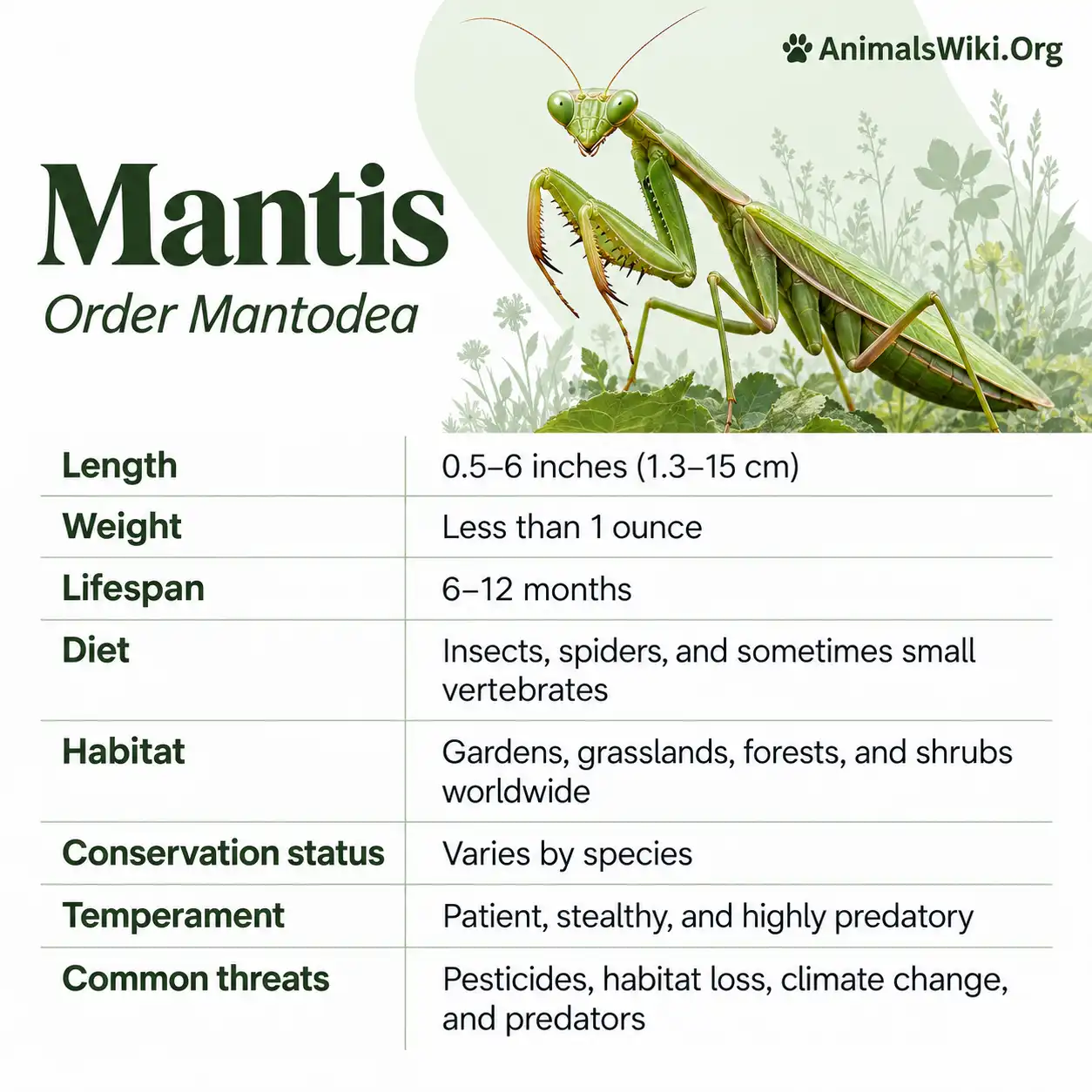
Mantis Facts
| Feature | Information |
|---|---|
| Common Name | Mantis / Praying Mantis |
| Animal Type | Insect |
| Order | Mantodea |
| Diet | Carnivorous |
| Main Food | Insects and other arthropods |
| Legs | 6 |
| Wings | Usually present in many adults, varying by species and sex |
| Front Legs | Specialized raptorial forelegs |
| Eyes | 2 large compound eyes |
| Simple Eyes | Usually 3 ocelli in adults |
| Hunting Style | Primarily ambush predation |
| Metamorphosis | Incomplete |
| Life Cycle | Egg → Nymph → Adult |
| Egg Case | Ootheca |
| Camouflage | Extremely developed in many species |
| Distribution | Widespread, especially in warm regions |
| Human Danger | Generally harmless |
| Famous Behavior | Ambush hunting and sexual cannibalism in some situations |
What Is a Mantis?
A mantis is a predatory insect belonging to the order Mantodea.
Mantises are characterized by their:
- Triangular heads
- Large compound eyes
- Long thorax
- Specialized grasping forelegs
- Flexible necks
- Predatory diet
The term praying mantis refers to the prayer-like posture created when the front legs are folded.
Is a Mantis an Insect?
Yes.
A mantis has the fundamental characteristics of an insect:
- Six legs
- Three main body regions
- One pair of antennae
- Exoskeleton
Its body consists of:
- Head
- Thorax
- Abdomen
Scientific Classification of Mantises
A simplified classification is:
| Classification | Name |
|---|---|
| Kingdom | Animalia |
| Phylum | Arthropoda |
| Class | Insecta |
| Order | Mantodea |
Mantodea contains many families, genera, and species adapted to different habitats around the world.
How Many Species of Mantises Are There?
Scientists recognize more than 2,000 mantis species worldwide, with commonly cited totals exceeding 2,400.
The precise number changes as researchers:
- Discover new species
- Reclassify known species
- Study DNA
- Revise relationships between groups
Mantis diversity is particularly rich in tropical and subtropical regions.
Types of Mantises
Mantises display remarkable diversity in:
- Size
- Shape
- Color
- Camouflage
- Habitat
- Hunting behavior
Well-known examples include:
- European mantis
- Chinese mantis
- Carolina mantis
- Orchid mantis
- Dead leaf mantises
- Ghost mantis
- Flower mantises
- Giant Asian mantises
European Mantis
The European mantis (Mantis religiosa) is one of the best-known species.
It has been introduced beyond parts of its original range and is recognizable by its classic mantis body form.
Individuals can vary from:
- Green
- Brown
- Yellowish shades
helping them blend with vegetation.
Chinese Mantis
The Chinese mantis (Tenodera sinensis) is a large species originally associated with Asia but introduced into other regions.
It is a formidable insect predator.
Carolina Mantis
The Carolina mantis (Stagmomantis carolina) is native to North America.
Its coloration can vary considerably, helping it blend into different vegetation.
Orchid Mantis
The orchid mantis (Hymenopus coronatus) is one of the most spectacular mantises.
Its body includes petal-like expansions and pale coloration that can resemble flowers.
This appearance can help it remain concealed while potential insect prey approaches.
Ghost Mantis
The ghost mantis (Phyllocrania paradoxa) resembles:
- Dry leaves
- Dead vegetation
- Twisted plant material
Its unusual body shape is an excellent example of camouflage.
Dead Leaf Mantis
Several mantises possess bodies resembling dried leaves.
Their:
- Color
- Shape
- Vein-like patterns
- Irregular edges
can make them difficult to distinguish from surrounding vegetation.
What Does a Mantis Look Like?
A typical mantis has:
- Triangular head
- Large compound eyes
- Long antennae
- Elongated thorax
- Six legs
- Specialized front legs
- Long abdomen
- Wings in many adults
Body coloration varies enormously.
Common colors include:
- Green
- Brown
- Gray
- Yellow
- White
- Pink
Mantis Anatomy
The mantis body is divided into three major sections.
Head
The head contains:
- Compound eyes
- Ocelli
- Antennae
- Mandibles
- Other mouthparts
Thorax
The thorax supports:
- Six legs
- Wings in winged adults
The front portion of the thorax is elongated, contributing to the mantis’s characteristic long-necked appearance.
Abdomen
The abdomen contains major:
- Digestive
- Reproductive
- Respiratory
structures.
Mantis Head
A mantis has an unusually mobile head compared with most insects.
This allows it to follow objects visually without repositioning its entire body.
Head mobility is particularly valuable for an ambush predator that needs to remain concealed.
Can a Mantis Turn Its Head?
Yes.
Mantises can rotate their heads extensively from side to side.
Popular descriptions often state that a mantis can turn its head “180 degrees.”
The important biological point is that mantises have exceptionally flexible necks for insects, allowing a very wide range of head movement.
Mantis Eyes
Mantises have two large compound eyes.
Each eye contains numerous individual visual units called:
ommatidia
Their eyes are particularly effective at detecting:
- Movement
- Direction
- Distance
- Potential prey
- Predators
Does a Mantis Have Five Eyes?
In a sense, yes.
A typical adult mantis has:
- 2 large compound eyes
- 3 simple eyes called ocelli
This gives a total of five eye structures.
The compound eyes provide detailed visual information, while the ocelli are particularly useful for detecting changes in light.
Why Do Mantis Eyes Look Black at Night?
Mantis eyes can appear dramatically darker under low-light conditions.
Changes within the compound eyes improve their ability to function when light levels decrease.
This does not mean the eyes physically become entirely black structures.
It reflects changes in how light interacts with the eye.
What Is the Black Dot in a Mantis Eye?
When looking at a mantis, a dark spot may seem to follow you around.
This is called a:
pseudopupil
It is an optical effect produced because certain ommatidia absorb incoming light from the observer’s viewing angle.
The dark spot is not a movable pupil like the pupil in a human eye.
Can Mantises See in 3D?
Yes.
Mantises possess stereoscopic vision.
They use differences between information reaching their two eyes to help judge depth.
This is especially important when deciding whether prey is within striking distance.
Mantis 3D Vision
Mantis stereopsis is particularly tuned to moving objects.
Their visual system does not operate exactly like human 3D vision.
Instead, it is highly specialized for the practical problem facing a predator:
Is that moving prey close enough to grab?
Can Mantises See Humans?
Yes.
A mantis can detect a nearby person as a large moving object.
It may turn its head and track human movement.
This can create the striking impression that the insect is directly “watching” you.
Mantis Antennae
Mantises possess two antennae.
They provide sensory information related to:
- Touch
- Air movement
- Chemicals
- Environmental conditions
Antenna length and shape vary among species and sexes.
Mantis Mouthparts
Mantises possess chewing mouthparts.
Strong mandibles allow them to:
- Bite
- Tear
- Consume prey
Unlike spiders, mantises do not inject venom into their prey.
They physically hold and eat it.
Does a Mantis Have Teeth?
Not true vertebrate teeth.
Mantises possess hardened, toothed or serrated structures associated with their mouthparts and predatory legs.
Their mandibles are powerful enough to process insect prey.
Mantis Raptorial Forelegs
The mantis’s most famous anatomical feature is its pair of specialized front legs.
These are called:
raptorial forelegs
They function like rapidly closing traps.
Why Does a Mantis Hold Its Front Legs Up?
The characteristic “praying” posture keeps the forelegs positioned for a rapid strike.
When prey enters range, the mantis can unfold them extremely quickly.
Mantis Leg Spines
The front legs possess numerous spines.
When the legs close around prey, these spines help prevent escape.
The prey becomes trapped between specialized segments of the forelegs.
How Many Legs Does a Mantis Have?
A mantis has:
6 legs
The first pair is highly modified for prey capture.
The remaining four legs are used primarily for:
- Walking
- Climbing
- Supporting the body
How Does a Mantis Hunt?
Many mantises are ambush predators.
A typical hunt involves:
- Remaining motionless.
- Detecting movement.
- Turning the head toward prey.
- Slowly adjusting position.
- Estimating distance.
- Launching the forelegs.
- Trapping prey between the spines.
- Biting with the mandibles.
The strike can happen extremely quickly.
Do Mantises Chase Their Prey?
Some mantises actively stalk or reposition themselves.
However, many rely heavily on:
sit-and-wait ambush hunting.
Camouflage makes this strategy especially effective.
What Do Mantises Eat?
Mantises are carnivorous predators.
Common prey includes:
- Flies
- Moths
- Grasshoppers
- Crickets
- Beetles
- Butterflies
- Bees
- Wasps
- Cockroaches
- Other mantises
- Spiders
Diet varies with:
- Species
- Body size
- Habitat
- Available prey
Do Mantises Eat Mosquitoes?
They can.
A mantis may catch mosquitoes when the opportunity arises.
However, mosquitoes are only one of many possible prey types, and mantises should not be considered specialized mosquito predators.
Do Mantises Eat Flies?
Yes.
Flies are common prey for many mantises.
Do Mantises Eat Grasshoppers?
Yes.
Larger mantises can capture grasshoppers and related insects.
Do Mantises Eat Crickets?
Yes.
Crickets can be important prey.
Do Mantises Eat Butterflies?
Yes.
Mantises may capture butterflies and moths that approach within striking range.
Flower-associated mantises can be particularly well positioned to intercept visiting insects.
Do Mantises Eat Bees?
Yes.
Some mantises capture bees.
This illustrates an important ecological point:
mantises are generalist predators.
They do not distinguish between insects humans consider beneficial and those humans consider pests.
Do Mantises Eat Spiders?
Yes.
Mantises can capture spiders, although spiders can also prey on small mantises.
The outcome depends on:
- Species
- Size
- Position
- Surprise
- Hunting strategy
Do Mantises Eat Other Mantises?
Yes.
Cannibalism occurs in mantises.
Larger individuals may eat smaller mantises, including members of the same species.
Can a Mantis Eat a Bird?
Very large mantises have occasionally been documented capturing tiny vertebrates, including small birds such as hummingbirds.
Such events are striking but should not be mistaken for the normal mantis diet.
Most mantis prey consists of:
insects and other arthropods.
Do Mantises Eat Lizards?
Large mantises can occasionally capture very small lizards.
Again, vertebrate predation is opportunistic rather than the typical feeding pattern.
Are Mantises Venomous?
No.
Mantises do not use venom to subdue prey.
Their weapons are mechanical:
- Speed
- Spined forelegs
- Strong mandibles
Are Mantises Poisonous?
Mantises are not generally considered poisonous to humans.
Their defense relies primarily on:
- Camouflage
- Threat displays
- Flight
- Biting if handled
- Physical intimidation
Mantis Camouflage
Camouflage is one of the defining features of many mantis species.
They can resemble:
- Leaves
- Flowers
- Twigs
- Bark
- Grass
- Dead vegetation
Camouflage helps both with:
hunting and avoiding predators.
Why Do Mantises Sway?
A mantis may gently rock from side to side while moving.
This behavior may help it:
- Blend with vegetation moving in the wind
- Gather visual depth information
- Approach prey less conspicuously
The exact function can vary with context.
Can a Mantis Change Color?
Some mantises show color variation associated with:
- Development
- Molting
- Environmental conditions
- Individual genetics
However, they cannot rapidly change into any background color like a fictional camouflage system.
Color changes are generally slower and more limited.
Orchid Mantis Camouflage
The orchid mantis is famous for flower-like coloration and petal-shaped legs.
Its appearance can attract or conceal it from flower-visiting insects.
Rather than simply being “invisible,” its flower-like form can interact with the visual expectations of potential prey.
Where Do Mantises Live?
Mantises inhabit a wide variety of terrestrial environments.
Habitats include:
- Tropical forests
- Grasslands
- Shrublands
- Savannas
- Deserts
- Gardens
- Agricultural areas
- Woodland edges
They are particularly diverse in warmer climates.
Where Are Mantises Found?
Mantises occur across much of:
- Africa
- Asia
- Europe
- Australia
- North America
- South America
Different regions contain their own native species, while several mantises have also been introduced beyond their natural ranges.
Where Do Mantises Hide?
Mantises may remain concealed among:
- Leaves
- Flowers
- Branches
- Grass
- Bark
- Shrubs
Their choice of resting place often complements their camouflage.
Do Mantises Live in Trees?
Many species live on:
- Trees
- Bushes
- Shrubs
Others are more strongly associated with:
- Grass
- Flowers
- Ground vegetation
- Dry branches
Mantis Life Cycle
Mantises undergo:
incomplete metamorphosis
Their life cycle is:
Egg → Nymph → Adult
There is no pupal stage.
Mantis Eggs
A female usually deposits many eggs inside a protective structure known as an:
ootheca
The eggs develop within this hardened case.
What Is a Mantis Ootheca?
An ootheca is a protective egg case.
The female produces a foamy secretion around the eggs.
The material hardens into a protective structure.
An ootheca may be attached to:
- Twigs
- Stems
- Bark
- Rocks
- Human-made surfaces
depending on species.
How Many Eggs Does a Mantis Lay?
The number varies greatly among species and individuals.
An ootheca may contain:
dozens to hundreds of eggs
in some species.
A female may also produce multiple oothecae.
Baby Mantis
A young mantis is called a:
nymph
It resembles a small wingless version of an adult.
Nymphs are already predators soon after hatching.
Do Baby Mantises Eat Each Other?
Cannibalism can occur among young mantises, particularly when:
- Food is scarce
- Individuals are crowded
- Size differences develop
This is one reason newly hatched mantises often disperse.
Mantis Molting
A mantis has a rigid external skeleton.
To grow, it must periodically shed this exoskeleton.
The process is called:
molting or ecdysis.
After a molt, the new exoskeleton is initially soft.
It gradually hardens.
How Many Times Does a Mantis Molt?
The number of molts varies with:
- Species
- Sex
- Temperature
- Nutrition
Mantises typically undergo several molts before becoming adults.
Why Is Molting Dangerous for a Mantis?
During and immediately after a molt, the mantis is vulnerable.
It may be:
- Soft
- Unable to defend itself effectively
- Unable to hunt normally
A failed molt can also cause serious deformities or death.
Do Mantises Have a Pupa?
No.
Unlike butterflies, moths, beetles, and ladybugs, mantises do not undergo a pupal stage.
They gradually become more adult-like through successive nymphal molts.
Adult Mantis
After the final molt, the mantis reaches adulthood.
In winged species, functional adult wings are fully developed after this molt.
Adults then focus heavily on:
- Feeding
- Finding mates
- Reproduction
- Egg production
Do Mantises Have Wings?
Many adult mantises have wings.
Typically there are:
two pairs
However, wing development varies considerably among:
- Species
- Sexes
Some mantises have reduced wings, and some are effectively flightless.
Can Mantises Fly?
Many can.
Flight ability depends strongly on species and sex.
Adult males are often lighter and more active fliers than females in species where females have heavier bodies.
Why Do Male Mantises Fly More?
Flying helps males search for females.
Males are often:
- Smaller
- Lighter
- More mobile
than females.
Large females may be much less capable of sustained flight.
Mantis Hearing
Mantises have another surprising adaptation:
some possess a specialized hearing organ capable of detecting ultrasonic frequencies.
In many species, the ear is located on the underside of the body, around the thoracic region.
Why Can Mantises Hear Ultrasound?
Ultrasound detection can help flying mantises detect hunting bats.
When a mantis detects bat-like ultrasonic signals during flight, it may perform evasive maneuvers.
This creates an extraordinary predator-prey contest:
bat echolocation vs. mantis hearing.
Mantis Defense Mechanisms
When threatened, a mantis may:
- Remain motionless
- Rely on camouflage
- Run
- Fly
- Raise its body
- Spread its wings
- Display bright colors
- Raise its raptorial legs
- Strike
- Bite
Large defensive displays can make the insect appear much bigger.
Mantis Threat Display
Some species reveal previously hidden:
- Eye spots
- Bright wing colors
- Contrasting patterns
when threatened.
This sudden visual display can startle a predator and create an opportunity to escape.
What Eats Mantises?
Mantis predators include:
- Birds
- Bats
- Lizards
- Frogs
- Spiders
- Snakes
- Larger insects
- Other mantises
Egg cases can also be attacked by parasitoids and other organisms.
Do Birds Eat Mantises?
Yes.
Birds are important predators of many mantis species.
Camouflage and immobility help reduce detection.
Do Bats Eat Mantises?
Yes.
Flying mantises may become prey for insect-eating bats.
Ultrasonic hearing provides some mantises with an early-warning system.
Do Spiders Eat Mantises?
They can.
Large spiders can capture mantises.
Conversely, mantises can prey upon spiders.
Mantis Mating
Mantis reproduction is famous because of sexual cannibalism.
A male generally approaches a female cautiously.
The male mounts the female and transfers sperm.
The interaction can be dangerous because the female may treat the male as potential prey.
Do Female Mantises Eat Males?
Sometimes.
Sexual cannibalism can occur:
- Before mating
- During mating
- After mating
But it does not happen during every mating encounter.
Why Do Female Mantises Eat Their Mates?
Several factors can influence sexual cannibalism.
A hungry female may benefit nutritionally from consuming a male.
The additional nutrients may contribute to:
- Egg production
- Body condition
However, sexual cannibalism also depends on species, environment, hunger, and individual behavior.
Does a Male Mantis Die After Mating?
Not necessarily.
Many males survive mating and can potentially mate again.
The idea that every male mantis is automatically killed by the female is a myth.
Can a Headless Mantis Move?
A mantis can continue performing some movements after severe injury because insect nervous systems are not organized exactly like the human nervous system.
This helps explain dramatic observations involving sexual cannibalism.
However, decapitation is ultimately fatal.
How Long Do Mantises Live?
Lifespan varies among species.
Many mantises complete their life cycle within roughly:
one year
although tropical species and captive individuals may have different lifespans.
Environmental conditions strongly influence survival.
Do Mantises Survive Winter?
In cold climates, adults of many species die as winter approaches.
Their offspring survive inside protective oothecae.
Nymphs hatch when conditions become favorable.
In warm tropical environments, seasonal patterns can differ considerably.
Mantis vs. Grasshopper
Mantises and grasshoppers are both insects but belong to different orders.
| Feature | Mantis | Grasshopper |
|---|---|---|
| Order | Mantodea | Orthoptera |
| Diet | Primarily carnivorous | Primarily herbivorous |
| Front Legs | Raptorial | Normal walking legs |
| Hind Legs | Not specialized primarily for jumping | Enlarged for jumping |
| Hunting | Ambush predator | Usually plant feeder |
| Head | Highly mobile | Less mobile |
Mantis vs. Stick Insect
Mantises and stick insects may both rely heavily on camouflage.
However:
| Feature | Mantis | Stick Insect |
|---|---|---|
| Diet | Carnivorous | Herbivorous |
| Order | Mantodea | Phasmatodea |
| Forelegs | Raptorial | Walking |
| Main Strategy | Ambush hunting | Plant mimicry and concealment |
| Prey Capture | Yes | No |
Mantis vs. Grasshopper Relationship
Mantises were historically grouped with several other orthopteroid insects, but modern classification recognizes Mantodea as a distinct order.
Their closest evolutionary relationships lie among other polyneopteran insects.
Are Mantises Related to Cockroaches?
Yes.
Mantises and cockroaches are evolutionary relatives within a broader insect group called:
Dictyoptera
Termites are also nested within this broader evolutionary lineage through their relationship with cockroaches.
This means a praying mantis is evolutionarily closer to a cockroach than its dramatically different appearance might suggest.
Mantis Adaptations
Mantises possess an impressive combination of predatory adaptations.
Raptorial Forelegs
Capture and restrain prey.
Leg Spines
Prevent struggling prey from escaping.
Mobile Head
Allows prey tracking without moving the entire body.
Compound Eyes
Provide excellent motion detection.
Stereoscopic Vision
Helps estimate prey distance.
Camouflage
Conceals the predator from prey and enemies.
Slow Stalking
Allows approach without attracting attention.
Rapid Strike
Captures prey before it can escape.
Wings
Provide mobility and escape in many adults.
Ultrasonic Hearing
Helps some flying mantises detect bats.
Ootheca
Protects developing eggs.
Are Mantises Good for Gardens?
Mantises consume many insects and can contribute to natural predation.
However, they are not selective pest-control agents.
They may eat:
- Plant pests
- Pollinators
- Other beneficial predators
Therefore, they are best understood as part of the natural food web rather than as insects that exclusively protect gardens.
Do Mantises Kill Pests?
Yes.
They may consume:
- Flies
- Grasshoppers
- Moths
- Other insects considered agricultural pests
But they also consume beneficial species.
Should You Release Mantises for Pest Control?
Introducing non-native mantis species can create ecological problems.
Supporting native biodiversity and native predators is generally more ecologically responsible than deliberately introducing unfamiliar mantis species.
Are Mantises Dangerous to Humans?
No.
Mantises are generally harmless to humans.
They:
- Do not sting
- Are not venomous
- Do not suck blood
- Do not hunt humans
A large mantis may bite defensively if handled roughly, but such bites are usually minor.
Can a Mantis Bite a Human?
Yes, but it is uncommon.
A mantis generally bites only when:
- Restrained
- Handled roughly
- Threatened
It would much rather escape than attack a person.
Can a Mantis Hurt You?
A large mantis can pinch or bite, but it poses little danger to a healthy human.
Its raptorial legs are designed for small prey rather than people.
Are Mantises Aggressive?
Mantises are aggressive predators toward suitable prey.
Their behavior toward humans is usually defensive rather than predatory.
Mantis Ecological Importance
Mantises occupy an important middle-predator role in terrestrial food webs.
They consume numerous arthropods while themselves becoming food for larger predators.
This means they transfer energy between:
- Insects
- Spiders
- Birds
- Reptiles
- Amphibians
- Mammals
Mantis Conservation
Conservation needs vary widely among species.
Potential threats include:
- Habitat destruction
- Pesticides
- Agricultural intensification
- Climate change
- Collection
- Loss of specialized vegetation
Widespread species may tolerate human-modified landscapes, while habitat specialists can be much more vulnerable.
40 Interesting Mantis Facts
- Mantises are insects.
- They belong to the order Mantodea.
- More than 2,000 species are known.
- Mantises have six legs.
- Their front legs are specialized for catching prey.
- These are called raptorial forelegs.
- The forelegs contain sharp spines.
- Mantises are primarily carnivorous.
- Many are ambush predators.
- They commonly eat flies.
- They can eat grasshoppers.
- They can eat moths.
- They can eat spiders.
- Mantises sometimes eat other mantises.
- Very large individuals occasionally capture tiny vertebrates.
- Mantises are not venomous.
- They do not have stingers.
- Mantises have two large compound eyes.
- Adults usually also possess three ocelli.
- Their compound eyes can produce a dark pseudopupil.
- Mantises possess stereoscopic vision.
- Their heads are unusually mobile for insects.
- Many species are superbly camouflaged.
- Some resemble living leaves.
- Others resemble dead leaves.
- Orchid mantises resemble flowers.
- Some mantises sway while moving.
- Many adults possess wings.
- Males are often better fliers than females.
- Some mantises can hear ultrasound.
- Ultrasonic hearing can help them detect bats.
- Mantises undergo incomplete metamorphosis.
- Their life cycle has no pupal stage.
- Young mantises are called nymphs.
- Mantis eggs are protected inside an ootheca.
- A single ootheca can contain many eggs.
- Sexual cannibalism occurs in some mating encounters.
- Females do not always eat males.
- Mantises are evolutionary relatives of cockroaches.
- Mantises are both predators and prey within terrestrial ecosystems.
Did You Know?
A praying mantis is one of the few insects known to use stereoscopic vision to judge the distance of moving prey.
Humans perceive depth partly because our two eyes view the world from slightly different positions.
The brain compares those images.
That difference helps us judge:
- Distance
- Depth
- Position
A mantis faces a similar problem.
Imagine sitting motionless on a branch while a fly approaches.
Striking too soon means the forelegs close on empty air.
Striking too late allows the fly to escape.
The mantis needs to determine:
When is the target within grabbing distance?
Its two enormous compound eyes provide the information.
But mantis 3D vision is not simply a miniature copy of human vision.
Research indicates that mantis stereopsis is particularly specialized for detecting changes and movement.
That makes perfect evolutionary sense.
A mantis does not need to admire a detailed three-dimensional landscape.
It needs to know whether a moving insect has entered its strike zone.
Once that calculation is made, the mantis launches its raptorial forelegs.
Spines close around the prey.
The target is trapped.
The entire sequence—from visual detection to depth judgment to physical capture—is an extraordinary integration of:
eyes, brain, muscles, and specialized predatory anatomy.
This tiny insect therefore solves a complex three-dimensional hunting problem every time it reaches out and catches prey.
Frequently Asked Questions About Mantises
What is a mantis?
A mantis is a predatory insect belonging to the order Mantodea.
What is a praying mantis?
“Praying mantis” is a common name inspired by the prayer-like position of the folded front legs.
Is a mantis an insect?
Yes.
How many legs does a mantis have?
Six.
How many mantis species are there?
More than 2,000 species are known worldwide, with commonly cited totals exceeding 2,400.
Where do mantises live?
They inhabit forests, grasslands, shrublands, gardens, savannas, deserts and other terrestrial habitats.
Where are praying mantises found?
Mantises occur across much of the world, especially in tropical and subtropical regions.
What do mantises eat?
They mainly eat insects and other arthropods.
Are mantises carnivores?
Yes.
Do mantises eat flies?
Yes.
Do mantises eat mosquitoes?
They can.
Do mantises eat grasshoppers?
Yes.
Do mantises eat crickets?
Yes.
Do mantises eat moths?
Yes.
Do mantises eat butterflies?
Yes.
Do mantises eat bees?
They can.
Do mantises eat wasps?
Some large mantises can capture wasps.
Do mantises eat spiders?
Yes.
Do mantises eat other mantises?
Yes.
Do mantises eat birds?
Large mantises have occasionally captured very small birds, but this is unusual.
Can a mantis eat a hummingbird?
Rare predation events involving large mantises and hummingbirds have been documented, but birds are not normal mantis prey.
Do mantises eat lizards?
Large mantises occasionally capture tiny lizards, but such vertebrate prey is unusual.
How does a mantis catch prey?
It rapidly closes its spiny raptorial forelegs around the target.
Why does a mantis look like it is praying?
Its folded front legs resemble hands held in prayer.
What are mantis front legs called?
Raptorial forelegs.
Why do mantis legs have spikes?
The spines help hold struggling prey.
Can a mantis turn its head?
Yes. Mantises possess unusually flexible necks for insects.
Can a mantis see behind itself?
Its head movement and broad visual field allow extensive visual coverage, although claims of perfect backward vision are oversimplified.
How many eyes does a mantis have?
Adults generally have two large compound eyes and three simple eyes, or ocelli.
What is the black dot in a mantis eye?
It is an optical effect called a pseudopupil.
Does the mantis pupil follow you?
The apparent dark spot can seem to follow an observer because of how light enters the compound eye.
Can mantises see in 3D?
Yes. They possess stereoscopic vision.
Why does a mantis need 3D vision?
It helps determine when moving prey is within striking distance.
Can mantises see humans?
Yes. They can detect and track nearby human movement.
Can mantises see color?
Mantises have visual systems capable of distinguishing visual information beyond simple light and darkness, although abilities vary among species.
Why do mantises sway?
Swaying may help camouflage movement and provide visual information about distance.
Can mantises change color?
Some undergo limited color changes associated with development and environmental conditions, but not instantaneous unlimited background matching.
Why are mantises camouflaged?
Camouflage helps them ambush prey and avoid predators.
What is an orchid mantis?
It is a highly specialized flower-like mantis known scientifically as Hymenopus coronatus.
Is an orchid mantis actually an orchid?
No. It is an insect whose appearance resembles flower structures.
What is a ghost mantis?
The ghost mantis is a species with camouflage resembling dry or dead vegetation.
Can mantises fly?
Many adult mantises can fly.
Do all mantises fly?
No. Flight ability varies by species and sex.
Do female mantises fly?
Some do, but heavy females of certain species have reduced flight ability.
Do male mantises fly?
Many males are active fliers, especially when searching for mates.
Do mantises have wings?
Many adults have two pairs of wings, although wing development varies.
Can baby mantises fly?
Nymphs do not have fully functional adult wings.
What is a baby mantis called?
A nymph.
What is the mantis life cycle?
Egg, nymph and adult.
Do mantises have a caterpillar stage?
No.
Do mantises have a pupa?
No.
Do mantises make cocoons?
No. Their eggs are protected in an ootheca rather than a cocoon.
What is a mantis ootheca?
It is a hardened protective egg case.
How many eggs does a mantis lay?
Depending on species, an ootheca can contain dozens or even hundreds of eggs.
Where do mantises lay eggs?
Oothecae may be attached to twigs, stems, bark, rocks or other surfaces.
Do baby mantises look like adults?
Yes. Nymphs resemble smaller wingless adults.
Do baby mantises eat each other?
Cannibalism can occur, particularly when individuals are crowded or food is limited.
Do mantises molt?
Yes.
Why do mantises molt?
Their rigid exoskeleton cannot expand continuously, so it must be shed as they grow.
How many times does a mantis molt?
Several times, with the exact number depending on species and sex.
Do female mantises eat males?
Sometimes.
Do female mantises always eat their mates?
No.
Why do female mantises eat males?
Hunger, nutritional condition, species and circumstances can influence sexual cannibalism.
Does a male mantis always die after mating?
No.
Can a mantis live without its head?
Some movements may continue temporarily because of insect nervous-system organization, but decapitation is ultimately fatal.
How long do mantises live?
Many species complete their life cycle within roughly a year, though lifespan varies considerably.
Do mantises survive winter?
In colder regions, adults often die while eggs overwinter inside oothecae.
Do mantises sting?
No.
Are mantises venomous?
No.
Are mantises poisonous?
They are not generally considered poisonous to humans.
Can a praying mantis bite?
Yes, especially if handled or threatened.
Does a mantis bite hurt?
A large mantis may cause a noticeable pinch, but it generally poses little danger to humans.
Are praying mantises dangerous?
No. They are generally harmless to people.
Are mantises aggressive?
They are aggressive toward suitable prey but normally defensive rather than predatory toward humans.
What animals eat mantises?
Birds, bats, reptiles, amphibians, spiders and other insects can prey on mantises.
Do birds eat mantises?
Yes.
Do bats eat mantises?
Yes.
Can mantises hear bats?
Some mantises detect ultrasonic frequencies associated with hunting bats.
Where are mantis ears?
In many species, the specialized hearing organ is located on the underside of the thoracic region rather than on the head.
Are mantises good for gardens?
They can eat pest insects, but they also consume pollinators and other beneficial arthropods.
Do mantises kill garden pests?
Yes, but they are generalist predators rather than selective pest controllers.
Should mantises be introduced into a garden?
Introducing non-native species is not recommended. Supporting native predators and habitat is a better ecological approach.
Are mantises related to grasshoppers?
They are both insects but belong to different orders.
Are mantises related to stick insects?
They are both polyneopteran insects but belong to distinct orders with very different feeding strategies.
Are mantises related to cockroaches?
Yes. Mantises and cockroaches are evolutionary relatives within Dictyoptera.
What is the difference between a mantis and grasshopper?
Mantises are primarily predatory and possess raptorial front legs, while grasshoppers are primarily herbivorous and possess enlarged jumping hind legs.
What is the difference between a mantis and stick insect?
Mantises are predators with grasping forelegs, while stick insects are primarily herbivores specialized for plant mimicry.
Why are mantises important?
They are predators and prey within terrestrial food webs and help shape arthropod communities.
Are praying mantises endangered?
Conservation status varies greatly among species. Some are widespread, while habitat specialists can face significant threats.
What threatens mantises?
Habitat destruction, pesticide use, agricultural intensification, environmental change and collection can affect particular species.
Conclusion
The mantis is one of the insect world’s most specialized ambush predators.
Almost every recognizable feature of its body contributes to hunting.
Its triangular head can turn extensively without forcing the rest of the body to move.
Two enormous compound eyes monitor the surroundings.
Stereoscopic vision helps determine when prey has entered striking range.
Its long thorax positions the front legs for attack.
Those folded “praying” legs are actually sophisticated predatory weapons lined with spines.
When prey approaches, the transformation from motionless camouflage to explosive attack happens almost instantly.
The forelegs shoot forward.
The spines close around the target.
Powerful mandibles begin processing the captured animal.
Yet speed alone does not explain the mantis’s success.
Many species survive by avoiding detection.
Some disappear among green leaves.
Others resemble:
- Twigs
- Bark
- Dry vegetation
- Dead leaves
- Flowers
The orchid mantis takes this strategy to an extraordinary extreme, with body structures that resemble petals.
A mantis can therefore function simultaneously as a predator hidden from its prey and an insect hidden from its own enemies.
Its life cycle reveals another side of the animal.
A female surrounds her eggs with a protective foamy material that hardens into an ootheca.
Inside, numerous young develop.
When they hatch, there is no caterpillar stage.
There is no chrysalis.
Tiny mantis nymphs emerge already resembling miniature predators.
They begin hunting, growing, and repeatedly molting until the final molt produces an adult.
Even adulthood contains surprising adaptations.
Many mantises can fly.
Some can detect ultrasonic signals generated by hunting bats.
When airborne, that acoustic warning can trigger evasive behavior—an evolutionary contest between one predator’s sonar and another animal’s ability to hear it.
Their famous reproductive behavior is equally misunderstood.
Female mantises really can eat males.
But sexual cannibalism is not an unavoidable rule of mantis reproduction.
Many males successfully mate without being eaten.
The outcome depends on the species, hunger, body condition, environment, and behavior of the individuals involved.
Mantises should therefore not be reduced to the familiar image of an insect that “prays” and then eats its mate.
They are visual specialists, camouflage experts, aerial targets for bats, predators of insects, prey for birds and reptiles, and important participants in terrestrial food webs.
From the dark pseudopupil that seems to follow an observer to the spined forelegs waiting motionlessly beneath its head, almost every part of the mantis reflects the same evolutionary strategy:
see the prey before it sees you, wait until the distance is right, and strike before it can escape.