Kiwi, The Flightless Nocturnal Birds of New Zealand
The Kiwi bird is one of the strangest and most recognizable birds on Earth.
Flightless.
Mostly nocturnal.
Covered in hair-like feathers.
Equipped with tiny hidden wings.
And armed with an extraordinarily long bill whose nostrils sit near:
the tip.
Kiwi are found naturally only in:
New Zealand.
They belong to the genus:
Apteryx.
Five living species are generally recognized:
- North Island Brown Kiwi — Apteryx mantelli
- Great Spotted Kiwi — Apteryx haastii
- Little Spotted Kiwi — Apteryx owenii
- Rowi — Apteryx rowi
- Southern Brown Kiwi — Apteryx australis
Together they represent one of the world’s most unusual groups of:
flightless birds.
Kiwi belong to an ancient evolutionary radiation of birds called:
palaeognaths.
This broader group includes:
- Ostriches
- Emus
- Cassowaries
- Rheas
- Tinamous
But the Kiwi’s closest evolutionary relationships are more surprising than its appearance might suggest.
Genetic research has shown that kiwi are closely related within the palaeognath radiation to the extinct:
elephant birds of Madagascar.
That is extraordinary because elephant birds were enormous, while Kiwi are approximately the size of:
chickens.
Kiwi are also unlike most familiar birds in several other ways.
Their feathers are:
loose and hair-like.
Their wings are:
tiny.
Their tail is essentially:
absent.
Their bones contain more marrow than those of many flying birds.
Their legs are:
powerful.
And their sense of smell is exceptionally important.
Most birds depend heavily on:
vision.
Kiwi spend much of their lives searching for food in darkness.
They walk through forest floors and other habitats with their long bills pointed toward:
the ground.
At the tip of the bill are:
nostrils.
This unusual arrangement allows Kiwi to smell food hidden beneath:
- Soil
- Leaf litter
- Moss
- Decaying vegetation
They also possess specialized sensory structures in the bill that help them detect prey.
A Kiwi may suddenly push its bill deep into:
the soil.
Then it pulls out:
- An earthworm
- Insect larva
- Beetle
- Other invertebrate
This unusual feeding behavior has produced another distinctive Kiwi feature.
The bird often leaves small:
probe holes
scattered across the ground.
But perhaps the most famous feature of Kiwi biology is:
the egg.
Relative to the female’s body size, a Kiwi egg is:
enormous.
A single egg can represent roughly:
15–20% of the female’s body mass, although the proportion varies among species and individuals.
Producing such a massive egg is an extraordinary energetic investment.
Inside it develops a highly advanced chick.
When a Kiwi chick hatches, it is far more physically developed than the helpless nestlings of many:
other birds.
Kiwi also have enormous cultural importance.
The bird is so strongly associated with New Zealand that:
“Kiwi”
became an internationally recognized informal name for:
New Zealanders themselves.
For Māori, kiwi are culturally significant:
taonga, or treasured species.
Yet these extraordinary birds face serious threats.
Before humans arrived, New Zealand had no native terrestrial mammalian predators comparable to:
- Stoats
- Cats
- Dogs
Kiwi evolved primarily alongside:
avian predators.
The introduction of mammalian predators changed everything.
Today important threats can include:
- Stoats
- Dogs
- Feral Cats
- Ferrets
- Habitat loss
- Road collisions
Conservation programs now use:
- Predator control
- Predator-free islands
- Fenced sanctuaries
- Egg management
- Captive incubation
- Chick rearing
- Translocations
- Habitat protection
- Genetic management
- Māori-led conservation
to give Kiwi populations a better chance of:
survival.
This comprehensive guide explores Kiwi bird facts, species, scientific classification, evolution, appearance, tiny wings, hair-like feathers, size, weight, habitat, New Zealand distribution, nocturnal behavior, long bill, nostrils, sense of smell, diet, feeding, burrows, enormous eggs, reproduction, chicks, lifespan, adaptations, predators, Kiwi vs Ostrich, Kiwi vs Kakapo, Kiwi vs Emu, danger to humans, Māori culture, conservation and why the Kiwi is one of the world’s most extraordinary birds.
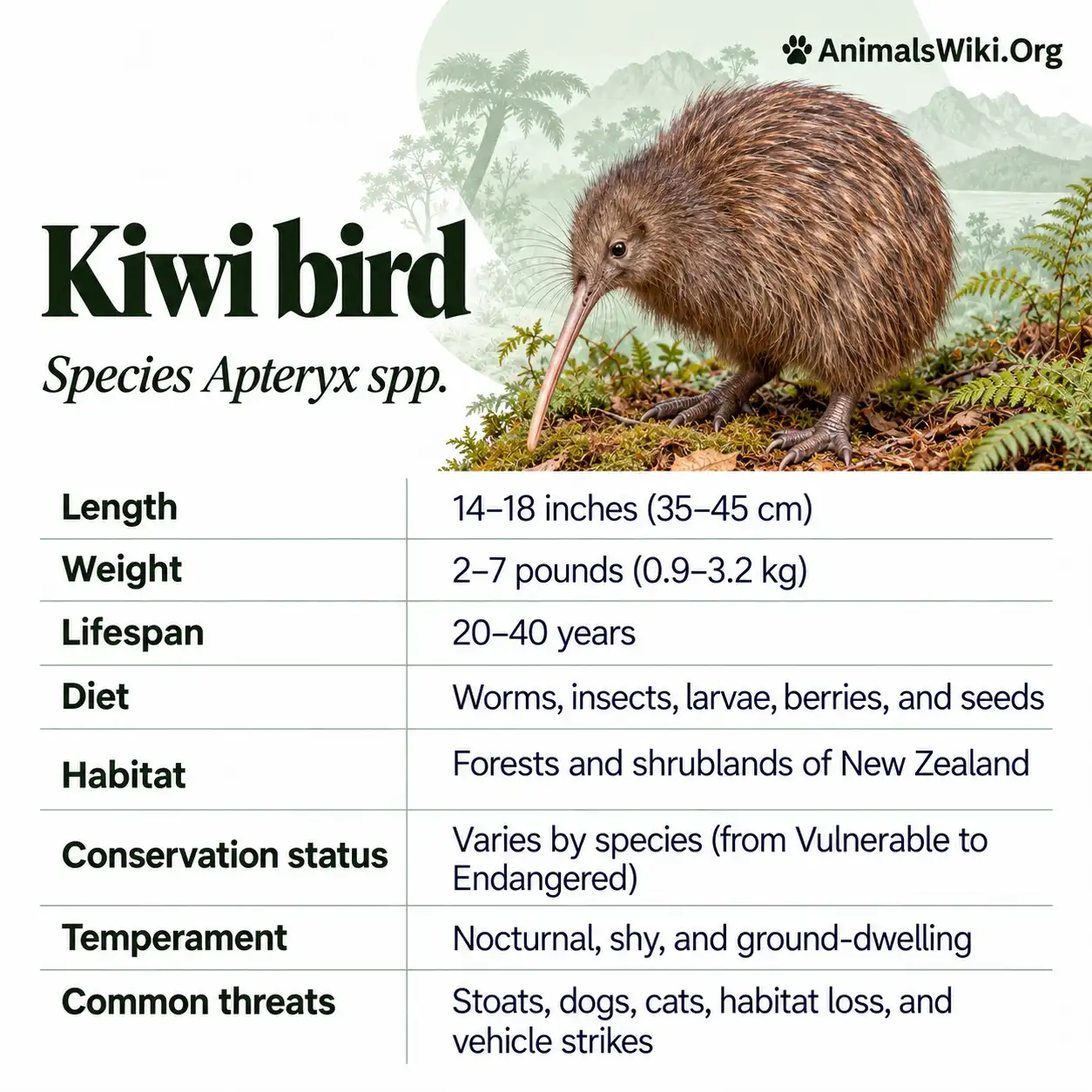
Kiwi Bird Facts
| Feature | Information |
|---|---|
| Common Name | Kiwi |
| Genus | Apteryx |
| Animal Type | Bird |
| Living Species | 5 |
| Native Country | New Zealand |
| Flight | Flightless |
| Activity | Mostly nocturnal |
| Diet | Omnivorous |
| Main Foods | Invertebrates, especially worms & insects |
| Feathers | Loose, hair-like |
| Wings | Extremely small |
| Tail | Essentially absent externally |
| Bill | Long and slender |
| Nostril Position | Near tip of bill |
| Legs | Strong & muscular |
| Nest | Burrow, hollow or sheltered site |
| Eggs | Very large relative to female |
| Typical Clutch | Usually 1–2 depending on species |
| Young | Chick |
| Major Threats | Introduced mammalian predators |
| Cultural Importance | National symbol of New Zealand |
What Is a Kiwi Bird?
A Kiwi is a small-to-medium-sized flightless bird belonging to the genus:
Apteryx.
Kiwi are native exclusively to:
New Zealand.
They are among the most evolutionarily and anatomically distinctive living:
birds.
Is a Kiwi Really a Bird?
Yes.
Despite having:
- Hair-like feathers
- Tiny wings
- Strong smell
- Heavy bones
the Kiwi is unquestionably a:
bird.
It has feathers, lays eggs and belongs to the class:
Aves.
Why Is the Kiwi So Unusual?
Kiwi combine several uncommon traits:
- Flightlessness
- Hair-like feathers
- Tiny wings
- No obvious external tail
- Strong sense of smell
- Nostrils near the bill tip
- Powerful legs
- Mostly nocturnal behavior
- Huge eggs relative to body size
Few other birds combine all these characteristics.
Scientific Classification of Kiwi
| Classification | Name |
|---|---|
| Kingdom | Animalia |
| Phylum | Chordata |
| Class | Aves |
| Order | Apterygiformes |
| Family | Apterygidae |
| Genus | Apteryx |
How Many Kiwi Species Are There?
Five living species are generally recognized.
North Island Brown Kiwi
Apteryx mantelli
Found on New Zealand’s:
North Island.
Great Spotted Kiwi
Apteryx haastii
The largest living:
Kiwi species.
Little Spotted Kiwi
Apteryx owenii
The smallest living:
Kiwi species.
Rowi
Apteryx rowi
A rare Kiwi associated especially with:
Ōkārito and conservation populations.
Southern Brown Kiwi
Apteryx australis
Occurs naturally in parts of:
southern New Zealand, including Stewart Island/Rakiura and parts of the South Island.
Are There Different Types of Brown Kiwi?
Yes.
Kiwi taxonomy can become more detailed at the:
subspecies and population level.
For general readers, however, the five-species framework provides the clearest overview.
What Does a Kiwi Look Like?
Kiwi have:
- Round bodies
- Long narrow bills
- Hair-like feathers
- Strong legs
- Three forward-pointing toes
- Tiny wings
- No obvious external tail
- Small eyes
The body shape can appear almost:
pear-shaped.
What Color Are Kiwi Birds?
Color varies among species.
Common shades include:
- Brown
- Reddish-brown
- Gray-brown
Spotted species have:
mottled or spotted plumage.
Do Kiwi Birds Have Fur?
No.
This is a common misconception.
Kiwi are covered in:
feathers.
The feathers simply lack the tightly interlocking structure typical of many flying birds, giving them a:
hair-like appearance.
Why Do Kiwi Feathers Look Like Hair?
Kiwi do not need the highly aerodynamic flight feathers required by:
flying birds.
Their loose plumage evolved primarily for insulation and protection rather than:
flight.
Do Kiwi Birds Have Wings?
Yes.
Kiwi have extremely:
small wings.
They are usually hidden beneath the feathers.
How Small Are Kiwi Wings?
The wings are only a few centimeters long.
They are tiny relative to:
the body.
Can Kiwi Birds Fly?
No.
All living Kiwi are:
flightless.
Their wings cannot generate enough lift for flight.
Why Can’t Kiwi Fly?
Over evolutionary time, the ancestors of Kiwi adapted to a terrestrial lifestyle.
Their flight apparatus became greatly:
reduced.
Modern Kiwi possess:
- Tiny wings
- Reduced flight musculature
- No functional flight capability
Do Kiwi Have a Tail?
They lack a conspicuous external tail like that of most familiar:
birds.
This contributes to their rounded appearance.
How Big Is a Kiwi Bird?
Size varies among species and sexes.
Kiwi are generally comparable in overall scale to:
large chickens, although some are substantially heavier.
How Much Does a Kiwi Weigh?
Depending on species and sex, adults can weigh roughly:
1–4 kg.
Females are generally:
larger than males.
Which Is the Largest Kiwi?
The:
Great Spotted Kiwi
is the largest living species.
Which Is the Smallest Kiwi?
The:
Little Spotted Kiwi
is the smallest living species.
Are Female Kiwi Bigger Than Males?
Yes.
Female Kiwi are generally:
larger and heavier.
They also usually possess:
longer bills.
Where Do Kiwi Birds Live?
Kiwi occur naturally only in:
New Zealand.
Today they survive across selected areas of:
- North Island
- South Island
- Stewart Island/Rakiura
- Offshore islands
- Predator-managed sanctuaries
Distribution differs by species.
Did Kiwi Once Live Throughout New Zealand?
Kiwi historically occupied a broader range than many populations do:
today.
Human-driven habitat changes and introduced predators caused major population contractions.
Kiwi Habitat
Depending on species and location, Kiwi can inhabit:
- Native forest
- Temperate rainforest
- Scrubland
- Grassland
- Subalpine habitat
- Regenerating forest
- Modified landscapes with sufficient cover
They are more adaptable in habitat use than sometimes assumed.
Do Kiwi Live in Rainforests?
Some populations inhabit wet:
temperate forests.
But Kiwi are not restricted exclusively to rainforest.
Where Do Kiwi Sleep?
Kiwi shelter in:
- Burrows
- Hollow logs
- Tree-root cavities
- Dense vegetation
- Natural hollows
They generally rest during:
daylight.
Do Kiwi Dig Burrows?
Yes.
Their strong legs and claws allow them to create or enlarge:
burrows.
Some burrows can have multiple entrances.
Are Kiwi Nocturnal?
Most Kiwi are primarily:
nocturnal.
They become active after sunset.
Why Are Kiwi Active at Night?
Their sensory system and feeding behavior are highly suited to:
low-light conditions.
Night activity may also reflect their evolutionary history and ecological niche.
Do Kiwi Ever Come Out During the Day?
Yes.
Daytime activity can occur, especially in:
- Remote areas
- Certain populations
- Particular weather conditions
They should therefore be described as primarily, rather than absolutely:
nocturnal.
Can Kiwi See in the Dark?
Kiwi have relatively small eyes and rely less heavily on vision than many:
birds.
Their senses of:
- Smell
- Touch
- Hearing
are particularly important during nocturnal foraging.
Do Kiwi Have a Good Sense of Smell?
Yes.
Kiwi have an unusually important sense of:
smell for a bird.
They use odor to help locate food beneath:
the ground.
Why Are Kiwi Nostrils Special?
Most birds have nostrils positioned near the:
base of the bill.
Kiwi nostrils are located close to:
the tip.
This allows the bird to investigate scents while probing the:
soil.
Is the Kiwi the Only Bird With Nostrils at the Tip of Its Bill?
Kiwi are famous for having external nostrils positioned extremely close to the:
bill tip.
It is one of their most distinctive sensory adaptations.
What Is the Kiwi Bill Used For?
The bill is used for:
- Smelling
- Probing soil
- Detecting prey
- Extracting invertebrates
- Investigating leaf litter
It functions as both a feeding tool and a highly specialized:
sensory organ.
Can Kiwi Feel Prey Through Their Bills?
Yes.
The bill contains specialized mechanosensory structures.
These help Kiwi detect tiny vibrations and movements produced by prey hidden in:
substrates.
What Do Kiwi Birds Eat?
Kiwi are:
omnivores.
Their diet can include:
- Earthworms
- Beetles
- Insect larvae
- Spiders
- Centipedes
- Other invertebrates
- Seeds
- Fruit
- Plant material
The exact diet varies according to habitat and season.
Do Kiwi Eat Worms?
Yes.
Earthworms are among the best-known foods eaten by:
Kiwi.
Do Kiwi Eat Insects?
Yes.
They consume numerous insects and:
larvae.
Do Kiwi Eat Plants?
Yes.
Fruit, seeds and other plant material can supplement their:
diet.
How Does a Kiwi Find Worms Underground?
It combines:
- Smell
- Touch
- Sensitive bill-tip structures
- Hearing
The bird inserts its bill into soil and investigates for:
hidden prey.
Why Are There Holes in the Ground Where Kiwi Feed?
When Kiwi push their long bills into soil, they leave characteristic:
probe holes.
These can be signs that Kiwi have recently been:
foraging.
Do Kiwi Drink Water?
Yes.
They can drink when water is available, while also obtaining moisture from:
food.
Do Kiwi Have Teeth?
No.
Like modern birds generally, Kiwi do not possess:
true teeth.
Food is swallowed and processed by the digestive system.
Do Kiwi Have Strong Legs?
Yes.
Their legs are:
extremely strong relative to body size.
A substantial portion of the Kiwi’s body mass is associated with powerful legs and:
musculature.
Why Are Kiwi Legs So Strong?
Kiwi use their legs for:
- Walking
- Running
- Digging
- Defense
- Territorial encounters
With flight no longer necessary, powerful terrestrial movement became particularly:
important.
Can Kiwi Run Fast?
Kiwi can move surprisingly quickly through dense:
vegetation.
They are agile ground birds, although exact standardized maximum-speed measurements are limited.
Can Kiwi Swim?
Kiwi can cross shallow water and are capable of swimming if:
necessary.
They are not aquatic birds.
Can Kiwi Climb Trees?
No.
Kiwi are fundamentally:
terrestrial birds.
Their bodies are adapted for life on the forest floor rather than climbing.
Kiwi Behavior
Kiwi are generally:
territorial.
Many adults maintain territories and use calls to advertise:
their presence.
Do Kiwi Live Alone?
They are not flocking birds.
Many form long-term breeding pairs while maintaining a shared:
territory.
Do Kiwi Mate for Life?
Some Kiwi pairs can remain together for:
many years.
However, “mate for life” should not be treated as an absolute rule for every individual.
Pairs can separate and partners can change.
How Do Kiwi Communicate?
Communication includes:
- Loud calls
- Scent
- Physical behavior
- Territorial displays
Their calls are particularly important at:
night.
What Does a Kiwi Sound Like?
Male and female calls differ.
Male calls are often:
high and repeated.
Female calls tend to sound:
lower and harsher.
These calls can carry through forest at night.
Are Kiwi Territorial?
Yes.
Pairs can defend territories from other:
Kiwi.
Territorial disputes may involve:
- Calling
- Chasing
- Kicking
Do Kiwi Fight?
Yes.
Territorial Kiwi can fight using their:
powerful legs and claws.
Despite their harmless-looking appearance, they are capable of defending themselves vigorously against other Kiwi.
Kiwi Reproduction
Kiwi reproduction is famous for one extraordinary feature:
the enormous egg.
How Big Is a Kiwi Egg?
Relative to the female’s body size, Kiwi produce one of the largest eggs of any living:
bird.
A single egg can represent approximately:
15–20% of her body weight, although the proportion varies.
Does the Kiwi Lay the World’s Largest Egg?
Not in absolute size.
The largest bird egg belongs to the:
Ostrich.
What makes the Kiwi remarkable is the egg’s size:
relative to the mother’s body.
Why Is a Kiwi Egg So Big?
The large egg contains:
- A large yolk
- Extensive energy reserves
- A well-developed embryo
The chick emerges at a relatively advanced stage of:
development.
How Many Eggs Does a Kiwi Lay?
Clutch size varies by species.
Often there are:
one or two eggs.
Some species usually produce a single egg at a time.
How Long Does a Kiwi Egg Take to Hatch?
Incubation is exceptionally:
long.
Depending on species, it can last roughly:
70–90 days.
This is one of the longest incubation periods among birds.
Who Incubates the Kiwi Egg?
This varies by species.
In several Kiwi species, the:
male
performs most or all incubation.
In some others, both members of the pair may participate.
Does the Male Kiwi Sit on the Egg?
Yes, in several species.
Male incubation is a notable feature of:
Kiwi reproduction.
What Is a Baby Kiwi Called?
A baby Kiwi is called a:
chick.
Are Kiwi Chicks Helpless?
No.
Kiwi chicks hatch in a relatively:
well-developed state.
Their large egg provides substantial resources before hatching.
Do Kiwi Parents Feed Their Chicks?
Kiwi chicks generally do not depend on parents bringing food directly to them in the way many songbird chicks do.
They begin learning to forage for:
themselves.
How Fast Do Kiwi Chicks Grow?
Growth varies by species.
They gradually become independent while developing:
- Stronger legs
- Improved foraging
- Greater body mass
- Adult plumage
Kiwi Lifespan
Kiwi are relatively:
long-lived birds.
Depending on species and conditions, individuals can survive for:
several decades.
Some may live approximately:
25–50 years or more.
Kiwi Adaptations
Flightlessness
Energy and anatomy are focused on terrestrial life.
Hair-Like Feathers
Provide insulation without the rigid structure required for flight.
Tiny Wings
Remain as evolutionary remnants but are not functional for flight.
Long Bill
Allows deep probing for prey.
Tip-Positioned Nostrils
Help detect food underground.
Sensitive Bill Tip
Detects vibrations and movement.
Strong Sense of Smell
Unusual and important among birds.
Powerful Legs
Provide locomotion, digging and defense.
Nocturnal Behavior
Supports feeding under darkness.
Large Egg
Produces a highly developed chick.
Burrow Use
Provides secure shelter.
What Animals Eat Kiwi Birds?
Before human settlement, adult Kiwi faced relatively few terrestrial mammalian:
predators.
Introduced mammals dramatically changed this.
Important predators now include:
- Stoats
- Dogs
- Feral Cats
- Ferrets
Different predators threaten different life stages.
Do Stoats Kill Kiwi?
Yes.
Stoats are particularly dangerous to:
young Kiwi.
Small chicks are vulnerable until they become large enough to better resist attack.
Do Dogs Kill Kiwi?
Yes.
Dogs are especially dangerous because even a friendly domestic dog may instinctively:
grab a Kiwi.
Kiwi have relatively fragile body structures compared with what a dog bite can inflict.
A single uncontrolled dog can potentially kill multiple birds.
Do Cats Kill Kiwi?
Feral and roaming Cats can prey on:
young Kiwi.
Do Ferrets Kill Kiwi?
Ferrets can also prey on:
Kiwi, particularly vulnerable individuals.
Do Possums Eat Kiwi?
Introduced possums can compete for resources and interact with nests, but they are not generally regarded as the primary predator driving Kiwi declines in the same way as:
Stoats and Dogs.
How Do Kiwi Defend Themselves?
Adult Kiwi can defend themselves using:
powerful legs and claws.
They may kick during:
- Territorial disputes
- Predator encounters
- Handling
Can a Kiwi Bird Hurt a Human?
A Kiwi is not a human predator.
However, a frightened or cornered bird can kick and:
scratch.
Wild Kiwi should be treated with respect.
Are Kiwi Birds Friendly?
Wild Kiwi are not domesticated animals.
They may be:
- Shy
- Territorial
- Defensive
Behavior differs between individuals.
Can Kiwi Birds Be Pets?
No.
Kiwi are protected native wildlife with highly specialized ecological and conservation:
requirements.
They are not ordinary pets.
Kiwi vs. Ostrich
| Feature | Kiwi | Ostrich |
|---|---|---|
| Native Region | New Zealand | Africa |
| Flight | Flightless | Flightless |
| Size | Small | Largest living bird |
| Activity | Mostly nocturnal | Mostly daytime |
| Bill | Long & slender | Shorter & broad |
| Egg | Huge relative to body | Largest absolute bird egg |
| Main Defense | Legs/claws | Powerful kicks |
| Lifestyle | Forest/ground | Open landscapes |
Kiwi vs. Emu
| Feature | Kiwi | Emu |
|---|---|---|
| Native Region | New Zealand | Australia |
| Size | Small | Very large |
| Flight | Flightless | Flightless |
| Feathers | Hair-like | Shaggy |
| Bill | Long | Shorter |
| Activity | Mostly nocturnal | Mainly diurnal |
| Egg | Pale/whitish | Dark green |
| Lifestyle | Ground-foraging | Wide-ranging runner |
Kiwi vs. Cassowary
Both are flightless palaeognath birds, but they differ dramatically.
Cassowaries are:
- Much larger
- Tropical
- Powerful runners
- Equipped with a casque
Kiwi are:
- Smaller
- Nocturnal
- Long-billed
- Specialized ground probers
Kiwi vs. Kakapo
| Feature | Kiwi | Kākāpō |
|---|---|---|
| Bird Group | Palaeognath | Parrot |
| Flight | Flightless | Flightless |
| Activity | Mostly nocturnal | Nocturnal |
| Diet | Omnivorous | Herbivorous |
| Bill | Long & slender | Parrot-like hooked bill |
| Feathers | Hair-like | Soft green plumage |
| Native Country | New Zealand | New Zealand |
| Reproduction | Large eggs relative to body | Lek-breeding parrot |
They evolved flightlessness independently.
Kiwi vs. Chicken
Kiwi may resemble a large brown chicken in body size, but their biology is radically different.
Kiwi possess:
- Tiny wings
- Long sensory bills
- Tip-positioned nostrils
- Hair-like feathers
- No obvious tail
- Strong nocturnal adaptations
Are Kiwi Birds Endangered?
Conservation status varies among the:
five species.
Some populations have improved under intensive management, while others remain threatened.
Therefore, Kiwi should not all be assigned one conservation category without specifying:
the species.
Why Did Kiwi Decline?
Major causes include:
- Introduced mammalian predators
- Habitat loss
- Habitat fragmentation
- Dogs
- Road mortality
- Small isolated populations
Predation on chicks has historically been especially damaging.
Why Are Stoats Such a Serious Problem?
Kiwi evolved without native mammalian predators like:
Stoats.
Young chicks are therefore extremely vulnerable.
Without predator control, many chicks may die before reaching a safer:
body size.
Why Are Adult Kiwi Vulnerable to Dogs?
An adult Kiwi may be large enough to resist some smaller predators.
But dogs can overpower:
adult birds.
Because Kiwi evolved without mammalian carnivores resembling dogs, their defensive strategies are poorly suited to this new threat.
How Are Kiwi Protected?
Conservation strategies include:
- Stoat control
- Rat control
- Cat control
- Dog management
- Predator-proof fencing
- Predator-free islands
- Habitat protection
- Egg collection
- Captive incubation
- Chick rearing
- Translocation
- Population monitoring
What Is Operation Nest Egg?
Operation Nest Egg is a conservation strategy in which vulnerable Kiwi eggs or young are:
removed from the wild.
Eggs can be artificially incubated.
Chicks are then raised in safer environments until they reach a size at which they are less vulnerable to:
Stoats.
They can later be returned to:
protected wild habitat.
Why Does Operation Nest Egg Work?
The most dangerous stage of a Kiwi’s life is often:
early youth.
Protecting chicks through this period dramatically increases the probability that they survive to:
adulthood.
Are Kiwi Kept on Predator-Free Islands?
Yes.
Offshore islands and fenced sanctuaries can provide important:
refuges.
Removing introduced predators allows Kiwi to breed with much higher:
survival rates.
Can Kiwi Populations Recover?
Yes.
Where predators are intensively controlled, Kiwi populations can:
increase.
However, conservation must often continue for many years.
Why Are Kiwi Important to Māori?
Kiwi are culturally significant:
taonga.
Their relationship with Māori includes traditional knowledge, cultural identity and modern conservation partnerships.
Specific traditions differ among:
iwi and regions.
Why Are New Zealanders Called Kiwis?
The Kiwi became such a powerful symbol of New Zealand that the name:
“Kiwi”
eventually became an informal term for a person from:
New Zealand.
Today it is widely used nationally and internationally.
Is the Kiwi New Zealand’s National Bird?
The Kiwi is New Zealand’s most famous national bird symbol and is deeply associated with the country’s:
identity.
Its image appears widely in cultural, conservation and national contexts.
Are Kiwi Important to Ecosystems?
Yes.
By probing and digging through soil and leaf litter, Kiwi influence:
- Soil disturbance
- Invertebrate populations
- Nutrient movement
- Forest-floor processes
They are part of New Zealand’s unique terrestrial:
food webs.
50 Interesting Kiwi Bird Facts
- Kiwi are birds.
- They are native only to New Zealand.
- Kiwi belong to the genus Apteryx.
- Five living Kiwi species are generally recognized.
- All Kiwi are flightless.
- Their wings are extremely small.
- The wings are hidden beneath the feathers.
- Kiwi have no obvious external tail.
- Their feathers look almost like hair.
- Kiwi do not have fur.
- Their feathers provide insulation.
- Kiwi are mostly nocturnal.
- They possess an unusually important sense of smell.
- Their nostrils occur near the bill tip.
- Their bills are long and slender.
- Kiwi use their bills to probe soil.
- Sensitive bill structures help detect prey.
- Kiwi eat earthworms.
- They also eat insects and larvae.
- Fruit and seeds can supplement their diet.
- Kiwi are omnivorous.
- Their legs are extremely strong.
- Kiwi can kick in defense.
- They can dig burrows.
- They sleep in burrows and natural shelters.
- Kiwi are territorial.
- Many adults form breeding pairs.
- Male and female calls sound different.
- Female Kiwi are generally larger than males.
- Females usually have longer bills.
- Kiwi produce enormous eggs relative to body size.
- A single egg can approach roughly one-fifth of a female’s weight.
- Kiwi eggs are not the world’s largest in absolute size.
- Ostriches produce larger eggs.
- Kiwi incubation can last around 70–90 days.
- Males perform much of the incubation in several species.
- Kiwi chicks hatch relatively well developed.
- There are five recognized living species.
- Great Spotted Kiwi are the largest living Kiwi.
- Little Spotted Kiwi are the smallest.
- Kiwi are palaeognath birds.
- Genetic evidence links their ancestry surprisingly closely with extinct Malagasy elephant birds.
- Stoats kill many young Kiwi.
- Dogs can kill adult Kiwi.
- Feral Cats can threaten young birds.
- Predator-free islands provide important refuges.
- Operation Nest Egg helps chicks survive vulnerable early stages.
- Kiwi are culturally important taonga for Māori.
- New Zealanders are commonly nicknamed “Kiwis.”
- Their combination of flightlessness, hair-like feathers, sensory bill, giant egg and nocturnal lifestyle makes Kiwi some of the world’s most unusual birds.
Did You Know?
A Kiwi can hunt for food without seeing what it is trying to catch.
Night covers a New Zealand:
forest.
The ground is almost:
dark.
A Kiwi walks slowly through damp leaf litter.
Its tiny eyes are not its most important:
tool.
Instead, it lowers its enormous:
bill.
At the very end are two small openings:
nostrils.
This arrangement is unusual for:
a bird.
The Kiwi stops.
Something is beneath:
the soil.
Perhaps an earthworm.
The bird cannot see it.
But it can gather information through:
smell and touch.
Specialized sensory structures near the tip of the bill can detect subtle mechanical signals.
The bill plunges:
downward.
Deep into the soil.
The head follows.
Then the Kiwi pulls:
back.
A worm appears.
The bird swallows it.
Then moves:
on.
Behind it remains a small:
hole.
Another probe.
Another hole.
Another:
meal.
This feeding style helps explain why the Kiwi looks so unlike the birds most people know.
A flying bird needs:
wings.
The Kiwi barely uses its.
A visually oriented bird needs large, highly effective:
eyes.
The Kiwi relies heavily on other senses.
A bird feeding above ground may need a short bill for pecking.
The Kiwi needs a:
probe.
Even its feathers tell the story.
They do not form smooth aerodynamic flight surfaces.
They hang loosely and look almost like:
fur.
Then comes reproduction.
Inside the female begins developing an egg.
It grows.
And grows.
And grows.
Eventually it can represent an astonishing proportion of her:
body mass.
For a human-sized comparison, it would be an extraordinary reproductive burden.
But inside that enormous egg is a major advantage.
The chick receives a huge supply of:
nutrients.
When it finally emerges after an unusually long incubation, it is already far more developed than many newly hatched:
birds.
The Kiwi’s biology therefore seems strange only when compared with:
flying birds.
In its own environment, each unusual feature makes sense.
Tiny wings.
Powerful legs.
Hair-like feathers.
A sensory bill.
Tip-positioned nostrils.
A huge egg.
Together they describe a bird that evolved for millions of years around a completely different way of:
living.
Frequently Asked Questions About Kiwi Birds
What is a Kiwi bird?
A Kiwi is a flightless bird native to New Zealand and belonging to the genus Apteryx.
Is Kiwi a bird?
Yes.
Is a Kiwi a mammal?
No. Despite its hair-like feathers and strong sense of smell, it is a bird.
Does a Kiwi have fur?
No. It has feathers that resemble coarse hair.
What is the scientific name of the Kiwi?
Kiwi belong to the genus Apteryx. Each of the five living species has its own scientific name.
How many Kiwi species are there?
Five living species are generally recognized.
What are the five Kiwi species?
North Island Brown Kiwi, Great Spotted Kiwi, Little Spotted Kiwi, Rowi and Southern Brown Kiwi.
What is the North Island Brown Kiwi’s scientific name?
Apteryx mantelli.
What is the Great Spotted Kiwi’s scientific name?
Apteryx haastii.
What is the Little Spotted Kiwi’s scientific name?
Apteryx owenii.
What is the Rowi’s scientific name?
Apteryx rowi.
What is the Southern Brown Kiwi’s scientific name?
Apteryx australis.
Where do Kiwi birds live?
Naturally only in New Zealand.
Do Kiwi live in Australia?
No. Kiwi are native to New Zealand.
Do Kiwi live in forests?
Yes, although some populations use scrub, grassland and other habitats.
Are Kiwi nocturnal?
Mostly.
Do Kiwi come out during the day?
They can, although most activity occurs at night.
Can Kiwi birds fly?
No.
Why can’t Kiwi fly?
Their wings and flight muscles became greatly reduced as they evolved a terrestrial lifestyle.
Do Kiwi have wings?
Yes, but they are extremely small.
Can you see a Kiwi’s wings?
Usually not easily because they are hidden beneath the feathers.
Do Kiwi have tails?
They do not have a conspicuous external tail like many other birds.
Why do Kiwi have hair?
They do not. Their feathers simply have a hair-like appearance.
Why are Kiwi feathers different?
Their loose feathers provide insulation without needing to form aerodynamic flight surfaces.
How big is a Kiwi bird?
Size varies by species, but they are broadly comparable to large chickens in body dimensions.
How much does a Kiwi weigh?
Depending on species and sex, roughly 1–4 kg is a useful general range.
Are female Kiwi larger than males?
Yes, generally.
Which Kiwi is the biggest?
The Great Spotted Kiwi.
Which Kiwi is the smallest?
The Little Spotted Kiwi.
Why does a Kiwi have a long beak?
The long bill is used to probe soil and leaf litter for food.
Where are a Kiwi’s nostrils?
Near the tip of the bill.
Why are Kiwi nostrils at the end of the bill?
Their position helps the bird detect odors while probing for underground prey.
Can Kiwi smell?
Yes, very well for a bird.
Can Kiwi smell worms underground?
Smell is one of several senses they use to locate hidden invertebrates.
Can Kiwi feel prey underground?
Yes. Specialized bill-tip sensory structures help detect mechanical signals.
Do Kiwi have good eyesight?
Vision is less dominant in Kiwi than in many other birds.
What senses do Kiwi use most?
Smell, touch and hearing are especially important during nocturnal foraging.
What do Kiwi eat?
Earthworms, insects, larvae, other invertebrates, fruit, seeds and plant material.
Are Kiwi carnivores?
No. They are better described as omnivores.
Do Kiwi eat worms?
Yes.
Do Kiwi eat insects?
Yes.
Do Kiwi eat fruit?
Yes, some plant foods are consumed.
Do Kiwi have teeth?
No.
Do Kiwi dig?
Yes. They can dig burrows and probe deeply into soil for food.
Where do Kiwi sleep?
In burrows, hollow logs, natural cavities and dense cover.
Are Kiwi strong?
Their legs are extremely powerful for their body size.
Can Kiwi run?
Yes.
Can Kiwi swim?
They can swim if necessary.
Can Kiwi climb trees?
No. They are terrestrial birds.
Are Kiwi territorial?
Yes.
Do Kiwi live in flocks?
No.
Do Kiwi live in pairs?
Many adults maintain pair bonds and shared territories.
Do Kiwi mate for life?
Some pairs remain together for many years, but partner changes can occur.
What sounds do Kiwi make?
They produce loud whistles, calls and other vocalizations, particularly at night.
Do male and female Kiwi sound different?
Yes.
How big is a Kiwi egg?
It is exceptionally large relative to the female’s body size.
Is a Kiwi egg 20% of its body weight?
It can approach roughly 15–20% in some cases, although the exact proportion varies.
Does the Kiwi lay the largest egg in the world?
Not in absolute size. Ostriches lay much larger eggs.
Which bird lays the largest egg relative to its size?
Kiwi are famous for producing one of the largest eggs relative to maternal body size among living birds.
Why are Kiwi eggs so large?
They contain extensive nutrients that allow the chick to develop to an advanced stage before hatching.
How many eggs does a Kiwi lay?
Usually one or two, depending on species.
How long does a Kiwi egg take to hatch?
Roughly 70–90 days depending on species and circumstances.
Does the male Kiwi incubate the egg?
In several species, males perform most or all incubation.
What is a baby Kiwi called?
A chick.
Are Kiwi chicks born helpless?
No. They hatch relatively well developed.
Do Kiwi parents feed their chicks?
Chicks become capable of independent feeding relatively early rather than relying on parents to deliver food continuously.
How long do Kiwi live?
They can live for several decades, potentially around 25–50 years or more depending on species and conditions.
What animals kill Kiwi?
Important introduced predators include Stoats, Dogs, Feral Cats and Ferrets.
Do Stoats kill Kiwi?
Yes, particularly young chicks.
Do Dogs kill Kiwi?
Yes. Dogs can kill even adult Kiwi.
Do Cats kill Kiwi?
Cats can prey on young Kiwi.
Can Kiwi defend themselves?
Adults can kick and scratch using powerful legs and claws.
Are Kiwi dangerous to humans?
They are not human predators, but a defensive bird can scratch or kick.
Can Kiwi be pets?
No. They are protected wildlife requiring specialized conservation care.
Are Kiwi birds endangered?
Status differs among species. Several remain threatened, while conservation has improved some populations.
Why are Kiwi threatened?
Introduced predators, habitat changes, dogs, road mortality and population fragmentation are important threats.
How are Kiwi protected?
Predator control, sanctuaries, egg management, chick rearing, habitat protection and translocations are major strategies.
What is Operation Nest Egg?
A conservation program that protects vulnerable Kiwi eggs and chicks before returning stronger young birds to protected habitats.
Why are Kiwi raised before release?
Larger young Kiwi are better able to survive attacks from some introduced predators, particularly Stoats.
Do Kiwi live on predator-free islands?
Some important conservation populations do.
Are Kiwi populations recovering?
Some populations have improved significantly under intensive predator management, although conservation needs differ among species and regions.
Why are New Zealanders called Kiwis?
The bird became such a strong national symbol that “Kiwi” developed into an informal name for New Zealanders.
Is the Kiwi New Zealand’s national bird?
It is New Zealand’s iconic national bird symbol and one of the country’s most recognizable animals.
What does Kiwi mean to Māori?
Kiwi are culturally significant taonga, with traditions and relationships differing among iwi.
Are Kiwi related to Ostriches?
They are both palaeognath birds, but their evolutionary histories diverged long ago.
Are Kiwi related to Emus?
They belong to the broader palaeognath radiation but are distinct lineages.
Are Kiwi related to extinct Elephant Birds?
Genetic evidence indicates a surprisingly close evolutionary relationship between Kiwi and Madagascar’s extinct elephant birds.
What is the difference between a Kiwi and a Kakapo?
Kiwi are palaeognath ground birds with long bills and an omnivorous diet; Kākāpō are flightless nocturnal parrots and are primarily herbivorous.
What is the difference between a Kiwi and an Emu?
Emus are much larger Australian flightless birds adapted for running, while Kiwi are smaller New Zealand ground-foragers specialized for probing soil.
What is the difference between a Kiwi and an Ostrich?
Ostriches are enormous African runners; Kiwi are much smaller nocturnal New Zealand birds.
Why are Kiwi so special?
Their flightlessness, hair-like feathers, sensory bill, tip-positioned nostrils, powerful legs, giant eggs and evolutionary history make them exceptionally unusual birds.
What is the most interesting Kiwi fact?
A Kiwi can walk through a dark New Zealand forest and locate prey hidden beneath the ground using a long sensory bill with nostrils near its tip—while carrying tiny hidden wings beneath feathers that look almost like mammalian hair.
Conclusion
The Kiwi bird challenges almost everything people expect a bird to:
look like.
It cannot:
fly.
Its wings are barely:
visible.
Its feathers resemble:
hair.
Its tail appears almost:
absent.
Its eyes are relatively:
small.
And instead of relying primarily on vision to find food, it walks through the darkness with its nose close to:
the ground.
At the end of its long bill are:
nostrils.
The Kiwi smells.
Probes.
Feels.
Listens.
Then suddenly pushes its bill into:
the soil.
A hidden worm becomes:
dinner.
The same unusual evolutionary story continues throughout its body.
Flight became unnecessary.
Wings became:
tiny.
Life moved onto the forest floor.
Legs became:
powerful.
Feathers no longer needed to create precise aerodynamic surfaces.
They became:
loose and hair-like.
And reproduction followed an equally remarkable path.
A female produces an egg so large that it can represent an extraordinary fraction of:
her body mass.
Inside that egg, the chick develops for:
months.
When it finally hatches, it enters the world already equipped for a relatively independent:
life.
For millions of years, this strategy worked in:
New Zealand.
Then unfamiliar predators arrived.
Stoats.
Cats.
Ferrets.
Dogs.
The Kiwi had evolved in a world without those terrestrial mammalian hunters.
Its greatest adaptations suddenly became insufficient against:
new threats.
But the story did not end there.
Eggs were protected.
Chicks were raised.
Predators were removed from:
islands.
Sanctuaries were created.
Communities protected:
habitats.
Māori conservation leadership and cultural knowledge became central to efforts to protect a treasured:
taonga.
And Kiwi populations in well-managed landscapes received another chance.
Today, the Kiwi represents far more than:
a strange flightless bird.
It represents New Zealand.
It represents an ancient evolutionary lineage.
It represents the vulnerability of island wildlife.
And it represents what sustained conservation can achieve.
A small bird with:
tiny wings.
A giant egg.
A remarkable nose.
Powerful legs.
Hair-like feathers.
And an identity recognized around:
the world.