Coconut Crab, The World’s Largest Land Arthropod With Powerful Claws
The coconut crab (Birgus latro) is one of the most extraordinary crustaceans on Earth. Famous for its enormous size, powerful claws, and ability to climb trees, this remarkable animal is widely recognized as the world’s largest living terrestrial arthropod.
Unlike most familiar crabs, coconut crabs spend nearly their entire adult lives on land.
They inhabit tropical islands across the Indian and Pacific Oceans, where they explore coastal forests, rocky areas, and sandy habitats in search of food.
Their appearance is unforgettable.
A fully grown coconut crab possesses a heavily armored body, long walking legs, and two powerful claws capable of gripping and crushing hard objects.
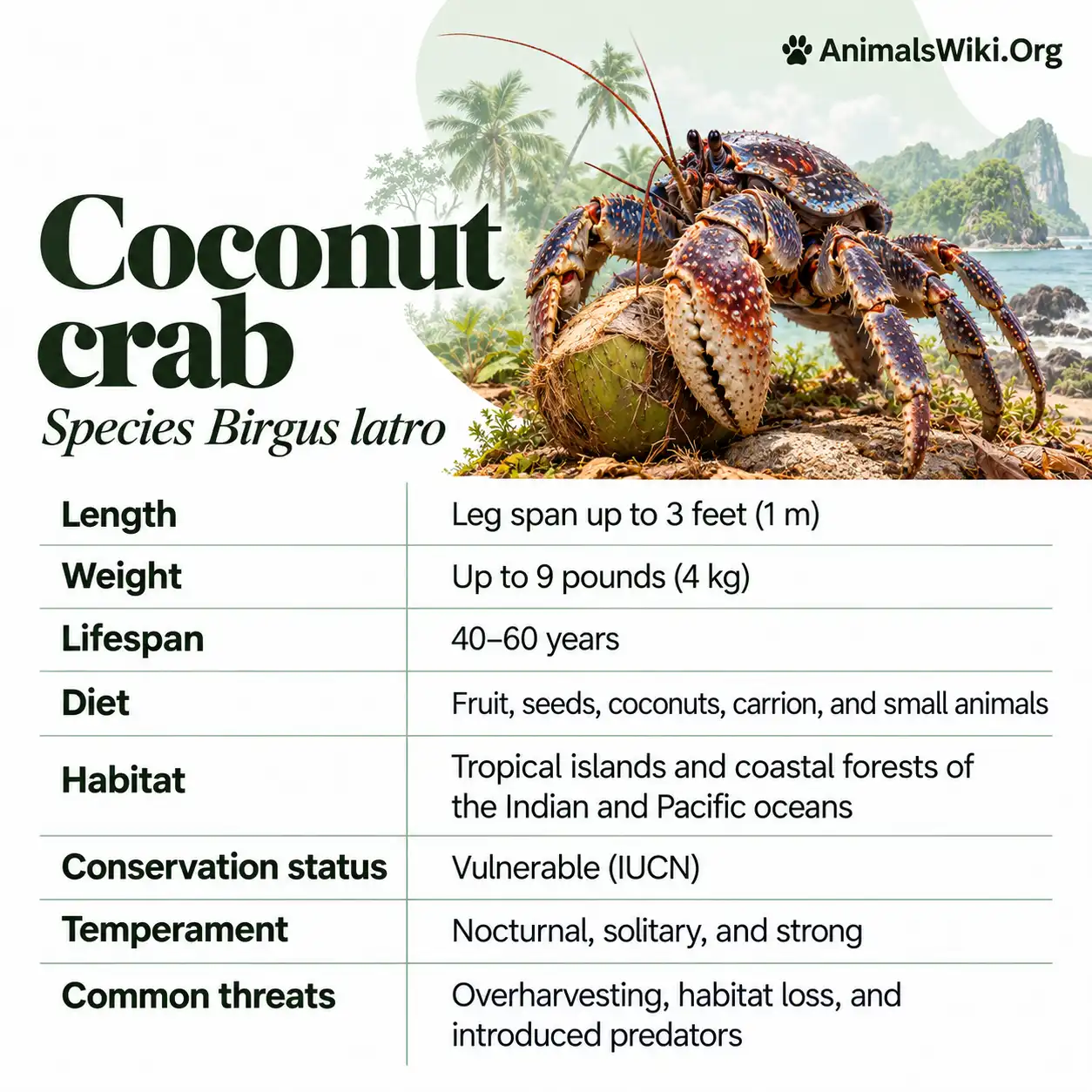
Some individuals have a leg span approaching one meter, making them among the most impressive land-dwelling invertebrates.
Despite their intimidating appearance, coconut crabs are generally solitary animals that spend much of their time searching for food or sheltering in burrows and rocky crevices.
Their diet is remarkably varied.
Although coconuts are a famous food source, coconut crabs also consume fallen fruits, seeds, plant material, carrion, and occasionally small animals.
Their powerful claws help them manipulate food, defend themselves, and break apart tough materials.
Coconut crabs are also exceptional climbers.
They can climb tree trunks, move across branches, and descend using their strong legs and claws.
Perhaps their most surprising characteristic is their evolutionary relationship with hermit crabs.
Young coconut crabs initially use empty gastropod shells for protection, much like their hermit crab relatives. As they mature, they develop a heavily reinforced abdomen and no longer require borrowed shells.
Although adult coconut crabs are adapted to terrestrial life, they still depend on the ocean for reproduction.
Females release developing eggs into seawater, where the young begin their lives as marine larvae.
Today, coconut crabs face threats from harvesting, habitat destruction, road mortality, and invasive predators.
This comprehensive guide explores coconut crab facts, scientific classification, size, weight, habitat, distribution, diet, claw strength, climbing ability, breathing, reproduction, lifespan, predators, adaptations, ecological importance, conservation, and frequently asked questions.
Coconut Crab Facts
| Feature | Information |
|---|---|
| Common name | Coconut Crab |
| Other names | Robber Crab, Palm Thief |
| Scientific name | Birgus latro |
| Family | Coenobitidae |
| Infraorder | Anomura |
| Order | Decapoda |
| Class | Malacostraca |
| Phylum | Arthropoda |
| Animal type | Terrestrial crustacean |
| Habitat | Tropical coastal forests and islands |
| Distribution | Indian and Pacific Oceans |
| Largest distinction | Largest living terrestrial arthropod by mass |
| Leg span | Can approach approximately 1 meter |
| Weight | Large individuals may reach around 4 kg or more |
| Diet | Fruits, seeds, coconuts, carrion, and small animals |
| Feeding type | Omnivorous scavenger and opportunistic predator |
| Breathing | Specialized air-breathing branchial chambers |
| Activity | Often nocturnal |
| Reproduction | Sexual, with marine larval development |
| Juveniles | Initially use borrowed shells |
| Lifespan | Potentially several decades |
| Climbing ability | Excellent |
| Main threats | Harvesting, habitat loss, introduced predators |
| Conservation status | Vulnerable (IUCN assessment; verify current listing before publication) |
What Is a Coconut Crab?
The coconut crab is a giant land-dwelling crustacean belonging to the species Birgus latro.
It is a decapod, meaning it belongs to the same order as true crabs, lobsters, shrimp, and hermit crabs.
However, coconut crabs are not true crabs of the infraorder Brachyura.
Instead, they belong to Anomura, the group that includes hermit crabs and several other crab-like crustaceans.
Is a Coconut Crab Really a Crab?
It is commonly called a crab, but scientifically it is an anomuran crustacean rather than a true crab.
Its closest living relatives include terrestrial hermit crabs.
Why Is It Called a Coconut Crab?
The name comes from its ability to feed on coconuts.
However, coconuts are only one component of its diverse diet.
Why Is It Called a Robber Crab?
Coconut crabs are sometimes called robber crabs or palm thieves because they may carry away food and other objects.
These names reflect their scavenging and exploratory behavior.
Scientific Classification of the Coconut Crab
| Classification | Name |
|---|---|
| Kingdom | Animalia |
| Phylum | Arthropoda |
| Subphylum | Crustacea |
| Class | Malacostraca |
| Order | Decapoda |
| Infraorder | Anomura |
| Family | Coenobitidae |
| Genus | Birgus |
| Species | Birgus latro |
What Does Birgus latro Mean?
Birgus latro is the scientific name of the coconut crab.
The species name latro comes from Latin and means thief or robber.
Are Coconut Crabs Related to Hermit Crabs?
Yes.
Coconut crabs belong to the same family as terrestrial hermit crabs.
Are Coconut Crabs Related to Lobsters?
Both are decapod crustaceans, but they belong to different evolutionary groups.
What Does a Coconut Crab Look Like?
Coconut crabs have massive bodies compared with most land-dwelling arthropods.
Their appearance includes:
- Large armored body
- Powerful claws
- Long walking legs
- Thick exoskeleton
- Segmented abdomen
- Antennae
- Compound eyes
- Strong climbing appendages
What Color Is a Coconut Crab?
Coloration varies among individuals and populations.
Common colors include:
- Blue
- Purple
- Red
- Orange
- Brown
- Dark gray
Some individuals display vivid blue or purple coloration, while others have reddish or brownish bodies.
Do Coconut Crabs Have Shells?
They possess hard exoskeletons.
However, mature adults do not normally occupy borrowed snail shells.
Why Don’t Adult Coconut Crabs Need Shells?
As they mature, their abdomen becomes heavily reinforced and protected by hardened tissues.
This reduces their dependence on external shells.
Coconut Crab Size and Weight
Coconut crabs are the largest living land-dwelling arthropods by mass.
How Big Can a Coconut Crab Get?
Large individuals may have a leg span approaching one meter.
Body size varies with sex, age, habitat, and food availability.
How Much Does a Coconut Crab Weigh?
Large coconut crabs may weigh around 4 kilograms or more.
Claims of much greater weights should be treated cautiously unless supported by reliable measurements.
Are Male Coconut Crabs Bigger Than Females?
Males are generally larger than females.
What Is the Largest Coconut Crab Ever Found?
Exceptional coconut crabs have been reported with very large leg spans and body masses.
However, exact record claims vary, and not all widely repeated measurements are scientifically verified.
Where Do Coconut Crabs Live?
Coconut crabs inhabit tropical islands in the Indian and Pacific Oceans.
Their distribution includes island groups in:
- Indian Ocean
- Western Pacific
- Central Pacific
- Parts of Southeast Asia
- Micronesia
- Melanesia
- Polynesia
They are associated with islands that provide suitable terrestrial habitat and access to coastal reproductive environments.
Do Coconut Crabs Live in Hawaii?
Coconut crabs are not generally considered established native members of the main Hawaiian Islands’ modern fauna.
Occasional sightings should not be confused with evidence of a widespread breeding population.
Do Coconut Crabs Live in Australia?
They occur on some Australian external territories, including Christmas Island.
Do Coconut Crabs Live in Japan?
They occur in parts of the Ryukyu Islands, including some southern Japanese islands.
Do Coconut Crabs Live in Freshwater?
No.
Adults are terrestrial animals, while larvae develop in seawater.
Coconut Crab Habitat
Coconut crabs inhabit tropical terrestrial environments.
These include:
- Coastal forests
- Tropical woodland
- Rocky areas
- Sandy coastal habitats
- Limestone formations
- Burrows
- Tree-covered island interiors
They require humid environments that help prevent excessive water loss.
Do Coconut Crabs Live on Beaches?
They may visit coastal areas, particularly during reproduction.
However, many spend much of their lives inland.
Do Coconut Crabs Live in Trees?
They can climb trees, but they are not permanently tree-dwelling animals.
Do Coconut Crabs Dig Burrows?
Yes.
They use burrows and crevices for shelter and protection.
What Do Coconut Crabs Eat?
Coconut crabs are omnivorous.
Their diet includes:
- Fallen fruits
- Coconuts
- Seeds
- Nuts
- Plant material
- Carrion
- Small invertebrates
- Occasionally small vertebrates
Do Coconut Crabs Eat Coconuts?
Yes.
They can feed on coconut flesh and use their claws to manipulate or break apart coconuts.
Can Coconut Crabs Open Coconuts?
Some can open or break apart coconuts, although the process may require considerable time and repeated manipulation.
They do not necessarily crack every intact coconut with a single squeeze.
Do Coconut Crabs Eat Meat?
Yes.
They consume carrion and may capture small animals.
Do Coconut Crabs Eat Birds?
They can prey on vulnerable birds in certain circumstances.
Documented observations include attacks on seabirds, but this should not be presented as their universal or primary feeding behavior.
Do Coconut Crabs Eat Rats?
They may consume small mammals opportunistically, although frequency varies and should not be generalized.
Are Coconut Crabs Cannibals?
Cannibalism can occur, particularly involving vulnerable or injured individuals.
How Strong Are Coconut Crab Claws?
Coconut crabs possess exceptionally powerful claws.
Their claws can exert strong gripping forces relative to body size.
Scientific research has measured substantial pinching forces in coconut crabs and estimated that the largest individuals may generate forces exceeding 3,000 newtons.
Can a Coconut Crab Crush a Coconut?
Its claws can break or damage hard coconut structures, although success depends on coconut condition and the animal’s size.
Can a Coconut Crab Break Human Bones?
Large coconut crabs can inflict serious crushing injuries.
It is possible for powerful claws to damage fingers or other vulnerable body parts.
However, dramatic claims about routinely breaking human bones should not be presented without evidence.
Why Are Coconut Crab Claws So Strong?
Their large muscles and robust claw structure allow them to generate substantial mechanical force.
Are Coconut Crab Claws Stronger Than Human Hands?
Large coconut crabs can produce impressive gripping forces, but comparisons depend on how force is measured and which human grip is being considered.
Can Coconut Crabs Climb Trees?
Yes.
Coconut crabs are excellent climbers.
They use their powerful legs and claws to grip bark and other surfaces.
Why Do Coconut Crabs Climb Trees?
They may climb to search for food, explore habitat, or avoid disturbances.
Can Coconut Crabs Climb Coconut Palms?
Yes.
Can Coconut Crabs Fall From Trees?
Yes.
Falls can occur, but these animals are adapted to moving through challenging terrestrial environments.
How Do Coconut Crabs Breathe?
Adult coconut crabs are adapted to breathing air.
They possess specialized respiratory chambers with highly vascularized surfaces that function somewhat like lungs.
These structures are derived from modified branchial chambers.
Do Coconut Crabs Have Lungs?
They possess specialized air-breathing structures often called branchiostegal lungs.
They are not identical to vertebrate lungs.
Can Coconut Crabs Breathe Underwater?
Adult coconut crabs are poorly adapted to prolonged submersion and can drown.
Their larvae, however, develop in seawater.
Why Do Coconut Crabs Need Humidity?
Their respiratory surfaces must remain sufficiently moist for effective gas exchange.
Dry conditions can increase water loss and physiological stress.
Coconut Crab Sense of Smell
Coconut crabs possess a highly developed sense of smell.
They use sensory structures on their antennae to detect odors.
Can Coconut Crabs Smell Food From Far Away?
They can detect airborne odors and use them to locate food.
The effective distance depends on wind, terrain, humidity, and the odor source.
Why Is Smell Important to Coconut Crabs?
It helps them locate fruits, carrion, and other food resources.
Coconut Crab Behavior
Coconut crabs are often solitary.
Many are most active at night, although activity patterns vary with environmental conditions.
Are Coconut Crabs Nocturnal?
They are commonly nocturnal, especially in hot or disturbed habitats.
Are Coconut Crabs Aggressive?
They may defend themselves when threatened or handled.
However, they do not normally seek out humans to attack.
Do Coconut Crabs Fight Each Other?
Yes.
Competition over food, shelter, and other resources can lead to aggressive encounters.
Coconut Crab Reproduction
Coconut crabs reproduce sexually.
Although adults live on land, reproduction requires access to the sea.
How Do Coconut Crabs Mate?
Males and females mate on land.
Females subsequently carry fertilized eggs beneath their abdomens.
Do Coconut Crabs Lay Eggs?
Yes.
Females carry eggs until they are ready to release the developing larvae into seawater.
How Many Eggs Does a Coconut Crab Lay?
Females can produce very large numbers of eggs.
Estimates vary by body size and reproductive condition.
Do Coconut Crabs Return to the Ocean?
Females approach the shoreline to release larvae into seawater.
Adults generally do not remain submerged.
Do Coconut Crabs Have Larvae?
Yes.
The larvae develop in the ocean before eventually returning to land.
Baby Coconut Crabs
Young coconut crabs begin life in seawater.
After passing through planktonic larval stages, they develop into a postlarval stage known as a glaucothoe.
This stage eventually settles and begins the transition to terrestrial life.
Do Baby Coconut Crabs Use Shells?
Yes.
Young coconut crabs initially use empty gastropod shells for protection.
When Do Coconut Crabs Stop Using Shells?
As juveniles grow and their abdomens become more heavily protected, they gradually abandon borrowed shells.
How Do Baby Coconut Crabs Grow?
They grow through molting.
Their exoskeleton is periodically shed and replaced.
Coconut Crab Molting
Coconut crabs must molt to grow.
Molting is a vulnerable period.
Do Coconut Crabs Shed Their Shells?
Yes.
They shed their exoskeletons during molting.
Where Do Coconut Crabs Molt?
They often shelter in burrows or protected locations.
Are Coconut Crabs Vulnerable During Molting?
Yes.
The new exoskeleton requires time to harden.
How Long Do Coconut Crabs Live?
Coconut crabs are relatively long-lived crustaceans.
They may survive for several decades.
Some estimates suggest that large individuals could reach ages approaching 50–60 years, although precise ages are difficult to verify.
How Long Does It Take a Coconut Crab to Mature?
Coconut crabs grow slowly and may require several years to reach sexual maturity.
Do Coconut Crabs Live for 100 Years?
There is insufficient reliable evidence to claim that coconut crabs routinely live for 100 years.
Coconut Crab Adaptations
Powerful Claws
Help process food and provide defense.
Strong Walking Legs
Support movement across land.
Climbing Ability
Allows access to elevated food sources.
Air-Breathing Chambers
Enable terrestrial respiration.
Hardened Abdomen
Protects adults without borrowed shells.
Strong Sense of Smell
Helps locate food.
Nocturnal Activity
May reduce exposure to heat and predators.
Burrowing Behavior
Provides shelter during vulnerable periods.
Marine Larval Development
Allows dispersal between islands.
Omnivorous Diet
Enables use of diverse food sources.
What Animals Eat Coconut Crabs?
Adult coconut crabs have relatively few natural predators because of their size and powerful claws.
However, vulnerable life stages may be eaten by:
- Large fish
- Seabirds
- Other crabs
- Introduced mammals
- Humans
Do Birds Eat Coconut Crabs?
Birds may consume smaller individuals or vulnerable life stages.
Do Rats Eat Coconut Crabs?
Introduced rats may threaten eggs or young crabs in some island ecosystems.
Do Humans Eat Coconut Crabs?
Yes.
Coconut crabs are harvested for food in some regions.
However, harvesting can threaten populations, and consumption may pose food-safety risks in certain circumstances.
Coconut Crab vs. Hermit Crab
| Feature | Coconut Crab | Hermit Crab |
|---|---|---|
| Scientific family | Coenobitidae | Several families, including Coenobitidae |
| Adult habitat | Primarily terrestrial | Marine or terrestrial |
| Adult borrowed shell | No | Common in many species |
| Size | Very large | Usually smaller |
| Climbing | Strong ability | Varies |
| Breathing | Specialized air-breathing structures | Varies by group |
| Larval development | Marine | Usually marine |
Coconut Crab vs. True Crab
Coconut crabs and true crabs are both decapod crustaceans.
However, coconut crabs belong to Anomura.
True crabs belong to Brachyura.
Coconut crabs are more closely related to hermit crabs than to typical true crabs.
Coconut Crab vs. Japanese Spider Crab
| Feature | Coconut Crab | Japanese Spider Crab |
|---|---|---|
| Scientific name | Birgus latro | Macrocheira kaempferi |
| Habitat | Land | Ocean |
| Main distinction | Largest terrestrial arthropod by mass | Among the largest living arthropods by leg span |
| Breathing | Air-breathing structures | Gills |
| Distribution | Tropical islands | Waters around Japan |
| Diet | Omnivorous | Scavenging and predation |
Are Coconut Crabs Dangerous to Humans?
Coconut crabs are not generally aggressive toward people.
However, their powerful claws can cause serious injuries.
They should never be handled carelessly.
Can Coconut Crabs Bite?
They do not bite in the same way as vertebrates.
Their main defensive weapons are their claws.
Can Coconut Crabs Pinch Humans?
Yes.
Can Coconut Crabs Kill Humans?
There is no sound basis for describing coconut crabs as animals that routinely kill humans.
However, their claws can cause significant injuries.
Are Coconut Crabs Venomous?
No.
Are Coconut Crabs Poisonous?
They are not generally poisonous to touch.
However, eating coconut crabs can carry risks, including potential toxin accumulation depending on local food sources.
Can You Touch a Coconut Crab?
Handling is discouraged because of the risk of injury and stress to the animal.
Are Coconut Crabs Endangered?
The coconut crab has been assessed as Vulnerable on the IUCN Red List.
Population conditions vary among islands.
Some populations are protected or relatively secure, while others face substantial harvesting and habitat pressures.
What Threatens Coconut Crabs?
Major threats include:
- Overharvesting
- Habitat destruction
- Coastal development
- Road mortality
- Introduced predators
- Pollution
- Climate change
- Slow growth and delayed maturity
Why Is Overharvesting Dangerous?
Coconut crabs grow slowly and may require years to reach reproductive maturity.
Removing large adults can reduce breeding potential.
How Does Habitat Loss Affect Coconut Crabs?
Loss of coastal forests and shelter sites reduces suitable habitat.
How Does Climate Change Affect Coconut Crabs?
Sea-level rise, coastal erosion, and changes in rainfall or temperature may affect island habitats and reproduction.
Coconut Crab Conservation
Conservation measures include:
- Harvest restrictions
- Minimum size limits
- Protection of breeding females
- Seasonal closures
- Habitat conservation
- Monitoring populations
- Managing introduced predators
- Community-based conservation programs
Specific regulations vary by island and jurisdiction.
Why Are Coconut Crabs Important?
Coconut crabs contribute to tropical island ecosystems.
They consume fallen fruits, seeds, carrion, and other organic material.
Their feeding and movement may influence nutrient cycling and seed interactions.
They also form part of island food webs.
Do Coconut Crabs Help Clean Forests?
They consume carrion and fallen organic material.
This contributes to decomposition and nutrient recycling.
Do Coconut Crabs Spread Seeds?
Their interactions with fruits and seeds may influence seed movement and survival, although the effects vary by plant species.
50 Interesting Coconut Crab Facts
- Coconut crabs are the largest living terrestrial arthropods by mass.
- Their scientific name is Birgus latro.
- They belong to the family Coenobitidae.
- They are relatives of hermit crabs.
- They are not true crabs of the infraorder Brachyura.
- Adults spend nearly all their lives on land.
- They inhabit tropical islands.
- Their distribution spans parts of the Indian and Pacific Oceans.
- Large individuals can have leg spans approaching one meter.
- Some weigh around 4 kilograms or more.
- Males are generally larger than females.
- Their claws are exceptionally powerful.
- They can manipulate and break apart coconuts.
- Coconuts are not their only food.
- They eat fallen fruits.
- They consume seeds.
- They eat carrion.
- They may prey on small animals.
- They can climb trees.
- They can climb coconut palms.
- They possess strong walking legs.
- Their bodies are protected by exoskeletons.
- Adults do not normally use borrowed shells.
- Juveniles initially use empty gastropod shells.
- They breathe using specialized air-breathing chambers.
- Adults can drown during prolonged submersion.
- Their larvae develop in seawater.
- Females release larvae into the ocean.
- Young coconut crabs eventually return to land.
- They grow by molting.
- They shelter during molting.
- Their new exoskeleton takes time to harden.
- They possess a strong sense of smell.
- Their antennae detect airborne odors.
- Many are active at night.
- They often shelter in burrows.
- They are generally solitary.
- They may defend food or shelter.
- They are not venomous.
- Their claws can injure humans.
- They may live for several decades.
- Their exact maximum lifespan is difficult to establish.
- They grow relatively slowly.
- They are harvested for food in some regions.
- Overharvesting threatens certain populations.
- Habitat loss is another concern.
- Introduced predators can threaten young crabs.
- They contribute to island nutrient cycling.
- Their conservation status has been assessed as Vulnerable.
- Their enormous size, climbing ability, and terrestrial lifestyle make them among the most extraordinary crustaceans on Earth.
Did You Know?
The Giant Crab That Climbs Trees and Lives Almost Entirely on Land
Imagine a tropical island at night.
The forest is quiet.
Warm air moves through the palm trees.
Fallen fruits lie scattered across the ground.
Then something large begins moving through the shadows.
It has long armored legs.
Two powerful claws.
A broad body.
And the unmistakable appearance of a giant crab.
But this animal is not moving across an ocean floor.
It is walking through a forest.
It is a coconut crab.
The animal pauses beside a fallen coconut.
Its antennae move as it investigates the scent.
It grips the coconut with its claws.
Slowly, it begins manipulating the tough outer material.
Its powerful claws help it reach the food inside.
Later, the same crab approaches a tree.
It grips the trunk and begins climbing.
Its strong legs carry it upward.
For an animal descended from marine crustacean ancestors, this terrestrial lifestyle is extraordinary.
But the coconut crab’s life still begins in the ocean.
When breeding season arrives, females approach the coastline.
They release developing larvae into seawater.
The larvae drift through the marine environment before eventually settling and beginning the transition toward land.
Young coconut crabs initially occupy empty shells.
As they grow, their bodies become more heavily protected.
Eventually, they abandon borrowed shells and become fully terrestrial adults.
Their life cycle connects two different worlds.
The ocean, where development begins.
And the island forest, where adulthood is spent.
Over many years, a coconut crab may grow into an enormous animal with claws capable of generating exceptional force.
Yet its slow growth also creates a conservation challenge.
Large adults can take many years to replace if removed from a population.
Protecting these remarkable animals therefore requires careful management of island habitats and harvesting.
The coconut crab is an extraordinary example of how a marine crustacean lineage adapted to life on land while retaining an essential connection to the sea.
Frequently Asked Questions About Coconut Crabs
What is a coconut crab?
A coconut crab is a giant terrestrial crustacean belonging to the species Birgus latro.
What is the scientific name of the coconut crab?
Birgus latro.
Is a coconut crab a true crab?
No. It belongs to Anomura rather than Brachyura.
Is a coconut crab a hermit crab?
It is a close relative of terrestrial hermit crabs.
Why is it called a coconut crab?
Because it can feed on coconuts.
Why is it called a robber crab?
Because it may carry away food and other objects.
Are coconut crabs arthropods?
Yes.
Are coconut crabs crustaceans?
Yes.
Are coconut crabs invertebrates?
Yes.
Are coconut crabs the largest land arthropods?
They are generally recognized as the largest living terrestrial arthropods by mass.
How big can coconut crabs get?
Large individuals may have leg spans approaching one meter.
How much do coconut crabs weigh?
Large adults may weigh around 4 kilograms or more.
Are male coconut crabs bigger than females?
Yes, generally.
What color are coconut crabs?
Blue, purple, red, orange, brown, and other colors.
Where do coconut crabs live?
On tropical islands across the Indian and Pacific Oceans.
Do coconut crabs live in Australia?
They occur on some Australian external territories.
Do coconut crabs live in Hawaii?
They are not generally established native animals of the main Hawaiian Islands.
Do coconut crabs live in Japan?
Yes, in parts of the southern Ryukyu Islands.
Do coconut crabs live in forests?
Yes.
Do coconut crabs live on beaches?
They may visit beaches, especially during reproduction.
Do coconut crabs live in trees?
They can climb trees but are not permanently tree-dwelling.
Can coconut crabs climb coconut palms?
Yes.
Why do coconut crabs climb trees?
To explore their environment and access potential food sources.
Do coconut crabs dig burrows?
Yes.
Are coconut crabs nocturnal?
Many are most active at night.
Are coconut crabs aggressive?
They may defend themselves, but they do not normally attack humans without provocation.
What do coconut crabs eat?
Fruits, seeds, coconuts, carrion, and small animals.
Do coconut crabs eat coconuts?
Yes.
Can coconut crabs open coconuts?
Yes, some can manipulate and break apart coconuts.
Do coconut crabs eat meat?
Yes.
Do coconut crabs eat birds?
They can prey on vulnerable birds under certain circumstances.
Do coconut crabs eat rats?
They may consume small mammals opportunistically.
Are coconut crabs cannibals?
Cannibalism can occur.
How strong are coconut crab claws?
Very strong; large individuals can generate substantial pinching forces.
Can coconut crabs crush coconuts?
Yes, under suitable conditions.
Can coconut crabs break human bones?
Large individuals can cause serious crushing injuries, but dramatic claims should be treated cautiously.
Are coconut crab claws stronger than human hands?
Comparisons depend on the type of force being measured.
Do coconut crabs have shells?
They possess exoskeletons, but adults do not normally occupy borrowed snail shells.
Do baby coconut crabs use shells?
Yes.
Why do adult coconut crabs stop using shells?
Their abdomens become heavily protected as they mature.
Do coconut crabs have lungs?
They possess specialized air-breathing branchial chambers.
Can coconut crabs breathe underwater?
Adults are poorly adapted to prolonged submersion.
Can coconut crabs drown?
Yes.
Why do coconut crabs need humidity?
Their respiratory surfaces must remain moist.
Do coconut crabs have a good sense of smell?
Yes.
Can coconut crabs smell food from far away?
They can detect airborne odors, although effective distance varies.
How do coconut crabs reproduce?
Sexually, with marine larval development.
Do coconut crabs lay eggs?
Yes.
Do coconut crabs return to the ocean?
Females approach the sea to release larvae.
Do coconut crabs have larvae?
Yes.
Do baby coconut crabs live in water?
Their early larval stages develop in seawater.
Do coconut crabs molt?
Yes.
Where do coconut crabs molt?
Often in protected burrows or crevices.
How long do coconut crabs live?
They may survive for several decades.
Can coconut crabs live 100 years?
There is insufficient reliable evidence to establish routine lifespans of 100 years.
What animals eat coconut crabs?
Predators vary by life stage and may include fish, birds, introduced mammals, and humans.
Are coconut crabs dangerous to humans?
Their claws can cause serious injuries, but they are not generally aggressive toward people.
Can coconut crabs pinch humans?
Yes.
Can coconut crabs bite?
Their main defensive weapons are their claws.
Are coconut crabs venomous?
No.
Are coconut crabs poisonous?
They are not generally poisonous to touch, but eating them can pose food-safety risks in some circumstances.
Can humans eat coconut crabs?
They are eaten in some regions, subject to local regulations and food-safety concerns.
Can you touch a coconut crab?
Handling is discouraged.
Are coconut crabs endangered?
They have been assessed as Vulnerable on the IUCN Red List.
Why are coconut crabs threatened?
Overharvesting, habitat loss, introduced predators, and other environmental pressures.
Why are coconut crabs important?
They contribute to tropical island food webs and nutrient cycling.
What is the most interesting coconut crab fact?
The coconut crab is the world’s largest living terrestrial arthropod by mass, yet its early life stages develop in the ocean.
Conclusion
The coconut crab is one of the most remarkable land-dwelling invertebrates on Earth.
Its enormous size, powerful claws, climbing ability, and specialized respiratory system distinguish it from most familiar crustaceans.
Although its ancestors were marine, the adult coconut crab has become highly adapted to terrestrial life.
It explores tropical island forests, consumes a wide variety of food, and uses its powerful claws to manipulate tough materials.
Yet the ocean remains essential to its life cycle.
Females release larvae into seawater, and young coconut crabs begin life as marine organisms before transitioning to land.
Coconut crabs also play important ecological roles by consuming organic material and participating in island food webs.
Unfortunately, slow growth, harvesting pressure, and habitat loss make some populations vulnerable.
Protecting these extraordinary animals requires conservation of island habitats and responsible management of human activities.
The coconut crab is more than a giant crab that climbs trees—it is a remarkable example of evolution, strength, and survival at the boundary between land and sea.
SEO Information
Primary keyword: Coconut Crab
Secondary keywords: Coconut Crab facts, Coconut Crab scientific name, Birgus latro, Robber Crab, Palm Thief, Coconut Crab size, largest Coconut Crab, Coconut Crab weight, Coconut Crab habitat, where do Coconut Crabs live, Coconut Crab diet, what do Coconut Crabs eat, Coconut Crab claws, Coconut Crab claw strength, Coconut Crab climbing, can Coconut Crabs climb trees, Coconut Crab breathing, Coconut Crab lungs, Coconut Crab reproduction, Coconut Crab eggs, baby Coconut Crab, Coconut Crab lifespan, Coconut Crab predators, Coconut Crab adaptations, Coconut Crab vs Hermit Crab, Coconut Crab vs True Crab, Coconut Crab vs Japanese Spider Crab, are Coconut Crabs dangerous, are Coconut Crabs poisonous, are Coconut Crabs endangered, Coconut Crab conservation.
SEO meta title: Coconut Crab Facts: Size, Claw Strength, Habitat & Diet
Meta description: Discover fascinating Coconut Crab facts, including their enormous size, powerful claws, tree-climbing ability, tropical habitat, diet, reproduction, lifespan, and conservation.
Suggested URL slug: coconut-crab-facts
Suggested image alt text: Large coconut crab with powerful claws and long walking legs moving across a tropical island forest floor in its natural habitat.
Suggested article category: Crustaceans / Land Animals
Suggested tags: Coconut Crab, Birgus latro, Robber Crab, Giant Crabs, Terrestrial Crustaceans, Island Wildlife, Arthropods
Editorial note: Coconut crab maximum size, lifespan, claw-force estimates, and population status should be presented with appropriate uncertainty. Avoid treating exceptional measurements as typical, and verify current IUCN conservation assessments and local harvesting regulations before publication.