Pistol Shrimp, The Tiny Ocean Animal That Creates Powerful Underwater Shock Waves
The pistol shrimp, also known as the snapping shrimp, is one of the most extraordinary small predators living beneath the ocean’s surface.
Despite measuring only a few centimeters in many species, this remarkable marine crustacean possesses a specialized claw capable of producing an incredibly loud underwater snap.
The sound is not created simply by two hard surfaces striking together.
Instead, the pistol shrimp closes its specialized claw so rapidly that it ejects a high-speed jet of water.
This jet produces a rapidly forming and collapsing cavitation bubble.
When the bubble collapses, it generates a sharp pressure pulse and the characteristic snapping sound that gives the animal its name.
The process can stun, injure, or kill small prey.
Some pistol shrimp also use their snapping claws to defend burrows, deter predators, and communicate with other shrimp.
Certain species form one of the ocean’s most fascinating partnerships with goby fish.
The shrimp digs and maintains a burrow, while the goby acts as a lookout for approaching danger.
Other snapping shrimp live in colonies inside marine sponges, where they display surprisingly complex social behavior.
Some species even form eusocial colonies with reproductive division of labor, an arrangement more commonly associated with ants, bees, and termites.
Pistol shrimp belong to the family Alpheidae, a diverse group of decapod crustaceans containing hundreds of species.
They inhabit tropical, subtropical, and temperate coastal waters, including coral reefs, sandy seabeds, rocky crevices, seagrass beds, and sponge communities.
Although small, snapping shrimp are ecologically important predators, burrow builders, and contributors to the underwater soundscape.
This comprehensive guide explores pistol shrimp facts, scientific classification, species, anatomy, size, habitat, distribution, diet, snapping claws, cavitation, shock waves, goby partnerships, reproduction, lifespan, predators, adaptations, ecological importance, conservation, and frequently asked questions.
Pistol Shrimp Facts
| Feature | Information |
|---|---|
| Common name | Pistol Shrimp |
| Other name | Snapping Shrimp |
| Scientific family | Alpheidae |
| Order | Decapoda |
| Class | Malacostraca |
| Phylum | Arthropoda |
| Animal type | Marine crustacean |
| Diversity | Hundreds of described species |
| Famous genera | Alpheus, Synalpheus |
| Habitat | Coastal marine environments |
| Distribution | Tropical, subtropical, and temperate oceans |
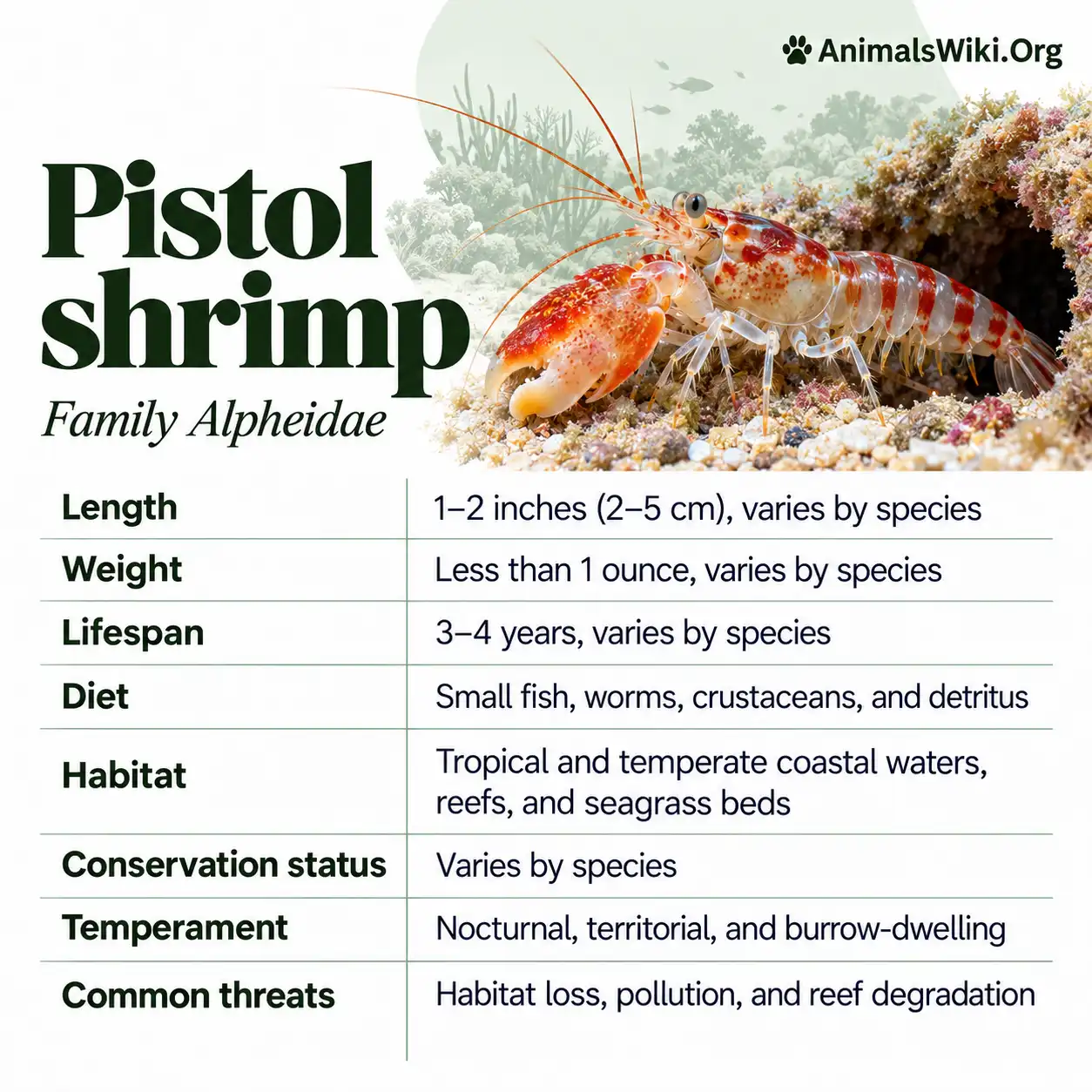
| Typical size | Often approximately 2–5 cm, depending on species |
| Larger species | Some reach several centimeters beyond this range |
| Main weapon | Specialized snapping claw |
| Snapping mechanism | High-speed water jet and cavitation |
| Diet | Small crustaceans, worms, and other invertebrates |
| Lifestyle | Burrowing, reef-dwelling, or sponge-associated |
| Special relationship | Mutualism with certain goby fish |
| Social behavior | Solitary, paired, or colonial depending on species |
| Reproduction | Sexual, egg-laying |
| Lifespan | Species-dependent; poorly documented for many |
| Predators | Fish, octopuses, crabs, and other marine predators |
| Conservation | Species-specific; many remain unassessed |
What Is a Pistol Shrimp?
A pistol shrimp is a small marine crustacean belonging to the family Alpheidae.
Pistol shrimp are decapods, meaning they belong to the same broader order as true shrimp, crabs, lobsters, and crayfish.
Their most recognizable feature is a specialized claw that produces a powerful underwater snapping event.
In many species, one claw is significantly larger than the other.
The enlarged claw is adapted to generate a high-speed water jet rather than simply pinch prey.
Why Is It Called a Pistol Shrimp?
The name comes from the sharp snapping sound produced by its specialized claw.
The sound can resemble a tiny gunshot when recorded underwater.
Is a Pistol Shrimp the Same as a Snapping Shrimp?
Yes.
Both names refer to members of the family Alpheidae.
Is a Pistol Shrimp a True Shrimp?
Pistol shrimp are decapod crustaceans commonly classified among shrimp.
Unlike mantis shrimp, which belong to a separate order, pistol shrimp belong to Decapoda.
Is a Pistol Shrimp Related to a Mantis Shrimp?
Both are crustaceans, but they belong to different orders.
Pistol shrimp belong to Decapoda, while mantis shrimp belong to Stomatopoda.
Scientific Classification of Pistol Shrimp
| Classification | Name |
|---|---|
| Kingdom | Animalia |
| Phylum | Arthropoda |
| Subphylum | Crustacea |
| Class | Malacostraca |
| Order | Decapoda |
| Infraorder | Caridea |
| Family | Alpheidae |
| Example genus | Alpheus |
| Example species | Alpheus bellulus |
Because pistol shrimp represent an entire family, they do not share a single species-level scientific name.
What Does Alpheidae Mean?
Alpheidae is the scientific family containing snapping shrimp.
It includes numerous genera and species with specialized snapping mechanisms and diverse lifestyles.
Are Pistol Shrimp Arthropods?
Yes.
They possess jointed appendages, segmented bodies, and exoskeletons.
Are Pistol Shrimp Invertebrates?
Yes.
They do not possess backbones.
Types of Pistol Shrimp
Pistol shrimp include many species with different appearances, habitats, and behaviors.
1. Tiger Pistol Shrimp
Scientific name: Alpheus bellulus
The tiger pistol shrimp is known for its patterned body and association with goby fish.
It commonly inhabits sandy or rubble-covered marine environments.
2. Randall’s Pistol Shrimp
Scientific name: Alpheus randalli
This species is recognized for its colorful red-and-white markings.
It forms partnerships with certain gobies and inhabits sandy reef environments.
3. Bigclaw Snapping Shrimp
Scientific name: Alpheus heterochaelis
This species is well known from coastal waters of the western Atlantic.
It has been studied for its snapping behavior and claw mechanics.
4. Sponge-Dwelling Snapping Shrimp
Example genus: Synalpheus
Many Synalpheus species inhabit marine sponges.
Some live in social colonies, while certain species display eusocial behavior.
5. Other Reef-Dwelling Pistol Shrimp
Numerous Alpheus species inhabit coral rubble, rocky crevices, and reef-associated sediments.
Their coloration and behavior vary widely.
What Does a Pistol Shrimp Look Like?
Pistol shrimp resemble small shrimp with elongated, segmented bodies.
Their most distinctive feature is the enlarged snapping claw.
Common anatomical features include:
- Hard exoskeleton
- Segmented abdomen
- Antennae
- Compound eyes
- Walking legs
- Swimming appendages
- Tail fan
- Specialized snapping claw
- Smaller opposing claw
Why Does a Pistol Shrimp Have One Big Claw?
The enlarged claw contains specialized structures that allow the animal to generate a high-speed water jet.
In many species, the two claws are noticeably unequal.
Can a Pistol Shrimp Have Two Large Claws?
The degree of claw asymmetry varies among species.
However, many familiar snapping shrimp have one enlarged snapping claw and one smaller claw.
Do Pistol Shrimp Have Bones?
No.
They possess hard exoskeletons rather than internal vertebrate bones.
Pistol Shrimp Colors
Pistol shrimp occur in a variety of colors and patterns.
These include:
- Brown
- Red
- Orange
- White
- Yellow
- Greenish tones
- Transparent or translucent patterns
- Striped combinations
Some species blend into sand and rubble.
Others possess distinctive patterns associated with reef environments.
Pistol Shrimp Size and Weight
Most pistol shrimp are relatively small.
Many species measure approximately 2–5 centimeters in length.
However, size varies considerably.
How Big Can a Pistol Shrimp Get?
Some larger species can exceed 5 centimeters and reach several additional centimeters in length.
What Is the Largest Pistol Shrimp?
There is no single universally cited maximum record covering every member of Alpheidae.
Large species in the family can be substantially bigger than the small snapping shrimp commonly encountered in reefs.
How Much Does a Pistol Shrimp Weigh?
Most weigh only a few grams or less, depending on size and species.
Where Do Pistol Shrimp Live?
Pistol shrimp occur in marine environments around the world.
They are especially diverse in warm coastal waters.
Their distribution includes:
- Pacific Ocean
- Atlantic Ocean
- Indian Ocean
- Caribbean Sea
- Red Sea
- Tropical coral reefs
- Temperate coastal habitats
Do Pistol Shrimp Live in Coral Reefs?
Yes.
Many species inhabit reef crevices, rubble, and nearby sandy areas.
Do Pistol Shrimp Live in the Deep Sea?
Most familiar snapping shrimp inhabit shallow coastal environments.
However, the broader family includes species occurring at greater depths.
Do Pistol Shrimp Live in Freshwater?
Pistol shrimp are primarily marine animals.
Some species occur in brackish environments, but they are not typical freshwater shrimp.
Pistol Shrimp Habitat
Pistol shrimp inhabit several types of marine environments.
These include:
- Sandy seabeds
- Coral rubble
- Rocky crevices
- Coral reefs
- Seagrass beds
- Mangrove-associated habitats
- Marine sponges
- Muddy coastal sediments
Many species construct or occupy burrows.
Others live inside sponges or beneath rocks.
Why Do Pistol Shrimp Dig Burrows?
Burrows provide protection from predators.
They also serve as shelter, feeding locations, and reproductive habitats.
Are Pistol Shrimp Territorial?
Many species defend their shelters or burrows.
Territorial behavior varies by species.
What Do Pistol Shrimp Eat?
Pistol shrimp are generally predators or opportunistic feeders.
Their diet may include:
- Small crustaceans
- Marine worms
- Small mollusks
- Other benthic invertebrates
- Organic material
- Small prey associated with sediment
Are Pistol Shrimp Carnivores?
Many species are primarily carnivorous.
Others consume a wider variety of organic material.
Do Pistol Shrimp Eat Fish?
They are not generally specialized predators of large or fast-swimming fish.
However, snapping shrimp may attack small, vulnerable aquatic animals.
Do Pistol Shrimp Eat Other Shrimp?
Some species can prey on smaller crustaceans.
Do Pistol Shrimp Eat Worms?
Yes.
Marine worms can be part of their diet.
How Does a Pistol Shrimp Snap Its Claw?
The snapping mechanism is one of the most remarkable examples of biological fluid mechanics.
The enlarged claw contains specialized structures that allow rapid closure.
As the claw closes, water is forced through a narrow opening at high speed.
The resulting water jet creates a region of low pressure.
This can cause a cavitation bubble to form.
The bubble then collapses rapidly.
The collapse generates a sharp pressure pulse and the characteristic snapping sound.
Does the Claw Make the Sound Directly?
The loud snapping sound is primarily associated with cavitation bubble collapse, rather than simply the claw surfaces striking together.
What Is Cavitation?
Cavitation occurs when rapid pressure changes in a liquid cause vapor bubbles to form and collapse.
Does a Pistol Shrimp Create a Shock Wave?
The collapse of the cavitation bubble produces a strong, rapidly changing pressure pulse.
It is often described as a shock wave in popular explanations.
Can a Pistol Shrimp Stun Prey?
Yes.
Some snapping shrimp can use the effects of the water jet and cavitation to stun or disable small prey.
Can a Pistol Shrimp Kill Prey With Its Snap?
Yes.
The snapping mechanism can injure or kill sufficiently small prey under suitable conditions.
How Loud Is a Pistol Shrimp?
Pistol shrimp snaps are among the most conspicuous biological sounds in shallow marine environments.
Some measurements report very high underwater sound pressure levels, sometimes exceeding 200 decibels referenced to 1 micropascal at a specified distance.
However, underwater decibel measurements cannot be directly compared with ordinary airborne sound levels.
Is a Pistol Shrimp Louder Than a Gun?
This comparison is misleading without specifying measurement conditions.
Underwater and airborne sound levels use different reference pressures and propagation conditions.
A pistol shrimp produces an exceptionally intense underwater impulse for its size, but that does not mean it is directly louder than a gunshot in air.
Can Humans Hear Pistol Shrimp?
People may hear snapping shrimp through underwater recordings, hydrophones, or in some shallow-water settings.
Large groups can create a continuous crackling sound.
Do Pistol Shrimp Make Noise at Night?
Many snapping shrimp are active during nighttime periods.
Their snapping activity varies with species, habitat, temperature, and other conditions.
Do Pistol Shrimp Produce Heat and Light?
The collapse of a cavitation bubble can generate extreme physical conditions over a very small region and a very short time.
Research has demonstrated light emission associated with snapping shrimp cavitation.
This phenomenon is sometimes called shrimpoluminescence.
Can a Pistol Shrimp Produce Temperatures as Hot as the Sun?
Popular articles sometimes compare the estimated temperature inside a collapsing cavitation bubble with the temperature at the Sun’s surface.
However, this does not mean the shrimp heats the surrounding ocean to that temperature.
The extreme conditions are localized within a microscopic, short-lived bubble.
Does a Pistol Shrimp Create Light?
Yes.
Light emission associated with snapping shrimp cavitation has been observed experimentally.
It is extremely brief and not comparable to a sustained visible flash from a lamp.
Is the Pistol Shrimp’s Snap a Tiny Explosion?
It is not a chemical explosion.
It is a rapid fluid-dynamic event involving cavitation bubble formation and collapse.
Pistol Shrimp and Goby Fish
One of the most fascinating pistol shrimp behaviors is its partnership with certain goby fish.
This relationship is a form of mutualism, in which both animals benefit.
How Does the Partnership Work?
The pistol shrimp digs and maintains a burrow.
The goby fish uses the burrow as shelter.
In return, the goby acts as a lookout.
When danger approaches, the goby can signal the shrimp through body movements.
Why Does the Pistol Shrimp Need a Goby?
Many burrow-associated pistol shrimp have limited visual ability compared with their goby partners.
The goby provides early warning of approaching predators.
How Do Pistol Shrimp Communicate With Gobies?
The shrimp often maintains contact with the goby using its antennae.
Changes in the goby’s movements can alert the shrimp to danger.
Do All Pistol Shrimp Live With Gobies?
No.
Only certain species form these partnerships.
Many other snapping shrimp live independently or associate with different organisms.
Do Gobies Protect Pistol Shrimp?
Yes.
The goby’s vigilance can help the shrimp avoid predators.
Do Pistol Shrimp Protect Gobies?
The shrimp provides and maintains a shelter that the goby can use.
Social Pistol Shrimp
Some snapping shrimp display remarkable social behavior.
Species in the genus Synalpheus may inhabit sponge colonies.
Certain species form eusocial groups.
What Does Eusocial Mean?
Eusociality generally involves cooperative care of young, overlapping generations, and reproductive division of labor.
Do Pistol Shrimp Have Queens?
Some eusocial Synalpheus colonies contain one or a few primary breeding females and numerous nonbreeding or less reproductively active colony members.
The breeding female is sometimes informally called a queen.
Do Pistol Shrimp Live in Colonies?
Some species do.
Others are solitary or live in pairs.
Are Pistol Shrimp Like Ants?
Certain sponge-dwelling species display social organization that resembles aspects of eusocial insect colonies.
However, the biological details differ.
Pistol Shrimp Reproduction
Pistol shrimp reproduce sexually.
Reproductive strategies vary by species.
Do Pistol Shrimp Lay Eggs?
Yes.
Females carry developing eggs attached beneath the abdomen.
How Many Eggs Does a Pistol Shrimp Lay?
Egg production varies by species, female size, and reproductive condition.
Some females carry numerous eggs.
Do Pistol Shrimp Guard Their Eggs?
Females typically carry and protect their eggs until hatching.
Do Pistol Shrimp Have Larvae?
Many species produce larvae that develop in the water column.
Other species have abbreviated or specialized development.
Do Pistol Shrimp Mate for Life?
Some species form stable pairs, but lifelong monogamy is not universal.
Baby Pistol Shrimp
Young pistol shrimp may begin life as planktonic larvae.
As they develop, they acquire the body structures of juvenile shrimp.
The specialized snapping claw develops through growth and molting.
Are Baby Pistol Shrimp Born With Large Snapping Claws?
Not in the fully developed adult form.
The specialized claw develops during juvenile growth.
How Do Baby Pistol Shrimp Grow?
They grow by molting their exoskeletons.
Pistol Shrimp Molting
Like other crustaceans, pistol shrimp must shed their exoskeletons to grow.
Do Pistol Shrimp Shed Their Shells?
Yes.
This process is called molting.
Are Pistol Shrimp Vulnerable During Molting?
Yes.
Their new exoskeleton requires time to harden.
Many remain sheltered during this period.
Can a Pistol Shrimp Regrow Its Claw?
Yes.
Pistol shrimp can regenerate lost appendages through successive molts.
In some species, losing the large snapping claw can trigger remarkable changes in claw specialization.
The smaller claw may develop into a functional snapping claw, while a replacement claw grows on the injured side.
Can a Pistol Shrimp Switch Its Snapping Claw?
In certain species, the snapping function can shift from one side to the other following claw loss.
This is a remarkable example of developmental flexibility.
How Long Does Claw Regeneration Take?
Regeneration depends on molting cycles, age, nutrition, and species.
How Long Do Pistol Shrimp Live?
Lifespan varies among species.
Many are thought to live for several years, but reliable maximum ages are unavailable for much of the family.
Some species have relatively short life cycles.
Others may survive longer under favorable conditions.
Pistol Shrimp Adaptations
Specialized Snapping Claw
Generates a high-speed water jet.
Cavitation Mechanism
Produces intense pressure pulses and sound.
Hard Exoskeleton
Protects the body.
Burrowing Ability
Provides shelter and hunting opportunities.
Antennae
Help detect environmental cues and maintain contact with partners.
Claw Regeneration
Allows recovery after injury.
Goby Mutualism
Provides early predator warning in certain species.
Social Colonies
Support cooperative living in some sponge-dwelling species.
Small Body Size
Allows occupation of narrow crevices and burrows.
Sensory Adaptations
Support feeding, shelter defense, and communication.
What Animals Eat Pistol Shrimp?
Potential predators include:
- Reef fish
- Groupers
- Octopuses
- Crabs
- Other predatory marine animals
Do Fish Eat Pistol Shrimp?
Yes.
Many predatory fish consume small crustaceans, including snapping shrimp.
Do Octopuses Eat Pistol Shrimp?
Yes.
Octopuses may prey on pistol shrimp.
Can Pistol Shrimp Defend Themselves?
Yes.
They can retreat into burrows and use snapping claws to deter predators.
Pistol Shrimp vs. Mantis Shrimp
| Feature | Pistol Shrimp | Mantis Shrimp |
|---|---|---|
| Scientific group | Alpheidae | Stomatopoda |
| Order | Decapoda | Stomatopoda |
| Main weapon | Snapping claw | Raptorial appendages |
| Mechanism | Water jet and cavitation | Direct high-speed strike; cavitation in some smashers |
| Typical prey | Small invertebrates | Mollusks, crustaceans, fish |
| Vision | Species-dependent | Highly specialized in many species |
| Famous behavior | Goby partnerships | Smashing and spearing |
| Habitat | Coastal marine environments | Coastal and other marine environments |
Pistol Shrimp vs. Ordinary Shrimp
Pistol shrimp and many familiar shrimp belong to the order Decapoda.
However, pistol shrimp possess specialized claws adapted for snapping.
Most ordinary shrimp do not possess the same cavitation-producing mechanism.
Their feeding strategies and lifestyles also differ.
Pistol Shrimp vs. Crab
Pistol shrimp and crabs are both decapod crustaceans.
However, pistol shrimp generally possess elongated shrimp-like bodies.
True crabs usually have broader, more compact bodies and different claw arrangements.
Are Pistol Shrimp Dangerous to Humans?
Pistol shrimp are not generally dangerous to humans in normal underwater encounters.
Their snapping claws are adapted primarily for small prey and defense.
However, a large snapping shrimp may cause discomfort or minor injury if handled.
Can a Pistol Shrimp Hurt a Human?
It can potentially cause localized discomfort or injury, especially if handled improperly.
Can a Pistol Shrimp Break a Human Finger?
Claims that pistol shrimp routinely break human fingers are exaggerated.
Their snapping mechanism is highly effective against small prey, but it should not be described as routinely capable of breaking human bones.
Can a Pistol Shrimp Kill a Human?
There is no credible basis for describing pistol shrimp as a normal lethal threat to humans.
Are Pistol Shrimp Venomous?
They are not generally considered venomous.
Can You Touch a Pistol Shrimp?
Handling is discouraged because it may stress the animal and expose fingers to its snapping claw.
Are Pistol Shrimp Endangered?
Conservation status varies by species.
Many members of Alpheidae have not received comprehensive species-specific conservation assessments.
Some may be affected by coastal habitat degradation and other environmental pressures.
What Threatens Pistol Shrimp?
Potential threats include:
- Coral reef destruction
- Coastal development
- Marine pollution
- Habitat degradation
- Sediment disturbance
- Ocean warming
- Ocean acidification
- Unsustainable collection
How Does Coral Reef Damage Affect Pistol Shrimp?
Reef-associated species rely on crevices, rubble, and other shelter structures.
Habitat degradation can reduce suitable living spaces.
How Does Pollution Affect Pistol Shrimp?
Pollutants may affect survival, reproduction, behavior, and prey availability.
The impacts depend on pollutant type, concentration, and species.
Why Are Pistol Shrimp Important?
Pistol shrimp contribute to marine ecosystems in several ways.
Predation
They consume small invertebrates and participate in marine food webs.
Burrow Construction
Some species alter sediment structure through digging.
Symbiotic Relationships
Their partnerships with goby fish demonstrate important ecological interactions.
Underwater Soundscapes
Snapping shrimp can be major contributors to biological noise in shallow marine environments.
Scientific Research
Their snapping mechanisms provide insights into cavitation, biomechanics, and fluid dynamics.
50 Interesting Pistol Shrimp Facts
- Pistol shrimp are also called snapping shrimp.
- They belong to the family Alpheidae.
- They are decapod crustaceans.
- Hundreds of species have been described.
- They inhabit marine environments worldwide.
- Many live in tropical coral reefs.
- Others inhabit sandy seabeds.
- Some live in marine sponges.
- Many possess one enlarged claw.
- The enlarged claw produces a rapid water jet.
- The jet can generate cavitation.
- Cavitation bubbles collapse rapidly.
- Bubble collapse creates a sharp snapping sound.
- The snap can produce an intense pressure pulse.
- Some pistol shrimp stun small prey.
- Their snaps can be extremely loud underwater.
- Underwater decibels are not directly comparable with airborne decibels.
- Snapping shrimp contribute to coastal underwater noise.
- Large groups may produce continuous crackling sounds.
- Some species are active at night.
- Many pistol shrimp construct burrows.
- Burrows provide protection.
- Some form partnerships with goby fish.
- Gobies act as lookouts.
- Shrimp maintain the shared burrow.
- Shrimp may maintain antenna contact with gobies.
- Not all pistol shrimp associate with gobies.
- Some species live in pairs.
- Some live in colonies.
- Certain Synalpheus species are eusocial.
- Eusocial colonies may contain a primary breeding female.
- Some colonies live inside sponges.
- Pistol shrimp are generally small.
- They possess segmented bodies.
- They have hard exoskeletons.
- They grow by molting.
- Females carry eggs beneath their abdomens.
- Many species have larval stages.
- They can regenerate lost appendages.
- Some can switch which claw performs the snapping function.
- They feed on small invertebrates.
- Marine worms may be part of their diet.
- Small crustaceans may also be prey.
- Fish can eat pistol shrimp.
- Octopuses may prey on them.
- Their snaps are not chemical explosions.
- Cavitation can produce brief localized extreme conditions.
- Light emission from snapping shrimp cavitation has been observed.
- Their claw mechanics are studied by scientists.
- Their combination of cavitation, goby partnerships, and unusual social behavior makes them among the most fascinating small marine crustaceans.
Did You Know?
The Tiny Shrimp That Uses a Bubble as a Weapon
Imagine a shallow coral reef in warm tropical water.
Small fish swim between coral branches.
Tiny crustaceans move through the sand.
Beneath a rock, a pistol shrimp waits inside its burrow.
Its body is only a few centimeters long.
One claw is much larger than the other.
A small prey animal approaches.
The shrimp positions its enlarged claw.
Then, almost instantly, the claw snaps shut.
But the most important part of the attack is not the claw itself.
The rapid closure forces water through a narrow opening.
A high-speed jet forms.
The pressure in the surrounding water changes.
A cavitation bubble appears.
Then it collapses.
The collapse produces a powerful pressure pulse and a sharp snapping sound.
The small prey animal may be stunned or injured.
The pistol shrimp can then capture its meal.
Nearby, another pistol shrimp lives in a sandy burrow with a goby fish.
The shrimp spends much of its time digging and maintaining the shelter.
The goby remains close to the entrance.
Its eyes scan the surroundings.
As the shrimp works, it keeps one antenna touching the fish.
Suddenly, a predator approaches.
The goby reacts.
The shrimp detects the warning and retreats into the burrow.
The goby follows.
Both animals survive because of their partnership.
Elsewhere, inside a marine sponge, a colony of snapping shrimp lives together.
Some individuals defend the colony.
A breeding female produces offspring.
The colony’s members occupy a shared shelter.
These behaviors reveal that pistol shrimp are far more complex than their small size suggests.
They use fluid mechanics as a weapon.
They cooperate with fish.
Some live in highly organized colonies.
And they contribute to the constant crackling sounds heard in many coastal marine habitats.
The pistol shrimp is a remarkable example of how a tiny animal can combine powerful physics with sophisticated ecological relationships.
Frequently Asked Questions About Pistol Shrimp
What is a pistol shrimp?
A pistol shrimp is a marine crustacean belonging to the family Alpheidae.
Is a pistol shrimp the same as a snapping shrimp?
Yes.
Why is it called a pistol shrimp?
Because its specialized claw produces a sharp underwater snap.
What is the scientific name of a pistol shrimp?
Pistol shrimp belong to the family Alpheidae. Individual species have separate scientific names.
Are pistol shrimp true shrimp?
They are decapod crustaceans commonly classified among shrimp.
Are pistol shrimp related to mantis shrimp?
Both are crustaceans, but they belong to different orders.
How many pistol shrimp species exist?
Hundreds of species have been described.
Are pistol shrimp arthropods?
Yes.
Are pistol shrimp invertebrates?
Yes.
Where do pistol shrimp live?
In coastal marine environments worldwide.
Do pistol shrimp live in coral reefs?
Yes.
Do pistol shrimp live in burrows?
Many do.
Do pistol shrimp live in freshwater?
They are primarily marine animals.
How big do pistol shrimp get?
Many species are approximately 2–5 centimeters long, although larger species exist.
Why do pistol shrimp have one large claw?
The enlarged claw is specialized for producing a high-speed water jet.
Do pistol shrimp have bones?
No.
Do pistol shrimp have shells?
They possess hard exoskeletons.
What colors are pistol shrimp?
They may be brown, red, orange, white, yellow, or patterned.
What do pistol shrimp eat?
Small crustaceans, worms, mollusks, and other invertebrates.
Are pistol shrimp carnivores?
Many are primarily carnivorous.
Do pistol shrimp eat fish?
They may attack very small vulnerable animals, but they are not generally specialized fish hunters.
Do pistol shrimp eat worms?
Yes.
Do pistol shrimp eat other shrimp?
Some consume smaller crustaceans.
How does a pistol shrimp snap?
It closes a specialized claw rapidly, ejecting a high-speed water jet that generates cavitation.
Does a pistol shrimp make sound with its claw?
The characteristic sound is primarily associated with cavitation bubble collapse.
What is cavitation?
The formation and collapse of vapor bubbles caused by pressure changes in a liquid.
Does a pistol shrimp create a shock wave?
The collapsing bubble produces a strong pressure pulse.
Can a pistol shrimp stun prey?
Yes.
Can a pistol shrimp kill small prey?
Yes.
How loud is a pistol shrimp?
Its snap can produce extremely high underwater sound pressure levels.
Is a pistol shrimp louder than a gun?
Direct comparisons are misleading because underwater and airborne sound measurements differ.
Can humans hear pistol shrimp?
Yes, through recordings or in certain underwater conditions.
Do pistol shrimp make noise at night?
Many species snap during nighttime activity.
Can pistol shrimp produce heat?
Cavitation collapse can generate brief localized extreme conditions.
Can pistol shrimp create light?
Light emission associated with snapping shrimp cavitation has been observed experimentally.
Is a pistol shrimp snap an explosion?
No. It is a fluid-dynamic cavitation event.
Why do pistol shrimp live with gobies?
The shrimp provides shelter, while the goby helps detect predators.
What is the pistol shrimp and goby relationship called?
Mutualism.
Do all pistol shrimp live with gobies?
No.
How do pistol shrimp communicate with gobies?
They often maintain antenna contact and respond to the fish’s movements.
Do gobies protect pistol shrimp?
They provide warning signals when predators approach.
Do pistol shrimp protect gobies?
They maintain a shared burrow.
Are pistol shrimp social?
Some species are, while others are solitary or paired.
Do pistol shrimp live in colonies?
Certain species do.
Do pistol shrimp have queens?
Some eusocial species have primary breeding females sometimes described as queens.
What is a eusocial pistol shrimp?
A snapping shrimp species that forms colonies with reproductive division of labor and cooperative behavior.
Do pistol shrimp lay eggs?
Yes.
How do pistol shrimp reproduce?
Sexually.
Do female pistol shrimp carry eggs?
Yes.
Do pistol shrimp have larvae?
Many species do.
Do pistol shrimp mate for life?
Some form stable pairs, but lifelong pairing is not universal.
Do pistol shrimp molt?
Yes.
Can pistol shrimp regrow claws?
Yes.
Can pistol shrimp switch their snapping claw?
Certain species can change which side develops the functional snapping claw after claw loss.
How long do pistol shrimp live?
Lifespan varies and remains poorly documented for many species.
What animals eat pistol shrimp?
Fish, octopuses, crabs, and other marine predators.
Do fish eat pistol shrimp?
Yes.
Do octopuses eat pistol shrimp?
Yes.
Are pistol shrimp dangerous to humans?
They are generally not dangerous in ordinary encounters.
Can a pistol shrimp hurt a person?
A snap may cause localized discomfort or minor injury.
Can a pistol shrimp break a human finger?
Routine finger-breaking claims are exaggerated.
Can a pistol shrimp kill a human?
They are not considered a normal lethal threat to humans.
Are pistol shrimp venomous?
No, they are not generally considered venomous.
Can you touch a pistol shrimp?
Handling is discouraged.
Are pistol shrimp endangered?
Conservation status varies by species, and many are unassessed.
What threatens pistol shrimp?
Habitat degradation, pollution, coastal development, and environmental change.
Why are pistol shrimp important?
They contribute to marine food webs, sediment processes, symbiotic relationships, and underwater soundscapes.
What is the most interesting pistol shrimp fact?
A pistol shrimp can use a specialized claw to generate a cavitation bubble whose collapse produces an intense underwater snap capable of stunning small prey.
Conclusion
The pistol shrimp is one of the most extraordinary small crustaceans living in the world’s oceans.
Its specialized snapping claw demonstrates an impressive combination of biological engineering and fluid physics.
By generating a high-speed water jet, the shrimp creates a cavitation bubble that collapses with a sharp pressure pulse and snapping sound.
This mechanism helps certain species capture prey and defend their shelters.
But the pistol shrimp is much more than a tiny underwater noise-maker.
Some species form remarkable partnerships with goby fish.
Others live inside marine sponges, where certain species organize themselves into eusocial colonies.
Pistol shrimp also contribute to coastal ecosystems as predators, burrow builders, and sources of biological underwater sound.
Although many species remain poorly studied, their unusual anatomy and behavior make them valuable subjects for marine biology and biomechanics research.
The pistol shrimp proves that extraordinary power, cooperation, and complexity can exist in an animal small enough to hide beneath a single rock.