Giant Isopod, The Deep-Sea Giant That Survives in the Ocean’s Darkest Depths
The giant isopod is one of the most extraordinary creatures living in the deep ocean. With its armored body, enormous size, numerous legs, and prehistoric appearance, this mysterious marine crustacean looks like an oversized version of a common woodlouse or pill bug.
But unlike its small land-dwelling relatives, the giant isopod inhabits the cold, dark depths of the ocean, where sunlight never reaches and food can be extremely scarce.
Giant isopods belong to the genus Bathynomus, a group of large marine crustaceans found in deep-sea environments around the world.
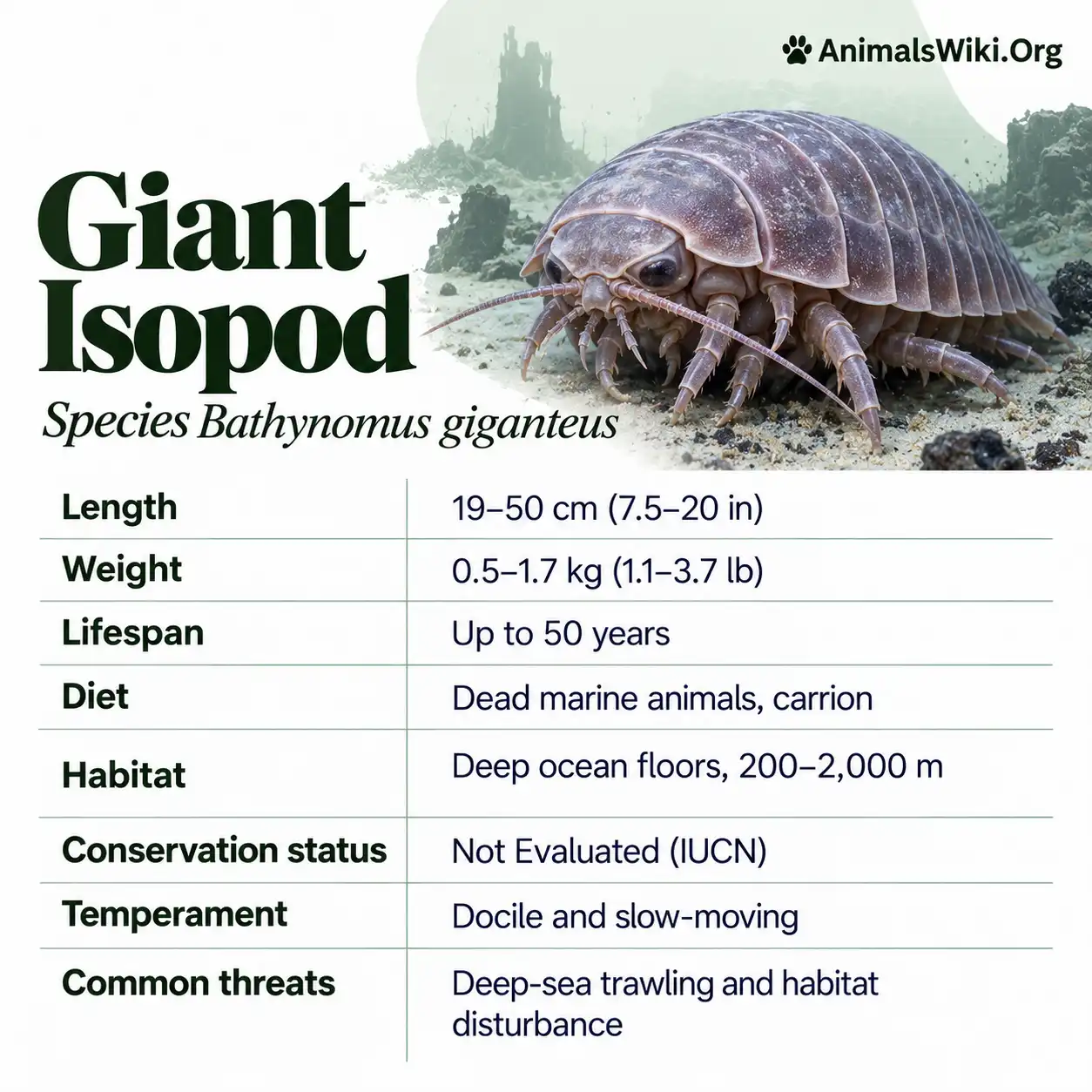
They are among the largest living isopods, with some species reaching lengths of approximately 50 centimeters or more.
Their bodies are protected by overlapping armor-like plates, while seven pairs of walking legs allow them to move across the seafloor.
Their enormous compound eyes, long antennae, and powerful mouthparts help them survive in an environment where food is unpredictable.
Perhaps their most remarkable adaptation is their ability to endure extended periods without eating.
Because meals may be separated by long intervals, giant isopods can conserve energy and survive on limited resources.
They are primarily scavengers and opportunistic predators, consuming dead fish, squid, crustaceans, and other organic material that reaches the ocean floor.
Their unusual size is often discussed in connection with deep-sea gigantism, a phenomenon in which certain deep-water animals grow larger than their shallower-water relatives.
Although giant isopods may appear frightening, they are not aggressive monsters. They are specialized deep-sea animals that play important roles in recycling organic material.
This comprehensive guide explores giant isopod facts, scientific classification, species, anatomy, size, habitat, distribution, diet, deep-sea gigantism, feeding, reproduction, lifespan, predators, adaptations, ecological importance, conservation, and frequently asked questions.
Giant Isopod Facts
| Feature | Information |
|---|---|
| Common name | Giant Isopod |
| Scientific genus | Bathynomus |
| Order | Isopoda |
| Family | Cirolanidae |
| Class | Malacostraca |
| Phylum | Arthropoda |
| Animal type | Deep-sea marine crustacean |
| Habitat | Deep ocean seabeds |
| Distribution | Atlantic, Pacific, and Indian Ocean regions |
| Typical depth | Commonly hundreds to more than 1,000 meters, depending on species |
| Body length | Often approximately 20–40 cm in large species |
| Exceptional size | Some species may reach around 50 cm or more |
| Body covering | Hard segmented exoskeleton |
| Walking legs | Seven pairs |
| Eyes | Large compound eyes |
| Antennae | Two pairs |
| Main diet | Carrion and other animal material |
| Feeding type | Scavenger and opportunistic predator |
| Famous adaptation | Ability to survive long periods between meals |
| Reproduction | Sexual, egg-laying |
| Egg development | Eggs carried in a brood pouch |
| Young | Hatch as mancae |
| Lifespan | Poorly documented |
| Main predators | Large deep-sea fish and other marine predators |
| Conservation | Species-specific; many are poorly assessed |
What Is a Giant Isopod?
A giant isopod is a large marine crustacean belonging to the genus Bathynomus.
It is a member of the order Isopoda, which includes thousands of species living in marine, freshwater, and terrestrial environments.
Giant isopods are closely related to smaller isopods such as woodlice and pill bugs.
However, they have evolved to survive in deep marine habitats.
Is a Giant Isopod an Insect?
No.
Giant isopods are crustaceans, not insects.
Both groups belong to the phylum Arthropoda, but they have different body structures and evolutionary histories.
Is a Giant Isopod Related to a Pill Bug?
Yes.
Giant isopods and pill bugs belong to the order Isopoda.
They share a segmented body plan and several anatomical features.
Is a Giant Isopod a Crab?
No.
Although giant isopods are crustaceans, they are not true crabs.
True crabs belong to the order Decapoda, while giant isopods belong to Isopoda.
Why Are They Called Giant Isopods?
They are much larger than most familiar isopods.
Their size is especially striking compared with terrestrial woodlice.
Scientific Classification of Giant Isopods
| Classification | Name |
|---|---|
| Kingdom | Animalia |
| Phylum | Arthropoda |
| Subphylum | Crustacea |
| Class | Malacostraca |
| Order | Isopoda |
| Suborder | Cymothoida |
| Family | Cirolanidae |
| Genus | Bathynomus |
| Example species | Bathynomus giganteus |
The term giant isopod refers to multiple species in the genus Bathynomus.
Therefore, not every giant isopod belongs to Bathynomus giganteus.
What Does Bathynomus Mean?
The genus name Bathynomus comes from Greek roots associated with depth and the idea of a creature inhabiting deep places.
Are Giant Isopods Arthropods?
Yes.
They possess jointed legs, segmented bodies, and hard exoskeletons.
Are Giant Isopods Invertebrates?
Yes.
They do not have backbones.
Types of Giant Isopods
Several species of Bathynomus have been described.
Scientists continue to study their diversity, and additional species have been recognized in recent years.
1. Giant Isopod
Scientific name: Bathynomus giganteus
This is one of the best-known species.
It occurs in the western Atlantic region, including the Gulf of Mexico and nearby deep waters.
It is famous for its large body and armored appearance.
2. Giant Isopod
Scientific name: Bathynomus doederleini
This species occurs in the northwestern Pacific, including waters near Japan.
It is often smaller than the largest Bathynomus species.
3. Supergiant Isopod
Scientific name: Bathynomus yucatanensis
This species was formally described from the Gulf of Mexico.
It closely resembles some other giant isopods but differs in anatomical and genetic characteristics.
4. Giant Isopod
Scientific name: Bathynomus jamesi
This species occurs in parts of the Indo-Pacific region.
It is among the large-bodied species associated with deep marine environments.
5. Giant Isopod
Scientific name: Bathynomus vaderi
This species was described from the South China Sea.
Its name refers to the resemblance of part of its head to the helmet of Darth Vader from Star Wars.
What Does a Giant Isopod Look Like?
Giant isopods have broad, flattened, segmented bodies.
Their appearance resembles a heavily armored pill bug.
Common anatomical features include:
- Large compound eyes
- Long antennae
- Hard exoskeleton
- Overlapping body plates
- Seven pairs of walking legs
- Powerful mouthparts
- Segmented abdomen
- Swimming and respiratory appendages
- Broad tail region
What Color Are Giant Isopods?
Most giant isopods display pale colors such as:
- Cream
- Gray
- Light purple
- Pinkish lavender
- Brownish tones
Their coloration may appear different under artificial lighting.
Do Giant Isopods Have Shells?
They possess a hard exoskeleton made primarily from chitin and other structural materials.
Do Giant Isopods Have Bones?
No.
Their exoskeleton provides structural support and protection.
How Many Legs Does a Giant Isopod Have?
Giant isopods have seven pairs of walking legs, totaling 14 walking legs.
They also possess additional appendages associated with other functions.
Giant Isopod Size and Weight
Giant isopods are among the largest members of the order Isopoda.
How Big Can a Giant Isopod Get?
Large species commonly reach approximately 20–40 centimeters.
Some exceptional individuals may reach around 50 centimeters or more.
What Is the Largest Giant Isopod?
Several large Bathynomus species can reach impressive sizes.
Claims about the single largest specimen vary, and some measurements are not consistently verified.
How Much Does a Giant Isopod Weigh?
Large individuals can weigh hundreds of grams or more.
Exact weight varies by species, size, and feeding condition.
Why Are Giant Isopods So Big?
Their large size is often associated with deep-sea gigantism.
However, the evolutionary causes are complex and may involve food availability, temperature, metabolism, oxygen conditions, and life-history traits.
What Is Deep-Sea Gigantism?
Deep-sea gigantism describes the tendency of certain deep-water animals to grow larger than closely related shallow-water species.
Giant isopods are a famous example.
Why Does Deep-Sea Gigantism Happen?
Scientists have proposed several explanations, including:
- Cold water temperatures
- Slow metabolism
- Energy storage advantages
- Food scarcity
- Environmental stability
- Evolutionary pressures affecting growth and reproduction
No single explanation applies to every deep-sea species.
Are All Deep-Sea Animals Giant?
No.
Many deep-sea animals are extremely small.
Deep-sea gigantism occurs in certain lineages, not throughout the entire deep ocean.
Where Do Giant Isopods Live?
Giant isopods inhabit deep marine environments in several ocean regions.
They have been recorded in parts of:
- Atlantic Ocean
- Pacific Ocean
- Indian Ocean
- Gulf of Mexico
- South China Sea
- Waters near Japan
- Other deep continental-margin habitats
Do Giant Isopods Live in the Mariana Trench?
Giant isopods inhabit deep waters, but it is inaccurate to assume that all species occur at the bottom of the Mariana Trench.
The deepest ocean trenches support different specialized communities, including other crustaceans.
Do Giant Isopods Live in Freshwater?
No.
Bathynomus species are marine animals.
Do Giant Isopods Live Near Coral Reefs?
Some may occur in deeper waters beyond coastal reef environments.
They are not typical shallow coral reef animals.
Giant Isopod Habitat
Giant isopods commonly inhabit deep-sea seabeds.
These environments may include:
- Continental slopes
- Deep muddy seabeds
- Soft sediments
- Deep marine basins
- Continental-margin habitats
How Deep Do Giant Isopods Live?
Many occur at depths of several hundred meters to more than 1,000 meters.
Depth ranges vary among species.
Is It Dark Where Giant Isopods Live?
Yes.
Most inhabit environments below the reach of significant sunlight.
Is the Water Cold?
Many giant isopods live in cold deep-sea environments.
Water temperature varies with location and depth.
What Do Giant Isopods Eat?
Giant isopods are primarily scavengers and opportunistic predators.
Their diet includes:
- Dead fish
- Squid remains
- Crustaceans
- Marine worms
- Other animal remains
- Occasionally living prey
Do Giant Isopods Eat Dead Whales?
They may feed on large animal remains reaching the seafloor.
However, whale falls support many scavengers, and not every giant isopod population is regularly associated with whale carcasses.
Do Giant Isopods Eat Fish?
Yes.
They consume dead fish and may attack vulnerable living animals.
Do Giant Isopods Eat Squid?
Yes.
Squid remains can provide food.
Are Giant Isopods Carnivores?
They primarily consume animal material.
Are Giant Isopods Scavengers?
Yes.
Scavenging is an important part of their feeding ecology.
How Do Giant Isopods Eat?
Giant isopods use strong mouthparts to tear and process food.
Their feeding appendages are adapted to consuming animal tissue.
When food becomes available, they may consume large meals.
Do Giant Isopods Have Teeth?
They possess specialized mouthparts rather than vertebrate teeth.
Can Giant Isopods Eat Large Meals?
Yes.
Some individuals consume substantial amounts of food when an opportunity arises.
Do Giant Isopods Hunt?
They are primarily scavengers but can also behave as opportunistic predators.
How Long Can Giant Isopods Survive Without Food?
Giant isopods are famous for their ability to survive long periods between meals.
In captivity, individual giant isopods have been reported to refuse food for several years.
One widely reported captive individual in Japan went more than five years without eating.
However, such cases should not be interpreted as the normal feeding interval of every giant isopod.
Why Can Giant Isopods Go So Long Without Eating?
Deep-sea environments often have unpredictable food availability.
Giant isopods can conserve energy through relatively low metabolic demands and reduced activity.
Do Giant Isopods Eat Every Day?
Not necessarily.
Their feeding opportunities can be irregular.
Can Giant Isopods Starve?
Yes.
They still require energy and nutrients to survive.
Giant Isopod Eyes and Vision
Giant isopods possess large compound eyes.
Their eyes contain numerous light-sensitive units called ommatidia.
Can Giant Isopods See in the Dark?
They are adapted to low-light conditions.
However, their exact visual capabilities vary and are not fully understood for every species.
Why Do Giant Isopods Have Large Eyes?
Large compound eyes may help detect limited available light and environmental cues.
Do Giant Isopods Have Antennae?
Yes.
They possess antennae used for sensing their surroundings.
How Do Giant Isopods Breathe?
Giant isopods breathe through specialized respiratory structures associated with their abdominal appendages.
These structures allow gas exchange with surrounding seawater.
Do Giant Isopods Have Gills?
They possess gill-like respiratory surfaces adapted for aquatic life.
Can Giant Isopods Breathe Air?
They are marine animals and are not adapted for prolonged life outside water.
Do Giant Isopods Have Lungs?
No.
How Do Giant Isopods Move?
Giant isopods use their walking legs to move across the seabed.
They can also use abdominal appendages to assist with movement in water.
Can Giant Isopods Swim?
They can move through water using their appendages, although they are primarily bottom-dwelling animals.
Are Giant Isopods Fast?
They generally move relatively slowly compared with active swimming fish.
However, they can become active when feeding opportunities arise.
Can Giant Isopods Roll Into Balls?
Some giant isopods can curl their bodies into a protective posture.
However, they do not necessarily roll into the same perfectly enclosed ball as certain terrestrial pill bugs.
Giant Isopod Reproduction
Giant isopods reproduce sexually.
Females carry developing eggs in a specialized brood pouch called a marsupium.
Do Giant Isopods Lay Eggs?
Yes.
Their eggs are retained in the brood pouch during development.
How Many Eggs Does a Giant Isopod Lay?
Egg production varies by species and female size.
Giant isopods generally produce relatively large eggs compared with many smaller crustaceans.
Do Giant Isopods Have Larvae?
They undergo direct development rather than producing the typical free-swimming larval stages seen in many other marine crustaceans.
What Is a Marsupium?
A marsupium is a brood pouch formed by specialized plates on the underside of the female.
It protects developing eggs and young.
Baby Giant Isopods
Young giant isopods hatch as mancae.
These juveniles resemble miniature adults but initially lack the fully developed final pair of thoracic walking legs.
What Is a Baby Giant Isopod Called?
A manca.
Do Baby Giant Isopods Look Like Adults?
Yes.
They resemble smaller versions of adults, although some appendages are not yet fully developed.
How Do Baby Giant Isopods Grow?
They grow through molting.
Giant Isopod Molting
Like other crustaceans, giant isopods must shed their exoskeletons to grow.
Do Giant Isopods Shed Their Shells?
Yes.
How Do Giant Isopods Molt?
Isopods commonly molt in two stages, shedding different portions of the exoskeleton separately.
Are Giant Isopods Vulnerable During Molting?
Yes.
Their new exoskeleton requires time to harden.
How Long Do Giant Isopods Live?
The maximum lifespan of giant isopods is poorly documented.
They are thought to be relatively long-lived compared with many small crustaceans, but reliable age estimates remain limited.
Can Giant Isopods Live for 20 Years?
Long lifespans have been suggested for some species, but exact maximum ages require further evidence.
Do Giant Isopods Live for 100 Years?
There is no reliable evidence that giant isopods routinely live for 100 years.
Giant Isopod Adaptations
Large Body Size
May provide advantages associated with deep-sea life.
Hard Exoskeleton
Protects against physical damage.
Seven Pairs of Walking Legs
Support movement across the seabed.
Large Compound Eyes
Help detect available light.
Long Antennae
Provide sensory information.
Powerful Mouthparts
Allow consumption of animal remains.
Low-Energy Lifestyle
Helps cope with irregular food availability.
Large Meal Capacity
Allows exploitation of occasional food sources.
Brood Pouch
Protects developing offspring.
Deep-Sea Physiology
Supports survival in cold, dark, high-pressure environments.
What Animals Eat Giant Isopods?
Potential predators include:
- Large deep-sea fish
- Certain sharks
- Other large marine predators
Predation relationships vary by species and habitat.
Do Sharks Eat Giant Isopods?
Some sharks and other large fishes may consume deep-sea crustaceans.
However, direct species-specific evidence varies.
Do Fish Eat Giant Isopods?
Yes.
Large predatory fish can consume isopods.
How Do Giant Isopods Defend Themselves?
Their hard exoskeleton provides protection.
They may also curl their bodies and use their appendages defensively.
Giant Isopod vs. Pill Bug
| Feature | Giant Isopod | Pill Bug |
|---|---|---|
| Order | Isopoda | Isopoda |
| Habitat | Deep ocean | Land |
| Size | Large | Small |
| Breathing | Aquatic respiratory structures | Adapted for terrestrial respiration |
| Diet | Mainly animal material | Mostly decaying plant matter |
| Body | Armored and segmented | Armored and segmented |
| Relationship | Marine isopod | Terrestrial isopod |
Giant Isopod vs. Horseshoe Crab
| Feature | Giant Isopod | Horseshoe Crab |
|---|---|---|
| Order | Isopoda | Xiphosurida |
| Main group | Crustacean | Chelicerate |
| Habitat | Deep ocean | Coastal waters |
| Body | Segmented armored body | Broad horseshoe-shaped carapace |
| Legs | Seven pairs of walking legs | Five pairs of walking legs |
| Tail | Broad rear body structures | Long telson |
| Diet | Scavenging and predation | Benthic feeding |
Giant Isopod vs. Giant Amphipod
Giant isopods and giant amphipods are both marine crustaceans.
However, they belong to different orders.
Isopods generally have dorsoventrally flattened bodies.
Amphipods are often laterally compressed.
Both groups include species adapted to deep-sea environments.
Are Giant Isopods Dangerous to Humans?
Giant isopods are not generally dangerous to humans.
They live in deep marine environments and do not normally encounter swimmers.
However, they possess strong mouthparts and should not be handled carelessly.
Can Giant Isopods Bite?
They possess mouthparts capable of processing animal tissue.
Handling could potentially result in injury.
Are Giant Isopods Venomous?
They are not generally recognized as venomous animals.
Are Giant Isopods Poisonous?
They are not generally considered poisonous to touch.
However, that does not mean every specimen is safe to eat.
Can You Touch a Giant Isopod?
Unnecessary handling should be avoided, particularly because deep-sea animals can be sensitive to environmental changes.
Are Giant Isopods Endangered?
Conservation status varies by species.
Many Bathynomus species have not been comprehensively assessed.
Their deep-sea habitats can make population monitoring difficult.
What Threatens Giant Isopods?
Potential threats include:
- Deep-sea bottom trawling
- Habitat disturbance
- Marine pollution
- Climate change
- Ocean deoxygenation
- Changes in organic food supply
- Deep-sea resource extraction
How Does Bottom Trawling Affect Giant Isopods?
Bottom trawling can disturb deep-sea habitats and capture non-target organisms.
How Does Climate Change Affect Giant Isopods?
Changes in ocean temperature, oxygen availability, and food supply may influence deep-sea ecosystems.
Why Are Giant Isopods Important?
Giant isopods contribute to deep-sea ecosystems by consuming animal remains and recycling organic material.
They help transfer nutrients through deep marine food webs.
Their unusual physiology also provides opportunities for scientific research.
Do Giant Isopods Clean the Ocean Floor?
They consume carrion and other organic material.
However, the ocean floor is maintained by complex communities of scavengers, decomposers, and microorganisms.
Why Do Scientists Study Giant Isopods?
They provide insights into deep-sea adaptation, feeding ecology, growth, and crustacean evolution.
50 Interesting Giant Isopod Facts
- Giant isopods are marine crustaceans.
- They belong to the genus Bathynomus.
- They are members of the order Isopoda.
- They are related to pill bugs.
- They are related to woodlice.
- They are not insects.
- They are not true crabs.
- They inhabit deep ocean environments.
- They occur in multiple ocean regions.
- Some live more than 1,000 meters deep.
- They possess hard exoskeletons.
- Their bodies are segmented.
- They have seven pairs of walking legs.
- They possess long antennae.
- They have large compound eyes.
- They are adapted to low-light conditions.
- Their bodies are often pale or lavender-colored.
- Some species exceed 40 centimeters.
- Exceptional individuals may reach around 50 centimeters or more.
- Their size is associated with deep-sea gigantism.
- Not all deep-sea animals are giants.
- Giant isopods are primarily scavengers.
- They consume dead fish.
- They may feed on squid remains.
- They can consume other animal material.
- They may act as opportunistic predators.
- They possess powerful mouthparts.
- They can consume large meals.
- Food can be scarce in their habitats.
- They can survive long periods between meals.
- Some captive individuals have gone years without feeding.
- They conserve energy through low activity and metabolism.
- They breathe through specialized aquatic respiratory surfaces.
- They are not adapted for prolonged life on land.
- They can move across the seabed.
- They can also move through water using appendages.
- They reproduce sexually.
- Females carry eggs in a marsupium.
- Their eggs are relatively large.
- Young hatch as mancae.
- Juveniles resemble small adults.
- They grow through molting.
- Isopods often molt in two stages.
- Their exact maximum lifespan is poorly documented.
- Large fish may prey on them.
- Their exoskeleton provides protection.
- They contribute to nutrient recycling.
- Deep-sea habitat disturbance may threaten some populations.
- Scientists continue to discover and describe Bathynomus species.
- Their enormous size, armored bodies, and deep-sea adaptations make them among the ocean’s most fascinating crustaceans.
Did You Know?
The Giant Ocean Scavenger That Can Wait Years for a Meal
Imagine descending hundreds of meters beneath the ocean’s surface.
Sunlight gradually disappears.
The water becomes colder.
The surrounding world grows darker.
Eventually, the seafloor appears.
It is a quiet landscape of soft sediment, scattered rocks, and slow-moving animals.
Food is not always abundant here.
Most of the energy supporting these communities ultimately comes from organic material sinking from the waters above.
Sometimes the remains of a fish or squid reach the seabed.
Sometimes a much larger carcass descends into the darkness.
For deep-sea scavengers, these events can provide valuable feeding opportunities.
Among the animals moving across the seafloor is a giant isopod.
Its body resembles an enormous armored pill bug.
Its overlapping plates protect its back.
Fourteen walking legs carry it across the sediment.
Its antennae investigate the surroundings.
The isopod detects a potential food source.
It approaches and begins feeding.
Using its strong mouthparts, it consumes animal tissue.
The meal may provide enough energy to support the animal for a considerable period.
In the deep ocean, another feeding opportunity may not arrive quickly.
Giant isopods are adapted to this uncertainty.
They can reduce activity and survive long intervals between meals.
Some captive individuals have even been documented refusing food for years.
But these animals are not merely unusual survivors.
They also perform an important ecological function.
By consuming carrion, they help recycle organic material and transfer energy through deep-sea food webs.
Their existence demonstrates how animals can evolve remarkable solutions to the challenges of darkness, cold water, high pressure, and unpredictable food availability.
The giant isopod is not a deep-sea monster. It is a highly specialized scavenger whose survival depends on patience, energy conservation, and extraordinary adaptation.
Frequently Asked Questions About Giant Isopods
What is a giant isopod?
A giant isopod is a large marine crustacean belonging to the genus Bathynomus.
What is the scientific name of the giant isopod?
Giant isopods belong to Bathynomus. One well-known species is Bathynomus giganteus.
Are giant isopods insects?
No.
Are giant isopods crustaceans?
Yes.
Are giant isopods arthropods?
Yes.
Are giant isopods invertebrates?
Yes.
Are giant isopods related to pill bugs?
Yes.
Are giant isopods related to woodlice?
Yes.
Are giant isopods crabs?
No.
Why are giant isopods so big?
Their size is associated with deep-sea gigantism, although its causes are complex.
What is deep-sea gigantism?
A phenomenon in which certain deep-water animals grow larger than related shallow-water species.
Are all deep-sea animals giant?
No.
How big do giant isopods get?
Large species commonly reach approximately 20–40 centimeters, with some exceptional individuals growing larger.
What is the largest giant isopod?
Several Bathynomus species reach large sizes, and exact record claims vary.
How much do giant isopods weigh?
Large individuals can weigh hundreds of grams or more.
What color are giant isopods?
Often cream, gray, pale purple, or lavender.
Where do giant isopods live?
On deep marine seabeds in several ocean regions.
Do giant isopods live in the Atlantic Ocean?
Yes.
Do giant isopods live in the Pacific Ocean?
Yes.
Do giant isopods live in the Indian Ocean?
Yes.
Do giant isopods live in the Mariana Trench?
Not all giant isopods inhabit ocean trenches, and their presence at the deepest parts of the Mariana Trench should not be assumed.
Do giant isopods live in freshwater?
No.
How deep do giant isopods live?
Many occur at depths of several hundred meters to more than 1,000 meters.
Is it dark where giant isopods live?
Yes.
Is the water cold?
Many inhabit cold deep-sea environments.
How many legs does a giant isopod have?
Fourteen walking legs.
Do giant isopods have shells?
They possess hard exoskeletons.
Do giant isopods have bones?
No.
Do giant isopods have eyes?
Yes.
Can giant isopods see in the dark?
They are adapted to low-light environments.
Do giant isopods have antennae?
Yes.
What do giant isopods eat?
Carrion, fish remains, squid remains, and other animal material.
Are giant isopods carnivores?
They primarily consume animal material.
Are giant isopods scavengers?
Yes.
Do giant isopods eat dead whales?
They may consume large animal remains reaching the seabed.
Do giant isopods eat fish?
Yes.
Do giant isopods eat squid?
Yes.
Do giant isopods hunt?
They may behave as opportunistic predators.
Do giant isopods have teeth?
They possess specialized mouthparts rather than vertebrate teeth.
How do giant isopods eat?
Using strong mouthparts adapted to processing animal tissue.
Can giant isopods eat large meals?
Yes.
How long can giant isopods survive without food?
Some captive individuals have survived several years without feeding.
Why can giant isopods survive so long without food?
Their physiology and low-energy lifestyle help them cope with unpredictable food availability.
Do giant isopods eat every day?
Not necessarily.
Can giant isopods starve?
Yes.
How do giant isopods breathe?
Through specialized aquatic respiratory structures associated with abdominal appendages.
Do giant isopods have gills?
They possess gill-like respiratory surfaces.
Can giant isopods breathe air?
They are not adapted for prolonged survival outside water.
Can giant isopods swim?
They can move through water using their appendages.
Are giant isopods fast?
They are generally slow-moving bottom dwellers.
Can giant isopods roll into balls?
Some can curl into protective postures.
Do giant isopods lay eggs?
Yes.
How do giant isopods reproduce?
Sexually.
Do giant isopods carry eggs?
Females carry eggs in a brood pouch.
What is a marsupium?
A specialized pouch that protects developing eggs and young.
What is a baby giant isopod called?
A manca.
Do baby giant isopods look like adults?
Yes, although they are smaller and initially lack some fully developed appendages.
Do giant isopods have larvae?
They undergo direct development rather than typical free-swimming larval stages.
Do giant isopods molt?
Yes.
How do giant isopods molt?
Isopods commonly shed their exoskeleton in separate stages.
How long do giant isopods live?
Their maximum lifespan is poorly documented.
Can giant isopods live for 100 years?
There is no reliable evidence for routine 100-year lifespans.
What animals eat giant isopods?
Large deep-sea fish and other marine predators.
Do sharks eat giant isopods?
Some large fishes may consume deep-sea crustaceans, but species-specific evidence varies.
Are giant isopods dangerous to humans?
They are not generally dangerous.
Can giant isopods bite?
Their mouthparts can process animal tissue, so careless handling should be avoided.
Are giant isopods venomous?
They are not generally considered venomous.
Are giant isopods poisonous?
They are not generally considered poisonous to touch.
Can you touch a giant isopod?
Unnecessary handling is discouraged.
Are giant isopods endangered?
Conservation status varies, and many species remain poorly assessed.
What threatens giant isopods?
Deep-sea habitat disturbance, pollution, and environmental changes.
Why are giant isopods important?
They consume carrion and help recycle organic material in deep-sea ecosystems.
What is the most interesting giant isopod fact?
Some captive giant isopods have survived for years without eating, demonstrating their extraordinary ability to cope with irregular food availability.
Conclusion
The giant isopod is one of the most remarkable animals inhabiting the deep ocean.
Its armored body, fourteen walking legs, large compound eyes, and impressive size make it instantly recognizable.
But its appearance is only part of the story.
Giant isopods have evolved to survive in cold, dark marine environments where food can be unpredictable.
Their ability to consume large meals and endure long periods between feeding opportunities makes them highly specialized scavengers.
They also play important ecological roles by consuming animal remains and contributing to nutrient recycling.
Although many aspects of their biology remain poorly understood, scientific research continues to reveal new information about their diversity, physiology, and deep-sea adaptations.
As human activities expand into deeper ocean environments, understanding and protecting these animals becomes increasingly important.
The giant isopod is not simply an oversized pill bug—it is an extraordinary deep-sea survivor that demonstrates how life adapts to some of the most challenging environments on Earth.
SEO Information
Primary keyword: Giant Isopod
Secondary keywords: Giant Isopod facts, Giant Isopod scientific name, Bathynomus, Bathynomus giganteus, Giant Isopod species, types of Giant Isopods, Giant Isopod anatomy, Giant Isopod size, largest Giant Isopod, Giant Isopod weight, Giant Isopod habitat, where do Giant Isopods live, Giant Isopod depth, Giant Isopod diet, what do Giant Isopods eat, Giant Isopod feeding, Giant Isopod deep-sea gigantism, Giant Isopod eyes, Giant Isopod legs, Giant Isopod reproduction, Giant Isopod eggs, baby Giant Isopod, Giant Isopod manca, Giant Isopod lifespan, Giant Isopod predators, Giant Isopod adaptations, Giant Isopod vs Pill Bug, Giant Isopod vs Horseshoe Crab, Giant Isopod vs Giant Amphipod, are Giant Isopods dangerous, Giant Isopod conservation.
SEO meta title: Giant Isopod Facts: Size, Habitat, Diet & Deep-Sea Life
Meta description: Discover fascinating Giant Isopod facts, including their enormous size, deep-sea habitat, scavenging diet, survival without food, reproduction, and adaptations.
Suggested URL slug: giant-isopod-facts
Suggested image alt text: Giant isopod with a pale armored segmented body, large compound eyes, and fourteen walking legs moving across a dark deep-sea seabed.
Suggested article category: Marine Animals / Crustaceans
Suggested tags: Giant Isopod, Bathynomus, Deep-Sea Animals, Marine Crustaceans, Deep-Sea Gigantism, Ocean Scavengers, Marine Biology
Editorial note: Giant isopods comprise multiple Bathynomus species with different maximum sizes, geographic ranges, and depth distributions. Avoid applying exceptional fasting records, unverified lifespan estimates, or maximum body measurements to every species. Scientific understanding of Bathynomus taxonomy continues to develop.