Dumbo Octopus, The Adorable Deep-Sea Octopus With Ear-Like Fins
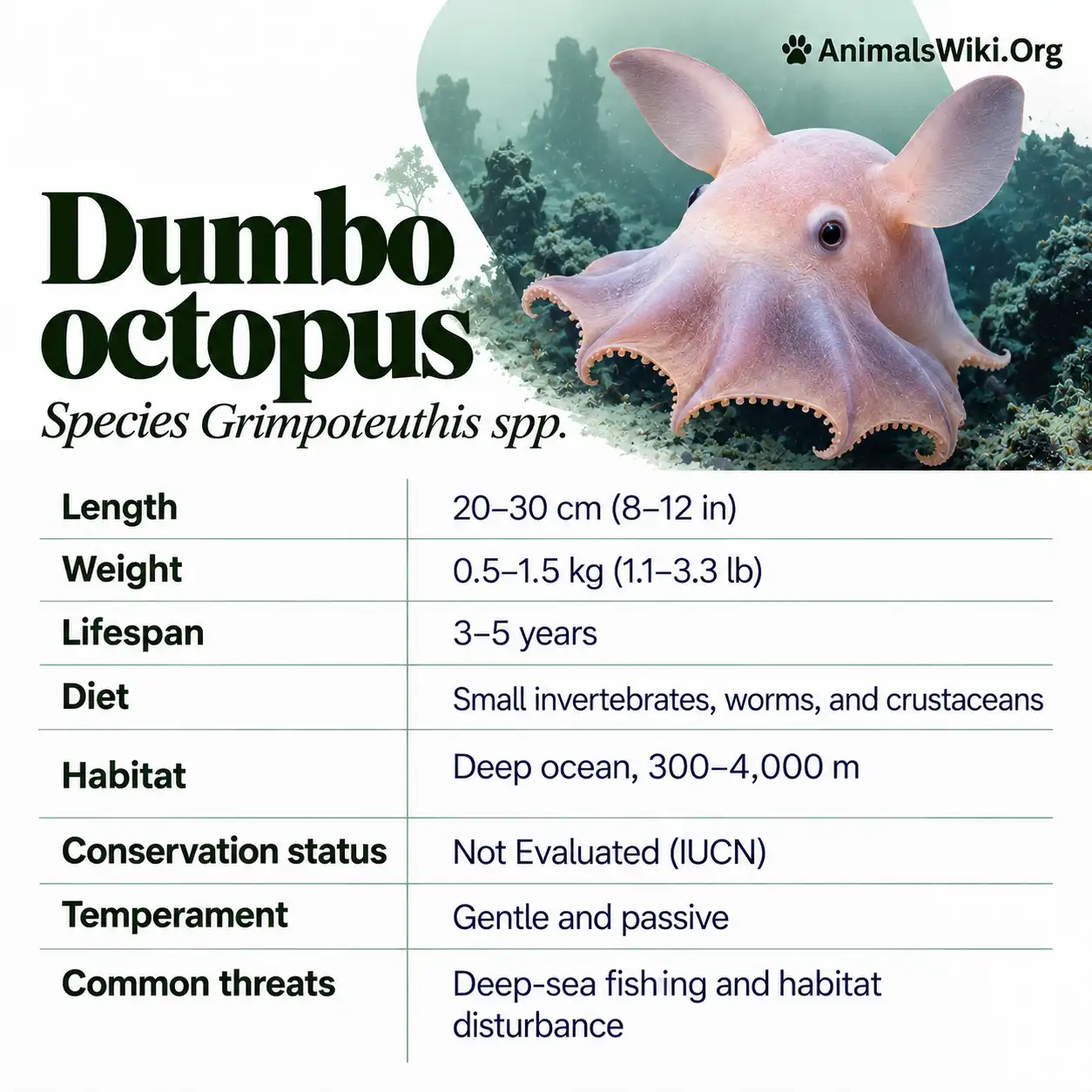
The Dumbo octopus is one of the most fascinating and unusual creatures living in the deep ocean. Famous for its rounded body, large eyes, and two ear-like fins, this remarkable animal appears to glide through the water like a tiny underwater elephant.
Its charming appearance has made it one of the most recognizable deep-sea animals in the world.
But behind that gentle appearance lies an extraordinary story of evolution, survival, and adaptation to one of Earth’s most challenging environments.
Dumbo octopuses belong to the genus Grimpoteuthis, a group of deep-sea octopuses found in oceans around the world.
They are named after Dumbo, the fictional Disney elephant whose oversized ears allow him to fly. The comparison comes from the octopus’s pair of fins, which resemble small ears extending from either side of its body.
Unlike many familiar shallow-water octopuses, Dumbo octopuses inhabit deep marine environments where sunlight is absent, temperatures are low, and water pressure is extremely high.
They move gracefully by flapping their fins, using their arms and webbing to steer through the water.
Their soft, gelatinous bodies help them function in deep-sea conditions.
Dumbo octopuses also have unusual reproductive adaptations. Research indicates that females of some species may carry eggs at different developmental stages, allowing reproduction without a narrowly defined seasonal breeding period.
Although they look delicate, Dumbo octopuses are specialized predators that feed on small marine invertebrates living on or near the deep ocean floor.
Their prey may include crustaceans, worms, and other small animals.
Because they inhabit remote deep-sea environments, many aspects of their biology remain poorly understood.
This comprehensive guide explores Dumbo octopus facts, scientific classification, species, anatomy, size, habitat, distribution, diet, swimming, reproduction, eggs, babies, lifespan, predators, adaptations, conservation, and frequently asked questions.
Dumbo Octopus Facts
| Feature | Information |
|---|---|
| Common name | Dumbo Octopus |
| Scientific genus | Grimpoteuthis |
| Animal group | Deep-sea octopus |
| Family | Grimpoteuthidae |
| Order | Octopoda |
| Phylum | Mollusca |
| Class | Cephalopoda |
| Habitat | Deep ocean waters |
| Distribution | Multiple ocean regions worldwide |
| Typical depth | Often hundreds to several thousand meters |
| Deepest records | Some cirrate octopuses occur beyond 6,000 meters |
| Body size | Varies considerably by species |
| Notable feature | Pair of ear-like fins |
| Arms | Eight |
| Arm webbing | Present |
| Body texture | Soft and often gelatinous |
| Diet | Small marine invertebrates |
| Feeding type | Carnivorous |
| Movement | Fin propulsion, arm movement, and webbing |
| Reproduction | Sexual, egg-laying |
| Eggs | Relatively large |
| Young | Develop directly without a typical planktonic larval stage |
| Lifespan | Poorly documented |
| Main predators | Deep-sea fish and other marine predators |
| Conservation | Species-specific; many remain unassessed |
What Is a Dumbo Octopus?
A Dumbo octopus is a deep-sea cephalopod belonging to the genus Grimpoteuthis.
It is a type of cirrate octopus.
Cirrate octopuses possess fins and small sensory structures called cirri along their arms.
These features distinguish them from the more familiar incirrate octopuses commonly seen in shallow coastal waters.
Is a Dumbo Octopus a Real Octopus?
Yes.
Dumbo octopuses are genuine octopuses belonging to the order Octopoda.
Why Is It Called a Dumbo Octopus?
The name comes from the resemblance between its fins and the oversized ears of Disney’s Dumbo.
Is a Dumbo Octopus a Fish?
No.
It is a mollusk belonging to the class Cephalopoda.
Is a Dumbo Octopus an Invertebrate?
Yes.
It does not possess a backbone.
Scientific Classification of the Dumbo Octopus
| Classification | Name |
|---|---|
| Kingdom | Animalia |
| Phylum | Mollusca |
| Class | Cephalopoda |
| Subclass | Coleoidea |
| Order | Octopoda |
| Suborder | Cirrina |
| Family | Grimpoteuthidae |
| Genus | Grimpoteuthis |
| Example species | Grimpoteuthis umbellata |
The term Dumbo octopus is commonly applied to species in the genus Grimpoteuthis.
It may also be used informally for other finned deep-sea octopuses with similar appearances.
What Does Grimpoteuthis Mean?
Grimpoteuthis is the scientific genus containing the octopuses most commonly known as Dumbo octopuses.
Are Dumbo Octopuses Related to Common Octopuses?
Yes.
Both belong to the order Octopoda.
However, they occupy different evolutionary branches and possess different anatomical adaptations.
Are Dumbo Octopuses Related to Squid?
Yes.
Octopuses and squid both belong to the class Cephalopoda.
Types of Dumbo Octopuses
Several species of Grimpoteuthis have been described.
Their taxonomy continues to be studied because deep-sea specimens are difficult to collect and examine.
1. Grimpoteuthis umbellata
This is one of the historically recognized species associated with the Dumbo octopus name.
It is known from deep Atlantic waters.
2. Grimpoteuthis bathynectes
This species has been recorded in the northeastern Pacific.
It inhabits deep marine environments.
3. Grimpoteuthis discoveryi
This species is associated with deep Atlantic environments.
Like other members of the genus, it possesses fins and webbed arms.
4. Grimpoteuthis wuelkeri
This species is known from deep Atlantic waters.
Its appearance and anatomy help distinguish it from related species.
5. Other Grimpoteuthis Species
Additional species have been described from different ocean regions.
Because their taxonomy is complex, species identification often requires careful anatomical examination.
What Does a Dumbo Octopus Look Like?
Dumbo octopuses have soft, rounded bodies and a pair of prominent fins.
Their appearance includes:
- Rounded mantle
- Two ear-like fins
- Eight arms
- Webbing between the arms
- Large eyes
- Soft gelatinous tissues
- Small cirri along the arms
- Suckers arranged along the arms
Are the Dumbo Octopus’s Ears Real Ears?
No.
The ear-like structures are fins used for swimming.
Does a Dumbo Octopus Have Eight Arms?
Yes.
Like other octopuses, it possesses eight arms.
Does a Dumbo Octopus Have Tentacles?
In everyday language, people sometimes call octopus arms tentacles.
Scientifically, octopuses have eight arms rather than the specialized feeding tentacles found in squid and cuttlefish.
Does a Dumbo Octopus Have Bones?
No.
It is an invertebrate with a soft body.
Dumbo Octopus Colors
Dumbo octopuses may appear in various colors.
These include:
- White
- Cream
- Pink
- Orange
- Red
- Brown
- Pale purple
Color varies among species and individuals.
The appearance of deep-sea animals can also change under artificial lighting.
Can Dumbo Octopuses Change Color?
Some cephalopods possess specialized pigment cells that allow rapid color changes.
However, Dumbo octopuses are not generally known for the dramatic rapid camouflage displays seen in many shallow-water octopuses.
Their coloration and capacity for change vary among species.
Dumbo Octopus Size and Weight
Dumbo octopuses vary considerably in size.
Many observed individuals are relatively small.
However, some species can grow substantially larger.
How Big Is a Dumbo Octopus?
Many individuals are only several centimeters to a few tens of centimeters long.
Body measurements vary depending on whether researchers measure the mantle or total arm span.
What Is the Largest Dumbo Octopus?
Large cirrate octopuses have been recorded with substantial arm spans.
However, some widely repeated maximum-size claims combine records from different finned octopus groups.
The largest verified size should be checked for the specific species being discussed.
How Much Does a Dumbo Octopus Weigh?
Weight varies by species and individual size.
Reliable measurements are limited because these animals are rarely collected.
Where Do Dumbo Octopuses Live?
Dumbo octopuses inhabit deep marine environments in multiple ocean regions.
They have been recorded in parts of:
- Atlantic Ocean
- Pacific Ocean
- Indian Ocean
- Southern Ocean
Do Dumbo Octopuses Live in the Pacific Ocean?
Yes.
Do Dumbo Octopuses Live in the Atlantic Ocean?
Yes.
Do Dumbo Octopuses Live in the Indian Ocean?
Members of the broader group occur in Indian Ocean regions.
Do Dumbo Octopuses Live in Freshwater?
No.
They are marine animals.
Dumbo Octopus Habitat
Dumbo octopuses inhabit deep-sea environments, often near the ocean floor.
Their habitats may include:
- Continental slopes
- Deep ocean basins
- Soft sediment seabeds
- Rocky deep-sea environments
- Areas near underwater ridges
- Abyssal habitats
How Deep Do Dumbo Octopuses Live?
Many inhabit depths ranging from several hundred meters to several thousand meters.
Exact depth ranges differ among species.
Can Dumbo Octopuses Live at 6,000 Meters?
Some cirrate octopuses have been observed at depths exceeding 6,000 meters.
However, the deepest records should not automatically be attributed to every species of Grimpoteuthis.
Do Dumbo Octopuses Live in the Mariana Trench?
Deep-sea finned octopuses have been observed in very deep ocean environments, but claims about a particular Grimpoteuthis species inhabiting the deepest Mariana Trench should be supported by species-specific records.
Is It Dark Where Dumbo Octopuses Live?
Yes.
Most live below the depth where sunlight can penetrate.
How Do Dumbo Octopuses Survive Deep-Sea Pressure?
Dumbo octopuses possess soft bodies adapted to deep-water conditions.
Their tissues and physiology allow them to function under high hydrostatic pressure.
Why Are Dumbo Octopuses Gelatinous?
Soft, water-rich tissues are characteristic of many deep-sea animals.
Such structures may support buoyancy and movement while reducing the need for heavy protective structures.
Can Dumbo Octopuses Survive at the Surface?
They are specialized for deep-sea environments.
Rapid changes in pressure and temperature can be harmful.
Are Dumbo Octopuses Cold-Water Animals?
Many inhabit cold deep-sea waters.
Temperature varies by region and depth.
What Do Dumbo Octopuses Eat?
Dumbo octopuses are carnivorous.
They feed on small marine animals.
Their diet may include:
- Small crustaceans
- Marine worms
- Amphipods
- Copepods
- Other benthic invertebrates
Do Dumbo Octopuses Eat Fish?
They are not generally specialized hunters of large fish.
Their diet primarily consists of small invertebrates.
Do Dumbo Octopuses Eat Shrimp?
They may consume small crustaceans, including shrimp-like animals.
Do Dumbo Octopuses Eat Worms?
Yes.
Marine worms can be part of their diet.
Are Dumbo Octopuses Predators?
Yes.
They actively capture small prey.
How Do Dumbo Octopuses Hunt?
Dumbo octopuses search for prey near the seabed.
They use their arms, suckers, and sensory structures to locate and capture food.
Do Dumbo Octopuses Have Suckers?
Yes.
They possess suckers along their arms.
What Are Cirri?
Cirri are small finger-like structures located along the arms of cirrate octopuses.
They are associated with sensory and feeding functions.
Do Dumbo Octopuses Chew Their Food?
They possess a beak and specialized feeding structures.
Their feeding process differs from human chewing.
Do Dumbo Octopuses Swallow Prey Whole?
They can consume small prey items, and feeding mechanics vary with prey type.
Some popular descriptions emphasize whole-prey swallowing, but this should not be generalized to every feeding event.
How Do Dumbo Octopuses Swim?
Dumbo octopuses move by flapping their ear-like fins.
They also use their arms and webbing to steer and control movement.
Can Dumbo Octopuses Fly Underwater?
They do not literally fly.
Their fin movements resemble flapping wings, giving the appearance of underwater flight.
Are Dumbo Octopuses Fast Swimmers?
They are generally associated with controlled, relatively gentle swimming rather than the rapid bursts characteristic of some shallow-water cephalopods.
Can Dumbo Octopuses Swim Backward?
They can adjust their movement using fins, arms, and water flow.
Why Do Dumbo Octopuses Have Webbed Arms?
The webbing helps control movement and may assist with feeding.
Dumbo Octopus Eyes and Vision
Dumbo octopuses possess eyes adapted to deep-sea environments.
Their visual abilities differ from those of shallow-water octopuses.
Can Dumbo Octopuses See in the Dark?
They are adapted to low-light environments.
However, their exact visual capabilities vary and remain incompletely understood.
Do Dumbo Octopuses Have Large Eyes?
Many have prominent eyes relative to their body size.
Are Dumbo Octopuses Blind?
No.
They possess eyes, although vision in deep-sea conditions differs from vision near the surface.
Dumbo Octopus Intelligence and Behavior
Octopuses are widely recognized for their complex nervous systems and behavior.
However, Dumbo octopuses are much less studied than familiar shallow-water species.
Are Dumbo Octopuses Intelligent?
They possess cephalopod nervous systems and specialized sensory abilities.
However, there is limited direct evidence about their problem-solving abilities compared with well-studied shallow-water octopuses.
Are Dumbo Octopuses Solitary?
They are generally observed individually.
Are Dumbo Octopuses Aggressive?
They are not known as aggressive animals toward humans.
Dumbo Octopus Reproduction
Dumbo octopuses reproduce sexually.
Their reproductive biology is unusual compared with many shallow-water octopuses.
Do Dumbo Octopuses Lay Eggs?
Yes.
Females produce relatively large eggs.
How Do Dumbo Octopuses Mate?
Males transfer sperm to females using specialized reproductive structures.
The details vary among cirrate octopus species.
Do Dumbo Octopuses Have a Breeding Season?
Research suggests that some Dumbo octopuses may reproduce throughout the year rather than during a narrowly defined breeding season.
Can Female Dumbo Octopuses Store Sperm?
Sperm storage has been documented in some deep-sea octopuses and may help females reproduce when mates are difficult to encounter.
Do Dumbo Octopuses Guard Their Eggs?
Egg-laying and parental behavior differ among species.
Some cirrate octopuses deposit large eggs on the seafloor or attach them to suitable structures.
The exact degree of parental care is not fully known for many Dumbo octopus species.
Baby Dumbo Octopuses
Dumbo octopuses produce relatively large eggs.
Their young develop directly rather than passing through the typical planktonic paralarval stage found in many shallow-water octopuses.
What Is a Baby Dumbo Octopus Called?
A hatchling or juvenile.
Do Baby Dumbo Octopuses Look Like Adults?
They possess many recognizable features of the adult body plan.
Can Baby Dumbo Octopuses Swim?
Yes.
Hatchlings of studied cirrate species are capable of swimming.
Do Baby Dumbo Octopuses Have Fins?
Yes.
Their characteristic fins develop during embryonic growth.
How Long Do Dumbo Octopuses Live?
The lifespan of Dumbo octopuses is poorly documented.
Their remote habitat makes long-term observation difficult.
Can Dumbo Octopuses Live for Several Years?
It is possible that some species live for multiple years, but precise lifespan estimates remain uncertain.
Do Dumbo Octopuses Live Longer Than Common Octopuses?
There is insufficient species-specific evidence to make a universal comparison.
Dumbo Octopus Adaptations
Ear-Like Fins
Provide efficient movement through deep water.
Webbed Arms
Help control swimming and feeding movements.
Soft Gelatinous Body
Supports deep-sea life.
Large Eyes
Provide visual information in low-light environments.
Sensory Cirri
Assist with feeding and environmental detection.
Deep-Sea Physiology
Allows survival under high pressure.
Large Eggs
Support advanced embryonic development.
Direct Development
Produces relatively well-developed hatchlings.
Flexible Reproductive Timing
May help reproduction in environments where mates are difficult to encounter.
Low-Energy Swimming
May support efficient movement in food-limited environments.
What Animals Eat Dumbo Octopuses?
Potential predators include:
- Large deep-sea fish
- Sharks
- Other marine predators
Predator-prey relationships are poorly documented for many species.
Do Sharks Eat Dumbo Octopuses?
Some deep-sea sharks consume cephalopods.
However, direct evidence involving particular Dumbo octopus species is limited.
Do Fish Eat Dumbo Octopuses?
Large predatory fish may consume them.
How Do Dumbo Octopuses Defend Themselves?
Their primary defenses may include avoidance, swimming, and remaining difficult to detect in deep water.
Dumbo Octopus vs. Common Octopus
| Feature | Dumbo Octopus | Common Octopus |
|---|---|---|
| Example group | Grimpoteuthis | Octopus vulgaris |
| Habitat | Deep ocean | Mostly coastal waters |
| Ear-like fins | Yes | No |
| Arm webbing | Usually prominent | Less extensive |
| Cirri | Present | Absent |
| Body | Soft, often gelatinous | Muscular |
| Swimming | Fin-based and arm-assisted | Jet propulsion and arm movement |
| Reproduction | Large eggs, direct development | Species-specific reproductive cycle |
Dumbo Octopus vs. Blanket Octopus
Dumbo octopuses and blanket octopuses are both octopuses.
However, they differ significantly in habitat and appearance.
Dumbo octopuses are deep-sea cirrate octopuses with ear-like fins.
Blanket octopuses belong to the genus Tremoctopus and are known for extensive webbing between certain arms.
Dumbo Octopus vs. Vampire Squid
| Feature | Dumbo Octopus | Vampire Squid |
|---|---|---|
| Group | Octopus | Vampyromorph cephalopod |
| Scientific example | Grimpoteuthis | Vampyroteuthis infernalis |
| Habitat | Deep ocean | Deep oxygen-poor waters |
| Fins | Ear-like fins | Pair of fins |
| Arms | Eight | Eight arms plus retractile filaments |
| Diet | Small animals | Primarily marine snow and organic particles |
| Feeding strategy | Predatory | Detritus feeding |
Are Dumbo Octopuses Dangerous to Humans?
Dumbo octopuses are not considered dangerous to humans.
They live at depths far beyond ordinary swimming and recreational diving.
Can Dumbo Octopuses Bite?
Like other octopuses, they possess beaks.
However, human encounters are extremely rare.
Are Dumbo Octopuses Venomous?
Many octopuses possess venom-associated salivary systems, but the venom biology of Dumbo octopuses is poorly studied.
They should not be described as medically dangerous without evidence.
Are Dumbo Octopuses Poisonous?
They are not generally known as poisonous animals.
Can You Touch a Dumbo Octopus?
Handling should be avoided.
Deep-sea animals are sensitive to disturbance and environmental changes.
Are Dumbo Octopuses Endangered?
Conservation status varies by species.
Many Dumbo octopuses have not received comprehensive population assessments.
Their deep-sea habitats make population monitoring difficult.
What Threatens Dumbo Octopuses?
Potential threats include:
- Deep-sea bottom trawling
- Habitat disturbance
- Marine pollution
- Climate change
- Ocean deoxygenation
- Deep-sea resource extraction
How Does Bottom Trawling Affect Dumbo Octopuses?
Bottom trawling can disturb seafloor habitats and capture non-target deep-sea animals.
How Does Climate Change Affect Dumbo Octopuses?
Changes in temperature, oxygen availability, and deep-sea food supply may affect their environments.
Why Are Dumbo Octopuses Important?
Dumbo octopuses contribute to deep-sea food webs as predators of small invertebrates.
They also provide valuable information about cephalopod evolution and adaptation.
Why Do Scientists Study Dumbo Octopuses?
They help researchers understand:
- Deep-sea adaptation
- Cephalopod evolution
- Finned swimming
- Reproductive strategies
- Deep-ocean biodiversity
50 Interesting Dumbo Octopus Facts
- Dumbo octopuses belong to the genus Grimpoteuthis.
- They are genuine octopuses.
- They belong to the class Cephalopoda.
- They are mollusks.
- They are invertebrates.
- They inhabit deep ocean environments.
- They occur in multiple ocean regions.
- They possess eight arms.
- They have two ear-like fins.
- Their fins are not ears.
- Their name was inspired by Disney’s Dumbo.
- They are cirrate octopuses.
- They possess cirri along their arms.
- They have webbing between their arms.
- They possess soft bodies.
- Many have gelatinous tissues.
- They swim by flapping their fins.
- Their swimming resembles underwater flight.
- They use their arms to help steer.
- They live in environments with little or no sunlight.
- Many inhabit cold deep-sea waters.
- They are adapted to high pressure.
- They possess eyes.
- Their visual systems are adapted to deep-sea conditions.
- They are carnivorous.
- They feed on small marine invertebrates.
- Marine worms can be part of their diet.
- Small crustaceans may also be prey.
- They possess suckers.
- They have beaks.
- They are generally observed individually.
- They are difficult to study in the wild.
- Several species have been described.
- Their taxonomy continues to develop.
- Females produce relatively large eggs.
- Some may reproduce throughout the year.
- Sperm storage may occur in certain deep-sea octopuses.
- Their young develop directly.
- Hatchlings resemble miniature adults.
- Hatchlings can swim.
- Their exact lifespan is poorly documented.
- Large deep-sea predators may eat them.
- They are not considered dangerous to humans.
- Their soft bodies are adapted to deep water.
- They differ from common shallow-water octopuses.
- They are not the same as vampire squid.
- Their fins provide an efficient swimming mechanism.
- They contribute to deep-sea food webs.
- Their conservation status remains poorly understood for many species.
- Their ear-like fins and deep-sea adaptations make them among the most fascinating cephalopods on Earth.
Did You Know?
The Deep-Sea Octopus That Appears to Fly Underwater
Imagine descending thousands of meters beneath the ocean’s surface.
Sunlight disappears.
The water becomes colder.
Pressure increases dramatically.
The surrounding environment becomes almost completely dark.
Then, in the beam of a deep-sea research vehicle, a small pale animal appears.
Its body is rounded.
Two delicate fins extend from either side of its head.
Eight webbed arms spread beneath it.
It moves slowly through the water.
The fins flap rhythmically.
The animal seems to fly.
It is a Dumbo octopus.
Unlike many familiar octopuses that crawl across rocky coastal habitats, this deep-sea creature spends much of its time swimming gently above the seabed.
Its ear-like fins provide propulsion.
Its arms and webbing help control direction.
Its soft body is adapted to the pressure and temperature of the deep ocean.
The octopus approaches the seafloor.
Small invertebrates live among the sediment.
Using its arms and sensory structures, it searches for prey.
When it encounters a suitable animal, it captures and consumes it.
The meal provides energy in an environment where food can be limited.
Somewhere else in the deep ocean, a female Dumbo octopus carries developing eggs.
Unlike many shallow-water octopuses, certain Dumbo octopus species may reproduce without a strictly seasonal cycle.
Their large eggs produce relatively well-developed hatchlings.
When the young emerge, they already possess recognizable features of their parents.
They can swim.
They can explore their environment.
And they begin life in one of Earth’s most mysterious ecosystems.
Scientists have only begun to understand these remarkable animals.
Each deep-sea expedition may reveal new information about their behavior, distribution, and diversity.
The Dumbo octopus is a remarkable example of how evolution can produce delicate-looking animals perfectly adapted to the extreme conditions of the deep ocean.
Frequently Asked Questions About Dumbo Octopuses
What is a Dumbo octopus?
A Dumbo octopus is a deep-sea finned octopus commonly belonging to the genus Grimpoteuthis.
What is the scientific name of the Dumbo octopus?
Dumbo octopuses belong to Grimpoteuthis. Individual species have different scientific names.
Is a Dumbo octopus a real octopus?
Yes.
Why is it called a Dumbo octopus?
Because its fins resemble the ears of Disney’s Dumbo.
Are Dumbo octopuses fish?
No.
Are Dumbo octopuses mollusks?
Yes.
Are Dumbo octopuses cephalopods?
Yes.
Are Dumbo octopuses invertebrates?
Yes.
Are Dumbo octopuses related to squid?
Yes.
Are Dumbo octopuses related to common octopuses?
Yes.
How many Dumbo octopus species exist?
Several species have been described, and taxonomy continues to develop.
What do Dumbo octopuses look like?
They have rounded bodies, ear-like fins, eight webbed arms, and soft tissues.
Are Dumbo octopus ears real ears?
No. They are fins.
How many arms does a Dumbo octopus have?
Eight.
Do Dumbo octopuses have tentacles?
Scientifically, they have arms rather than specialized feeding tentacles.
Do Dumbo octopuses have bones?
No.
Do Dumbo octopuses have suckers?
Yes.
Do Dumbo octopuses have beaks?
Yes.
What colors are Dumbo octopuses?
White, cream, pink, orange, red, brown, and other colors.
Can Dumbo octopuses change color?
Their color-changing abilities are not as well documented as those of many shallow-water octopuses.
How big are Dumbo octopuses?
Size varies from relatively small individuals to larger species with substantial arm spans.
What is the largest Dumbo octopus?
Maximum-size claims vary and should be verified for the specific species.
How much do Dumbo octopuses weigh?
Weight varies and is poorly documented for many species.
Where do Dumbo octopuses live?
In deep ocean environments worldwide.
Do Dumbo octopuses live in the Atlantic Ocean?
Yes.
Do Dumbo octopuses live in the Pacific Ocean?
Yes.
Do Dumbo octopuses live in the Indian Ocean?
Members of the broader group occur in Indian Ocean regions.
Do Dumbo octopuses live in freshwater?
No.
How deep do Dumbo octopuses live?
Many inhabit depths of several hundred to several thousand meters.
Can Dumbo octopuses live at 6,000 meters?
Some cirrate octopuses occur at such depths, but records should be attributed carefully.
Do Dumbo octopuses live in the Mariana Trench?
Specific claims require verified species-level observations.
Is it dark where Dumbo octopuses live?
Yes.
Is the water cold where Dumbo octopuses live?
Many inhabit cold deep-sea environments.
How do Dumbo octopuses survive deep-sea pressure?
Their physiology and soft tissues are adapted to high-pressure environments.
Why are Dumbo octopuses gelatinous?
Their water-rich tissues are characteristic of deep-sea adaptation.
Can Dumbo octopuses survive at the surface?
They are specialized for deep water and may be harmed by rapid environmental changes.
What do Dumbo octopuses eat?
Small marine invertebrates.
Are Dumbo octopuses carnivores?
Yes.
Do Dumbo octopuses eat fish?
They are not generally specialized fish predators.
Do Dumbo octopuses eat shrimp?
They may consume small crustaceans.
Do Dumbo octopuses eat worms?
Yes.
How do Dumbo octopuses hunt?
They use their arms, suckers, and sensory structures to capture prey.
What are cirri?
Small structures along the arms of cirrate octopuses associated with sensory and feeding functions.
Can Dumbo octopuses swim?
Yes.
How do Dumbo octopuses swim?
By flapping their fins and using their arms and webbing.
Can Dumbo octopuses fly?
No. Their swimming only resembles flight.
Are Dumbo octopuses fast swimmers?
They are generally known for controlled fin-based swimming.
Why do Dumbo octopuses have webbed arms?
The webbing helps with movement and feeding.
Do Dumbo octopuses have eyes?
Yes.
Can Dumbo octopuses see in the dark?
They possess visual systems adapted to low-light conditions.
Are Dumbo octopuses blind?
No.
Are Dumbo octopuses intelligent?
They possess cephalopod nervous systems, but their cognitive abilities remain poorly studied.
Are Dumbo octopuses solitary?
They are generally observed individually.
Are Dumbo octopuses aggressive?
They are not known to be aggressive toward humans.
Do Dumbo octopuses lay eggs?
Yes.
How do Dumbo octopuses reproduce?
Sexually.
Do Dumbo octopuses have a breeding season?
Some species may reproduce throughout the year.
Can female Dumbo octopuses store sperm?
Sperm storage occurs in some deep-sea octopuses.
Do Dumbo octopuses guard their eggs?
Parental behavior varies and remains poorly documented for many species.
What is a baby Dumbo octopus called?
A hatchling or juvenile.
Do baby Dumbo octopuses look like adults?
They possess many adult-like features.
Can baby Dumbo octopuses swim?
Yes.
Do baby Dumbo octopuses have fins?
Yes.
How long do Dumbo octopuses live?
Their lifespan remains poorly documented.
What animals eat Dumbo octopuses?
Potential predators include large deep-sea fish and other marine predators.
Do sharks eat Dumbo octopuses?
Some sharks consume cephalopods, but direct evidence involving particular Dumbo octopus species is limited.
Are Dumbo octopuses dangerous to humans?
No, they are not considered dangerous.
Can Dumbo octopuses bite?
They possess beaks, but encounters with humans are extremely rare.
Are Dumbo octopuses venomous?
Their venom biology is poorly studied.
Are Dumbo octopuses poisonous?
They are not generally known as poisonous animals.
Can you touch a Dumbo octopus?
Handling is discouraged.
Are Dumbo octopuses endangered?
Conservation status varies by species, and many are poorly assessed.
What threatens Dumbo octopuses?
Potential threats include deep-sea habitat disturbance, pollution, and environmental change.
Why are Dumbo octopuses important?
They contribute to deep-sea food webs and help scientists understand cephalopod evolution and deep-sea adaptation.
What is the most interesting Dumbo octopus fact?
Dumbo octopuses use ear-like fins to glide through deep ocean waters, giving them the appearance of flying underwater.
Conclusion
The Dumbo octopus is one of the most fascinating and unusual animals inhabiting the deep ocean.
Its rounded body, ear-like fins, webbed arms, and gentle swimming movements make it instantly recognizable.
But its appearance is only one part of its remarkable biology.
Dumbo octopuses are highly specialized cephalopods adapted to cold, dark, high-pressure marine environments.
Their fins provide controlled movement, while their arms and sensory structures help them locate and capture small prey.
Their reproductive strategies are equally fascinating, with large eggs and relatively well-developed hatchlings.
Although many aspects of their biology remain poorly understood, scientific research continues to reveal new information about these extraordinary animals.
As human activities increasingly affect deep-sea environments, understanding and protecting marine biodiversity becomes more important.
The Dumbo octopus is more than an adorable deep-sea creature—it is a remarkable example of evolution, adaptation, and survival in one of Earth’s most mysterious environments.