Mimic Octopus Facts, The Master of Disguise That Imitates Other Sea Animals
The mimic octopus (Thaumoctopus mimicus) is one of the most remarkable animals in the ocean. Famous for its extraordinary camouflage, flexible body, and unusual defensive behavior, this intelligent cephalopod can change its appearance and movements to resemble other marine creatures.
Unlike animals that rely only on blending into their surroundings, the mimic octopus can adopt different postures and swimming styles that appear similar to those of other species.
Its best-known displays resemble animals such as flatfish, lionfish, and sea snakes.
This ability has made it one of the most fascinating examples of behavioral mimicry in the animal kingdom.
The mimic octopus was scientifically described in 1998, following observations in Indonesian waters.
Its discovery attracted worldwide attention because of the unusual ways it uses its body to deceive potential predators.
The species inhabits shallow tropical waters in parts of the Indo-Pacific, particularly sandy and muddy coastal habitats.
Its body is usually patterned with contrasting brown and pale bands.
When threatened, it may flatten its body, extend its arms, or alter its swimming movements.
These transformations are not magical changes of shape. Instead, they are made possible by the octopus’s highly flexible body, sophisticated skin coloration, and precise muscular control.
The mimic octopus is also an active predator.
It searches for small crustaceans, fish, and other marine animals while exploring the seabed.
Like other octopuses, it possesses eight arms, numerous suckers, a sharp beak, and a complex nervous system.
Although its mimicry has been extensively discussed in popular science, researchers continue to investigate exactly how these displays work and how predators respond to them.
This comprehensive guide explores mimic octopus facts, scientific classification, anatomy, size, habitat, distribution, mimicry, camouflage, intelligence, diet, hunting, reproduction, lifespan, predators, adaptations, conservation, and frequently asked questions.
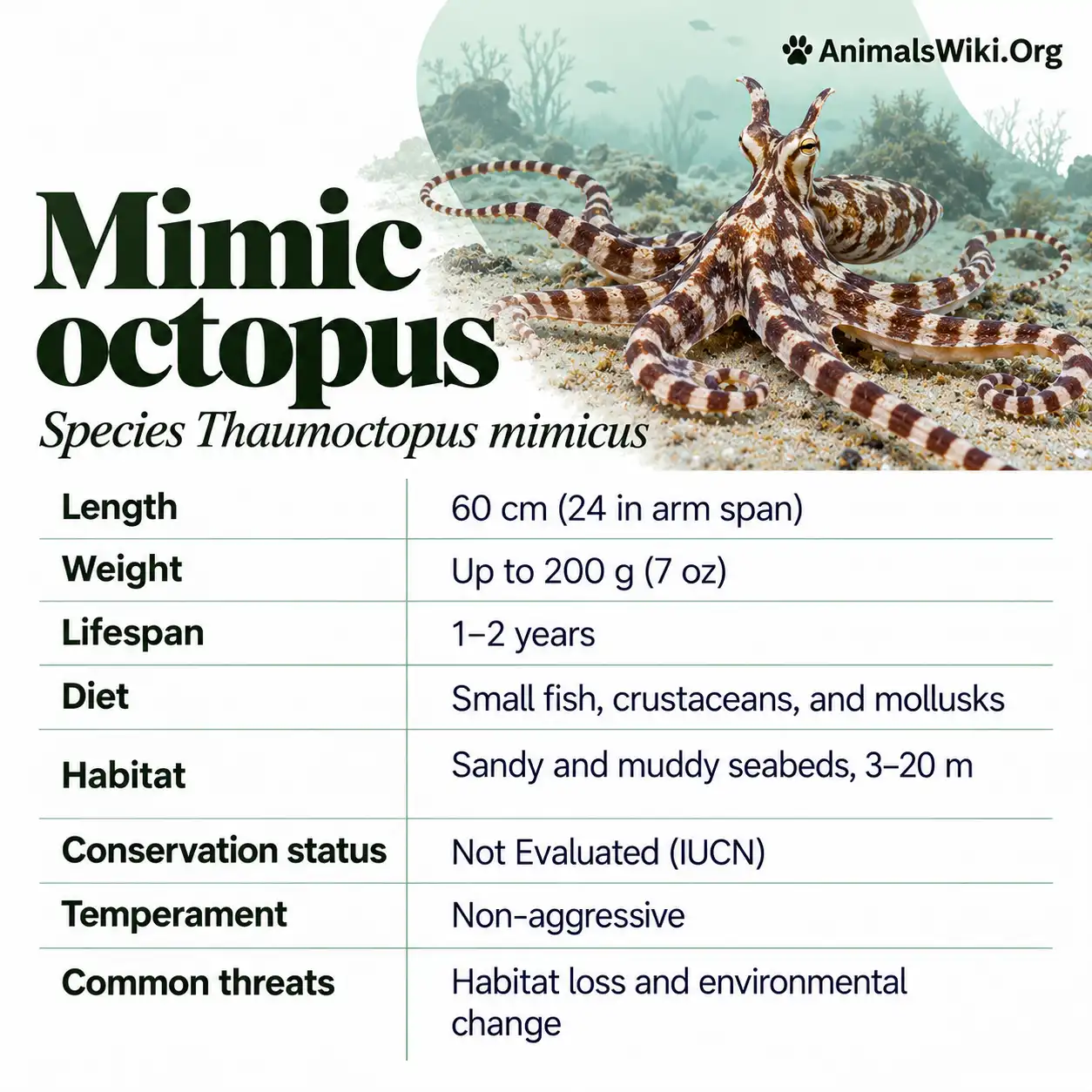
Mimic Octopus Facts
| Feature | Information |
|---|---|
| Common name | Mimic Octopus |
| Scientific name | Thaumoctopus mimicus |
| Genus | Thaumoctopus |
| Family | Octopodidae |
| Order | Octopoda |
| Class | Cephalopoda |
| Phylum | Mollusca |
| Animal type | Marine octopus |
| Habitat | Shallow sandy and muddy seabeds |
| Distribution | Tropical Indo-Pacific waters |
| First scientific description | 1998 |
| Body size | Relatively small |
| Total length | Commonly reported up to approximately 60 cm |
| Color | Brown with contrasting pale bands |
| Arms | Eight |
| Main adaptation | Behavioral mimicry |
| Famous imitations | Flatfish, lionfish, and sea snakes |
| Diet | Small crustaceans, fish, and other marine prey |
| Feeding type | Carnivorous |
| Behavior | Generally solitary |
| Reproduction | Sexual, egg-laying |
| Lifespan | Poorly documented |
| Predators | Predatory fish and other marine animals |
| Conservation | Population status incompletely assessed |
What Is a Mimic Octopus?
The mimic octopus is a marine cephalopod belonging to the species Thaumoctopus mimicus.
It is famous for its ability to change body posture, coloration, and movement to resemble other animals.
This behavior differs from ordinary camouflage.
Camouflage primarily helps an animal blend into its surroundings.
Mimicry involves resembling another organism or object in ways that may influence how other animals respond.
Is the Mimic Octopus a Real Octopus?
Yes.
It belongs to the order Octopoda.
Why Is It Called the Mimic Octopus?
Because it can imitate the appearance and movements of other marine animals.
Is the Mimic Octopus a Fish?
No.
It is a mollusk.
Is the Mimic Octopus an Invertebrate?
Yes.
It does not possess a backbone.
Scientific Classification of the Mimic Octopus
| Classification | Name |
|---|---|
| Kingdom | Animalia |
| Phylum | Mollusca |
| Class | Cephalopoda |
| Subclass | Coleoidea |
| Order | Octopoda |
| Family | Octopodidae |
| Genus | Thaumoctopus |
| Species | Thaumoctopus mimicus |
What Does Thaumoctopus mimicus Mean?
The genus name Thaumoctopus refers to the animal’s remarkable or wondrous nature.
The species name mimicus refers to mimicry.
Is the Mimic Octopus Related to Common Octopuses?
Yes.
Both belong to the order Octopoda.
Is the Mimic Octopus Related to Squid?
Yes.
Both are cephalopod mollusks.
Discovery of the Mimic Octopus
The mimic octopus was scientifically described in 1998.
It became famous because of observations of its unusual defensive displays.
Where Was the Mimic Octopus Discovered?
It was first scientifically documented from Indonesian waters.
Why Was Its Discovery Important?
It provided striking evidence of complex behavioral mimicry in a marine invertebrate.
Was the Mimic Octopus Unknown Before 1998?
The species was formally described in 1998.
However, scientific description does not necessarily mean that local communities had never encountered it.
What Does a Mimic Octopus Look Like?
The mimic octopus has a soft, flexible body with eight long arms.
Its appearance includes:
- Elongated arms
- Brown and pale bands
- Large eyes
- Soft mantle
- Numerous suckers
- Sharp beak
- Color-changing skin
- Highly flexible body
What Color Is a Mimic Octopus?
It is commonly brown with contrasting pale or cream-colored bands.
Does the Mimic Octopus Have Stripes?
Yes.
Its striped appearance is important in several mimicry displays.
How Many Arms Does a Mimic Octopus Have?
Eight.
Does a Mimic Octopus Have Bones?
No.
Its soft body allows considerable flexibility.
Mimic Octopus Size and Weight
The mimic octopus is relatively small.
How Big Is a Mimic Octopus?
Its total length is commonly reported as reaching approximately 60 centimeters, including the arms.
How Much Does a Mimic Octopus Weigh?
Reliable weight measurements are limited.
Are Female Mimic Octopuses Bigger Than Males?
Sexual size differences have not been thoroughly documented across the species.
Where Do Mimic Octopuses Live?
Mimic octopuses inhabit tropical Indo-Pacific waters.
They are particularly associated with:
- Indonesia
- Southeast Asian coastal waters
- Shallow tropical marine environments
Do Mimic Octopuses Live in Indonesia?
Yes.
Indonesia is particularly famous for observations of the species.
Do Mimic Octopuses Live in Australia?
Records and identification should be checked carefully because similar octopus species occur in nearby waters.
Do Mimic Octopuses Live in the Atlantic Ocean?
They are not generally recognized as native Atlantic animals.
Do Mimic Octopuses Live in Freshwater?
No.
They are marine animals.
Mimic Octopus Habitat
Mimic octopuses are associated with shallow sandy and muddy seabeds.
Their habitats include:
- Sandy flats
- Muddy coastal bottoms
- Estuarine marine environments
- Shallow bays
- Soft sediment habitats
- Areas with burrows and small shelters
Do Mimic Octopuses Live in Coral Reefs?
They are especially associated with soft-bottom environments rather than complex coral reef structures.
Do Mimic Octopuses Live in Deep Water?
They are primarily known from shallow coastal habitats.
Do Mimic Octopuses Dig Burrows?
They can use and modify shelters in soft sediment.
Why Do Mimic Octopuses Prefer Sandy Habitats?
Soft sediments provide opportunities for hiding, hunting, and moving between shelters.
What Is Mimicry?
Mimicry occurs when one organism resembles another organism or object in a way that influences interactions with other animals.
What Is Batesian Mimicry?
Batesian mimicry occurs when a relatively harmless organism resembles a dangerous or unpalatable species.
Is the Mimic Octopus an Example of Batesian Mimicry?
Some of its displays have been interpreted as possible Batesian mimicry.
However, demonstrating Batesian mimicry scientifically requires evidence that predators respond to the resemblance.
Is Mimicry the Same as Camouflage?
No.
Camouflage helps an organism blend into its environment.
Mimicry involves resembling another organism or object.
What Animals Can the Mimic Octopus Imitate?
The mimic octopus is best known for displays resembling:
- Flatfish
- Lionfish
- Sea snakes
Other suggested imitations have appeared in popular descriptions, but not all have been equally well documented.
How Does the Mimic Octopus Imitate a Flatfish?
The mimic octopus can flatten its body, arrange its arms, and swim close to the seabed.
This creates a silhouette resembling a flatfish.
Why Would It Mimic a Flatfish?
The resemblance may influence predator behavior or allow movement across exposed areas.
Does It Really Become a Flatfish?
No.
It changes posture and movement rather than transforming anatomically.
How Does the Mimic Octopus Imitate a Lionfish?
The mimic octopus may spread its arms outward in a way that resembles the extended fins of a lionfish.
Lionfish possess venomous spines, making them potentially dangerous to predators.
Does the Mimic Octopus Have Lionfish Spines?
No.
Its arms only resemble the general appearance of extended fins.
Does It Become Venomous Like a Lionfish?
No.
Mimicking another animal does not give it that animal’s physical defenses.
How Does the Mimic Octopus Imitate a Sea Snake?
The mimic octopus may hide most of its body while extending two banded arms.
The arms can resemble the movement and appearance of a banded sea snake.
Why Would It Mimic a Sea Snake?
Sea snakes can be dangerous predators, and resembling one may discourage certain attackers.
Can It Choose Which Animal to Mimic?
Observations suggest that mimic octopuses can display different postures in different contexts.
However, claims that they consciously identify each predator and select a perfectly tailored disguise require careful scientific evidence.
Can the Mimic Octopus Imitate More Than Three Animals?
Popular sources sometimes claim that mimic octopuses can imitate more than a dozen different species.
However, the best-documented displays involve a smaller number of animal types.
The exact number of scientifically demonstrated mimicked species remains uncertain.
How Does the Mimic Octopus Change Color?
Like other octopuses, the mimic octopus possesses specialized pigment cells called chromatophores.
These cells allow rapid changes in skin coloration.
What Are Chromatophores?
Chromatophores are pigment-containing cells controlled by muscles and neural signals.
Can Mimic Octopuses Change Texture?
Octopuses can alter skin appearance using muscular structures, although the degree of texture change varies by species.
Can Mimic Octopuses Become Invisible?
No.
They can become difficult to detect through camouflage.
Mimic Octopus Intelligence
Octopuses possess complex nervous systems.
The mimic octopus demonstrates flexible behavior and precise control of its body.
Is the Mimic Octopus Intelligent?
It displays sophisticated behavioral adaptations.
However, the exact cognitive processes behind its mimicry remain under investigation.
Does the Mimic Octopus Know What It Is Imitating?
Scientists cannot directly determine whether an octopus possesses a human-like concept of the animal it resembles.
Its behavior can be studied without assuming human-style awareness.
Can Mimic Octopuses Learn?
Octopuses are capable of learning, but species-specific experimental evidence for Thaumoctopus mimicus remains limited.
What Do Mimic Octopuses Eat?
Mimic octopuses are carnivorous.
Their diet includes:
- Small crustaceans
- Shrimp
- Crabs
- Small fish
- Other marine invertebrates
Do Mimic Octopuses Eat Crabs?
Yes.
Do Mimic Octopuses Eat Shrimp?
Yes.
Do Mimic Octopuses Eat Fish?
They may consume small fish.
Are Mimic Octopuses Carnivores?
Yes.
How Do Mimic Octopuses Hunt?
Mimic octopuses search for prey in sandy and muddy habitats.
They use their arms and suckers to investigate crevices and sediment.
Do Mimic Octopuses Use Camouflage to Hunt?
Camouflage can help them approach prey and avoid detection.
Do Mimic Octopuses Have Beaks?
Yes.
Do Mimic Octopuses Have Venom?
Like other octopuses, they possess venom-associated salivary systems.
However, they are not generally considered medically dangerous to humans in the same way as blue-ringed octopuses.
Mimic Octopus Movement
Mimic octopuses move using their arms and jet propulsion.
They can crawl, swim, and change body posture.
Can Mimic Octopuses Swim?
Yes.
Can Mimic Octopuses Walk on the Seafloor?
They can move across the seabed using their arms.
Can Mimic Octopuses Swim Backward?
They can use jet propulsion to move rapidly away from threats.
Mimic Octopus Behavior
Mimic octopuses are generally solitary.
They spend much of their time exploring the seabed and seeking food or shelter.
Are Mimic Octopuses Nocturnal?
They have been observed active during daylight, although activity can vary.
Are Mimic Octopuses Aggressive?
They are not generally aggressive toward humans.
Do Mimic Octopuses Live in Groups?
They are usually observed individually.
Mimic Octopus Reproduction
Mimic octopuses reproduce sexually.
How Do Mimic Octopuses Mate?
Males transfer sperm using a specialized arm called the hectocotylus.
Do Mimic Octopuses Lay Eggs?
Yes.
How Many Eggs Does a Mimic Octopus Lay?
Reliable species-specific clutch-size information is limited.
Do Mimic Octopuses Guard Their Eggs?
Egg guarding is common among octopuses, but detailed observations for this species are limited.
Do Mimic Octopuses Die After Reproduction?
Most octopuses are semelparous, reproducing during a single major reproductive period.
The detailed life history of the mimic octopus remains incompletely documented.
Baby Mimic Octopuses
Young mimic octopuses develop from eggs.
What Is a Baby Mimic Octopus Called?
A hatchling or juvenile.
Can Baby Mimic Octopuses Mimic Other Animals?
The development of mimicry behavior in young individuals remains poorly documented.
Do Baby Mimic Octopuses Look Like Adults?
Their appearance changes as they grow.
How Long Do Mimic Octopuses Live?
The exact lifespan of Thaumoctopus mimicus is not well established.
Many small octopus species live relatively short lives, but a precise lifespan should not be assigned without species-specific evidence.
Do Mimic Octopuses Live for One Year?
A lifespan around one year is sometimes suggested, but reliable species-specific confirmation is limited.
Can Mimic Octopuses Live for Ten Years?
There is no reliable evidence that they routinely live for ten years.
Mimic Octopus Adaptations
Behavioral Mimicry
Allows resemblance to other marine animals.
Color-Changing Skin
Supports camouflage and signaling.
Flexible Body
Enables unusual postures.
Eight Arms
Provide movement and prey capture.
Suckers
Allow gripping and exploration.
Large Eyes
Help detect movement and surroundings.
Sharp Beak
Processes prey.
Jet Propulsion
Supports rapid escape.
Burrow Use
Provides shelter.
Complex Nervous System
Supports coordinated behavior.
What Animals Eat Mimic Octopuses?
Potential predators include:
- Large fish
- Groupers
- Eels
- Other predatory marine animals
Do Sharks Eat Mimic Octopuses?
Some sharks eat octopuses, but direct evidence involving this particular species is limited.
Do Fish Eat Mimic Octopuses?
Predatory fish are likely important threats.
How Do Mimic Octopuses Defend Themselves?
They use camouflage, hiding, rapid escape, and mimicry displays.
Mimic Octopus vs. Blue-Ringed Octopus
| Feature | Mimic Octopus | Blue-Ringed Octopus |
|---|---|---|
| Scientific name | Thaumoctopus mimicus | Hapalochlaena species |
| Famous feature | Behavioral mimicry | Blue warning rings |
| Habitat | Sandy and muddy seabeds | Shallow coastal habitats |
| Venom | Typical octopus venom-associated system | Tetrodotoxin-containing venom |
| Human danger | Not generally considered highly dangerous | Potentially life-threatening bite |
| Camouflage | Highly specialized | Highly developed |
| Body pattern | Brown and pale bands | Bright blue markings |
Mimic Octopus vs. Wonderpus
The mimic octopus is often confused with the wonderpus octopus (Wunderpus photogenicus).
Both have striking brown and pale patterns and inhabit Indo-Pacific coastal waters.
However, they are distinct species.
How Can You Tell Them Apart?
Identification may involve:
- Arm pattern
- Eye markings
- Body proportions
- Behavior
- Other anatomical features
Accurate identification may require expert examination.
Mimic Octopus vs. Common Octopus
| Feature | Mimic Octopus | Common Octopus |
|---|---|---|
| Scientific name | Thaumoctopus mimicus | Octopus vulgaris |
| Main distinction | Behavioral mimicry | General camouflage and problem-solving |
| Habitat | Tropical soft-bottom environments | Various coastal habitats |
| Body pattern | Often strongly banded | Highly variable |
| Size | Relatively small | Usually larger |
| Hunting | Small marine prey | Crustaceans, mollusks, and other prey |
Are Mimic Octopuses Dangerous to Humans?
Mimic octopuses are not generally considered dangerous to humans.
However, they possess beaks and should not be handled unnecessarily.
Can Mimic Octopuses Bite?
Yes.
Are Mimic Octopuses Venomous?
They possess venom-associated salivary systems, as do other octopuses.
However, they are not known for the severe tetrodotoxin envenomation associated with blue-ringed octopuses.
Are Mimic Octopuses Poisonous?
They are not generally recognized as poisonous to touch.
Can You Touch a Mimic Octopus?
Handling is discouraged because it can stress the animal and may cause injury.
Are Mimic Octopuses Endangered?
Their population status is not comprehensively documented.
A current species-specific conservation assessment should be checked before making a definitive endangered-status claim.
What Threatens Mimic Octopuses?
Potential threats include:
- Coastal habitat destruction
- Marine pollution
- Sediment disturbance
- Coastal development
- Fishing activities
- Climate change
- Aquarium collection
How Does Coastal Development Affect Mimic Octopuses?
It can alter soft-bottom habitats and reduce suitable shelter or feeding areas.
How Does Pollution Affect Mimic Octopuses?
Pollution may affect prey availability, habitat quality, and survival.
Why Are Mimic Octopuses Important?
Mimic octopuses contribute to coastal food webs as predators of small marine animals.
They also provide valuable opportunities to study behavioral mimicry, camouflage, and cephalopod evolution.
Why Do Scientists Study Mimic Octopuses?
They help researchers understand:
- Behavioral mimicry
- Camouflage
- Predator avoidance
- Cephalopod behavior
- Marine evolution
- Sensory processing
50 Interesting Mimic Octopus Facts
- The mimic octopus’s scientific name is Thaumoctopus mimicus.
- It was scientifically described in 1998.
- It is a genuine octopus.
- It belongs to the class Cephalopoda.
- It is a mollusk.
- It is an invertebrate.
- It inhabits tropical Indo-Pacific waters.
- It is especially associated with Indonesia.
- It prefers sandy and muddy seabeds.
- It has eight arms.
- It possesses numerous suckers.
- It has a sharp beak.
- Its body is soft and flexible.
- It commonly displays brown and pale bands.
- It can change skin coloration.
- It possesses chromatophores.
- It is famous for behavioral mimicry.
- It can resemble a flatfish.
- It can resemble a lionfish.
- It can resemble a sea snake.
- Its mimicry involves body posture.
- Movement is important to its mimicry.
- It does not physically transform into other animals.
- Its stripes contribute to visual resemblance.
- Some displays may represent Batesian mimicry.
- The exact number of mimicked species is uncertain.
- It can flatten its body.
- It can spread its arms.
- It can extend banded arms from shelter.
- It can swim.
- It can crawl across the seabed.
- It uses jet propulsion.
- It is carnivorous.
- It eats small crustaceans.
- It may consume shrimp.
- It may eat small fish.
- It uses camouflage while hunting.
- It is generally solitary.
- It possesses a complex nervous system.
- It has well-developed eyes.
- It reproduces sexually.
- Males transfer sperm using a specialized arm.
- Females lay eggs.
- Its exact lifespan is poorly documented.
- Predatory fish may eat it.
- It uses mimicry to discourage predators.
- It is often confused with the wonderpus octopus.
- Its conservation status remains incompletely assessed.
- Scientists study it to understand behavioral mimicry.
- Its ability to resemble several different marine animals makes it one of the ocean’s most extraordinary masters of disguise.
Did You Know?
The Octopus That Pretends to Be a Sea Snake
Imagine exploring a shallow tropical seabed in Indonesia.
The water is warm.
The bottom is covered with sand and soft sediment.
Small fish swim above the seafloor.
A narrow opening in the sand hides an unusual animal.
Only a pair of eyes and a few striped arms are visible.
It is a mimic octopus.
The animal slowly emerges.
Its long arms spread across the seabed.
Its body displays contrasting brown and pale bands.
A predatory fish approaches.
The octopus reacts.
Instead of simply hiding, it changes its posture.
Most of its body disappears into the shelter.
Two banded arms remain extended.
They move through the water in a way that resembles a sea snake.
The resemblance may discourage a predator that recognizes sea snakes as dangerous animals.
Later, the octopus moves across an open sandy area.
It flattens its body.
Its arms are arranged into a broad shape.
Its swimming movement now resembles that of a flatfish.
The same animal has adopted a different appearance.
This extraordinary behavior demonstrates the flexibility of its body and the sophistication of its motor control.
But scientists remain careful about interpreting the behavior.
Observing a resemblance does not automatically prove that every predator is deceived.
Researchers must study how predators respond to these displays.
Even with these uncertainties, the mimic octopus remains a remarkable example of behavioral adaptation.
Its flexible body allows unusual movements.
Its chromatophores create contrasting patterns.
Its nervous system coordinates complex postures.
Together, these abilities allow the animal to respond to a changing environment.
The mimic octopus demonstrates that survival in the ocean can depend not only on strength or speed, but also on the ability to create convincing appearances.
Frequently Asked Questions About Mimic Octopuses
What is a mimic octopus?
A mimic octopus is a marine octopus belonging to the species Thaumoctopus mimicus.
What is the scientific name of the mimic octopus?
Thaumoctopus mimicus.
Is the mimic octopus a real octopus?
Yes.
Is the mimic octopus a fish?
No.
Is the mimic octopus a mollusk?
Yes.
Is the mimic octopus a cephalopod?
Yes.
Is the mimic octopus an invertebrate?
Yes.
Why is it called the mimic octopus?
Because it can imitate the appearance and movement of other marine animals.
When was the mimic octopus discovered?
It was scientifically described in 1998.
Where was the mimic octopus discovered?
In Indonesian waters.
Was the mimic octopus unknown before 1998?
It was formally described in 1998, but that does not necessarily mean nobody had encountered it before.
How big is a mimic octopus?
Its total length is commonly reported as reaching approximately 60 centimeters.
How much does a mimic octopus weigh?
Reliable weight data are limited.
What color is a mimic octopus?
Usually brown with contrasting pale bands.
Does the mimic octopus have stripes?
Yes.
How many arms does a mimic octopus have?
Eight.
Does the mimic octopus have bones?
No.
Does the mimic octopus have suckers?
Yes.
Does the mimic octopus have a beak?
Yes.
Where do mimic octopuses live?
In tropical Indo-Pacific waters.
Do mimic octopuses live in Indonesia?
Yes.
Do mimic octopuses live in Australia?
Identification and distribution records should be checked carefully.
Do mimic octopuses live in the Atlantic Ocean?
They are not generally native to the Atlantic.
Do mimic octopuses live in freshwater?
No.
What habitat do mimic octopuses prefer?
Shallow sandy and muddy seabeds.
Do mimic octopuses live in coral reefs?
They are especially associated with soft-bottom habitats.
Do mimic octopuses live in deep water?
They are primarily known from shallow coastal waters.
Do mimic octopuses dig burrows?
They use and modify shelters in soft sediment.
What is mimicry?
Resemblance to another organism or object that influences interactions with other animals.
What is Batesian mimicry?
When a relatively harmless organism resembles a dangerous or unpalatable species.
Is the mimic octopus an example of Batesian mimicry?
Some displays have been interpreted that way, but predator responses require scientific verification.
What animals can the mimic octopus imitate?
Its best-known displays resemble flatfish, lionfish, and sea snakes.
Can a mimic octopus imitate a flatfish?
Yes.
Can a mimic octopus imitate a lionfish?
It can adopt a posture resembling a lionfish.
Can a mimic octopus imitate a sea snake?
Yes.
Can a mimic octopus imitate more than ten animals?
Popular claims exist, but the number of scientifically demonstrated imitations is uncertain.
Can the mimic octopus choose which animal to imitate?
It displays different behaviors in different contexts, but claims about deliberate predator-specific selection require careful evidence.
Does the mimic octopus actually transform?
No.
Can mimic octopuses change color?
Yes.
What are chromatophores?
Specialized pigment cells that allow rapid changes in skin coloration.
Can mimic octopuses change texture?
Octopuses can alter skin appearance, although the degree varies.
Can mimic octopuses become invisible?
No, but camouflage can make them difficult to detect.
Are mimic octopuses intelligent?
They display complex behavior, although their cognitive abilities remain incompletely studied.
Can mimic octopuses learn?
Octopuses can learn, but species-specific evidence is limited.
What do mimic octopuses eat?
Small crustaceans, shrimp, fish, and other marine prey.
Are mimic octopuses carnivores?
Yes.
Do mimic octopuses eat crabs?
Yes.
Do mimic octopuses eat shrimp?
Yes.
Do mimic octopuses eat fish?
They may consume small fish.
How do mimic octopuses hunt?
Using their arms, suckers, camouflage, and sensory abilities.
Can mimic octopuses swim?
Yes.
Can mimic octopuses walk on the seafloor?
They can move across the seabed using their arms.
Can mimic octopuses swim backward?
They can use jet propulsion to escape.
Are mimic octopuses nocturnal?
They have been observed active during daylight.
Are mimic octopuses solitary?
Generally, yes.
Are mimic octopuses aggressive?
They are not generally aggressive toward humans.
How do mimic octopuses reproduce?
Sexually.
Do mimic octopuses lay eggs?
Yes.
Do mimic octopuses guard their eggs?
Egg guarding is common among octopuses, but detailed species-specific evidence is limited.
What is a baby mimic octopus called?
A hatchling or juvenile.
Can baby mimic octopuses mimic animals?
The development of mimicry in young individuals remains poorly documented.
How long do mimic octopuses live?
Their exact lifespan is not well established.
What animals eat mimic octopuses?
Predatory fish, eels, and other marine animals.
Are mimic octopuses dangerous to humans?
They are not generally considered highly dangerous.
Can mimic octopuses bite?
Yes.
Are mimic octopuses venomous?
They possess venom-associated salivary systems, but are not known for the severe tetrodotoxin envenomation of blue-ringed octopuses.
Are mimic octopuses poisonous?
They are not generally recognized as poisonous to touch.
Can you touch a mimic octopus?
Handling is discouraged.
Are mimic octopuses endangered?
Their conservation status is incompletely assessed.
What threatens mimic octopuses?
Habitat degradation, pollution, fishing, and environmental change.
Why are mimic octopuses important?
They contribute to marine food webs and help scientists study behavioral mimicry.
What is the most interesting mimic octopus fact?
The mimic octopus can adopt different body postures and movements resembling flatfish, lionfish, and sea snakes, making it one of the most remarkable examples of behavioral mimicry in marine animals.
Conclusion
The mimic octopus is one of the most extraordinary examples of behavioral adaptation in the ocean.
Its ability to resemble different marine animals through body posture, movement, and coloration distinguishes it from most familiar octopuses.
Although its famous displays have inspired many popular descriptions, scientists continue to investigate exactly how mimicry works and how predators respond.
The mimic octopus is also an important coastal predator that feeds on small marine animals.
Its soft body, flexible arms, sophisticated skin, and complex nervous system allow it to survive in sandy and muddy marine habitats.
Protecting healthy coastal ecosystems will help preserve the remarkable biodiversity represented by this unusual cephalopod.
The mimic octopus is more than a master of disguise—it is a fascinating example of how behavior, anatomy, and evolution can work together to improve survival.