Blue-Ringed Octopus, The Tiny, Beautiful Octopus With Deadly Venom
The blue-ringed octopus is one of the most fascinating, beautiful, and potentially dangerous animals in the ocean. Despite its small size, this remarkable marine predator possesses powerful venom capable of causing life-threatening paralysis in humans.
Famous for its brilliant electric-blue rings, the blue-ringed octopus is a striking example of how nature combines extraordinary beauty with an effective chemical defense.
Most blue-ringed octopuses are small enough to fit comfortably in a person’s hand, yet they should never be touched or handled.
Their venom contains tetrodotoxin (TTX), a potent neurotoxin that interferes with nerve signaling.
Severe envenomation can cause muscle paralysis and respiratory failure.
Unlike many dangerous animals, blue-ringed octopuses are not generally aggressive toward humans. Bites usually occur when an animal is handled, trapped, or disturbed.
Their vivid blue markings are especially noticeable during defensive displays.
When threatened, a blue-ringed octopus can rapidly reveal or intensify its bright blue rings, warning potential predators to keep their distance.
These octopuses inhabit shallow coastal waters across parts of the Indian and Pacific Oceans, including Australia, Japan, and Southeast Asia.
They shelter beneath rocks, inside shells, and among coral rubble, emerging to hunt small crustaceans and other marine animals.
Blue-ringed octopuses are intelligent predators with flexible bodies, sharp beaks, specialized sensory systems, and complex camouflage abilities.
Although their venom makes them dangerous to handle, they play important ecological roles as predators in coastal marine ecosystems.
This comprehensive guide explores blue-ringed octopus facts, scientific classification, species, anatomy, size, habitat, distribution, venom, blue rings, diet, hunting, reproduction, lifespan, predators, adaptations, conservation, safety, and frequently asked questions.
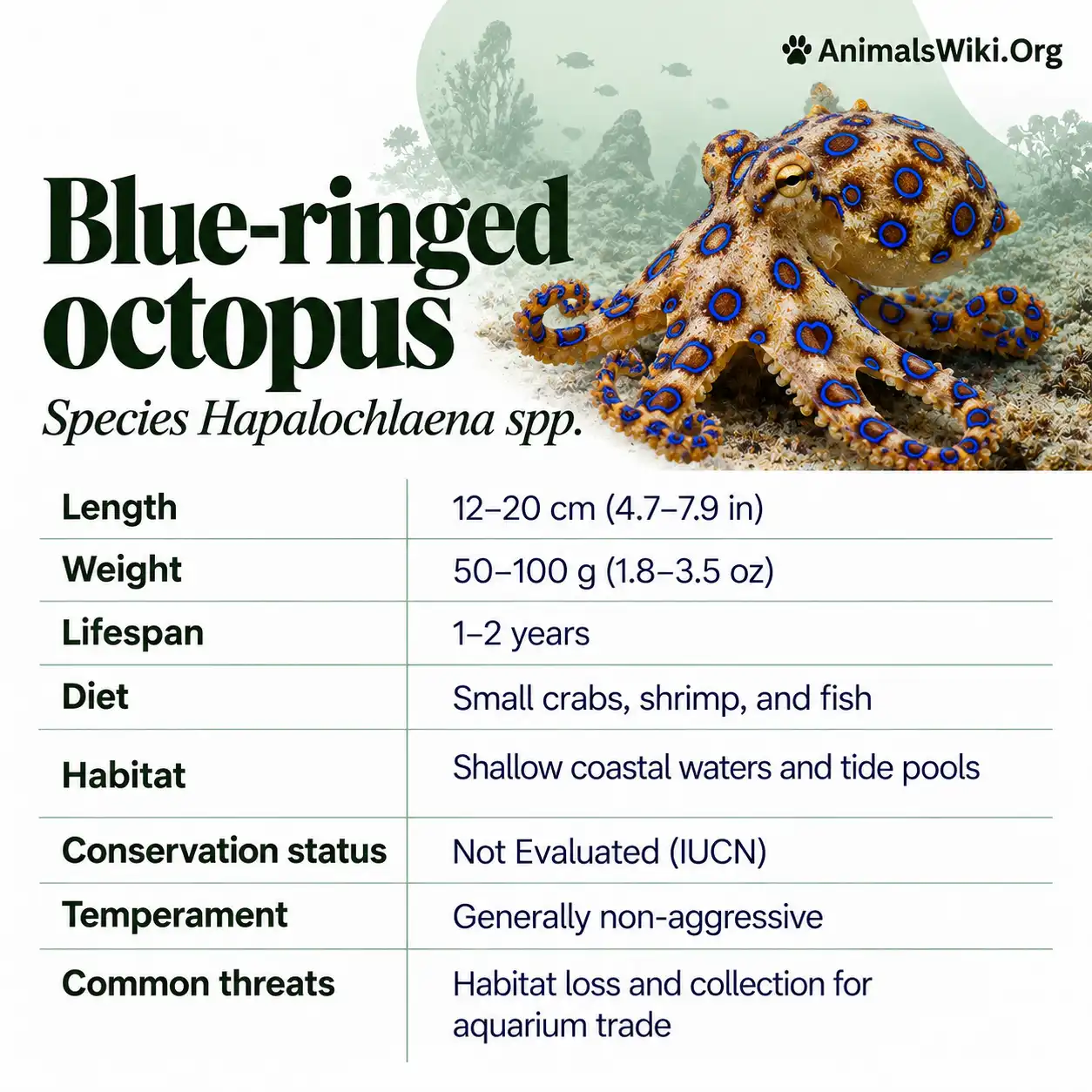
Blue-Ringed Octopus Facts
| Feature | Information |
|---|---|
| Common name | Blue-Ringed Octopus |
| Scientific genus | Hapalochlaena |
| Animal type | Venomous marine octopus |
| Family | Octopodidae |
| Order | Octopoda |
| Class | Cephalopoda |
| Phylum | Mollusca |
| Habitat | Shallow coastal marine environments |
| Distribution | Indo-Pacific region |
| Famous feature | Bright blue rings |
| Body size | Small; varies by species |
| Arm span | Commonly around 10–20 cm in many species |
| Arms | Eight |
| Diet | Crabs, shrimp, and other small marine animals |
| Feeding type | Carnivorous |
| Venom | Contains tetrodotoxin |
| Main danger | Neuromuscular paralysis and respiratory failure |
| Behavior | Generally secretive and nonaggressive |
| Reproduction | Sexual, egg-laying |
| Parental care | Females guard eggs |
| Lifespan | Commonly around 1–2 years, depending on species |
| Predators | Larger fish, eels, and other marine predators |
| Conservation | Species-specific; many remain poorly assessed |
What Is a Blue-Ringed Octopus?
A blue-ringed octopus is a small venomous octopus belonging to the genus Hapalochlaena.
These animals are cephalopod mollusks, related to other octopuses, squid, and cuttlefish.
Their most recognizable features are their bright blue rings and powerful venom.
Is a Blue-Ringed Octopus a Real Octopus?
Yes.
It belongs to the order Octopoda.
Why Is It Called a Blue-Ringed Octopus?
The name refers to the vivid blue rings or markings that appear on its body and arms.
Is a Blue-Ringed Octopus a Fish?
No.
It is a mollusk.
Is a Blue-Ringed Octopus an Invertebrate?
Yes.
It does not possess a backbone.
Scientific Classification of Blue-Ringed Octopuses
| Classification | Name |
|---|---|
| Kingdom | Animalia |
| Phylum | Mollusca |
| Class | Cephalopoda |
| Subclass | Coleoidea |
| Order | Octopoda |
| Family | Octopodidae |
| Genus | Hapalochlaena |
| Example species | Hapalochlaena maculosa |
Blue-ringed octopus refers to multiple species rather than one species.
What Does Hapalochlaena Mean?
Hapalochlaena is the scientific genus containing blue-ringed octopuses.
Are Blue-Ringed Octopuses Related to Common Octopuses?
Yes.
Both belong to the order Octopoda.
Are Blue-Ringed Octopuses Related to Squid?
Yes.
Both are cephalopods.
Types of Blue-Ringed Octopuses
Several species of blue-ringed octopus are recognized.
1. Greater Blue-Ringed Octopus
Scientific name: Hapalochlaena lunulata
This species is known for its prominent blue rings and occurs in parts of the Indo-Pacific.
2. Southern Blue-Ringed Octopus
Scientific name: Hapalochlaena maculosa
This species occurs in southern Australian waters.
It is generally small and often associated with coastal habitats.
3. Blue-Lined Octopus
Scientific name: Hapalochlaena fasciata
This species is known for blue lines and markings rather than only circular rings.
It occurs in parts of eastern Australian waters.
4. Other Hapalochlaena Species
Additional species have been described or proposed.
Taxonomy continues to develop as researchers examine genetic and anatomical differences.
What Does a Blue-Ringed Octopus Look Like?
Blue-ringed octopuses possess small, soft bodies with eight arms.
Their appearance includes:
- Rounded mantle
- Eight flexible arms
- Suckers
- Large eyes
- Sharp beak
- Color-changing skin
- Bright blue rings or lines
- Soft body without bones
Are Blue-Ringed Octopuses Always Blue?
No.
When calm, their bodies may appear yellowish, brown, or tan.
Their blue markings can become more conspicuous during defensive displays.
Why Do Their Rings Glow Blue?
The bright blue appearance is produced by specialized reflective structures in the skin.
It is not bioluminescence.
Do Blue-Ringed Octopuses Produce Light?
No.
Their rings reflect light rather than generating their own light.
Blue-Ringed Octopus Size and Weight
Blue-ringed octopuses are small.
How Big Is a Blue-Ringed Octopus?
Many have arm spans around 10–20 centimeters.
Size varies by species and individual.
What Is the Largest Blue-Ringed Octopus?
The greater blue-ringed octopus is among the larger recognized species.
However, exact maximum measurements vary.
How Much Does a Blue-Ringed Octopus Weigh?
Most weigh only a few grams to several tens of grams.
Can a Blue-Ringed Octopus Fit in Your Hand?
Many are small enough to fit in a human hand.
However, they should never be picked up.
Where Do Blue-Ringed Octopuses Live?
Blue-ringed octopuses inhabit the Indo-Pacific region.
They occur in coastal waters around:
- Australia
- Japan
- Indonesia
- Philippines
- Papua New Guinea
- Other parts of Southeast Asia and the western Pacific
Do Blue-Ringed Octopuses Live in Australia?
Yes.
Several species occur in Australian waters.
Do Blue-Ringed Octopuses Live in Japan?
Yes.
Some species occur in Japanese coastal waters.
Do Blue-Ringed Octopuses Live in the Atlantic Ocean?
They are not generally native to the Atlantic Ocean.
Do Blue-Ringed Octopuses Live in Freshwater?
No.
They are marine animals.
Blue-Ringed Octopus Habitat
Blue-ringed octopuses inhabit shallow coastal environments.
These include:
- Rocky reefs
- Coral rubble
- Tide pools
- Sandy seabeds
- Seagrass beds
- Shell beds
- Coastal crevices
Do Blue-Ringed Octopuses Live in Tide Pools?
Yes.
Some may be encountered in shallow tide pools and intertidal environments.
Do Blue-Ringed Octopuses Live in Coral Reefs?
Yes.
Some inhabit coral-associated habitats.
Do Blue-Ringed Octopuses Live in Deep Water?
They are primarily associated with shallow coastal habitats.
Where Do Blue-Ringed Octopuses Hide?
They shelter beneath rocks, inside shells, and in narrow crevices.
Why Are Blue-Ringed Octopuses So Dangerous?
Blue-ringed octopuses possess venom containing tetrodotoxin.
Tetrodotoxin blocks voltage-gated sodium channels in nerve and muscle cells.
This interferes with the transmission of electrical signals.
What Is Tetrodotoxin?
Tetrodotoxin is a potent neurotoxin found in several marine and terrestrial organisms.
What Does Tetrodotoxin Do?
It can cause:
- Numbness
- Tingling
- Muscle weakness
- Paralysis
- Difficulty breathing
- Respiratory failure
Can Blue-Ringed Octopus Venom Kill Humans?
Yes.
Severe envenomation can be fatal without rapid medical support.
Is There an Antivenom for Blue-Ringed Octopus Bites?
There is no specific approved antivenom for tetrodotoxin poisoning.
Treatment focuses on urgent supportive medical care, particularly maintaining breathing and circulation.
Can Someone Survive a Blue-Ringed Octopus Bite?
Yes.
Survival is possible, especially with prompt emergency treatment and respiratory support when required.
How Does a Blue-Ringed Octopus Deliver Venom?
Blue-ringed octopuses possess a sharp beak and venom-associated salivary glands.
They can deliver venom through a bite.
Do Blue-Ringed Octopuses Have Teeth?
They possess a beak and a radula rather than vertebrate teeth.
Can a Blue-Ringed Octopus Bite Without Being Noticed?
Yes.
A bite may initially be relatively painless or difficult to notice.
Do Blue-Ringed Octopuses Bite Humans on Purpose?
They do not normally seek out humans.
Bites usually occur during handling or accidental contact.
What Should You Do if Bitten by a Blue-Ringed Octopus?
A suspected blue-ringed octopus bite is a medical emergency, even if the bite seems minor.
- Move away from the animal without handling it.
- Call emergency medical services immediately.
- Keep the affected person still and minimize movement.
- Apply a pressure-immobilization bandage to the bitten limb if trained to do so, following local medical guidance.
- Immobilize the limb.
- Monitor breathing and responsiveness.
- Begin CPR if the person becomes unresponsive and is not breathing normally.
- Provide rescue breathing or assisted ventilation if trained and appropriate.
- Continue emergency care until medical professionals take over.
Do not cut the wound, attempt to suck out venom, or use a tourniquet.
Do not wait for symptoms to develop.
What Do Blue-Ringed Octopuses Eat?
Blue-ringed octopuses are carnivorous predators.
Their diet includes:
- Small crabs
- Shrimp
- Other crustaceans
- Occasionally small fish
Do Blue-Ringed Octopuses Eat Crabs?
Yes.
Crabs are important prey.
Do Blue-Ringed Octopuses Eat Shrimp?
Yes.
Do Blue-Ringed Octopuses Eat Fish?
They may consume small fish.
Are Blue-Ringed Octopuses Carnivores?
Yes.
How Do Blue-Ringed Octopuses Hunt?
Blue-ringed octopuses use camouflage and stealth to approach prey.
They capture prey with their arms and suckers.
They can deliver venom to immobilize or kill prey.
Do Blue-Ringed Octopuses Use Venom to Hunt?
Yes.
Their venom is an important part of their feeding strategy.
Do Blue-Ringed Octopuses Hunt at Night?
They may be active during different periods depending on species and environmental conditions.
Can Blue-Ringed Octopuses Change Color?
Yes.
They possess specialized skin cells involved in color changes.
Blue-Ringed Octopus Warning Displays
When threatened, blue-ringed octopuses can rapidly reveal bright blue markings.
Why Do Their Rings Flash?
The appearance of the rings changes as specialized skin structures expose or conceal reflective markings.
Is the Blue Color a Warning?
Yes.
The vivid markings function as an aposematic warning signal to potential predators.
Do Blue-Ringed Octopuses Glow in the Dark?
No.
Their markings are not bioluminescent.
Blue-Ringed Octopus Intelligence and Behavior
Blue-ringed octopuses possess complex nervous systems.
Like other octopuses, they can explore environments and respond to sensory information.
Are Blue-Ringed Octopuses Intelligent?
They possess sophisticated cephalopod nervous systems.
However, species-specific research on their cognition is more limited than for some larger octopuses.
Are Blue-Ringed Octopuses Solitary?
They are generally solitary outside reproductive interactions.
Are Blue-Ringed Octopuses Aggressive?
They are generally secretive and avoid unnecessary confrontation.
Blue-Ringed Octopus Reproduction
Blue-ringed octopuses reproduce sexually.
How Do Blue-Ringed Octopuses Mate?
Males transfer sperm using a specialized arm called the hectocotylus.
Do Blue-Ringed Octopuses Lay Eggs?
Yes.
Females produce eggs and provide parental care.
How Many Eggs Does a Blue-Ringed Octopus Lay?
Clutch size varies by species.
Some females produce dozens of relatively large eggs.
Do Female Blue-Ringed Octopuses Guard Their Eggs?
Yes.
Females guard and care for developing eggs.
Do Blue-Ringed Octopuses Die After Reproduction?
Like many octopuses, they are generally semelparous, meaning they reproduce during a single major reproductive period.
Females typically die after their eggs hatch.
Baby Blue-Ringed Octopuses
Young blue-ringed octopuses develop inside eggs.
Their early development varies among species.
What Is a Baby Blue-Ringed Octopus Called?
A hatchling or juvenile.
Are Baby Blue-Ringed Octopuses Venomous?
Young individuals may possess venom-associated defenses, although toxin levels and effectiveness vary with development.
They should never be handled.
Do Baby Blue-Ringed Octopuses Have Blue Rings?
Their characteristic markings develop during growth.
Do Baby Blue-Ringed Octopuses Look Like Adults?
Some species hatch as relatively well-developed juveniles.
Others have early life stages with different developmental characteristics.
How Long Do Blue-Ringed Octopuses Live?
Blue-ringed octopuses generally have short lifespans.
Many live approximately one to two years.
Why Do Blue-Ringed Octopuses Have Short Lifespans?
Their life cycles involve relatively rapid growth, maturation, and reproduction.
Can Blue-Ringed Octopuses Live for Ten Years?
They are not generally known to survive for ten years.
Blue-Ringed Octopus Adaptations
Tetrodotoxin Venom
Provides a powerful chemical weapon.
Bright Blue Warning Rings
Warn potential predators.
Camouflage
Helps them remain concealed.
Flexible Body
Allows entry into narrow crevices.
Eight Arms
Support movement and prey capture.
Suckers
Help grip prey and surfaces.
Sharp Beak
Allows processing of prey.
Complex Nervous System
Supports sensory processing and behavior.
Egg Guarding
Protects developing offspring.
Small Body Size
Allows use of narrow shelters.
What Animals Eat Blue-Ringed Octopuses?
Potential predators include:
- Large fish
- Moray eels
- Other octopuses
- Marine predators capable of avoiding or tolerating their defenses
Do Fish Eat Blue-Ringed Octopuses?
Some fish may prey on them.
Do Eels Eat Blue-Ringed Octopuses?
Eels may be potential predators.
How Do Blue-Ringed Octopuses Defend Themselves?
They use camouflage, hiding, warning displays, and venom.
Blue-Ringed Octopus vs. Common Octopus
| Feature | Blue-Ringed Octopus | Common Octopus |
|---|---|---|
| Scientific example | Hapalochlaena | Octopus vulgaris |
| Size | Small | Usually much larger |
| Main defense | Venom and warning coloration | Camouflage, ink, escape |
| Habitat | Indo-Pacific coastal waters | Coastal marine environments |
| Blue rings | Present | Absent |
| Venom | Contains tetrodotoxin | Different venom chemistry |
| Human danger | Potentially life-threatening bite | Generally much lower risk |
Blue-Ringed Octopus vs. Mimic Octopus
Blue-ringed octopuses are known for their venom and warning coloration.
Mimic octopuses are famous for changing their appearance and posture to resemble other marine animals.
Both are cephalopods with complex camouflage abilities.
Blue-Ringed Octopus vs. Dumbo Octopus
| Feature | Blue-Ringed Octopus | Dumbo Octopus |
|---|---|---|
| Scientific group | Hapalochlaena | Grimpoteuthis |
| Habitat | Shallow coastal waters | Deep ocean |
| Fins | No ear-like fins | Ear-like fins |
| Venom | Tetrodotoxin-containing | Poorly studied |
| Warning markings | Bright blue rings | Absent |
| Swimming | Arms and jet propulsion | Fin-based movement |
| Human danger | Potentially life-threatening bite | Not considered dangerous |
Are Blue-Ringed Octopuses Endangered?
Conservation status varies by species.
Many blue-ringed octopus populations have not been comprehensively assessed.
Their coastal habitats can be affected by pollution, development, and environmental changes.
What Threatens Blue-Ringed Octopuses?
Potential threats include:
- Coastal habitat destruction
- Marine pollution
- Coral reef degradation
- Collection for aquariums
- Climate change
- Habitat disturbance
How Does Coastal Development Affect Blue-Ringed Octopuses?
It can reduce suitable shelter and feeding habitats.
How Does Pollution Affect Blue-Ringed Octopuses?
Pollution may affect survival, prey availability, and reproductive success.
Why Are Blue-Ringed Octopuses Important?
Blue-ringed octopuses contribute to marine ecosystems as predators of small crustaceans.
They also provide valuable information about venom biology and cephalopod evolution.
Why Do Scientists Study Blue-Ringed Octopus Venom?
Tetrodotoxin is important in neuroscience because it blocks voltage-gated sodium channels.
Researchers use tetrodotoxin as a scientific tool for studying nerve signaling.
Are Blue-Ringed Octopuses Important for Marine Biodiversity?
Yes.
They are part of coastal marine food webs and contribute to ecological diversity.
50 Interesting Blue-Ringed Octopus Facts
- Blue-ringed octopuses belong to the genus Hapalochlaena.
- They are genuine octopuses.
- They belong to the class Cephalopoda.
- They are mollusks.
- They are invertebrates.
- They inhabit Indo-Pacific coastal waters.
- Several species occur in Australia.
- Some occur in Japan.
- They are generally small.
- Many have arm spans around 10–20 centimeters.
- They possess eight arms.
- They have suckers.
- They possess sharp beaks.
- They can change skin coloration.
- Their bodies may appear tan or brown when calm.
- Their blue rings become conspicuous during defensive displays.
- Their blue markings are not bioluminescent.
- The blue appearance is produced by reflective skin structures.
- Their rings function as warning signals.
- They possess venom containing tetrodotoxin.
- Tetrodotoxin blocks sodium channels.
- Severe envenomation can cause paralysis.
- Respiratory failure is the main life-threatening complication.
- There is no specific approved antivenom.
- Prompt respiratory support can be lifesaving.
- Bites may initially be difficult to notice.
- They do not normally seek out humans.
- Handling increases the risk of bites.
- They shelter beneath rocks.
- They may hide inside shells.
- They inhabit tide pools.
- They occur in coral-associated habitats.
- They are carnivorous.
- They eat crabs.
- They consume shrimp.
- They may eat small fish.
- They use venom to immobilize prey.
- They are generally solitary.
- They possess complex nervous systems.
- They reproduce sexually.
- Males transfer sperm using a specialized arm.
- Females lay eggs.
- Females guard developing eggs.
- They generally have short lifespans.
- Many live around one to two years.
- Females usually die after reproduction.
- Young octopuses develop inside eggs.
- Their coastal habitats face environmental pressures.
- Their venom is important in neuroscience research.
- Their combination of vivid warning coloration and potent venom makes them among the ocean’s most remarkable small predators.
Did You Know?
The Tiny Octopus That Warns Predators With Electric-Blue Rings
Imagine exploring a shallow tropical tide pool.
The water is clear.
Small fish swim between rocks.
Tiny crabs move across the sandy bottom.
Beneath a shell, a small octopus remains almost invisible.
Its body is only a few centimeters long.
Its skin is pale brown.
Its arms are curled close to its body.
A small crab approaches.
The octopus moves forward.
Its flexible arms extend around the prey.
The crab is captured.
The octopus uses its beak and venom-associated saliva to immobilize the animal.
After feeding, the octopus retreats beneath a rock.
Later, a larger predator approaches.
The octopus detects the threat.
Suddenly, its appearance changes.
Bright blue rings become visible across its body and arms.
The markings stand out against its pale skin.
The warning is unmistakable.
This small animal possesses a powerful chemical defense.
The blue rings are not glowing with their own light.
Instead, specialized structures in the skin reflect light to produce an intense blue appearance.
The display may discourage a predator from attacking.
For humans, however, the lesson is especially important.
Blue-ringed octopuses are not animals to pick up or handle.
Their bites can deliver tetrodotoxin, a neurotoxin capable of causing life-threatening paralysis.
Because bites may initially be painless, immediate medical attention is essential after suspected exposure.
Despite their dangerous venom, these octopuses are not aggressive monsters.
They are small coastal predators that generally prefer hiding and avoiding conflict.
Their venom helps them capture prey and defend themselves.
Their warning colors help communicate danger.
Their camouflage allows them to disappear into their surroundings.
The blue-ringed octopus demonstrates how a tiny marine animal can combine extraordinary beauty, sophisticated camouflage, and one of nature’s most powerful chemical defenses.
Frequently Asked Questions About Blue-Ringed Octopuses
What is a blue-ringed octopus?
A blue-ringed octopus is a small venomous marine octopus belonging to the genus Hapalochlaena.
What is the scientific name of the blue-ringed octopus?
Blue-ringed octopuses belong to Hapalochlaena.
Is a blue-ringed octopus a real octopus?
Yes.
Is a blue-ringed octopus a fish?
No.
Is a blue-ringed octopus a mollusk?
Yes.
Is a blue-ringed octopus a cephalopod?
Yes.
Is a blue-ringed octopus an invertebrate?
Yes.
Why is it called a blue-ringed octopus?
Because of its bright blue markings.
How many blue-ringed octopus species exist?
Several species are recognized.
What is the greater blue-ringed octopus?
Hapalochlaena lunulata.
What is the southern blue-ringed octopus?
Hapalochlaena maculosa.
What is the blue-lined octopus?
Hapalochlaena fasciata.
How big is a blue-ringed octopus?
Many have arm spans around 10–20 centimeters.
How much does a blue-ringed octopus weigh?
Usually only a few grams to several tens of grams.
Can a blue-ringed octopus fit in your hand?
Yes, many can, but they should never be handled.
What color is a blue-ringed octopus?
Usually tan, brown, or yellowish with bright blue markings.
Are blue-ringed octopuses always blue?
No.
Why do blue-ringed octopuses flash blue?
Their blue markings become more conspicuous during defensive displays.
Do blue-ringed octopuses glow?
No.
Are blue-ringed octopuses bioluminescent?
No.
Where do blue-ringed octopuses live?
In Indo-Pacific coastal waters.
Do blue-ringed octopuses live in Australia?
Yes.
Do blue-ringed octopuses live in Japan?
Yes.
Do blue-ringed octopuses live in the Philippines?
Yes, some occur in Philippine waters.
Do blue-ringed octopuses live in freshwater?
No.
Do blue-ringed octopuses live in tide pools?
Yes.
Do blue-ringed octopuses live in coral reefs?
Some inhabit coral-associated environments.
Where do blue-ringed octopuses hide?
Beneath rocks, inside shells, and in crevices.
Are blue-ringed octopuses dangerous?
Yes.
Why are blue-ringed octopuses dangerous?
Their venom contains tetrodotoxin.
What is tetrodotoxin?
A potent neurotoxin that blocks sodium channels.
Can a blue-ringed octopus kill a human?
Yes, severe bites can be fatal.
How does blue-ringed octopus venom work?
It interferes with nerve and muscle signaling.
Can a blue-ringed octopus bite be painless?
Yes.
Is there an antivenom for blue-ringed octopus bites?
No specific approved antivenom exists.
Can you survive a blue-ringed octopus bite?
Yes, especially with prompt emergency treatment and respiratory support.
What should you do if bitten?
Call emergency services immediately, keep the person still, use pressure immobilization when appropriate, and provide breathing support or CPR if needed.
Do blue-ringed octopuses attack humans?
They generally bite when threatened or handled.
Are blue-ringed octopuses aggressive?
They are usually secretive and avoid confrontation.
Can you touch a blue-ringed octopus?
No. Never intentionally handle one.
Are baby blue-ringed octopuses venomous?
Young individuals may possess venom-associated defenses and should not be handled.
What do blue-ringed octopuses eat?
Crabs, shrimp, and other small marine animals.
Are blue-ringed octopuses carnivores?
Yes.
Do blue-ringed octopuses eat crabs?
Yes.
Do blue-ringed octopuses eat shrimp?
Yes.
Do blue-ringed octopuses eat fish?
They may consume small fish.
How do blue-ringed octopuses hunt?
Using camouflage, arms, suckers, and venom.
Do blue-ringed octopuses use venom to hunt?
Yes.
Do blue-ringed octopuses have teeth?
They possess a beak and radula.
Do blue-ringed octopuses have eight arms?
Yes.
Can blue-ringed octopuses change color?
Yes.
Are blue-ringed octopuses intelligent?
They possess complex cephalopod nervous systems.
Are blue-ringed octopuses solitary?
Generally, yes.
How do blue-ringed octopuses reproduce?
Sexually.
Do blue-ringed octopuses lay eggs?
Yes.
Do blue-ringed octopuses guard their eggs?
Yes.
Do female blue-ringed octopuses die after reproduction?
They typically die after their reproductive period.
What is a baby blue-ringed octopus called?
A hatchling or juvenile.
How long do blue-ringed octopuses live?
Commonly around one to two years.
What animals eat blue-ringed octopuses?
Potential predators include fish, eels, and other marine animals.
Are blue-ringed octopuses endangered?
Conservation status varies by species.
What threatens blue-ringed octopuses?
Coastal habitat degradation, pollution, collection, and environmental changes.
Why are blue-ringed octopuses important?
They are coastal predators and valuable subjects for venom and neuroscience research.
What is the most interesting blue-ringed octopus fact?
A blue-ringed octopus can reveal brilliant blue warning rings while carrying venom containing tetrodotoxin, making it one of the most dangerous small marine animals to handle.
Conclusion
The blue-ringed octopus is one of the most remarkable small predators in the ocean.
Its vivid blue markings, flexible body, sophisticated camouflage, and powerful venom make it an extraordinary example of marine adaptation.
Although small, it possesses a chemical defense capable of causing life-threatening paralysis in humans.
However, blue-ringed octopuses are generally secretive animals that do not seek out human encounters.
They play important roles in coastal marine ecosystems by feeding on small crustaceans and participating in marine food webs.
Their venom also provides valuable insights for scientific research into nerve signaling and neurotoxins.
Understanding these animals helps people appreciate their ecological importance while recognizing the need for caution.
The blue-ringed octopus is a powerful reminder that some of the ocean’s most beautiful creatures deserve admiration from a safe distance.