Immortal Jellyfish, The Tiny Ocean Creature That Can Reverse Its Life Cycle
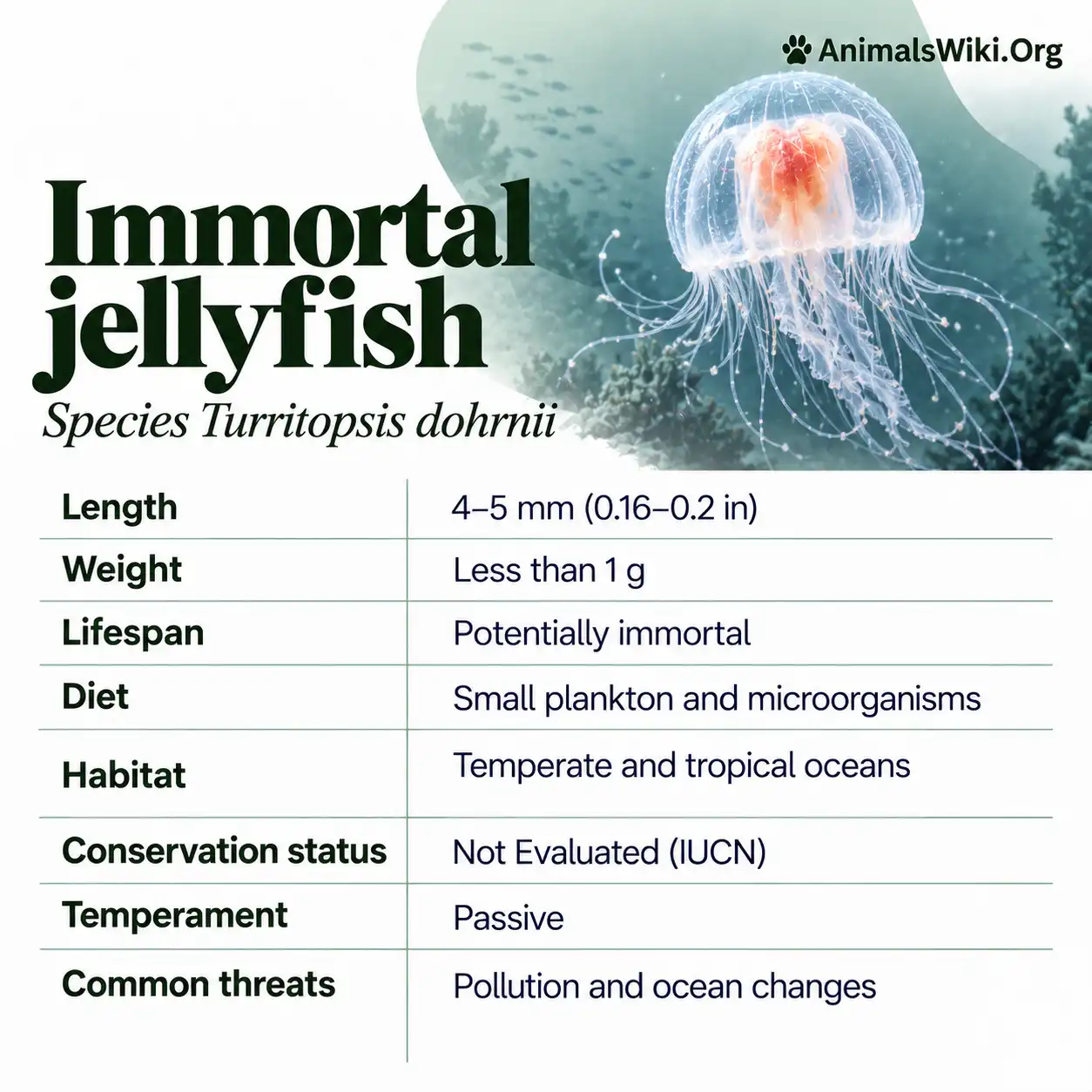
The immortal jellyfish (Turritopsis dohrnii) is one of the most extraordinary animals ever studied by scientists. This tiny marine creature possesses a remarkable biological ability: under certain conditions, it can reverse its development and return from its adult jellyfish stage to an earlier stage of its life cycle.
This process has earned it the popular nickname “the immortal jellyfish.”
But is this unusual animal truly immortal?
Not exactly.
The immortal jellyfish is not invincible, and it can still die from predators, disease, starvation, and environmental stress.
What makes it exceptional is its capacity for life-cycle reversal, a form of developmental rejuvenation that allows a mature medusa to transform into a younger polyp stage.
Most familiar jellyfish follow a life cycle in which an immature polyp eventually produces a free-swimming medusa.
In Turritopsis dohrnii, that progression can sometimes run in reverse.
Instead of continuing toward death, a stressed or damaged medusa may undergo a remarkable transformation.
Its body changes, its tissues reorganize, and it can eventually produce a new polyp colony.
Under suitable conditions, that colony may later generate new medusae.
This unusual ability has attracted worldwide scientific attention.
Researchers study the immortal jellyfish to understand cellular reprogramming, regeneration, development, and the biological mechanisms associated with aging.
However, scientists have not demonstrated that this animal can live forever in natural conditions.
The immortal jellyfish is also surprisingly small.
Its bell is usually only a few millimeters across, making it far less noticeable than large jellyfish species.
Despite its tiny size, it has become one of the most famous marine animals because of its extraordinary life history.
This comprehensive guide explores immortal jellyfish facts, scientific classification, anatomy, size, habitat, distribution, diet, life-cycle reversal, transdifferentiation, reproduction, lifespan, predators, adaptations, conservation, scientific research, and frequently asked questions.
Immortal Jellyfish Facts
| Feature | Information |
|---|---|
| Common name | Immortal Jellyfish |
| Scientific name | Turritopsis dohrnii |
| Animal group | Hydrozoan jellyfish |
| Family | Oceaniidae |
| Order | Anthoathecata |
| Class | Hydrozoa |
| Phylum | Cnidaria |
| Habitat | Marine coastal and offshore waters |
| Historical native region | Mediterranean Sea and nearby Atlantic waters |
| Distribution | Reported from multiple ocean regions |
| Bell diameter | Usually a few millimeters |
| Body shape | Small, transparent, bell-shaped medusa |
| Tentacles | Numerous; number varies with development |
| Diet | Small planktonic animals |
| Feeding type | Carnivorous |
| Main adaptation | Reversal from medusa to polyp |
| Special biological process | Cellular reprogramming and transdifferentiation |
| Reproduction | Sexual and asexual stages |
| Life-cycle stages | Planula, polyp, and medusa |
| Lifespan | No verified maximum lifespan |
| Main predators | Fish and other plankton-feeding animals |
| Human danger | Not generally considered dangerous |
| Conservation | Population status incompletely assessed |
What Is an Immortal Jellyfish?
The immortal jellyfish is a small hydrozoan cnidarian belonging to the species Turritopsis dohrnii.
It is famous for its ability to reverse its life cycle.
Unlike many jellyfish that eventually die after reaching maturity, this species can sometimes transform back into a juvenile polyp stage.
Is the Immortal Jellyfish a Real Jellyfish?
Yes.
It is a hydrozoan jellyfish.
However, it differs from the larger scyphozoan jellyfish commonly seen washed onto beaches.
Why Is It Called the Immortal Jellyfish?
Because it can reverse its development and potentially repeat parts of its life cycle.
Is the Immortal Jellyfish Actually Immortal?
It is sometimes described as biologically immortal because of its rejuvenation ability.
However, it can still die, and indefinite survival in nature has not been demonstrated.
Is the Immortal Jellyfish an Invertebrate?
Yes.
It does not possess a backbone.
Scientific Classification of the Immortal Jellyfish
| Classification | Name |
|---|---|
| Kingdom | Animalia |
| Phylum | Cnidaria |
| Subphylum | Medusozoa |
| Class | Hydrozoa |
| Order | Anthoathecata |
| Family | Oceaniidae |
| Genus | Turritopsis |
| Species | Turritopsis dohrnii |
What Does Turritopsis dohrnii Mean?
Turritopsis is the scientific genus containing several small hydrozoan jellyfish.
The species name dohrnii honors the zoologist Anton Dohrn.
Is the Immortal Jellyfish Related to Other Jellyfish?
Yes.
It belongs to the phylum Cnidaria.
Is the Immortal Jellyfish Related to Coral?
Yes.
Jellyfish and corals both belong to Cnidaria.
Is the Immortal Jellyfish Related to Sea Anemones?
Yes.
They share a broader cnidarian ancestry.
Discovery of the Immortal Jellyfish
Turritopsis dohrnii was scientifically described in the nineteenth century.
Its remarkable life-cycle reversal was recognized much later.
Research during the late twentieth century demonstrated that certain Turritopsis medusae could transform into polyp stages.
When Was the Immortal Jellyfish Discovered?
The species was described in 1883.
When Was Its Rejuvenation Ability Discovered?
Experimental observations of life-cycle reversal became prominent during research in the late twentieth century, especially in the 1990s.
Why Was This Discovery Important?
It demonstrated an unusual form of developmental reversal in an animal.
The findings opened new research questions about cell identity, regeneration, and aging.
What Does an Immortal Jellyfish Look Like?
The immortal jellyfish is tiny and mostly transparent.
Its appearance includes:
- Small bell-shaped body
- Transparent outer tissues
- Central digestive structures
- Numerous tentacles
- Radial canals
- Ring canal
- Mouth
- Specialized stinging cells
What Color Is the Immortal Jellyfish?
Its bell is generally transparent.
Internal structures may appear reddish or orange.
Does the Immortal Jellyfish Have Tentacles?
Yes.
Does the Immortal Jellyfish Have Eyes?
It does not possess complex camera-type eyes like those of vertebrates.
Does the Immortal Jellyfish Have a Brain?
No.
It possesses a diffuse nervous system rather than a centralized brain.
Immortal Jellyfish Size and Weight
The immortal jellyfish is extremely small.
How Big Is the Immortal Jellyfish?
Its bell is typically only a few millimeters across.
Can You See an Immortal Jellyfish Without a Microscope?
Yes, but it is very small and difficult to identify without magnification.
How Much Does an Immortal Jellyfish Weigh?
Its weight is extremely low and not commonly reported.
Is the Immortal Jellyfish the Smallest Jellyfish?
No.
Other hydrozoan species can also be extremely small.
Where Do Immortal Jellyfish Live?
Turritopsis dohrnii has been associated historically with the Mediterranean region.
Related populations and records occur in several ocean regions.
Do Immortal Jellyfish Live in the Mediterranean Sea?
Yes.
Do Immortal Jellyfish Live in the Atlantic Ocean?
Yes, records exist from Atlantic waters.
Do Immortal Jellyfish Live in the Pacific Ocean?
Turritopsis jellyfish occur in Pacific waters, but species identification requires care because several closely related species exist.
Do Immortal Jellyfish Live in Freshwater?
No.
Turritopsis dohrnii is a marine species.
Immortal Jellyfish Habitat
The immortal jellyfish occurs in marine environments.
Its life stages occupy different habitats.
The medusa stage swims or drifts through the water.
The polyp stage attaches to solid surfaces.
Where Do Immortal Jellyfish Polyps Live?
Polyps attach to substrates such as:
- Rocks
- Shells
- Other hard surfaces
- Artificial marine structures
Where Do Immortal Jellyfish Medusae Live?
They occur in the water column.
Are Immortal Jellyfish Deep-Sea Animals?
They are not exclusively deep-sea animals.
They are generally associated with marine environments that include coastal waters.
What Makes the Immortal Jellyfish Special?
Its most famous adaptation is the ability to reverse its life cycle.
A mature medusa may transform into a polyp under certain conditions.
Can an Immortal Jellyfish Become Young Again?
It can return to an earlier developmental stage.
However, this is not identical to a human becoming younger.
Can an Immortal Jellyfish Repeat Its Life Cycle?
Under suitable conditions, it can potentially repeat the transition between polyp and medusa stages.
Can Every Jellyfish Reverse Its Life Cycle?
No.
Life-cycle reversal is not a universal feature of jellyfish.
Immortal Jellyfish Life Cycle
The immortal jellyfish has a complex life cycle involving sexual and asexual stages.
Stage 1: Fertilization
Eggs are fertilized, producing embryos.
Stage 2: Planula Larva
The embryo develops into a small swimming larva called a planula.
Stage 3: Settlement
The planula attaches to a suitable surface.
Stage 4: Polyp Formation
It develops into a polyp.
Stage 5: Polyp Colony
Polyps may reproduce asexually and form colonies.
Stage 6: Medusa Production
The colony produces small free-swimming medusae.
Stage 7: Adult Medusa
Medusae grow and reproduce sexually.
Stage 8: Life-Cycle Reversal
Under certain conditions, a medusa can undergo regression and return to the polyp stage.
This reversal is the feature that makes the species extraordinary.
How Does the Immortal Jellyfish Reverse Its Life Cycle?
Life-cycle reversal involves dramatic changes in tissue organization and cell identity.
The medusa may contract, lose its normal swimming form, and transform into a cyst-like structure.
From this structure, new polyp tissue can develop.
What Is Transdifferentiation?
Transdifferentiation occurs when a differentiated cell changes into another differentiated cell type.
It is one of the cellular processes associated with developmental plasticity.
Does Every Cell Become Young Again?
No.
The transformation involves complex tissue remodeling and cellular processes.
It should not be described as every cell simply becoming a young version of itself.
Does the Jellyfish Turn Into an Egg Again?
No.
It generally reverts toward the polyp stage rather than returning to a fertilized egg.
What Triggers Life-Cycle Reversal?
Researchers have observed reversal in response to conditions such as:
- Physical injury
- Environmental stress
- Starvation
- Changes in temperature
- Other unfavorable conditions
Does the Jellyfish Reverse Its Life Cycle Every Day?
No.
It is not a normal daily behavior.
Can the Jellyfish Reverse Its Life Cycle When Injured?
In some circumstances, injury can trigger the process.
Can Starvation Trigger Rejuvenation?
Starvation has been associated with life-cycle reversal under experimental conditions.
Is the Immortal Jellyfish Truly Immortal?
The answer depends on how immortality is defined.
The species can reverse its developmental cycle, potentially avoiding some consequences of progressing through a single adult life stage.
However, it remains vulnerable to death.
Can an Immortal Jellyfish Die?
Yes.
Can Predators Kill an Immortal Jellyfish?
Yes.
Can Disease Kill an Immortal Jellyfish?
Yes.
Can an Immortal Jellyfish Starve to Death?
Yes.
Life-cycle reversal is not guaranteed to succeed under every condition.
Can an Immortal Jellyfish Live Forever?
There is no verified observation of an individual living forever.
Immortal Jellyfish and Aging
The immortal jellyfish has attracted attention from scientists studying aging.
Its ability to reorganize tissues raises questions about developmental plasticity and cellular maintenance.
Does the Immortal Jellyfish Stop Aging?
It can reverse aspects of its developmental progression.
However, this does not establish that all forms of cellular aging are permanently eliminated.
Can Scientists Use It to Stop Human Aging?
Not currently.
Research on this species may improve understanding of cell biology, but it does not provide a proven treatment for human aging.
Can Humans Become Immortal Like This Jellyfish?
No existing scientific method allows humans to reverse their entire life cycle like Turritopsis dohrnii.
What Do Immortal Jellyfish Eat?
Immortal jellyfish are carnivorous.
Their diet includes small planktonic organisms.
Potential prey includes:
- Copepods
- Small crustaceans
- Planktonic larvae
- Other tiny marine animals
Do Immortal Jellyfish Eat Fish?
They are too small to prey on most fish.
Do Immortal Jellyfish Eat Plankton?
Yes.
They consume animal plankton.
Are Immortal Jellyfish Carnivores?
Yes.
How Do Immortal Jellyfish Hunt?
They use tentacles equipped with specialized stinging cells.
These cells contain structures called nematocysts.
What Are Nematocysts?
Nematocysts are microscopic stinging capsules found in cnidarians.
Do Immortal Jellyfish Sting Their Prey?
Yes.
Do Immortal Jellyfish Have Teeth?
No.
How Do Immortal Jellyfish Digest Food?
Captured prey is transported toward the mouth and digested in the gastrovascular cavity.
Immortal Jellyfish Movement
The medusa stage moves by contracting its bell.
Can Immortal Jellyfish Swim?
Yes.
Are Immortal Jellyfish Fast Swimmers?
No.
They are small animals whose movement is strongly influenced by water currents.
Do Immortal Jellyfish Drift?
Yes.
They can be carried by ocean currents.
Immortal Jellyfish Reproduction
The species has both sexual and asexual reproductive stages.
Do Immortal Jellyfish Lay Eggs?
The medusa stage produces reproductive cells, and fertilization leads to embryos.
Do Immortal Jellyfish Reproduce Sexually?
Yes.
Do Immortal Jellyfish Reproduce Asexually?
Yes.
The polyp stage can reproduce asexually.
Can Immortal Jellyfish Clone Themselves?
Asexual reproduction can produce genetically similar offspring.
Baby Immortal Jellyfish
The earliest developmental stage after fertilization is an embryo.
It later develops into a planula larva.
What Is a Baby Immortal Jellyfish Called?
A planula is an early larval stage.
Do Baby Immortal Jellyfish Look Like Adults?
No.
Their early developmental stages differ significantly from adult medusae.
Do Baby Immortal Jellyfish Have Tentacles?
Tentacles develop during later stages.
How Long Do Immortal Jellyfish Live?
There is no verified maximum lifespan for Turritopsis dohrnii.
Its life-cycle reversal makes conventional lifespan measurement difficult.
Can an Immortal Jellyfish Live for 100 Years?
There is no reliable evidence confirming a 100-year lifespan for an individual.
Can an Immortal Jellyfish Live for 1,000 Years?
No verified evidence supports such claims.
Why Is Its Lifespan Difficult to Measure?
Because the animal can change developmental stages and may produce new medusae through a polyp colony.
Tracking individual identity over repeated cycles is challenging.
Immortal Jellyfish Adaptations
Life-Cycle Reversal
Allows developmental regression.
Cellular Plasticity
Supports tissue reorganization.
Transdifferentiation
Contributes to changes in cell identity.
Small Body Size
Supports a planktonic lifestyle.
Transparent Body
May reduce visibility.
Stinging Cells
Help capture prey.
Polyp Colony Formation
Supports asexual reproduction.
Medusa Stage
Allows dispersal and sexual reproduction.
Environmental Responsiveness
Allows changes in development under certain conditions.
Marine Dispersal
Supports movement across ocean environments.
What Animals Eat Immortal Jellyfish?
Potential predators include:
- Small fish
- Larger jellyfish
- Other plankton-feeding marine animals
Do Fish Eat Immortal Jellyfish?
Yes, some fish consume small gelatinous plankton.
Do Larger Jellyfish Eat Immortal Jellyfish?
Some jellyfish consume other gelatinous animals.
Can Immortal Jellyfish Escape Predators by Rejuvenating?
Life-cycle reversal does not provide an instant escape from being eaten.
Immortal Jellyfish vs. Moon Jellyfish
| Feature | Immortal Jellyfish | Moon Jellyfish |
|---|---|---|
| Scientific name | Turritopsis dohrnii | Aurelia species |
| Class | Hydrozoa | Scyphozoa |
| Size | A few millimeters | Much larger |
| Life-cycle reversal | Documented | Not equivalent |
| Body | Tiny transparent medusa | Broad translucent bell |
| Habitat | Marine waters | Marine waters |
Immortal Jellyfish vs. Box Jellyfish
| Feature | Immortal Jellyfish | Box Jellyfish |
|---|---|---|
| Scientific group | Turritopsis dohrnii | Cubozoa |
| Size | Tiny | Species-dependent |
| Body shape | Small bell | Box-like bell |
| Human danger | Low | Some species highly dangerous |
| Main distinction | Life-cycle reversal | Complex eyes and potent stings in some species |
| Habitat | Marine | Marine |
Immortal Jellyfish vs. Hydra
Hydra are small freshwater cnidarians famous for regenerative abilities.
Immortal jellyfish are marine hydrozoans capable of life-cycle reversal.
Both attract scientific interest in regeneration and aging.
However, their biological mechanisms are not identical.
Are Immortal Jellyfish Dangerous to Humans?
Immortal jellyfish are not generally considered dangerous to humans.
They possess stinging cells, but their tiny size and prey specialization make them unlikely to cause significant human injury.
Can Immortal Jellyfish Sting Humans?
They possess stinging cells, but their stings are not generally regarded as medically significant.
Are Immortal Jellyfish Venomous?
Their nematocysts deliver substances used to capture prey.
Are Immortal Jellyfish Poisonous?
They are not generally recognized as poisonous to touch.
Can You Touch an Immortal Jellyfish?
Unnecessary handling should be avoided because they are delicate animals.
Are Immortal Jellyfish Endangered?
Their conservation status is not comprehensively documented.
The species is difficult to monitor because of its small size and complex life cycle.
What Threatens Immortal Jellyfish?
Potential threats include:
- Marine pollution
- Changes in ocean temperature
- Habitat alteration
- Changes in plankton availability
- Coastal ecosystem disturbance
Can Climate Change Affect Immortal Jellyfish?
Yes.
Environmental changes may influence their distribution, reproduction, and survival.
Can Pollution Kill Immortal Jellyfish?
Yes.
Their ability to reverse development does not protect them from all environmental hazards.
Why Are Immortal Jellyfish Important?
Immortal jellyfish are scientifically important because of their unusual developmental biology.
They provide opportunities to investigate:
- Cell reprogramming
- Transdifferentiation
- Regeneration
- Aging
- Developmental biology
- Marine evolution
Can Immortal Jellyfish Help Scientists Understand Aging?
Yes.
Research may reveal mechanisms associated with tissue maintenance and developmental rejuvenation.
Can Immortal Jellyfish Cure Aging?
No.
There is currently no evidence that studying this species has produced a cure for human aging.
50 Interesting Immortal Jellyfish Facts
- The immortal jellyfish’s scientific name is Turritopsis dohrnii.
- It is a marine cnidarian.
- It belongs to the class Hydrozoa.
- It is an invertebrate.
- It is extremely small.
- Its bell is usually only a few millimeters wide.
- Its body is mostly transparent.
- Internal structures may appear reddish.
- It possesses tentacles.
- It has stinging cells.
- It uses nematocysts to capture prey.
- It is carnivorous.
- It eats small planktonic animals.
- It inhabits marine waters.
- It is associated historically with the Mediterranean region.
- Related populations occur in multiple ocean regions.
- It has a complex life cycle.
- Its life cycle includes a planula stage.
- It also has a polyp stage.
- It produces free-swimming medusae.
- Medusae reproduce sexually.
- Polyps can reproduce asexually.
- It is famous for life-cycle reversal.
- A medusa can return to a polyp stage.
- This process may occur after stress or injury.
- Starvation can be associated with developmental reversal.
- Tissue remodeling is involved.
- Cellular reprogramming contributes to the process.
- Transdifferentiation is associated with its developmental plasticity.
- It does not turn back into a fertilized egg.
- It can potentially repeat parts of its life cycle.
- Its rejuvenation ability inspired the name immortal jellyfish.
- It is not invincible.
- Predators can kill it.
- Disease can kill it.
- Environmental stress can kill it.
- It has no verified maximum lifespan.
- No individual has been proven to live forever.
- It does not possess a centralized brain.
- It has a diffuse nervous system.
- It swims by contracting its bell.
- Ocean currents influence its movement.
- It can attach to surfaces during the polyp stage.
- Polyp colonies can produce new medusae.
- It was scientifically described in 1883.
- Its rejuvenation ability became widely recognized during late twentieth-century research.
- Scientists study it to understand regeneration.
- It provides insights into developmental biology.
- It has not provided a proven treatment for human aging.
- Its ability to reverse development makes it one of the most extraordinary animals in the ocean.
Did You Know?
The Jellyfish That Can Return to Childhood
Imagine a tiny jellyfish drifting through warm Mediterranean waters.
Its transparent bell is only a few millimeters wide.
Delicate tentacles extend beneath its body.
It moves slowly through the water, feeding on microscopic marine animals.
To most observers, it appears to be an ordinary small jellyfish.
But this animal possesses an extraordinary biological ability.
Under certain conditions, its life cycle can reverse.
Imagine that the jellyfish experiences environmental stress.
Instead of continuing through its adult stage, its body begins to change.
The familiar bell contracts.
Its tentacles disappear.
Its tissues reorganize.
The animal transforms into a small cyst-like structure.
From this structure, a new polyp can develop.
The polyp attaches to a surface.
It may grow into a colony.
Later, the colony can produce new free-swimming jellyfish.
The life cycle has effectively restarted.
This is the remarkable biology of Turritopsis dohrnii.
Scientists call the process life-cycle reversal.
It involves changes in cell identity and tissue organization.
One important concept is transdifferentiation, in which differentiated cells can change into other cell types.
The discovery has inspired research into regeneration, development, and aging.
But the word immortal can be misleading.
The jellyfish can still be eaten.
It can still become diseased.
It can still die from unfavorable conditions.
Its special ability does not make it indestructible.
Instead, it demonstrates that some animals possess extraordinary developmental flexibility.
For humans, aging is associated with complex changes throughout the body.
The immortal jellyfish does not provide a simple solution to those processes.
However, studying its biology may help scientists better understand how cells change identity and how tissues can be reorganized.
The immortal jellyfish is not a creature that has defeated death—it is a remarkable animal that can sometimes reverse its developmental journey, challenging our understanding of how animal life cycles work.
Frequently Asked Questions About Immortal Jellyfish
What is an immortal jellyfish?
An immortal jellyfish is a small marine hydrozoan known scientifically as Turritopsis dohrnii.
What is the scientific name of the immortal jellyfish?
Turritopsis dohrnii.
Why is it called the immortal jellyfish?
Because it can reverse its life cycle and return to an earlier developmental stage.
Is the immortal jellyfish really immortal?
Not in the sense of being indestructible or guaranteed to live forever.
Can an immortal jellyfish die?
Yes.
Can predators kill an immortal jellyfish?
Yes.
Can disease kill an immortal jellyfish?
Yes.
Can an immortal jellyfish starve?
Yes.
Can an immortal jellyfish live forever?
No individual has been scientifically demonstrated to live forever.
Is the immortal jellyfish a real jellyfish?
Yes.
Is the immortal jellyfish a fish?
No.
Is the immortal jellyfish an invertebrate?
Yes.
Is the immortal jellyfish related to coral?
Yes.
Is the immortal jellyfish related to sea anemones?
Yes.
When was the immortal jellyfish discovered?
It was scientifically described in 1883.
When was its rejuvenation ability discovered?
The phenomenon became widely recognized through research in the late twentieth century.
How big is an immortal jellyfish?
Its bell is usually only a few millimeters wide.
Can you see an immortal jellyfish?
Yes, but magnification is useful for identification.
What color is an immortal jellyfish?
Mostly transparent, with some internal structures appearing reddish.
Does an immortal jellyfish have tentacles?
Yes.
Does an immortal jellyfish have eyes?
It does not possess complex camera-type eyes.
Does an immortal jellyfish have a brain?
No.
Where do immortal jellyfish live?
In marine waters, historically associated with the Mediterranean and nearby Atlantic.
Do immortal jellyfish live in the Mediterranean Sea?
Yes.
Do immortal jellyfish live in the Atlantic Ocean?
Yes.
Do immortal jellyfish live in the Pacific Ocean?
Related Turritopsis populations occur there, but species identification requires care.
Do immortal jellyfish live in freshwater?
No.
Are immortal jellyfish deep-sea animals?
They are not exclusively deep-sea animals.
What is the immortal jellyfish life cycle?
It includes embryo, planula, polyp, and medusa stages.
What is a planula?
A small swimming larval stage.
What is a polyp?
An attached stage that can grow and reproduce asexually.
What is a medusa?
The free-swimming jellyfish stage.
How does an immortal jellyfish become young again?
It can undergo developmental reversal from medusa toward polyp.
Does the immortal jellyfish turn into an egg again?
No.
What is transdifferentiation?
The conversion of one differentiated cell type into another.
Does every immortal jellyfish reverse its life cycle?
Not necessarily.
What triggers life-cycle reversal?
Stress, injury, starvation, and other environmental conditions may trigger it.
Can injury trigger rejuvenation?
Yes, under certain conditions.
Can starvation trigger rejuvenation?
It has been associated with reversal in experimental observations.
Does the immortal jellyfish reverse its life cycle every day?
No.
Can the immortal jellyfish repeat its life cycle?
Potentially, under suitable conditions.
Does the immortal jellyfish stop aging?
It can reverse developmental stages, but that does not establish complete elimination of cellular aging.
Can immortal jellyfish help scientists study aging?
Yes.
Can immortal jellyfish cure human aging?
No proven treatment has resulted from this research.
Can humans become immortal like jellyfish?
No existing method allows humans to reverse their entire life cycle in this way.
What do immortal jellyfish eat?
Small planktonic animals.
Are immortal jellyfish carnivores?
Yes.
Do immortal jellyfish eat fish?
They are too small to eat most fish.
Do immortal jellyfish eat plankton?
Yes.
How do immortal jellyfish hunt?
Using tentacles with stinging cells.
What are nematocysts?
Microscopic stinging capsules found in cnidarians.
Can immortal jellyfish swim?
Yes.
Are immortal jellyfish fast swimmers?
No.
Do immortal jellyfish drift?
Yes.
Do immortal jellyfish reproduce sexually?
Yes, during the medusa stage.
Do immortal jellyfish reproduce asexually?
Yes, during the polyp stage.
Can immortal jellyfish clone themselves?
Asexual reproduction can produce genetically similar offspring.
What is a baby immortal jellyfish called?
The planula is an early larval stage.
Do baby immortal jellyfish look like adults?
No.
How long do immortal jellyfish live?
Their maximum lifespan is unknown.
Can immortal jellyfish live for 100 years?
There is no verified evidence confirming such a lifespan.
Can immortal jellyfish live for 1,000 years?
No verified evidence supports that claim.
What animals eat immortal jellyfish?
Fish and other plankton-feeding marine animals.
Are immortal jellyfish dangerous to humans?
They are not generally considered dangerous.
Can immortal jellyfish sting?
They possess stinging cells.
Are immortal jellyfish venomous?
Their stinging cells contain substances used to capture prey.
Can you touch an immortal jellyfish?
Handling is discouraged because they are delicate.
Are immortal jellyfish endangered?
Their conservation status is incompletely documented.
What threatens immortal jellyfish?
Pollution, environmental changes, and habitat disturbance.
Why are immortal jellyfish important?
They provide valuable insights into regeneration, developmental plasticity, and aging.
What is the most interesting immortal jellyfish fact?
The immortal jellyfish can sometimes reverse its life cycle from an adult medusa to an earlier polyp stage, allowing it to restart part of its development.
Conclusion
The immortal jellyfish is one of the most extraordinary animals ever studied by marine biologists.
Despite being only a few millimeters wide, it possesses a remarkable ability to reverse its developmental cycle.
Under certain conditions, an adult medusa can transform into an earlier polyp stage.
This process involves tissue remodeling and cellular changes that have attracted scientific interest worldwide.
However, the immortal jellyfish is not truly invincible.
It can still die from predators, disease, starvation, and environmental stress.
Its unusual biology does not prove that an individual can survive forever.
Instead, it reveals how flexible animal development can be.
Scientists continue to investigate its cellular mechanisms to better understand regeneration, cell identity, and aging.
The immortal jellyfish is a tiny ocean creature with an enormous scientific significance, reminding us that some of nature’s most remarkable discoveries come from its smallest animals.
SEO Information
Primary keyword: Immortal Jellyfish
Secondary keywords: Immortal Jellyfish facts, Immortal Jellyfish scientific name, Turritopsis dohrnii, is the Immortal Jellyfish really immortal, can Immortal Jellyfish die, Immortal Jellyfish life cycle, Immortal Jellyfish rejuvenation, Immortal Jellyfish transdifferentiation, Immortal Jellyfish regeneration, Immortal Jellyfish aging, Immortal Jellyfish size, Immortal Jellyfish habitat, where do Immortal Jellyfish live, Immortal Jellyfish diet, what do Immortal Jellyfish eat, Immortal Jellyfish reproduction, Immortal Jellyfish polyp, Immortal Jellyfish medusa, Immortal Jellyfish planula, Immortal Jellyfish lifespan, Immortal Jellyfish predators, Immortal Jellyfish adaptations, Immortal Jellyfish vs Moon Jellyfish, Immortal Jellyfish vs Box Jellyfish, Immortal Jellyfish vs Hydra, are Immortal Jellyfish dangerous, Immortal Jellyfish scientific research.
SEO meta title: Immortal Jellyfish Facts: Life Cycle, Aging & Rejuvenation
Meta description: Discover fascinating Immortal Jellyfish facts, including how Turritopsis dohrnii reverses its life cycle, regenerates tissues, survives, reproduces, and challenges our understanding of aging.
Suggested URL slug: immortal-jellyfish-facts
Suggested image alt text: Tiny transparent immortal jellyfish, Turritopsis dohrnii, with delicate tentacles and visible reddish internal structures floating in clear ocean water.
Suggested article category: Marine Animals / Jellyfish
Suggested tags: Immortal Jellyfish, Turritopsis dohrnii, Jellyfish Facts, Marine Biology, Life-Cycle Reversal, Transdifferentiation, Regeneration, Aging Research, Ocean Wildlife
Editorial note: The term “immortal” refers to the capacity for life-cycle reversal, not demonstrated indefinite survival. Distinguish Turritopsis dohrnii from related species and avoid claims that it cannot die, has a verified centuries-long lifespan, or provides a proven cure for human aging. Cellular mechanisms and distribution records should be checked against current peer-reviewed research before publication.