Lion’s Mane Jellyfish, The Giant Ocean Jellyfish With Thousands of Stinging Tentacles
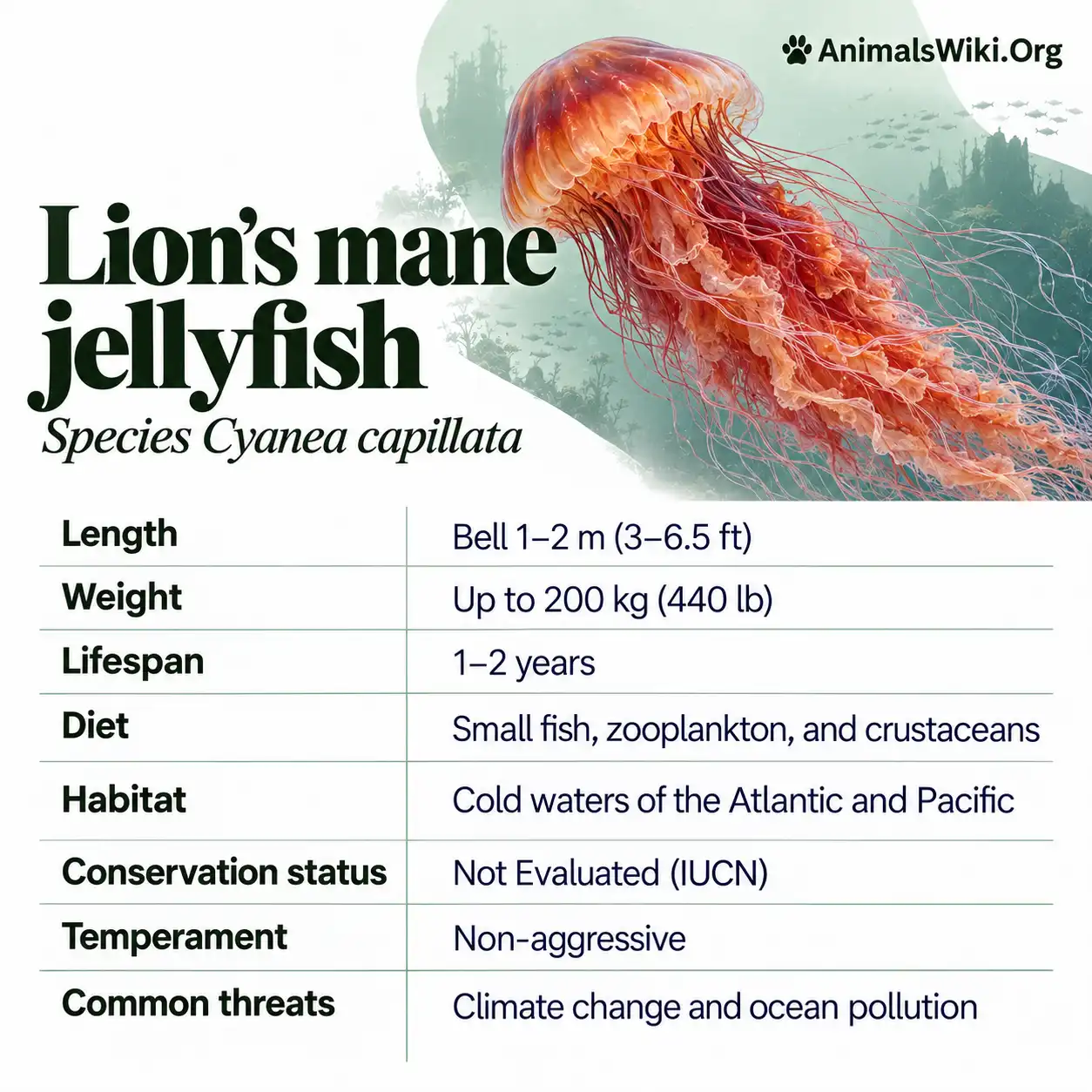
The lion’s mane jellyfish (Cyanea capillata) is one of the most extraordinary marine animals on Earth. Famous for its enormous bell, flowing hair-like tentacles, and striking reddish-orange coloration, this remarkable creature is widely recognized as one of the largest jellyfish species in the world.
Its appearance is both beautiful and intimidating.
From a distance, the lion’s mane jellyfish resembles a giant floating flower or an enormous underwater lion’s mane. Its long, delicate tentacles drift through the water, creating a spectacular display of color and movement.
But these tentacles are more than decorative structures.
They contain specialized stinging cells called cnidocytes, which help the jellyfish capture prey and defend itself.
The lion’s mane jellyfish inhabits cold and temperate marine waters, especially in the northern Atlantic, northern Pacific, and Arctic regions.
It is particularly associated with coastal and offshore environments where cold water, plankton, and ocean currents provide suitable conditions.
Some exceptionally large individuals have been reported with bells more than two meters across and tentacles extending for many meters.
A famous historical specimen was described as having tentacles approximately 36.6 meters (120 feet) long. However, such extreme measurements are difficult to verify, and they should not be treated as typical.
Despite its enormous potential size, the lion’s mane jellyfish has no brain, heart, bones, or centralized nervous system.
Instead, it survives through a combination of simple but effective anatomical structures, sensory systems, and feeding adaptations.
It is also an important marine predator, consuming zooplankton, small fish, and other gelatinous animals.
At the same time, it serves as prey for leatherback sea turtles and certain other marine predators.
This comprehensive guide explores lion’s mane jellyfish facts, scientific classification, anatomy, size, tentacle length, habitat, distribution, diet, stings, venom, behavior, reproduction, life cycle, lifespan, predators, adaptations, conservation, and frequently asked questions.
Lion’s Mane Jellyfish Facts
| Feature | Information |
|---|---|
| Common name | Lion’s Mane Jellyfish |
| Other name | Giant Jellyfish |
| Scientific name | Cyanea capillata |
| Family | Cyaneidae |
| Order | Semaeostomeae |
| Class | Scyphozoa |
| Phylum | Cnidaria |
| Animal type | True jellyfish |
| Habitat | Cold and temperate marine waters |
| Distribution | Northern Atlantic, northern Pacific, and Arctic regions |
| Bell diameter | Commonly tens of centimeters; exceptionally over 2 meters |
| Tentacle length | Several meters in large individuals; exceptional historical reports are much longer |
| Color | Red, orange, yellow, brown, or purple tones |
| Tentacles | Numerous, arranged in groups |
| Main feature | Large bell and long, hair-like stinging tentacles |
| Diet | Zooplankton, small fish, fish larvae, and other gelatinous prey |
| Feeding type | Carnivorous |
| Movement | Bell contractions and drifting |
| Reproduction | Sexual medusa stage and asexual polyp stage |
| Life cycle | Egg, planula, polyp, ephyra, medusa |
| Lifespan | Typically an annual medusa cycle in many populations |
| Main predators | Leatherback sea turtles and other jellyfish predators |
| Human danger | Painful stings; severe reactions are possible |
| Conservation | No comprehensive global population assessment established |
What Is a Lion’s Mane Jellyfish?
The lion’s mane jellyfish is a large marine cnidarian belonging to the species Cyanea capillata.
It is classified as a true jellyfish within the class Scyphozoa.
Unlike hydrozoan jellyfish such as the immortal jellyfish, the lion’s mane jellyfish belongs to a group characterized by a prominent medusa stage.
Why Is It Called the Lion’s Mane Jellyfish?
The name comes from its long, flowing tentacles, which resemble the thick mane of a lion.
Is the Lion’s Mane Jellyfish a Real Jellyfish?
Yes. It is a true jellyfish.
Is the Lion’s Mane Jellyfish a Fish?
No. Despite its common name, it is not a fish.
Is the Lion’s Mane Jellyfish an Invertebrate?
Yes. It has no backbone.
Scientific Classification of the Lion’s Mane Jellyfish
| Classification | Name |
|---|---|
| Kingdom | Animalia |
| Phylum | Cnidaria |
| Subphylum | Medusozoa |
| Class | Scyphozoa |
| Order | Semaeostomeae |
| Family | Cyaneidae |
| Genus | Cyanea |
| Species | Cyanea capillata |
What Does Cyanea capillata Mean?
The genus name Cyanea is associated with coloration, while capillata refers to hair-like structures.
The scientific name is appropriate for an animal famous for its long, hair-like tentacles.
Is the Lion’s Mane Jellyfish Related to Moon Jellyfish?
Yes. Both belong to the class Scyphozoa.
Is It Related to Box Jellyfish?
Yes, more distantly. Both belong to the phylum Cnidaria, but box jellyfish belong to a different class, Cubozoa.
Is It Related to Coral?
Yes. Corals and jellyfish share a common cnidarian ancestry.
What Does a Lion’s Mane Jellyfish Look Like?
The lion’s mane jellyfish has a broad, dome-shaped bell surrounded by numerous tentacles.
Its appearance includes:
- Large gelatinous bell
- Eight clusters of marginal tentacles
- Long, thin stinging tentacles
- Frilly oral arms
- Radial digestive structures
- Transparent or translucent tissues
- Reddish, orange, yellow, or brown coloration
- Sensory structures around the bell margin
Why Does It Look Like a Lion’s Mane?
Its numerous tentacles flow behind the bell like strands of hair.
Does It Have a Head?
No. The bell is not a head in the vertebrate sense.
Does It Have Eyes?
It lacks complex camera-type eyes, but possesses sensory structures that help it respond to environmental conditions.
Does It Have a Brain?
No. It has a distributed nerve net rather than a centralized brain.
Lion’s Mane Jellyfish Colors
The lion’s mane jellyfish can display several colors.
These include:
- Deep red
- Reddish-orange
- Golden yellow
- Pale yellow
- Brown
- Purple-brown
Smaller individuals may appear lighter, while larger individuals often have deeper coloration.
However, color varies with age, location, lighting, and individual characteristics.
Are All Lion’s Mane Jellyfish Red?
No. Their coloration is variable.
Can They Change Color?
They are not known for rapid color changes comparable to octopuses.
Lion’s Mane Jellyfish Size
The lion’s mane jellyfish is among the largest known jellyfish.
How Big Is a Lion’s Mane Jellyfish?
Many individuals have bells measuring tens of centimeters across.
Exceptionally large individuals may exceed two meters in bell diameter.
What Is the Largest Lion’s Mane Jellyfish Ever Recorded?
A frequently cited historical specimen from the nineteenth century was described as having a bell approximately 2.3 meters (7.5 feet) across and tentacles approximately 36.6 meters (120 feet) long.
These figures are widely repeated, but the historical measurement is difficult to independently verify.
Is the Lion’s Mane Jellyfish Bigger Than a Blue Whale?
Not in overall body mass or volume.
Some historical tentacle-length reports exceed the length of many blue whales, but that does not make the jellyfish a larger animal in every sense.
How Much Does a Lion’s Mane Jellyfish Weigh?
Weight varies enormously with bell size and water content.
Reliable maximum-weight records are limited.
How Long Are Lion’s Mane Jellyfish Tentacles?
The tentacles can extend several meters in large individuals.
Exceptional historical reports describe much greater lengths.
How Many Tentacles Does a Lion’s Mane Jellyfish Have?
Its marginal tentacles occur in eight groups.
The total number can reach hundreds or more in mature individuals.
Some descriptions refer to approximately 1,200 tentacles in exceptionally large specimens, but counts vary.
Why Does It Have So Many Tentacles?
Numerous tentacles increase the area available for capturing drifting prey.
Are All the Tentacles Venomous?
The tentacles contain stinging cells used for prey capture and defense.
Where Do Lion’s Mane Jellyfish Live?
Lion’s mane jellyfish inhabit northern marine waters.
They are associated with:
- Arctic Ocean
- North Atlantic Ocean
- North Pacific Ocean
- North Sea
- Baltic Sea regions
- Coastal waters of northern Europe
- Coastal waters of eastern Canada
- Northern United States coastal waters
Distribution records require care because several related Cyanea species can resemble one another.
Do Lion’s Mane Jellyfish Live in the Arctic Ocean?
Yes.
Do Lion’s Mane Jellyfish Live in the Atlantic Ocean?
Yes.
Do Lion’s Mane Jellyfish Live in the Pacific Ocean?
Yes, although species identification within Cyanea can be complex.
Do Lion’s Mane Jellyfish Live in Tropical Waters?
They are primarily associated with cooler marine environments.
Lion’s Mane Jellyfish Habitat
Lion’s mane jellyfish inhabit marine waters ranging from coastal areas to offshore environments.
Their habitats include:
- Cold coastal waters
- Open marine waters
- Bays
- Fjords
- Continental shelf environments
- Areas with abundant plankton
Are Lion’s Mane Jellyfish Deep-Sea Animals?
They can occur at different depths but are not exclusively deep-sea animals.
Do They Come Near Beaches?
Yes. They may occur near shore and sometimes wash onto beaches.
Can They Survive in Freshwater?
No. They are marine animals.
Do Ocean Currents Carry Them?
Yes. Currents strongly influence their distribution.
What Do Lion’s Mane Jellyfish Eat?
Lion’s mane jellyfish are carnivorous predators.
Their diet includes:
- Copepods
- Small crustaceans
- Fish larvae
- Small fish
- Other jellyfish
- Gelatinous plankton
Do Lion’s Mane Jellyfish Eat Fish?
Yes. They can capture small fish and fish larvae.
Do They Eat Other Jellyfish?
Yes. Other gelatinous animals can be part of their diet.
Do They Eat Plankton?
Yes, especially animal plankton.
Are Lion’s Mane Jellyfish Carnivores?
Yes.
How Do Lion’s Mane Jellyfish Hunt?
Lion’s mane jellyfish use their long tentacles to capture prey.
The tentacles contain cnidocytes equipped with nematocysts.
When suitable prey contacts the tentacles, stinging capsules can discharge.
The prey is immobilized or restrained and transported toward the mouth.
What Are Cnidocytes?
Cnidocytes are specialized stinging cells found in cnidarians.
What Are Nematocysts?
Nematocysts are microscopic capsules containing structures capable of rapid discharge.
Do Lion’s Mane Jellyfish Have Teeth?
No.
How Do They Digest Food?
They digest prey within a gastrovascular cavity.
Lion’s Mane Jellyfish Sting
The lion’s mane jellyfish can deliver painful stings.
The severity varies with the amount of contact, individual sensitivity, and other circumstances.
What Does a Lion’s Mane Jellyfish Sting Feel Like?
Symptoms may include:
- Burning pain
- Redness
- Itching
- Raised welts
- Skin irritation
- Local swelling
More serious reactions can occur, particularly after extensive exposure or in sensitive individuals.
Can a Lion’s Mane Jellyfish Sting Kill a Human?
Fatal outcomes are not typical, but severe systemic reactions and medical emergencies are possible.
Are Lion’s Mane Jellyfish More Dangerous Than Box Jellyfish?
The most dangerous box jellyfish species generally present a much greater risk of life-threatening envenomation.
Can Dead Lion’s Mane Jellyfish Still Sting?
Yes. Detached tentacles and stranded jellyfish may retain functional stinging cells.
What Should You Do if Stung by a Lion’s Mane Jellyfish?
Seek emergency medical assistance immediately if the person has difficulty breathing, chest pain, fainting, severe widespread symptoms, or a serious allergic reaction.
For a localized sting:
- Leave the water safely.
- Avoid rubbing or scraping the affected skin.
- Rinse carefully with seawater rather than freshwater.
- Remove visible tentacles using tweezers or protective gloves.
- Seek local medical or lifeguard advice about pain relief and appropriate treatment.
- Monitor for worsening symptoms.
Treatment recommendations differ among jellyfish species and regions. Vinegar, heat, and cold treatments should not be applied indiscriminately because their effects on nematocyst discharge and pain can vary.
Do not use urine or attempt to suck venom from the skin.
Can Lion’s Mane Jellyfish Swim?
Yes.
They move by contracting and relaxing their bells.
Are They Fast Swimmers?
No. They are relatively weak swimmers compared with fish.
Do They Drift With Ocean Currents?
Yes.
Can They Swim Against Currents?
Their swimming ability is limited relative to strong currents.
Lion’s Mane Jellyfish Nervous System
The lion’s mane jellyfish has no centralized brain.
Instead, it possesses a nerve net and specialized sensory structures.
How Does It Move Without a Brain?
Its nervous system coordinates bell contractions and responses to environmental stimuli.
Can It Feel Pain?
Jellyfish respond to harmful stimuli, but whether they experience conscious pain is scientifically uncertain.
Can It Think?
There is no evidence that lion’s mane jellyfish possess human-like thought or cognition.
Lion’s Mane Jellyfish Reproduction
Lion’s mane jellyfish have a complex life cycle involving sexual and asexual reproduction.
Do Lion’s Mane Jellyfish Lay Eggs?
Females produce eggs, and fertilization leads to embryos.
Do They Reproduce Sexually?
Yes, during the medusa stage.
Do They Reproduce Asexually?
Yes, during the polyp stage.
Do They Have Male and Female Individuals?
The species has sexual reproductive structures, with reproductive biology following the general scyphozoan pattern.
Lion’s Mane Jellyfish Life Cycle
Stage 1: Fertilization
Eggs are fertilized.
Stage 2: Planula Larva
The embryo develops into a small ciliated larva.
Stage 3: Settlement
The planula attaches to a suitable surface.
Stage 4: Scyphistoma Polyp
The attached larva develops into a polyp.
Stage 5: Strobilation
The polyp can produce young jellyfish through asexual segmentation.
Stage 6: Ephyra
A small, immature jellyfish is released.
Stage 7: Adult Medusa
The ephyra grows into a mature lion’s mane jellyfish.
Baby Lion’s Mane Jellyfish
Young jellyfish begin as ephyrae after being released from the polyp stage.
What Is a Baby Lion’s Mane Jellyfish Called?
An ephyra is an early free-swimming stage.
Do Baby Lion’s Mane Jellyfish Have Long Tentacles?
Their tentacles develop as they grow.
Are Baby Lion’s Mane Jellyfish Venomous?
Their stinging structures develop during growth.
How Long Do Lion’s Mane Jellyfish Live?
The free-swimming medusa stage often follows a seasonal or approximately annual life cycle.
The attached polyp stage may persist longer and can produce additional medusae.
Do Lion’s Mane Jellyfish Live for One Year?
Many populations have an approximately annual medusa cycle.
Can Lion’s Mane Jellyfish Live for Ten Years?
A ten-year lifespan for an individual medusa is not established.
Why Is Their Lifespan Difficult to Measure?
Their life cycle includes multiple developmental stages, and environmental conditions influence growth and survival.
Lion’s Mane Jellyfish Adaptations
Long Stinging Tentacles
Increase prey-capture opportunities.
Numerous Nematocysts
Help immobilize prey.
Large Bell
Supports swimming and body organization.
Gelatinous Body
Provides a water-rich structure suited to marine life.
Nerve Net
Coordinates movement without a centralized brain.
Sensory Rhopalia
Help detect environmental conditions.
Complex Life Cycle
Allows reproduction through different stages.
Asexual Polyp Reproduction
Can produce multiple young medusae.
Cold-Water Adaptation
Supports life in northern marine environments.
Extensive Feeding Surface
Helps capture small drifting prey.
What Animals Eat Lion’s Mane Jellyfish?
Potential predators include:
- Leatherback sea turtles
- Ocean sunfish
- Certain fish
- Other jellyfish predators
Do Leatherback Sea Turtles Eat Lion’s Mane Jellyfish?
Yes. Leatherback sea turtles consume large gelatinous prey, including lion’s mane jellyfish.
Do Ocean Sunfish Eat Lion’s Mane Jellyfish?
Ocean sunfish consume gelatinous organisms, although their diets are more varied than once assumed.
Can Other Jellyfish Eat Lion’s Mane Jellyfish?
Some jellyfish prey on other gelatinous animals.
Lion’s Mane Jellyfish and Marine Ecosystems
Lion’s mane jellyfish are important predators in marine food webs.
They consume zooplankton and small fish while also serving as prey for larger animals.
Do Lion’s Mane Jellyfish Affect Fish Populations?
They can consume fish eggs and larvae, potentially influencing local food-web dynamics.
Are They Important for Sea Turtles?
Yes. They can be a food source for leatherback sea turtles.
Do They Compete With Fish for Food?
They may consume some of the same planktonic prey as fish.
Lion’s Mane Jellyfish vs. Moon Jellyfish
| Feature | Lion’s Mane Jellyfish | Moon Jellyfish |
|---|---|---|
| Scientific name | Cyanea capillata | Aurelia species |
| Size | Can become enormous | Generally smaller |
| Tentacles | Numerous and often very long | Shorter marginal tentacles |
| Color | Red, orange, yellow, brown | Usually translucent |
| Sting | Often painful | Usually mild for humans |
| Habitat | Cold and temperate waters | Broad marine distribution |
Lion’s Mane Jellyfish vs. Nomura’s Jellyfish
Nomura’s jellyfish (Nemopilema nomurai) is another enormous jellyfish species.
Both can develop very large bells.
However, the lion’s mane jellyfish is especially famous for its long, hair-like tentacles.
Nomura’s jellyfish is notable for its massive bell and substantial body weight.
Lion’s Mane Jellyfish vs. Box Jellyfish
| Feature | Lion’s Mane Jellyfish | Box Jellyfish |
|---|---|---|
| Class | Scyphozoa | Cubozoa |
| Bell shape | Rounded | Box-like |
| Tentacles | Numerous marginal groups | Tentacles arise from corners |
| Habitat | Mostly cold and temperate waters | Many species in tropical or subtropical waters |
| Sting | Painful | Some species potentially fatal |
| Eyes | Simple sensory structures | Some have complex eyes |
Lion’s Mane Jellyfish vs. Immortal Jellyfish
The lion’s mane jellyfish and immortal jellyfish belong to different cnidarian classes.
The lion’s mane jellyfish is a large scyphozoan with long stinging tentacles.
The immortal jellyfish (Turritopsis dohrnii) is a tiny hydrozoan known for its ability to reverse its developmental life cycle.
Lion’s mane jellyfish are not known to possess the same form of life-cycle reversal.
Are Lion’s Mane Jellyfish Dangerous to Humans?
Lion’s mane jellyfish can cause painful stings.
Most localized stings are not life-threatening, but serious reactions are possible.
Can You Touch a Lion’s Mane Jellyfish?
No. Avoid contact with living, dead, or stranded individuals.
Can Lion’s Mane Jellyfish Sting Through Clothing?
Protective clothing can reduce exposure, but thin or poorly fitted material may not prevent all contact.
Are Lion’s Mane Jellyfish Poisonous?
They are venomous through their stinging cells rather than poisonous in the usual sense of being harmful when eaten or touched without venom injection.
Are Lion’s Mane Jellyfish Endangered?
A comprehensive global conservation assessment has not established a single population trend for the species.
Population abundance can vary greatly between regions and years.
Are Lion’s Mane Jellyfish Populations Increasing?
Changes in jellyfish abundance are complex and differ by location.
It is inaccurate to assume that all jellyfish populations are increasing worldwide.
What Threatens Lion’s Mane Jellyfish?
Potential environmental pressures include:
- Ocean warming
- Changes in prey availability
- Marine pollution
- Shifts in ocean currents
- Coastal habitat alteration
- Changes in predator populations
How Does Climate Change Affect Lion’s Mane Jellyfish?
Changes in temperature, currents, and plankton communities may alter their distribution and seasonal abundance.
Can Pollution Kill Lion’s Mane Jellyfish?
Yes. Pollution can affect marine organisms and their habitats.
Why Are Lion’s Mane Jellyfish Important?
They are important predators and prey within northern marine ecosystems.
Scientists study them to understand:
- Jellyfish ecology
- Marine food webs
- Cold-water adaptation
- Nematocyst biology
- Jellyfish population dynamics
- Ocean environmental change
50 Interesting Lion’s Mane Jellyfish Facts
- The lion’s mane jellyfish’s scientific name is Cyanea capillata.
- It belongs to the phylum Cnidaria.
- It is a true jellyfish.
- It belongs to the class Scyphozoa.
- It is an invertebrate.
- It is not a fish.
- It is among the largest jellyfish species.
- Its bell can exceed two meters in exceptional individuals.
- Its tentacles can extend many meters.
- A historical specimen was reported to have tentacles around 36.6 meters long.
- That extreme historical record is difficult to verify independently.
- Its tentacles resemble a lion’s mane.
- It can have hundreds of tentacles.
- Its tentacles are arranged in eight groups.
- Its coloration may be red, orange, yellow, or brown.
- Larger individuals often have deeper coloration.
- It inhabits cold and temperate marine waters.
- It occurs in northern Atlantic waters.
- It occurs in northern Pacific waters.
- It is associated with Arctic marine environments.
- It can appear near beaches.
- It may wash ashore.
- Detached tentacles can still sting.
- It possesses cnidocytes.
- Its stinging capsules are called nematocysts.
- Its stings can be painful.
- Severe reactions are possible.
- It has no centralized brain.
- It possesses a nerve net.
- It has no heart.
- It has no bones.
- It moves by contracting its bell.
- Ocean currents strongly influence its movement.
- It is carnivorous.
- It consumes zooplankton.
- It can eat small fish.
- It can consume fish larvae.
- It may prey on other jellyfish.
- Leatherback sea turtles eat it.
- It reproduces sexually during the medusa stage.
- It also has an asexual polyp stage.
- Its early larval stage is called a planula.
- Its attached stage is called a scyphistoma.
- Young medusae are called ephyrae.
- Polyps can produce ephyrae through strobilation.
- Many populations have an annual medusa cycle.
- It is important in marine food webs.
- Its abundance varies with environmental conditions.
- Scientists study its stinging cells and ecology.
- Its enormous bell and flowing tentacles make it one of the most spectacular animals in the ocean.
Did You Know?
The Jellyfish With Tentacles Longer Than a Blue Whale
Imagine exploring the cold waters of the northern Atlantic Ocean.
The sea is dark blue.
Sunlight filters through the upper layers.
Small fish swim among drifting plankton.
Suddenly, an enormous reddish shape appears in the distance.
It moves slowly through the water.
As it approaches, its massive bell becomes visible.
Beneath the bell hangs a dense collection of delicate tentacles.
They extend downward and trail behind the animal like a flowing underwater curtain.
This is a lion’s mane jellyfish.
Its appearance is almost unreal.
The bell contracts gently.
The tentacles sway with the current.
Each strand contains specialized stinging cells capable of capturing small marine animals.
A tiny fish swims into the trailing tentacles.
The jellyfish’s stinging structures discharge.
The prey becomes trapped and is gradually transported toward the mouth.
Despite its enormous appearance, the jellyfish has no brain or heart.
Its simple nervous system coordinates movement and feeding.
Its body is composed largely of water.
The surrounding ocean supports its gelatinous structure.
Some historical accounts describe lion’s mane jellyfish with tentacles extending more than 30 meters.
One famous report gives a length of approximately 36.6 meters.
If accurate, such tentacles would exceed the length of many blue whales.
However, scientists treat extreme historical measurements cautiously because verification is difficult.
Even without relying on those records, the lion’s mane jellyfish remains an extraordinary marine giant.
Its long tentacles create a large feeding area.
Its stinging cells help capture prey.
Its cold-water habitat provides access to plankton-rich marine ecosystems.
But this giant is also part of a larger food web.
A leatherback sea turtle may approach and begin feeding on the jellyfish.
The predator consumes the gelatinous animal, obtaining energy from a creature that itself feeds on smaller marine organisms.
The scene demonstrates how energy moves through ocean ecosystems.
Small plankton support jellyfish.
Jellyfish support larger predators.
And the enormous lion’s mane jellyfish plays an important role in connecting these different levels of marine life.
The lion’s mane jellyfish is a spectacular example of how an animal without bones, a heart, or a centralized brain can become one of the ocean’s most impressive predators.
Frequently Asked Questions About Lion’s Mane Jellyfish
What is a lion’s mane jellyfish?
A lion’s mane jellyfish is a large marine cnidarian belonging to the species Cyanea capillata.
What is the scientific name of the lion’s mane jellyfish?
Cyanea capillata.
Why is it called the lion’s mane jellyfish?
Because its long tentacles resemble a lion’s mane.
Is the lion’s mane jellyfish a real jellyfish?
Yes.
Is the lion’s mane jellyfish a fish?
No.
Is the lion’s mane jellyfish an invertebrate?
Yes.
Is the lion’s mane jellyfish a true jellyfish?
Yes. It belongs to the class Scyphozoa.
Is it related to moon jellyfish?
Yes.
Is it related to box jellyfish?
Yes, within the phylum Cnidaria.
Is it related to coral?
Yes.
How big is a lion’s mane jellyfish?
Many are tens of centimeters across, but exceptionally large individuals may have bells exceeding two meters.
What is the largest lion’s mane jellyfish?
A famous historical specimen was reported with a bell around 2.3 meters across.
How long are lion’s mane jellyfish tentacles?
They can extend several meters, with exceptional historical reports of much greater lengths.
Can lion’s mane jellyfish tentacles reach 120 feet?
A historical report describes this length, but it is difficult to verify.
Is the lion’s mane jellyfish longer than a blue whale?
Some reported tentacle lengths exceed the length of many blue whales, but the measurements are not typical.
How many tentacles does a lion’s mane jellyfish have?
It can have hundreds, arranged in eight groups.
Does the lion’s mane jellyfish have 1,200 tentacles?
Such counts have been reported for very large specimens, but numbers vary.
How much does a lion’s mane jellyfish weigh?
Weight varies greatly, and reliable maximum records are limited.
What color is a lion’s mane jellyfish?
Red, orange, yellow, brown, or related shades.
Are all lion’s mane jellyfish red?
No.
Where do lion’s mane jellyfish live?
In cold and temperate northern marine waters.
Do lion’s mane jellyfish live in the Arctic Ocean?
Yes.
Do lion’s mane jellyfish live in the Atlantic Ocean?
Yes.
Do lion’s mane jellyfish live in the Pacific Ocean?
Yes, although identification of related Cyanea species requires care.
Do lion’s mane jellyfish live in tropical waters?
They are mainly associated with cooler waters.
Do lion’s mane jellyfish live in freshwater?
No.
Do lion’s mane jellyfish come near beaches?
Yes.
Can lion’s mane jellyfish wash ashore?
Yes.
Can dead lion’s mane jellyfish sting?
Yes.
Are lion’s mane jellyfish dangerous?
They can cause painful stings and occasionally more serious reactions.
Can a lion’s mane jellyfish kill a human?
Fatal outcomes are not typical, but severe reactions require emergency medical attention.
What does a lion’s mane jellyfish sting feel like?
Burning pain, redness, itching, and welts are common symptoms.
What should you do after a lion’s mane jellyfish sting?
Leave the water, avoid rubbing, rinse with seawater, carefully remove tentacles, and seek medical advice. Serious symptoms require emergency care.
Should you use vinegar on a lion’s mane jellyfish sting?
Do not assume vinegar is appropriate. Treatment recommendations vary by species and region.
Can lion’s mane jellyfish sting through clothing?
Protective clothing can reduce exposure but may not eliminate all risk.
Do lion’s mane jellyfish have venom?
Yes. Their stinging cells deliver venom.
Do lion’s mane jellyfish have teeth?
No.
Do lion’s mane jellyfish have a brain?
No.
Do lion’s mane jellyfish have a heart?
No.
Do lion’s mane jellyfish have bones?
No.
Do lion’s mane jellyfish have eyes?
They possess sensory structures but lack complex camera-type eyes.
How do lion’s mane jellyfish move?
By contracting their bells and drifting with currents.
Can lion’s mane jellyfish swim?
Yes.
Are lion’s mane jellyfish fast swimmers?
No.
What do lion’s mane jellyfish eat?
Zooplankton, small fish, fish larvae, and other gelatinous animals.
Are lion’s mane jellyfish carnivores?
Yes.
Do lion’s mane jellyfish eat fish?
Yes.
Do lion’s mane jellyfish eat other jellyfish?
Yes.
Do lion’s mane jellyfish eat plankton?
Yes.
How do lion’s mane jellyfish hunt?
They capture prey with stinging tentacles.
What are cnidocytes?
Specialized stinging cells.
What are nematocysts?
Microscopic stinging capsules.
How do lion’s mane jellyfish digest food?
Inside their gastrovascular cavity.
How do lion’s mane jellyfish reproduce?
Sexually during the medusa stage and asexually during the polyp stage.
Do lion’s mane jellyfish lay eggs?
Females produce eggs.
What is a planula?
A small larval stage.
What is a scyphistoma?
An attached jellyfish polyp.
What is an ephyra?
A young free-swimming jellyfish.
What is strobilation?
A process in which a polyp produces young jellyfish.
What is a baby lion’s mane jellyfish called?
An ephyra during its early free-swimming stage.
How long do lion’s mane jellyfish live?
Many populations have an approximately annual medusa cycle.
Can lion’s mane jellyfish live for ten years?
Such a lifespan has not been established for individual medusae.
What animals eat lion’s mane jellyfish?
Leatherback sea turtles and other jellyfish predators.
Do leatherback sea turtles eat lion’s mane jellyfish?
Yes.
Do ocean sunfish eat lion’s mane jellyfish?
Ocean sunfish consume gelatinous animals, although their diets are varied.
Are lion’s mane jellyfish endangered?
A comprehensive global conservation assessment is not established.
What threatens lion’s mane jellyfish?
Environmental changes, pollution, and shifts in marine food webs.
Why are lion’s mane jellyfish important?
They are predators and prey in marine ecosystems.
What is the most interesting lion’s mane jellyfish fact?
A famous historical specimen was reported to have tentacles approximately 36.6 meters long, making the lion’s mane jellyfish one of the most extraordinary animals ever described in terms of potential tentacle length.
Conclusion
The lion’s mane jellyfish is one of the most spectacular marine animals in the world.
Its enormous bell, flowing tentacles, and striking colors make it instantly recognizable.
Although it lacks a brain, heart, and bones, it possesses effective adaptations for feeding, movement, reproduction, and survival.
Its long tentacles contain specialized stinging cells that help capture small fish, plankton, and other marine animals.
The lion’s mane jellyfish is also an important food source for predators such as leatherback sea turtles.
Its complex life cycle connects free-swimming medusae with attached polyp stages.
Despite its impressive appearance, the species remains sensitive to changes in ocean conditions and marine food webs.
Understanding its biology helps scientists investigate jellyfish ecology, cold-water ecosystems, and the relationships between marine predators and prey.
The lion’s mane jellyfish proves that some of the ocean’s most extraordinary giants can be built almost entirely from water, delicate tissues, and thousands of remarkably effective stinging cells.