Box Jellyfish, The Deadly Ocean Jellyfish With 24 Eyes and Powerful Venom
The box jellyfish is one of the most extraordinary and potentially dangerous marine animals in the world. Famous for its transparent, cube-shaped bell, long stinging tentacles, and surprisingly sophisticated visual system, this remarkable creature is among the ocean’s most specialized predators.
Unlike many jellyfish that drift primarily with ocean currents, box jellyfish are capable of active swimming and directional movement.
Some species can navigate around obstacles, respond to visual information, and hunt small fish and crustaceans with remarkable efficiency.
However, box jellyfish are especially famous for their venom.
Certain species, particularly the Australian box jellyfish (Chironex fleckeri), possess extremely potent venom that can cause severe pain, cardiovascular complications, and potentially fatal envenomation.
Not all box jellyfish are equally dangerous.
The term box jellyfish refers to an entire class of cnidarians called Cubozoa, containing numerous species with different sizes, habitats, venom characteristics, and ecological roles.
Some species produce relatively mild stings, while others are responsible for serious medical emergencies.
Box jellyfish also possess one of the most remarkable sensory systems among jellyfish.
Many species have 24 eyes, arranged in four sensory structures called rhopalia.
These eyes include different types, some capable of forming simple images.
Despite this visual complexity, box jellyfish do not possess a centralized brain comparable to that of vertebrates.
Their nervous systems coordinate swimming, sensory processing, and responses to the environment.
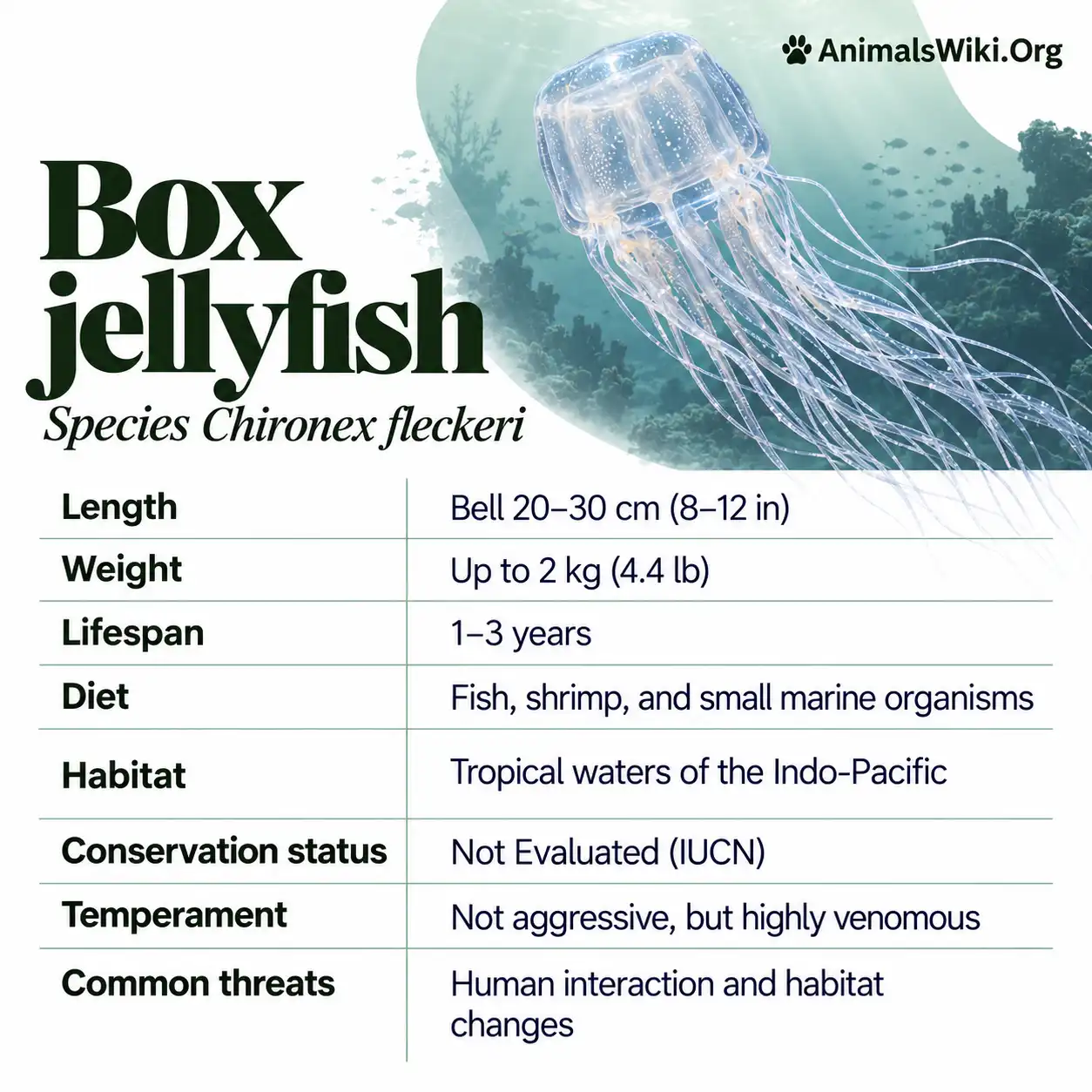
Box jellyfish inhabit tropical and subtropical marine waters, especially coastal regions of the Indo-Pacific.
They are important predators in marine food webs, feeding on fish, shrimp, and other small animals.
Their unusual anatomy, sophisticated vision, and potent venom make them fascinating subjects for marine biology, toxicology, and evolutionary research.
This comprehensive guide explores box jellyfish facts, scientific classification, species, anatomy, size, habitat, distribution, eyes, venom, stings, diet, hunting, behavior, reproduction, lifespan, predators, adaptations, conservation, and frequently asked questions.
Box Jellyfish Facts
| Feature | Information |
|---|---|
| Common name | Box Jellyfish |
| Scientific class | Cubozoa |
| Animal type | Marine cnidarian |
| Phylum | Cnidaria |
| Subphylum | Medusozoa |
| Class | Cubozoa |
| Major orders | Carybdeida and Chirodropida |
| Famous species | Chironex fleckeri |
| Bell shape | Box-like or cube-shaped |
| Habitat | Coastal tropical and subtropical marine waters |
| Distribution | Indo-Pacific and other warm-water regions |
| Bell size | Varies greatly by species |
| Large species | Bell height may reach around 30 cm |
| Tentacles | One or several per bell corner, depending on species |
| Eyes | Commonly 24, arranged in four rhopalia |
| Diet | Small fish, shrimp, and other marine animals |
| Feeding type | Carnivorous |
| Movement | Active swimming using bell contractions |
| Venom | Species-dependent; extremely potent in some |
| Main danger | Severe envenomation, including cardiovascular complications |
| Reproduction | Sexual medusa stage and polyp development |
| Lifespan | Species-dependent and incompletely documented |
| Predators | Sea turtles and some fish |
| Conservation | Varies by species; many poorly assessed |
What Is a Box Jellyfish?
A box jellyfish is a marine cnidarian belonging to the class Cubozoa.
The group is named for the distinctive box-like shape of its bell.
Box jellyfish are related to true jellyfish, corals, sea anemones, and other cnidarians.
However, they differ from typical scyphozoan jellyfish in several important ways.
These include:
- Box-shaped bell
- Specialized tentacle attachment structures
- Complex visual organs
- Strong swimming ability
- Distinctive nervous system organization
- Powerful venom in some species
Is a Box Jellyfish a Real Jellyfish?
Yes.
Box jellyfish are a distinct class of jellyfish-like cnidarians.
Is a Box Jellyfish a Fish?
No.
It is an invertebrate.
Why Is It Called a Box Jellyfish?
Because its bell has a box-like shape.
Are All Box Jellyfish Dangerous?
All possess stinging cells, but the severity of their stings varies greatly by species.
Scientific Classification of Box Jellyfish
| Classification | Name |
|---|---|
| Kingdom | Animalia |
| Phylum | Cnidaria |
| Subphylum | Medusozoa |
| Class | Cubozoa |
| Major orders | Carybdeida and Chirodropida |
| Example family | Chirodropidae |
| Example genus | Chironex |
| Example species | Chironex fleckeri |
What Does Cubozoa Mean?
The name refers to the cube-like body shape of these jellyfish.
Are Box Jellyfish Related to Moon Jellyfish?
Yes.
Both belong to Cnidaria, but moon jellyfish belong to the class Scyphozoa.
Are Box Jellyfish Related to Lion’s Mane Jellyfish?
Yes.
They share a cnidarian ancestry.
Are Box Jellyfish Related to Coral?
Yes.
Types of Box Jellyfish
Box jellyfish include multiple species.
1. Australian Box Jellyfish
Scientific name: Chironex fleckeri
This is one of the most dangerous known box jellyfish species.
It occurs in northern Australian and nearby Indo-Pacific waters.
Its venom can cause life-threatening envenomation.
2. Sea Wasp
The term sea wasp is commonly used for Chironex fleckeri, although it is sometimes applied more broadly to dangerous box jellyfish.
3. Irukandji Jellyfish
Example species: Carukia barnesi
This small box jellyfish can cause Irukandji syndrome, a potentially serious systemic reaction.
4. Four-Handed Box Jellyfish
Scientific name: Chiropsalmus quadrumanus
This species occurs in parts of the Atlantic region and can produce medically significant stings.
5. Other Box Jellyfish Species
Numerous additional cubozoan species occur in tropical and subtropical waters.
Their biology and venom potency vary.
What Does a Box Jellyfish Look Like?
Box jellyfish possess a transparent or translucent bell with four distinct sides.
Their anatomy includes:
- Cube-shaped bell
- Four bell corners
- Tentacles
- Pedalia
- Rhopalia
- Eyes
- Mouth
- Manubrium
- Gastrovascular structures
- Stinging cells
What Are Pedalia?
Pedalia are muscular structures at the bell corners from which tentacles extend.
What Are Rhopalia?
Rhopalia are sensory structures that contain eyes and other sensory components.
Do Box Jellyfish Have Tentacles?
Yes.
Do Box Jellyfish Have Bones?
No.
Box Jellyfish Size and Weight
Box jellyfish vary greatly in size.
How Big Is a Box Jellyfish?
Small species may have bells only a few centimeters across.
Large species such as Chironex fleckeri may have bells approximately 30 centimeters tall.
How Long Are Box Jellyfish Tentacles?
In large species, tentacles can extend several meters.
How Much Does a Box Jellyfish Weigh?
Weight varies by species and size.
Reliable standardized maximum-weight records are limited.
Are Box Jellyfish Bigger Than Lion’s Mane Jellyfish?
Generally, no.
Lion’s mane jellyfish can have much larger bells and longer tentacles.
Why Do Box Jellyfish Have 24 Eyes?
One of the most extraordinary features of many box jellyfish is their visual system.
They typically possess four rhopalia, each containing six eyes.
This produces a total of 24 eyes.
What Types of Eyes Do Box Jellyfish Have?
Their eyes include:
- Upper lens eyes
- Lower lens eyes
- Slit eyes
- Pit eyes
Each rhopalium typically contains two lens eyes and four simpler eyes.
Can Box Jellyfish See Images?
Their lens eyes can form images, although visual resolution is limited compared with many vertebrates.
Do Box Jellyfish Have Better Vision Than Other Jellyfish?
They possess unusually sophisticated visual organs compared with many other jellyfish groups.
Can Box Jellyfish See Humans?
They can detect visual features in their environment, but their ability to recognize humans as distinct objects is not established.
Do Box Jellyfish Have a Brain?
Box jellyfish do not possess a centralized brain like mammals, birds, or fish.
However, they have organized nervous structures associated with their sensory organs.
How Can Box Jellyfish See Without a Brain?
Their nervous systems process sensory information through distributed and localized neural networks.
Can Box Jellyfish Learn?
Research has demonstrated forms of associative learning in at least one box jellyfish species.
However, these findings should not automatically be generalized to every cubozoan.
Are Box Jellyfish Intelligent?
They display sophisticated sensory-guided behavior, but intelligence is difficult to compare across very different animal groups.
Where Do Box Jellyfish Live?
Box jellyfish inhabit tropical and subtropical marine waters.
Their distribution includes:
- Northern Australia
- Southeast Asia
- Western Pacific Ocean
- Indian Ocean
- Parts of the Atlantic Ocean
- Caribbean Sea
- Other warm coastal regions
Do Box Jellyfish Live in Australia?
Yes.
Do Box Jellyfish Live in Thailand?
Yes, dangerous box jellyfish occur in some Thai coastal waters.
Do Box Jellyfish Live in the Philippines?
Yes.
Do Box Jellyfish Live in the Caribbean?
Some box jellyfish species occur in Caribbean waters.
Do Box Jellyfish Live in Freshwater?
No. They are marine animals.
Box Jellyfish Habitat
Box jellyfish commonly inhabit shallow coastal waters.
Habitats may include:
- Sandy beaches
- Coastal bays
- Estuaries
- Mangrove-associated waters
- Coral reef environments
- Shallow lagoons
- Nearshore marine habitats
Do Box Jellyfish Live Near Beaches?
Yes.
Some dangerous species occur in shallow waters frequented by swimmers.
Do Box Jellyfish Live in Deep Water?
Many are primarily coastal, although habitat preferences vary.
Do Box Jellyfish Live in Coral Reefs?
Some species inhabit reef-associated waters.
What Do Box Jellyfish Eat?
Box jellyfish are carnivorous predators.
Their diet includes:
- Small fish
- Shrimp
- Other crustaceans
- Zooplankton
- Fish larvae
Diet varies among species and developmental stages.
Do Box Jellyfish Eat Fish?
Yes.
Do Box Jellyfish Eat Shrimp?
Yes.
Do Box Jellyfish Eat Plankton?
Some species and life stages consume planktonic animals.
Are Box Jellyfish Carnivores?
Yes.
How Do Box Jellyfish Hunt?
Box jellyfish use tentacles equipped with specialized stinging cells.
Their nematocysts discharge when stimulated by appropriate contact.
The venom helps immobilize prey.
Do Box Jellyfish Chase Their Prey?
Some species are active swimmers and can orient toward suitable environments or prey.
Do Box Jellyfish Have Teeth?
No.
Do Box Jellyfish Use Their Eyes to Hunt?
Visual information contributes to navigation and behavior, although prey capture also depends on tentacle contact.
Box Jellyfish Venom
Box jellyfish venom is produced within specialized stinging cells.
Its composition varies among species.
What Makes Box Jellyfish Venom Dangerous?
Some species possess venom components that damage cells and affect cardiovascular function.
Is Box Jellyfish Venom a Neurotoxin?
Box jellyfish venoms contain complex mixtures of bioactive substances.
Their effects cannot be described accurately as involving only one toxin type.
Can Box Jellyfish Venom Stop the Heart?
Severe envenomation by certain species can cause cardiovascular collapse and cardiac arrest.
Are All Box Jellyfish Equally Venomous?
No.
Venom potency and clinical effects vary greatly.
Australian Box Jellyfish: Chironex fleckeri
Chironex fleckeri is among the most medically dangerous jellyfish species.
It inhabits northern Australian and nearby tropical marine waters.
Why Is Chironex fleckeri So Dangerous?
Its tentacles contain numerous nematocysts capable of delivering potent venom.
Extensive contact can cause severe pain and rapid cardiovascular complications.
Can Chironex fleckeri Kill a Human?
Yes.
Fatal envenomation has been documented.
Is Chironex fleckeri the Deadliest Jellyfish?
It is widely recognized as one of the most dangerous jellyfish species.
However, ranking all jellyfish by deadliness is difficult because exposure, species identification, and medical reporting vary.
What Is Irukandji Syndrome?
Irukandji syndrome is a potentially serious systemic illness caused by stings from certain box jellyfish and related medically important species.
Symptoms can include:
- Severe generalized pain
- Back pain
- Muscle cramps
- Nausea
- Sweating
- Anxiety
- High blood pressure
- Cardiovascular complications
Symptoms may develop after an initial sting that seems relatively mild.
What Causes Irukandji Syndrome?
Venom from certain small jellyfish, including Carukia barnesi.
Can Irukandji Syndrome Be Fatal?
Severe cases can be life-threatening.
Are Irukandji Jellyfish Small?
Yes. Some are very small and difficult to see in the water.
What Does a Box Jellyfish Sting Feel Like?
Symptoms vary by species.
They may include:
- Immediate severe pain
- Burning sensation
- Red welts
- Linear skin marks
- Nausea
- Vomiting
- Sweating
- Muscle pain
- Breathing difficulties
- Cardiovascular complications
Can a Box Jellyfish Sting Kill a Human?
Yes, some species can cause fatal envenomation.
Can a Box Jellyfish Sting Be Painless?
Some small jellyfish associated with Irukandji syndrome may initially cause a relatively mild sting.
Can Dead Box Jellyfish Still Sting?
Yes.
Detached tentacles and dead jellyfish may retain active nematocysts.
What Should You Do if Stung by a Box Jellyfish?
A suspected serious box jellyfish sting is a medical emergency.
- Get the person out of the water safely.
- Call emergency medical services immediately.
- For suspected tropical Australian box jellyfish stings, follow regional guidance recommending vinegar to inhibit discharge of unfired nematocysts.
- Do not rub the affected area.
- Avoid freshwater rinsing.
- Carefully remove tentacles only when safe and according to local guidance.
- If the person is unresponsive and not breathing normally, begin CPR immediately.
- Follow emergency dispatcher instructions until medical professionals arrive.
Important: Sting treatment differs among jellyfish species and regions. Vinegar is recommended for certain dangerous tropical box jellyfish but is not a universal treatment for every jellyfish sting. Do not delay CPR or emergency care to obtain vinegar.
How Do Box Jellyfish Swim?
Box jellyfish swim by contracting their bells and expelling water.
They can move more directionally than many drifting jellyfish.
Are Box Jellyfish Fast Swimmers?
Some species are capable of relatively rapid swimming for jellyfish.
Can Box Jellyfish Change Direction?
Yes.
Can Box Jellyfish Avoid Obstacles?
Some species use visual information to navigate around obstacles.
Box Jellyfish Behavior
Box jellyfish exhibit behaviors associated with feeding, navigation, and environmental responses.
Are Box Jellyfish Nocturnal?
Activity patterns vary by species.
Do Box Jellyfish Sleep?
Sleep-like states have been studied in some cnidarians, but normal sleep patterns are not established for all box jellyfish.
Are Box Jellyfish Aggressive?
They are predators, but they do not deliberately seek out humans to sting.
Box Jellyfish Reproduction
Box jellyfish reproduce sexually during the medusa stage.
Their life cycle includes a polyp stage.
Do Box Jellyfish Lay Eggs?
Females produce eggs, and fertilization leads to embryos.
Do Box Jellyfish Reproduce Sexually?
Yes.
Do Box Jellyfish Reproduce Asexually?
The polyp stage can reproduce asexually in some species.
Do Box Jellyfish Have Male and Female Individuals?
Many species have separate sexes.
Box Jellyfish Life Cycle
Stage 1: Fertilization
Eggs are fertilized.
Stage 2: Planula Larva
The embryo develops into a swimming larva.
Stage 3: Settlement
The larva attaches to a suitable surface.
Stage 4: Polyp
A small attached polyp develops.
Stage 5: Metamorphosis
The polyp transforms into a juvenile medusa.
Stage 6: Adult Box Jellyfish
The medusa grows and eventually reproduces.
Unlike many true jellyfish, box jellyfish typically develop through a polyp-to-medusa transformation rather than the same strobilation process characteristic of many scyphozoans.
Baby Box Jellyfish
Young box jellyfish develop from the polyp stage.
What Is a Baby Box Jellyfish Called?
A juvenile medusa.
Do Baby Box Jellyfish Have Eyes?
Their sensory structures develop during metamorphosis and growth.
Are Baby Box Jellyfish Venomous?
Young individuals can possess stinging cells, but venom characteristics vary with species and development.
How Long Do Box Jellyfish Live?
Lifespan varies by species.
Some box jellyfish have relatively short seasonal medusa stages.
Do Box Jellyfish Live for One Year?
Some species have approximately annual or seasonal life cycles.
Can Box Jellyfish Live for Ten Years?
Such a lifespan is not established for most species.
Why Is Their Lifespan Difficult to Measure?
Different species have different life cycles, and the polyp stage may persist longer than the medusa stage.
Box Jellyfish Adaptations
Cube-Shaped Bell
Supports their distinctive body organization.
Complex Eyes
Provide visual information.
Rhopalia
Contain sensory structures.
Active Swimming
Allows directional movement.
Powerful Nematocysts
Help capture prey.
Venom
Immobilizes prey and provides defense.
Transparent Body
Can reduce visibility.
Tentacle Arrangement
Supports prey capture.
Polyp Stage
Allows attachment and development.
Sensory-Guided Navigation
Helps some species respond to obstacles and habitat features.
What Animals Eat Box Jellyfish?
Potential predators include:
- Sea turtles
- Certain fish
- Other jellyfish predators
Do Sea Turtles Eat Box Jellyfish?
Some sea turtles consume jellyfish, including cubozoans.
Do Fish Eat Box Jellyfish?
Some fish can consume jellyfish.
How Do Box Jellyfish Defend Themselves?
They rely primarily on stinging tentacles and venom.
Box Jellyfish vs. Moon Jellyfish
| Feature | Box Jellyfish | Moon Jellyfish |
|---|---|---|
| Class | Cubozoa | Scyphozoa |
| Bell shape | Box-like | Rounded |
| Eyes | Complex visual structures | Simpler sensory organs |
| Swimming | Often active and directional | More dependent on currents |
| Venom | Some species highly dangerous | Usually mild to humans |
| Habitat | Often tropical coastal waters | Broad marine distribution |
Box Jellyfish vs. Lion’s Mane Jellyfish
| Feature | Box Jellyfish | Lion’s Mane Jellyfish |
|---|---|---|
| Scientific group | Cubozoa | Cyanea capillata |
| Bell shape | Cube-shaped | Dome-shaped |
| Tentacles | Species-dependent | Numerous, often extremely long |
| Eyes | Up to 24 specialized eyes in typical species | Simpler sensory structures |
| Habitat | Many tropical and subtropical waters | Cold and temperate waters |
| Human danger | Some species potentially fatal | Usually painful, less commonly severe |
Box Jellyfish vs. Immortal Jellyfish
The immortal jellyfish (Turritopsis dohrnii) is a tiny hydrozoan known for its unusual life-cycle reversal.
Box jellyfish belong to Cubozoa and are famous for their complex visual systems and potent stings in certain species.
They represent different evolutionary adaptations within Cnidaria.
Are Box Jellyfish Dangerous to Humans?
Some box jellyfish are among the most medically dangerous marine animals.
However, the risk varies greatly among species.
Can You Touch a Box Jellyfish?
No. Never intentionally handle one.
Can Box Jellyfish Sting Through Clothing?
Protective clothing may reduce exposure, but ordinary clothing is not guaranteed to prevent stings.
Are Box Jellyfish Poisonous?
They are venomous through their stinging cells.
Do Box Jellyfish Attack Humans?
They do not intentionally hunt humans.
Stings generally occur through accidental contact.
How to Avoid Box Jellyfish Stings
- Follow local beach warnings.
- Avoid swimming in closed or restricted areas.
- Use designated protected swimming enclosures where available.
- Wear appropriate protective stinger suits in high-risk regions.
- Avoid touching stranded jellyfish.
- Follow seasonal advice from local marine safety authorities.
- Seek immediate medical attention after suspected serious stings.
Are Box Jellyfish Endangered?
Conservation status varies among species.
Many cubozoans have not been comprehensively assessed.
What Threatens Box Jellyfish?
Potential environmental pressures include:
- Coastal habitat destruction
- Marine pollution
- Changes in ocean temperature
- Changes in prey availability
- Coastal development
- Altered marine food webs
Does Climate Change Affect Box Jellyfish?
Changes in ocean conditions may influence their distribution and seasonal abundance.
Are Box Jellyfish Populations Increasing?
Population trends vary among species and locations.
It is inaccurate to assume that all box jellyfish populations are increasing worldwide.
Why Are Box Jellyfish Important?
Box jellyfish are predators in coastal marine food webs.
They also provide valuable research opportunities in:
- Venom toxicology
- Vision evolution
- Sensory biology
- Nervous system organization
- Marine ecology
- Jellyfish behavior
Why Do Scientists Study Box Jellyfish Eyes?
Their visual systems demonstrate how complex sensory organs can evolve without a centralized vertebrate-style brain.
Why Do Scientists Study Box Jellyfish Venom?
Research helps explain toxin mechanisms and improve medical treatment.
50 Interesting Box Jellyfish Facts
- Box jellyfish belong to the class Cubozoa.
- They are marine cnidarians.
- They are invertebrates.
- They are not fish.
- Their bells have a box-like shape.
- They possess four bell corners.
- Their tentacles extend from specialized structures called pedalia.
- They possess stinging cells called cnidocytes.
- Their stinging capsules are called nematocysts.
- Some species possess extremely potent venom.
- Chironex fleckeri is among the most dangerous species.
- Severe stings can cause cardiovascular collapse.
- Some box jellyfish cause Irukandji syndrome.
- Irukandji syndrome can involve severe generalized pain.
- Not all box jellyfish are equally dangerous.
- Many species possess 24 eyes.
- Their eyes occur in four rhopalia.
- Each rhopalium typically contains six eyes.
- Some eyes contain lenses.
- Other eyes are simpler structures.
- They do not have a centralized brain like vertebrates.
- Their nervous systems process visual information.
- Some species can navigate around obstacles.
- Research has demonstrated learning in at least one species.
- Box jellyfish can swim actively.
- They can change direction.
- They are carnivorous.
- They eat small fish.
- They consume shrimp.
- Their tentacles immobilize prey.
- They inhabit tropical and subtropical marine waters.
- Some species occur in Australia.
- Others occur in Southeast Asia.
- Some occur in Atlantic and Caribbean waters.
- They can occur near beaches.
- They may inhabit shallow coastal waters.
- Some have nearly transparent bodies.
- Large species can have bells around 30 centimeters tall.
- Their tentacles can extend several meters.
- They reproduce sexually.
- Their life cycle includes a planula larva.
- They develop through a polyp stage.
- Polyps transform into juvenile medusae.
- Their life cycles differ from those of many true jellyfish.
- Sea turtles may prey on them.
- Detached tentacles can still sting.
- Severe stings require emergency medical attention.
- Regional sting first-aid recommendations vary.
- Scientists study their venom and visual systems.
- Their combination of complex eyes, active swimming, and powerful venom makes them among the ocean’s most extraordinary jellyfish.
Did You Know?
The Jellyfish With 24 Eyes but No Brain
Imagine swimming through the warm coastal waters of northern Australia.
The sea is calm.
Sunlight penetrates the shallow water.
Small fish move between patches of sand and seagrass.
Almost invisible against the surrounding water, a transparent animal swims nearby.
Its body is shaped like a small box.
Long tentacles trail beneath it.
This is a box jellyfish.
At first glance, it appears simple.
It has no bones.
It has no heart.
It has no centralized brain like a fish or mammal.
Yet it possesses an extraordinary sensory system.
Around its bell are four structures called rhopalia.
Each contains six eyes.
Together, they provide a total of 24 eyes.
Some detect light and dark.
Others contain lenses capable of forming images.
These visual organs help certain box jellyfish navigate their surroundings.
The jellyfish contracts its bell.
It moves forward.
Its tentacles drift behind it.
A small fish approaches.
The fish contacts a tentacle.
Microscopic stinging capsules discharge.
Venom enters the prey.
The jellyfish captures its meal.
This feeding mechanism is highly effective.
But in certain species, the same venom system can be extremely dangerous to humans.
The Australian box jellyfish, Chironex fleckeri, is among the most medically significant marine animals.
Severe contact with its tentacles can cause rapid and potentially fatal complications.
Despite this danger, box jellyfish are not animals that deliberately attack humans.
They are predators adapted to catching small marine prey.
Their sophisticated eyes help them respond to environmental features.
Their swimming ability allows them to move through coastal habitats.
Their venom helps them feed and defend themselves.
Scientists continue to study how these animals process visual information without a centralized brain.
They also investigate the chemistry of their venom to improve understanding of envenomation and medical treatment.
The box jellyfish demonstrates that even an animal without a vertebrate-style brain can possess remarkable vision, precise movement, and one of the ocean’s most effective predatory systems.
Frequently Asked Questions About Box Jellyfish
What is a box jellyfish?
A box jellyfish is a marine cnidarian belonging to the class Cubozoa.
What is the scientific name of box jellyfish?
Box jellyfish belong to the class Cubozoa, which includes numerous species.
Is a box jellyfish a real jellyfish?
Yes.
Is a box jellyfish a fish?
No.
Is a box jellyfish an invertebrate?
Yes.
Why is it called a box jellyfish?
Because of its cube-shaped bell.
Are all box jellyfish dangerous?
No. Sting severity varies among species.
What is the most dangerous box jellyfish?
Chironex fleckeri is among the most dangerous known species.
What is the Australian box jellyfish?
Chironex fleckeri.
What is a sea wasp?
A common name often used for dangerous box jellyfish, especially Chironex fleckeri.
What is an Irukandji jellyfish?
A small jellyfish capable of causing Irukandji syndrome.
How big is a box jellyfish?
Size varies from small species to large species with bells around 30 centimeters tall.
How long are box jellyfish tentacles?
Some large species have tentacles several meters long.
What color is a box jellyfish?
Many are transparent or translucent.
Why are box jellyfish transparent?
Transparency can reduce visibility in water.
How many eyes does a box jellyfish have?
Many species possess 24 eyes.
Where are box jellyfish eyes located?
In four sensory structures called rhopalia.
What are rhopalia?
Sensory structures containing eyes and other sensory components.
Can box jellyfish see images?
Some lens eyes can form images.
Do box jellyfish have a brain?
No centralized brain comparable to that of vertebrates.
How can box jellyfish see without a brain?
Their nervous systems process sensory information through distributed and localized neural structures.
Can box jellyfish learn?
Learning has been demonstrated in at least one species.
Are box jellyfish intelligent?
They display sophisticated sensory-guided behavior, but comparisons with vertebrate intelligence are difficult.
Where do box jellyfish live?
In tropical and subtropical marine waters.
Do box jellyfish live in Australia?
Yes.
Do box jellyfish live in Thailand?
Yes.
Do box jellyfish live in the Philippines?
Yes.
Do box jellyfish live in the Caribbean?
Some species do.
Do box jellyfish live in freshwater?
No.
Do box jellyfish live near beaches?
Yes.
Do box jellyfish live in coral reefs?
Some species inhabit reef-associated waters.
What do box jellyfish eat?
Small fish, shrimp, and other marine animals.
Are box jellyfish carnivores?
Yes.
Do box jellyfish eat fish?
Yes.
Do box jellyfish eat shrimp?
Yes.
How do box jellyfish hunt?
They capture prey with venomous stinging tentacles.
Do box jellyfish have teeth?
No.
What are cnidocytes?
Specialized stinging cells.
What are nematocysts?
Microscopic stinging capsules.
Why are box jellyfish dangerous?
Some species possess venom capable of causing severe systemic complications.
Can box jellyfish kill humans?
Yes, certain species can cause fatal envenomation.
Can box jellyfish venom stop the heart?
Severe envenomation can cause cardiovascular collapse and cardiac arrest.
What does a box jellyfish sting feel like?
It may cause intense pain, burning, welts, and systemic symptoms.
Can a box jellyfish sting be painless?
Some small species may initially produce mild symptoms before serious systemic effects develop.
What is Irukandji syndrome?
A potentially serious systemic illness associated with certain jellyfish stings.
Can Irukandji syndrome be fatal?
Severe cases can be life-threatening.
Can dead box jellyfish sting?
Yes.
What should you do after a box jellyfish sting?
Seek emergency medical assistance, follow regional first-aid guidance, and begin CPR if the person is unresponsive and not breathing normally.
Should you use vinegar on a box jellyfish sting?
Vinegar is recommended for certain dangerous tropical box jellyfish stings, but not universally for every jellyfish species.
Can box jellyfish sting through clothing?
Protective clothing reduces risk but may not prevent every sting.
Do box jellyfish attack humans?
They do not deliberately hunt humans.
Can box jellyfish swim?
Yes.
Are box jellyfish fast swimmers?
Some species are relatively fast for jellyfish.
Can box jellyfish change direction?
Yes.
Can box jellyfish avoid obstacles?
Some species use visual information to navigate around obstacles.
Are box jellyfish nocturnal?
Activity patterns vary by species.
How do box jellyfish reproduce?
Sexually during the medusa stage, with a polyp stage in the life cycle.
Do box jellyfish lay eggs?
Females produce eggs.
What is a planula?
A swimming larval stage.
What is a box jellyfish polyp?
An attached developmental stage.
What is a baby box jellyfish called?
A juvenile medusa.
How long do box jellyfish live?
Lifespan varies by species and life stage.
What animals eat box jellyfish?
Sea turtles and some fish.
Are box jellyfish endangered?
Conservation status varies by species.
What threatens box jellyfish?
Coastal habitat changes, pollution, and environmental shifts.
Why are box jellyfish important?
They contribute to marine food webs and provide valuable research opportunities in vision and venom biology.
What is the most interesting box jellyfish fact?
Many box jellyfish possess 24 eyes arranged in four rhopalia, allowing sophisticated visual behavior despite lacking a centralized vertebrate-style brain.
Conclusion
Box jellyfish are among the most extraordinary and medically significant marine animals in the world.
Their distinctive cube-shaped bells, complex visual systems, active swimming abilities, and venomous tentacles distinguish them from many other jellyfish.
Some species, particularly Chironex fleckeri, can cause life-threatening envenomation.
However, box jellyfish are not deliberately aggressive toward humans.
They are specialized marine predators that use their sensory systems and venom to capture small fish and crustaceans.
Their biology also provides important insights into the evolution of vision and nervous systems.
Scientists continue to investigate their venom, behavior, reproduction, and ecological roles.
Understanding box jellyfish helps people appreciate their remarkable adaptations while recognizing the importance of marine safety.
The box jellyfish proves that some of the ocean’s most sophisticated and dangerous predators can exist without bones, a heart, or a centralized brain.