Crown-of-Thorns Starfish, The Venomous Coral-Eating Sea Star That Can Transform Entire Reefs
The crown-of-thorns starfish is one of the most fascinating and ecologically significant animals living on tropical coral reefs. Famous for its numerous arms, sharp venomous spines, and unusual feeding behavior, this remarkable marine predator can have an enormous influence on coral reef ecosystems.
Unlike many sea stars that feed on mollusks or other marine invertebrates, crown-of-thorns starfish specialize in consuming living coral tissue.
They crawl across reef surfaces, position their bodies over coral colonies, and extend their stomachs outside their mouths to digest coral tissue.
This extraordinary feeding strategy allows them to consume coral polyps while leaving much of the underlying calcium carbonate skeleton behind.
Crown-of-thorns starfish are naturally occurring members of Indo-Pacific coral reef communities. At relatively low densities, they are part of the reef’s normal ecological processes.
However, when their populations increase dramatically, they can cause extensive coral mortality.
These population explosions are commonly called crown-of-thorns starfish outbreaks.
Outbreaks have affected major coral reef systems, including Australia’s Great Barrier Reef, where crown-of-thorns starfish are recognized as an important cause of coral loss.
Scientists study these outbreaks to understand the roles of ocean conditions, larval survival, food availability, predator populations, and human influences.
Despite their reputation as destructive animals, crown-of-thorns starfish are not invasive everywhere they occur, nor are they inherently unnatural components of coral reefs.
They are native predators whose ecological effects change considerably with population density.
Another remarkable feature is their defensive anatomy.
Their upper surfaces are covered with numerous long, sharp spines capable of penetrating human skin and causing painful injuries.
Some crown-of-thorns starfish also possess more than 20 arms, making them visually different from the familiar five-armed sea star.
This comprehensive guide explores crown-of-thorns starfish facts, scientific classification, species, anatomy, size, habitat, distribution, diet, coral-feeding behavior, venomous spines, reproduction, lifespan, predators, reef outbreaks, conservation, and frequently asked questions.
Crown-of-Thorns Starfish Facts
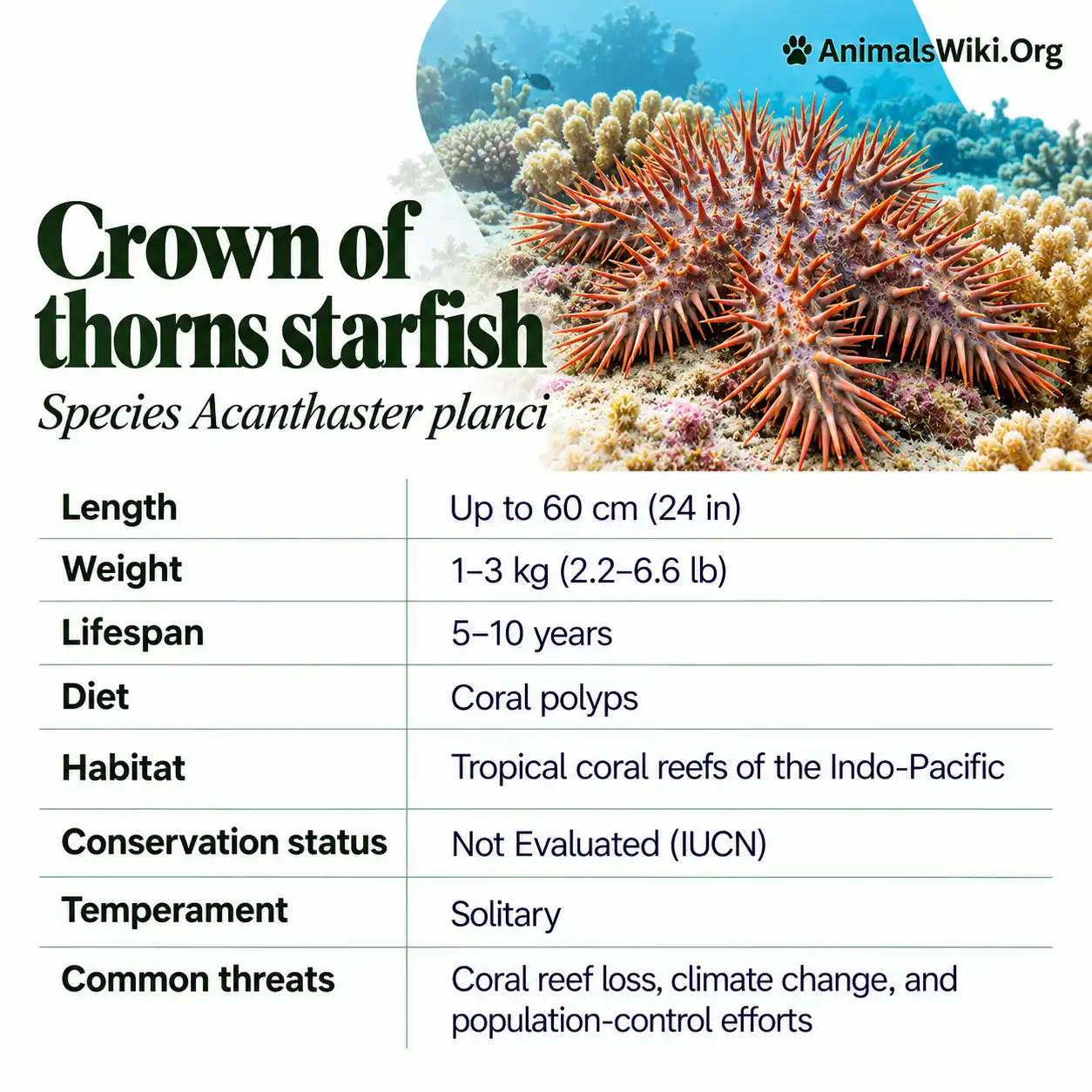
| Feature | Information |
|---|---|
| Common name | Crown-of-Thorns Starfish |
| Other name | Crown-of-Thorns Sea Star |
| Scientific group | Acanthaster species complex |
| Historically used scientific name | Acanthaster planci |
| Phylum | Echinodermata |
| Class | Asteroidea |
| Order | Valvatida |
| Family | Acanthasteridae |
| Animal type | Marine echinoderm |
| Habitat | Tropical coral reefs |
| Distribution | Indo-Pacific and associated tropical reef regions |
| Body diameter | Commonly about 25–40 cm; larger individuals occur |
| Arms | Often 10–20 or more |
| Spines | Numerous long, sharp, venom-bearing spines |
| Main diet | Living coral tissue |
| Feeding type | Carnivorous corallivore |
| Movement | Tube feet |
| Reproduction | Sexual reproduction, usually external fertilization |
| Larval stage | Planktonic larvae |
| Lifespan | Several years; exact longevity varies |
| Main predators | Some reef fish, invertebrates, and other predators |
| Ecological importance | Coral predator and reef population regulator |
| Human danger | Painful puncture wounds and envenomation |
| Conservation | Species-specific assessments are limited |
| Main concern | High-density outbreaks can cause major coral loss |
What Is a Crown-of-Thorns Starfish?
A crown-of-thorns starfish is a large, multi-armed sea star belonging to the genus Acanthaster.
It is best known for its venom-bearing spines and its ability to consume living coral.
Is the Crown-of-Thorns Starfish a Real Starfish?
Yes. It belongs to the class Asteroidea, which contains sea stars.
Why Is It Called the Crown-of-Thorns Starfish?
Its body is covered with sharp spines that resemble a crown of thorns.
Is the Crown-of-Thorns Starfish a Fish?
No. Despite its common name, it is an echinoderm, not a fish.
Is the Crown-of-Thorns Starfish an Invertebrate?
Yes. It has no backbone.
Scientific Classification of Crown-of-Thorns Starfish
| Classification | Name |
|---|---|
| Kingdom | Animalia |
| Phylum | Echinodermata |
| Class | Asteroidea |
| Order | Valvatida |
| Family | Acanthasteridae |
| Genus | Acanthaster |
| Species | Multiple closely related species |
What Is the Scientific Name of the Crown-of-Thorns Starfish?
The name Acanthaster planci has historically been applied broadly to crown-of-thorns starfish.
However, genetic and taxonomic research has revealed multiple distinct species within the group.
For example, Acanthaster cf. solaris has been widely used in scientific literature for Pacific populations, while Acanthaster solaris is also used in current taxonomic treatments.
Because species boundaries and naming conventions have undergone revision, the exact scientific name should be matched to the geographic population being discussed.
What Does Acanthaster Mean?
The genus name combines Greek roots referring to a spine and a star.
Are Crown-of-Thorns Starfish Related to Other Sea Stars?
Yes.
Are Crown-of-Thorns Starfish Related to Sea Urchins?
Yes. Both belong to Echinodermata.
Types and Species of Crown-of-Thorns Starfish
Crown-of-thorns starfish were historically treated largely as one widespread species.
Modern research has identified several closely related lineages and species.
1. Pacific Crown-of-Thorns Starfish
Often referred to in research as Acanthaster cf. solaris or Acanthaster solaris.
It occurs across tropical Pacific reef systems, including the Great Barrier Reef.
2. Northern Indian Ocean Crown-of-Thorns Starfish
Associated with the Acanthaster planci species complex.
Populations occur in northern Indian Ocean reef environments.
3. Southern Indian Ocean Crown-of-Thorns Starfish
A genetically distinct lineage has been identified in parts of the southern Indian Ocean.
4. Red Sea Crown-of-Thorns Starfish
Red Sea populations are also genetically distinct from several other regional groups.
Why Does Species Identification Matter?
Different crown-of-thorns species may differ in distribution, genetics, reproduction, and ecological characteristics.
Accurate identification improves conservation research and outbreak management.
What Does a Crown-of-Thorns Starfish Look Like?
The crown-of-thorns starfish has a broad central disc surrounded by numerous arms.
Its upper body surface is covered with long, sharp spines.
Important anatomical features include:
- Central disc
- Multiple arms
- Venom-bearing spines
- Tube feet
- Water vascular system
- Mouth
- Eversible stomach
- Digestive glands
- Sensory structures
- Internal calcareous skeletal elements
What Color Is a Crown-of-Thorns Starfish?
Colors vary by individual and region.
Common colors include:
- Purple
- Brown
- Reddish brown
- Blue-gray
- Greenish tones
- Orange-tipped spines
Does It Have Eyes?
Sea stars possess simple light-sensitive structures near the tips of their arms.
Does It Have a Brain?
No. It has a decentralized nervous system.
Crown-of-Thorns Starfish Size and Weight
Crown-of-thorns starfish are among the larger sea stars found on tropical coral reefs.
How Big Is a Crown-of-Thorns Starfish?
Adults commonly measure approximately 25–40 centimeters across.
Some individuals can become considerably larger.
Can Crown-of-Thorns Starfish Reach 80 Centimeters?
Very large individuals approaching this size have been reported, but they are exceptional.
How Much Does a Crown-of-Thorns Starfish Weigh?
Weight varies with body size, age, and condition.
Are Crown-of-Thorns Starfish Bigger Than Common Sea Stars?
They are larger than many familiar coastal sea stars, although some other sea star species can also grow very large.
How Many Arms Does a Crown-of-Thorns Starfish Have?
Crown-of-thorns starfish usually possess far more than five arms.
Do Crown-of-Thorns Starfish Have 20 Arms?
Yes. Individuals may have around 20 arms, sometimes more.
Are All Crown-of-Thorns Starfish the Same Shape?
No. Arm number and body proportions vary.
Can Crown-of-Thorns Starfish Regrow Arms?
Yes. Like many sea stars, they can regenerate damaged arms under suitable conditions.
Crown-of-Thorns Starfish Spines
The animal’s most distinctive defensive feature is its covering of long, sharp spines.
Are Crown-of-Thorns Starfish Spines Venomous?
Yes. Their spines can cause painful envenomation.
How Long Are the Spines?
Spines can extend several centimeters, depending on the individual.
Can the Spines Break Off in Skin?
Yes. Fragments can remain embedded in puncture wounds.
Why Does the Starfish Have Spines?
They provide protection against predators.
Where Do Crown-of-Thorns Starfish Live?
Crown-of-thorns starfish occur in tropical reef environments across the Indo-Pacific.
Their distribution includes:
- Great Barrier Reef
- Coral Sea
- Western Pacific
- Southeast Asian reef systems
- Indian Ocean
- Red Sea
- Central Pacific islands
- Other tropical coral reef regions
Do Crown-of-Thorns Starfish Live in Australia?
Yes.
Do They Live on the Great Barrier Reef?
Yes.
Do They Live in the Indian Ocean?
Yes.
Do They Live in the Red Sea?
Yes.
Do They Live in Freshwater?
No. They are marine animals.
Crown-of-Thorns Starfish Habitat
Crown-of-thorns starfish inhabit coral reef environments.
They may occur on:
- Reef slopes
- Reef crests
- Coral-rich lagoon areas
- Reef patches
- Sheltered coral habitats
Do They Live in Shallow Water?
Yes. They occur in shallow coral reef environments.
Can They Live in Deeper Reef Areas?
Yes. They can occur at different reef depths.
Do They Hide During the Day?
Smaller individuals and some adults may shelter within reef structures, depending on conditions and behavior.
What Do Crown-of-Thorns Starfish Eat?
Crown-of-thorns starfish primarily consume living coral tissue.
They are specialized coral predators.
Do Crown-of-Thorns Starfish Eat Coral?
Yes.
Do They Eat Hard Corals?
Yes. Reef-building hard corals are major prey.
Do They Prefer Certain Coral Species?
They often feed preferentially on some branching and table-forming corals, including Acropora, although preferences vary with availability and conditions.
Do They Eat Dead Coral?
They primarily target living coral tissue.
Are Crown-of-Thorns Starfish Carnivores?
Yes. Coral polyps are animals.
How Do Crown-of-Thorns Starfish Eat Coral?
Their feeding process is one of the most remarkable behaviors among echinoderms.
Step 1: Locate Coral
The starfish moves across the reef toward suitable coral colonies.
Step 2: Position the Body
It spreads its arms and body over the coral surface.
Step 3: Evert the Stomach
The starfish extends part of its stomach outside its mouth.
Step 4: Digest Coral Tissue
Digestive enzymes break down the coral’s living tissues.
Step 5: Absorb Nutrients
The digested material is absorbed.
Step 6: Move to Another Feeding Area
The starfish continues feeding elsewhere on the reef.
Does the Starfish Eat the Coral Skeleton?
No. It mainly consumes living tissue, leaving the calcium carbonate skeleton behind.
Why Does Coral Turn White After Feeding?
The exposed coral skeleton appears pale after living tissues have been removed.
This is different from coral bleaching, in which living coral loses symbiotic algae or their pigments.
Crown-of-Thorns Starfish Outbreaks
An outbreak occurs when crown-of-thorns starfish populations reach unusually high densities.
At these densities, coral consumption may exceed coral growth and recovery.
Why Are Crown-of-Thorns Starfish Outbreaks Dangerous?
They can cause extensive coral mortality.
Do Crown-of-Thorns Starfish Destroy Coral Reefs?
High-density outbreaks can severely reduce live coral cover.
However, reefs may recover when conditions are favorable and additional disturbances are limited.
Are Crown-of-Thorns Starfish Naturally Part of Coral Reefs?
Yes.
Are Crown-of-Thorns Starfish Invasive?
They are native to many Indo-Pacific reefs.
Calling them invasive throughout their natural range would be inaccurate.
What Causes Crown-of-Thorns Starfish Outbreaks?
Scientists continue to investigate outbreak causes.
Potential contributing factors include:
- High larval survival
- Favorable ocean conditions
- Increased phytoplankton availability
- Nutrient enrichment
- Changes in predator abundance
- Successful recruitment
- Population connectivity between reefs
Can Agricultural Runoff Contribute to Outbreaks?
Nutrient runoff may increase phytoplankton availability under certain conditions, potentially benefiting larvae.
However, outbreak causes are complex and cannot be attributed to runoff alone.
Can Overfishing Affect Outbreaks?
Changes in predator populations may influence crown-of-thorns populations, but the strength of these effects varies and remains an active research topic.
Are Outbreaks Caused by Climate Change?
Climate change may affect reef ecosystems and population dynamics, but outbreaks have multiple interacting causes.
Crown-of-Thorns Starfish and the Great Barrier Reef
The Great Barrier Reef has experienced multiple waves of crown-of-thorns starfish outbreaks.
These outbreaks are a major management concern because they can reduce live coral cover across affected reefs.
Why Are Crown-of-Thorns Starfish a Problem on the Great Barrier Reef?
Large populations can consume extensive areas of living coral.
Can the Great Barrier Reef Recover After an Outbreak?
Coral recovery is possible, but depends on coral recruitment, surviving colonies, water quality, temperature, and subsequent disturbances.
Are Crown-of-Thorns Starfish the Only Threat to the Great Barrier Reef?
No.
Marine heatwaves, coral bleaching, cyclones, poor water quality, and other pressures also affect reef health.
Crown-of-Thorns Starfish Movement
Crown-of-thorns starfish move using tube feet.
Do Crown-of-Thorns Starfish Swim?
Adults generally crawl rather than swim.
Are Crown-of-Thorns Starfish Fast?
They move slowly compared with swimming animals, but can travel across reef surfaces.
How Do Tube Feet Work?
Tube feet operate through the water vascular system and muscular mechanisms.
Can Crown-of-Thorns Starfish Climb Coral?
Yes.
Crown-of-Thorns Starfish Senses
These animals respond to chemical, tactile, and light-related signals.
Can Crown-of-Thorns Starfish Smell Coral?
They can detect chemical cues associated with their environment and potential food.
Do They Have Eyes?
They possess simple light-sensitive structures.
Do They Have a Brain?
No centralized brain.
Crown-of-Thorns Starfish Reproduction
Crown-of-thorns starfish reproduce sexually.
They generally release eggs and sperm into the surrounding water.
Do Crown-of-Thorns Starfish Lay Eggs?
Yes. Females release eggs into seawater.
How Many Eggs Can a Female Produce?
Large females can produce millions of eggs during a spawning season.
The number varies with body size and reproductive condition.
Do Crown-of-Thorns Starfish Reproduce Asexually?
Arm regeneration is possible, but routine reproduction by fragmentation is not their normal reproductive strategy.
Crown-of-Thorns Starfish Life Cycle
Stage 1: Spawning
Adults release eggs and sperm.
Stage 2: Fertilization
Fertilization occurs in the water.
Stage 3: Embryonic Development
Embryos develop into larvae.
Stage 4: Planktonic Larvae
Larvae drift and feed in the water column.
Stage 5: Settlement
Larvae settle on suitable reef substrates.
Stage 6: Juvenile Starfish
Young starfish develop and initially feed on encrusting algae and other suitable food sources.
Stage 7: Coral-Feeding Juvenile
As they grow, juveniles transition toward feeding on living coral.
Stage 8: Adult Starfish
Adults reproduce and continue feeding on coral.
Baby Crown-of-Thorns Starfish
Young crown-of-thorns starfish differ significantly from adults.
What Is a Baby Crown-of-Thorns Starfish Called?
A juvenile crown-of-thorns starfish after settlement.
Do Baby Crown-of-Thorns Starfish Eat Coral?
Early juveniles commonly feed on crustose coralline algae before transitioning to coral.
Do Baby Crown-of-Thorns Starfish Have Spines?
Spines develop as they grow.
How Long Do Crown-of-Thorns Starfish Live?
Crown-of-thorns starfish can survive for several years.
Their exact lifespan varies with environmental conditions, food availability, and predation.
Can Crown-of-Thorns Starfish Live for Ten Years?
Long lifespans are possible in some sea stars, but precise maximum ages for crown-of-thorns populations remain uncertain.
How Quickly Do They Grow?
Growth depends on food supply, temperature, and life stage.
Crown-of-Thorns Starfish Adaptations
Venom-Bearing Spines
Provide defense against predators.
Numerous Arms
Increase contact with reef surfaces and feeding opportunities.
Tube Feet
Enable movement and attachment.
Eversible Stomach
Allows external digestion of coral tissue.
Regeneration
Supports recovery from some injuries.
High Reproductive Output
Large females can release many eggs.
Planktonic Larvae
Allow dispersal between reefs.
Chemical Sensing
Helps locate suitable habitat and food.
Flexible Feeding Behavior
Allows use of different coral prey.
Reef Shelter
Provides protection for smaller individuals.
What Animals Eat Crown-of-Thorns Starfish?
Predators and potential predators include:
- Giant triton snails
- Some pufferfish
- Certain triggerfish
- Other reef fish
- Some invertebrate predators
Predation rates vary with the starfish’s size and developmental stage.
Do Giant Triton Snails Eat Crown-of-Thorns Starfish?
Yes. Giant triton snails are documented predators.
Do Triggerfish Eat Crown-of-Thorns Starfish?
Some triggerfish may attack or consume crown-of-thorns starfish.
Do Pufferfish Eat Crown-of-Thorns Starfish?
Some pufferfish can prey on them.
Are Juveniles More Vulnerable to Predators?
Yes. Small juveniles may be consumed by a variety of reef organisms.
Crown-of-Thorns Starfish vs. Common Starfish
| Feature | Crown-of-Thorns Starfish | Typical Five-Armed Sea Star |
|---|---|---|
| Scientific group | Acanthaster | Various genera |
| Arms | Often 10–20 or more | Often five |
| Spines | Numerous long venom-bearing spines | Usually shorter or less prominent |
| Diet | Primarily living coral | Species-dependent |
| Habitat | Tropical coral reefs | Diverse marine habitats |
| Human danger | Painful puncture wounds | Usually lower, but varies |
Crown-of-Thorns Starfish vs. Sunflower Sea Star
The sunflower sea star (Pycnopodia helianthoides) is another large, multi-armed sea star.
However, the two species differ greatly in diet and habitat.
Crown-of-thorns starfish specialize in consuming coral tissue.
Sunflower sea stars are predators of various marine invertebrates and occur mainly in northeastern Pacific waters.
Crown-of-Thorns Starfish vs. Sea Urchin
Both belong to the phylum Echinodermata.
However, sea urchins possess rounded bodies with spines, while crown-of-thorns starfish have multiple arms extending from a central disc.
Their diets and ecological roles also differ.
Are Crown-of-Thorns Starfish Dangerous to Humans?
Yes.
Their sharp spines can puncture skin and deliver venom.
What Happens if You Step on a Crown-of-Thorns Starfish?
You may experience:
- Immediate sharp pain
- Swelling
- Redness
- Inflammation
- Bleeding
- Retained spine fragments
- Nausea or other systemic symptoms in some cases
Can a Crown-of-Thorns Starfish Kill a Human?
Fatal outcomes are exceptionally uncommon, but serious injury, infection, or allergic reactions require medical attention.
Can You Touch a Crown-of-Thorns Starfish?
No. Avoid direct handling.
What Should You Do if Stung by a Crown-of-Thorns Starfish?
- Leave the water safely.
- Avoid squeezing or rubbing the puncture wound.
- Rinse the wound gently with clean water.
- Seek medical evaluation because spine fragments may remain embedded.
- Warm-water immersion may help pain in some marine spine injuries, but the water must not be hot enough to burn skin; follow medical advice.
- Do not dig deeply into the wound to remove embedded fragments.
- Seek urgent care for severe pain, spreading swelling, infection signs, or systemic symptoms.
Call emergency services for difficulty breathing, collapse, or signs of a severe allergic reaction.
Medical professionals may assess retained fragments, infection risk, and tetanus protection.
Are Crown-of-Thorns Starfish Endangered?
Conservation status is not comprehensively established for every species within the complex.
In some reef regions, management focuses on reducing outbreak populations rather than protecting large aggregations.
Should Crown-of-Thorns Starfish Be Removed From Coral Reefs?
Targeted control may be appropriate during damaging outbreaks under professional reef management programs.
However, indiscriminate removal is not recommended.
Are Crown-of-Thorns Starfish Important to Coral Reefs?
Yes. At natural densities, they are part of reef ecosystems.
How Are Crown-of-Thorns Starfish Outbreaks Controlled?
Reef management programs may use:
- Monitoring surveys
- Early outbreak detection
- Targeted removal
- Carefully regulated injection-based control
- Research on larval recruitment
- Water-quality improvement
- Predator conservation
- Reef restoration planning
Can Divers Remove Crown-of-Thorns Starfish?
Only trained personnel should participate in authorized control programs.
The animals have venomous spines, and improper handling may cause injury or ecological damage.
Can Outbreaks Be Completely Prevented?
No single method is guaranteed to prevent every outbreak.
Why Are Crown-of-Thorns Starfish Important?
Crown-of-thorns starfish are important because they influence coral reef structure and biodiversity.
At low densities, coral predation can create space for other organisms and contribute to natural ecological turnover.
At high densities, they can cause extensive coral loss.
Their population dynamics provide important insights into:
- Coral reef ecology
- Predator-prey relationships
- Marine larval dispersal
- Reef disturbance
- Ecosystem resilience
- Conservation management
50 Interesting Crown-of-Thorns Starfish Facts
- Crown-of-thorns starfish belong to the genus Acanthaster.
- They are marine echinoderms.
- They belong to the class Asteroidea.
- They are not fish.
- They are invertebrates.
- Their bodies are covered with sharp spines.
- Their spines can deliver venom.
- They often have more than five arms.
- Some individuals have more than 20 arms.
- They inhabit tropical coral reefs.
- They occur on the Great Barrier Reef.
- They also occur in Indian Ocean reefs.
- They occur in the Red Sea.
- They are native to many Indo-Pacific reef systems.
- They primarily consume living coral tissue.
- Coral polyps are animals.
- Crown-of-thorns starfish are carnivorous.
- They can consume branching corals.
- They often feed on Acropora corals.
- They extend their stomachs outside their bodies to feed.
- They digest coral tissue externally.
- They leave much of the coral skeleton behind.
- Coral skeletons may appear white after feeding.
- Coral predation is different from coral bleaching.
- They move using tube feet.
- Their tube feet operate through a water vascular system.
- They can climb reef structures.
- They have no centralized brain.
- They possess simple sensory structures.
- They can detect environmental chemical cues.
- They reproduce sexually.
- Females can produce millions of eggs.
- Fertilization generally occurs in seawater.
- Their larvae drift in the plankton.
- Young juveniles initially feed on encrusting algae.
- Older juveniles transition to coral feeding.
- They can regenerate damaged arms.
- They can survive for several years.
- Giant triton snails prey on them.
- Some reef fish also consume them.
- Their population density strongly affects reef impacts.
- Low-density populations are natural components of reefs.
- High-density outbreaks can cause major coral mortality.
- The Great Barrier Reef has experienced repeated outbreaks.
- Scientists study outbreak causes.
- Nutrient availability may influence larval survival.
- Predator populations may affect recruitment and survival.
- Reef management programs monitor outbreaks.
- Targeted control can reduce local coral losses.
- Their combination of venomous spines, numerous arms, and coral-feeding behavior makes them among the most distinctive sea stars in the ocean.
Did You Know?
The Sea Star That Can Consume an Entire Coral Colony
Imagine diving above a colorful tropical coral reef.
Branching corals extend toward the sunlight.
Small reef fish move through the complex structures.
Sea turtles swim slowly above the reef.
The underwater landscape appears peaceful.
But hidden among the coral branches is an unusual predator.
Its body is broad and covered with sharp spines.
Numerous arms extend from a central disc.
It is a crown-of-thorns starfish.
The starfish begins moving across the reef.
Hundreds of tiny tube feet grip the coral surface.
It approaches a living coral colony.
The starfish spreads its arms across the coral.
Then something remarkable happens.
It pushes its stomach outside its mouth.
The stomach spreads over the coral surface.
Digestive enzymes begin breaking down the coral’s living tissues.
The starfish absorbs nutrients.
When it moves away, the underlying coral skeleton is left exposed.
The feeding scar appears pale against the surrounding living coral.
A single crown-of-thorns starfish is part of the reef’s natural food web.
But imagine hundreds or thousands of these animals feeding across the same reef system.
The consequences can be dramatic.
Large areas of living coral may disappear.
Fish that depend on branching coral for shelter may lose habitat.
Other reef organisms may be affected.
Scientists call these population increases crown-of-thorns starfish outbreaks.
Outbreaks have caused major coral losses on the Great Barrier Reef and other tropical reef systems.
Yet the starfish itself is not an unnatural invader throughout its native range.
It is a native marine predator.
Its ecological impact depends largely on how many individuals are present and how quickly corals can recover.
Scientists continue to investigate why some populations remain relatively small while others increase dramatically.
They study larval survival, food availability, ocean currents, and predator relationships.
Reef managers also use monitoring and targeted control to protect vulnerable coral areas.
The crown-of-thorns starfish demonstrates how a naturally occurring predator can become a powerful force of ecological change when its population reaches unusually high densities.
Frequently Asked Questions About Crown-of-Thorns Starfish
What is a crown-of-thorns starfish?
A crown-of-thorns starfish is a large, multi-armed marine sea star belonging to the genus Acanthaster.
What is the scientific name of the crown-of-thorns starfish?
The group includes multiple related Acanthaster species. Acanthaster planci is a historically widespread name.
Is the crown-of-thorns starfish a real starfish?
Yes.
Is the crown-of-thorns starfish a fish?
No.
Is the crown-of-thorns starfish an invertebrate?
Yes.
Why is it called crown-of-thorns starfish?
Because of its numerous long, sharp spines.
Is the crown-of-thorns starfish venomous?
Yes.
Are crown-of-thorns starfish poisonous?
They are primarily described as venomous because their spines can deliver toxins.
How big is a crown-of-thorns starfish?
Adults commonly measure about 25–40 centimeters across.
Can crown-of-thorns starfish reach 80 centimeters?
Exceptionally large individuals approaching this size have been reported.
How many arms does a crown-of-thorns starfish have?
Often 10–20 or more.
Can crown-of-thorns starfish have 20 arms?
Yes.
Can crown-of-thorns starfish regrow arms?
Yes.
What color are crown-of-thorns starfish?
Purple, brown, reddish, greenish, and other colors.
Do crown-of-thorns starfish have eyes?
They possess simple light-sensitive structures.
Do crown-of-thorns starfish have brains?
No centralized brain.
Where do crown-of-thorns starfish live?
On tropical coral reefs in the Indo-Pacific.
Do crown-of-thorns starfish live in Australia?
Yes.
Do crown-of-thorns starfish live on the Great Barrier Reef?
Yes.
Do crown-of-thorns starfish live in the Indian Ocean?
Yes.
Do crown-of-thorns starfish live in the Red Sea?
Yes.
Do crown-of-thorns starfish live in freshwater?
No.
What do crown-of-thorns starfish eat?
Primarily living coral tissue.
Are crown-of-thorns starfish carnivores?
Yes.
Do crown-of-thorns starfish eat coral?
Yes.
Do crown-of-thorns starfish eat hard coral?
Yes.
Do crown-of-thorns starfish eat dead coral?
They primarily target living coral tissue.
Do crown-of-thorns starfish eat fish?
Fish are not their normal primary food.
How do crown-of-thorns starfish eat coral?
They extend their stomachs over coral and digest tissues externally.
Do crown-of-thorns starfish eat coral skeletons?
No. They primarily consume living tissues.
Why does coral turn white after crown-of-thorns feeding?
Because the living tissue has been removed, exposing the pale skeleton.
Is crown-of-thorns feeding the same as coral bleaching?
No.
What is a crown-of-thorns starfish outbreak?
An unusually high population density that can cause extensive coral mortality.
Why are crown-of-thorns starfish outbreaks dangerous?
They can remove large areas of living coral.
Are crown-of-thorns starfish invasive?
They are native to many Indo-Pacific reef systems.
What causes crown-of-thorns starfish outbreaks?
Multiple interacting factors, potentially including larval survival, food availability, ocean conditions, and predator populations.
Can pollution contribute to outbreaks?
Nutrient enrichment may influence larval food availability in some circumstances.
Can overfishing contribute to outbreaks?
Changes in predator communities may influence populations, although effects vary.
Can crown-of-thorns starfish destroy coral reefs?
Severe outbreaks can cause extensive coral mortality.
Can coral reefs recover after outbreaks?
Yes, under favorable conditions.
How do crown-of-thorns starfish move?
Using tube feet.
Can crown-of-thorns starfish swim?
Adults generally crawl rather than swim.
Are crown-of-thorns starfish fast?
They move slowly compared with fish.
How do crown-of-thorns starfish reproduce?
Through sexual reproduction with eggs and sperm released into water.
Do crown-of-thorns starfish lay eggs?
Yes.
How many eggs do crown-of-thorns starfish produce?
Large females can produce millions of eggs.
Do crown-of-thorns starfish reproduce asexually?
Routine asexual reproduction is not their normal strategy.
What is a baby crown-of-thorns starfish called?
A juvenile after settlement.
What do baby crown-of-thorns starfish eat?
Early juveniles often feed on crustose coralline algae.
When do crown-of-thorns starfish start eating coral?
They transition to coral feeding as juveniles grow.
How long do crown-of-thorns starfish live?
Several years, although exact longevity varies.
What animals eat crown-of-thorns starfish?
Giant triton snails, some reef fish, and other predators.
Do giant triton snails eat crown-of-thorns starfish?
Yes.
Do triggerfish eat crown-of-thorns starfish?
Some species may attack or consume them.
Do pufferfish eat crown-of-thorns starfish?
Some can prey on them.
Can crown-of-thorns starfish sting humans?
Their sharp spines can puncture skin and deliver venom.
What happens if you touch a crown-of-thorns starfish?
You risk painful puncture wounds and envenomation.
Can crown-of-thorns starfish kill humans?
Fatal outcomes are exceptionally uncommon, but serious complications are possible.
What should you do after a crown-of-thorns starfish injury?
Clean the wound, avoid digging out embedded spines, and seek medical evaluation.
Are crown-of-thorns starfish endangered?
Conservation assessments vary and remain incomplete for the species complex.
Should crown-of-thorns starfish be removed from reefs?
Targeted control may be appropriate during damaging outbreaks under authorized management programs.
How are crown-of-thorns starfish outbreaks controlled?
Through monitoring, targeted removal, and regulated professional control methods.
Are crown-of-thorns starfish important to coral reefs?
Yes. They are natural coral predators.
Why do scientists study crown-of-thorns starfish?
To understand reef ecology, population outbreaks, coral mortality, and conservation management.
What is the most interesting crown-of-thorns starfish fact?
Crown-of-thorns starfish can extend their stomachs outside their bodies to digest living coral tissue, and high-density populations can dramatically alter entire reef ecosystems.
Conclusion
The crown-of-thorns starfish is one of the most remarkable and ecologically influential animals found on tropical coral reefs.
Its numerous arms, venom-bearing spines, and specialized coral-feeding behavior distinguish it from many other sea stars.
By extending its stomach outside its body, it can digest living coral tissue directly on the reef.
At natural population densities, crown-of-thorns starfish are part of healthy reef ecosystems.
However, when populations increase dramatically, their feeding activity can cause extensive coral mortality.
Outbreaks have affected major reef systems, including the Great Barrier Reef.
Scientists continue to study the causes of these population changes and develop strategies to reduce damage to vulnerable coral habitats.
Understanding crown-of-thorns starfish helps explain the complex relationships between marine predators, coral communities, and environmental conditions.
The crown-of-thorns starfish is a powerful reminder that even native animals can dramatically reshape ecosystems when their populations move beyond the levels those ecosystems can readily support.
SEO Information
Primary keyword: Crown-of-Thorns Starfish
Secondary keywords: Crown-of-Thorns Starfish facts, Crown-of-Thorns Starfish scientific name, Acanthaster planci, Acanthaster solaris, Crown-of-Thorns Sea Star, Crown-of-Thorns Starfish species, Crown-of-Thorns Starfish anatomy, Crown-of-Thorns Starfish size, Crown-of-Thorns Starfish arms, Crown-of-Thorns Starfish spines, Crown-of-Thorns Starfish venom, Crown-of-Thorns Starfish habitat, where do Crown-of-Thorns Starfish live, Crown-of-Thorns Starfish Great Barrier Reef, Crown-of-Thorns Starfish diet, what do Crown-of-Thorns Starfish eat, Crown-of-Thorns Starfish coral feeding, Crown-of-Thorns Starfish outbreak, causes of Crown-of-Thorns Starfish outbreaks, Crown-of-Thorns Starfish reproduction, Crown-of-Thorns Starfish life cycle, baby Crown-of-Thorns Starfish, Crown-of-Thorns Starfish lifespan, Crown-of-Thorns Starfish predators, Crown-of-Thorns Starfish adaptations, Crown-of-Thorns Starfish control, Crown-of-Thorns Starfish vs Sea Star, are Crown-of-Thorns Starfish dangerous, Crown-of-Thorns Starfish conservation.
SEO meta title: Crown-of-Thorns Starfish Facts: Coral, Venom & Outbreaks
Meta description: Discover Crown-of-Thorns Starfish facts, including venomous spines, coral-feeding behavior, tropical reef habitat, reproduction, predators, and damaging outbreaks.
Suggested URL slug: crown-of-thorns-starfish-facts
Suggested image alt text: Crown-of-thorns starfish with numerous spiny arms crawling across a tropical coral reef, showing its distinctive venom-bearing spines and colorful body.
Suggested article category: Marine Animals / Echinoderms
Suggested tags: Crown-of-Thorns Starfish, Acanthaster, Acanthaster planci, Acanthaster solaris, Sea Star Facts, Coral Reef Animals, Great Barrier Reef, Coral Predators, Marine Biology, Ocean Wildlife
Editorial note: Crown-of-thorns starfish comprise a taxonomically complex group. Historical references to Acanthaster planci may encompass multiple species, and Pacific populations are often identified as Acanthaster solaris or Acanthaster cf. solaris. Outbreak causes are multifactorial and remain an active area of research. Avoid claiming that all outbreaks result from a single factor or that the species is inherently invasive within its native range. Extreme size, reproductive output, and lifespan figures should be treated as variable rather than universal.