Purple Sea Urchin, The Spiny Ocean Grazer That Can Transform Kelp Forests
The purple sea urchin (Strongylocentrotus purpuratus) is one of the most fascinating marine invertebrates found along the Pacific coast of North America. With its rounded body, sharp purple spines, specialized feeding apparatus, and remarkable ability to survive in changing coastal environments, this small animal plays an enormous role in ocean ecosystems.
At first glance, a purple sea urchin looks like a tiny purple pincushion resting on the seafloor.
But beneath its protective spines is a highly specialized marine animal equipped with tube feet, sensory structures, and a powerful five-part feeding apparatus known as Aristotle’s lantern.
Purple sea urchins are particularly important because of their relationship with kelp forests.
These underwater forests provide habitat for fish, sea otters, crabs, abalone, and countless other marine organisms.
Purple sea urchins feed on kelp, algae, and drifting plant material.
At moderate population densities, they are natural grazers that contribute to coastal ecosystem processes.
However, when purple sea urchin populations become extremely abundant, their grazing can remove large areas of kelp.
This can transform productive underwater forests into urchin barrens, where exposed rock and dense populations of sea urchins replace much of the original kelp vegetation.
Such ecological changes have become especially important along portions of the California coast, where the decline of sunflower sea stars, marine heatwaves, and changes in predator-prey relationships have contributed to major kelp forest losses.
Despite their small size, purple sea urchins are also important scientific research organisms.
Their embryos have been studied for generations to understand fertilization, early development, cell division, genetics, and evolutionary biology.
Scientists have also used the purple sea urchin genome to investigate relationships between echinoderms and other animals.
This comprehensive guide explores purple sea urchin facts, scientific classification, anatomy, size, habitat, distribution, diet, kelp grazing, spines, predators, reproduction, lifespan, adaptations, ecological importance, and frequently asked questions.
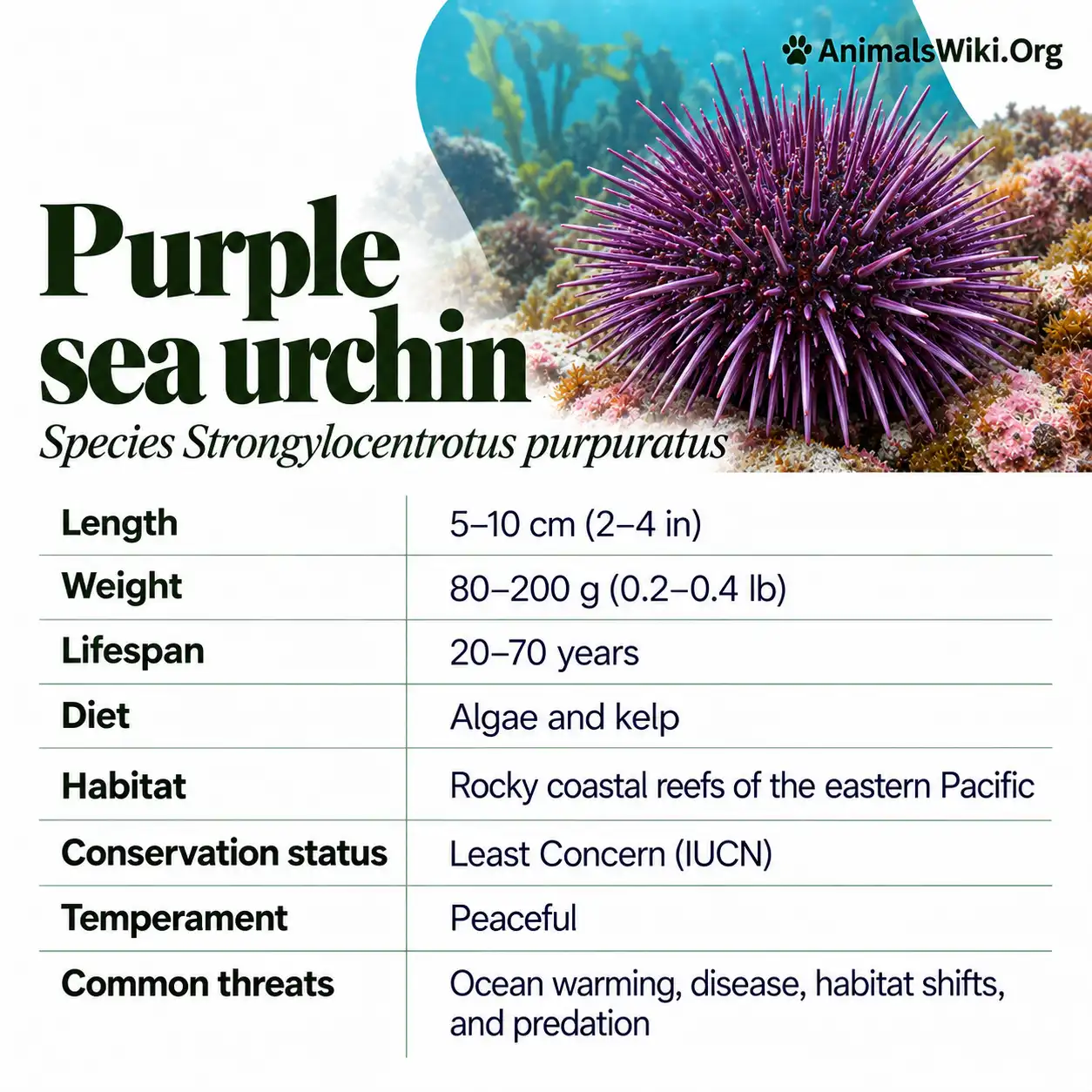
Purple Sea Urchin Quick Facts
| Feature | Information |
|---|---|
| Common name | Purple Sea Urchin |
| Scientific name | Strongylocentrotus purpuratus |
| Phylum | Echinodermata |
| Class | Echinoidea |
| Order | Camarodonta |
| Family | Strongylocentrotidae |
| Animal type | Marine invertebrate |
| Habitat | Rocky intertidal and shallow subtidal environments |
| Distribution | Pacific coast of North America |
| Body shape | Rounded, with a rigid test |
| Test diameter | Commonly several centimeters; can reach approximately 10 cm |
| Color | Purple, violet, or reddish-purple |
| Spines | Numerous movable protective spines |
| Mouth | Located on the underside |
| Feeding apparatus | Aristotle’s lantern |
| Diet | Kelp, algae, and organic material |
| Feeding type | Primarily herbivorous grazer |
| Movement | Tube feet and spines |
| Reproduction | Sexual reproduction, usually external fertilization |
| Larval stage | Echinopluteus larva |
| Lifespan | Can survive for decades under suitable conditions |
| Main predators | Sea otters, sunflower sea stars, some fish, and other predators |
| Ecological role | Algal grazer and kelp forest consumer |
| Human danger | Sharp spines can cause puncture wounds |
| Conservation | Local abundance varies considerably |
What Is a Purple Sea Urchin?
The purple sea urchin is a marine echinoderm belonging to the species Strongylocentrotus purpuratus.
It is closely related to other sea urchins, sand dollars, and sea stars.
Purple sea urchins inhabit rocky coastal environments where they graze on algae and kelp.
Is the Purple Sea Urchin a Fish?
No. It is an invertebrate.
Is the Purple Sea Urchin a Starfish?
No. Sea urchins and sea stars belong to different classes within Echinodermata.
Is the Purple Sea Urchin an Invertebrate?
Yes. It has no backbone.
Why Is It Called the Purple Sea Urchin?
Because its body is covered with purple or violet spines.
Scientific Classification of the Purple Sea Urchin
| Classification | Name |
|---|---|
| Kingdom | Animalia |
| Phylum | Echinodermata |
| Subphylum | Echinozoa |
| Class | Echinoidea |
| Order | Camarodonta |
| Family | Strongylocentrotidae |
| Genus | Strongylocentrotus |
| Species | Strongylocentrotus purpuratus |
What Does Strongylocentrotus purpuratus Mean?
The genus name refers to a rounded, spiny sea urchin, while purpuratus refers to its purple coloration.
Are Purple Sea Urchins Related to Sand Dollars?
Yes. Both belong to Echinoidea.
Are Purple Sea Urchins Related to Sea Stars?
Yes. Both belong to Echinodermata.
Are Purple Sea Urchins Related to Sea Cucumbers?
Yes. They share the same phylum.
What Does a Purple Sea Urchin Look Like?
Purple sea urchins have a rounded body covered with numerous movable spines.
Their anatomy includes:
- Rigid test
- Movable spines
- Tube feet
- Pedicellariae
- Mouth
- Aristotle’s lantern
- Water vascular system
- Digestive tract
- Sensory cells
- Reproductive organs
What Is the Test?
The test is the rigid internal skeleton made of fused calcium carbonate plates.
What Are Pedicellariae?
Pedicellariae are small pincer-like structures found on the surface of many sea urchins.
They help with cleaning and defense.
Do Purple Sea Urchins Have Eyes?
They lack conventional eyes but possess light-sensitive cells that help them respond to light.
Do Purple Sea Urchins Have Brains?
No. They have a decentralized nervous system.
Purple Sea Urchin Size and Weight
Purple sea urchins are relatively small echinoderms.
How Big Is a Purple Sea Urchin?
Their test commonly measures several centimeters across.
Large individuals may approach approximately 10 centimeters in test diameter.
Are Purple Sea Urchins Bigger Than Red Sea Urchins?
Usually not.
Red sea urchins (Mesocentrotus franciscanus) generally grow larger.
How Much Does a Purple Sea Urchin Weigh?
Weight varies with body size and reproductive condition.
Purple Sea Urchin Color
Purple sea urchins are famous for their deep purple coloration.
However, color varies among individuals.
Possible shades include:
- Violet
- Dark purple
- Reddish purple
- Lavender
- Purple-brown
Are All Purple Sea Urchins Purple?
Most display purple coloration, but shade and intensity vary.
Can Purple Sea Urchins Change Color?
They are not known for rapid color changes comparable to cephalopods.
Where Do Purple Sea Urchins Live?
Purple sea urchins occur along the Pacific coast of North America.
Their range extends from Alaska and British Columbia southward along the western United States to Baja California, Mexico, although local distribution varies.
Do Purple Sea Urchins Live in California?
Yes.
Do Purple Sea Urchins Live in Oregon?
Yes.
Do Purple Sea Urchins Live in Washington?
Yes.
Do Purple Sea Urchins Live in Alaska?
They occur in northern Pacific coastal regions, including parts of Alaska.
Do Purple Sea Urchins Live in Freshwater?
No. They are marine animals.
Purple Sea Urchin Habitat
Purple sea urchins inhabit rocky coastal environments.
Common habitats include:
- Rocky intertidal zones
- Tide pools
- Shallow subtidal reefs
- Kelp forests
- Rocky seafloors
- Crevices and sheltered areas
Do Purple Sea Urchins Live in Tide Pools?
Yes.
Do Purple Sea Urchins Live in Kelp Forests?
Yes.
Do Purple Sea Urchins Live in Deep Water?
They occur mainly in coastal environments, including subtidal habitats.
Can Purple Sea Urchins Survive Low Tide?
Yes. Individuals in intertidal habitats tolerate temporary exposure and changing conditions.
What Do Purple Sea Urchins Eat?
Purple sea urchins primarily graze on algae and kelp.
Their diet includes:
- Kelp
- Red algae
- Brown algae
- Green algae
- Drift algae
- Biofilms
- Detrital organic material
Do Purple Sea Urchins Eat Kelp?
Yes.
Do Purple Sea Urchins Eat Seaweed?
Yes.
Do Purple Sea Urchins Eat Fish?
Fish are not their normal primary food.
Are Purple Sea Urchins Herbivores?
They are primarily herbivorous grazers, although they may consume other organic material opportunistically.
How Do Purple Sea Urchins Eat?
Purple sea urchins use a specialized feeding apparatus called Aristotle’s lantern.
It contains five teeth supported by a complex skeletal and muscular structure.
What Is Aristotle’s Lantern?
A five-part feeding apparatus used by many regular sea urchins.
Do Purple Sea Urchins Have Teeth?
Yes.
Can Purple Sea Urchins Scrape Rocks?
Yes. Their teeth help scrape algae from hard surfaces.
Can Purple Sea Urchins Eat Large Kelp Plants?
They can graze on attached kelp, especially when drifting algae are scarce or population densities are high.
Purple Sea Urchins and Kelp Forests
Purple sea urchins are important grazers in kelp forest ecosystems.
Kelp forests support extensive marine biodiversity.
Why Do Purple Sea Urchins Eat Kelp?
Kelp provides an important food source.
Can Purple Sea Urchins Destroy Kelp Forests?
High-density populations can remove large areas of kelp through intense grazing.
What Is an Urchin Barren?
An urchin barren is a seafloor habitat dominated by sea urchins and relatively little large seaweed.
Are Urchin Barrens Natural?
Urchin barrens can occur naturally, but unusually extensive or persistent barrens may reflect major ecological disturbances.
Why Do Purple Sea Urchin Populations Increase?
Population increases may be associated with:
- Reduced predation
- Favorable recruitment
- Changes in ocean conditions
- Shifts in food availability
- Ecosystem disturbance
Can Predator Declines Cause Urchin Outbreaks?
Yes. Reduced predation can allow more sea urchins to survive.
Did Sunflower Sea Star Declines Affect Purple Sea Urchins?
The widespread decline of sunflower sea stars contributed to reduced predation pressure in some northeastern Pacific ecosystems.
Can Marine Heatwaves Affect Urchin Populations?
Yes. Marine heatwaves can alter kelp forests and food-web relationships.
Purple Sea Urchin Movement
Purple sea urchins move using tube feet and spines.
Can Purple Sea Urchins Walk?
Yes. They crawl slowly across surfaces.
Do Purple Sea Urchins Swim?
Adults do not swim like fish.
How Fast Do Purple Sea Urchins Move?
They move slowly, although movement varies with conditions.
Can Purple Sea Urchins Climb Rocks?
Yes.
Purple Sea Urchin Spines
Purple sea urchins possess numerous sharp, movable spines.
Are Purple Sea Urchin Spines Venomous?
Strongylocentrotus purpuratus is not generally regarded as a medically important venomous sea urchin.
However, its spines can puncture skin and cause pain.
Can Purple Sea Urchin Spines Break Off?
Yes.
What Happens if You Step on a Purple Sea Urchin?
You may experience puncture wounds, pain, swelling, and retained spine fragments.
Why Do Purple Sea Urchins Have Spines?
Their spines provide protection and help with movement.
Are Purple Sea Urchins Dangerous to Humans?
Purple sea urchins are not aggressive toward humans.
Their main hazard is injury from sharp spines.
Can Purple Sea Urchins Sting?
Their spines can puncture skin, but this is different from a jellyfish sting.
Can Purple Sea Urchins Kill Humans?
Fatal injuries from this species are not typical.
Can You Touch a Purple Sea Urchin?
Avoid unnecessary handling because spines can cause injury.
What Should You Do if Injured by a Purple Sea Urchin?
- Leave the water safely.
- Wash the affected area with clean water.
- Avoid squeezing or digging into deep puncture wounds.
- Remove only easily accessible superficial spine fragments with clean tweezers.
- Seek medical evaluation for embedded spines, persistent pain, swelling, or infection.
- Ask a healthcare professional about tetanus protection.
Warm-water immersion may help relieve pain from some marine spine injuries, but the water must not be hot enough to burn the skin.
Purple Sea Urchin Nervous System
Purple sea urchins have a decentralized nervous system.
Do Purple Sea Urchins Have Brains?
No.
Can Purple Sea Urchins Sense Light?
Yes.
Can Purple Sea Urchins Detect Predators?
They respond to environmental and chemical cues.
Purple Sea Urchin Reproduction
Purple sea urchins reproduce sexually.
Adults release eggs and sperm into the water.
Do Purple Sea Urchins Lay Eggs?
Females release eggs into seawater.
Do Purple Sea Urchins Reproduce Sexually?
Yes.
Do Purple Sea Urchins Reproduce Asexually?
Asexual reproduction is not their normal reproductive strategy.
Purple Sea Urchin Life Cycle
Stage 1: Spawning
Adults release eggs and sperm.
Stage 2: Fertilization
Fertilization occurs in seawater.
Stage 3: Embryo
The embryo undergoes cell division.
Stage 4: Echinopluteus Larva
A free-swimming larva develops.
Stage 5: Settlement
The larva settles onto suitable seafloor habitat.
Stage 6: Juvenile Sea Urchin
The young urchin develops its characteristic body form.
Stage 7: Adult Sea Urchin
The animal grows and becomes reproductively mature.
Baby Purple Sea Urchins
Young purple sea urchins begin as planktonic larvae.
What Is a Baby Purple Sea Urchin Called?
An echinopluteus during the larval stage and a juvenile sea urchin after settlement.
Do Baby Purple Sea Urchins Have Spines?
Spines develop during metamorphosis and juvenile growth.
Do Baby Purple Sea Urchins Eat Kelp?
Their diet changes with development, from planktonic feeding as larvae to benthic grazing after settlement.
How Long Do Purple Sea Urchins Live?
Purple sea urchins can survive for many years.
Some individuals may live for decades.
Can Purple Sea Urchins Live for 20 Years?
Long lifespans are possible, although age estimates vary.
Can Purple Sea Urchins Live for 100 Years?
Extreme longevity is better documented in certain other sea urchin species, particularly red sea urchins. It should not be assumed for purple sea urchins.
Why Is Sea Urchin Lifespan Difficult to Measure?
Age estimation can be complicated by growth variation and environmental conditions.
Purple Sea Urchin Adaptations
Protective Spines
Help defend against predators.
Rigid Test
Provides structural protection.
Tube Feet
Support movement and attachment.
Aristotle’s Lantern
Allows efficient grazing.
Light Sensitivity
Helps detect environmental conditions.
Chemical Sensing
Supports predator and food detection.
Strong Attachment
Helps resist waves.
Intertidal Tolerance
Allows survival in changing coastal conditions.
Flexible Feeding
Supports survival when preferred algae are scarce.
Reproductive Dispersal
Planktonic larvae allow colonization of suitable habitats.
What Animals Eat Purple Sea Urchins?
Predators include:
- Sea otters
- Sunflower sea stars
- Certain fish
- Crabs
- Other marine predators
Do Sea Otters Eat Purple Sea Urchins?
Yes.
Do Sunflower Sea Stars Eat Purple Sea Urchins?
Yes.
Do Fish Eat Purple Sea Urchins?
Some fish consume sea urchins.
Do Crabs Eat Purple Sea Urchins?
Some crabs may prey on small or vulnerable individuals.
Purple Sea Urchins and Sea Otters
Sea otters are important predators of sea urchins in some coastal ecosystems.
By consuming sea urchins, sea otters can reduce grazing pressure on kelp.
Why Are Sea Otters Important for Kelp Forests?
They can help maintain kelp by controlling sea urchin populations.
Do Sea Otters Eat Only Purple Sea Urchins?
No. Their diet includes many marine invertebrates.
Purple Sea Urchins and Sunflower Sea Stars
Sunflower sea stars are important predators of sea urchins.
Their decline has affected predator-prey relationships in parts of the northeastern Pacific.
What Caused Sunflower Sea Star Declines?
Sea star wasting disease has caused major population losses, with environmental conditions influencing impacts.
Did Purple Sea Urchins Benefit From Sea Star Declines?
Reduced predation likely contributed to increased survival in some regions.
Purple Sea Urchins vs. Red Sea Urchins
| Feature | Purple Sea Urchin | Red Sea Urchin |
|---|---|---|
| Scientific name | Strongylocentrotus purpuratus | Mesocentrotus franciscanus |
| Color | Purple | Red to reddish-purple |
| Size | Generally smaller | Generally larger |
| Habitat | Rocky Pacific coast | Rocky Pacific coast |
| Diet | Algae and kelp | Algae and kelp |
| Lifespan | Can live for decades | Some individuals may live over a century |
| Ecological role | Algal grazer | Algal grazer |
Purple Sea Urchin vs. Sand Dollar
Both belong to the class Echinoidea.
Purple sea urchins have rounded bodies with long spines.
Sand dollars have flattened bodies with much shorter spines and are adapted to life in sandy sediments.
Purple Sea Urchin vs. Crown-of-Thorns Starfish
Purple sea urchins and crown-of-thorns starfish are echinoderms.
However, they belong to different classes.
Purple sea urchins primarily graze on algae and kelp.
Crown-of-thorns starfish consume living coral tissue.
Are Purple Sea Urchins Endangered?
Purple sea urchins are abundant in many parts of their range.
However, local population trends vary.
Are Purple Sea Urchins Overpopulated?
Some regions experience unusually high densities.
Should Purple Sea Urchins Be Removed?
Targeted removal may be part of authorized kelp restoration programs.
Indiscriminate removal is not recommended.
How Are Purple Sea Urchin Barrens Managed?
Management strategies may include:
- Monitoring urchin densities
- Targeted urchin removal
- Predator conservation
- Kelp restoration
- Habitat monitoring
- Research on ecosystem recovery
Can Kelp Forests Recover After Urchin Removal?
Yes, under suitable conditions.
Recovery depends on environmental conditions, remaining kelp, recruitment, and continued grazing pressure.
Why Are Purple Sea Urchins Important?
Purple sea urchins play important roles in marine ecosystems and scientific research.
They are studied for:
- Fertilization
- Embryonic development
- Genetics
- Evolution
- Marine ecology
- Kelp forest dynamics
- Predator-prey relationships
- Environmental change
Why Are Purple Sea Urchins Used in Science?
Their embryos are useful for studying early development and cell biology.
Has the Purple Sea Urchin Genome Been Sequenced?
Yes. It is an important model organism in genomic research.
50 Interesting Purple Sea Urchin Facts
- The purple sea urchin’s scientific name is Strongylocentrotus purpuratus.
- It belongs to the phylum Echinodermata.
- It belongs to the class Echinoidea.
- It is a marine invertebrate.
- It is not a fish.
- It is related to sea stars.
- It is related to sand dollars.
- Its body is covered with purple spines.
- Its rigid skeleton is called a test.
- Its spines are movable.
- It possesses tube feet.
- It moves slowly across rocks.
- It can climb rocky surfaces.
- It uses a water vascular system.
- Its mouth is on the underside.
- It has five teeth.
- Its feeding apparatus is called Aristotle’s lantern.
- It scrapes algae from rocks.
- It eats kelp.
- It consumes drifting algae.
- It is primarily herbivorous.
- It inhabits the Pacific coast of North America.
- It occurs in California.
- It occurs in Oregon.
- It occurs in Washington.
- It inhabits rocky tide pools.
- It lives in kelp forests.
- It can survive changing intertidal conditions.
- It has no centralized brain.
- It possesses light-sensitive cells.
- It can detect environmental cues.
- Its spines provide defense.
- Its spines can puncture human skin.
- It is not generally considered a medically important venomous species.
- It reproduces sexually.
- Eggs and sperm are released into seawater.
- Its larvae are called echinoplutei.
- Larvae drift in the plankton.
- Juveniles settle onto the seafloor.
- It can survive for many years.
- Sea otters eat purple sea urchins.
- Sunflower sea stars prey on them.
- Some fish consume them.
- High-density populations can overgraze kelp.
- Dense urchin populations can create barrens.
- Urchin barrens contain relatively little large seaweed.
- Predator declines can influence urchin populations.
- Purple sea urchins are important research organisms.
- Their embryos are widely studied in developmental biology.
- Their grazing behavior can influence the structure of entire kelp forest ecosystems.
Did You Know?
The Tiny Purple Animal That Can Transform an Underwater Forest
Imagine diving through a giant kelp forest along the California coast.
Tall kelp plants rise toward the ocean surface.
Sunlight filters through their broad blades.
Fish swim between the underwater stems.
Sea otters float above the forest.
The ecosystem is rich with marine life.
On the rocky seafloor, a small purple animal slowly moves across a stone.
Its body is round.
Its surface is covered with sharp spines.
Hundreds of tiny tube feet help it grip the rock.
This is a purple sea urchin.
The urchin approaches a piece of kelp.
Beneath its body is a remarkable feeding apparatus.
Five teeth begin scraping the plant material.
The urchin consumes the algae.
At moderate densities, this feeding is part of the natural balance of the ecosystem.
But imagine what happens when predators decline.
More sea urchins survive.
Their numbers increase.
Thousands of purple sea urchins begin grazing across the seafloor.
Kelp plants are eaten faster than they can recover.
The underwater forest gradually disappears.
In its place remains a rocky landscape dominated by sea urchins.
Scientists call this an urchin barren.
These ecological transformations have occurred along parts of the Pacific coast.
In some regions, the decline of sunflower sea stars reduced an important source of predation.
Marine heatwaves also damaged kelp forests.
Together, these changes contributed to conditions in which purple sea urchins could become unusually abundant.
Yet the purple sea urchin is not an unnatural invader.
It is a native animal.
Its ecological effects depend on population density and the health of the surrounding food web.
Sea otters and sunflower sea stars can help control sea urchin populations.
Kelp restoration projects may also reduce grazing pressure in selected areas.
The purple sea urchin is therefore both a fascinating animal and an important indicator of changes in coastal ecosystems.
The purple sea urchin demonstrates how a small marine grazer can influence the survival of enormous underwater forests and the many animals that depend on them.
Frequently Asked Questions About Purple Sea Urchins
What is a purple sea urchin?
A purple sea urchin is a marine echinoderm belonging to the species Strongylocentrotus purpuratus.
What is the scientific name of the purple sea urchin?
Strongylocentrotus purpuratus.
Is a purple sea urchin a fish?
No.
Is a purple sea urchin an invertebrate?
Yes.
Is a purple sea urchin related to starfish?
Yes.
Is a purple sea urchin related to sand dollars?
Yes.
Why is it called a purple sea urchin?
Because of its purple spines.
How big is a purple sea urchin?
Its test commonly measures several centimeters across and may approach 10 centimeters in large individuals.
How much does a purple sea urchin weigh?
Weight varies by size and condition.
What color are purple sea urchins?
Purple, violet, or reddish-purple.
Do purple sea urchins have spines?
Yes.
Are purple sea urchin spines sharp?
Yes.
Are purple sea urchins venomous?
They are not generally considered a medically important venomous sea urchin species.
Can purple sea urchins sting?
Their spines can puncture skin.
Can purple sea urchins kill humans?
Fatal injuries are not typical.
What happens if you step on a purple sea urchin?
You may experience puncture wounds, pain, and retained spine fragments.
What should you do after a purple sea urchin injury?
Clean the wound and seek medical evaluation if fragments remain or symptoms persist.
Can you touch a purple sea urchin?
Avoid unnecessary handling.
Do purple sea urchins have brains?
No.
Do purple sea urchins have eyes?
They possess light-sensitive cells but lack conventional eyes.
Do purple sea urchins have hearts?
No vertebrate-style heart.
Do purple sea urchins have teeth?
Yes.
How many teeth do purple sea urchins have?
Five.
What is Aristotle’s lantern?
A specialized feeding apparatus with five teeth.
Where do purple sea urchins live?
Along the Pacific coast of North America.
Do purple sea urchins live in California?
Yes.
Do purple sea urchins live in Oregon?
Yes.
Do purple sea urchins live in Washington?
Yes.
Do purple sea urchins live in Alaska?
They occur in northern Pacific coastal regions.
Do purple sea urchins live in freshwater?
No.
Do purple sea urchins live in tide pools?
Yes.
Do purple sea urchins live in kelp forests?
Yes.
What do purple sea urchins eat?
Kelp, algae, and other organic material.
Are purple sea urchins herbivores?
Primarily, yes.
Do purple sea urchins eat kelp?
Yes.
Do purple sea urchins eat seaweed?
Yes.
Do purple sea urchins eat fish?
Fish are not their normal primary food.
How do purple sea urchins eat?
Using Aristotle’s lantern.
Can purple sea urchins scrape rocks?
Yes.
Can purple sea urchins move?
Yes.
Can purple sea urchins walk?
They crawl using tube feet and spines.
Can purple sea urchins swim?
Adults do not swim.
Can purple sea urchins climb rocks?
Yes.
What is an urchin barren?
A seafloor habitat dominated by sea urchins with little large seaweed.
Can purple sea urchins destroy kelp forests?
High-density populations can cause extensive kelp loss.
Why do purple sea urchin populations increase?
Factors include reduced predation and changing environmental conditions.
Do sea otters eat purple sea urchins?
Yes.
Do sunflower sea stars eat purple sea urchins?
Yes.
Do fish eat purple sea urchins?
Some species do.
How do purple sea urchins reproduce?
Sexually, with eggs and sperm released into seawater.
Do purple sea urchins lay eggs?
Yes.
What is a baby purple sea urchin called?
An echinopluteus during the larval stage and a juvenile after settlement.
How long do purple sea urchins live?
They can live for many years, potentially decades.
Can purple sea urchins live for 100 years?
Extreme longevity is better documented in red sea urchins.
Are purple sea urchins endangered?
They are abundant in many areas, but local population trends vary.
Are purple sea urchins overpopulated?
Some coastal regions have unusually high densities.
Should purple sea urchins be removed?
Targeted removal may be used in authorized kelp restoration programs.
Can kelp forests recover after urchin removal?
Yes, under suitable conditions.
Why are purple sea urchins important to science?
Their embryos are widely used to study fertilization and development.
Has the purple sea urchin genome been sequenced?
Yes.
What is the most interesting purple sea urchin fact?
Large populations of purple sea urchins can overgraze kelp forests and transform productive underwater habitats into rocky urchin barrens.
Conclusion
The purple sea urchin is one of the most ecologically important marine invertebrates along the Pacific coast of North America.
Its protective spines, specialized feeding apparatus, tube feet, and remarkable adaptability allow it to survive in rocky coastal habitats.
Purple sea urchins are natural grazers that feed on kelp and algae.
At moderate densities, they are important components of healthy coastal ecosystems.
However, when their populations become unusually abundant, they can overgraze kelp forests and create extensive urchin barrens.
These ecological changes highlight the importance of predators such as sea otters and sunflower sea stars.
Purple sea urchins are also valuable scientific research organisms, especially in developmental biology and genetics.
Understanding their biology helps explain the relationships between marine grazers, predators, kelp forests, and environmental change.
The purple sea urchin proves that even a small, slow-moving marine animal can have an enormous influence on the structure and health of underwater ecosystems.