Sea Anemone, The Colorful Ocean Predator That Looks Like a Flower
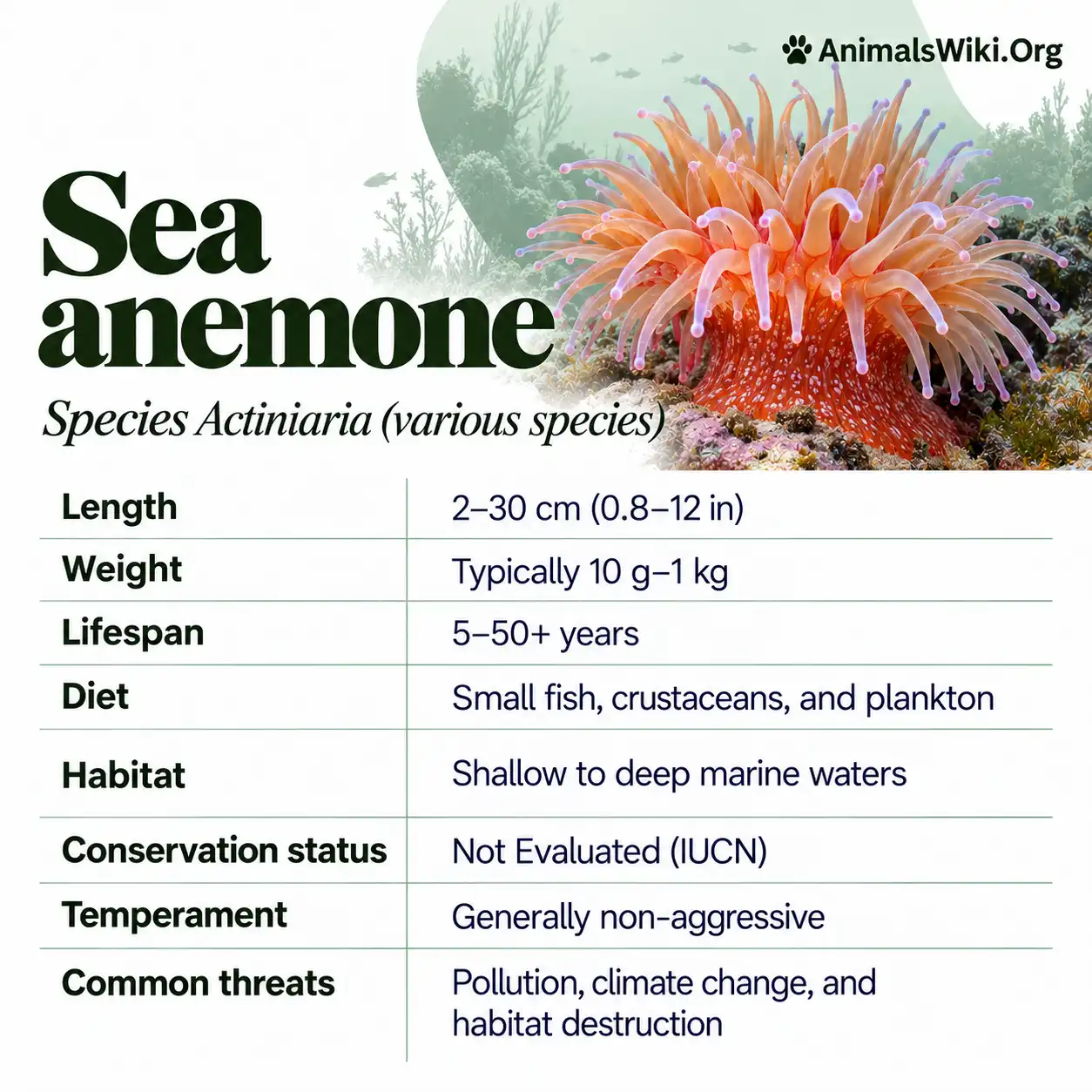
The sea anemone is one of the ocean’s most beautiful and fascinating animals. With its colorful tentacles, flower-like appearance, and remarkable relationships with clownfish, this unusual marine creature often looks more like a plant than a predator.
But sea anemones are not flowers, plants, or corals. They are living marine animals belonging to the order Actiniaria, within the phylum Cnidaria.
Despite their delicate appearance, sea anemones are carnivorous predators. Their tentacles contain specialized stinging cells that help them capture small fish, crustaceans, and other marine organisms.
Sea anemones inhabit a remarkable variety of marine environments, from shallow tropical coral reefs and rocky coastlines to cold, deep ocean habitats.
Some species attach themselves to rocks, shells, or coral rubble. Others live partly buried in sand, while certain deep-sea species survive in environments with little or no sunlight.
One of their most famous characteristics is their relationship with clownfish.
Certain sea anemones provide shelter among their tentacles for clownfish, which possess adaptations that help them avoid being stung by their hosts.
In return, clownfish may defend the anemone, provide nutrients through waste, and improve water circulation around its tentacles.
Sea anemones also possess extraordinary regenerative abilities. Some species can reproduce asexually by dividing or forming new individuals from fragments of their bodies.
Unlike jellyfish, sea anemones generally spend their adult lives in a polyp form, attached to a surface rather than swimming freely through the ocean.
Although they lack a brain, heart, and backbone, sea anemones have successfully adapted to marine environments across the world.
This comprehensive guide explores sea anemone facts, scientific classification, species, anatomy, size, colors, habitat, distribution, diet, stinging tentacles, clownfish relationships, reproduction, lifespan, predators, adaptations, conservation, and frequently asked questions.
Sea Anemone Facts
| Feature | Information |
|---|---|
| Common name | Sea Anemone |
| Scientific order | Actiniaria |
| Phylum | Cnidaria |
| Class | Anthozoa |
| Subclass | Hexacorallia |
| Animal type | Marine invertebrate |
| Habitat | Coral reefs, rocky shores, sandy seabeds, and deep ocean |
| Distribution | Oceans worldwide |
| Body shape | Cylindrical polyp with tentacles |
| Size | From less than 1 cm to over 1 meter across in some species |
| Colors | Red, orange, green, pink, purple, yellow, white, and brown |
| Tentacles | Numerous, depending on species |
| Diet | Small fish, crustaceans, plankton, and other marine animals |
| Feeding type | Carnivorous |
| Movement | Usually attached; some can move slowly |
| Nervous system | Diffuse nerve net |
| Reproduction | Sexual and asexual |
| Famous relationship | Clownfish mutualism |
| Lifespan | Species-dependent; some may survive for decades |
| Main predators | Sea stars, nudibranchs, fish, and other marine predators |
| Human danger | Usually low, but some species cause painful stings |
| Conservation | Varies by species and habitat |
What Is a Sea Anemone?
A sea anemone is a marine cnidarian belonging to the order Actiniaria.
It has a soft, cylindrical body topped with a ring of tentacles surrounding a central mouth.
Although its appearance resembles a flower, it is an animal.
Is a Sea Anemone a Plant or an Animal?
A sea anemone is an animal.
It belongs to the kingdom Animalia.
Why Is It Called a Sea Anemone?
Its name comes from its resemblance to the flowering plants called anemones.
Is a Sea Anemone a Jellyfish?
No. Sea anemones and jellyfish are related cnidarians, but they belong to different classes.
Is a Sea Anemone an Invertebrate?
Yes. It has no backbone.
Scientific Classification of Sea Anemones
| Classification | Name |
|---|---|
| Kingdom | Animalia |
| Phylum | Cnidaria |
| Class | Anthozoa |
| Subclass | Hexacorallia |
| Order | Actiniaria |
| Example family | Actiniidae |
| Example genus | Actinia |
| Example species | Actinia equina |
Sea anemones comprise many families, genera, and species.
What Does Actiniaria Mean?
Actiniaria is the scientific order containing true sea anemones.
Are Sea Anemones Related to Coral?
Yes. Both belong to Anthozoa.
Are Sea Anemones Related to Jellyfish?
Yes. Both belong to Cnidaria.
Are Sea Anemones Related to Box Jellyfish?
Yes, but they belong to different cnidarian classes.
Types of Sea Anemones
There are more than 1,000 described sea anemone species, with considerable diversity in size, color, habitat, and behavior.
1. Beadlet Anemone
Scientific name: Actinia equina
The beadlet anemone is commonly found on rocky shores in parts of the northeastern Atlantic and nearby seas.
It is famous for its bright red coloration and ability to survive periods of exposure during low tide.
2. Bubble-Tip Anemone
Scientific name: Entacmaea quadricolor
The bubble-tip anemone is a well-known tropical reef species.
Its tentacles may develop rounded, bubble-like tips, although their shape varies.
It is also associated with several clownfish species.
3. Magnificent Sea Anemone
Scientific name: Heteractis magnifica
This large tropical anemone is famous for its striking appearance and symbiotic relationships with clownfish.
It may form large aggregations in suitable reef habitats.
4. Giant Carpet Anemone
Scientific name: Stichodactyla gigantea
This tropical species possesses a broad oral disc covered with short, sticky tentacles.
It is one of the sea anemones capable of hosting clownfish.
5. Giant Green Anemone
Scientific name: Anthopleura xanthogrammica
This large sea anemone occurs along the Pacific coast of North America.
Its green coloration is associated partly with symbiotic photosynthetic organisms.
6. Plumose Anemone
Scientific name: Metridium senile
The plumose anemone has numerous fine tentacles and is found in cooler marine environments.
7. Snakelocks Anemone
Scientific name: Anemonia viridis
This species has long, slender tentacles and occurs in parts of the northeastern Atlantic and Mediterranean.
8. Corkscrew Anemone
Scientific name: Macrodactyla doreensis
This tropical Indo-Pacific species is associated with sandy substrates and may host clownfish.
9. Adhesive Sea Anemone
Scientific name: Cryptodendrum adhaesivum
This Indo-Pacific anemone has a distinctive appearance with dense, sticky tentacles.
10. Delicate Sea Anemone
Scientific name: Heteractis malu
This species occurs in Indo-Pacific waters and often inhabits sandy or rubble-covered seabeds.
What Does a Sea Anemone Look Like?
Sea anemones have soft bodies with tentacles surrounding a central mouth.
Their anatomy includes:
- Oral disc
- Mouth
- Tentacles
- Column
- Pedal disc
- Gastrovascular cavity
- Mesenteries
- Stinging cells
- Nerve net
What Is the Oral Disc?
The oral disc is the upper body surface surrounding the mouth.
What Is the Pedal Disc?
The pedal disc is the base used for attachment.
Do Sea Anemones Have Tentacles?
Yes.
Do Sea Anemones Have Bones?
No.
Sea Anemone Colors
Sea anemones occur in many colors.
These include:
- Bright red
- Orange
- Green
- Pink
- Purple
- Yellow
- White
- Brown
- Blue-green shades
Why Are Sea Anemones So Colorful?
Their colors arise from pigments, tissue structures, and sometimes symbiotic photosynthetic organisms.
Can Sea Anemones Change Color?
Some show changes in appearance related to lighting, pigments, health, and symbiont abundance.
They do not generally change color as rapidly as octopuses.
Are All Sea Anemones Brightly Colored?
No. Some are pale, brown, or relatively inconspicuous.
Sea Anemone Size and Weight
Sea anemones vary enormously in size.
How Big Is a Sea Anemone?
Some species are less than one centimeter across, while exceptionally large species can exceed one meter across when expanded.
What Is the Largest Sea Anemone?
Several large tropical species can reach impressive dimensions.
The largest depends on whether size is measured by oral disc diameter, tentacle spread, or body height.
How Much Does a Sea Anemone Weigh?
Weight varies greatly with species, size, and water content.
Where Do Sea Anemones Live?
Sea anemones occur in oceans worldwide.
They inhabit:
- Atlantic Ocean
- Pacific Ocean
- Indian Ocean
- Arctic Ocean
- Southern Ocean
- Mediterranean Sea
- Tropical coral reefs
- Temperate rocky shores
- Deep-sea environments
Do Sea Anemones Live in Coral Reefs?
Yes. Many species inhabit coral reefs.
Do Sea Anemones Live in the Deep Sea?
Yes. Some species inhabit deep ocean environments.
Do Sea Anemones Live in Freshwater?
True sea anemones are marine animals, although some species tolerate reduced salinity.
Do Sea Anemones Live in Cold Water?
Yes.
Sea Anemone Habitat
Sea anemones inhabit many marine habitats.
These include:
- Coral reefs
- Rocky intertidal zones
- Tide pools
- Sandy seabeds
- Muddy bottoms
- Kelp forests
- Deep-sea rocky substrates
- Submerged artificial structures
Do Sea Anemones Attach to Rocks?
Yes.
Can Sea Anemones Live in Sand?
Yes. Some species attach below or within sandy substrates.
Can Sea Anemones Survive Low Tide?
Certain intertidal species can survive temporary exposure to air by retracting their tentacles and retaining moisture.
What Do Sea Anemones Eat?
Sea anemones are carnivorous predators.
Their diet may include:
- Small fish
- Shrimp
- Crabs
- Copepods
- Zooplankton
- Marine larvae
- Other small invertebrates
- Organic particles captured from water
Do Sea Anemones Eat Fish?
Yes. Some species capture small fish.
Do Sea Anemones Eat Shrimp?
Yes.
Do Sea Anemones Eat Plankton?
Yes. Many species capture planktonic animals.
Are Sea Anemones Carnivores?
Yes.
How Do Sea Anemones Hunt?
Sea anemones capture prey using their tentacles.
These tentacles contain cnidocytes equipped with nematocysts.
When prey contacts the tentacles, stinging structures can discharge and help immobilize it.
The tentacles then transport the prey toward the mouth.
What Are Cnidocytes?
Cnidocytes are specialized stinging cells.
What Are Nematocysts?
Nematocysts are microscopic capsules capable of discharging a stinging structure.
Do Sea Anemones Have Teeth?
No.
How Do Sea Anemones Digest Food?
They digest food inside their gastrovascular cavity.
Do Sea Anemones Sting?
Yes.
Sea anemones use venom-delivering stinging cells to capture prey and defend themselves.
Can Sea Anemones Sting Humans?
Yes, although many species produce little or no noticeable reaction on intact human skin.
Are Sea Anemones Dangerous?
Most are not considered highly dangerous to humans, but some species can cause painful stings.
Can Sea Anemone Stings Be Serious?
Yes. Severe irritation or allergic reactions are possible.
Can Dead Sea Anemones Still Sting?
Stinging cells may remain functional after an animal dies.
What Should You Do if Stung by a Sea Anemone?
- Stop touching the animal and leave the water if necessary.
- Avoid rubbing the affected skin.
- Rinse gently with seawater.
- Remove visible attached material carefully using tweezers or protective gloves.
- Seek medical advice for persistent pain, swelling, or irritation.
- Call emergency services for difficulty breathing, fainting, or severe allergic symptoms.
First-aid recommendations may differ by species. Avoid assuming that vinegar, freshwater, or heat is appropriate for every cnidarian sting.
Can Sea Anemones Move?
Yes.
Although most sea anemones remain attached to surfaces, some can move slowly.
How Do Sea Anemones Move?
They may creep using their pedal discs.
Can Sea Anemones Swim?
Some species can detach and perform swimming-like movements.
Are Sea Anemones Fast?
Most move slowly.
Why Do Sea Anemones Move?
They may relocate in response to unsuitable conditions, competition, or predators.
Do Sea Anemones Have Brains?
No.
Sea anemones possess diffuse nervous systems.
How Do Sea Anemones Respond Without Brains?
Their nerve nets coordinate tentacle movement, feeding, contraction, and other responses.
Do Sea Anemones Have Eyes?
They lack complex eyes, but can respond to light and other environmental signals.
Can Sea Anemones Feel Pain?
They respond to harmful stimuli, but whether they experience conscious pain remains scientifically uncertain.
Sea Anemones and Clownfish
One of the most famous marine partnerships is the relationship between clownfish and sea anemones.
Certain clownfish live among the tentacles of specific host anemones.
Why Do Clownfish Live in Sea Anemones?
The anemone provides shelter from many predators.
Why Don’t Clownfish Get Stung?
Clownfish possess specialized mucus and behavioral adaptations that reduce triggering of the host anemone’s stinging cells.
Do Clownfish Help Sea Anemones?
Yes. Depending on the species and conditions, clownfish may provide nutrients, defend the host, and improve water movement.
Do All Sea Anemones Host Clownfish?
No. Only certain species serve as natural clownfish hosts.
Can Sea Anemones Survive Without Clownfish?
Yes. Many sea anemones live without clownfish.
Sea Anemones and Symbiotic Algae
Some sea anemones host photosynthetic organisms within their tissues.
These symbionts can provide nutrients produced through photosynthesis.
Do Sea Anemones Perform Photosynthesis?
The anemone itself does not photosynthesize. Its symbiotic organisms may do so.
Do All Sea Anemones Have Symbiotic Algae?
No.
Can Sea Anemones Bleach?
Yes. Some symbiotic sea anemones can lose photosynthetic symbionts or pigments under stressful conditions.
Sea Anemone Reproduction
Sea anemones can reproduce sexually and asexually.
Do Sea Anemones Reproduce Sexually?
Yes.
Do Sea Anemones Lay Eggs?
Many species produce eggs and sperm.
Do Sea Anemones Reproduce Asexually?
Yes. Some species reproduce by fission, budding, or pedal laceration.
What Is Pedal Laceration?
Pedal laceration occurs when small pieces of the pedal disc develop into new anemones.
Sea Anemone Life Cycle
Stage 1: Fertilization
Eggs are fertilized.
Stage 2: Embryo
The embryo develops.
Stage 3: Planula Larva
Many species produce a swimming planula larva.
Stage 4: Settlement
The larva settles on a suitable substrate.
Stage 5: Juvenile Polyp
A young sea anemone develops.
Stage 6: Adult Sea Anemone
The animal grows and becomes reproductively mature.
Not all species follow exactly the same reproductive and developmental pattern.
Baby Sea Anemones
Young sea anemones may develop from fertilized eggs or asexual reproduction.
What Is a Baby Sea Anemone Called?
A juvenile sea anemone.
Do Baby Sea Anemones Have Tentacles?
Tentacles develop during growth.
Can Baby Sea Anemones Sting?
Their stinging structures develop as they mature.
How Long Do Sea Anemones Live?
Sea anemone lifespan varies considerably.
Some species may live for decades under suitable conditions.
Can Sea Anemones Live for 100 Years?
Very long lifespans are sometimes suggested for certain species, but exact ages are difficult to verify.
Do Sea Anemones Die of Old Age?
They can die from physiological deterioration, disease, predation, and environmental stress.
Are Sea Anemones Immortal?
No. Regeneration and asexual reproduction do not make them invincible.
Sea Anemone Regeneration
Sea anemones can possess impressive regenerative abilities.
Can Sea Anemones Regrow Tentacles?
Yes. Many species can regenerate damaged tentacles.
Can Sea Anemones Regenerate Their Bodies?
Some species can regenerate substantial body structures.
Can a Sea Anemone Grow From a Fragment?
In species capable of certain forms of asexual reproduction, fragments can develop into new individuals.
Sea Anemone Adaptations
Stinging Tentacles
Capture prey and provide defense.
Nematocysts
Deliver venom.
Pedal Disc
Allows attachment to surfaces.
Contractile Body
Helps protect vulnerable structures.
Regeneration
Supports recovery from damage.
Asexual Reproduction
Allows population growth without mating.
Symbiotic Relationships
Provide ecological benefits in some species.
Coloration
May reflect pigments or symbiotic organisms.
Salinity Tolerance
Allows some species to inhabit estuarine environments.
Habitat Diversity
Supports survival across many marine ecosystems.
What Animals Eat Sea Anemones?
Predators include:
- Nudibranchs
- Sea stars
- Certain fish
- Some crustaceans
- Other specialized marine predators
Do Nudibranchs Eat Sea Anemones?
Some nudibranch species feed on sea anemones.
Do Sea Stars Eat Sea Anemones?
Some sea stars consume sea anemones.
Do Fish Eat Sea Anemones?
Certain fish species feed on sea anemones.
Sea Anemone vs. Jellyfish
| Feature | Sea Anemone | Jellyfish |
|---|---|---|
| Main body form | Polyp | Usually medusa |
| Movement | Mostly attached | Free-swimming |
| Tentacles | Around oral disc | Usually around bell or oral structures |
| Stinging cells | Yes | Yes |
| Brain | No centralized brain | No centralized brain in most |
| Habitat | Seafloor and attached substrates | Water column |
| Reproduction | Sexual and often asexual | Varies by group |
Sea Anemone vs. Coral
| Feature | Sea Anemone | Coral |
|---|---|---|
| Scientific group | Actiniaria | Several anthozoan groups |
| Body | Soft polyp | Polyp, often with skeleton |
| Lifestyle | Usually solitary | Often colonial |
| Hard skeleton | Generally absent | Present in stony corals |
| Tentacles | Surround mouth | Surround mouth |
| Symbiotic algae | Some species | Many reef-building species |
Sea Anemone vs. Sea Nettle
Sea anemones and sea nettles are related cnidarians.
Sea anemones are primarily attached polyps.
Sea nettles are free-swimming true jellyfish belonging to the genus Chrysaora.
Both use stinging cells to capture prey.
Are Sea Anemones Dangerous to Humans?
Most sea anemones are not highly dangerous to humans.
However, contact can cause irritation, and some species have more potent stings.
Can You Touch a Sea Anemone?
Avoid touching wild sea anemones.
Are Sea Anemones Poisonous?
They are generally described as venomous because their stinging cells deliver toxins.
Can Sea Anemones Kill Humans?
Fatal outcomes are extremely unusual, but severe allergic reactions can be dangerous.
Are Sea Anemones Endangered?
Conservation status varies by species.
Some populations may be threatened by habitat destruction, pollution, or collection.
Are Sea Anemones Protected?
Protection depends on the species and jurisdiction.
Are All Sea Anemones Endangered?
No.
What Threatens Sea Anemones?
Potential threats include:
- Coral reef degradation
- Ocean warming
- Marine pollution
- Coastal development
- Ocean acidification
- Aquarium collection
- Destructive fishing practices
- Changes in symbiotic relationships
Can Climate Change Affect Sea Anemones?
Yes. Temperature changes can affect survival, reproduction, and symbiotic organisms.
Can Sea Anemones Bleach Like Corals?
Some species with photosynthetic symbionts can experience bleaching.
Why Are Sea Anemones Important?
Sea anemones contribute to marine ecosystems as predators, hosts, and habitat-associated organisms.
They are important for:
- Marine food webs
- Clownfish habitats
- Symbiotic relationships
- Reef biodiversity
- Regeneration research
- Cnidarian evolution
- Coastal ecosystem studies
50 Interesting Sea Anemone Facts
- Sea anemones belong to the order Actiniaria.
- They are marine animals.
- They belong to the phylum Cnidaria.
- They are invertebrates.
- They are not plants.
- They are related to jellyfish.
- They are closely related to corals.
- They resemble underwater flowers.
- They possess numerous tentacles.
- Their tentacles surround a central mouth.
- They possess stinging cells.
- Their stinging capsules are called nematocysts.
- They use venom to capture prey.
- They are carnivorous.
- They eat small fish.
- They consume crustaceans.
- Many eat plankton.
- They inhabit oceans worldwide.
- Some live on coral reefs.
- Others live on rocky shores.
- Some inhabit the deep sea.
- Certain species survive temporary exposure during low tide.
- They attach using a pedal disc.
- Most remain attached for long periods.
- Some can move slowly.
- A few species can perform swimming-like movements.
- They have no centralized brain.
- They possess nerve nets.
- They have no heart.
- They have no backbone.
- They can be brightly colored.
- Some are red.
- Others are green, purple, or orange.
- Some host clownfish.
- Clownfish benefit from shelter among their tentacles.
- Clownfish may defend their host anemones.
- Some anemones contain photosynthetic symbionts.
- Not all species host symbiotic algae.
- Some can experience bleaching.
- They reproduce sexually.
- Some reproduce asexually.
- Some reproduce by fission.
- Others reproduce through pedal laceration.
- Many can regenerate damaged tentacles.
- Some can regenerate substantial body structures.
- Certain species may live for decades.
- Nudibranchs can prey on sea anemones.
- Some sea stars eat them.
- They are important in marine ecosystems.
- Their combination of stinging tentacles, regeneration, and symbiosis makes them among the most fascinating marine invertebrates.
Did You Know?
The Ocean Flower That Protects Clownfish
Imagine exploring a tropical coral reef.
Sunlight filters through the clear blue water.
Colorful reef fish swim among branching corals.
On a rocky surface, a large sea anemone gently waves its tentacles.
Its body resembles a flower.
The tentacles are soft-looking and colorful.
But each contains specialized stinging cells.
A small shrimp approaches.
The shrimp touches a tentacle.
Microscopic stinging structures discharge.
The prey becomes trapped and is transported toward the mouth.
The sea anemone is a predator.
Yet something unusual happens nearby.
A brightly colored clownfish swims directly into the tentacles.
Instead of being captured, the fish moves safely among them.
It disappears into the anemone.
Moments later, it emerges again.
Why is this fish able to survive where other animals might be stung?
Clownfish possess specialized mucus and behavioral adaptations that reduce the activation of the anemone’s stinging cells.
The anemone provides shelter from predators.
The clownfish may help defend the anemone from certain fish that feed on its tentacles.
Its waste can also provide nutrients.
This relationship is an example of mutualism.
Both organisms can benefit.
The sea anemone gains protection and nutrients.
The clownfish gains a relatively safe home.
But sea anemones have even more extraordinary abilities.
Some can regenerate damaged tentacles.
Others can reproduce by dividing.
Certain species can survive for decades.
Despite lacking a centralized brain, heart, or backbone, these animals have successfully colonized habitats from tropical reefs to cold deep-sea environments.
The sea anemone demonstrates that an animal can be both a beautiful underwater flower-like organism and a highly effective marine predator, while also forming one of nature’s most remarkable partnerships with clownfish.
Frequently Asked Questions About Sea Anemones
What is a sea anemone?
A sea anemone is a marine cnidarian belonging to the order Actiniaria.
Is a sea anemone a plant or an animal?
It is an animal.
Why does a sea anemone look like a flower?
Its tentacles surround the mouth in a flower-like arrangement.
Is a sea anemone a jellyfish?
No, but they are related.
Is a sea anemone a coral?
No, although they are closely related.
Is a sea anemone an invertebrate?
Yes.
What is the scientific name of sea anemones?
Sea anemones belong to the order Actiniaria.
How many sea anemone species exist?
More than 1,000 species have been described.
What is a bubble-tip anemone?
Entacmaea quadricolor.
What is a beadlet anemone?
Actinia equina.
What is a magnificent sea anemone?
Heteractis magnifica.
What is a giant carpet anemone?
Stichodactyla gigantea.
What is a giant green anemone?
Anthopleura xanthogrammica.
How big are sea anemones?
Size varies from tiny species to large individuals exceeding one meter across.
What is the largest sea anemone?
Several large species compete depending on the measurement used.
What color are sea anemones?
Red, orange, green, purple, pink, white, yellow, and brown.
Why are sea anemones colorful?
Pigments and sometimes photosynthetic symbionts contribute to coloration.
Do sea anemones have tentacles?
Yes.
Do sea anemones have eyes?
They lack complex eyes.
Do sea anemones have brains?
No.
Do sea anemones have hearts?
No.
Do sea anemones have bones?
No.
Where do sea anemones live?
In oceans worldwide.
Do sea anemones live in coral reefs?
Yes.
Do sea anemones live in the deep sea?
Yes.
Do sea anemones live in freshwater?
True sea anemones are marine animals.
Do sea anemones live in cold water?
Yes.
Do sea anemones attach to rocks?
Yes.
Do sea anemones live in sand?
Some species do.
Can sea anemones survive low tide?
Some intertidal species can survive temporary exposure.
What do sea anemones eat?
Small fish, crustaceans, plankton, and other marine animals.
Are sea anemones carnivores?
Yes.
Do sea anemones eat fish?
Yes.
Do sea anemones eat shrimp?
Yes.
Do sea anemones eat plankton?
Yes.
How do sea anemones hunt?
They capture prey using stinging tentacles.
What are cnidocytes?
Specialized stinging cells.
What are nematocysts?
Microscopic stinging capsules.
Do sea anemones have teeth?
No.
Do sea anemones sting?
Yes.
Can sea anemones sting humans?
Yes.
Are sea anemones dangerous?
Most are not highly dangerous, but some cause painful stings.
Can dead sea anemones sting?
Stinging cells may remain active after death.
What should you do after a sea anemone sting?
Avoid rubbing, rinse gently with seawater, remove attached material carefully, and seek medical advice if necessary.
Can sea anemones move?
Yes.
Can sea anemones walk?
Some creep slowly using their pedal discs.
Can sea anemones swim?
A few species can perform swimming-like movements.
Are sea anemones fast?
Usually not.
Why do clownfish live in sea anemones?
They receive shelter from predators.
Why don’t clownfish get stung?
They possess specialized mucus and behavioral adaptations.
Do clownfish help sea anemones?
Yes, in several ways.
Do all sea anemones host clownfish?
No.
Can sea anemones live without clownfish?
Yes.
Do sea anemones have symbiotic algae?
Some species do.
Do sea anemones photosynthesize?
The anemone itself does not, but some host photosynthetic symbionts.
Can sea anemones bleach?
Yes, some symbiotic species can.
How do sea anemones reproduce?
Sexually and, in many species, asexually.
Do sea anemones lay eggs?
Many species produce eggs.
Can sea anemones reproduce without mating?
Some can reproduce asexually.
What is pedal laceration?
A process in which fragments of the pedal disc develop into new anemones.
Can sea anemones regenerate tentacles?
Yes.
Can sea anemones regenerate their bodies?
Some species can regenerate substantial body structures.
What is a baby sea anemone called?
A juvenile sea anemone.
How long do sea anemones live?
Lifespan varies, and some species may live for decades.
Can sea anemones live for 100 years?
Such extreme ages are difficult to verify.
Are sea anemones immortal?
No.
What animals eat sea anemones?
Nudibranchs, sea stars, fish, and other predators.
Do nudibranchs eat sea anemones?
Some species do.
Do sea stars eat sea anemones?
Some do.
Are sea anemones endangered?
Conservation status varies by species.
What threatens sea anemones?
Habitat destruction, pollution, warming, and collection.
Why are sea anemones important?
They support marine food webs, biodiversity, and symbiotic relationships.
What is the most interesting sea anemone fact?
Some sea anemones provide shelter to clownfish, which can live among their venomous tentacles because of specialized protective adaptations.
Conclusion
Sea anemones are among the most beautiful and fascinating animals in the ocean.
Although they resemble flowers, they are carnivorous marine predators equipped with specialized stinging tentacles.
Their extraordinary diversity allows them to inhabit tropical coral reefs, rocky coastlines, sandy seabeds, and deep ocean environments.
Some species form remarkable mutualistic relationships with clownfish.
Others host photosynthetic symbionts that contribute nutrients.
Many sea anemones can regenerate damaged body parts, and some reproduce asexually through division or fragmentation.
Despite lacking a centralized brain, heart, and backbone, these animals have evolved effective adaptations for feeding, reproduction, and survival.
Understanding sea anemones helps reveal the complexity of marine ecosystems and the importance of protecting ocean biodiversity.
The sea anemone proves that some of nature’s most beautiful flower-like creatures are actually extraordinary predators, survivors, and partners in the underwater world.