Sand Dollar, The Fascinating Flat Sea Urchin With a Five-Petal Pattern
The sand dollar is one of the most recognizable and fascinating marine invertebrates found along sandy ocean floors. Famous for its flattened, circular body and distinctive five-petal pattern, this unusual sea creature is often discovered as a pale, coin-shaped skeleton washed onto beaches.
Although many people think sand dollars are shells, stones, or fossils, living sand dollars are actually animals.
They belong to the class Echinoidea, making them close relatives of sea urchins.
Unlike the rounded bodies and long spines of familiar sea urchins, sand dollars possess flattened bodies covered with thousands of tiny, movable spines.
These spines help them move through sand, collect food particles, and interact with their environment.
Living sand dollars are often purple, brown, greenish, or dark-colored, depending on the species.
The white sand dollars commonly collected from beaches are usually the remains of dead animals.
Their rigid internal skeleton, called a test, becomes exposed after the soft tissues and spines disappear.
Sand dollars are particularly interesting because of their specialized feeding behavior.
Many species consume microscopic algae, organic particles, and small organisms found in sandy sediments.
They use their tiny spines and tube feet to move food toward their mouths.
Sand dollars also possess a remarkable body plan based on five-part symmetry.
The flower-like pattern visible on their upper surfaces is formed by specialized areas called petaloids, which contain pores associated with respiratory tube feet.
Despite their simple appearance, sand dollars have complex adaptations for life in shifting marine sediments.
They can burrow into sand, resist water movement, detect environmental cues, and reproduce by releasing eggs and sperm into seawater.
This comprehensive guide explores sand dollar facts, scientific classification, species, anatomy, size, habitat, distribution, diet, feeding behavior, movement, reproduction, lifespan, predators, adaptations, conservation, and frequently asked questions.
Sand Dollar Facts
| Feature | Information |
|---|---|
| Common name | Sand Dollar |
| Animal type | Flattened marine echinoid |
| Phylum | Echinodermata |
| Class | Echinoidea |
| Group | Irregular echinoids |
| Commonly recognized order | Clypeasteroida, depending on classification |
| Example species | Dendraster excentricus |
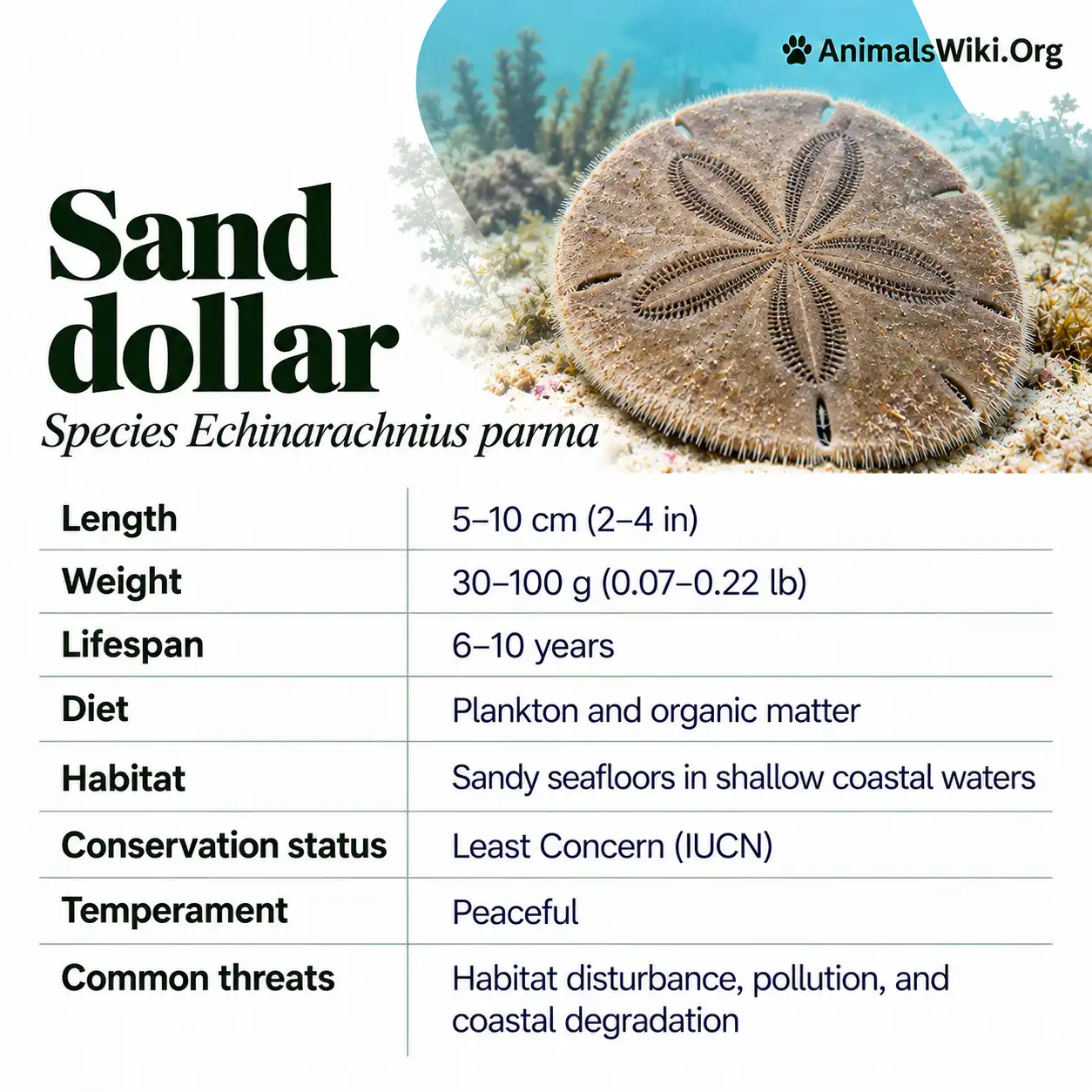
| Habitat | Sandy coastal seafloors |
| Distribution | Many temperate and tropical marine regions |
| Body shape | Flattened, circular, oval, or irregular |
| Size | Often 5–10 cm across; varies by species |
| Living color | Purple, brown, greenish, or dark |
| Dead test color | Usually pale gray or white |
| Body covering | Numerous tiny movable spines |
| Distinctive feature | Five-petal-like petaloid pattern |
| Mouth | Located on the underside |
| Diet | Microalgae, detritus, and small organic particles |
| Feeding type | Primarily deposit or suspension feeding, depending on species |
| Movement | Tiny spines and tube feet |
| Reproduction | Sexual reproduction, usually external fertilization |
| Larval stage | Echinopluteus |
| Lifespan | Often several years; varies by species |
| Predators | Fish, crabs, sea stars, and other marine animals |
| Human danger | Harmless to humans |
| Conservation | Varies by species and habitat |
What Is a Sand Dollar?
A sand dollar is a flattened marine echinoderm closely related to sea urchins.
Sand dollars belong to the class Echinoidea and are adapted to life on or beneath sandy seafloors.
Is a Sand Dollar a Living Animal?
Yes.
A living sand dollar is an animal covered with tiny spines.
Is a Sand Dollar a Shell?
No.
The hard object commonly found on beaches is the animal’s test, not a mollusk shell.
Is a Sand Dollar a Sea Urchin?
Yes, in the broad zoological sense.
Sand dollars are specialized members of the sea urchin class Echinoidea.
Is a Sand Dollar a Fish?
No.
It is a marine invertebrate.
Scientific Classification of Sand Dollars
Sand dollars include multiple species and are not represented by a single scientific name.
| Classification | Name |
|---|---|
| Kingdom | Animalia |
| Phylum | Echinodermata |
| Subphylum | Echinozoa |
| Class | Echinoidea |
| Major group | Irregular echinoids |
| Order | Clypeasteroida in commonly used classifications |
| Example family | Dendrasteridae |
| Example genus | Dendraster |
| Example species | Dendraster excentricus |
Taxonomic classifications of sand dollars and related flattened echinoids vary among scientific systems.
What Does Echinodermata Mean?
The name refers to animals with spiny skin.
Are Sand Dollars Related to Sea Stars?
Yes.
Are Sand Dollars Related to Sea Cucumbers?
Yes.
Are Sand Dollars Related to Sea Urchins?
Yes. They belong to the same class.
Types of Sand Dollars
There are many sand dollar species, with differences in body shape, size, habitat, and distribution.
1. Pacific Sand Dollar
Scientific name: Dendraster excentricus
This species occurs along the Pacific coast of North America.
It is known for its flattened body and slightly off-center petal pattern.
2. Keyhole Sand Dollar
Scientific name: Mellita quinquiesperforata
This western Atlantic species possesses distinctive openings called lunules.
These openings help distinguish it from many other sand dollars.
3. Six-Keyhole Sand Dollar
Scientific name: Leodia sexiesperforata
This species is found in tropical and subtropical western Atlantic waters.
It has multiple openings in its test.
4. Common Sand Dollar
Scientific name: Echinarachnius parma
This species occurs in cooler northern marine environments.
5. Sea Biscuit
Scientific group: Various species within Clypeasteroida and related groups.
Sea biscuits are related flattened echinoids, often with thicker, more domed tests.
They are not necessarily classified as sand dollars in the narrow everyday sense.
What Does a Sand Dollar Look Like?
Sand dollars have flattened bodies with a rigid test covered by tiny spines.
Their anatomy includes:
- Test
- Tiny movable spines
- Tube feet
- Petaloids
- Mouth
- Digestive tract
- Water vascular system
- Sensory cells
- Reproductive organs
- Anus
What Is the Test?
The test is the rigid skeleton made from fused calcium carbonate plates.
What Are Petaloids?
Petaloids are petal-shaped regions containing pores associated with specialized tube feet.
Do Sand Dollars Have Spines?
Yes.
Do Sand Dollars Have Bones?
They have a calcareous skeleton but no vertebrate-style bones.
Why Do Sand Dollars Have Five Petals?
The five-petal pattern reflects the underlying five-part body organization characteristic of many echinoderms.
Are the Petals Real Flowers?
No.
Are the Petals Decorative?
No. They are functional anatomical structures.
Do All Sand Dollars Have Exactly Five Visible Petals?
Most familiar species display a five-part pattern, but its appearance varies among species.
Sand Dollar Size and Weight
Sand dollar size varies considerably.
How Big Is a Sand Dollar?
Many commonly encountered species measure approximately 5–10 centimeters across.
Can Sand Dollars Grow Larger?
Yes. Some species grow substantially larger.
How Much Does a Sand Dollar Weigh?
Weight depends on species, size, and whether the animal is alive or only the test remains.
Sand Dollar Colors
Living sand dollars are often darker than dead tests.
Possible colors include:
- Purple
- Violet
- Brown
- Greenish brown
- Dark gray
- Nearly black
Why Are Dead Sand Dollars White?
After death, the spines and soft tissues disappear, leaving the pale calcium carbonate test.
Are All Living Sand Dollars Purple?
No.
Can Sand Dollars Change Color?
They are not known for rapid color changes like octopuses.
Where Do Sand Dollars Live?
Sand dollars occur in many ocean regions.
They inhabit:
- Pacific Ocean
- Atlantic Ocean
- Indian Ocean
- Tropical coastal waters
- Temperate coastal waters
- Shallow sandy marine habitats
- Deeper sandy seafloors
Do Sand Dollars Live in California?
Yes.
Do Sand Dollars Live in Florida?
Yes. Several sand dollar species occur in Florida waters.
Do Sand Dollars Live in the Atlantic Ocean?
Yes.
Do Sand Dollars Live in the Pacific Ocean?
Yes.
Do Sand Dollars Live in Freshwater?
No.
Sand Dollar Habitat
Sand dollars are adapted to sandy marine environments.
Habitats include:
- Sandy beaches below the waterline
- Shallow coastal seafloors
- Sandy bays
- Subtidal sand flats
- Offshore sandy bottoms
Do Sand Dollars Live in Sand?
Yes.
Do Sand Dollars Burrow?
Many species can bury themselves partly or completely in sand.
Do Sand Dollars Live in Deep Water?
Some species inhabit deeper marine environments.
Do Sand Dollars Live on Coral Reefs?
They are primarily associated with sandy substrates rather than living coral surfaces.
What Do Sand Dollars Eat?
Sand dollars feed on small organic particles and microorganisms.
Their diet may include:
- Microscopic algae
- Diatoms
- Detritus
- Bacteria-associated organic material
- Small planktonic organisms
- Organic particles suspended in water
Do Sand Dollars Eat Plankton?
Some species capture plankton and suspended particles.
Do Sand Dollars Eat Algae?
Yes.
Do Sand Dollars Eat Fish?
Fish are not their normal primary food.
Are Sand Dollars Carnivores?
Their feeding habits vary, but many are primarily detritivorous, microphagous, or suspension-feeding animals.
How Do Sand Dollars Eat?
Sand dollars use tiny spines and tube feet to collect and transport food.
Do Sand Dollars Have Mouths?
Yes.
Where Is a Sand Dollar’s Mouth?
Usually on the underside.
Do Sand Dollars Have Teeth?
Many sand dollars possess a modified Aristotle’s lantern, although feeding structures vary among irregular echinoids.
How Do Sand Dollars Digest Food?
Food passes through their digestive tract.
How Do Sand Dollars Move?
Sand dollars move using their tiny spines and tube feet.
Can Sand Dollars Walk?
They crawl slowly across or through sand.
Can Sand Dollars Swim?
Adults do not swim like fish.
Are Sand Dollars Fast?
No.
Can Sand Dollars Dig Into Sand?
Yes.
Why Do Sand Dollars Bury Themselves?
Burrowing provides several advantages.
These include:
- Protection from predators
- Reduced exposure to waves
- Access to food particles
- Stability in shifting sediments
Can Sand Dollars Hide Completely?
Some species can become largely buried.
Do Sand Dollars Stay Buried All the Time?
Behavior varies by species and environmental conditions.
Sand Dollar Nervous System
Sand dollars possess decentralized nervous systems.
Do Sand Dollars Have Brains?
No.
Do Sand Dollars Have Eyes?
They lack conventional eyes but possess sensory cells that respond to environmental signals.
Can Sand Dollars Sense Light?
They can respond to light-related cues.
Can Sand Dollars Feel Pain?
Whether they experience conscious pain is scientifically uncertain.
Sand Dollar Reproduction
Sand dollars reproduce sexually.
Adults release eggs and sperm into seawater.
Do Sand Dollars Lay Eggs?
Females release eggs.
Do Sand Dollars Reproduce Sexually?
Yes.
Do Sand Dollars Reproduce Asexually?
Asexual reproduction is not their normal reproductive strategy.
Sand Dollar Life Cycle
Stage 1: Spawning
Adults release eggs and sperm.
Stage 2: Fertilization
Fertilization occurs in seawater.
Stage 3: Embryo
The fertilized egg develops.
Stage 4: Echinopluteus Larva
A free-swimming larva develops.
Stage 5: Settlement
The larva settles onto suitable sandy habitat.
Stage 6: Juvenile Sand Dollar
The young animal develops its flattened body.
Stage 7: Adult Sand Dollar
The animal grows and becomes reproductively mature.
Baby Sand Dollars
Young sand dollars begin as planktonic larvae.
What Is a Baby Sand Dollar Called?
An echinopluteus during its larval stage and a juvenile after settlement.
Do Baby Sand Dollars Have Spines?
Spines develop as the animal matures.
Do Baby Sand Dollars Look Like Adults?
No. Their larval form differs greatly from the adult body shape.
How Long Do Sand Dollars Live?
Sand dollar lifespan varies by species.
Many species survive for several years.
Can Sand Dollars Live for Ten Years?
Some species may approach or exceed this lifespan under suitable conditions.
Can Sand Dollars Live for 100 Years?
Such extreme longevity is not typical of familiar sand dollar species.
How Do Scientists Estimate Sand Dollar Age?
Researchers may study growth patterns, size distributions, and other biological indicators.
Sand Dollar Adaptations
Flattened Body
Helps survival in sandy environments.
Tiny Spines
Support movement and feeding.
Tube Feet
Assist with feeding, respiration, and movement.
Petaloids
Support respiratory functions.
Rigid Test
Provides structural protection.
Burrowing Behavior
Helps avoid predators and strong water movement.
Sediment Feeding
Allows use of small organic food particles.
Planktonic Larvae
Support dispersal.
Sensory Cells
Help detect environmental conditions.
Species-Specific Openings
Lunules in some species influence water flow and stability.
What Animals Eat Sand Dollars?
Predators include:
- Certain fish
- Crabs
- Sea stars
- Other benthic predators
Do Fish Eat Sand Dollars?
Some fish prey on sand dollars.
Do Crabs Eat Sand Dollars?
Yes. Some crabs consume sand dollars.
Do Sea Stars Eat Sand Dollars?
Some sea stars may prey on them.
Sand Dollars and Marine Ecosystems
Sand dollars influence sediment ecosystems through feeding and movement.
They contribute to:
- Organic matter processing
- Sediment mixing
- Benthic food webs
- Nutrient cycling
- Sandy habitat ecology
Are Sand Dollars Important?
Yes.
Do Sand Dollars Clean the Ocean?
They help process organic particles, but describing them as ocean cleaners oversimplifies their ecological role.
Sand Dollar vs. Sea Urchin
| Feature | Sand Dollar | Typical Sea Urchin |
|---|---|---|
| Body shape | Flattened | Rounded |
| Spines | Short and fine | Often longer |
| Habitat | Sandy seafloor | Often rocky habitats |
| Movement | Tiny spines and tube feet | Spines and tube feet |
| Diet | Fine organic particles | Often algae |
| Skeleton | Flattened test | Rounded test |
| Scientific class | Echinoidea | Echinoidea |
Sand Dollar vs. Purple Sea Urchin
Purple sea urchins have rounded bodies covered with long purple spines.
Sand dollars have flattened bodies covered with tiny spines.
Purple sea urchins primarily graze on algae and kelp.
Sand dollars commonly feed on small particles and microorganisms in sandy environments.
Sand Dollar vs. Red Sea Urchin
Red sea urchins are large, rounded grazers found on rocky Pacific coast habitats.
Sand dollars are flattened echinoids adapted to sandy seafloors.
Some red sea urchins can survive for more than a century, while familiar sand dollar species generally have much shorter lifespans.
Sand Dollar vs. Sea Biscuit
Sea biscuits are close relatives of sand dollars.
However, sea biscuits generally have thicker, more domed bodies.
Sand dollars are usually flatter and more disc-like.
Are Sand Dollars Dangerous to Humans?
Sand dollars are generally harmless.
Can Sand Dollars Sting?
They do not have the long venomous spines associated with some other sea urchins.
Can Sand Dollars Bite?
They are not dangerous biting animals.
Can You Touch a Living Sand Dollar?
It is best to avoid handling living sand dollars because handling can injure them.
How Can You Tell if a Sand Dollar Is Alive?
Living sand dollars often have:
- Tiny moving spines
- Darker coloration
- A velvety appearance
- Movement when observed carefully
Dead tests are typically pale, smooth, and lack living spines.
Should You Collect Living Sand Dollars?
No. Leave living animals in their natural habitat.
Can You Collect Dead Sand Dollar Tests?
Rules vary by location. Check local regulations before collecting.
Are Sand Dollars Endangered?
Conservation status varies among species.
Many species have not received comprehensive global assessments.
What Threatens Sand Dollars?
Potential threats include:
- Coastal development
- Marine pollution
- Habitat disturbance
- Dredging
- Bottom-contact fishing
- Ocean warming
- Ocean acidification
- Collection of living animals
Why Are Sand Dollars Important?
Sand dollars are important marine invertebrates that contribute to sediment ecosystems.
They are also useful for studying:
- Echinoderm evolution
- Marine development
- Sediment ecology
- Feeding adaptations
- Ocean biodiversity
- Environmental change
50 Interesting Sand Dollar Facts
- Sand dollars are living marine animals.
- They are not shells.
- They belong to the phylum Echinodermata.
- They belong to the class Echinoidea.
- They are relatives of sea urchins.
- They are related to sea stars.
- They are invertebrates.
- They have flattened bodies.
- Their skeleton is called a test.
- Living sand dollars have tiny spines.
- Their spines can move.
- Many living sand dollars are purple or brown.
- Dead tests often become white.
- Many display a five-petal pattern.
- The petal-like structures are called petaloids.
- Petaloids contain pores associated with specialized tube feet.
- Sand dollars possess tube feet.
- They have a water vascular system.
- Their mouths are on the underside.
- They feed on microscopic food particles.
- Many consume microalgae.
- Some capture suspended plankton.
- They inhabit sandy seafloors.
- Some live near beaches.
- Others inhabit deeper sandy habitats.
- They can burrow into sand.
- Their flattened bodies help them survive in sediments.
- They move slowly.
- Adults do not swim like fish.
- They have no centralized brain.
- They possess sensory cells.
- They reproduce sexually.
- Eggs and sperm are released into seawater.
- Their larvae are called echinoplutei.
- Larvae drift in the plankton.
- Juveniles settle onto the seafloor.
- Their body shape changes dramatically during development.
- Some species possess openings called lunules.
- Lunules can influence water flow around the body.
- Sand dollars occur in multiple oceans.
- The Pacific sand dollar is Dendraster excentricus.
- The common sand dollar is Echinarachnius parma.
- The keyhole sand dollar is Mellita quinquiesperforata.
- Some fish eat sand dollars.
- Some crabs prey on them.
- They contribute to sediment food webs.
- They help process organic material.
- Their tests are commonly found washed onto beaches.
- Living sand dollars should be left undisturbed.
- Their unique flattened bodies and five-petal patterns make them among the most recognizable marine echinoderms.
Did You Know?
The Living Ocean Animal That Looks Like a Silver Coin
Imagine walking along a quiet beach after the tide has gone out.
The sand is smooth.
Small waves roll toward the shore.
Among the shells and pebbles, you notice a pale, circular object.
Its surface displays a delicate five-petal pattern.
It resembles a silver coin.
You pick it up.
It is a sand dollar test.
The living animal that once occupied this skeleton was very different from the pale object now resting on the beach.
Imagine traveling beneath the ocean surface to a sandy seafloor.
There, a living sand dollar lies partly buried in the sediment.
Its body is dark purple.
Thousands of tiny spines cover its surface.
These spines move in coordinated patterns.
They help the sand dollar travel slowly across the sand.
Tiny tube feet collect food particles.
Microscopic algae and organic material are transported toward its mouth.
The animal feeds quietly on the seafloor.
When waves become stronger, it may bury itself more deeply.
Its flattened body helps it remain stable in shifting sediments.
A fish swims nearby.
The sand dollar remains partly hidden.
Its body shape and burrowing behavior provide protection.
Later, during reproduction, adult sand dollars release eggs and sperm into the surrounding water.
Fertilized eggs develop into microscopic larvae.
These larvae drift through the ocean.
Eventually, some settle onto sandy habitats and transform into juvenile sand dollars.
Over time, they develop the familiar flattened body and petal-shaped structures.
When a sand dollar dies, its soft tissues and tiny spines gradually disappear.
The remaining test may become bleached by sunlight and seawater.
Eventually, waves can carry it onto a beach.
The pale object that looks like a coin is therefore the skeleton of a once-living marine animal.
The sand dollar demonstrates how a small, flattened echinoderm can be perfectly adapted to life beneath shifting ocean sands while leaving behind one of the most recognizable natural treasures found on beaches.
Frequently Asked Questions About Sand Dollars
What is a sand dollar?
A sand dollar is a flattened marine echinoderm closely related to sea urchins.
Is a sand dollar alive?
Living sand dollars are animals, but the white tests found on beaches are usually remains of dead individuals.
Is a sand dollar a shell?
No.
Is a sand dollar a sea urchin?
Yes, in the broad zoological sense.
Is a sand dollar a fish?
No.
Is a sand dollar an invertebrate?
Yes.
Why is it called a sand dollar?
Its flattened, coin-like appearance inspired the name.
What is the scientific name of a sand dollar?
Sand dollars include many species, such as Dendraster excentricus.
What is the Pacific sand dollar?
Dendraster excentricus.
What is the common sand dollar?
Echinarachnius parma.
What is a keyhole sand dollar?
A sand dollar with openings in its test, such as Mellita quinquiesperforata.
How big is a sand dollar?
Many species measure approximately 5–10 centimeters across.
What color are living sand dollars?
Often purple, brown, greenish, or dark.
Why are dead sand dollars white?
Their soft tissues and spines disappear, exposing the pale test.
Do sand dollars have spines?
Yes, tiny movable spines.
Do sand dollars have eyes?
They lack conventional eyes.
Do sand dollars have brains?
No.
Do sand dollars have hearts?
No vertebrate-style heart.
Do sand dollars have mouths?
Yes.
Where is a sand dollar’s mouth?
On the underside.
Do sand dollars have teeth?
Many possess modified feeding structures related to Aristotle’s lantern.
Why do sand dollars have five petals?
The pattern reflects their five-part echinoderm body organization.
Are sand dollar petals real flowers?
No.
What are petaloids?
Petal-shaped regions associated with specialized tube feet.
Where do sand dollars live?
On sandy marine seafloors.
Do sand dollars live in California?
Yes.
Do sand dollars live in Florida?
Yes.
Do sand dollars live in the Atlantic Ocean?
Yes.
Do sand dollars live in the Pacific Ocean?
Yes.
Do sand dollars live in freshwater?
No.
Do sand dollars live in sand?
Yes.
Do sand dollars burrow?
Many species do.
Do sand dollars live in deep water?
Some species do.
What do sand dollars eat?
Microscopic algae, organic particles, and other small food sources.
Do sand dollars eat plankton?
Some species do.
Do sand dollars eat algae?
Yes.
Do sand dollars eat fish?
Fish are not their normal primary food.
Are sand dollars carnivores?
Their diets vary, but many feed mainly on fine organic particles and microorganisms.
How do sand dollars eat?
Using tiny spines and tube feet to collect food.
Can sand dollars move?
Yes.
Can sand dollars walk?
They crawl slowly using spines and tube feet.
Can sand dollars swim?
Adults do not swim.
Can sand dollars dig?
Yes.
Why do sand dollars bury themselves?
For protection, stability, and access to food.
How do sand dollars reproduce?
Sexually, by releasing eggs and sperm into seawater.
Do sand dollars lay eggs?
Yes.
What is a baby sand dollar called?
An echinopluteus during its larval stage and a juvenile after settlement.
Do baby sand dollars look like adults?
No.
How long do sand dollars live?
Often several years, depending on species.
Can sand dollars live for ten years?
Some species may approach or exceed that age.
Can sand dollars live for 100 years?
Such longevity is not typical.
What animals eat sand dollars?
Fish, crabs, sea stars, and other predators.
Do crabs eat sand dollars?
Some species do.
Do fish eat sand dollars?
Yes, some fish prey on them.
Are sand dollars dangerous?
No, they are generally harmless.
Can sand dollars sting?
They lack the long venomous spines of some sea urchins.
Can sand dollars bite humans?
They are not dangerous biting animals.
Can you touch a living sand dollar?
It is best to avoid handling it.
How can you tell if a sand dollar is alive?
Look for tiny moving spines and living tissue.
Should you collect living sand dollars?
No.
Can you collect dead sand dollar tests?
Only where local regulations allow.
Are sand dollars endangered?
Conservation status varies by species.
What threatens sand dollars?
Habitat disturbance, pollution, dredging, and environmental change.
Why are sand dollars important?
They contribute to sandy seafloor food webs and sediment processes.
What is the most interesting sand dollar fact?
The white sand dollar commonly found on beaches is the skeleton of a once-living marine animal covered with thousands of tiny moving spines.
Conclusion
Sand dollars are among the most fascinating and recognizable marine invertebrates.
Although their pale, coin-shaped tests are commonly found on beaches, living sand dollars are complex animals adapted to life on sandy seafloors.
Their flattened bodies, tiny movable spines, specialized tube feet, and distinctive five-petal patterns distinguish them from more familiar rounded sea urchins.
Sand dollars feed on microscopic algae, organic particles, and other small food sources.
They also contribute to sediment ecosystems by processing organic material and serving as prey for marine predators.
Their complex life cycle includes free-swimming larvae that eventually settle and develop into flattened adults.
Understanding sand dollars helps reveal the diversity of echinoderms and the importance of protecting coastal marine habitats.
The sand dollar proves that one of the ocean’s simplest-looking beach treasures is actually the remains of a remarkable living animal perfectly adapted to life beneath the sand.