Feather Star, The Extraordinary Ocean Animal With Feather-Like Arms That Can Swim
The feather star is one of the most beautiful and unusual marine animals found beneath the ocean’s surface. With its delicate, feather-like arms, striking colors, and graceful movements, this remarkable creature often resembles an underwater flower, a floating plant, or an intricate piece of living coral.
However, feather stars are not plants, corals, or jellyfish.
They are marine invertebrates belonging to the class Crinoidea, the same group that includes sea lilies.
Most living feather stars are unstalked crinoids that can attach themselves temporarily to rocks, corals, sponges, and other underwater surfaces.
Unlike their stalked relatives, feather stars are capable of moving across the seafloor, and many species can swim by rhythmically waving their arms.
Their beautiful arms are not merely decorative.
They are highly specialized feeding structures covered with smaller branches called pinnules.
Together, these structures create a feather-like appearance and allow the animal to capture tiny food particles suspended in seawater.
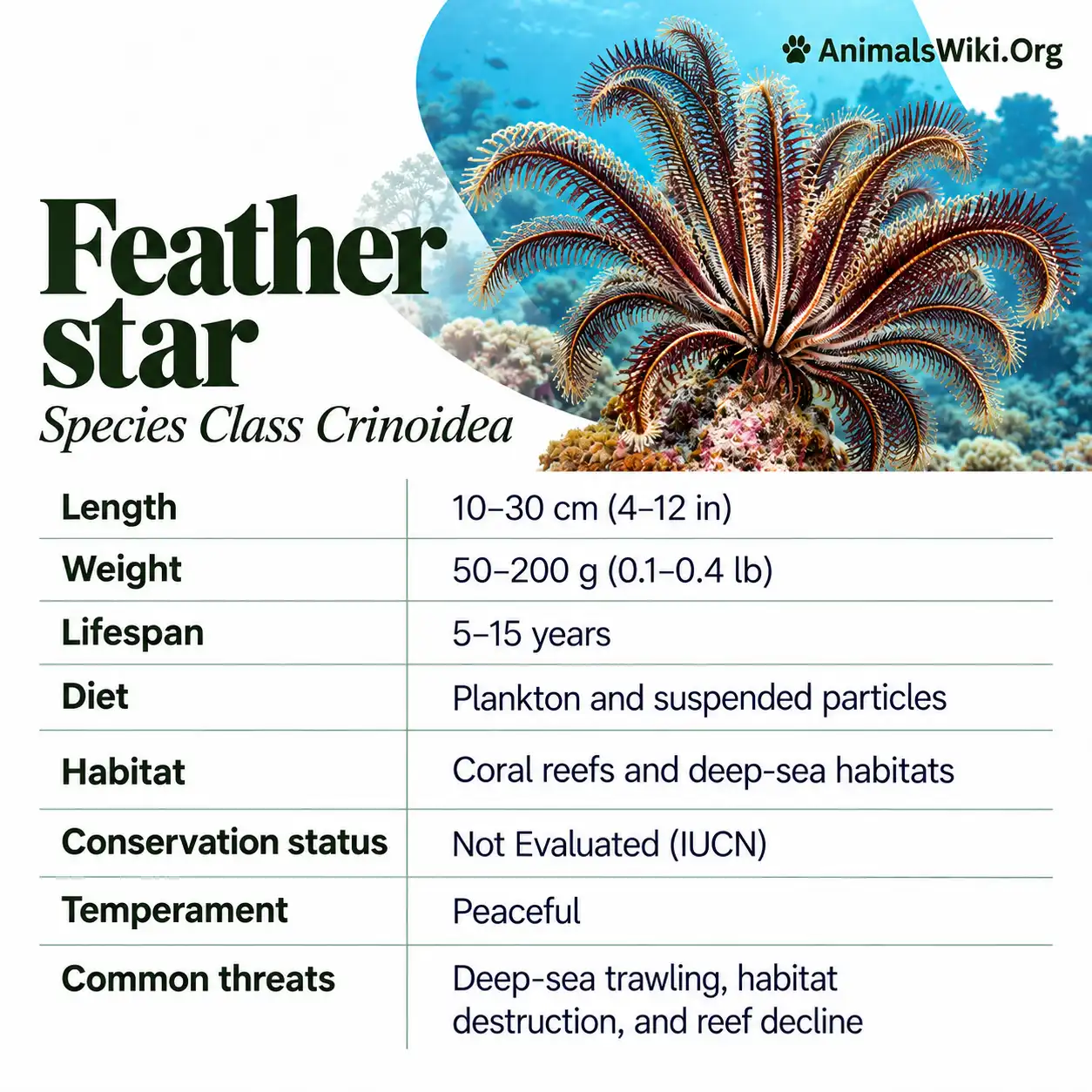
Feather stars feed primarily on plankton and other suspended organic material.
They use mucus-covered tube feet to collect particles and transport them along grooves toward a centrally located mouth.
Although feather stars may look fragile, they possess remarkable adaptations.
Some species can regenerate lost arms, escape predators by swimming, and cling securely to underwater surfaces using specialized appendages called cirri.
Feather stars occur in tropical, temperate, and deep-sea environments, making them an important component of marine biodiversity.
Their evolutionary history is equally fascinating.
Crinoids have existed for hundreds of millions of years, and their fossils provide valuable information about ancient marine ecosystems.
This comprehensive guide explores feather star facts, scientific classification, species, anatomy, size, colors, habitat, distribution, diet, feeding behavior, movement, reproduction, lifespan, predators, regeneration, adaptations, and frequently asked questions.
Feather Star Facts
| Feature | Information |
|---|---|
| Common name | Feather Star |
| Scientific group | Unstalked crinoids, especially comatulids |
| Phylum | Echinodermata |
| Class | Crinoidea |
| Major living group | Comatulida |
| Animal type | Marine invertebrate |
| Closest familiar relatives | Sea lilies, sea stars, sea urchins, and brittle stars |
| Habitat | Coral reefs, rocky seabeds, seagrass areas, and deeper marine habitats |
| Distribution | Oceans worldwide |
| Body shape | Central body with numerous feather-like arms |
| Arms | Commonly 10 or more; varies by species |
| Arm structure | Branching pinnules |
| Colors | Yellow, orange, red, brown, black, white, and multicolored |
| Size | From small species to individuals with arm spans of several tens of centimeters |
| Feeding type | Suspension feeder |
| Diet | Plankton and suspended organic particles |
| Movement | Crawling and swimming in many species |
| Attachment | Cirri in many species |
| Reproduction | Sexual reproduction |
| Larval stage | Free-swimming larva |
| Regeneration | Can regenerate lost arms |
| Lifespan | Species-dependent and not well documented for many species |
| Main predators | Fish and other marine predators |
| Human danger | Generally harmless |
| Conservation | Varies by species and habitat |
What Is a Feather Star?
A feather star is a marine echinoderm belonging to the class Crinoidea.
It is characterized by a central body surrounded by multiple feather-like arms.
Most familiar feather stars belong to the group Comatulida.
Unlike stalked sea lilies, adult feather stars generally lack a permanent stalk.
Is a Feather Star an Animal?
Yes.
Is a Feather Star a Plant?
No.
Is a Feather Star a Starfish?
No. Feather stars and sea stars belong to different echinoderm classes.
Is a Feather Star an Invertebrate?
Yes. It has no backbone.
Scientific Classification of Feather Stars
Feather stars include many species and are not represented by a single scientific name.
| Classification | Name |
|---|---|
| Kingdom | Animalia |
| Phylum | Echinodermata |
| Subphylum | Crinozoa |
| Class | Crinoidea |
| Major group | Comatulida |
| Example family | Comatulidae |
| Example genus | Comatula |
| Example species | Comatula pectinata |
What Does Crinoidea Mean?
Crinoidea comes from Greek roots referring to a lily-like appearance.
Are Feather Stars Related to Sea Lilies?
Yes. Both belong to Crinoidea.
Are Feather Stars Related to Sea Stars?
Yes. Both belong to Echinodermata.
Are Feather Stars Related to Sea Urchins?
Yes.
Types of Feather Stars
Feather stars include many species with different colors, arm structures, habitats, and behaviors.
1. Common Feather Star
Scientific name: Antedon bifida
This species occurs in parts of the northeastern Atlantic and nearby seas.
It is often found attached to underwater structures and can swim by moving its arms.
2. Mediterranean Feather Star
Scientific name: Antedon mediterranea
This species occurs in the Mediterranean Sea.
3. Elegant Feather Star
Scientific name: Comatula pectinata
This Indo-Pacific feather star has numerous delicate arm branches.
4. Tropical Feather Stars
Various species inhabit tropical coral reefs.
They may display striking colors and occupy exposed feeding positions.
5. Deep-Sea Feather Stars
Numerous feather star species inhabit deeper marine environments.
Their adaptations vary according to current strength, substrate, and food availability.
What Does a Feather Star Look Like?
Feather stars possess a small central body surrounded by multiple arms.
The arms are covered with smaller side branches called pinnules.
Important anatomical structures include:
- Central body or calyx
- Arms
- Pinnules
- Ambulacral grooves
- Tube feet
- Mouth
- Anus
- Cirri
- Water vascular system
- Reproductive structures
What Are Pinnules?
Pinnules are small branches extending from the arms.
What Are Cirri?
Cirri are specialized appendages that help many feather stars grip underwater surfaces.
Do Feather Stars Have Spines?
They do not possess the long defensive spines typical of sea urchins.
Do Feather Stars Have Bones?
They have internal skeletal elements made primarily of calcium carbonate.
Why Do Feather Stars Look Like Feathers?
Their arms are lined with numerous pinnules.
These branches create a feather-like appearance.
Are Feather Star Arms Soft?
The arms contain skeletal elements and flexible joints.
Are Feather Star Arms Fragile?
They can be damaged or detached.
Can Feather Stars Regrow Arms?
Yes.
How Many Arms Does a Feather Star Have?
Many feather stars possess 10 arms, while other species have 20, 30, or considerably more.
Do Feather Stars Have Five Arms?
The basic crinoid body plan has fivefold organization, but arm branching produces larger numbers.
Can Feather Stars Have 100 Arms?
Some species possess very numerous arms, although counts vary.
Do All Feather Stars Have the Same Number of Arms?
No.
Feather Star Size and Weight
Feather star size varies among species.
How Big Is a Feather Star?
Many species have arm spans measuring several tens of centimeters.
Are Feather Stars Large Animals?
Most familiar species are relatively small, although some have extensive arm spreads.
How Much Does a Feather Star Weigh?
Weight varies by species and body size.
Feather Star Colors
Feather stars occur in many colors.
These include:
- Yellow
- Orange
- Red
- Black
- Brown
- White
- Purple
- Multicolored patterns
Why Are Feather Stars Colorful?
Their colors result from pigments and other structural characteristics.
Are All Feather Stars Brightly Colored?
No. Some species are relatively dull.
Can Feather Stars Change Color?
They are not known for rapid color changes like octopuses.
Where Do Feather Stars Live?
Feather stars occur in oceans worldwide.
They inhabit:
- Atlantic Ocean
- Pacific Ocean
- Indian Ocean
- Mediterranean Sea
- Tropical coral reefs
- Temperate coastal waters
- Deep-sea environments
Do Feather Stars Live in Coral Reefs?
Yes.
Do Feather Stars Live in the Deep Sea?
Yes.
Do Feather Stars Live in Freshwater?
No.
Do Feather Stars Live in Cold Water?
Yes.
Feather Star Habitat
Feather stars inhabit a variety of marine environments.
These include:
- Coral reefs
- Rocky seabeds
- Sponge communities
- Seagrass-associated habitats
- Reef slopes
- Deeper continental shelf habitats
Do Feather Stars Attach to Rocks?
Yes.
Do Feather Stars Live on Coral?
Some species attach temporarily to coral structures.
Do Feather Stars Live on Sponges?
Some species use sponges as attachment sites.
What Do Feather Stars Eat?
Feather stars are suspension feeders.
Their diet includes:
- Phytoplankton
- Zooplankton
- Microscopic organisms
- Organic particles
- Detritus suspended in water
Do Feather Stars Eat Plankton?
Yes.
Do Feather Stars Eat Fish?
No. Fish are not their normal food.
Are Feather Stars Carnivores?
Their feeding is based on suspended particles, including small organisms, so describing them simply as carnivores is incomplete.
How Do Feather Stars Eat?
Feather stars capture food from seawater using their arms.
Step 1: Extend Arms
The feather star positions its arms in the water current.
Step 2: Capture Particles
Tube feet and mucus help trap suspended food.
Step 3: Transport Food
Particles move along ambulacral grooves.
Step 4: Deliver Food to Mouth
Food reaches the mouth on the oral surface.
Step 5: Digest Food
The digestive system processes the captured material.
Do Feather Stars Have Teeth?
No. They do not possess the specialized teeth of sea urchins.
Do Feather Stars Have Mouths?
Yes.
Can Feather Stars Swim?
Yes.
Many feather stars can swim by coordinating their arms.
How Do Feather Stars Swim?
They rhythmically wave their arms through the water.
Are Feather Stars Fast Swimmers?
They are not fast compared with fish, but swimming can help them relocate or escape.
Can All Feather Stars Swim?
Swimming ability varies among species and individuals.
Why Do Feather Stars Swim?
They may swim to escape predators or move to more suitable habitats.
Can Feather Stars Walk?
Yes.
Feather stars can crawl using coordinated arm movements.
Do Feather Stars Have Legs?
No.
Do Feather Stars Have Feet?
They possess tube feet used mainly in feeding and sensory functions, while crawling relies largely on arm movements.
Can Feather Stars Climb?
They can move over underwater structures.
Feather Star Nervous System
Feather stars have a decentralized nervous system.
Do Feather Stars Have Brains?
No centralized brain.
Do Feather Stars Have Eyes?
They lack conventional eyes.
Can Feather Stars Sense Light?
They can respond to environmental signals, although sensory abilities vary.
Feather Star Reproduction
Feather stars reproduce sexually.
Many species release gametes into seawater.
Do Feather Stars Lay Eggs?
They produce eggs.
Do Feather Stars Reproduce Sexually?
Yes.
Do Feather Stars Reproduce Asexually?
Asexual reproduction is not the normal reproductive strategy of most feather stars.
Feather Star Life Cycle
Stage 1: Gamete Release
Adults release reproductive cells.
Stage 2: Fertilization
Fertilization occurs.
Stage 3: Larval Development
A free-swimming larva develops.
Stage 4: Settlement
The larva attaches to a suitable substrate.
Stage 5: Stalked Juvenile
A young crinoid develops a temporary stalk.
Stage 6: Stalk Loss
In feather stars, the juvenile eventually loses its stalk.
Stage 7: Adult Feather Star
The adult becomes a free-living, unstalked crinoid.
Development varies among species.
Baby Feather Stars
Young feather stars begin as larvae.
What Is a Baby Feather Star Called?
A larva during early development and a juvenile crinoid after settlement.
Do Baby Feather Stars Have Arms?
Arms develop during juvenile growth.
Do Baby Feather Stars Have Stalks?
Many pass through a temporary stalked stage.
How Long Do Feather Stars Live?
Feather star lifespan varies by species.
Precise maximum ages are poorly documented for many species.
Can Feather Stars Live for Ten Years?
Some crinoids may survive for multiple years, but species-specific longevity data are limited.
Are Feather Stars Immortal?
No.
Can Feather Stars Regenerate Forever?
Regeneration is limited by health, energy availability, and environmental conditions.
Feather Star Regeneration
Feather stars can regenerate damaged or lost arms.
Can Feather Stars Regrow Arms?
Yes.
Can Feather Stars Survive Losing an Arm?
Many can survive and regenerate after partial arm loss.
Why Is Regeneration Important?
It helps recover feeding structures and survive some predator attacks.
Feather Star Adaptations
Feather-Like Arms
Increase surface area for feeding.
Pinnules
Help capture suspended particles.
Tube Feet
Assist with food collection.
Ambulacral Grooves
Transport food toward the mouth.
Cirri
Provide attachment to surfaces.
Swimming Ability
Allows escape and relocation.
Arm Regeneration
Supports recovery from injury.
Flexible Body
Helps withstand water movement.
Suspension Feeding
Allows feeding without active pursuit of prey.
Habitat Diversity
Supports survival across different marine environments.
What Animals Eat Feather Stars?
Potential predators include:
- Certain reef fish
- Crustaceans
- Other marine predators
Do Fish Eat Feather Stars?
Some fish feed on crinoids or their arms.
Do Crabs Eat Feather Stars?
Some crustaceans may prey on them.
Can Feather Stars Escape Predators?
Many can move or swim away.
Feather Star vs. Sea Lily
| Feature | Feather Star | Sea Lily |
|---|---|---|
| Scientific class | Crinoidea | Crinoidea |
| Adult stalk | Usually absent | Usually present |
| Movement | Can crawl; many can swim | Mostly attached |
| Arms | Feather-like | Feather-like |
| Diet | Suspension feeding | Suspension feeding |
| Habitat | Coastal to deep sea | Commonly deeper marine habitats |
Feather Star vs. Sea Star
Feather stars and sea stars are echinoderms.
However, feather stars belong to Crinoidea, while sea stars belong to Asteroidea.
Feather stars possess pinnule-covered arms adapted for suspension feeding.
Sea stars have different arm structures and feeding strategies.
Feather Star vs. Brittle Star
Brittle stars belong to the class Ophiuroidea.
They possess slender, flexible arms used primarily for movement and feeding.
Feather stars have pinnule-covered arms specialized for suspension feeding.
Feather Star vs. Crinoid
A feather star is a type of crinoid.
The term crinoid includes both feather stars and sea lilies.
Are Feather Stars Dangerous to Humans?
Feather stars are generally harmless.
Can Feather Stars Sting?
They do not possess jellyfish-like stinging cells.
Can Feather Stars Bite?
They do not have dangerous biting mouthparts.
Can You Touch a Feather Star?
Avoid handling them because their delicate arms can be damaged.
Are Feather Stars Endangered?
Conservation status varies by species.
Many species have not received comprehensive global assessments.
What Threatens Feather Stars?
Potential threats include:
- Habitat destruction
- Coral reef degradation
- Bottom trawling
- Marine pollution
- Ocean warming
- Ocean acidification
- Destructive collection
Why Are Feather Stars Important?
Feather stars contribute to marine biodiversity and suspension-feeding communities.
They are important for:
- Marine food webs
- Particle capture
- Echinoderm evolution
- Reef biodiversity
- Deep-sea ecology
- Fossil research
- Regeneration studies
50 Interesting Feather Star Facts
- Feather stars are marine animals.
- They belong to the phylum Echinodermata.
- They belong to the class Crinoidea.
- They are invertebrates.
- They are not plants.
- They are related to sea lilies.
- They are related to sea stars.
- They are related to sea urchins.
- Their arms resemble feathers.
- Their arms possess pinnules.
- Pinnules increase feeding surface area.
- Feather stars are suspension feeders.
- They capture food from seawater.
- They consume plankton.
- They also capture organic particles.
- Their tube feet help collect food.
- Food moves along grooves toward the mouth.
- They have no centralized brain.
- They lack conventional eyes.
- They possess a water vascular system.
- Many species have ten arms.
- Some species have considerably more arms.
- They can regenerate lost arms.
- Many species can swim.
- They swim by moving their arms.
- They can crawl across underwater surfaces.
- Many possess cirri for attachment.
- They can attach to rocks.
- Some attach to coral structures.
- Some use sponges as attachment sites.
- They inhabit tropical coral reefs.
- They occur in temperate waters.
- They also inhabit deep-sea environments.
- They occur in multiple oceans.
- They are not freshwater animals.
- Some are brightly colored.
- Others have darker coloration.
- They reproduce sexually.
- Their early life cycle includes larvae.
- Many juveniles have a temporary stalk.
- Adult feather stars generally lack a permanent stalk.
- Sea lilies retain a stalk as adults.
- Feather stars have calcium carbonate skeletal elements.
- Their arms are flexible.
- Some predators consume their arms.
- Swimming can help them escape predators.
- They are generally harmless to humans.
- Their delicate arms can be damaged by handling.
- Crinoids have an ancient fossil history.
- Their feather-like arms and graceful movements make them among the most distinctive echinoderms in the ocean.
Did You Know?
The Underwater Feather That Can Suddenly Swim Away
Imagine diving over a colorful coral reef.
Sunlight filters through the water.
Fish move between branching corals.
Sponges and sea fans cover the reef.
On a rocky surface, something unusual catches your attention.
It resembles a delicate underwater flower.
Long, feather-like arms spread outward.
The arms are decorated with hundreds of tiny branches.
The creature is bright yellow and orange.
At first, it appears motionless.
You might mistake it for a plant.
But it is not a plant.
It is a feather star.
The feather star extends its arms into the water current.
Tiny suspended particles drift toward it.
Its specialized tube feet capture food.
The particles move along grooves toward the central mouth.
The animal is feeding.
Suddenly, a fish approaches.
The feather star begins moving its arms.
The movements become faster.
Its body lifts away from the surface.
The arms beat rhythmically through the water.
The feather star begins swimming.
For a few moments, it resembles a floating feather carried by an invisible current.
Then it settles onto another rocky surface.
Its cirri grip the substrate.
The animal spreads its arms and resumes feeding.
This remarkable behavior helps feather stars escape some predators and relocate to better feeding positions.
But swimming is only one of their extraordinary adaptations.
Feather stars can regenerate lost arms.
They can survive in tropical reefs and deep-sea habitats.
Their ancestors belong to an evolutionary lineage extending hundreds of millions of years into the past.
Fossil crinoids provide evidence of ancient marine ecosystems that existed long before modern coral reefs.
The feather star demonstrates that an animal can resemble a flower, feed like a living underwater net, regenerate damaged arms, and even swim gracefully through the ocean without possessing a centralized brain or backbone.
Frequently Asked Questions About Feather Stars
What is a feather star?
A feather star is an unstalked marine crinoid with feather-like arms.
Is a feather star an animal?
Yes.
Is a feather star a plant?
No.
Is a feather star a starfish?
No.
Is a feather star an invertebrate?
Yes.
What is the scientific name of feather stars?
They belong to the class Crinoidea, especially the group Comatulida.
What does Crinoidea mean?
The name refers to their lily-like appearance.
Are feather stars related to sea lilies?
Yes.
Are feather stars related to sea stars?
Yes.
Are feather stars related to sea urchins?
Yes.
Why do feather stars look like feathers?
Their arms are lined with small branches called pinnules.
What are pinnules?
Small branches extending from the arms.
What are cirri?
Appendages used for attachment.
How many arms does a feather star have?
Many species have ten or more arms.
Can feather stars have 20 arms?
Yes.
Can feather stars have 100 arms?
Some species have very numerous arms.
Are feather star arms fragile?
They can be damaged or detached.
Can feather stars regenerate arms?
Yes.
How big are feather stars?
Size varies, with many species having arm spans of several tens of centimeters.
What color are feather stars?
Yellow, orange, red, brown, black, white, and other colors.
Do feather stars have brains?
No centralized brain.
Do feather stars have eyes?
They lack conventional eyes.
Do feather stars have hearts?
No vertebrate-style heart.
Do feather stars have bones?
They possess calcium carbonate skeletal elements.
Where do feather stars live?
In oceans worldwide.
Do feather stars live in coral reefs?
Yes.
Do feather stars live in the deep sea?
Yes.
Do feather stars live in cold water?
Yes.
Do feather stars live in freshwater?
No.
Do feather stars attach to rocks?
Yes.
Do feather stars attach to coral?
Some species do.
Do feather stars attach to sponges?
Some species do.
What do feather stars eat?
Plankton and suspended organic particles.
Are feather stars carnivores?
Their diet includes small organisms, but suspension feeding is the more informative description.
Do feather stars eat plankton?
Yes.
Do feather stars eat fish?
No.
How do feather stars eat?
They capture particles using arms, pinnules, mucus, and tube feet.
Do feather stars have mouths?
Yes.
Do feather stars have teeth?
No specialized teeth like sea urchins.
Can feather stars swim?
Yes, many species can.
How do feather stars swim?
By rhythmically waving their arms.
Are feather stars fast swimmers?
Not compared with fish.
Can all feather stars swim?
Swimming ability varies.
Why do feather stars swim?
To escape predators or relocate.
Can feather stars walk?
They can crawl using their arms.
Do feather stars have legs?
No.
Do feather stars have tube feet?
Yes.
Can feather stars climb?
They can move over underwater structures.
How do feather stars reproduce?
Sexually.
Do feather stars lay eggs?
They produce eggs.
What is a baby feather star called?
A larva or juvenile crinoid, depending on development.
Do baby feather stars have stalks?
Many pass through a temporary stalked stage.
How long do feather stars live?
Lifespan varies and is poorly documented for many species.
Are feather stars immortal?
No.
What animals eat feather stars?
Certain fish and other marine predators.
Do fish eat feather stars?
Some species do.
Can feather stars escape predators?
Many can move or swim away.
Are feather stars dangerous?
Generally not.
Can feather stars sting?
No.
Can feather stars bite?
They do not have dangerous biting structures.
Can you touch a feather star?
Avoid handling them.
Are feather stars endangered?
Conservation status varies by species.
What threatens feather stars?
Habitat damage, pollution, bottom trawling, and environmental change.
Why are feather stars important?
They contribute to marine food webs and suspension-feeding communities.
Are feather stars ancient animals?
Yes. Crinoids have a fossil history extending hundreds of millions of years.
What is the most interesting feather star fact?
Many feather stars can detach from underwater surfaces and swim by rhythmically waving their feather-like arms.
Conclusion
Feather stars are among the most beautiful and unusual marine invertebrates in the ocean.
Their delicate, feather-like arms, colorful appearance, and graceful swimming movements distinguish them from other echinoderms.
Although they resemble underwater plants, feather stars are animals.
They feed by capturing plankton and suspended organic particles using specialized arms, pinnules, mucus, and tube feet.
Many species can swim, crawl, attach to underwater structures, and regenerate damaged arms.
Their evolutionary history extends hundreds of millions of years, making them valuable subjects for studying ancient and modern marine ecosystems.
Understanding feather stars helps reveal the extraordinary diversity of ocean life and the importance of protecting marine habitats.
The feather star proves that one of the ocean’s most delicate-looking creatures can be a remarkable swimmer, efficient suspension feeder, and resilient survivor.