Sea Lily, The Ancient Deep-Sea Animal That Looks Like an Underwater Flower
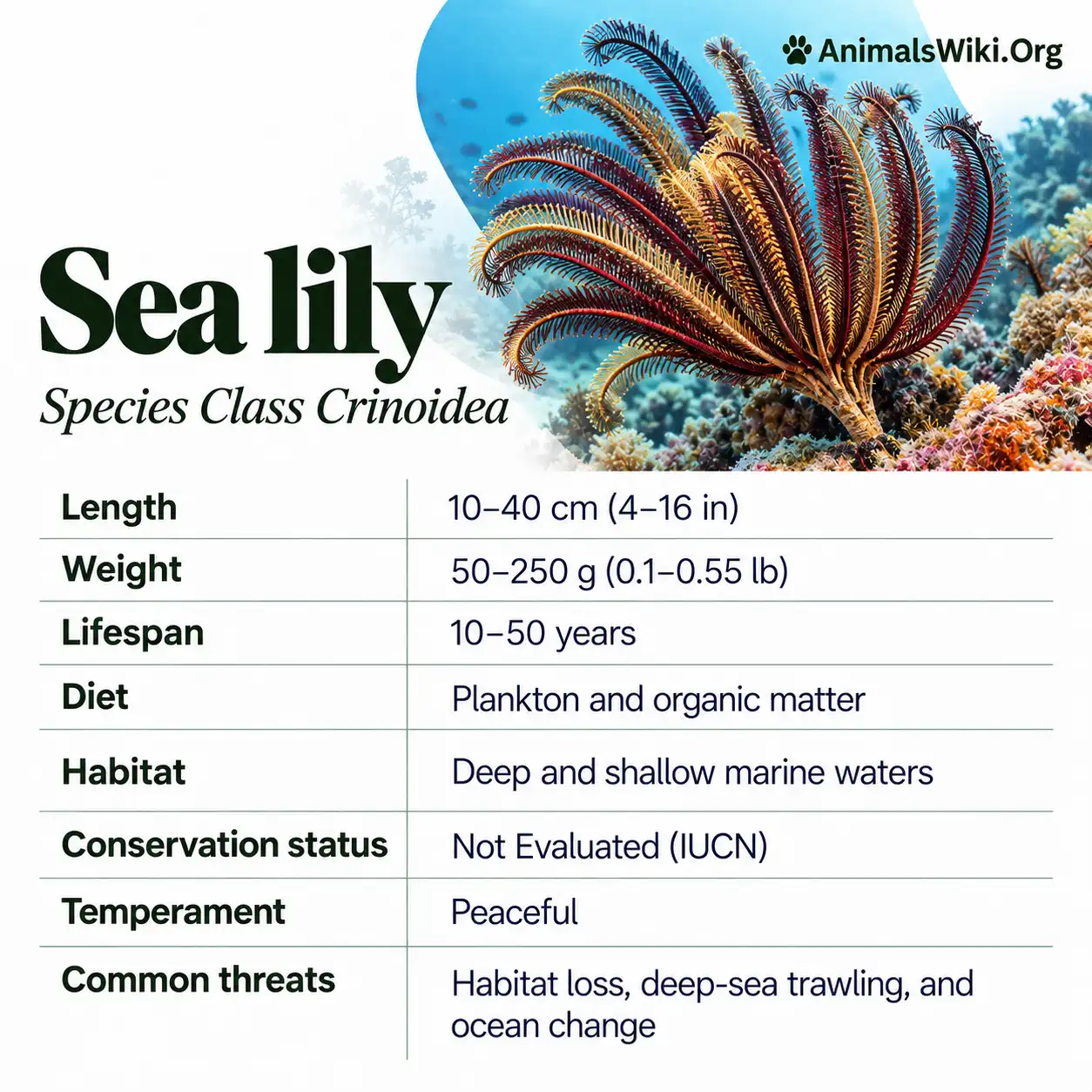
The sea lily is one of the ocean’s most extraordinary and ancient-looking animals. With a long, flexible stalk and a crown of delicate, feather-like arms, this unusual marine creature resembles a beautiful underwater flower growing from the seafloor.
However, sea lilies are not plants.
They are marine invertebrates belonging to the class Crinoidea, a group of echinoderms that also includes feather stars.
Sea lilies are especially fascinating because their ancestors appeared hundreds of millions of years ago. Fossil crinoids were abundant in many ancient seas, and their remains are commonly preserved in marine sedimentary rocks.
Although sea lilies were once widespread in shallow marine environments, most living stalked sea lilies are now associated with deeper ocean habitats.
These remarkable animals spend much of their lives attached to the seafloor, rocks, or other hard underwater surfaces.
Their long stalks elevate their feeding arms into water currents, allowing them to capture tiny plankton and suspended organic particles.
Unlike flowering plants, sea lilies do not obtain energy through photosynthesis.
Instead, they are suspension-feeding animals that collect food using specialized tube feet, mucus, and grooves running along their feather-like arms.
Another fascinating characteristic is their ability to regenerate damaged arms.
Some stalked crinoids can also detach portions of their attachment structures or reposition themselves, although their movement capabilities vary considerably among species.
Sea lilies are important components of deep-sea ecosystems and provide valuable information about echinoderm evolution, marine biodiversity, and the history of life on Earth.
This comprehensive guide explores sea lily facts, scientific classification, species, anatomy, size, habitat, distribution, diet, feeding behavior, reproduction, life cycle, lifespan, predators, regeneration, adaptations, fossils, and frequently asked questions.
Sea Lily Facts
| Feature | Information |
|---|---|
| Common name | Sea Lily |
| Scientific group | Stalked crinoids |
| Phylum | Echinodermata |
| Class | Crinoidea |
| Major living groups | Includes Isocrinida, Hyocrinida, Bourgueticrinida, and other stalked crinoid lineages |
| Animal type | Marine invertebrate |
| Closest relatives | Feather stars |
| Other relatives | Sea stars, brittle stars, sea urchins, and sea cucumbers |
| Habitat | Mostly deep-sea rocky and sedimentary environments |
| Distribution | Oceans worldwide |
| Body shape | Stalk supporting a crown of branching arms |
| Arms | Commonly five or more, often branching into larger numbers |
| Arm structures | Pinnules and ambulacral grooves |
| Colors | White, yellow, orange, reddish, brown, and other shades |
| Size | Highly variable, from small species to long-stalked forms |
| Feeding type | Suspension feeder |
| Diet | Plankton and suspended organic particles |
| Movement | Usually attached; mobility varies by species |
| Attachment | Stalk, cirri, or terminal attachment structures |
| Reproduction | Sexual reproduction |
| Larval development | Species-dependent; typically includes a settlement stage |
| Regeneration | Can regenerate damaged arms |
| Lifespan | Poorly documented for many species |
| Main predators | Certain fish and other marine predators |
| Human danger | Generally harmless |
| Fossil history | More than 450 million years |
| Conservation | Species-specific assessments are limited |
What Is a Sea Lily?
A sea lily is a stalked marine crinoid.
It belongs to the class Crinoidea, which is part of the phylum Echinodermata.
Sea lilies possess a central body supported by a stalk and surrounded by branching feeding arms.
Their flower-like appearance gives them their common name.
Is a Sea Lily an Animal?
Yes. Sea lilies are animals.
Is a Sea Lily a Plant?
No. They do not perform photosynthesis.
Is a Sea Lily a Flower?
No. Their flower-like crown consists of feeding arms.
Is a Sea Lily an Invertebrate?
Yes. Sea lilies have no backbone.
Is a Sea Lily a Starfish?
No. Sea lilies belong to Crinoidea, while sea stars belong to Asteroidea.
Scientific Classification of Sea Lilies
Sea lilies include multiple species and evolutionary lineages rather than one scientific species.
| Classification | Name |
|---|---|
| Kingdom | Animalia |
| Phylum | Echinodermata |
| Subphylum | Crinozoa |
| Class | Crinoidea |
| Common grouping | Stalked crinoids |
| Example order | Isocrinida |
| Example family | Isocrinidae |
| Example genus | Metacrinus |
| Example species | Metacrinus rotundus |
What Does Crinoidea Mean?
The name Crinoidea comes from Greek words associated with a lily-like appearance.
What Is the Scientific Name of a Sea Lily?
There is no single scientific name for every sea lily.
Individual species have their own names, such as Metacrinus rotundus.
Are Sea Lilies Related to Feather Stars?
Yes. Both belong to Crinoidea.
Are Sea Lilies Related to Sea Urchins?
Yes. Both belong to Echinodermata.
Types and Species of Sea Lilies
Sea lilies include several groups with different body shapes, stalk structures, and habitats.
1. Japanese Sea Lily
Scientific name: Metacrinus rotundus
This stalked crinoid occurs in waters around Japan and nearby western Pacific regions.
It has a long stalk and a crown of branching feeding arms.
2. Atlantic Sea Lily
Scientific name: Endoxocrinus parrae
This species occurs in the western Atlantic, including Caribbean-region deep waters.
It belongs to a group of stalked crinoids capable of limited relocation.
3. Sea Lily of the Genus Bathycrinus
Species of Bathycrinus inhabit deep marine environments.
They generally have slender stalks and feeding crowns adapted to collecting suspended particles.
4. Sea Lilies of the Genus Hyocrinus
Members of this genus inhabit deep-sea environments.
They have specialized stalk and attachment structures.
5. Sea Lilies of the Genus Democrinus
These stalked crinoids occur in deep-water habitats and possess delicate feeding crowns.
6. Fossil Sea Lilies
Many extinct crinoid groups were far more abundant in ancient seas.
Their fossils often include stalk segments, cups, and branching arms.
What Does a Sea Lily Look Like?
A sea lily resembles a flower growing from a long underwater stem.
Its body consists of a feeding crown and a supporting stalk.
Important anatomical structures include:
- Calyx
- Arms
- Pinnules
- Ambulacral grooves
- Tube feet
- Mouth
- Anus
- Stalk
- Stalk ossicles
- Cirri or other attachment structures
- Water vascular system
- Reproductive structures
What Is the Calyx?
The calyx is the cup-like central body region that contains important internal organs.
What Are Pinnules?
Pinnules are small branches extending from the feeding arms.
What Is the Stalk?
The stalk is a series of skeletal elements that supports the body above the seafloor.
What Are Ossicles?
Ossicles are calcium carbonate skeletal elements that provide support.
What Are Cirri?
Cirri are appendages that help some crinoids attach to surfaces.
Not every sea lily possesses the same attachment structures.
Why Do Sea Lilies Look Like Flowers?
Sea lilies have a central body surrounded by radiating, branching arms.
The arrangement resembles the petals of a flower.
However, these arms are specialized feeding structures.
Are Sea Lily Arms Real Petals?
No.
Do Sea Lilies Have Leaves?
No.
Do Sea Lilies Have Roots?
No. Their attachment structures are not botanical roots.
Do Sea Lilies Produce Seeds?
No. They reproduce as animals.
How Many Arms Does a Sea Lily Have?
Arm number varies among species.
The basic crinoid body plan is organized around fivefold symmetry, but arm branching can produce many more feeding arms.
Do Sea Lilies Have Five Arms?
Some species have five primary arms, while others have more through branching.
Can Sea Lilies Have Ten Arms?
Yes.
Can Sea Lilies Have Twenty Arms?
Yes, depending on the species.
Do All Sea Lilies Have the Same Number of Arms?
No.
Sea Lily Size and Length
Sea lily size varies considerably.
Some living species have relatively short stalks, while others possess long, slender stalks that elevate their feeding crowns above the seafloor.
How Tall Is a Sea Lily?
Height varies from species to species and cannot be represented accurately by one universal measurement.
Can Sea Lilies Grow Over One Meter Tall?
Some living stalked crinoids can attain substantial total lengths, while certain extinct crinoids reached several meters.
How Big Are Sea Lily Arms?
Arm length depends on species, age, and body size.
Are Ancient Sea Lilies Larger Than Modern Sea Lilies?
Some extinct species were much larger than many living forms.
Sea Lily Colors
Sea lilies occur in several colors, including:
- White
- Cream
- Yellow
- Orange
- Red
- Brown
- Pale pink
Are All Sea Lilies White?
No.
Why Are Sea Lilies Colorful?
Coloration varies with species, pigments, and tissue characteristics.
Can Sea Lilies Change Color?
They are not known for rapid color changes comparable to octopuses.
Where Do Sea Lilies Live?
Living sea lilies occur in marine environments worldwide.
They are especially associated with deeper ocean habitats.
Their distribution includes:
- Atlantic Ocean
- Pacific Ocean
- Indian Ocean
- Southern Ocean
- Deep continental slopes
- Submarine ridges
- Other suitable deep-sea habitats
Do Sea Lilies Live in the Atlantic Ocean?
Yes.
Do Sea Lilies Live in the Pacific Ocean?
Yes.
Do Sea Lilies Live in the Indian Ocean?
Yes.
Do Sea Lilies Live in Freshwater?
No.
Do Sea Lilies Live in Cold Water?
Yes. Many inhabit cold deep-sea environments.
Sea Lily Habitat
Sea lilies live in habitats where suitable attachment surfaces and water currents allow them to feed.
Common environments include:
- Deep rocky seafloors
- Continental slopes
- Submarine ridges
- Hard-bottom habitats
- Some soft-sediment deep-sea environments
- Areas with persistent water movement
Do Sea Lilies Live on Coral Reefs?
Most familiar modern stalked sea lilies inhabit deeper environments, although crinoids occur across a wide range of marine habitats.
Do Sea Lilies Live in the Deep Sea?
Yes.
Do Sea Lilies Attach to Rocks?
Many species do.
Do Sea Lilies Live in Mud?
Some deep-sea stalked crinoids are adapted to soft sediment habitats.
What Do Sea Lilies Eat?
Sea lilies are suspension feeders.
They capture food particles carried by seawater.
Their diet can include:
- Phytoplankton
- Zooplankton
- Microscopic organisms
- Organic detritus
- Suspended particulate organic matter
Do Sea Lilies Eat Plankton?
Yes.
Do Sea Lilies Eat Fish?
No. Fish are not their normal food.
Are Sea Lilies Carnivores?
Their diet may include microscopic animals, but suspension feeder is the most accurate general description.
Do Sea Lilies Eat Algae?
They can capture microscopic algae suspended in seawater.
How Do Sea Lilies Eat?
Sea lilies possess specialized feeding structures adapted to capturing suspended particles.
Step 1: Elevate the Feeding Crown
The stalk positions the crown above the seafloor.
Step 2: Extend the Arms
The arms spread into surrounding water currents.
Step 3: Capture Food Particles
Mucus and specialized tube feet help trap suspended food.
Step 4: Transport Food
Ciliary activity and tube feet move captured particles along ambulacral grooves.
Step 5: Deliver Food to the Mouth
Particles travel toward the mouth.
Step 6: Digest Food
The digestive system processes the material.
Do Sea Lilies Have Mouths?
Yes.
Where Is a Sea Lily’s Mouth?
The mouth is located on the upward-facing oral surface of the crown.
Do Sea Lilies Have Teeth?
They do not have the specialized five-toothed feeding apparatus found in many sea urchins.
Why Do Sea Lilies Have Long Stalks?
The stalk helps elevate the feeding crown into moving water.
This can improve access to suspended food.
Is the Stalk a Backbone?
No.
Is the Stalk Flexible?
Flexibility varies among species and stalk regions.
Can the Stalk Break?
Yes.
Can Sea Lilies Regenerate Stalk Structures?
Some crinoids can repair or regenerate portions of their skeletal structures, although abilities vary.
Can Sea Lilies Move?
Sea lilies are generally more sedentary than feather stars.
However, not every stalked crinoid is permanently immobile.
Can Sea Lilies Walk?
Some stalked crinoids can relocate by coordinated movements or through detachment and reattachment.
Can Sea Lilies Swim?
Typical adult stalked sea lilies do not swim like many feather stars.
Are Sea Lilies Permanently Attached?
Many remain attached for long periods, but some species can change location.
How Fast Do Sea Lilies Move?
Movement is generally slow and varies among species.
Sea Lily Nervous System
Sea lilies possess a decentralized nervous system.
Do Sea Lilies Have Brains?
No centralized brain.
Do Sea Lilies Have Eyes?
They lack conventional eyes.
Can Sea Lilies Sense Water Currents?
They can respond to environmental conditions and mechanical stimulation.
Can Sea Lilies Feel Pain?
Whether they experience conscious pain remains uncertain.
Sea Lily Reproduction
Sea lilies reproduce sexually.
Many species release reproductive cells into seawater, while reproductive details vary among groups.
Do Sea Lilies Lay Eggs?
They produce eggs.
Do Sea Lilies Reproduce Sexually?
Yes.
Do Sea Lilies Reproduce Asexually?
Arm regeneration is possible, but it should not be confused with normal asexual reproduction.
Sea Lily Life Cycle
Stage 1: Reproduction
Adults produce eggs and sperm.
Stage 2: Fertilization
Fertilization occurs according to the species’ reproductive strategy.
Stage 3: Embryonic Development
The embryo develops.
Stage 4: Larval Development
A larval stage occurs.
Stage 5: Settlement
The developing crinoid settles onto suitable substrate.
Stage 6: Juvenile Sea Lily
The young sea lily develops its stalk and feeding crown.
Stage 7: Adult Sea Lily
The animal grows into a mature stalked crinoid.
Exact developmental details differ among species.
Baby Sea Lilies
Young sea lilies differ considerably from adults.
What Is a Baby Sea Lily Called?
A larva during early development and a juvenile crinoid after settlement.
Do Baby Sea Lilies Have Stalks?
A stalk develops during juvenile growth.
Do Baby Sea Lilies Have Arms?
Arms develop as the animal matures.
Do Baby Sea Lilies Look Like Flowers?
The familiar flower-like form develops as the feeding crown grows.
How Long Do Sea Lilies Live?
The lifespan of many living sea lily species remains poorly documented.
Deep-sea environments make long-term observation difficult.
Can Sea Lilies Live for Decades?
Long lifespans are possible in some marine invertebrates, but reliable species-specific age estimates are limited for many sea lilies.
Can Sea Lilies Live for 100 Years?
There is insufficient evidence to treat a century-long lifespan as typical for sea lilies.
Are Sea Lilies Immortal?
No.
Why Is Sea Lily Lifespan Difficult to Study?
Many species inhabit deep-sea environments that are difficult to monitor continuously.
Sea Lily Regeneration
Sea lilies can regenerate damaged arms.
Can Sea Lilies Regrow Arms?
Yes.
Can Sea Lilies Survive Losing an Arm?
Many can survive partial arm loss.
Why Is Regeneration Important?
It allows damaged feeding structures to recover.
Can Sea Lilies Regrow Their Entire Bodies?
Regenerating an arm does not mean that every species can regenerate an entire body from any fragment.
Sea Lily Adaptations
Long Stalk
Elevates the feeding crown above the seafloor.
Feather-Like Arms
Provide a large surface area for collecting food.
Pinnules
Increase feeding efficiency.
Tube Feet
Help capture suspended particles.
Ambulacral Grooves
Transport food toward the mouth.
Calcium Carbonate Skeleton
Provides structural support.
Attachment Structures
Help secure the animal to underwater surfaces.
Regeneration
Allows recovery from some injuries.
Suspension Feeding
Enables feeding without chasing prey.
Deep-Sea Adaptations
Support survival in cold, dark environments with variable food availability.
What Animals Eat Sea Lilies?
Predators and potential predators include:
- Certain fish
- Some crustaceans
- Other benthic marine predators
Predation patterns vary among species and habitats.
Do Fish Eat Sea Lilies?
Some fish consume crinoid tissues or arms.
Do Crabs Eat Sea Lilies?
Some crustaceans may prey on them.
Can Sea Lilies Escape Predators?
Their escape strategies are generally more limited than those of actively swimming feather stars.
Sea Lily vs. Feather Star
| Feature | Sea Lily | Feather Star |
|---|---|---|
| Scientific class | Crinoidea | Crinoidea |
| Adult stalk | Usually retained | Usually absent |
| Main habitat | Often deeper marine environments | Shallow to deep marine habitats |
| Movement | Mostly attached; some can relocate | Can crawl; many can swim |
| Feeding | Suspension feeding | Suspension feeding |
| Arms | Feather-like | Feather-like |
| Attachment | Stalk and specialized structures | Often cirri |
| Evolutionary relationship | Stalked crinoid | Unstalked crinoid |
Sea Lily vs. Sea Star
Sea lilies and sea stars are echinoderms.
However, sea lilies belong to Crinoidea.
Sea stars belong to Asteroidea.
Sea lilies primarily capture suspended food using branching arms.
Sea stars have different feeding strategies, including predation and scavenging.
Sea Lily vs. Brittle Star
Brittle stars belong to Ophiuroidea.
They have slender, flexible arms used for movement and feeding.
Sea lilies possess a stalk and a crown of pinnule-covered feeding arms.
Sea Lily vs. Coral
Sea lilies and corals are both marine animals, but they belong to different phyla.
Sea lilies are echinoderms.
Corals are cnidarians.
Some corals build reefs, while sea lilies are suspension feeders with a different body structure.
Sea Lily vs. Sea Anemone
Sea anemones belong to Cnidaria.
Sea lilies belong to Echinodermata.
Sea anemones capture prey with stinging tentacles.
Sea lilies capture suspended food using specialized arms and tube feet.
Are Sea Lilies Dangerous to Humans?
Sea lilies are generally harmless.
Can Sea Lilies Sting?
They do not possess the stinging cells of jellyfish or sea anemones.
Can Sea Lilies Bite?
They do not have dangerous biting structures.
Can You Touch a Sea Lily?
Avoid handling them because their arms and stalks can be damaged.
Are Sea Lilies Poisonous?
They are not generally regarded as dangerous poisonous animals.
Are Sea Lilies Endangered?
Conservation status varies among species.
Many deep-sea species have not received comprehensive assessments.
What Threatens Sea Lilies?
Potential threats include:
- Deep-sea bottom trawling
- Habitat disturbance
- Marine pollution
- Ocean warming
- Ocean acidification
- Deep-sea resource extraction
- Damage to vulnerable benthic communities
Can Bottom Trawling Harm Sea Lilies?
Yes. Bottom-contact fishing can damage stalked crinoids and their habitats.
Can Ocean Acidification Affect Sea Lilies?
Changes in seawater chemistry may influence calcification and other biological processes.
Sea Lily Fossils
Sea lilies have an exceptionally rich fossil history.
Crinoids appeared more than 450 million years ago, during the Ordovician Period.
They became abundant in many Paleozoic marine ecosystems.
Are Sea Lily Fossils Common?
Crinoid skeletal fragments are common in many marine sedimentary rocks.
What Are Crinoid Stems?
They are fossilized segments of the crinoid stalk.
Why Do Crinoid Fossils Look Like Small Discs?
The stalk consists of numerous stacked skeletal elements.
Were Ancient Sea Lilies Larger?
Some extinct crinoids developed very long stalks and large feeding crowns.
Are Sea Lilies Living Fossils?
They are members of an ancient evolutionary lineage, but modern sea lilies are living species that have continued evolving. The phrase “living fossil” should not imply that they are unchanged from their ancestors.
Sea Lilies in Ancient Oceans
During parts of the Paleozoic Era, crinoids were abundant in shallow seas.
Some marine environments contained extensive communities of stalked crinoids.
Their skeletal remains accumulated in sediments and contributed to limestone deposits.
Did Sea Lilies Exist Before Dinosaurs?
Yes.
Did Sea Lilies Exist During the Paleozoic Era?
Yes.
Did Sea Lilies Survive Mass Extinctions?
Crinoid lineages survived multiple major extinction events, although many groups disappeared.
Why Are Sea Lilies Important?
Sea lilies contribute to marine biodiversity and suspension-feeding communities.
They are important for:
- Deep-sea food webs
- Suspended particle capture
- Marine biodiversity
- Echinoderm evolution
- Paleontology
- Deep-sea ecology
- Regeneration research
- Understanding ancient oceans
50 Interesting Sea Lily Facts
- Sea lilies are marine animals.
- They are not plants.
- They belong to the phylum Echinodermata.
- They belong to the class Crinoidea.
- They are invertebrates.
- They are closely related to feather stars.
- They are related to sea stars.
- They are related to sea urchins.
- Their bodies resemble underwater flowers.
- They possess a central calyx.
- They have branching feeding arms.
- Their arms contain pinnules.
- Pinnules increase feeding surface area.
- They are suspension feeders.
- They capture plankton.
- They also capture suspended organic particles.
- Their tube feet help collect food.
- Food moves along ambulacral grooves.
- Their mouths are on the upward-facing oral surface.
- They have no centralized brain.
- They lack conventional eyes.
- They possess a water vascular system.
- Their stalks contain calcium carbonate ossicles.
- Many species attach to underwater surfaces.
- Some inhabit soft-sediment deep-sea habitats.
- Most familiar living stalked sea lilies occur in deeper waters.
- They occur in the Atlantic Ocean.
- They occur in the Pacific Ocean.
- They occur in the Indian Ocean.
- They are not freshwater animals.
- Some species are white or cream-colored.
- Others are yellow, orange, or reddish.
- They reproduce sexually.
- Their life cycle includes larval development.
- Juveniles develop a stalk.
- Adults retain a stalk.
- Many feather stars lose their juvenile stalk.
- Sea lilies can regenerate damaged arms.
- Some stalked crinoids can relocate.
- Typical sea lilies do not swim like feather stars.
- Their stalks elevate feeding arms into currents.
- Some fish prey on crinoids.
- Their arms may be damaged by predators.
- They are generally harmless to humans.
- Their delicate structures can be damaged by handling.
- Crinoids existed more than 450 million years ago.
- Their fossils are common in many Paleozoic rocks.
- Fossil stalk segments are called columnals.
- Some ancient crinoids grew several meters long.
- Sea lilies are among the most remarkable surviving representatives of an ancient marine animal lineage.
Did You Know?
The Deep-Sea Flower That Is Actually an Animal
Imagine descending beneath the ocean surface in a deep-sea research submersible.
Sunlight gradually disappears.
The water becomes darker and colder.
Far below the waves, the seafloor stretches across a vast underwater landscape.
Rocks, sediments, and strange marine organisms cover the bottom.
Then the submersible’s lights reveal something unexpected.
A delicate flower appears to be growing from the seafloor.
It has a long, slender stalk.
At the top, dozens of feather-like branches spread into the surrounding water.
The structure looks almost too delicate to survive in the deep ocean.
But it is not a flower.
It is a sea lily.
The animal remains attached to the seafloor.
Its stalk lifts the feeding crown into the current.
Tiny food particles drift past.
Specialized tube feet capture the particles.
Mucus helps hold them.
The food moves along grooves in the arms toward the mouth.
The sea lily feeds without chasing prey.
Its feeding strategy depends on the movement of seawater.
Nearby, another sea lily extends its arms in a different direction.
Each animal responds to the surrounding environment.
Some may remain in favorable positions for long periods.
Others may have limited abilities to relocate.
The scene looks peaceful, but sea lilies are part of a much older story.
Hundreds of millions of years ago, ancient seas contained enormous numbers of crinoids.
Some grew on long stalks.
Others formed dense underwater communities.
Their skeletal remains accumulated on ancient seafloors.
Over geological time, these remains became fossils preserved in limestone.
Today, fossilized crinoid stems can be found in rocks that formed long before dinosaurs appeared.
The living sea lily in front of the submersible belongs to this ancient evolutionary lineage.
Its ancestors survived enormous changes in Earth’s oceans.
Continents shifted.
Marine ecosystems evolved.
Mass extinction events eliminated many other species.
Yet crinoids continued to survive and diversify.
The sea lily demonstrates how an animal that resembles a delicate underwater flower can represent more than 450 million years of marine evolutionary history.
Frequently Asked Questions About Sea Lilies
What is a sea lily?
A sea lily is a stalked marine crinoid with feather-like feeding arms.
Is a sea lily an animal?
Yes.
Is a sea lily a plant?
No.
Is a sea lily a flower?
No.
Is a sea lily a starfish?
No.
Is a sea lily an invertebrate?
Yes.
What is the scientific name of sea lilies?
Sea lilies belong to the class Crinoidea and include multiple stalked species.
What does Crinoidea mean?
The name refers to a lily-like appearance.
Are sea lilies related to feather stars?
Yes.
Are sea lilies related to sea stars?
Yes.
Are sea lilies related to sea urchins?
Yes.
Why do sea lilies look like flowers?
Their branching feeding arms resemble petals.
Do sea lilies have roots?
No. They have specialized attachment structures.
Do sea lilies have leaves?
No.
Do sea lilies produce seeds?
No.
What is a sea lily stalk?
A supporting structure made of skeletal elements.
What is a sea lily calyx?
The central cup-like body region.
What are sea lily pinnules?
Small branches extending from the feeding arms.
What are sea lily ossicles?
Calcium carbonate skeletal elements.
How many arms does a sea lily have?
Arm number varies among species.
Can sea lilies have ten arms?
Yes.
Can sea lilies have twenty arms?
Yes.
Are sea lily arms fragile?
They can be damaged or detached.
Can sea lilies regenerate arms?
Yes.
How big are sea lilies?
Size varies considerably among species.
Can sea lilies grow over one meter tall?
Some stalked crinoids can attain substantial lengths, while certain extinct species were several meters long.
What color are sea lilies?
White, cream, yellow, orange, red, brown, and other shades.
Do sea lilies have brains?
No centralized brain.
Do sea lilies have eyes?
They lack conventional eyes.
Do sea lilies have hearts?
No vertebrate-style heart.
Do sea lilies have bones?
They possess calcium carbonate skeletal elements.
Where do sea lilies live?
In marine environments worldwide.
Do sea lilies live in the Atlantic Ocean?
Yes.
Do sea lilies live in the Pacific Ocean?
Yes.
Do sea lilies live in the Indian Ocean?
Yes.
Do sea lilies live in the deep sea?
Yes.
Do sea lilies live in freshwater?
No.
Do sea lilies live on coral reefs?
Most familiar living stalked sea lilies occur in deeper environments.
Do sea lilies attach to rocks?
Many species do.
Do sea lilies live in mud?
Some species inhabit soft-sediment deep-sea environments.
What do sea lilies eat?
Plankton and suspended organic particles.
Are sea lilies carnivores?
Their food includes microscopic organisms, but suspension feeding is the best general description.
Do sea lilies eat plankton?
Yes.
Do sea lilies eat fish?
No.
How do sea lilies eat?
They capture particles using their arms, pinnules, mucus, and tube feet.
Do sea lilies have mouths?
Yes.
Where is a sea lily’s mouth?
On the oral surface of the feeding crown.
Do sea lilies have teeth?
They lack the specialized teeth of sea urchins.
Can sea lilies swim?
Typical stalked adults do not swim like feather stars.
Can sea lilies move?
Some species can relocate.
Can sea lilies walk?
Certain stalked crinoids can move slowly through specialized movements.
Are sea lilies permanently attached?
Many remain attached for long periods, but some can change position.
How do sea lilies reproduce?
Sexually.
Do sea lilies lay eggs?
They produce eggs.
What is a baby sea lily called?
A larva or juvenile crinoid, depending on developmental stage.
Do baby sea lilies have stalks?
A stalk develops during juvenile growth.
How long do sea lilies live?
Lifespan is poorly documented for many species.
Are sea lilies immortal?
No.
Can sea lilies regenerate their arms?
Yes.
What animals eat sea lilies?
Some fish and other marine predators.
Are sea lilies dangerous?
Generally not.
Can sea lilies sting?
No.
Can sea lilies bite?
They lack dangerous biting structures.
Can you touch a sea lily?
Avoid handling them.
Are sea lilies endangered?
Conservation status varies among species.
What threatens sea lilies?
Habitat damage, bottom trawling, pollution, and environmental change.
Are sea lily fossils common?
Crinoid fossils are common in many ancient marine rocks.
How old are sea lilies?
Crinoids have a fossil history extending more than 450 million years.
Did sea lilies exist before dinosaurs?
Yes.
Are sea lilies living fossils?
They belong to an ancient lineage, but modern species have continued evolving.
Why are sea lilies important?
They contribute to deep-sea food webs and provide information about marine evolution.
What is the most interesting sea lily fact?
Sea lilies are animals that resemble underwater flowers, and their crinoid ancestors lived in Earth’s oceans more than 450 million years ago.
Conclusion
Sea lilies are among the most extraordinary marine invertebrates living in the world’s oceans.
Their long stalks, delicate feather-like arms, and flower-like appearance distinguish them from many other marine animals.
Although they resemble underwater plants, sea lilies are specialized suspension-feeding echinoderms.
They capture plankton and organic particles using their arms, pinnules, mucus, and tube feet.
Many living sea lilies inhabit deeper marine environments, where they contribute to benthic biodiversity and food webs.
Their ability to regenerate damaged arms and survive in challenging ocean habitats makes them particularly fascinating.
Perhaps their most remarkable characteristic is their ancient evolutionary history.
Crinoids have existed for more than 450 million years, and their fossils reveal the richness of marine life in ancient oceans.
Understanding sea lilies helps explain the evolution of echinoderms, the ecology of deep-sea habitats, and the extraordinary diversity of marine life.
The sea lily proves that one of the ocean’s most beautiful flower-like creatures is actually an ancient animal whose lineage has survived hundreds of millions of years of evolutionary change.
SEO Information
Primary keyword: Sea Lily
Secondary keywords: Sea Lily facts, Sea Lily scientific name, Crinoidea, Stalked Crinoid, Sea Lily species, types of Sea Lilies, Sea Lily anatomy, Sea Lily stalk, Sea Lily calyx, Sea Lily pinnules, Sea Lily arms, Sea Lily size, Sea Lily colors, Sea Lily habitat, where do Sea Lilies live, Deep-Sea Sea Lily, Sea Lily diet, what do Sea Lilies eat, Sea Lily reproduction, Sea Lily life cycle, baby Sea Lily, Sea Lily lifespan, Sea Lily regeneration, Sea Lily predators, Sea Lily adaptations, Sea Lily fossils, ancient Sea Lilies, Sea Lily vs Feather Star, Sea Lily vs Sea Star, Sea Lily vs Brittle Star, Sea Lily vs Coral, Sea Lily vs Sea Anemone, are Sea Lilies dangerous, Sea Lily conservation.
SEO meta title: Sea Lily Facts: Deep-Sea Habitat, Diet & Ancient Fossils
Meta description: Discover Sea Lily facts, including their flower-like arms, deep-sea habitats, plankton diet, regeneration, reproduction, and 450-million-year fossil history.
Suggested URL slug: sea-lily-facts
Suggested image alt text: Stalked sea lily crinoid with a long slender stem and delicate branching feather-like arms extended above the rocky deep-sea floor.
Suggested article category: Marine Animals / Echinoderms
Suggested tags: Sea Lily, Crinoidea, Stalked Crinoid, Metacrinus, Deep-Sea Animals, Ancient Marine Animals, Crinoid Fossils, Echinoderms, Marine Biology, Ocean Wildlife
Editorial note: Sea lilies include multiple stalked crinoid lineages, so size, arm number, mobility, depth range, reproduction, and lifespan vary by species. Not all sea lilies are permanently immobile, and not all inhabit the deepest parts of the ocean. Crinoid fossils date back more than 450 million years, but living sea lilies are modern species that have continued evolving. Avoid presenting unverified extreme lifespan or size figures as universal characteristics.