Giant Clam, The World’s Largest Living Clam and Its Amazing Coral Reef Secrets
The giant clam (Tridacna gigas) is one of the most extraordinary marine mollusks living in tropical oceans. Famous for its enormous shell, brilliantly colored mantle, and remarkable partnership with microscopic algae, this impressive animal is widely recognized as the largest living bivalve mollusk.
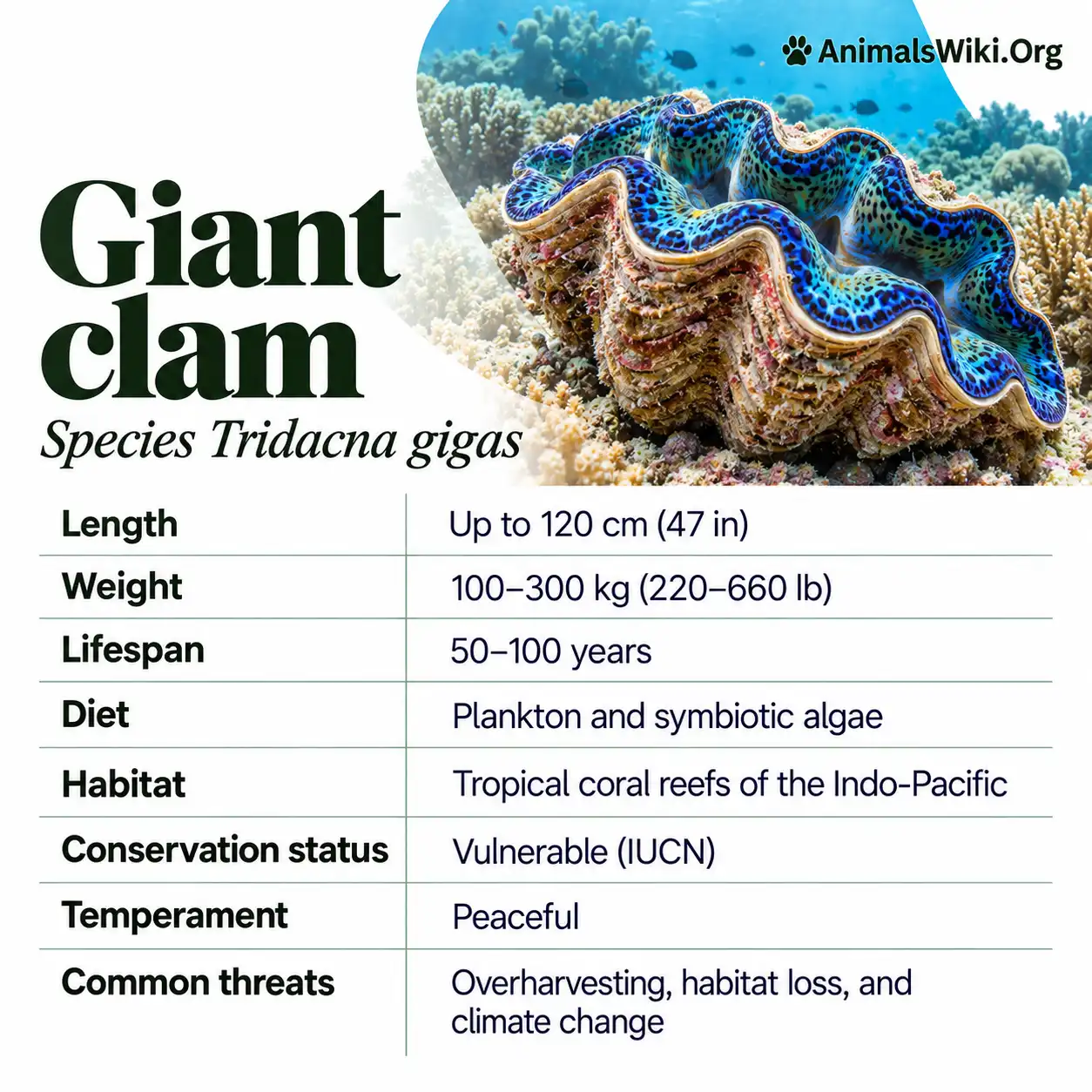
Some giant clams can grow more than one meter across and weigh over 200 kilograms, making them among the heaviest shelled mollusks on Earth.
Despite their enormous size, giant clams are peaceful filter-feeding animals that spend their adult lives resting on the seafloor.
Their appearance is unforgettable.
Two massive shells surround a soft body, while a broad mantle extends between the shell edges.
The mantle may display beautiful patterns of blue, green, gold, brown, or iridescent colors.
These colors are not merely decorative.
Giant clams maintain an extraordinary biological relationship with microscopic photosynthetic algae living inside their tissues.
The algae use sunlight to produce organic compounds, some of which help nourish the clam.
In return, the clam provides the algae with a protected environment and access to nutrients.
This relationship allows giant clams to thrive in the clear, sunlit waters of tropical coral reefs.
Giant clams also filter particles from seawater using their specialized gills.
Their feeding strategy combines suspension feeding with nutritional contributions from their algal symbionts.
Although giant clams were once surrounded by stories about trapping divers between their shells, these accounts are largely myths.
Giant clams close their shells relatively slowly, and they do not hunt or deliberately capture humans.
Unfortunately, these magnificent animals face serious conservation challenges.
Overharvesting, illegal wildlife trade, habitat degradation, and climate-related changes threaten many giant clam populations.
This comprehensive guide explores giant clam facts, scientific classification, anatomy, size, weight, habitat, distribution, diet, symbiotic algae, reproduction, lifespan, predators, adaptations, conservation, and frequently asked questions.
Giant Clam Facts
| Feature | Information |
|---|---|
| Common name | Giant Clam |
| Scientific name | Tridacna gigas |
| Phylum | Mollusca |
| Class | Bivalvia |
| Order | Cardiida |
| Family | Cardiidae |
| Subfamily | Tridacninae |
| Genus | Tridacna |
| Species | Tridacna gigas |
| Animal type | Marine bivalve mollusk |
| Habitat | Shallow tropical coral reefs and reef-associated environments |
| Distribution | Indo-Pacific region |
| Body structure | Two large shells enclosing soft tissues |
| Maximum shell length | More than 1 meter; exceptional individuals approximately 1.3 meters |
| Maximum weight | More than 200 kg in exceptional individuals |
| Mantle colors | Blue, green, brown, gold, and multicolored patterns |
| Feeding type | Filter feeding and nutritional symbiosis |
| Diet | Suspended organic particles and nutrients from symbiotic algae |
| Symbiotic organisms | Photosynthetic dinoflagellates commonly called zooxanthellae |
| Movement | Adults are largely sedentary |
| Reproduction | Sexual reproduction with external fertilization |
| Sexual system | Protandrous hermaphroditism |
| Larval stage | Free-swimming veliger |
| Lifespan | Several decades; potentially around 100 years in some cases |
| Main predators | Predatory snails, crabs, fish, and other animals, particularly when young |
| Human danger | Generally harmless |
| Conservation | Threatened by overharvesting and habitat degradation |
| Ecological role | Reef-associated filter feeder and host for symbiotic algae |
What Is a Giant Clam?
The giant clam is a large marine bivalve mollusk belonging to the species Tridacna gigas.
It is closely related to other clams, cockles, and bivalve mollusks.
Giant clams inhabit warm tropical marine environments, especially shallow coral reefs.
Unlike many smaller clams that bury themselves deeply in sand, adult giant clams generally remain exposed on the seafloor.
Is a Giant Clam an Animal?
Yes.
Is a Giant Clam a Fish?
No.
Is a Giant Clam an Invertebrate?
Yes. It has no backbone.
Is a Giant Clam a Mollusk?
Yes.
Is a Giant Clam a Bivalve?
Yes. Its body is enclosed by two shells.
Scientific Classification of the Giant Clam
| Classification | Name |
|---|---|
| Kingdom | Animalia |
| Phylum | Mollusca |
| Class | Bivalvia |
| Subclass | Autobranchia |
| Order | Cardiida |
| Superfamily | Cardioidea |
| Family | Cardiidae |
| Subfamily | Tridacninae |
| Genus | Tridacna |
| Species | Tridacna gigas |
What Does Tridacna gigas Mean?
The species name gigas means giant.
Are Giant Clams Related to Oysters?
Yes. Both belong to Bivalvia.
Are Giant Clams Related to Mussels?
Yes.
Are Giant Clams Related to Scallops?
Yes.
Types of Giant Clams
The term giant clam can refer specifically to Tridacna gigas or more broadly to several large tridacnine clam species.
1. True Giant Clam
Scientific name: Tridacna gigas
The largest living bivalve species.
It possesses a massive shell and a broad, colorful mantle.
2. Fluted Giant Clam
Scientific name: Tridacna squamosa
This species is known for prominent shell scales.
3. Small Giant Clam
Scientific name: Tridacna maxima
A smaller species commonly found in coral reef habitats.
4. Boring Giant Clam
Scientific name: Tridacna crocea
This species can bore into coral limestone and live embedded within reef structures.
5. Smooth Giant Clam
Scientific name: Tridacna derasa
This species has a comparatively smooth shell.
6. Bear Paw Clam
Scientific name: Hippopus hippopus
A related large tridacnine clam with a distinctive shell shape.
7. China Clam
Scientific name: Hippopus porcellanus
A related tridacnine species found in parts of the Indo-Pacific.
What Does a Giant Clam Look Like?
Giant clams possess two massive shells surrounding a soft body.
Their anatomy includes:
- Two shell valves
- Mantle
- Siphonal openings
- Gills
- Muscular tissues
- Digestive system
- Reproductive organs
- Light-sensitive structures
- Symbiotic algae-containing tissues
What Is the Mantle?
The mantle is a soft tissue structure that produces the shell and forms the colorful exposed surface.
What Are the Shell Valves?
The two halves of the shell.
Do Giant Clams Have Eyes?
They possess numerous light-sensitive structures along the mantle, but not conventional camera-like eyes.
Do Giant Clams Have Brains?
They lack a centralized brain like that of vertebrates, but possess a nervous system with ganglia.
Giant Clam Size and Weight
Giant clams are the largest living bivalves.
How Big Is a Giant Clam?
Large individuals can exceed one meter in shell length.
Can Giant Clams Reach 1.3 Meters?
Exceptional individuals have been reported at approximately this length.
How Much Does a Giant Clam Weigh?
Exceptionally large individuals can weigh more than 200 kilograms.
Are Giant Clams the Largest Clams?
Tridacna gigas is generally recognized as the largest living bivalve mollusk.
Giant Clam Shell
The giant clam shell is thick, heavy, and made primarily of calcium carbonate.
Why Are Giant Clam Shells So Large?
Their shells grow as the animal develops and provide structural protection.
Are Giant Clam Shells Strong?
Yes, although they can be damaged.
Can Giant Clams Close Their Shells?
Yes.
Do Giant Clams Close Quickly?
They do not snap shut like mechanical traps.
Giant Clam Colors
Giant clams may display spectacular mantle coloration.
Possible colors include:
- Blue
- Green
- Turquoise
- Brown
- Gold
- Yellow
- Multicolored patterns
Why Are Giant Clams Colorful?
Their colors result from tissue pigments, structural optical effects, and the presence of symbiotic algae.
Are All Giant Clams Blue?
No.
Can Giant Clams Change Color?
They do not rapidly change color like octopuses.
Where Do Giant Clams Live?
Giant clams inhabit the tropical Indo-Pacific region.
Their distribution includes parts of:
- Indian Ocean
- Western Pacific Ocean
- Southeast Asian waters
- Northern Australian waters
- Coral Triangle
- Tropical island reef systems
Do Giant Clams Live in Australia?
Yes.
Do Giant Clams Live in Indonesia?
Yes.
Do Giant Clams Live in the Philippines?
Yes, although populations have been affected by harvesting and conservation efforts.
Do Giant Clams Live in the Atlantic Ocean?
Tridacna gigas is not native to the Atlantic Ocean.
Do Giant Clams Live in Freshwater?
No.
Giant Clam Habitat
Giant clams inhabit shallow, sunlit tropical marine environments.
Common habitats include:
- Coral reefs
- Reef flats
- Lagoons
- Sandy reef-associated bottoms
- Shallow reef slopes
Do Giant Clams Live in Coral Reefs?
Yes.
Do Giant Clams Need Sunlight?
Sunlight is important because their symbiotic algae require light for photosynthesis.
Do Giant Clams Live in Deep Water?
They are primarily shallow-water animals.
Do Giant Clams Live in Sand?
They may rest on sandy or rubble-covered reef substrates.
What Do Giant Clams Eat?
Giant clams obtain nutrition through two major pathways.
Filter Feeding
They capture suspended food particles from seawater.
Symbiotic Algae
They receive organic compounds produced by photosynthetic algae living within their tissues.
Their nutrition may include:
- Phytoplankton
- Suspended organic particles
- Dissolved nutrients processed through symbiosis
- Photosynthetic products from symbiotic algae
Do Giant Clams Eat Plankton?
Yes.
Do Giant Clams Eat Fish?
No.
Are Giant Clams Carnivores?
They are not active predators of fish or large animals.
Do Giant Clams Eat Algae?
They host symbiotic algae and obtain nutrients from their photosynthesis.
Giant Clams and Zooxanthellae
One of the most fascinating giant clam adaptations is their symbiotic relationship with photosynthetic dinoflagellates.
These microorganisms are commonly called zooxanthellae.
What Are Zooxanthellae?
Microscopic photosynthetic dinoflagellates that live in association with certain marine animals.
How Do Zooxanthellae Help Giant Clams?
They produce organic compounds through photosynthesis.
How Do Giant Clams Help Zooxanthellae?
They provide a protected habitat and access to nutrients.
Is This Relationship Mutualism?
Yes, it is generally described as mutualistic.
How Do Giant Clams Filter Feed?
Giant clams use their gills to capture suspended particles.
Step 1: Water Enters
Seawater enters through an inhalant opening.
Step 2: Particles Are Captured
The gills trap food particles.
Step 3: Food Is Transported
Cilia and mucus move particles toward the digestive system.
Step 4: Digestion
The clam digests captured material.
Step 5: Water Exits
Filtered water leaves through an exhalant opening.
Can Giant Clams Move?
Adult giant clams are largely sedentary.
Can Giant Clams Walk?
Adults do not walk like mobile animals.
Can Giant Clams Swim?
No.
Can Baby Giant Clams Move?
Larvae swim in the plankton, and juveniles can reposition themselves before becoming largely sedentary.
Giant Clam Nervous System
Giant clams possess a nervous system with ganglia.
Do Giant Clams Have Brains?
They do not possess a centralized brain like vertebrates.
Can Giant Clams Sense Light?
Yes.
Can Giant Clams Detect Shadows?
Yes. They can respond to sudden changes in light.
Can Giant Clams Feel Pain?
Whether bivalves experience conscious pain remains scientifically uncertain.
Giant Clam Reproduction
Giant clams reproduce sexually.
They are protandrous hermaphrodites.
This means they generally develop male reproductive function first and later develop female reproductive capability.
Do Giant Clams Lay Eggs?
Yes.
Are Giant Clams Hermaphrodites?
Yes.
Can Giant Clams Self-Fertilize?
Their reproductive behavior generally reduces self-fertilization, but fertilization dynamics depend on spawning conditions.
How Do Giant Clams Reproduce?
They release eggs and sperm into seawater.
Giant Clam Eggs
Large mature giant clams can release enormous numbers of eggs during spawning.
How Many Eggs Can a Giant Clam Produce?
Large females may release millions of eggs during reproductive events.
Are Giant Clam Eggs Fertilized Internally?
No. Fertilization generally occurs externally.
Do Giant Clams Care for Their Eggs?
They do not provide parental care after spawning.
Giant Clam Life Cycle
Stage 1: Spawning
Adults release eggs and sperm.
Stage 2: Fertilization
Fertilization occurs in seawater.
Stage 3: Embryonic Development
The fertilized egg develops.
Stage 4: Trochophore Larva
An early swimming larval stage develops.
Stage 5: Veliger Larva
The larva develops a temporary shell and swimming structures.
Stage 6: Settlement
The larva settles onto suitable substrate.
Stage 7: Juvenile Giant Clam
The young clam grows and establishes its symbiotic relationship.
Stage 8: Adult Giant Clam
The animal grows into a large, sedentary bivalve.
Baby Giant Clams
Young giant clams begin life as planktonic larvae.
What Is a Baby Giant Clam Called?
A larva or juvenile clam, depending on developmental stage.
Do Baby Giant Clams Have Shells?
Developing larvae produce shells.
Do Baby Giant Clams Have Zooxanthellae?
Symbiotic algae are generally acquired from the environment during early development.
How Long Do Giant Clams Live?
Giant clams can live for several decades.
Some may survive for around a century under suitable conditions.
Can Giant Clams Live for 100 Years?
Long lifespans approaching a century are often reported, although reliable maximum-age estimates vary.
Are Giant Clams Immortal?
No.
Why Do Giant Clams Live So Long?
Their longevity reflects species-specific growth, physiology, and environmental conditions.
Giant Clam Adaptations
Massive Shell
Provides protection.
Colorful Mantle
Supports light capture and symbiotic functions.
Symbiotic Algae
Provide additional nutrition.
Filter Feeding
Allows capture of suspended food.
Light Sensitivity
Helps detect environmental changes.
Large Body Size
Provides protection against some predators.
High Reproductive Output
Increases the chance that some larvae survive.
Planktonic Larvae
Enable dispersal.
Long Lifespan
Allows reproduction over many years.
Reef Association
Provides access to sunlight and suitable water conditions.
What Animals Eat Giant Clams?
Predators vary with the clam’s age and size.
Potential predators include:
- Predatory snails
- Crabs
- Certain fish
- Octopuses
- Other marine predators
Young clams are particularly vulnerable.
Do Fish Eat Giant Clams?
Some fish consume young clams or exposed tissues.
Do Crabs Eat Giant Clams?
Some crabs prey on smaller individuals.
Do Octopuses Eat Giant Clams?
Octopuses can prey on bivalves, although the largest adult giant clams are difficult prey.
Giant Clams and Coral Reefs
Giant clams contribute to reef ecosystems through filtration, nutrient cycling, and interactions with other organisms.
Are Giant Clams Important for Coral Reefs?
Yes.
Do Giant Clams Build Coral Reefs?
They do not build reefs like reef-building corals.
Do Giant Clams Help Filter Water?
Yes.
Can Giant Clams Improve Water Quality?
They remove suspended particles, although the ecological effect depends on abundance and environmental conditions.
Giant Clam vs. Oyster
| Feature | Giant Clam | Oyster |
|---|---|---|
| Scientific group | Bivalvia | Bivalvia |
| Size | Can exceed 1 meter | Usually much smaller |
| Habitat | Tropical reefs | Various marine and estuarine habitats |
| Feeding | Filter feeding and algal symbiosis | Primarily filter feeding |
| Shell | Massive, strongly ribbed | Variable |
| Symbiotic algae | Present | Generally absent |
Giant Clam vs. Scallop
Giant clams are largely sedentary as adults.
Many scallops can swim by rapidly opening and closing their shells.
Both are bivalve mollusks.
Giant Clam vs. Mussel
Giant clams are enormous tropical reef-associated bivalves.
Mussels are generally smaller and commonly attach to surfaces using byssal threads.
Giant Clam vs. Pearl Oyster
Giant clams and pearl oysters are bivalves.
Pearl oysters are cultivated for pearls.
Giant clams are primarily known for their massive shells, colorful mantles, and symbiotic algae.
Are Giant Clams Dangerous to Humans?
Giant clams are generally harmless.
Can Giant Clams Trap Divers?
The popular story of giant clams deliberately trapping divers is largely a myth.
Can Giant Clams Close Their Shells?
Yes.
Can Giant Clams Bite?
They do not have biting jaws.
Can Giant Clams Kill Humans?
They are not predatory animals and do not hunt humans.
Are Giant Clams Endangered?
Giant clam populations have declined in many areas because of overharvesting and habitat degradation.
Tridacna gigas is internationally protected through wildlife trade controls.
What Threatens Giant Clams?
Major threats include:
- Overharvesting
- Illegal shell trade
- Collection for food
- Coral reef destruction
- Marine heatwaves
- Ocean acidification
- Pollution
- Climate change
Can Giant Clams Become Bleached?
Yes. Stress can cause loss or reduction of symbiotic algae, similar in some respects to coral bleaching.
Can Ocean Acidification Affect Giant Clams?
Yes. Changes in seawater chemistry may affect shell formation and development.
Giant Clam Conservation
Conservation strategies include:
- Marine protected areas
- Harvest regulations
- International trade controls
- Hatchery breeding
- Juvenile restocking
- Reef restoration
- Community-based conservation
- Population monitoring
Can Giant Clams Be Farmed?
Yes. Giant clams can be bred and raised in aquaculture facilities.
Can Giant Clams Be Reintroduced?
Hatchery-produced juveniles may be used in carefully managed restoration programs.
Why Are Giant Clams Important?
Giant clams contribute to marine ecosystems and scientific research.
They are important for:
- Coral reef biodiversity
- Filter feeding
- Nutrient cycling
- Marine symbiosis
- Bivalve biology
- Reef conservation
- Aquaculture research
- Climate change studies
50 Interesting Giant Clam Facts
- The true giant clam’s scientific name is Tridacna gigas.
- It belongs to the phylum Mollusca.
- It belongs to the class Bivalvia.
- It is a marine invertebrate.
- It is not a fish.
- It is related to oysters.
- It is related to mussels.
- It is related to scallops.
- It is the largest living bivalve mollusk.
- Some individuals exceed one meter in length.
- Exceptionally large individuals may weigh over 200 kilograms.
- It possesses two massive shells.
- Its shells are made mainly of calcium carbonate.
- It has a colorful mantle.
- Its mantle may display blue and green patterns.
- It hosts symbiotic photosynthetic algae.
- These algae are commonly called zooxanthellae.
- The algae produce organic compounds through photosynthesis.
- The clam provides the algae with a protected environment.
- Giant clams also filter-feed.
- Their gills capture suspended particles.
- They inhabit tropical coral reefs.
- They occur in the Indo-Pacific region.
- They live in Australian waters.
- They occur in Southeast Asian waters.
- They are primarily shallow-water animals.
- Sunlight is important for their symbiotic algae.
- Adults are largely sedentary.
- Their larvae swim in the plankton.
- They reproduce sexually.
- They are protandrous hermaphrodites.
- They develop male reproductive function first.
- Large adults can release millions of eggs.
- Fertilization occurs in seawater.
- Their larvae pass through a veliger stage.
- Juveniles acquire symbiotic algae from the environment.
- They can live for several decades.
- Long lifespans approaching a century are reported.
- They possess light-sensitive mantle structures.
- They can respond to shadows.
- They do not hunt fish.
- They do not deliberately trap divers.
- Young clams are vulnerable to predators.
- Predatory snails can attack giant clams.
- Some crabs prey on juveniles.
- Giant clams contribute to reef nutrient cycling.
- They remove suspended particles from seawater.
- Overharvesting has reduced populations in many regions.
- Hatchery breeding supports some conservation programs.
- Their enormous shells and colorful symbiotic mantles make them among the most extraordinary mollusks in the ocean.
Did You Know?
The Giant Clam That Uses Sunlight to Help Feed Itself
Imagine diving over a tropical coral reef in the Indo-Pacific Ocean.
Sunlight passes through the clear blue water.
Colorful fish swim between coral formations.
Sea anemones sway in gentle currents.
Among the corals, a massive shell rests on the seafloor.
Its two thick valves are partly open.
Between them stretches a broad, colorful mantle.
Brilliant blue and green patterns shimmer in the sunlight.
This is a giant clam.
At first glance, it appears motionless.
It does not swim.
It does not chase prey.
It does not possess powerful jaws.
Yet the giant clam has developed an extraordinary way of obtaining energy.
Inside its mantle tissues live microscopic photosynthetic algae.
These algae use sunlight to produce organic compounds.
Some of these compounds contribute to the clam’s nutrition.
In return, the clam provides the algae with a protected environment and access to nutrients.
The partnership allows the clam to benefit from sunlight while remaining an animal.
But photosynthesis is only part of its nutritional strategy.
The giant clam also draws seawater through specialized openings.
Its gills capture suspended food particles.
These particles are transported toward the digestive system.
The clam therefore combines filter feeding with nutritional contributions from its symbiotic algae.
Over many years, the animal grows.
Its shell becomes larger and heavier.
Eventually, a mature giant clam may exceed one meter in length.
Some exceptional individuals weigh more than 200 kilograms.
Yet even this enormous mollusk remains vulnerable.
Young clams may be eaten by predators.
Adult populations can decline because of overharvesting.
Marine heatwaves and coral reef degradation can also threaten their habitats.
Scientists and conservationists are working to protect giant clams through breeding programs, reef management, and restoration projects.
The giant clam demonstrates how one of the world’s largest shelled animals can survive through an extraordinary partnership with microscopic algae, combining sunlight, seawater, and biological cooperation into a remarkable marine lifestyle.
Frequently Asked Questions About Giant Clams
What is a giant clam?
A giant clam is a large marine bivalve mollusk, especially the species Tridacna gigas.
What is the scientific name of the giant clam?
Tridacna gigas.
Is a giant clam an animal?
Yes.
Is a giant clam a fish?
No.
Is a giant clam an invertebrate?
Yes.
Is a giant clam a mollusk?
Yes.
Is a giant clam a bivalve?
Yes.
Are giant clams related to oysters?
Yes.
Are giant clams related to mussels?
Yes.
Are giant clams related to scallops?
Yes.
What is the largest living clam?
Tridacna gigas.
How big is a giant clam?
Large individuals can exceed one meter in shell length.
Can giant clams reach 1.3 meters?
Exceptional individuals have been reported around this size.
How much does a giant clam weigh?
Exceptionally large individuals may exceed 200 kilograms.
Are giant clams the largest bivalves?
Yes. Tridacna gigas is generally recognized as the largest living bivalve.
What color are giant clams?
Their mantles may be blue, green, brown, gold, or multicolored.
Why are giant clams colorful?
Their mantle coloration reflects pigments, optical structures, and symbiotic algae.
Do giant clams have shells?
Yes, two large shell valves.
Are giant clam shells strong?
Yes.
Can giant clams close their shells?
Yes.
Do giant clams close quickly?
They do not snap shut like mechanical traps.
Do giant clams have eyes?
They possess light-sensitive structures along the mantle.
Do giant clams have brains?
They lack a vertebrate-style centralized brain.
Do giant clams have hearts?
Yes. Bivalves possess a circulatory system with a heart.
Where do giant clams live?
In tropical Indo-Pacific waters.
Do giant clams live in Australia?
Yes.
Do giant clams live in Indonesia?
Yes.
Do giant clams live in the Philippines?
Yes.
Do giant clams live in the Atlantic Ocean?
Tridacna gigas is not native to the Atlantic.
Do giant clams live in freshwater?
No.
Do giant clams live in coral reefs?
Yes.
Do giant clams need sunlight?
Sunlight supports their symbiotic algae.
Do giant clams live in deep water?
They are primarily shallow-water animals.
What do giant clams eat?
Suspended food particles and nutrients obtained through symbiotic algae.
Do giant clams eat plankton?
Yes.
Do giant clams eat fish?
No.
Are giant clams carnivores?
They are not active predators.
What are zooxanthellae?
Photosynthetic dinoflagellates living in association with marine animals.
How do zooxanthellae help giant clams?
They produce organic compounds through photosynthesis.
How do giant clams help zooxanthellae?
They provide a protected environment and nutrients.
Do giant clams photosynthesize?
The clam itself does not perform photosynthesis; its symbiotic algae do.
How do giant clams filter-feed?
Their gills capture suspended particles from seawater.
Can giant clams move?
Adults are largely sedentary.
Can giant clams walk?
Adults do not walk like mobile animals.
Can giant clams swim?
No.
Can baby giant clams swim?
Larvae swim in the plankton.
How do giant clams reproduce?
Sexually, by releasing eggs and sperm into seawater.
Are giant clams hermaphrodites?
Yes.
Do giant clams lay eggs?
Yes.
How many eggs can giant clams produce?
Large adults can release millions of eggs.
What is a baby giant clam called?
A larva or juvenile clam.
Do baby giant clams have shells?
Developing larvae produce shells.
How long do giant clams live?
They can live for several decades, with long lifespans approaching a century reported.
Can giant clams live for 100 years?
Some age estimates approach a century, although reliable maximum ages vary.
Are giant clams immortal?
No.
What animals eat giant clams?
Predatory snails, crabs, certain fish, and other marine predators, especially when clams are young.
Do fish eat giant clams?
Some fish consume young clams or exposed tissues.
Do crabs eat giant clams?
Some crabs prey on juveniles.
Do octopuses eat giant clams?
Octopuses can prey on bivalves, although very large giant clams are difficult prey.
Can giant clams trap divers?
They do not deliberately trap divers.
Can giant clams bite humans?
No.
Are giant clams dangerous?
Generally not.
Can giant clams kill humans?
They are not predatory animals and do not hunt humans.
Are giant clams endangered?
Populations have declined in many regions, and conservation status varies by species and assessment.
What threatens giant clams?
Overharvesting, illegal trade, reef degradation, warming, and ocean acidification.
Can giant clams become bleached?
Yes. Stress can reduce their symbiotic algae.
Can giant clams be farmed?
Yes.
Can giant clams be reintroduced?
Hatchery-produced juveniles can be used in restoration programs.
Why are giant clams important?
They contribute to coral reef biodiversity, nutrient cycling, filtration, and symbiotic marine communities.
What is the most interesting giant clam fact?
The giant clam is the world’s largest living bivalve and receives part of its nutrition from photosynthetic algae living inside its colorful mantle.
Conclusion
The giant clam is one of the most extraordinary marine mollusks in the tropical oceans.
Its enormous shell, colorful mantle, and remarkable symbiotic relationship with microscopic algae distinguish it from other bivalves.
Giant clams are peaceful animals that obtain nutrition through filter feeding and photosynthetic symbiosis.
They contribute to coral reef ecosystems through nutrient cycling, particle filtration, and interactions with other marine organisms.
Their complex reproductive cycle includes planktonic larvae that eventually settle and grow into large, sedentary adults.
Unfortunately, overharvesting, habitat degradation, and environmental change threaten many giant clam populations.
Conservation programs, aquaculture, and responsible reef management are important for protecting these remarkable animals.
Understanding giant clams helps reveal the complexity of marine symbiosis and the importance of conserving tropical coral reef ecosystems.
The giant clam proves that one of the ocean’s largest and heaviest shelled animals can thrive through an extraordinary partnership with microscopic algae, using sunlight and seawater to support a remarkable life beneath the waves.