Nudibranch, The Colorful Sea Slugs With Extraordinary Ocean Superpowers
The nudibranch is one of the most colorful, unusual, and fascinating marine animals in the ocean. Often described as an underwater jewel, a living rainbow, or a butterfly of the sea, this remarkable creature belongs to a diverse group of shell-less marine gastropod mollusks.
With their brilliant colors, delicate body structures, unusual feeding habits, and extraordinary defensive adaptations, nudibranchs are among the most visually striking animals found beneath the ocean’s surface.
Some nudibranchs display electric-blue stripes, bright orange bodies, purple gills, or vivid yellow spots. Others resemble leaves, flowers, sea anemones, or tiny pieces of coral.
Despite their delicate appearance, nudibranchs possess remarkable survival strategies.
Some obtain defensive chemicals from the sponges or other organisms they consume. Others can store functional stinging structures taken from their cnidarian prey.
Certain species even retain chloroplasts from algae for a limited period, although this ability is better known in some other sea slugs and should not be assumed for nudibranchs generally.
Unlike many familiar snails, adult nudibranchs do not possess an external shell.
Instead, they rely on camouflage, warning colors, chemical defenses, and specialized anatomy to survive.
Nudibranchs are found in oceans worldwide, from tropical coral reefs to cold temperate seas and deeper marine environments.
Scientists have described thousands of nudibranch species, and additional species continue to be identified.
These marine mollusks also play important ecological roles as predators of sponges, hydroids, bryozoans, sea anemones, and other small marine organisms.
This comprehensive guide explores nudibranch facts, scientific classification, species, anatomy, size, colors, habitat, distribution, diet, feeding behavior, reproduction, lifespan, predators, chemical defenses, adaptations, conservation, and frequently asked questions.
Nudibranch Facts
| Feature | Information |
|---|---|
| Common name | Nudibranch |
| Other name | Sea slug, although not all sea slugs are nudibranchs |
| Scientific group | Nudibranchia |
| Phylum | Mollusca |
| Class | Gastropoda |
| Major clade | Nudibranchia |
| Animal type | Marine gastropod mollusk |
| Habitat | Coral reefs, rocky coasts, seagrass areas, and deeper marine environments |
| Distribution | Oceans worldwide |
| Body shape | Soft-bodied, elongated, flattened, or ornamented |
| Adult shell | Absent |
| Size | From a few millimeters to several tens of centimeters, depending on species |
| Colors | Blue, orange, yellow, purple, red, green, white, black, and multicolored |
| Sensory organs | Rhinophores and other sensory structures |
| Feeding apparatus | Radula in many species |
| Diet | Sponges, hydroids, bryozoans, cnidarians, and other prey |
| Feeding type | Predominantly carnivorous |
| Movement | Muscular foot |
| Reproduction | Sexual reproduction; most are simultaneous hermaphrodites |
| Eggs | Often deposited in ribbons or clusters |
| Larval stage | Usually veliger, although development varies |
| Lifespan | Often months to around a year; varies considerably |
| Main predators | Certain fish, crabs, sea stars, and other marine predators |
| Defense | Chemical compounds, camouflage, warning colors, and sometimes stored stinging cells |
| Human danger | Most are not dangerous to observe; some species contain potent toxins |
| Conservation | Species-specific assessments are limited |
What Is a Nudibranch?
A nudibranch is a marine gastropod mollusk belonging to the group Nudibranchia.
Nudibranchs are commonly called sea slugs because they possess soft bodies and lack the external shells associated with many other gastropods.
However, not every animal called a sea slug is a nudibranch.
Is a Nudibranch a Sea Slug?
Yes. Nudibranchs are a group of sea slugs.
Are All Sea Slugs Nudibranchs?
No. Sea slugs include several different gastropod groups.
Is a Nudibranch a Snail?
Nudibranchs are gastropod mollusks and are evolutionarily related to snails.
Is a Nudibranch a Fish?
No.
Is a Nudibranch an Invertebrate?
Yes. It has no backbone.
Scientific Classification of Nudibranchs
| Classification | Name |
|---|---|
| Kingdom | Animalia |
| Phylum | Mollusca |
| Class | Gastropoda |
| Major lineage | Heterobranchia |
| Group | Nudibranchia |
| Major subgroup | Doridina |
| Major subgroup | Cladobranchia |
Taxonomic arrangements and ranks within Nudibranchia have changed as molecular research has improved understanding of their evolutionary relationships.
What Does Nudibranch Mean?
The word nudibranch comes from Latin roots meaning naked gills.
The name refers to exposed respiratory structures found in many species.
Are Nudibranchs Related to Octopuses?
Both belong to Mollusca, but nudibranchs are gastropods and octopuses are cephalopods.
Are Nudibranchs Related to Snails?
Yes.
Are Nudibranchs Related to Clams?
Yes. They share the phylum Mollusca.
Types and Species of Nudibranchs
There are thousands of nudibranch species with extraordinary diversity in appearance and behavior.
1. Spanish Dancer Nudibranch
Scientific name: Hexabranchus sanguineus
The Spanish dancer is famous for its broad, colorful body and swimming movements.
When disturbed, it can undulate its mantle edges in a way that resembles flowing fabric.
It is among the larger nudibranchs.
2. Blue Dragon Nudibranch
Scientific name: Glaucus atlanticus
The blue dragon is a small pelagic nudibranch that floats near the ocean surface.
It feeds on venomous cnidarians, including Portuguese man o’ war.
It can store stinging structures from its prey for defense.
3. Sea Bunny Nudibranch
Scientific name: Jorunna parva
This small nudibranch is famous for its fuzzy-looking body and rhinophores that resemble rabbit ears.
Its appearance has made it especially popular in underwater photography.
4. Pikachu Nudibranch
Scientific name: Thecacera pacifica
This brightly colored species is known for its yellow body and dark-tipped appendages.
Its appearance has inspired comparisons with a popular animated character.
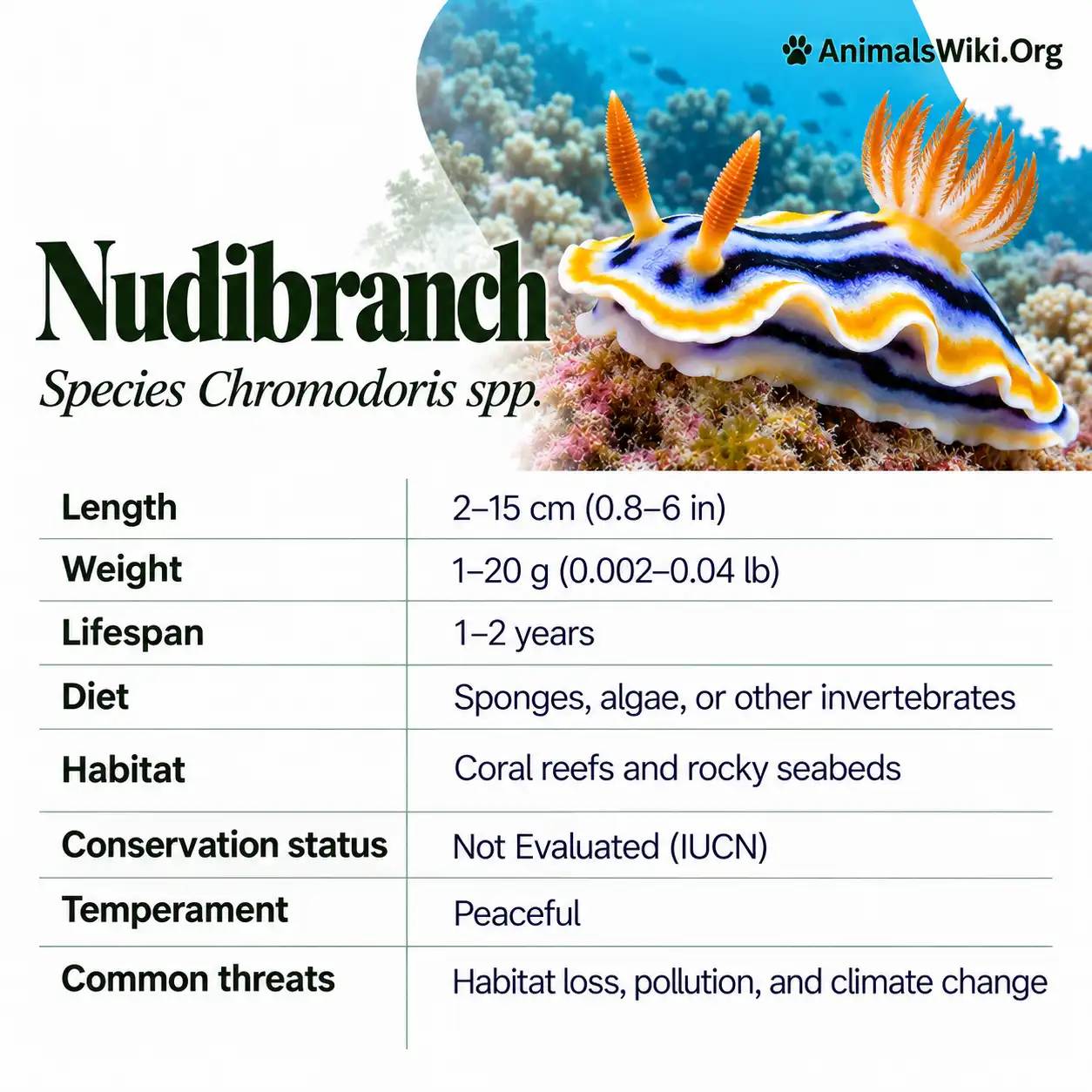
5. Chromodoris Nudibranchs
Scientific group: Chromodoris and related genera.
These nudibranchs are famous for brilliant patterns involving blue, purple, yellow, orange, and white.
Many feed on sponges.
6. Nembrotha Nudibranchs
Scientific genus: Nembrotha
Members of this group often display striking combinations of green, black, orange, and blue.
Some feed on colonial tunicates.
7. Flabellina-Like Nudibranchs
Several related genera possess slender bodies with colorful finger-like projections.
These projections are called cerata.
8. Hooded Nudibranch
Scientific name: Melibe leonina
This unusual species has a large oral hood used to capture small prey.
9. Sea Lemon Nudibranch
Scientific name: Doris montereyensis
This northeastern Pacific nudibranch has a rounded yellow body and a rough-looking dorsal surface.
10. Giant Nudibranch
Scientific name: Dendronotus iris
This large, branching nudibranch occurs in northeastern Pacific waters and feeds on certain cnidarians.
What Does a Nudibranch Look Like?
Nudibranch appearance varies dramatically among species.
Some have smooth, oval bodies.
Others possess branching gills, elongated projections, or elaborate frills.
Common anatomical structures include:
- Head
- Rhinophores
- Oral tentacles
- Mantle
- Muscular foot
- Cerata in some species
- Gill structures
- Digestive system
- Radula in many species
- Reproductive organs
What Are Rhinophores?
Rhinophores are specialized sensory structures located on the head.
They help detect chemical cues in seawater.
What Are Cerata?
Cerata are finger-like or branching projections found in many cladobranch nudibranchs.
They can serve digestive, respiratory, and defensive functions.
Do Nudibranchs Have Gills?
Many possess exposed respiratory structures, although their form varies.
Do Nudibranchs Have Shells?
Adult nudibranchs lack external shells.
Why Are Nudibranchs So Colorful?
Nudibranchs are famous for extraordinary color patterns.
Their coloration may serve several functions.
Warning Coloration
Bright colors can warn predators that an animal is chemically defended or unpalatable.
Camouflage
Some species closely resemble the sponges, hydroids, or other organisms on which they live.
Species Recognition
Color patterns may contribute to interactions between individuals.
Mimicry
Some species resemble other defended organisms.
Not every bright color has the same ecological function, and coloration must be interpreted species by species.
Nudibranch Size and Weight
Nudibranch size varies greatly.
How Big Is a Nudibranch?
Some species measure only a few millimeters.
Others grow to several tens of centimeters.
What Is the Largest Nudibranch?
The Spanish dancer and some other large species are among the largest familiar nudibranchs.
Maximum size depends on species identification and measurement.
What Is the Smallest Nudibranch?
Some species are only a few millimeters long.
How Much Does a Nudibranch Weigh?
Weight varies considerably with body size and species.
Where Do Nudibranchs Live?
Nudibranchs inhabit marine environments around the world.
They occur in:
- Pacific Ocean
- Atlantic Ocean
- Indian Ocean
- Southern Ocean
- Arctic marine environments
- Tropical coral reefs
- Temperate rocky coasts
- Deep-sea habitats
Do Nudibranchs Live in Coral Reefs?
Yes.
Do Nudibranchs Live in Cold Water?
Yes.
Do Nudibranchs Live in the Deep Sea?
Yes. Some species inhabit deeper marine environments.
Do Nudibranchs Live in Freshwater?
Nudibranchs are marine animals.
Nudibranch Habitat
Nudibranchs occupy a wide variety of underwater habitats.
These include:
- Coral reefs
- Rocky reefs
- Tide pools
- Seagrass beds
- Kelp forests
- Sandy bottoms
- Sponge communities
- Hydroid colonies
- Deep-sea environments
Do Nudibranchs Live on Sponges?
Many species live near or on their sponge prey.
Do Nudibranchs Live on Coral?
Some species occur on coral reefs and may feed on coral-associated organisms.
Do Nudibranchs Live in Tide Pools?
Yes. Some species inhabit intertidal environments.
What Do Nudibranchs Eat?
Most nudibranchs are carnivorous predators.
Their diets vary significantly by species.
Common prey include:
- Sponges
- Hydroids
- Sea anemones
- Bryozoans
- Tunicates
- Other sea slugs
- Small marine invertebrates
- Certain cnidarians
Do Nudibranchs Eat Sponges?
Yes. Many dorid nudibranchs specialize in sponge feeding.
Do Nudibranchs Eat Jellyfish?
Some species consume cnidarians, including floating hydrozoan colonies.
Do Nudibranchs Eat Coral?
Certain nudibranchs feed on coral tissue or coral-associated organisms.
Do Nudibranchs Eat Fish?
Fish are not their normal primary prey.
Are Nudibranchs Carnivores?
Most are.
How Do Nudibranchs Eat?
Feeding methods vary among species.
Many use a radula, a ribbon-like feeding structure covered with microscopic teeth.
What Is a Radula?
A specialized feeding organ found in many mollusks.
Do Nudibranchs Have Teeth?
Many possess radular teeth.
Do All Nudibranchs Have a Radula?
No. Some species have lost or modified this structure.
How Do Nudibranchs Find Food?
They use chemical and tactile cues.
How Do Nudibranchs Move?
Nudibranchs usually move using a muscular foot.
Can Nudibranchs Crawl?
Yes.
Can Nudibranchs Swim?
Some species can swim.
Are Nudibranchs Fast?
Most crawl slowly.
Can Nudibranchs Climb?
They can move across rocks, sponges, and other underwater surfaces.
Can Nudibranchs Swim?
Some nudibranchs possess specialized swimming behaviors.
How Does the Spanish Dancer Swim?
It undulates its broad mantle edges.
Can Blue Dragons Swim?
Blue dragons primarily float at the ocean surface, supported by swallowed air and surface tension, rather than swimming like fish.
Can All Nudibranchs Swim?
No.
Nudibranch Senses
Nudibranchs possess specialized sensory structures.
Do Nudibranchs Have Eyes?
Many have simple eyes that detect light.
Do Nudibranchs Have Brains?
They possess a nervous system with ganglia, including a central concentration of nerve cells.
Can Nudibranchs Smell?
They detect dissolved chemical cues using specialized sensory structures.
Can Nudibranchs Hear?
They do not possess ears like vertebrates.
Nudibranch Chemical Defenses
One of the most remarkable nudibranch adaptations is chemical defense.
Some species obtain defensive compounds from their prey.
Others produce or modify defensive chemicals.
Are Nudibranchs Poisonous?
Some contain toxins or deterrent chemicals.
Are Nudibranchs Venomous?
Certain species can deliver stinging structures acquired from prey, but most nudibranchs do not inject venom in the manner of venomous fish or jellyfish.
Can Nudibranchs Store Stinging Cells?
Some aeolid nudibranchs can retain functional cnidarian stinging capsules, called nematocysts.
Why Do Nudibranchs Have Bright Colors?
In some species, bright colors advertise chemical defenses.
Blue Dragon Nudibranch Defense
The blue dragon, Glaucus atlanticus, is especially famous for its unusual feeding and defense.
It consumes floating cnidarians, including Portuguese man o’ war.
The blue dragon can store nematocysts from its prey in specialized structures.
Is the Blue Dragon Dangerous?
Contact can cause painful stings because stored nematocysts may remain functional.
Should You Touch a Blue Dragon?
No.
Are All Nudibranchs Like Blue Dragons?
No. Defensive strategies vary greatly.
Nudibranch Reproduction
Most nudibranchs are simultaneous hermaphrodites.
This means each individual possesses both male and female reproductive structures.
However, they generally reproduce by mating with another individual.
Do Nudibranchs Lay Eggs?
Yes.
Are Nudibranchs Hermaphrodites?
Most are simultaneous hermaphrodites.
Can Nudibranchs Fertilize Themselves?
Self-fertilization is not the normal reproductive strategy of most nudibranchs.
How Do Nudibranchs Mate?
Individuals exchange sperm during mating.
Nudibranch Eggs
Nudibranchs often lay eggs in colorful ribbons or clusters.
What Do Nudibranch Eggs Look Like?
Egg masses may form spirals, ribbons, loops, or other patterns.
Are Nudibranch Eggs Colorful?
Some egg masses are brightly colored.
How Many Eggs Do Nudibranchs Lay?
Numbers vary by species and reproductive condition.
Nudibranch Life Cycle
Stage 1: Mating
Adults exchange sperm.
Stage 2: Egg Deposition
Eggs are deposited in ribbons or clusters.
Stage 3: Embryonic Development
Embryos develop inside egg capsules.
Stage 4: Larval Development
Many species develop into veliger larvae.
Stage 5: Settlement
Larvae settle onto suitable substrates.
Stage 6: Juvenile Nudibranch
Young nudibranchs develop their characteristic body structures.
Stage 7: Adult Nudibranch
Adults become reproductively mature.
Some species have direct development and do not follow every stage described above.
Baby Nudibranchs
Young nudibranchs may differ significantly from adults.
What Is a Baby Nudibranch Called?
A larva or juvenile, depending on developmental stage.
Do Baby Nudibranchs Have Shells?
Many nudibranch larvae possess temporary shells that are lost during metamorphosis.
Do Baby Nudibranchs Have Bright Colors?
Adult coloration may develop as juveniles grow.
How Long Do Nudibranchs Live?
Nudibranch lifespan varies greatly.
Many species live for months to approximately a year.
Some may survive longer.
Can Nudibranchs Live for One Year?
Yes.
Can Nudibranchs Live for Several Years?
Some species may live longer than a year, but lifespan data are limited for many nudibranchs.
Are Nudibranchs Immortal?
No.
Why Do Some Nudibranchs Have Short Lifespans?
Lifespan reflects species-specific growth, reproduction, predation, and environmental conditions.
Nudibranch Regeneration
Some nudibranchs can repair damaged tissues.
A particularly remarkable ability has been documented in certain sacoglossan sea slugs, which can regenerate bodies after self-decapitation.
However, these sacoglossans are not nudibranchs.
Can Nudibranchs Regrow Their Bodies?
Regenerative ability varies, and full-body regeneration should not be assumed for nudibranchs.
Can Nudibranchs Survive Injury?
Some can survive and repair certain injuries.
Nudibranch Adaptations
Bright Warning Colors
Can discourage predators.
Camouflage
Helps some species blend with prey or habitat.
Chemical Defenses
Provide protection against predators.
Stored Nematocysts
Allow certain species to use prey-derived stinging structures.
Rhinophores
Help detect chemical cues.
Radula
Supports specialized feeding.
Cerata
Can contribute to respiration, digestion, and defense.
Muscular Foot
Allows crawling.
Specialized Diet
Enables exploitation of particular prey.
Egg Ribbons
Protect and organize developing embryos.
What Animals Eat Nudibranchs?
Predators include:
- Certain fish
- Crabs
- Sea stars
- Other nudibranchs
- Some marine invertebrates
Do Fish Eat Nudibranchs?
Some fish do.
Do Crabs Eat Nudibranchs?
Yes, some crabs prey on them.
Do Nudibranchs Eat Other Nudibranchs?
Some species do.
Why Don’t All Predators Eat Nudibranchs?
Chemical defenses, camouflage, and warning coloration can reduce predation.
Nudibranch vs. Sea Slug
| Feature | Nudibranch | Other Sea Slugs |
|---|---|---|
| Scientific group | Nudibranchia | Several gastropod lineages |
| Adult external shell | Absent | Usually absent or reduced, depending on group |
| Diet | Mostly animal prey | Highly variable |
| Color | Often colorful | Variable |
| Defensive adaptations | Chemical defenses, camouflage, sometimes stored nematocysts | Diverse strategies |
| Example | Chromodoris | Sacoglossan sea slugs |
Nudibranch vs. Sea Snail
Nudibranchs are shell-less adult gastropods.
Many familiar sea snails possess external shells.
Both belong to Gastropoda.
Nudibranch vs. Flatworm
Nudibranchs are mollusks.
Marine flatworms belong to different animal groups, including Platyhelminthes.
Some flatworms resemble nudibranchs because of their bright colors and flattened bodies.
Nudibranch vs. Sea Anemone
Nudibranchs are mollusks.
Sea anemones are cnidarians.
Some nudibranchs feed on sea anemones and can acquire their stinging structures.
Nudibranch vs. Jellyfish
Nudibranchs are gastropod mollusks.
Jellyfish belong to cnidarian groups.
They differ in anatomy, movement, and reproduction.
Are Nudibranchs Dangerous to Humans?
Most nudibranchs are harmless to observe.
However, some possess potent chemical defenses or stored stinging structures.
Can Nudibranchs Sting Humans?
Some species, particularly certain aeolids, can cause stinging contact.
Can Nudibranchs Bite Humans?
They are not generally dangerous biting animals.
Can You Touch a Nudibranch?
Avoid handling them.
Are All Nudibranchs Poisonous?
No. Toxicity varies greatly.
What Should You Do After Contact With a Stinging Nudibranch?
If a stinging species causes symptoms:
- Leave the water safely.
- Avoid rubbing the affected area.
- Rinse gently with seawater if stinging cells may be involved.
- Do not apply unverified chemicals or remedies.
- Seek medical advice for persistent pain or significant skin reactions.
- Seek emergency care for breathing difficulties or severe allergic symptoms.
First aid may vary according to the species involved.
Are Nudibranchs Endangered?
Conservation status varies by species.
Many species have not received comprehensive assessments.
What Threatens Nudibranchs?
Potential threats include:
- Coral reef degradation
- Marine pollution
- Ocean warming
- Ocean acidification
- Habitat destruction
- Loss of specialized prey
- Destructive collection
- Coastal development
Can Climate Change Affect Nudibranchs?
Yes. Changes in temperature, ocean chemistry, habitat, and prey availability may influence populations.
Why Are Nudibranchs Important?
Nudibranchs are important predators and members of marine food webs.
They are also valuable for studying:
- Marine biodiversity
- Chemical ecology
- Predator-prey relationships
- Evolution
- Sensory biology
- Reproductive biology
- Defensive adaptations
- Species specialization
50 Interesting Nudibranch Facts
- Nudibranchs are marine gastropod mollusks.
- They belong to the phylum Mollusca.
- They belong to the class Gastropoda.
- Their group is called Nudibranchia.
- They are invertebrates.
- They are not fish.
- They are related to snails.
- They are related to other sea slugs.
- Adult nudibranchs lack external shells.
- Many species are brightly colored.
- Some resemble underwater flowers.
- Some resemble leaves or pieces of coral.
- The sea bunny is a nudibranch.
- The Spanish dancer is a nudibranch.
- The blue dragon is a nudibranch.
- The Pikachu nudibranch is Thecacera pacifica.
- Nudibranchs inhabit oceans worldwide.
- Some live on tropical coral reefs.
- Others inhabit cold temperate waters.
- Some occur in deep-sea environments.
- Most nudibranchs are carnivorous.
- Many feed on sponges.
- Some consume hydroids.
- Some feed on sea anemones.
- Some eat other sea slugs.
- Many possess a radula.
- Rhinophores help detect chemical cues.
- Cerata occur in many cladobranch species.
- Some species store defensive chemicals from prey.
- Certain aeolids store functional nematocysts.
- Blue dragons can store stinging structures from Portuguese man o’ war.
- Bright colors can advertise chemical defenses.
- Some species use camouflage.
- Most crawl using a muscular foot.
- Some species can swim.
- Spanish dancers swim by undulating their mantles.
- Nudibranchs possess nervous systems with ganglia.
- Many have simple light-sensitive eyes.
- Most are simultaneous hermaphrodites.
- They usually mate with another individual.
- They lay eggs.
- Egg masses often form ribbons.
- Many species have veliger larvae.
- Some develop directly.
- Many species live for months.
- Some can survive approximately a year or longer.
- Certain fish prey on nudibranchs.
- Some nudibranchs are toxic or distasteful to predators.
- Thousands of nudibranch species have been described.
- Their extraordinary colors, feeding specialization, and chemical defenses make them among the most remarkable marine mollusks.
Did You Know?
The Tiny Sea Slug That Steals Its Enemy’s Weapons
Imagine diving over a tropical coral reef.
Colorful fish move between branching corals.
Sponges cover the rocky surfaces.
Small sea anemones extend their tentacles into the water.
Among these organisms, a tiny brightly colored animal slowly crawls across the reef.
Its body is soft.
Its colors are brilliant.
Delicate projections extend from its back.
It is a nudibranch.
At first glance, it appears defenseless.
It has no protective shell.
It cannot swim quickly away from danger.
It has no large claws or powerful jaws.
Yet this small animal may possess one of the ocean’s most remarkable defensive strategies.
Some nudibranchs feed on cnidarians such as hydroids and sea anemones.
These prey animals possess specialized stinging capsules called nematocysts.
Most predators must avoid these structures.
But certain aeolid nudibranchs can consume cnidarian tissues without triggering every stinging capsule.
Some of the nematocysts pass through the digestive system without being discharged.
The nudibranch transports them into specialized structures within its cerata.
There, the stinging capsules remain functional.
When a predator attacks, the nudibranch may use these stored structures as a defense.
It has effectively acquired part of its prey’s weaponry.
One of the most famous examples is the blue dragon, Glaucus atlanticus.
This small nudibranch floats near the ocean surface.
It feeds on floating cnidarians, including Portuguese man o’ war.
The blue dragon can store nematocysts from its prey.
Its striking blue coloration also helps it blend with the ocean surface when viewed from certain directions.
The result is an extraordinary marine animal that combines unusual feeding behavior, camouflage, and prey-derived defenses.
But nudibranch diversity extends far beyond blue dragons.
Some species resemble fuzzy rabbits.
Others resemble miniature flowers.
Some swim like pieces of flowing fabric.
Others spend their lives feeding on particular sponge species.
Scientists continue discovering and studying nudibranchs because of their extraordinary diversity.
The nudibranch demonstrates that even a small, soft-bodied sea slug without a shell can survive by using sophisticated chemical defenses, specialized feeding strategies, and some of the most spectacular colors found in the ocean.
Frequently Asked Questions About Nudibranchs
What is a nudibranch?
A nudibranch is a shell-less marine gastropod mollusk belonging to Nudibranchia.
Is a nudibranch a sea slug?
Yes.
Are all sea slugs nudibranchs?
No.
Is a nudibranch a snail?
It is a gastropod mollusk related to snails.
Is a nudibranch a fish?
No.
Is a nudibranch an invertebrate?
Yes.
What does nudibranch mean?
The name means naked gills.
What is the scientific name of nudibranchs?
Nudibranchia is the scientific group.
Are nudibranchs related to octopuses?
Both are mollusks, but they belong to different classes.
Are nudibranchs related to clams?
Yes. Both belong to Mollusca.
How many nudibranch species exist?
Thousands of species have been described.
What is the most colorful nudibranch?
Many species display spectacular colors, especially chromodorid nudibranchs.
What is a sea bunny?
A small nudibranch commonly associated with Jorunna parva.
What is a Spanish dancer nudibranch?
A large nudibranch known for its swimming movements.
What is a blue dragon nudibranch?
Glaucus atlanticus, a pelagic nudibranch that feeds on floating cnidarians.
What is a Pikachu nudibranch?
Thecacera pacifica.
How big are nudibranchs?
From a few millimeters to several tens of centimeters, depending on species.
Do nudibranchs have shells?
Adults lack external shells.
Do nudibranchs have spines?
Some have projections, but these are not the same as sea urchin spines.
What are rhinophores?
Sensory structures that detect chemical cues.
What are cerata?
Projections that can serve digestive, respiratory, and defensive functions.
Do nudibranchs have eyes?
Many have simple eyes.
Do nudibranchs have brains?
They possess ganglia and a centralized concentration of nerve cells.
Do nudibranchs have hearts?
They have a circulatory system with a heart, unlike many echinoderms.
Do nudibranchs have teeth?
Many possess a radula with microscopic teeth.
Where do nudibranchs live?
In oceans worldwide.
Do nudibranchs live in coral reefs?
Yes.
Do nudibranchs live in cold water?
Yes.
Do nudibranchs live in the deep sea?
Yes.
Do nudibranchs live in freshwater?
No.
Do nudibranchs live on sponges?
Many species do.
What do nudibranchs eat?
Sponges, hydroids, bryozoans, cnidarians, and other small marine animals.
Are nudibranchs carnivores?
Most are.
Do nudibranchs eat sponges?
Yes.
Do nudibranchs eat jellyfish?
Some consume cnidarians.
Do nudibranchs eat coral?
Certain species feed on coral or coral-associated organisms.
Do nudibranchs eat fish?
Fish are not their normal primary prey.
How do nudibranchs eat?
Many use a radula.
Can nudibranchs move?
Yes.
Can nudibranchs crawl?
Yes.
Can nudibranchs swim?
Some species can.
Can all nudibranchs swim?
No.
How does the Spanish dancer swim?
By undulating its broad mantle edges.
Can blue dragons swim?
They primarily float near the ocean surface.
Why are nudibranchs so colorful?
Coloration can serve camouflage, warning, and other functions.
Are nudibranchs poisonous?
Some possess toxic or deterrent chemicals.
Are nudibranchs venomous?
Some can deploy stored stinging structures from prey, but most do not inject venom.
Can nudibranchs sting humans?
Some species can cause stinging contact.
Can nudibranchs bite humans?
They are not generally dangerous biting animals.
Are all nudibranchs dangerous?
No.
Can you touch a nudibranch?
Avoid handling them.
How do nudibranchs defend themselves?
Through chemical defenses, camouflage, warning colors, and sometimes stored nematocysts.
Can nudibranchs steal stinging cells?
Certain aeolid nudibranchs can retain functional nematocysts from prey.
How do nudibranchs reproduce?
Sexually.
Are nudibranchs hermaphrodites?
Most are simultaneous hermaphrodites.
Do nudibranchs lay eggs?
Yes.
What do nudibranch eggs look like?
Often ribbons, spirals, or clusters.
What is a baby nudibranch called?
A larva or juvenile, depending on developmental stage.
Do baby nudibranchs have shells?
Many larvae possess temporary shells.
How long do nudibranchs live?
Often months to around a year, although lifespan varies.
Can nudibranchs live for several years?
Some may live longer than a year, but species-specific data are limited.
Are nudibranchs immortal?
No.
Can nudibranchs regenerate their bodies?
Regenerative abilities vary; full-body regeneration is not a general nudibranch characteristic.
What animals eat nudibranchs?
Certain fish, crabs, sea stars, and other marine predators.
Do fish eat nudibranchs?
Some species do.
Do crabs eat nudibranchs?
Yes, some do.
Do nudibranchs eat other nudibranchs?
Some species do.
Are nudibranchs endangered?
Conservation status varies by species.
What threatens nudibranchs?
Habitat loss, pollution, climate change, and loss of specialized prey.
Why are nudibranchs important?
They contribute to marine food webs and provide valuable insights into chemical ecology and evolution.
What is the most interesting nudibranch fact?
Some nudibranchs can store functional stinging capsules taken from the animals they eat and use them for defense.
Conclusion
Nudibranchs are among the most beautiful and extraordinary marine invertebrates found in the world’s oceans.
Their brilliant colors, delicate body structures, unusual feeding habits, and specialized defenses distinguish them from many other marine animals.
Although nudibranchs lack protective external shells as adults, they have evolved remarkable survival strategies.
Some use camouflage to blend into their surroundings.
Others advertise chemical defenses with striking colors.
Certain species can even retain functional stinging structures obtained from their prey.
Nudibranchs also display fascinating reproductive behaviors, including simultaneous hermaphroditism and elaborate egg ribbons.
Their diversity makes them valuable subjects for marine biology, evolutionary research, and underwater photography.
Understanding nudibranchs helps reveal the complexity of marine food webs and the extraordinary adaptations that allow soft-bodied animals to survive in challenging environments.
The nudibranch proves that even one of the ocean’s smallest and most delicate-looking creatures can possess remarkable defensive abilities and some of the most spectacular colors in the natural world.