Tadpole Shrimp, The Remarkable Crustaceans That Thrive in Temporary Pools
A shallow pool fills after rain. For days, it may appear to contain little more than muddy water. Then small, shield-shaped animals begin moving across the bottom, stirring sediment with dozens of delicate limbs. These unusual creatures are tadpole shrimp, freshwater crustaceans whose lives are closely connected to the arrival and disappearance of water.
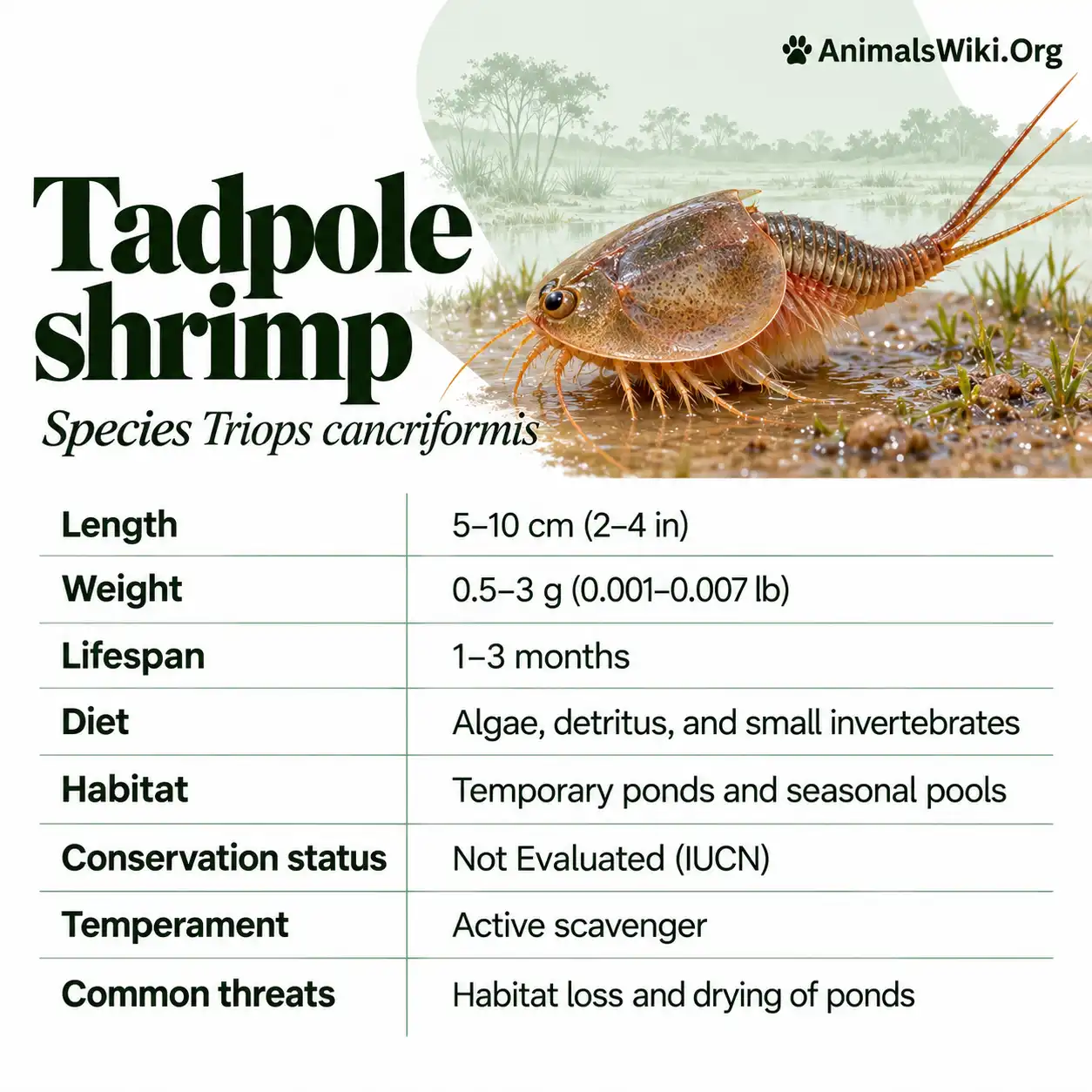
Tadpole shrimp belong to the order Notostraca, which includes the living genera Triops and Lepidurus. They are recognizable by their broad protective shield, segmented rear body, and two slender tail filaments. Despite their common name, they are not baby frogs and will never develop into amphibians.
Their most impressive adaptation is hidden in the soil. While active animals depend on water, their resting eggs can survive conditions that adults cannot. These eggs form a reserve in the sediment, allowing populations to reappear when suitable conditions return.
Tadpole shrimp also have a fascinating evolutionary history. Their body plan resembles that of ancient fossil animals, but the familiar claim that modern species have remained completely unchanged for hundreds of millions of years is misleading.
This detailed guide explains what tadpole shrimp are, where they live, what they eat, how their eggs survive dry periods, and why temporary pools deserve more attention.
Information checked: October 15, 2026.
Tadpole Shrimp Facts
| Feature | Information |
|---|---|
| Common name | Tadpole shrimp |
| Scientific order | Notostraca |
| Class | Branchiopoda |
| Family containing living species | Triopsidae |
| Living genera | Triops and Lepidurus |
| Animal group | Freshwater crustaceans |
| Typical appearance | Shield-shaped front, segmented rear body, and two tail filaments |
| Adult size | Usually measured in centimeters; varies by species and measurement method |
| Main habitats | Temporary freshwater pools, seasonal wetlands, and some flooded agricultural fields |
| Distribution | Widely distributed across several continents |
| Diet | Small animals, algae, plant material, and organic debris |
| Reproduction | Varies among species and populations |
| Early development | Includes small larval stages followed by repeated molts |
| Active lifespan | Commonly weeks to months, depending on species and conditions |
| Dry-period survival | Primarily through resistant resting eggs |
| Notable adaptation | Delayed and staggered hatching |
| Conservation status | Species-specific; some populations are highly threatened |
1. What Is a Tadpole Shrimp?
A tadpole shrimp is a small aquatic crustacean belonging to the order Notostraca. Its front body is covered by a broad, shield-like carapace, while a narrower segmented region extends behind it.
The name comes from its overall outline. Viewed from above, its wide front and trailing rear body can suggest a tadpole. However, the resemblance does not indicate a close relationship.
A frog tadpole is a vertebrate with an internal skeleton. A tadpole shrimp is an invertebrate with jointed appendages and an external skeleton. Their development, anatomy, and evolutionary histories are fundamentally different.
The word “shrimp” can also create confusion. Tadpole shrimp are crustaceans, but they do not belong to the same order as familiar aquarium shrimp or the shrimp commonly sold as food.
A useful way to understand them is as specialized freshwater branchiopods. Their biology combines rapid aquatic development with a resistant egg stage that persists between favorable periods.
That combination allows them to occupy habitats where the presence of water is temporary and future conditions are uncertain.
2. Tadpole Shrimp Classification
Scientific classification places tadpole shrimp within a larger framework of animal relationships.
| Classification level | Group |
|---|---|
| Kingdom | Animalia |
| Phylum | Arthropoda |
| Class | Branchiopoda |
| Order | Notostraca |
| Family | Triopsidae |
| Living genera | Triops and Lepidurus |
Arthropods include animals with jointed appendages and an external skeleton. Branchiopoda contains several freshwater crustacean groups, including fairy shrimp, clam shrimp, and water fleas.
The classification explains both similarities and differences. Tadpole shrimp share broader ancestry with other branchiopods, but their protective shield and bottom-associated habits distinguish them from many relatives.
The group contains multiple species, and its diversity is more complicated than older species lists suggest. Genetic studies have revealed distinct lineages that can look very similar.
Consequently, there is no permanently fixed species total suitable for every article. Counts depend on ongoing descriptions, revisions, and decisions about previously named forms.
For a general reader, recognizing the order and its two living genera is more useful than memorizing a number that may change.
3. What Does a Tadpole Shrimp Look Like?
The most conspicuous feature is the carapace, the broad shield covering the front portion of the body.
Below this shield are numerous appendages. They move actively during swimming and feeding, but many are difficult to see clearly from above.
The rear body extends beyond the carapace as a series of exposed segments. At its end are two long filaments, sometimes described informally as tails.
These filaments are not stingers. They do not form a scorpion-like weapon, and they should not be confused with the muscular tail of a crayfish.
Color varies. Tadpole shrimp may appear brown, olive, reddish, or partly translucent, depending on the species, age, lighting, and surrounding sediment.
Their appearance is especially striking in motion. An apparently simple shield glides over the bottom while a complex set of limbs works underneath it.
A still photograph can therefore hide much of the animal’s anatomy. Views from the side or below reveal a very different impression from the familiar top-down silhouette.
4. How Big Do Tadpole Shrimp Grow?
Adult tadpole shrimp are generally centimeter-scale animals, but size varies among species and individuals.
A statement about their length is incomplete unless it explains what was measured.
Researchers may record carapace length, body length, or total length including the tail filaments. These measurements can produce noticeably different numbers for the same animal.
For example, a long-tailed specimen may look much larger when its filaments are included, even though the main body remains relatively small.
Age and growing conditions also matter. Food availability, population density, water temperature, and other environmental factors can influence development.
A photograph without a scale can be misleading. Close-up images make the animals look like large prehistoric creatures, while a distant image may conceal their distinctive features.
When comparing species or reading care information, check whether the author means shield length or total length.
The most accurate general description is that tadpole shrimp are small freshwater animals whose adults are usually measured in centimeters rather than millimeters or tens of centimeters.
5. Do Tadpole Shrimp Have Three Eyes?
The name Triops is associated with the idea of “three eyes.”
These animals possess a pair of compound eyes and a median eye structure. However, the three are not identical organs functioning like three human eyes.
A compound eye contains numerous visual units called ommatidia. Together, these units receive light from different directions.
The median eye is structurally different. Its presence should not be interpreted as a third camera-like eye with the same image-forming abilities as the compound pair.
Research on tadpole shrimp eyes has examined their detailed internal organization and differences between Triops and Lepidurus.
These studies show that even a small, familiar-looking feature can contain considerable anatomical complexity.
For a reader, the practical point is simple: tadpole shrimp can detect light, but their visual system does not work like human vision.
Descriptions that call the median structure a supernatural “third eye” or claim it provides extraordinary powers replace an interesting biological feature with fiction. pubmed.ncbi.nlm.nih.gov
6. Triops and Lepidurus: What Is the Difference?
The living tadpole shrimp belong to two genera: Triops and Lepidurus.
They share the broad shield, numerous limbs, segmented rear body, and paired tail filaments that characterize the group.
One important identification feature is a plate extending behind the terminal body region in Lepidurus. This is commonly called the supra-anal plate. Triops lacks the corresponding projecting plate.
Nevertheless, identifying an animal accurately can require more than noticing one feature in a photograph. The position of the body, sediment, and image quality may obscure useful structures.
| Feature | Triops | Lepidurus |
|---|---|---|
| Broad front carapace | Present | Present |
| Paired tail filaments | Present | Present |
| Projecting supra-anal plate | Absent | Present |
| Scientific group | Notostraca | Notostraca |
| Typical ecological association | Many species use temporary waters | Includes species associated with seasonal and cooler-water habitats |
| Identification difficulty | Similar-looking lineages occur | Detailed examination may be needed |
Neither genus should be treated as a single species with one universal care requirement or life history.
7. Where Do Tadpole Shrimp Live?
Tadpole shrimp are widely distributed, with species recorded from regions across several continents.
Their habitats include temporary freshwater pools, seasonal wetlands, flood-filled depressions, and some agricultural fields.
The geographical breadth of the group does not mean every species occurs everywhere. Individual species and genetic lineages may have much narrower ranges.
A warm-season Triops population and a cool-season Lepidurus population may experience quite different environmental conditions.
Local geology and soil are important too. A shallow depression must retain water long enough for development, but it may dry before becoming a permanent pond.
The absence of adults at a site does not necessarily indicate the absence of a population. Resting eggs may remain in the sediment when no active animals are visible.
This makes distribution difficult to map through casual observation.
A pool surveyed in the wrong season may appear empty, while the same location after suitable rainfall may support a short-lived burst of aquatic activity.
8. Why Temporary Pools Suit Tadpole Shrimp
A temporary pool presents an obvious challenge: the water eventually disappears.
However, temporary water also creates opportunities. Predators and competitors that require permanent aquatic conditions may be unable to establish lasting populations.
Tadpole shrimp exploit this pattern through their life cycle. They develop during the wet phase and leave resistant eggs behind for later.
The habitat is therefore more than an inferior version of a permanent pond. Its alternating wet and dry conditions help define the community.
Making a temporary pool permanently wet can change that community. Animals adapted to the original cycle may lose their advantage, while different predators, plants, or competitors arrive.
The key environmental variable is often the hydroperiod: the length of time the habitat holds water.
A pool must remain wet long enough for successful reproduction. Yet longer water retention does not automatically improve the habitat for every temporary-water specialist.
Understanding this balance helps explain why conservation cannot simply aim to keep every seasonal wetland full of water throughout the year.
9. What Are Vernal Pools?
Vernal pools are seasonal wetlands that fill during a wet period and become dry later.
The exact timing depends on the region. The word should not be interpreted as a guarantee that every such pool fills only during the calendar spring.
Some have distinctive soils or underlying layers that limit drainage. Others occupy depressions where rainwater and runoff accumulate.
During the wet phase, the pool supports aquatic organisms. During the dry phase, many of those organisms persist through resistant eggs, seeds, or other dormant stages.
A dry vernal pool may look biologically inactive, but its sediment can contain the beginnings of future aquatic communities.
This makes the pool bed itself part of the living system.
The California vernal pool tadpole shrimp, Lepidurus packardi, is a well-known example of a species associated with these habitats.
Its conservation demonstrates why a seasonal patch of water can have substantial ecological importance even when it is small, shallow, or dry for part of the year.
10. How Do Tadpole Shrimp Swim and Dig?
Tadpole shrimp use their numerous limbs for several activities rather than assigning one simple job to each appendage.
Functional studies describe roles in swimming, standing, digging, climbing, collecting food, handling food, sensing the environment, and carrying eggs.
This versatility suits a bottom-associated animal moving through sediment and changing water conditions.
When swimming, coordinated appendage movements interact with the water beneath and around the body.
When feeding near the bottom, the same general limb system helps disturb and process material.
Digging is especially noticeable in a container or shallow pool. Sediment may rise into the water, making the animal’s activity visible even when its body is partly hidden.
However, a muddy pool should not automatically be interpreted as unhealthy simply because it is less visually clear than an aquarium.
Natural sediment disturbance is part of the behavior of many bottom-feeding animals.
The ecological effect depends on context: how much sediment moves, what is growing nearby, and how the resulting water conditions affect other organisms. CiNii Research
11. How Do Tadpole Shrimp Breathe?
Tadpole shrimp obtain oxygen from water.
Their appendages include structures involved in respiration, and limb movements help maintain water flow around the respiratory surfaces.
This illustrates why their limbs cannot be understood merely as legs. Movement, feeding, and gas exchange are linked within the same general body system.
The amount of oxygen available in a shallow pool can change over the day. Temperature, photosynthesis, decomposition, and mixing all influence dissolved oxygen.
A warmer pool may increase an animal’s metabolic demands while also altering the water’s capacity to hold oxygen.
Research on Triops longicaudatus has shown that oxygen consumption, growth, and reproductive output respond to environmental temperature and oxygen conditions.
However, tolerating variable water conditions is not the same as surviving indefinitely without oxygen.
The resistant egg stage and the active animal have different physiological abilities.
An adult swimming in water cannot be assumed to withstand the extreme conditions tolerated by a dormant egg buried in sediment. journals.uchicago.edu
12. What Do Tadpole Shrimp Eat?
Tadpole shrimp are broadly opportunistic feeders.
Depending on species, size, and available food, they may consume small aquatic animals, plant material, algae, and organic debris.
Their diet can include insect larvae and other crustaceans. They also collect or process material associated with the pool bottom.
This flexibility makes sense in a habitat where food resources change quickly.
A newly filled pool does not present the same feeding opportunities as a pool several weeks into its wet phase. Small hatchlings also cannot handle every item available to a larger animal.
Food collection involves the appendages beneath the body and the mouthparts that process material.
Calling tadpole shrimp “predators” describes only part of the picture. Calling them “cleaners” is equally incomplete.
They are active participants in a food web, capable of taking different kinds of resources.
Their effect on a pool depends on abundance, body size, prey availability, and the other organisms present.
A single label is therefore less informative than explaining how their flexible feeding behavior works.
13. Do Tadpole Shrimp Eat Each Other?
Cannibalism can occur in tadpole shrimp.
A larger individual may consume a smaller one, particularly where food is limited or animals are crowded together.
This behavior does not make the species unusually cruel. Cannibalism occurs in many aquatic and terrestrial animals and reflects feeding opportunities rather than human moral categories.
The risk can change with size differences. A newly hatched individual and a much larger juvenile do not occupy the same physical situation, even if they belong to the same species.
Observations in captivity also need context. A small container can create encounter rates very different from those in a natural pool.
At the same time, it would be inaccurate to claim that cannibalism is exclusively an aquarium problem.
The useful biological point is that a tadpole shrimp can be both predator and prey, including within its own species.
Population density, available shelter, food supply, and developmental timing can all affect those interactions.
The presence of cannibalism should therefore be understood as part of a broader feeding strategy rather than the defining feature of the animal.
14. What Eats Tadpole Shrimp?
Tadpole shrimp provide food for other animals.
Waterbirds are particularly important consumers of large branchiopods, although the importance of a particular shrimp species depends on its location and seasonal availability.
Other aquatic predators may also consume them where the relevant species occur.
Their carapace provides some protection, but it is not an impenetrable defense.
Temporary pools can reduce exposure to predators that require permanent water, yet they do not remove predation altogether.
A bird can visit a newly filled wetland even if fish cannot survive there year-round.
Seasonal timing matters as well. A burst of branchiopod growth may coincide with a period when birds are moving through a landscape and need food.
The relationship also connects wetlands across space. Birds travel among habitats, while the shrimp develop locally.
A small pool can therefore contribute to a wider food network rather than functioning as an isolated puddle with no importance beyond its edges. Springer Nature Link
15. The Tadpole Shrimp Life Cycle
The basic life cycle links an active aquatic phase with a resistant egg phase.
| Stage | What happens |
|---|---|
| Resting egg | Development is delayed while conditions remain unsuitable |
| Hatching | A small larva emerges when appropriate cues are present |
| Larval development | Successive molts change the body and add adult features |
| Juvenile growth | The animal increases in size and develops toward maturity |
| Reproductive stage | Eggs are produced and deposited |
| Loss of suitable conditions | Active animals die, while some eggs remain for future wet periods |
This sequence is a general framework, not a fixed timetable.
Species differ, and environmental conditions change the speed of development. Some populations can reach reproduction rapidly, while others require longer.
The important ecological achievement is successful egg production before the wet phase ends.
An individual does not need to live for years to contribute to population persistence.
Its descendants may survive through a combination of short active lives and much longer periods spent as resting eggs.
That distinction explains much of the group’s success.
16. How Quickly Do Tadpole Shrimp Grow?
Some tadpole shrimp develop remarkably quickly.
Research in flooded agricultural settings has documented rapid maturation and egg production within a short period after flooding.
However, “fast” is not a universal number of days.
Temperature affects developmental rate, but the relationship involves trade-offs. In one laboratory study of Triops longicaudatus, warmer conditions produced earlier reproduction while survival was shorter under the tested conditions.
That does not establish a single ideal temperature for every species. It shows that faster development and longer life are not necessarily the same outcome.
Food supply, oxygen, density, and genetic differences can also influence performance.
A growth claim should therefore identify the species and the setting in which it was measured.
Rapid development is best understood as a response to a limited opportunity: the animal must grow and reproduce while water remains available.
It is not evidence that every tadpole shrimp follows a rigid countdown from hatching to adulthood.
The pool’s timetable and the animal’s development must fit together sufficiently well for reproduction to succeed. jstage.jst.go.jp
17. Molting: How Their Bodies Expand
Tadpole shrimp grow by molting.
Their external skeleton provides structure, but it cannot simply stretch without limit as the animal’s tissues increase in size.
During a molt, the old covering is shed and replaced. Repeated molts allow development from a tiny larva toward the adult form.
This process can leave a transparent or pale cast in the water.
A shed covering may resemble a dead shrimp at first glance, especially if it retains the outline of the carapace and appendages.
The University of California’s agricultural guidance specifically notes that molt skins can be mistaken for dead animals.
Molting also makes a useful reminder about observation. Seeing one empty-looking body does not establish that an animal has died.
A careful observer looks for continued movement by the living individual and examines whether the object is an empty covering.
Development involves both increasing size and changes in structure, so early molts are not merely repetitions of an already completed adult body.
18. How Long Do Tadpole Shrimp Live?
The active lifespan of tadpole shrimp is generally short, commonly measured in weeks or months.
However, a single number would conceal meaningful differences.
Species, water temperature, food, oxygen, crowding, disease, and the duration of the wet habitat can affect survival.
Published accounts of Triops longicaudatus commonly describe lifespans of several weeks, while official information for Lepidurus packardi reports a substantially longer average under its documented conditions.
These are not contradictory if the animals and environments differ.
A laboratory experiment may also produce a different lifespan from a field account. Each result describes a particular set of conditions.
Most importantly, adult lifespan and egg longevity must remain separate.
An egg that remains viable for years does not mean the adult shrimp lives for years.
The population persists through alternating stages with very different properties.
This distinction prevents one of the most common misunderstandings about animals advertised as surviving long periods in dry soil.
19. Tadpole Shrimp Eggs: Their Most Important Adaptation
The resting egg is central to tadpole shrimp biology.
When an adult deposits eggs, some can remain in the pool bed through periods unsuitable for active life.
These resting stages are often called cysts, although descriptions may vary in their use of “egg,” “resting egg,” and “encysted embryo.”
Inside the protective covering is a developing organism whose progress can be delayed.
The covering helps separate it from external conditions, but its resistance also involves internal physiological processes.
An egg is not simply an adult shrimp folded into a tiny ball.
It represents a specific developmental stage with specialized survival abilities.
When the pool dries, the adults do not turn into eggs. The eggs were produced earlier and remain after the active animals disappear.
That sequence matters because it explains how a place can seem empty during a dry period yet support shrimp after flooding.
The next generation was already present in the sediment.
20. How Long Can Tadpole Shrimp Eggs Survive?
Resting eggs can remain viable for multiple years, and some documented accounts describe survival extending into decades.
However, there is no responsible universal answer that applies to every egg of every species.
Survival depends on the biological stage, storage or field conditions, moisture history, temperature, and damage.
An unusually long-lived batch does not prove that all eggs will remain viable for the same period.
It is also important to distinguish observation from speculation.
A claim that eggs have survived for decades is different from a claim that eggs can survive for centuries or millions of years.
The existence of an ancient lineage provides no evidence that an individual egg is equally ancient.
For most ecological explanations, the key point is that resting eggs outlast a single wet season.
That creates continuity across years when active adults may be absent.
Long-term viability is impressive enough without suggesting that eggs are immortal or immune to environmental destruction.
21. Diapause, Drying, and Extreme Conditions
Diapause is a regulated delay in development.
It should not be described simply as ordinary sleep. A dormant embryo operates differently from an active animal resting between movements.
Drying tolerance is related but not identical. An egg may undergo physiological changes that allow survival when much of its water is lost.
Research on Triops granarius has examined the effects of developmental stage, humidity, and temperature on survival.
The results showed that resistance depended on the conditions of exposure. Dry eggs and hydrated eggs did not respond identically to heat.
This is why spectacular claims about surviving extreme temperatures need context.
A brief laboratory treatment, a dry resting stage, and a natural summer in exposed soil are different situations.
The adult shrimp should never be assumed to share the egg’s resistance.
Likewise, strong drying tolerance does not mean resistance to every chemical, crushing, soil removal, or unlimited heating.
The adaptation is specialized and remarkable, but it operates within biological limits. pubmed.ncbi.nlm.nih.gov
22. What Makes Tadpole Shrimp Eggs Hatch?
Water is essential, but it is not always the only relevant signal.
Experiments have investigated light, temperature, salinity, pH, moisture history, and other conditions affecting hatching.
For Triops granarius, studies showed an important role for light in resuming development under the tested conditions.
This makes ecological sense because an egg’s position can matter. An egg buried in sediment may experience different light conditions from one exposed near the surface.
Other research has shown that water chemistry and temperature influence hatching in Triops newberryi.
Drying history can also affect later emergence.
However, these findings should not be turned into one rigid instruction claiming that every tadpole shrimp egg needs identical treatment.
A cue useful for one species or population may not describe another.
Nor is complete drying universally necessary before any egg can hatch.
The central point is that hatching reflects an interaction between the embryo’s condition and its environment. Adding water creates an opportunity; it does not always guarantee immediate emergence. jstage.jst.go.jp
23. Why Do Only Some Eggs Hatch?
A temporary pool can fill and then disappear before a young shrimp has time to reproduce.
If every viable egg hatched during that failed wet period, the local population could lose its entire reserve.
Staggered hatching can spread this risk across different flooding events.
Some eggs hatch now, while others remain available for future opportunities. This pattern is commonly discussed as bet hedging.
The term describes an evolutionary strategy, not a conscious decision by the eggs.
There is also an important diagnostic caution: an unhatched egg is not automatically dead.
It may be viable but unresponsive to the current conditions. Alternatively, it may genuinely be damaged or nonviable.
Distinguishing these possibilities can require repeated observations or specialized methods.
The visible hatchlings therefore represent only part of the potential population.
This explains why a low hatch count from one trial does not necessarily reveal the complete condition of an egg reserve.
It also explains why one brief wet season cannot always determine the long-term fate of a population.
24. What Is a Tadpole Shrimp Egg Bank?
An egg bank is the collection of resting eggs accumulated in sediment.
It is similar in principle to a soil seed bank: the visible organisms present today are supported by a less visible reserve of future individuals.
An egg bank may contain eggs produced during different breeding events. Its composition reflects both recent reproduction and survival from earlier years.
Not all eggs are necessarily viable, and not all viable eggs hatch at the same time.
For conservation, this changes the meaning of an apparently empty pool.
Removing or replacing the sediment can destroy a population even when no adults are present.
Scientists studying Triops cancriformis have compared hatching methods with molecular approaches to assess egg banks.
The work illustrates the difficulty of monitoring organisms whose active stage is brief and whose persistent stage is hidden.
A survey that looks only for swimming adults may miss a substantial part of the biological system.
The sediment is therefore habitat, reproductive storage, and historical record at the same time. PMC
25. How Do Tadpole Shrimp Reproduce?
Reproductive systems vary among tadpole shrimp species and populations.
Some populations have separate males and females. Others include self-fertilizing hermaphrodites, and some have combinations of males and hermaphrodites.
The term androdioecy describes a population containing males and hermaphrodites.
Self-fertilization and parthenogenesis should not be treated as identical. Self-fertilization involves fertilization using reproductive cells from the same individual. Parthenogenesis involves development from an unfertilized egg.
Distinguishing reproductive systems can require genetic evidence rather than simply counting animals that appear male or female.
Research on Triops newberryi, for example, used parent and offspring genetic information to investigate the contribution of self-fertilization and outcrossing.
These differences matter ecologically. The ability of an isolated individual to reproduce can affect colonization, while mating patterns influence genetic diversity.
However, no single reproductive label describes every tadpole shrimp.
A scientifically accurate article must preserve that variation rather than declaring that all individuals reproduce without partners. pubmed.ncbi.nlm.nih.gov
26. Where Are the Eggs Carried and Laid?
Egg-bearing tadpole shrimp have specialized structures associated with carrying eggs beneath the body.
In familiar Triops descriptions, paired brood pouches are associated with modified appendages.
The eggs are subsequently deposited in the habitat, where they become part of the sediment reserve.
This is not the same as prolonged care for free-swimming young.
Carrying eggs temporarily can protect or manage them before deposition, but it should not be interpreted as a mother teaching or guarding hatchlings.
The number of eggs produced varies with the species and circumstances.
Larger individuals may produce more eggs, but body size alone does not explain every difference in reproductive output.
Food, environmental conditions, and the remaining duration of suitable habitat can all matter.
An egg count reported for one species should therefore remain attached to that species.
The ecological goal is not a fixed number of offspring. It is the successful addition of viable eggs to a reserve capable of surviving future unfavorable periods.
27. Are Tadpole Shrimp Really Living Fossils?
Tadpole shrimp are frequently described as living fossils because their body plan resembles ancient fossils.
That resemblance is real and scientifically interesting. However, it does not establish that modern species have remained genetically and biologically unchanged.
Evolution includes more than obvious changes in overall shape.
Populations can diverge, reproductive systems can change, and new species can arise while a recognizable body plan persists.
Molecular studies have revealed substantial hidden diversity within tadpole shrimp and have challenged simple stories of evolutionary inactivity.
The phrase “living fossil” can therefore be useful only if its meaning is explained carefully.
It should describe morphological resemblance rather than imply that evolution stopped.
A modern Triops is a modern organism with its own evolutionary history.
It is not an individual survivor from the dinosaur era, and its eggs were not left behind by ancient reptiles.
The real story combines an enduring general body design with continuing diversification, extinction, and adaptation. PMC
28. Are Modern Triops Older Than Dinosaurs?
The ancestry of tadpole shrimp reaches far into geological history, and related fossil forms occur in ancient rocks.
However, the age of a broad lineage is different from the age of a living species.
A recent reassessment of Triassic fossils previously assigned to Triops cancriformis concluded that the material belonged to a different fossil genus and species.
That finding directly challenges the popular claim that the living species itself has persisted unchanged since those fossils formed.
This distinction is not a minor technical correction.
If a fossil belongs to a different species, it cannot establish the minimum age of the modern species simply because the two share a similar outline.
The accurate statement is that tadpole shrimp have an ancient evolutionary heritage and a conservative body plan.
Determining the age of a particular living species requires additional evidence.
Their biological significance remains substantial without awarding them an unsupported title such as “the world’s oldest unchanged animal.” Wiley Online Library
29. Tadpole Shrimp in Rice Fields
Some tadpole shrimp populations inhabit flooded rice fields.
These environments can reproduce aspects of temporary freshwater habitats: soil is flooded, aquatic organisms develop, and the field later changes condition.
In certain agricultural settings, tadpole shrimp can damage establishing rice.
Their feeding can injure young plant structures, while digging can disturb seeds or seedlings. Sediment disturbance can also reduce water clarity.
Research has examined how shrimp size and seedling stage influence damage. Young establishing plants are not equally vulnerable throughout development.
This agricultural role does not mean tadpole shrimp are harmful in every habitat.
A species may be an important native wetland organism in one setting and an agricultural concern in another.
Ecological descriptions should identify the context rather than label the animal universally good or bad.
For growers, management decisions require local agricultural guidance and accurate identification. For a general wildlife article, the important point is that tadpole shrimp interact with plants physically as well as through feeding. ipm.ucanr.edu
30. Tadpole Shrimp Conservation
The conservation status of tadpole shrimp varies.
A group can be widespread overall while particular species or populations are restricted and threatened.
Temporary wetlands face drainage, filling, land conversion, altered water movement, pollution, and changes in seasonal flooding.
These threats can affect both active animals and their resting eggs.
Preserving a pool requires more than retaining a depression in the ground. Its soil, water source, surrounding catchment, and natural timing all contribute to habitat quality.
The vernal pool tadpole shrimp, Lepidurus packardi, is listed as endangered in the United States. Official information identifies habitat loss and degradation among its major threats.
The example shows why the resilience of resting eggs should not be mistaken for invulnerability.
Eggs can survive drying yet still be destroyed when a pool bed is removed or its hydrology is permanently changed.
Biological resistance to one predictable challenge does not protect against every form of habitat destruction. U.S. Fish & Wildlife Service
A Recovery Example From Scotland
Conservation work involving Triops cancriformis in Scotland illustrates the importance of suitable habitat and careful planning.
NatureScot reported the appearance of adults at Mersehead following a coordinated reintroduction effort involving eggs and habitat preparation.
The account is valuable because it documents active conservation rather than assuming that rainfall alone can restore any lost population.
Reintroduction depends on appropriate conditions, suitable source material, and professional assessment.
Its success should not be interpreted as permission to scatter commercially obtained eggs into local ponds.
Moving animals or resting stages can mix lineages or introduce organisms outside their natural ranges.
Protecting existing populations and their habitat remains essential even when restoration is possible. presscentre.nature.scot
31. How Scientists Study Tadpole Shrimp
Tadpole shrimp research combines field observation, laboratory work, microscopy, genetics, and environmental measurement.
Each approach addresses a different question.
A field survey shows where active animals occur. A sediment sample can reveal resting stages. A hatching experiment investigates responses to controlled conditions.
Genetic analysis can distinguish lineages that look similar, while anatomical examination helps describe the structures associated with those differences.
Researchers also measure water conditions because a species name alone does not explain the environment experienced by an individual.
Temperature, oxygen, flooding duration, and population density can influence results.
Repeated visits are especially important. A single unsuccessful survey may reflect timing rather than true absence.
The same caution applies to an experiment in which no eggs hatch. The result could involve unsuitable cues, nonviable eggs, or a combination.
Good research separates these possibilities rather than assuming the simplest explanation.
This makes tadpole shrimp useful study animals for broader questions about development, dormancy, environmental uncertainty, and the persistence of populations through time.
32. Common Tadpole Shrimp Myths
| Myth | More accurate explanation |
|---|---|
| They are baby frogs. | They are crustaceans and never become frogs. |
| All tadpole shrimp are one species. | The group includes multiple species in two living genera. |
| Adults survive completely dry for years. | Long dry-period survival primarily involves resting eggs. |
| Every egg hatches when water is added. | Hatching depends on biological state and environmental cues. |
| Unhatched eggs must be dead. | Some remain viable but dormant. |
| All populations reproduce identically. | Reproductive systems vary. |
| Their lifespan is always the same. | Species and environmental conditions affect survival. |
| They have stopped evolving. | Similar body shape does not mean evolutionary inactivity. |
| A dry pool contains no living wildlife. | Resting eggs and other dormant stages may remain. |
| A temporary pool is improved by permanent flooding. | Changing its natural cycle can alter the ecological community. |
These corrections make the real animal easier to understand. Its biology is remarkable because it combines rapid growth, environmental sensitivity, and persistent resting stages—not because it ignores ordinary biological limits.
33. Frequently Asked Questions About Tadpole Shrimp
1. What is a tadpole shrimp in simple words?
A tadpole shrimp is a small freshwater crustacean with a broad shield over its front body, many limbs underneath, and two slender tail filaments. It belongs to the order Notostraca. Its name describes its general outline, not a relationship with frog tadpoles.
2. Is a tadpole shrimp the same as Triops?
Triops is one genus of tadpole shrimp. The other living genus is Lepidurus. Therefore, every Triops is a tadpole shrimp, but not every tadpole shrimp belongs to Triops. Using the broader common name is helpful when the animal has not been identified more precisely.
3. Do tadpole shrimp turn into frogs?
No. Frog tadpoles are amphibian larvae, while tadpole shrimp are crustaceans. Tadpole shrimp develop through larval and juvenile stages into adult crustaceans. Their external skeleton, appendages, and reproductive biology remain entirely different from the anatomy and development of frogs.
4. Can tadpole shrimp live in saltwater?
They are primarily freshwater animals. The fact that some resting stages may tolerate particular exposures does not mean adults are marine animals. Brine shrimp are a different group. A saltwater survival claim must identify the species, life stage, salinity, and duration involved.
5. Why do tadpole shrimp appear after rain?
Rain can refill a habitat containing resting eggs. When suitable conditions occur, some eggs hatch and the young grow. The animals have not appeared from nowhere, and rain does not create them. Their earlier life stage was already present in the sediment.
6. How long does it take their eggs to hatch?
There is no universal hatching time. Some eggs respond quickly under suitable conditions, while others remain dormant through the same flooding event. Temperature, light, water chemistry, egg history, and species identity can all matter. A short delay does not necessarily indicate failure.
7. Must their eggs dry before hatching?
Not always. Drying can influence later hatching, and many populations are adapted to alternating wet and dry periods. However, research has shown that drying requirements are not identical across all situations. It is inaccurate to claim that no tadpole shrimp egg can hatch without complete drying.
8. How many legs do tadpole shrimp have?
They possess numerous paired appendages, but a single count should not be assigned to the entire group. Species, developmental stage, and the definition of an appendage affect the answer. Many limbs are hidden beneath the shield and serve several functions beyond walking.
9. What is the third eye of Triops?
The familiar description refers to a median eye in addition to the compound eye pair. These structures are not three identical visual organs. The median eye differs anatomically from the compound eyes, and the name should not be taken to imply human-like three-eyed vision.
10. What do tadpole shrimp eat in the wild?
They use a flexible diet that can include small aquatic animals, algae, plant material, and organic debris. Available food changes as a pool develops. Their body size also affects what they can collect and process, so hatchlings and larger individuals need not consume identical items.
11. Do tadpole shrimp eat mosquito larvae?
Some Triops consume mosquito larvae, and researchers have investigated their potential as biological control organisms. However, eating larvae under particular conditions does not establish a reliable or appropriate control method everywhere. Their wider ecological effects and local suitability also matter.
12. Are tadpole shrimp cannibals?
Cannibalism can occur, particularly when differently sized animals encounter one another under crowded or food-limited conditions. It is one part of an opportunistic feeding strategy. It does not mean every individual constantly hunts its own species or that cannibalism is inevitable in every population.
13. Are tadpole shrimp dangerous to people?
They are not recognized as venomous animals or routine threats to people. Their mouthparts are adapted for feeding on small organisms and material in their habitat. Ordinary care around pond water is still sensible, but there is no need to portray them as dangerous prehistoric predators.
14. How long do adult tadpole shrimp live?
Their active lives are generally measured in weeks or months, depending on the species and environment. Published results differ because water conditions and study methods differ. A lifespan quoted for a warm-water Triops should not automatically be used for a cool-season Lepidurus.
15. Can their eggs survive for years?
Yes, resting eggs can remain viable across multiple years, and some accounts document much longer persistence. However, survival is conditional rather than guaranteed. Moisture, temperature, damage, developmental state, and species identity influence the outcome. Long-lived eggs are resistant, not indestructible.
16. Are tadpole shrimp older than dinosaurs?
Their broader evolutionary heritage is ancient, and related fossil animals occur in old geological deposits. That does not prove that a modern species has remained unchanged since before dinosaurs. The age of a lineage, the age of a fossil, and the age of a living species are different questions.
17. Why is there an empty shell in the water?
It may be a shed exoskeleton left after molting. The cast can preserve enough of the animal’s shape to resemble a dead shrimp. Look for the living individual before assuming it has died. Transparent, empty coverings are a normal consequence of arthropod growth.
18. Can one tadpole shrimp start a population?
In a population with an appropriate reproductive system, a self-fertilizing individual may produce viable eggs without a partner. However, this ability does not apply identically to every species or population. Reproductive biology must be established rather than inferred from the common name alone.
19. Are tadpole shrimp endangered?
Some species or regional populations are threatened, while others have broader distributions. The California vernal pool tadpole shrimp is a formally protected example. Conservation status must be checked for the particular species and location rather than applied uniformly to all tadpole shrimp.
20. Why are temporary pools important for wildlife?
Temporary pools support organisms adapted to a changing water supply. Their drying phase helps shape which predators, competitors, and plants can persist. A dry pool bed may retain eggs and seeds supporting future communities. Its importance continues even when no open water is visible.
21. Why should commercially obtained Triops not be released?
Commercial stock may belong to a different species or lineage from local animals. Releasing it can introduce organisms or genetic material into an existing ecosystem. Eggs are also easy to overlook in sediment and water. Keeping captive material separate from natural wetlands avoids these problems.
22. What makes tadpole shrimp scientifically interesting?
They connect several major biological questions: rapid development, dormancy, environmental sensing, reproductive variation, and evolution beneath a conservative body shape. Their egg banks also demonstrate how populations persist through unfavorable periods. Studying them reveals how a short-lived animal can maintain a lasting presence in an unpredictable habitat.