Copepod, The Tiny Crustaceans Connecting Microscopic Life With Ocean Giants
A copepod may be smaller than a grain of rice, yet its place in the aquatic world is enormous. These small crustaceans live in oceans, lakes, rivers, groundwater, sediments, and countless other wet habitats. Some graze microscopic organisms, others capture animal prey, and many live in close association with larger hosts.
Their importance becomes clear when we follow the food. A microscopic alga captures energy from sunlight. A copepod consumes that alga. A young fish eats the copepod, and a larger predator eventually eats the fish. In other cases, the connection is more direct: a whale filters dense concentrations of copepods from seawater.
However, copepods are much more than passive packages of food. They detect tiny disturbances in water, perform rapid escape jumps, find mates through specialized sensory behavior, and pass through a sequence of distinct developmental stages.
Some accumulate large lipid reserves and descend into deep water for a seasonal resting period. Others produce eggs that remain in sediment until conditions improve. Certain species even release blue bioluminescent secretions.
Understanding copepods means looking beyond a single microscope photograph. They represent a diverse group of animals with different body forms, diets, life histories, and ecological relationships.
This guide explains what copepods are, how they live, and why these easily overlooked crustaceans matter to freshwater ecosystems, fisheries, whales, and the ocean carbon cycle.
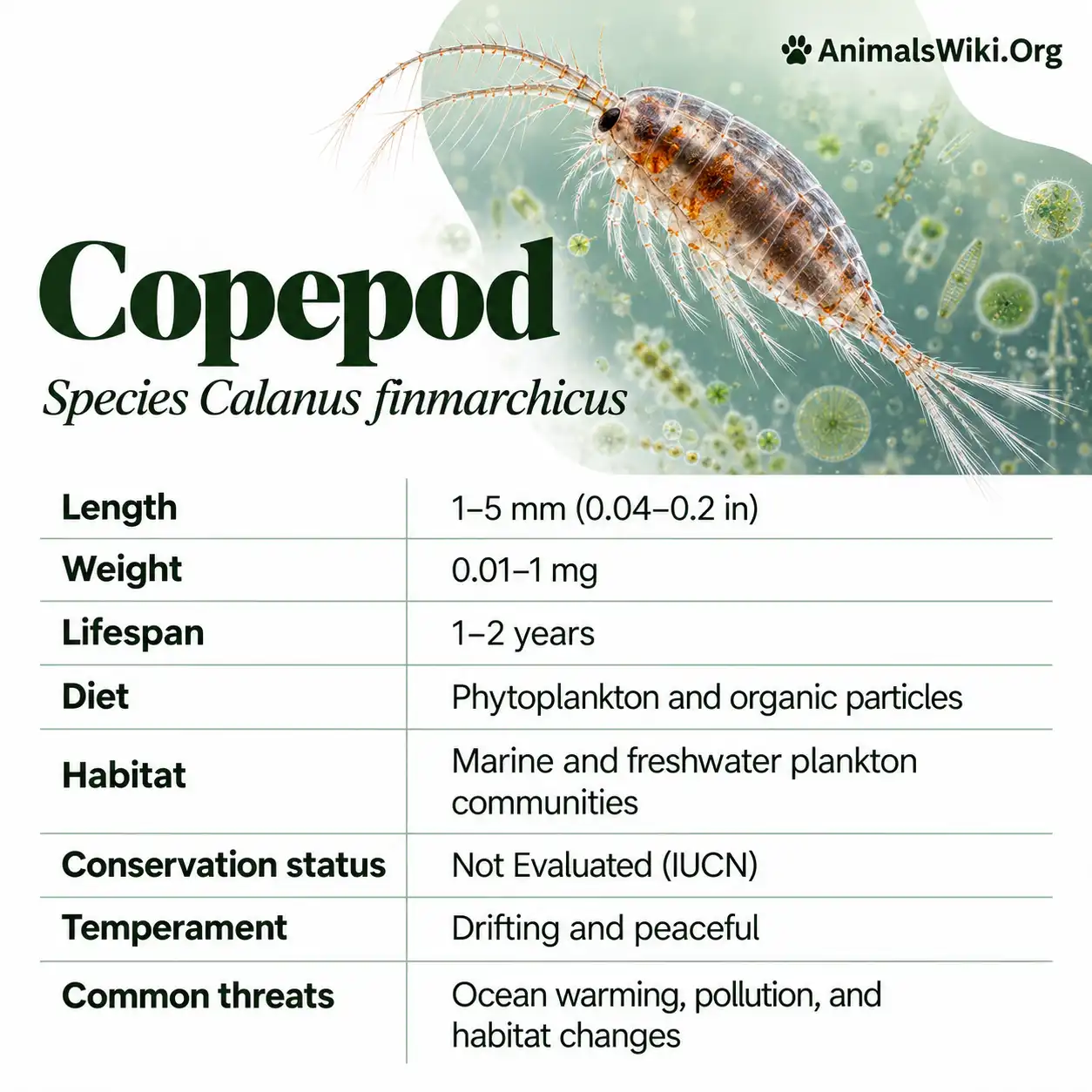
Copepod Facts
| Feature | Information |
|---|---|
| Common name | Copepod |
| Scientific group | Copepoda |
| Animal type | Aquatic crustacean |
| Phylum | Arthropoda |
| Typical size | Many familiar adults are approximately 1–2 millimeters long |
| Size exceptions | Smaller species, larger free-living forms, and greatly enlarged parasites occur |
| Distribution | Aquatic habitats worldwide |
| Habitats | Oceans, fresh water, groundwater, sediments, vegetation, and animal hosts |
| Diet | Algae, protists, small animals, organic particles, or host-derived food |
| Movement | Swimming, hopping, crawling, or host-associated attachment |
| Reproduction | Usually sexual |
| Early development | Commonly includes naupliar and copepodid stages |
| Egg strategy | Eggs may be released freely or carried in attached sacs |
| Resting strategies | Dormant eggs or later developmental diapause in some species |
| Predators | Fish, larger zooplankton, and other aquatic animals |
| Notable abilities | Sensitive water-motion detection and rapid escape responses |
| Ecological importance | Food-web transfer, nutrient recycling, and carbon transport |
1. What Is a Copepod?
A copepod is a small aquatic crustacean belonging to Copepoda. The word describes a large scientific group containing thousands of species, not one particular animal.
Many copepods are free-living. They feed, grow, reproduce, and move through their surroundings without being attached to a host. Others live as parasites or in different kinds of association with aquatic animals.
The familiar free-swimming form has a segmented body, prominent antennae, several pairs of appendages, and a narrower rear region. However, specialized parasites can look dramatically different from that textbook outline.
Copepods are animals with differentiated tissues and organs. They are not bacteria, algae, or immature insects.
Many belong to the zooplankton, but others live mainly on surfaces or within sediments.
Their diversity makes them difficult to summarize with a single lifestyle. The most useful starting point is to recognize them as crustaceans whose small bodies occupy an exceptionally wide range of aquatic roles.
That variety is part of their ecological success.
2. Copepod Classification and Scientific Names
Copepods belong to Arthropoda, the broad animal group characterized by jointed appendages and an external skeleton.
They are crustaceans, sharing broad ancestry with animals such as shrimp, crabs, krill, and water fleas.
The ranks used above and around Copepoda differ among classification systems, so a simplified outline is often clearer than presenting one arrangement as universally fixed.
| Classification level | Group |
|---|---|
| Kingdom | Animalia |
| Phylum | Arthropoda |
| Broad animal grouping | Crustaceans |
| Scientific group | Copepoda |
| Example order | Calanoida |
| Example genus | Calanus |
| Example species | Calanus finmarchicus |
Scientific names become especially useful when discussing feeding, development, or habitat. Two animals called copepods may have very different biological requirements.
The name of a genus is capitalized, while the species name is lowercase. Both are conventionally italicized.
For example, Calanus finmarchicus identifies a particular species, whereas Calanus alone refers to the genus.
Correct naming allows observations from different studies to be compared without confusing unlike animals.
3. Main Copepod Groups
Several groups are especially useful for understanding copepod diversity.
| Group | General characteristics |
|---|---|
| Calanoid copepods | Often prominent in open-water plankton, commonly with long first antennae |
| Cyclopoid copepods | Include freshwater and marine forms with varied feeding habits |
| Harpacticoid copepods | Many live on or among surfaces, vegetation, and sediment |
| Siphonostomatoid copepods | Include many specialized parasites |
| Other copepod lineages | Add further variation in habitat, development, and host association |
These are general patterns rather than absolute rules.
Some harpacticoids occur in the plankton, and a group containing parasites should not be understood solely through one familiar fish parasite.
Examples help make the diversity concrete. Calanus is important in many marine plankton communities. Cyclops is familiar from freshwater samples. Tigriopus includes species living in coastal rock pools.
A generic care guide, feeding description, or photograph cannot represent all of them accurately.
Identifying the major group is therefore an important step before making detailed claims about an individual specimen.
4. How Big Are Copepods?
Many familiar adult copepods are approximately one or two millimeters long.
At that scale, they may appear as tiny moving specks to the unaided eye. Magnification reveals the body segments and appendages that distinguish them from other organisms.
However, their size range is much broader than the familiar planktonic example suggests.
Some species are smaller, while others reach several millimeters or more. Highly modified parasitic forms can become far larger than typical free-living copepods.
The measurement method also matters. Researchers distinguish body length from measurements that include appendages or specialized extensions.
Age, sex, reproductive condition, and environmental history can influence size within a species.
A female carrying eggs may look much bulkier without having a proportionally longer body.
For this reason, “microscopic crustacean” is a convenient introduction but not a precise description of every copepod.
Educational images should include a scale whenever possible. A full-screen photograph otherwise makes a one-millimeter animal look deceptively large.
5. What Does a Copepod Look Like?
A typical free-living copepod has a broader front body and a narrower rear region.
The front region contains the head and appendage-bearing segments. The posterior portion usually carries fewer obvious locomotory structures and ends in paired tail-like structures bearing setae.
Setae are fine projections that can serve sensory or mechanical roles. They are not simply miniature versions of mammalian hair.
The first antennae, called antennules, are often conspicuous. In many calanoids they extend widely from the body.
A second pair of antennae and additional mouth-related appendages contribute to feeding and movement.
Unlike Daphnia, a familiar copepod does not have the same enclosing, rounded carapace around most of its body.
Many appear transparent, although pigmentation, gut contents, reproductive tissues, and lipid stores can change their appearance.
Species identification may depend on tiny details of appendages and body proportions.
A photograph showing only a general outline can establish that an animal resembles a copepod without proving its exact species.
6. Do Copepods Have Eyes, Gills, and a Heart?
Many free-living copepods have a median eye often called a naupliar eye.
It may appear as a small colored spot, but its visibility and structure vary. The familiar “one-eyed” description should not be treated as a complete account of every copepod’s sensory biology.
They also detect their environment through structures that do not depend on vision.
Typical small free-living copepods lack the conspicuous specialized gills seen in larger crustaceans. Oxygen exchange occurs across body surfaces.
Their circulatory arrangements are also comparatively simple, with differences among groups. It would be inaccurate to give every copepod the same internal anatomy.
Small size helps make direct exchange across tissues practical because distances inside the body are short.
Nevertheless, a small body does not mean an animal has no physiological limits.
Temperature, oxygen availability, and activity affect its energy requirements.
The most informative question is therefore not whether a copepod resembles a miniature shrimp internally, but how its particular body organization supports life at its size.
7. Where Do Copepods Live?
Copepods occur in an extraordinary range of wet environments.
They inhabit open oceans, coastal waters, estuaries, lakes, rivers, groundwater, and sediments. Some occupy water held among plants or in small natural containers.
Others live in association with hosts.
This diversity extends vertically as well as geographically. Marine copepods occur near the surface and in deep water, while other species occupy habitats inaccessible to ordinary plankton nets.
Their broad distribution does not mean that every species tolerates every environment.
A freshwater copepod cannot automatically be transferred into seawater, and a polar planktonic species does not share the requirements of a tropical parasite.
Habitat descriptions must therefore connect a species with measurable conditions such as salinity, temperature, oxygen, food, and available surfaces.
For researchers, this variety presents a sampling challenge.
A water-column survey can miss sediment dwellers, while a sediment sample may reveal little about open-water communities.
Different lifestyles require different methods of observation.
8. Freshwater and Marine Copepods
Freshwater and marine copepods share broad anatomical and developmental features, but they occupy different chemical environments.
Salinity affects water balance and ion regulation. Species differ in their ability to cope with those demands.
Some live within relatively stable salinity ranges. Others tolerate fluctuations in estuaries or coastal pools.
Tigriopus californicus, for example, inhabits high-shore rock pools where conditions can change sharply through evaporation, rain, sunlight, and nighttime respiration.
Research on these populations has examined variation in temperature and salinity tolerance.
This makes them valuable for studying local adaptation. Populations separated by comparatively short distances can experience different environments and evolve different responses.
However, the tolerance of a tide-pool specialist is not evidence that every copepod is equally hardy.
A species adapted to stable ocean conditions may respond poorly to the same fluctuation.
“Copepod” is therefore a biological identity, not a guarantee of tolerance to any water someone happens to provide.
9. Bottom-Dwelling Copepods
Many copepods live on or within the bottom environment rather than continuously swimming in open water.
These animals are described as benthic. Those living among sediment particles form part of the small-bodied community often called meiofauna.
Harpacticoid copepods are especially prominent in discussions of these habitats.
They may move among sand grains, across vegetation, or over other submerged surfaces.
Their body shape and behavior often suit these environments better than the long-antennule silhouette associated with open-water calanoids.
The distinction changes their ecological role. A bottom-associated copepod encounters different food, predators, and physical disturbances from one living in a surface-water patch.
It also changes how people detect them.
A sample taken from the middle of a pond can miss animals concentrated on plant surfaces or in sediment.
This is one reason an apparently low copepod count does not necessarily describe the whole habitat.
The surrounding surfaces may contain a community that the sampling method never reached.
10. How Do Copepods Swim?
Copepods use several movement patterns rather than one universal swimming stroke.
During ordinary activity, appendage movements can produce feeding currents and slower movement. Escape swimming relies on rapid strokes of the swimming legs.
Experiments with Temora longicornis demonstrated a major difference between routine foraging and escape motion.
At the small scale of a copepod, viscosity strongly affects movement. Water does not behave like an empty space through which the animal can simply coast indefinitely.
An appendage stroke changes both the animal’s position and the surrounding flow.
That flow matters because predators and prey can detect mechanical signals.
Movement is therefore not only a way to travel. It also creates information.
A feeding copepod may reveal its position through the disturbance it generates, while a predator’s approach can provide the signal that triggers escape.
Understanding swimming requires considering both propulsion and the sensory consequences of moving through water.
11. How Fast Can a Copepod Escape?
Copepods can perform rapid escape jumps relative to their small body size.
Their success depends on more than maximum speed.
Sensitive mechanoreceptors can detect the flow created by an approaching threat, allowing a response before the animal reaches the predator’s immediate capture zone.
Research using flow that mimicked suction feeding showed how copepods respond to these signals.
Acceleration and timing were crucial. A tiny animal does not need to outrun a fish over a long distance if it can react early enough to move away from the most dangerous position.
However, escape is not guaranteed. Responses vary among species and depend on the geometry and speed of the encounter.
Claims such as “the fastest animal in the world” can be misleading unless the comparison specifies absolute speed, body lengths per second, acceleration, or reaction time.
The scientifically interesting achievement is the combination of early detection and rapid movement.
That combination helps explain how small, heavily consumed animals can remain successful in predator-rich environments.
12. How Copepods Sense Their Surroundings
A copepod inhabits a world rich in information that humans cannot see directly.
Water movement, dissolved chemicals, contact with particles, and light can all provide useful signals.
Sensory setae on the antennules are especially important in many free-living species. They can help detect disturbances associated with prey, predators, or other animals.
Different tasks involve different signals.
Detecting a moving prey item is not necessarily the same process as locating a mate. Likewise, information useful at close range may not provide reliable guidance across a larger distance.
Research has challenged overly simple accounts in which copepods supposedly smell every algal cell from far away.
For some feeding interactions, near-field mechanical detection provides a better explanation.
This distinction matters because it connects biological behavior with fluid physics.
The animal’s sensory world is shaped by how signals spread and weaken in water.
A copepod is not merely drifting until food collides with its mouth. It interacts with information generated by its own movements and those of surrounding organisms.
13. What Do Copepods Eat?
Copepod diets are extremely varied.
Depending on the species, food can include phytoplankton, ciliates, other protists, small animals, organic particles, and resources obtained from a host.
Some are mainly grazers. Others are omnivores or predators.
A copepod that consumes animal prey may capture other zooplankton, including smaller copepods.
This diversity makes the description “cows of the sea” useful only as an introduction to grazing forms. It does not describe every member of the group.
Food choice also changes with developmental stage.
A nauplius may be unable to collect or process the same items as an adult.
The resources present in a habitat also shift through seasons and depth.
A flexible diet can provide opportunities, but flexibility is not unlimited. Particle size, mobility, nutritional quality, and capture mechanics restrict what an animal can use.
Understanding diet therefore involves both what enters the digestive tract and how that material supports growth, survival, and reproduction.
14. Feeding Currents, Ambushes, and Marine Snow
Copepods use several solutions to the challenge of obtaining food from dilute water.
Feeding-current feeders move appendages to bring water and potential food within reach.
Ambush feeders remain relatively quiet and respond when suitable prey approaches.
Other copepods cruise through the water or exploit particles and aggregates.
Aggregated organic material, commonly called marine snow, can provide concentrated feeding opportunities.
These strategies involve different costs.
Actively generating a current can increase encounters with food but also creates a mechanical signal. Remaining quiet can reduce that signal but may limit encounters.
Laboratory flow measurements around Temora longicornis have shown how a copepod’s feeding appendages shape the surrounding water.
Broader research compares these strategies as trade-offs involving food acquisition, energy use, predation risk, and mate encounters.
There is therefore no single best feeding mode for every environment.
The success of a strategy depends on what food is available, how it moves, and which dangers accompany the search.
15. Why Food Quality Matters
A high concentration of particles does not automatically provide a high-quality diet.
Copepods require resources for maintenance, growth, energy storage, and reproduction.
Different prey supply different combinations of nutrients and biochemical compounds.
A diet that allows survival may not support the same egg production or lipid accumulation as another diet.
This matters beyond the copepod itself. A fish consuming lipid-rich prey obtains a different resource from a fish consuming the same number of less energy-rich animals.
Community composition therefore matters alongside total abundance.
NOAA monitoring in the California Current uses changes in copepod communities as part of understanding conditions relevant to marine food webs.
The distinction prevents a misleading interpretation of “more plankton.”
A sample can contain many small organisms while providing a different energy pathway from one dominated by larger, lipid-rich copepods.
Counting individuals is useful, but body size, species identity, and nutritional condition help explain what those counts mean ecologically.
16. Copepods in Aquatic Food Webs
Copepods help transfer resources from microscopic organisms to larger consumers.
In a simplified pathway, phytoplankton capture energy, copepods consume them, and fish eat the copepods.
Real food webs contain additional steps. Copepods may consume protists that have already grazed smaller organisms, or predators may consume copepods indirectly through fish.
They also release waste and regenerate nutrients, helping support further biological production.
Their ecological role is therefore broader than being a container of calories.
Changes in copepod abundance or composition can influence several parts of the community at once.
A fish larva needs prey that is available at the right place, depth, time, and size. A large regional count does not guarantee suitable feeding conditions for every larva.
That spatial and developmental match helps explain why plankton research contributes to fisheries science.
Studying copepods is one way to investigate how conditions near the base of a food web affect animals people notice more readily.
17. How Can Whales Feed on Copepods?
Some baleen whales exploit dense concentrations of copepods.
North Atlantic right whales are a particularly important example. Their feeding is associated with aggregations of suitable prey, including Calanus finmarchicus.
An individual copepod is small, but concentrated prey can make bulk feeding energetically worthwhile.
This is why distribution matters alongside total abundance.
A whale cannot use every copepod spread across an ocean equally efficiently. It needs prey concentrated sufficiently for its feeding method.
Recent NOAA-associated research found that incorporating copepod aggregation information improved models of right whale distribution.
This connects the ecology of tiny crustaceans with management of large endangered animals.
If changing ocean conditions move important prey, whales may change where they feed. Those movements can alter their overlap with ships, fishing activity, and other human uses of the ocean.
Copepod monitoring can therefore support conservation decisions far beyond the plankton community itself.
18. The Copepod Life Cycle
A common free-living copepod developmental sequence includes eggs, nauplii, copepodids, and adults.
| Stage | Main characteristics |
|---|---|
| Egg | Embryonic development occurs inside the egg |
| Nauplius | Early larva with a body organization different from the adult |
| Later naupliar stages | Growth and developmental changes continue through molts |
| Copepodid | Juvenile increasingly resembles the adult |
| Adult | Reproductive maturity is reached |
Many familiar species have six naupliar stages followed by five juvenile copepodid stages and the adult stage.
The adult is sometimes labeled the sixth copepodid stage, or C6. This explains why two descriptions may sound different while referring to the same sequence.
However, highly specialized copepods can have modified development.
A general life-cycle diagram should therefore be presented as a common pattern rather than a rule without exceptions.
Development also depends on conditions. Temperature and food influence timing, while diapause can interrupt the progression.
A stage label identifies development, not a universally fixed age in days.
19. What Is a Copepod Nauplius?
A nauplius is an early crustacean larval form.
In copepods, it looks different from the familiar segmented adult. Its appendages and body organization reflect the tasks and constraints of early development.
Successive molts add or reorganize structures as development proceeds.
The transition to the copepodid phase produces a juvenile with a more recognizable adult-like body.
This does not mean the early larva is poorly designed. It is a functioning stage with requirements appropriate to its size and developmental condition.
Some early stages rely initially on stored resources, while feeding abilities vary through development and among species.
Nauplii are also important prey for other organisms.
Their small size can make them available to fish larvae that cannot yet handle larger zooplankton.
Consequently, changes in early copepod survival can affect both future adult populations and current food availability.
Understanding recruitment requires studying these small stages rather than counting adults alone.
20. How Do Copepods Find Mates?
Many copepods reproduce sexually, creating the challenge of locating a partner in a three-dimensional environment.
Research on Temora longicornis has revealed males tracking trails associated with swimming females.
The observed paths included pursuit, turns, and corrections rather than simple movement toward a visible target.
Chemical information played an important role, while physical signals contributed to close-range interactions.
These studies demonstrate how fluid conditions influence behavior.
A signal is useful only if it persists long enough and has a structure the receiver can interpret.
Movement by the female changes the trail, and the searching male must respond within that changing field.
However, one species’ behavior should not be treated as a universal mating script.
Copepods differ in swimming, habitat, density, and sensory organization.
The broader lesson is that reproduction involves specialized behavior, not merely random collisions.
For a small aquatic animal, finding a mate can depend on information distributed through the water rather than visual pursuit alone.
21. Copepod Eggs and Egg Sacs
Copepod reproductive strategies include releasing eggs into the water and carrying eggs in attached sacs.
The number and arrangement of sacs vary among groups.
An egg-bearing female may therefore look very different from a nonreproductive individual of the same species.
Carrying eggs provides a different set of benefits and costs from releasing them freely.
Attached eggs remain associated with the mother’s movements and risks. Freely released eggs enter an environment where sinking, transport, and predation influence survival.
Neither method is universally superior.
The outcome depends on habitat and life history.
A photograph of paired egg sacs is useful for recognizing some copepods, but the absence of visible sacs does not rule out copepod identity.
Likewise, sacs are not part of the permanent adult body.
They represent reproductive condition at the time of observation.
Descriptions of egg number should remain species-specific because body size, food, temperature, and reproductive history can influence output.
22. Resting Eggs and Sediment Egg Banks
Some copepods produce eggs capable of delaying development through unfavorable conditions.
Accumulated resting eggs can form an egg bank in sediment.
The idea resembles a soil seed bank: a visible population is supported by a hidden reserve of future individuals.
Research on Acartia pacifica documented viable eggs in sediment layers representing multiple years.
Work on Acartia tonsa has also shown that environmental conditions such as oxygen availability affect embryonic arrest and survival.
Dormancy is therefore not simply an egg waiting passively for any contact with water.
Its condition and surroundings influence whether development stops, remains delayed, or resumes.
An unhatched egg may be viable but dormant, or it may be damaged or dead.
Distinguishing those possibilities is essential when assessing an egg bank.
These strategies also explain why a population can reappear after the active water-column stage has become scarce.
The sediment may preserve part of the population through a period when swimming adults are absent.
23. Diapause and Lipid Storage
Some marine copepods survive unfavorable seasons through diapause, a regulated period involving arrested development and reduced activity.
In certain Calanus species, late copepodids accumulate substantial lipid reserves before descending into deeper water.
Those reserves support maintenance during a period with little or no feeding.
The animal must balance how much energy it stores against how much it will use before conditions improve.
Temperature affects that budget because it influences metabolic demand.
The strategy also links present feeding with future reproduction. Resources collected during a productive period can support survival and later maturation.
Diapause is not identical to an ordinary brief rest.
It involves coordinated changes in development, physiology, and behavior.
Nor do all copepods use the same stage or depth.
The common image of every copepod descending into deep water for winter would exclude many freshwater, benthic, tropical, and parasitic forms.
The correct explanation connects dormancy to particular species and environmental cycles.
24. How Long Do Copepods Live?
Copepod lifespan varies greatly.
Small, rapidly developing species may complete generations relatively quickly under favorable conditions. Other species have much longer seasonal cycles, especially when diapause interrupts development.
Temperature, food quality, predation, parasites, and developmental strategy all affect survival.
The time from egg to adult is also different from total lifespan.
A copepod may spend a prolonged period in a resting stage before it becomes reproductive.
Researchers must therefore specify what they measured: development time, adult survival, generation length, or the persistence of dormant eggs.
These are related but distinct quantities.
Molting helps mark developmental progress. In the familiar free-living pattern, the terminal molt produces the adult, which does not continue through an unlimited sequence of larger adult stages.
That differs from crustaceans whose adults continue molting.
A single lifespan number for all copepods would conceal the diversity that makes the group successful across so many habitats.
Species identity and environmental context provide a more meaningful answer.
25. Daily and Seasonal Migration
Many planktonic copepods change their depth over time.
Diel vertical migration describes movement associated with the daily cycle. A familiar pattern involves occupying deeper water during daylight and moving upward at night.
This can reduce exposure to visual predators while preserving access to food.
However, oxygen, temperature, food distribution, and predator behavior affect the pattern.
Seasonal movement is different.
A copepod descending for diapause may remain at depth for an extended period rather than returning to the surface every night.
These movements connect habitats with different biological and chemical conditions.
They also affect sampling. A net deployed at one depth or time may encounter a very different community from another deployed nearby later.
A low surface count can therefore reflect vertical redistribution rather than the disappearance of the population.
Understanding movement is essential for estimating abundance and explaining how predators encounter their prey.
The water column is a changing habitat, not one uniform container.
26. Copepods and the Ocean Carbon Cycle
Copepods influence carbon movement through feeding, respiration, waste production, mortality, and migration.
Carbon captured by phytoplankton enters copepods when they feed.
Some remains in tissues, some is released, and some enters fecal pellets or other particles that may sink.
Daily migration can actively transport material below the surface.
Seasonal descent adds another pathway. Lipid-rich copepods carry stored carbon into deep water and use some of it there during diapause.
This process is often described as a lipid pump.
Research on Calanus finmarchicus has estimated contributions from deep respiration and mortality during overwintering.
However, transporting carbon below the surface does not mean every unit remains isolated from the atmosphere permanently.
Storage depends on depth, circulation, and biological processing.
The important point is that copepods affect more than who eats whom.
Their life histories contribute to the movement and transformation of material across an ocean system involved in regulating Earth’s climate.
27. Can Copepods Produce Light?
Some copepods are bioluminescent.
Species including Gaussia princeps and members of Metridia can produce blue light.
In some, light originates from secretions released from glands rather than from an evenly glowing body.
The underlying chemistry involves a light-producing reaction using a luciferase enzyme and an appropriate substrate.
Researchers have investigated these molecules both to understand the animals and to develop laboratory tools.
Copepod luciferases can act as reporters, allowing scientists to track processes in experimental systems.
This illustrates an unexpected connection between marine biodiversity and biotechnology.
However, bioluminescence is not a universal copepod feature.
A statement that all copepods glow is incorrect, just as a statement that none do would overlook well-documented examples.
It is also important to distinguish light produced biologically from reflected microscope illumination.
The appearance of bright spots in an image alone does not demonstrate active light emission.
28. Parasitic Copepods
Many copepods live in association with hosts, and parasitic forms represent a substantial part of their diversity.
Hosts include fish and other aquatic animals.
Parasitic adults may be highly modified, making them difficult to recognize as relatives of familiar free-swimming copepods.
Body regions can change as the animal becomes specialized for attachment, feeding, and reproduction.
The salmon louse, Lepeophtheirus salmonis, provides a well-studied example.
Its life cycle includes free-swimming early stages followed by stages associated with a fish host. Females produce conspicuous egg strings.
This example also shows why a general developmental diagram needs exceptions. The stage pattern of a specialized parasite does not match every feature of a typical free-living calanoid.
The word “parasite” describes a biological relationship, not a complete taxonomic identity.
It would be equally wrong to assume every copepod is parasitic or to treat all parasites as one identical kind of fish louse.
Identifying the species and host is essential.
29. Copepods Versus Water Fleas, Amphipods, and Krill
Small aquatic crustaceans are often confused because all can appear as moving specks in a sample.
| Group | Useful general distinction |
|---|---|
| Copepods | Commonly have a segmented body, prominent antennules, and naupliar development |
| Daphnia water fleas | Much of the body is enclosed in a rounded carapace |
| Amphipods | Usually laterally compressed, often with a curved shrimp-like outline |
| Krill | Marine euphausiids with shrimp-like bodies and externally visible gills |
| Ostracods | Body enclosed within a shell-like pair of valves |
These are introductory distinctions, not substitutes for a detailed identification key.
Size alone is unreliable. A juvenile of a larger crustacean can overlap with an adult copepod.
Movement is also only a clue because several unrelated animals hop or swim jerkily.
A proper identification uses body organization, appendages, and developmental features.
The comparison matters ecologically as well. These groups do not necessarily eat the same food or occupy the same habitat.
Knowing which animal is present improves every later explanation about its behavior and role.
30. Copepods in Aquaculture and Research
Copepods are important in the study and production of live feeds for aquatic animals.
Their small early stages can provide prey suited to particular fish larvae, while their nutritional composition makes some species valuable in culture systems.
However, no copepod is automatically suitable for every animal being reared.
Prey size, behavior, nutritional condition, production reliability, and water requirements all matter.
Research also uses copepods to investigate development, sensory biology, swimming mechanics, environmental tolerance, and genetics.
Tigriopus californicus is especially useful for studying population differences and responses to variable conditions.
Studies have shown that stressful salinity can alter reproductive performance and affect age groups differently.
These results connect laboratory measurements with the challenges of natural habitats.
For researchers, the value of a model organism comes from asking well-defined questions under controlled conditions.
A copepod’s small size and manageable culture do not make every experiment simple; they make particular biological processes accessible to careful measurement.
31. Environmental Change and Conservation
Copepods respond to changes in temperature, salinity, food, oxygen, and habitat structure.
A response can involve altered development, reproduction, distribution, or community composition.
It does not always appear as an immediate mass mortality.
A cold-water species may decline locally while another species becomes more common. The total number of copepods can therefore hide an important change in food-web quality.
Climate projections for Calanus finmarchicus have examined how warming could affect its distribution and density in parts of the northwest Atlantic.
Such projections depend on the scenario and model and should not be presented as a guaranteed outcome everywhere.
Monitoring remains essential.
NOAA programs combine plankton observations with longer-term ecosystem information to help interpret changing marine conditions.
Protecting copepod communities also requires protecting the habitats and water processes supporting them.
Their abundance should not be mistaken for ecological invulnerability.
A common group can remain important even when individual species are rarely the focus of public attention.
32. Common Copepod Myths
| Myth | More accurate explanation |
|---|---|
| Copepod is the name of one species. | Copepoda contains thousands of species. |
| Every copepod lives in the ocean. | Freshwater and other nonmarine habitats also contain copepods. |
| All copepods are parasites. | Many are free-living. |
| All copepods eat algae. | Diets include animal prey, organic particles, and host-derived resources. |
| Plankton cannot swim. | Copepods swim actively while remaining influenced by water movement. |
| Every copepod has the same life cycle. | A common pattern exists, but specialized groups have modifications. |
| Egg sacs are permanent body parts. | They reflect reproductive condition. |
| All copepods survive through dormant eggs. | Some use other strategies, including later-stage diapause. |
| None can produce light. | Bioluminescence occurs in particular species. |
| Their importance comes only from being fish food. | They also influence nutrient cycling, carbon transport, and other ecological processes. |
Their actual biology is more interesting than these shortcuts. Diversity is the central feature of the group, not an exception that can be ignored.
33. Frequently Asked Questions About Copepods
1. What is a copepod in simple words?
A copepod is a small aquatic crustacean. Many live freely in water or on submerged surfaces, while others are associated with hosts. They have specialized appendages, pass through developmental stages, and occupy many feeding roles. The name describes a large group rather than one species.
2. Is a copepod an insect?
No. Copepods are crustaceans, although insects and crustaceans share broader arthropod ancestry. Their anatomy and development differ from an insect’s familiar life cycle. They do not become winged adults, and a tiny organism in pond water should not automatically be identified as an insect larva.
3. Can you see copepods without a microscope?
Many can be seen as small moving specks, especially against a contrasting background. Magnification is needed to examine their anatomy clearly and often to identify them reliably. Visibility depends on body size, transparency, lighting, and the developmental stage being observed.
4. Where are copepods found?
They occur in oceans, fresh water, estuaries, groundwater, sediments, vegetation, and animal hosts. Their habitats range widely in depth and chemistry. This does not mean one species can occupy all of them; individual species have particular environmental requirements.
5. What do copepods eat?
Their diets include algae, protists, small animals, organic particles, and host-derived material. Feeding strategy varies among species and life stages. Describing them all as algae-eating filter feeders overlooks predators, ambush feeders, particle-associated forms, and specialized parasites.
6. Do copepods eat other copepods?
Some do. Predatory or omnivorous copepods can capture smaller copepods, including young stages. This is part of their varied feeding ecology. It does not mean every species routinely consumes its relatives or that all copepods have the same hunting ability.
7. Why do copepods jump?
Rapid jumps can help them escape threats or reposition themselves. Their sensory systems detect water disturbances, and fast leg strokes produce movement. A jump is not necessarily random agitation. It can be a coordinated response to information about the surrounding environment.
8. Are copepods faster than fish?
Not in a simple absolute-speed comparison. Their advantage can come from early detection, rapid acceleration, and moving out of a capture zone. Claims about speed must specify the measure. Body lengths per second, acceleration, and maximum travel speed answer different questions.
9. Do copepods have one eye?
Many familiar free-living copepods have a median naupliar eye. However, eye structure and visibility vary, and sensory abilities extend far beyond vision. Their antennules and other structures detect mechanical or chemical information that can be crucial for feeding and survival.
10. How do copepods reproduce?
Most reproduce sexually. Depending on the group, females release eggs into the water or carry them in attached sacs. Mating behavior, egg production, and development vary. The reproductive biology of a calanoid should not automatically be applied to every parasite or sediment-dwelling species.
11. Why do some copepods carry two sacs?
Those structures can be egg sacs attached to a reproductive female. Their number and arrangement depend on the species. They are not universal copepod features, and an individual without visible sacs may be male, immature, or simply not carrying eggs at that moment.
12. What is a copepod nauplius?
It is an early larval stage with a body organization different from the adult. Successive molts lead through further development. Nauplii are important both as future adults and as prey for other organisms, including fish larvae that require very small food items.
13. How many stages are in the copepod life cycle?
A familiar pattern includes six naupliar stages, five juvenile copepodid stages, and an adult stage. The adult may be called copepodid stage six. Specialized groups can differ, so this sequence is a useful model rather than an exception-free rule for all Copepoda.
14. Can copepod eggs remain dormant?
Some can. Resting eggs may persist in sediment and resume development under suitable conditions. Other copepods use different survival strategies, including diapause as later juveniles. Dormant eggs and overwintering copepodids are distinct stages and should not be confused.
15. What is the orange material inside some copepods?
In certain species it can include conspicuous lipid stores. These reserves provide energy for survival, development, and reproduction. However, color alone is not a complete identification tool. Gut contents and other tissues can also affect what an observer sees.
16. How long do copepods live?
There is no single lifespan for the group. Species, food, temperature, dormancy, and mortality pressures all matter. Development time is also different from total survival. A useful answer must identify the organism and whether the measurement includes resting stages or only active adults.
17. Do all copepods glow?
No. Bioluminescence occurs in particular species, including some Gaussia and Metridia. Many other copepods do not produce light. In luminous species, secreted material can generate blue light, which differs from ordinary reflection or fluorescence under external illumination.
18. Are copepods good food for fish?
Many are important natural prey for fish, particularly small or developing stages. Suitability depends on prey size, nutritional condition, behavior, and availability. A fish cannot benefit from food that is too large, inaccessible, or absent during its critical feeding period.
19. Why do whales eat such small animals?
Dense aggregations make bulk feeding worthwhile. A whale collects large numbers rather than pursuing individual copepods. Prey concentration is therefore essential. The same number scattered across a vast area would not provide the same feeding opportunity as a dense, accessible patch.
20. Are copepods the same as water fleas?
No. Daphnia water fleas belong to a different crustacean group. They commonly have a rounded carapace enclosing much of the body, while familiar copepods have a more visibly segmented outline. Their reproductive biology and developmental patterns also differ.
21. Are all copepods harmful in aquariums?
No. Free-living copepods and parasitic copepods have different relationships with other animals. Their presence cannot be judged from the common name alone. Accurate identification and the condition of the surrounding community are more informative than assuming every tiny moving crustacean is a pest.
22. Why should people care about copepods?
They connect microscopic production with fish, whales, and other consumers. Their movements and life histories influence carbon transport, while their communities help scientists interpret environmental change. Protecting aquatic ecosystems means understanding these less visible animals as well as the larger species that depend on them.