Barnacle, The Extraordinary Crustaceans Living Inside Coastal Armor
A barnacle may look like a tiny stone, a miniature volcano, or an empty shell attached to a rock. Place a living one underwater, however, and the apparently motionless object reveals its secret. A set of delicate, featherlike appendages emerges and begins collecting food.
Inside that protective structure is a crustacean—a relative of crabs, shrimp, and copepods. Its unusual appearance reflects a highly specialized way of life. Instead of walking around as an adult, a familiar acorn barnacle remains attached to a surface and brings food within reach.
Its life does not begin in that position. Barnacles typically start as swimming larvae, develop through several stages, and eventually select a settlement site. The transition from mobile larva to attached adult is one of their most remarkable biological features.
Barnacles also possess powerful underwater adhesives, varied reproductive systems, and ecological relationships ranging from ordinary filter feeding to highly specialized parasitism. Some live on rocks, others on floating objects, and certain species spend their adult lives riding on marine animals.
They matter to coastal food webs, scientific research, shipping, and the movement of species around the world. Their dense coverings can create habitat for smaller organisms while also increasing drag on vessel hulls.
This guide explores what barnacles are, how they live, what they eat, and why these familiar coastal animals deserve a closer look.
Information checked: October 18, 2026.
Barnacle Facts
| Feature | Information |
|---|---|
| Common name | Barnacle |
| Scientific group | Cirripedia |
| Animal type | Crustacean |
| Phylum | Arthropoda |
| Familiar forms | Acorn barnacles and stalked or goose barnacles |
| Other forms | Burrowing and highly specialized parasitic barnacles |
| Main habitats | Marine and brackish environments |
| Distribution | Oceans and coastal regions worldwide |
| Adult movement | Familiar free-living forms remain attached to a surface |
| Larval movement | Typically includes swimming stages |
| Diet | Suspended food in many species; host-derived resources in parasites |
| Feeding structures | Modified appendages called cirri in familiar suspension feeders |
| Attachment | Specialized biological adhesives |
| Reproduction | Often hermaphroditic, with important differences among species |
| Growth | Combines molting of cuticle with expansion of mineralized plates |
| Predators | Whelks, crabs, fish, and other animals, depending on habitat |
| Human significance | Biofouling, ecology, evolution, and underwater-adhesive research |
1. What Is a Barnacle?
A barnacle is a crustacean belonging to Cirripedia. The familiar coastal forms live inside protective structures attached to rocks, shells, pilings, vessels, or other surfaces.
Their adult appearance is so unusual that early naturalists struggled to place them correctly. A barnacle resembles a shelled mollusk from the outside, while its underlying anatomy and development reveal its crustacean identity.
The animal inside has jointed appendages, a digestive system, muscles, reproductive organs, and a body covering that undergoes molting.
The hard exterior is therefore part of a living animal’s protective arrangement rather than a small rock growing from the shore.
Most familiar adult barnacles are sessile, meaning they remain attached in one place. Their larvae provide the mobile stage that allows new surfaces to be reached.
This division of labor between life stages is fundamental. The larva disperses and chooses a location; the adult grows, feeds, and reproduces there.
A barnacle’s stationary appearance represents specialization rather than biological simplicity.
2. Barnacle Classification
Barnacles belong to Arthropoda, the animal phylum that includes crustaceans, insects, spiders, and other jointed-legged animals.
Within the crustaceans, they are associated with Thecostraca and the group Cirripedia.
| Classification level | Group |
|---|---|
| Kingdom | Animalia |
| Phylum | Arthropoda |
| Broad animal group | Crustaceans |
| Larger grouping | Thecostraca |
| Barnacle group | Cirripedia |
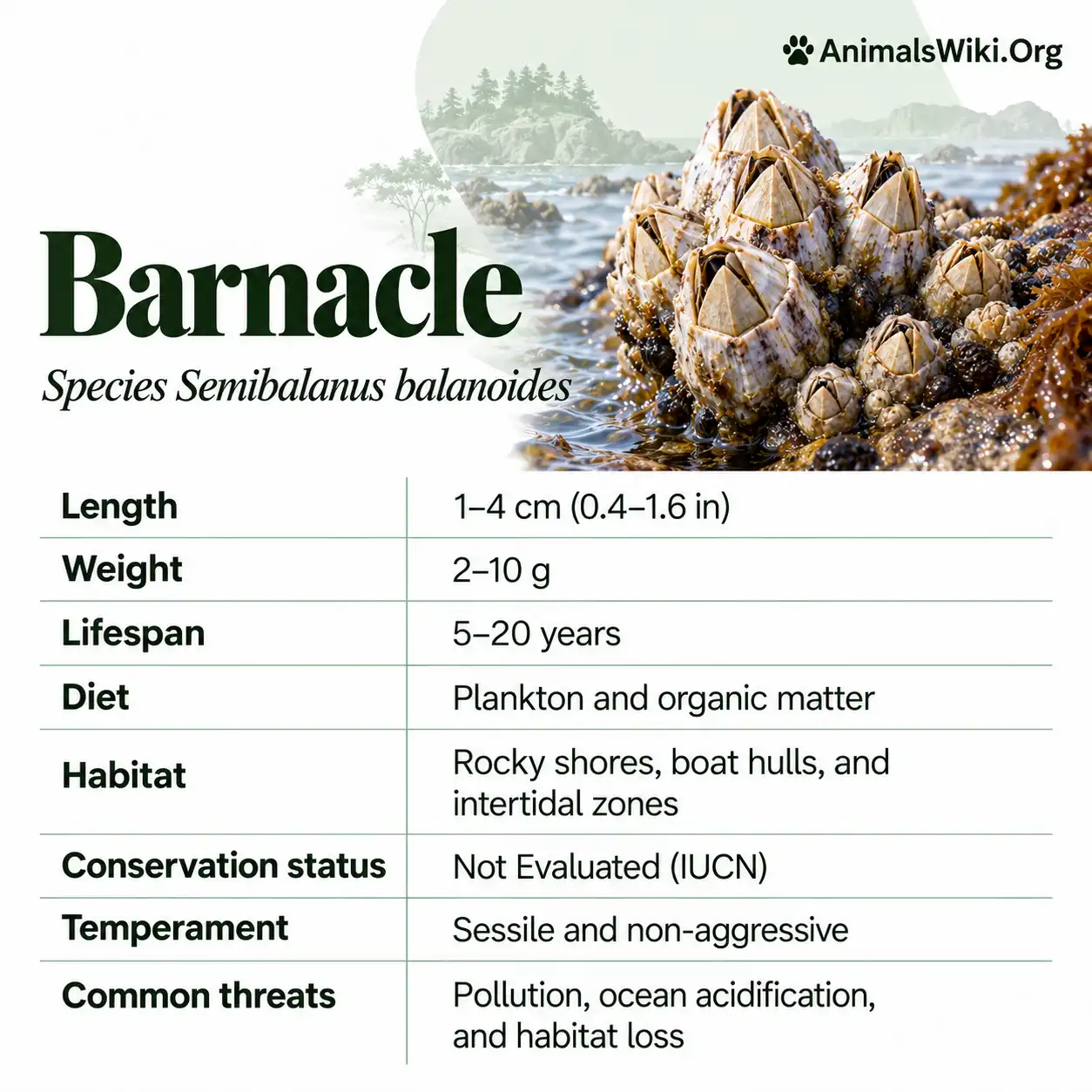
| Example genus | Semibalanus |
| Example species | Semibalanus balanoides |
The exact rank assigned to some higher groups can vary among classification systems. Their relationships and distinguishing features are more important than memorizing one hierarchy as permanently fixed.
Scientific names also change as classification improves. Older publications may use a genus name that has since been revised.
For example, familiar species formerly placed broadly in Balanus are now distributed among several genera.
This matters when comparing studies. Two names may refer to the same species under different historical classifications.
Conversely, the common word “barnacle” covers animals whose adult biology differs dramatically.
3. Acorn Barnacles
Acorn barnacles are the familiar low, cone-shaped barnacles attached directly to a surface.
Their mineralized wall plates surround the body. Movable plates around the opening allow access to the water and help protect the soft tissues.
The overall appearance is sometimes compared with a miniature volcano.
Different species vary in height, width, color, ridging, and plate arrangement. Some form low, spreading structures, while crowded individuals may become taller as neighboring animals restrict sideways growth.
Examples include Semibalanus balanoides, Amphibalanus amphitrite, and Balanus glandula.
Although their general shape is recognizable, identifying them accurately can require close examination. The number and arrangement of plates, the opening, and internal structures can all be useful.
A white cone on a rock is therefore a good starting clue, but it is not a complete species identification.
These animals dominate many rocky-shore scenes because their attached lifestyle allows them to occupy surfaces exposed repeatedly by the tides.
4. Goose Barnacles and Other Stalked Forms
Stalked barnacles attach through a flexible structure called a peduncle.
At the other end is the capitulum, the region enclosing much of the body and bearing protective plates in familiar forms.
This creates a very different silhouette from an acorn barnacle.
Some goose barnacles occur on floating wood, ropes, buoys, and other objects. Others live on wave-exposed rocks or in more specialized settings.
Species of Lepas are familiar on floating material, while Pollicipes species form conspicuous clusters on rocky coasts.
The common names overlap in everyday usage, so “goose barnacle” does not identify one universal species.
Their feeding still involves jointed appendages collecting material from the water.
An old European legend claimed that certain geese developed from these barnacles. The resemblance and the mystery of where the birds bred helped sustain the story.
Modern biology shows a crustacean life cycle involving eggs and larvae, with no transformation into birds.
5. Burrowing and Parasitic Barnacles
Cirripedia includes forms that do not resemble the common acorn or goose barnacle.
Burrowing barnacles occupy cavities in suitable material, while parasitic barnacles have evolved highly modified adult bodies.
These groups demonstrate why the shell-covered filter feeder is an introduction rather than a complete definition of barnacle diversity.
In specialized parasites, features familiar from a rocky-shore adult can become reduced or disappear. Their relationships are revealed through development, comparative anatomy, and molecular evidence.
This is a useful lesson in classification: close relatives do not always look alike as adults.
A body adapted to living within a host faces different demands from one collecting particles on a wave-washed rock.
The same principle explains why adult appearance alone once confused barnacle classification.
Throughout this article, descriptions of feeding fans, shell doors, and rock attachment primarily concern familiar free-living thoracican barnacles.
The biology of parasitic forms is discussed separately because their food supply, development, and effects on hosts require a different explanation.
6. How Big Are Barnacles?
Barnacle size varies widely.
Many familiar shore species measure only millimeters to a few centimeters across. Larger species grow much more conspicuously.
The giant acorn barnacle, Balanus nubilus, illustrates the upper end of the familiar acorn form, while numerous small species remain easy to overlook.
Measurements need context. The width of an acorn barnacle, its height, and the total length of a stalked barnacle describe different dimensions.
A long peduncle can make a stalked species appear large without an equally large capitulum.
Age also does not determine size by itself. Food supply, crowding, water movement, and environmental stress influence growth.
A crowded barnacle may have a different shape from an isolated individual of the same species.
For this reason, photographs used in educational articles should include a scale or clear measurement.
The shell’s outline alone rarely reveals the animal’s exact age, condition, or species.
7. Inside a Barnacle’s Shell
The protective structure surrounds a soft-bodied crustacean.
In familiar suspension-feeding barnacles, the body is arranged so that its thoracic appendages can extend through the opening.
These modified appendages are called cirri.
They bear fine projections called setae, which help capture and handle food.
Muscles control movement and closure, while the mantle and associated tissues contribute to the protective arrangement.
| Structure | General role |
|---|---|
| Wall plates | Protect the enclosed body |
| Movable opening plates | Regulate access and help seal the animal inside |
| Cirri | Collect and handle suspended food |
| Mouthparts | Transfer and process captured material |
| Mantle | Associated with the body cavity and shell formation |
| Attachment region | Secures the animal to its surface |
Plate arrangements differ among species.
A description showing six wall plates should not be treated as universal. Some acorn barnacles have four or eight.
The animal’s internal organization is also more complex than the visible “door” suggests. Opening the plates provides access to an active feeding system, not an empty cavity.
8. Where Do Barnacles Live?
Barnacles occupy marine environments across the world.
Their habitats range from exposed rocky shores to sheltered estuaries, submerged structures, floating objects, and deep-water settings.
Some live on other animals, including whales, turtles, crabs, and shell-bearing invertebrates.
Not every surface supports every species.
Temperature, salinity, water movement, food availability, and the duration of exposure to air influence suitability.
A barnacle adapted to an estuary may tolerate salinity fluctuations that challenge another species.
Depth matters too. A species that remains submerged does not experience the same drying cycle as a high-shore barnacle.
The attached surface also has a history. A clean new object, a rock covered with microbial growth, and the shell of a moving animal present different settlement opportunities.
The broad geographical success of barnacles reflects many specialized lineages rather than one species able to live anywhere.
Understanding habitat therefore begins by identifying both the barnacle and the physical setting it occupies.
9. What Do Barnacles Eat?
Many familiar barnacles are suspension feeders.
They collect food carried in the surrounding water, including phytoplankton, small zooplankton, and organic particles.
The precise diet varies with species, body size, and what is available.
Cirri extend into the water and capture material. Other appendages and mouthparts help move suitable food toward the mouth.
This process is often called filter feeding, although it involves active movements and handling rather than an inert household-filter mechanism.
Not every captured particle provides the same nutritional value.
Food must be a suitable size, accessible to the feeding apparatus, and useful for growth or reproduction.
Specialized forms can use different feeding strategies, and parasitic barnacles obtain resources through their host relationship.
The accurate generalization is therefore that many free-living barnacles collect suspended food.
It would be incorrect to claim that every barnacle eats only algae or that a barnacle attached to an animal necessarily consumes that animal’s tissues.
10. How Barnacle Feeding Fans Work
Barnacle cirri form an elegant food-collecting system.
Longer appendages can spread into the water, while shorter structures help transfer captured material toward the mouth.
The arrangement and types of setae differ among species.
Microscopic studies have linked those differences with feeding behavior and the handling of different food items.
The fan is therefore more than a set of identical feathers.
Each component operates within a moving fluid environment. Opening, sweeping, retracting, and manipulating material all influence feeding success.
The animal must also react to disturbance. Rapid withdrawal reduces exposure when a potential threat occurs.
An underwater video makes this coordination easier to appreciate. A shell that looked inactive during low tide may become a repeated sequence of extension and withdrawal once submerged.
Feeding movements can vary with flow and other conditions, so a motionless fan does not automatically mean the barnacle is unhealthy.
Observation becomes more informative when the surrounding water movement and the animal’s recent exposure are considered.
11. Why Water Flow Matters
A barnacle depends on water movement to deliver food, but stronger flow is not always better.
Gentle flow may provide too few encounters with useful particles. Extreme flow can increase mechanical stress on exposed structures.
Barnacles balance these demands through behavior and, in some species, changes in feeding morphology.
Studies comparing barnacles from different wave environments found differences in cirrus length, thickness, and setal arrangement.
Longer structures can provide a larger collecting area in lower flow. Shorter, sturdier structures can better withstand stronger movement.
This is an example of phenotypic plasticity, in which environmental conditions influence the characteristics produced by an organism.
The response has limits. Research also shows that the relationship does not continue indefinitely as water velocity rises.
These findings explain why two members of the same species can have different feeding appendages.
They also show that remaining attached does not mean remaining biologically unresponsive. A sessile animal can adjust to its surroundings without walking to another location.
12. The Barnacle Life Cycle
A familiar free-living barnacle life cycle includes a mobile larval phase followed by permanent attachment.
| Stage | Main event |
|---|---|
| Egg | Embryonic development occurs |
| Nauplius | Early larva enters a developmental sequence |
| Later naupliar stages | Growth and molts continue, commonly with planktonic feeding |
| Cyprid | Settlement-specialized larva searches for a suitable surface |
| Settlement | Permanent attachment begins |
| Juvenile | Metamorphosis produces the attached body form |
| Adult | Feeding, growth, and reproduction continue |
Many thoracican barnacles pass through six naupliar stages and one cyprid stage.
There are exceptions involving different patterns of brooding, feeding, and larval release.
The general sequence is valuable because it explains how a fixed adult produces offspring that reach new surfaces.
It also shows why larvae and adults can occupy different ecological roles.
The larvae participate in the plankton community, while adults link their feeding and survival to a particular attachment site.
One life cycle therefore connects open water with the seafloor or another surface.
13. What Is a Barnacle Nauplius?
A nauplius is an early crustacean larval form.
Barnacle nauplii look very different from attached adults. They possess appendages used in movement and pass through successive molts as development continues.
In familiar patterns, most of the naupliar phase involves feeding in the plankton.
The larvae encounter food, currents, predators, and changing water conditions.
Their survival influences how many individuals eventually become available to settle.
This means a shore covered with suitable bare rock will not necessarily receive a strong new generation every year.
Larval production and transport must also align with favorable conditions.
The naupliar stage reveals an important aspect of barnacle identity. Its body organization makes the connection with other crustaceans much more obvious than an adult shell does.
Developmental evidence therefore helped scientists understand relationships that external adult appearance had concealed.
A barnacle begins as a mobile participant in the water community before adopting the familiar attached form.
14. The Cyprid: A Larva Searching for a Home
The cyprid is specialized for finding a settlement site.
In the common life cycle, it does not feed. It relies on stored resources while swimming, exploring surfaces, and evaluating possible locations.
Its antennules play an important role in contact and temporary attachment.
A suitable location must support the animal beyond the immediate moment. The attached juvenile will need access to water, food, space, and eventually reproductive opportunities.
Surface texture, chemistry, biological films, and the presence of other barnacles can influence settlement.
The cyprid’s choice has long-lasting consequences because the juvenile cannot simply walk away afterward.
However, this is not a conscious decision in the human sense. It is a set of sensory and behavioral responses shaped by evolution.
The searching period also has an energy limit. A nonfeeding larva cannot explore indefinitely.
Settlement therefore represents a balance between finding a favorable site and using the resources available to complete attachment and metamorphosis.
15. How Do Barnacles Attach Underwater?
Barnacles use specialized biological adhesives.
During surface exploration, a cyprid can attach temporarily and move on. Permanent settlement involves a different adhesive event.
Research has demonstrated secretions associated with temporary antennular attachment, showing that the larva does more than hold itself in place through a simple suction-cup mechanism.
Permanent attachment then secures the animal as metamorphosis proceeds.
Adult barnacles maintain an adhesive interface as they grow.
This is an impressive materials challenge. The organism must create stable attachment in a wet environment while its body and supporting structures continue changing.
Its success depends on biological chemistry, surface contact, and physical organization.
The adhesive system is frequently described as barnacle cement, but it is not the same material used in building construction.
It includes proteins and other biological components arranged through controlled secretion.
Different adhesive stages should also be distinguished. Temporary exploration, permanent larval settlement, and adult attachment solve related but different problems.
16. Why Barnacle Cement Interests Scientists
Underwater attachment is difficult for many artificial materials.
Water can interfere with intimate contact between surfaces, and waves impose repeated mechanical forces.
Barnacle adhesives provide a natural example of solving parts of that problem.
Scientists investigate their proteins, structures, and interactions with different surfaces.
The research serves two broad purposes.
One is understanding and reducing unwanted attachment on vessels or equipment. The other is developing new materials inspired by biological adhesion.
Biomimetics means drawing engineering ideas from living systems. It does not require making a manufactured adhesive chemically identical to the natural one.
Researchers may borrow a structural principle, a molecular interaction, or a sequence of processing steps.
Progress should also be described accurately. A promising laboratory material is not automatically a finished product ready for every application.
The biological system remains valuable precisely because it combines several functions in a wet, changing environment.
Studying it connects marine zoology with chemistry, materials science, and engineering.
17. Can Adult Barnacles Move?
A familiar attached adult barnacle does not crawl across a rock to select a new home.
Once settlement and metamorphosis establish that lifestyle, the attachment site becomes central to its survival.
Its appendages and opening plates still move, and its body grows. Being sessile does not mean having no muscular activity.
A stalked barnacle can also bend with its flexible peduncle and the movement of its supporting object.
The distinction is between moving body parts and relocating the whole attached animal.
When barnacles occur on driftwood, a whale, or a ship, the supporting surface transports them.
They remain attached relative to that surface while changing geographical position.
This arrangement creates both opportunities and risks. A moving surface can provide food-rich flow or carry the animal into unsuitable conditions.
Detachment is not equivalent to a larva beginning a fresh settlement search.
The adult body has already been transformed for life at an attachment point.
18. How Do Barnacles Grow and Molt?
Barnacles combine crustacean molting with the growth of mineralized protective plates.
The distinction is important because the entire hard shell is not discarded like a crab’s external covering.
The body’s cuticle undergoes molting, while the mineralized plates expand through additional growth.
Research has examined how growth zones, secretion, and mineralization work together.
In acorn barnacles, the attachment interface also expands as the base grows.
This allows the animal to remain fixed while increasing its footprint.
Crowding changes the available space. A barnacle surrounded by neighbors may grow into a different shape from one with room to expand.
Growth therefore involves both internal biological processes and external physical constraints.
An empty plate structure left after death is not a molt of the complete barnacle.
Likewise, pale material swept from living barnacles may include shed cuticle.
Correctly interpreting these traces requires separating the permanent mineralized structure from the tissues and coverings periodically replaced inside it.
19. How Long Do Barnacles Live?
Barnacle lifespan depends on the species and environment.
Some familiar shore barnacles survive for several years, while local conditions can shorten life considerably.
Exposure, predation, crowding, food supply, and the stability of the attachment surface all matter.
A barnacle on a short-lived floating object faces a different situation from one attached to stable rock.
Even within a species, shore height can influence survival.
An animal that feeds more frequently at a lower position may also encounter different predators or competitive pressures.
Size alone is therefore an unreliable age indicator.
A large barnacle may reflect favorable feeding and growth rather than exceptional age.
Researchers studying lifespan follow mapped individuals, examine population changes, or use other species-appropriate methods.
The question also needs a defined starting point: time since settlement differs from total age including larval development.
For a general article, “species-specific and often several years in familiar forms” is more accurate than one universal lifespan.
20. How Do Barnacles Reproduce?
Many free-living barnacles are simultaneous hermaphrodites, possessing both male and female reproductive functions.
This does not automatically mean they fertilize their own eggs.
Cross-fertilization is important in many species, and attached life creates a practical challenge: reproductive material must reach a partner without the adult leaving its site.
In familiar forms, an extensible reproductive organ allows sperm transfer to nearby individuals.
The arrangement helps explain why settling near members of the same species can be advantageous.
However, dense settlement also increases competition for space and food.
Reproduction therefore adds another trade-off to the placement of a new juvenile.
Species differ in maturity, brood frequency, and reproductive timing. Temperature, feeding, season, and geographical location can influence performance.
A statement that all barnacles reproduce a fixed number of times each year would be inaccurate.
The biological pattern is diverse, and the reproductive success of an attached animal depends partly on the neighborhood established during settlement.
21. Spermcasting, Dwarf Males, and Reproductive Diversity
Barnacle reproduction includes alternatives to the familiar neighbor-to-neighbor description.
Research on the stalked barnacle Pollicipes polymerus found evidence that individuals can obtain sperm released into the surrounding water.
This process is called spermcasting.
Genetic analysis was important because isolated individuals carrying fertilized eggs could otherwise have been interpreted as self-fertilizing.
Other barnacle groups include separate sexes or combinations of hermaphrodites and small males.
These dwarf males can be highly specialized and associated closely with a larger reproductive partner.
Their existence illustrates how different solutions evolve around an attached lifestyle and limited mate availability.
The categories should remain distinct. Hermaphroditism, self-fertilization, separate sexes, and sperm capture describe different aspects of reproduction.
A barnacle group containing several of these arrangements cannot be explained accurately with one slogan.
The most interesting feature is the diversity itself: closely related animals solve the problem of reproduction through substantially different body forms and behaviors.
22. How Barnacles Survive Low Tide
Intertidal barnacles repeatedly alternate between underwater conditions and exposure to air.
When the tide falls, familiar acorn barnacles close their opening plates, reducing water loss and protecting the soft body.
This allows them to endure a period when ordinary suspension feeding is unavailable.
However, closure is a protective response with costs. The animal cannot collect food in its usual way while sealed.
The length of exposure influences the balance between feeding opportunity and physical stress.
Rainfall, sunlight, wind, and the temperature of the underlying rock also matter.
A barnacle’s immediate surroundings can differ substantially from a nearby weather station’s measurements.
A shaded crack and an exposed horizontal surface may experience different conditions during the same low tide.
These small-scale differences help explain patchy survival on a shore.
The protective shell is therefore one part of an integrated strategy involving behavior, physiology, attachment, and the position where the larva originally settled.
23. Why Barnacles Form Bands on Rocky Shores
Rocky shores often show recognizable zones of organisms at different heights.
Barnacles contribute to these patterns, but the boundaries have several causes.
High on the shore, drying and heat can restrict survival. Lower down, longer submersion may provide more feeding while also increasing competition or predation.
Classic experiments by ecologist Joseph Connell used barnacles to demonstrate how interactions between species can restrict distribution.
Removing a competitor changed where another species could persist.
This helped distinguish the conditions an organism can tolerate from the conditions under which it actually occurs alongside other organisms.
Larval settlement also matters. A suitable area cannot develop an adult population without a supply of larvae.
Consequently, a visible boundary is not explained simply by drawing a line at one tidal height.
Physical stress, biological interactions, recruitment, and local topography combine to produce the observed pattern.
Barnacles became important research animals because their fixed positions made individual survival and competition unusually tractable to study.
24. What Eats Barnacles?
Barnacles are food for several kinds of predators.
Depending on the region and species, consumers include whelks, crabs, fish, sea stars, and birds.
A protective shell reduces access but does not eliminate it.
The dog whelk, Nucella lapillus, is a well-studied predator of barnacles and mussels.
Its feeding can involve gaining access through the shell or opening, followed by digestion and consumption of the tissues.
Predation takes time and creates risks for the predator too. A whelk exposed on a shore faces waves, drying, and its own enemies.
Barnacle defenses therefore influence a wider interaction rather than making the prey perfectly safe.
Young barnacles may face different risks from larger adults.
Small size, shell thickness, position, and crowding can change accessibility.
Empty shells on a rock record mortality, but they do not identify the cause by themselves.
Predation, heat, competition, and other pressures can all leave an unoccupied structure behind.
25. Competition and Habitat for Other Organisms
Barnacles compete for attachment space, an essential resource for organisms unable to move freely as adults.
Crowding can restrict growth and change body shape. Other attached organisms may overgrow, displace, or shade them.
Mussels, algae, limpets, and neighboring barnacles can influence the resulting community in different ways.
At the same time, a barnacle-covered surface creates small-scale structure.
Gaps, ridges, and empty shells provide places where other small organisms can shelter.
This means barnacles are both competitors and habitat-forming participants.
Their effects continue after an individual dies because the shell may remain.
A rock covered with barnacles is therefore not simply the sum of individual filter feeders. It is a textured environment that changes water movement, refuge availability, and the space accessible to later settlers.
The result depends on density and species composition.
A living community develops through repeated settlement, growth, mortality, and occupation of the spaces left behind.
26. Why Do Barnacles Live on Whales?
Certain barnacles are adapted to living on marine animals, including whales.
A whale provides a moving attachment surface. The barnacle gains access to water flowing past its feeding structures while remaining associated with the host.
This does not automatically mean it feeds on whale tissue.
Familiar whale-associated filter feeders obtain suspended food from the water.
The relationship is commonly described in terms of the barnacle benefiting from transport and attachment while causing little direct harm under ordinary conditions.
However, all host associations should not be collapsed into one universal category.
Species identity, location, abundance, and attachment method influence the interaction.
Barnacles also help produce the characteristic mottled appearance of some gray whales.
Their occurrence reflects a specific biological relationship rather than evidence that any barnacle drifting near a whale can establish there.
Host-associated species must encounter and recognize suitable surfaces during their developmental cycle.
A whale-riding lifestyle is therefore a specialization, not simply an ordinary rock barnacle choosing a larger vehicle.
27. Barnacles on Crabs, Turtles, and Other Animals
Barnacles also occur on other marine animals.
Some attach to shells or external coverings, using the host primarily as a surface.
The interaction can change with the host’s biology. A crab that molts may shed attached barnacles along with its old covering.
This creates a temporary habitat whose duration is partly controlled by the host’s growth cycle.
NOAA observations of barnacle-covered crabs illustrate this kind of association.
Other barnacles are adapted to particular body regions or hosts and cannot be understood simply through a general fouling model.
It is important to separate external attachment from internal parasitism.
Seeing a barnacle on a crab does not prove that roots extend through the crab’s body.
Conversely, an unfamiliar structure beneath a crab may belong to a specialized parasite rather than an ordinary shell-covered barnacle.
The relationship must be identified through anatomy and life history.
Its significance depends on how the barnacle obtains food, attaches, grows, and reproduces.
28. Sacculina and Other Parasitic Barnacles
Sacculina is a genus of highly modified parasitic barnacles associated with crabs.
It differs dramatically from a barnacle sweeping food from seawater on a rock.
The parasite develops an internal, rootlike system used to obtain resources from the host.
An external reproductive structure appears beneath the crab’s abdomen, in the region where a female crab would normally carry eggs.
The association can interfere with the host’s reproduction and alter behaviors so that the crab cares for the parasite’s reproductive structure.
This is one of the strongest examples of how an adult body can become transformed through specialization.
The parasitic form no longer resembles the familiar image of a crustacean enclosed in a cone of plates.
Its identity becomes understandable through development and evolutionary relationships.
Calling it a barnacle is therefore a scientific statement about ancestry, not a claim that it behaves like an acorn barnacle.
The contrast also prevents a common mistake: ordinary barnacles attached externally to animals should not all be described as body-invading parasites.
29. Barnacles, Ships, and Biofouling
When barnacles accumulate on vessel hulls or submerged equipment, they become part of biofouling.
The community can also include algae, microorganisms, mussels, tubeworms, and other attached organisms.
Roughness changes the way water moves around a hull, increasing resistance and affecting performance.
The exact consequences depend on the amount, type, and distribution of fouling.
Barnacles also occupy sheltered recesses and other areas where inspection and cleaning are difficult.
Their attachment biology is therefore an engineering concern as well as a zoological interest.
Managing biofouling requires considering both removal and prevention.
A method that strips organisms from a surface can create additional problems if it damages coatings or releases material capable of establishing elsewhere.
This is why professional guidance addresses environmental performance alongside practical cleaning.
Barnacles are ordinary members of natural ecosystems, but their presence on manufactured structures places the same biology in an economically different context.
The animal has not changed purpose; the consequences of its attachment have changed with the surface.
30. Invasive Barnacles and Environmental Change
Ships and other moving surfaces can transport barnacles beyond their native ranges.
If introduced animals survive, reproduce, and spread, they may alter local communities.
Austrominius modestus, naturally associated with Australasia, is a familiar example in discussions of introduced barnacles in European waters.
Invasive status depends on species and location. A native population does not become harmful simply because another barnacle species causes problems elsewhere.
Environmental change adds another layer.
Heat, altered salinity, and changing conditions can affect settlement, survival, and competition. Intertidal animals can experience especially intense heating when exposed during low tide.
Studies using barnacle-shaped temperature loggers have shown that body temperatures vary with microhabitat and local conditions.
Latitude or seawater temperature alone may therefore fail to explain the stress experienced on a rock surface.
Understanding future communities requires combining transport pathways, species interactions, larval supply, and the physical environment.
31. Darwin, Barnacles, and Modern Science
Charles Darwin devoted eight years to studying barnacles.
Their diversity provided difficult questions about variation, classification, reproductive anatomy, and the boundaries between species.
His work helped reveal that seemingly repetitive coastal animals contained extraordinary biological complexity.
Barnacles remain valuable research organisms for related reasons.
Attached adults can be mapped and followed through time. Larvae provide a model for studying settlement and development. Adhesive systems connect biology with materials science.
Modern tools add genetics, high-resolution microscopy, chemical analysis, and controlled flow experiments.
Each method answers a different question.
A field survey reveals distribution, while an experiment can test a proposed cause. Imaging shows a structure, while chemical analysis helps explain its composition.
Combining these approaches provides a stronger understanding than treating a photograph or a single measurement as a complete explanation.
Barnacles are especially instructive because their fixed adult lifestyle makes environmental influences visible without making the underlying processes simple.
32. Common Barnacle Myths
| Myth | More accurate explanation |
|---|---|
| Barnacles are small rocks. | They are living crustaceans. |
| Their shells make them mollusks. | Anatomy and development place them among crustaceans. |
| All barnacles look like white cones. | Stalked, burrowing, and parasitic forms also occur. |
| Barnacles never move during life. | Familiar species have swimming larvae. |
| Their feeding structures are mouths or tentacles. | The visible fan consists of modified jointed appendages called cirri. |
| Every barnacle eats its host. | Many externally attached forms collect food from water. |
| Hermaphroditism always means self-fertilization. | Many species cross-fertilize, and other reproductive systems occur. |
| Barnacles shed the complete shell when growing. | Molting and plate growth involve different processes. |
| Any adult can detach and settle again normally. | Permanent settlement transforms the animal for an attached lifestyle. |
| All barnacles are invasive. | Invasive status depends on species, location, and introduction history. |
Their true biology is more varied than these shortcuts suggest. A barnacle-covered rock contains animals continuously negotiating food supply, attachment, competition, and changing tides.
33. Frequently Asked Questions About Barnacles
1. What is a barnacle in simple words?
A barnacle is a crustacean that, in familiar forms, lives attached to a surface inside protective plates. It extends modified appendages to collect food from water. Its life usually begins with swimming larvae before settlement produces the attached juvenile.
2. Is a barnacle an animal or a shell?
It is an animal. The hard structure belongs to its protective body covering, while soft tissues and organs live inside. An empty shell can remain after death, so the presence of plates alone does not establish that a particular barnacle is alive.
3. Are barnacles related to crabs?
Yes. Both are crustaceans, although their adult body forms differ greatly. Barnacle larvae make that relationship easier to recognize. Their development and jointed appendages helped scientists understand an identity that the shell-covered adult appearance had obscured.
4. Are barnacles the same as limpets?
No. Limpets are mollusks, whereas barnacles are crustaceans. Both may occupy rocky shores and possess protective hard structures. A limpet typically moves using a muscular foot, while a familiar adult barnacle remains attached and feeds with cirri.
5. What do barnacles eat?
Many free-living species collect suspended food, including microscopic algae, small animals, and organic particles. Diet varies with species and circumstances. Parasitic barnacles obtain resources through their hosts, so the feeding fan description does not apply to every member of Cirripedia.
6. Why do barnacles wave their legs?
The featherlike structures are cirri, modified appendages used in feeding. Their movements help capture and transfer food. Patterns vary with water flow and other conditions. Rapid retraction can protect the appendages when the animal detects a potential disturbance.
7. Can barnacles survive out of water?
Intertidal species can endure periods of exposure by closing their opening and reducing water loss. Their tolerance has limits and differs among species. A barnacle adapted to remaining submerged should not be assumed to tolerate the same exposure as a high-shore species.
8. How do barnacles breathe?
Gas exchange occurs through tissues associated with their body and mantle environment. Their physiology is adapted to the conditions of their particular habitat. Closing during low tide changes activity and exchange conditions, so surviving exposure involves coordinated physiological responses rather than shell closure alone.
9. Do adult barnacles crawl around?
Familiar attached adults do not crawl to a new feeding location. Their appendages move, and stalked forms can bend, but the attachment point remains fixed. Movement across geographical space occurs when a supporting object, vessel, or animal carries them.
10. How do barnacles reach a new rock?
Their larvae move through the water and encounter surfaces. The settlement-specialized cyprid explores potential locations before attaching permanently. Currents influence where larvae travel, while local conditions and biological cues influence whether they establish successfully after arrival.
11. What is a cyprid?
A cyprid is a larval stage specialized for settlement. In the familiar barnacle life cycle it does not feed, instead using stored resources while searching. It explores with modified antennules and eventually attaches, after which metamorphosis produces the juvenile form.
12. Why is barnacle glue so strong?
Its performance comes from a specialized biological adhesive system involving secreted components and an organized attachment interface. Researchers study both chemical interactions and physical structure. Describing it simply as ordinary glue produced underwater misses much of the mechanism.
13. Do barnacles molt?
Yes, but the mineralized plates are not shed as one complete shell. Cuticle is replaced through molting while plates grow. This specialized arrangement allows the animal to increase in size while remaining attached to its supporting surface.
14. How long do barnacles live?
Lifespan depends on species and location. Some familiar shore barnacles survive for several years. Predation, drying, heat, crowding, and the persistence of the supporting surface influence survival. A single number cannot accurately describe the whole group.
15. Are all barnacles hermaphrodites?
No. Hermaphroditism is common, but separate sexes and systems involving dwarf males also occur. Possessing both reproductive functions does not automatically establish self-fertilization. Barnacle reproductive biology includes several distinct ways of transferring sperm and producing offspring.
16. Why do barnacles grow close together?
Nearby individuals can provide reproductive opportunities and settlement cues. However, crowding also increases competition for space and can affect feeding and growth. Dense clusters reflect a balance of settlement, survival, and biological interactions rather than a universal preference for unlimited crowding.
17. Do barnacles hurt whales?
Familiar whale-associated filter-feeding barnacles are commonly described as causing little direct harm under ordinary conditions. They collect food from water rather than automatically consuming whale tissue. The exact interaction depends on the species and attachment, so all host associations should not be treated identically.
18. Are barnacles on crabs always parasites?
No. Some use the crab’s exterior as an attachment surface and may be shed when it molts. Specialized internal parasites such as Sacculina have a very different relationship. External appearance and host identity must be examined before deciding what kind of association is present.
19. What eats barnacles?
Predators include whelks, crabs, fish, and other animals, depending on the habitat. Shells offer protection but can be breached or exploited. Young and adult barnacles may face different risks, and predator access depends on size, position, and shell structure.
20. Why are barnacles a problem for ships?
Their growth contributes to biofouling, increasing surface roughness and resistance through water. They can also occupy difficult-to-clean areas and help transport marine organisms between regions. The size of the problem depends on the fouling community and vessel conditions.
21. Are all barnacles invasive?
No. Most discussions of invasion concern particular species introduced outside their native ranges. A native barnacle remains part of its local community. Species identification and geographical context are necessary before describing a population as introduced or invasive.
22. Why are barnacles important?
They connect plankton with shore-based food webs, provide prey, alter surface habitats, and reveal major principles of ecology and evolution. Their larvae and adhesives also support research. Their fixed appearance conceals an animal group with unusually rich developmental and biological diversity.