Cassowary Facts
| Feature | Details |
|---|---|
| Common Name | Cassowary (Southern Cassowary — focus species) |
| Scientific Name | Casuarius casuarius (Southern Cassowary) |
| Family | Casuariidae |
| Order | Casuariiformes |
| First Described | 1758 (by Carl Linnaeus) |
| Native Habitat | Tropical rainforest; forest edges; wetland margins; fruit-bearing woodland |
| Geographic Range | New Guinea; northeastern Australia (Queensland); surrounding islands |
| Average Size | 1.5–1.8 meters height; 1.0–1.5 meters body length |
| Average Weight | Males: 29–34 kg; Females: 58–76 kg (females significantly larger) |
| Lifespan | 18–20 years (wild); up to 40 years (captivity) |
| Diet | Primarily frugivore — fallen fruits; also fungi, invertebrates, small vertebrates |
| Conservation Status | Least Concern globally (C. casuarius); Endangered in Australia |
| Defining Feature | World’s most dangerous bird; razor-sharp inner toe dagger claw; prominent casque (helmet); brilliant blue and red neck; largest rainforest bird in the world |
| Number of Species | 3 species in genus Casuarius |
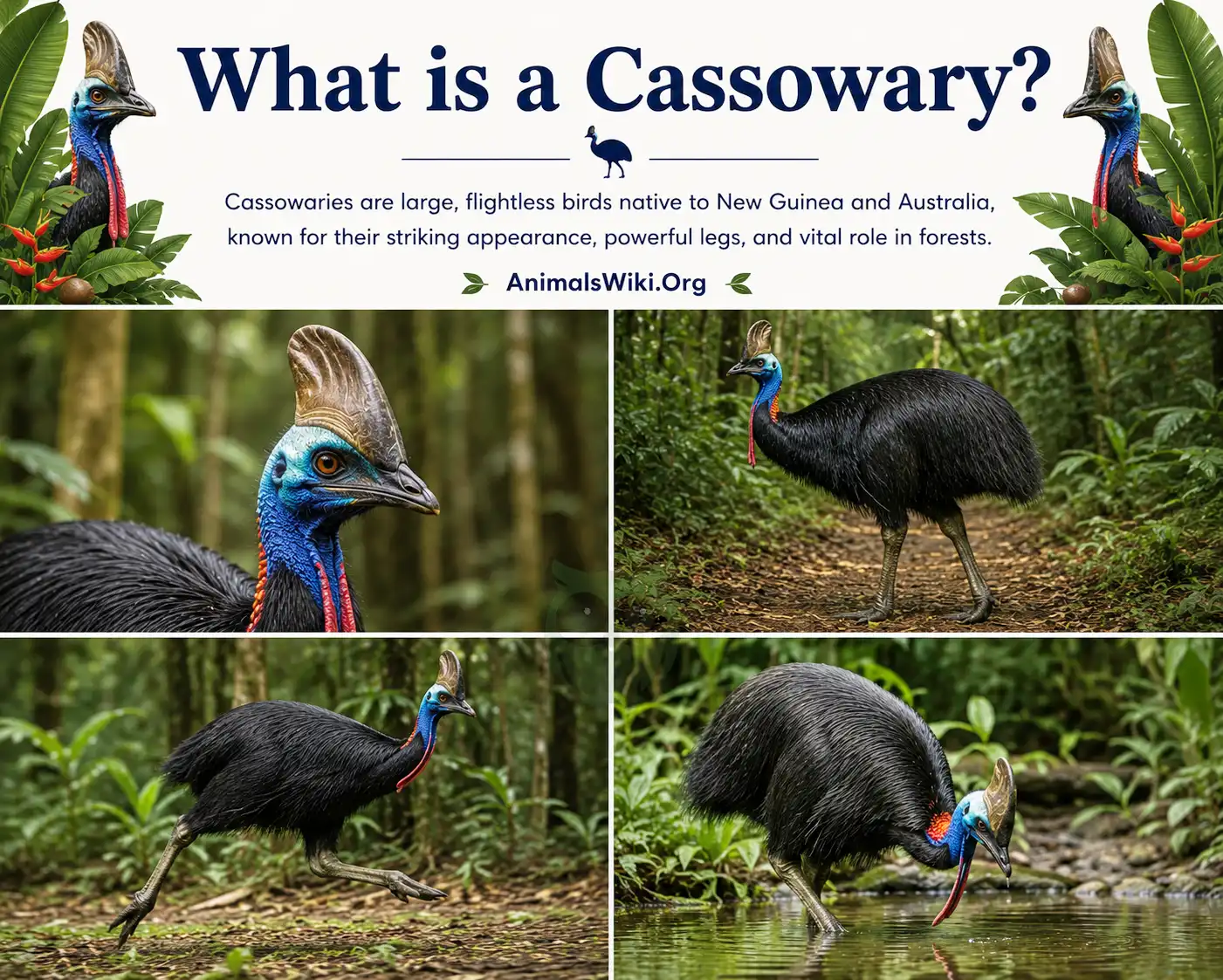
1. Species Overview & Classification
In the dense rainforest of Queensland’s wet tropics, between the villages of Mission Beach and Cape Tribulation, there is a bird that commands a quality of attention most other animals simply cannot produce. Not because it is the largest bird in the world — it is not. Not because it is the fastest — it is not that either. The cassowary commands attention because of what it is capable of doing when it decides that you have come too close. Its inner toe bears a dagger-like claw that can reach 12 centimeters in length. It can kick forward with the force and speed of a trained martial artist. It can run at 50 km/h through dense rainforest — faster than you, through terrain you cannot navigate. And it will — if sufficiently provoked, startled, or defending young — use all of these capabilities without hesitation.
The Southern Cassowary (Casuarius casuarius) is universally described by ornithologists, wildlife managers, and the Guinness World Records as the world’s most dangerous bird — the only bird species with a documented record of killing adult humans in modern times through physical attack. This reputation, while genuine, represents only one dimension of an extraordinary animal — an evolutionary anachronism that belongs to the same ancient group as the ostrich and emu, that has been shaped by 60+ million years of forest evolution into a creature perfectly adapted for its role as the keystone seed disperser of the Australo-Papuan rainforest.
The cassowary is simultaneously the most feared bird in Australia and one of the most ecologically critical — a “gardener of the rainforest” whose consumption and dispersal of large rainforest fruits maintains the diversity of tree species in some of the most biodiverse forest on Earth. Without cassowaries, the characteristic large-fruited trees of the Queensland and New Guinean rainforest cannot effectively disperse their seeds — a dependency so complete that the entire ecology of these ancient forests is built around the cassowary’s continued presence.
Understanding the cassowary means holding two ideas simultaneously — the genuine danger this animal poses to humans who approach or corner it, and the genuine ecological irreplaceability that makes its conservation one of the most important wildlife challenges in the Australo-Papuan region.
Species Classification Table
| Classification Level | Details |
|---|---|
| Kingdom | Animalia |
| Phylum | Chordata |
| Class | Aves |
| Order | Casuariiformes |
| Family | Casuariidae |
| Genus | Casuarius |
| Focus Species | Casuarius casuarius — Southern Cassowary |
| Described By | Carl Linnaeus, 1758 |
| Common Name | Southern Cassowary; Double-wattled Cassowary |
The Three Cassowary Species
| Species | Scientific Name | Range | IUCN Status | Notable Feature |
|---|---|---|---|---|
| Southern Cassowary | Casuarius casuarius | S New Guinea; NE Australia; Aru Islands | LC globally; Endangered (Australia) | Largest; most studied; most dangerous |
| Northern Cassowary | Casuarius unappendiculatus | N New Guinea | Vulnerable | Single-wattled; blue-yellow neck |
| Dwarf Cassowary | Casuarius bennetti | New Guinea; New Britain | Least Concern | Smallest; mountain specialist; tiny casque |
The Ratite Connection
The cassowary belongs to the ratites — the large flightless birds whose distribution across the southern hemisphere has fascinated evolutionary biologists for over a century. Key ratite facts:
| Species | Location | Status | Relationship to Cassowary |
|---|---|---|---|
| Cassowary (Casuarius spp.) | Australasia | All threatened to varying degrees | Focus group |
| Emu (Dromaius novaehollandiae) | Australia | Least Concern | Closest living relative of cassowary |
| Ostrich (Struthio camelus) | Africa | Least Concern | More distant relative |
| Rhea (Rhea spp.) | South America | Near Threatened | Distant relative |
| Kiwi (Apteryx spp.) | New Zealand | Vulnerable to Endangered | Very distant relative |
Modern molecular phylogenetics has confirmed that cassowaries and emus are each other’s closest relatives — together forming the family Casuariidae — and that ratite flightlessness evolved independently multiple times in different lineages rather than from a single flightless ancestor carried by Gondwana’s breakup.
Did You Know? The cassowary is often described as the most “dinosaur-like” of all living birds — and with good reason. Its prominent casque (helmet-like head crest), its scaly legs, its three-toed feet with a dagger claw, and its ancient forest-dwelling lifestyle give it an appearance and demeanor that most observers find genuinely prehistoric. When a large female cassowary fixes you with its pale yellow eye and tilts its casque toward you in a threat display, the experience is widely described as one of the most primally alarming encounters available in the modern natural world.
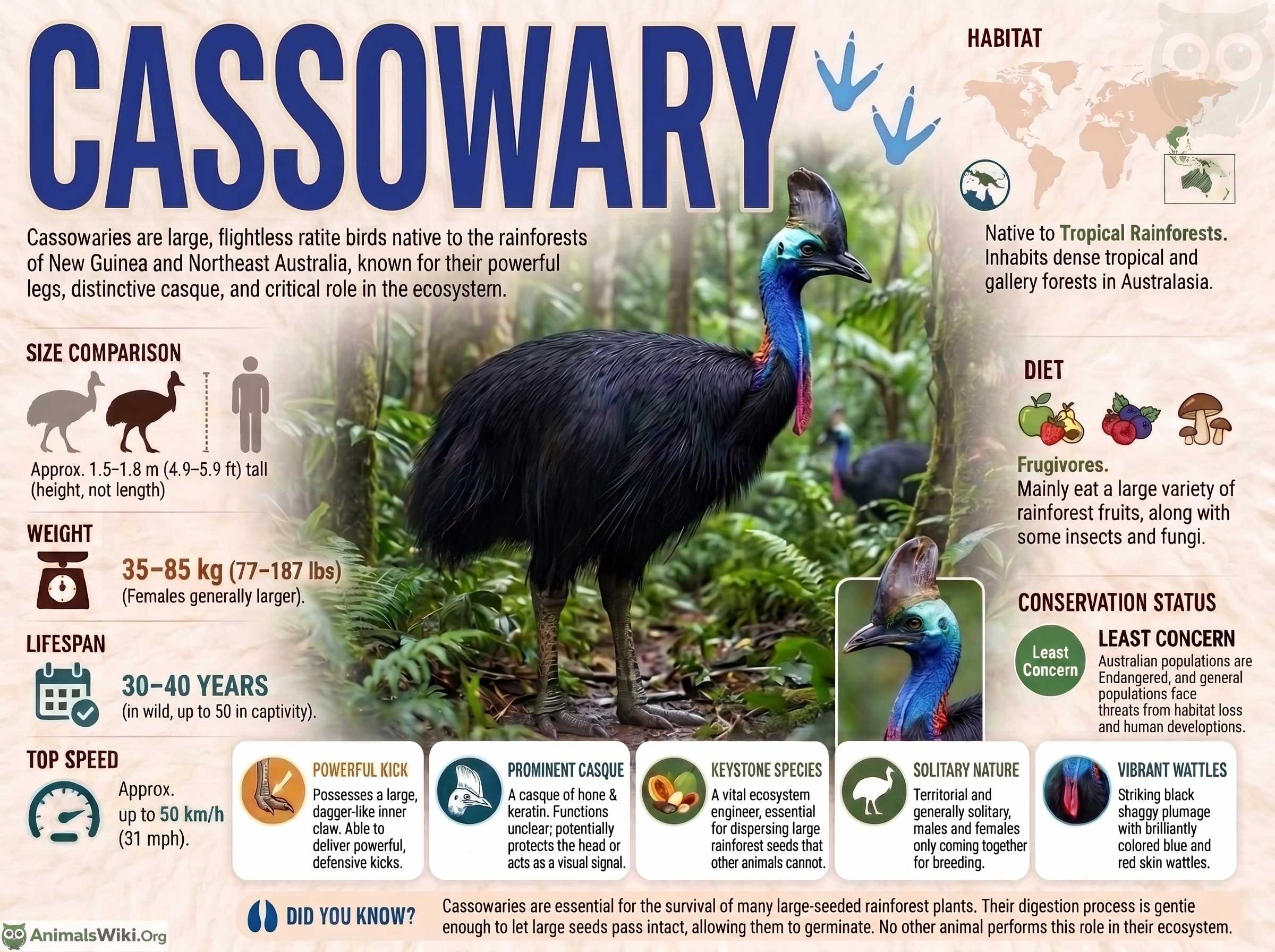
2. Physical Description & Unique Features
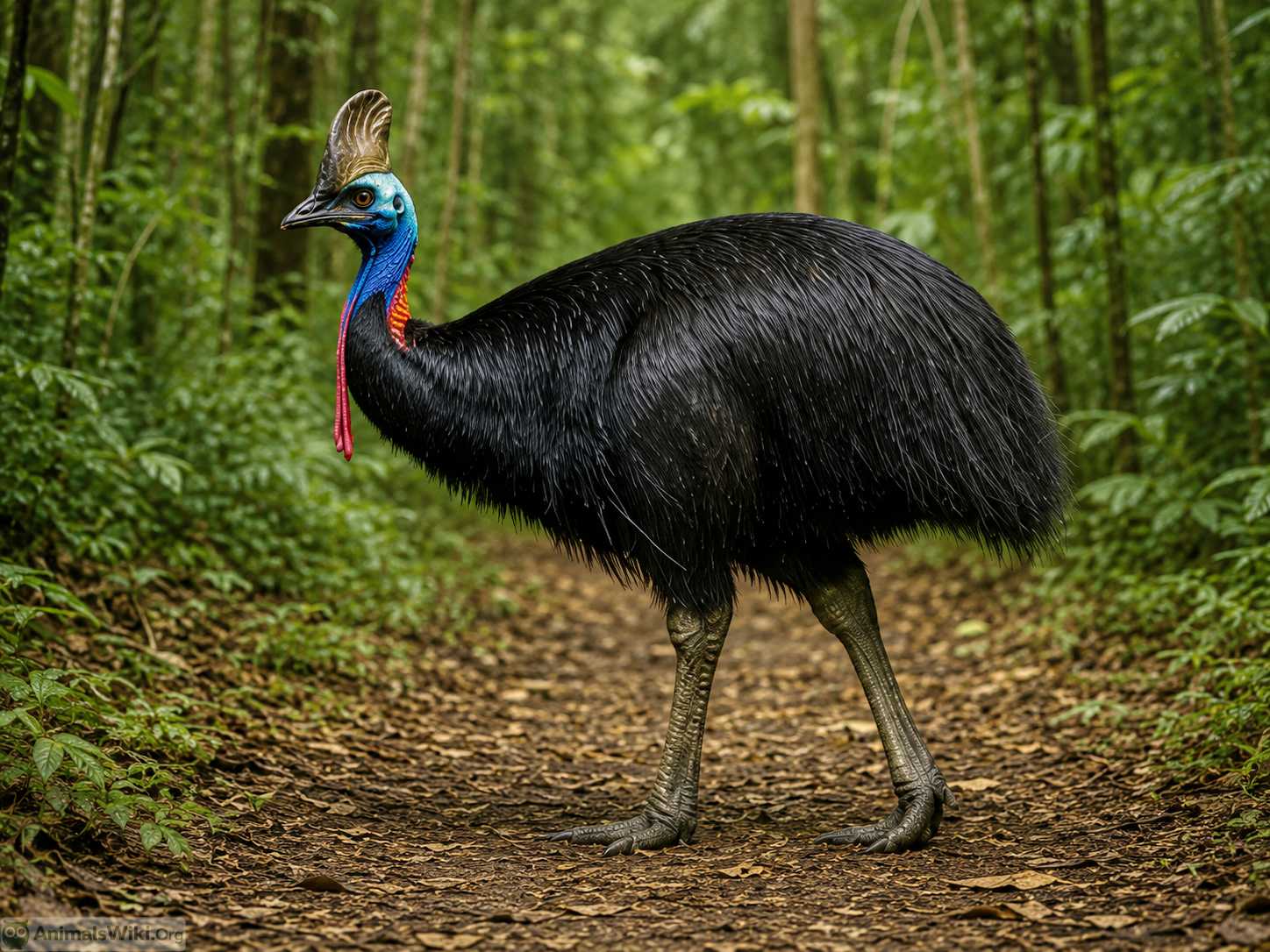
The cassowary’s physical form is one of the most immediately striking of any bird — combining vivid color, imposing size, and an anatomical toolkit that makes it simultaneously one of the most beautiful and most formidable animals in the Australo-Papuan rainforest.
Size — The Reverse of the Expected
One of the cassowary’s most immediately remarkable features is its reverse sexual dimorphism — the female is significantly larger than the male, an unusual arrangement in birds:
Females:
- Height: 1.5–1.8 meters (4.9–5.9 feet)
- Weight: 58–76 kg (128–168 lbs) — the largest females among the heaviest birds in the world
- Body length: 1.0–1.5 meters
Males:
- Height: 1.0–1.3 meters (3.3–4.3 feet)
- Weight: 29–34 kg (64–75 lbs)
- Significantly smaller and lighter than females
Why females are larger: The size reversal reflects the cassowary’s unusual reproductive system — females are the competitive sex (competing with other females for males and territories) and the males provide parental care; larger female size provides competitive advantage in female-female contests, while smaller male size may reduce the caloric demands of the incubating male.
The Casque — The Cassowary’s Most Distinctive Feature
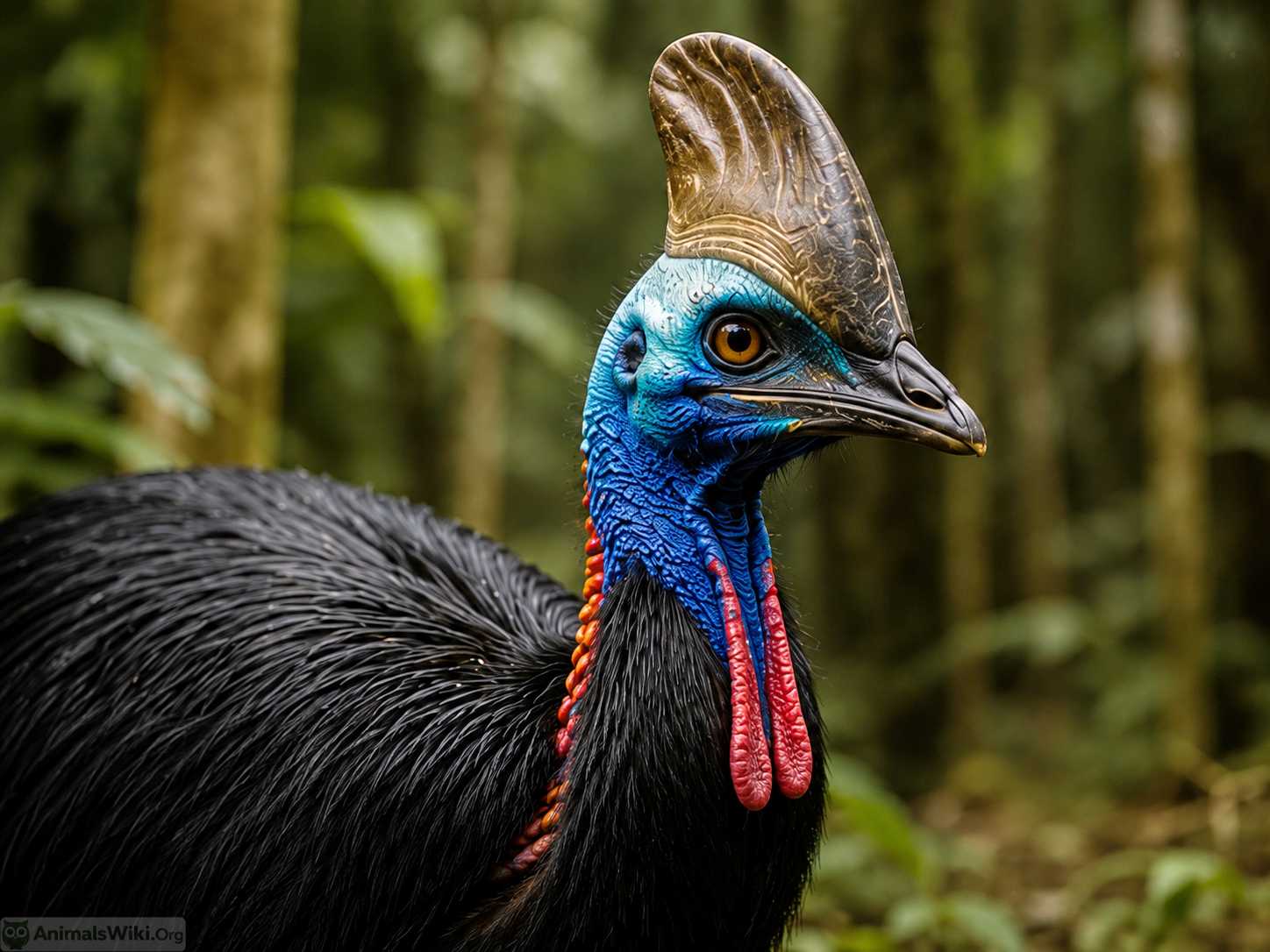
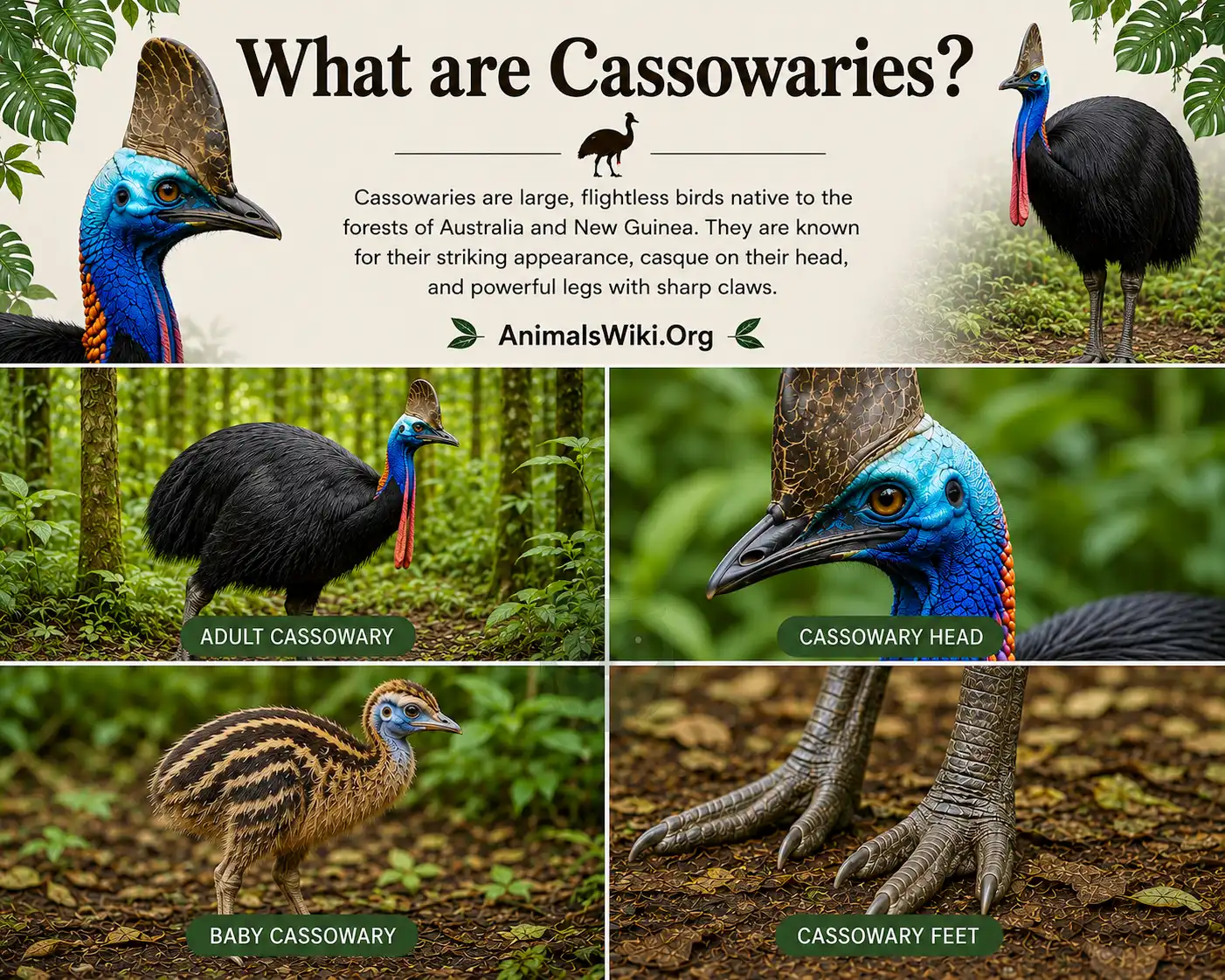
The casque (pronounced “cask”) — the prominent, helmet-like bony crest on top of the cassowary’s head — is the animal’s most immediately recognizable feature and one of the most distinctive anatomical structures of any bird:
Structure: The casque is composed of trabecular bone filled with a keratin-like material — it is not hollow as sometimes claimed, but neither is it as dense as typical bone; the external surface is covered in keratin (the same protein as fingernails and bird beaks)
Size: In adults, the casque typically reaches 13–18 cm in height above the skull; it continues growing throughout the bird’s life — older individuals have proportionally larger casques
Function: The function of the casque has been debated for decades. Multiple hypotheses have been proposed:
- Pushing through dense undergrowth — the casque protects the head when the bird pushes through dense vegetation and fallen debris on the forest floor; behavioral observation supports this
- Low-frequency sound production and detection — research has suggested that the casque may function as an acoustic resonator for the cassowary’s infrasound calls; this remains an active area of investigation
- Social and dominance signaling — larger casques in older individuals may communicate age, experience, and dominance status to other cassowaries
- Thermoregulation — the casque’s blood-vessel-rich tissue may assist with heat regulation in the hot, humid rainforest
- Mate selection — cassowaries may assess casque size and condition in selecting mates
The honest answer is that the casque probably serves multiple simultaneous functions — as is typical of complex anatomical structures.
The Neck — Nature’s Most Vivid Display
The Southern Cassowary’s neck is one of the most brilliantly colored areas of any non-passerine bird:
Color pattern:
- Bright cobalt blue on the neck and face — more intense in adults, particularly during the breeding season; produced by structural coloration of the skin (similar mechanisms to the iridescent colors of other birds but producing vivid blue in bare skin rather than feathers)
- Vivid red on the wattles — the two fleshy appendages hanging from the neck of the Southern Cassowary (C. casuarius — hence the name “double-wattled cassowary”); the wattles are bright red, intensifying to crimson in excited or alarmed birds
- The Northern Cassowary (C. unappendiculatus) has a single wattle; the Dwarf Cassowary (C. bennetti) lacks wattles
Function: The vivid neck coloration functions in social communication — color intensity signals emotional state, dominance status, and reproductive readiness; the ability to rapidly intensify or pale the neck and wattle colors through changes in blood flow to the skin provides a sophisticated visual signal system
The Feathers — Not What You’d Expect
Cassowary feathers are unlike the feathers of most birds:
Double-quilled structure: Each feather has two shafts emerging from a single base — creating a distinctive drooping, hair-like appearance rather than the flat, interlocking structure of typical bird feathers; this structure gives cassowaries their characteristic shaggy, hair-like body plumage
Color: The body plumage is entirely glossy black in adults; juveniles show brown-streaked plumage that gradually darkens to adult coloration over 3 years
No flight capability: Cassowary wings are vestigial — reduced to small stubs bearing just a few modified quills; the wing bones are present but tiny; no aspect of the cassowary’s physiology supports flight
The modified primary feathers: The vestigial wings retain several modified primary quills — stiff, spine-like structures with no vane (the flat surface of a typical feather); these quill-spines are occasionally used defensively
The Legs and the Dagger Claw
The cassowary’s legs are the anatomical feature that makes it genuinely dangerous — and among the most formidable lower limbs of any living bird:
Build: Extremely powerful; heavily muscled; covered in large, rough scales; adapted for moving through dense forest at speed and for delivering powerful kicks
Three toes: The cassowary has three forward-pointing toes on each foot (unlike the ostrich’s two, or most other birds’ three forward and one backward); the inner toe is reduced in typical walking function but bears the weapon that gives the cassowary its dangerous reputation
The inner toe claw (hallux): The most anatomically significant feature:
- Length: Typically 10–12 cm (4–5 inches) in adults; occasionally longer
- Shape: Straight, dagger-like — not curved like most bird claws
- Structure: Composed of keratin over a bony core; extraordinarily hard and sharply pointed
- Sharpness: Razor-sharp at the tip and along the inner edge
- Weapon function: Used in a forward kick directed at perceived threats; the kick is fast (reflexively fast, not deliberate), powerful, and the dagger claw can penetrate flesh, sever tendons, cause deep lacerations, and in documented cases has caused lethal injuries to humans
Running Speed and Agility
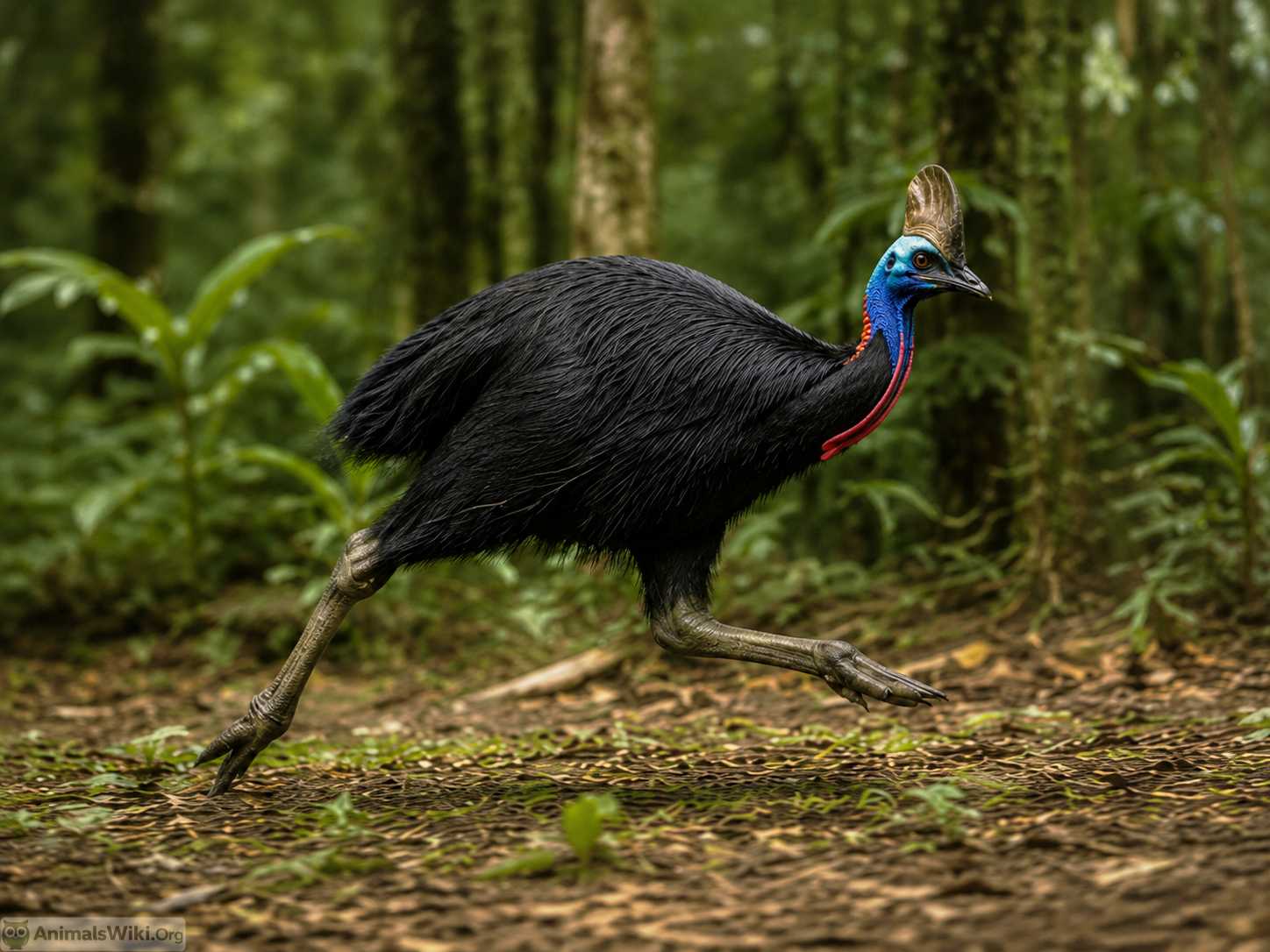
Despite being one of the heaviest birds in the world, the cassowary is extraordinarily fast:
- Maximum running speed: Approximately 50 km/h (31 mph) through dense forest
- Capable of navigating dense rainforest undergrowth at speed that humans cannot match
- Can jump up to 1.5 meters vertically from a standing position
- An excellent swimmer — readily enters and crosses rivers, swimming with its body submerged and head above water
Did You Know? The cassowary’s inner toe dagger claw can reach 12 cm (nearly 5 inches) in length in old females — approximately the length of a steak knife blade. Unlike most bird claws, which are curved, the cassowary’s inner claw is nearly straight — optimized for penetration rather than gripping. In the documented fatal attack of 1926 (the only documented human fatality from a cassowary attack in the 20th century), the 75-year-old victim was struck in the neck by this claw when he fell on a cassowary he had cornered. The claw severed his carotid artery.
3. Natural Habitat & Geographic Range
The cassowary is a bird of tropical and subtropical rainforest — one of the most demanding and most specific habitat associations of any large bird, reflecting millions of years of co-evolution with the ancient forests of the Australo-Papuan region.
Primary Habitat Requirements
Dense tropical rainforest — the core habitat for all three cassowary species; the dense forest floor, with its abundance of fallen fruits and covering vegetation, provides both the food and the cover that cassowaries require; cassowaries are fundamentally birds of the forest floor and lower canopy edge, not of open spaces
Access to fruit-bearing trees — cassowaries require habitats with year-round or near-year-round availability of fallen fruits from large-fruited tree species; the diversity and abundance of fruit-bearing trees directly determines the carrying capacity of cassowary habitat
Water access — cassowaries drink regularly and readily swim; habitats with streams, pools, or access to wetlands are preferred; during fruit scarcity, cassowaries may travel significant distances to water
Dense undergrowth and cover — cassowaries require dense vegetation for nesting cover, shade from the intense tropical sun, and escape cover from threats; open habitats are generally avoided except during food searches
Australian Range — The Wet Tropics
The Southern Cassowary in Australia is restricted to the Wet Tropics bioregion of northeastern Queensland — a narrow strip of lowland and montane rainforest running approximately 250 km from Cooktown in the north to Cardwell in the south:
Key areas:
- Daintree Rainforest and Cape Tribulation — UNESCO World Heritage area; most famous cassowary habitat; accessible to wildlife tourists; highest public awareness of cassowary conservation
- Mission Beach and Kennedy Range — one of the highest Australian cassowary densities; the site of intensive cassowary monitoring and conservation programs; also the site of significant road mortality
- Atherton Tablelands — inland rainforest habitat; significant cassowary population in highland areas
- Kuranda and surroundings — cassowaries present near tourist infrastructure; some of the most frequently photographed individuals
Australian population estimate: Approximately 2,000–4,000 individuals — though estimates vary widely and the population is considered to be declining; some assessments suggest fewer than 1,500 birds remain in Australia, making the Australian population critically important for conservation attention
New Guinea Range
The cassowary’s primary range is New Guinea — the world’s second-largest island (after Greenland), shared between Papua New Guinea (PNG) and the Indonesian provinces of Papua and West Papua:
- The Southern Cassowary occupies southern New Guinea — the lowland forests of the Trans-Fly region and the southern coast
- The Northern Cassowary (C. unappendiculatus) occupies northern and western New Guinea
- The Dwarf Cassowary (C. bennetti) occupies highland New Guinea — forests at elevations of 1,000–3,000 meters — as well as parts of New Britain island
New Guinea is poorly surveyed and cassowary population estimates for PNG and Indonesian Papua are uncertain — but the island’s vast extent of relatively intact tropical forest means New Guinea populations are likely much larger than Australian populations.
Habitat Use — Daily and Seasonal Movement
Home range size: Cassowary home ranges are substantial — typically 17–70 km² for adult females in Australian rainforest studies; males occupy smaller ranges during incubation
Seasonal movement: Cassowaries follow the fruiting phenology of rainforest trees — moving through their home range to exploit trees in current fruit production; in Queensland, seasonal movements between elevation zones follow the altitudinal fruiting patterns of different tree species
Forest floor specialists: Despite their height, cassowaries spend most of their time on the forest floor — foraging among fallen fruit and leaf litter; they occasionally climb embankments and use elevated terrain but rarely move into the forest canopy
4. Diet & Feeding Behavior
The cassowary’s diet is fundamentally that of a frugivore — an animal specializing in fruits — though it supplements this with a variety of other foods that make it technically an omnivore. The frugivorous diet is the basis of the cassowary’s most important ecological role and the key to understanding its evolutionary history.
What Cassowaries Eat
Fallen fruits — the overwhelming majority of the cassowary’s diet; cassowaries consume fruits primarily from the forest floor after they have fallen from the tree; they can swallow extraordinarily large fruits — fruits up to 10 cm in diameter are swallowed whole; fruits with tough outer skins that most animals cannot access are handled effectively by the powerful beak
Key fruit species in Queensland:
- Cassowary plum (Cerbera floribunda) — toxic to most animals but consumed by cassowaries; the seeds are dispersed intact in dung
- Bleeding heart (Homalanthus novoguineensis) — important cassowary food
- Davidson’s plum (Davidsonia pruriens) — consumed in large quantities during fruiting
- Pepper vine (Piper spp.) — consumed regularly
- Over 238 plant species have been documented in the cassowary diet in Australia alone
Fungi — consumed regularly, particularly during periods of fruit scarcity; the cassowary’s consumption of fungi contributes to fungal spore dispersal across the forest
Invertebrates — snails, insects, worms, and other invertebrates gleaned from forest floor leaf litter; more important in juveniles and during fruit scarcity
Small vertebrates — small frogs, lizards, snakes, and small mammals occasionally consumed; primarily opportunistic; more common than often recognized but still a minor dietary component
Carrion — occasionally consumed; cassowaries will feed on dead animals encountered during forest floor foraging
Vegetation — seeds, shoots, and small plant parts consumed incidentally; grass shoots and aquatic plants consumed near water sources
The Cassowary’s Extraordinary Digestive System
The cassowary’s digestive system is specifically adapted for processing large, tough fruits:
The muscular gizzard — like all ratites (and many other birds), cassowaries have a powerful gizzard that grinds food mechanically; the cassowary gizzard can process hard seed coats that most animals cannot handle
Gut passage time — research has measured cassowary gut passage time for seeds at approximately 21–23 minutes for small seeds to several hours for larger seeds; this relatively fast passage time means seeds are deposited at distances of several hundred meters to over a kilometer from the parent tree — genuine long-distance dispersal
Selective digestion — cassowaries digest the fruit pulp and sugars while passing seeds largely intact; the digestive chemistry does not damage most seeds; for some species, gut passage through a cassowary actually improves germination rates — possibly by scarifying seed coats or removing inhibitory compounds from the seed surface
Tolerance for toxicity — cassowaries can consume fruits that are toxic to most other animals; the biochemistry of this tolerance is not fully understood but appears to involve liver detoxification systems that rapidly neutralize plant toxins
Foraging Behavior
Foraging style: Cassowaries walk systematically through their home range, following regular routes that cover key fruiting trees; they use auditory cues (the sound of fruit hitting the forest floor) to locate fresh falls; they also use olfactory cues (smell of ripe fruit) and visual cues (color of ripe fruit on the forest floor)
Foraging time: Most active foraging occurs in the early morning and late afternoon when temperatures are cooler; midday rest periods in shade are common
Food availability tracking: Cassowaries appear to maintain mental maps of fruiting tree locations in their home ranges and make directed movements to trees expected to be in fruit based on phenological experience — suggesting a level of spatial and temporal planning that is remarkable in a bird
Diet Breakdown Table
| Food Type | % of Annual Diet | Peak Season | Notes |
|---|---|---|---|
| Fallen fruits | 70–85% | Year-round; peaks with fruiting seasons | Primary food; 238+ species documented in Australia |
| Fungi | 5–10% | Wet season | Important during fruit scarcity; spore dispersal |
| Invertebrates | 5–10% | Year-round | Snails, insects, worms; more important for juveniles |
| Small vertebrates | 2–5% | Year-round | Frogs, lizards, snakes; opportunistic |
| Vegetation | 2–5% | Dry season | Shoots, grass; supplementary |
| Carrion | <2% | Year-round | Opportunistic; rarely documented |
5. Reproduction & Life Cycle
The cassowary’s reproductive biology is one of the most remarkable of any large bird — featuring role-reversed sex roles in which the male performs all incubation and chick-rearing, the female is the competitive and territory-holding sex, and the pair bond is minimal and seasonal.
Sexual Maturity
- Females: Sexual maturity at approximately 2–3 years of age
- Males: Sexual maturity at approximately 3–4 years of age; males must establish territories and demonstrate ability to incubate and raise chicks before achieving reproductive success
Breeding Season
In Australia, cassowary breeding season runs approximately May–October — the austral winter and dry season; this timing ensures that chicks hatch and grow through the wet season when fruit availability is highest.
The breeding season timing in New Guinea varies by location and elevation.
Courtship — Female Initiated
Contrary to the pattern in most birds where males initiate and display, female cassowaries actively court males:
- Females patrol their large territories and approach smaller, more timid males
- Courtship involves deep, resonant booming calls (the lowest-frequency calls of any bird in Australia) produced by both sexes
- The female performs a stiff-legged strutting display with neck feathers ruffled and wattles displayed
- The male, if receptive, adopts a submissive posture
- Pairing is typically brief — the pair associate for only a few weeks while mating occurs, then the female moves on (potentially to mate with other males in her territory)
The Unusual Mating System — Polyandry
The Southern Cassowary’s mating system is sequential polyandry — a rare system in birds where one female mates with multiple males:
- A single female may mate with 2–3 males per season
- After mating with each male, she lays a clutch of eggs and leaves the male to incubate and raise the young independently
- The female plays no role in incubation or chick-rearing
- The female moves to her next mate while the first male is still incubating
This system makes the female the reproductive bottleneck and the competitive sex — females compete with other females for access to multiple males. It is one of the clearest examples of sex-role reversal in any vertebrate.
Nesting and Incubation
Nest construction: The male constructs a rudimentary nest on the forest floor — a shallow scrape lined with leaves, ferns, and plant material, typically located in dense undergrowth that provides concealment
Clutch size: Typically 3–5 eggs (range 2–8)
Egg characteristics:
- Color: Distinctive bright pea green to olive green — one of the most unusual egg colors of any bird; the green color provides camouflage among the vegetation of the forest floor
- Size: Large — approximately 9 cm × 14 cm (3.5 × 5.5 inches); weighing approximately 600 grams
- Texture: Slightly granular surface with a rough, pitted texture
Incubation:
- Performed entirely by the male
- Incubation period: Approximately 49–52 days — one of the longer incubation periods among ratites
- The male sits on the eggs nearly continuously; he leaves the nest only briefly to feed and drink
- The male loses significant body weight during incubation due to reduced feeding
Chick Development
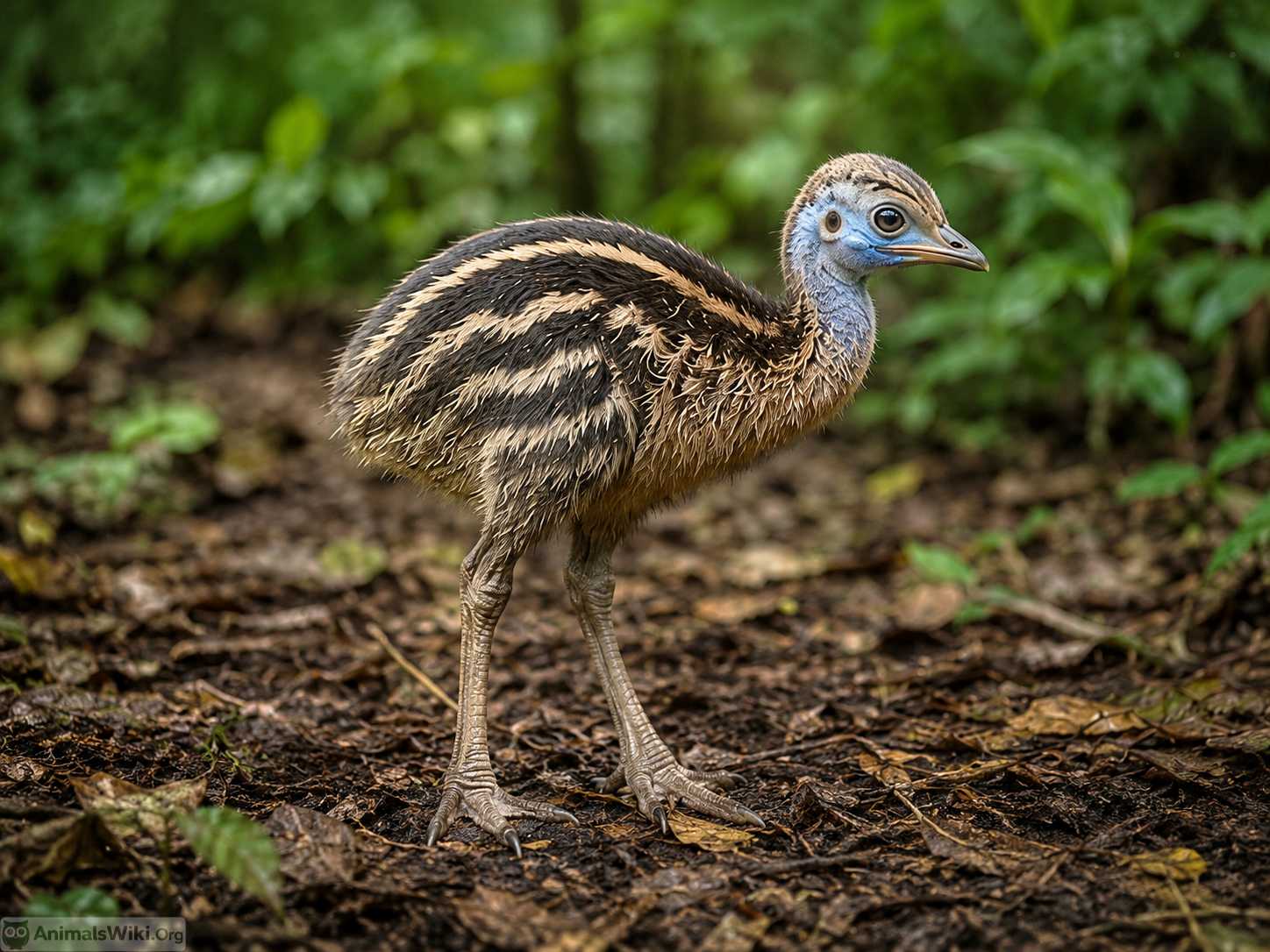
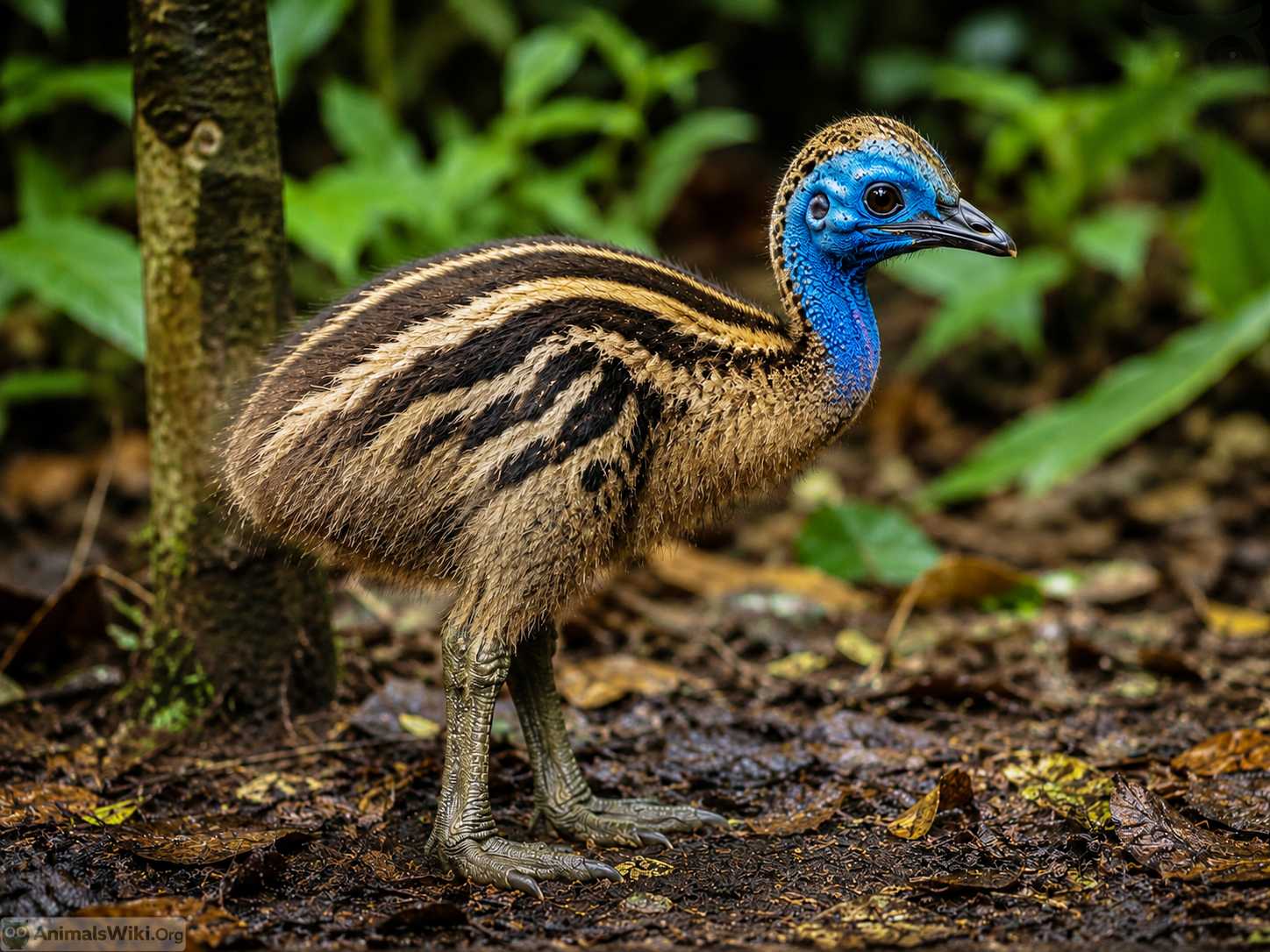
Cassowary chicks are precocial — striped brown and buff at hatching, mobile within hours:
| Stage | Timing | Development |
|---|---|---|
| Hatching | Day 0 | Buff with dark brown stripes; eyes open; mobile within hours |
| First foraging | Day 2–3 | Follow father; peck at food items father indicates |
| Stripe fading | Months 3–6 | Stripes fade; plain brown juvenile plumage emerging |
| Casque development | Months 6–12 | Small casque beginning to develop |
| Adult plumage | Year 3 | Full black adult plumage; wattles and casque approaching adult |
| Full adult size | Year 3–4 | Full size achieved; reproductive maturity approaching |
Paternal care duration: The male guards and raises his chicks for approximately 9–16 months — one of the longest paternal investment periods of any bird; during this time, he is extremely aggressive toward any perceived threats to his chicks and is at his most dangerous to humans
Lifespan
- Wild: Approximately 18–20 years
- Captivity: Up to 40 years documented; one individual at the Toronto Zoo lived for over 40 years
6. Social Behavior & Communication
The cassowary is fundamentally solitary — one of the most asocial of all large birds — yet maintains sophisticated territory communication systems and produces one of the most remarkable acoustic repertoires of any bird.
Solitary Lifestyle
Adult cassowaries live alone for most of the year:
- Each adult maintains an exclusive territory defended against other adults
- The only regular social interactions are during the breeding season (brief male-female pairing) and the extended male-chick association
- Juveniles begin independent ranging from approximately 18 months, initially in areas near their father’s territory
Territory size:
- Female territories: 17–70 km² in Queensland — the largest home ranges documented for any Australian bird
- Male territories: Smaller; nested within one or more female territories
- Territory boundaries are maintained through vocalizations and apparent familiarity with other individuals’ ranges
The Remarkable Vocal Repertoire
Cassowaries produce one of the most extraordinary collections of sounds of any bird in Australia — spanning from infrasound (below human hearing) to audible calls:
The booming call (infrasound): The cassowary’s most significant vocalization is a deep, resonant boom produced at frequencies partly or wholly below the threshold of human hearing (below 20 Hz). Research by Cathy Hercock and others has documented that this infrasound propagates through dense forest vegetation much more effectively than higher-frequency sounds, allowing cassowaries to communicate across distances of several kilometers through rainforest that would block most bird calls.
The casque is thought to be involved in generating and/or receiving these infrasound calls — functioning as a resonating chamber for low-frequency sound production and a detector for incoming infrasound.
Audible calls:
- Rumbling booms — the most commonly heard cassowary sound; a series of deep, resonant boom-boom-boom calls; the lowest-frequency calls regularly audible to humans produced by any Australian bird
- Hissing — produced during threat and challenge situations; an intense warning that almost always precedes an attack
- Rumbling growls — lower-intensity threat vocalizations
- Bellowing and roaring — rare, high-intensity alarm calls produced during extreme disturbance
- Chick calls — high-pitched whistling and chirping by chicks; maintains contact with the father
Territorial Communication
Cassowaries maintain territory boundaries through a combination of:
- Infrasound booming — long-range territory advertisement
- Scent marking — possibly through dung deposits at territory boundaries
- Physical presence — regular patrol of territory boundaries
Intruding cassowaries are typically confronted directly — the resident ruffles its feathers, extends its neck, makes itself appear as large as possible, and advances toward the intruder; the intruder typically retreats before contact, though physical combat between females competing for territory or between males does occasionally occur.
7. Predators & Defense Mechanisms
The adult cassowary has essentially no natural predators — the combination of its size, speed, and weaponry makes it invulnerable to any predator currently present in its range. The situation for juveniles is dramatically different.
Natural Predators
Adult cassowaries: No living animal in New Guinea or Australia is capable of successfully predating a healthy adult cassowary under normal circumstances. Historically, Thylacine (Tasmanian Tiger) may have occasionally taken cassowaries in mainland Australia before its extinction, but this is speculative.
The primary mortality source for adult cassowaries is humans — through vehicle strikes, dog attacks, and habitat loss.
Juvenile cassowaries (< 18 months):
- Domestic and feral dogs — the most significant predator of cassowary chicks and juveniles in Australia; a major conservation concern around urban-rural interfaces
- Pigs (Sus scrofa) — feral pigs disrupt cassowary nests, consume eggs, and may attack small chicks
- Pythons (Morelia spp.) — large pythons can take juvenile cassowaries on the forest floor
- Saltwater Crocodile (Crocodylus porosus) — takes juvenile cassowaries at water crossings
- Various raptors — large eagles and hawks may occasionally take young chicks; no systematic predation documented
The Defense Arsenal
The cassowary’s defensive capabilities are among the most impressive of any bird:
Primary weapon — the dagger kick: The cassowary’s primary offensive and defensive weapon is the forward kick delivered with the inner-toe dagger claw:
- The kick is delivered forward and downward (not backward like a horse or ostrich)
- The force is exceptional — a large cassowary kick can stagger or knock down an adult human
- The dagger claw penetrates flesh to considerable depth — documented wounds include lacerations to 30 cm deep and penetration of body cavities
- The kick is reflexively fast — humans have been struck before consciously processing the beginning of the movement
Secondary weapon — the leap: Cassowaries can jump and deliver a kick at face or chest height to a human adult — a capability that removes the potential safety of being taller than the bird
Running: The ability to flee at 50 km/h through dense forest means that in most circumstances, a cassowary can escape any threat; attack is typically a last resort when escape is impossible or when the cassowary is defending young
Defensive display — before the attack: The cassowary typically provides a threat sequence before physical attack:
- Freeze and stare — the cassowary stops moving and fixes its gaze on the threat; the pale yellow eye is extraordinarily piercing
- Feather puffing — body feathers raised to increase apparent size
- Neck extension — neck extended and wattles displayed at maximum vividity; the casque tilted toward the threat
- Hissing — audible warning hiss
- Charge — rapid advance toward the threat; may be a mock charge (stopping short) or committed
The sequence from frozen stare to committed charge can happen very rapidly — experienced handlers emphasize that the stare alone should be treated as an attack warning requiring immediate withdrawal.
Documented Human Attacks
The cassowary has a documented record of attacks on humans spanning centuries:
The 1926 fatality: The only 20th-century human fatality from a cassowary attack; Philip McLean, 75, died after falling onto a cassowary he had been chasing with his brother on their property near Mossman, Queensland; the bird’s inner claw opened a wound in his neck that severed his carotid artery.
The 2019 fatality: Marvin Hajos, 75, died on his property in Alachua County, Florida, USA, following an attack by his pet cassowary while he was down on the ground near the bird. This was the first confirmed cassowary-related human fatality in over 90 years.
Documented attacks globally: Studies have documented over 200 cassowary attacks on humans over recorded history; the majority involve kicks causing lacerations, puncture wounds, and broken bones; serious injuries are not uncommon in attacks where the human is knocked to the ground (making them vulnerable to the forward dagger kick at body level).
Common contexts for attacks:
- People approaching cassowaries that have habituated to humans and associate humans with food
- Surprising a cassowary with a feeding territory
- Getting between a male and his chicks
- Approaching a corner (cassowaries cannot back up rapidly and may attack when they feel they cannot escape)
- People attempting to touch or photograph cassowaries at close range
Did You Know? According to the Guinness World Records, the cassowary holds the title of “World’s Most Dangerous Bird” — the only bird species with a documented record of killing adult humans in recent times through direct physical attack. However, the cassowary is not instinctively aggressive — the vast majority of cassowaries encountered in the wild do not attack humans unless provoked, cornered, or habituated to human food association. The danger is real but statistical — a cassowary surprised or cornered is the situation to avoid at all costs.
8. Relationship with Humans
Indigenous Relationships — Thousands of Years of Coexistence
Indigenous peoples of New Guinea and Australia have coexisted with cassowaries for thousands to tens of thousands of years — developing deep cultural, practical, and spiritual relationships with the bird.
New Guinea peoples: The cassowary is one of the most culturally significant animals in Papuan and Melanesian cultures across New Guinea:
- As food — cassowary meat is an important protein source across New Guinea; hunting cassowaries is a traditional practice associated with significant prestige; cassowary fat and meat are considered valuable and are distributed through traditional food-sharing networks
- Cassowary as trade commodity — live cassowaries (particularly juveniles captured and raised as semi-domesticated animals) are one of the most important traditional trade goods in New Guinea; cassowaries are used in bride price ceremonies, traded between communities, and kept for ceremonial feasts
- Feathers and bones as cultural materials — cassowary feathers and bones are used extensively in traditional ornamentation, ceremonial dress, and tool-making; the dagger claws are particularly valued as ornaments and weapons
- Spiritual significance — the cassowary appears in the cosmological frameworks of numerous Papuan peoples; in some traditions it is associated with forest spirits, ancestors, or powerful natural forces; hunting cassowaries involves specific ritual observances in many cultures
Aboriginal Australians: The Southern Cassowary has been part of the cultural landscape of northeastern Queensland Aboriginal peoples for the full duration of their occupation of the Wet Tropics — over 50,000 years:
- The Dyirbal, Yidiny, Djabugay, and other peoples of the Wet Tropics region have traditional knowledge of cassowary ecology, behavior, and management that extends over millennia
- Cassowary appears in Dreaming stories and is associated with specific country and family connections in northeastern Queensland
- Traditional ecological knowledge of cassowary behavior, habitat requirements, and seasonal movements is extensive in these communities and increasingly recognized as complementary to scientific wildlife management
European Discovery and Documentation
European naturalists first formally documented the cassowary in the 17th century from specimens brought to Europe by Dutch trading expeditions:
- The first European description of a cassowary comes from a specimen brought to Europe from the Banda Islands (now part of Indonesia) in approximately 1597
- The bird caused enormous confusion among European natural historians unfamiliar with any comparable animal — some initially classified it with the ostrich, others with mythological creatures
- Carl Linnaeus formally described Casuarius casuarius in 1758
Modern Human-Cassowary Conflict
The primary modern human-cassowary relationship challenge is human-wildlife conflict — specifically around food conditioning and road mortality in Australia:
Food conditioning: Cassowaries that are fed by humans (deliberate feeding, handouts from tourists, or access to human food scraps) undergo behavioral changes that significantly increase attack risk:
- They associate humans with food sources
- They approach humans with increased confidence
- When no food is provided, they may become aggressive
- Feeding cassowaries is illegal in Queensland but widely practiced by residents and tourists
The Mission Beach area and other tourist-dense parts of the Wet Tropics have populations of cassowaries that have been significantly food-conditioned over decades — creating an ongoing public safety challenge and management burden.
Road mortality: Vehicle strikes are the leading cause of cassowary death in Australia:
- Cassowaries cross roads regularly as they move through their home ranges
- Road infrastructure has expanded substantially through cassowary habitat over recent decades
- Night-time road crossing is common (when vehicles are less visible)
- Road mortality data from Queensland suggests dozens of cassowaries are killed by vehicles annually — a significant proportion of the small Australian population
The Mission Beach community has been a leader in cassowary road mortality reduction through programs including:
- Road signage (the iconic “slow down for cassowaries” signs)
- Cassowary cameras at high-risk road sections
- Community wildlife patrol programs
- Speed reduction campaigns at known cassowary crossing points
9. Conservation Status & Threats
IUCN Status
- Southern Cassowary (C. casuarius): Least Concern globally — large New Guinea populations maintain the species at global scale
- Southern Cassowary in Australia: Endangered under Australian national legislation (EPBC Act) — small, declining population with documented threats
- Northern Cassowary (C. unappendiculatus): Vulnerable — declining due to habitat loss and hunting in New Guinea
- Dwarf Cassowary (C. bennetti): Least Concern — most secure; highland mountain habitats less severely impacted
The Australian Conservation Crisis
The Australian Southern Cassowary population represents approximately 2,000–4,000 individuals (some estimates lower) in the Wet Tropics of Queensland — a small, fragmented, declining population that is effectively a distinct conservation unit from the much larger New Guinea populations:
The fragmented landscape: The Wet Tropics of Queensland is a linear strip of forest approximately 250 km long and typically less than 50 km wide — bordered by the Coral Sea to the east and by dryland habitats to the west. Within this already narrow strip, the forest is further fragmented by:
- Agricultural land (particularly sugar cane, banana, and cattle farming)
- Urban development (coastal towns, resorts)
- Roads and infrastructure
Cassowaries must navigate this fragmented landscape to maintain population connectivity — but the barriers (roads, cleared land, buildings) increase mortality risk dramatically.
Key Threats
1. Road Mortality — The Leading Cause of Death
Vehicle strikes are the single leading cause of cassowary mortality in Australia — accounting for approximately 30–40% of all recorded cassowary deaths. The combination of expanding road infrastructure, increasing traffic volume, and the cassowary’s habit of road-crossing makes this a persistent and worsening threat.
Why roads are particularly dangerous:
- Cassowaries have not evolved road-avoidance behavior (roads have only existed in their habitat for decades)
- The forest edge habitat along roads provides attractive foraging conditions
- Cassowaries cross roads as part of normal home range use
- Night-time crossing reduces visibility to drivers
2. Dog Attacks
Dogs — both domestic and feral — are the second leading cause of cassowary mortality in Australia:
- Domestic dogs in residential areas adjacent to cassowary habitat attack cassowaries that enter yards
- Feral dogs in forest areas prey on juvenile cassowaries and stress adults
- Dog attacks cause injuries that result in death either directly or through infection
3. Habitat Loss
The conversion of Wet Tropics forest to agriculture, residential development, and infrastructure has:
- Reduced total cassowary habitat area
- Increased the fragmentation of remaining habitat
- Eliminated wildlife corridors between forest patches
- Reduced fruit tree diversity and abundance in edge habitats
4. Habitat Degradation
Even within remaining forest, habitat quality is affected by:
- Feral pigs — root up forest floor vegetation, destroy cassowary nests, and consume eggs and chicks
- Invasive weeds — replace native fruit-bearing plants with species of no food value to cassowaries
- Climate change — affecting fruiting phenology and fruit availability in the Wet Tropics
5. Low Genetic Diversity
The small, fragmented Australian population faces risk of genetic isolation — isolated subpopulations cannot exchange genetic material, leading to inbreeding depression and reduced fitness over generations.
Conservation Programs in Australia
Rainforest Rescue — significant land protection and revegetation program in the Wet Tropics; planting cassowary food trees in fragmented areas
Department of Environment and Science (Queensland) — monitoring, rescue and rehabilitation, road mortality data collection
Community-based cassowary programs — numerous community groups in Mission Beach, Cape Tribulation, and other areas actively monitoring cassowaries, reducing road mortality, and managing conflict
Cassowary Recovery Team — government-led recovery planning under the EPBC Act
10. Famous Cassowaries Around the World
Peanut — Mission Beach’s Most Famous Resident
In the Mission Beach community of Queensland, individual cassowaries are named and tracked by residents and conservation volunteers — many have become celebrities within the local conservation community. “Peanut” and other named individuals at Mission Beach have been photographed thousands of times, appeared in conservation campaigns, and serve as ambassadors for the species in local community awareness programs.
The Toronto Zoo’s Long-Lived Ambassadors
The Toronto Zoo has maintained Southern Cassowaries for decades and holds records for some of the longest-lived cassowaries in captivity — individuals at Toronto and other major accredited zoos have provided data on cassowary longevity, health, and captive management that informs both captive care standards and conservation management for wild populations.
The Specimens That Founded European Science
The first European cassowary specimens — brought from the Banda Islands to the Netherlands in approximately 1597 — caused scientific confusion that persisted for decades; they were initially housed in the menageries of Holy Roman Emperor Rudolf II in Prague, becoming the first cassowaries seen in Europe. Their examination by European naturalists including Carolus Clusius produced the first scientific descriptions of the species.
The Banda Islands Population — Historical Significance
The cassowary population of the Banda Islands (now part of Indonesia) holds historical significance as the source of the first specimens to reach Europe and the basis for Linnaeus’s formal description. The Banda population is a subspecies-level variant (C. c. bicarunculatus) that remains present on the islands — themselves historically famous as the center of the global nutmeg trade that drove early Dutch colonial expansion.
11. Role in Ecosystem & Food Chain
The “Gardener of the Rainforest” — Seed Dispersal
The cassowary’s most important ecological role — and the one that makes its conservation so critical — is as a seed disperser of extraordinary significance for the Australo-Papuan rainforest:
The scale of the function:
- In Queensland rainforest, over 238 plant species have been documented in cassowary diet
- Approximately 70–80 plant species in Queensland rainforest produce fruits that are exclusively or primarily dispersed by cassowaries — they have no other effective disperser
- These cassowary-dependent plants are not minor components of the forest — they include some of the most ecologically important and structurally dominant tree species in the Wet Tropics
Why cassowaries are irreplaceable: Most large-fruited rainforest trees in northeastern Queensland face a dispersal problem — their fruits are too large for birds other than the cassowary to swallow, too tough for most mammals to handle, and too toxic for most animals to consume without harm. The cassowary is not merely the best disperser for these fruits — in many cases it is the only disperser.
The consequence is direct: forests without cassowaries eventually lose the large-fruited tree species that cassowaries disperse. Over decades to centuries, the tree community composition shifts — large-fruited species fail to recruit new trees from seed, their populations age and gradually disappear, and the forest becomes simpler and less diverse.
This is not a theoretical prediction — it is an observed process in forest patches from which cassowaries have been extirpated in Australia and New Guinea.
Long-distance dispersal: Cassowaries move across their large home ranges (17–70 km² in Australia) while digesting seeds; a seed consumed at one side of the home range may be deposited several kilometers away in a completely different forest community — providing genetic mixing across the plant population that localized dispersal (by bats, smaller birds, or fruit fall) cannot achieve.
Recovery function: Cassowaries are particularly important for rainforest recovery after disturbance — they are among the first large animals to enter recovering rainforest patches, bringing seeds from nearby intact forest and accelerating the return of large-fruited tree species that would otherwise fail to colonize recovering areas.
As Prey — Supporting the Food Web
Cassowary eggs and chicks are an important food source for several forest species:
- Feral and domestic dogs — significant predation impact
- Feral pigs — consume eggs and young chicks
- Pythons — take young chicks opportunistically
- Crocodiles — take water-crossing juveniles
The cassowary’s position in the food web, while not as a dominant prey species, contributes to the energy flow supporting these predator populations.
Habitat Modification
Cassowaries contribute to habitat modification through:
- Leaf litter disturbance — foraging activity turns over considerable leaf litter, exposing invertebrates and creating microhabitats for decomposers and forest floor species
- Trail maintenance — regular movement along established trails through dense forest maintains pathways used by numerous other species
- Dung deposition — cassowary dung is a nutrient-rich fertilizer; concentrated at regularly used spots within the home range, it creates nutrient hot-spots that support enhanced plant growth
12. Myths, Culture & Pop Culture Appearances
New Guinean Cultural Significance
As described in the human relationships section, the cassowary is one of the most culturally significant animals in New Guinean traditional cultures — its importance spanning material culture, ceremony, and cosmology:
The cassowary in Asaro (Mudmen) culture: The peoples of the Asaro Valley in Papua New Guinea’s Eastern Highlands — famous for the “mudmen” ritual in which participants cover themselves in clay masks — include cassowary feathers in ceremonial dress and regard the cassowary as a powerful forest spirit associated with male initiation and warrior status.
Cassowary dagger claws as weapons: Throughout New Guinea, the cassowary’s inner dagger claw is used as a spear tip, awl, and ornament. Archaeological sites in New Guinea contain cassowary claw ornaments dating back thousands of years — demonstrating the longevity of this cultural relationship.
The cassowary and headhunting traditions: In some Papuan cultural traditions historically associated with headhunting, the cassowary was associated with the warrior ethos — the bird’s dangerous reputation made its feathers and claws powerful symbolic objects in warrior regalia.
Australian Aboriginal Cultural Connections
In Queensland’s Wet Tropics, Aboriginal traditional ecological knowledge of the cassowary is extensive. The Dyirbal word for cassowary is gunduy; the bird features in Dreaming stories that explain the characteristics of the cassowary in narrative terms and connect the bird to specific ancestral country. Traditional knowledge of cassowary behavior — including seasonal movement patterns, fruiting associations, and dangerous approach behaviors — is held by Elders of Wet Tropics communities and represents thousands of years of accumulated observation.
The “Most Dangerous Bird” in Popular Media
The cassowary’s reputation as the world’s most dangerous bird has made it a recurring presence in popular media:
- Guinness World Records — the cassowary’s official recognition as the world’s most dangerous bird in the Guinness records has been cited in thousands of popular science articles, social media posts, and educational materials; this designation has probably done more to raise global cassowary awareness than any specific conservation campaign
- Social media — cassowary content — particularly videos of cassowaries interacting with humans, stalking tourists, or displaying at zoo fences — consistently generates extraordinary engagement across platforms; the combination of vivid coloration, prehistoric appearance, and dangerous reputation makes cassowaries exceptionally compelling social media subjects
- Documentary coverage — the cassowary appears in virtually every major natural history documentary series covering Australia or New Guinea; David Attenborough productions have featured the cassowary multiple times; the BBC’s “Life” series (2009) included cassowary footage; the bird’s striking appearance and behavioral repertoire make it excellent documentary subject matter
- Australian wildlife education — the cassowary features prominently in Australian school education about Wet Tropics ecology; it is used as a flagship species for rainforest conservation education in Queensland
- Dinosaur comparisons — the cassowary’s prehistoric appearance has made it a recurring reference in popular dinosaur content; multiple viral social media posts have described it as “the closest thing to a dinosaur you can encounter today” — a scientifically legitimate point (birds are dinosaurs, and the cassowary is among the most morphologically “archaic” of all living birds)
Did You Know? Scientists studying the biomechanics of theropod dinosaurs (the group that includes both Velociraptor and the ancestors of modern birds) have used the cassowary as a living model for understanding how theropods may have used their inner claw (the killing claw). Velociraptor’s famous inner claw was long assumed to be used for slashing prey — the cassowary demonstrates exactly this mechanism in a living bird. When researchers analyzed the cassowary’s attack kinematics and compared them with theropod anatomy, they found compelling parallels that have influenced modern interpretations of theropod predation. In this sense, watching a cassowary defend itself is watching a version of Velociraptor’s attack mechanism in real time.
13. Discovery & Evolution Timeline
~165 million years ago — The evolutionary lineage leading to modern birds diverges from other theropod dinosaurs; early bird evolution begins in the late Jurassic.
~66 million years ago — The end-Cretaceous mass extinction eliminates non-avian dinosaurs; birds survive and begin an extraordinary adaptive radiation.
~60–65 million years ago — The Palaeognathae (the superorder containing ratites including cassowaries, as well as kiwis and tinamous) diverges from the Neognathae (all other modern birds); the earliest ratite ancestors are established.
~50–55 million years ago — Australia and New Guinea begin separating from the rest of Gondwana; the ancestors of cassowaries are isolated in the Australo-Papuan region and begin their independent evolutionary trajectory.
~35–40 million years ago — The cassowary lineage (Casuariidae) diverges from the emu lineage; the ancestors of modern cassowaries are established in the rainforest environment of the Australo-Papuan region.
~20 million years ago — The three modern cassowary species’ lineages begin differentiating as New Guinea’s mountain building separates highland from lowland forest environments.
~50,000+ years ago — First humans arrive in Australia and New Guinea; the long-term coexistence between cassowaries and Indigenous peoples begins.
~18,000 years ago — Sea level changes at the peak of the last glacial maximum connect Australia and New Guinea; cassowaries are present throughout the combined landmass.
~7,000 years ago — Rising sea levels following glacial retreat separate Australia from New Guinea (via the Torres Strait); Australian and New Guinean cassowary populations become isolated.
~1597 — Dutch trading vessels from the Banda Islands spice trade bring the first cassowary specimens to Europe; the birds are housed in the menageries of Holy Roman Emperor Rudolf II in Prague.
1613 — The first detailed European description of a living cassowary is published; European naturalists begin attempting to classify the bird.
1758 — Carl Linnaeus formally describes Casuarius casuarius in Systema Naturae; the scientific name and genus are established.
Early 19th century — The first Southern Cassowaries reach Europe and North America as exhibits; European public fascination with the bird’s appearance and danger begins.
1926 — Philip McLean becomes the first (and until 2019, only) documented human killed by a cassowary in the 20th century in Australia.
Early 20th century — Large-scale land clearing for sugar cane and banana agriculture in Queensland begins seriously reducing cassowary habitat; the first recognition of conservation concern emerges.
1975 — The first systematic cassowary population studies in Queensland begin; the Mission Beach area becomes a focus for cassowary research.
1994 — Southern Cassowary listed as Endangered under Queensland legislation; formal conservation planning begins.
1999 — Listed as Endangered under the Australian national environmental legislation (EPBC Act).
2006 — The first comprehensive Cassowary Recovery Plan published by the Australian government; formal recovery targets and actions established.
2019 — Marvin Hajos becomes the second person in the 20th–21st century killed by a cassowary; his pet cassowary attacked him on his Florida property.
2022–2026 — Continuing cassowary conservation programs in Queensland; ongoing habitat restoration and road mortality reduction efforts; growing scientific understanding of cassowary seed dispersal importance; expanding recognition of Indigenous knowledge in cassowary management.
14. Comparison with Similar Species
| Feature | Southern Cassowary (C. casuarius) | Emu (D. novaehollandiae) | Ostrich (S. camelus) | Rhea (R. americana) |
|---|---|---|---|---|
| Height | 1.5–1.8 m | 1.5–1.9 m | 2.1–2.8 m | 1.2–1.4 m |
| Weight (female) | 58–76 kg | 30–60 kg | 90–110 kg | 20–40 kg |
| Weight (male) | 29–34 kg | 30–60 kg | 100–156 kg | 20–40 kg |
| Sexual dimorphism | Female larger (reversed) | Similar | Male larger | Male larger |
| Range | NE Australia; New Guinea | Australia | Sub-Saharan Africa | South America |
| Habitat | Dense rainforest | Open woodland/grassland | Savannah/grassland | Grassland/pampas |
| Casque | Large, prominent | None | None | None |
| Neck color | Vivid blue/red | Blue-grey (bare skin) | Pink-red (male) | Grey |
| Primary danger | Inner dagger claw; forward kick | Forward kick | Forward kick | Forward kick |
| Most dangerous | ✅ World’s most dangerous bird | Less dangerous | Dangerous but less so than cassowary | Less dangerous |
| Diet | Primarily frugivore | Omnivore | Omnivore | Omnivore |
| Parental care | Male only | Male primarily | Both sexes (day/night) | Male only |
| IUCN Status | LC globally; Endangered in Australia | Least Concern | Least Concern | Near Threatened |
| Seed dispersal role | Extraordinarily important | Moderate | Limited | Moderate |
15. Best Places to See Cassowaries in the Wild
Australia — The Most Accessible Cassowary Habitat
Australia offers the most structured and most accessible cassowary watching experiences — primarily in the Wet Tropics of Queensland:
- 🇦🇺 Mission Beach, Queensland — the world’s most famous cassowary watching destination; the Mission Beach area has one of the highest cassowary densities in Australia; cassowaries are regularly encountered on walking tracks, in residential gardens adjacent to forest, and along the roads; the Licuala State Forest walking track at Mission Beach is particularly productive; the Mission Beach Cassowary Conservation Programme provides maps of known cassowary locations and guidelines for responsible observation; best time: early morning in the wet season (November–April) when fruit is abundant and cassowaries are most active
- 🇦🇺 Daintree Rainforest and Cape Tribulation, Queensland — UNESCO World Heritage listed; cassowaries are present throughout the Daintree Lowland Rainforest; the Cape Tribulation section of Daintree National Park is excellent cassowary habitat; walking tracks including the Dubuji Boardwalk and Kulki Lookout Track provide forest floor access where cassowaries forage; the combination of extraordinary rainforest scenery and cassowary encounters makes this Australia’s most spectacular cassowary watching setting
- 🇦🇺 Etty Bay, south of Innisfail, Queensland — one of the most reliably productive cassowary sites in Australia; cassowaries come to the beach to feed on fallen fruit and are regularly observed in the early morning; the beach setting provides unusual visibility for cassowary observation; a small parking area and short beach walk access the site; best time: early morning year-round
- 🇦🇺 Atherton Tablelands, Queensland — the highland rainforest areas of the Tablelands support cassowary populations; the Malanda area and surrounding highland forest patches have cassowary populations that can be observed on guided walks with specialist local naturalists
- 🇦🇺 Kuranda, Queensland — the Kuranda area near Cairns has cassowary populations accessible from the famous Skyrail Rainforest Cableway corridor and associated walking tracks; less certain sightings than Mission Beach or Daintree but more accessible from Cairns infrastructure
New Guinea — The Wild Heart of Cassowary Country
New Guinea offers the possibility of encountering cassowaries in genuinely wild, largely undisturbed rainforest — though logistics are considerably more complex:
- 🇵🇬 Papua New Guinea — Varirata National Park (near Port Moresby) — the most accessible PNG national park; Southern Cassowary (C. casuarius) and Dwarf Cassowary (C. bennetti) both present; guided walks with local naturalists
- 🇵🇬 Tari Valley and surroundings, PNG Southern Highlands — Dwarf Cassowary country in highland Papua New Guinea; combine cassowary watching with extraordinary cultural experiences in one of PNG’s most visited highland areas
- 🇮🇩 Arfak Mountains, West Papua, Indonesia — extraordinarily biodiverse; Northern and Dwarf Cassowaries present; specialist birding tours available
Wildlife Parks and Zoos
For guaranteed close-range cassowary viewing with educational interpretation:
- Wildlife Habitat, Port Douglas, Queensland — excellent cassowary exhibit in the Wet Tropics; educational interpretation; breakfast with cassowaries experience available
- Rainforestation Nature Park, Kuranda, Queensland — cassowary in natural-setting exhibit; educational programs
- Taronga Zoo, Sydney — Southern Cassowary; excellent exhibit
- Singapore Zoo — Dwarf Cassowary; well-maintained exhibit with natural habitat elements
Safety Guidelines for Wild Cassowary Encounters
- Maintain a minimum distance of 5 meters from any wild cassowary
- Never feed cassowaries — this habituates them to humans and increases attack risk; it is illegal in Queensland
- Back away slowly if a cassowary approaches you — do not run; running may trigger a pursuit response
- Do not crouch or fall near a cassowary — being at eye level or lower dramatically increases attack risk
- If approached aggressively: hold a bag or jacket in front of you to appear larger; retreat to behind a tree or vehicle
- If attacked: protect your neck and torso; the inner claw kick is the primary weapon; attempt to place an obstacle between you and the bird
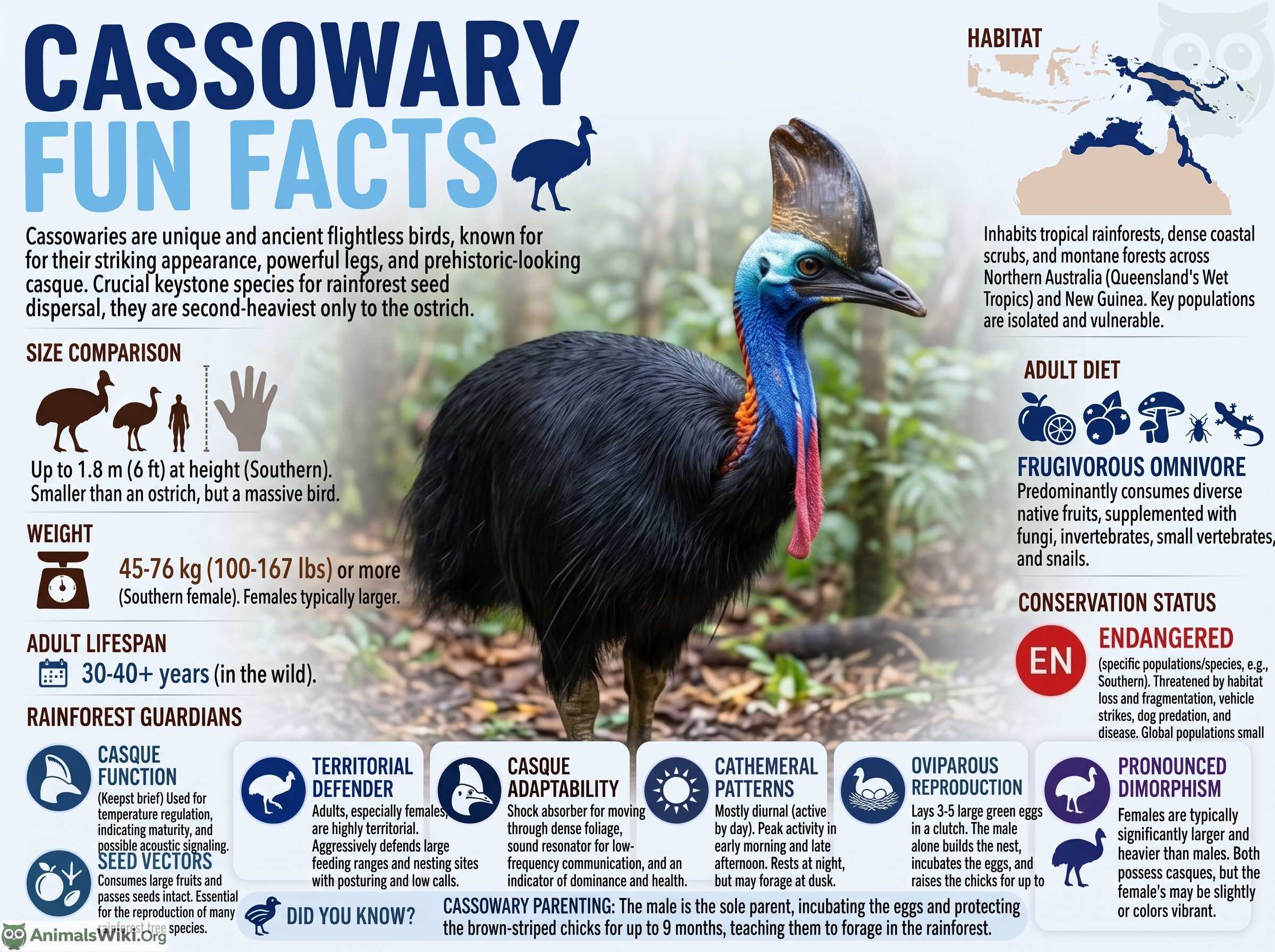
16. Cassowary Fun Facts for Kids
- The cassowary is the world’s most dangerous bird — the only bird species with a documented record of killing adult humans in modern times
- Female cassowaries are significantly larger than males — one of the most dramatic sex-role reversals in the bird world
- The cassowary’s inner claw can reach 12 cm (nearly 5 inches) — approximately the length of a steak knife blade
- Cassowaries can run at 50 km/h (31 mph) through dense rainforest
- The cassowary can jump 1.5 meters vertically from a standing start
- The cassowary’s eggs are bright pea green — one of the most unusual egg colors of any bird
- Over 238 plant species have been documented in the Southern Cassowary’s diet in Australia
- Some cassowary-dependent plants have no other effective seed disperser — without cassowaries, they cannot maintain their populations
- The cassowary’s booming call contains frequencies below human hearing (infrasound) that carry through dense forest for kilometers
- The cassowary is more closely related to the emu than to any other living bird
- The cassowary’s casque (helmet) continues growing throughout its life — old individuals have the largest casques
- Paleontologists use the cassowary as a living model for theropod dinosaur dagger-claw attack mechanics
17. How You Can Help
Support These Organizations
- Rainforest Rescue (rainforestrescue.com.au) — purchasing and protecting Wet Tropics rainforest; planting cassowary food trees in fragmented areas; one of the most direct ways to protect cassowary habitat in Australia
- Mission Beach Cassowary Conservation Programme (cassowaryrecovery.com.au) — community-based cassowary monitoring, road mortality reduction, and habitat management at the most important cassowary locality in Australia; volunteer programs available for visitors
- WWF Australia (wwf.org.au) — broad Queensland wildlife conservation programs including Wet Tropics habitat protection
- Wildlife Queensland (wildlife.org.au) — Queensland-focused wildlife conservation advocacy; cassowary conservation campaigns
- Department of Environment and Science, Queensland — the government agency with primary responsibility for cassowary conservation under the EPBC Act; supporting their programs through public advocacy and political engagement
- Australian Wildlife Conservancy (australianwildlife.org) — protecting Australian wildlife habitat; supporting habitat security for cassowary populations
What You Can Do
- Never feed wild cassowaries — feeding habituates cassowaries to humans, increases attack risk, and is illegal in Queensland; if you visit the Wet Tropics and encounter a cassowary, enjoy it from a respectful distance without offering food
- Drive slowly in cassowary country — road mortality is the leading cause of cassowary death; when driving in the Wet Tropics, particularly at dawn and dusk, drive at reduced speeds and watch for cassowaries crossing roads; the iconic cassowary warning signs are genuine safety advice, not tourist decoration
- Support habitat restoration — donating to organizations that plant cassowary food trees in fragmented Wet Tropics rainforest directly addresses habitat loss; even small donations fund planting programs that improve cassowary habitat connectivity
- Advocate for wildlife corridor protection — the maintenance of connected forest corridors through the Wet Tropics is essential for cassowary population viability; supporting planning policies that protect vegetation corridors between forest patches is a meaningful conservation action
- Control dogs in cassowary habitat — if you live in or visit cassowary habitat, ensure your dog is leashed or properly contained; even friendly, non-aggressive dogs can injure or kill cassowaries through pursuit
- Report cassowary sightings — in Queensland, reporting cassowary sightings to the Department of Environment and Science or to community monitoring programs contributes valuable population data; photograph sightings with GPS data if possible
Recommended Documentaries & Books
- “Wild Australia” (BBC/Australian Geographic) — multiple productions featuring cassowary behavior and conservation
- “Life” (BBC, 2009) — includes cassowary footage in the birds episode
- “Cassowary — The Most Dangerous Bird” (National Geographic) — dedicated feature on cassowary biology and danger
- “Daintree: The Oldest Rainforest” (various) — covers the ecological context of cassowary habitat
- “The Cassowary” by Clifford Frith — the most comprehensive scientific treatment of cassowary biology and ecology; essential reference
- “Wildlife of Tropical North Queensland” by various authors — comprehensive field guide including detailed cassowary accounts
18. Frequently Asked Questions About Cassowary Birds
Q1: Is the cassowary really the world’s most dangerous bird?
Yes — the cassowary holds this distinction officially through the Guinness World Records and is recognized by ornithologists and wildlife managers as the only bird species with a documented record of killing adult humans in modern times through direct physical attack. The most recent fatality was in 2019 in Florida, USA (a captive bird); the previous was in 1926 in Queensland, Australia. The cassowary’s danger comes from its inner dagger claw (up to 12 cm long, straight and razor-sharp), its powerful forward kick, its ability to run at 50 km/h, and its willingness to attack when cornered or defending young. However, cassowaries do not attack humans routinely — the vast majority of encounters in the wild do not result in attacks; danger arises primarily when humans approach too closely, corner the bird, or when the bird has been food-conditioned.
Q2: Why is the cassowary’s casque (helmet) on its head?
The function of the cassowary’s distinctive casque is not fully established and probably serves multiple purposes simultaneously. The most supported hypotheses are: protection when pushing through dense undergrowth — behavioral observation shows cassowaries using their casque to push through thick vegetation; acoustic function — the casque may amplify or detect the cassowary’s infrasound calls, which travel through dense forest for kilometers; social signaling — casque size increases with age and may communicate the bird’s competitive status to other cassowaries; and thermoregulation — the blood-vessel-rich tissue of the casque may assist with heat management. The casque continues growing throughout the bird’s life, making it an age indicator.
Q3: What role do cassowaries play in the rainforest?
Cassowaries are described as “Gardeners of the Rainforest” for their extraordinary seed dispersal function. They consume fruits from over 238 plant species in Queensland rainforest and deposit the seeds (undigested) in their dung at distances of hundreds of meters to over a kilometer from the parent tree. Crucially, approximately 70–80 plant species in Queensland rainforest have no other effective seed disperser — they produce fruits too large for other birds, too tough for most mammals, and sometimes toxic to all but the cassowary. Without cassowaries, these plants cannot effectively disperse their seeds, and over decades the forest loses these species — becoming less diverse and less complex. This makes the cassowary’s conservation not merely desirable but ecologically essential for maintaining the diversity of Wet Tropics rainforest.
Q4: Why is the female cassowary larger than the male?
The cassowary’s reversed sexual dimorphism — females significantly larger than males — reflects its unusual mating system. In cassowaries, the female is the competitive sex — she competes with other females for access to males and territories. Being larger provides competitive advantage in female-female contests. Meanwhile, the male provides all parental care (incubation and chick-rearing), for which smaller size is not disadvantageous and may even be advantageous in terms of energy efficiency during the long incubation period. This sex-role reversal is most extreme in species (like the cassowary) where females mate with multiple males (sequential polyandry) — the female is competing for reproductive access while the male is selected for his parental investment capacity.
Q5: What should I do if I encounter a cassowary in the wild?
If you encounter a wild cassowary: maintain a minimum distance of 5 meters; never approach or attempt to touch the bird; back away slowly if it approaches you — do not run (running may trigger pursuit); never crouch or fall near a cassowary — being at lower height dramatically increases attack risk; never feed the bird (illegal in Queensland, and it habituates cassowaries to dangerous close human contact); if the bird becomes aggressive — hold a bag or jacket in front of you as a shield; position yourself behind a tree or vehicle if possible; retreat while maintaining eye contact with the bird. The vast majority of cassowary encounters result in no attack — the bird typically moves away. The situations most likely to result in attack are: approaching too closely, cornering the bird, getting between a male and his chicks, or startling a bird unaware of your presence.
Q6: Are cassowaries kept as pets?
Keeping cassowaries as pets is extremely dangerous and generally illegal without appropriate permits. The 2019 fatality in Florida occurred with a pet cassowary — demonstrating that captive birds retain their dangerous capabilities and are not domesticated. In Australia, cassowaries are protected by law and cannot be kept without specific permits. In the United States, regulations vary by state but most prohibit the keeping of cassowaries without exotic animal permits. Even in countries with permissive exotic animal laws, cassowaries are not suitable as pets — they are large, powerful, potentially lethal, expensive to feed and house, have complex social needs, and can live for 40 years. Zoos and accredited wildlife facilities keep cassowaries for conservation and education purposes under specialized conditions.
Q7: How many cassowaries are left in Australia?
The Australian Southern Cassowary population is estimated at approximately 2,000–4,000 individuals — though some surveys suggest the number may be lower, potentially fewer than 1,500 birds in some assessment models. The population is restricted to the Wet Tropics bioregion of northeastern Queensland — a narrow strip of rainforest approximately 250 km long. The Australian population is listed as Endangered under the EPBC Act. Key threats include vehicle strikes (the leading cause of documented deaths), dog attacks, habitat loss, and habitat fragmentation. Despite the small population size, the Australian cassowary population receives significant conservation attention through government programs, community organizations, and international conservation support.
Q8: What is the significance of the cassowary’s egg color?
Cassowary eggs are a distinctive bright pea green — one of the most unusual egg colors of any bird. The green color provides camouflage on the forest floor among vegetation and leaf litter; the eggs are incubated in a shallow scrape nest on the forest floor, typically in dense undergrowth, where the green color blends with surrounding vegetation. The coloring is produced by biliverdin — a green bile pigment deposited in the eggshell during formation. The same pigment produces green eggs in several other bird species, including the cassowary’s ratite relatives (emus lay dark green eggs). The large size of the eggs (approximately 600 grams each) means the investment in each egg is substantial — cassowaries typically lay only 3–5 eggs per clutch.
19. Sources Researched
The information in this article was researched and verified using the following authoritative sources:
- Wikipedia — Casuarius casuarius, Southern cassowary, Cassowary, Casuariidae, Ratite
- IUCN Red List (iucnredlist.org) — Southern Cassowary, Northern Cassowary, and Dwarf Cassowary conservation status assessments; BirdLife International assessments
- BirdLife International (birdlife.org) — Cassowary species accounts, distribution data, and conservation status
- Department of Environment and Science, Queensland — Australian cassowary population data, threat assessments, and conservation program information
- Guinness World Records — Documentation of cassowary as world’s most dangerous bird
- National Geographic (nationalgeographic.com) — Cassowary biology, behavior, and danger features
- Britannica (britannica.com) — Cassowary, Casuarius, Ratite
- Frith, C.B. and Frith, D.W. (various publications) — Foundational research on cassowary biology, ecology, and behavior; the most comprehensive scientific treatment
- Crome, F.H.J. (various publications) — Research on cassowary seed dispersal function; defining papers on cassowary ecological role
- Cassowary Recovery Plan (2006, updated) — Australian government recovery plan under the EPBC Act
- Mission Beach Cassowary Conservation Programme (cassowaryrecovery.com.au) — Community monitoring data and conservation program information
- Journal of Tropical Ecology — Multiple peer-reviewed papers on cassowary seed dispersal and rainforest ecology
- Rainforest Rescue (rainforestrescue.com.au) — Habitat protection and restoration program data
- BBC Nature (bbc.co.uk/nature) — Documentary references and species behavior data
20. Cassowary Bird Images