Flamingo Facts
| Feature | Details |
|---|---|
| Common Name | Flamingo |
| Scientific Name | Family Phoenicopteridae, genus Phoenicopterus (and Phoeniconaias, Phoenicoparrus) |
| Family | Phoenicopteridae |
| Order | Phoenicopteriformes |
| First Described | 1758 (Greater Flamingo, by Carl Linnaeus) |
| Native Habitat | Saline and alkaline lakes, coastal lagoons, estuaries, salt pans, mudflats |
| Geographic Range | Africa, southern Europe, the Middle East, South Asia, the Caribbean, and South America |
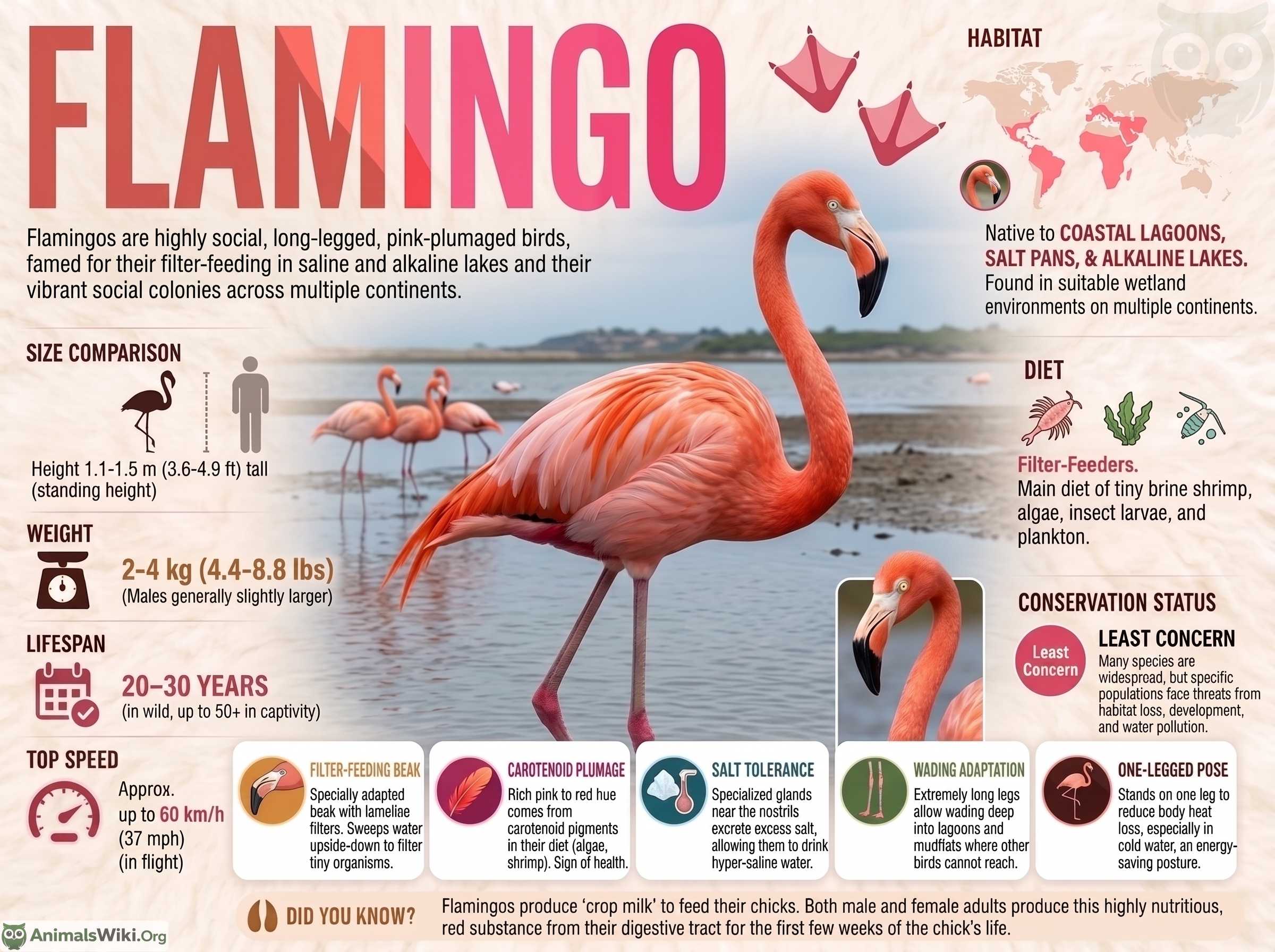
| Average Size | 0.8–1.5 m tall depending on species |
| Average Weight | 1.9–4.5 kg depending on species |
| Lifespan | 20–30 years (wild); up to 50+ years (captivity) |
| Diet | Omnivore — algae, cyanobacteria, brine shrimp, small invertebrates, diatoms |
| Conservation Status | Ranges from Least Concern to Near Threatened, depending on species |
| Defining Feature | Vivid pink-to-scarlet plumage derived from diet; long stilt-like legs; distinctively downturned bill; one-legged standing posture; enormous synchronized breeding colonies |
| Number of Species | 6 recognized species worldwide |
1. Species Overview & Classification
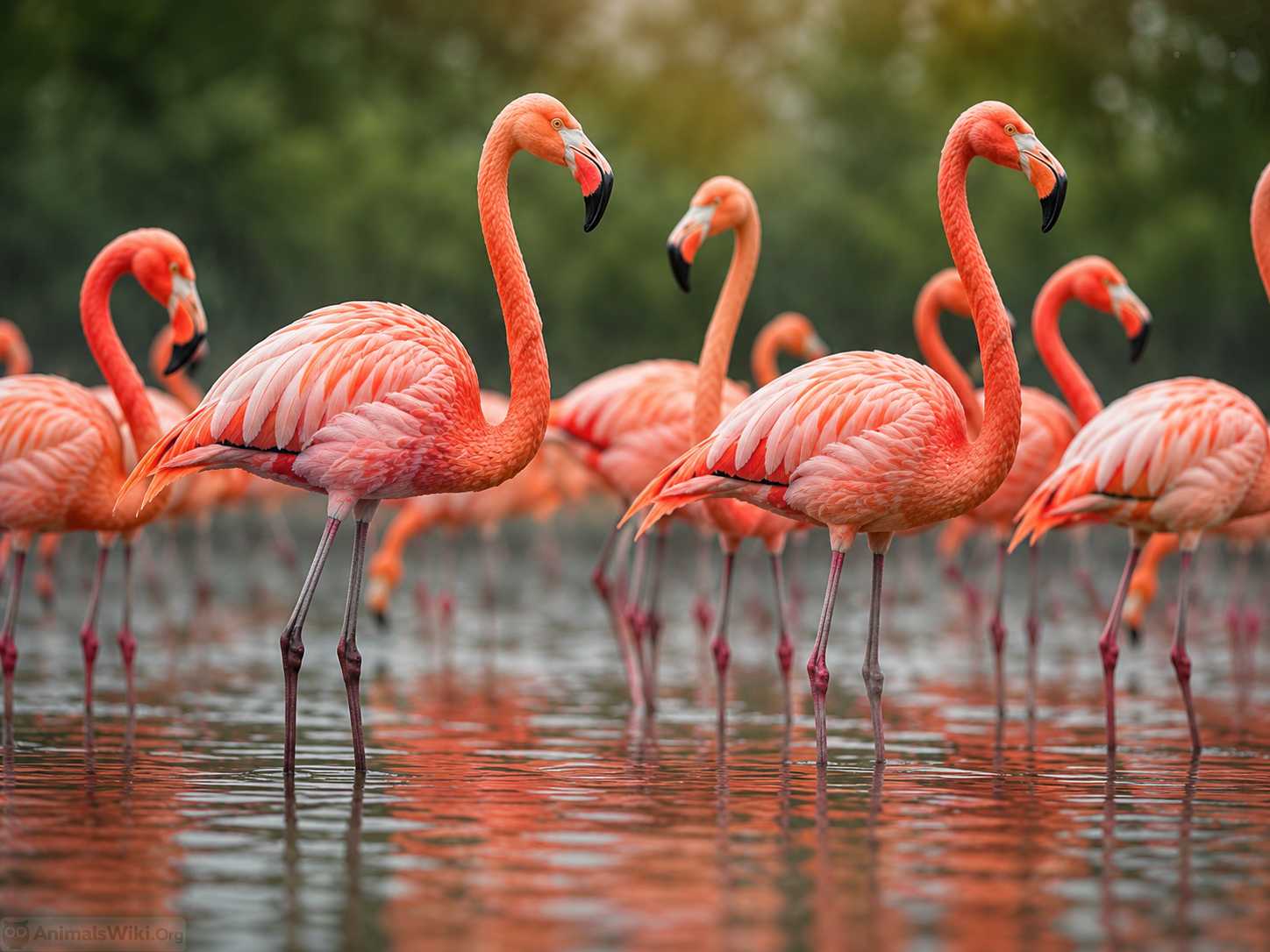
At dawn on the shores of Lake Nakuru or Lake Bogoria in Kenya’s Great Rift Valley, the water’s edge seems to catch fire. What at a distance looks like a shimmering pink haze resolves, as the light strengthens, into hundreds of thousands of individual birds — necks curved into elegant S-shapes, bills inverted and sweeping through the shallows, legs impossibly thin and impossibly still. It is one of the most extraordinary sights in the natural world: a super-colony of flamingos, sometimes numbering over a million individual birds, transforming an entire lake into a single, breathing organism of color and motion.
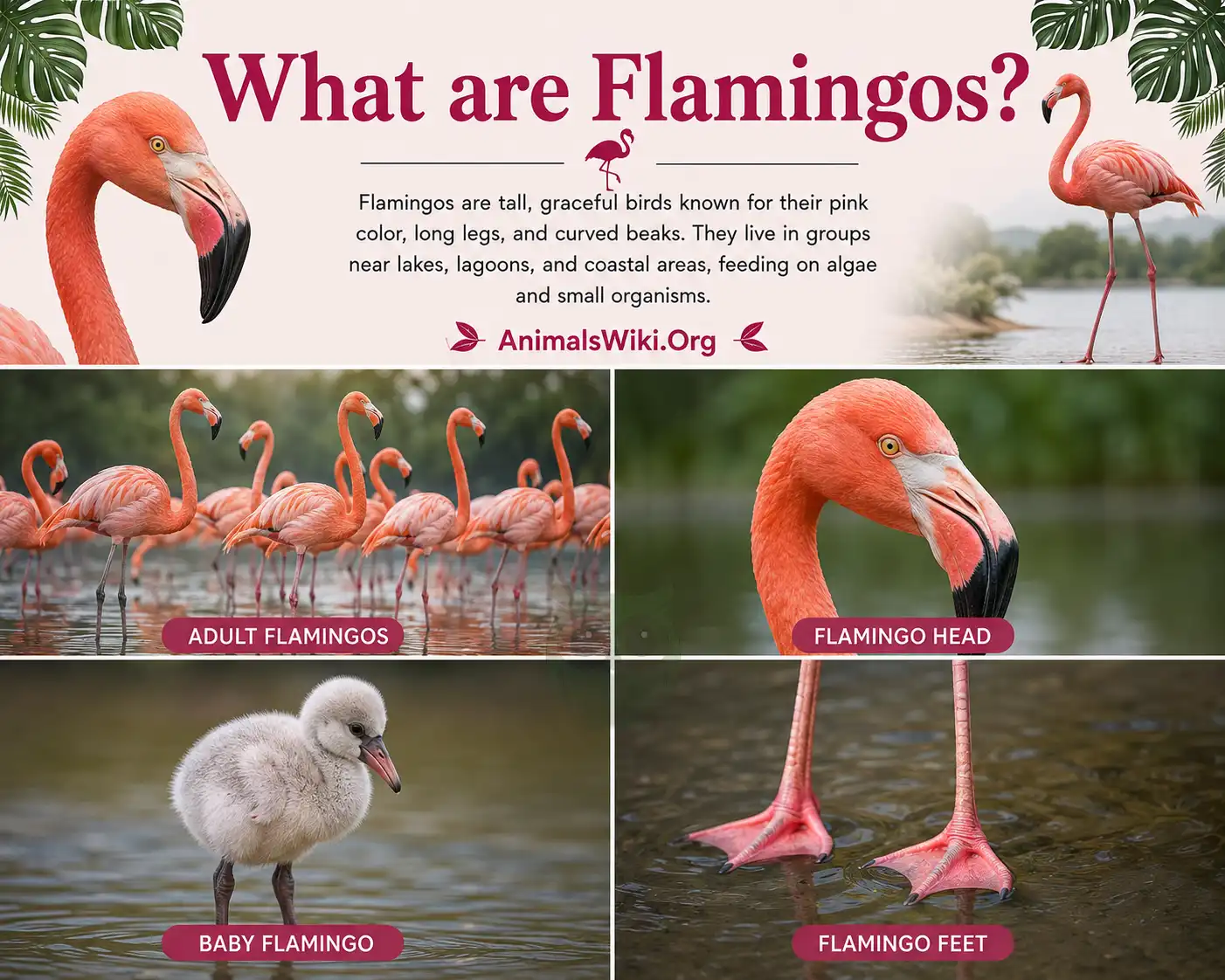
The flamingo is one of the most instantly recognizable birds on Earth — a family of large, long-legged, long-necked wading birds distinguished by their vivid pink-to-crimson plumage, their strikingly down-bent bills, and their surreal habit of resting on a single leg. Six species make up the flamingo family, distributed across four continents, unified by a shared and highly specialized way of life: filtering microscopic algae, cyanobacteria, and tiny invertebrates from some of the harshest aquatic environments on the planet — hypersaline lakes, volcanic soda lakes, and coastal lagoons so alkaline or salty that few other vertebrates can survive there at all.
Far more than an ornamental icon of zoos and postcards, the flamingo is a specialist extremophile — a bird whose entire biology, from its uniquely constructed filter-feeding bill to its remarkable tolerance for water many times saltier than the sea, has evolved to exploit an ecological niche that almost nothing else can occupy. Its pink coloration is not innate but diet-derived, a visible record of the carotenoid-rich algae and crustaceans it consumes. Its breeding biology is built around synchronized, colonial nesting on remote mudflats, producing some of the largest bird colonies on the planet. And its conservation story is a tale of contrasts: some flamingo species are thriving and expanding, while others — confined to a handful of remote, high-altitude lakes — are numbered among the rarest large birds in the world.
Species Classification Table
| Classification Level | Details |
|---|---|
| Kingdom | Animalia |
| Phylum | Chordata |
| Class | Aves |
| Order | Phoenicopteriformes |
| Family | Phoenicopteridae |
| Genera | Phoenicopterus, Phoeniconaias, Phoenicoparrus |
| Described By | Carl Linnaeus, 1758 (Greater Flamingo) |
| Common Names | Flamingo (English); Flamenco (Spanish); Flamant (French) |
The Six Flamingo Species
| Species | Scientific Name | Range | Population | Notes |
|---|---|---|---|---|
| Greater Flamingo | Phoenicopterus roseus | Africa, southern Europe, Middle East, South/Central Asia | ~500,000–1,000,000 | Largest and most widespread species; palest pink |
| American (Caribbean) Flamingo | Phoenicopterus ruber | Caribbean, Yucatán, Galápagos, northern South America | ~850,000 | Most vividly colored species; deep orange-red |
| Chilean Flamingo | Phoenicopterus chilensis | South America (Andes to Patagonia) | ~200,000 | Distinctive grey legs with pink “knees” |
| Lesser Flamingo | Phoeniconaias minor | East Africa, southern Africa, India | ~2,000,000–3,000,000 | Smallest and most numerous species; forms the largest colonies |
| Andean Flamingo | Phoenicoparrus andinus | High-altitude Andean lakes (Chile, Argentina, Bolivia, Peru) | ~38,000–40,000 | Only flamingo with yellow legs; rarest species |
| James’s (Puna) Flamingo | Phoenicoparrus jamesi | High-altitude Andean salt flats | ~100,000–120,000 | Smallest of the high-Andean flamingos; was thought extinct until 1957 |
Why “Flamingo”? Origins of the Name
The name flamingo derives from the Spanish/Portuguese word “flamengo”, itself rooted in the Latin flamma (“flame”) — a direct reference to the bird’s fiery plumage. Some etymologists also connect the word to an old Spanish term associated with “Flemish,” historically used somewhat mockingly to describe anything considered flamboyant or showy — a linguistic echo that still fits a bird whose entire identity is built around vivid color and dramatic display.
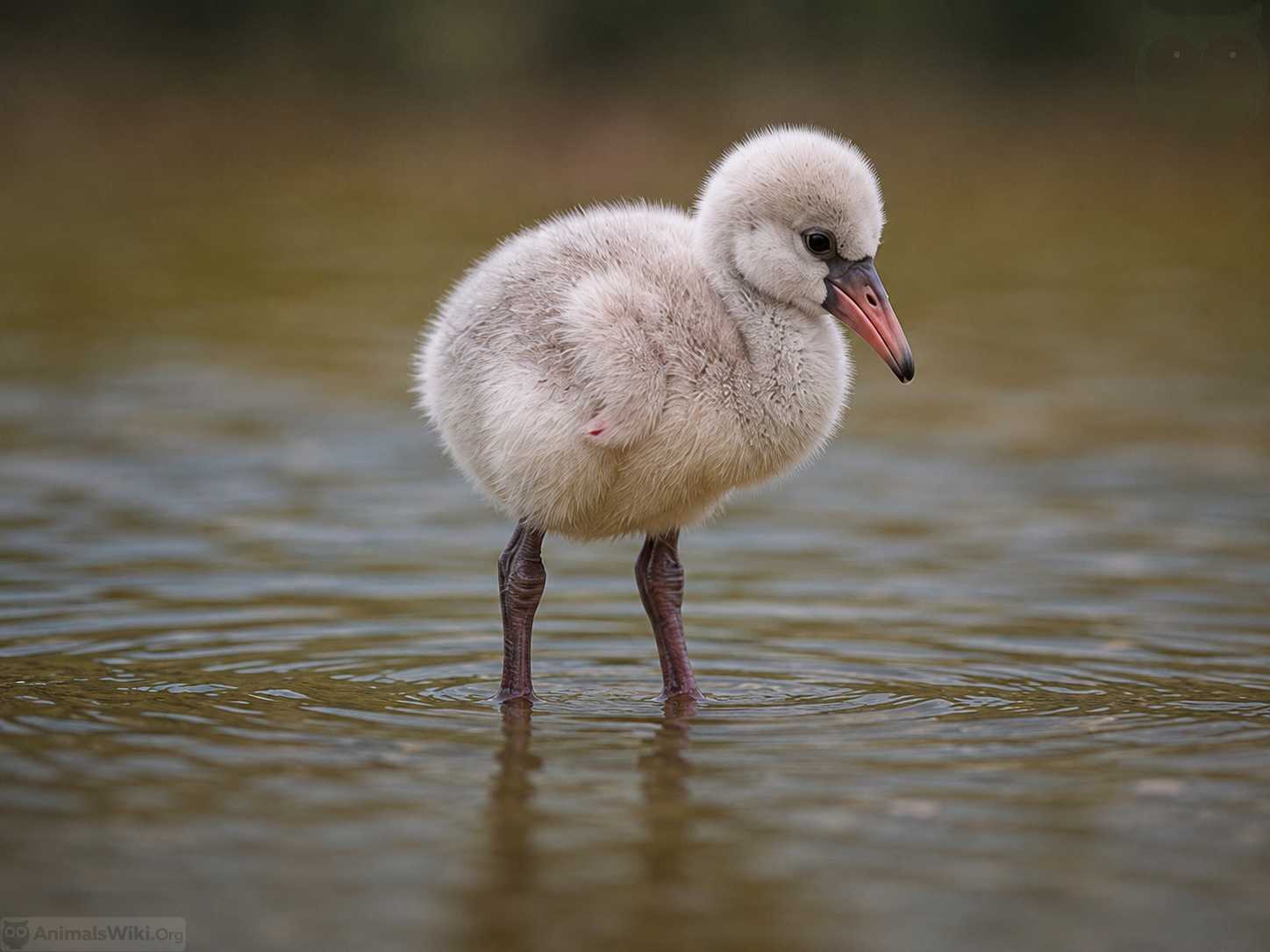
Did You Know? Flamingos are not born pink. Chicks hatch with grey, downy plumage, and juveniles remain pale grey-white for their first one to two years of life. The pink only develops gradually as the bird accumulates carotenoid pigments from its diet — meaning a flamingo’s exact shade of pink is a direct, visible readout of what it has been eating.
2. Physical Description & Unique Features
The flamingo’s body plan is one of the most distinctive and most specialized of any bird family — an assemblage of anatomical adaptations that together allow it to wade, filter-feed, and thermoregulate in some of the most extreme aquatic environments on Earth.
Size and Build
Flamingo size varies considerably across the six species:
Greater Flamingo (largest species):
- Height: 1.2–1.5 m (3.9–4.9 feet)
- Weight: 2–4 kg (4.4–8.8 lbs); large males can exceed 4.5 kg
- Wingspan: 1.4–1.7 m (4.6–5.6 feet)
Lesser Flamingo (smallest species):
- Height: 0.8–1.0 m (2.6–3.3 feet)
- Weight: 1.2–2.1 kg (2.6–4.6 lbs)
Sexual dimorphism: Modest — males are typically slightly larger and heavier than females across all species, but the difference is far less pronounced than in many other large birds; the sexes are essentially identical in plumage color, making visual sex determination difficult in the field
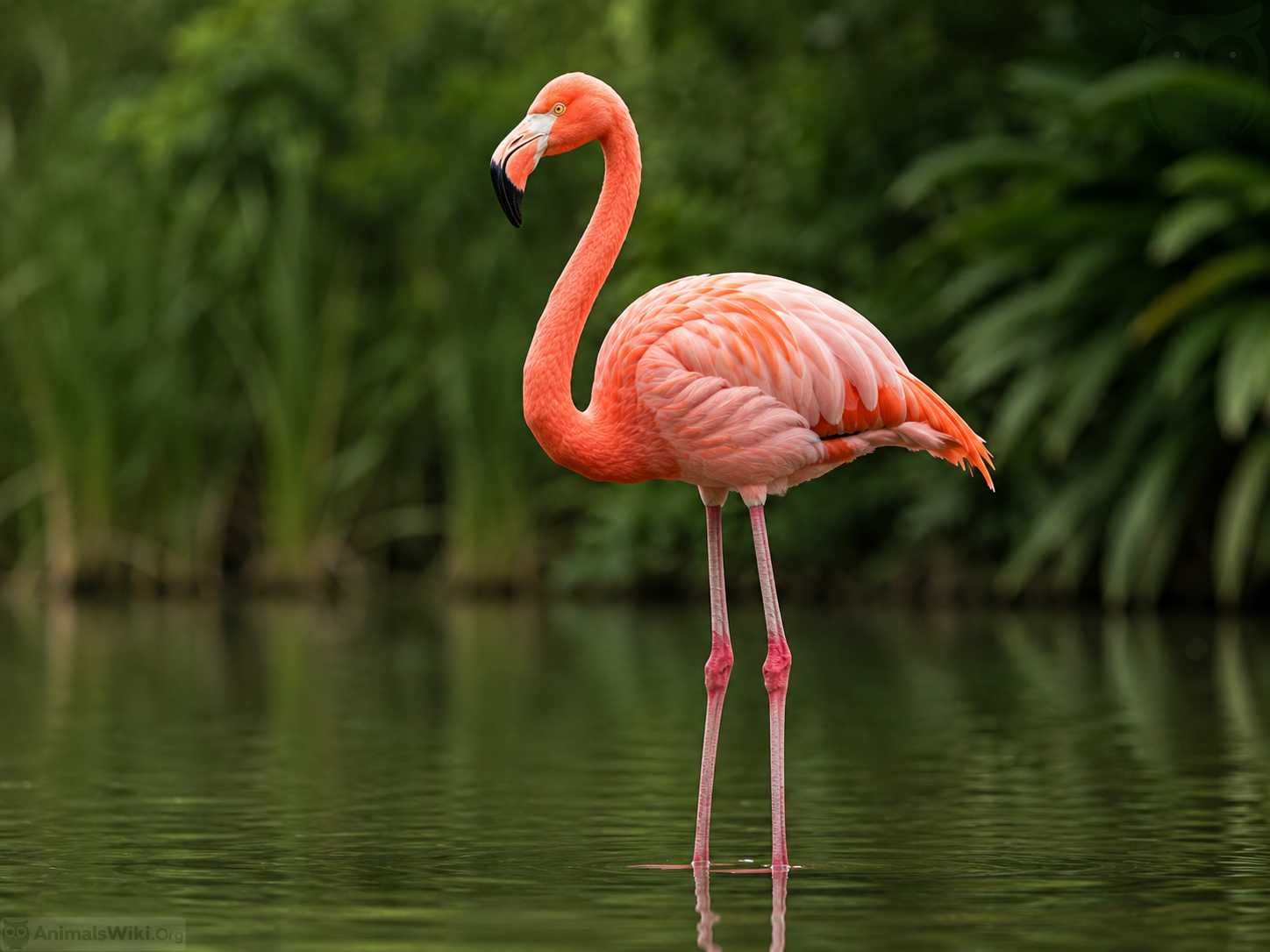
Body proportions: Flamingos possess an extraordinarily elongated neck (containing 19 vertebrae — more than almost any other bird) and extremely long, thin legs that together account for a substantial proportion of total body length; the combination gives flamingos one of the highest leg-to-body ratios of any bird
The Iconic Bill — A Specialized Filtering Machine
The flamingo bill is one of the most unusual feeding structures in the entire bird world:
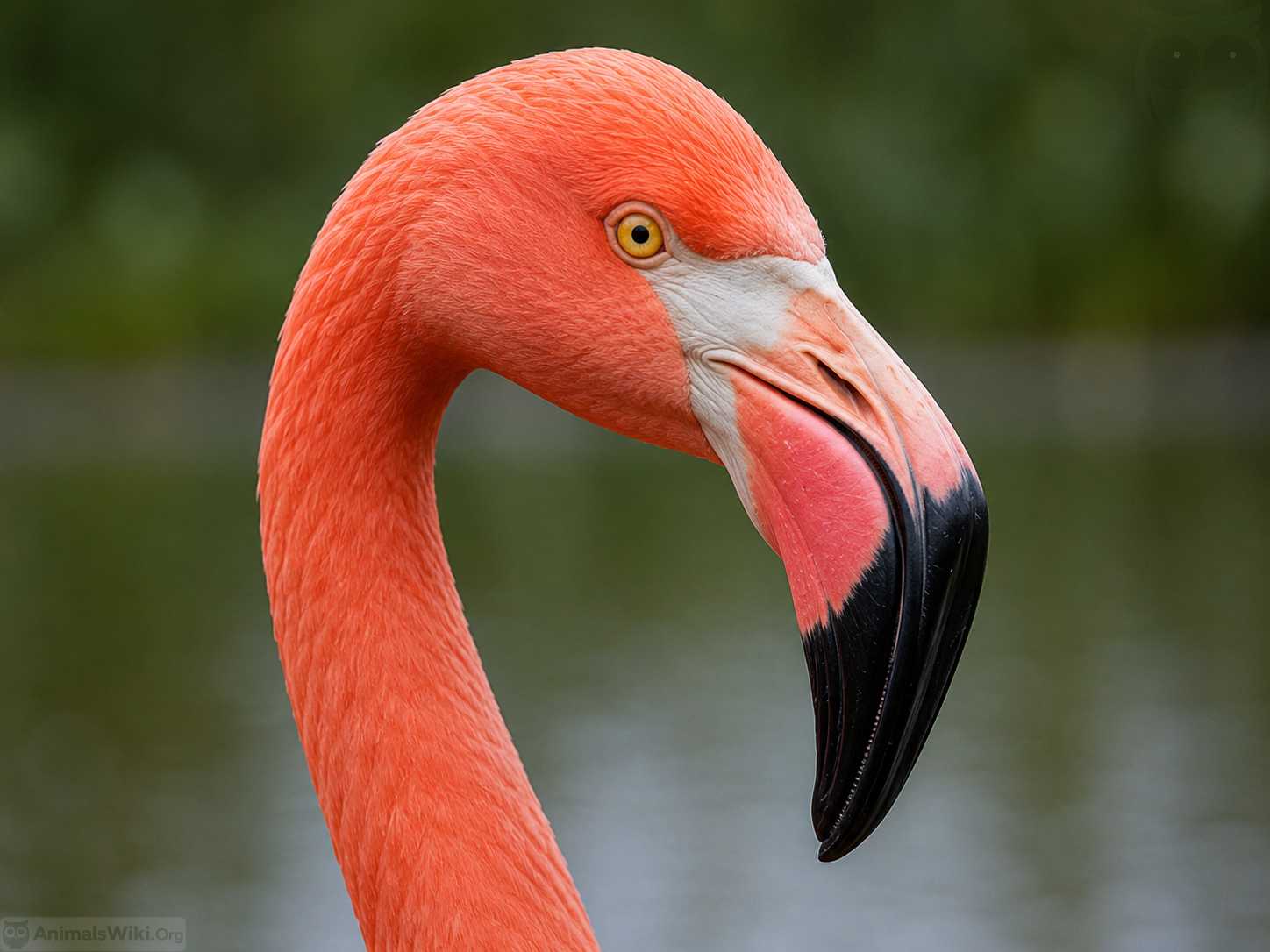
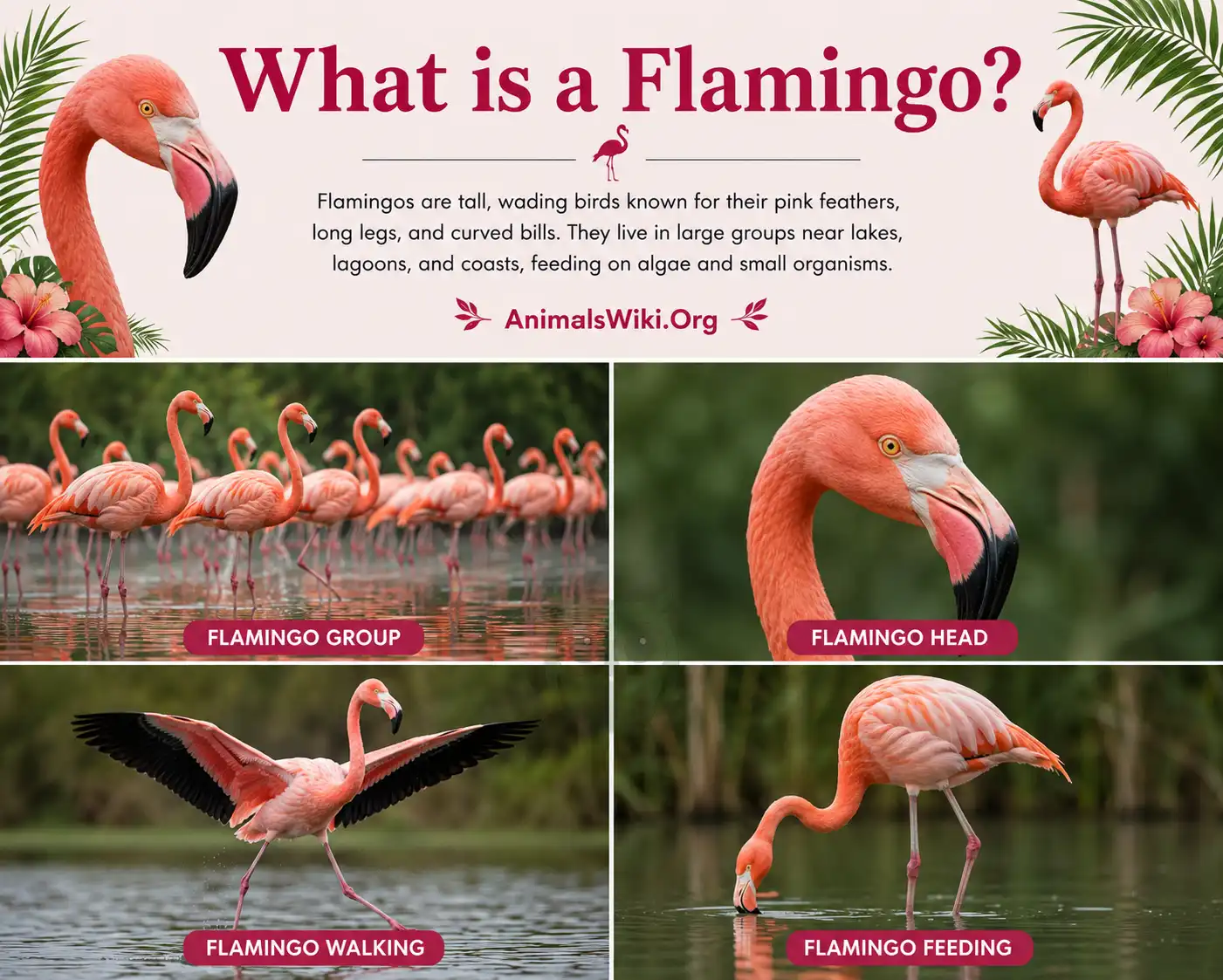
Shape: Sharply downturned at the midpoint, giving the bill a distinctive bent or “broken” appearance; this bend allows the bird to hold its bill upside-down and parallel to the water’s surface while feeding — the upper mandible, not the lower, is the mobile part, an arrangement found in almost no other bird family
Internal structure: The bill contains rows of comb-like structures called lamellae — thin, closely spaced plates lining the mandibles that act as a sieve; the tongue, thick and muscular, pumps water in and out of the bill several times per second, straining food particles against the lamellae while expelling water and mud
Size variation between species: Lesser Flamingos have the deepest-keeled, most specialized bill of any flamingo species, adapted for filtering the smallest food particles (cyanobacteria); Greater Flamingos have shallower-keeled bills adapted for a broader diet including larger invertebrates
The Legendary Pink Plumage
Flamingo coloration ranges from pale pink (Greater Flamingo) to vivid orange-scarlet (American/Caribbean Flamingo), and the biological mechanism behind it is one of the most well-known facts about the family:
Diet-derived pigmentation: Flamingos are not genetically pink; they synthesize their color from carotenoid pigments — primarily canthaxanthin and beta-carotene — obtained from the algae, cyanobacteria, and brine shrimp they consume; these pigments are metabolized and deposited in the growing feathers, as well as in the skin
Color variation by species and diet:
| Species | Typical Coloration | Primary Carotenoid Source |
|---|---|---|
| American Flamingo | Deep orange-red to scarlet | Beta-carotene-rich algae and brine shrimp (Caribbean salt pans) |
| Chilean Flamingo | Pale pink with grey legs | Mixed diet; lower carotenoid concentration |
| Greater Flamingo | Very pale pink to white with pink wing patches | Lower-carotenoid diet; largest range of diet variability |
| Lesser Flamingo | Deep pink, especially in breeding season | Spirulina cyanobacteria, exceptionally carotenoid-rich |
| Andean Flamingo | Pale pink with black wing feathers | High-altitude algae |
| James’s Flamingo | Bright pink with red eye-ring | Diatoms and cyanobacteria |
Captive flamingos lose color without supplementation: Zoos and aquariums must supplement captive flamingo diets with synthetic carotenoids (canthaxanthin) or shrimp-based feed, since captive diets otherwise lack sufficient pigment; a flamingo denied carotenoids will gradually fade to pale grey-white over successive molts
The One-Legged Stance — Solving an Old Mystery
The flamingo’s habit of standing on one leg, often for extended periods, puzzled naturalists for centuries. Modern biomechanical research has clarified the mechanism:
- Passive mechanical stability: Studies (notably by researchers at the Georgia Institute of Technology) demonstrated that a flamingo’s leg, tucked beneath its body, locks into a stable configuration that requires little to no active muscular effort to maintain — the bird can balance on one leg with essentially no additional energy expenditure compared to standing on two
- Thermoregulation: Tucking one leg against the body’s feathers reduces heat loss through the unfeathered leg, an advantage in cold water; flamingos have been observed switching legs periodically and standing on both legs more often in warm water, supporting the thermoregulatory explanation
- Rest during sleep: Flamingos frequently sleep while standing on one leg, sometimes with the head tucked into the back feathers — the passive locking mechanism allows genuine rest without collapse
Wing Coloration and Flight
Flamingos are strong, capable fliers despite their ungainly appearance on the ground:
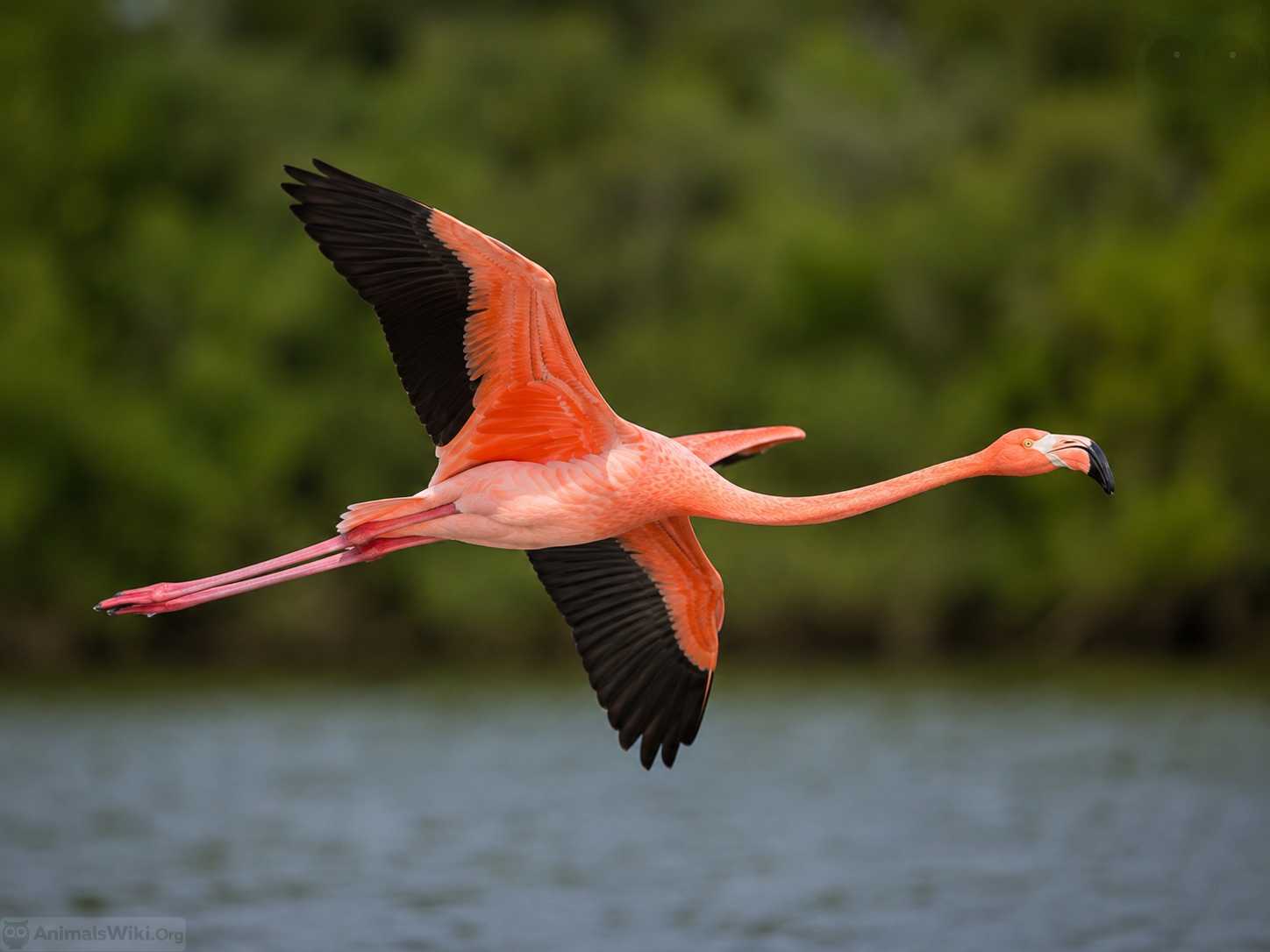
- In-flight silhouette: Neck and legs both extended straight out, creating a long, cross-shaped profile very different from the folded-neck posture of herons
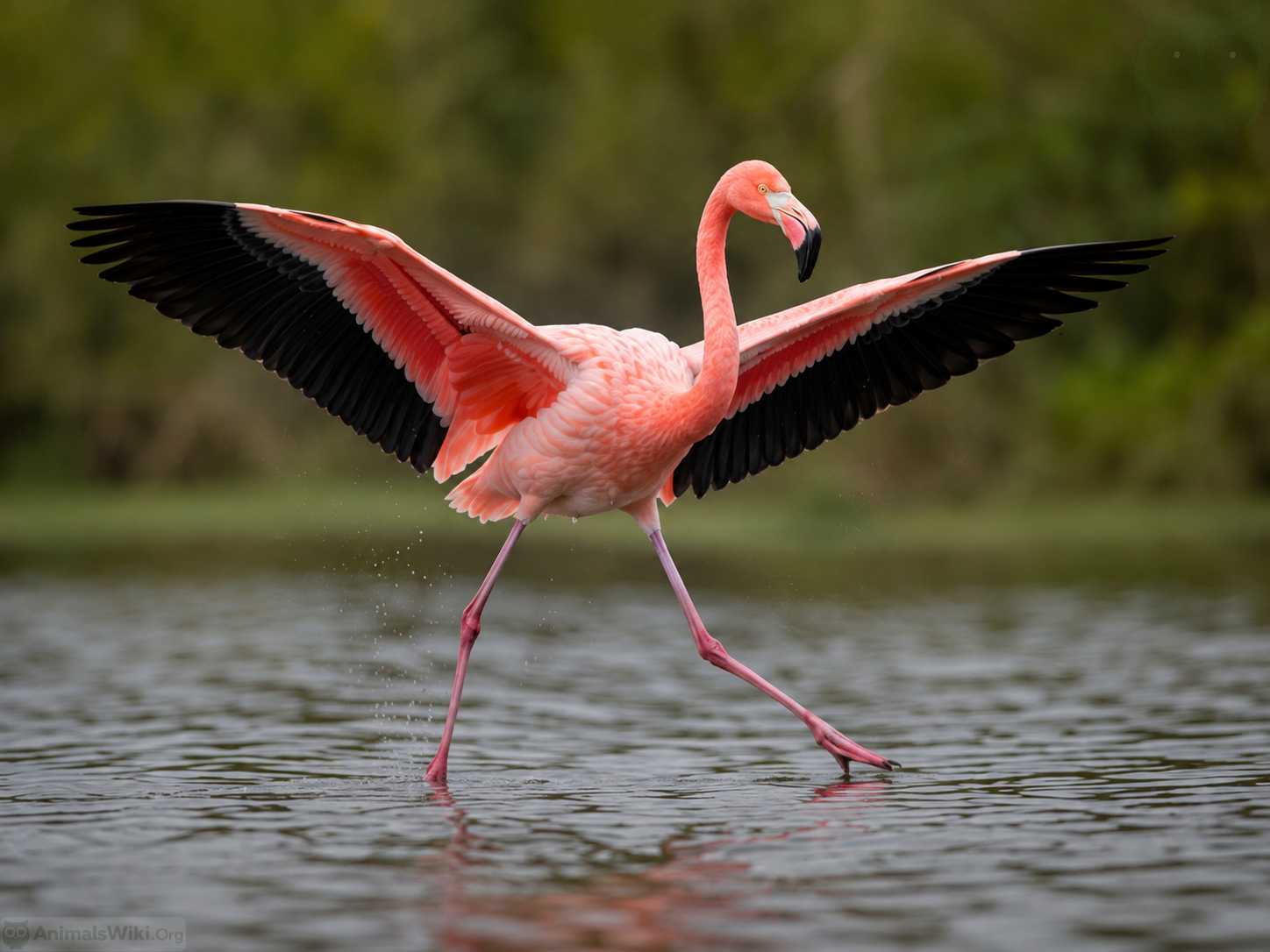
- Wing coloration: Black flight feathers (primaries and secondaries) contrast with pink or red covert feathers — visible dramatically during takeoff and landing, and a key field mark for species identification
- Flight speed: Flamingos can sustain flight speeds of 50–60 km/h (31–37 mph) and have been tracked migrating at altitudes over 3,000 meters, sometimes flying 500–600 km in a single overnight flight
Legs and Feet
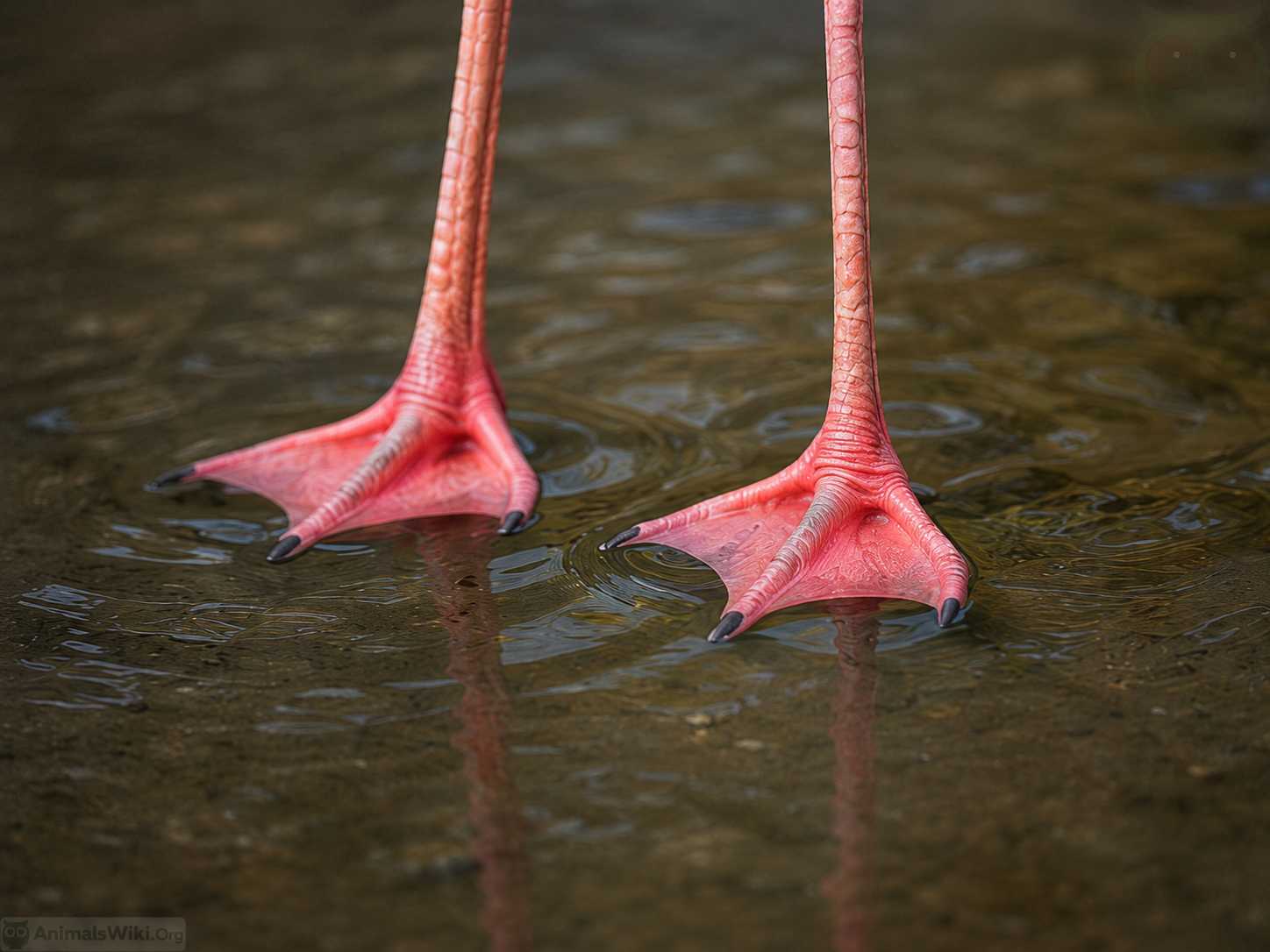
- Webbed feet: Flamingos possess partially webbed feet, an adaptation for walking across soft mud and shallow water without sinking, and for swimming when necessary
- Leg color: Varies by species — pink to red-orange (Greater, American), grey with pink joints (Chilean), yellow (Andean, uniquely among flamingos) — and leg color is a key identification feature
3. Natural Habitat & Geographic Range
Flamingos occupy one of the most physiologically demanding habitat niches of any bird family — the hypersaline and highly alkaline lakes, lagoons, and salt flats that few other vertebrates can tolerate.
Preferred Habitat Features
Saline and hypersaline lakes — the core flamingo habitat; these are lakes with salt concentrations often several times that of seawater, created by high evaporation rates in arid or semi-arid climates with no outlet to the sea; the extreme salinity excludes most fish and other predators, creating relatively safe, food-rich conditions for flamingos
Alkaline soda lakes — East Africa’s Rift Valley lakes (Nakuru, Bogoria, Natron) are highly alkaline (caustic) rather than simply saline, with pH levels that can exceed 10.5; these conditions are lethal to most organisms but ideal for the cyanobacteria that Lesser Flamingos depend on
Coastal lagoons and estuaries — American and Chilean Flamingos frequently use brackish coastal lagoons, mangrove-fringed bays, and tidal mudflats in addition to inland saline lakes
High-altitude Andean salt flats (salares) — Andean and James’s Flamingos inhabit some of the highest-elevation wetlands used by any bird family, at elevations up to 4,500 meters (14,800 feet), where nighttime temperatures can plunge far below freezing even as daytime sun is intense
Shallow water depth requirement — flamingos require relatively shallow water (typically under 30–50 cm) for effective wading and filter-feeding; extensive shallow mudflats and lake margins are essential habitat features
Habitat Types Occupied
| Habitat | Primary Flamingo Use | Species | Key Features |
|---|---|---|---|
| East African soda lakes | Feeding, breeding | Lesser, Greater | Extremely alkaline; cyanobacteria-rich |
| Caribbean/Yucatán salt pans | Feeding, breeding | American | Hypersaline coastal lagoons |
| Andean high-altitude salares | Feeding, breeding | Andean, James’s, Chilean | Extreme elevation and cold |
| Southern Europe wetlands (Camargue, etc.) | Feeding, breeding | Greater | Mediterranean coastal marshes |
| South Asian salt lakes | Feeding, wintering | Greater, Lesser | Seasonal wetlands |
| Galápagos brackish lagoons | Feeding, breeding | American | Small isolated island population |
Geographic Range
Current global range by species:
| Region | Key Countries | Primary Species | Population Status |
|---|---|---|---|
| East Africa | Kenya, Tanzania, Ethiopia | Lesser, Greater | Largest single-site concentrations in the world |
| Southern Africa | South Africa, Namibia, Botswana | Greater, Lesser | Stable |
| Southern Europe | Spain (Camargue via France border region), France, Italy, Turkey | Greater | Recovering and expanding |
| Middle East / Central Asia | Iran, Kazakhstan, Turkey | Greater | Fluctuating with wetland conditions |
| South Asia | India, Pakistan | Greater, Lesser | Important wintering grounds (e.g., Rann of Kutch, Sambhar Lake) |
| Caribbean | Bahamas, Cuba, Yucatán (Mexico), Bonaire, Turks and Caicos | American | Recovering strongly |
| South America (lowland) | Venezuela, Colombia, Galápagos | American | Stable |
| South America (Andean) | Chile, Argentina, Bolivia, Peru | Chilean, Andean, James’s | Andean and James’s are range-restricted and vulnerable |
The Great Rift Valley — The World’s Flamingo Epicenter
The soda lakes of the East African Rift Valley — particularly Lake Nakuru, Lake Bogoria, and Lake Natron — support the largest flamingo concentrations on Earth. Lake Natron, in northern Tanzania, is especially critical: its extreme alkalinity (pH up to 10.5) and high temperatures (surface water can exceed 60°C in places) make it lethal to nearly all other vertebrates, yet it is the primary breeding site for over 75% of the world’s Lesser Flamingo population — meaning the future of the species is disproportionately tied to the ecological condition of a single lake. Flamingo numbers at any given Rift Valley lake fluctuate dramatically from year to year — sometimes by hundreds of thousands of birds within a single season — as flocks track shifting algae blooms and water chemistry across the lake system, a nomadic pattern that is one of the most striking features of flamingo ecology.
4. Diet & Feeding Behavior
The flamingo is one of the most specialized filter feeders among all birds — its entire bill, tongue, and feeding posture engineered around straining microscopic and small-bodied food from water and sediment.
What Flamingos Eat
Cyanobacteria (blue-green algae) — the primary food of the Lesser Flamingo; the cyanobacterium Arthrospira (Spirulina) fusiformis blooms densely in the alkaline soda lakes of East Africa, providing the carotenoid-rich, protein-dense food source that supports the largest flamingo populations on Earth
Diatoms and green algae — important food for several species, particularly in slightly less extreme saline conditions; diatoms are photosynthetic single-celled algae with silica shells
Brine shrimp (Artemia spp.) — a critical food source in many hypersaline lakes, particularly for American and Greater Flamingos; brine shrimp themselves feed on algae and concentrate carotenoid pigments, making them an especially valuable pigment source for flamingos that consume them
Brine flies and their larvae — small invertebrates that thrive in saline lake margins; consumed opportunistically by several species, particularly at lake edges and mudflats
Small mollusks and crustaceans — larger-bodied invertebrates consumed particularly by Greater and Chilean Flamingos, whose broader, shallower-keeled bills are adapted to filter somewhat larger particles than the specialized Lesser Flamingo bill
Small fish and fish eggs — consumed occasionally by some populations, though flamingos are not primarily piscivorous
The Filter-Feeding Mechanism
Flamingo feeding technique is one of the most distinctive in the bird world:
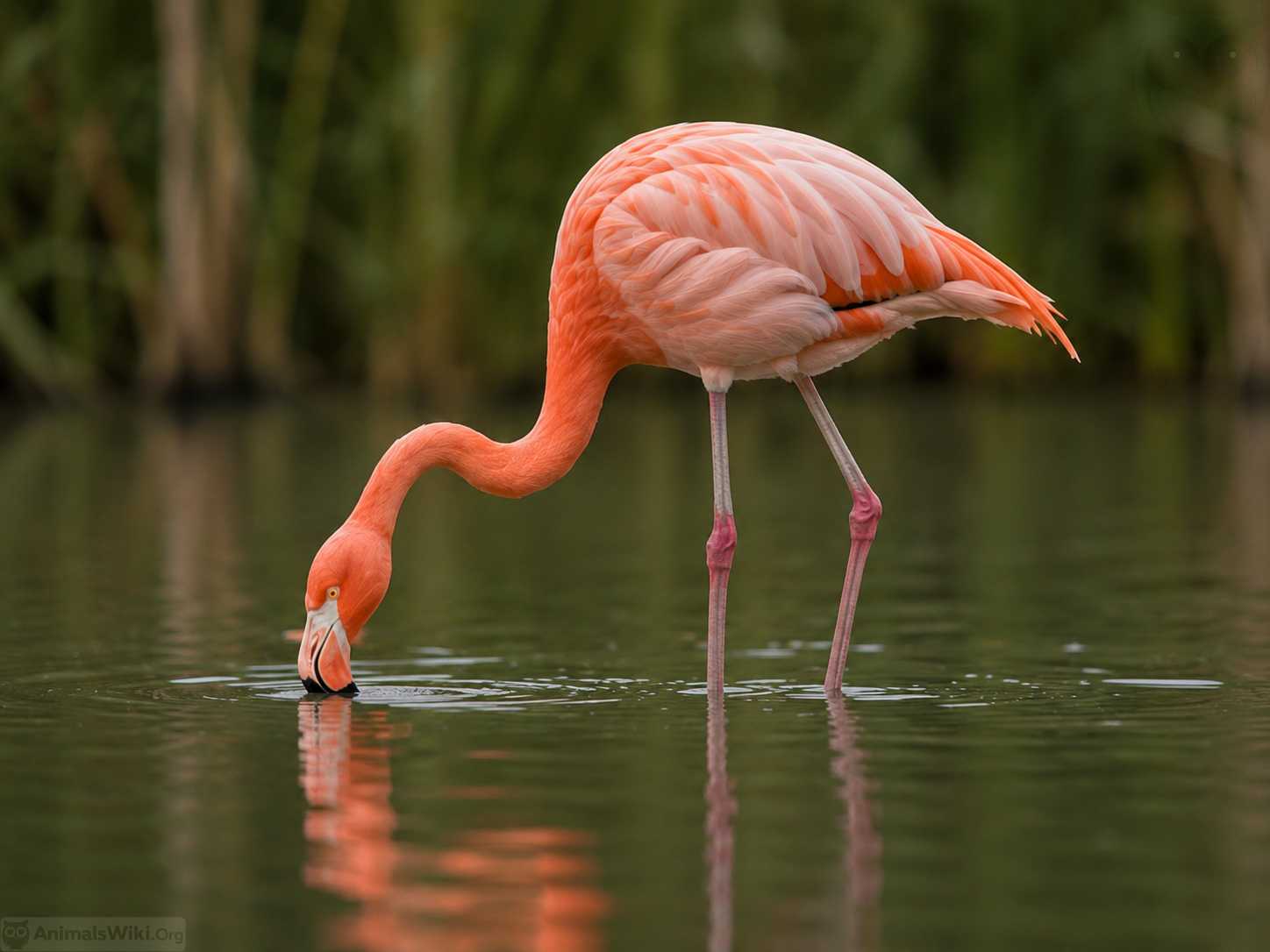
- Head inversion — the bird lowers its head and inverts the bill so that the upper mandible (the moving part) faces downward
- Tongue pumping — the thick, muscular tongue moves rapidly back and forth (up to several times per second), drawing water and sediment into the bill and then expelling it
- Lamellar filtration — as water is pumped out, the comb-like lamellae lining the bill trap food particles while allowing water and fine sediment to pass through
- Sorting by particle size — different species’ lamellae are spaced differently, allowing filtration of food particles of different sizes; this fine-scale anatomical difference is a major driver of the resource partitioning that allows multiple flamingo species to coexist at the same lake without direct competition
Head-swinging feeding: Flamingos often feed while walking slowly forward and swinging the head side-to-side through the water and surface mud, covering a wide feeding path with each pass; in deeper water, flamingos may swim while feeding, sometimes upending like a duck, or stamp their feet to stir up sediment and disturb food organisms into the water column
The Critical Role of Bill Structure in Species Coexistence
The differences in bill depth and lamellar spacing between flamingo species represent one of the clearest examples of resource partitioning in bird ecology: at East African lakes where both Lesser and Greater Flamingos feed side by side, the Lesser Flamingo’s deep-keeled bill filters microscopic cyanobacteria directly from the water column, while the Greater Flamingo’s shallower bill targets larger invertebrates and algae from the sediment surface — allowing both species to exploit the same lake without significant dietary overlap.
Seasonal and Migratory Feeding Patterns
| Context | Feeding Behavior | Notes |
|---|---|---|
| Algae bloom conditions | Intensive feeding; rapid weight gain | Populations can surge into an area within days of a bloom |
| Breeding season | High energy demand; feeding near colony | Adults must balance feeding time with nest attendance |
| Chick-rearing | Crop milk production; sustained high feeding rates | Discussed further in Reproduction section |
| Drought/lake drying | Mass movement to alternate lakes | Nomadic tracking of water and food conditions across regional lake networks |
Daily Feeding Requirements
- Flamingos may spend up to 15–20 hours per day feeding, particularly the smaller Lesser Flamingo, whose food (microscopic cyanobacteria) requires processing enormous volumes of water
- Feeding often continues around the clock, including at night, particularly during peak growth periods of algae blooms
- A single Lesser Flamingo may filter an estimated tens of liters of water daily in pursuit of adequate cyanobacteria intake
5. Reproduction & Life Cycle
Flamingo reproduction is organized around some of the most spectacular and tightly synchronized colonial breeding events of any bird family — vast, coordinated gatherings that transform remote salt flats into temporary cities of hundreds of thousands of nesting birds.
Sexual Maturity
Flamingos are relatively slow to mature compared to many birds:
- First breeding: Typically at 3–6 years of age, though some individuals may not breed successfully until 6 or more years
- Extended immaturity: Young flamingos spend several years in loose non-breeding flocks before joining breeding colonies, and courtship “practice” displays are observed in immature birds well before they are physiologically ready to breed
Colonial Breeding — Safety and Synchrony in Numbers
Flamingos are obligate colonial nesters — they breed only in large groups, sometimes numbering from a few hundred to well over a million pairs at a single site:
Why colonial breeding?
- Predator swamping — with so many nests concentrated in one place, the proportion of eggs and chicks any individual predator can take is diluted
- Synchronized hatching — coordinated breeding means that vulnerable eggs and chicks are exposed for the shortest possible window
- Site limitation — suitable breeding sites (remote, predator-free mudflats with the right water and salinity conditions) are extremely limited, concentrating birds by necessity as much as by choice
Group courtship displays: Before breeding, flamingos perform elaborate, highly synchronized group displays involving hundreds or thousands of birds simultaneously:
- Head-flagging — rapid side-to-side head turning in unison
- Wing salutes — birds stretch their necks upward and briefly flash open wings, displaying the black-and-pink wing pattern
- Marching — large groups walk in tight formation, changing direction together
- These synchronized displays help stimulate hormonal readiness across the colony simultaneously, contributing to breeding synchrony
Nest Building
Flamingo nests are among the most distinctive structures built by any bird:
- Mud mound nests — flamingos construct conical mounds of mud, small stones, and vegetation debris, typically 15–46 cm (6–18 inches) tall, with a shallow depression at the top
- Function: The height of the mound elevates the single egg above the immediate ground level, offering protection from flooding, extreme surface heat, and some predators
- Colony density: Nests are packed extremely close together — often just far enough apart that incubating adults cannot quite reach neighboring nests, minimizing conflict while maximizing colony density
Egg-Laying and Incubation
- Clutch size: A single egg — almost invariably; very rarely two
- Egg description: Chalky white, elongated oval shape
- Incubation period: Approximately 27–31 days, shared by both parents in alternating shifts
- Both sexes incubate: Unlike many bird species, flamingo parenting is highly equitable — males and females share incubation and chick-feeding duties roughly equally
Chick Development — Crèches and Crop Milk
Hatching: Chicks hatch with grey down and a straight bill (the diagnostic downward curve develops only after several weeks)
Crop milk: Both parents feed the chick a substance called “crop milk” — a nutrient-rich secretion produced in the upper digestive tract, similar to (though not identical to) the crop milk produced by pigeons and doves; flamingo crop milk is notably reddish in color, due to the same carotenoid pigments and canthaxanthin present in the adult diet, and is exceptionally rich in fat and protein
The crèche system: After approximately 5–12 days, chicks leave the nest mound and gather into massive groups called crèches, which may contain thousands of chicks supervised by a relatively small number of adult “guard” birds:
- Crèches allow parents to leave chicks for extended feeding trips, sometimes traveling considerable distances from the colony
- Parents can still recognize and feed their own chick within a crèche of thousands, primarily through individually distinctive vocalizations learned in the first days after hatching
- Crèche behavior is thought to provide additional protection from predators and helps chicks thermoregulate through huddling
| Stage | Timing | Development |
|---|---|---|
| Hatching | Day 0 | Grey down; straight bill; ~70–90 g |
| Nest-bound period | Days 1–8 | Fed crop milk by both parents at the nest mound |
| Crèche formation | Days 8–15 | Joins large chick groups; still dependent on parental feeding |
| Bill curvature develops | Weeks 4–8 | Bill begins to acquire the characteristic downward bend |
| Fledging | 10–12 weeks | First flight capability |
| Juvenile plumage | 1–2 years | Pale grey-white; gradually pinks with age and diet |
| Sexual maturity | 3–6 years | First breeding attempts |
Lifespan
- Wild: Typically 20–30 years
- Captivity: Flamingos are exceptionally long-lived in captivity, with documented individuals living 50 years or more; one Greater Flamingo at the Adelaide Zoo in Australia, named “Greater,” was estimated to be over 83 years old at death in 2014, making it among the longest-lived birds ever documented, though the exact age has been debated by ornithologists
6. Social Behavior & Communication
Flamingo social life is built almost entirely around the flock — the species is among the most intensely social of all birds, with individuals rarely if ever found alone in the wild under natural conditions.
Flock Structure and Size
Flock size: Flamingo flocks range from small groups of a few dozen birds to congregations of over a million individuals at the largest East African soda lakes — among the largest gatherings of any bird species on the planet
Fluid, nomadic membership: Unlike many colonial birds, flamingo flocks are not closed, fixed social units; individuals move relatively freely between flocks and lake systems, tracking food availability, water conditions, and breeding opportunities across a regional network of wetlands
Mixed-species flocks: At lakes supporting multiple flamingo species (common in both East Africa and the high Andes), different species frequently feed and roost in proximity, segregating primarily by microhabitat and food type rather than by strict spatial separation
Synchronized Movement
One of the most visually striking aspects of flamingo social behavior is coordinated, near-simultaneous movement across large flocks:
- Synchronized feeding — flocks often move, feed, and rest in unison, creating the shimmering, wave-like visual patterns famous in aerial photographs of large colonies
- Synchronized takeoff — large portions of a flock may take flight together, triggered by a disturbance or by the collective decision-making that governs many large bird aggregations
- Marching displays — pre-breeding group marches (described in the Reproduction section) are among the most elaborate synchronized behaviors in the bird world, sometimes involving tens of thousands of birds moving as a coordinated unit
Dominance and Aggression
Flamingos maintain relatively low levels of aggression within flocks, but disputes do occur, particularly:
- At feeding sites — competition for the richest patches of algae or invertebrates can produce brief bill-jabbing disputes
- At nest sites — during the breeding season, defense of the nest mound against intruding neighbors is common, typically resolved through neck-stretching displays and vocal threats rather than physical combat
- Pair bonds — flamingos generally form seasonally monogamous pair bonds, with some pairs re-forming in subsequent seasons, though pair fidelity across years is variable and not absolute
Communication — A Multi-Modal System
Vocalizations:
- Honking/goose-like calls — the flamingo’s most familiar vocalization, resembling a goose’s honk; used extensively for flock contact and coordination, particularly in flight
- Growling contact calls — softer vocalizations exchanged between mates and between parents and chicks
- Individual recognition calls — chicks and parents each develop distinctive vocal signatures used to locate one another within massive crèches; this individual vocal recognition is essential to successful parental feeding within colonies of hundreds of thousands of birds
Visual signals:
- Head-flagging — synchronized head-turning display used in group courtship
- Wing-salute — wings briefly opened and neck stretched skyward, displaying the black-and-pink wing pattern; used both in courtship and as a general alertness/display behavior
- Neck-stretch threat display — an aggressive posture used to warn off intruders near the nest or in disputes over feeding space
- Marching — synchronized group walking that functions as a social display strengthening flock cohesion and breeding readiness
7. Predators & Defense Mechanisms
Adult flamingos, by virtue of their extreme habitat specialization, face relatively few natural predators compared to many bird species — but eggs, chicks, and occasionally adults remain vulnerable, particularly at and near breeding colonies.
Natural Predators
Marabou Storks (Leptoptilos crumenifer) — a significant predator of flamingo eggs and small chicks at East African colonies; marabou storks are frequently observed patrolling the margins of flamingo breeding colonies, opportunistically taking unattended eggs and vulnerable young
African Fish Eagles (Haliaeetus vocifer) and other raptors — take flamingo chicks, and occasionally weakened or injured adults, particularly at colony margins
Jackals and hyenas — at some African breeding sites, black-backed jackals and spotted hyenas have been documented raiding flamingo colonies, taking eggs and chicks, particularly where colonies are accessible from dry land rather than isolated on mud islands surrounded by water
Andean foxes (Lycalopex culpaeus) — a predator of Andean and James’s Flamingo eggs and chicks at high-altitude South American breeding sites
Gulls and other opportunistic birds — various gull species scavenge eggs and prey on very young chicks at accessible colony sites, including some American Flamingo colonies in the Caribbean
Crocodiles — at a small number of African wetlands where flamingos and Nile crocodiles overlap, crocodiles occasionally take adult flamingos in shallow water
Defense Strategies
Extreme habitat selection as primary defense: The single most important flamingo defense strategy is not behavioral but ecological — breeding colonies are established on remote, often difficult-to-access mud islands surrounded by hypersaline or highly alkaline water that few land predators can cross; this habitat specialization is the primary reason flamingo colonies achieve the enormous, largely undisturbed sizes that they do
Colonial predator swamping: As described in the Reproduction section, breeding in enormous synchronized colonies dilutes individual predation risk — a predator raiding a colony of a million nests can only take a small fraction of the total eggs and chicks present
Flight and flocking: Adult flamingos are strong, fast fliers and typically take flight en masse at the first sign of a terrestrial predator or major disturbance, a coordinated group response that reduces individual risk
Vigilance in shallow water: Flamingos typically avoid deep water where aquatic predators such as crocodiles could approach undetected, preferring shallow margins with clear sightlines
Alarm calling: Flamingos produce distinct alarm vocalizations upon detecting a threat, which propagate rapidly through a flock and can trigger mass, coordinated flight
8. Relationship with Humans
Ancient and Historical Cultural Relationships
Flamingos have held a striking place in human culture for thousands of years, prized above all for their extraordinary and unusual coloration:
Ancient Egypt: The flamingo is believed to have been the living inspiration for the hieroglyphic sign representing the god Ra, associated with the sun; the bird’s fiery coloration and its habit of standing motionless at dawn made it a natural symbol of the sun’s rising color
Ancient Rome: Flamingo tongues were considered an extravagant delicacy among wealthy Romans; the Roman writer Pliny the Elder documented flamingo tongue as a prized dish, and the birds’ harvest for this purpose is one of the earliest documented instances of a flamingo population being exploited for luxury cuisine
Andean cultures: Indigenous peoples of the high Andes, including cultures associated with the Atacama region, have long incorporated Andean and James’s Flamingos into local tradition and folklore, and historically harvested flamingo eggs from high-altitude salt flat colonies as a food source, a practice that in some areas contributed to historical population declines before modern protections were established
The Rise of the Flamingo as a Cultural Icon
Zoos and captive collections: Flamingos have been kept in captivity since antiquity and became a fixture of major zoological gardens from the 19th century onward, prized for their visual spectacle and relative ease of maintenance in large mixed flocks; captive flamingo flocks are among the most popular exhibits at zoos worldwide
The plastic pink flamingo lawn ornament: Designed in 1957 by artist Don Featherstone for Union Products, the plastic pink flamingo lawn ornament became one of the most recognizable pieces of American kitsch design in history — a symbol variously associated with 1950s suburban culture, camp aesthetics, and later, ironic or nostalgic celebration; the city of Madison, Wisconsin even adopted the plastic flamingo as its official city bird in 2009 as a tribute to a famous prank in which students placed over 1,000 plastic flamingos on a campus lawn in 1979
Flamingo tourism: Flamingo colonies are among the most significant wildlife tourism draws in several countries; Kenya’s Rift Valley lakes, the Camargue in France, and various Caribbean and Andean sites generate substantial tourism revenue built specifically around flamingo viewing
Conflict and Human Impact
Habitat modification: Soda ash extraction, water diversion for agriculture and industry, and geothermal energy development at several key East African soda lakes have created ongoing tension between economic development and flamingo habitat protection, particularly at Lake Natron, Lake Bogoria, and Lake Magadi
Egg and chick collection (historical): Historical harvesting of flamingo eggs for food at various sites — including some Andean salares and, in earlier centuries, East African lakes — contributed to localized population declines before conservation protections were established in the 20th century
Disturbance at breeding colonies: Because flamingo colonies are so sensitive to disturbance, tourism, low-flying aircraft, and unauthorized colony access have all been documented causing mass nest abandonment events, in which a disturbed colony of tens of thousands of birds abandons eggs and chicks en masse
9. Conservation Status & Threats
IUCN Status by Species
| Species | IUCN Status |
|---|---|
| Greater Flamingo | Least Concern |
| American Flamingo | Least Concern |
| Chilean Flamingo | Near Threatened |
| Lesser Flamingo | Near Threatened |
| Andean Flamingo | Vulnerable |
| James’s Flamingo | Near Threatened |
The family as a whole spans a wide range of conservation concern — from broadly secure and even locally expanding populations (Greater, American) to genuinely vulnerable, range-restricted species (Andean) whose entire global population is concentrated across a small number of remote high-altitude lakes.
Current Threats
1. Habitat Loss and Degradation at Key Sites
Because flamingos depend on a relatively small number of highly specific saline and alkaline wetlands, damage to even a handful of critical sites can have outsized population-level consequences:
- Water extraction and diversion for agriculture, industry, and urban use reduces water levels and alters salinity at critical lakes across the flamingo’s global range
- Soda ash (sodium carbonate) mining at East African soda lakes, particularly proposals affecting Lake Natron, threaten the single most important Lesser Flamingo breeding site in the world
- Lithium mining in the high Andean salares of Chile, Argentina, and Bolivia — the same brine-rich basins that support Andean and James’s Flamingo populations — has emerged as a significant and rapidly growing threat, as global demand for lithium (used in batteries) drives extraction activity in exactly the habitats these rare flamingo species depend upon
2. Climate Change
- Altered rainfall and evaporation patterns affect water levels and salinity balance at flamingo lakes, potentially disrupting the delicate algae and cyanobacteria bloom cycles that flamingo populations depend on
- Increased drought frequency in already arid flamingo habitat regions threatens breeding success in dry years when water levels fall too low or salinity rises too high for successful nesting
3. Colony Disturbance
- Low-flying aircraft, tourism vehicles, and unauthorized human access to breeding colonies have repeatedly caused mass nest abandonment, in which disturbed adults desert eggs and chicks across an entire colony
- Because flamingos will only breed in undisturbed conditions, disturbance at one of the small number of suitable colony sites in a region can suppress breeding success across a very large proportion of a regional population in a given year
4. Pollution and Chemical Contamination
- Industrial and agricultural runoff into flamingo lakes can alter water chemistry in ways that disrupt algae and cyanobacteria communities
- Avian botulism and other disease outbreaks, sometimes linked to water quality degradation, have caused significant mass mortality events at some flamingo sites
5. Avian Influenza
Highly pathogenic avian influenza (H5N1 and related strains) has caused documented mortality events in wild flamingo populations in recent years, adding to the list of emerging threats facing colonial waterbirds globally; large, dense breeding colonies are potentially vulnerable to rapid disease transmission once introduced.
10. Famous Flamingos Around the World
“Pink Floyd” — The One-Legged Rebel of Aitutaki
A Greater Flamingo, likely an escapee from a private collection, became internationally famous after establishing itself alone in the Aitutaki lagoon in the Cook Islands — thousands of kilometers from the nearest wild Greater Flamingo population — where it lived for years as a local celebrity and unexpected symbol of the island, nicknamed “Pink Floyd” by residents.
“Greater” — The Long-Lived Legend of Adelaide Zoo
A Greater Flamingo at Adelaide Zoo in Australia, believed to have arrived from Europe around 1933, lived for over eight decades before dying in 2014; estimated to be among the oldest flamingos — and among the oldest birds of any species — ever documented, “Greater” became a beloved fixture of the zoo across multiple generations of visitors.
Lake Bogoria and Lake Nakuru’s Super-Colonies
While not individually named, the flamingo super-colonies of Kenya’s Lake Bogoria and Lake Nakuru have themselves achieved a kind of collective fame, celebrated for decades as one of the greatest wildlife spectacles on the African continent; documentary filmmakers, including the BBC’s Africa and Planet Earth series, have repeatedly featured these colonies as among the most visually spectacular wildlife gatherings on the planet, sometimes described in older tourism and documentary literature (somewhat hyperbolically) as one of the “wonders of the natural world.”
The Feral Flamingo Flocks of Florida
For decades, wild American Flamingos in Florida were assumed to be escapees from captivity rather than a genuinely wild population; research published in the 2010s helped establish that at least some Florida flamingo sightings, including flocks at Florida Bay within Everglades National Park, represent genuinely wild, naturally occurring birds originating from Caribbean and Mexican breeding populations — a finding that has reshaped conservation planning for the species in the southeastern United States.
11. Role in Ecosystem & Food Chain
Ecosystem Engineers of Extreme Wetlands
Flamingos occupy a highly unusual ecological role: they are among the very few large vertebrates capable of exploiting the primary productivity of hypersaline and highly alkaline lakes — environments so chemically extreme that they exclude nearly all fish and most other large consumers.
Grazing pressure on algae and cyanobacteria: In lakes supporting large flamingo populations, the birds can consume an enormous proportion of standing algal and cyanobacterial biomass; at peak densities, Lesser Flamingo flocks at East African soda lakes have been estimated to consume many tons of cyanobacteria daily across a large colony, representing a major top-down control on primary productivity in these ecosystems
Nutrient cycling: Flamingo droppings, concentrated at roosting and feeding sites, contribute significant nutrient input to lake systems, potentially influencing algal growth cycles in a feedback loop with their own food supply
Bioturbation: Flamingo foot-stamping and bill-probing while feeding disturbs lake-bottom sediment, potentially influencing nutrient release from sediments and benefiting the small invertebrate communities that other wetland species depend on
Flamingos as Prey and Indicators
Although adult flamingos face few significant natural predators, flamingo eggs, chicks, and occasionally adults support the local predator community (marabou storks, jackals, raptors) described in the Predators section, forming a modest but real link between algae-based primary production and higher trophic levels in these otherwise depauperate (species-poor) extreme wetland ecosystems.
Indicator species status: Because flamingos depend so specifically on stable water chemistry and undisturbed breeding conditions, their presence, absence, and breeding success at a given lake is widely used by conservationists and hydrologists as an indicator of overall wetland ecosystem health — a decline in flamingo numbers or breeding activity at a monitored site is often one of the earliest visible signals of broader water chemistry or habitat degradation.
12. Myths, Culture & Pop Culture Appearances
Ancient Symbolism
As noted in the Human Relationships section, the flamingo’s association with fire, the sun, and the god Ra in Ancient Egyptian tradition reflects a very old and cross-cultural human fascination with the bird’s improbable, vivid coloration — a color that, to ancient observers with no knowledge of carotenoid biochemistry, must have seemed genuinely otherworldly.
The Plastic Pink Flamingo Phenomenon
The plastic lawn flamingo, created by Don Featherstone in 1957, deserves particular cultural attention as one of the most successful and most enduring pieces of mass-produced American kitsch:
- It became strongly associated with John Waters’ 1972 cult film “Pink Flamingos”, which used the ornament’s association with tacky suburban excess as part of its deliberately transgressive aesthetic
- The plastic flamingo subsequently underwent a cultural rehabilitation, evolving from a symbol of tastelessness into an object of ironic affection, nostalgic Americana, and eventually genuine popular fondness
- Madison, Wisconsin’s adoption of the plastic flamingo as an official city symbol reflects this full-circle journey from mockery to municipal pride
Flamingos in Croquet — “Alice in Wonderland”
Lewis Carroll’s “Alice’s Adventures in Wonderland” (1865) features flamingos used as croquet mallets by the Queen of Hearts’ court — one of the most famous and enduring literary appearances of the bird, cementing the flamingo’s association in Western popular culture with absurdity, whimsy, and surreal spectacle well over a century before the plastic lawn ornament era.
Pop Culture Appearances
- “Alice in Wonderland” (multiple adaptations, including Disney’s 1951 animated film) — the flamingo-as-croquet-mallet sequence remains one of the most recognizable flamingo appearances in all of children’s literature and film
- “Pink Flamingos” (1972, dir. John Waters) — the cult film that helped establish the plastic pink flamingo as a countercultural and camp icon
- Miami and South Florida branding — the flamingo (alongside palm trees and Art Deco pastels) is one of the defining visual symbols of Miami and South Florida tourism and design culture, despite wild flamingos historically being relatively uncommon visitors to the mainland Florida coast
- “Finding Nemo” (Pixar, 2003) — features a flamingo character within its aquarium tank setting
- Las Vegas’ “Flamingo Hotel & Casino” — opened in 1946, one of the earliest and most iconic Las Vegas Strip resorts, taking its name and pink neon branding directly from the bird
- Video game and social media culture — the inflatable pool flamingo became a defining image of 2010s social media and leisure culture, echoing the earlier plastic lawn flamingo phenomenon in a new commercial form
- State and city symbolism — the American Flamingo has at various points been informally associated with Florida’s tourism identity, and the flamingo appears on the flag or seal of several Caribbean nations and territories, including the Bahamas, where it is the national bird
Did You Know? The Bahamas’ national bird is the American Flamingo, and the species appears on the country’s coat of arms; Inagua National Park in the southern Bahamas protects one of the largest breeding colonies of American Flamingos in the world, a population that itself recovered from a low of only a few thousand birds in the mid-20th century following decades of hunting and egg collection.
13. Discovery & Evolution Timeline
~30–50 million years ago — Fossil evidence places early flamingo-like birds (family Phoenicopteridae and related extinct lineages) in the fossil record, with the family’s closest living relatives now understood, based on modern molecular and morphological research, to be grebes (family Podicipedidae) — a genetic relationship that surprised ornithologists, given the two families’ very different appearances and lifestyles.
~18–20 million years ago — Diversification of the modern flamingo genera begins, with fossil flamingos known from a much broader historical range than the modern family occupies, including North America and Australia, regions where flamingos are no longer native breeders today.
Ancient Egypt (c. 3000+ years ago) — Flamingo imagery becomes associated with the sun god Ra in Egyptian iconography, one of the earliest documented human cultural relationships with the bird.
1st century CE — Roman writer Pliny the Elder documents flamingo tongue as a prized delicacy among Roman elites in his Natural History.
1758 — Carl Linnaeus formally describes the Greater Flamingo (Phoenicopterus roseus, originally classified under a related name) in the 10th edition of Systema Naturae, establishing the modern scientific naming convention for the family.
19th century — Flamingos become established as popular exhibits in the growing zoological gardens of Europe and North America; ornithological expeditions document flamingo colonies across Africa, the Caribbean, and South America in greater detail.
1938 — The Camargue wetlands of southern France are established as a protected nature reserve, helping secure one of Europe’s most important Greater Flamingo breeding sites.
1957 — Massachusetts artist Don Featherstone designs the plastic pink lawn flamingo for Union Products — a design that becomes one of the best-selling lawn ornaments in American history and an enduring cultural icon.
1962 — Inagua National Park is established in the Bahamas, protecting critical American Flamingo breeding habitat following decades of population decline from hunting and egg harvesting.
1972 — John Waters’ film “Pink Flamingos” is released, cementing the plastic flamingo’s status as a symbol of camp and countercultural aesthetics.
1990s–2000s — Genetic and molecular studies clarify flamingo evolutionary relationships, confirming grebes as the flamingo’s closest living relatives and refining the classification of the six modern species.
2000s–2010s — Escalating conservation attention focuses on the Andean and James’s Flamingos, whose small, geographically concentrated populations across high-altitude South American salares are identified as being at heightened risk from mining and climate change.
2014 — Death of “Greater,” the Adelaide Zoo Greater Flamingo believed to be among the longest-lived birds ever documented.
2020s — Lithium mining expansion across the Andean salares of Chile, Argentina, and Bolivia emerges as a major and rapidly growing conservation concern for Andean and James’s Flamingo populations, driven by global battery and electric vehicle demand.
2022–2026 — Documented avian influenza outbreaks affect wild flamingo populations at several sites globally; ongoing conservation and monitoring efforts continue at key sites including Lake Natron, the Camargue, and the Andean salares, alongside continued research into the effects of climate change on lake water chemistry and flamingo breeding success.
14. Comparison with Similar Species
| Feature | Flamingo (Phoenicopteridae) | Great Blue Heron (Ardea herodias) | Roseate Spoonbill (Platalea ajaja) | Scarlet Ibis (Eudocimus ruber) |
|---|---|---|---|---|
| Family/Order | Phoenicopteridae/Phoenicopteriformes | Ardeidae/Pelecaniformes | Threskiornithidae/Pelecaniformes | Threskiornithidae/Pelecaniformes |
| Height | 0.8–1.5 m | 1.0–1.4 m | 0.7–0.9 m | 0.55–0.6 m |
| Weight | 1.9–4.5 kg | 1.8–2.6 kg | 1.2–1.8 kg | 0.6–0.9 kg |
| Coloration source | Diet-derived carotenoids | Structural/pigment, not diet-dependent | Diet-derived carotenoids | Diet-derived carotenoids |
| Bill shape | Sharply downturned; filter-feeding | Straight, dagger-like; spear-fishing | Flat, spoon-shaped; sweeping | Long, downcurved; probing |
| Feeding style | Filter-feeding via lamellae | Ambush/stab predation | Tactile sweeping in shallow water | Probing mud for invertebrates |
| Social structure | Highly colonial; huge flocks | Largely solitary feeder; colonial nester | Moderately colonial | Highly colonial |
| Typical habitat | Saline/alkaline lakes, lagoons | Wide freshwater/coastal range | Coastal shallows, lagoons | Mangroves, coastal wetlands |
| Conservation | Varies by species (LC–Vulnerable) | Least Concern | Least Concern | Least Concern |
| Famous for | Pink color; one-leg stance; mega-colonies | Wide range; solitary stillness | Spoon bill; pink color | Vivid scarlet color |
15. Best Places to See Flamingos in the Wild
East Africa — The Global Epicenter
- 🇰🇪 Lake Nakuru National Park, Kenya — historically one of the most famous flamingo viewing sites on Earth; numbers fluctuate seasonally as birds move between Rift Valley lakes; best combined with Lake Bogoria for the fullest picture of regional flamingo movements
- 🇰🇪 Lake Bogoria National Reserve, Kenya — often hosts the largest current concentrations in Kenya when Lake Nakuru numbers are lower; renowned for its geothermal hot springs alongside the flamingo spectacle
- 🇹🇿 Lake Natron, Tanzania — the single most important Lesser Flamingo breeding site in the world; extremely difficult terrain and limited tourist infrastructure, but among the most significant sites for the species anywhere on Earth
- 🇹🇿 Lake Manyara National Park, Tanzania — accessible flamingo viewing combined with broader Rift Valley wildlife
Southern Africa
- 🇳🇦/🇿🇦 Walvis Bay, Namibia — significant Greater and Lesser Flamingo concentrations at this coastal lagoon system
- 🇿🇦 Kamfers Dam, South Africa — one of the few reliable Lesser Flamingo breeding sites in southern Africa
Europe
- 🇫🇷 Camargue Regional Nature Park, southern France — the most significant Greater Flamingo breeding site in Europe; extensive protected wetlands with well-developed visitor infrastructure
- 🇪🇸 Fuente de Piedra Lagoon, Spain — one of the largest Greater Flamingo breeding colonies in the Mediterranean region
The Americas
- 🇧🇸 Inagua National Park, Bahamas — protects one of the largest American Flamingo colonies in the world; the flamingo is the Bahamas’ national bird
- 🇲🇽 Ría Lagartos and Celestún, Yucatán, Mexico — major American Flamingo breeding and feeding sites with well-established ecotourism infrastructure
- 🇧🇶 Bonaire and the ABC Islands — accessible American Flamingo viewing in salt pans close to popular tourist areas
- 🇺🇸 Florida Bay, Everglades National Park — site of confirmed genuinely wild American Flamingo sightings and small resident flocks
High Andes
- 🇨🇱/🇦🇷/🇧🇴 Salar de Atacama and Los Flamencos National Reserve, Chile — one of the best locations to see all three South American Andean-region species (Chilean, Andean, and James’s Flamingos) together
- 🇧🇴 Laguna Colorada, Bolivia — a strikingly red-hued high-altitude lake famous for large concentrations of Andean and James’s Flamingos against a dramatic volcanic landscape
South Asia
- 🇮🇳 Rann of Kutch, Gujarat, India — one of the largest flamingo breeding and wintering areas in South Asia, hosting both Greater and Lesser Flamingos
16. Flamingo Fun Facts for Kids
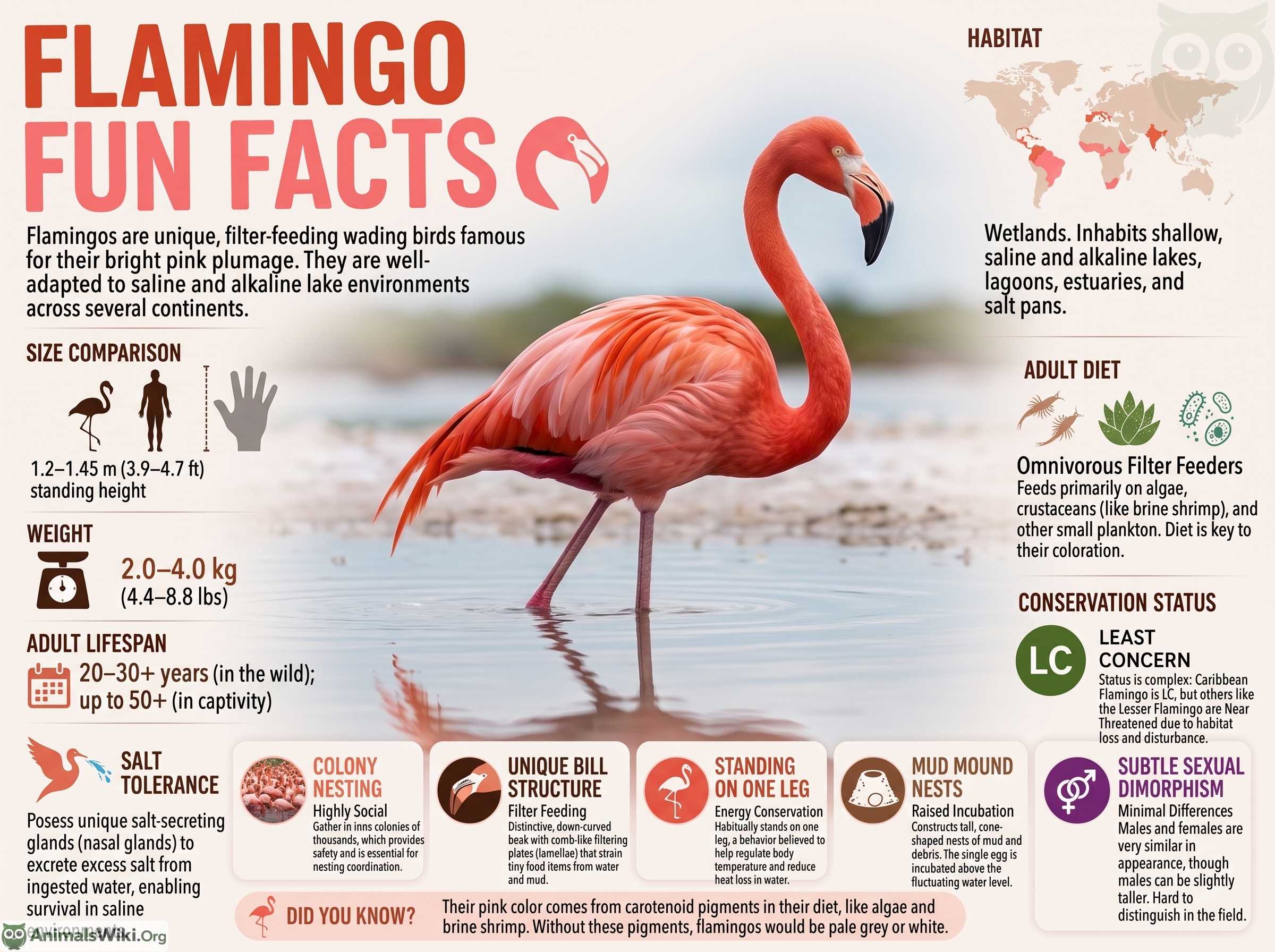
- 🦩 Flamingos are not naturally pink — chicks are born grey, and the pink color develops entirely from carotenoid pigments absorbed through diet
- 🦩 A flamingo’s knee is hidden inside its body — what looks like a backward-bending “knee” on its long leg is actually its ankle joint; the true knee sits close to the body, largely concealed by feathers
- 🦩 Flamingos can stand on one leg for hours with almost no muscular effort, thanks to a passive mechanical locking mechanism in the leg joint
- 🦩 A single flamingo colony can contain over a million individual birds — among the largest gatherings of any bird species on Earth
- 🦩 Flamingo parents produce a reddish “crop milk” to feed their chicks, colored by the same carotenoid pigments responsible for adult plumage
- 🦩 The flamingo’s closest living relatives, according to modern genetic research, are grebes — small diving waterbirds that look nothing like flamingos at all
- 🦩 Flamingos feed with their bills upside down — the upper mandible, not the lower, is the moving part, a nearly unique arrangement among birds
- 🦩 The Andean Flamingo is the only flamingo species with yellow legs, and among the rarest large birds in the world, confined to remote high-altitude Andean salt flats
- 🦩 A Greater Flamingo at Australia’s Adelaide Zoo, nicknamed “Greater,” may have lived to be over 80 years old
- 🦩 The plastic pink lawn flamingo, invented in 1957, remains one of the best-selling lawn ornaments in American history
- 🦩 Lesser Flamingos, the smallest and most numerous species, feed almost exclusively on microscopic cyanobacteria, filtering it from caustic, highly alkaline lake water with a pH that can exceed 10.5
- 🦩 Flamingos can fly at speeds of 50–60 km/h and have been tracked migrating overnight distances of 500–600 km in a single flight
17. How You Can Help
Support These Organizations
- BirdLife International (birdlife.org) — global bird conservation network coordinating flamingo habitat protection efforts across multiple continents, including work on East African soda lakes
- The Flamingo Specialist Group / IUCN SSC — the leading international scientific body coordinating flamingo research, population monitoring, and conservation strategy across all six species
- Wetlands International (wetlands.org) — global wetland conservation organization active in protecting the saline and alkaline lake systems flamingos depend on
- Bahamas National Trust (bnt.bs) — manages Inagua National Park and other protected areas critical to American Flamingo conservation
- Tour du Valat / Camargue conservation programs — supports Greater Flamingo research and habitat protection in the Mediterranean region
- Local conservation NGOs in Chile, Argentina, and Bolivia working on Andean salar protection — increasingly important given the intersection of flamingo habitat with lithium mining expansion
What You Can Do
- Support wetland and lake protection advocacy — because flamingos depend on a small number of critical sites worldwide, protecting key lakes such as Lake Natron and the Andean salares from unsustainable mining and water extraction is one of the most impactful conservation actions available
- Choose responsible flamingo tourism operators — select tour operators who maintain safe viewing distances and avoid disturbing active breeding colonies, since colony disturbance can cause mass nest abandonment
- Support climate-conscious lithium sourcing advocacy — as demand for lithium batteries grows, supporting responsible sourcing and mining practices in the Andean salar region directly benefits Andean and James’s Flamingo habitat
- Participate in citizen science and monitoring programs — several flamingo research programs rely on birdwatcher-submitted sightings and photographs to track population movements and colony status
- Avoid purchasing flamingo feathers or products of uncertain origin — supporting only certified, sustainable, or captive-bred products helps reduce pressure on wild populations where relevant
Recommended Documentaries & Books
- “Flamingo” episodes within BBC’s “Africa” and “Planet Earth” series — extensive, high-quality footage of East African super-colonies
- “The Crimson Wing: Mystery of the Flamingos” (Disneynature, 2008) — a feature-length documentary focused specifically on Lake Natron’s Lesser Flamingo breeding colony
- “The Flamingo” by Caitlin Doughty and various ornithological press publications on flamingo biology — accessible overviews of flamingo natural history
- Scientific literature from the IUCN Flamingo Specialist Group — the most authoritative technical source on flamingo population status and conservation planning
18. Frequently Asked Questions About Flamingo
Q1: Why are flamingos pink?
Flamingos are pink because of carotenoid pigments — primarily canthaxanthin and beta-carotene — obtained from their diet of algae, cyanobacteria, and small crustaceans such as brine shrimp. These pigments are absorbed during digestion and deposited into growing feathers (and skin) during molt. Flamingos are not born pink; chicks hatch with grey down, and the pink coloration develops gradually over the first one to two years of life as the bird’s diet-derived pigment accumulates. Captive flamingos denied a carotenoid-rich diet gradually fade to pale grey-white, which is why zoos supplement captive diets with synthetic canthaxanthin or shrimp-based feed to maintain vivid coloration.
Q2: Why do flamingos stand on one leg?
Research has shown that flamingos can balance on one leg with very little active muscular effort, thanks to a passive mechanical locking mechanism in the leg’s joint structure — essentially, the leg “locks” into a stable position that requires minimal energy to maintain, allowing the bird to rest or even sleep in this posture. The behavior is also linked to thermoregulation: tucking one leg up against the warm feathers of the body reduces heat loss through the unfeathered leg, which is particularly useful when standing in cold water. Flamingos are observed switching legs periodically and are more likely to stand on both legs in warmer water, supporting this heat-conservation explanation.
Q3: How many species of flamingo are there?
There are six recognized flamingo species worldwide: the Greater Flamingo (Phoenicopterus roseus), American/Caribbean Flamingo (Phoenicopterus ruber), Chilean Flamingo (Phoenicopterus chilensis), Lesser Flamingo (Phoeniconaias minor), Andean Flamingo (Phoenicoparrus andinus), and James’s/Puna Flamingo (Phoenicoparrus jamesi). They are distributed across Africa, southern Europe, the Middle East, South and Central Asia, the Caribbean, and South America, with the Andean and James’s Flamingos restricted to remote, high-altitude salt flats in the South American Andes.
Q4: What do flamingos eat, and how do they feed?
Flamingos are filter feeders, consuming algae, cyanobacteria, diatoms, brine shrimp, and small invertebrates depending on species and location. They feed with the bill held upside down in the water, using a thick, muscular tongue to rapidly pump water in and out of the bill; comb-like structures called lamellae lining the bill act as a sieve, trapping food particles while expelling water and sediment. The Lesser Flamingo has the most specialized bill, adapted to filter microscopic cyanobacteria, while larger-billed species like the Greater Flamingo target somewhat bigger food items such as brine shrimp and small mollusks.
Q5: Why do flamingos gather in such enormous flocks?
Flamingos are obligate colonial breeders, meaning they nest only in large groups — sometimes exceeding a million individuals at a single site. Colonial nesting provides protection through predator swamping (diluting the risk to any individual nest), enables synchronized breeding and hatching (minimizing the time eggs and chicks are vulnerable), and reflects the practical reality that suitable breeding habitat — remote, predator-free saline or alkaline mudflats — is extremely limited, concentrating birds at a small number of viable sites worldwide.
Q6: Are flamingos endangered?
It depends on the species. The Greater Flamingo and American Flamingo are both listed as Least Concern by the IUCN, with stable or recovering populations. The Lesser Flamingo, Chilean Flamingo, and James’s Flamingo are listed as Near Threatened, while the Andean Flamingo is classified as Vulnerable — the most at-risk of the six species, with a global population of roughly 38,000–40,000 birds confined to a small number of remote, high-altitude Andean lakes increasingly threatened by lithium mining and climate change.
Q7: What is a flamingo crèche?
A crèche is a large gathering of flamingo chicks — sometimes numbering in the thousands — that forms after chicks leave their individual nest mounds, typically around 8–15 days after hatching. Crèches are loosely supervised by a small number of adult “guard” birds and allow parents to leave chicks unattended for extended feeding trips. Despite the enormous size of these groups, parent flamingos are able to locate and feed their own chick using individually distinctive vocalizations that both parent and chick learn to recognize in the first days after hatching.
Q8: Can flamingos fly, and how far do they migrate?
Yes — despite their ungainly appearance on land, flamingos are strong, capable fliers, sustaining speeds of 50–60 km/h (31–37 mph) and flying with their long neck and legs both extended, creating a distinctive cross-shaped silhouette in flight. Several flamingo species undertake substantial nomadic and migratory movements, tracking shifting water levels and algae blooms across regional networks of lakes; individual overnight flights of 500–600 km have been documented, and flamingos have been tracked flying at altitudes exceeding 3,000 meters during migration.
19. Sources Researched
The information in this article was researched and verified using the following authoritative sources:
- Wikipedia — Flamingo, Phoenicopteridae, Greater flamingo, Lesser flamingo, American flamingo, Andean flamingo, James’s flamingo, Chilean flamingo
- IUCN Red List (iucnredlist.org) — Species-by-species flamingo conservation status assessments
- BirdLife International (birdlife.org) — Flamingo species accounts, population estimates, and threat assessments
- IUCN SSC Flamingo Specialist Group — Technical research and conservation planning documents
- National Geographic (nationalgeographic.com) — Flamingo biology, behavior, and conservation features
- Britannica (britannica.com) — Flamingo, Phoenicopteriformes
- BBC Nature / BBC Earth — Documentary references, including “Africa” and “Planet Earth” series footage and accompanying research notes
- Zimmermann, B. et al., ornithological research on flamingo leg biomechanics (Georgia Institute of Technology) — Passive standing mechanism research
- Wetlands International (wetlands.org) — East African soda lake ecology and conservation reporting
- San Diego Zoo Wildlife Alliance (sandiegozoowildlifealliance.org) — Flamingo care, diet, and captive breeding information
- Journal of Avian Biology / Waterbirds journal — Peer-reviewed research on flamingo colonial breeding, feeding ecology, and taxonomy
20. Flamingo Images