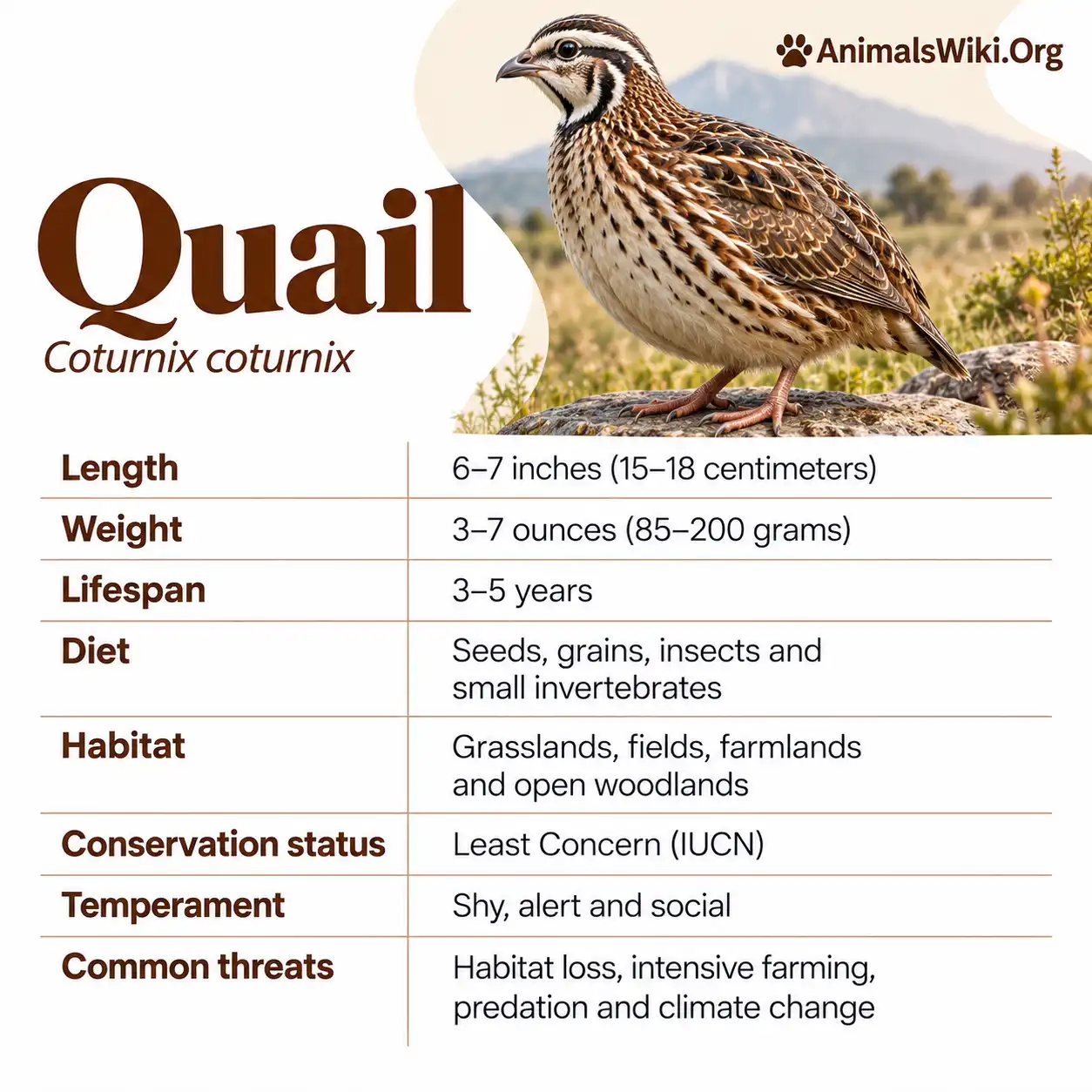
Quail Facts
| Feature | Details |
|---|---|
| Common Name | Quail |
| Scientific Name | Multiple genera — New World: Colinus, Callipepla, Cyrtonyx (family Odontophoridae); Old World: Coturnix (family Phasianidae) |
| Family | Odontophoridae (New World quail); Phasianidae (Old World quail) |
| Order | Galliformes |
| First Described | 1758 (Common Quail, by Carl Linnaeus) |
| Native Habitat | Grassland, farmland, scrubland, open woodland, desert edge |
| Geographic Range | Americas, Europe, Africa, Asia; introduced to Australia, New Zealand, Hawaii |
| Average Size | 15–28 cm depending on species |
| Average Weight | 70–270 g depending on species |
| Lifespan | 1–3 years typical (wild); up to 6–8 years (captivity) |
| Diet | Omnivore — seeds, grains, insects, leaves, berries |
| Conservation Status | Ranges from Least Concern to Near Threatened/Vulnerable depending on species |
| Defining Feature | Ground-nesting; explosive short-burst flight; distinctive head plumes/topknots; highly precocial chicks; significant game bird and agricultural history |
| Number of Species | Roughly 130+ species worldwide across both quail-containing families |
1. Quail Species Overview & Classification
Just after dawn on a dry, brush-dotted hillside in the American Southwest, as the first light catches the tips of the creosote bushes, a small, plump-bodied bird emerges cautiously from beneath a tangle of low shrubs, a single delicate, forward-curving black plume bobbing comically atop its head with every step. It moves in short, quick bursts across the open ground, pausing frequently to scan the surroundings, before a soft, rolling contact call brings a dozen more identical birds scurrying out of the brush behind it — a tight, coordinated covey moving as a single unit across the desert floor. Then, without warning, something startles the group, and the entire covey erupts skyward in a sudden, thunderous flurry of wings — a burst of explosive, short-range flight that has startled generations of hikers, hunters, and naturalists alike, before the birds glide low to the ground and vanish again into cover barely fifty meters away. This is the quail — one of the most widely recognized, most culturally significant, and most genuinely endearing small ground-birds in the world.
The quail is not a single species but a broad common name applied to a considerable number of small, plump-bodied, ground-dwelling birds within the order Galliformes — the same broad taxonomic order that includes chickens, pheasants, turkeys, and grouse. Quail are found across two distinct evolutionary lineages: the New World quail (family Odontophoridae), native to the Americas and including familiar species such as the Northern Bobwhite, California Quail, and Gambel’s Quail; and the Old World quail (genus Coturnix, within the pheasant family Phasianidae), native to Europe, Asia, and Africa and including the widely domesticated Japanese Quail and the migratory Common Quail. Despite belonging to two genuinely separate evolutionary lineages that are not each other’s closest relatives, New World and Old World quail have converged, through a shared ground-dwelling ecological lifestyle, on a broadly similar body plan, size, and general behavioral pattern — a genuinely instructive example of convergent evolution operating across two independently evolved bird lineages that nonetheless share the common English name “quail.”
Quail occupy a genuinely significant position at the intersection of wildlife biology, agriculture, game management, and human cultural history: few bird groups anywhere in the world have been so extensively studied, so intensively managed for hunting purposes, so widely domesticated for both meat and egg production, and so deeply embedded in human religious and literary tradition across multiple, entirely independent cultural contexts spanning the Americas, Europe, the Middle East, and Asia. At the same time, several quail species — including some of the most historically abundant and once economically significant North American species — have experienced genuinely dramatic, sustained population declines in recent decades, making quail conservation one of the more actively studied and, in some regions, urgently addressed areas of modern gamebird and grassland ecosystem management.
Species Classification Table
| Classification Level | Details |
|---|---|
| Kingdom | Animalia |
| Phylum | Chordata |
| Class | Aves |
| Order | Galliformes |
| Families | Odontophoridae (New World quail); Phasianidae (Old World quail, genus Coturnix and relatives) |
| Described By | Carl Linnaeus, 1758 (Common Quail) |
| Common Names | Quail (English, applied broadly across both lineages) |
Notable Quail Species
| Species | Scientific Name | Family/Lineage | Range | Notes |
|---|---|---|---|---|
| Northern Bobwhite | Colinus virginianus | Odontophoridae (New World) | Eastern/central US, Mexico | Most studied North American quail; significant historical decline |
| California Quail | Callipepla californica | Odontophoridae (New World) | Western US, introduced elsewhere | State bird of California; distinctive forward-curving topknot |
| Gambel’s Quail | Callipepla gambelii | Odontophoridae (New World) | Southwestern US desert regions | Highly desert-adapted |
| Montezuma (Mearns’s) Quail | Cyrtonyx montezumae | Odontophoridae (New World) | Southwestern US, Mexico | Striking harlequin facial pattern |
| Common Quail | Coturnix coturnix | Phasianidae (Old World) | Europe, Africa, Asia | Highly migratory; only Old World quail to undertake long migrations |
| Japanese Quail | Coturnix japonica | Phasianidae (Old World) | East Asia (wild); worldwide (domesticated) | Extensively domesticated for eggs, meat, and research |
The Name “Quail”
The English word “quail” derives from Old French “quaille,” ultimately tracing back through Medieval Latin to an earlier root generally believed to be imitative (onomatopoeic) in origin — attempting to phonetically capture the bird’s distinctive, repetitive call, a naming pattern common across numerous bird names in many languages worldwide, where the animal’s name directly echoes the sound of its own vocalization.
Did You Know? The Japanese Quail holds a genuinely unique distinction in the history of human spaceflight: it was among the first birds to have its eggs successfully hatched in space, aboard the Soviet Mir space station in 1990, as part of ongoing scientific research into avian embryonic development under microgravity conditions — making this small, unassuming quail species a genuine, if often overlooked, pioneer of orbital biological research.
2. Quail Physical Description & Unique Features
Quail across both the New World and Old World lineages share a broadly consistent, compact body plan reflecting their shared ground-dwelling, short-flight ecological lifestyle, while displaying considerable species-specific variation in plumage pattern, head ornamentation, and regional adaptation.
Size and Build
Quail size varies moderately across the many recognized species, though the group as a whole is characterized by a notably compact, rounded body form:
- Body length: Typically 15–28 cm (6–11 inches) depending on species
- Weight: Generally 70–270 g (2.5–9.5 oz), with most commonly encountered species falling toward the middle of this range
- Body shape: A plump, rounded body with a short tail and relatively short, rounded wings — a body plan well suited to the group’s characteristic explosive, short-burst flight pattern described in the Predators section, prioritizing rapid initial acceleration over sustained, efficient long-distance flight
Sexual dimorphism: Present in many species, though the degree varies; several New World quail species show meaningful differences in plumage coloration and pattern intensity between males and females, generally with males displaying somewhat bolder, more contrasted coloration, while several Old World Coturnix species show comparatively more subtle sexual dimorphism.
Distinctive Head Plumes and Ornamentation
One of the most visually distinctive and popularly recognized features across several prominent quail species, particularly within the New World lineage, is the presence of specialized head plumes or “topknots”:
- California Quail and Gambel’s Quail: Both species display a distinctive single, forward-curving black plume projecting from the top of the head — actually formed by a small cluster of feathers rather than a true single feather, though it visually presents as a singular, comma-shaped ornamental plume — one of the most immediately recognizable and popularly beloved physical features among all quail species, frequently used as a defining visual identifier in popular and commercial imagery associated with these species
- Montezuma Quail: Displays a genuinely striking, boldly patterned harlequin-style facial marking, combining black, white, and rufous coloration in a dramatic mask-like pattern unlike that of almost any other North American bird, making it one of the more visually distinctive quail species despite being considerably less commonly encountered by casual observers than the more widespread California Quail or Northern Bobwhite
Plumage Coloration and Camouflage
Quail plumage across the great majority of species is dominated by cryptic, earth-toned coloration — combinations of browns, greys, buffs, and rufous tones, frequently overlaid with intricate barring, scalloping, or streaking patterns — providing highly effective camouflage against the grassland, scrubland, and open woodland ground-litter habitats the group predominantly occupies, a defensive coloration strategy discussed further in the Predators section.
Legs and Feet
Quail possess relatively short, sturdy legs and feet well adapted for their predominantly ground-dwelling, walking and running lifestyle, with strong claws suited to scratching through leaf litter and loose soil in search of the seeds and invertebrate prey described in the Diet section — a foraging technique broadly shared across numerous other ground-dwelling galliform birds, including chickens and pheasants.
Wing Structure and the Explosive Flight Adaptation
Quail wings are notably short and rounded relative to overall body size, an adaptation directly connected to the group’s characteristic explosive, short-burst flight pattern:
- Rapid wingbeat frequency: Quail wings are capable of extremely rapid wingbeat cycling, allowing the birds to achieve sudden, near-vertical takeoff acceleration when startled — a defensive flight strategy discussed extensively in the Predators section, prioritizing immediate escape velocity over sustained flight efficiency or distance
- Limited sustained flight capability: Reflecting this short-burst flight specialization, quail are generally poor long-distance fliers compared to many other bird groups, typically covering relatively modest distances (often well under a few hundred meters) before landing and immediately seeking ground cover again — with the notable exception of certain migratory Old World species discussed in the Habitat section
Beak Structure
Quail possess a short, somewhat stout, slightly curved beak well suited to their omnivorous diet, described extensively in the Diet section, capable of efficiently processing both seeds and grain and the various insects and other small invertebrates consumed as a significant dietary component, particularly by growing chicks.
3. Quail Habitat & Geographic Range
Quail occupy a considerable range of open and semi-open terrestrial habitats across the Americas, Europe, Africa, and Asia, with the group as a whole showing a strong general preference for grassland, scrubland, and agricultural edge environments offering a combination of adequate ground cover and open foraging space.
Preferred Habitat Features
Grassland and scrubland — the core habitat type for the majority of quail species, providing the essential combination of adequate low, dense cover for shelter and predator avoidance alongside sufficiently open ground for efficient foraging and movement
Agricultural edge habitat — many quail species, particularly several prominent North American species, show a strong historical and ongoing association with traditional, less-intensively managed agricultural landscapes, including field margins, fencerows, and fallow or lightly grazed farmland, which have historically provided an especially favorable combination of food resources (including waste grain) and adequate cover
Brushy cover and hedgerows — dense, low shrub cover, including hedgerows, brush piles, and similar structural features, provides critical shelter from both predators and weather extremes across much of the group’s range
Desert and arid scrubland (specific species) — several New World quail species, notably Gambel’s Quail, show particularly strong adaptation to hot, arid desert scrubland conditions across the southwestern United States and northern Mexico, representing one of the more habitat-specialized branches of the broader quail group
Open woodland edge — several species, including the Montezuma Quail, favor the transitional zone between open grassland and more substantial woodland cover, particularly in oak savanna and similar mixed-habitat environments
Habitat Types Occupied
| Habitat | Primary Quail Use | Species Examples | Key Features |
|---|---|---|---|
| Grassland/prairie | Primary habitat | Northern Bobwhite, various species | Dense ground cover; seed-rich foraging |
| Desert scrubland | Primary habitat | Gambel’s Quail | Extreme heat/arid tolerance |
| Chaparral/coastal scrub | Primary habitat | California Quail | Mediterranean climate adaptation |
| Agricultural field margins | Feeding, shelter | Bobwhite, Common Quail, others | Waste grain; fencerow cover |
| Oak savanna/open woodland | Primary habitat | Montezuma Quail | Transitional grass-woodland zone |
| European/Asian cultivated farmland | Breeding, migration stopover | Common Quail | Cereal crop fields |
Geographic Range
Current range by region:
| Region | Key Countries | Primary Species | Population Status |
|---|---|---|---|
| Eastern/Central North America | United States, Mexico | Northern Bobwhite | Significant historical decline, though regionally variable |
| Western North America | United States, Mexico | California Quail, Gambel’s Quail, Montezuma Quail | Generally more stable, though regionally variable |
| Europe | Widespread across the continent | Common Quail | Migratory; population fluctuates with breeding/hunting pressure |
| Africa/Middle East | Wide distribution | Common Quail (wintering), Harlequin Quail, others | Variable; significant hunting pressure along migration routes |
| Asia | Japan, China, and broader East/South Asia | Japanese Quail, various Asian Coturnix and related species | Wild populations variable; extensive domestication |
| Introduced range | Australia, New Zealand, Hawaii, and others | Various species | Successfully established in several introduced regions |
Migration — A Distinctive Feature of the Common Quail
Unlike the great majority of New World quail species, which are predominantly non-migratory, sedentary birds maintaining relatively stable home ranges year-round, the Old World Common Quail is notably migratory, undertaking substantial seasonal movements between European and West/Central Asian breeding grounds and African wintering areas — a genuinely significant behavioral distinction within the broader quail group, and one that has historically made the species a significant target for seasonal hunting along well-established migration corridors across the Mediterranean region and Middle East, a practice with a documented history extending back thousands of years, discussed further in the Human Relationships section.
4. Quails Diet & Feeding Behavior
Quail are genuinely omnivorous ground foragers, with a diet that shifts meaningfully across life stages and seasons, reflecting the group’s broadly opportunistic feeding ecology adapted to the variable resource availability of grassland and scrubland environments.
What Quail Eat
Seeds and grain — the dietary foundation for adult quail across most species and seasons; a wide range of native grass and forb seeds, along with agricultural grain where available, forms the primary adult dietary component, particularly during the non-breeding season
Insects and other invertebrates — a critical dietary component, particularly for growing chicks during the early weeks of life, when the substantially higher protein content of insect prey supports the rapid growth and development characteristic of precocial galliform chicks, described further in the Reproduction section; adult quail also continue to consume insects opportunistically, particularly during the breeding season when protein demands increase
Leaves and green vegetation — consumed as a supplementary dietary component across most species, particularly valuable during periods when seed and insect availability is more limited
Berries and fruit — consumed opportunistically when seasonally available, contributing modestly to overall dietary diversity
Waste agricultural grain — a historically significant food resource for many quail populations inhabiting or bordering traditional agricultural landscapes, particularly relevant to the group’s historical association with less-intensively managed farmland described in the Habitat section
Chick Diet — The Critical Early Protein Requirement
As referenced above, quail chicks require a substantially higher-protein diet, dominated by insects and other small invertebrates, during their first several weeks of life to support the rapid growth characteristic of precocial galliform development — a dietary requirement with direct and significant conservation implications, since the availability of adequate insect prey during this critical early developmental window has been identified by researchers as a key factor influencing quail population productivity, and one directly affected by the pesticide use and habitat simplification associated with modern intensive agricultural practices, discussed further in the Conservation section.
Feeding Behavior Patterns
Ground foraging: Quail forage predominantly by walking and scratching across open or lightly vegetated ground, using their beak and feet, described in the Physical Description section, to search through leaf litter, loose soil, and low vegetation for seeds and invertebrate prey
Covey feeding: Outside the breeding season, quail typically forage in coordinated coveys (the specific term for a quail social group, discussed extensively in the Social Behavior section), moving together across suitable foraging habitat and benefiting from the collective predator-vigilance advantages of group foraging
Crepuscular feeding peaks: Quail feeding activity often shows peak intensity during the cooler, lower-light periods of early morning and late afternoon/early evening, with reduced activity during the heat of midday, particularly pronounced in the more heat-adapted desert species such as Gambel’s Quail
Grit consumption: Like many seed-eating birds, quail regularly consume small stones and grit, which are retained in the muscular gizzard and assist in mechanically breaking down tough seed coats during digestion — a common digestive adaptation shared broadly across the Galliformes order.
Water Requirements
Water requirements vary considerably by species and habitat: several desert-adapted species, notably Gambel’s Quail, show meaningful tolerance for extended periods with limited direct water access, obtaining a significant proportion of moisture requirements from consumed vegetation and insects, while quail in less arid habitats typically show more regular reliance on directly available water sources.
5. Quail Reproduction & Life Cycle
Quail reproductive biology follows a broadly typical galliform pattern — ground nesting, substantial clutch sizes, and highly precocial chicks capable of considerable independent activity almost immediately after hatching — while showing some genuinely notable variation in specific breeding strategy and parental care investment across different quail species.
Sexual Maturity
Quail reach sexual maturity remarkably quickly compared to many of the other bird species covered elsewhere in broader wildlife guides, typically within their first year of life, and in several species, including the widely domesticated Japanese Quail, sexual maturity and egg-laying capability can begin at just 6–8 weeks of age — an extremely rapid maturation timeline that has made quail, and particularly the Japanese Quail specifically, a genuinely significant and widely used model organism in reproductive and developmental biology research, discussed further in the Human Relationships section.
Breeding Season and Courtship
Quail breeding season timing varies by species and region but is generally concentrated during spring and early summer across most temperate-zone populations, coinciding with improved food availability and more favorable environmental conditions for chick-rearing.
Male courtship displays: Male quail across various species engage in courtship behavior including distinctive vocalizations (described further in the Social Behavior section), postural displays, and, in several species, feeding displays in which the male presents food items to a prospective mate — a courtship-feeding behavior documented across numerous galliform bird species more broadly.
Mating system variation: Quail mating systems vary somewhat by species; several New World quail species, including the Northern Bobwhite, are generally considered to show a broadly monogamous breeding pattern for a given breeding season, with pair bonds typically not persisting beyond the single season, while certain other quail species show somewhat more variable or opportunistic mating patterns.
Nesting
- Nest site and construction: Quail construct relatively simple ground nests, typically a shallow depression in the soil, often positioned beneath or within dense low vegetation or brush cover offering concealment from predators, lined with available grass, leaves, and other plant material
- Clutch size: Quail typically produce notably large clutches relative to overall body size — commonly ranging from 10 to 20 eggs per clutch depending on species, among the larger relative clutch sizes found in birds more broadly, reflecting the group’s overall reproductive strategy of producing substantial numbers of offspring to offset the significant predation and environmental mortality pressure young quail face, discussed further in the Predators section
- Incubation period: Typically 21–24 days, varying modestly by species, with incubation duties performed predominantly, though not always exclusively, by the female in most species
Precocial Chick Development
Quail chicks are strongly precocial — hatching in a comparatively well-developed state, covered in down, with eyes open, and capable of leaving the nest and beginning independent foraging activity within hours of hatching, a developmental strategy broadly shared across the Galliformes order more generally and standing in sharp contrast to the altricial (helpless, blind, and entirely dependent) hatchling condition characteristic of many other bird groups.
| Stage | Timing | Development |
|---|---|---|
| Hatching | Day 0 | Down-covered; eyes open; capable of leaving nest within hours |
| Early chick development | Days 1–14 | Rapid growth; high-protein insect-dominated diet; brooded by parent(s) for warmth |
| Feather development | Weeks 2–4 | Down progressively replaced by juvenile flight feathers |
| First flight capability | ~Weeks 2–3 | Limited flight ability develops notably early relative to many other precocial birds |
| Juvenile independence | ~6–8 weeks | Increasing independence; covey integration |
| Sexual maturity | ~6 weeks–1 year (species-dependent) | Reproductive capability begins |
Rapid early flight capability: A genuinely notable feature of quail chick development is the comparatively early onset of limited flight capability, often within just 2–3 weeks of hatching — considerably earlier than most other precocial ground-nesting birds achieve meaningful flight, an adaptation that provides young quail chicks with a significant additional predator-escape capability at a notably early developmental stage.
Renesting and Double-Brooding
Several quail species, including the Northern Bobwhite, show a genuine capacity for renesting following nest failure (whether from predation, weather events, or other causes) and, under favorable conditions, double-brooding (successfully raising a second clutch within the same breeding season) — a reproductive flexibility that provides some meaningful resilience against the otherwise substantial nest-failure rates quail populations commonly experience, discussed further in the Predators section.
Lifespan of Quail
- Wild: Typically quite short — most wild quail populations experience high annual mortality, with average individual lifespan often estimated at only 1–3 years, reflecting substantial predation pressure and, in actively hunted populations, additional harvest mortality
- Captivity: Considerably longer under protected conditions, with some captive quail documented living 6–8 years or more, illustrating the substantial gap between typical wild mortality pressure and the species’ underlying physiological longevity potential.
6. Social Behavior & Communication
Quail social structure centers substantially on the distinctive covey — the specific collective term for a quail social group — representing one of the more behaviorally well-documented and genuinely important social structures among North American game birds specifically.
The Covey — Quail’s Defining Social Unit
Outside the breeding season, quail across most species aggregate into coveys — cohesive social groups typically ranging from a handful of individuals to 20 or more birds, depending on species, local population density, and habitat conditions:
- Covey formation: Coveys typically form in late summer and autumn following the breeding season, often incorporating multiple family groups (parents and their offspring from the preceding breeding season) into a single, larger cohesive social unit
- Collective foraging and vigilance: Covey members forage together, described in the Diet section, benefiting from the collective predator-detection advantage of group vigilance — with multiple individuals simultaneously alert to potential threats, the overall group’s chances of detecting an approaching predator in time to respond are significantly improved compared to solitary foraging
- The distinctive “covey flush”: When a covey is startled by a genuine predator threat, the group characteristically explodes into flight nearly simultaneously in a dramatic, sudden burst — the “covey flush” described in the Species Overview section — a coordinated group escape response that, through sheer sensory overload and multiple simultaneous escape trajectories, can genuinely confuse and disorient an attacking predator, reducing the likelihood of successful predation on any single individual
Roosting Behavior — The Circular Huddle
One of the most distinctive and frequently documented quail social behaviors is the group’s characteristic nighttime roosting formation: covey members typically settle into a tight circular huddle on the ground, facing outward in all directions — a formation that provides both significant thermoregulatory benefit (through shared body heat, particularly important during colder periods) and, critically, 360-degree collective vigilance against approaching ground predators, allowing the covey to detect and respond to a threat approaching from any direction and to erupt collectively into the defensive covey flush described above with minimal warning or coordination delay.
Territoriality
Territorial behavior in quail is generally most pronounced during the breeding season, when paired individuals or mated pairs establish and, to varying degrees depending on species and local population density, defend a breeding territory against other quail; outside the breeding season, territorial behavior is generally considerably reduced as birds integrate into the larger, more cooperative covey social structure described above.
Communication — A Genuinely Distinctive Vocal Repertoire
Quail vocalizations are among the more distinctive and, in several cases, culturally recognized bird calls across their respective ranges:
- The “bob-white” call: The Northern Bobwhite’s clear, whistled, rising “bob-WHITE” call — from which the species derives its common name directly — is among the most recognizable and widely referenced bird vocalizations in eastern and central North America, historically serving as a genuinely iconic soundmark of rural American farmland and grassland habitat
- Covey contact calls: Quail produce a range of softer contact calls used to maintain covey cohesion during foraging movement, particularly important for keeping the group coordinated while moving through dense ground cover with limited direct visual contact between individuals
- Alarm calls: Distinct alarm vocalizations alert the covey to detected predator threats, often the initial trigger for the coordinated covey flush response described above
- The “coturnix” call of Old World quail: The Common Quail’s distinctive, repetitive “wet-my-lips”-sounding call (variously transliterated across different European languages, and itself a further example of onomatopoeic naming influence) is similarly well recognized across the species’ considerable European and Asian breeding range, and has historically served as a significant means of locating and hunting the species given its otherwise highly cryptic ground-dwelling behavior and coloration
Communal Roosting and Covey Reformation
Following any disturbance or the dramatic covey flush described above, dispersed covey members typically use contact calling to relocate and reform the group, generally reconvening within a relatively short period once the immediate threat has passed — a resilient social reorganization capability that helps maintain the covey’s collective vigilance and foraging benefits despite the group’s periodic, predator-triggered scattering.
7. Predators & Defense Mechanisms
As small, ground-dwelling birds occupying open and semi-open habitat across their considerable range, quail face substantial and genuinely significant predation pressure from a wide range of both avian and mammalian predators, and the group’s entire behavioral and physical toolkit — camouflage, covey social structure, and explosive flight — is fundamentally shaped by this pressure.
Natural Predators
Hawks and other diurnal raptors — including Cooper’s hawks, red-tailed hawks, and various other regional raptor species, represent significant predators of quail across much of the group’s range, capable of both aerial pursuit and ambush attack
Owls — great horned owls and various other owl species represent significant nocturnal predators, particularly relevant given quail roosting behavior described in the Social Behavior section
Foxes and coyotes — significant mammalian predators of quail across much of the group’s North American, European, and broader range, capable of both direct pursuit and, in some cases, successfully exploiting the vulnerable roosting huddle formation described in the Social Behavior section if detection or approach occurs before the covey can respond
Snakes — various snake species represent significant predators of quail eggs and, in some cases, adult birds, particularly during the nesting period when incubating adults and eggs are especially vulnerable
Raccoons, skunks, and opossums — significant nest predators across much of the North American quail range, contributing substantially to the often considerable nest failure rates quail populations experience
Domestic and feral cats — a documented and, in some regions, significant predation source, particularly in areas of quail habitat overlapping with human settlement
Defense Strategies
Cryptic camouflage: As described extensively in the Physical Description section, quail plumage coloration provides highly effective camouflage against typical grassland, scrubland, and ground-litter habitat backgrounds, representing the group’s primary passive defense strategy and the foundation of its broader “freeze and hide” initial predator-avoidance behavior
The “freeze” response: When a potential threat is detected but has not yet closed to an immediately dangerous distance, quail typically first rely on remaining motionless, relying on camouflage to avoid detection, rather than immediately fleeing — a common initial predator-avoidance strategy across numerous cryptically colored ground-dwelling bird species
The explosive covey flush: As detailed extensively in the Social Behavior section, when a threat closes to a sufficiently immediate distance that freezing is no longer an adequate defense, quail employ their characteristic sudden, explosive, near-simultaneous group flight response — the coordinated “covey flush” — designed to startle, confuse, and disorient an approaching predator through sudden sensory overload and multiple simultaneous escape trajectories, significantly reducing the probability of successful predation on any individual bird within the group
Circular roosting vigilance: The outward-facing circular roosting huddle described in the Social Behavior section provides genuine, functional 360-degree collective threat detection during the particularly vulnerable nighttime resting period
Ground cover utilization: Quail rely heavily on dense, low vegetation and brush cover, described extensively in the Habitat section, both as a primary refuge destination following the initial flush response and as ongoing concealment during regular foraging and movement activity
Distraction displays (nesting adults): Like several other ground-nesting bird species, incubating quail parents have been documented performing distraction displays — including feigned injury behavior intended to lure a potential predator away from the nest site — when a threat approaches an active nest, a defensive behavior parallel to that documented across numerous other ground-nesting bird species worldwide.
8. Relationship with Humans
Ancient Historical and Religious Significance
Quail hold a genuinely deep and long-documented place in human history, religious tradition, and cultural practice across multiple, entirely independent civilizations:
Biblical significance: The Common Quail features prominently in the biblical Book of Exodus, in which quail are described as miraculously provided as a food source to the Israelites during their wilderness journey — a narrative episode that reflects, with genuine historical and ecological plausibility, the real, well-documented phenomenon of massive seasonal Common Quail migration flocks passing through the eastern Mediterranean and Sinai regions, historically arriving in such exhausted, low-flying concentrations following their long migratory sea crossing that they could be readily captured by hand or simple nets — a genuine ecological basis underlying one of the more frequently referenced biblical animal narratives
Ancient Egyptian significance: Quail chicks appear as a recognizable hieroglyphic symbol in ancient Egyptian writing, representing the phonetic sound “w” in the Egyptian hieroglyphic system — reflecting the bird’s evident familiarity and cultural presence within ancient Egyptian civilization
Ancient Chinese and East Asian tradition: Quail hold significant cultural and, historically, practical importance across various East Asian traditions, including a long-documented history of both quail hunting and quail domestication across China and Japan, with the Japanese Quail specifically becoming one of history’s most successfully and extensively domesticated bird species, discussed further below
Native American traditions: Various Indigenous peoples across the quail’s North American range incorporated quail into traditional subsistence practice and, in various specific cultural traditions, into broader spiritual and symbolic significance, reflecting the bird’s long-standing ecological presence and practical importance across pre-Columbian North America.
Domestication — The Japanese Quail as a Global Agricultural and Research Animal
The Japanese Quail represents one of the more significant and, in certain specific contexts, underappreciated bird domestication success stories in human agricultural history:
- Egg and meat production: Japanese Quail have been extensively domesticated for both egg and meat production, particularly significant across East Asia but increasingly present in agricultural and culinary contexts worldwide, valued for the species’ extremely rapid growth and reproductive cycle (described in the Reproduction section), relatively modest space and resource requirements compared to larger domestic poultry, and the genuine culinary appeal of quail eggs and meat in numerous regional cuisines
- Scientific research model organism: Beyond its agricultural significance, the Japanese Quail has become a genuinely important model organism in avian biology, developmental biology, toxicology, and physiology research, valued specifically for its rapid generational turnover, well-characterized genetics, and relatively modest housing requirements compared to larger research animals — as referenced in the Species Overview section, this research significance extended even into orbital spaceflight biology, with Japanese Quail eggs among the first bird eggs successfully hatched in space aboard the Soviet Mir space station in 1990
The Quail as a Premier Game Bird
Across much of the Northern Hemisphere, quail — and particularly the Northern Bobwhite in North America and the Common Quail across Europe, the Middle East, and parts of Asia — hold significant historical and ongoing status as premier game birds, with quail hunting representing a longstanding and, in many regions, culturally and economically significant traditional sporting and subsistence practice:
- North American bobwhite hunting tradition: Bobwhite quail hunting, traditionally conducted with trained pointing dogs, holds particular historical and cultural significance across the southeastern United States specifically, where it has historically represented both a significant recreational hunting tradition and, in various periods, a genuinely important regional agricultural and land-management economic driver
- Mediterranean and Middle Eastern quail hunting: The Common Quail’s substantial migratory movements, described in the Habitat section, have historically made the species a significant hunting target along well-established migration corridors across the Mediterranean basin and Middle East, a hunting tradition with a documented history extending back thousands of years and continuing, in regulated form, in various countries today
Modern Backyard and Small-Scale Quail Keeping
In recent decades, particularly reflecting broader trends toward small-scale, backyard, and homestead-style poultry keeping, quail — again predominantly the Japanese Quail, given its manageable size, rapid reproductive cycle, and modest housing requirements — have become an increasingly popular choice for small-scale hobbyist and homestead egg and meat production, representing a modern extension of the species’ much longer domestication and agricultural history.
9. Quail Conservation Status & Threats
Conservation Status Overview
Quail conservation status varies considerably across the numerous recognized species, ranging from broadly secure, widespread populations to species experiencing genuinely significant, sustained population decline requiring active conservation management attention:
| Species (Representative Examples) | IUCN Status | Population Trend Notes |
|---|---|---|
| Northern Bobwhite | Near Threatened | Significant, well-documented historical decline across much of range |
| California Quail | Least Concern | Generally stable |
| Gambel’s Quail | Least Concern | Generally stable |
| Common Quail | Least Concern | Overall stable, though facing significant regional hunting pressure |
| Japanese Quail | Near Threatened (wild population specifically) | Wild population declining; domesticated population secure |
| Montezuma Quail | Least Concern | Stable but naturally limited range |
The Northern Bobwhite’s Dramatic Decline — A Significant North American Conservation Story
The Northern Bobwhite represents one of the more genuinely significant and closely studied gamebird conservation stories in North American wildlife management history:
- Scale of decline: Northern Bobwhite populations across substantial portions of the species’ historical eastern and central United States range have declined by an estimated more than 80% since the mid-20th century, according to long-term breeding bird survey data — a decline of genuinely striking magnitude for a species that was, within living memory, considered one of the most abundant and widely hunted game birds across large portions of its range
- Primary driver — habitat loss and agricultural intensification: The overwhelming primary driver of this decline is widely understood by wildlife biologists to be the fundamental transformation of the American agricultural landscape over the preceding decades — the shift from smaller-scale, diversified farming featuring extensive fallow fields, brushy fencerows, field margins, and generally “messier,” less intensively managed agricultural land (historically ideal bobwhite habitat, as described in the Habitat section) toward large-scale, highly mechanized, intensively managed monoculture farming that has eliminated much of the brush cover, field-edge habitat, and weedy fallow ground the species fundamentally depends upon
- Compounding factors: Beyond the primary agricultural land-use transformation driver, additional compounding factors contributing to the decline include fire suppression (which has allowed woody vegetation succession to encroach upon and degrade previously open grassland and savanna habitat in many regions), pesticide use reducing the insect prey base critical to chick survival described in the Diet section, and broader habitat fragmentation
Current Threats
1. Habitat Loss and Agricultural Intensification
As detailed extensively above regarding the Northern Bobwhite specifically, the broader, ongoing transformation of traditional grassland, scrubland, and diversified agricultural landscapes toward more intensively managed, simplified land-use patterns represents the single most significant sustained threat facing numerous quail species across their range, both in North America and, to varying degrees, across parts of the Common Quail’s European and Asian range as well.
2. Fire Suppression and Habitat Succession
Reduced natural and prescribed fire frequency across much of the historical range of several fire-adapted grassland and savanna quail species has allowed woody vegetation encroachment to degrade previously suitable open habitat, a threat increasingly recognized and actively addressed through targeted prescribed burning conservation management programs in several regions.
3. Pesticide Use and Reduced Insect Prey Base
Given the critical dependence of young quail chicks on insect protein described in the Diet section, widespread agricultural pesticide use — which can substantially reduce insect abundance across managed farmland — represents a significant, if somewhat less visible, threat to quail reproductive success and population productivity in many agricultural landscape contexts.
4. Predation Pressure (Compounded by Habitat Fragmentation)
While predation represents a natural and, in intact ecosystems, generally sustainable pressure on quail populations (as detailed in the Predators section), habitat fragmentation and the reduction of adequate escape and nesting cover can meaningfully increase effective predation pressure by concentrating vulnerable quail populations into smaller, more easily searched remaining habitat patches, and by reducing the availability of adequate cover needed for effective defensive response.
5. Overhunting (Localized, Historical, and Ongoing Regional Concern)
While quail hunting is generally well regulated and sustainably managed across much of the species’ modern range in North America and Europe, unregulated or inadequately managed hunting pressure, particularly along the Common Quail’s significant Mediterranean and Middle Eastern migration corridors, remains an area of ongoing conservation concern and active international regulatory discussion.
6. Climate Change
Shifting precipitation and temperature patterns associated with broader climate change represent a longer-term threat consideration across quail range, with potential implications for breeding season timing, chick-rearing food availability, and the broader suitability of currently occupied habitat, particularly relevant to the more habitat- and climate-sensitive quail species.
10. Famous Quails Around the World
The Biblical Quail of Exodus
As detailed extensively in the Human Relationships section, the quail described in the biblical Book of Exodus as miraculously provided to the wandering Israelites represents, collectively, one of the most historically and culturally significant animal references in the entire Western religious and literary tradition — a narrative episode grounded in genuine, documented ecological reality regarding Common Quail migration patterns across the eastern Mediterranean and Sinai regions.
California’s State Bird
The California Quail, formally designated the official state bird of California in 1931, holds a genuinely significant symbolic status within California state identity and wildlife heritage, appearing extensively across California state wildlife agency branding, educational materials, and broader regional cultural and commercial imagery, reflecting the species’ status as one of the most visually recognizable and popularly beloved native California wildlife species.
The Mir Space Station Quail
As introduced in the Species Overview section, the Japanese Quail eggs successfully hatched aboard the Soviet Mir space station in 1990 — part of a significant Soviet/Russian orbital biological research program — deserve recognition as, collectively, among the more scientifically significant individual animals (or in this case, developing embryos) in the history of human spaceflight biological research, representing a genuine milestone in understanding vertebrate embryonic development under microgravity conditions.
11. Role in Ecosystem & Food Chain
Quail as Prey — A Foundational Position in Grassland and Scrubland Food Webs
As detailed extensively in the Predators section, quail occupy a genuinely significant position as a primary prey species supporting a considerable range of predators — including numerous raptor, owl, and mammalian carnivore species — across the grassland, scrubland, and agricultural-edge ecosystems they inhabit; the group’s substantial reproductive output, described in the Reproduction section, reflects and helps sustain this significant role as a foundational prey base within these ecosystems.
Seed Dispersal and Insect Population Regulation
Through their significant seed consumption and, particularly relevant given the substantial insect component of chick diet described in the Diet section, their predation on various insect populations, quail contribute meaningfully to both localized seed dispersal (through undigested seed passage) and a degree of natural insect population regulation within the grassland and agricultural-edge habitats they occupy.
Indicator Species Status — The Bobwhite as a Grassland Health Signal
Given the Northern Bobwhite’s well-documented, close ecological association with specific grassland and diversified agricultural habitat conditions, described extensively in the Conservation section, the species’ population trends are widely used by wildlife biologists and grassland conservation researchers as a meaningful indicator of broader grassland and early-successional habitat ecosystem health across much of its historical eastern and central North American range — the species’ dramatic documented decline serving as a genuinely significant and closely tracked signal of the broader landscape-level habitat transformation affecting numerous other grassland-dependent species sharing the same increasingly fragmented and intensively managed agricultural landscape.
Quail Hunting as a Conservation Funding Mechanism
As with several other actively managed North American game species covered elsewhere in broader wildlife guides, regulated quail hunting license revenue and associated conservation funding mechanisms have historically supported meaningful habitat protection and restoration efforts specifically targeting quail and broader grassland ecosystem conservation, representing a genuine, if sometimes underappreciated, connection between regulated sport hunting practice and measurable habitat conservation outcomes.
12. Quail Discovery & Evolution Timeline
~20–30 million years ago — The broader order Galliformes, encompassing quail alongside chickens, pheasants, turkeys, and grouse, continues diversifying across its considerable global range, with the specific lineages leading to modern New World quail (family Odontophoridae) and Old World quail (genus Coturnix within Phasianidae) becoming established as distinct evolutionary branches — a genuinely notable case of two separately evolved lineages converging, through shared ground-dwelling ecology, on a broadly similar general body plan and lifestyle now grouped under the shared common English name “quail.”
Ancient Egypt (thousands of years ago) — Quail chicks become established as a recognizable hieroglyphic symbol within ancient Egyptian writing, reflecting the bird’s long-standing familiarity within ancient Egyptian civilization.
Biblical era (approximate composition period of Exodus narrative) — The quail-provision narrative within the Book of Exodus becomes established within Judeo-Christian religious tradition, reflecting genuine, documented ecological patterns of Common Quail migration through the eastern Mediterranean and Sinai regions.
Ancient China/Japan (historical period) — Long-documented traditions of quail hunting and, progressively, quail domestication become established across East Asia, laying the historical groundwork for the eventual extensive domestication of the Japanese Quail specifically.
1758 — Carl Linnaeus formally describes the Common Quail in the 10th edition of Systema Naturae, establishing the modern scientific classification foundation for subsequent Old World quail taxonomic research.
19th–early 20th century — Continued formal Western scientific description and taxonomic documentation of the considerable diversity of New World and Old World quail species, alongside the establishment of quail hunting as a significant, formalized recreational sporting tradition across substantial portions of North America and Europe.
Early-mid 20th century — Northern Bobwhite populations reach their historical peak abundance across much of the eastern and central United States, coinciding with the traditional, diversified small-farm agricultural landscape pattern particularly favorable to the species, described extensively in the Conservation section.
1931 — The California Quail is formally designated the official state bird of California, cementing the species’ significant symbolic status within California state identity.
Mid-late 20th century — Beginning of the substantial, sustained Northern Bobwhite population decline across much of the species’ historical range, driven predominantly by the progressive transformation of American agricultural land-use patterns described extensively in the Conservation section.
1990 — Japanese Quail eggs become among the first bird eggs successfully hatched aboard the Soviet Mir space station, marking a genuine milestone in orbital biological research and vertebrate developmental science.
1990s–2000s — Growing scientific documentation and increasing conservation management attention to the scale and drivers of Northern Bobwhite decline, alongside the establishment of significant, dedicated bobwhite habitat restoration and prescribed-fire management programs across multiple range states.
2010s–2020s — Continued expansion of small-scale, backyard, and homestead-style Japanese Quail keeping as part of broader trends toward diversified small-scale poultry husbandry, alongside continued, active bobwhite and broader grassland-bird habitat conservation programming across North America.
2022–2026 — Ongoing Northern Bobwhite habitat restoration and prescribed-fire management efforts across multiple U.S. states, continued international regulatory discussion regarding sustainable Common Quail migration-corridor hunting management across the Mediterranean and Middle East, and continued growth in both agricultural and research applications of the extensively domesticated Japanese Quail worldwide.
13. Quail Comparison with Similar Species
| Feature | Quail (Odontophoridae/Coturnix) | Partridge (various Phasianidae genera) | Pheasant (Phasianus spp.) | Grouse (various Phasianidae genera) |
|---|---|---|---|---|
| Order | Galliformes | Galliformes | Galliformes | Galliformes |
| Size | 15–28 cm | 28–35 cm | 60–90 cm (incl. tail) | 30–90 cm (species-dependent) |
| Native range | Americas, Europe, Africa, Asia | Europe, Asia, Africa | Asia (native); widely introduced | N. America, Europe, Asia |
| Habitat | Grassland, scrubland, farmland edge | Farmland, grassland, scrubland | Woodland edge, farmland | Forest, tundra, sagebrush (species-dependent) |
| Social structure | Coveys (non-breeding season) | Coveys/family groups | Largely solitary/loose groups | Varies; some form leks |
| Flight style | Explosive, short-burst | Explosive, short-burst | Strong but generally short-range | Varies by species |
| Clutch size | 10–20 eggs | 10–20 eggs | 8–15 eggs | 6–12 eggs (species-dependent) |
| Conservation | Varies (LC–Near Threatened) | Varies by species | Least Concern (widely introduced) | Varies widely by species |
| Closest relative in this guide | Partridge (shared Phasianidae for Old World quail) | Quail | N/A | N/A |
14. Best Places to See Quail in the Wild
North America
- 🇺🇸 South Texas brush country — among the most reliable and celebrated locations for observing Northern Bobwhite alongside significant regional quail hunting tradition and active habitat conservation programming
- 🇺🇸 Southern California chaparral and coastal scrub habitat — reliable California Quail viewing, particularly around parks and reserves maintaining suitable native scrubland habitat
- 🇺🇸 Sonoran Desert region, Arizona — excellent Gambel’s Quail viewing, particularly around desert washes and residential areas bordering suitable native desert scrub habitat
- 🇺🇸 Southeastern Arizona sky island mountain ranges — among the best locations to observe the more range-restricted, visually striking Montezuma Quail
Europe
- 🇪🇸/🇮🇹/🇬🇷 Mediterranean agricultural regions, Spain/Italy/Greece — significant Common Quail breeding populations across traditional cereal-growing agricultural landscapes, particularly audible (if less frequently visually observed, given the species’ notably secretive habits) during the spring breeding season
Africa/Middle East
- 🇪🇬/🇮🇱 Sinai Peninsula and eastern Mediterranean coastal regions — historically and currently significant Common Quail migration stopover areas, directly connected to the biblical migration narrative described extensively in the Human Relationships and Myths sections
Asia
- 🇯🇵 Rural agricultural regions, Japan — supports both wild Japanese Quail populations and extensive domesticated quail farming operations, reflecting the species’ deep historical association with Japanese agricultural tradition
15. Fun Facts About Quails
- Quail chicks are so well-developed at hatching that they can begin walking and foraging within hours of leaving the egg — and can achieve limited flight within just 2–3 weeks
- A group of quail is called a “covey,” and outside the breeding season, quail spend the majority of their time in these tight-knit social groups of anywhere from a handful to 20 or more birds
- Quail roost at night in a distinctive circular huddle facing outward in all directions, providing 360-degree collective vigilance against approaching predators
- The Northern Bobwhite’s common name comes directly from its own distinctive, clear “bob-WHITE” call
- Northern Bobwhite populations have declined by more than 80% since the mid-20th century across much of their historical U.S. range — one of the most dramatic documented gamebird declines in North America
- The quail described in the biblical Book of Exodus reflects a genuine, documented real-world phenomenon: exhausted Common Quail migration flocks historically arriving in low, easily captured concentrations across the Sinai and eastern Mediterranean
- Japanese Quail eggs were among the first bird eggs ever successfully hatched in space, aboard the Soviet Mir space station in 1990
- Some quail species can begin laying eggs at just 6–8 weeks of age, among the fastest reproductive maturation timelines of any bird
- The California Quail’s distinctive forward-curving head plume is actually formed by a small cluster of feathers, not a single feather
- Quail typically lay unusually large clutches for their body size — often 10 to 20 eggs at once
- When startled, a covey of quail explodes into flight in a sudden, coordinated burst known as a “covey flush,” designed specifically to confuse and disorient predators
- Despite its small size, the Montezuma Quail displays one of the most strikingly patterned faces of any North American bird, with a bold black, white, and rufous harlequin-style mask
16. Frequently Asked Questions About Quails
Q1: What is the difference between New World and Old World quail?
New World quail (family Odontophoridae) and Old World quail (genus Coturnix within family Phasianidae) represent two genuinely separate evolutionary lineages that are not each other’s closest relatives, despite sharing the common English name “quail” and a broadly similar general body plan, size, and ground-dwelling ecology. This similarity is a result of convergent evolution — both lineages independently evolved comparable adaptations in response to a similarly ground-dwelling, open-habitat ecological lifestyle. New World quail, including the Northern Bobwhite and California Quail, are native to the Americas, while Old World quail, including the Common Quail and Japanese Quail, are native to Europe, Africa, and Asia.
Q2: Why has the Northern Bobwhite declined so dramatically?
Northern Bobwhite populations have declined by an estimated more than 80% across much of their historical eastern and central United States range since the mid-20th century, primarily driven by the fundamental transformation of the American agricultural landscape. The shift from smaller-scale, diversified farming — featuring extensive fallow fields, brushy fencerows, and weedy field margins that historically provided ideal bobwhite habitat — toward large-scale, intensively managed monoculture agriculture has eliminated much of the brush cover and edge habitat the species depends upon. Compounding factors include fire suppression allowing woody vegetation encroachment, and pesticide use reducing the insect prey base critical to chick survival.
Q3: What is a “covey,” and why do quail form them?
A covey is the specific term for a quail social group, typically formed outside the breeding season and ranging from a handful of birds to 20 or more individuals. Quail form coveys primarily for collective predator defense: group foraging provides significantly better predator-detection vigilance than solitary foraging, and when a genuine threat is detected, the entire covey explodes into flight nearly simultaneously in a coordinated “covey flush” designed to confuse and disorient the predator through sudden, multi-directional movement. Coveys also roost together at night in a distinctive circular huddle facing outward, providing 360-degree collective vigilance during the vulnerable nighttime resting period.
Q4: Is the story of quail in the Bible based on a real phenomenon?
Yes, genuinely — the quail-provision narrative in the biblical Book of Exodus reflects a real, well-documented ecological phenomenon connected to Common Quail migration. The Common Quail undertakes substantial seasonal migrations between European/Central Asian breeding grounds and African wintering areas, and historically, exhausted migrating flocks would arrive in the eastern Mediterranean and Sinai regions in such low-flying, depleted concentrations following their long migratory sea crossing that they could be readily captured by hand or with simple nets — providing a genuine ecological basis for the biblical narrative describing quail as a divinely provided food source for the wandering Israelites.
Q5: Can quail really fly, given how short their wings are?
Yes, though in a distinctive way compared to many other birds. Quail wings are short and rounded, an adaptation specifically suited to explosive, short-burst flight — extremely rapid wingbeat cycling that allows sudden, near-vertical takeoff acceleration when startled, prioritizing immediate escape speed over sustained flight efficiency or distance. Most quail flights cover relatively modest distances, often well under a few hundred meters, before the bird lands and immediately seeks ground cover again. This is quite different from the sustained, efficient long-distance flight seen in many other bird groups, though the notably migratory Common Quail is a significant exception, capable of substantial sustained flight during its seasonal migrations.
Q6: Why is the Japanese Quail significant to science and agriculture?
The Japanese Quail is one of history’s most successfully domesticated bird species, valued for both egg and meat production given its extremely rapid growth and reproductive cycle (sexual maturity can begin at just 6–8 weeks of age), relatively modest space requirements, and genuine culinary appeal. Beyond agriculture, the species has become a significant model organism in avian biology, developmental biology, and physiology research, valued for its rapid generational turnover and well-characterized genetics. This research significance extended into orbital spaceflight biology as well — Japanese Quail eggs were among the first bird eggs ever successfully hatched in space, aboard the Soviet Mir space station in 1990.
Q7: How many eggs do quail typically lay, and how quickly do the chicks develop?
Quail typically lay notably large clutches relative to their body size — commonly 10 to 20 eggs per clutch, among the larger relative clutch sizes found in birds more broadly. After an incubation period of roughly 21–24 days, quail chicks hatch in a strongly precocial state — covered in down, with eyes open, and capable of leaving the nest and beginning independent foraging within hours of hatching. Remarkably, quail chicks can achieve limited flight capability within just 2–3 weeks of hatching, considerably earlier than most other precocial ground-nesting birds, providing an important additional layer of predator-escape capability at a notably early developmental stage.
Q8: Are quail dangerous or aggressive toward humans?
No — quail pose no meaningful danger to humans and are, in fact, notably shy, skittish birds that rely primarily on camouflage and evasive flight to avoid any close human contact whatsoever. Wild quail generally flee well before humans approach closely enough for any direct interaction, and their sudden, explosive covey-flush flight response, described extensively in the Predators and Social Behavior sections, is a startling but entirely harmless defensive behavior directed at avoiding predators (including, incidentally, humans perceived as a potential threat) rather than any form of aggressive or defensive behavior directed at people.