Sea Cucumber , The Ocean-Floor Cleaner With Extraordinary Survival Abilities
The Sea Cucumber is one of the strangest and most important animals living beneath the ocean’s surface.
At first glance, it resembles a soft, elongated vegetable resting on the seabed.
It has no obvious face, no legs, and no large eyes. Many species move so slowly that they appear almost motionless.
But beneath this simple appearance is an extraordinary marine animal with remarkable adaptations.
Sea cucumbers can process enormous quantities of seafloor sediment, recycle nutrients, breathe through specialized internal structures, and defend themselves in ways that seem almost unbelievable.
Some species can expel internal organs when threatened.
Others release sticky defensive threads that entangle predators.
Many can regenerate damaged or lost internal structures.
Certain deep-sea sea cucumbers can even swim above the ocean floor.
And despite their unusual appearance, sea cucumbers are close relatives of sea stars and sea urchins.
They belong to the class Holothuroidea, within the phylum Echinodermata.
Scientists recognize more than 1,700 described species, and their diversity continues to be studied.
Sea cucumbers occur in oceans worldwide, from warm tropical coral reefs to polar waters and the deepest ocean basins.
Some species are only a few centimeters long, while others can exceed a meter in length.
Their feeding activities make them particularly important members of marine ecosystems.
By swallowing sediment and extracting organic material, many sea cucumbers help recycle nutrients and influence the condition of the seafloor.
For this reason, they are sometimes described as the recyclers or cleaners of the ocean floor.
However, their importance extends beyond their ecological role.
Sea cucumbers are harvested as seafood in many countries, especially for products commonly called bêche-de-mer or trepang.
High demand has contributed to overfishing and conservation concerns for several species.
This comprehensive guide explores Sea Cucumber facts, scientific classification, types, anatomy, size, habitat, distribution, feeding, breathing, movement, reproduction, regeneration, defense mechanisms, predators, lifespan, ecological importance, human uses, conservation, and frequently asked questions.
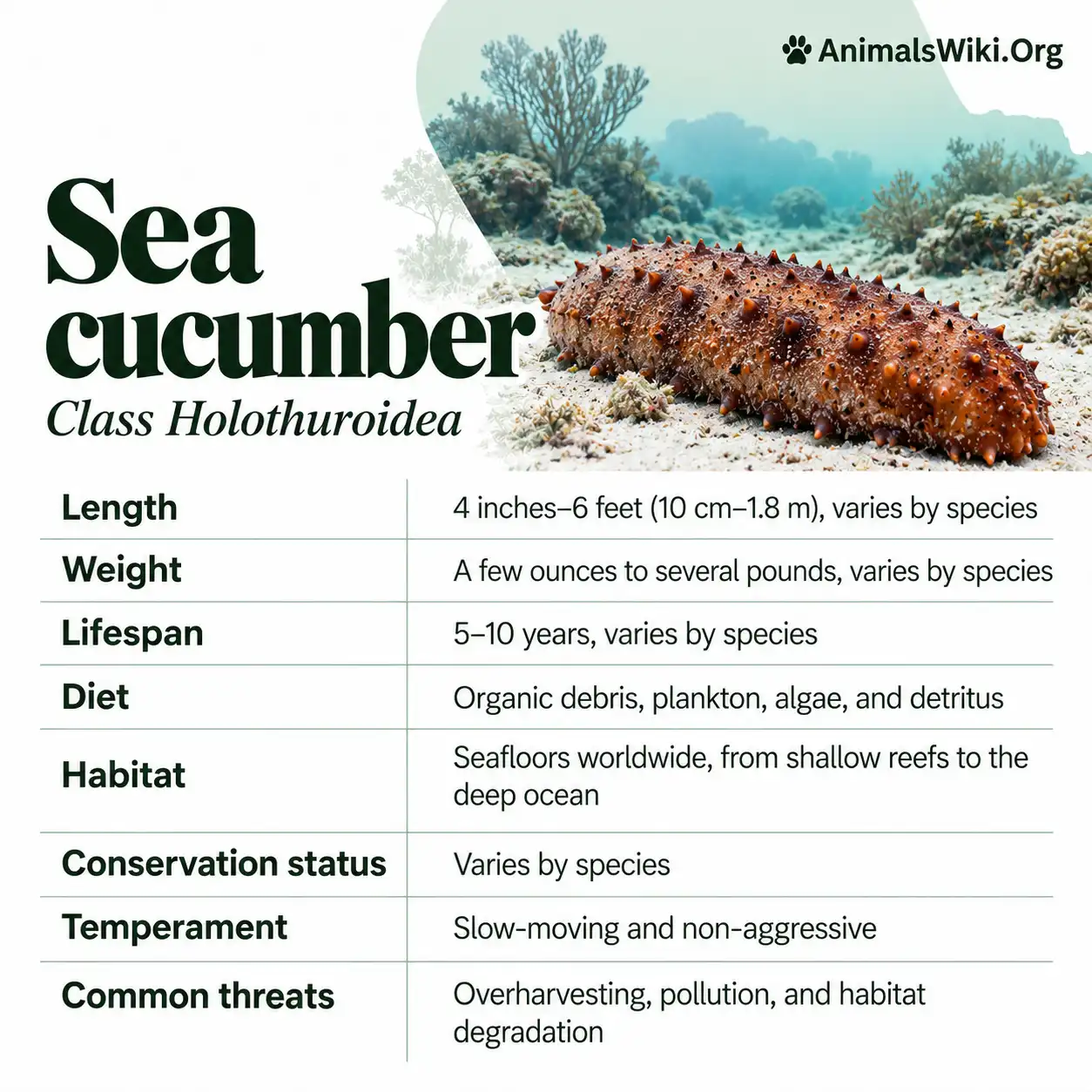
Sea Cucumber Facts
| Feature | Information |
|---|---|
| Common name | Sea Cucumber |
| Scientific class | Holothuroidea |
| Phylum | Echinodermata |
| Animal type | Marine invertebrate |
| Close relatives | Sea stars, sea urchins, brittle stars |
| Described species | More than 1,700 |
| Habitat | Ocean floors worldwide |
| Depth | Shallow coastal waters to deep ocean trenches |
| Body shape | Soft, elongated, usually cylindrical |
| Typical size | Varies greatly by species |
| Diet | Organic detritus, microorganisms, suspended particles |
| Movement | Tube feet and body-wall contractions |
| Breathing | Respiratory trees in many species; other gas-exchange mechanisms also occur |
| Reproduction | Usually sexual; asexual reproduction in some species |
| Famous defense | Evisceration and Cuvierian tubules in certain species |
| Regeneration | Present in many species |
| Ecological role | Sediment processing and nutrient recycling |
| Human use | Seafood and scientific research |
| Conservation | Species-specific; some are threatened by overharvesting |
What Is a Sea Cucumber?
A sea cucumber is a marine invertebrate belonging to the class Holothuroidea.
Sea cucumbers are echinoderms, meaning they are related to sea stars, sea urchins, brittle stars, and sea lilies.
Unlike the spiny, star-shaped appearance of many echinoderms, sea cucumbers have elongated, flexible bodies.
Most live on or within the seabed.
Is a Sea Cucumber an Animal or a Plant?
A sea cucumber is an animal.
Despite its vegetable-like name and appearance, it is not a plant.
It has specialized tissues, muscles, a digestive system, and other animal organ systems.
Why Is It Called a Sea Cucumber?
The name comes from its elongated shape, which resembles a cucumber.
However, sea cucumbers are not botanically related to cucumbers or any other vegetables.
Is Sea Cucumber One Species?
No.
“Sea cucumber” is a common name for an entire class of marine animals containing more than 1,700 described species.
Different species vary substantially in size, color, habitat, feeding behavior, and defensive abilities.
Scientific Classification of Sea Cucumbers
| Classification | Name |
|---|---|
| Kingdom | Animalia |
| Phylum | Echinodermata |
| Class | Holothuroidea |
| Major groups | Multiple orders and families |
| Example genus | Holothuria |
| Example species | Holothuria atra |
Because sea cucumbers include many species, they do not share one single species-level scientific name.
What Does Holothuroidea Mean?
Holothuroidea is the scientific class containing sea cucumbers.
The name derives from historical terminology used for these unusual marine animals.
What Does a Sea Cucumber Look Like?
Most sea cucumbers have elongated, soft bodies.
Their appearance varies considerably among species.
Common features include:
- Flexible body wall
- Cylindrical or sausage-like shape
- Mouth surrounded by feeding tentacles
- Tube feet in many species
- Reduced internal skeletal structures
- An anus at the opposite end from the mouth
- Specialized connective tissues
- Small skeletal ossicles embedded in the skin
Do Sea Cucumbers Have Bones?
They do not have a vertebrate skeleton.
However, many possess microscopic calcareous structures called ossicles.
These are part of the echinoderm skeletal system.
Do Sea Cucumbers Have Spines?
Some species have visible projections or papillae that may look spiny.
However, most do not possess the long rigid spines characteristic of sea urchins.
Do Sea Cucumbers Have Eyes?
Most sea cucumbers do not have conventional image-forming eyes.
They detect environmental conditions through sensory cells and other structures.
Do Sea Cucumbers Have a Brain?
Sea cucumbers do not have a centralized brain comparable to that of vertebrates.
They possess a nerve ring and a network of nerves that coordinate movement and other activities.
Do Sea Cucumbers Have a Heart?
They do not possess a vertebrate-style heart.
Their internal transport systems differ from those of mammals and fishes.
Sea Cucumber Size and Weight
Sea cucumbers range from tiny species measuring only a few centimeters to exceptionally large forms exceeding one meter.
Body size depends on species, age, nutrition, and environmental conditions.
What Is the Largest Sea Cucumber?
Some large tropical sea cucumbers can exceed 1–2 meters in length.
The giant sea cucumber Synapta maculata, for example, can reach several meters under favorable conditions and is among the longest sea cucumbers.
It is important to distinguish the longest species from the heaviest or largest by body volume.
What Is the Smallest Sea Cucumber?
Some species are only a few millimeters or centimeters long.
How Much Does a Sea Cucumber Weigh?
Weight varies enormously.
Small species weigh very little, while large, thick-bodied species can weigh several kilograms.
Where Do Sea Cucumbers Live?
Sea cucumbers inhabit marine environments worldwide.
They occur in:
- Pacific Ocean
- Atlantic Ocean
- Indian Ocean
- Southern Ocean
- Arctic Ocean
- Mediterranean Sea
- Coral reef ecosystems
- Continental shelves
- Deep ocean basins
Do Sea Cucumbers Live in Coral Reefs?
Yes.
Many species inhabit coral reefs, reef flats, sandy lagoons, and nearby seagrass habitats.
Do Sea Cucumbers Live in the Deep Sea?
Yes.
Sea cucumbers are especially important animals in many deep-sea ecosystems.
Some species inhabit abyssal plains and hadal trenches.
How Deep Can Sea Cucumbers Live?
Certain species have been observed at depths exceeding 8,000 meters.
Sea cucumbers are among the animals capable of inhabiting some of the deepest parts of the ocean.
Do Sea Cucumbers Live in Freshwater?
No.
Sea cucumbers are marine animals.
Sea Cucumber Habitat
Sea cucumbers occupy a wide range of seafloor environments.
These include:
- Sandy seabeds
- Muddy bottoms
- Coral reefs
- Seagrass beds
- Rocky habitats
- Deep-sea sediments
- Ocean trenches
Some live exposed on the surface.
Others bury themselves partially or completely in sediment.
What Do Sea Cucumbers Eat?
Most sea cucumbers feed on organic material associated with sediment or suspended in the water.
Their food can include:
- Decaying organic matter
- Microorganisms
- Bacteria
- Microalgae
- Organic particles
- Plankton
- Detritus
Are Sea Cucumbers Herbivores?
Not exclusively.
Many are deposit feeders or suspension feeders that consume mixtures of organic material and microorganisms.
Do Sea Cucumbers Eat Sand?
Some sea cucumbers swallow sand or sediment.
However, the mineral grains themselves are not the main nutritional target.
The animal extracts organic matter and microorganisms associated with the sediment.
Do Sea Cucumbers Eat Plankton?
Suspension-feeding species capture plankton and other organic particles from seawater.
Are Sea Cucumbers Carnivores?
Most are not active predators.
Their feeding behavior is generally based on collecting organic particles rather than hunting large animals.
How Do Sea Cucumbers Eat?
Sea cucumbers possess feeding tentacles around the mouth.
These tentacles are modified tube feet.
Different species use them in different ways.
Deposit Feeding
Deposit-feeding species collect or swallow sediment and extract organic matter.
Suspension Feeding
Suspension-feeding species extend branched tentacles into water currents to capture particles.
Sediment Processing
Some sea cucumbers pass large quantities of sediment through their digestive systems.
The processed sediment is expelled after nutrients have been extracted.
How Do Sea Cucumbers Move?
Sea cucumbers usually move slowly.
Many use tube feet and muscular contractions of the body wall.
Some species move primarily through muscular waves, while others crawl using specialized tube feet.
Do Sea Cucumbers Have Feet?
Many have tube feet, which are part of the echinoderm water vascular system.
These are not legs like those of insects or mammals.
Can Sea Cucumbers Swim?
Yes, certain species can.
Some deep-sea sea cucumbers lift themselves above the seafloor and swim using rhythmic body movements.
However, most familiar shallow-water species primarily crawl.
How Fast Can Sea Cucumbers Move?
Most move very slowly.
Speed varies by species and environmental conditions.
How Do Sea Cucumbers Breathe?
Many sea cucumbers possess specialized internal structures called respiratory trees.
These branch from the cloaca near the rear of the body.
Water is pumped in and out through the anus, allowing gas exchange.
Do Sea Cucumbers Breathe Through Their Anus?
In many species, yes, in the sense that water enters and exits through the anal opening and passes through respiratory trees.
The respiratory trees, rather than the anus itself, are the main specialized gas-exchange surfaces.
Do All Sea Cucumbers Breathe This Way?
No.
Some groups lack respiratory trees and rely more heavily on gas exchange across the body surface and other tissues.
Do Sea Cucumbers Have Lungs?
No.
They do not have mammalian lungs.
Sea Cucumber Defense Mechanisms
Sea cucumbers possess some of the most unusual defenses in the marine world.
Depending on the species, these include:
- Expelling internal organs
- Releasing sticky defensive tubules
- Producing toxic compounds
- Hiding in sediment
- Contracting or stiffening the body
- Camouflage
- Regenerating lost structures
Can Sea Cucumbers Expel Their Internal Organs?
Yes, some species can.
This process is called evisceration.
During evisceration, a sea cucumber expels part of its internal organs through the body wall or cloacal opening.
The expelled material may distract predators.
The animal can later regenerate lost structures.
Do All Sea Cucumbers Eject Their Organs?
No.
Evisceration is not universal across all sea cucumber species.
Does Evisceration Kill the Sea Cucumber?
Not necessarily.
Species capable of controlled evisceration can survive and regenerate missing organs.
However, regeneration requires energy and time.
What Are Cuvierian Tubules?
Cuvierian tubules are specialized defensive structures found in certain sea cucumbers.
When threatened, some species eject sticky, thread-like tubules from the posterior end.
These can entangle or discourage predators.
Are Cuvierian Tubules Poisonous?
Some species possess chemical defenses associated with these structures.
The exact toxicity varies.
Are Sea Cucumbers Poisonous?
Some species produce defensive chemicals called saponins, including compounds often described as holothurins.
These can be harmful to certain marine organisms.
However, not every sea cucumber has the same chemical defenses.
Are Sea Cucumbers Venomous?
Sea cucumbers are not generally classified as venomous animals that inject venom through fangs or stingers.
Some species are chemically toxic, which is a different defensive mechanism.
Can Sea Cucumbers Regenerate Organs?
Yes.
Regeneration is one of their most remarkable abilities.
Some species can regrow parts of the digestive tract and other internal structures after evisceration.
How Long Does Regeneration Take?
Regeneration time varies widely with species, temperature, nutrition, and the structures lost.
It may take weeks or months.
Can a Sea Cucumber Regrow Its Entire Body?
Some sea cucumbers can reproduce through body division, and separated portions may regenerate missing structures.
However, it would be inaccurate to claim that every species can regrow an entire animal from any small fragment.
Sea Cucumber Reproduction
Sea cucumbers reproduce in several ways.
Most species reproduce sexually.
Some also reproduce asexually.
Do Sea Cucumbers Lay Eggs?
Yes.
Many release eggs and sperm into seawater.
Fertilization usually occurs externally.
How Many Eggs Do Sea Cucumbers Produce?
Some species release very large numbers of eggs.
The exact number varies with species, size, and reproductive condition.
What Is Broadcast Spawning?
Broadcast spawning occurs when adults release eggs and sperm into the surrounding water.
Fertilization occurs outside the body.
Do Sea Cucumbers Have Larvae?
Many species have free-swimming larvae.
The larvae may pass through several developmental stages before settling and transforming into juveniles.
Can Sea Cucumbers Reproduce Asexually?
Yes.
Certain species can reproduce by dividing their bodies, a process called fission.
Each surviving portion regenerates missing structures.
Do Sea Cucumbers Care for Their Young?
Many species provide no prolonged parental care after spawning.
However, some species brood their young, demonstrating considerable variation in reproductive strategies.
How Long Do Sea Cucumbers Live?
Sea cucumber lifespan varies by species.
Some may live only several years, while others can survive for more than a decade.
Reliable age estimates are difficult for many species because they lack easily interpreted annual growth structures.
Sea Cucumber Adaptations
Flexible Body
Allows movement through narrow spaces and soft sediments.
Reduced Skeleton
Provides flexibility while retaining microscopic skeletal support.
Feeding Tentacles
Capture sediment-associated food or suspended particles.
Water Vascular System
Supports movement and other physiological functions.
Respiratory Trees
Allow gas exchange in many species.
Evisceration
Provides an unusual defensive response in certain species.
Regeneration
Allows recovery from damage and organ loss.
Chemical Defenses
Discourage predators.
Sediment Processing
Allows exploitation of organic material within seabed sediments.
Deep-Sea Adaptations
Enable certain species to survive extreme pressure and limited food availability.
What Animals Eat Sea Cucumbers?
Predators vary by habitat and species.
They can include:
- Certain fishes
- Sea stars
- Crabs
- Marine snails
- Some sea turtles
- Other marine predators
Chemical defenses and tough body walls help protect many species.
Do Fish Eat Sea Cucumbers?
Yes.
Some fish species prey on them.
Do Sea Stars Eat Sea Cucumbers?
Certain sea stars can.
Do Crabs Eat Sea Cucumbers?
Some crabs consume sea cucumbers or their tissues.
Sea Cucumber and Pearl Fish
One of the strangest relationships involving sea cucumbers occurs with small fishes known as pearlfish.
Some pearlfish enter the cloacal opening of sea cucumbers and shelter inside the body cavity or respiratory system.
Depending on the species, the relationship may be commensal or parasitic.
Do Fish Really Live Inside Sea Cucumbers?
Yes.
Certain pearlfish species use sea cucumbers as shelters.
Do Sea Cucumbers Benefit From Pearlfish?
Not necessarily.
Some associations provide little obvious benefit to the sea cucumber, while others can be harmful.
Sea Cucumber vs. Sea Star
| Feature | Sea Cucumber | Sea Star |
|---|---|---|
| Class | Holothuroidea | Asteroidea |
| Body shape | Elongated | Usually star-shaped |
| Skeleton | Reduced ossicles | More extensive ossicles |
| Movement | Tube feet and muscular contractions | Tube feet |
| Feeding | Often deposit or suspension feeding | Diverse, including predation |
| Regeneration | Common in many species | Common in many species |
| Habitat | Marine | Marine |
Sea Cucumber vs. Sea Urchin
| Feature | Sea Cucumber | Sea Urchin |
|---|---|---|
| Class | Holothuroidea | Echinoidea |
| Body | Soft and elongated | Rounded or flattened |
| Spines | Usually reduced or absent externally | Often prominent |
| Feeding | Detritus and suspended particles | Algae and other food |
| Movement | Slow crawling | Tube feet and spines |
| Skeleton | Flexible body with ossicles | Rigid test |
Sea Cucumber vs. Jellyfish
Sea cucumbers and jellyfish are very different animals.
Sea cucumbers are echinoderms.
Jellyfish belong to the phylum Cnidaria.
Sea cucumbers usually live on the seabed, while many jellyfish drift or swim in the water column.
Are Sea Cucumbers Dangerous to Humans?
Most sea cucumbers are not aggressive or dangerous.
They do not chase or attack humans.
However, some possess toxic defensive chemicals, and unnecessary handling can stress or injure them.
Certain species may release irritating substances.
People should avoid touching unfamiliar marine animals and follow local wildlife guidance.
Can Humans Eat Sea Cucumbers?
Yes.
Sea cucumbers are consumed in several cuisines.
They are especially important in parts of East and Southeast Asia.
Dried and processed sea cucumber is often called bêche-de-mer or trepang.
What Does Sea Cucumber Taste Like?
Sea cucumber generally has a mild flavor.
Its texture is often more important than its taste.
It can become soft, gelatinous, or slightly chewy depending on preparation.
Is Sea Cucumber Healthy?
Sea cucumber contains protein and various biologically active compounds.
However, its nutritional composition varies by species and processing method.
Claims that it cures serious diseases should not be accepted without strong clinical evidence.
Can You Eat Raw Sea Cucumber?
Raw or improperly prepared seafood can pose food-safety risks.
Consumption should follow established local food-safety and preparation guidance.
Sea Cucumber Fishing and Trade
Sea cucumbers are harvested commercially in many tropical and temperate regions.
Some species command high prices.
Commercial demand has encouraged intensive harvesting in certain locations.
Because many sea cucumbers are relatively slow-moving and easy to collect, populations can be vulnerable to overexploitation.
Are Sea Cucumbers Endangered?
Conservation status varies by species.
Some remain widespread and relatively abundant.
Others have experienced serious population declines.
Several commercially valuable species are classified in threatened categories or are subject to international trade controls.
It would be inaccurate to assign one global conservation category to every sea cucumber.
What Threatens Sea Cucumbers?
Important threats include:
- Overfishing
- Illegal harvesting
- Habitat degradation
- Marine pollution
- Climate change
- Ocean warming
- Coral reef decline
- Poorly regulated trade
Why Is Overfishing Dangerous for Sea Cucumbers?
Sea cucumbers can be easy to collect.
When populations become sparse, successful reproduction may decline because adults are too far apart for efficient fertilization during broadcast spawning.
This can slow population recovery.
Why Are Sea Cucumbers Important?
Sea cucumbers help maintain healthy marine ecosystems.
Many species process sediment, consume organic matter, and recycle nutrients.
Their feeding activities can influence sediment chemistry and microbial processes.
Are Sea Cucumbers the Vacuum Cleaners of the Ocean?
They are sometimes called the ocean’s vacuum cleaners.
This is a useful metaphor for their sediment-processing behavior.
However, sea cucumbers do not literally remove all pollution or make the ocean completely clean.
Do Sea Cucumbers Help Coral Reefs?
Yes.
In some reef environments, their sediment-processing activities can contribute to nutrient cycling and influence sediment conditions.
The exact effects depend on species and local ecosystem characteristics.
Do Sea Cucumbers Help the Deep Sea?
Yes.
In many deep-sea ecosystems, sea cucumbers are major consumers of organic material deposited on the ocean floor.
They help redistribute and recycle this material.
50 Interesting Sea Cucumber Facts
- Sea cucumbers are animals, not vegetables.
- They belong to the class Holothuroidea.
- They are echinoderms.
- Sea stars are their relatives.
- Sea urchins are also their relatives.
- More than 1,700 sea cucumber species have been described.
- They occur in oceans worldwide.
- Some live in tropical coral reefs.
- Others live in polar waters.
- Many inhabit the deep ocean.
- Certain species occur deeper than 8,000 meters.
- Most have elongated bodies.
- Their bodies are flexible.
- They possess microscopic skeletal ossicles.
- They do not have conventional vertebrate bones.
- Most lack image-forming eyes.
- They do not possess a vertebrate-style brain.
- They have a nerve ring and nervous network.
- Many move using tube feet.
- Some can swim.
- Many feed on sediment-associated organic matter.
- Some capture suspended particles.
- Their feeding tentacles are modified tube feet.
- Many swallow sediment.
- They extract organic matter from sediment.
- They help recycle nutrients.
- They influence seafloor sediment conditions.
- Many possess respiratory trees.
- Water can enter respiratory trees through the anus.
- Not every sea cucumber has respiratory trees.
- Some species can expel internal organs.
- This defense is called evisceration.
- Many can regenerate lost organs.
- Some possess Cuvierian tubules.
- These tubules can entangle predators.
- Some produce toxic saponins.
- They are not generally venomous.
- Many reproduce by broadcast spawning.
- Their larvae can swim.
- Some species brood young.
- Some reproduce through body division.
- Sea cucumbers can be prey for fishes.
- Certain sea stars also eat them.
- Pearlfish may live inside sea cucumbers.
- Some pearlfish associations are parasitic.
- Sea cucumbers are eaten by humans.
- Dried sea cucumber is called bêche-de-mer.
- Some species are threatened by overharvesting.
- Sea cucumbers are important to coral reef and deep-sea ecosystems.
- Their combination of unusual breathing, regeneration, and sediment processing makes them among the ocean’s most fascinating invertebrates.
Did You Know?
The Animal That Can Expel Its Organs and Grow Them Back
Imagine a quiet coral reef.
Sunlight filters through the water.
Small fishes move between coral branches.
On the sandy seabed lies an animal that looks almost completely ordinary.
A sea cucumber.
It has no obvious face.
No claws.
No large eyes.
It moves slowly across the sand.
As it travels, it collects organic material from the sediment.
To an observer, it may seem defenseless.
Then a predator approaches.
The sea cucumber has nowhere to run.
It cannot sprint away.
It cannot swim rapidly like a fish.
But some sea cucumbers possess a defense that seems almost impossible.
They can expel part of their internal organs.
The expelled material may distract or discourage the predator.
The sea cucumber survives.
Over time, specialized biological processes allow it to regenerate the lost structures.
What appeared to be a devastating injury can become a recoverable event.
Other sea cucumbers use a different strategy.
They release sticky defensive threads that entangle an attacker.
And some rely on toxic chemicals to discourage predation.
These abilities demonstrate that an animal does not need speed, claws, or teeth to survive.
Evolution can produce extraordinary defenses in unexpected forms.
The same animal that can regenerate internal structures may also spend its days quietly processing seafloor sediment.
That activity helps recycle nutrients and influence the health of marine ecosystems.
The sea cucumber is therefore much more than a strange-looking ocean creature.
It is a survivor, a recycler, and one of the most biologically unusual animals living on the seafloor.
Frequently Asked Questions About Sea Cucumbers
What is a sea cucumber?
A sea cucumber is a marine invertebrate belonging to the class Holothuroidea.
Is a sea cucumber an animal?
Yes.
Is a sea cucumber a vegetable?
No.
Why is it called a sea cucumber?
Its elongated body resembles a cucumber.
What is the scientific name of a sea cucumber?
Sea cucumbers belong to the class Holothuroidea; individual species have their own scientific names.
How many species of sea cucumbers exist?
More than 1,700 species have been described.
Are sea cucumbers related to sea stars?
Yes.
Are sea cucumbers related to sea urchins?
Yes.
Are sea cucumbers fish?
No.
Are sea cucumbers jellyfish?
No.
Are sea cucumbers invertebrates?
Yes.
Do sea cucumbers have bones?
They possess small skeletal ossicles rather than vertebrate bones.
Do sea cucumbers have a brain?
They lack a centralized vertebrate-style brain.
Do sea cucumbers have eyes?
Most lack conventional image-forming eyes.
Do sea cucumbers have a heart?
They do not have a vertebrate-style heart.
Where do sea cucumbers live?
In marine environments worldwide.
Do sea cucumbers live in coral reefs?
Yes.
Do sea cucumbers live in the deep sea?
Yes.
How deep can sea cucumbers live?
Certain species occur at depths exceeding 8,000 meters.
Do sea cucumbers live in freshwater?
No.
How big are sea cucumbers?
They range from tiny species to forms exceeding a meter or more.
What is the largest sea cucumber?
Some exceptionally long species, including Synapta maculata, can reach several meters.
How much do sea cucumbers weigh?
Weight varies enormously by species and body size.
What do sea cucumbers eat?
Organic detritus, microorganisms, sediment-associated material, and suspended particles.
Do sea cucumbers eat sand?
Some swallow sediment to extract organic nutrients.
Do sea cucumbers eat plankton?
Suspension-feeding species can.
Are sea cucumbers carnivores?
Most are deposit or suspension feeders rather than active predators.
How do sea cucumbers eat?
They use specialized feeding tentacles around the mouth.
How do sea cucumbers move?
Using tube feet and muscular body movements.
Do sea cucumbers have feet?
Many possess tube feet.
Can sea cucumbers swim?
Some species can.
Are sea cucumbers fast?
Most are slow-moving.
How do sea cucumbers breathe?
Many use internal respiratory trees, while others rely on different gas-exchange surfaces.
Do sea cucumbers breathe through their anus?
In many species, water enters and exits through the anus to ventilate respiratory trees.
Do all sea cucumbers breathe through their anus?
No.
Do sea cucumbers have lungs?
No.
Can sea cucumbers expel their organs?
Some species can.
Why do sea cucumbers expel their organs?
It can function as a defensive response.
What is evisceration?
The controlled expulsion of internal organs or tissues.
Can sea cucumbers survive without their organs?
Certain species can survive evisceration and regenerate lost structures.
Can sea cucumbers regrow organs?
Yes, many can.
Can sea cucumbers regrow their entire bodies?
Some reproduce through fission and regenerate missing structures, but this ability is not universal.
What are Cuvierian tubules?
Sticky defensive threads expelled by certain sea cucumber species.
Are sea cucumbers poisonous?
Some produce toxic defensive compounds.
Are sea cucumbers venomous?
They are not generally classified as venomous animals.
Can sea cucumbers hurt humans?
Most are harmless, although some defensive chemicals can cause irritation.
Do sea cucumbers bite?
They do not possess jaws designed for biting humans.
Do sea cucumbers lay eggs?
Yes, many reproduce through external spawning.
How do sea cucumbers reproduce?
Usually sexually, with asexual reproduction occurring in some species.
Can sea cucumbers reproduce without mating?
Certain species can reproduce asexually through fission.
Do sea cucumbers have babies?
Yes. Many develop through larval stages.
Do sea cucumbers care for their young?
Most do not provide prolonged care, although some species brood offspring.
How long do sea cucumbers live?
Lifespan varies by species and may range from several years to more than a decade.
What animals eat sea cucumbers?
Certain fishes, sea stars, crabs, and other marine predators.
Do fish eat sea cucumbers?
Yes.
Do crabs eat sea cucumbers?
Some species do.
Do sea stars eat sea cucumbers?
Certain species can.
Do fish live inside sea cucumbers?
Some pearlfish do.
What is a pearlfish?
A small fish that may shelter inside sea cucumbers or other marine animals.
Can humans eat sea cucumbers?
Yes.
What is bêche-de-mer?
A dried and processed sea cucumber product.
What does sea cucumber taste like?
Usually mild, with texture playing an important role in its culinary use.
Is sea cucumber healthy?
It provides nutrients, but specific medical claims require clinical evidence.
Are sea cucumbers endangered?
Some species are threatened, while others remain relatively widespread.
Why are sea cucumbers overfished?
High commercial demand and relatively easy collection can encourage intensive harvesting.
Are sea cucumbers important to coral reefs?
Yes, their feeding activities can influence sediment and nutrient cycling.
Are sea cucumbers the cleaners of the ocean?
They are often described as seafloor recyclers because many process sediment and organic matter.
Do sea cucumbers clean sand?
Many process sediment and extract organic material, influencing seabed conditions.
Do sea cucumbers help the deep ocean?
Yes, they are important consumers and recyclers of organic material in many deep-sea ecosystems.
What is the strangest sea cucumber fact?
Some species can expel internal organs to defend themselves and later regenerate the lost structures.
Conclusion
The Sea Cucumber is one of the ocean’s most underestimated animals.
Its soft, elongated body may look simple, but its biology is extraordinarily complex.
Some species breathe using respiratory trees connected to the rear of the body.
Others can swim above the seafloor.
Many process sediment and recycle organic nutrients.
Certain species defend themselves by ejecting sticky threads or even expelling internal organs.
And some can regenerate structures that would be impossible for many other animals to replace.
Sea cucumbers are also important to humans as seafood and to scientists studying regeneration, marine ecology, and biological chemistry.
Yet overharvesting and habitat degradation threaten several species.
Protecting sea cucumbers means protecting animals that quietly support the functioning of marine ecosystems.
The Sea Cucumber may not be the ocean’s fastest or most intimidating creature, but it is one of its most remarkable recyclers and survivors.