Sea Star, The Five-Armed Ocean Predator With Amazing Regeneration Abilities
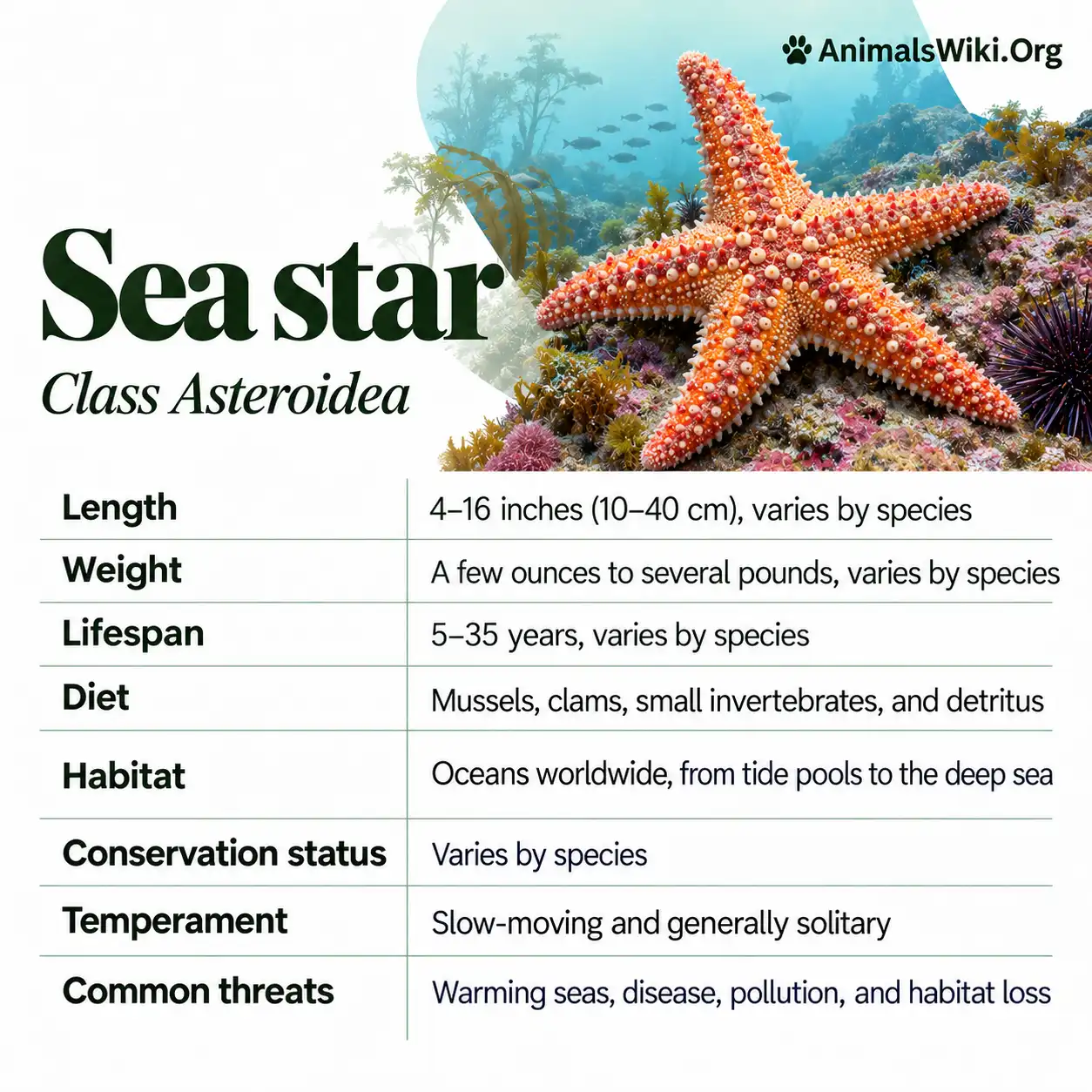
The Sea Star, commonly known as the Starfish, is one of the most recognizable and fascinating animals living in the world’s oceans.
With its star-shaped body, colorful appearance, and remarkable ability to regenerate lost arms, the Sea Star seems almost unlike any other creature on Earth.
Most people recognize Sea Stars by their five arms extending from a central disc. However, not all species have five arms. Some possess ten, twenty, or even more.
Sea Stars come in a remarkable variety of colors, including red, orange, purple, blue, yellow, brown, and combinations of these shades.
They inhabit marine environments worldwide, from shallow tropical coral reefs and rocky shores to cold polar waters and deep ocean basins.
Despite their peaceful appearance, many Sea Stars are effective predators.
Some feed on mussels, clams, oysters, and other mollusks. Others consume coral polyps, small invertebrates, or organic material.
One of their most extraordinary abilities is external digestion.
Certain Sea Stars can extend their stomach outside their body and begin digesting prey before bringing the food back inside.
Another remarkable adaptation is regeneration.
Many species can regrow arms lost to predators or injury. In certain species, a detached arm containing sufficient central body tissue may even regenerate into an entirely new individual.
Sea Stars also move using hundreds of small tube feet powered by a unique water vascular system.
Although they have no centralized brain like mammals, they possess a sophisticated network of nerves that coordinates movement, feeding, and responses to their surroundings.
Sea Stars are not fish. They are marine invertebrates belonging to the class Asteroidea, within the phylum Echinodermata.
Their closest relatives include sea urchins, brittle stars, sea cucumbers, and sea lilies.
With approximately 2,000 recognized living species, Sea Stars are among the most diverse and ecologically important echinoderms.
This comprehensive guide explores Sea Star facts, scientific classification, anatomy, size, species, habitat, distribution, diet, hunting, external digestion, tube feet, water vascular system, regeneration, reproduction, eggs, larvae, lifespan, predators, adaptations, conservation, comparisons with other marine animals, and frequently asked questions.
Sea Star Facts
| Feature | Information |
|---|---|
| Common name | Sea Star |
| Other name | Starfish |
| Scientific class | Asteroidea |
| Phylum | Echinodermata |
| Animal type | Marine invertebrate |
| Number of species | Approximately 2,000 |
| Typical arms | Five, although many species have more |
| Habitat | Marine environments worldwide |
| Depth | Intertidal zones to deep ocean |
| Body symmetry | Usually pentaradial as adults |
| Movement | Tube feet and water vascular system |
| Diet | Mollusks, other invertebrates, coral, detritus, depending on species |
| Breathing | Gas exchange through body surfaces and papulae |
| Reproduction | Sexual; asexual in some species |
| Regeneration | Many can regrow lost arms |
| Brain | No centralized vertebrate-like brain |
| Blood | No vertebrate-style blood circulation |
| Ecological role | Predation, scavenging, ecosystem regulation |
| Conservation | Species-specific; some face serious threats |
What Is a Sea Star?
A Sea Star is a marine invertebrate belonging to the class Asteroidea.
Sea Stars are echinoderms, meaning they are related to sea urchins, sea cucumbers, brittle stars, and sea lilies.
Their bodies generally consist of a central disc with arms extending outward.
The arms contain important structures involved in movement, feeding, sensing, and reproduction.
Is a Sea Star the Same as a Starfish?
Yes.
Sea Star and Starfish are two common names for the same group of animals.
Scientists and educators often prefer the term Sea Star because these animals are not fish.
Why Is It Called a Sea Star?
The name comes from its star-shaped body.
Is a Sea Star a Fish?
No.
Sea Stars do not have a backbone, gills, fins, or the anatomy of true fish.
They are echinoderm invertebrates.
Scientific Classification of Sea Stars
| Classification | Name |
|---|---|
| Kingdom | Animalia |
| Phylum | Echinodermata |
| Class | Asteroidea |
| Orders | Multiple |
| Families | Multiple |
| Example genus | Asterias |
| Example species | Asterias rubens |
Sea Stars are a large group, so there is no single scientific species name for every Sea Star.
What Does Asteroidea Mean?
The name Asteroidea refers to their star-like appearance.
Are Sea Stars Related to Sea Urchins?
Yes.
Both belong to the phylum Echinodermata.
Are Sea Stars Related to Sea Cucumbers?
Yes.
Sea Cucumbers belong to the class Holothuroidea, while Sea Stars belong to Asteroidea.
What Does a Sea Star Look Like?
Most Sea Stars have a flattened central disc surrounded by radiating arms.
Their appearance varies considerably among species.
Common features include:
- Central disc
- Radiating arms
- Tube feet
- Mouth on the underside
- Internal calcareous skeleton
- Spines or surface projections
- Sensory structures
- Water vascular system
Do All Sea Stars Have Five Arms?
No.
Five arms are common, but many species possess more.
Some species have seven, ten, twenty, or even more arms.
How Many Arms Can a Sea Star Have?
Depending on species, Sea Stars may have five to more than forty arms.
The Sunflower Sea Star is particularly famous for having numerous arms.
Do Sea Stars Have Legs?
No.
Their arms are not legs in the usual sense.
Movement is primarily accomplished through tube feet.
Do Sea Stars Have Bones?
They do not possess vertebrate bones.
However, their bodies contain small calcareous skeletal plates called ossicles.
Do Sea Stars Have Spines?
Many species possess spines or other surface projections.
These provide protection and may help with body support or other functions.
Sea Star Colors
Sea Stars occur in a remarkable range of colors.
Common colors include:
- Red
- Orange
- Yellow
- Purple
- Blue
- Brown
- Greenish tones
- Cream
- Black
Some species display spots, stripes, or contrasting patterns.
Coloration may help with camouflage, warning signals, or other ecological functions, depending on the species.
Sea Star Size and Weight
Sea Star size varies dramatically.
Some species measure only a few centimeters across.
Others can reach impressive sizes.
What Is the Largest Sea Star?
The Sunflower Sea Star (Pycnopodia helianthoides) is among the largest Sea Stars by arm span.
Large individuals can exceed 80 centimeters across and may possess more than twenty arms.
Other species can have very long arms or unusually large body mass.
What Is the Smallest Sea Star?
Some miniature Sea Stars measure only a few millimeters to a centimeter across.
How Much Does a Sea Star Weigh?
Weight varies by species and size.
Small species weigh very little, while large Sea Stars may weigh several kilograms.
Where Do Sea Stars Live?
Sea Stars inhabit oceans worldwide.
They occur in:
- Pacific Ocean
- Atlantic Ocean
- Indian Ocean
- Southern Ocean
- Arctic Ocean
- Mediterranean Sea
- Coral reef environments
- Coastal rocky shores
- Deep ocean basins
Do Sea Stars Live in Coral Reefs?
Yes.
Many species inhabit coral reefs and nearby habitats.
Do Sea Stars Live in the Deep Sea?
Yes.
Sea Stars occur at considerable depths, including abyssal environments.
Do Sea Stars Live in Freshwater?
No.
Sea Stars are marine animals.
Can Sea Stars Live on Land?
No.
They depend on marine conditions and cannot survive prolonged exposure to air.
Some intertidal species tolerate temporary exposure during low tide, but this is not the same as living on land.
Sea Star Habitat
Sea Stars occupy many marine environments.
Typical habitats include:
- Rocky shores
- Tide pools
- Coral reefs
- Sandy seabeds
- Muddy bottoms
- Seagrass beds
- Kelp forests
- Deep-sea sediments
Different species are adapted to different depths, temperatures, and food sources.
What Do Sea Stars Eat?
Sea Star diets vary by species.
Common food sources include:
- Mussels
- Clams
- Oysters
- Snails
- Barnacles
- Other echinoderms
- Small invertebrates
- Coral polyps
- Organic detritus
Are Sea Stars Carnivores?
Many are carnivores.
However, feeding strategies vary, and some consume detritus or other organic material.
Do Sea Stars Eat Clams?
Yes.
Certain Sea Stars are highly effective predators of clams and other bivalves.
Do Sea Stars Eat Mussels?
Yes.
Mussels are important prey for several species.
Do Sea Stars Eat Coral?
Some species do.
The Crown-of-Thorns Sea Star is especially well known for feeding on living coral.
Do Sea Stars Eat Fish?
Most do not actively hunt healthy, fast-swimming fish.
However, some species may consume small, trapped, injured, or dead fish.
How Do Sea Stars Eat?
Sea Stars have one of the most unusual feeding systems in the animal kingdom.
Many species possess two stomach regions:
- Cardiac stomach
- Pyloric stomach
In some species, the cardiac stomach can be extended outside the body.
Do Sea Stars Turn Their Stomachs Inside Out?
Certain species can evert their cardiac stomach.
This allows digestion to begin outside the body.
How Does a Sea Star Eat a Clam?
A Sea Star may use its tube feet to grip the shells of a clam or mussel.
It applies sustained pulling force.
Even a small opening may be enough for the Sea Star to extend its stomach into the shell.
Digestive enzymes begin breaking down the prey.
The partially digested food is then absorbed.
Do All Sea Stars Digest Food Outside Their Bodies?
No.
External stomach eversion is especially associated with certain groups and feeding strategies.
It is not identical across all Sea Star species.
How Do Sea Stars Move?
Sea Stars move using their tube feet.
These structures are connected to the water vascular system.
Tube feet extend and attach to surfaces, then help pull the body forward.
What Are Sea Star Tube Feet?
Tube feet are small muscular and hydraulic structures found along the underside of the arms.
They assist with:
- Movement
- Attachment
- Feeding
- Sensory functions
What Is the Water Vascular System?
The water vascular system is a specialized hydraulic network found in echinoderms.
It helps operate tube feet and supports several physiological functions.
How Fast Can Sea Stars Move?
Most move slowly.
However, speed varies greatly.
The Sunflower Sea Star is unusually mobile and can move much faster than many familiar Sea Star species.
Do Sea Stars Have Eyes?
Yes, many Sea Stars possess simple light-sensing eyespots near the tips of their arms.
These structures can detect light and, in some species, help recognize broad environmental features.
Can Sea Stars See?
They have limited visual abilities compared with vertebrates.
Some can detect shapes or large contrasting features, but they do not see detailed images like humans.
Do Sea Stars Have a Brain?
No centralized brain comparable to that of mammals.
They possess a nerve ring and radial nerves that coordinate their bodies.
Do Sea Stars Have a Heart?
They do not have a vertebrate-style heart.
Internal transport relies on systems different from vertebrate blood circulation.
Do Sea Stars Have Blood?
They do not possess a conventional vertebrate-style blood system.
Body fluids and specialized internal transport systems distribute materials.
How Do Sea Stars Breathe?
Sea Stars exchange gases through thin body surfaces, including structures called papulae or dermal branchiae.
Tube feet can also contribute to gas exchange.
They do not have lungs.
Do Sea Stars Have Gills?
They do not have fish-like gills.
Some gas-exchange structures are informally called skin gills.
Sea Star Regeneration
Regeneration is one of the most remarkable Sea Star abilities.
Many species can regrow arms lost to injury or predation.
Can Sea Stars Regrow Their Arms?
Yes.
Many species can regenerate damaged or missing arms.
Can a Sea Star Grow a New Body From One Arm?
In certain species, an arm containing enough central disc tissue can regenerate the missing body.
However, this ability is not universal.
Can Every Sea Star Regrow Its Entire Body?
No.
Regenerative ability varies substantially among species.
How Long Does Sea Star Regeneration Take?
Regrowth may take months or longer.
The process depends on species, temperature, nutrition, and injury severity.
Why Do Sea Stars Regenerate?
Regeneration helps recover from injury and predator attacks.
In some species, body division and regeneration also contribute to asexual reproduction.
Sea Star Reproduction
Sea Stars reproduce sexually, and some species can also reproduce asexually.
Do Sea Stars Lay Eggs?
Many release eggs and sperm into seawater.
Fertilization often occurs externally.
How Many Eggs Do Sea Stars Produce?
Some species release thousands or millions of eggs during reproductive events.
Numbers vary widely.
Do Sea Stars Have Larvae?
Many species develop through free-swimming larval stages.
These larvae are bilaterally symmetrical before transforming into radially symmetrical juveniles.
Can Sea Stars Reproduce Asexually?
Yes.
Some species reproduce through fission or fragmentation followed by regeneration.
Do Sea Stars Care for Their Babies?
Many provide no prolonged parental care.
However, some species brood eggs or young.
Baby Sea Stars
Young Sea Stars may begin life as microscopic larvae drifting in the water.
After development, larvae settle and transform into juvenile Sea Stars.
Are Baby Sea Stars Born With Five Arms?
Not necessarily.
Many develop through larval stages before acquiring their adult body organization.
How Do Sea Stars Grow?
They grow through cell division and expansion of their skeletal and soft tissues.
Growth rates depend on food, temperature, and species.
How Long Do Sea Stars Live?
Lifespan varies substantially.
Some species may live only a few years.
Others can survive for several decades.
Certain cold-water species are thought to be particularly long-lived.
Sea Star Adaptations
Radial Symmetry
Allows interaction with the environment from multiple directions.
Tube Feet
Support movement, attachment, and prey handling.
Water Vascular System
Provides hydraulic control of tube feet.
External Digestion
Allows some species to consume prey that would otherwise be difficult to swallow.
Regeneration
Helps recover from injury.
Calcareous Ossicles
Provide structural support and protection.
Eyespots
Help detect light and environmental features.
Chemical Sensing
Assists with locating food and responding to surroundings.
Spines
Provide physical protection.
Diverse Feeding Strategies
Allow different species to occupy a wide range of ecological niches.
What Animals Eat Sea Stars?
Predators vary by species and habitat.
They include:
- Certain fish
- Crabs
- Sea otters
- Other Sea Stars
- Some marine snails
- Other marine predators
Do Fish Eat Sea Stars?
Yes.
Some fish species prey on Sea Stars.
Do Crabs Eat Sea Stars?
Yes.
Do Sea Otters Eat Sea Stars?
Sea otters may consume Sea Stars as part of their varied marine diet.
Do Sea Stars Eat Other Sea Stars?
Some species are predators of other echinoderms, including Sea Stars.
Crown-of-Thorns Sea Star
The Crown-of-Thorns Sea Star (Acanthaster species complex) is one of the most famous coral-eating Sea Stars.
It has numerous arms and long spines.
Its diet consists primarily of living coral tissue.
Why Are Crown-of-Thorns Sea Stars Important?
At natural population levels, they are part of coral reef ecosystems.
However, population outbreaks can cause extensive coral mortality.
Are Crown-of-Thorns Sea Stars Venomous?
Their spines can cause painful puncture wounds and deliver toxic substances.
People should not handle them.
Sunflower Sea Star
The Sunflower Sea Star (Pycnopodia helianthoides) is among the largest and fastest-moving Sea Stars.
It may possess more than twenty arms.
It is an important predator of sea urchins and other invertebrates.
Why Is the Sunflower Sea Star Important?
Its predation can help regulate sea urchin populations.
Loss of Sunflower Sea Stars can contribute to ecological changes in kelp forest systems.
Are Sunflower Sea Stars Endangered?
The Sunflower Sea Star has experienced severe population declines associated with sea star wasting disease and other pressures.
It has been assessed as Critically Endangered by the IUCN.
Sea Star vs. Sea Cucumber
| Feature | Sea Star | Sea Cucumber |
|---|---|---|
| Class | Asteroidea | Holothuroidea |
| Body shape | Star-shaped | Elongated |
| Arms | Usually present | Absent |
| Feeding | Often predatory | Often deposit or suspension feeding |
| Movement | Tube feet | Tube feet and body contractions |
| Regeneration | Common in many species | Common in many species |
| Habitat | Marine | Marine |
Sea Star vs. Brittle Star
| Feature | Sea Star | Brittle Star |
|---|---|---|
| Class | Asteroidea | Ophiuroidea |
| Arms | Usually broader, continuous with disc | Slender, sharply distinct from disc |
| Movement | Primarily tube feet | Mainly arm movements |
| Feeding | Often predatory or scavenging | Diverse feeding strategies |
| Regeneration | Common | Common |
| Body structure | Flexible arms with internal organs | Distinct disc and narrow arms |
Sea Star vs. Sea Urchin
Sea Stars and Sea Urchins are both echinoderms.
However, Sea Urchins have rounded or flattened bodies covered in spines.
Sea Stars usually have radiating arms.
Their feeding structures and ecological roles also differ.
Are Sea Stars Dangerous to Humans?
Most Sea Stars are harmless when observed without handling.
However, some species possess sharp or venomous spines.
The Crown-of-Thorns Sea Star can cause painful injuries.
Can Sea Stars Bite Humans?
They do not have jaws designed to bite humans like fish or mammals.
Are Sea Stars Poisonous?
Some species contain defensive toxins.
The degree of toxicity varies.
Are Sea Stars Venomous?
Most familiar Sea Stars are not dangerous venomous animals, but certain spiny species can deliver toxins through puncture wounds.
Can You Touch a Sea Star?
It is best to avoid handling wild Sea Stars.
Removing them from water, squeezing them, or placing them on unsuitable surfaces can cause stress or injury.
Some species also possess potentially harmful spines.
Are Sea Stars Endangered?
Conservation status varies by species.
Some remain widespread.
Others face serious declines.
Important threats include:
- Sea star wasting disease
- Ocean warming
- Habitat degradation
- Pollution
- Ocean acidification
- Collection
- Ecological imbalance
What Is Sea Star Wasting Disease?
Sea star wasting disease describes a syndrome involving symptoms such as lesions, tissue deterioration, loss of body integrity, and sometimes rapid death.
It has affected multiple Sea Star species.
The causes and environmental drivers are complex and remain subjects of scientific research.
Can Sea Stars Recover From Wasting Disease?
Some individuals survive, but severe outbreaks can cause major population losses.
Why Are Sea Stars Important?
Sea Stars perform several important ecological roles.
Many are predators that regulate populations of mussels, sea urchins, and other invertebrates.
Some are keystone predators, meaning their effects on community structure are disproportionately large relative to their abundance.
What Is a Keystone Species?
A keystone species has a particularly strong influence on ecosystem structure.
Certain Sea Stars are classic examples.
The ochre sea star (Pisaster ochraceus) played an important role in foundational ecological research on keystone predation.
How Do Sea Stars Help Kelp Forests?
Some Sea Stars consume sea urchins.
By limiting sea urchin populations, they can help reduce grazing pressure on kelp.
However, the strength of this effect depends on the species and local ecosystem.
50 Interesting Sea Star Facts
- Sea Stars are also called Starfish.
- They are not fish.
- They belong to the class Asteroidea.
- They are echinoderms.
- Sea urchins are their relatives.
- Sea cucumbers are also relatives.
- Approximately 2,000 living species are recognized.
- Most familiar Sea Stars have five arms.
- Some have many more arms.
- Sunflower Sea Stars can possess more than twenty arms.
- Sea Stars occur in oceans worldwide.
- They inhabit coral reefs.
- They inhabit rocky shores.
- Some live in the deep ocean.
- They are marine animals.
- They do not naturally inhabit freshwater.
- Many move using tube feet.
- Tube feet are operated through a water vascular system.
- Sea Stars possess calcareous skeletal plates.
- They do not have vertebrate bones.
- Many have simple eyespots.
- They do not have a centralized vertebrate-style brain.
- They possess a nerve ring.
- Many are carnivores.
- Some eat mussels.
- Some eat clams.
- Some eat oysters.
- Crown-of-Thorns Sea Stars feed on coral.
- Certain species can extend their stomachs outside their bodies.
- External digestion helps them consume prey.
- Many can regenerate lost arms.
- Regeneration can take months.
- Some can reproduce through fragmentation.
- Many release eggs and sperm into seawater.
- Their larvae may be bilaterally symmetrical.
- Adults usually exhibit radial symmetry.
- Some species brood their young.
- Sea Stars can live for years or decades.
- Certain fish eat Sea Stars.
- Crabs can prey on Sea Stars.
- Some Sea Stars eat other Sea Stars.
- Crown-of-Thorns Sea Stars have dangerous spines.
- Sunflower Sea Stars are important sea urchin predators.
- Sea star wasting disease has affected numerous species.
- Ocean warming can influence Sea Star survival.
- Some Sea Stars are keystone predators.
- The ochre sea star is famous in ecological research.
- Sea Stars help regulate marine invertebrate populations.
- Different species occupy many ecological niches.
- Their combination of regeneration, hydraulic movement, and unusual digestion makes them among the ocean’s most extraordinary animals.
Did You Know?
The Animal That Can Digest Food Outside Its Body
Imagine a rocky shoreline beneath the ocean’s surface.
A mussel clings tightly to a rock.
Its shell is closed.
Its powerful muscles hold the two halves together.
For many predators, opening that shell would require crushing force.
Then a Sea Star approaches.
It moves slowly across the rock using hundreds of tiny tube feet.
The Sea Star settles over the mussel.
Its tube feet grip the shell.
Then it begins pulling.
The mussel resists.
Minutes pass.
The shell remains almost completely closed.
But the Sea Star does not need a large opening.
In certain species, even a narrow gap can be enough.
The Sea Star extends part of its stomach outside its own body and into the shell.
Digestive enzymes begin breaking down the mussel’s tissues.
The predator then absorbs the partially digested food.
This is one of the strangest feeding strategies in the marine world.
But the Sea Star’s remarkable abilities do not end there.
If a predator damages or removes an arm, many species can regenerate the missing structure.
Over time, new tissues develop.
The arm grows.
The animal may eventually recover much of its original body form.
Some species can even reproduce through body division followed by regeneration.
An animal without a centralized brain, conventional legs, or a vertebrate-style circulatory system has evolved a remarkable combination of abilities.
It can move hydraulically.
It can sense light.
It can digest prey externally.
And it can rebuild damaged body parts.
The Sea Star may look simple, but its biology is anything but ordinary.
It is one of the clearest examples of how evolution can produce complex survival strategies without a body plan resembling our own.
Frequently Asked Questions About Sea Stars
What is a Sea Star?
A Sea Star is a marine echinoderm belonging to the class Asteroidea.
Is a Sea Star the same as a Starfish?
Yes.
Is a Sea Star a fish?
No.
Why is it called a Sea Star?
Because of its star-shaped body.
What is the scientific name of a Sea Star?
Sea Stars belong to the class Asteroidea. Individual species have separate scientific names.
How many Sea Star species exist?
Approximately 2,000 living species are recognized.
Are Sea Stars invertebrates?
Yes.
Are Sea Stars related to Sea Urchins?
Yes.
Are Sea Stars related to Sea Cucumbers?
Yes.
Are Sea Stars related to Brittle Stars?
Yes.
Do all Sea Stars have five arms?
No.
How many arms can a Sea Star have?
Depending on species, five to more than forty.
What is the largest Sea Star?
The Sunflower Sea Star is among the largest by arm span.
What is the smallest Sea Star?
Some species measure only a few millimeters or centimeters across.
How much does a Sea Star weigh?
Weight varies greatly by species.
Where do Sea Stars live?
In marine environments worldwide.
Do Sea Stars live in coral reefs?
Yes.
Do Sea Stars live in the deep ocean?
Yes.
Can Sea Stars live in freshwater?
No.
Can Sea Stars live outside water?
They cannot survive prolonged exposure to air, although some intertidal species tolerate temporary exposure.
Do Sea Stars have legs?
No.
How do Sea Stars move?
Using tube feet and the water vascular system.
What are Sea Star tube feet?
Small hydraulic structures used for movement, attachment, and feeding.
What is the water vascular system?
A specialized hydraulic system found in echinoderms.
How fast do Sea Stars move?
Most move slowly, although some species are relatively fast.
Do Sea Stars have eyes?
Many have simple eyespots near arm tips.
Can Sea Stars see?
They can detect light and sometimes broad shapes, but not detailed images like humans.
Do Sea Stars have a brain?
No centralized vertebrate-style brain.
Do Sea Stars have a heart?
No vertebrate-style heart.
Do Sea Stars have blood?
They lack conventional vertebrate-style blood circulation.
Do Sea Stars have bones?
They possess calcareous ossicles rather than vertebrate bones.
How do Sea Stars breathe?
Through thin body surfaces, papulae, and tube feet.
Do Sea Stars have lungs?
No.
What do Sea Stars eat?
Mollusks, other invertebrates, coral, and organic material, depending on species.
Are Sea Stars carnivores?
Many are.
Do Sea Stars eat clams?
Yes.
Do Sea Stars eat mussels?
Yes.
Do Sea Stars eat coral?
Some species do.
Do Sea Stars eat fish?
Some may consume small, injured, trapped, or dead fish.
How do Sea Stars eat?
Some use external stomach eversion, while others feed differently.
Do Sea Stars turn their stomachs inside out?
Certain species can evert their cardiac stomach.
Why do Sea Stars digest food outside their bodies?
It allows them to process prey that may be too large or difficult to swallow whole.
Can Sea Stars regenerate arms?
Yes, many can.
Can a Sea Star grow a new body from one arm?
Certain species can, provided sufficient necessary tissues remain.
Can every Sea Star regenerate its entire body?
No.
How long does Sea Star regeneration take?
Often months or longer.
Do Sea Stars lay eggs?
Many release eggs into seawater.
How do Sea Stars reproduce?
Sexually, and asexually in some species.
Can Sea Stars reproduce without mating?
Certain species can reproduce asexually.
Do Sea Stars have larvae?
Yes, many species do.
Are baby Sea Stars born with five arms?
Not necessarily; many develop through larval stages.
Do Sea Stars care for their babies?
Most do not provide prolonged care, but some species brood young.
How long do Sea Stars live?
Lifespan varies from several years to decades.
What animals eat Sea Stars?
Certain fish, crabs, sea otters, other Sea Stars, and marine predators.
Do fish eat Sea Stars?
Yes.
Do crabs eat Sea Stars?
Yes.
Do Sea Otters eat Sea Stars?
They may.
Are Sea Stars poisonous?
Some species contain defensive toxins.
Are Sea Stars venomous?
Certain spiny species can deliver toxins through puncture wounds.
Can Sea Stars bite humans?
They do not have jaws designed for biting people.
Are Sea Stars dangerous?
Most are harmless when left undisturbed, but some have dangerous spines.
Can you touch a Sea Star?
It is best to avoid handling wild Sea Stars.
What is a Crown-of-Thorns Sea Star?
A spiny coral-eating Sea Star associated with coral reef ecosystems.
Why are Crown-of-Thorns Sea Stars harmful to coral reefs?
Population outbreaks can cause extensive coral mortality.
What is a Sunflower Sea Star?
A large, many-armed Sea Star that is an important predator of sea urchins.
Are Sunflower Sea Stars endangered?
They have been assessed as Critically Endangered following major population declines.
What is sea star wasting disease?
A syndrome involving lesions, tissue deterioration, and sometimes rapid death.
Are Sea Stars endangered?
Conservation status varies by species.
Why are Sea Stars important?
They regulate marine invertebrate populations and contribute to ecosystem structure.
What is a keystone Sea Star?
A Sea Star whose ecological influence is disproportionately large relative to its abundance.
What is the most interesting Sea Star fact?
Some Sea Stars can extend their stomach outside their body to digest prey, while many can regenerate lost arms.
Conclusion
The Sea Star is one of the most remarkable marine invertebrates.
Its star-shaped body is instantly recognizable, but its unusual anatomy reveals a much more complex animal than its appearance suggests.
Sea Stars can move using hydraulic tube feet, detect light through simple eyespots, and capture prey with specialized feeding systems.
Certain species can extend their stomachs outside their bodies.
Many can regenerate damaged or lost arms.
Some even reproduce asexually through fragmentation.
Beyond these extraordinary abilities, Sea Stars are important predators and scavengers that help maintain the balance of marine ecosystems.
Some species regulate mussel populations, while others influence sea urchins and coral reef communities.
However, disease, environmental changes, and habitat pressures threaten certain Sea Star populations.
Protecting them means preserving animals that play important roles in the health and diversity of the world’s oceans.
The Sea Star is far more than a beautiful star-shaped creature—it is a remarkable example of regeneration, adaptation, and ecological importance beneath the sea.
SEO Information
Primary keyword: Sea Star
Secondary keywords: Sea Star facts, Starfish facts, Sea Star scientific name, Asteroidea, Sea Star species, types of Sea Stars, Sea Star anatomy, Sea Star arms, Sea Star size, Sea Star habitat, where do Sea Stars live, Sea Star diet, what do Sea Stars eat, Sea Star feeding, Sea Star stomach, Sea Star external digestion, Sea Star tube feet, Sea Star water vascular system, Sea Star regeneration, can Sea Stars regrow arms, Sea Star reproduction, Sea Star eggs, baby Sea Star, Sea Star lifespan, Sea Star predators, Sea Star adaptations, Crown-of-Thorns Sea Star, Sunflower Sea Star, Sea Star wasting disease, Sea Star vs Sea Cucumber, Sea Star vs Brittle Star, are Sea Stars poisonous, are Sea Stars dangerous, Sea Star conservation, Sea Star ecological importance.
SEO meta title: Sea Star Facts: Diet, Habitat, Regeneration & Anatomy
Meta description: Discover fascinating Sea Star facts, including their unusual anatomy, tube feet, external digestion, arm regeneration, reproduction, ocean habitats, and ecological importance.
Suggested URL slug: sea-star-facts
Suggested image alt text: Colorful sea star resting on a rocky ocean floor in its natural marine habitat, showing five arms, textured skin, and distinctive star-shaped body.
Editorial note: Sea Stars include approximately 2,000 species with diverse feeding, reproduction, and regeneration abilities. Avoid presenting species-specific traits as universal. Verify current conservation assessments and new research on sea star wasting disease before publication.