Brittle Star, The Five-Armed Ocean Survivor That Can Regrow Its Limbs
The Brittle Star, also written as Brittlestar, is one of the most fascinating and widespread invertebrates living on the ocean floor.
With its small central disc and five long, flexible arms, this unusual marine animal resembles a sea star at first glance. However, brittle stars possess a remarkably different body structure and method of movement.
Unlike most sea stars, which crawl using hundreds of tiny tube feet, brittle stars move primarily by rapidly bending and coordinating their slender arms.
Their movements can be surprisingly quick.
Some species dart across the seabed, disappear beneath rocks, or hide among coral branches within seconds.
The name Brittle Star comes from one of their most remarkable defensive abilities: many species can deliberately shed an arm when attacked.
This process, called autotomy, can distract a predator and allow the animal to escape.
Even more remarkably, many brittle stars can regenerate their missing arms over time.
Brittle stars belong to the class Ophiuroidea, a major group of marine echinoderms closely related to sea stars, sea urchins, sea cucumbers, and sea lilies.
More than 2,000 living species have been described, making brittle stars one of the most diverse groups of echinoderms.
They inhabit nearly every marine environment, from shallow coral reefs and rocky shorelines to cold polar seas and deep ocean trenches.
Some live beneath stones, while others hide inside sponges, cling to corals, or gather in enormous numbers across the deep seafloor.
Certain species possess another extraordinary ability: bioluminescence, allowing them to produce visible light through specialized chemical reactions.
Others use highly branched arms to capture suspended food particles from ocean currents.
These branching forms are commonly called basket stars, and they belong to the broader brittle star group.
Despite their delicate appearance, brittle stars are remarkably successful marine animals.
They are important scavengers, predators, suspension feeders, and prey species, helping transfer energy through marine food webs.
This comprehensive guide explores Brittle Star facts, scientific classification, anatomy, size, species, habitat, distribution, diet, movement, arm regeneration, reproduction, bioluminescence, predators, lifespan, adaptations, conservation, comparisons with sea stars, and frequently asked questions.
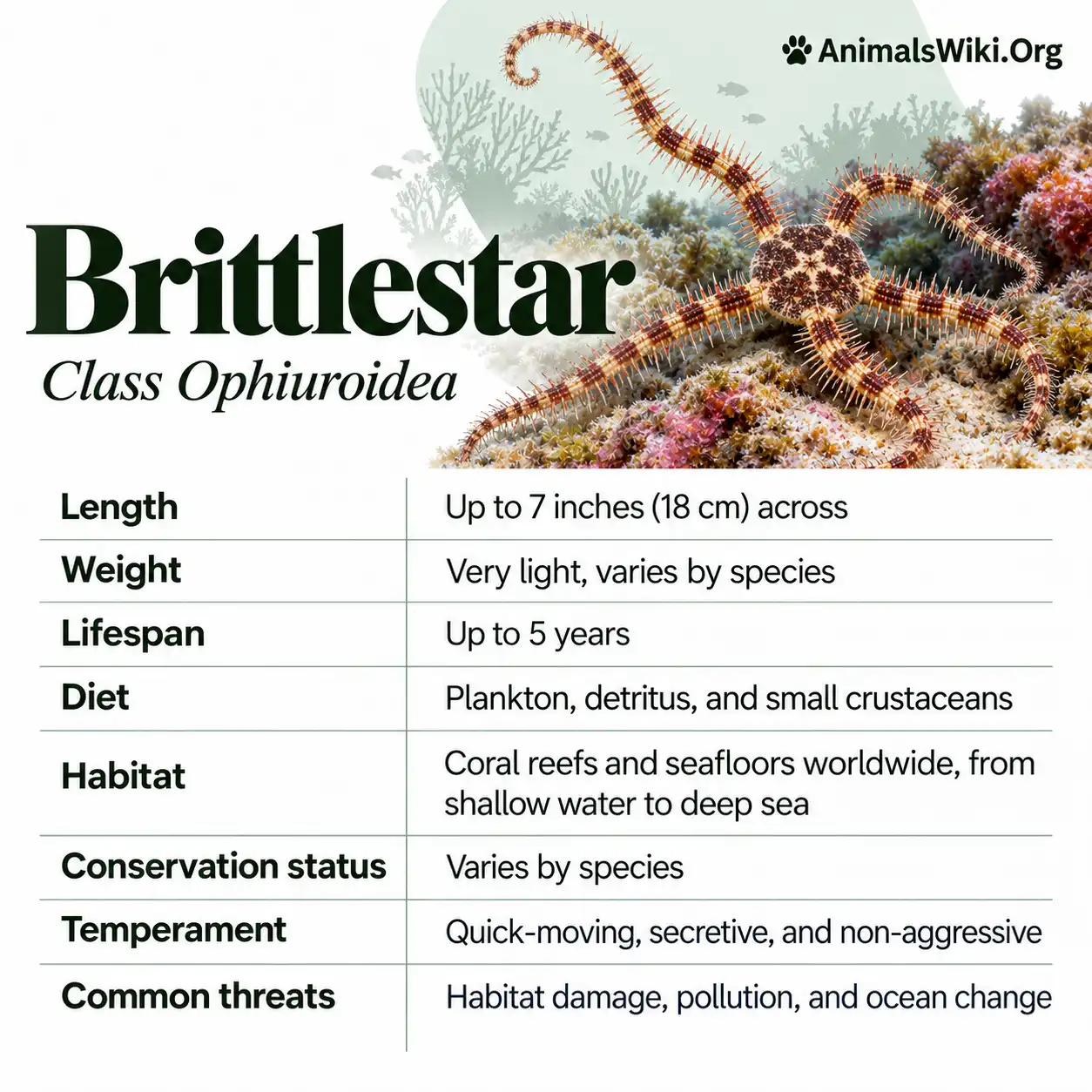
Brittle Star Facts
| Feature | Information |
|---|---|
| Common name | Brittle Star |
| Alternative spelling | Brittlestar |
| Scientific class | Ophiuroidea |
| Phylum | Echinodermata |
| Animal type | Marine invertebrate |
| Described species | More than 2,000 living species |
| Close relatives | Sea stars, sea urchins, sea cucumbers |
| Typical arms | Five |
| Body structure | Distinct central disc with slender arms |
| Habitat | Marine environments worldwide |
| Depth | Intertidal areas to deep ocean trenches |
| Diet | Detritus, plankton, microorganisms, small invertebrates |
| Movement | Coordinated arm movements |
| Tube feet | Present, mainly used for feeding and sensing |
| Regeneration | Many species can regrow lost arms |
| Reproduction | Mostly sexual; asexual reproduction in some species |
| Bioluminescence | Present in certain species |
| Defense | Arm shedding, hiding, camouflage |
| Ecological role | Nutrient cycling and marine food webs |
| Conservation | Varies by species |
What Is a Brittle Star?
A brittle star is a marine invertebrate belonging to the class Ophiuroidea.
It is an echinoderm, meaning it shares an evolutionary relationship with sea stars, sea urchins, sea cucumbers, and other members of the phylum Echinodermata.
Most brittle stars possess a small central disc and five elongated arms.
Their arms are clearly separated from the disc, unlike the broader arms of most sea stars.
Brittle stars are especially recognizable by their flexible, snake-like movements.
Why Is It Called a Brittle Star?
The name comes from the animal’s ability to detach its arms when threatened.
This defensive behavior is known as autotomy.
The detached arm may continue moving briefly, distracting the predator while the brittle star escapes.
Is a Brittle Star the Same as a Sea Star?
No.
Although both are echinoderms, brittle stars belong to Ophiuroidea, while sea stars belong to Asteroidea.
They differ in body structure, movement, feeding, and several anatomical features.
Is a Brittle Star a Fish?
No.
Brittle stars are marine invertebrates, not fish.
They do not have a backbone, fins, or fish-like gills.
Scientific Classification of Brittle Stars
| Classification | Name |
|---|---|
| Kingdom | Animalia |
| Phylum | Echinodermata |
| Class | Ophiuroidea |
| Major groups | Multiple orders and families |
| Example genus | Ophiothrix |
| Example species | Ophiothrix fragilis |
Because brittle stars represent an entire class, they do not share one species-level scientific name.
What Does Ophiuroidea Mean?
The name is derived from Greek roots associated with snakes and tails.
It refers to the slender, flexible arms and their characteristic movements.
Are Brittle Stars Related to Sea Stars?
Yes.
Brittle stars and sea stars are closely related echinoderms.
However, they belong to separate classes.
Are Basket Stars Brittle Stars?
Yes.
Basket stars are specialized members of Ophiuroidea.
They possess branching arms adapted for capturing food from ocean currents.
What Does a Brittle Star Look Like?
Most brittle stars have a circular or pentagonal central disc with five long, narrow arms.
Their appearance varies by species.
Common features include:
- Distinct central disc
- Five slender arms
- Flexible arm joints
- Small spines along the arms
- Tube feet
- Mouth on the underside
- Calcareous skeletal plates
- Radial nervous system
Why Are Brittle Star Arms So Thin?
Their arms contain articulated skeletal elements that provide both support and flexibility.
This structure allows rapid, coordinated movements.
Do Brittle Stars Have Spines?
Many species have spines along their arms.
These can provide protection and help with feeding or interaction with the environment.
Do Brittle Stars Have Bones?
They do not have vertebrate bones.
Their bodies contain calcareous ossicles, including articulated skeletal elements in the arms.
Do Brittle Stars Have Five Arms?
Most species have five arms.
However, certain species have six or more.
Can Brittle Stars Have Six Arms?
Yes.
Some species naturally possess six arms, and certain six-armed species can reproduce through body division.
Brittle Star Colors
Brittle stars display a wide variety of colors.
Common colors include:
- Brown
- Black
- Gray
- Red
- Orange
- Yellow
- Purple
- Greenish tones
- Cream
Some species have striped or banded arms.
Others possess contrasting patterns that help them blend into coral, rocks, or sediment.
Brittle Star Size and Weight
Brittle stars vary greatly in size.
Many familiar species have central discs measuring only a few centimeters across.
Their arms may extend several times the diameter of the disc.
How Big Can a Brittle Star Get?
Large brittle stars can have arm spans exceeding 50 centimeters.
Basket stars can become much larger when their branching arms are fully extended.
What Is the Smallest Brittle Star?
Some species have central discs only a few millimeters across.
How Much Does a Brittle Star Weigh?
Weight varies considerably.
Most small brittle stars are lightweight, while large basket stars possess much greater body mass.
Where Do Brittle Stars Live?
Brittle stars occur in oceans worldwide.
They inhabit:
- Pacific Ocean
- Atlantic Ocean
- Indian Ocean
- Southern Ocean
- Arctic Ocean
- Mediterranean Sea
- Coral reefs
- Rocky shores
- Sandy seabeds
- Deep ocean basins
Do Brittle Stars Live in Coral Reefs?
Yes.
Many species hide among coral branches, beneath rocks, or inside reef crevices.
Do Brittle Stars Live in the Deep Sea?
Yes.
Brittle stars are especially abundant in many deep-sea ecosystems.
How Deep Can Brittle Stars Live?
Different species inhabit depths ranging from shallow coastal waters to several thousand meters.
Some occur in deep ocean trench environments.
Do Brittle Stars Live in Freshwater?
No.
Brittle stars are marine animals.
Brittle Star Habitat
Brittle stars occupy a remarkable range of habitats.
These include:
- Coral reefs
- Rocky crevices
- Sandy bottoms
- Muddy seabeds
- Seagrass beds
- Kelp forests
- Sponge communities
- Deep-sea sediments
- Cold-water coral habitats
Many species prefer sheltered environments where they can avoid predators.
Some remain hidden during the day and become more active at night.
What Do Brittle Stars Eat?
Brittle star diets vary considerably among species.
They may consume:
- Organic detritus
- Dead animal material
- Plankton
- Microorganisms
- Small crustaceans
- Worms
- Other small invertebrates
- Suspended organic particles
Are Brittle Stars Carnivores?
Some species are carnivorous predators.
Others are scavengers, deposit feeders, or suspension feeders.
Do Brittle Stars Eat Plankton?
Yes.
Suspension-feeding species capture plankton and organic particles from seawater.
Do Brittle Stars Eat Dead Animals?
Yes.
Many species scavenge organic remains.
Do Brittle Stars Eat Algae?
Some may consume algae-associated material or organic particles, depending on species and habitat.
However, brittle stars are not universally herbivorous.
How Do Brittle Stars Eat?
Brittle stars use their arms and tube feet to collect food.
Food particles are transferred toward the mouth on the underside of the central disc.
Different species use different strategies.
Deposit Feeding
Some collect organic material from the sediment.
Suspension Feeding
Others extend their arms into currents to capture suspended particles.
Scavenging
Many consume dead animal material.
Predation
Certain species capture small invertebrates.
How Do Brittle Stars Move?
Brittle stars move primarily by coordinating their arms.
Instead of relying mainly on tube feet for locomotion, they bend and push with their flexible arms.
This allows relatively rapid movement across the seabed.
Are Brittle Stars Faster Than Sea Stars?
Many brittle stars move substantially faster than familiar slow-moving sea stars.
However, speed varies by species.
Do Brittle Stars Use Tube Feet to Walk?
Tube feet are present, but they are not the main locomotor structures in most brittle stars.
Can Brittle Stars Swim?
Most are bottom-dwelling animals.
However, some species can move through the water using coordinated arm motions for limited periods.
They are not generally specialized open-water swimmers.
Brittle Star Arm Regeneration
One of the most remarkable brittle star abilities is regeneration.
Many species can replace arms lost to predators or injury.
Can Brittle Stars Regrow Their Arms?
Yes.
Regeneration is widespread among brittle stars.
Why Do Brittle Stars Lose Their Arms?
They may deliberately shed an arm when threatened.
This process is called autotomy.
Does Losing an Arm Hurt a Brittle Star?
Brittle stars possess sensory and nervous systems, but their subjective experience cannot be determined from arm loss alone.
Autotomy is a specialized biological response that can improve survival during predator attacks.
How Long Does It Take a Brittle Star to Regrow an Arm?
Regeneration may take weeks or months.
The time depends on species, temperature, nutrition, and the extent of the injury.
Can a Brittle Star Regrow Its Entire Body?
Some species reproduce through disc division and regeneration.
However, an ordinary detached arm generally cannot regenerate an entire animal on its own.
Brittle Star Reproduction
Brittle stars reproduce through several mechanisms.
Most species reproduce sexually.
Some also reproduce asexually.
Do Brittle Stars Lay Eggs?
Many species release eggs and sperm into seawater.
Fertilization usually occurs externally.
How Many Eggs Do Brittle Stars Produce?
Egg production varies widely.
Some species release large numbers of small eggs.
Others produce fewer, larger eggs or brood developing young.
Do Brittle Stars Have Larvae?
Many species develop through free-swimming larvae called ophiopluteus larvae.
These larvae have distinctive elongated skeletal supports.
Can Brittle Stars Reproduce Asexually?
Yes.
Certain species can divide their central discs and regenerate missing body parts.
Do Brittle Stars Care for Their Babies?
Some species brood eggs or young within specialized structures.
Others release reproductive cells into the water without prolonged parental care.
Baby Brittle Stars
Young brittle stars may begin life as free-swimming larvae.
After development, larvae settle and transform into juveniles.
Some species develop directly without a prolonged planktonic larval stage.
Are Baby Brittle Stars Born With Five Arms?
Not always.
Their body organization develops during metamorphosis.
How Do Baby Brittle Stars Grow?
They grow through the development of new skeletal and soft tissues.
Growth depends on species, food availability, and environmental conditions.
How Long Do Brittle Stars Live?
Lifespan varies by species.
Some may live only a few years.
Others can survive for a decade or longer.
Reliable age estimates are difficult for many deep-sea species.
Brittle Star Bioluminescence
Some brittle stars can produce visible light.
This ability is called bioluminescence.
Bioluminescence results from chemical reactions that generate light within living organisms.
Why Do Brittle Stars Glow?
Possible functions include:
- Predator deterrence
- Startle responses
- Defensive signaling
- Other ecological interactions
The exact function varies among species and is not fully understood in every case.
Do All Brittle Stars Glow?
No.
Bioluminescence occurs in certain species, not all brittle stars.
What Color Do Glowing Brittle Stars Produce?
Many bioluminescent marine animals produce blue or greenish light.
The color and intensity depend on the species and its light-producing system.
Basket Stars
Basket stars are some of the most unusual members of Ophiuroidea.
Their arms divide repeatedly into branching structures.
When extended, these branches form a net-like feeding apparatus.
What Do Basket Stars Eat?
They capture plankton and suspended organic particles from water currents.
How Do Basket Stars Catch Food?
They extend their branching arms into moving water.
Small particles and animals become trapped among the branches.
The captured material is transported toward the mouth.
Are Basket Stars Dangerous?
They are not generally dangerous to humans.
Their branching arms are delicate and should not be handled unnecessarily.
Brittle Star Adaptations
Flexible Arms
Allow rapid movement and escape.
Autotomy
Enables arm shedding during predator attacks.
Regeneration
Allows recovery after losing arms.
Arm Spines
Provide protection and may assist with feeding.
Tube Feet
Help collect food and detect environmental conditions.
Chemical Sensing
Supports food detection and environmental awareness.
Camouflage
Helps conceal animals among rocks, coral, and sediment.
Bioluminescence
Provides defensive or signaling functions in certain species.
Branching Arms
Enable basket stars to capture suspended food.
Deep-Sea Adaptations
Allow species to survive under high pressure and limited food availability.
What Animals Eat Brittle Stars?
Predators include:
- Fish
- Crabs
- Sea stars
- Some marine snails
- Other benthic predators
Their ability to shed arms provides an important escape mechanism.
Do Fish Eat Brittle Stars?
Yes.
Many fish species consume brittle stars.
Do Crabs Eat Brittle Stars?
Yes.
Do Sea Stars Eat Brittle Stars?
Certain sea stars can prey on brittle stars.
Can Brittle Stars Escape Predators?
Yes.
They may hide, move rapidly, or shed an arm.
Brittle Star vs. Sea Star
| Feature | Brittle Star | Sea Star |
|---|---|---|
| Scientific class | Ophiuroidea | Asteroidea |
| Body structure | Distinct disc and slender arms | Arms usually continuous with disc |
| Movement | Mainly arm motions | Mainly tube feet |
| Arm flexibility | Very high | Usually lower |
| Regeneration | Common | Common |
| Feeding | Detritus, plankton, small prey | Often larger invertebrate prey |
| Stomach eversion | Not typical | Present in many species |
| Habitat | Marine | Marine |
Brittle Star vs. Sea Cucumber
Brittle stars and sea cucumbers are both echinoderms.
However, brittle stars have a central disc and slender arms.
Sea cucumbers have elongated bodies without radiating arms.
Many sea cucumbers feed on sediment-associated organic material, while brittle stars use a wider range of arm-based feeding strategies.
Brittle Star vs. Basket Star
Basket stars are specialized brittle stars.
The main difference is their branching arms.
| Feature | Typical Brittle Star | Basket Star |
|---|---|---|
| Arms | Usually five unbranched arms | Repeatedly branching arms |
| Movement | Arm-driven crawling | Arm movements and attachment |
| Feeding | Diverse | Primarily suspension feeding |
| Appearance | Star-like | Basket or net-like |
| Scientific class | Ophiuroidea | Ophiuroidea |
Are Brittle Stars Dangerous to Humans?
Most brittle stars are harmless to humans.
They do not possess powerful jaws or stingers designed to injure people.
However, some species have spines that may cause minor irritation.
Handling can also damage their delicate arms.
Can Brittle Stars Bite?
They do not have jaws adapted for biting humans.
Are Brittle Stars Poisonous?
Most are not considered dangerous poisonous animals.
Defensive chemistry varies among species, so broad claims should be avoided.
Are Brittle Stars Venomous?
Brittle stars are not generally recognized as venomous animals.
Can You Touch a Brittle Star?
It is best to avoid handling wild brittle stars.
Their arms can detach or become injured easily.
Are Brittle Stars Endangered?
Conservation status varies by species.
Many brittle stars remain widespread.
Others may be vulnerable to habitat damage or environmental changes.
Because many deep-sea species are poorly studied, their population trends are not well understood.
What Threatens Brittle Stars?
Potential threats include:
- Seafloor trawling
- Habitat destruction
- Marine pollution
- Ocean warming
- Ocean acidification
- Coral reef degradation
- Sediment disturbance
- Climate-related ecosystem changes
How Does Bottom Trawling Affect Brittle Stars?
Bottom trawling can disturb seafloor habitats and directly injure benthic animals.
The severity of impacts varies with fishing practices, habitat type, and species.
How Does Ocean Acidification Affect Brittle Stars?
Changes in seawater chemistry can affect calcification, growth, and physiological processes.
Responses differ among species and life stages.
Why Are Brittle Stars Important?
Brittle stars play important roles in marine ecosystems.
They consume organic material, capture suspended particles, and serve as prey for other animals.
In some habitats, they occur in extremely high densities.
Their activities can influence sediment conditions and nutrient cycling.
Are Brittle Stars Important in the Deep Sea?
Yes.
They are often abundant members of deep-sea benthic communities.
Do Brittle Stars Help Clean the Ocean Floor?
Many consume detritus and organic remains.
They contribute to nutrient recycling, although describing them as complete ocean cleaners would be an oversimplification.
Do Brittle Stars Help Coral Reefs?
They participate in reef food webs by consuming organic material and serving as prey.
Some also live closely associated with corals and sponges.
50 Interesting Brittle Star Facts
- Brittle stars are marine invertebrates.
- They belong to the class Ophiuroidea.
- They are echinoderms.
- Sea stars are their relatives.
- Sea cucumbers are also relatives.
- More than 2,000 living species have been described.
- Most have five arms.
- Some species have six or more.
- Their arms are slender and flexible.
- Their central disc is clearly defined.
- They move mainly by bending their arms.
- Many move faster than familiar sea stars.
- They possess tube feet.
- Their tube feet are mainly involved in feeding and sensing.
- They inhabit oceans worldwide.
- They live in coral reefs.
- They live beneath rocks.
- They inhabit sandy seabeds.
- They are abundant in many deep-sea environments.
- Some live in polar waters.
- They do not naturally inhabit freshwater.
- Many hide during daylight.
- Some become more active at night.
- Their diet varies by species.
- Some eat detritus.
- Some consume small invertebrates.
- Others capture plankton.
- Many are scavengers.
- Basket stars are brittle stars.
- Basket stars have branching arms.
- They use branching arms to capture suspended food.
- Many brittle stars can shed arms.
- Arm shedding is called autotomy.
- Detached arms may continue moving.
- Many species regenerate missing arms.
- Regeneration requires time and energy.
- Some reproduce through body division.
- Most reproduce sexually.
- Many release eggs and sperm into seawater.
- Some brood developing young.
- Many have free-swimming larvae.
- Some species produce bioluminescent light.
- Bioluminescence may help deter predators.
- Fish eat brittle stars.
- Crabs also prey on them.
- Some sea stars consume brittle stars.
- They possess calcareous skeletal structures.
- They contribute to marine nutrient cycling.
- They are important members of deep-sea food webs.
- Their ability to combine rapid movement, arm shedding, and regeneration makes them extraordinary marine survivors.
Did You Know?
The Ocean Animal That Can Leave an Arm Behind
Imagine a rocky reef beneath the ocean’s surface.
A brittle star rests inside a narrow crevice.
Only its five slender arms extend into the surrounding water.
Small particles drift past.
The brittle star slowly gathers food.
Suddenly, a predatory fish approaches.
The fish notices one of the exposed arms.
It lunges.
The brittle star has almost no time to escape.
But instead of allowing the predator to pull its entire body from the crevice, the animal uses a remarkable defense.
It releases the captured arm.
The detached arm may continue moving.
The fish is distracted.
Meanwhile, the brittle star retreats deeper into the rocks.
It has lost part of its body, but it has survived.
Over the following weeks or months, regeneration begins.
New tissues develop.
Skeletal structures form.
The missing arm gradually grows back.
Eventually, the brittle star may once again possess its full complement of arms.
This extraordinary ability is not unique to brittle stars, but it is especially characteristic of their survival strategy.
Now imagine another brittle star living far below the sunlit ocean.
Its surroundings are dark.
Food is scarce.
Predators are difficult to detect.
In certain species, the animal can produce light through bioluminescence.
A brief flash may help discourage an attacker.
Elsewhere, a basket star spreads its branching arms into an ocean current.
Its body forms a living net.
Tiny particles and plankton become trapped among the branches.
The animal collects its meal without chasing prey.
These very different lifestyles all belong to the same remarkable evolutionary group.
Some brittle stars hide.
Some crawl rapidly.
Some glow.
Some capture food with branching arms.
And many can sacrifice a limb to survive.
The Brittle Star demonstrates that even a delicate-looking animal can possess extraordinary defenses and adaptations.
Frequently Asked Questions About Brittle Stars
What is a brittle star?
A brittle star is a marine echinoderm belonging to the class Ophiuroidea.
Is Brittlestar the same as Brittle Star?
Yes. Both spellings refer to the same group.
Is a brittle star a sea star?
No. They belong to different echinoderm classes.
Is a brittle star a fish?
No.
Why is it called a brittle star?
Because many species can detach their arms when threatened.
What is the scientific name of a brittle star?
Brittle stars belong to the class Ophiuroidea.
How many brittle star species exist?
More than 2,000 living species have been described.
Are brittle stars invertebrates?
Yes.
Are brittle stars related to sea stars?
Yes.
Are brittle stars related to sea cucumbers?
Yes.
Are basket stars brittle stars?
Yes.
How many arms does a brittle star have?
Most have five.
Can brittle stars have six arms?
Yes.
Why are brittle star arms so flexible?
They contain articulated skeletal structures that permit extensive bending.
Do brittle stars have bones?
They have calcareous ossicles rather than vertebrate bones.
Do brittle stars have spines?
Many species do.
How big do brittle stars get?
Size varies, with some large species having arm spans exceeding 50 centimeters.
What is the smallest brittle star?
Some have central discs only a few millimeters wide.
Where do brittle stars live?
In marine environments worldwide.
Do brittle stars live in coral reefs?
Yes.
Do brittle stars live in the deep sea?
Yes.
Do brittle stars live in freshwater?
No.
Do brittle stars live under rocks?
Many do.
Are brittle stars nocturnal?
Some are more active at night.
How do brittle stars move?
Primarily through coordinated arm movements.
Are brittle stars faster than sea stars?
Many species are.
Do brittle stars have tube feet?
Yes.
Do brittle stars walk with tube feet?
Tube feet are not the primary locomotor structures in most species.
Can brittle stars swim?
Some can perform limited swimming movements, but most are bottom-dwelling.
What do brittle stars eat?
Detritus, plankton, microorganisms, small invertebrates, and other organic material.
Are brittle stars carnivores?
Some species are.
Do brittle stars eat plankton?
Yes, especially suspension feeders.
Do brittle stars eat dead animals?
Many scavenge.
How do brittle stars catch food?
They use their arms and tube feet to collect particles or small prey.
Do brittle stars have a mouth?
Yes, on the underside of the central disc.
Do brittle stars have a brain?
They lack a centralized vertebrate-style brain.
Do brittle stars have eyes?
They generally lack conventional image-forming eyes, although some possess sophisticated light-sensitive structures.
Can brittle stars see?
Some species can detect light patterns using specialized photoreceptive systems.
Do brittle stars have a heart?
They do not possess a vertebrate-style heart.
How do brittle stars breathe?
Through gas exchange across body surfaces, including specialized bursae.
Why do brittle stars lose their arms?
Arm shedding can help them escape predators.
What is autotomy?
The controlled shedding of a body part.
Can brittle stars regrow their arms?
Yes.
How long does brittle star regeneration take?
Often weeks or months, depending on conditions.
Can a brittle star regrow its entire body?
Some species reproduce through division and regeneration, but an ordinary detached arm does not generally become a complete animal.
Can brittle stars reproduce asexually?
Yes, some species can.
Do brittle stars lay eggs?
Many release eggs into seawater.
Do brittle stars have larvae?
Many develop through ophiopluteus larvae.
Do brittle stars care for their young?
Some species brood their young, while others do not.
How long do brittle stars live?
Lifespan varies from a few years to potentially more than a decade.
Do brittle stars glow in the dark?
Some species produce bioluminescent light.
Why do brittle stars glow?
Possible reasons include predator deterrence and defensive signaling.
Do all brittle stars glow?
No.
What is a basket star?
A brittle star with repeatedly branching arms adapted for suspension feeding.
Are basket stars dangerous?
They are generally harmless to humans.
What animals eat brittle stars?
Fish, crabs, sea stars, and other marine predators.
Do fish eat brittle stars?
Yes.
Do crabs eat brittle stars?
Yes.
Do sea stars eat brittle stars?
Certain species do.
Are brittle stars poisonous?
Most are not considered dangerous poisonous animals.
Are brittle stars venomous?
They are not generally recognized as venomous.
Can brittle stars bite?
They do not have jaws designed to bite humans.
Are brittle stars dangerous?
Most are harmless when left undisturbed.
Can you touch a brittle star?
It is best not to handle them because their arms can be damaged or detached.
Are brittle stars endangered?
Conservation status varies by species.
What threatens brittle stars?
Habitat damage, bottom trawling, pollution, ocean warming, and other environmental changes.
Why are brittle stars important?
They contribute to nutrient cycling, sediment processes, and marine food webs.
What is the most interesting brittle star fact?
Many brittle stars can deliberately shed an arm to escape a predator and later regenerate the missing limb.
Conclusion
The Brittle Star is one of the ocean’s most remarkable and adaptable invertebrates.
Its small central disc and long, flexible arms may appear delicate, but its survival strategies are extraordinary.
Brittle stars can move rapidly across the seabed, hide in narrow crevices, capture suspended food particles, and escape predators by shedding their arms.
Many can regenerate lost limbs.
Some species reproduce asexually through body division.
Others produce bioluminescent light, while basket stars use intricate branching arms to capture food from ocean currents.
Brittle stars also play important ecological roles as scavengers, predators, suspension feeders, and prey animals.
Their abundance in many deep-sea ecosystems makes them especially significant members of marine food webs.
Although many species remain widespread, habitat disturbance and environmental change can threaten vulnerable populations.
The Brittle Star is much more than a fragile-looking relative of the Sea Star—it is an extraordinary example of movement, regeneration, and survival in the world’s oceans.
SEO Information
Primary keyword: Brittle Star
Secondary keywords: Brittle Star facts, Brittlestar facts, Brittle Star scientific name, Ophiuroidea, Brittle Star species, types of Brittle Stars, Brittle Star anatomy, Brittle Star arms, Brittle Star size, Brittle Star habitat, where do Brittle Stars live, Brittle Star diet, what do Brittle Stars eat, Brittle Star movement, Brittle Star tube feet, Brittle Star regeneration, Brittle Star autotomy, can Brittle Stars regrow arms, Brittle Star reproduction, Brittle Star eggs, baby Brittle Star, Brittle Star lifespan, Brittle Star predators, Brittle Star adaptations, Brittle Star bioluminescence, Basket Star, Brittle Star vs Sea Star, Brittle Star vs Sea Cucumber, are Brittle Stars poisonous, are Brittle Stars dangerous, Brittle Star conservation, Brittle Star ecological importance.
SEO meta title: Brittle Star Facts: Habitat, Diet, Arms & Regeneration
Meta description: Discover fascinating Brittle Star facts, including their flexible arms, ocean habitats, diet, rapid movement, arm regeneration, bioluminescence, reproduction, and marine ecology.
Suggested URL slug: brittle-star-facts
Suggested image alt text: Brittle star with five long, slender arms extending from a small central disc on a natural rocky ocean floor.
Editorial note: Brittle stars comprise thousands of species with different feeding, reproduction, movement, and bioluminescent abilities. Avoid treating species-specific characteristics as universal, and verify current taxonomy and conservation assessments when publishing.