Crinoid, The Ancient Feather-Armed Marine Animal That Survived for Millions of Years
The Crinoid is one of the most extraordinary and ancient-looking animals living in the world’s oceans.
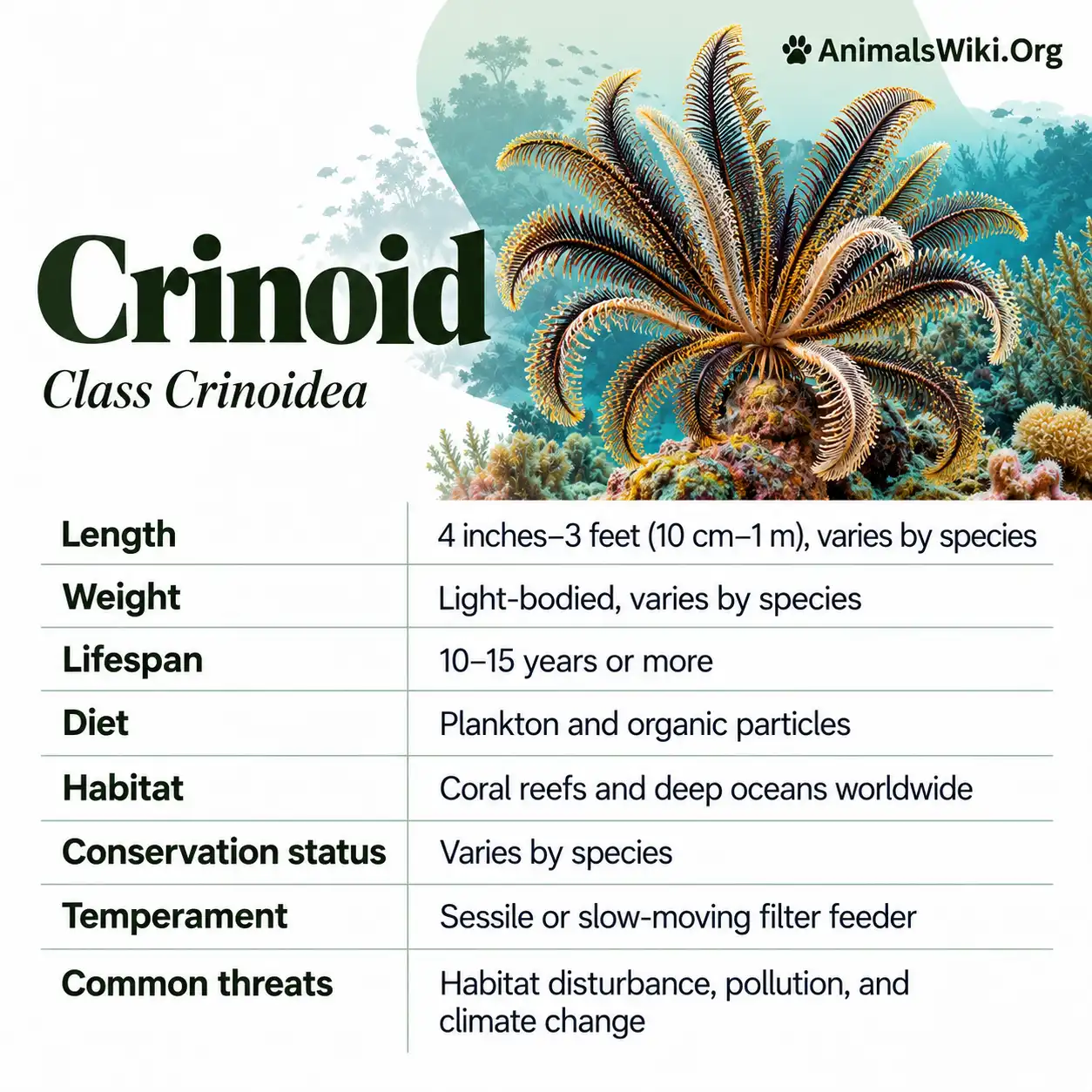
With its delicate, feather-like arms, flower-shaped body, and graceful underwater movements, a crinoid can easily be mistaken for a marine plant.
Some resemble colorful underwater flowers attached to the seafloor.
Others spread their long arms into the current like delicate feathers, capturing microscopic food particles drifting through the water.
But despite their plant-like appearance, crinoids are animals.
They belong to the class Crinoidea, a group of marine echinoderms closely related to sea stars, brittle stars, sea urchins, and sea cucumbers.
Crinoids are divided into two familiar living forms: sea lilies and feather stars.
Sea lilies usually remain attached to the seabed by a long stalk, while most adult feather stars are unstalked and can crawl or sometimes swim using coordinated arm movements.
Their evolutionary history extends back more than 480 million years, making crinoids one of the oldest surviving lineages of echinoderms.
Long before dinosaurs appeared, crinoids were already flourishing in ancient oceans.
During parts of the Paleozoic Era, enormous communities of stalked crinoids covered shallow marine environments.
Their fossilized stems and skeletal plates became so abundant in some regions that entire limestone deposits contain substantial quantities of crinoid remains.
Today, living crinoids inhabit tropical reefs, temperate seas, polar waters, and deep ocean environments.
Some are brightly colored, displaying yellow, orange, red, purple, or striped arms.
Others are pale or nearly transparent, particularly in deep-sea habitats.
Their most remarkable feature is their feeding system.
Crinoids use numerous tiny projections along their arms to capture plankton and organic particles from seawater.
These particles are transported along specialized grooves toward the mouth.
Although they may appear passive, crinoids are highly specialized suspension feeders that play important roles in marine food webs.
This comprehensive guide explores Crinoid facts, scientific classification, sea lilies, feather stars, anatomy, size, habitat, distribution, feeding, movement, reproduction, regeneration, fossils, evolutionary history, predators, lifespan, adaptations, ecological importance, conservation, and frequently asked questions.
Crinoid Facts
| Feature | Information |
|---|---|
| Common name | Crinoid |
| Scientific class | Crinoidea |
| Phylum | Echinodermata |
| Animal type | Marine invertebrate |
| Living forms | Sea lilies and feather stars |
| Living diversity | Approximately 600–700 described species |
| Fossil history | More than 480 million years |
| Habitat | Marine environments worldwide |
| Depth | Shallow reefs to deep ocean |
| Body structure | Central calyx with branching or feather-like arms |
| Symmetry | Usually five-part radial organization |
| Feeding | Suspension feeding |
| Main food | Plankton and suspended organic particles |
| Movement | Crawling or swimming in many feather stars; stalked attachment in sea lilies |
| Reproduction | Sexual, with species-specific brooding strategies |
| Regeneration | Many can regenerate damaged arms |
| Skeleton | Calcareous ossicles |
| Famous feature | Ancient fossil record and feather-like feeding arms |
| Conservation | Varies by species; many remain poorly assessed |
What Is a Crinoid?
A crinoid is a marine invertebrate belonging to the class Crinoidea.
Crinoids are echinoderms, meaning they are related to sea stars, brittle stars, sea urchins, and sea cucumbers.
Their bodies typically consist of a central cup-like structure called the calyx, from which multiple arms extend.
These arms often carry numerous smaller branches called pinnules, producing a feather-like appearance.
Is a Crinoid an Animal or a Plant?
A crinoid is an animal.
Although sea lilies resemble flowers and feather stars resemble underwater plants, they possess animal tissues, muscles, nerves, digestive organs, and reproductive structures.
Why Are Crinoids Called Sea Lilies?
Stalked crinoids resemble flowers growing from the ocean floor.
Their long stems and crown-like arms give them a lily-like appearance.
However, they are not plants.
Are Feather Stars Crinoids?
Yes.
Feather stars are unstalked or largely unstalked adult crinoids that often possess flexible arms and small grasping appendages called cirri.
Scientific Classification of Crinoids
| Classification | Name |
|---|---|
| Kingdom | Animalia |
| Phylum | Echinodermata |
| Class | Crinoidea |
| Major living group | Articulata |
| Example genus | Antedon |
| Example species | Antedon bifida |
Crinoids are a class containing many species, so they do not share one single species-level scientific name.
What Does Crinoidea Mean?
The name Crinoidea comes from Greek roots associated with lilies.
It reflects their flower-like appearance.
Are Crinoids Related to Sea Stars?
Yes.
Both are echinoderms.
Are Crinoids Related to Brittle Stars?
Yes.
They share the same phylum but belong to different classes.
Types of Crinoids
Living crinoids are commonly grouped into two recognizable forms.
1. Sea Lilies
Sea lilies are stalked crinoids.
They usually remain attached to the seabed through a long stem.
Their feeding arms extend into surrounding water currents.
Many living sea lilies inhabit deeper marine environments.
2. Feather Stars
Feather stars are crinoids that typically lose their juvenile stalk during development.
Adults often attach temporarily using cirri or move across the seabed.
Some can swim by rhythmically moving their arms.
Feather stars are especially familiar in tropical reef environments.
What Does a Crinoid Look Like?
Crinoids have distinctive bodies that resemble underwater flowers or feathers.
Common features include:
- Central calyx
- Multiple flexible arms
- Feather-like pinnules
- Tube feet
- Ambulacral feeding grooves
- Calcareous skeletal plates
- Mouth on the upper-facing oral surface
- Cirri in many feather stars
- Stalk in sea lilies
What Is the Crinoid Calyx?
The calyx is the central cup-like skeletal structure supporting the main body organs and arms.
What Are Crinoid Arms?
Crinoid arms are elongated structures used primarily for feeding.
They contain skeletal elements, muscles, nerves, and specialized food-collecting structures.
What Are Pinnules?
Pinnules are small lateral branches along the arms.
They increase the surface area available for collecting food.
Do Crinoids Have Bones?
They do not possess vertebrate bones.
Their skeleton consists of calcareous ossicles made primarily of calcium carbonate.
Do Crinoids Have Spines?
Some species have spines or other skeletal projections, but their appearance varies.
Crinoid Colors
Living crinoids can be remarkably colorful.
Common colors include:
- Yellow
- Orange
- Red
- Purple
- Brown
- White
- Black
- Striped combinations
Coloration varies by species and habitat.
Some reef-dwelling feather stars display striking patterns that contrast with coral or surrounding vegetation.
Crinoid Size and Weight
Crinoid size varies considerably.
Small feather stars may have relatively short arms, while larger species possess broad crowns extending tens of centimeters.
Some deep-sea sea lilies have long stalks.
How Big Can a Crinoid Get?
Many living feather stars have arm spans of several centimeters to several tens of centimeters.
Some larger species can extend much farther.
Certain fossil crinoids possessed exceptionally long stalks.
What Is the Largest Crinoid?
The answer depends on whether size refers to arm span, stalk length, or total body dimensions.
Some extinct stalked crinoids reached several meters in overall height or length.
How Much Does a Crinoid Weigh?
Weight varies by species.
Most familiar feather stars are relatively lightweight.
Where Do Crinoids Live?
Crinoids inhabit marine environments worldwide.
They occur in:
- Pacific Ocean
- Atlantic Ocean
- Indian Ocean
- Southern Ocean
- Arctic Ocean
- Mediterranean Sea
- Coral reefs
- Rocky seabeds
- Deep ocean slopes
- Continental shelves
Do Crinoids Live in Coral Reefs?
Yes.
Many feather stars inhabit tropical coral reefs.
Do Crinoids Live in the Deep Sea?
Yes.
Many stalked sea lilies occur in deep marine environments.
Do Crinoids Live in Freshwater?
No.
Crinoids are marine animals.
Crinoid Habitat
Crinoids occupy a range of habitats.
These include:
- Coral reefs
- Rocky substrates
- Deep-sea slopes
- Cold-water coral communities
- Continental shelves
- Seamounts
- Ocean basins
Many position themselves where water currents bring suspended food.
Why Do Crinoids Prefer Water Currents?
Currents transport plankton and organic particles.
By extending their arms into moving water, crinoids can capture food efficiently.
What Do Crinoids Eat?
Crinoids are primarily suspension feeders.
Their diet includes:
- Phytoplankton
- Zooplankton
- Small organic particles
- Microorganisms
- Detrital material
Are Crinoids Carnivores?
Their food can include small animal plankton, but they are not active pursuit predators.
Do Crinoids Eat Plankton?
Yes.
Plankton is an important component of their diet.
Do Crinoids Eat Algae?
They may capture microscopic algae suspended in the water.
Do Crinoids Eat Fish?
No.
They are not adapted to hunt or consume ordinary-sized fish.
How Do Crinoids Eat?
Crinoids use their feather-like arms as feeding structures.
The arms are covered with pinnules and tube feet that help capture suspended particles.
Food is transferred into grooves running along the arms.
Cilia and mucus help transport particles toward the mouth.
What Are Ambulacral Grooves?
Ambulacral grooves are specialized channels along the arms.
They transport captured food toward the mouth.
Do Crinoids Have a Mouth?
Yes.
The mouth is located on the oral surface of the body.
Do Crinoids Have a Stomach?
They possess a digestive system, including a digestive tract adapted to processing suspended food.
Do Crinoids Have an Anus?
Yes, living crinoids generally possess an anus on the oral surface, often associated with a raised anal structure.
How Do Crinoids Move?
Movement depends on the type of crinoid.
Can Feather Stars Swim?
Yes.
Some feather stars swim by coordinating rhythmic movements of their arms.
This produces a graceful, feather-like motion.
Can Sea Lilies Move?
Stalked sea lilies are generally attached to the seabed, but some can alter their position or move slowly under certain conditions.
They are not usually free-swimming animals.
Do Crinoids Have Legs?
No.
They do not possess legs like vertebrates or arthropods.
What Are Crinoid Cirri?
Cirri are small grasping appendages found in many feather stars.
They help attach the animal to rocks, coral, or other surfaces.
Crinoid Reproduction
Crinoids reproduce sexually.
Many species have separate males and females.
Reproductive cells are commonly associated with specialized structures in the pinnules.
Do Crinoids Lay Eggs?
Yes.
Eggs develop from reproductive cells produced by females.
Fertilization and early development vary among species.
Do Crinoids Release Eggs Into Water?
Many species release eggs and sperm into seawater.
Other species brood developing embryos.
Do Crinoids Have Larvae?
Yes.
Crinoids typically develop through larval stages before transforming into juveniles.
Do Baby Crinoids Have Stalks?
Many feather stars pass through a stalked juvenile stage before becoming free-living adults.
Can Crinoids Reproduce Asexually?
Some crinoids can regenerate lost structures, but regeneration should not automatically be confused with asexual reproduction.
Sexual reproduction is the main reproductive strategy of living crinoids.
Baby Crinoids
Young crinoids undergo substantial changes during development.
Larvae eventually settle or transform into juvenile forms.
In feather stars, the juvenile may initially possess a stalk.
As development continues, the animal can detach and adopt its adult lifestyle.
Crinoid Regeneration
Many crinoids can regenerate damaged or lost arms.
This is an important survival adaptation.
Can Crinoids Regrow Their Arms?
Yes.
Many species can regenerate arms after injury or predation.
How Long Does Crinoid Regeneration Take?
The process may take weeks or months, depending on species, environmental conditions, and injury severity.
Can a Crinoid Regrow Its Entire Body?
Regeneration of lost arms is well documented, but it would be inaccurate to claim that every crinoid can regenerate an entire animal from an isolated arm.
How Long Do Crinoids Live?
Crinoid lifespan varies by species.
Some may live for several years, while others can survive longer.
Precise maximum ages are poorly documented for many deep-sea species.
Crinoid Fossils
Crinoids possess one of the most impressive fossil records among marine invertebrates.
Their history extends back to the Ordovician Period, more than 480 million years ago.
How Old Are Crinoids?
Crinoids originated hundreds of millions of years before dinosaurs.
Their fossil record extends back more than 480 million years.
Were Crinoids Alive During the Dinosaurs?
Yes.
Crinoids existed before, during, and after the age of dinosaurs.
Are Crinoids Still Alive?
Yes.
Hundreds of living species inhabit modern oceans.
Why Are Crinoid Fossils So Common?
Their skeletons contain numerous calcareous plates.
After death, these plates often separate and accumulate in marine sediments.
What Are Crinoid Stem Fossils?
Crinoid stems consist of stacked skeletal segments called columnals.
Fossil columnals often resemble small discs with central holes.
What Is Crinoidal Limestone?
Crinoidal limestone is limestone containing abundant fossil crinoid skeletal material.
In some ancient marine deposits, crinoid fragments make up a substantial portion of the rock.
Crinoid Evolution
Crinoids flourished in ancient Paleozoic seas.
During the Paleozoic Era, stalked crinoids were especially abundant in many shallow marine habitats.
Their diversity changed dramatically through major extinction events.
Did Crinoids Survive the Permian Mass Extinction?
Yes, the crinoid lineage survived the end-Permian mass extinction, although its diversity was greatly reduced and later groups evolved from surviving lineages.
Did Crinoids Survive the Dinosaur Extinction?
Yes.
Crinoids survived the end-Cretaceous extinction event and continue to inhabit oceans today.
Are Crinoids Living Fossils?
Crinoids are sometimes described as living fossils because of their ancient evolutionary history.
However, modern species have continued evolving and are not identical to their ancient ancestors.
Crinoid Adaptations
Feather-Like Arms
Increase the area available for capturing suspended food.
Pinnules
Improve feeding efficiency.
Tube Feet
Help capture food particles.
Ambulacral Grooves
Transport food toward the mouth.
Flexible Arms
Allow feeding structures to respond to water currents.
Calcareous Skeleton
Provides structural support.
Cirri
Allow feather stars to attach to suitable surfaces.
Swimming Ability
Helps some feather stars relocate or escape threats.
Regeneration
Allows recovery from arm damage.
Deep-Sea Adaptations
Enable certain species to survive in cold, dark, high-pressure environments.
What Animals Eat Crinoids?
Potential predators include:
- Certain fish
- Crabs
- Sea urchins
- Other marine invertebrates
- Specialized benthic predators
Predation pressure varies among habitats.
Do Fish Eat Crinoids?
Yes.
Some fish species feed on crinoid arms or other tissues.
Do Crabs Eat Crinoids?
Some crabs may prey on crinoids.
Can Crinoids Escape Predators?
Some feather stars can crawl or swim away.
Others rely on attachment, concealment, and regeneration.
Crinoid vs. Sea Star
| Feature | Crinoid | Sea Star |
|---|---|---|
| Class | Crinoidea | Asteroidea |
| Body shape | Crown with feather-like arms | Star-shaped body |
| Main feeding | Suspension feeding | Often predation |
| Movement | Swimming/crawling in some; attached in others | Tube-foot crawling |
| Fossil history | More than 480 million years | Ancient echinoderm lineage |
| Regeneration | Common in many species | Common in many species |
| Habitat | Marine | Marine |
Crinoid vs. Brittle Star
| Feature | Crinoid | Brittle Star |
|---|---|---|
| Class | Crinoidea | Ophiuroidea |
| Arms | Often feather-like with pinnules | Slender and jointed |
| Feeding | Mainly suspension feeding | Diverse |
| Movement | Some swim; others attached | Primarily arm-driven crawling |
| Body | Calyx and arms | Distinct central disc |
| Habitat | Marine | Marine |
Crinoid vs. Sea Cucumber
Crinoids and sea cucumbers are both echinoderms.
However, crinoids possess radiating feeding arms.
Sea cucumbers have elongated bodies and usually move across or within seabed sediments.
Crinoids mainly capture suspended food particles, while many sea cucumbers feed on sediment-associated organic matter.
Crinoid vs. Coral
Crinoids and corals can look similar, but they are different animals.
Crinoids are echinoderms.
Corals belong to the phylum Cnidaria.
Coral polyps often form colonies and may construct reef frameworks.
Crinoids are individual echinoderm animals with specialized feeding arms.
Are Crinoids Dangerous to Humans?
Most crinoids are harmless to humans.
They do not possess powerful jaws, stingers, or venom-injecting structures.
However, their arms are delicate and can be damaged by handling.
Can Crinoids Bite?
They are not adapted to bite humans.
Are Crinoids Poisonous?
Crinoids are not generally considered dangerous poisonous animals.
Are Crinoids Venomous?
They are not generally recognized as venomous.
Can You Touch a Crinoid?
It is best to avoid touching or collecting wild crinoids.
Handling can damage their fragile arms and feeding structures.
Are Crinoids Endangered?
Conservation status varies by species.
Many crinoids are poorly studied, particularly those living in deep water.
Some may be vulnerable to habitat disturbance and environmental changes.
What Threatens Crinoids?
Potential threats include:
- Bottom trawling
- Deep-sea habitat disturbance
- Marine pollution
- Ocean warming
- Ocean acidification
- Coral reef degradation
- Sedimentation
- Habitat destruction
How Does Bottom Trawling Affect Crinoids?
Bottom trawling can damage seafloor habitats and physically disturb attached or slow-moving animals.
How Does Ocean Acidification Affect Crinoids?
Changes in seawater chemistry may influence skeletal development and physiological processes.
Responses vary among species.
Why Are Crinoids Important?
Crinoids contribute to marine ecosystems by capturing suspended organic particles.
They transfer energy from plankton and other small particles into benthic food webs.
They also provide habitat or attachment surfaces for some small marine organisms.
Their fossil record is extremely valuable for understanding ancient marine environments and evolutionary history.
Why Are Crinoids Important to Paleontology?
Their abundant fossils help scientists reconstruct ancient seas, sedimentary environments, and changes in marine biodiversity.
Do Crinoids Help Coral Reefs?
Crinoids contribute to reef food webs through suspension feeding and interactions with other organisms.
Are Crinoids Important in the Deep Sea?
Yes.
Many stalked crinoids are characteristic members of deep-sea benthic communities.
50 Interesting Crinoid Facts
- Crinoids are marine animals.
- They belong to the class Crinoidea.
- They are echinoderms.
- Sea stars are their relatives.
- Brittle stars are also relatives.
- Sea cucumbers are related to them.
- Crinoids are not plants.
- They often resemble underwater flowers.
- Living crinoids include sea lilies.
- Living crinoids also include feather stars.
- Sea lilies usually possess stalks.
- Most adult feather stars are unstalked.
- Many feather stars can crawl.
- Some feather stars can swim.
- Their arms are often feather-like.
- Small branches along the arms are called pinnules.
- Their arms capture suspended food.
- Tube feet assist with feeding.
- Food travels along ambulacral grooves.
- Crinoids are suspension feeders.
- They consume plankton.
- They also capture organic particles.
- Crinoids inhabit oceans worldwide.
- Some live in tropical reefs.
- Others inhabit polar seas.
- Many sea lilies live in deep water.
- Crinoids do not naturally inhabit freshwater.
- They possess calcareous skeletons.
- Their skeletal plates are called ossicles.
- Many can regenerate lost arms.
- Some feather stars possess cirri.
- Cirri help them grip surfaces.
- Their mouth is located on the oral surface.
- Living crinoids generally possess an anus.
- They reproduce sexually.
- Many release reproductive cells into seawater.
- Some species brood developing young.
- Feather stars may pass through a stalked juvenile stage.
- Their fossil history exceeds 480 million years.
- They existed long before dinosaurs.
- They were abundant in many Paleozoic seas.
- Fossil crinoid stems contain stacked columnals.
- Crinoid fossils occur in limestone.
- Some limestone contains abundant crinoid fragments.
- Crinoids survived major mass extinction events.
- Modern crinoids are still evolving.
- Fish can prey on crinoids.
- Some crinoids can escape by swimming.
- They contribute to marine food webs.
- Their ancient history and extraordinary feather-like anatomy make them among the ocean’s most fascinating invertebrates.
Did You Know?
The Underwater Flower That Survived the Age of Dinosaurs
Imagine an ancient ocean more than 400 million years ago.
The seafloor is covered with strange marine animals.
Trilobites crawl across the sediment.
Early fishes move through the water.
And rising above the seabed are countless flower-like creatures.
They resemble underwater gardens.
But these are not plants.
They are crinoids.
Their long stalks hold delicate feeding crowns above the ocean floor.
Their feather-like arms spread into the currents, collecting microscopic food particles.
Over millions of years, crinoids become abundant in many ancient marine environments.
Their skeletal remains accumulate on the seabed.
Some eventually become part of thick limestone deposits.
Then the world changes.
Mass extinction events reshape marine ecosystems.
Entire groups disappear.
But crinoids survive.
Millions of years later, dinosaurs appear.
Crinoids continue living in the oceans.
Then another major extinction event ends the age of non-avian dinosaurs.
Crinoids survive again.
Today, a diver exploring a tropical coral reef may encounter a feather star.
Its colorful arms spread gracefully through the water.
When disturbed, it may crawl or even swim away.
Far below the surface, stalked sea lilies still rise above the seabed, capturing food from deep ocean currents.
These living animals are not identical to their ancient ancestors.
They have continued evolving.
Yet they preserve a remarkable body plan that has persisted through immense stretches of geological time.
Crinoids are living reminders that some of the most successful evolutionary designs have endured for hundreds of millions of years.
Frequently Asked Questions About Crinoids
What is a crinoid?
A crinoid is a marine echinoderm belonging to the class Crinoidea.
Is a crinoid an animal?
Yes.
Is a crinoid a plant?
No.
Why do crinoids look like flowers?
Their stalks and feather-like arms resemble stems and petals.
What is the scientific name of crinoids?
Crinoids belong to the class Crinoidea.
Are crinoids echinoderms?
Yes.
Are crinoids related to sea stars?
Yes.
Are crinoids related to brittle stars?
Yes.
Are crinoids related to sea cucumbers?
Yes.
What are the two main living types of crinoids?
Sea lilies and feather stars.
What is a sea lily?
A stalked crinoid that usually remains attached to the seabed.
What is a feather star?
An adult crinoid that is generally unstalked and may crawl or swim.
Are feather stars crinoids?
Yes.
Are sea lilies plants?
No.
How many crinoid species exist?
Approximately 600–700 living species are commonly recognized, although taxonomy continues to change.
How old are crinoids?
Their fossil record extends back more than 480 million years.
Were crinoids alive before dinosaurs?
Yes.
Were crinoids alive during the dinosaurs?
Yes.
Are crinoids still alive?
Yes.
Are crinoids living fossils?
They are sometimes described that way, but living species have continued evolving.
Where do crinoids live?
In oceans worldwide.
Do crinoids live in coral reefs?
Yes.
Do crinoids live in the deep sea?
Yes.
Do crinoids live in freshwater?
No.
How big are crinoids?
Size varies, with some species having broad arm crowns and others possessing long stalks.
What is the largest crinoid?
Some extinct stalked crinoids reached several meters in overall dimensions.
Do crinoids have arms?
Yes.
What are crinoid pinnules?
Small branches along the arms that increase feeding surface area.
What is a crinoid calyx?
The central cup-like structure supporting the body and arms.
Do crinoids have bones?
They possess calcareous ossicles rather than vertebrate bones.
Do crinoids have a mouth?
Yes.
Do crinoids have an anus?
Yes, living crinoids generally do.
Do crinoids have a brain?
They lack a centralized vertebrate-style brain.
Do crinoids have eyes?
They do not possess conventional image-forming eyes.
How do crinoids breathe?
Through gas exchange across specialized body surfaces.
What do crinoids eat?
Plankton and suspended organic particles.
Are crinoids carnivores?
They may consume animal plankton but are primarily suspension feeders rather than active hunters.
Do crinoids eat fish?
No.
How do crinoids catch food?
Using feather-like arms, pinnules, tube feet, and feeding grooves.
What are ambulacral grooves?
Channels that transport captured food toward the mouth.
Can crinoids swim?
Some feather stars can.
Can sea lilies move?
Most remain attached, although some can reposition under certain conditions.
Do crinoids have legs?
No.
What are crinoid cirri?
Grasping appendages used by many feather stars to attach to surfaces.
Do crinoids lay eggs?
Yes.
How do crinoids reproduce?
Sexually, with variation in spawning and brooding strategies.
Do crinoids have larvae?
Yes.
Do baby feather stars have stalks?
Many pass through a stalked juvenile stage.
Can crinoids regenerate arms?
Yes.
Can crinoids regrow their entire bodies?
Arm regeneration is common, but whole-body regeneration from an isolated arm is not a universal ability.
How long do crinoids live?
Lifespan varies and is poorly documented for many species.
What animals eat crinoids?
Certain fish, crabs, and other marine predators.
Do fish eat crinoids?
Yes.
Do crabs eat crinoids?
Some do.
Are crinoids poisonous?
They are not generally considered dangerous poisonous animals.
Are crinoids venomous?
They are not generally recognized as venomous.
Can crinoids bite?
They are not adapted to bite humans.
Are crinoids dangerous?
Most are harmless when left undisturbed.
Can you touch a crinoid?
Handling is discouraged because their delicate arms can be damaged.
What are crinoid fossils?
Fossilized remains of ancient crinoid skeletons.
Why are crinoid fossils common?
Their numerous skeletal plates accumulated in ancient marine sediments.
What are crinoid stem fossils?
Fossilized stalk segments called columnals.
What is crinoidal limestone?
Limestone containing abundant crinoid skeletal fragments.
Did crinoids survive mass extinctions?
Yes, the lineage survived several major extinction events.
Are crinoids endangered?
Conservation status varies by species.
What threatens crinoids?
Habitat disturbance, bottom trawling, pollution, and environmental changes.
Why are crinoids important?
They contribute to marine food webs and provide valuable evidence of ancient marine ecosystems.
What is the most interesting crinoid fact?
Crinoids have existed for more than 480 million years, surviving major extinction events while retaining their distinctive feather-armed body plan.
Conclusion
The Crinoid is one of the most extraordinary survivors in the history of marine life.
Its flower-like appearance hides the anatomy of a highly specialized echinoderm.
Sea lilies rise above the seabed on stalks, while feather stars spread their delicate arms through ocean currents.
Some feather stars can even swim.
Crinoids capture plankton and organic particles using their feather-like arms, pinnules, and specialized feeding grooves.
Many can regenerate damaged arms.
Their fossil record stretches back more than 480 million years, revealing that their evolutionary lineage survived enormous changes in Earth’s oceans.
Today, crinoids remain important members of marine ecosystems, from colorful coral reefs to deep ocean environments.
Although many species are poorly studied, their ecological roles and extraordinary evolutionary history make them worthy of scientific attention and conservation.
The Crinoid is not simply an underwater flower—it is a living representative of one of the most ancient and remarkable animal lineages still inhabiting our planet.
SEO Information
Primary keyword: Crinoid
Secondary keywords: Crinoid facts, Crinoid scientific name, Crinoidea, Crinoid species, types of Crinoids, Sea Lily, Feather Star, Crinoid anatomy, Crinoid arms, Crinoid calyx, Crinoid pinnules, Crinoid size, Crinoid habitat, where do Crinoids live, Crinoid diet, what do Crinoids eat, Crinoid feeding, Crinoid reproduction, Crinoid eggs, baby Crinoid, Crinoid regeneration, Crinoid fossils, Crinoid stem fossils, crinoidal limestone, Crinoid evolution, Crinoid lifespan, Crinoid predators, Crinoid adaptations, Crinoid vs Sea Star, Crinoid vs Brittle Star, Crinoid vs Sea Cucumber, are Crinoids dangerous, are Crinoids still alive, Crinoid conservation.
SEO meta title: Crinoid Facts: Sea Lilies, Feather Stars, Fossils & Habitat
Meta description: Discover fascinating Crinoid facts, including sea lilies, feather stars, ancient fossils, feeding arms, ocean habitats, reproduction, regeneration, and evolution.
Suggested URL slug: crinoid-facts
Suggested image alt text: Colorful feather star crinoid spreading its delicate feather-like arms on a tropical coral reef in its natural underwater habitat.
Editorial note: Crinoids include many species with different sizes, habitats, mobility, and reproductive strategies. Avoid applying feather star swimming behavior to all stalked sea lilies, and distinguish fossil species from living forms when discussing maximum size and evolutionary history.