Horseshoe Crab, The Ancient Marine Arthropod With Blue Blood and a 450-Million-Year History
The horseshoe crab is one of the most extraordinary animals living along the world’s coastlines. With its hard, horseshoe-shaped shell, long pointed tail, and armored appearance, this unusual marine creature looks like something from a prehistoric ocean.
And in many ways, it is.
Horseshoe crabs belong to an ancient evolutionary lineage whose fossil relatives date back approximately 450 million years, long before the first dinosaurs appeared.
Despite their name, horseshoe crabs are not true crabs. They are marine chelicerate arthropods, making them more closely related to spiders and scorpions than to familiar crabs, lobsters, or shrimp.
Only four living species of horseshoe crabs are recognized today. One inhabits the Atlantic coast of North America, while three occur in coastal regions of Asia.
Perhaps their most famous characteristic is their remarkable blue blood.
Unlike humans, whose blood contains iron-based hemoglobin, horseshoe crabs use a copper-containing respiratory pigment called hemocyanin. This pigment gives oxygenated blood its distinctive blue appearance.
Their blood also contains specialized immune cells called amebocytes, which react to certain bacterial toxins. Scientists have used this response to develop important tests for bacterial endotoxins in medical products.
Horseshoe crabs are equally important in nature.
During spawning seasons, large numbers gather on sandy beaches to lay eggs. These eggs provide essential food for migrating shorebirds, including the red knot.
Although horseshoe crabs have survived enormous evolutionary changes, modern populations face threats from coastal development, fishing pressure, habitat loss, and other human activities.
This comprehensive guide explores horseshoe crab facts, scientific classification, species, anatomy, size, habitat, distribution, blue blood, feeding, reproduction, eggs, babies, lifespan, predators, adaptations, ecological importance, conservation, and frequently asked questions.
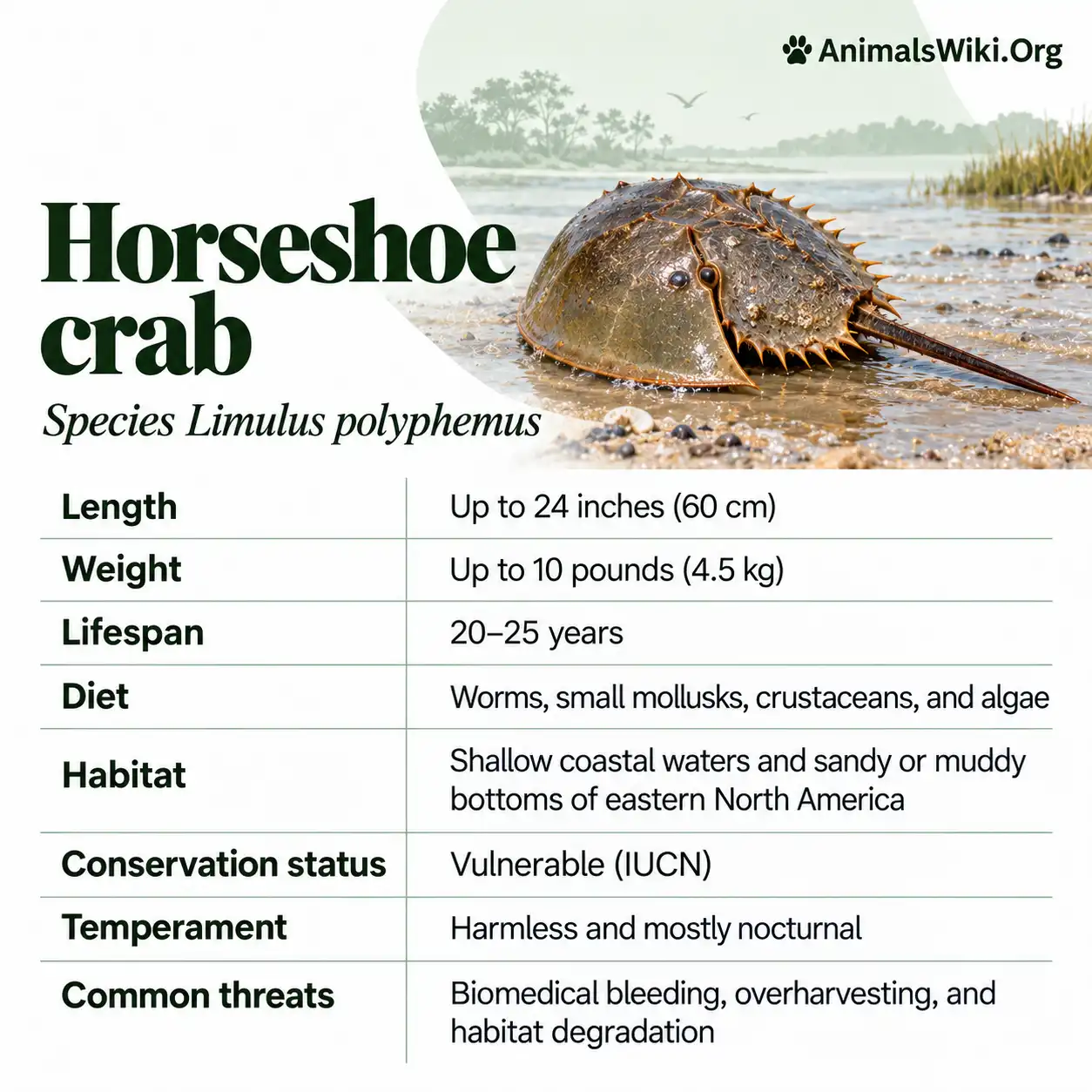
Horseshoe Crab Facts
| Feature | Information |
|---|---|
| Common name | Horseshoe Crab |
| Animal group | Chelicerate arthropod |
| Order | Xiphosurida |
| Living family | Limulidae |
| Living species | Four |
| Fossil lineage | Approximately 450 million years |
| Habitat | Shallow coastal waters and sandy or muddy seabeds |
| Distribution | Atlantic North America and parts of Asia |
| Body covering | Hard exoskeleton |
| Legs | Five pairs of walking legs, plus specialized appendages |
| Tail | Long, pointed telson |
| Blood color | Blue when oxygenated |
| Respiratory pigment | Hemocyanin |
| Breathing | Book gills |
| Diet | Worms, mollusks, and other small bottom-dwelling animals |
| Reproduction | Egg-laying |
| Fertilization | External |
| Lifespan | Commonly around 20 years or more in the American species |
| Main predators | Fish, sea turtles, birds, and other coastal animals |
| Ecological role | Benthic feeding and providing eggs for coastal food webs |
| Conservation | Varies by species |
What Is a Horseshoe Crab?
A horseshoe crab is a marine arthropod belonging to the order Xiphosurida.
Its body is protected by a hard exoskeleton and divided into three major external regions:
- Prosoma, or front body section
- Opisthosoma, or rear body section
- Telson, or tail spine
The broad front shell gives the animal its distinctive horseshoe-like appearance.
Although it resembles a crab, its evolutionary relationships are quite different.
Is a Horseshoe Crab Really a Crab?
No.
Horseshoe crabs are not true crabs.
True crabs belong to the crustacean order Brachyura.
Horseshoe crabs are chelicerates, a group that also includes spiders, scorpions, ticks, and mites.
Why Is It Called a Horseshoe Crab?
Its rounded front shell resembles the curved shape of a horseshoe.
The word “crab” comes from its armored, bottom-dwelling appearance rather than its actual classification.
Is the Horseshoe Crab a Living Fossil?
Horseshoe crabs are frequently called living fossils because their general body plan resembles that of ancient fossil relatives.
However, modern horseshoe crabs are not unchanged prehistoric animals.
Their lineage has continued evolving over millions of years.
The term is best understood as a description of long-term similarities in body structure, not an absence of evolution.
Scientific Classification of Horseshoe Crabs
| Classification | Name |
|---|---|
| Kingdom | Animalia |
| Phylum | Arthropoda |
| Subphylum | Chelicerata |
| Order | Xiphosurida |
| Family | Limulidae |
| Example genus | Limulus |
| Example species | Limulus polyphemus |
What Does Limulus polyphemus Mean?
Limulus polyphemus is the scientific name of the American horseshoe crab.
It is one of four living horseshoe crab species.
Are Horseshoe Crabs Related to Spiders?
Yes.
Horseshoe crabs and spiders are both chelicerates.
The precise relationships among horseshoe crabs, arachnids, and other chelicerate groups continue to be investigated.
Are Horseshoe Crabs Related to Trilobites?
Horseshoe crabs and trilobites were both marine arthropods with ancient evolutionary histories.
However, horseshoe crabs are not living trilobites, and trilobites belonged to a separate extinct arthropod lineage.
The Four Living Species of Horseshoe Crabs
Only four living species are generally recognized.
1. American Horseshoe Crab
Scientific name: Limulus polyphemus
The American horseshoe crab inhabits the Atlantic coast of North America, including the Gulf of Mexico.
It is particularly well known for its spawning gatherings along the Delaware Bay coastline.
This species has been extensively studied because of its ecological importance and the biomedical use of its blood.
2. Tri-Spine Horseshoe Crab
Scientific name: Tachypleus tridentatus
The tri-spine horseshoe crab inhabits coastal waters of East and Southeast Asia.
It is among the largest living horseshoe crab species.
It faces serious conservation concerns, including habitat loss and harvesting pressure.
3. Coastal Horseshoe Crab
Scientific name: Tachypleus gigas
This species occurs in coastal waters of South and Southeast Asia.
It inhabits shallow marine environments, including sandy and muddy seabeds.
4. Mangrove Horseshoe Crab
Scientific name: Carcinoscorpius rotundicauda
The mangrove horseshoe crab inhabits coastal and estuarine environments in parts of South and Southeast Asia.
It is generally smaller than the largest horseshoe crab species.
It is associated with mangrove systems, muddy habitats, and sheltered coastal waters.
What Does a Horseshoe Crab Look Like?
Horseshoe crabs have broad, flattened bodies protected by a rigid exoskeleton.
Their appearance includes:
- Horseshoe-shaped front shell
- Smaller rear body section
- Long pointed tail
- Multiple pairs of legs
- Compound eyes
- Additional light-sensitive organs
- Book gills
- Mouth on the underside
- Strong feeding appendages
Their shells are commonly olive-green, brown, gray, or dark earthy colors.
What Is the Horseshoe Crab Shell Made Of?
The exoskeleton contains chitin and structural proteins.
It provides protection and supports the animal’s body.
Does a Horseshoe Crab Have Bones?
No.
Horseshoe crabs are invertebrates and do not possess an internal vertebrate skeleton.
Their hard exoskeleton provides support and protection.
Why Does a Horseshoe Crab Have a Long Tail?
The long tail is called a telson.
It helps the animal right itself when overturned.
The telson is not a venomous stinger.
Is the Horseshoe Crab Tail Dangerous?
The tail is pointed and should be handled carefully, but it does not inject venom.
Horseshoe crabs do not use their tails to sting people.
Horseshoe Crab Size and Weight
Size varies among species and between males and females.
Females are generally larger than males.
Large horseshoe crabs can reach approximately 60 centimeters or more in total length, including the tail.
What Is the Largest Horseshoe Crab?
The tri-spine horseshoe crab is among the largest living species.
Exceptional individuals can reach impressive sizes, although maximum records vary by measurement method.
How Much Does a Horseshoe Crab Weigh?
Large adults can weigh several kilograms.
Weight depends on species, sex, age, and body condition.
Are Female Horseshoe Crabs Bigger Than Males?
Yes.
Females are typically larger and heavier.
This difference is especially noticeable during spawning, when smaller males attach themselves to females.
Where Do Horseshoe Crabs Live?
Horseshoe crabs inhabit shallow coastal marine environments.
Their natural distribution includes:
- Atlantic coast of North America
- Gulf of Mexico
- Coastal East Asia
- Coastal South Asia
- Coastal Southeast Asia
Do Horseshoe Crabs Live in the Atlantic Ocean?
Yes.
The American horseshoe crab occurs along the western Atlantic coast.
Do Horseshoe Crabs Live in the Pacific Ocean?
Asian horseshoe crab species occur in coastal regions connected to the western Pacific and nearby seas.
Do Horseshoe Crabs Live in Freshwater?
They are primarily marine and estuarine animals.
Some species tolerate brackish water and may enter low-salinity coastal habitats.
They are not ordinary freshwater animals.
Do Horseshoe Crabs Live in Deep Water?
Adults usually inhabit relatively shallow coastal environments, although they may move into deeper nearby waters seasonally.
Horseshoe Crab Habitat
Horseshoe crabs inhabit environments such as:
- Sandy beaches
- Muddy seabeds
- Shallow coastal waters
- Estuaries
- Tidal flats
- Coastal bays
- Mangrove-associated habitats
Suitable spawning beaches are especially important for successful reproduction.
Why Do Horseshoe Crabs Need Sandy Beaches?
Many species lay eggs in sandy or mixed-sediment coastal areas.
The sediment protects developing eggs while allowing appropriate environmental conditions.
Do Horseshoe Crabs Live in Mangroves?
Yes.
The mangrove horseshoe crab is particularly associated with mangrove and estuarine habitats.
What Do Horseshoe Crabs Eat?
Horseshoe crabs are bottom-feeding animals.
Their diet includes:
- Marine worms
- Clams
- Small mollusks
- Other benthic invertebrates
- Small crustaceans
- Organic material associated with the seabed
Are Horseshoe Crabs Carnivores?
They are primarily consumers of small bottom-dwelling animals, although their diet can include other organic material.
Do Horseshoe Crabs Eat Clams?
Yes.
They can consume small clams and other mollusks.
Do Horseshoe Crabs Eat Worms?
Yes.
Marine worms are an important food source.
Do Horseshoe Crabs Eat Fish?
They are not specialized predators of large or fast-swimming fish.
They primarily feed on animals found on or within the seabed.
How Do Horseshoe Crabs Eat?
Horseshoe crabs use specialized structures on their legs to grasp and process food.
Their mouth is located on the underside of the body, between the leg bases.
Spiny structures called gnathobases help crush and move food toward the mouth.
Unlike humans, horseshoe crabs do not chew using jaws.
Do Horseshoe Crabs Have Teeth?
They do not possess conventional vertebrate teeth.
Instead, they use specialized spiny surfaces on their appendages to process food.
Do Horseshoe Crabs Have a Mouth?
Yes.
The mouth is located underneath the front part of the body.
Why Do Horseshoe Crabs Have Blue Blood?
One of the most famous horseshoe crab facts is that their blood appears blue when oxygenated.
The color comes from hemocyanin, a copper-containing protein that transports oxygen.
Humans use iron-containing hemoglobin, which gives oxygenated blood its red color.
Is Horseshoe Crab Blood Really Blue?
Yes.
Oxygenated horseshoe crab hemolymph appears blue because of hemocyanin.
Does Horseshoe Crab Blood Contain Copper?
Yes.
Copper is part of the hemocyanin molecules involved in oxygen transport.
Why Is Horseshoe Crab Blood Important to Medicine?
Horseshoe crab blood contains immune cells called amebocytes.
These cells react strongly to certain bacterial endotoxins.
Scientists developed the Limulus Amebocyte Lysate (LAL) test using this biological response.
LAL has been used to detect bacterial endotoxin contamination in pharmaceutical products and medical devices.
What Is the LAL Test?
The Limulus Amebocyte Lysate test is a method used to detect endotoxins associated with certain Gram-negative bacteria.
It has played an important role in pharmaceutical quality control.
Are Horseshoe Crabs Killed for Their Blood?
In some biomedical collection programs, horseshoe crabs are captured, partially bled, and released.
However, the process can cause stress, injury, and mortality, and released animals may experience physiological or behavioral effects.
Other harvesting practices may involve animals being killed for bait or other uses.
Is There an Alternative to Horseshoe Crab Blood Testing?
Yes.
Recombinant technologies, including recombinant factor C-based methods, provide alternatives for detecting bacterial endotoxins.
Their regulatory acceptance and practical use depend on jurisdiction, product type, and validated testing procedures.
How Do Horseshoe Crabs Breathe?
Horseshoe crabs breathe using specialized structures called book gills.
These are located beneath the rear section of the body.
The gills consist of thin, layered surfaces that exchange gases with surrounding water.
What Are Book Gills?
Book gills are respiratory structures containing numerous thin plates arranged somewhat like pages in a book.
They provide a large surface area for gas exchange.
Can Horseshoe Crabs Breathe on Land?
Horseshoe crabs can survive temporary exposure to air under suitable moist conditions.
However, they are aquatic animals and should not be left out of water unnecessarily.
Do Horseshoe Crabs Have Lungs?
No.
They breathe using book gills rather than lungs.
How Do Horseshoe Crabs Move?
Horseshoe crabs walk across the seabed using their legs.
They can also swim, often moving upside down through the water.
Can Horseshoe Crabs Swim?
Yes.
They can swim by moving their appendages and book-gill structures.
Can Horseshoe Crabs Walk on Land?
They can move across wet beaches during spawning, but they are not terrestrial animals.
Are Horseshoe Crabs Fast?
They generally move slowly compared with active swimming fish.
Their movement is adapted to bottom-dwelling life.
Horseshoe Crab Eyes and Vision
Horseshoe crabs possess an unusually complex system of light-sensitive organs.
They have large lateral compound eyes and several additional light-sensitive structures.
How Many Eyes Does a Horseshoe Crab Have?
Horseshoe crabs possess multiple eyes and photoreceptive organs.
Descriptions often mention approximately ten eyes or light-sensitive structures, although counts depend on how different photoreceptors are categorized.
Can Horseshoe Crabs See?
Yes.
Their visual system detects light, movement, and environmental cues.
Why Are Horseshoe Crab Eyes Important to Science?
Horseshoe crab vision has contributed significantly to research on visual processing and the nervous system.
Studies of their compound eyes helped scientists understand how neurons process visual information.
Horseshoe Crab Reproduction
Horseshoe crabs reproduce by laying eggs.
Spawning often occurs in shallow coastal environments.
In the American horseshoe crab, spawning is strongly associated with spring and early summer tides.
How Do Horseshoe Crabs Mate?
Males may attach themselves to females using modified appendages.
The female moves toward a suitable spawning area and deposits eggs in the sediment.
Males release sperm to fertilize the eggs externally.
Do Horseshoe Crabs Lay Eggs?
Yes.
Females deposit eggs in nests beneath beach sediment.
How Many Eggs Does a Horseshoe Crab Lay?
A female American horseshoe crab may produce tens of thousands of eggs across a spawning season.
Egg production varies with species, size, and reproductive condition.
Why Do Horseshoe Crabs Spawn During High Tides?
High tides allow adults to reach suitable beach areas for egg deposition.
In some regions, spawning activity is especially associated with lunar and tidal cycles.
Do Horseshoe Crabs Mate for Life?
No.
They do not form lifelong monogamous pairs.
Baby Horseshoe Crabs
Young horseshoe crabs hatch from eggs as small aquatic juveniles.
Early stages resemble miniature adults, although their body proportions and development differ.
What Is a Baby Horseshoe Crab Called?
Young horseshoe crabs are generally called larvae or juveniles, depending on developmental stage.
The early hatchling stage is often called a trilobite larva because of its appearance.
Do Baby Horseshoe Crabs Have Tails?
The telson develops during early growth.
Newly hatched forms may have a reduced or incompletely developed tail compared with adults.
How Do Baby Horseshoe Crabs Grow?
They grow by molting.
During a molt, the old exoskeleton is shed and replaced by a larger one.
Horseshoe Crab Molting
Like other arthropods, horseshoe crabs possess rigid exoskeletons that cannot expand continuously.
They must periodically shed their old shells.
Do Horseshoe Crabs Shed Their Shells?
Yes.
This process is called molting or ecdysis.
How Many Times Does a Horseshoe Crab Molt?
American horseshoe crabs typically molt many times before reaching adulthood, often around 16–17 molts, although the exact number varies.
Do Adult Horseshoe Crabs Continue Molting?
Adults generally stop molting after reaching sexual maturity.
How Long Do Horseshoe Crabs Live?
American horseshoe crabs can live approximately 20 years or more.
They require many years to reach reproductive maturity.
How Long Does It Take a Horseshoe Crab to Become an Adult?
American horseshoe crabs often take around 9–12 years to reach maturity, depending on sex and environmental conditions.
Do Horseshoe Crabs Live for 100 Years?
There is no reliable basis for claiming that individual horseshoe crabs routinely live for 100 years.
Their evolutionary lineage is ancient, but that does not mean individual animals have exceptionally long lifespans.
Horseshoe Crab Adaptations
Hard Exoskeleton
Protects the body from physical damage and predators.
Horseshoe-Shaped Shell
Provides broad protective coverage.
Book Gills
Enable underwater respiration.
Telson
Helps the animal right itself when overturned.
Compound Eyes
Support visual detection.
Hemocyanin
Transports oxygen in the hemolymph.
Sensitive Immune System
Helps detect and respond to bacterial components.
Specialized Feeding Appendages
Process small bottom-dwelling prey.
Burrowing Ability
Allows animals to interact with sediment and deposit eggs.
Tidal Spawning Behavior
Helps adults reach suitable nesting habitats.
What Animals Eat Horseshoe Crabs?
Horseshoe crabs and their eggs provide food for numerous coastal animals.
Predators include:
- Sea turtles
- Certain fish
- Shorebirds
- Crabs
- Other coastal predators
Do Sea Turtles Eat Horseshoe Crabs?
Yes.
Loggerhead sea turtles are known to consume horseshoe crabs.
Do Birds Eat Horseshoe Crabs?
Shorebirds consume horseshoe crab eggs.
The eggs are particularly important during migration.
Do Fish Eat Horseshoe Crab Eggs?
Yes.
Fish and other marine animals may consume eggs and young horseshoe crabs.
Horseshoe Crabs and Migratory Shorebirds
Horseshoe crab spawning is closely connected to the survival of several migratory shorebird populations.
During spring migration, birds stop at coastal areas where horseshoe crabs lay eggs.
The eggs provide a concentrated food source.
Why Are Horseshoe Crab Eggs Important to Red Knots?
Red knots undertake extraordinary long-distance migrations.
In Delaware Bay, horseshoe crab eggs provide valuable energy that helps birds continue their journeys toward Arctic breeding grounds.
What Happens if Horseshoe Crab Numbers Decline?
Reduced egg availability can affect migratory shorebirds and other coastal animals that depend on this seasonal food resource.
Horseshoe Crab vs. True Crab
| Feature | Horseshoe Crab | True Crab |
|---|---|---|
| Group | Chelicerate arthropod | Crustacean |
| Order | Xiphosurida | Brachyura |
| Main shell | Broad horseshoe-shaped carapace | Usually compact carapace |
| Tail | Long telson | Reduced abdomen |
| Breathing | Book gills | Gills |
| Close relatives | Other chelicerates | Other crustaceans |
| Blood pigment | Hemocyanin | Often hemocyanin |
| Evolutionary lineage | Ancient xiphosuran lineage | Decapod crustacean lineage |
Horseshoe Crab vs. Spider
Horseshoe crabs and spiders are both chelicerates.
However, spiders are primarily terrestrial arachnids, while horseshoe crabs are marine animals.
Spiders possess four pairs of walking legs and breathe through structures such as book lungs or tracheae, depending on the group.
Horseshoe crabs have aquatic book gills and a broad armored body.
Horseshoe Crab vs. Trilobite
| Feature | Horseshoe Crab | Trilobite |
|---|---|---|
| Living today | Yes | No |
| Main group | Chelicerata | Extinct trilobite lineage |
| Body | Broad carapace and telson | Segmented three-lobed exoskeleton |
| Habitat | Marine and estuarine | Ancient marine environments |
| Fossil history | Very ancient | Cambrian to Permian |
| Extinction | Living lineage survives | Extinct |
Are Horseshoe Crabs Dangerous to Humans?
Horseshoe crabs are generally harmless to humans.
They do not possess venomous stingers.
They do not chase people or attack swimmers.
However, their shells and tails can have sharp edges or points, and rough handling can injure both the person and the animal.
Can Horseshoe Crabs Sting?
No.
Their tails are not stingers.
Can Horseshoe Crabs Bite?
They do not have jaws designed to deliver dangerous bites to humans.
Are Horseshoe Crabs Venomous?
No.
Are Horseshoe Crabs Poisonous?
They are not generally considered poisonous to touch, but this does not mean all species are safe to eat.
In particular, the mangrove horseshoe crab has been associated with dangerous food poisoning in some regions, including cases involving tetrodotoxin.
People should never assume wild horseshoe crabs are safe for consumption.
Can You Touch a Horseshoe Crab?
It is best to observe wild animals without unnecessary handling.
If a stranded horseshoe crab must be turned over, local conservation guidance generally recommends gently lifting it by the sides of its shell, never by the tail.
Are Horseshoe Crabs Endangered?
Conservation status differs among the four living species.
The American horseshoe crab has been assessed as Vulnerable on the IUCN Red List.
The tri-spine horseshoe crab has been assessed as Endangered.
Other species have different assessments and information gaps.
Because conservation categories may be updated, the latest species-specific Red List entries should be checked before publication.
What Threatens Horseshoe Crabs?
Major threats include:
- Coastal habitat loss
- Beach development
- Shoreline modification
- Overharvesting
- Fishing bait demand
- Biomedical collection impacts
- Pollution
- Climate change
- Disturbance of spawning beaches
Why Is Coastal Development Dangerous?
Horseshoe crabs require suitable coastal environments for spawning.
Beach alteration, shoreline hardening, and habitat degradation can reduce available nesting areas.
Does Climate Change Affect Horseshoe Crabs?
Yes.
Sea-level rise, coastal erosion, temperature changes, and altered storm patterns can affect spawning habitats and coastal ecosystems.
Horseshoe Crab Conservation
Conservation efforts include:
- Protecting spawning beaches
- Regulating harvesting
- Monitoring populations
- Reducing unnecessary handling
- Supporting biomedical testing alternatives
- Restoring coastal habitat
- Protecting migratory shorebird feeding areas
How Can People Help Horseshoe Crabs?
People can support responsible coastal management, avoid disturbing spawning animals, follow local wildlife regulations, and participate in authorized conservation programs.
Why Are Horseshoe Crabs Important?
Horseshoe crabs are important for several reasons.
Ecological Importance
They feed on bottom-dwelling animals and contribute to coastal food webs.
Shorebird Migration
Their eggs support migrating birds.
Biomedical Research
Their immune-cell response has contributed to bacterial endotoxin testing.
Scientific Research
Their visual and nervous systems have provided valuable insights into animal physiology.
Evolutionary History
Their fossil relatives help scientists study ancient marine ecosystems and long-term evolutionary change.
50 Interesting Horseshoe Crab Facts
- Horseshoe crabs are not true crabs.
- They are chelicerate arthropods.
- Their relatives include spiders and scorpions.
- Four living species are recognized.
- Their broader fossil lineage dates back approximately 450 million years.
- They existed long before dinosaurs.
- They are often called living fossils.
- Modern horseshoe crabs have continued evolving.
- Their shells resemble horseshoes.
- Their bodies are protected by exoskeletons.
- They possess a long pointed telson.
- The telson is not a venomous stinger.
- The tail helps them right themselves.
- They possess multiple light-sensitive organs.
- Their compound eyes have contributed to scientific research.
- They breathe using book gills.
- They are primarily marine animals.
- Some tolerate brackish water.
- They inhabit shallow coastal environments.
- They feed on worms and small mollusks.
- They process food using specialized appendages.
- Their mouth is on the underside.
- Their blood is blue when oxygenated.
- Hemocyanin contains copper.
- Their blood contains amebocytes.
- Amebocytes respond to bacterial endotoxins.
- Horseshoe crab blood contributed to the development of the LAL test.
- Recombinant endotoxin testing alternatives exist.
- Females are generally larger than males.
- Horseshoe crabs lay eggs.
- Fertilization occurs externally.
- Females may produce tens of thousands of eggs in a season.
- Spawning is influenced by tides.
- Sandy beaches are important nesting habitats.
- Their young develop through several stages.
- Juveniles grow by molting.
- American horseshoe crabs take many years to mature.
- Adults generally stop molting.
- They can live around 20 years or more.
- Horseshoe crabs can swim.
- They sometimes swim upside down.
- Loggerhead sea turtles eat horseshoe crabs.
- Shorebirds consume horseshoe crab eggs.
- Red knots rely heavily on eggs during migration in Delaware Bay.
- Horseshoe crab eggs support coastal food webs.
- The American horseshoe crab occurs along Atlantic North America.
- Three living species occur in Asia.
- Some species face serious conservation threats.
- Coastal habitat protection is important for their survival.
- Their combination of ancient ancestry, blue blood, and ecological importance makes them among the most remarkable marine arthropods.
Did You Know?
The Ancient Animal Whose Blue Blood Helps Protect Modern Medicine
Imagine a warm spring night along the Atlantic coast of North America.
The tide rises.
Waves move gently across a sandy beach.
Then, beneath the moonlight, unusual armored animals begin emerging from the water.
They are horseshoe crabs.
Their broad shells glide across the wet sand.
Long pointed tails trail behind them.
Females move toward suitable nesting areas, often accompanied by smaller males.
Beneath the sand, the females deposit thousands of eggs.
For these animals, the beach is a place of reproduction.
But for migrating birds, it is also a place of survival.
Thousands of shorebirds arrive to feed on horseshoe crab eggs.
The energy gained from these eggs helps fuel extraordinary migrations.
Now consider another remarkable part of the horseshoe crab’s biology.
Its blood is blue.
The color comes from copper-containing hemocyanin, which carries oxygen through the animal’s body.
But the most medically important feature is not the blue color itself.
It is the response of specialized immune cells.
Horseshoe crab amebocytes react to certain bacterial endotoxins.
Scientists developed laboratory tests based on this response, helping manufacturers detect contamination in medical products.
An animal whose lineage predates dinosaurs has therefore contributed to modern biomedical safety.
Yet this scientific value has also created conservation challenges.
Collecting horseshoe crabs for biomedical use can stress animals and contribute to mortality.
At the same time, fishing, coastal development, and habitat degradation place additional pressure on populations.
Newer recombinant testing technologies offer ways to reduce dependence on animal-derived materials.
The horseshoe crab’s story therefore connects ancient evolution, coastal ecology, medical science, and conservation.
An animal that has survived hundreds of millions of years now depends partly on how responsibly humans protect its coastal habitats and manage its use.
Frequently Asked Questions About Horseshoe Crabs
What is a horseshoe crab?
A horseshoe crab is a marine chelicerate arthropod belonging to the order Xiphosurida.
Is a horseshoe crab a real crab?
No.
What is the scientific name of the horseshoe crab?
The American horseshoe crab is Limulus polyphemus. Three other living species have different scientific names.
How many horseshoe crab species exist?
Four living species are recognized.
Are horseshoe crabs arthropods?
Yes.
Are horseshoe crabs related to spiders?
Yes. Both are chelicerates.
Are horseshoe crabs related to scorpions?
Yes, through their shared chelicerate ancestry.
Are horseshoe crabs dinosaurs?
No.
Are horseshoe crabs living fossils?
They are often described that way because of similarities with ancient fossil relatives.
How old are horseshoe crabs?
Their broader evolutionary lineage extends back approximately 450 million years.
Did horseshoe crabs exist before dinosaurs?
Yes.
Are horseshoe crabs older than dinosaurs?
Their lineage is much older than the earliest dinosaurs.
Are horseshoe crabs related to trilobites?
Both are arthropods, but trilobites belonged to a separate extinct lineage.
Why are horseshoe crabs called horseshoe crabs?
Their front shells resemble horseshoes.
Where do horseshoe crabs live?
Along the Atlantic coast of North America and in coastal regions of Asia.
Do horseshoe crabs live in freshwater?
They are primarily marine and estuarine animals.
Do horseshoe crabs live in the ocean?
Yes.
Do horseshoe crabs live on beaches?
They visit suitable beaches to spawn.
Do horseshoe crabs live in mangroves?
Some species, especially the mangrove horseshoe crab, inhabit mangrove-associated environments.
How big do horseshoe crabs get?
Large adults can reach approximately 60 centimeters or more in total length.
How much do horseshoe crabs weigh?
Large individuals may weigh several kilograms.
Are female horseshoe crabs bigger than males?
Yes.
What is the largest horseshoe crab species?
The tri-spine horseshoe crab is among the largest living species.
Do horseshoe crabs have shells?
Yes, they possess hard exoskeletons.
Do horseshoe crabs have bones?
No.
Do horseshoe crabs have tails?
Yes, a long pointed telson.
Why do horseshoe crabs have tails?
The tail helps them right themselves when overturned.
Can horseshoe crabs sting?
No.
Are horseshoe crab tails poisonous?
No. They are not venomous stingers.
How many legs do horseshoe crabs have?
They possess five pairs of walking legs and additional specialized appendages.
Do horseshoe crabs have eyes?
Yes.
How many eyes do horseshoe crabs have?
They possess multiple eyes and light-sensitive structures, commonly described as approximately ten depending on classification.
Can horseshoe crabs see?
Yes.
Do horseshoe crabs have a brain?
They possess a nervous system with a central brain region and associated nerve structures.
Do horseshoe crabs have a heart?
Yes. They have a tubular heart associated with an open circulatory system.
Why is horseshoe crab blood blue?
Because it contains copper-based hemocyanin.
Is horseshoe crab blood really blue?
Yes, when oxygenated.
Does horseshoe crab blood contain copper?
Yes.
Why is horseshoe crab blood valuable?
Its amebocytes have been used to develop bacterial endotoxin tests.
What is the LAL test?
A laboratory test that detects bacterial endotoxins using horseshoe crab-derived amebocyte lysate.
Is horseshoe crab blood used in vaccines?
Horseshoe crab-derived endotoxin testing has been used in pharmaceutical quality control, including products such as injectable medicines and vaccines.
Are horseshoe crabs killed for their blood?
Biomedical bleeding programs may release animals afterward, but collection can still cause mortality and other harmful effects.
Are there alternatives to horseshoe crab blood?
Yes, including recombinant factor C-based endotoxin tests.
How do horseshoe crabs breathe?
Using book gills.
Can horseshoe crabs breathe air?
They can tolerate temporary air exposure under suitable conditions but are aquatic animals.
Do horseshoe crabs have lungs?
No.
Can horseshoe crabs swim?
Yes.
Can horseshoe crabs swim upside down?
Yes.
Can horseshoe crabs walk on land?
They can move across wet beaches during spawning.
What do horseshoe crabs eat?
Marine worms, mollusks, and other small bottom-dwelling animals.
Do horseshoe crabs eat clams?
Yes.
Do horseshoe crabs eat worms?
Yes.
Do horseshoe crabs have teeth?
No conventional vertebrate teeth.
How do horseshoe crabs eat?
They process food using specialized appendages near their mouth.
Do horseshoe crabs lay eggs?
Yes.
How do horseshoe crabs reproduce?
Through external fertilization of eggs deposited in coastal sediment.
How many eggs does a horseshoe crab lay?
Females can produce tens of thousands of eggs during a spawning season.
Why do horseshoe crabs spawn during high tides?
High tides help adults reach suitable nesting areas.
Do horseshoe crabs mate for life?
No.
What are baby horseshoe crabs called?
Larvae or juveniles, depending on developmental stage.
Do baby horseshoe crabs have tails?
The tail develops during early growth.
Do horseshoe crabs molt?
Yes, especially during juvenile development.
How many times do horseshoe crabs molt?
American horseshoe crabs typically molt around 16–17 times before maturity, although this varies.
How long do horseshoe crabs live?
Around 20 years or more in the American species.
How long do horseshoe crabs take to mature?
Often around 9–12 years in the American species.
What animals eat horseshoe crabs?
Sea turtles, fish, birds, and other coastal predators.
Do sea turtles eat horseshoe crabs?
Yes.
Do birds eat horseshoe crab eggs?
Yes.
Why are horseshoe crab eggs important?
They provide food for migrating shorebirds and other coastal wildlife.
Are horseshoe crabs dangerous?
They are generally harmless to humans.
Can horseshoe crabs bite?
They are not equipped to deliver dangerous bites to people.
Are horseshoe crabs venomous?
No.
Are horseshoe crabs poisonous?
They are not generally poisonous to touch, but some species may be unsafe to eat.
Can humans eat horseshoe crabs?
They are consumed in some regions, but serious poisoning risks exist for certain species and locations.
Can you pick up a horseshoe crab?
Unnecessary handling should be avoided. If helping an overturned animal, follow local conservation guidance and never lift it by the tail.
Are horseshoe crabs endangered?
Conservation status varies by species; some are threatened.
Why are horseshoe crabs declining?
Threats include harvesting, coastal habitat loss, shoreline modification, and environmental changes.
Why are horseshoe crabs important?
They support coastal food webs, migratory birds, biomedical research, and scientific understanding of evolution.
What is the most interesting horseshoe crab fact?
Horseshoe crabs have blue blood containing specialized immune cells that have helped scientists develop tests for bacterial endotoxins in medical products.
Conclusion
The horseshoe crab is one of the most remarkable survivors in the history of marine life.
Its broad armored shell, pointed tail, multiple eyes, and unusual respiratory system make it instantly recognizable.
But its importance goes far beyond appearance.
Horseshoe crabs belong to an evolutionary lineage that stretches back approximately 450 million years.
They have survived major changes in Earth’s oceans and continue to occupy coastal ecosystems today.
Their eggs provide vital food for migratory shorebirds, while their bottom-feeding behavior contributes to marine food webs.
Their blue blood has also played an important role in modern biomedical testing.
Despite their ancient ancestry, horseshoe crabs face modern conservation challenges.
Coastal development, habitat degradation, harvesting, and environmental changes threaten some populations.
Protecting spawning beaches, supporting sustainable management, and developing alternatives to animal-derived biomedical testing can help reduce these pressures.
The horseshoe crab is not simply a prehistoric-looking marine animal—it is an important link between Earth’s ancient oceans, modern coastal ecosystems, and medical science.