Mantis Shrimp, The Colorful Ocean Predator With One of Nature’s Fastest Punches
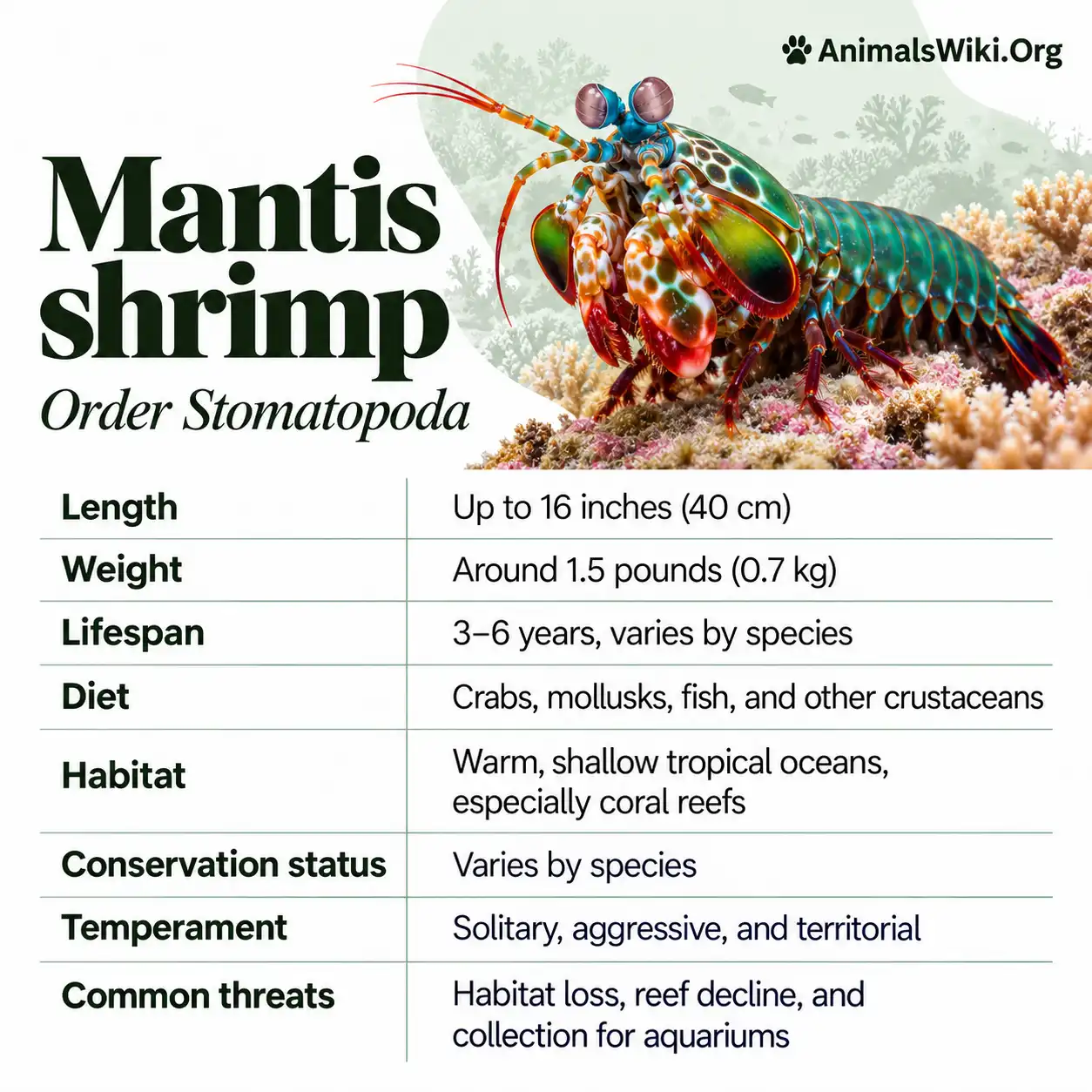
The mantis shrimp is one of the most extraordinary predators living beneath the ocean’s surface. Famous for its powerful striking appendages, remarkable eyes, and vivid colors, this small marine animal possesses abilities that seem almost impossible for a creature of its size.
Some mantis shrimp can deliver exceptionally fast strikes capable of breaking the shells of snails, crabs, and other hard-bodied prey.
Others use sharp, spear-like appendages to capture fish and soft-bodied animals.
Despite its common name, the mantis shrimp is neither a true shrimp nor a praying mantis. It belongs to a separate group of marine crustaceans known as stomatopods, classified in the order Stomatopoda.
Mantis shrimp have evolved specialized hunting structures, complex visual systems, and surprisingly sophisticated behaviors.
Their eyes are among the most unusual in the animal kingdom. Depending on the species, they possess numerous types of photoreceptors, can detect polarized light, and move their eyes independently.
The colorful peacock mantis shrimp is particularly famous for its brilliant green, blue, orange, and red body.
However, not all mantis shrimp are brightly colored. Some species are brown, sandy, or mottled, allowing them to remain concealed within sediment or reef environments.
Mantis shrimp inhabit warm and temperate marine waters around the world, especially tropical coral reefs, rocky seabeds, and sandy or muddy coastal habitats.
Most spend considerable time inside burrows or crevices, emerging to hunt, defend territories, or search for mates.
Some species are solitary and territorial, while others form long-lasting mating partnerships.
Although mantis shrimp are relatively small, their combination of speed, strength, vision, and hunting precision makes them highly effective marine predators.
This comprehensive guide explores mantis shrimp facts, scientific classification, species, anatomy, size, habitat, distribution, diet, punching power, cavitation, vision, hunting strategies, reproduction, lifespan, predators, adaptations, ecological importance, conservation, and frequently asked questions.
Mantis Shrimp Facts
| Feature | Information |
|---|---|
| Common name | Mantis Shrimp |
| Scientific order | Stomatopoda |
| Animal type | Marine crustacean |
| Phylum | Arthropoda |
| Class | Malacostraca |
| Described species | More than 500 |
| Main hunting types | Smashers and spearers |
| Habitat | Tropical, subtropical, and some temperate marine waters |
| Typical environment | Coral reefs, rocky crevices, sandy and muddy burrows |
| Body length | Commonly several centimeters to around 20 cm, depending on species |
| Large species | Some exceed 30 cm |
| Diet | Crustaceans, mollusks, fish, and other marine animals |
| Hunting weapon | Modified raptorial appendages |
| Famous ability | Extremely fast strikes |
| Strike speed | Around 20 m/s or more in some studied smashers |
| Vision | Complex compound eyes |
| Polarization sensitivity | Present in many species |
| Reproduction | Sexual, egg-laying |
| Parental care | Egg guarding in many species |
| Lifespan | Species-dependent; some survive for years |
| Main predators | Fish, octopuses, and other marine predators |
| Conservation | Varies by species; many are poorly assessed |
What Is a Mantis Shrimp?
A mantis shrimp is a predatory marine crustacean belonging to the order Stomatopoda.
It is an arthropod with a segmented body, jointed appendages, and a hard external skeleton.
Unlike familiar shrimp, mantis shrimp possess highly specialized front appendages used to capture or strike prey.
These appendages are called raptorial appendages.
The structure of these weapons varies among species.
Some are adapted for smashing hard shells.
Others are adapted for spearing soft-bodied prey.
Is a Mantis Shrimp Really a Shrimp?
No.
Mantis shrimp are crustaceans, but they are not true shrimp.
True shrimp generally belong to decapod crustacean groups, while mantis shrimp belong to Stomatopoda.
Is a Mantis Shrimp Related to a Praying Mantis?
Not closely.
The name comes from the resemblance between the folded hunting appendages of mantis shrimp and those of praying mantises.
Praying mantises are insects, while mantis shrimp are marine crustaceans.
Why Is It Called a Mantis Shrimp?
Its front hunting appendages resemble those of a praying mantis, while its elongated body resembles a shrimp.
Scientific Classification of Mantis Shrimp
| Classification | Name |
|---|---|
| Kingdom | Animalia |
| Phylum | Arthropoda |
| Subphylum | Crustacea |
| Class | Malacostraca |
| Order | Stomatopoda |
| Example genus | Odontodactylus |
| Example species | Odontodactylus scyllarus |
The scientific name Odontodactylus scyllarus refers specifically to the peacock mantis shrimp.
There is no single species-level scientific name covering every mantis shrimp.
Types of Mantis Shrimp
Mantis shrimp are commonly divided into two functional hunting categories: smashers and spearers.
This distinction describes their feeding appendages rather than a complete formal taxonomic classification.
1. Smashing Mantis Shrimp
Smashers possess club-like structures adapted for powerful impacts.
They typically hunt hard-shelled animals such as:
- Snails
- Crabs
- Hermit crabs
- Other crustaceans
- Shelled mollusks
The peacock mantis shrimp is a famous example.
2. Spearing Mantis Shrimp
Spearers possess elongated, spiny appendages adapted to seize prey.
They often hunt:
- Small fish
- Shrimp
- Other soft-bodied animals
Some wait near the entrances of burrows and strike rapidly when prey approaches.
3. Peacock Mantis Shrimp
Scientific name: Odontodactylus scyllarus
The peacock mantis shrimp is among the best-known species.
It is famous for its brilliant colors and powerful smashing appendages.
4. Zebra Mantis Shrimp
Scientific name: Lysiosquillina maculata
The zebra mantis shrimp is a large spearing species with a striking banded appearance.
It inhabits sandy and muddy environments and hunts from burrows.
5. Purple Spot Mantis Shrimp
Scientific name: Gonodactylus smithii
This reef-associated smashing species has been extensively studied for its visual abilities and behavior.
What Does a Mantis Shrimp Look Like?
Mantis shrimp have elongated, segmented bodies.
Their appearance varies considerably by species.
Common anatomical features include:
- Movable compound eyes
- Eye stalks
- Antennae
- Raptorial appendages
- Segmented thorax
- Segmented abdomen
- Walking appendages
- Swimming appendages
- Tail fan
- Hard exoskeleton
How Many Legs Does a Mantis Shrimp Have?
Mantis shrimp possess several pairs of specialized appendages.
Some are used for feeding, others for walking, swimming, or handling prey.
Their appendages should not all be described as ordinary walking legs.
Do Mantis Shrimp Have Claws?
They possess modified raptorial appendages rather than typical crab-like pincers.
Smashing species have club-shaped striking surfaces.
Spearing species have spiny grasping structures.
Do Mantis Shrimp Have Bones?
No.
They possess a hard exoskeleton rather than an internal vertebrate skeleton.
Mantis Shrimp Colors
Mantis shrimp display a remarkable variety of colors.
These include:
- Green
- Blue
- Red
- Orange
- Purple
- Brown
- Yellow
- Cream
- Striped combinations
Some species have bright warning-like patterns.
Others blend into sand, coral rubble, or muddy environments.
The peacock mantis shrimp is especially famous for its vivid coloration.
Mantis Shrimp Size and Weight
Size varies greatly among species.
Many mantis shrimp are only a few centimeters long.
Others can exceed 20 centimeters.
Some exceptionally large species reach more than 30 centimeters.
What Is the Largest Mantis Shrimp?
The zebra mantis shrimp, Lysiosquillina maculata, is among the largest living species and can exceed 30 centimeters in length.
Exceptional individuals may approach approximately 40 centimeters.
How Big Is a Peacock Mantis Shrimp?
Peacock mantis shrimp commonly reach around 10–18 centimeters, although individual size varies.
How Much Does a Mantis Shrimp Weigh?
Weight varies by species, size, and body condition.
Small species weigh only a few grams, while large individuals can be considerably heavier.
Where Do Mantis Shrimp Live?
Mantis shrimp inhabit marine environments worldwide, especially warmer coastal waters.
They occur in:
- Indian Ocean
- Pacific Ocean
- Atlantic Ocean
- Caribbean Sea
- Red Sea
- Coral reef environments
- Sandy coastal seabeds
- Muddy marine habitats
Do Mantis Shrimp Live in Coral Reefs?
Yes.
Many species inhabit reef crevices and coral rubble.
Do Mantis Shrimp Live in the Deep Sea?
Some species occur in deeper marine environments, but many familiar species inhabit relatively shallow coastal waters.
Do Mantis Shrimp Live in Freshwater?
No.
Mantis shrimp are marine crustaceans.
Mantis Shrimp Habitat
Mantis shrimp are strongly associated with shelters.
Different species inhabit:
- Coral crevices
- Rocky holes
- Burrows in sand
- Muddy seabeds
- Coral rubble
- Coastal reef flats
- Seagrass-associated environments
Many species construct or maintain burrows.
Why Do Mantis Shrimp Live in Burrows?
Burrows provide protection from predators and serve as hunting locations.
They may also be used for mating, egg guarding, and shelter during molting.
Are Mantis Shrimp Territorial?
Many species defend burrows or shelter sites against competitors.
Territorial behavior varies by species.
What Do Mantis Shrimp Eat?
Mantis shrimp are carnivorous predators.
Their diet depends on hunting type and habitat.
Common prey includes:
- Crabs
- Snails
- Clams
- Shrimp
- Small fish
- Marine worms
- Other crustaceans
- Various bottom-dwelling invertebrates
Do Mantis Shrimp Eat Fish?
Yes.
Spearing species are especially adapted to capture small fish.
Do Mantis Shrimp Eat Crabs?
Yes.
Smashing species commonly attack crabs and other hard-bodied crustaceans.
Do Mantis Shrimp Eat Snails?
Yes.
Snails are important prey for many smashing species.
Are Mantis Shrimp Herbivores?
No.
They are primarily carnivorous.
How Do Mantis Shrimp Hunt?
Mantis shrimp use specialized raptorial appendages to capture prey.
Their hunting method depends on species.
Smashing Strategy
A smashing mantis shrimp approaches a hard-shelled animal.
It positions its striking appendage and releases a rapid blow.
The impact can damage or break the prey’s shell.
Repeated strikes may be used.
Spearing Strategy
A spearing mantis shrimp waits near its burrow.
When a fish or other suitable prey approaches, the mantis shrimp rapidly extends its spiny appendages.
The prey is seized and pulled toward the burrow.
How Powerful Is a Mantis Shrimp Punch?
The striking mechanism of smashing mantis shrimp is one of the most remarkable examples of biological mechanics.
Some species accelerate their clubs to speeds around 20 meters per second or more.
That is approximately 72 kilometers per hour.
The strikes are extremely fast relative to the animal’s body size.
How Does a Mantis Shrimp Punch So Fast?
Smashing mantis shrimp use a spring-loaded mechanism.
Muscles gradually store elastic energy in specialized structures.
A latch holds the appendage in place.
When released, the stored energy drives the club forward extremely rapidly.
This is called power amplification.
Can a Mantis Shrimp Break Shells?
Yes.
Smashing species can break or damage the shells of snails, crabs, and other prey.
Can a Mantis Shrimp Break Glass?
Large smashing mantis shrimp have occasionally damaged thin aquarium glass.
However, claims that every mantis shrimp can shatter thick glass are exaggerated.
Aquarium safety depends on species, animal size, glass thickness, and enclosure design.
Can a Mantis Shrimp Break Human Bones?
Claims that mantis shrimp routinely break human bones are exaggerated.
A large smashing species can cause painful injuries, and handling should be avoided, but the outcome depends on the species and circumstances.
What Is Mantis Shrimp Cavitation?
Cavitation is the formation and collapse of vapor bubbles in liquid when local pressure changes rapidly.
The extremely fast strike of certain smashing mantis shrimp can generate cavitation bubbles in the surrounding water.
When these bubbles collapse, they produce additional mechanical effects.
Does a Mantis Shrimp Produce Two Impacts?
A smashing strike can produce both the direct club impact and a subsequent cavitation-related pressure event.
The effects depend on the strike and surrounding conditions.
Does a Mantis Shrimp Punch Create Heat?
Cavitation bubble collapse can generate brief, localized extreme conditions.
However, claims that mantis shrimp routinely heat surrounding seawater to enormous temperatures are misleading.
Any extreme temperatures associated with bubble collapse are microscopic and extremely short-lived.
Can a Mantis Shrimp Create Light With Its Punch?
Cavitation can produce light under certain physical conditions, but visible light production is not a routine or established feature of every mantis shrimp strike.
Mantis Shrimp Vision
Mantis shrimp possess some of the most specialized visual systems known among animals.
Their compound eyes can move independently.
Many species possess a distinctive midband region containing specialized photoreceptor structures.
How Many Color Receptors Do Mantis Shrimp Have?
Some well-studied species possess up to approximately 12 spectral photoreceptor classes involved in color detection, along with additional receptors specialized for other visual functions.
This differs from the three main cone types used for human daytime color vision.
Can Mantis Shrimp See More Colors Than Humans?
Their eyes detect different parts of the spectrum and process visual information differently.
However, having more photoreceptor classes does not automatically mean they distinguish more colors than humans.
Behavioral research suggests that some mantis shrimp use a different, relatively coarse color-recognition strategy.
Can Mantis Shrimp See Ultraviolet Light?
Yes.
Some species possess photoreceptors sensitive to ultraviolet wavelengths.
Can Mantis Shrimp See Polarized Light?
Yes.
Many species detect polarized light, and certain species can detect forms of circular polarization.
Can Mantis Shrimp Move Their Eyes Independently?
Yes.
Their eyes are mounted on movable stalks and can rotate independently.
Do Mantis Shrimp Have Trinocular Vision?
Their compound eyes contain specialized regions that allow unusual forms of depth and spatial perception.
Descriptions of mantis shrimp vision sometimes use the term trinocular vision to describe the arrangement of visual regions within each eye.
This is not identical to human binocular vision.
Mantis Shrimp Intelligence and Behavior
Mantis shrimp exhibit complex behavior.
Some can recognize familiar individuals, assess opponents, defend territories, and modify their responses based on previous encounters.
Are Mantis Shrimp Intelligent?
They possess sophisticated sensory and behavioral abilities.
However, intelligence is difficult to compare directly across very different animal groups.
Can Mantis Shrimp Recognize Each Other?
Research suggests that certain species can recognize or distinguish individuals using chemical and other sensory cues.
Are Mantis Shrimp Aggressive?
Many species are territorial, especially around shelters.
Their behavior depends on species, sex, reproductive condition, and environmental context.
Mantis Shrimp Reproduction
Mantis shrimp reproduce sexually.
Their reproductive strategies vary considerably.
Do Mantis Shrimp Lay Eggs?
Yes.
Females produce eggs that are fertilized and subsequently guarded or carried in many species.
How Many Eggs Does a Mantis Shrimp Lay?
Egg production varies by species and female size.
Some females produce large clutches containing thousands of eggs.
Do Mantis Shrimp Care for Their Eggs?
Yes.
Many females carefully guard or carry egg masses.
They may clean and aerate the eggs.
Do Mantis Shrimp Mate for Life?
Some species form long-lasting monogamous partnerships.
However, lifelong pairing is not universal.
Do Mantis Shrimp Have Larvae?
Yes.
Many species have planktonic larval stages before settling into bottom-dwelling juvenile habitats.
Baby Mantis Shrimp
Young mantis shrimp develop through larval stages.
Their early body structure differs from that of adults.
As they grow, their specialized appendages and hunting abilities develop.
Are Baby Mantis Shrimp Dangerous?
Young individuals are generally much smaller and less powerful than adults.
However, unnecessary handling should still be avoided.
Do Baby Mantis Shrimp Have Punching Appendages?
Their specialized appendages develop through growth and molting.
Mantis Shrimp Molting
Like other crustaceans, mantis shrimp possess hard exoskeletons.
To grow, they must periodically shed the old exoskeleton.
Do Mantis Shrimp Shed Their Shells?
Yes.
This process is called molting.
Are Mantis Shrimp Vulnerable During Molting?
Yes.
Their new exoskeleton requires time to harden, making them more vulnerable.
Many remain hidden in burrows during this period.
How Long Do Mantis Shrimp Live?
Lifespan varies by species.
Some species live only a few years.
Others may survive for a decade or longer under suitable conditions.
Reliable maximum lifespan estimates are unavailable for many species.
Mantis Shrimp Adaptations
Raptorial Appendages
Allow rapid prey capture or powerful strikes.
Spring-Loaded Strike Mechanism
Enables power amplification.
Reinforced Club Structures
Help withstand repeated high-impact strikes in smashing species.
Complex Compound Eyes
Provide specialized visual detection.
Ultraviolet Sensitivity
Allows detection of wavelengths beyond ordinary human vision.
Polarization Sensitivity
Provides additional visual information.
Burrowing Behavior
Offers shelter and hunting opportunities.
Hard Exoskeleton
Protects the body.
Rapid Reaction Time
Supports effective predatory behavior.
Egg Guarding
Improves the survival chances of developing offspring.
What Animals Eat Mantis Shrimp?
Mantis shrimp are predators, but they also become prey.
Potential predators include:
- Large reef fish
- Groupers
- Triggerfish
- Octopuses
- Other marine predators
Do Octopuses Eat Mantis Shrimp?
Yes.
Octopuses can prey on mantis shrimp, although the interaction may be dangerous for both animals.
Do Fish Eat Mantis Shrimp?
Yes.
Large predatory fish may consume them.
How Do Mantis Shrimp Defend Themselves?
They use shelters, rapid movements, armored bodies, and powerful raptorial appendages.
Mantis Shrimp vs. True Shrimp
| Feature | Mantis Shrimp | True Shrimp |
|---|---|---|
| Order | Stomatopoda | Various decapod groups |
| Main hunting weapon | Raptorial appendages | Varies by species |
| Diet | Primarily predatory | Diverse |
| Eyes | Highly specialized compound eyes | Compound eyes |
| Body | Segmented crustacean | Segmented crustacean |
| Hunting | Smashing or spearing | Diverse feeding strategies |
Mantis Shrimp vs. Praying Mantis
| Feature | Mantis Shrimp | Praying Mantis |
|---|---|---|
| Animal group | Crustacean | Insect |
| Habitat | Marine | Primarily terrestrial |
| Hunting appendages | Raptorial appendages | Raptorial forelegs |
| Breathing | Gills | Tracheal system |
| Body covering | Exoskeleton | Exoskeleton |
| Main prey | Marine animals | Insects and other small animals |
Mantis Shrimp vs. Pistol Shrimp
Mantis shrimp and pistol shrimp are both famous for powerful underwater mechanisms.
However, their abilities are different.
| Feature | Mantis Shrimp | Pistol Shrimp |
|---|---|---|
| Main weapon | Rapid raptorial strike | Specialized snapping claw |
| Mechanism | Spring-loaded appendage | High-speed water jet from claw snap |
| Cavitation | Can accompany smashing strikes | Central to snapping mechanism |
| Main function | Hunting and defense | Hunting, defense, signaling |
| Classification | Stomatopoda | Decapoda |
Are Mantis Shrimp Dangerous to Humans?
Mantis shrimp are not aggressive toward humans in ordinary circumstances.
However, large individuals can cause painful injuries if handled.
Smashing species may strike fingers or other exposed body parts.
Spearing species possess sharp appendages that can puncture skin.
Can a Mantis Shrimp Punch a Human?
Yes.
A threatened animal may strike when handled or cornered.
Can a Mantis Shrimp Break a Finger?
A large mantis shrimp can cause injury, but claims that it routinely breaks human fingers should not be treated as established facts.
Are Mantis Shrimp Venomous?
They are not generally recognized as venomous animals.
Their primary weapons are mechanical rather than venom-injecting.
Can You Touch a Mantis Shrimp?
Handling is discouraged.
Observe them without placing fingers near burrows or striking appendages.
Are Mantis Shrimp Endangered?
Conservation status varies by species.
Many mantis shrimp have not been comprehensively assessed.
Some species may be affected by habitat degradation, pollution, and harvesting.
It is inaccurate to assign one conservation status to all mantis shrimp.
What Threatens Mantis Shrimp?
Potential threats include:
- Coral reef degradation
- Coastal development
- Marine pollution
- Habitat destruction
- Bottom trawling
- Ocean warming
- Ocean acidification
- Unsustainable harvesting
How Does Coral Reef Damage Affect Mantis Shrimp?
Reef-associated species depend on suitable crevices, rubble, and surrounding habitat.
Damage to these environments can reduce available shelter and feeding opportunities.
Why Are Mantis Shrimp Important?
Mantis shrimp play important roles in marine ecosystems.
They prey on small fish, mollusks, and crustaceans.
They are also consumed by larger predators.
Their burrowing activity can influence sediment structure.
They are scientifically important for research on biomechanics, vision, material science, and animal behavior.
Why Do Scientists Study Mantis Shrimp Punches?
Their striking appendages provide examples of natural power amplification and impact-resistant structures.
These mechanisms inspire research into materials and engineering.
Why Do Scientists Study Mantis Shrimp Eyes?
Their unusual photoreceptors and polarization sensitivity provide insights into visual evolution and optical sensing.
50 Interesting Mantis Shrimp Facts
- Mantis shrimp are marine crustaceans.
- They belong to the order Stomatopoda.
- They are not true shrimp.
- They are not insects.
- More than 500 species have been described.
- They inhabit marine environments worldwide.
- Many live in tropical coral reefs.
- Others inhabit sandy or muddy burrows.
- They possess segmented bodies.
- Their eyes are mounted on movable stalks.
- They can move their eyes independently.
- Some species possess numerous spectral photoreceptor classes.
- Some can detect ultraviolet light.
- Many detect polarized light.
- Certain species detect circular polarization.
- More photoreceptor types do not necessarily mean better color discrimination.
- Mantis shrimp are carnivores.
- They hunt crustaceans.
- Some hunt fish.
- Others feed on mollusks.
- They possess specialized raptorial appendages.
- Smashing species use club-like appendages.
- Spearing species use spiny appendages.
- Some smashing strikes exceed 20 meters per second.
- Their strikes involve elastic energy storage.
- A latch mechanism helps release stored energy.
- This mechanism is called power amplification.
- Smashing strikes can produce cavitation.
- Cavitation can contribute additional mechanical effects.
- Some species break snail shells.
- Others capture fish from burrows.
- The peacock mantis shrimp is brightly colored.
- The zebra mantis shrimp is a large spearing species.
- Some mantis shrimp exceed 30 centimeters.
- Many defend burrows.
- Some recognize familiar individuals.
- Certain species form long-term mating partnerships.
- Females lay eggs.
- Many females guard their eggs.
- Some species have planktonic larvae.
- They grow by molting.
- They are vulnerable during molting.
- Large fish prey on mantis shrimp.
- Octopuses may also hunt them.
- Mantis shrimp can injure people if handled.
- They are not generally venomous.
- Their eyes are studied by vision scientists.
- Their striking clubs inspire materials research.
- They contribute to marine food webs.
- Their combination of speed, vision, and specialized hunting weapons makes them among the ocean’s most extraordinary predators.
Did You Know?
The Tiny Predator With a Spring-Loaded Hammer
Imagine a tropical coral reef beneath the ocean’s surface.
Sunlight filters through the water.
Colorful fish move between coral branches.
A small snail crawls across the seabed.
Nearby, inside a rocky crevice, a peacock mantis shrimp waits.
Its bright green body is partially hidden.
Its independently moving eyes scan the surroundings.
The snail approaches.
The mantis shrimp emerges.
It positions its specialized striking appendage.
Inside that appendage, muscles have already stored energy in elastic structures.
A biological latch holds the mechanism in place.
Then the latch releases.
The club accelerates with extraordinary speed.
It strikes the snail’s shell.
The impact is so rapid that it may also generate cavitation bubbles in the surrounding water.
The shell begins to crack.
The mantis shrimp strikes again.
Eventually, the protective shell breaks.
The predator can now reach the soft animal inside.
This entire hunting strategy depends on an unusual combination of anatomy, mechanics, and precise sensory control.
Now imagine another mantis shrimp living in a sandy burrow.
It does not possess the same club-like weapon.
Instead, it has long, spiny spearing appendages.
A small fish swims past the entrance.
The mantis shrimp launches forward and captures it.
Both animals belong to the same evolutionary group, yet they use very different hunting strategies.
One smashes.
The other spears.
And both possess sensory systems unlike those of most familiar marine predators.
Scientists study these animals not only to understand their biology but also to investigate how nature produces powerful mechanical systems and specialized optical sensors.
The mantis shrimp demonstrates that extraordinary strength and sophisticated vision do not require a large body.
Frequently Asked Questions About Mantis Shrimp
What is a mantis shrimp?
A mantis shrimp is a predatory marine crustacean belonging to the order Stomatopoda.
Is a mantis shrimp really a shrimp?
No.
Is a mantis shrimp a praying mantis?
No.
Why is it called a mantis shrimp?
Its hunting appendages resemble those of a praying mantis, while its body resembles a shrimp.
What is the scientific name of a mantis shrimp?
Mantis shrimp belong to Stomatopoda. The peacock mantis shrimp is Odontodactylus scyllarus.
How many mantis shrimp species exist?
More than 500 species have been described.
Are mantis shrimp crustaceans?
Yes.
Are mantis shrimp arthropods?
Yes.
Are mantis shrimp invertebrates?
Yes.
Where do mantis shrimp live?
In marine environments worldwide, especially warmer coastal waters.
Do mantis shrimp live in coral reefs?
Yes.
Do mantis shrimp live in burrows?
Many do.
Do mantis shrimp live in freshwater?
No.
How big do mantis shrimp get?
Many are several centimeters long, while some large species exceed 30 centimeters.
What is the largest mantis shrimp?
The zebra mantis shrimp is among the largest living species.
How big is a peacock mantis shrimp?
Commonly around 10–18 centimeters.
What colors are mantis shrimp?
They can be green, blue, orange, red, purple, brown, and other colors.
Why are peacock mantis shrimp colorful?
Their coloration reflects species-specific pigmentation and structural features.
What do mantis shrimp eat?
Crustaceans, mollusks, fish, and other marine animals.
Are mantis shrimp carnivores?
Yes.
Do mantis shrimp eat fish?
Yes.
Do mantis shrimp eat crabs?
Yes.
Do mantis shrimp eat snails?
Yes.
What are the two main hunting types?
Smashers and spearers.
What is a smashing mantis shrimp?
A species with club-like appendages used to strike hard-bodied prey.
What is a spearing mantis shrimp?
A species with spiny appendages used to seize prey.
How powerful is a mantis shrimp punch?
Some species deliver extremely fast strikes capable of damaging hard shells.
How fast can a mantis shrimp punch?
Around 20 meters per second or more in some studied smashing species.
Why is a mantis shrimp punch so fast?
It uses elastic energy storage and a latch mechanism.
What is power amplification?
A mechanism that releases stored energy faster than muscles alone could generate the movement.
Can mantis shrimp break shells?
Yes.
Can mantis shrimp break aquarium glass?
Large smashing species have occasionally damaged thin aquarium glass.
Can mantis shrimp break human bones?
They can cause injury, but routine bone-breaking claims are exaggerated.
What is cavitation?
The formation and collapse of vapor bubbles caused by rapid pressure changes in a liquid.
Does a mantis shrimp create cavitation?
Some smashing species do during rapid strikes.
Does a mantis shrimp create two impacts?
A strike can produce both direct contact and cavitation-related effects.
Can mantis shrimp create heat?
Cavitation collapse can produce brief localized extreme conditions.
Do mantis shrimp create light when punching?
Light production is not a routine established feature of every strike.
How many eyes does a mantis shrimp have?
Two compound eyes on movable stalks.
Can mantis shrimp move their eyes independently?
Yes.
How many color receptors do mantis shrimp have?
Some species possess approximately 12 spectral photoreceptor classes involved in color detection.
Can mantis shrimp see more colors than humans?
Their visual system is different, but additional receptor types do not automatically provide finer color discrimination.
Can mantis shrimp see ultraviolet light?
Some species can.
Can mantis shrimp see polarized light?
Yes.
Can mantis shrimp see circular polarization?
Certain species can detect it.
Do mantis shrimp have good eyesight?
They possess highly specialized visual systems adapted to their environments.
Are mantis shrimp intelligent?
They exhibit sophisticated sensory processing and behavior.
Can mantis shrimp recognize individuals?
Certain species can distinguish familiar individuals.
Are mantis shrimp aggressive?
Many are territorial, especially around shelters.
Do mantis shrimp lay eggs?
Yes.
How do mantis shrimp reproduce?
Sexually.
Do mantis shrimp guard their eggs?
Many females do.
Do mantis shrimp mate for life?
Some species form long-lasting partnerships, but this is not universal.
Do mantis shrimp have larvae?
Yes.
Do mantis shrimp molt?
Yes.
Are mantis shrimp vulnerable while molting?
Yes.
How long do mantis shrimp live?
Lifespan varies; some survive for several years or longer.
What animals eat mantis shrimp?
Large fish, octopuses, and other marine predators.
Do octopuses eat mantis shrimp?
Yes.
Do fish eat mantis shrimp?
Yes.
Are mantis shrimp dangerous to humans?
They can cause painful injuries if handled.
Can a mantis shrimp punch a person?
Yes, if threatened or handled.
Can mantis shrimp break fingers?
They may cause injury, but claims of routine finger fractures are exaggerated.
Are mantis shrimp venomous?
They are not generally considered venomous.
Can you touch a mantis shrimp?
Handling is discouraged.
Are mantis shrimp endangered?
Conservation status varies by species, and many remain poorly assessed.
What threatens mantis shrimp?
Habitat damage, pollution, harvesting, and environmental change.
Why are mantis shrimp important?
They help regulate prey populations and are important subjects of scientific research.
What is the most interesting mantis shrimp fact?
Some mantis shrimp deliver spring-loaded strikes so fast that they generate cavitation bubbles while breaking the shells of their prey.
Conclusion
The mantis shrimp is one of the most extraordinary marine predators on Earth.
Its relatively small body contains an impressive combination of powerful hunting appendages, specialized eyes, rapid reflexes, and complex behavior.
Smashing species use spring-loaded clubs to break hard shells.
Spearing species use sharp appendages to capture fish and other soft-bodied prey.
Their unusual visual systems detect information beyond ordinary human vision, including ultraviolet and polarized light in certain species.
Mantis shrimp also display territorial behavior, parental care, and specialized relationships with their habitats.
Beyond their ecological roles, they provide valuable inspiration for scientific research into biomechanics, optical sensing, and impact-resistant materials.
Although many species remain poorly studied, their diversity and adaptations make them important members of marine ecosystems.
The mantis shrimp is proof that some of nature’s most impressive predators are not the largest animals in the ocean, but the smallest creatures with the most extraordinary adaptations.