Firefly Squid, The Glowing Deep-Sea Squid That Lights Up Japan’s Ocean
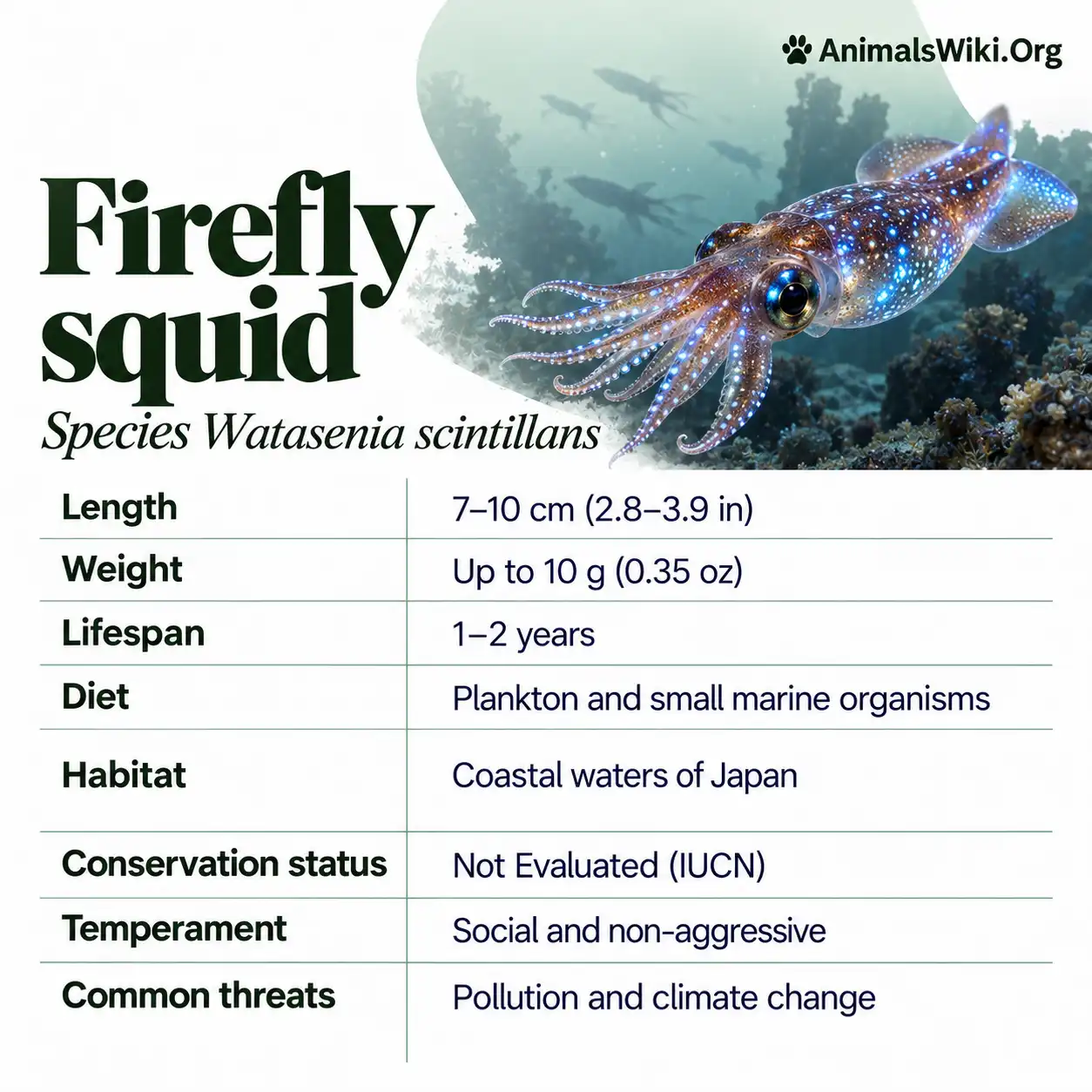
The firefly squid (Watasenia scintillans) is one of the most extraordinary bioluminescent animals in the ocean. Despite its small size, this remarkable marine creature can produce brilliant blue light from specialized organs distributed across its body.
Every spring, large numbers of firefly squid gather in the coastal waters of Japan, creating one of nature’s most spectacular marine displays.
When thousands of these tiny squid illuminate the water, the sea can appear filled with glowing blue stars.
The phenomenon is especially famous in Toyama Bay, where firefly squid are an important part of local marine biodiversity, fishing traditions, tourism, and scientific research.
Unlike ordinary squid that rely primarily on camouflage, speed, and ink for protection, the firefly squid possesses an additional biological advantage: the ability to produce its own light.
This natural light is generated through a chemical process called bioluminescence.
Firefly squid use specialized light-producing organs called photophores, which are found on different parts of their bodies, including the arms, head, and underside.
These organs may help with camouflage, communication, and interactions with other animals.
Their large, specialized photophores can produce especially noticeable blue flashes.
Firefly squid spend much of their lives in deeper offshore waters and migrate vertically through the water column. During the breeding season, adults may approach shallower coastal waters.
Although they are small, firefly squid are active predators that feed on planktonic crustaceans, small fish, and other marine organisms.
They also serve as prey for larger fish, seabirds, and marine mammals, making them important components of marine food webs.
This comprehensive guide explores firefly squid facts, scientific classification, anatomy, size, habitat, distribution, bioluminescence, glowing organs, diet, behavior, reproduction, lifespan, predators, adaptations, conservation, and frequently asked questions.
Firefly Squid Facts
| Feature | Information |
|---|---|
| Common name | Firefly Squid |
| Japanese name | Hotaru-ika (ホタルイカ) |
| Scientific name | Watasenia scintillans |
| Family | Enoploteuthidae |
| Order | Oegopsida |
| Class | Cephalopoda |
| Phylum | Mollusca |
| Animal type | Marine squid |
| Habitat | Offshore and coastal marine waters |
| Distribution | Northwestern Pacific, especially waters around Japan |
| Famous location | Toyama Bay, Japan |
| Mantle length | Commonly around 5–8 cm |
| Total length | Often roughly 10–15 cm, depending on individual |
| Weight | Generally only a few grams |
| Color | Reddish-brown to translucent, with blue bioluminescence |
| Arms | Eight |
| Tentacles | Two specialized feeding tentacles |
| Main adaptation | Bioluminescent photophores |
| Light color | Predominantly blue |
| Diet | Small fish, crustaceans, and other marine prey |
| Feeding type | Carnivorous |
| Reproduction | Sexual, egg-laying |
| Lifespan | Approximately one year |
| Predators | Fish, seabirds, and marine mammals |
| Conservation | Species-specific population trends require monitoring |
What Is a Firefly Squid?
The firefly squid is a small bioluminescent squid belonging to the species Watasenia scintillans.
It is a cephalopod mollusk, making it related to octopuses, cuttlefish, and other squid.
Its most recognizable feature is its ability to produce bright blue light using specialized organs.
Why Is It Called a Firefly Squid?
The name comes from its ability to emit light, resembling the glow of terrestrial fireflies.
However, firefly squid and fireflies are not closely related.
Fireflies are insects, while firefly squid are marine mollusks.
Is a Firefly Squid a Real Squid?
Yes.
It is a genuine squid with eight arms, two feeding tentacles, a mantle, fins, and a beak.
Is a Firefly Squid a Fish?
No.
It belongs to the phylum Mollusca.
Is a Firefly Squid an Invertebrate?
Yes.
It does not possess a backbone.
Scientific Classification of Firefly Squid
| Classification | Name |
|---|---|
| Kingdom | Animalia |
| Phylum | Mollusca |
| Class | Cephalopoda |
| Subclass | Coleoidea |
| Superorder | Decapodiformes |
| Order | Oegopsida |
| Family | Enoploteuthidae |
| Genus | Watasenia |
| Species | Watasenia scintillans |
What Does Watasenia scintillans Mean?
Watasenia is the genus name, while scintillans is derived from Latin and refers to sparkling or glittering.
The name reflects the animal’s remarkable ability to produce light.
Are Firefly Squid Related to Octopuses?
Yes.
Both belong to the class Cephalopoda.
However, squid and octopuses have different body structures and evolutionary histories.
Are Firefly Squid Related to Cuttlefish?
Yes.
They share a broader cephalopod ancestry.
What Does a Firefly Squid Look Like?
Firefly squid have small, streamlined bodies adapted for swimming.
Their anatomy includes:
- Elongated mantle
- Large eyes
- Eight arms
- Two feeding tentacles
- Fins
- Beak
- Suckers and specialized arm structures
- Light-producing photophores
- Ink sac
- Internal supporting structure
How Many Arms Does a Firefly Squid Have?
It has eight arms.
How Many Tentacles Does a Firefly Squid Have?
It has two specialized feeding tentacles.
Does a Firefly Squid Have Ten Arms?
In everyday descriptions, squid are sometimes said to have ten arms.
Scientifically, they have eight arms and two tentacles.
Does a Firefly Squid Have Bones?
No.
It possesses an internal supporting structure called a gladius or pen rather than a vertebrate skeleton.
Firefly Squid Colors
Firefly squid often appear reddish-brown or partly translucent under ordinary lighting.
However, their most famous feature is their blue bioluminescence.
Why Do Firefly Squid Glow Blue?
Their photophores produce light through biochemical reactions.
Blue wavelengths travel efficiently through seawater, making blue light useful in marine environments.
Can Firefly Squid Glow Other Colors?
Their most characteristic visible light is blue.
Different photophores and viewing conditions can affect the apparent color and intensity.
Firefly Squid Size and Weight
Firefly squid are relatively small cephalopods.
How Big Is a Firefly Squid?
Their mantle length is commonly approximately 5–8 centimeters.
Total body length, including appendages, may be roughly 10–15 centimeters.
Are Female Firefly Squid Bigger Than Males?
Females are generally larger than males.
How Much Does a Firefly Squid Weigh?
They typically weigh only a few grams, although weight varies with size and reproductive condition.
Are Firefly Squid Smaller Than Common Squid?
Yes.
They are much smaller than many commercially familiar squid species.
Where Do Firefly Squid Live?
Firefly squid inhabit the northwestern Pacific Ocean.
They are especially associated with waters around Japan.
Their distribution includes:
- Sea of Japan
- Pacific waters near Japan
- Offshore marine environments
- Coastal waters used during reproduction
Do Firefly Squid Live in Japan?
Yes.
Japan is particularly famous for its firefly squid populations.
Do Firefly Squid Live in Toyama Bay?
Yes.
Toyama Bay is one of the world’s best-known locations for observing their seasonal coastal aggregations.
Do Firefly Squid Live in the Atlantic Ocean?
They are not generally recognized as native inhabitants of the Atlantic Ocean.
Do Firefly Squid Live in Freshwater?
No.
They are marine animals.
Firefly Squid Habitat
Firefly squid spend much of their lives in offshore marine environments.
They are associated with mesopelagic waters and may move vertically through the water column.
How Deep Do Firefly Squid Live?
They are often associated with depths of several hundred meters, although their depth changes with time of day, season, and life stage.
Do Firefly Squid Live in the Deep Sea?
They inhabit relatively deep offshore waters, especially the mesopelagic zone.
However, they are not exclusively bottom-dwelling deep-sea animals.
Do Firefly Squid Come to the Surface?
Yes.
They may move toward shallower waters, especially during nighttime activity and reproductive periods.
Why Do Firefly Squid Come Near Shore?
Seasonal reproductive movements bring adults into coastal waters in some regions.
Why Do Firefly Squid Glow?
Firefly squid produce light through bioluminescence.
Their bodies contain specialized light-producing organs called photophores.
What Is Bioluminescence?
Bioluminescence is the production of light by living organisms through chemical reactions.
What Are Photophores?
Photophores are specialized organs that produce or control light.
Firefly squid possess numerous photophores distributed across their bodies.
Where Are Firefly Squid Photophores Located?
They occur on several body regions, including:
- Arms
- Head
- Ventral body surfaces
- Other specialized locations
Do Firefly Squid Produce Their Own Light?
Yes.
Their light is generated biologically through specialized internal chemical systems.
Do Firefly Squid Need Sunlight to Glow?
No.
Bioluminescence does not require direct sunlight.
How Does Firefly Squid Bioluminescence Work?
Firefly squid produce light through specialized biochemical reactions.
In general, biological light production involves molecules that release energy as visible light during chemical reactions.
The exact chemistry of firefly squid photophores is complex and differs from the familiar firefly system.
Do Firefly Squid Use Luciferin?
Their light-producing chemistry involves specialized compounds and enzymatic reactions, but it should not be assumed to be identical to the luciferin-luciferase system of terrestrial fireflies.
Can Firefly Squid Turn Their Lights On and Off?
They can regulate their light-producing organs and display different patterns of illumination.
Do Firefly Squid Glow All the Time?
No.
Light production can vary with behavior and environmental conditions.
What Is Counterillumination?
Counterillumination is a camouflage strategy used by many bioluminescent marine animals.
An animal produces light from its underside to reduce its silhouette when viewed from below against faint downwelling light.
Firefly squid possess ventral photophores that may contribute to this form of camouflage.
Why Is Counterillumination Important?
It can make an animal harder for predators to detect.
Do Firefly Squid Use Light for Communication?
Bioluminescence may also contribute to signaling and interactions between individuals.
However, the precise functions of different light displays are still being studied.
Do Firefly Squid Use Light to Attract Mates?
Light signaling may play a role in reproductive interactions, but specific claims should be supported by behavioral evidence.
The Glowing Firefly Squid of Toyama Bay
Toyama Bay is famous for seasonal firefly squid aggregations.
During spring, large numbers of mature firefly squid move into coastal waters.
Their bioluminescence can create spectacular blue flashes.
When Is Firefly Squid Season in Japan?
The most famous coastal season in Toyama Bay generally occurs during spring, particularly from March through May.
Exact timing varies with environmental conditions and local regulations.
Why Is Toyama Bay Famous for Firefly Squid?
The bay’s coastal geography and seasonal squid movements make large aggregations accessible for observation and fishing.
Can Tourists See Glowing Firefly Squid?
Yes.
Seasonal tours and educational experiences have historically been offered in the Toyama Bay region.
Availability depends on local conditions, regulations, and operators.
Does the Entire Ocean Glow Blue?
No.
The famous glowing displays occur when sufficient numbers of squid are illuminated or disturbed in suitable conditions.
Photographs and videos may also use long exposures or specialized lighting to emphasize the effect.
What Do Firefly Squid Eat?
Firefly squid are carnivorous predators.
Their diet may include:
- Small fish
- Copepods
- Amphipods
- Other small crustaceans
- Planktonic animals
- Other small marine organisms
Do Firefly Squid Eat Fish?
Yes.
Small fish can be part of their diet.
Do Firefly Squid Eat Shrimp?
They may consume small shrimp-like crustaceans.
Do Firefly Squid Eat Plankton?
They consume animal plankton, especially small crustaceans.
Are Firefly Squid Carnivores?
Yes.
How Do Firefly Squid Hunt?
Firefly squid use their eyes, arms, tentacles, and rapid swimming ability to capture prey.
Their specialized feeding tentacles help seize small animals.
Do Firefly Squid Have Beaks?
Yes.
They possess hard beaks used to process prey.
Do Firefly Squid Have Teeth?
They possess a beak and a toothed feeding structure called a radula rather than vertebrate teeth.
Do Firefly Squid Hunt at Night?
They may be active during nighttime vertical movements.
Do Firefly Squid Use Their Light to Hunt?
Bioluminescence may influence interactions with prey, but its precise role in hunting is not fully established.
Firefly Squid Swimming and Movement
Firefly squid are active swimmers.
They use jet propulsion and fins to move through water.
How Does a Firefly Squid Swim?
It draws water into its mantle cavity and expels it through a funnel.
This produces jet propulsion.
Can Firefly Squid Swim Backward?
Yes.
Squid can adjust their direction by controlling water flow through the funnel.
Are Firefly Squid Fast?
They are agile swimmers relative to their small size.
Do Firefly Squid Migrate?
Yes.
They undertake vertical movements and seasonal reproductive movements.
What Is Diel Vertical Migration?
Diel vertical migration is the regular movement of animals between different ocean depths over a daily cycle.
Many mesopelagic animals move toward shallower waters at night and deeper waters during daylight.
Firefly squid participate in vertical movements associated with feeding, light, and predator avoidance.
Why Do Firefly Squid Move Vertically?
Possible advantages include:
- Access to food
- Avoiding predators
- Responding to light
- Energy conservation
- Reproductive behavior
Firefly Squid Eyes and Vision
Firefly squid possess well-developed eyes.
Vision is important for detecting prey, predators, and light signals.
Can Firefly Squid See in the Dark?
They are adapted to low-light marine environments.
Can Firefly Squid See Their Own Light?
Their visual systems are capable of detecting relevant light wavelengths, although the exact perception of their own displays is difficult to determine.
Do Firefly Squid Have Large Eyes?
Their eyes are relatively prominent for their small bodies.
Firefly Squid Behavior
Firefly squid exhibit behaviors associated with schooling, migration, feeding, and reproduction.
Do Firefly Squid Live in Groups?
They may form aggregations, especially during seasonal reproductive movements.
Are Firefly Squid Social?
They interact with other squid, but their social behavior is not equivalent to that of highly social mammals or insects.
Are Firefly Squid Nocturnal?
They often move toward shallower waters at night, although their behavior is not limited to nighttime.
Firefly Squid Reproduction
Firefly squid reproduce sexually.
They have a relatively short lifespan and a seasonal reproductive cycle.
How Do Firefly Squid Mate?
Males transfer sperm packets called spermatophores to females.
Do Firefly Squid Lay Eggs?
Yes.
Females release eggs into the marine environment.
How Many Eggs Does a Firefly Squid Lay?
Females can produce large numbers of eggs, with estimates varying by individual and reproductive condition.
Do Firefly Squid Die After Reproduction?
Firefly squid generally have an approximately annual life cycle, with adults dying after the reproductive period.
Do Firefly Squid Guard Their Eggs?
They are not known for prolonged egg guarding comparable to that of some octopus species.
Baby Firefly Squid
Young firefly squid develop from eggs released into the ocean.
Their early life stages differ in body proportions and behavior from adults.
What Is a Baby Firefly Squid Called?
A hatchling or juvenile squid.
Are Baby Firefly Squid Born Glowing?
Photophore development occurs during growth.
The timing and distribution of functional light organs depend on developmental stage.
How Do Baby Firefly Squid Grow?
They grow through feeding and tissue development rather than molting an external exoskeleton.
How Long Do Firefly Squid Live?
Firefly squid generally live for approximately one year.
Their life cycle is closely connected with seasonal reproduction.
Do Firefly Squid Live for Several Years?
They are generally regarded as short-lived squid with an approximately annual life cycle.
Why Do Firefly Squid Have Short Lifespans?
Their reproductive strategy involves rapid growth, maturation, and seasonal reproduction.
Firefly Squid Adaptations
Bioluminescent Photophores
Produce blue light.
Ventral Light Organs
May support counterillumination camouflage.
Large Eyes
Help detect light and movement.
Streamlined Body
Supports swimming.
Jet Propulsion
Allows rapid movement.
Feeding Tentacles
Capture small prey.
Ink Production
Provides a defensive mechanism.
Vertical Migration
Allows access to different depth zones.
Seasonal Reproduction
Coordinates breeding with environmental conditions.
Small Body Size
Supports an active planktonic and nektonic lifestyle.
What Animals Eat Firefly Squid?
Firefly squid are prey for several marine predators.
Potential predators include:
- Larger fish
- Seabirds
- Marine mammals
- Other squid
Do Dolphins Eat Firefly Squid?
Some dolphins consume squid, although the importance of firefly squid in their diet varies by location.
Do Tuna Eat Firefly Squid?
Large predatory fish may consume firefly squid.
Do Seabirds Eat Firefly Squid?
Yes.
Seabirds may feed on squid when they are accessible near the surface.
Firefly Squid vs. Common Squid
| Feature | Firefly Squid | Common Market Squid |
|---|---|---|
| Scientific example | Watasenia scintillans | Various species |
| Size | Small | Often larger |
| Main distinction | Blue bioluminescence | Species-dependent features |
| Habitat | Offshore and coastal waters | Varies |
| Photophores | Numerous specialized organs | Absent or present depending on species |
| Lifespan | Approximately one year | Varies by species |
| Famous location | Toyama Bay | Worldwide fisheries |
Firefly Squid vs. Vampire Squid
| Feature | Firefly Squid | Vampire Squid |
|---|---|---|
| Scientific name | Watasenia scintillans | Vampyroteuthis infernalis |
| Group | Squid | Vampyromorph cephalopod |
| Habitat | Northwestern Pacific marine waters | Deep oxygen-poor waters |
| Diet | Small animals | Marine snow and organic particles |
| Light production | Blue photophores | Bioluminescent organs |
| Feeding structures | Eight arms and two tentacles | Eight arms and retractile filaments |
Firefly Squid vs. Dumbo Octopus
Firefly squid and Dumbo octopuses are both cephalopods.
However, they differ in anatomy and lifestyle.
Firefly squid possess eight arms, two feeding tentacles, and a streamlined body adapted for active swimming.
Dumbo octopuses possess eight arms, ear-like fins, and webbing between their arms.
Firefly squid are famous for blue bioluminescence, while Dumbo octopuses are best known for their fin-based swimming.
Are Firefly Squid Dangerous to Humans?
Firefly squid are not considered dangerous to humans.
They are small marine animals.
Can Firefly Squid Bite?
They possess beaks and can potentially bite when handled.
However, they are not normally a significant threat.
Are Firefly Squid Venomous?
They are not generally recognized as medically significant venomous animals.
Are Firefly Squid Poisonous?
They are consumed as seafood in Japan.
However, raw or inadequately prepared firefly squid may carry foodborne parasite risks.
Can Humans Eat Firefly Squid?
Yes.
They are a traditional seasonal seafood in Japan.
Is Raw Firefly Squid Safe?
Raw firefly squid can carry parasites, including organisms associated with foodborne illness.
Proper processing and cooking are important, and local food-safety guidance should be followed.
Are Firefly Squid Endangered?
Firefly squid populations are subject to natural environmental variability and fishing pressure.
A current species-specific conservation assessment should be checked before making a definitive endangered-status claim.
What Threatens Firefly Squid?
Potential threats include:
- Overfishing
- Ocean warming
- Changes in ocean currents
- Marine pollution
- Habitat changes
- Changes in prey availability
- Environmental variability affecting reproduction
How Does Climate Change Affect Firefly Squid?
Changes in temperature, currents, and prey distribution may influence their migration and reproductive success.
How Does Fishing Affect Firefly Squid?
Fishing removes individuals from populations.
Sustainable management requires monitoring catches, reproduction, and environmental conditions.
Why Are Firefly Squid Important?
Firefly squid contribute to marine ecosystems as both predators and prey.
They consume small marine organisms and provide food for larger predators.
They are also important in scientific research on bioluminescence.
Why Do Scientists Study Firefly Squid?
They help researchers understand:
- Bioluminescence
- Marine camouflage
- Cephalopod vision
- Photophore anatomy
- Reproductive migration
- Marine food webs
Why Are Firefly Squid Important in Japan?
They are culturally and economically significant, especially in Toyama Prefecture.
They support seasonal fisheries, local cuisine, education, and tourism.
50 Interesting Firefly Squid Facts
- The firefly squid’s scientific name is Watasenia scintillans.
- It is a marine cephalopod.
- It belongs to the phylum Mollusca.
- It is a genuine squid.
- It is not a fish.
- It is an invertebrate.
- It lives in the northwestern Pacific.
- It is especially famous in Japan.
- Toyama Bay is known for seasonal firefly squid aggregations.
- Its Japanese name is hotaru-ika.
- It produces blue bioluminescence.
- Its light comes from specialized photophores.
- Photophores occur on multiple body regions.
- Some photophores are located on its arms.
- Other photophores occur on its underside.
- Blue light travels efficiently through seawater.
- Bioluminescence may help with camouflage.
- Counterillumination reduces an animal’s silhouette.
- Light signaling may also have behavioral functions.
- Firefly squid do not need sunlight to produce light.
- They possess eight arms.
- They also possess two feeding tentacles.
- They have a hard beak.
- They possess large eyes.
- Their bodies are streamlined.
- They swim using jet propulsion.
- Their fins help control movement.
- They are carnivorous.
- They eat small crustaceans.
- They may consume small fish.
- They feed on animal plankton.
- They undertake vertical movements through the water column.
- They may move toward shallower waters at night.
- They inhabit offshore marine environments.
- They approach coastal waters during reproductive periods.
- Females are generally larger than males.
- Their mantle length is usually only several centimeters.
- They live for approximately one year.
- They reproduce sexually.
- Males transfer spermatophores.
- Females lay eggs.
- Their life cycle is strongly seasonal.
- Larger fish eat firefly squid.
- Seabirds may consume them.
- Marine mammals may also prey on them.
- They are harvested as seafood in Japan.
- Raw firefly squid can carry parasite risks.
- Their bioluminescence attracts scientific interest.
- Environmental changes may affect their populations.
- Their brilliant blue light makes them among the ocean’s most spectacular small cephalopods.
Did You Know?
The Tiny Squid That Turns Japan’s Ocean Blue
Imagine standing beside the coast of Japan on a quiet spring night.
The sky is dark.
The ocean appears calm.
Far below the surface, thousands of small squid are moving through the water.
Each squid is only a few centimeters long.
But their bodies contain remarkable biological structures.
Specialized organs called photophores are capable of producing brilliant blue light.
As the squid gather in coastal waters, their light displays create a spectacular underwater scene.
Suddenly, the darkness is interrupted by tiny blue flashes.
More lights appear.
Then hundreds.
Then thousands.
The water seems filled with glowing stars.
These are firefly squid.
For much of their lives, they inhabit deeper offshore waters.
They move through the water column, feeding on small animals and avoiding predators.
Their bioluminescence may help them blend into the faint light filtering down from above.
This camouflage strategy is known as counterillumination.
By producing light from the underside of the body, an animal can reduce its visibility to predators looking upward.
But the firefly squid’s life is short.
Most live for approximately one year.
As the reproductive season approaches, mature squid move toward suitable coastal environments.
Females release eggs into the ocean.
The next generation begins developing.
After reproduction, the adults complete their life cycle.
Their remarkable seasonal appearance has become an important part of the natural and cultural heritage of Toyama Bay.
Scientists study their light-producing organs to better understand marine bioluminescence.
Local communities celebrate their seasonal arrival.
Visitors travel to the region hoping to witness their extraordinary glow.
Yet behind the beautiful blue light lies a complex marine animal adapted to feeding, reproduction, migration, and survival.
The firefly squid is a brilliant reminder that some of the ocean’s most spectacular natural wonders come from its smallest inhabitants.
Frequently Asked Questions About Firefly Squid
What is a firefly squid?
A firefly squid is a small bioluminescent marine cephalopod belonging to the species Watasenia scintillans.
What is the scientific name of the firefly squid?
Watasenia scintillans.
Why is it called a firefly squid?
Because it produces light resembling the glow of fireflies.
Is a firefly squid a real squid?
Yes.
Is a firefly squid a fish?
No.
Is a firefly squid a mollusk?
Yes.
Is a firefly squid a cephalopod?
Yes.
Is a firefly squid an invertebrate?
Yes.
Is a firefly squid related to octopuses?
Yes.
Is a firefly squid related to cuttlefish?
Yes.
How big is a firefly squid?
Its mantle is commonly around 5–8 centimeters long.
How much does a firefly squid weigh?
Generally only a few grams.
Are female firefly squid bigger than males?
Yes, generally.
What color is a firefly squid?
Its body may appear reddish-brown or translucent, while its light is predominantly blue.
Why do firefly squid glow?
They produce light using specialized photophores.
What is bioluminescence?
The biological production of light through chemical reactions.
What are photophores?
Specialized light-producing organs.
Where are firefly squid photophores located?
On the arms, head, underside, and other body regions.
Do firefly squid produce their own light?
Yes.
Do firefly squid need sunlight to glow?
No.
Can firefly squid turn their lights on and off?
They can regulate light production.
Do firefly squid glow all the time?
No.
Why is firefly squid light blue?
Blue wavelengths transmit efficiently through seawater.
Do firefly squid use light for camouflage?
Their ventral photophores may help with counterillumination.
What is counterillumination?
A camouflage strategy that uses light to reduce an animal’s silhouette.
Do firefly squid use light to communicate?
Light signaling may play a role, although some functions remain uncertain.
Do firefly squid use light to attract mates?
This is a possible function, but specific behavioral evidence is needed.
Where do firefly squid live?
In the northwestern Pacific Ocean, especially around Japan.
Do firefly squid live in Japan?
Yes.
Do firefly squid live in Toyama Bay?
Yes.
Do firefly squid live in the Atlantic Ocean?
They are not generally native to the Atlantic.
Do firefly squid live in freshwater?
No.
How deep do firefly squid live?
They inhabit offshore waters and may occur at depths of several hundred meters.
Do firefly squid come to the surface?
Yes.
Why do firefly squid come near shore?
Seasonal reproductive movements bring adults into coastal waters.
When is firefly squid season in Japan?
Usually during spring, particularly March through May in Toyama Bay.
Can tourists see glowing firefly squid?
Yes, through seasonal observation experiences when conditions allow.
Does the entire ocean glow blue?
No. The glowing effect depends on squid numbers, behavior, and viewing conditions.
How many arms does a firefly squid have?
Eight.
How many tentacles does a firefly squid have?
Two feeding tentacles.
Does a firefly squid have ten arms?
It has eight arms and two tentacles.
Does a firefly squid have bones?
No.
Does a firefly squid have a beak?
Yes.
Does a firefly squid have teeth?
It possesses a radula and a beak rather than vertebrate teeth.
What do firefly squid eat?
Small fish, crustaceans, and other marine animals.
Are firefly squid carnivores?
Yes.
Do firefly squid eat fish?
Yes.
Do firefly squid eat shrimp?
They may consume small shrimp-like crustaceans.
Do firefly squid eat plankton?
They consume animal plankton.
How do firefly squid hunt?
Using their eyes, arms, tentacles, and swimming ability.
Do firefly squid hunt at night?
They may feed during nighttime vertical movements.
Do firefly squid use light to hunt?
The precise role of their light in hunting remains uncertain.
How do firefly squid swim?
Through jet propulsion and fin movement.
Can firefly squid swim backward?
Yes.
Are firefly squid fast swimmers?
They are agile swimmers.
Do firefly squid migrate?
Yes.
What is diel vertical migration?
Daily movement between different ocean depths.
Why do firefly squid migrate vertically?
To access food, respond to light, and potentially reduce predation risk.
Do firefly squid have eyes?
Yes.
Can firefly squid see in the dark?
They are adapted to low-light environments.
Do firefly squid live in groups?
They may form aggregations.
Are firefly squid nocturnal?
They often move toward shallower waters at night.
How do firefly squid reproduce?
Sexually.
Do firefly squid lay eggs?
Yes.
Do firefly squid die after reproduction?
They generally complete their annual life cycle after the reproductive period.
What is a baby firefly squid called?
A hatchling or juvenile.
Are baby firefly squid born glowing?
Photophore development occurs during growth.
How long do firefly squid live?
Approximately one year.
What animals eat firefly squid?
Fish, seabirds, marine mammals, and other squid.
Do dolphins eat firefly squid?
Some dolphins eat squid, but species-specific diet composition varies.
Are firefly squid dangerous to humans?
No, they are not generally dangerous.
Can firefly squid bite?
They possess beaks and may bite when handled.
Are firefly squid venomous?
They are not generally recognized as medically significant venomous animals.
Are firefly squid poisonous?
They are edible, but raw or improperly prepared squid can carry foodborne parasite risks.
Can humans eat firefly squid?
Yes.
Is raw firefly squid safe?
Raw firefly squid may carry parasites, so proper food-safety precautions are important.
Are firefly squid endangered?
A current conservation assessment is needed to make a definitive species-level claim.
What threatens firefly squid?
Potential threats include fishing pressure, environmental change, and marine pollution.
Why are firefly squid important?
They support marine food webs, scientific research, fisheries, and cultural traditions.
What is the most interesting firefly squid fact?
Firefly squid can produce brilliant blue light using specialized photophores, creating spectacular seasonal glowing displays in Japan’s Toyama Bay.
Conclusion
The firefly squid is one of the most remarkable bioluminescent animals in the world’s oceans.
Despite its small size, it possesses sophisticated light-producing organs that allow it to illuminate the surrounding water with brilliant blue flashes.
Its bioluminescence may contribute to camouflage, communication, and other ecological interactions.
Firefly squid are also active marine predators that undertake vertical movements and seasonal reproductive migrations.
Their annual life cycle connects deeper offshore environments with coastal waters.
In Japan, especially Toyama Bay, their seasonal appearance has become an extraordinary natural attraction and an important part of local culture.
Scientists continue to investigate their light-producing chemistry, visual systems, reproductive biology, and ecological roles.
Protecting healthy marine ecosystems will help preserve the remarkable biodiversity represented by these small glowing cephalopods.
The firefly squid proves that an animal does not need to be large to create one of the ocean’s most breathtaking natural displays.