Sea Nettle, The Beautiful Stinging Jellyfish of Coastal Oceans
The sea nettle is one of the most recognizable and fascinating jellyfish found in coastal marine waters. Known for its graceful swimming movements, long trailing tentacles, and often striking reddish-brown or golden coloration, this beautiful marine predator is an important part of ocean ecosystems.
Although sea nettles may appear delicate, their tentacles contain thousands of microscopic stinging structures used to capture prey and defend against threats.
Their stings can cause painful skin irritation in humans, making them familiar to swimmers, divers, and beach visitors in regions where these jellyfish occur.
Sea nettles belong primarily to the jellyfish genus Chrysaora, which includes several species distributed across the Atlantic, Pacific, and other marine regions.
Among the best-known are the Atlantic sea nettle (Chrysaora quinquecirrha), Pacific sea nettle (Chrysaora fuscescens), and bay nettle (Chrysaora chesapeakei).
Each species has distinctive features, preferred habitats, and ecological characteristics.
Sea nettles are especially interesting because of their complex life cycle.
Like many true jellyfish, they begin life as tiny larvae, develop into attached polyps, and eventually produce free-swimming juvenile jellyfish called ephyrae.
These young jellyfish grow into the graceful, tentacled adults commonly observed in coastal waters.
Sea nettles are carnivorous predators that consume zooplankton, small crustaceans, fish eggs, fish larvae, and other gelatinous animals.
They also serve as prey for sea turtles and other marine predators.
Despite their simple appearance, sea nettles possess specialized sensory structures, coordinated swimming movements, and highly effective feeding mechanisms.
This comprehensive guide explores sea nettle facts, scientific classification, species, anatomy, size, habitat, distribution, stings, venom, diet, hunting, behavior, reproduction, life cycle, lifespan, predators, adaptations, conservation, and frequently asked questions.
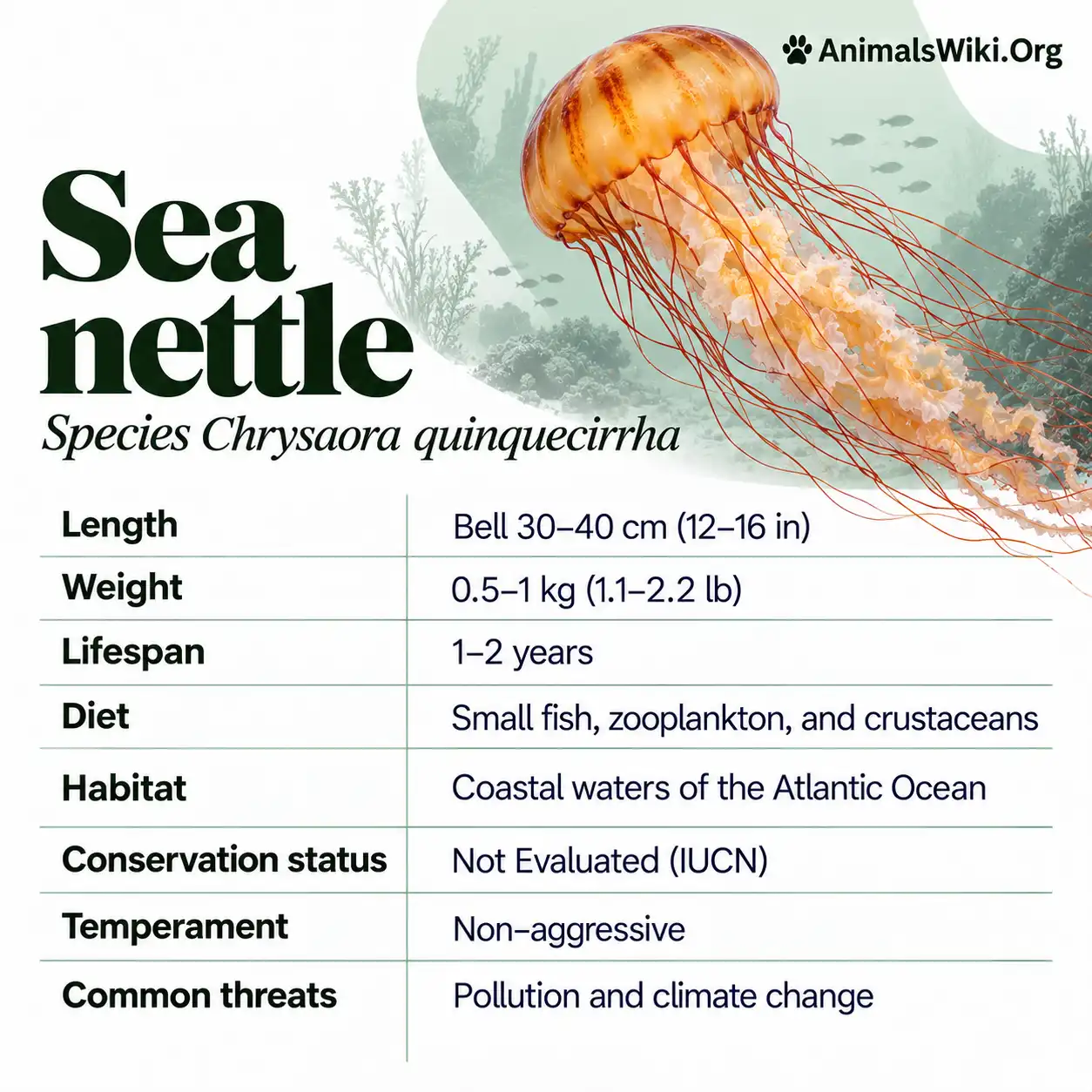
Sea Nettle Quick Facts
| Feature | Information |
|---|---|
| Common name | Sea Nettle |
| Scientific genus | Chrysaora |
| Animal type | True jellyfish |
| Family | Pelagiidae |
| Order | Semaeostomeae |
| Class | Scyphozoa |
| Phylum | Cnidaria |
| Famous species | Atlantic Sea Nettle, Pacific Sea Nettle, Bay Nettle |
| Habitat | Coastal marine and estuarine waters |
| Distribution | Atlantic, Pacific, and other ocean regions |
| Bell shape | Rounded, umbrella-shaped |
| Bell diameter | Varies by species; often 10–30 cm in adults |
| Tentacles | Long marginal stinging tentacles |
| Oral arms | Four frilly feeding structures |
| Color | Golden, reddish-brown, white, or translucent |
| Diet | Zooplankton, small crustaceans, fish larvae, and other gelatinous animals |
| Feeding type | Carnivorous |
| Movement | Bell contractions and drifting |
| Sting | Painful but usually not life-threatening |
| Reproduction | Sexual medusa stage and asexual polyp stage |
| Life cycle | Egg, planula, polyp, ephyra, medusa |
| Lifespan | Species-dependent; medusae often live months |
| Main predators | Sea turtles, fish, and other gelatinous predators |
| Conservation | Species-specific; many populations poorly assessed |
What Is a Sea Nettle?
A sea nettle is a jellyfish belonging to the genus Chrysaora.
These animals are classified as true jellyfish within the class Scyphozoa.
Sea nettles are famous for their long stinging tentacles and often colorful bells.
Is a Sea Nettle a Real Jellyfish?
Yes.
Sea nettles are true jellyfish.
Why Is It Called a Sea Nettle?
The name refers to the painful stinging sensation caused by contact with its tentacles, similar to the irritation caused by stinging nettle plants.
Is a Sea Nettle a Fish?
No.
It is a cnidarian invertebrate.
Is a Sea Nettle a Plant?
No.
Despite the word nettle, it is an animal.
Scientific Classification of Sea Nettles
| Classification | Name |
|---|---|
| Kingdom | Animalia |
| Phylum | Cnidaria |
| Subphylum | Medusozoa |
| Class | Scyphozoa |
| Order | Semaeostomeae |
| Family | Pelagiidae |
| Genus | Chrysaora |
| Example species | Chrysaora quinquecirrha |
What Does Chrysaora Mean?
The name Chrysaora comes from Greek roots associated with gold and a sword.
Are Sea Nettles Related to Moon Jellyfish?
Yes.
Both belong to the class Scyphozoa.
Are Sea Nettles Related to Box Jellyfish?
Yes, but box jellyfish belong to the class Cubozoa.
Are Sea Nettles Related to Coral?
Yes.
Both belong to the phylum Cnidaria.
Types of Sea Nettles
Several species of sea nettles occur in different marine regions.
1. Atlantic Sea Nettle
Scientific name: Chrysaora quinquecirrha
The Atlantic sea nettle occurs along portions of the Atlantic coast of North America.
It is associated with coastal marine environments.
2. Pacific Sea Nettle
Scientific name: Chrysaora fuscescens
The Pacific sea nettle is known for its golden-brown bell and long flowing tentacles.
It occurs in northeastern Pacific waters.
3. Bay Nettle
Scientific name: Chrysaora chesapeakei
The bay nettle inhabits estuarine environments, including Chesapeake Bay.
It was historically confused with the Atlantic sea nettle before being recognized as a distinct species.
4. Japanese Sea Nettle
Scientific name: Chrysaora pacifica
This species occurs in northwestern Pacific waters.
5. Black Sea Nettle
Scientific name: Chrysaora achlyos
The black sea nettle is a large jellyfish found in parts of the eastern Pacific.
It is known for its dark coloration.
What Does a Sea Nettle Look Like?
Sea nettles have umbrella-shaped bells with long trailing tentacles.
Their anatomy includes:
- Rounded bell
- Marginal tentacles
- Four oral arms
- Mouth
- Gastrovascular cavity
- Radial digestive structures
- Rhopalia
- Stinging cells
- Gelatinous body tissues
What Color Are Sea Nettles?
Depending on species, they may be:
- Golden brown
- Reddish brown
- Yellow
- White
- Translucent
- Dark purple or nearly black
Do Sea Nettles Have Tentacles?
Yes.
Do Sea Nettles Have Eyes?
They possess sensory structures but lack complex camera-type eyes.
Do Sea Nettles Have Brains?
No.
They possess distributed nerve nets.
Sea Nettle Size and Weight
Sea nettles vary in size depending on species.
How Big Is a Sea Nettle?
Many adult sea nettles have bells measuring approximately 10–30 centimeters across.
Larger species can exceed this range.
How Big Is a Pacific Sea Nettle?
Pacific sea nettles can develop bells several tens of centimeters across, with tentacles extending several meters in large individuals.
How Big Is a Black Sea Nettle?
The black sea nettle is among the larger species in the genus.
How Much Does a Sea Nettle Weigh?
Weight varies with species, size, and water content.
How Long Are Sea Nettle Tentacles?
Sea nettles possess long, slender tentacles that trail beneath and behind the bell.
Why Are Sea Nettle Tentacles So Long?
They increase the area available for capturing drifting prey.
How Many Tentacles Does a Sea Nettle Have?
Tentacle number varies with species and development.
Are Sea Nettle Tentacles Venomous?
Yes.
They contain specialized stinging cells.
Where Do Sea Nettles Live?
Sea nettles occur in multiple ocean regions.
Their distribution includes:
- Atlantic Ocean
- Pacific Ocean
- Coastal North America
- Chesapeake Bay
- Japanese coastal waters
- Other temperate and tropical marine regions
Do Sea Nettles Live in the Atlantic Ocean?
Yes.
Do Sea Nettles Live in the Pacific Ocean?
Yes.
Do Sea Nettles Live in Chesapeake Bay?
Yes.
The bay nettle is particularly associated with Chesapeake Bay.
Do Sea Nettles Live in Freshwater?
No.
Some tolerate brackish estuarine waters, but they are not freshwater animals.
Sea Nettle Habitat
Sea nettles inhabit coastal and offshore marine environments.
Habitats include:
- Coastal bays
- Estuaries
- Nearshore waters
- Open marine waters
- Plankton-rich coastal environments
Do Sea Nettles Live in Estuaries?
Yes.
Some species tolerate reduced salinity.
Do Sea Nettles Live in Deep Water?
Some occur at different depths, but many familiar species are associated with coastal waters.
Do Sea Nettles Come Near Beaches?
Yes.
What Do Sea Nettles Eat?
Sea nettles are carnivorous predators.
Their diet includes:
- Copepods
- Zooplankton
- Small crustaceans
- Fish eggs
- Fish larvae
- Other jellyfish
- Comb jellies
Do Sea Nettles Eat Fish?
They can consume fish larvae and small fish.
Do Sea Nettles Eat Plankton?
Yes.
Do Sea Nettles Eat Other Jellyfish?
Some species consume gelatinous animals.
Are Sea Nettles Carnivores?
Yes.
How Do Sea Nettles Hunt?
Sea nettles use their long tentacles to capture prey.
Their tentacles contain cnidocytes equipped with nematocysts.
What Are Cnidocytes?
Specialized stinging cells found in cnidarians.
What Are Nematocysts?
Microscopic stinging capsules that discharge rapidly.
Do Sea Nettles Have Teeth?
No.
How Do Sea Nettles Digest Food?
They digest prey in the gastrovascular cavity.
Sea Nettle Sting
Sea nettles can deliver painful stings.
Symptoms may include:
- Burning pain
- Redness
- Itching
- Welts
- Skin irritation
- Local swelling
Are Sea Nettle Stings Dangerous?
Most stings cause localized pain and irritation.
However, severe allergic or systemic reactions are possible.
Can a Sea Nettle Sting Kill a Human?
Fatal outcomes are not typical, but serious reactions require emergency medical attention.
Can Dead Sea Nettles Still Sting?
Yes.
Detached tentacles can retain active stinging cells.
What Should You Do if Stung by a Sea Nettle?
For a suspected sea nettle sting:
- Leave the water safely.
- Avoid rubbing the affected area.
- Rinse gently with seawater.
- Remove visible tentacles using tweezers or protective gloves.
- Follow current local medical or lifeguard guidance for pain relief.
- Seek medical attention if symptoms are severe or persistent.
Call emergency services immediately for difficulty breathing, fainting, chest pain, widespread swelling, or signs of a severe allergic reaction.
Treatment recommendations for vinegar, heat, and cold vary among jellyfish species. Do not assume one method is appropriate for every sting.
How Do Sea Nettles Swim?
Sea nettles move by contracting and relaxing their bells.
Are Sea Nettles Fast Swimmers?
No.
Do Sea Nettles Drift With Currents?
Yes.
Can Sea Nettles Change Direction?
They can alter movement through bell contractions, but currents strongly influence their travel.
Sea Nettle Nervous System
Sea nettles possess distributed nerve nets.
Do Sea Nettles Have Brains?
No.
How Do Sea Nettles Move Without Brains?
Their nervous systems coordinate bell contractions.
Can Sea Nettles Feel Pain?
They respond to stimuli, but whether they experience conscious pain is uncertain.
Sea Nettle Reproduction
Sea nettles reproduce sexually during the medusa stage.
Their life cycle also includes an asexual polyp stage.
Do Sea Nettles Lay Eggs?
Females produce eggs.
Do Sea Nettles Reproduce Sexually?
Yes.
Do Sea Nettles Reproduce Asexually?
Yes, during the polyp stage.
Sea Nettle Life Cycle
Stage 1: Fertilization
Eggs are fertilized.
Stage 2: Planula Larva
A swimming larva develops.
Stage 3: Settlement
The larva attaches to a surface.
Stage 4: Polyp
A small attached polyp develops.
Stage 5: Strobilation
The polyp produces young jellyfish.
Stage 6: Ephyra
An immature jellyfish is released.
Stage 7: Adult Medusa
The ephyra grows into an adult sea nettle.
Baby Sea Nettles
Young sea nettles begin as ephyrae after being released from the polyp stage.
What Is a Baby Sea Nettle Called?
An ephyra during its early free-swimming stage.
Do Baby Sea Nettles Have Tentacles?
Tentacles develop as they grow.
Can Baby Sea Nettles Sting?
Their stinging structures develop during growth.
How Long Do Sea Nettles Live?
The medusa stage often survives for several months.
Lifespan varies by species and environmental conditions.
Do Sea Nettles Live for One Year?
Some have seasonal or approximately annual life cycles.
Can Sea Nettles Live for Ten Years?
Such a lifespan is not established for individual medusae.
Sea Nettle Adaptations
Stinging Tentacles
Help capture prey.
Nematocysts
Deliver venom.
Transparent or Colored Bell
Provides species-specific appearance and possible concealment.
Gelatinous Body
Supports life in water.
Nerve Net
Coordinates movement.
Rhopalia
Provide sensory information.
Oral Arms
Transport food toward the mouth.
Polyp Stage
Supports attachment and asexual reproduction.
Ephyra Stage
Allows development into the medusa.
Salinity Tolerance
Allows some species to inhabit estuaries.
What Animals Eat Sea Nettles?
Potential predators include:
- Sea turtles
- Ocean sunfish
- Certain fish
- Other gelatinous predators
Do Sea Turtles Eat Sea Nettles?
Yes.
Do Ocean Sunfish Eat Sea Nettles?
Ocean sunfish consume gelatinous animals, although their diets are varied.
Do Fish Eat Sea Nettles?
Some fish consume jellyfish.
Sea Nettles and Marine Ecosystems
Sea nettles influence coastal food webs by consuming plankton and other small animals.
They can also affect populations of fish larvae and competing plankton feeders.
Are Sea Nettles Important for Marine Ecosystems?
Yes.
Can Sea Nettles Affect Fish Populations?
They may consume fish eggs and larvae.
Do Sea Nettles Compete With Fish for Food?
They can consume some of the same planktonic prey.
Sea Nettle vs. Moon Jellyfish
| Feature | Sea Nettle | Moon Jellyfish |
|---|---|---|
| Scientific group | Chrysaora | Aurelia |
| Color | Often golden or reddish | Usually translucent |
| Tentacles | Long and conspicuous | Generally shorter |
| Sting | Often painful | Usually mild |
| Habitat | Coastal and marine | Broad marine distribution |
| Diet | Plankton and small animals | Plankton and small animals |
Sea Nettle vs. Lion’s Mane Jellyfish
| Feature | Sea Nettle | Lion’s Mane Jellyfish |
|---|---|---|
| Scientific group | Chrysaora | Cyanea capillata |
| Size | Species-dependent | Can become enormous |
| Tentacles | Long marginal tentacles | Numerous hair-like tentacles |
| Color | Often golden or reddish | Red, orange, yellow, brown |
| Habitat | Various marine regions | Primarily cold and temperate northern waters |
| Sting | Painful | Painful |
Sea Nettle vs. Box Jellyfish
| Feature | Sea Nettle | Box Jellyfish |
|---|---|---|
| Class | Scyphozoa | Cubozoa |
| Bell shape | Rounded | Box-like |
| Eyes | Simpler sensory structures | Some have complex lens eyes |
| Swimming | Bell contractions and drifting | Often more active |
| Sting | Usually localized pain | Some species potentially fatal |
| Habitat | Coastal and offshore | Often tropical and subtropical coastal waters |
Are Sea Nettles Dangerous to Humans?
Sea nettles can cause painful stings.
However, most encounters do not result in life-threatening injury.
Can You Touch a Sea Nettle?
No.
Can Sea Nettles Sting Through Clothing?
Protective clothing may reduce exposure but does not guarantee complete protection.
Are Sea Nettles Poisonous?
They are venomous through their stinging cells.
Do Sea Nettles Attack Humans?
No.
Stings usually occur through accidental contact.
Are Sea Nettles Endangered?
Conservation status varies by species.
Many populations have not been comprehensively assessed.
What Threatens Sea Nettles?
Potential environmental pressures include:
- Marine pollution
- Coastal habitat changes
- Ocean warming
- Changes in salinity
- Changes in prey availability
- Altered marine food webs
Can Climate Change Affect Sea Nettles?
Yes.
Changes in ocean conditions can influence distribution and seasonal abundance.
Are Sea Nettle Populations Increasing?
Population trends vary by region and species.
Why Are Sea Nettles Important?
Sea nettles are important predators and prey in marine ecosystems.
Scientists study them to understand:
- Jellyfish ecology
- Coastal food webs
- Stinging cell biology
- Marine population dynamics
- Estuarine ecosystems
- Ocean environmental change
50 Interesting Sea Nettle Facts
- Sea nettles belong primarily to the genus Chrysaora.
- They are true jellyfish.
- They belong to the class Scyphozoa.
- They are cnidarians.
- They are invertebrates.
- They are not fish.
- Their name refers to their painful sting.
- They possess rounded bells.
- They have long marginal tentacles.
- They possess four oral arms.
- Their tentacles contain cnidocytes.
- Their stinging capsules are called nematocysts.
- They use venom to capture prey.
- They are carnivorous.
- They eat zooplankton.
- They consume small crustaceans.
- They may eat fish larvae.
- Some consume other gelatinous animals.
- They occur in Atlantic waters.
- They occur in Pacific waters.
- Some inhabit estuaries.
- The bay nettle occurs in Chesapeake Bay.
- The Atlantic sea nettle is Chrysaora quinquecirrha.
- The Pacific sea nettle is Chrysaora fuscescens.
- The bay nettle is Chrysaora chesapeakei.
- The Japanese sea nettle is Chrysaora pacifica.
- The black sea nettle is Chrysaora achlyos.
- Their coloration varies among species.
- Some are golden brown.
- Others are reddish.
- Some are nearly transparent.
- They have no centralized brain.
- They possess nerve nets.
- They have no heart.
- They have no bones.
- They swim by contracting their bells.
- Ocean currents influence their movement.
- They reproduce sexually.
- They have an asexual polyp stage.
- Their larvae are called planulae.
- Their polyps can produce ephyrae.
- Ephyrae develop into adult medusae.
- Their medusa lifespan is often measured in months.
- Sea turtles may eat them.
- Some fish consume them.
- Dead or detached tentacles can still sting.
- Their stings usually cause localized pain.
- Serious allergic reactions are possible.
- They contribute to coastal food webs.
- Their long tentacles and graceful swimming make them among the most beautiful stinging jellyfish.
Did You Know?
The Jellyfish That Hunts With a Curtain of Stinging Tentacles
Imagine exploring the coastal waters of the Pacific Ocean.
Sunlight filters through the water.
Small fish swim beneath the surface.
Tiny plankton drift with the currents.
A golden-brown shape appears in the distance.
Its rounded bell contracts slowly.
Long, delicate tentacles trail behind it.
This is a Pacific sea nettle.
The jellyfish moves gracefully through the water.
Its bell pulses.
Its tentacles extend into the surrounding water like a floating curtain.
Each tentacle contains microscopic stinging cells.
When a small crustacean contacts one of these tentacles, specialized capsules discharge.
The prey becomes trapped.
The jellyfish gradually transports the captured animal toward its mouth.
The process is remarkably effective.
The sea nettle does not need a centralized brain to coordinate this behavior.
Its distributed nervous system controls swimming and responses to stimulation.
The surrounding ocean currents help carry it through plankton-rich waters.
But the sea nettle is not only a predator.
A sea turtle may approach and begin feeding on the jellyfish.
The same animal that captures small marine prey becomes food for a larger predator.
This interaction demonstrates the importance of sea nettles in coastal ecosystems.
They help regulate plankton communities.
They consume fish larvae and small crustaceans.
They also provide food for marine animals adapted to eating gelatinous prey.
Despite their delicate appearance, sea nettles are effective hunters.
Their tentacles are specialized feeding tools.
Their stinging cells deliver venom.
Their bell contractions allow movement.
Their complex life cycle supports reproduction and dispersal.
The sea nettle demonstrates how an animal without bones, a heart, or a centralized brain can survive as a successful predator in the world’s oceans.
Frequently Asked Questions About Sea Nettles
What is a sea nettle?
A sea nettle is a jellyfish belonging to the genus Chrysaora.
What is the scientific name of a sea nettle?
Sea nettles belong to several species in the genus Chrysaora.
Is a sea nettle a real jellyfish?
Yes.
Is a sea nettle a fish?
No.
Is a sea nettle a plant?
No.
Is a sea nettle an invertebrate?
Yes.
Why is it called a sea nettle?
Because its sting can cause irritation similar to a stinging nettle plant.
What is the Atlantic sea nettle?
Chrysaora quinquecirrha.
What is the Pacific sea nettle?
Chrysaora fuscescens.
What is the bay nettle?
Chrysaora chesapeakei.
What is the Japanese sea nettle?
Chrysaora pacifica.
What is the black sea nettle?
Chrysaora achlyos.
How big is a sea nettle?
Many have bells around 10–30 centimeters across, but size varies.
How long are sea nettle tentacles?
They can extend several meters in large individuals.
What color are sea nettles?
Golden, reddish-brown, white, translucent, or dark, depending on species.
Do sea nettles have tentacles?
Yes.
Do sea nettles have oral arms?
Yes.
Do sea nettles have brains?
No.
Do sea nettles have hearts?
No.
Do sea nettles have bones?
No.
Do sea nettles have eyes?
They possess sensory structures but lack complex camera-type eyes.
Where do sea nettles live?
In coastal and offshore marine waters.
Do sea nettles live in the Atlantic Ocean?
Yes.
Do sea nettles live in the Pacific Ocean?
Yes.
Do sea nettles live in Chesapeake Bay?
Yes.
Do sea nettles live in freshwater?
No.
Do sea nettles live in estuaries?
Some species do.
Do sea nettles come near beaches?
Yes.
What do sea nettles eat?
Zooplankton, small crustaceans, fish larvae, and other gelatinous animals.
Are sea nettles carnivores?
Yes.
Do sea nettles eat fish?
They can consume small fish and fish larvae.
Do sea nettles eat plankton?
Yes.
Do sea nettles eat other jellyfish?
Some species do.
How do sea nettles hunt?
Using stinging tentacles.
What are cnidocytes?
Specialized stinging cells.
What are nematocysts?
Microscopic stinging capsules.
Do sea nettles have teeth?
No.
Are sea nettles venomous?
Yes.
Are sea nettles poisonous?
They are venomous through their stinging cells.
Can sea nettles sting humans?
Yes.
What does a sea nettle sting feel like?
It can cause burning pain, redness, itching, and welts.
Are sea nettle stings dangerous?
Most cause localized symptoms, but serious reactions are possible.
Can sea nettle stings kill humans?
Fatal outcomes are not typical.
Can dead sea nettles sting?
Yes.
What should you do after a sea nettle sting?
Leave the water, avoid rubbing, rinse with seawater, remove tentacles carefully, and seek medical advice.
Should you use vinegar on a sea nettle sting?
Follow current local guidance because treatment varies by species.
Can sea nettles sting through clothing?
Protective clothing reduces risk but may not prevent every sting.
Can sea nettles swim?
Yes.
Are sea nettles fast swimmers?
No.
Do sea nettles drift?
Yes.
How do sea nettles reproduce?
Sexually during the medusa stage and asexually during the polyp stage.
Do sea nettles lay eggs?
Females produce eggs.
What is a planula?
A jellyfish larval stage.
What is a polyp?
An attached developmental stage.
What is an ephyra?
A young free-swimming jellyfish.
What is strobilation?
A process in which a polyp produces young jellyfish.
What is a baby sea nettle called?
An ephyra during its early medusa stage.
How long do sea nettles live?
The medusa stage often lasts several months.
What animals eat sea nettles?
Sea turtles, fish, and other gelatinous predators.
Do sea turtles eat sea nettles?
Yes.
Are sea nettles endangered?
Conservation status varies by species.
What threatens sea nettles?
Pollution, habitat changes, and environmental shifts.
Why are sea nettles important?
They are predators and prey in coastal marine ecosystems.
What is the most interesting sea nettle fact?
Sea nettles capture prey using long tentacles covered with microscopic stinging cells, allowing them to hunt effectively without a centralized brain.
Conclusion
Sea nettles are among the most beautiful and ecologically important jellyfish found in coastal marine environments.
Their long tentacles, colorful bells, and graceful swimming movements make them fascinating animals to observe.
Although they lack bones, hearts, and centralized brains, they possess highly effective feeding and reproductive adaptations.
Their stinging tentacles allow them to capture plankton, small crustaceans, and fish larvae.
Their complex life cycle includes attached polyps and free-swimming medusae.
Sea nettles also provide food for sea turtles and other marine predators.
While their stings can be painful, most encounters do not cause life-threatening injury.
Understanding sea nettles helps people appreciate the diversity of jellyfish and their importance in marine ecosystems.
The sea nettle is a remarkable example of how a seemingly delicate animal can become an effective predator through specialized anatomy, venom, and adaptation to ocean life.