Cone Snail, The Beautiful but Venomous Sea Snail With a Harpoon-Like Tooth
The cone snail is one of the ocean’s most fascinating and potentially dangerous marine mollusks. Famous for its beautifully patterned, cone-shaped shell and sophisticated venom-delivery system, this remarkable animal combines the appearance of an ordinary seashell with the hunting abilities of a highly specialized predator.
Cone snails belong to the family Conidae, a diverse group of marine gastropod mollusks found mainly in tropical and subtropical oceans.
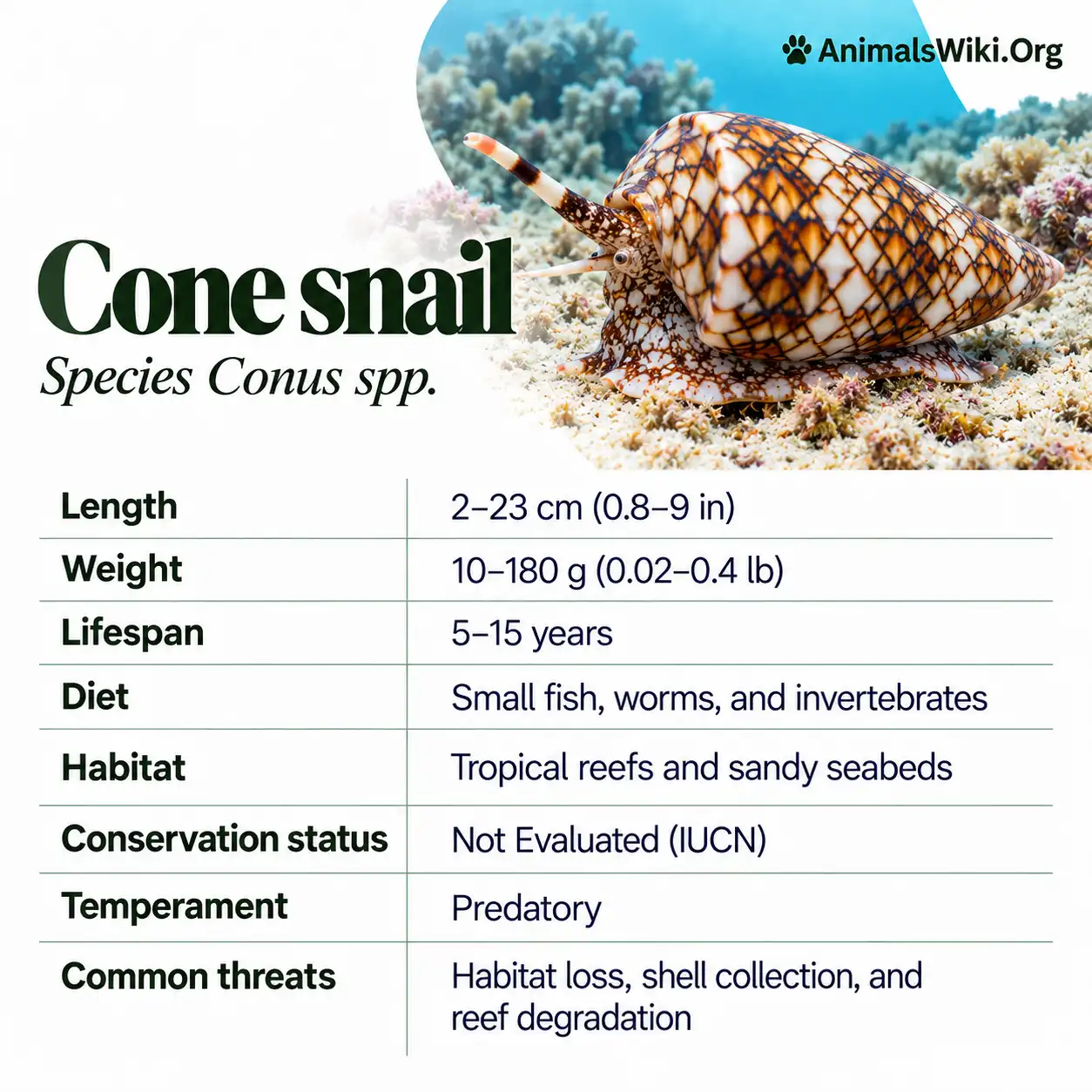
Their shells are often decorated with intricate geometric patterns, including triangles, zigzags, bands, spots, and net-like markings.
These beautiful shells have attracted collectors for centuries.
However, a living cone snail is very different from an empty decorative shell.
Hidden inside the shell is a predatory animal equipped with a specialized venom apparatus.
Cone snails capture prey using a modified radular tooth that functions like a tiny harpoon.
This tooth can penetrate prey and deliver a complex mixture of venom peptides known as conotoxins.
Different cone snail species possess different venom compositions.
Some species specialize in hunting marine worms, while others feed on mollusks or fish.
Fish-hunting species are particularly famous because some possess venom capable of causing severe poisoning in humans.
The geography cone snail, Conus geographus, is among the best-known medically dangerous species.
Although serious human envenomations are uncommon, some cone snail stings can cause paralysis, respiratory failure, and death.
For this reason, living cone snails should never be handled.
Cone snails are also scientifically important.
Their venom contains biologically active compounds that researchers study for potential medical applications.
One cone snail-derived peptide inspired the development of ziconotide, a prescription medication used to treat certain forms of severe chronic pain.
Cone snails therefore represent an extraordinary combination of natural beauty, predatory specialization, chemical complexity, and biomedical significance.
This comprehensive guide explores cone snail facts, scientific classification, species, anatomy, size, habitat, distribution, diet, hunting behavior, venom, reproduction, lifespan, predators, adaptations, medical research, conservation, and frequently asked questions.
Cone Snail Facts
| Feature | Information |
|---|---|
| Common name | Cone Snail |
| Scientific family | Conidae |
| Well-known genus | Conus |
| Phylum | Mollusca |
| Class | Gastropoda |
| Order | Neogastropoda |
| Animal type | Predatory marine gastropod mollusk |
| Habitat | Coral reefs, sandy bottoms, rocky shores, and other marine habitats |
| Distribution | Primarily tropical and subtropical oceans; some temperate species |
| Shell shape | Conical, often with a narrow aperture |
| Shell patterns | Geometric markings, bands, spots, and zigzags |
| Size | From a few centimeters to more than 20 cm in some species |
| Diet | Marine worms, mollusks, or fish, depending on species |
| Feeding type | Carnivorous |
| Hunting weapon | Modified radular tooth |
| Venom | Complex mixture of bioactive compounds, including conotoxins |
| Movement | Muscular foot |
| Reproduction | Sexual reproduction |
| Eggs | Usually deposited in protective capsules |
| Larval development | Varies by species |
| Lifespan | Species-dependent; often several years |
| Main predators | Certain fish, crustaceans, and other marine predators |
| Human danger | Potentially severe or fatal envenomation |
| Medical significance | Source of compounds studied for neurological and pain-related applications |
| Conservation | Varies by species |
What Is a Cone Snail?
A cone snail is a predatory marine gastropod mollusk belonging to the family Conidae.
It is recognized by its cone-shaped shell and specialized venom-delivery system.
Unlike many marine snails that graze on algae or scavenge organic material, cone snails actively hunt animal prey.
Is a Cone Snail an Animal?
Yes.
Is a Cone Snail a Mollusk?
Yes.
Is a Cone Snail a Gastropod?
Yes.
Is a Cone Snail a Fish?
No.
Is a Cone Snail an Invertebrate?
Yes. It has no backbone.
Scientific Classification of Cone Snails
| Classification | Name |
|---|---|
| Kingdom | Animalia |
| Phylum | Mollusca |
| Class | Gastropoda |
| Major lineage | Caenogastropoda |
| Order | Neogastropoda |
| Superfamily | Conoidea |
| Family | Conidae |
| Example genus | Conus |
| Example species | Conus geographus |
Cone snail classification has undergone revisions as molecular research has revealed relationships among different lineages.
Some taxonomic systems recognize multiple genera within Conidae, while others retain broader arrangements.
What Does Conidae Mean?
Conidae is the scientific family name for cone snails.
What Does Conus Mean?
Conus refers to the cone-like shell shape.
Are Cone Snails Related to Other Sea Snails?
Yes.
Are Cone Snails Related to Nudibranchs?
Yes. Both belong to Gastropoda, although they are different evolutionary groups.
Are Cone Snails Related to Octopuses?
Both are mollusks, but cone snails are gastropods and octopuses are cephalopods.
Types and Species of Cone Snails
There are hundreds of recognized cone snail species, with additional diversity revealed through taxonomic research.
1. Geography Cone Snail
Scientific name: Conus geographus
The geography cone snail is one of the most medically significant cone snail species.
It inhabits tropical Indo-Pacific waters and primarily hunts fish.
Its venom can cause life-threatening envenomation in humans.
2. Textile Cone Snail
Scientific name: Conus textile
This species is known for its beautiful geometric shell pattern.
It primarily feeds on other mollusks.
It is venomous and should not be handled.
3. Tulip Cone Snail
Scientific name: Conus tulipa
This Indo-Pacific species is a fish-hunting cone snail.
It possesses specialized venom components that help subdue prey.
4. Striated Cone Snail
Scientific name: Conus striatus
This species is known for its elongated shell and fish-hunting behavior.
5. Marble Cone Snail
Scientific name: Conus marmoreus
This species has a striking black-and-white patterned shell.
It primarily hunts other mollusks.
6. California Cone Snail
Scientific name: Californiconus californicus
This eastern Pacific species occurs in cooler waters than many tropical cone snails.
It has a relatively broad diet that includes various marine invertebrates.
7. Imperial Cone Snail
Scientific name: Conus imperialis
This species is associated with marine worm predation and has been studied for its venom chemistry.
8. Magician’s Cone Snail
Scientific name: Conus magus
This species is particularly important in biomedical research because its venom contains a peptide that inspired the drug ziconotide.
What Does a Cone Snail Look Like?
Cone snails possess a distinctive shell with a narrow opening.
Their anatomy includes:
- Conical shell
- Shell aperture
- Muscular foot
- Head
- Tentacles
- Eyes
- Proboscis
- Radular tooth
- Venom gland
- Venom duct
- Digestive system
- Reproductive organs
What Is the Proboscis?
The proboscis is an extendable feeding structure used to deliver the specialized radular tooth.
What Is the Radula?
The radula is a feeding structure found in many mollusks.
In cone snails, individual radular teeth are modified into venom-delivering harpoons.
Do Cone Snails Have Eyes?
Yes. They possess simple eyes.
Do Cone Snails Have Brains?
They have a nervous system with ganglia.
Cone Snail Shell
Cone snail shells are among the most recognizable and beautifully patterned shells in the ocean.
Why Are Cone Snail Shells Cone-Shaped?
The shape reflects their evolutionary body plan and shell growth.
Are Cone Snail Shells Strong?
They provide protection, although they can be damaged.
Can Cone Snails Leave Their Shells?
No. The shell is part of the living animal.
Are Empty Cone Snail Shells Dangerous?
An empty shell does not contain a living venom apparatus. However, a shell that appears empty may still contain a live snail, so it should not be handled unless its empty condition is certain.
Cone Snail Colors and Patterns
Cone snail shells display extraordinary variation.
Common patterns include:
- Brown and white geometric markings
- Black and white triangles
- Orange bands
- Yellow patches
- Zigzag lines
- Spotted patterns
- Net-like designs
Why Are Cone Snail Shells So Beautiful?
Shell patterns result from species-specific pigmentation and shell growth processes.
Are All Cone Snails Colorful?
No. Some have relatively plain shells.
Can Cone Snails Change Shell Color?
Shell coloration changes gradually through growth rather than rapid color changes.
Cone Snail Size and Weight
Cone snail size varies greatly.
How Big Is a Cone Snail?
Many species measure a few centimeters, while some exceed 20 centimeters in shell length.
What Is the Largest Cone Snail?
Conus betulinus and some other large species can reach substantial shell lengths.
Are All Cone Snails Small?
No.
How Much Does a Cone Snail Weigh?
Weight varies with shell size and species.
Where Do Cone Snails Live?
Cone snails occur in marine environments worldwide, especially warm tropical and subtropical waters.
They inhabit:
- Indian Ocean
- Pacific Ocean
- Atlantic Ocean
- Caribbean Sea
- Red Sea
- Coral Triangle
- Tropical reef systems
- Some temperate coastal waters
Do Cone Snails Live in Australia?
Yes.
Do Cone Snails Live in the Philippines?
Yes.
Do Cone Snails Live in Indonesia?
Yes.
Do Cone Snails Live in the Caribbean?
Yes.
Do Cone Snails Live in Freshwater?
No. Cone snails are marine animals.
Cone Snail Habitat
Cone snails occupy several marine habitats.
These include:
- Coral reefs
- Sandy seabeds
- Rocky shores
- Reef rubble
- Seagrass-associated areas
- Shallow lagoons
- Deeper marine environments
Do Cone Snails Live in Coral Reefs?
Yes.
Do Cone Snails Bury Themselves?
Many species bury themselves in sand or sediment.
Do Cone Snails Live in Tide Pools?
Some species occur in shallow coastal environments.
Do Cone Snails Live in Deep Water?
Yes. Some inhabit deeper marine habitats.
What Do Cone Snails Eat?
Cone snails are carnivorous predators.
Their diets generally fall into three broad categories.
Worm-Hunting Cone Snails
These species feed mainly on marine worms.
Mollusk-Hunting Cone Snails
These species prey on other gastropods and mollusks.
Fish-Hunting Cone Snails
These species capture small fish.
Do Cone Snails Eat Fish?
Some species do.
Do Cone Snails Eat Worms?
Yes.
Do Cone Snails Eat Other Snails?
Some species do.
Are Cone Snails Carnivores?
Yes.
How Do Cone Snails Hunt?
Cone snails use specialized venom-delivery systems.
Step 1: Detect Prey
The snail detects chemical and other environmental cues.
Step 2: Approach Prey
It moves toward the target using its muscular foot.
Step 3: Extend the Proboscis
The proboscis is positioned near the prey.
Step 4: Deliver the Radular Tooth
A modified tooth penetrates the prey.
Step 5: Inject Venom
Venom enters the prey through the specialized tooth.
Step 6: Subdue Prey
Venom compounds interfere with physiological processes.
Step 7: Consume Prey
The snail feeds after the prey has been immobilized.
Not all cone snail species use exactly the same hunting sequence.
Cone Snail Venom
Cone snail venom is a complex mixture of biologically active molecules.
These include peptides called conotoxins.
What Are Conotoxins?
Conotoxins are venom peptides that interact with molecular targets such as ion channels and receptors.
Why Is Cone Snail Venom Powerful?
Different venom components can disrupt nerve and muscle signaling.
Do All Cone Snails Have Venom?
Cone snails possess venom systems, but venom composition and medical danger vary greatly.
Are All Cone Snails Deadly?
No. Not all species pose the same level of risk to humans.
How Dangerous Is a Cone Snail Sting?
Some cone snail stings can be life-threatening.
Severe envenomation may cause:
- Local pain or altered sensation
- Numbness
- Tingling
- Muscle weakness
- Dizziness
- Difficulty speaking or swallowing
- Paralysis
- Respiratory failure
Symptoms vary depending on the species, venom dose, and individual response.
Can Cone Snail Venom Kill Humans?
Yes. Fatal cases have been documented.
Can a Cone Snail Sting Through Skin?
Yes.
Can a Cone Snail Sting Through Gloves?
Protective gloves should not be relied upon to prevent envenomation.
Is a Cone Snail Sting Always Painful?
No. Initial pain may be mild or absent.
What Should You Do If Stung by a Cone Snail?
A suspected cone snail sting is a medical emergency.
- Leave the water and move to safety.
- Call emergency medical services immediately.
- Keep the affected person still and calm.
- Avoid unnecessary movement of the affected limb.
- Follow local emergency guidance for immobilization.
- Monitor breathing and responsiveness.
- Begin CPR if necessary and if trained.
- Do not cut, suck, or attempt to extract venom.
- Do not apply an arterial tourniquet.
- Obtain urgent hospital treatment even if early symptoms seem mild.
In regions where recommended for cone snail envenomation, a properly applied pressure-immobilization bandage may be used while awaiting medical care. Incorrect application can cause harm, so follow local medical guidance.
There is no widely available specific antivenom for cone snail envenomation. Treatment is primarily supportive, including respiratory support when necessary.
Can Cone Snails Sting Without Being Provoked?
Cone snails usually use their venom for hunting and defense.
Human stings most commonly occur when living animals are handled or disturbed.
Should You Pick Up a Cone Snail?
No.
Should You Touch a Cone Snail Shell?
Do not touch or collect a shell that may contain a living cone snail.
Can Cone Snails Attack Divers?
They do not actively hunt humans.
Cone Snail Movement
Cone snails move using a muscular foot.
Can Cone Snails Crawl?
Yes.
Can Cone Snails Swim?
Adults generally crawl rather than swim.
Are Cone Snails Fast?
They are slow compared with fish.
Can Cone Snails Burrow?
Many species can.
Cone Snail Senses
Cone snails use sensory structures to detect prey and environmental conditions.
Do Cone Snails Have Eyes?
Yes.
Can Cone Snails Smell?
They detect dissolved chemical cues.
Do Cone Snails Have Ears?
No vertebrate-style ears.
Can Cone Snails Detect Prey?
Yes.
Cone Snail Reproduction
Cone snails reproduce sexually.
Unlike many nudibranchs, cone snails generally have separate male and female individuals.
Do Cone Snails Lay Eggs?
Yes.
Are Cone Snails Hermaphrodites?
Cone snails generally have separate sexes.
How Do Cone Snails Mate?
Males transfer sperm to females during mating.
Cone Snail Eggs
Female cone snails deposit eggs in protective capsules.
What Do Cone Snail Eggs Look Like?
Eggs are enclosed in capsules attached to suitable surfaces.
How Many Eggs Do Cone Snails Lay?
Numbers vary greatly by species.
Do Cone Snails Guard Their Eggs?
Extended parental care is not typical of most species.
Cone Snail Life Cycle
Stage 1: Mating
Male and female cone snails mate.
Stage 2: Egg Capsule Deposition
Females lay egg capsules.
Stage 3: Embryonic Development
Embryos develop inside capsules.
Stage 4: Larval Development
Some species produce swimming veliger larvae.
Stage 5: Settlement
Larvae settle onto suitable marine substrates.
Stage 6: Juvenile Cone Snail
Young snails begin developing their adult feeding and shell characteristics.
Stage 7: Adult Cone Snail
Adults become reproductively mature.
Development varies among species, and some have reduced or absent planktonic larval stages.
Baby Cone Snails
Young cone snails develop within egg capsules.
What Is a Baby Cone Snail Called?
A larva or juvenile cone snail, depending on developmental stage.
Do Baby Cone Snails Have Shells?
Yes. Shell development begins early.
Are Baby Cone Snails Venomous?
Venom systems develop as the animals mature, but juvenile venom biology varies among species.
How Long Do Cone Snails Live?
Cone snail lifespan varies by species.
Some survive for several years.
Can Cone Snails Live for Ten Years?
Some species may survive for many years, but precise lifespan data are limited.
Are Cone Snails Immortal?
No.
Why Is Cone Snail Lifespan Difficult to Estimate?
Many species are difficult to monitor throughout their entire lives.
Cone Snail Adaptations
Conical Shell
Provides protection.
Venomous Harpoon
Allows prey capture.
Complex Venom
Targets specific physiological processes.
Extendable Proboscis
Supports venom delivery.
Specialized Radular Teeth
Function as disposable hunting structures.
Chemical Sensing
Helps locate prey.
Burrowing Behavior
Provides concealment.
Species-Specific Diet
Allows specialization on particular prey.
Egg Capsules
Protect developing embryos.
Marine Habitat Diversity
Supports survival across different environments.
What Animals Eat Cone Snails?
Potential predators include:
- Certain fish
- Crabs
- Other predatory gastropods
- Some marine vertebrates
Do Fish Eat Cone Snails?
Some fish prey on them.
Do Crabs Eat Cone Snails?
Some crabs can attack cone snails.
Do Cone Snails Have Natural Predators?
Yes.
Cone Snail Venom and Medical Research
Cone snail venom has attracted major scientific interest.
Its peptides can interact with specific nerve receptors and ion channels.
What Is Ziconotide?
Ziconotide is a synthetic medication based on a peptide originally identified in the venom of Conus magus.
It is used for certain cases of severe chronic pain.
Is Ziconotide Taken as a Pill?
No. It is administered into the fluid surrounding the spinal cord using specialized medical equipment.
Can Cone Snail Venom Cure Diseases?
Cone snail venom contains compounds with research potential, but claims of cures require rigorous clinical evidence.
Are Conotoxins Used in Research?
Yes. They are valuable tools in neuroscience and pharmacology.
Cone Snail vs. Sea Snail
Cone snails are a specialized group of predatory sea snails.
Many other sea snails graze on algae, scavenge, or feed using different methods.
Cone snails are distinguished by their specialized venom apparatus.
Cone Snail vs. Nudibranch
| Feature | Cone Snail | Nudibranch |
|---|---|---|
| Scientific group | Conidae | Nudibranchia |
| Adult shell | Present | Absent |
| Diet | Carnivorous | Mostly carnivorous |
| Venom delivery | Specialized radular tooth | Varies; some use stored nematocysts |
| Movement | Muscular foot | Muscular foot |
| Appearance | Conical shell | Soft, often colorful body |
| Human danger | Some species can cause fatal envenomation | Most are harmless; some can sting or contain toxins |
Cone Snail vs. Blue-Ringed Octopus
Both are venomous marine mollusks.
Cone snails are gastropods.
Blue-ringed octopuses are cephalopods.
Cone snails deliver venom through modified radular teeth.
Blue-ringed octopuses can deliver tetrodotoxin-containing venom through a bite.
Both require urgent medical attention after suspected envenomation.
Cone Snail vs. Stonefish
Cone snails are marine mollusks.
Stonefish are venomous fish.
Cone snails use modified radular teeth.
Stonefish deliver venom through specialized fin spines.
Are Cone Snails Endangered?
Conservation status varies among species.
Some species face threats from habitat degradation, shell collecting, and restricted geographic ranges.
What Threatens Cone Snails?
Potential threats include:
- Coastal development
- Coral reef degradation
- Pollution
- Ocean warming
- Ocean acidification
- Shell collecting
- Habitat destruction
Are Cone Snails Protected?
Protection varies by species and location.
Why Are Cone Snails Important?
Cone snails contribute to marine ecosystems as specialized predators.
They are also important for:
- Marine biodiversity
- Predator-prey relationships
- Venom evolution
- Neuroscience
- Pharmacology
- Drug discovery
- Marine conservation
- Gastropod evolution
50 Interesting Cone Snail Facts
- Cone snails are marine gastropod mollusks.
- They belong to the family Conidae.
- They are invertebrates.
- They are not fish.
- They are related to other sea snails.
- They are related to nudibranchs.
- They possess cone-shaped shells.
- Their shells often have geometric patterns.
- Some have triangular markings.
- Others display bands or spots.
- Cone snails are carnivorous.
- Some hunt marine worms.
- Some hunt other mollusks.
- Some hunt fish.
- They possess specialized radular teeth.
- Their radular teeth function like harpoons.
- They deliver venom through these teeth.
- Their venom contains biologically active compounds.
- Many venom peptides are called conotoxins.
- Different species have different venom compositions.
- Some cone snail stings can be fatal to humans.
- The geography cone snail is particularly dangerous.
- Cone snail stings may initially cause little pain.
- Severe envenomation can cause paralysis.
- Respiratory failure is a major danger.
- There is no widely available specific cone snail antivenom.
- Living cone snails should never be handled.
- Cone snails inhabit tropical oceans.
- Some occur in temperate waters.
- They live on coral reefs.
- Some inhabit sandy seabeds.
- Many can burrow.
- They crawl using a muscular foot.
- They possess simple eyes.
- They detect chemical cues.
- They reproduce sexually.
- They generally have separate sexes.
- Females deposit egg capsules.
- Some species have swimming larvae.
- Others have different developmental strategies.
- They can live for several years.
- Some fish prey on cone snails.
- Some crabs attack cone snails.
- Cone snail venom is studied in neuroscience.
- Conus magus venom inspired ziconotide.
- Ziconotide is used to treat certain forms of severe chronic pain.
- Cone snail venom contains many distinct peptides.
- Cone snails are important marine predators.
- Conservation status varies among species.
- Their combination of beautiful shells and sophisticated venom systems makes them among the most remarkable marine gastropods.
Did You Know?
The Beautiful Seashell That Hides a Deadly Harpoon
Imagine exploring a tropical coral reef.
Sunlight filters through clear blue water.
Colorful fish move between coral formations.
Small crabs crawl across the sandy seafloor.
Among the rocks lies a beautiful shell.
It is smooth and cone-shaped.
Its surface is decorated with intricate brown-and-white patterns.
At first glance, it looks like an ordinary seashell.
But this shell is not empty.
Inside lives a cone snail.
The snail slowly extends its soft body.
Its sensory structures detect chemical signals from nearby prey.
A small fish approaches.
The cone snail remains almost motionless.
Then it extends a specialized proboscis.
Inside the proboscis is a modified radular tooth.
The tooth resembles a tiny hollow harpoon.
When the fish comes close enough, the cone snail delivers the tooth and injects venom.
The venom contains a mixture of peptides that interfere with the prey’s nervous and muscular systems.
The fish becomes immobilized.
The cone snail then consumes its prey.
This sophisticated hunting system is extraordinary for an animal that moves so slowly.
But cone snail venom is not only interesting because of its danger.
Scientists have discovered that some venom peptides interact with highly specific molecular targets.
These properties make conotoxins valuable tools for studying nerve signaling.
Research on a peptide from Conus magus contributed to the development of ziconotide, a medication used in specialized treatment of severe chronic pain.
The same biological system that helps a cone snail capture prey has therefore contributed to modern medicine.
However, the animal remains dangerous to handle.
Some species can cause life-threatening envenomation.
The safest approach is to admire living cone snails without touching them.
The cone snail demonstrates how one of the ocean’s most beautiful shells can conceal a sophisticated venom-delivery system that is both a powerful hunting weapon and an important subject of medical research.
Frequently Asked Questions About Cone Snails
What is a cone snail?
A cone snail is a predatory marine gastropod mollusk belonging to the family Conidae.
Is a cone snail an animal?
Yes.
Is a cone snail a mollusk?
Yes.
Is a cone snail a gastropod?
Yes.
Is a cone snail a fish?
No.
Is a cone snail an invertebrate?
Yes.
What is the scientific name of cone snails?
They belong to the family Conidae.
What is the scientific name of the geography cone snail?
Conus geographus.
Are cone snails related to nudibranchs?
Yes. Both are gastropod mollusks.
Are cone snails related to octopuses?
Both belong to Mollusca.
How many cone snail species exist?
Hundreds of species are recognized, with taxonomy continuing to change.
What is the most dangerous cone snail?
The geography cone snail is among the most medically dangerous species.
What is a textile cone snail?
Conus textile, a venomous species with a geometric shell pattern.
What is a marble cone snail?
Conus marmoreus.
What is a tulip cone snail?
Conus tulipa, a fish-hunting species.
How big are cone snails?
From a few centimeters to more than 20 centimeters, depending on species.
What is the largest cone snail?
Some large species, including Conus betulinus, can exceed 20 centimeters.
Do cone snails have shells?
Yes.
Can cone snails leave their shells?
No.
Are cone snail shells beautiful?
Many have intricate patterns.
Are empty cone snail shells dangerous?
An empty shell cannot inject venom, but a shell that appears empty may contain a living animal.
Do cone snails have eyes?
Yes.
Do cone snails have brains?
They possess a nervous system with ganglia.
Do cone snails have hearts?
Yes.
Do cone snails have teeth?
They possess specialized radular teeth.
What is a cone snail harpoon?
A modified radular tooth used to deliver venom.
Where do cone snails live?
Mainly in tropical and subtropical marine environments.
Do cone snails live in Australia?
Yes.
Do cone snails live in Indonesia?
Yes.
Do cone snails live in the Philippines?
Yes.
Do cone snails live in the Caribbean?
Yes.
Do cone snails live in freshwater?
No.
Do cone snails live in coral reefs?
Yes.
Do cone snails bury themselves?
Many species do.
Do cone snails live in deep water?
Some species do.
What do cone snails eat?
Marine worms, mollusks, or fish, depending on species.
Are cone snails carnivores?
Yes.
Do cone snails eat fish?
Some species do.
Do cone snails eat worms?
Yes.
Do cone snails eat other snails?
Some species do.
How do cone snails hunt?
They use a specialized radular tooth to inject venom into prey.
Are cone snails venomous?
Yes.
Are all cone snails deadly?
No. Human risk varies considerably by species.
What are conotoxins?
Venom peptides that interact with specific molecular targets.
Can cone snail venom kill humans?
Yes.
Can cone snails sting humans?
Yes.
Can cone snails sting through gloves?
Gloves should not be considered reliable protection.
Is a cone snail sting painful?
Pain varies, and some stings may initially cause little discomfort.
What are cone snail sting symptoms?
Symptoms may include numbness, weakness, paralysis, and breathing difficulties.
Is there a cone snail antivenom?
There is no widely available specific antivenom.
What should you do after a cone snail sting?
Seek emergency medical care immediately and keep the affected person still.
Should you pick up a cone snail?
No.
Can cone snails attack divers?
They do not hunt humans, but they can sting defensively.
Can cone snails move?
Yes.
Can cone snails crawl?
Yes.
Can cone snails swim?
Adults generally crawl rather than swim.
Can cone snails burrow?
Many species can.
How do cone snails reproduce?
Sexually.
Are cone snails hermaphrodites?
They generally have separate sexes.
Do cone snails lay eggs?
Yes.
What do cone snail eggs look like?
They are enclosed in protective capsules.
What is a baby cone snail called?
A larva or juvenile.
Do baby cone snails have shells?
Yes.
How long do cone snails live?
Often several years, depending on species.
Are cone snails immortal?
No.
What animals eat cone snails?
Certain fish, crabs, and other marine predators.
Why is cone snail venom important to medicine?
Its peptides help scientists study nerve signaling and have inspired drug development.
What is ziconotide?
A prescription pain medication derived from research on a cone snail venom peptide.
Can cone snail venom cure diseases?
Some compounds have medical potential, but claims of cures require clinical evidence.
Are cone snails endangered?
Conservation status varies by species.
What threatens cone snails?
Habitat loss, pollution, warming, and shell collecting.
Why are cone snails important?
They are marine predators and valuable subjects for venom and neuroscience research.
What is the most interesting cone snail fact?
Cone snails use a modified radular tooth like a venomous harpoon, and research on one species’ venom led to a medication for severe chronic pain.
Conclusion
Cone snails are among the most fascinating and sophisticated predatory mollusks in the ocean.
Their beautifully patterned shells, specialized hunting systems, and chemically complex venom distinguish them from other marine gastropods.
Although they move slowly, cone snails can capture worms, mollusks, and even fish using venom-delivering radular teeth.
Some species possess venom capable of causing life-threatening poisoning in humans.
For this reason, living cone snails should never be handled.
Cone snails are also important to science.
Their venom peptides have provided valuable insights into nerve signaling and contributed to the development of specialized pain medication.
Their diversity, predatory behavior, and chemical adaptations demonstrate the extraordinary complexity of marine evolution.
Understanding cone snails helps reveal the importance of ocean biodiversity and the need to protect marine habitats.
The cone snail proves that an animal hidden inside a beautiful seashell can possess one of the ocean’s most sophisticated venom-delivery systems while offering valuable insights for modern medical research.