Crayfish, The Clawed Crustaceans Shaping Freshwater Life
A crayfish moving across a stream bottom looks like a miniature lobster. Its antennae sweep through the water, its claws remain ready, and its walking legs carry it between stones and submerged leaves. Disturb it suddenly, and a powerful tail movement can send it backward into shelter.
These familiar freshwater animals are much more than small clawed scavengers. They are predators, plant consumers, burrow builders, nutrient recyclers, and prey for numerous other animals. Their activities influence the structure and function of streams, wetlands, lakes, and underground waters.
Crayfish also have extraordinary life histories. They grow by shedding their external skeleton, regenerate lost appendages, and carry their developing young beneath the abdomen. Some spend much of their lives in deep burrows. Others inhabit caves, cool mountain streams, or seasonal floodplains.
The group contains hundreds of species, and their differences are substantial. A small burrowing crayfish and a giant Tasmanian freshwater crayfish do not share one universal lifespan, growth rate, or environmental requirement.
Their relationship with people is equally varied. Some support aquaculture and regional food traditions. Others are threatened native species, while introduced crayfish can alter ecosystems beyond their natural ranges.
This guide explains what crayfish are, where they live, what they eat, how they reproduce, and why understanding the species matters.
Information checked: October 18, 2026.
Crayfish Facts
| Feature | Information |
|---|---|
| Common name | Crayfish |
| Other familiar names | Crawfish, crawdad, and mudbug |
| Animal group | Freshwater crustaceans |
| Phylum | Arthropoda |
| Class | Malacostraca |
| Order | Decapoda |
| General body form | Lobster-like, with a protective carapace and segmented abdomen |
| Main walking appendages | Five pairs, including the claw-bearing first pair |
| Breathing | Gills beneath the carapace |
| Habitats | Streams, rivers, lakes, wetlands, burrows, springs, and caves |
| Diet | Plants, organic debris, algae, and animal food, depending on species and circumstances |
| Reproduction | Usually sexual; marbled crayfish are a notable exception |
| Young | Develop in eggs carried beneath the female’s abdomen |
| Growth | Occurs through repeated molts |
| Escape movement | Rapid abdominal flexion and tail flipping |
| Regeneration | Lost appendages can regrow across subsequent molts |
| Lifespan | Highly variable, from relatively short lives to several decades in some species |
| Ecological importance | Predation, decomposition, burrowing, habitat modification, and food-web support |
1. What Is a Crayfish?
A crayfish is a freshwater decapod crustacean with a lobster-like body and a prominent pair of claws.
The word describes a diverse collection of species rather than one animal found identically in every river or pond.
Crayfish are invertebrates, meaning they lack a backbone. Their external skeleton provides support and protection while creating the need to molt as they grow.
They share broad ancestry with lobsters, crabs, shrimp, and other crustaceans. Their closer relationships and freshwater adaptations distinguish them from those groups.
Most familiar crayfish move across the bottom, using shelter beneath stones, logs, roots, or vegetation. Other species are specialized for burrows or underground waters.
These differences matter whenever someone asks a general question about their behavior.
A stream-dwelling species may need flowing, oxygen-rich water, while a burrowing species occupies a humid tunnel system connected to groundwater.
Their ecological success comes from this diversity of adaptations. The familiar claws are only the most obvious feature of a much more varied freshwater animal group.
2. Crayfish, Crawfish, Crawdads, and Mudbugs
“Crayfish,” “crawfish,” “crawdad,” and “mudbug” are common names used in different regions.
In many contexts, they refer to the same general kind of freshwater crustacean.
A crawfish does not become a different animal merely because the name appears on a restaurant menu rather than in a biology textbook.
However, common names can also conceal species differences. Two communities using the same word may be describing different native crayfish.
Regional naming becomes especially important with the word “lobster.” Tasmania’s giant freshwater lobster is a crayfish, while marine spiny lobsters are called crayfish in some other places.
Scientific names provide a clearer reference.
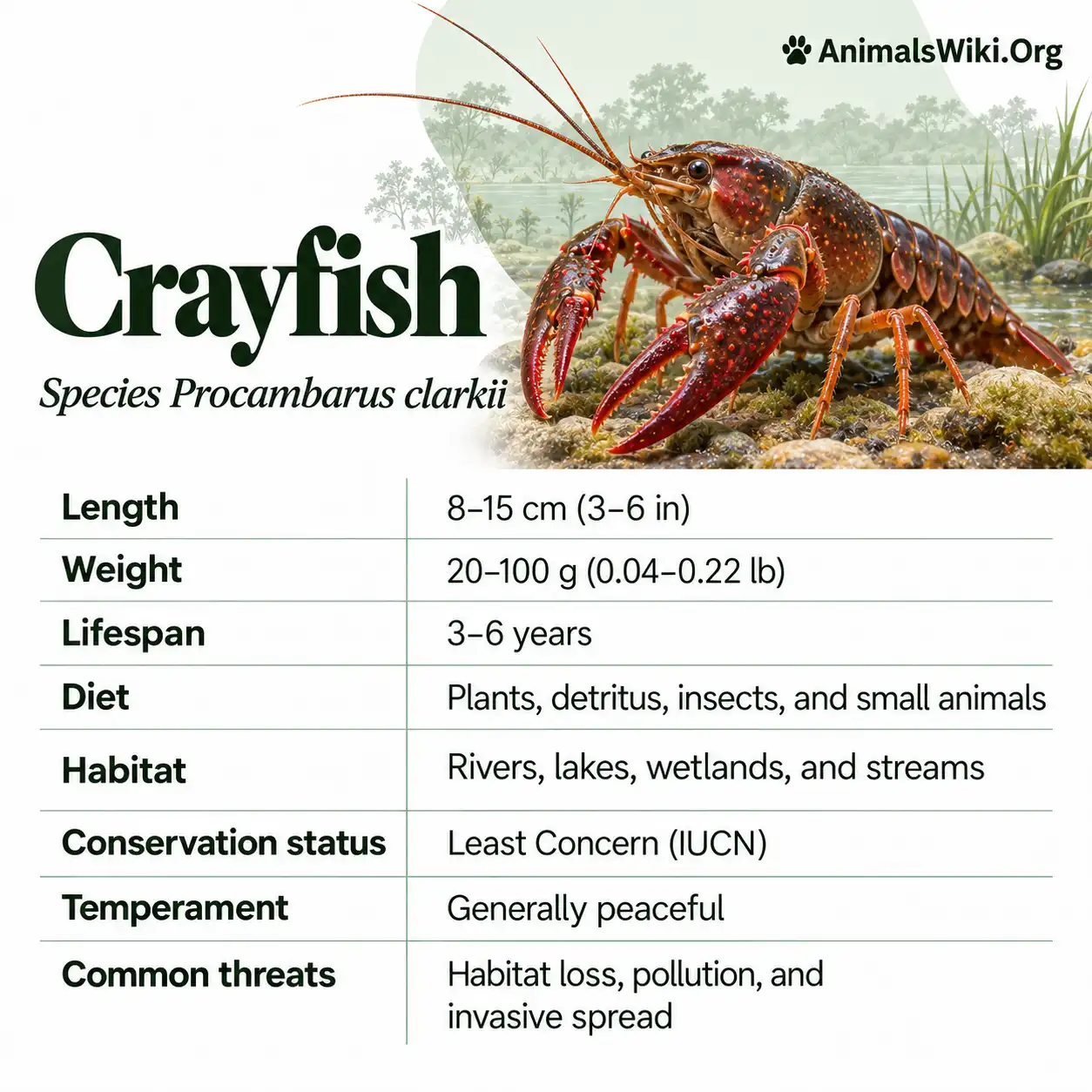
For example, Procambarus clarkii identifies the red swamp crayfish regardless of which regional common name is used.
The practical lesson is to separate a familiar label from a precise biological identity.
Common names help people communicate, while scientific identification becomes essential when discussing conservation, environmental requirements, reproduction, or the risks of introducing animals to new waters.
3. Crayfish Classification
Crayfish belong to Decapoda, the order containing ten-footed crustaceans.
The ten conspicuous appendages include the large claw-bearing pair and four additional pairs primarily associated with walking.
| Classification level | Group |
|---|---|
| Kingdom | Animalia |
| Phylum | Arthropoda |
| Broad animal group | Crustaceans |
| Class | Malacostraca |
| Order | Decapoda |
| Larger relationship group | Astacidea |
| Example genus | Procambarus |
| Example species | Procambarus clarkii |
Different crayfish lineages have distinct anatomical and geographical histories.
Their identification can involve the shape of the rostrum, claws, carapace, spines, reproductive structures, and other features.
Color alone is unreliable. Individuals of the same species can vary, while unrelated species may share similar shades.
Genetic evidence has also helped researchers investigate relationships and distinguish difficult groups.
The classification therefore provides more than a naming exercise. It organizes information about ancestry and helps explain why some species share characteristics that others do not.
An accurate species name makes later comparisons much more meaningful.
4. Familiar Crayfish Species
Several species illustrate the range of crayfish biology.
| Species | Common name or significance |
|---|---|
| Procambarus clarkii | Red swamp crayfish; important in aquaculture and invasive-species research |
| Pacifastacus leniusculus | Signal crayfish; native to western North America and introduced elsewhere |
| Faxonius rusticus | Rusty crayfish; an important invasive species outside its native range |
| Austropotamobius pallipes | White-clawed crayfish; a European conservation concern |
| Cherax destructor | Common yabby; a familiar Australian crayfish |
| Astacopsis gouldi | Giant Tasmanian freshwater crayfish |
| Procambarus virginalis | Marbled crayfish; reproduces through parthenogenesis |
These examples should not be treated as interchangeable.
A species capable of rapid population growth in warm, disturbed waters may differ greatly from a slow-growing inhabitant of shaded streams.
The same distinction applies to conservation. An animal can be native and ecologically important in one region while becoming damaging after introduction elsewhere.
Species identity is therefore the foundation of a useful crayfish description.
5. What Does a Crayfish Look Like?
A crayfish has two main body regions: the cephalothorax and the abdomen.
The cephalothorax combines the head and thorax beneath a protective carapace. The abdomen is the visibly segmented region commonly called the tail.
At the front are stalked eyes, long antennae, shorter antennules, and a projecting rostrum.
The claws are carried by specialized appendages called chelipeds.
Smaller appendages near the mouth collect, manipulate, and process food.
The abdomen carries swimmerets beneath it and ends in a fan formed by the telson and paired uropods.
These structures work together. Walking legs support movement over the bottom, sensory appendages gather information, and the abdomen powers rapid escape.
The animal’s outline is therefore a practical arrangement for navigating complex freshwater habitats.
A cave crayfish or specialized burrower may show modifications to this familiar body plan, but its crustacean organization remains recognizable.
6. How Many Legs Does a Crayfish Have?
Crayfish are decapods, a name meaning “ten feet.”
The familiar count includes five pairs of major thoracic appendages. The first pair bears the large claws, while four additional pairs function primarily as walking legs.
The claws are therefore part of the ten-footed arrangement rather than an extra pair added to it.
A crayfish also has other appendages, including mouthparts, antennae, and swimmerets.
Counting every projection visible beneath the body as a walking leg produces confusion.
| Appendage | Main role |
|---|---|
| Chelipeds | Grasping, food handling, defense, and social interactions |
| Walking legs | Movement and support |
| Swimmerets | Roles that include water movement and reproduction |
| Antennae and antennules | Sensory information |
| Mouth-associated appendages | Food manipulation and processing |
Individual animals may be missing legs because of injury or predation.
A specimen with fewer visible appendages does not necessarily belong to a different group. Some of the missing structures may later regenerate through subsequent molts.
7. How Big Do Crayfish Grow?
Crayfish range from small species only a few centimeters long to exceptionally large animals.
Measurements must specify whether they refer to the carapace, the main body, or total length.
Including extended claws or antennae creates a different result from measuring from the front of the body to the tail.
Age, sex, food, temperature, and population density also influence size.
The giant Tasmanian freshwater crayfish, Astacopsis gouldi, provides a dramatic example of the group’s upper size range.
Australian government information recognizes it as the world’s largest freshwater crustacean, with exceptional historical weights reaching several kilograms.
Most crayfish encountered in ordinary ponds or streams are far smaller.
The giant species should therefore not be used to set expectations for a typical crayfish.
Its size also accompanies a slow life history, unlike the rapid development familiar from some commercially raised species.
Large body size can represent a very different ecological strategy rather than simply better growth in the same kind of animal.
8. Where Do Crayfish Live?
Crayfish occupy streams, rivers, lakes, ponds, wetlands, springs, caves, and groundwater-associated burrows.
Some depend on permanent flowing water. Others thrive in habitats with seasonal changes in surface water.
North America contains especially rich crayfish diversity. Australia and other regions also contain distinctive native lineages.
A broad distribution does not mean each species occupies a large range.
Some are restricted to one drainage, a small wetland region, or a limited underground system.
The connection between geography and water movement helps explain this pattern. A species that rarely leaves a stream may remain separated from neighboring populations in another drainage.
Human transport changes that relationship by moving animals across natural boundaries.
A crayfish found locally may therefore be native, introduced, or uncertain in origin.
Understanding its habitat requires looking beyond whether water is present. Flow, temperature, shelter, substrate, and seasonal timing all help determine whether the site can support its full life cycle.
9. Why Shelter and Substrate Matter
For many crayfish, a suitable shelter is as important as open water.
Spaces beneath stones, submerged wood, roots, and undercut banks offer protection from predators and competitors.
Shelter becomes especially valuable during molting, when the animal’s new covering is soft.
Substrate also influences feeding and movement. Coarse stones, fine sediment, leaf litter, and submerged vegetation provide different resources and physical conditions.
An apparently clear stream can become unsuitable if fine sediment fills the gaps beneath rocks.
Likewise, removing woody material can reduce refuge availability even when water chemistry remains similar.
Species differ in what they require. A burrower needs appropriate soil and water access, while a stream specialist may depend on stable spaces among cobbles.
Habitat protection therefore involves structure as well as water quality.
Official assessments of species such as the Black Creek crayfish identify combinations of flow, cover, substrate, and water conditions rather than one single habitat feature.
10. Burrowing Crayfish and Mud Chimneys
Some crayfish build conspicuous burrows with piles of mud pellets around the entrance.
These structures are commonly called chimneys.
The crayfish excavates material from below and deposits it at the surface as it develops or maintains its tunnel system.
Burrows can connect to moist soil or groundwater, allowing the animal to occupy places that appear relatively dry above ground.
Specialized burrowing crayfish may spend most of their lives underground and emerge only under suitable conditions.
Their bodies can differ from those of active stream dwellers. Reduced abdominal proportions and shapes suited to narrow tunnels occur in some groups.
The exact function of every chimney feature remains incompletely understood.
It is therefore better to describe how the structure is made than assign a universal explanation such as breathing, flood prevention, or temperature control.
Burrowing also varies in degree. A shallow shelter beneath a rock is different from an extensive underground system.
The word “burrower” covers several ecological strategies.
11. Cave Crayfish and Life in Darkness
Some crayfish live in caves and underground waters.
Species restricted to these environments may have reduced pigmentation and reduced or absent functional eyes.
These characteristics are associated with life where sunlight provides little useful information.
Other sensory systems remain important, particularly touch and chemical detection.
However, every crayfish found in a cave is not necessarily a specialized, eyeless cave species.
Some enter from surface waters or inhabit springs connecting underground and surface environments.
The distinction matters for conservation. A population restricted to one aquifer or cave system may have a very small geographical range.
Pollution entering above ground can affect animals far from the visible source.
The Hell Creek cave crayfish is one example of a highly restricted, eyeless species whose biology remains incompletely understood.
Its existence shows that freshwater biodiversity includes habitats people rarely see.
Protecting a cave population requires considering the connected water system, not only the opening accessible to visitors.
12. What Do Crayfish Eat?
Crayfish are generally opportunistic omnivores.
Depending on species and circumstances, their diet includes plants, algae, decaying leaves, other organic material, and animal food.
They can capture invertebrates, consume carrion, and process material associated with the bottom.
This flexibility connects several food-web pathways.
A crayfish eating fallen leaves helps transfer resources from surrounding vegetation into the aquatic community. One consuming insect larvae acts as a predator.
The importance of each food source varies.
Young crayfish may use different resources from larger adults, while seasonal changes alter what is available.
Their claws help grasp and manipulate items, but smaller mouth-associated appendages also perform essential work.
The description “scavenger” is therefore incomplete.
Crayfish do not simply wait for dead animals to appear. They actively explore, select food, and interact with living organisms.
Likewise, consuming organic debris does not make them a universal solution to polluted water.
Their feeding is part of ecosystem functioning rather than complete water treatment.
13. Predation, Cannibalism, and Food Handling
Crayfish can act as both predators and scavengers.
Their prey may include worms, snails, insect larvae, and other small animals that they can capture or handle.
They may also consume eggs or vulnerable young of other aquatic organisms where encounters allow.
Cannibalism occurs too, particularly when one animal is smaller, injured, or freshly molted.
This behavior makes sense within an opportunistic feeding strategy. A soft-bodied crayfish can be easier to consume than a hardened individual of similar size.
Crowding can increase encounters, but natural populations also experience competition and predation.
Feeding risk changes with context.
A crayfish handling a large food item may expose itself to predators or rivals. It must balance the value of food against the costs of obtaining and retaining it.
These interactions explain why diet cannot be reduced to a fixed menu.
The animal responds to size, accessibility, nutritional value, and the dangers associated with each opportunity.
14. How Crayfish Find Food
Crayfish gather information through vision, touch, water movement, and chemical detection.
The long antennae and shorter antennules have different sensory roles.
Antennules carry specialized sensory structures involved in detecting dissolved substances.
Their flicking movements affect how water passes the sensory surfaces.
Research on Procambarus clarkii has shown that the mechanics of this movement influence exposure to odor-bearing water.
This means “smelling underwater” involves more than passively waiting for chemicals to arrive.
The animal’s behavior shapes the information available to its receptors.
Chemical signals can help locate food or habitat and contribute to social interactions.
However, moving water produces changing patches and trails rather than a perfectly smooth chemical map.
A crayfish must interpret information within that physical environment.
Its ability to feed at night therefore depends on a sensory system that extends beyond what its eyes can see.
The familiar sweeping antennae are working information-gathering tools, not decorative additions.
15. Walking, Swimming, and Tail-Flip Escape
Crayfish usually move over the bottom using their walking legs.
Their claws can be held forward during exploration or defensive encounters, while the legs negotiate stones, vegetation, and uneven surfaces.
Rapid escape uses a different mechanism.
A strong flexion of the abdomen and tail fan propels the animal backward.
This response is coordinated by specialized nervous pathways and involves precise movements of several body structures.
Research has shown that even the antennal scales participate in organized escape behavior.
A tail flip is therefore more than an uncontrolled startle.
The direction and timing of the threat influence the response.
Nevertheless, escape has limits. Shelter availability, body condition, reproductive state, and the predator’s position affect the outcome.
A female carrying eggs or young may face a different balance between defense and escape.
These differences show how movement is integrated with the animal’s wider life history rather than functioning independently of feeding and reproduction.
16. Claws and Social Behavior
Crayfish claws serve several purposes.
They handle food, defend the body, and play a role in interactions with other crayfish.
An encounter may include posturing, contact, pushing, or more intense fighting.
The outcome can affect access to shelter and other resources.
Body size and claw size matter, but social interactions involve additional information.
Experiments have demonstrated the importance of chemical signals released during encounters.
Water currents generated by the animals can help transport that information.
Previous experience can also influence later behavior.
It is therefore too simple to describe every meeting as the larger crayfish automatically winning.
The social environment is dynamic, and established relationships can change with new individuals or conditions.
These behaviors do not require assigning human personalities to the animals.
They can be studied through measurable actions, sensory information, and outcomes.
Crayfish are valuable research subjects partly because their visible interactions connect directly with questions about communication and nervous-system function.
17. How Do Crayfish Breathe?
Crayfish breathe through gills protected beneath the carapace.
Water moving across these structures supplies oxygen and removes respiratory gases.
Their gills must remain functional and appropriately moist.
Some species can survive out of open water for a period when conditions prevent the gills from drying.
This ability helps explain how certain crayfish occupy burrows or move across damp ground.
However, out-of-water tolerance differs among species and situations.
It does not make crayfish ordinary terrestrial animals, nor does it mean that every species can survive prolonged drying.
Burrowing forms maintain access to water or humid conditions through specialized behavior and habitat use.
Water temperature and oxygen availability also influence performance.
A species adapted to cool, flowing water may respond very differently from one living in warm seasonal wetlands.
The useful biological distinction is between remaining dependent on water for gas exchange and possessing ways to manage temporary exposure.
18. Molting: How Crayfish Grow
A crayfish’s external skeleton cannot expand indefinitely as its tissues grow.
The animal therefore replaces it through molting, also called ecdysis.
Before a molt, physiological changes prepare a new covering beneath the old one.
The old exoskeleton then opens, and the crayfish withdraws.
After emergence, the new covering is soft and can expand before hardening.
This creates a vulnerable period. The animal is less protected and often remains in shelter.
Molting frequency changes with age, growth, and environmental conditions. Young, actively growing animals commonly molt more frequently than larger adults.
A shed exoskeleton can resemble a dead crayfish, particularly if it retains the outlines of claws and legs.
Careful observation distinguishes an empty covering from a body containing tissues.
Molting is therefore both the mechanism of growth and a recurring survival challenge.
The process links physiology with habitat because access to shelter can influence whether the animal survives its soft-bodied stage.
19. Calcium Storage and the New Shell
Crayfish shell hardening involves mineral management.
Before molting, some calcium from the old exoskeleton is recovered and stored.
A particularly interesting storage structure is the gastrolith, sometimes informally called a stomach stone.
Paired gastroliths develop in association with the stomach wall during preparation for a molt.
After molting, stored material becomes available for hardening parts of the new exoskeleton.
Research has examined both calcium transport and the microscopic structure of these deposits.
The process involves more than simply eating an old shell and immediately becoming hard.
Internal recycling, stored minerals, environmental uptake, and feeding contribute at different stages.
This makes molting a coordinated physiological cycle.
It also explains why shell condition cannot be understood separately from water chemistry, nutrition, and developmental stage.
A crayfish is continuously managing resources across periods of protection, preparation, vulnerability, and renewed growth.
The external change is dramatic, but much of the work happens before and after the visible shedding event.
20. Can Crayfish Regrow Lost Claws?
Crayfish can regenerate lost appendages.
A missing claw or leg may begin to redevelop, with the replacement becoming visible and functional through subsequent molts.
The new structure may initially be smaller than its counterpart.
Regeneration involves wound healing, tissue growth, and reconstruction of the appendage’s organization.
It is not an instant replacement, and its progress depends on the animal’s developmental and physiological condition.
Research also shows regeneration of sensory appendages such as antennules.
Recovering a structure is especially important when it contributes to feeding or information gathering.
However, regeneration does not make injury harmless.
The animal must survive while the replacement develops and allocate resources to rebuilding tissue.
An unequal pair of claws in a wild crayfish may therefore reflect earlier loss and regrowth rather than a normal species characteristic.
The capacity is remarkable, but it operates within the same resource and survival constraints that shape the rest of the animal’s life.
21. The Crayfish Life Cycle
The general crayfish life cycle includes eggs, dependent early young, independent juveniles, and reproductive adults.
| Stage | Main events |
|---|---|
| Egg | Development occurs while eggs are attached beneath the female |
| Newly hatched young | Early juveniles remain associated with the mother |
| Juvenile | Independent feeding and repeated molting support growth |
| Mature crayfish | Reproduction becomes possible |
| Later adult life | Growth, reproduction, and survival continue according to species and conditions |
Unlike many marine crustaceans, freshwater crayfish do not normally release a long sequence of free-swimming planktonic larvae.
Young emerge with a recognizable crayfish form, although their earliest stages still differ from independent juveniles.
This direct-development pattern keeps the early offspring associated with maternal protection.
The duration of each stage varies greatly.
A rapidly developing warm-water species and a giant stream-dwelling species may reach maturity on very different timescales.
The life-cycle sequence is therefore more reliable as a general description than any fixed timetable.
22. Mating, Eggs, and Maternal Care
Most crayfish reproduce sexually.
The details of mating and sperm transfer differ among lineages.
Females carry eggs attached beneath the abdomen, associated with the swimmerets.
An egg-bearing female is often described as berried because the cluster resembles a group of small berries.
The female protects and tends the developing eggs while maintaining water movement around them.
After hatching, the young remain attached or closely associated for an early period before becoming independent.
This provides a degree of parental care that differs from simply releasing eggs into open water.
Egg number and incubation time vary with species, female size, condition, and temperature.
Some species carry eggs through a long cool season, while others develop more rapidly under warmer conditions.
A reproductive schedule observed in one region should therefore remain attached to that population rather than becoming a rule for all crayfish.
Successful reproduction depends on both the female’s condition and the habitat supporting her and the young.
23. How Young Crayfish Become Independent
Early crayfish development includes a close association with the mother.
In familiar species, hatchlings remain attached through initial molts and then begin making movements away from her.
The transition is gradual rather than an immediate switch from egg to fully independent adult behavior.
Remaining nearby offers protection while the young develop mobility and feeding ability.
Once independent, juveniles face strong pressures.
They must find suitable food and shelter while avoiding fish, other predators, and larger crayfish.
Their smaller size can allow access to narrow spaces, but it also makes them vulnerable.
The availability of refuges can therefore influence juvenile survival and later population size.
Recruitment—the addition of young animals to later stages—depends on more than the number of eggs a female produces.
A large brood may contribute few survivors if habitat conditions are poor.
Understanding this distinction helps explain why visible reproduction does not always translate into a growing population.
24. Marbled Crayfish: A Reproductive Exception
The marbled crayfish, Procambarus virginalis, is unusual because it reproduces through parthenogenesis.
Offspring develop from unfertilized eggs, allowing a female to reproduce without mating.
Genomic research has investigated its close relationship with the sexually reproducing slough crayfish and its distinctive triploid genetic organization.
This reproductive ability contributes to its potential for rapid establishment after introduction.
A single individual can have a very different population-founding potential from a species that requires a mate.
However, marbled crayfish should not be used to describe the reproductive system of all crayfish.
Most species have a different pattern.
The case is important scientifically because it connects recent evolutionary change, genetics, and biological invasion.
It is also a practical example of why releasing an unfamiliar aquarium animal can have consequences beyond the survival of that one individual.
The biology of the species determines what may happen next.
25. How Long Do Crayfish Live?
Crayfish lifespan varies enormously.
Some relatively short-lived species complete their lives within a few years.
Other species grow slowly and can survive for decades.
The giant Tasmanian freshwater crayfish represents the long-lived end of that range, with a life history very different from commercially familiar warm-water crayfish.
A lifespan statement also needs to distinguish typical survival from exceptional longevity.
Predation, habitat disturbance, food, temperature, and disease influence how long an individual actually lives.
Age can be difficult to estimate from size because growth occurs through molts and varies with conditions.
A large animal may have experienced favorable growth rather than simply more years.
The same caution applies to sexual maturity. Some species reproduce relatively early, while others require a long period of development.
These differences are crucial for conservation.
A slow-growing population cannot necessarily replace lost reproductive adults as quickly as a fast-developing species.
26. Seasonal Activity and Drought Survival
Crayfish activity changes with environmental conditions.
Temperature, rainfall, water level, and reproduction influence when animals feed, move, or remain hidden.
Many species are most active at night, although this pattern varies.
Some retreat into burrows during dry periods, maintaining access to moist conditions or groundwater.
Other species remain within permanent water and use deeper or more protected locations during unfavorable seasons.
These responses should not all be described as identical hibernation.
A reduction in activity can involve different physiological and behavioral mechanisms.
A crayfish absent from a daytime survey may be hiding rather than missing from the habitat.
Likewise, low surface-water abundance during drought may conceal animals below ground.
Research in floodplain systems has shown strong seasonal differences in the detection of particular species.
Understanding these patterns requires repeated sampling.
A single visit can reveal what was visible at that moment without establishing the population’s complete annual cycle.
27. What Eats Crayfish?
Crayfish are prey for fish, birds, reptiles, amphibians, and mammals.
Predators differ with location, but examples include bass, wading birds, turtles, snakes, raccoons, mink, and otters.
Their defensive claws and shelter use reduce risk without removing it.
Freshly molted animals are especially vulnerable because the new exoskeleton provides less protection.
Young crayfish also face different predators from large adults.
This links population structure with the food web. A habitat containing many small crayfish provides different feeding opportunities from one dominated by larger individuals.
Crayfish can also transfer resources between aquatic and terrestrial environments.
An otter or bird consuming them moves material beyond the immediate stream bottom.
Their ecological importance therefore includes both their influence on prey and their contribution to predators.
Removing crayfish from a system can affect consumers that depend on them, even when the animals themselves are difficult to observe.
The food-web role extends well beyond their visible daytime activity.
28. Crayfish as Ecosystem Engineers
Crayfish can alter the physical environment through digging, feeding, and movement.
Animals that change habitat structure in this way are often described as ecosystem engineers.
Burrows create underground spaces used by other organisms.
Sediment disturbance changes the distribution of particles, while plant consumption and cutting can alter aquatic vegetation.
Processing leaf litter also influences the movement of organic material through a stream or wetland.
The ecological effect depends on species, density, and setting.
A native burrowing population can contribute to a functioning wetland community, while a dense introduced population may strongly modify a previously different habitat.
The label “engineer” therefore does not automatically mean beneficial or damaging.
It describes an ability to change conditions.
Research comparing native and invasive crayfish confirms that both can have substantial effects on ecosystem components.
Context determines whether those effects maintain a familiar community or contribute to unwanted change.
29. Nutrient Cycling and Leaf Litter
Fallen leaves and other plant material connect surrounding vegetation with freshwater food webs.
Crayfish help process this material through feeding and physical disturbance.
Their activities can make resources available to other organisms and alter the rate at which material moves through the system.
Animal prey contributes additional pathways.
A crayfish can therefore connect living plants, detritus, microbes, invertebrates, and larger predators.
This does not mean every crayfish is primarily a leaf eater.
Diet varies, and ecological influence depends on what the animal does in its particular habitat.
It also does not mean crayfish eliminate all undesirable organic matter.
Decomposition is a community process involving microbes, animals, oxygen conditions, and water movement.
The useful explanation is that crayfish participate in resource processing rather than acting as a complete cleaning system.
Their feeding changes both the amount and form of material available to the rest of the community.
30. Native Crayfish and Invasive Crayfish
A species can be native in one region and invasive in another.
The rusty crayfish, signal crayfish, and red swamp crayfish are familiar examples of species causing problems after introduction beyond their natural ranges.
Their effects can include competition with native crayfish, changes in vegetation, predation, burrowing damage, and disease transmission.
The combination differs among species and locations.
Rusty crayfish, for example, can displace native crayfish and alter aquatic communities.
Red swamp crayfish can construct extensive burrows that affect banks and infrastructure in invaded settings.
These impacts do not justify treating every crayfish as an unwanted pest.
Native populations may have restricted ranges and important ecological relationships.
The distinction is geographical and biological rather than a judgment based on claws or behavior alone.
Identification is therefore essential before discussing control, conservation, or movement between sites.
An introduced animal may look ordinary while creating ecological effects that emerge only as its population grows.
31. What Is Crayfish Plague?
Crayfish plague is associated with infection by Aphanomyces astaci, an oomycete commonly described as a water mold.
Its effects differ among host lineages.
Some North American crayfish can carry the pathogen, while susceptible species elsewhere may experience severe mortality.
This has been a major concern for native European crayfish.
The pathogen can move with infected animals and through contaminated water or damp equipment.
An outbreak therefore does not require someone to release a visibly sick crayfish directly into the affected stream.
Recent monitoring in England has illustrated how disease can spread through a catchment and threaten remaining populations.
Biosecurity measures focus on preventing the movement of material between waters.
The larger lesson is that introducing an animal can introduce more than the animal itself.
Pathogens and associated organisms may cross the same geographical barrier.
Conservation must therefore address the movement of water, equipment, and living stock as well as the visible distribution of invasive crayfish.
32. Conservation and Scientific Research
Many crayfish have small ranges and specific habitat requirements.
Threats include pollution, altered water flow, sedimentation, habitat conversion, invasive species, and disease.
The importance of each threat varies.
A cave species may depend on groundwater quality, while a burrowing species requires suitable wet soils and seasonal hydrology.
The Panama City crayfish illustrates the significance of wetland structure, soil, and fluctuating water levels.
Researchers use field surveys, burrow sampling, genetics, environmental measurements, and laboratory studies to investigate such needs.
Sampling methods also introduce biases. A trap that frequently catches large males may underrepresent smaller animals or females.
Good monitoring combines methods and repeated visits.
Conservation then uses the evidence to maintain the conditions supporting the full life cycle.
Protecting only the place where an adult was photographed may overlook the water supply, shelter, reproductive habitat, or neighboring populations essential to long-term survival.
33. Common Crayfish Myths
| Myth | More accurate explanation |
|---|---|
| Crayfish are fish. | They are crustaceans without backbones. |
| Crawfish and crayfish always mean different animals. | They are commonly regional names for the same general group. |
| Every crayfish lives in an open stream. | Burrowing, wetland, lake, spring, and cave specialists also occur. |
| All crayfish eat only dead material. | Many consume living plants and animals as well. |
| Every crayfish has the same lifespan. | Life histories range from relatively short to several decades. |
| Molting means the animal has died. | The shed exoskeleton can remain after a successful molt. |
| A lost claw regrows immediately. | Regeneration develops across subsequent molts. |
| Every species can reproduce without a mate. | Marbled crayfish are an unusual exception to the usual sexual pattern. |
| An animal that survives air exposure is fully terrestrial. | Crayfish remain dependent on suitable conditions for gill function. |
| All crayfish are invasive. | Invasive status depends on species, location, and introduction history. |
These distinctions reveal a more varied animal group than the familiar image of a small lobster hiding beneath a stone.
34. Frequently Asked Questions About Crayfish
1. What is a crayfish in simple words?
A crayfish is a freshwater crustacean with a lobster-like body, a pair of large claws, and a segmented abdomen. Most move across the bottom or use burrows and shelters. The name includes many species with different sizes, habitats, and life histories.
2. Is a crayfish a fish?
No. Crayfish are invertebrate crustaceans, while fish are vertebrates. Crayfish have jointed appendages and an external skeleton. Their gills allow aquatic breathing, but sharing water and a similar common-name ending does not place them in the same animal group.
3. What is the difference between crayfish and crawfish?
In many places, the words are regional alternatives for the same general animals. “Crawfish” is especially familiar in parts of the United States. Neither word identifies one precise species, so scientific names are useful when biological differences matter.
4. Are crayfish baby lobsters?
No. They are distinct freshwater crustaceans that remain crayfish as adults. Their resemblance reflects evolutionary relationships and a shared body plan. In some regions, common names overlap with marine lobsters, so the intended animal should be identified from context.
5. Where do crayfish live?
They occupy streams, rivers, lakes, ponds, wetlands, springs, caves, and groundwater-associated burrows. Individual species have narrower requirements. The presence of water alone does not establish suitable habitat; shelter, temperature, chemistry, substrate, and seasonal conditions also matter.
6. Why are there mud chimneys in a lawn or wetland?
Some burrowing crayfish deposit excavated mud around tunnel entrances. These piles form chimney-like structures. A burrow can connect to moist soil or groundwater below the surface, explaining why crayfish may occur where no permanent pond is visible.
7. What do crayfish eat in the wild?
They commonly consume a mixture of plants, algae, organic debris, and animal food. The balance depends on species, size, season, and available resources. Their broad diet makes them both consumers of living organisms and participants in processing dead material.
8. Do crayfish eat each other?
Cannibalism can occur. Small, injured, or freshly molted individuals may be particularly vulnerable. Crowding and food conditions influence encounters, but the behavior also occurs naturally. It is part of an opportunistic feeding strategy rather than evidence of a uniquely aggressive species in every case.
9. Are crayfish active at night?
Many species forage most actively at night, although activity patterns vary. Shelter, predators, temperature, and season influence behavior. Failing to see crayfish during a daytime visit does not establish that the habitat contains none.
10. Can crayfish survive outside water?
Some tolerate periods out of open water when their gills remain functional and sufficiently moist. This varies among species and conditions. Burrow-dwelling forms use humid underground environments, but that does not make every crayfish capable of surviving prolonged drying.
11. Why do crayfish swim backward?
Rapid abdominal flexion and movement of the tail fan can propel them backward during escape. This differs from ordinary walking over the bottom. The response is coordinated by specialized nervous pathways and changes according to how the threat is encountered.
12. Why do crayfish molt?
Their rigid external skeleton limits expansion. Molting allows the old covering to be replaced and the new one to expand before hardening. The process supports growth but temporarily reduces protection, making access to shelter particularly valuable.
13. Is an empty crayfish shell a dead animal?
It may be a shed exoskeleton from a successful molt. The covering can retain a convincing outline of the body and appendages. Looking for the living animal and checking whether tissues remain helps distinguish a molt from a dead specimen.
14. Can crayfish regrow their claws?
Yes. Replacement appendages develop through regeneration and become established across later molts. They may initially be smaller than the original. Regeneration requires time and resources, so the ability should not be interpreted as making injury harmless.
15. Where do crayfish carry their eggs?
Females carry eggs beneath the abdomen, attached in association with the swimmerets. The cluster is often described as a berried condition. The developing young receive protection and tending before hatching and during their earliest dependent stages.
16. Do crayfish have swimming larvae like shrimp?
Freshwater crayfish generally have direct development, with young hatching in a recognizable crayfish form and remaining associated with the mother initially. This differs from the extended planktonic larval sequence familiar in many marine crustaceans.
17. How long do crayfish live?
It depends strongly on the species. Some live only a few years, while slow-growing species can survive for decades. Environmental conditions and predation affect actual survival. A lifespan reported for commercial warm-water crayfish should not be applied to every species.
18. What is special about marbled crayfish?
Marbled crayfish reproduce through parthenogenesis, producing offspring from unfertilized eggs. This allows reproduction without mating. Their unusual biology makes them valuable in genetic research and contributes to their potential for establishment after introduction to new environments.
19. Are blue crayfish always a separate species?
No. Blue coloration can occur in different species, and color alone cannot provide a reliable identification. Body structures, geographical information, and sometimes genetic evidence are more informative. A commercial color label may describe appearance rather than a scientific species.
20. Are crayfish good for an ecosystem?
Native crayfish can play important roles as consumers, prey, burrow builders, and processors of organic material. The effect depends on species and context. Introduced populations can alter communities, so ecological importance does not mean every crayfish belongs in every water body.
21. Why should crayfish not be moved between waters?
Moving them can introduce a species outside its natural range or transfer pathogens and associated organisms. Even a healthy-looking animal may carry biological material relevant to another population. Natural drainage boundaries can be important for protecting distinct freshwater communities.
22. Why should people care about crayfish?
Crayfish connect plants, detritus, invertebrates, and larger predators. Their burrows create habitat, while their presence reflects specialized freshwater histories. Conserving them helps protect streams, wetlands, and underground waters that support much more biodiversity than the crayfish alone.